Being a student is exciting — new classes, new people, new chances. But it can also feel like juggling a lot at once. Tests, projects, group work, part-time jobs, family expectations, and trying to have a life all add up fast.
Feeling stressed, worn out, or anxious sometimes is normal. Short stories about mental health recovery can show how small steps and simple habits help students handle these moments so they stop taking over.
This is written like I’m talking to you: plain, honest, and practical. Below are clear steps and real tips you can try tomorrow.
What mental health recovery actually means
Recovery doesn’t mean you suddenly feel great every day. It doesn’t mean you never get overwhelmed. Recovery means regaining control little by little.
It means learning what helps you calm down, how to get back on track after a bad week, and how to build habits that keep you steady through busy periods.
Everyone’s path is different. Your recovery might include therapy, or it might be a mix of small routines and friends who check in. Either way, the goal is the same: to help you live your life more fully, even when things are hard.
Short Stories About Mental Health Recovery
These short stories show how students can overcome struggles and find hope, balance, and strength through recovery.
1. The Morning Walk

Alex woke up to the shrill sound of their alarm.
Exhaustion hit immediately. Not the kind that goes away with a nap. This was deeper, heavy, like it had settled into their bones.
The night had been restless. Tossing and turning. Thoughts racing. Now the morning light felt harsh instead of welcoming.
Alex stayed in bed for a moment. Staring at the ceiling.
Classes. Deadlines. Emails. Group projects. Everything waiting. The weight pressed down. Anxiety tightened their chest. Breathing was hard.
Eventually, they sighed and rolled out of bed.
The dorm was quiet. Too quiet. Except for the heater hum. Birds chirping outside.
Normally, Alex would rush: shower, eat, scroll, leave.
But today felt different. Something urged a pause. A small rebellion against constant rushing.
They grabbed a light jacket and stepped outside.
The campus was almost empty.
The sun peeked over the horizon. Pink and gold streaks filled the sky.
The air was cool. Crisp. Fresh.
For the first time in weeks, Alex breathed.
No emails. No deadlines. No expectations.
Just their own footsteps and the world waking up.
At first, it felt strange.
Life was moving. Alex felt disconnected, like watching from a distance.
But with each step, tension eased. Shoulders loosened. Mind slowed.
Thoughts that had been jumbled began to settle.
Anxiety was still there. But it no longer felt like it would swallow them whole.
The next morning, Alex walked again.
Five minutes. That was all.
They discovered a path lined with oak trees. Leaves rustling softly.
A pair of squirrels chased each other.
A group of joggers passed by in sync.
Alex felt a small flicker of calm.
For the first time in weeks, life felt gentle.
The walk became a habit. Slowly.
Sometimes they paused by the fountain. Sometimes they brought a notebook.
The walk wasn’t just movement. It was mental reset.
Small changes appeared.
Morning anxiety didn’t vanish. But it became manageable.
Sitting through early classes was easier.
The tightness in their chest loosened enough to focus.
Small victories accumulated quietly.
One morning, Alex met a friend, Jamie, on the path.
Jamie waved and joined.
They walked together. Mostly silence.
No cafeteria chaos. No dorm lounge noise.
Just quiet companionship.
Recovery could be nurtured by gentle connection.
Weeks passed.
Alex added mindful practices.
Noticing surroundings. Color of the sky. Sound of footsteps. Smell of coffee drifting nearby.
Brief breathing exercises. Inhale four counts. Hold four. Exhale four.
These small practices anchored the mind.
Perspective shifted.
Anxiety no longer dominated.
It could be observed. Not feared.
One Thursday morning, Alex smiled without thinking.
They arrived at class grounded and proud.
The first day they stepped outside feeling heavy seemed like a different life.
Recovery was not instant transformation.
It was repetition. Showing up. Tiny, consistent steps.
Five minutes became ten. Ten became fifteen.
Each walk was an investment in mental health.
Even on anxious days, Alex walked.
Paused mid-route. Closed eyes. Felt the world.
Sometimes music accompanied them. A single song. Uplifting, not overwhelming.
Each adaptation taught patience. Noticing what helped. What didn’t.
The walks encouraged other recovery habits.
Journaling after returning to the dorm.
Writing observations. Emotions. Small victories.
Patterns emerged. Anxiety triggers. Coping mechanisms.
Clarity and control grew.
Social interactions improved.
Calmer Alex could engage better.
Group discussions felt less intimidating. Collaboration became possible.
Recovery wasn’t just internal. It rippled outward.
Stressful weeks still came.
Midterms. Assignments. Panic.
Alex almost skipped walks.
Then remembered the anchor.
Even ten minutes offered clarity.
The walk became non-negotiable.
A lifeline in chaos.
Friends noticed.
“How are you so calm?” they asked.
Alex smiled. “Five minutes outside each morning. That’s it.”
Some tried it. Small clusters of students walked quietly at dawn.
Finding their own moments of peace.
By semester’s end, Alex reflected.
The walk started small. Almost desperate.
Now it was central to mental health.
Recovery didn’t require dramatic change.
Consistency mattered more.
Life would always present stress. Deadlines. Anxiety.
But the morning walk proved something vital: small actions rebuild balance.
Reduce stress. Nurture resilience.
Recovery was ongoing. Imperfect. Personal. Real.
No more waking up dreading the day.
Even difficult mornings, they stepped outside.
Crisp air. A few minutes of calm.
It transformed student life.
Recovery began with a single step.
And each step afterward reinforced that healing was possible.
2. The Forgotten Assignment

Jordan’s phone buzzed while they were making breakfast.
A notification.
An email.
Heart sank before even opening it.
Assignment overdue.
Jordan froze.
It had completely slipped their mind.
Panic rose immediately. Tight chest. Racing thoughts.
“How could I forget?” they muttered.
Guilt hit. Anxiety followed.
They felt like a failure already, before even trying to fix it.
For a moment, Jordan considered ignoring it.
Pretend it didn’t exist.
Maybe if they ignored it, it would go away.
But deep down, Jordan knew that was a lie.
Ignoring it would only make things worse.
So, they took a deep breath.
And opened the email.
The professor’s message wasn’t as harsh as expected.
It stated the assignment was late. That’s all. No judgment. No lecture.
Jordan’s mind spun. Relief and dread mixed together.
What now?
They couldn’t erase the mistake.
But they could try to fix it.
Jordan typed a reply: honest, apologetic, but solution-focused.
“I missed the assignment. I want to complete it. Can I submit late?”
The professor responded within the hour.
Kind. Flexible. Offering a realistic extension.
Relief washed over Jordan.
It wasn’t perfect, but it was enough.
Jordan realized recovery often starts with facing reality.
Avoiding mistakes only makes anxiety stronger.
Next, Jordan made a plan.
Step one: break the assignment into small tasks.
Step two: schedule short, manageable blocks to complete them.
Step three: include breaks and self-care.
They started with the first step.
Twenty minutes of focused work. Then a five-minute break.
Breathing exercises during breaks.
Noticing tension in shoulders. Inhaling slowly. Exhaling completely.
Small victories.
Each step reassured Jordan that they could handle this.
The assignment began to feel less like a mountain.
More like a series of small hills.
Each hill climbed brought confidence.
Jordan noticed something else.
The panic and guilt hadn’t disappeared.
But it no longer controlled them.
They could acknowledge the anxiety and continue anyway.
This became a turning point.
Recovery wasn’t about perfection.
It was about progress. Step by step.
Jordan continued the plan.
Work blocks, breaks, and reflection.
Sometimes distractions came.
A friend texting. Social media notifications.
Jordan noticed, acknowledged the distractions, and returned to work.
Each time they returned, it strengthened resilience.
Over the next few days, the assignment slowly took shape.
Drafts completed. Notes organized.
The work wasn’t perfect, but it was done.
Jordan submitted it with a sense of accomplishment.
A small but powerful triumph.
Later, Jordan reflected on the experience.
Stress and anxiety had been intense.
But facing the mistake, rather than hiding, had made recovery possible.
They began applying the same approach to other areas of life.
Studying for exams. Managing part-time work. Balancing social life.
Step by step. Task by task.
Jordan also added self-care practices.
Short walks outside to clear the mind.
Listening to music for ten minutes during study breaks.
Journaling briefly about feelings.
Even tiny actions contributed to overall mental health.
The forgotten assignment became more than just a missed deadline.
It became a lesson.
Recovery is about confronting mistakes, forgiving yourself, and creating structured, achievable plans.
Jordan realized that stress doesn’t have to be paralyzing.
With intention and support, it can be managed.
A week later, Jordan faced another stressful situation.
An unexpected quiz announcement.
Usually, this would trigger panic.
But now, they remembered the assignment experience.
Take a deep breath. Break it down. Focus on what can be controlled.
One small action at a time.
The panic lessened. Anxiety felt manageable.
Recovery wasn’t about never feeling stress.
It was about building strategies to navigate it.
Jordan also shared their experience with a friend struggling with procrastination.
“How did you get past it?” the friend asked.
“Step by step. One small action at a time. And don’t punish yourself for mistakes,” Jordan replied.
Sharing the strategy reinforced it.
It became a habit, not just a single solution.
Over the semester, Jordan noticed improvements.
Better sleep. Less racing thoughts. Focus during lectures improved.
Small wins accumulated into a sense of stability.
They even started to enjoy studying again.
The weight of constant worry began to lift.
Jordan understood recovery is personal.
It isn’t linear. Good days and bad days happen.
What matters is showing up consistently.
Even when anxiety rises.
Even when mistakes are made.
Because recovery is about action.
And self-compassion.
By semester’s end, Jordan’s perspective had shifted.
The forgotten assignment was no longer a source of shame.
It was a catalyst for learning and growth.
They learned that asking for help, making a plan, and taking deliberate steps are powerful tools for recovery.
Stress and setbacks remain part of life.
But now, Jordan faced them with clarity and confidence.
Recovery had started with a single, intentional choice: to confront the assignment instead of running from it.
From that choice came a series of small, consistent actions.
And with each step, Jordan felt stronger, calmer, and more capable.
3. The Empty Notebook

Sam sat at their desk, staring at the blank page on their laptop.
Nothing made sense.
Thoughts were tangled.
Deadlines, exams, social pressures, and self-doubt swirled together in a storm inside their mind.
Studying felt impossible.
Every attempt ended with frustration.
Every word typed seemed wrong.
The pressure was suffocating.
Sam pushed away from the desk.
They felt exhausted, but it wasn’t physical tiredness.
It was mental. Emotional.
The kind that made even small tasks feel like mountains.
A friend noticed Sam’s struggle.
“Try keeping a notebook,” they suggested.
Sam blinked.
“Just write one thought or worry a day,” the friend added.
It sounded almost too simple.
But Sam was desperate for something, anything, to help.
That evening, Sam opened a plain notebook.
First entry: “I feel overwhelmed.”
Short. Honest. Barely enough.
But it was a start.
The next day, they wrote about a missed class.
The day after, a worry about an upcoming exam.
Over time, the notebook filled.
One sentence a day, sometimes a few lines.
Sometimes just doodles to express feelings.
The act of writing helped Sam externalize their thoughts.
They began to see patterns.
What triggered anxiety. What made focus impossible.
What small actions brought relief.
The storm inside slowly became more manageable.
Sam started pairing the notebook with small routines.
A ten-minute walk before studying.
Short breathing exercises.
Listening to calming music.
Each combination provided small relief.
Over weeks, studying became less overwhelming.
The blank page no longer intimidated Sam.
Writing in the notebook became a tool for clarity.
It allowed them to organize tasks and emotions.
Even small progress felt like a victory.
One morning, Sam noticed the difference.
They woke up anxious as usual.
But instead of panicking, they reached for the notebook.
They wrote down worries.
Then made a short plan: study one chapter, take a break, check emails.
Step by step.
Each step felt achievable.
The anxiety didn’t vanish.
But it became something they could manage.
Recovery was happening, one small action at a time.
Sam also started sharing insights from the notebook with a trusted friend.
“Writing helps me notice patterns,” they said.
The friend nodded.
Talking about feelings, even briefly, reduced the weight further.
The notebook became a companion.
A safe place to express what couldn’t be said aloud.
It also became a record of growth.
Looking back, Sam saw entries about worries that seemed enormous at the time.
Now, those same worries seemed smaller, less threatening.
Recovery, they realized, wasn’t a sudden fix.
It was accumulation. Consistency. Patience.
Each day of writing, breathing, and walking built resilience.
Sam experimented further.
Some days, writing five sentences was enough.
Other days, full pages poured out, capturing every anxious thought.
Some entries included small achievements: finishing a project, speaking up in class, or making a friend smile.
These entries became reminders that progress exists, even if slow.
Sam’s academic performance improved gradually.
Focusing in lectures became possible.
Assignments were completed with less stress.
Even social interactions felt easier.
The notebook helped Sam navigate mental clutter.
It also taught them to forgive themselves.
Mistakes no longer sparked panic.
They were noted, learned from, and released onto the page.
Sam noticed another benefit.
Sleep improved.
Evenings became calmer when thoughts were written down instead of ruminated on.
The stormy mind began to quiet each night.
Over the semester, the notebook became integral to recovery.
Sam paired it with other habits:
Short walks, stretching, brief meditation, and mindful breaks between study sessions.
These small rituals reinforced calm and clarity.
One particularly stressful week, with multiple exams and assignments, tested Sam’s resilience.
The anxiety threatened to overwhelm them again.
But instead of spiraling, Sam opened the notebook.
They wrote down every worry.
Then prioritized tasks into manageable chunks.
They took breaks, stretched, and walked around campus.
By the end of the week, tasks were completed.
Anxiety still visited, but it no longer controlled Sam.
They could observe it. Accept it. Move forward anyway.
Recovery, Sam realized, was not about erasing anxiety.
It was about learning to live alongside it with strategies and support.
The notebook also encouraged creativity.
Sometimes Sam wrote letters they never sent.
Sometimes sketches, poetry, or lists of things they were grateful for.
Each entry was a small act of self-care.
Even seemingly insignificant habits added to the bigger picture.
By the end of the semester, Sam reflected on the journey.
From the first blank page to a notebook full of thoughts, worries, and small victories, growth was clear.
They had developed a toolkit for managing anxiety and stress.
The notebook was central.
But so were the habits built around it.
Walking, journaling, brief meditations, sharing with friends.
Each step reinforced the next.
Recovery was ongoing.
Not perfect.
Sometimes messy.
But always moving forward.
Sam understood now that mental health recovery is personal.
It requires patience, self-compassion, and consistency.
Small daily actions, repeated, create lasting change.
Even when overwhelmed, Sam could turn to the notebook.
A place to release worry, plan steps, and acknowledge growth.
It became a lifeline, a record of resilience, and a reminder: progress is possible.
Recovery is built one small action at a time.
And even tiny habits can create significant, positive change.
4. The Late-Night Call

It was 1:07 a.m.
Riley lay in bed, staring at the ceiling.
The dorm was quiet.
Too quiet.
Every creak of the building sounded amplified.
The hum of the heater was almost deafening in its silence.
Riley felt restless.
Anxious.
Alone.
Even though the dorm was full of people, they felt isolated.
Thoughts raced.
Exams, assignments, social plans, family expectations—all tangled in their mind.
They turned over, hoping sleep would come.
It didn’t.
Hours passed.
The restlessness grew heavier.
The weight of unspoken worries pressed down.
Riley reached for their phone.
Typing felt impossible.
But they typed anyway.
“Hey… can we talk?”
They hit send before overthinking.
Almost immediately, a reply came.
“Of course. Call me?”
Riley’s heart softened slightly.
Relief. A small spark in the dark.
They dialed.
Hearing their friend’s voice brought unexpected calm.
“Hey,” their friend said softly.
“Hey,” Riley whispered.
At first, words stumbled.
Feelings felt too big. Too overwhelming.
But slowly, the sentences started to flow.
“I just… I feel so alone,” Riley admitted.
“I can’t sleep. My mind won’t stop racing. I don’t know what to do.”
Their friend listened.
Not judgmental. Not rushing.
Just present.
Sometimes just being heard is powerful.
Riley spoke about stress, anxiety, and exhaustion.
About the assignments that felt impossible.
About social events that seemed unbearable.
Their friend didn’t try to fix everything.
They offered understanding.
Encouragement.
“I get it. I’m here. You’re not alone,” they said.
Riley felt the tightness in their chest loosen.
It didn’t disappear completely.
But the weight was smaller.
Recovery, Riley realized, sometimes starts with connection.
Just letting someone in.
Being honest.
Not hiding behind social facades.
The call lasted almost an hour.
By the end, Riley felt lighter.
Not completely free from anxiety, but capable of breathing again.
They lay back on the pillow, feeling seen.
For the first time in nights, the racing thoughts slowed.
The following night, Riley texted their friend again.
Same time.
Same honesty.
It became a ritual.
A lifeline.
Even fifteen minutes of open conversation eased the mind.
They also began pairing the calls with other recovery strategies.
Writing brief journal entries before bed.
Taking a short walk when thoughts became too loud.
Breathing exercises.
Small, consistent actions alongside the connection.
Over weeks, Riley noticed changes.
Sleep improved.
Not perfect sleep. But more restful.
Focus during classes returned.
Social interactions felt manageable again.
Recovery wasn’t about instant fixes.
It was about small, consistent steps.
Connection. Reflection. Self-care.
One afternoon, Riley had a particularly stressful day.
Three exams back-to-back.
A lab assignment due.
An argument with a roommate.
They felt panic rising.
Instead of spiraling, Riley remembered the late-night calls.
Texted their friend.
A calm, listening presence on the other end.
It helped anchor them.
The panic remained, but it became navigable.
Riley began to see patterns in their anxiety.
Late nights alone amplified stress.
Isolation made thoughts spiral.
Small interventions—calling a friend, journaling, walking—reduced intensity.
Recovery, Riley realized, is often about noticing triggers.
And responding with care rather than self-criticism.
The calls also encouraged Riley to be more open during the day.
Talking to roommates about needs.
Sharing challenges with classmates.
Asking for help wasn’t weakness.
It was strength.
Small steps built confidence.
Over the semester, Riley documented progress.
Noticing better sleep. Less racing thoughts. Improved focus.
Even small victories—finishing an assignment on time, attending a social event—felt significant.
The late-night calls became symbolic.
A reminder that recovery is possible.
That support exists.
That asking for help is part of healing.
Riley also began helping others.
A friend expressed stress about midterms.
Riley listened. Offered reassurance.
Encouraged small, manageable steps.
Passing on support reinforced Riley’s own recovery.
By semester’s end, Riley reflected on the journey.
They had started the calls in desperation.
Alone, anxious, sleepless.
Now, they were calmer, stronger, and more aware of their mental health needs.
Recovery wasn’t linear.
Bad nights still came.
Stressful days still happened.
But now, Riley had tools.
Connection. Reflection. Small daily actions.
Compassion for themselves.
Recovery started with one honest message.
One call.
One person willing to listen.
And it grew into habits that supported resilience.
Riley learned that even in the darkest, quietest moments, reaching out can spark hope.
Recovery, they realized, doesn’t require perfection.
It requires presence, action, and compassion.
And sometimes, it starts with a simple late-night call.
5. The Music Break

Casey sat at their desk for what felt like the hundredth hour.
Textbooks open. Notes scattered. Laptop humming.
Their head ached. Eyes burned.
Mental exhaustion was setting in.
The day had been relentless.
Classes, assignments, club meetings, and a part-time job all demanded attention.
There had been no pause. No break.
Only constant motion.
Casey rubbed their temples.
A sense of overwhelm pressed down.
Stress had built quietly but relentlessly.
Each task seemed heavier than the last.
Even the thought of dinner felt exhausting.
Finally, they slammed the notebook shut.
Enough.
The fatigue wasn’t just physical.
It was emotional, mental.
Their mind refused to focus anymore.
Scrolling through social media felt worse than helpful.
Everything seemed like a comparison trap.
Other students were productive, happy, achieving.
Casey felt behind.
Defeated.
They leaned back and closed their eyes.
Then, an idea came.
What if they just paused?
Not for hours.
Just five minutes.
A break.
A single, intentional pause.
Casey reached for their headphones.
Pressed play.
Music filled their ears.
Familiar, comforting melodies.
The rhythm vibrated gently.
The lyrics didn’t demand analysis.
They didn’t lecture or compare.
They just existed.
Casey closed their eyes and let it wash over them.
Five minutes.
No deadlines. No expectations.
No pressure.
Just music.
It felt strange at first.
Almost indulgent.
But also… necessary.
The mind began to relax.
The tightness in their chest eased.
The racing thoughts slowed.
The world felt less heavy.
After the song ended, Casey opened their eyes.
Something was different.
They felt lighter.
More present.
The tasks still existed.
The stress hadn’t vanished.
But the energy to tackle them had returned.
The next day, Casey tried it again.
Five minutes between classes.
A short song while walking to the next lecture.
The pause became a ritual.
Small, intentional, restorative.
Music became more than sound.
It became a lifeline.
A bridge between exhaustion and focus.
Casey started to notice patterns.
When stress built, it helped to pause.
When tasks seemed endless, music provided clarity.
Even short breaks made a difference.
Over weeks, Casey expanded the practice.
Different genres. Different moods.
Sometimes upbeat songs to energize.
Sometimes calm, instrumental tracks to soothe.
Five minutes could turn a spiraling mind into a manageable state.
The habit also encouraged other healthy routines.
Walking while listening.
Stretching.
Deep breathing.
Brief journaling about thoughts during breaks.
Music became the gateway to broader self-care.
Casey also noticed subtle mental shifts.
Focus during classes improved.
Retention of material increased.
Anxiety about assignments lessened.
Even social interactions became easier.
The break was no longer optional.
It was integral.
A non-negotiable part of the day.
Recovery, Casey realized, could start with something as small as pressing play.
Music reminded them to care for themselves.
To pause.
To breathe.
The benefits rippled beyond study sessions.
Evenings felt calmer.
Sleep improved.
The mind was quieter.
Stress didn’t disappear, but it was manageable.
Over time, Casey experimented further.
Listening to music while walking across campus.
During short waits in line at the cafeteria.
Even for a single song before bed.
Each pause reinforced calm and balance.
Recovery was gradual.
Built one song, one moment, one pause at a time.
Casey noticed another unexpected benefit.
Their mood stabilized.
Moments of irritability, frustration, or worry were softened by these intentional breaks.
Even small joys—like a favorite chorus or a soothing melody—added layers of relief.
Classmates noticed the change.
“Hey, you seem more relaxed lately,” one commented.
Casey smiled.
“Just a five-minute music break,” they said.
Some friends tried it.
Soon, small clusters of students could be seen walking between classes with headphones on.
Finding their own moments of calm.
The practice became a form of resilience.
A reminder that small habits can protect mental health.
Casey’s music break also inspired reflection.
They began journaling about what songs or rhythms helped most.
Which emotions each track evoked.
Over time, they built a personal playlist tailored to different moods and needs.
Recovery became more intentional.
Not just passive listening, but a mindful interaction with sound and emotion.
Stressful days still came.
Exams. Deadlines. Group projects.
Sometimes, more than one song was needed.
Sometimes, it was paired with walking, stretching, or brief breathing exercises.
The key was the pause.
To step back. Reset. Return with clarity.
Even on particularly overwhelming days, Casey could rely on the music break.
Five minutes of presence.
A moment away from chaos.
It became a tool, a strategy, a form of self-care that was tangible and repeatable.
By the end of the semester, Casey reflected.
The music break had started as a small experiment.
Now, it was central to daily life.
Stress was still present, but no longer controlling.
Anxiety came and went, but they had strategies to manage it.
The simple act of pausing, of giving oneself permission to breathe and reset, proved transformative.
Recovery, Casey realized, isn’t about eliminating stress.
It’s about creating systems and habits that support mental health.
Small rituals, repeated consistently, can have a profound impact.
The music break reminded Casey of another truth.
Self-care doesn’t need to be elaborate or expensive.
Sometimes it’s as simple as pressing play.
Giving yourself five minutes to exist without pressure.
These tiny moments accumulate.
And over time, they create lasting change.
By semester’s end, Casey not only felt more balanced academically and socially.
They felt empowered.
Able to face stress without being overwhelmed.
Capable of making intentional choices to care for themselves.
The music break was a reminder that recovery begins with small, manageable actions.
Even a single song, a short pause, can create calm in chaos.
And that calm can grow into focus, balance, and resilience.
Casey learned that sometimes the simplest tools are the most powerful.
The music break wasn’t just a habit.
It was a lifeline.
A daily reminder that mental health matters.
That recovery is possible.
And that small, intentional pauses can transform a life filled with stress into one filled with manageable, hopeful moments.
6. The Group Study Switch
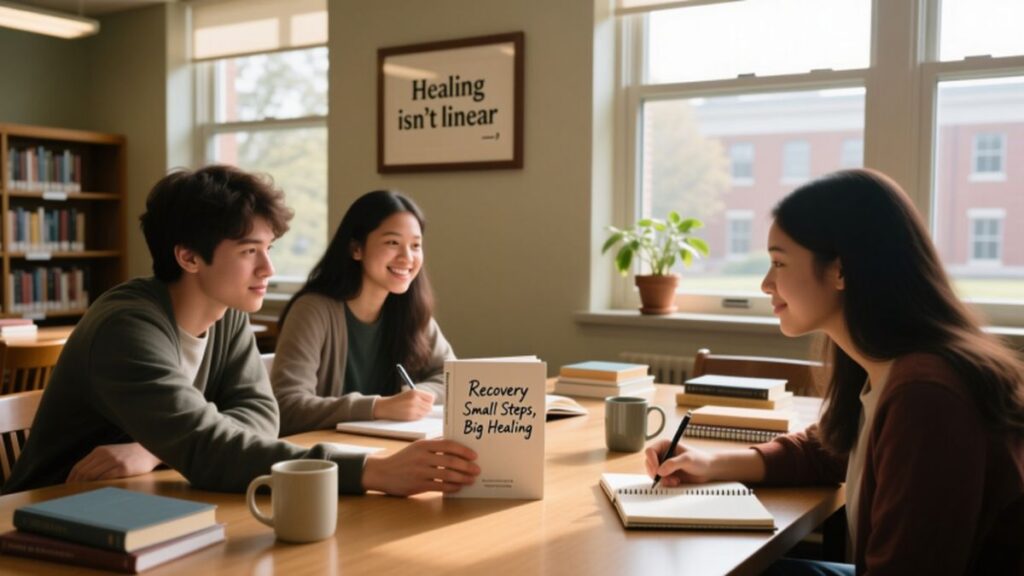
Morgan always dreaded group projects.
Even the thought of joining a team made their stomach twist.
Past experiences lingered in memory.
Group members who ignored tasks.
Arguments over who did what.
Feeling invisible, or worse, criticized.
It wasn’t just about the work.
It was the anxiety.
The racing heart. The sweaty palms.
The sense that no matter what they did, it wouldn’t be enough.
This semester, a large biology project loomed.
Morgan’s first instinct was to avoid collaboration.
To isolate.
To carry the work alone.
But the project grade counted significantly.
Ignoring it was not an option.
So, reluctantly, Morgan joined a study group.
Their first meeting was tense.
Morgan felt on edge, hyper-aware of every word.
Each comment from others felt like potential criticism.
They stayed quiet.
Listened.
The anxiety was exhausting.
By the second meeting, Morgan realized something was different.
The group had agreed on clear roles.
Everyone knew their responsibilities.
Expectations were explicit.
The structure reduced unpredictability, which eased Morgan’s anxiety slightly.
Small relief.
Morgan decided to take another step.
To contribute actively, even if it felt uncomfortable.
They shared a small idea about the project structure.
The group responded positively.
Not criticism. Not dismissal.
Just acknowledgment.
Morgan felt a flicker of confidence.
Recovery, they realized, could grow from safe environments.
A place where boundaries and expectations were clear.
Over the next few weeks, Morgan experimented with small habits.
Arriving five minutes early to each session.
Bringing notes to ensure preparedness.
Practicing brief grounding exercises before meetings.
Even standing in a hallway, taking a deep breath, counting to ten.
These steps didn’t remove anxiety entirely.
But they made participation manageable.
Gradually, Morgan started contributing more.
Sharing ideas. Asking questions. Offering feedback.
Each positive interaction reinforced confidence.
The sense of being capable within the group strengthened self-esteem.
Morgan noticed another change.
They started collaborating outside of meetings.
Texting ideas. Sharing resources. Offering support.
The anxiety that once made isolation appealing now had a counterbalance: connection.
Recovery, they learned, wasn’t about avoiding fear.
It was about creating structures and support to face it safely.
The group project became a microcosm for broader mental health growth.
Morgan experimented with small self-care techniques.
Short breaks between tasks.
A five-minute walk after long meetings.
Breathing exercises to calm racing thoughts.
Even positive affirmations: “I am capable. I belong.”
These small habits compounded.
What felt impossible at first slowly became manageable.
Morgan began reflecting after each meeting.
Journaling about successes.
Moments where anxiety appeared but didn’t take over.
Acknowledging personal growth.
This reflection reinforced recovery.
It made progress visible.
Which, in turn, increased confidence.
The mid-point of the semester brought a particularly stressful challenge.
A major component of the project had unexpected technical issues.
Other students panicked.
Morgan felt anxiety rising.
But they paused.
Applied the same strategies.
Broke the problem into smaller steps.
Collaborated openly with teammates.
Took short breaks to reset.
The result: the issue was solved efficiently.
Morgan realized the growth was real.
They could manage anxiety within group settings.
The fear that had once paralyzed them was replaced by competence.
Even small contributions mattered.
Even partial success was a win.
By the end of the project, Morgan’s transformation was evident.
They had gone from silent observer to active participant.
Confidence had grown steadily, reinforced by each manageable step.
The project grade reflected the effort.
But more importantly, the internal growth was clear.
Morgan started applying these lessons to other areas.
Other group assignments.
Social interactions.
Public speaking.
Even casual conversations.
The techniques learned—safe structures, small steps, self-care—were transferable.
Recovery wasn’t linear.
Some meetings were still stressful.
Some days, anxiety returned.
But the skills Morgan had developed provided tools to navigate it.
One day, a friend asked, “How do you handle group work now? You used to hate it.”
Morgan smiled.
“It’s about structure, preparation, and small steps. And taking care of myself along the way.”
The friend nodded.
Morgan realized recovery is often about learning systems that work for you.
It’s about preparation, support, and consistent effort.
The group project also showed Morgan the importance of communication.
Expressing needs. Asking for clarification. Setting boundaries.
These skills extended beyond academics.
They built resilience.
Self-efficacy.
Confidence in navigating challenges.
Morgan’s anxiety didn’t disappear.
But it no longer dictated behavior.
It became manageable.
A signal to apply strategies, not a reason to retreat.
The final presentation arrived.
Morgan stood at the front, ready to speak.
Heart racing, yes.
But calm enough to deliver content clearly.
Teammates supported them.
Everything aligned.
The experience was validating.
Morgan reflected on how far they had come.
From dreading group projects to actively engaging with confidence.
Recovery had started with small, intentional actions.
Joining a structured group. Taking tiny steps to participate.
Pausing for self-care. Reflecting on progress.
Each contributed to building resilience.
Morgan realized recovery is cumulative.
Small victories compound into meaningful change.
Even tiny, deliberate habits—short walks, breathing exercises, journaling, positive affirmations—made a difference.
By semester’s end, Morgan approached challenges differently.
Group projects were no longer terrifying.
Anxiety still appeared.
But it became a tool to guide action, not a barrier.
Morgan’s story illustrates a key lesson:
Recovery isn’t about eliminating fear.
It’s about managing it, building supportive structures, and taking consistent, intentional steps.
The group study switch was more than an academic change.
It was a personal transformation.
A journey from fear and avoidance to confidence and resilience.
And it proved that even small, manageable strategies can lead to lasting recovery.
7. The Self-Care Jar
Taylor’s dorm room was cluttered.
Textbooks stacked on the desk.
Notes scattered on the floor.
Laptop open to a half-finished essay.
And somewhere in the chaos, Taylor felt completely overwhelmed.
Stress had been building for weeks.
Assignments, club responsibilities, part-time job, social commitments—all colliding at once.
Their mind felt like a stormy ocean.
Thoughts crashing, waves of anxiety rising.
Taylor didn’t know where to start.
Everything seemed urgent.
Yet nothing felt manageable.
They sat on the bed, hands in their hair.
Exhausted. Frustrated.
Then, they remembered a tip from a campus mental health workshop.
“Start small. Focus on one tiny act of self-care each day.”
Taylor sighed.
Easier said than done.
What was self-care anyway?
A bath? Reading a book? Going for a walk?
They felt paralyzed by options.
Then, inspiration struck.
What if self-care wasn’t about planning hours or routines?
What if it was about randomness?
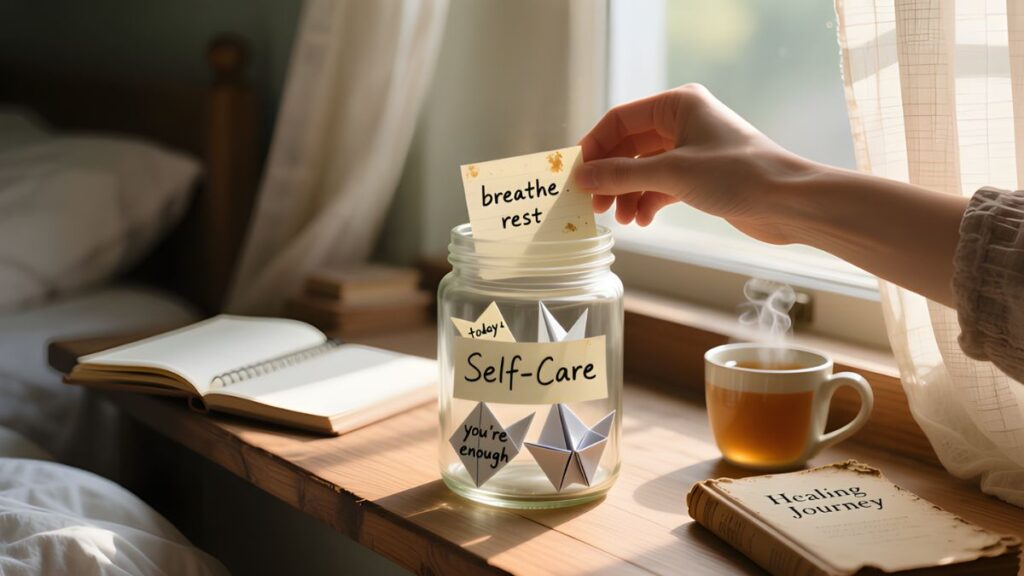
Taylor grabbed a jar from the shelf.
A simple glass jar, empty and waiting.
They cut small pieces of paper.
On each, they wrote one tiny self-care activity:
Take a five-minute walk.
Listen to a favorite song.
Call a friend.
Do a short stretch routine.
Write one line in a journal.
Make a cup of tea and sip it slowly.
Even watch a funny video.
Little things. Tiny, manageable.
Taylor folded each paper and dropped it into the jar.
It looked like magic.
A jar full of options.
Options they didn’t have to decide on.
They could just pick one.
And so the next morning, Taylor reached into the jar.
A slip of paper: “Take a five-minute walk.”
Simple enough.
Taylor stepped outside.
Breathe in the crisp morning air.
Sunlight touching their face.
Feet moving. Step by step.
It didn’t solve everything.
Assignments still waited.
Stress wasn’t gone.
But Taylor felt a spark of calm.
A sense of agency.
Recovery, they realized, begins with tiny choices.
The jar became a daily ritual.
Each morning, or whenever overwhelmed, they picked a slip.
Some days, they drew a walk.
Other days, a music break.
Or journaling.
Even five minutes of something pleasant made a noticeable difference.
Weeks passed.
Taylor noticed subtle changes.
They felt calmer during classes.
Able to focus longer.
Anxiety still visited, but it no longer controlled the day.
Recovery wasn’t instant.
But it was steady.
Each small act built resilience.
Each slip of paper, a step toward balance.
Taylor experimented further.
They added slips for social activities.
Call a friend. Text a roommate.
Or for relaxation: watch a sunset, stretch for ten minutes, meditate.
The jar became a toolkit.
Flexible. Adaptable. Personal.
Even when the semester became hectic, Taylor returned to the jar.
It was grounding.
A tangible reminder that recovery was possible.
Even amidst chaos.
One particularly stressful week arrived.
Three assignments due.
A major exam.
Dorm roommate upset.
Taylor’s mind wanted to spiral.
But the jar offered a simple solution.
Pick one slip. Do one small act.
The slip: “Call a friend.”
Taylor dialed.
A short conversation.
Laughing, venting, sharing.
Relief.
Then another slip: “Five-minute stretch.”
Body loosened. Mind cleared slightly.
Taylor realized recovery is not about completing everything at once.
It’s about small, intentional acts.
Step by step.
Even tiny actions compound over time.
The jar also encouraged reflection.
After each act, Taylor noted how it felt.
Some activities had immediate effect.
Some subtle, noticeable only in hindsight.
Patterns emerged.
What helped most during stress.
What sparked joy.
What anchored calm.
The jar became more than slips of paper.
It became a mirror for growth.
Taylor also began sharing the idea with friends.
“Try a self-care jar,” they suggested.
Some laughed at first.
Then tried it.
Soon, a few friends picked slips daily.
Sharing small victories, tips, and new ideas strengthened their network.
Recovery, Taylor noticed, is social too.
Even simple acts can be amplified by community.
Over the semester, Taylor reflected on changes.
Before the jar, stress often felt unmanageable.
Tasks felt overwhelming.
Anxiety was relentless.
Now, small steps provided relief.
The storm became navigable.
Even difficult days had structure.
Taylor could pause, reset, and regain focus.
They realized recovery isn’t perfection.
It’s consistency.
Small, repeated actions that build resilience.
By semester’s end, the jar was full of memories.
Slips added, folded, removed, each representing a step toward balance.
Taylor felt capable.
Confident.
Able to face new challenges without being consumed by anxiety.
Recovery had started with a simple, creative idea.
A jar. Tiny acts. Choice without pressure.
Even small moments mattered.
Even brief pauses created meaningful change.
The self-care jar taught Taylor another lesson:
Recovery is personal.
It doesn’t have to be elaborate.
It doesn’t require hours or perfection.
It requires intention, patience, and repeated action.
Every slip of paper was proof that mental health matters.
That small, intentional habits build long-term resilience.
And that sometimes, recovery begins with the simplest things: a jar, folded papers, and a commitment to care for oneself one day at a time.
Why recovery matters for students
If you ignore stress, it usually gets louder.
Poor sleep, skipped meals, and nonstop studying can lead to foggy thinking, mood swings, and burnout. That’s not just about grades — your relationships and daily energy suffer too.
Recovering your balance helps you:
- Concentrate better in class.
- Get more out of studying (less time, better focus).
- Be less reactive with friends and family.
- Feel like you again — not just a checklist of tasks.
Think of recovery as preventative care. You wouldn’t ignore a bad ankle sprain and keep running; same idea here.
Early signs that you might need help
Notice these and don’t shrug them off:
- You’re tired all the time, even after sleep.
- Things you liked feel boring or heavy.
- Your attention keeps slipping during class.
- You eat or sleep much more or much less.
- You’re snapping at people, feeling hopeless, or avoiding friends.
- You start using booze, weed, or caffeine in ways that feel out of control.
If several of these last more than two weeks, it’s time to try some of the steps below — and reach out.
Real, doable steps to start recovery today
Recovery is about tiny, steady moves. Try one or two of these and see what fits.
1) Talk to someone
You don’t need a perfect speech. Try:
- “I’ve been feeling off lately — can we talk?”
- “I’m having trouble keeping up, and I could use your advice.”
- “I haven’t been sleeping and it’s messing with me. Would you listen for a bit?”
If you want a professional, your school’s counseling center or student health is the place to start. Most colleges let you book an appointment online or drop by during office hours.
If you feel like you might hurt yourself or someone else, contact emergency services or a crisis line right away. Don’t try to handle it alone.
2) Build a simple routine
Routines don’t have to be strict. Start with three pieces:
- Wake and sleep within the same 60–90 minute window every day.
- Eat three meals (or regular small meals) — even a sandwich helps.
- Schedule one short break every study hour (stand up, stretch, breathe).
Example: study 50 minutes → 10 minute walk → repeat. That’s it.
3) Sleep that actually helps
Good sleep resets everything. Try:
- Wind down 30–60 minutes before bed: dim lights, put your phone face down, read a paper book or listen to calm music.
- Avoid big meals and caffeine within 3–4 hours of sleeping.
- If your mind races, keep a “worry notepad” by your bed: jot one worry and one next step, then close it.
Even 7–8 hours consistently helps more than random all-nighters.
4) Move in ways that feel doable
Exercise isn’t just for gyms. Try:
- 10–20 minute walk between classes.
- 10-minute bodyweight routine in your room.
- Dance to one song, stretch, or join a casual intramural.
Small movement fights stress chemicals and helps your brain reset.
5) Use focused work tricks
If studying feels impossible, try the Pomodoro method:
- Work 25 minutes, break 5 minutes. Do this 3–4 times, then take a longer break. Or:
- Start with one paragraph, or 10 minutes. Small wins build momentum.
6) Try short mindfulness tools
You don’t need a long meditation app. Use:
- Box breathing: inhale 4s → hold 4s → exhale 4s → hold 4s. Repeat 3 times.
- One-minute grounding: name 3 things you see, 2 you can touch, 1 you hear.
These calm your nervous system fast.
7) Journal prompts that actually work
If blank pages feel useless, try writing:
- One line about how you feel right now.
- Three things you did today that were okay.
- One step you’ll take tomorrow (even a tiny one).
Journaling helps you find patterns and small wins.
8) Manage screens and social media
If scrolling fuels anxiety:
- Set a 30–60 minute “no social media” block each day.
- Use the phone’s screen time limits for specific apps.
- Unfollow accounts that make you compare — curate your feed.
Digital breaks free up mood and focus.
How to reach school support?
Most campuses offer free or low-cost resources. Try:
- Student counseling center: usually by appointment or drop-in.
- Academic advisors: for workload, extensions, and planning.
- Student health: for sleep, medication, or physical symptoms.
- Resident advisor or campus chaplain: for someone local to talk to.
If you’re unsure where to start, email your student services office or ask a professor you trust. They’ll point you in the right direction.
What to do if recovery feels stalled
Sometimes the small steps don’t move the needle. That’s okay — it happens.
Try these next moves:
- Rebook a counseling session and be honest: “I tried X and it didn’t help; what next?”
- Ask for academic accommodations temporarily (extensions, reduced load).
- Try a new routine piece: morning sunlight, a different bedtime, or a social check-in.
- Consider a support group (many schools offer them for anxiety, grief, etc.).
If you’re on medication and it feels off, talk to your prescriber before stopping anything.
How friends and family can actually help
If someone confides in you, simple actions matter more than big speeches:
- Listen. Don’t fix right away.
- Say: “I believe you,” or “Thanks for telling me.”
- Offer concrete help: walk to the counseling center with them, or bring dinner.
- Check in again later. Small follow-ups mean a lot.
If you’re the one asking for help, naming one request makes it easier: “Could you check on me tomorrow?” or “Can we hang out Sunday?”
Quick tools to use in a pinch
- 5–4–3–2–1 grounding (senses).
- Two-minute breathing break.
- Text a friend: “Could you call in 10? Need to talk.”
- Walk for 10 minutes outside.
- Drink a full glass of water and eat a snack.
These easy moves reduce anxiety quickly and buy you time to think.
Recovery is not perfection
You will have good days and bad days. You will try something that doesn’t help. You will make mistakes. That’s not failure. That’s the process.
Celebrate small wins: a full night’s sleep, a study session that felt manageable, a conversation you had even though it was hard. Those add up.
Recovery builds resilience. It teaches you how to respond next time instead of being overwhelmed.
When things are urgent
If you or someone else is in immediate danger or actively thinking about self-harm, call emergency services right away.
If you’re in the U.S., you can call 988 for crisis support. If you’re elsewhere, contact your local emergency number or a mental health crisis line. Don’t wait.
If you’re not in immediate danger but need urgent help, reach out to your school’s crisis services, a trusted adult, or a counselor.
Final thoughts
You’re doing more than you think. Balancing school and life is hard work. Wanting help doesn’t mean you’re weak — it means you’re human.
Start small. Pick one thing from this guide and try it for a week. Maybe it’s one extra hour of sleep, a five-minute breathing break, or reaching out to one person.
If one thing doesn’t help, try another. Keep going. Small, steady steps change things over time.
If you ever need to talk, reach out. People care. There are tools and supports built for students like you. You don’t have to do it all alone.
Take one small step today. You matter.