There is something special about telling a scary story at school.
A dark bedroom can make almost any story frightening, but a school setting adds a different kind of tension. Empty classrooms, silent hallways, flickering lights, locked storage rooms, old staircases, forgotten school bags, and strange sounds coming from somewhere nearby can turn ordinary places into perfect settings for spooky storytelling.
Scary Stories to Tell Your Friends at School are especially popular because they are easy to share during lunch breaks, sleepovers, school trips, classroom storytelling sessions, or quiet conversations with friends. The best stories do not necessarily need blood, violence, or extreme horror. Sometimes, a mysterious sound behind a classroom door or a message appearing on a forgotten phone can be much more unsettling.
This article explores what makes school scary stories effective, how to tell them, what themes work best, and how to create spooky stories that are frightening without becoming excessively disturbing.
Note: The stories in this article are intended as fictional entertainment. When sharing scary stories at school, keep the age and comfort level of your audience in mind.
What Are Scary Stories to Tell Your Friends at School?
Scary stories to tell your friends at school are short fictional tales designed to create suspense, mystery, surprise, and a little fear.
They usually take place in familiar school environments.
That familiarity is what makes them effective.
A haunted castle may seem frightening, but an empty classroom that you recognize from your own school can feel much closer to reality.
A story about footsteps in an abandoned building might be interesting. A story about footsteps coming from the classroom next door after everyone has gone home can be much more unsettling.
School scary stories often involve:
- Mysterious sounds
- Empty classrooms
- Strange messages
- Forgotten objects
- Locked rooms
- School legends
- Unexplained shadows
- Strange reflections
- Abandoned buildings
- Old photographs
- Mysterious teachers
- Secret passages
- Unexpected visitors
- Objects that seem to move
- Unexplained events after school hours
The strongest stories usually begin with something ordinary and gradually introduce something that does not make sense.
Scary Stories to Tell Your Friends at School
Here are 7 fictional scary story ideas designed for sharing with friends at school. Each has a different setting, mystery, and twist, while keeping the horror focused on suspense and atmosphere rather than graphic violence.
1. The Classroom That Was Always Locked
There was one room at Westbrook High that students almost never talked about.
Not because they were forbidden to.
Not because teachers had threatened them.
And not because anyone had officially declared it off-limits.
They simply knew that Room 17 was different.
It sat at the very end of the second-floor hallway, beyond the science laboratories and opposite an old staircase that nobody used anymore.
The door was always locked.
Always.
For years, students had invented explanations.
Some said the room had once been a laboratory.
Others claimed it had been a music room.
One particularly imaginative student insisted that a teacher had disappeared there in the 1980s.
Nobody knew which story was true.
The teachers never discussed Room 17.
Whenever students asked about it, they usually received the same answer.
“It’s just an unused classroom.”
That answer only made the room more interesting.
Among the students who had heard the rumors was a seventeen-year-old boy named Ethan Carter.
Ethan was not particularly interested in ghost stories.
He liked football, music, video games, and finding excuses to avoid homework.
He had heard all the stories about Room 17 and had always laughed at them.
“It’s a locked classroom,” he once told his friend Noah. “Not a haunted castle.”
Noah grinned.
“You say that now.”
“I’ll say it tomorrow too.”
“You wouldn’t go inside.”
Ethan looked at him.
“If it were open, I’d walk right in.”
Noah laughed.
“Sure.”
Ethan forgot about the conversation.
Until one rainy Thursday afternoon.
The school day had ended nearly an hour earlier.
Most students had already gone home.
The halls were unusually quiet.
Rain tapped against the tall windows, and the fluorescent lights above the corridor hummed softly.
Ethan was halfway down the stairs when he suddenly stopped.
His face changed.
“My notebook.”
He had left his history notebook in Classroom 12.
He sighed.
He had an important assignment due the following morning.
There was no way he could leave it behind.
Ethan turned around.
The school felt completely different when it was almost empty.
During the day, the hallways were filled with voices, footsteps, laughter, and the sound of lockers opening.
Now there was only silence.
Ethan walked toward Classroom 12.
He opened the door.
His notebook was lying on the desk.
“Thank goodness.”
He grabbed it.
Then he heard something.
A faint metallic sound.
Click.
Ethan looked toward the hallway.
Nothing.
He stepped outside.
The corridor was empty.
He shrugged.
Probably a locker.
He started walking toward the stairs.
Then he noticed something.
Room 17.
The door was open.
Ethan stopped.
For several seconds, he simply stared.
He knew Room 17 was always locked.
He had passed it hundreds of times.
He had never seen the door open.
He walked closer.
The door was slightly ajar.
A thin strip of darkness showed between the door and the frame.
Ethan looked around.
Nobody was there.
“Hello?”
No answer.
He should have walked away.
Instead, curiosity won.
He pushed the door open.
The room was surprisingly ordinary.
There were desks.
A teacher’s desk.
A whiteboard.
Several shelves.
A large window overlooking the football field.
Nothing strange.
Nothing frightening.
Ethan stepped inside.
Dust covered almost everything.
The room looked as if nobody had used it for years.
He walked toward the teacher’s desk.
There was an old wooden chair beside it.
A faded calendar hung on the wall.
The date was from more than a decade ago.
Ethan smiled nervously.
“So this is the big mystery.”
He turned around.
Then stopped.
One desk near the middle of the room was completely clean.
Unlike the others, it had no dust.
Ethan walked toward it.
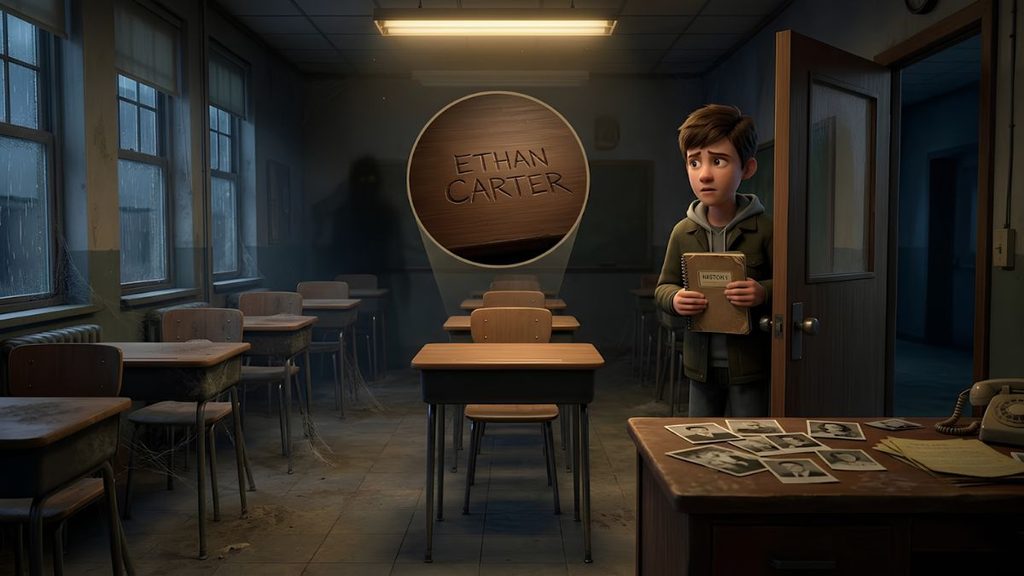
Something was written on the surface.
At first, he thought it was a scratch.
Then he read it.
ETHAN CARTER
His stomach tightened.
He stared at his name.
“No.”
He touched the desk.
The writing looked old.
Very old.
But his name was unmistakable.
Ethan looked around the room.
“Okay.”
He laughed nervously.
“Very funny.”
He assumed someone had played a prank.
Maybe Noah.
Maybe another student.
He pulled out his phone.
There was no signal.
That was unusual.
Westbrook High usually had decent reception.
Ethan tried calling Noah.
Nothing.
He tried again.
Still nothing.
A faint sound came from behind him.
Scrape.
Ethan turned.
The chair at the teacher’s desk had moved.
Only slightly.
But it had moved.
He stared at it.
His heart began beating faster.
“Probably the floor.”
He forced himself to laugh.
“Old building.”
He walked toward the door.
Then he heard a sound behind him.
Tap.
He stopped.
Another tap.
Tap.
He slowly turned.
The clean desk was now empty.
His name was still written on it.
But something else was sitting there.
His notebook.
Ethan froze.
He had been holding it.
He looked down.
His hands were empty.
He looked back at the desk.
His history notebook was lying neatly in the center.
Ethan felt a chill.
He had not put it there.
He stepped toward it.
Then stopped.
A strange thought entered his mind.
Leave it.
He backed toward the door.
His hand reached for the handle.
He turned it.
Nothing.
Locked.
Ethan pulled harder.
Still nothing.
“Come on.”
He tried again.
The handle didn’t move.
He looked around.
“Is anyone there?”
Silence.
Then a faint scratching sound came from the whiteboard.
Ethan turned.
Something was writing on it.
He couldn’t see a hand.
He couldn’t see anyone.
But letters slowly appeared.
One by one.
YOU FORGOT SOMETHING.
Ethan stared.
His breathing became shallow.
“What?”
The writing continued.
YOU ALWAYS FORGET SOMETHING.
He backed away.
“No.”
The marker stopped.
Silence returned.
Then Ethan noticed something on the teacher’s desk.
A small wooden box.
He had not seen it earlier.
The box was open.
Inside was a collection of old photographs.
Ethan approached slowly.
He picked up the first one.
It showed a group of students standing outside Westbrook High.
The photograph looked decades old.
He picked up another.
Different students.
Another.
Different students.
Then he noticed something.
In every photograph, there was the same desk.
The clean desk from Room 17.
Ethan’s hands began shaking.
He picked up another photograph.
This one showed a classroom.
Room 17.
Students were sitting at desks.
The teacher stood at the front.
Ethan looked closer.
One student was sitting at the clean desk.
The boy looked vaguely familiar.
Ethan turned the photograph over.
There was writing on the back.
October 14, 1987.
Ethan frowned.
He looked at the boy again.
Something about him felt familiar.
Then he noticed the boy’s sweater.
Westbrook High.
Same school.
Same classroom.
Ethan placed the photograph down.
Another sound came from the hallway.
Footsteps.
Someone was walking toward Room 17.
Ethan rushed to the door.
“Help!”
The footsteps stopped.
He waited.
Nothing.
Then a voice came from outside.
“Ethan?”
He recognized it.
It was Mr. Harris, his history teacher.
Ethan felt relieved.
“Mr. Harris!”
He grabbed the handle.
The door opened.
Mr. Harris stood in the hallway.
“What are you doing in here?”
Ethan stepped outside.
“I thought the door was open.”
Mr. Harris looked at Room 17.
His expression changed.
“You shouldn’t be here.”
“I know.”
“Who opened the door?”
“I don’t know.”
Mr. Harris looked at him carefully.
“Did you see anything unusual?”
Ethan hesitated.
Then he remembered the photographs.
“The desk.”
Mr. Harris looked toward it.
“What desk?”
“The one in the middle.”
Mr. Harris stepped inside.
He looked at the desk.
His face became pale.
Ethan noticed.
“You know something.”
Mr. Harris didn’t answer.
“Mr. Harris?”
The teacher walked toward the wooden box.
He opened it.
He looked inside.
Then he closed it again.
“You need to go home.”
“What happened here?”
“Nothing.”
“You’re lying.”
Mr. Harris sighed.
For a moment, he looked much older.
“Room 17 was used as a temporary classroom many years ago.”
Ethan waited.
“One of the students who studied here was named Ethan.”
Ethan’s face changed.
“What?”
Mr. Harris nodded.
“He was seventeen.”
“When?”
“1987.”
Ethan looked at the old photograph.
The boy sitting at the clean desk suddenly seemed much more familiar.
“What happened to him?”
Mr. Harris looked away.
“He disappeared.”
Ethan felt cold.
“Disappeared?”
“One afternoon, he stayed behind after school.”
“Why?”
“Nobody knows.”
“Did they find him?”
“No.”
The hallway seemed colder.
Ethan looked toward Room 17.
“Then why is my name on the desk?”
Mr. Harris didn’t answer.
“Mr. Harris?”
The teacher finally spoke.
“Some students believe the room remembers people.”
Ethan stared at him.
“That doesn’t make sense.”
“I know.”
“Then why was my notebook inside?”
Mr. Harris looked at him.
“What notebook?”
Ethan pointed.
The desk was empty.
The notebook was gone.
Ethan’s heart jumped.
He looked at the floor.
Nothing.
Mr. Harris frowned.
“Let’s go.”
They walked away from Room 17.
Ethan kept looking back.
The door was closing.
Slowly.
Very slowly.
Just before it shut completely, Ethan saw something through the narrow opening.
The clean desk.
And someone sitting in the chair.
A boy.
Seventeen years old.
Wearing an old Westbrook uniform.
Ethan stopped.
The door closed.
He turned toward Mr. Harris.
“Did you see that?”
Mr. Harris didn’t answer.
They continued walking.
The next morning, Ethan arrived at school early.
He went straight to the second-floor hallway.
Room 17 was locked.
As usual.
He tried the handle.
It didn’t move.
No sign of yesterday’s events remained.
He almost convinced himself that he had imagined everything.
Then he noticed something on the floor.
A small piece of paper.
He picked it up.
It was old.
Yellow.
Faded.
There were only four words written on it.
Don’t forget me again.
Ethan stared at the message.
He turned around.
The hallway was empty.
Then he heard a faint sound from behind Room 17.
A chair scraping across the floor.
Scrape.
Ethan stepped backward.
The bell rang.
Students began filling the hallway.
The moment was gone.
Ethan folded the paper and put it in his pocket.
He never told his friends the whole story.
He did tell Noah that Room 17 was strange.
Noah laughed.
“You actually went inside?”
Ethan nodded.
“And?”
Ethan looked toward the locked door.
“I don’t think it wants people inside.”
Noah smiled.
“Why?”
Ethan thought about the boy in the photograph.
Then he answered quietly.
“Maybe it wants someone to remember.”
From that day forward, Ethan never walked past Room 17 alone.
But something strange happened every October.
On the fourteenth day of the month, when the school was almost empty, the lights outside Room 17 would flicker.
And sometimes, students passing by would hear a chair scraping across the floor.
Nobody ever opened the door.
Nobody ever found out exactly what happened to the boy from 1987.
But years later, when the school replaced the old classroom furniture, workers found something carved beneath the clean desk.
Two names.
One was nearly impossible to read.
The other was clear.
ETHAN CARTER
And underneath it was a date.
October 14.
No year.
Just October 14.
Moral
Not every mystery needs to be solved immediately. Sometimes the most frightening things are the questions that remain unanswered. Curiosity can lead us into unexpected places, but it is always wise to respect boundaries and investigate strange situations carefully.nds
2. The Student Who Wasn’t on the Class List
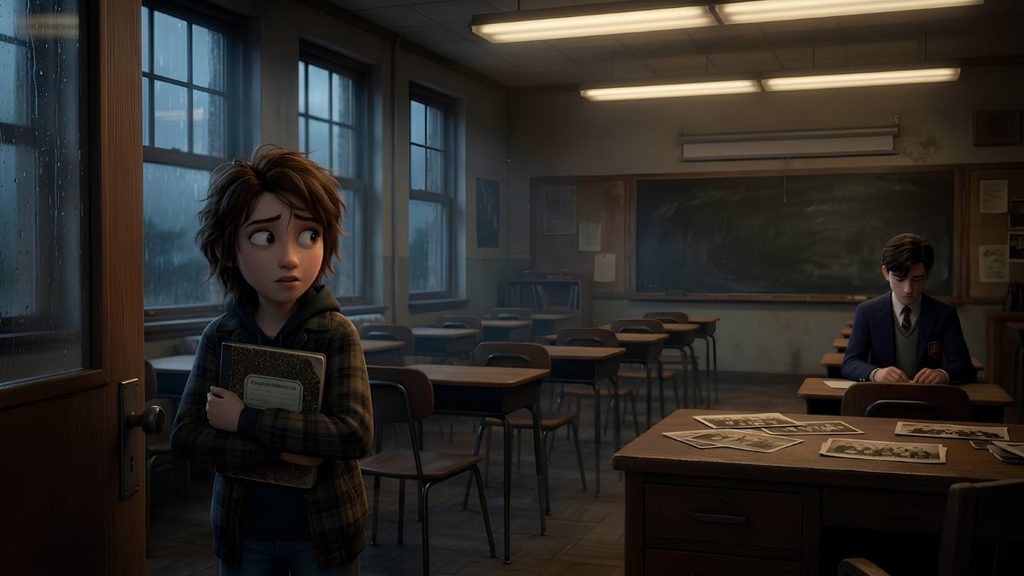
It started with a boy Emma had never seen before.
That was strange.
Not because Westbrook High was a small school. It wasn’t.
There were more than a thousand students, and Emma couldn’t possibly know everyone.
But she was the kind of person who noticed things.
She remembered faces.
She remembered names.
She noticed when someone got a new haircut or changed their backpack.
And the boy sitting at the back of her history classroom was someone she was certain she had never seen before.
His name, she would eventually discover, was Daniel.
Or at least, that was what she thought.
It was a Monday morning.
Rain had been falling since sunrise, leaving the school grounds covered in puddles.
Emma walked into History 204 just before the bell.
Her best friend, Sophie, was already sitting near the window.
“You’re late,” Sophie whispered.
“By thirty seconds.”
“Still late.”
Emma smiled and dropped her bag beside her chair.
She looked toward the back of the room.
A boy was sitting alone.
He had dark blond hair, pale skin, and a navy-blue school sweater.
He wasn’t doing anything.
No phone.
No notebook.
No conversation.
He was simply sitting there, looking toward the window.
Emma frowned.
“Who’s that?”
Sophie looked.
“Who?”
“The boy.”
“What boy?”
Emma pointed.
Sophie stared at the empty chair.
“There isn’t anyone there.”
Emma’s smile disappeared.
“What?”
Sophie laughed.
“Emma, the chair is empty.”
Emma looked again.
It was.
Completely empty.
She blinked.
“I swear someone was sitting there.”
Sophie shook her head.
“You need more sleep.”
Emma looked at the chair one last time.
Then the teacher entered.
“Good morning, everyone.”
The class began.
Emma tried to concentrate.
But throughout the lesson, she kept glancing toward the back.
The chair remained empty.
At least she thought it did.
The next morning, Emma saw him again.
This time, there was no question.
He was sitting at the back of the classroom.
The same navy sweater.
The same dark blond hair.
The same expressionless face.
Emma stared.
The boy looked directly at her.
For several seconds, neither moved.
Then he smiled.
It was a small smile.
Not frightening.
Almost friendly.
Emma looked away.
When she looked back, he was gone.
She turned toward Sophie.
“Did you see him?”
“See who?”
“The boy.”
“What boy?”
Emma pointed toward the back.
The chair was empty.
Again.
Emma felt uncomfortable.
“Never mind.”
Sophie frowned.
“You’re acting weird.”
“I know.”
At lunchtime, Emma mentioned the boy to another friend, Lucas.
He immediately laughed.
“You’re talking about the ghost?”
Emma stopped.
“What?”
Lucas lowered his voice dramatically.
“Don’t you know about him?”
“No.”
Lucas looked around.
“There’s a story about a student who used to attend this school years ago.”
Sophie rolled her eyes.
“Lucas, don’t start.”
“No, seriously.”
Emma leaned closer.
“What story?”
Lucas smiled.
“Apparently, there was a boy who attended Westbrook High decades ago. He always sat at the back of History 204.”
Emma’s expression changed.
“What was his name?”
Lucas shrugged.
“Daniel, I think.”
Emma looked at Sophie.
Sophie stopped smiling.
“That’s the name you gave him.”
Emma nodded.
Lucas continued.
“They say he disappeared one day.”
“When?”
“I don’t know.”
“Recently?”
Lucas shook his head.
“A long time ago.”
Emma felt a chill.
“Where did you hear this?”
“My older brother.”
“Does he know what happened?”
“No.”
Lucas grinned.
“But he says people sometimes see the boy sitting at the back of the classroom.”
Emma stared at him.
“You’re joking.”
“Maybe.”
Sophie looked annoyed.
“Stop trying to scare her.”
Lucas laughed.
“I’m just telling you what I heard.”
Emma said nothing.
But she couldn’t stop thinking about it.
That afternoon, Emma went to the school library.
She had a history project and needed an old newspaper article.
The librarian, Mrs. Wilson, directed her toward the archive section.
“Try the old school records.”
Emma nodded.
She began searching.
Year after year.
Then she found a folder labeled:
WESTBROOK HIGH SCHOOL ARCHIVES
She opened it.
Inside were old photographs, school newsletters, and newspaper clippings.
Emma searched for the name Daniel.
Nothing.
She searched again.
Then she found an old class photograph.
It showed a group of students standing outside the school.
She looked at the date.
October 1996.
Emma studied the faces.
Then she froze.
The boy from her classroom was standing in the back row.
Same hair.
Same face.
Same expression.
Emma’s hands became cold.
She looked closer.
Under the photograph was a list of names.
She read them.
One by one.
Daniel.
Her heart started beating faster.
She took out her phone and photographed the page.
Then she noticed something strange.
The name Daniel had been crossed out.
Emma frowned.
Why?
She searched through another folder.
Nothing.
Then another.
Nothing.
Finally, she found a school newsletter from November 1996.
The headline read:
STUDENT MISSING AFTER SCHOOL EVENT
Emma’s heart dropped.
She read the article.
A sixteen-year-old student named Daniel Reeves had disappeared after staying late at school.
He had reportedly been seen entering the second-floor hallway.
He was never found.
Emma read the article twice.
Then a sound came from behind her.
Tap.
She turned.
Nobody was there.
Another sound.
Tap.
It was coming from the library window.
Emma approached.
Nothing.
She returned to the table.
The photograph was gone.
She searched everywhere.
Nothing.
Then she noticed something on the table.
A school notebook.
Old.
Dusty.
Emma opened it.
On the first page was a name.
Daniel Reeves.
She almost dropped it.
Inside were handwritten notes.
Most were ordinary.
History assignments.
Homework.
Notes about football practice.
Then she reached the final page.
There were only two sentences.
I waited in Room 204.
And underneath:
Nobody came back for me.
Emma stared at the words.
A cold feeling moved through her.
She closed the notebook.
Then she heard a voice.
“Emma.”
She turned.
The boy was standing at the end of the library.
Daniel.
He looked exactly as he had in the classroom.
Emma couldn’t speak.
He looked at her.
Then he pointed toward the notebook.
“Don’t forget.”
Emma swallowed.
“What happened to you?”
Daniel didn’t answer.
Instead, he turned and walked away.
Emma followed.
“Wait!”
He disappeared around a corner.
Emma ran after him.
The corridor was empty.
She searched the entire library.
Nothing.
Then she heard footsteps upstairs.
She followed them.
They led toward History 204.
The classroom door was open.
Emma stopped outside.
Inside, the room was empty.
The same room she had attended every week.
She stepped inside.
“Daniel?”
Nothing.
She looked toward the back.
The chair was there.
Empty.
Then the classroom door closed behind her.
Emma turned.
The handle wouldn’t move.
She tried it again.
Locked.
Her breathing became faster.
“Okay.”
She took a deep breath.
“Stay calm.”
A faint sound came from the back of the room.
Scrape.
The chair moved.
Emma stared.
The chair slowly pulled itself away from the desk.
Then a boy appeared sitting in it.
Daniel.
He looked at her.
Emma stood frozen.
“You’re not real.”
Daniel smiled sadly.
“I know.”
Emma felt tears forming in her eyes.
“What do you want?”
He pointed toward the teacher’s desk.
Emma walked over.
There was an old metal box.
She opened it.
Inside were several documents.
One was a newspaper clipping.
Another was an old school map.
And one was a handwritten letter.
Emma read it.
It was written by a teacher.
The letter explained that Daniel had stayed behind after school because he had discovered that an old storage room was being used to hide damaged school records.
He had told a teacher he planned to investigate.
But before he could explain what he had found, he disappeared.
The school had searched.
Nothing was discovered.
The case was eventually forgotten.
Emma looked at Daniel.
“What happened in this room?”
He pointed toward the wall.
Emma followed his gaze.
There was an old bookshelf.
She moved it slightly.
Behind it was a narrow door.
She opened it.
A small storage space was hidden behind the wall.
Inside were boxes of old records.
One box had Daniel’s name on it.
Emma opened it.
Inside was his missing school bag.
His notebook.
And an old photograph.
Emma understood.
Daniel hadn’t simply disappeared.
He had discovered something the school had forgotten.
But what had happened afterward remained unclear.
Emma looked back.
Daniel was gone.
The chair was empty.
The door behind her suddenly unlocked.
She stepped into the hallway.
The next morning, Emma went directly to the principal.
She explained everything.
At first, he looked skeptical.
Then she showed him the old notebook.
His expression changed.
He called the school archivist.
Within hours, the hidden storage room was opened properly.
The school discovered dozens of forgotten documents.
Among them was information that helped explain Daniel’s disappearance.
He had apparently become trapped in an old maintenance area beneath the school after a structural door accidentally locked behind him.
The area had later been sealed during renovations.
His remains were never found because the entire section had been forgotten behind a renovated wall.
The discovery shocked the school.
For the first time in decades, Daniel’s disappearance was no longer simply a rumor.
The school contacted his surviving relatives.
A memorial was eventually placed near the library.
Emma attended the ceremony.
She stood quietly among the students.
Sophie stood beside her.
“You did something important,” Sophie whispered.
Emma nodded.
“I just followed him.”
Sophie looked at the memorial.
“Maybe that’s what he wanted.”
Emma looked toward the second-floor windows.
For a moment, she thought she saw Daniel standing inside History 204.
She blinked.
The window was empty.
Weeks passed.
Life returned to normal.
The story spread throughout the school.
Some students claimed Daniel had appeared to them.
Others said it was all coincidence.
Some insisted Emma had invented the entire thing.
Emma didn’t argue.
She knew what she had seen.
One afternoon, she was walking past History 204.
The door was open.
She looked inside.
The classroom was empty.
The desks had been rearranged.
There was no longer a desk at the back.
Emma smiled.
Then she noticed something on the teacher’s desk.
A piece of paper.
She picked it up.
There was only one sentence.
Thank you for remembering me.
Emma smiled.
She folded the paper carefully.
Then she walked away.
As she reached the end of the hallway, she heard the classroom door close.
She turned.
The door was shut.
And from inside came a quiet sound.
A chair scraping across the floor.
Scrape.
Emma smiled.
“Goodbye, Daniel.”
The hallway became silent.
And this time, the silence didn’t feel frightening.
It felt peaceful.
Moral
Sometimes the things people forget can remain important for years. The story reminds us that listening carefully, asking questions, and remembering those who have been forgotten can make a difference. Not every mystery exists to frighten us. Some mysteries simply want to be remembered.
3. The Bell at 3:17
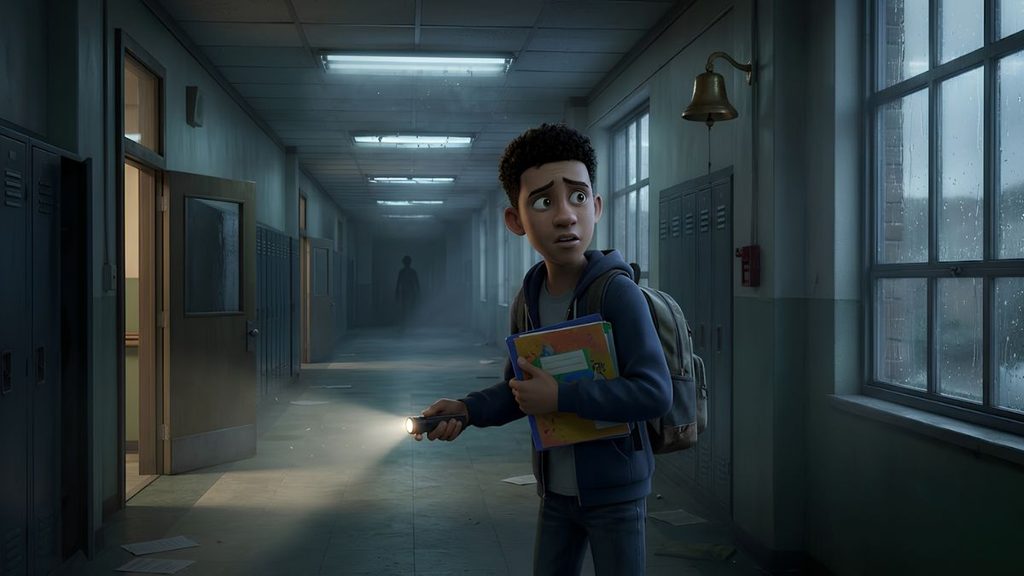
At Westbrook High, the final bell rang at exactly 3:00 p.m.
Every student knew that.
At 2:55, teachers began wrapping up their lessons.
At 2:58, students started packing their bags.
At 3:00, the bell rang.
Students poured into the hallways.
The school came alive with footsteps, laughter, conversations, and the sound of lockers slamming shut.
By 3:20, most of the building was empty.
That was the normal routine.
Except for one strange thing.
Every afternoon, at exactly 3:17 p.m., another bell sometimes rang.
Nobody knew why.
Teachers said it was an old electrical problem.
The administration claimed the system was being repaired.
Students had their own explanations.
Some said it was a forgotten alarm.
Others said it was connected to a student who had disappeared years earlier.
And some believed the bell wasn’t really a bell at all.
It was a warning.
Noah Bennett had heard the stories many times.
He was sixteen, curious, confident, and perhaps a little too willing to investigate things he should have left alone.
His best friend, Ethan, had warned him repeatedly.
“Don’t stay at school after three.”
Noah laughed.
“Why?”
“You know why.”
“The bell?”
“Yes.”
“The haunted bell?”
Ethan rolled his eyes.
“I’m serious.”
Noah smiled.
“You actually believe that?”
“I don’t know.”
“That means you do.”
Ethan shrugged.
“I just don’t like empty schools.”
Noah laughed.
“It’s a building.”
“Buildings can be creepy.”
“Only if you’re scared.”
Ethan looked at him.
“You’ll understand someday.”
Noah didn’t think much about it.
Until one Thursday.
Noah had forgotten his science project.
It was inside his locker.
He didn’t realize until he was already halfway home.
He stopped on the sidewalk.
“Oh, come on.”
He checked his watch.
3:08 p.m.
The school gates were still open.
He could run back.
It would take five minutes.
He turned around.
By 3:12, Noah was back inside the school.
The hallways were nearly empty.
A few teachers were still in their classrooms.
A janitor was pushing a cleaning cart toward the main entrance.
Noah hurried to his locker.
He grabbed his project.
Then he checked his watch.
3:15.
He smiled.
“Perfect.”
He turned toward the stairs.
Then he heard it.
A faint metallic sound.
Ding.
Noah stopped.
He looked at the clock on the wall.
3:17.
The bell rang again.
DING.
The sound echoed through the hallway.
Noah’s smile disappeared.
The school became completely silent.
He waited.
Nothing.
He laughed nervously.
“Okay.”
He continued walking.
Then he heard footsteps.
Behind him.
Step.
He stopped.
The footsteps stopped.
Noah turned around.
The hallway was empty.
He looked toward the staircase.
Nothing.
He continued.
Step.
He stopped.
Silence.
Then another step.
Step.
Noah’s heart started beating faster.
“Who’s there?”
No answer.
He took another step.
The footsteps followed.
Step.
Step.
Step.
Noah walked faster.
So did the footsteps.
He turned the corner.
Nothing.
He checked the classrooms.
Empty.
He looked down the hallway.
Empty.
Then he heard a door close.
Bang.
Noah jumped.
He recognized the sound.
Room 204.
He walked toward it.
The door was slightly open.
Noah pushed it.
“Hello?”
Nothing.
He stepped inside.
The classroom was empty.
Desks stood in neat rows.
A clock hung above the whiteboard.
It was frozen at 3:17.
Noah stared.
“That can’t be right.”
He checked his phone.
3:18.
He looked back at the clock.
Still 3:17.
Then something appeared on the blackboard.
At first, Noah thought it was an old mark.
Then he realized it was writing.
Letters appeared slowly.
YOU’RE LATE.
Noah froze.
He backed toward the door.
The writing stopped.
The room became silent.
Then another line appeared.
YOU SHOULD HAVE LEFT AT 3:00.
Noah reached for the door.
It wouldn’t open.
He pulled harder.
Nothing.
“Come on.”
He tried again.
Locked.
Then the bell rang.
DING.
Noah jumped.
The clock changed.
3:18.
The classroom lights flickered.
Once.
Twice.
Then went out.
Noah stood in darkness.
His phone flashlight turned on.
He pointed it toward the blackboard.
The message was gone.
Now there was only one sentence.
FOLLOW THE BELL.
Noah swallowed.
“What does that mean?”
The bell rang again.
This time, it came from somewhere inside the school.
Not the main hallway.
Not the classroom.
It sounded distant.
Deep.
Almost underground.
Noah opened the door.
This time it worked.
He stepped into the hallway.
The school looked different.
The emergency lights were glowing.
The corridors were empty.
He followed the sound.
DING.
He walked down the stairs.
DING.
He reached the first floor.
DING.
The sound seemed to come from the old west wing.
Noah hesitated.
The west wing had been closed for years.
Students weren’t supposed to go there.
A sign hung across the entrance:
AUTHORIZED PERSONNEL ONLY
Noah looked at it.
Then heard the bell.
DING.
He stepped over the barrier.
The west wing smelled old.
The walls were darker.
Some lights didn’t work.
Noah walked slowly.
The bell continued.
DING.
He passed abandoned classrooms.
A storage room.
An old music room.
A staircase leading downward.
The bell rang again.
Noah looked at the stairs.
The sound was coming from below.
He didn’t want to go down.
He knew he should turn around.
Instead, he descended.
The staircase ended at a metal door.
Noah pushed it open.
Beyond it was a narrow corridor.
At the end stood an old room.
A brass bell hung from the ceiling.
Noah stared.
It was enormous.
Older than anything else in the school.
A rope hung beneath it.
The rope was moving slightly.
Noah stepped closer.
“Who’s ringing it?”
The bell moved.
DING.
Noah jumped backward.
Nobody was there.
Then he noticed something carved into the wall.
Names.
Dozens of them.
Most were old.
Some were almost impossible to read.
He moved his flashlight over them.
Then stopped.
One name was clearly visible.
Daniel Reeves.
Noah remembered the story.
Daniel was the student who had disappeared decades earlier.
Another name was carved underneath.
October 14, 1996.
Noah stared.
Then another line appeared.
3:17.
His phone suddenly rang.
No caller ID.
Noah answered.
“Hello?”
Silence.
Then a faint voice.
“Go home.”
Noah froze.
“Who is this?”
The voice repeated.
“Go home.”
The call ended.
Noah immediately turned around.
He ran.
He reached the staircase.
Then the bell rang behind him.
DING.
Noah didn’t look back.
He ran upstairs.
Through the west wing.
Past the old classrooms.
Back toward the main hallway.
The moment he crossed the barrier, the lights returned.
The school suddenly felt normal.
He checked his phone.
3:29 p.m.
Only twelve minutes had passed.
It felt like an hour.
He ran toward the main entrance.
The janitor was still there.
Noah stopped.
“Did you hear the bell?”
The janitor looked at him.
“What bell?”
“The bell at 3:17.”
The man’s face changed.
For a second, he didn’t speak.
Then he said quietly,
“You went into the west wing.”
Noah nodded.
The janitor sighed.
“You shouldn’t have.”
“What is that bell?”
The janitor looked toward the hallway.
“My grandfather used to work here.”
Noah waited.
“He told me about it.”
“What did he say?”
“That the bell rings when someone is still inside the school after 3:17.”
Noah frowned.
“But why?”
The janitor shook his head.
“He never knew.”
“Who rings it?”
The janitor looked directly at Noah.
“Nobody.”
Noah felt cold.
“That doesn’t make sense.”
“I know.”
The janitor picked up his cleaning cart.
“Go home.”
Noah didn’t argue.
The next day, Noah told Ethan everything.
Ethan listened without laughing.
When Noah finished, Ethan was silent.
“You don’t believe me?”
“I do.”
Noah looked surprised.
“Why?”
Ethan opened his phone.
He showed Noah an old photograph.
It was from the school’s archives.
A group of students stood outside the west wing.
Behind them was the same bell.
The photograph was dated 1996.
Noah looked closer.
Daniel Reeves stood near the center.
His hand was resting on the bell rope.
Ethan pointed to the bottom of the photograph.
There was handwriting.
3:17 p.m.
Noah stared.
“Where did you get this?”
“My sister found it in the library.”
Noah looked at the photograph again.
Then he noticed something.
Someone had written another sentence beneath the date.
The bell only rings for those who are not supposed to be there.
Noah felt a chill.
For the next few weeks, Noah avoided the west wing.
He never stayed at school after three.
He made sure his bag was packed before the final bell.
He even started checking his locker twice.
The strange events seemed to stop.
Until one Friday afternoon.
Noah was walking out with Ethan.
They were almost through the school gates.
Then they heard it.
DING.
They both stopped.
Noah looked at his watch.
3:17.
Ethan stared at him.
Neither spoke.
Then they heard footsteps behind them.
Step.
They slowly turned.
The school hallway was empty.
Then another sound came from the second floor.
A chair scraping.
Scrape.
Noah remembered Room 204.
The bell rang again.
DING.
Ethan whispered,
“We’re leaving.”
Noah nodded.
They walked faster.
As they reached the gate, Noah looked back one last time.
A figure was standing at the second-floor window.
A teenage boy.
Wearing an old school uniform.
Daniel.
Noah blinked.
The window was empty.
He looked at Ethan.
“Did you see him?”
Ethan shook his head.
“No.”
They walked away.
Neither mentioned the bell again.
Years later, the school renovated the west wing.
The old bell was removed.
Workers discovered a sealed corridor behind one of the walls.
Inside was an old school bag.
It belonged to Daniel Reeves.
There was also a notebook.
On its final page was a sentence written in faded ink:
If the bell rings at 3:17, someone has been left behind.
The school never explained exactly what the message meant.
But after the renovation, the bell was gone.
For the first time in decades, the school remained silent at 3:17.
Students stopped telling the story.
The west wing became classrooms again.
Everything seemed normal.
Until one rainy Thursday afternoon, years later.
A student stayed behind to finish a science project.
At 3:16, she packed her bag.
At 3:17, she reached the stairs.
Then she heard a sound.
DING.
She stopped.
Slowly, she looked toward the empty hallway.
A second bell followed.
DING.
And somewhere far away, beneath the school, an old wooden chair scraped across the floor.
Scrape.
The student ran.
She never told anyone what she heard.
But the next morning, she found something inside her locker.
A small piece of paper.
Four words were written on it.
You made it home.
Moral
Curiosity can be exciting, but not every mystery needs to be investigated alone. When something feels genuinely unsafe or unfamiliar, the wiser choice is to step away and ask for help. Sometimes the bravest decision is knowing when to leave.
4. The Face in the Window
At Westbrook High, there was an old classroom on the third floor that almost nobody used anymore.
It wasn’t abandoned.
It wasn’t officially closed.
It simply wasn’t needed.
The school had more classrooms than it needed, so Room 308 had become a storage room for old desks, broken projectors, outdated textbooks, sports equipment, and boxes of school records.
Students rarely went there.
Teachers almost never did.
But one rainy afternoon, a girl named Sophie Miller saw something in its window.
Something she couldn’t explain.
And after that day, she started noticing that the face in the window wasn’t always where it was supposed to be.
Sophie was seventeen and had a habit of staying at school longer than necessary.
Not because she loved studying.
She simply hated going home during heavy rain.
Her parents were often working late, and waiting at school for her father to pick her up was easier than standing outside a bus stop in the rain.
That Friday afternoon, the rain was particularly heavy.
Students rushed through the main entrance carrying umbrellas and backpacks over their heads.
Sophie stood beneath the covered entrance and checked her phone.
Her father had sent a message.
Running late. Be there in twenty minutes.
Sophie sighed.
“Twenty minutes.”
She looked around.
The school was already becoming quiet.
Most students had gone.
She decided to sit in the library.
The library was on the third floor.
As she walked upstairs, she noticed that the lights in the upper hallway were flickering.
She frowned.
“Great.”
She continued walking.
At the end of the corridor was a large window overlooking the football field.
Sophie stopped there.
Rain poured across the field.
The goalposts were barely visible through the gray curtain of water.
She leaned against the windowsill.
Then something caught her attention.
A face.
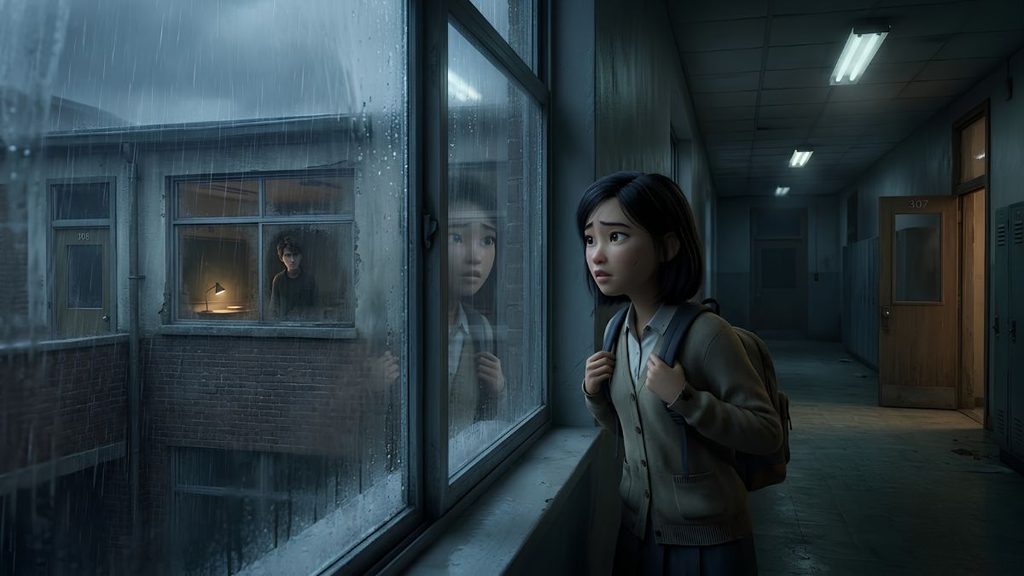
It was visible in the window of the building opposite hers.
Third floor.
Room 308.
A boy was standing behind the glass.
Sophie stared.
He appeared to be about her age.
Dark hair.
Pale face.
School uniform.
He was looking directly at her.
Sophie smiled awkwardly.
Maybe he was another student.
She raised her hand.
The boy didn’t move.
Sophie waved again.
Nothing.
She frowned.
Then the lights in the room went off.
The face disappeared.
Sophie stepped closer to the window.
The room was dark.
She couldn’t see anything.
She looked toward the staircase.
Maybe someone was still upstairs.
She shrugged.
“Probably nothing.”
She went to the library.
Twenty minutes later, her father arrived.
Sophie went home.
She forgot about the face.
At least, she tried to.
The next morning, she mentioned it to her best friend, Emma.
“You saw someone in Room 308?”
“Yes.”
“Maybe a student.”
“Maybe.”
“What’s strange about that?”
Sophie hesitated.
“He didn’t move.”
Emma laughed.
“Maybe he was looking at you.”
“For ten minutes?”
“Maybe you were beautiful.”
Sophie rolled her eyes.
“Very funny.”
Emma smiled.
“Seriously, don’t worry about it.”
Sophie nodded.
But something still bothered her.
She remembered the boy’s face.
There had been something strangely familiar about him.
Not familiar in the way of recognizing a friend.
More like seeing a face she had seen before without knowing where.
That afternoon, Sophie went to the library.
She had a project to finish.
As she walked through the third-floor hallway, she looked toward Room 308.
The window was visible from where she stood.
She stopped.
There was someone inside.
The same boy.
Sophie froze.
He was standing in exactly the same position.
Looking directly at her.
She checked the time.
4:02 p.m.
She walked closer.
The boy didn’t move.
Sophie raised her hand.
Nothing.
She stepped closer.
Still nothing.
Then she noticed something.
The window was dusty.
Very dusty.
There were cobwebs around the frame.
Nobody had cleaned it in a long time.
Sophie looked confused.
She turned toward the classroom door.
It was locked.
A printed sign was attached to it.
STORAGE AREA. STAFF ONLY.
Sophie stepped back.
“How can someone be inside?”
She looked at the window again.
The boy was gone.
Her heart began beating faster.
She ran toward the library.
That evening, Sophie searched the school’s website.
She looked for information about Room 308.
Nothing.
She searched old photographs.
Nothing.
She searched the school’s history page.
Still nothing.
Then she found an old digital yearbook.
She clicked through the photographs.
Then she stopped.
A class photograph from 1997.
She stared at the students.
There he was.
The boy from the window.
Same face.
Same hair.
Same expression.
Sophie zoomed in.
She felt a chill.
Under the photograph was a list of names.
One name was highlighted.
Evan Parker.
Sophie read the date.
May 1997.
She looked at the photograph again.
Then she noticed something.
Evan was wearing a school badge.
The same badge students wore today.
Sophie searched his name.
Nothing appeared.
She tried again.
Nothing.
Finally, she found an old newspaper archive.
The headline made her heart stop.
WESTBROOK STUDENT MISSING AFTER SCHOOL EVENT
The student was Evan Parker.
He was seventeen.
He had disappeared after staying late at school.
The last place anyone had seen him was near the third-floor corridor.
Room 308 was mentioned in the article.
Sophie stared at the screen.
She felt cold despite being inside her warm bedroom.
The next day, she told Emma.
Emma didn’t laugh this time.
“You’re sure?”
Sophie nodded.
“I found his photograph.”
Emma looked at it.
“That’s him?”
“Yes.”
Emma stared.
“That is creepy.”
“I know.”
“What happened to him?”
“Nobody knows.”
Emma looked nervous.
“Maybe you should tell someone.”
Sophie nodded.
“I will.”
But before they could find a teacher, something strange happened.
Sophie received a message.
No number.
No name.
Just an image.
It was a photograph of her standing outside Westbrook High.
She recognized the moment.
It had been taken the previous afternoon.
She was standing near the entrance.
Her father had not arrived yet.
She stared at the photograph.
Then another message appeared.
LOOK UP.
Sophie slowly raised her eyes.
She was standing in the school hallway.
Room 308 was visible through the window.
The boy was standing there.
Looking at her.
Sophie dropped her phone.
Emma grabbed her arm.
“Let’s go.”
They ran downstairs.
They went straight to Mr. Harris, the history teacher.
He listened carefully.
When Sophie showed him the photograph, his expression changed.
“You shouldn’t have received this.”
“What do you mean?”
Mr. Harris closed the classroom door.
“I’ve heard stories about Evan.”
“Do you know what happened?”
“No.”
“But you’ve heard them?”
“Yes.”
“What kind of stories?”
Mr. Harris hesitated.
“Some teachers believe he never actually left the school.”
Sophie felt a chill.
“What does that mean?”
“It means nothing.”
“Then why do you look frightened?”
Mr. Harris sighed.
“Because when I was a student here, people used to say they saw him in Room 308.”
Emma asked,
“When?”
“Late afternoon.”
“Every day?”
“No.”
“Then when?”
Mr. Harris looked toward the window.
“Whenever someone was waiting alone.”
Sophie felt her stomach tighten.
“Why?”
Mr. Harris shook his head.
“Nobody knows.”
That afternoon, Sophie decided to investigate.
Emma insisted on coming.
They waited until most students had left.
At 4:30 p.m., they went upstairs.
The hallway was quiet.
Room 308 stood at the end.
The door was locked.
Sophie looked through the narrow glass panel.
Nothing.
“Maybe he’s not there,” Emma whispered.
Sophie nodded.
They turned to leave.
Then the lights flickered.
Once.
Twice.
The hallway became darker.
Emma grabbed Sophie’s arm.
“Did you see that?”
Sophie nodded.
They looked toward Room 308.
A face appeared in the window.
Evan.
He was staring directly at Sophie.
Sophie stepped forward.
“Evan?”
The boy raised his hand.
He pointed toward the classroom door.
Then he disappeared.
Emma stared.
“Did he just point at the door?”
“Yes.”
Sophie tried the handle.
It turned.
The door opened.
Both girls froze.
Emma whispered,
“That was locked.”
They entered.
The room was filled with old furniture.
Boxes.
Broken chairs.
Dusty books.
Old school equipment.
A faint smell of paper filled the air.
Sophie looked around.
“Evan?”
Nothing.
Then she noticed something on the floor.
An old school photograph.
She picked it up.
It showed Evan standing with several friends.
On the back was a handwritten note.
Don’t forget the window.
Sophie frowned.
“What does that mean?”
Emma looked around.
“Maybe there’s something behind it.”
They examined the window.
Nothing.
Then Sophie noticed a small gap in the wooden frame.
She touched it.
A section moved.
Behind it was a folded piece of paper.
Sophie pulled it out.
It was a letter.
The paper was old.
The handwriting was shaky.
It was written by Evan.
The letter explained that he had stayed after school one evening because he had heard someone calling from Room 308.
He had entered.
He had discovered an old maintenance passage behind the wall.
He planned to tell a teacher.
But the letter ended abruptly.
The final sentence was:
I can hear someone outside, but nobody can see me.
Sophie looked at Emma.
“What happened after this?”
“I don’t know.”
A sound came from behind them.
Knock.
Both girls turned.
The door was closed.
Emma tried it.
Locked.
“Again?”
Sophie stepped toward the window.
Outside, the rain had stopped.
The football field was empty.
Then she saw him.
Evan.
Standing in the reflection.
Not outside.
In the glass.
He was standing directly behind her.
Sophie froze.
She slowly turned around.
Nobody was there.
She looked at the window again.
Evan was still visible.
He pointed toward the wall.
Sophie looked.
There was a faint outline in the wall.
A hidden door.
She and Emma moved the boxes.
Behind them was a narrow wooden door.
Emma opened it.
A dark passage led into the wall.
They didn’t enter.
Instead, they called the school security officer.
The door was examined.
It turned out to be an old maintenance passage that had been sealed during renovations years ago.
Inside, workers later discovered an old backpack.
It belonged to Evan Parker.
They also found evidence suggesting that Evan had accidentally entered the passage and become trapped after part of the old structure collapsed.
The school contacted his family.
The discovery finally answered a mystery that had lasted decades.
A memorial was placed near the library.
Students learned about Evan.
His name was no longer just a rumor.
The story of the face in the window slowly changed.
People stopped calling it a ghost story.
Instead, it became a story about a student who had been forgotten.
But Sophie still occasionally looked toward Room 308.
Months later, she was walking past the third-floor hallway.
She glanced toward the window.
Nothing.
She smiled.
Then she noticed something.
A handprint.
On the inside of the dusty glass.
Sophie stopped.
The handprint was small.
Like a teenager’s hand.
She placed her hand against it.
For a moment, the hallway was completely silent.
Then she heard a whisper.
“Thank you.”
Sophie pulled her hand away.
She looked around.
Nobody was there.
She smiled.
“You’re welcome.”
The lights flickered once.
Then returned to normal.
Sophie walked away.
She never saw Evan again.
But every year, on the anniversary of his disappearance, someone would find a fresh handprint on the window of Room 308.
Nobody ever discovered who made it.
And nobody tried to clean it away.
Moral
Sometimes the things that frighten us are not meant to harm us. A mystery can sometimes be a forgotten story waiting to be understood. The story also reminds us that remembering people and listening carefully can help bring closure to mysteries from the past.
5. The Voice on the School Intercom
At Westbrook High, the school intercom was used for ordinary things.
Announcements.
Sports results.
Lost-and-found notices.
Reminders about homework.
Occasionally, a teacher would use it to call a student to the office.
Nothing unusual.
Nothing frightening.
But one Friday afternoon, Daniel Brooks heard his own name coming through the speakers.
The school had been almost empty.
And nobody had any reason to call him.
Daniel was sixteen and had a reputation for staying late at school.
He wasn’t exactly a troublemaker.
He simply had a habit of forgetting things.
Books.
Homework.
Sports equipment.
Once, he had forgotten his backpack and had to walk halfway home before realizing it.
His friends joked that his memory worked on a strict schedule.
Unfortunately, that schedule didn’t include remembering everything.
That Friday, Daniel stayed behind to finish a science project.
His group had been working on a presentation about renewable energy.
Everyone else had gone home.
Daniel had promised to finish the slides before Monday.
By 4:20 p.m., he was still in the computer lab.
Rain tapped against the windows.
The school hallway outside was silent.
Daniel stretched.
“Almost done.”
He saved the presentation.
Then he noticed something.
His USB drive was missing.
He searched his pockets.
Nothing.
He checked his backpack.
Nothing.
He looked under the desk.
Nothing.
“Oh, come on.”
He remembered using it in the library.
He packed his things and left the computer lab.
The hallway was empty.
He walked toward the library.
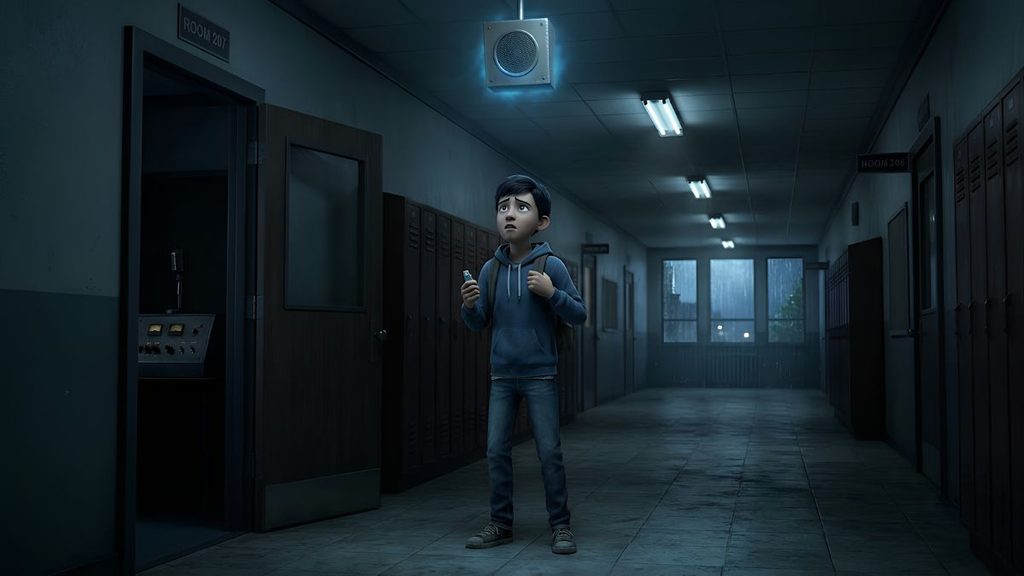
As he passed the main office, the intercom suddenly crackled.
Krrrrr.
Daniel stopped.
The speakers above him produced a burst of static.
Then a voice spoke.
“Daniel.”
He froze.
The voice was quiet.
Almost a whisper.
Daniel looked around.
Nobody was there.
He walked closer to the office.
“Hello?”
The intercom crackled again.
“Daniel Brooks.”
Daniel’s heart began beating faster.
He looked at the speaker.
“Who is this?”
Silence.
Then the intercom clicked off.
Daniel stood there for several seconds.
“Okay.”
He laughed nervously.
“Very funny.”
He assumed someone was playing a prank.
Maybe one of his friends had stayed behind.
He checked his phone.
No messages.
He walked toward the library.
The library door was open.
Daniel stepped inside.
The lights were still on.
He searched the table where he had been sitting earlier.
No USB drive.
He checked another table.
Nothing.
Then he heard the intercom again.
This time, the voice said:
“Daniel.”
He looked toward the ceiling.
“How do you know my name?”
No answer.
The speaker crackled.
“You’re looking in the wrong place.”
Daniel froze.
He looked around.
“What?”
The intercom went silent.
Daniel felt uncomfortable.
He walked toward the librarian’s desk.
Maybe the librarian had left the system on.
But the library was empty.
He checked the office.
Nobody.
He returned to the main hallway.
Then the intercom came alive again.
“Second floor.”
Daniel looked toward the stairs.
The voice continued.
“Room 214.”
Daniel swallowed.
The intercom went silent.
He stood at the bottom of the staircase.
He didn’t want to go upstairs.
He knew Room 214.
It was an unused classroom.
Nobody used it after school.
Daniel slowly climbed the stairs.
The second floor was darker.
Several lights were switched off.
Daniel walked toward Room 214.
The door was closed.
He pushed it open.
The classroom was empty.
Old desks were stacked along one wall.
A projector sat on a table.
The windows were covered by blinds.
Daniel switched on his phone flashlight.
“Hello?”
Nothing.
Then the intercom crackled.
But there was no speaker inside the classroom.
The voice seemed to come from the hallway.
“Look under the desk.”
Daniel looked around.
There were six desks.
He walked toward the nearest one.
Nothing.
“Which desk?”
The voice answered immediately.
“Third row.”
Daniel counted.
One.
Two.
Three.
He crouched down.
Under the desk was a small object.
His USB drive.
Daniel picked it up.
His relief lasted only a second.
Then he noticed something written on the desk.
His name.
DANIEL BROOKS
He stepped backward.
“How?”
The intercom crackled.
“Don’t leave yet.”
Daniel looked toward the door.
“Who are you?”
Silence.
Then:
“Someone who waited.”
Daniel’s stomach tightened.
“Waited for what?”
No answer.
The lights flickered.
Daniel ran out of the room.
He hurried down the hallway.
The intercom suddenly came alive.
“Daniel.”
He stopped.
The voice was louder now.
“Don’t leave yet.”
Daniel turned.
The hallway was empty.
Then he heard footsteps.
Behind him.
Step.
He turned.
Nothing.
Another step.
Step.
Daniel ran.
He reached the stairs.
The intercom followed him.
“Daniel.”
He ran faster.
“Daniel.”
He reached the first floor.
The voice continued.
“You forgot something.”
Daniel stopped.
He looked toward the library.
“What?”
The intercom crackled.
“You forgot to look behind you.”
Daniel slowly turned.
The hallway was empty.
He laughed nervously.
“Very funny.”
Then he noticed something.
A classroom door was open.
Room 102.
It had been closed earlier.
Daniel approached.
Inside was an old intercom control panel.
He stared.
The panel was connected to the school announcement system.
There was nobody there.
But a small red light was blinking.
Daniel stepped closer.
A microphone sat on the desk.
The microphone was switched on.
He looked at it.
Then the speaker above him said:
“Hello, Daniel.”
Daniel jumped.
He backed away.
“Who is doing this?”
The microphone answered.
“I’m not doing anything.”
Daniel stared at it.
The voice was coming through the microphone.
But the microphone was sitting in an empty room.
Then another sound came through.
A faint breath.
Daniel whispered,
“Who are you?”
The voice replied:
“My name is Daniel.”
He froze.
“What?”
The voice repeated:
“My name is Daniel.”
Daniel’s face went pale.
“That’s my name.”
“Yes.”
“Who are you?”
Silence.
Then:
“That’s what I want to know.”
The microphone suddenly switched off.
Daniel stared at it.
He felt completely confused.
The next morning, Daniel told the principal.
The principal listened carefully.
Then he called the school’s maintenance supervisor.
The supervisor inspected the intercom system.
Everything seemed normal.
No hidden microphones.
No extra speakers.
No recording devices.
Nothing.
The principal looked at Daniel.
“Are you sure you weren’t tired?”
Daniel nodded.
“I know what I heard.”
The principal didn’t argue.
But he clearly didn’t know what to say.
Later that day, Daniel returned to Room 102.
He wanted to prove to himself that the whole thing had been a prank.
The microphone was gone.
The control panel had been disconnected.
He felt relieved.
Then he noticed something taped beneath the desk.
A small envelope.
His name was written on it.
DANIEL BROOKS
He opened it.
Inside was a photograph.
It showed a group of students standing in front of Westbrook High.
The photograph looked old.
Very old.
Daniel looked at the students.
Then his blood ran cold.
One of them looked exactly like him.
Same face.
Same eyes.
Same hair.
He turned the photograph over.
A date was written on the back.
October 1989.
Underneath was a name.
Daniel Brooks.
Daniel stared at the photograph.
The student had his exact name.
His exact face.
It couldn’t be possible.
He ran to the library.
He searched the school’s digital archives.
He found the photograph.
The school had records from 1989.
There had been a student named Daniel Brooks.
He had attended Westbrook High.
He was sixteen.
And he had disappeared.
Daniel felt cold.
He read the article.
The student had stayed late one afternoon to finish a school project.
He had never returned home.
The investigation had found no explanation.
Daniel looked at the photograph again.
Then the intercom crackled.
He froze.
“Daniel.”
He looked toward the speaker.
The voice was quiet.
“Now you know.”
Daniel swallowed.
“Are you him?”
Silence.
Then:
“I don’t know.”
“What do you want?”
“I wanted someone to hear me.”
Daniel looked around.
The library was empty.
“Why me?”
The voice answered:
“Because you stayed.”
The speaker clicked off.
Daniel spent the next several weeks researching the old disappearance.
He discovered that the school had been renovated several times.
Some areas had been demolished.
Some classrooms had been rebuilt.
The old intercom system had been replaced decades ago.
Yet nobody could explain how the voice had appeared.
Daniel eventually found a forgotten newspaper article.
The headline read:
STUDENT LAST SEEN NEAR OLD BROADCAST ROOM
The article mentioned that the school once had a small broadcasting room used for student announcements.
The room had been closed after a renovation.
Daniel searched the old building plans.
The room was still there.
Hidden behind a wall near the auditorium.
Daniel told the principal.
Workers opened the sealed area.
Inside, they discovered an old room.
There was a desk.
A microphone.
A cassette recorder.
And a school notebook.
The notebook belonged to the missing Daniel Brooks.
The final page contained one sentence:
If anyone finds this, please tell my family I didn’t leave willingly.
The discovery reopened the old case.
Investigators determined that the student had accidentally become trapped in the sealed section during construction.
His story had been forgotten after the building was renovated.
The exact circumstances remained uncertain, but his family finally received answers.
The school placed a memorial plaque near the auditorium.
Daniel attended the ceremony.
He stood quietly as the principal read the missing student’s name.
For the first time, the name Daniel Brooks was not connected to a mystery.
It was connected to a person who had finally been remembered.
Months later, Daniel stayed late at school again.
This time, he was helping a teacher organize equipment.
The clock showed 4:30.
He packed his bag.
As he walked toward the exit, the intercom crackled.
Daniel stopped.
He looked up.
For a moment, he expected to hear his name.
Instead, a soft voice said:
“Thank you.”
Daniel smiled.
“You’re welcome.”
The speaker clicked off.
He walked toward the door.
Then he heard one final message.
“Go home, Daniel.”
Daniel laughed.
“I am.”
He stepped outside.
The rain had stopped.
The evening sky was clear.
He looked back at the school.
Every window was dark.
Except one.
The small window above the old broadcasting room was glowing softly.
Daniel smiled.
Then the light disappeared.
He walked home.
He never heard the voice again.
But every year, on the anniversary of the missing student’s disappearance, the school intercom would briefly activate at 4:30 p.m.
No message was ever recorded.
Only a quiet burst of static.
And then silence.
Moral
Sometimes people simply want to be heard and remembered. The story reminds us that mysteries can hide forgotten human stories, and that paying attention can help bring closure. At the same time, when something genuinely strange happens, it is always better to involve trusted adults rather than investigate alone.
6. The Locker That Opened by Itself
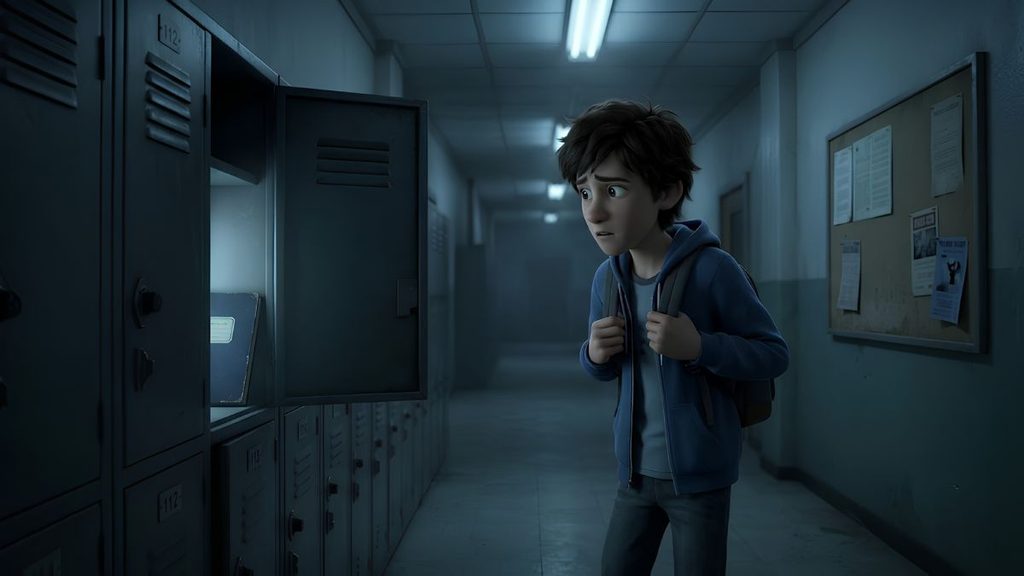
At Westbrook High, there was a locker nobody used.
It stood at the very end of the second-floor hallway, between a broken drinking fountain and an old noticeboard.
Unlike the other lockers, it had no number.
It had no name tag.
It didn’t even have a proper combination lock.
Instead, it had a small brass handle that looked older than everything around it.
Students had tried opening it for years.
Nobody could.
But there was something stranger about the locker.
Every morning, it was locked.
Every afternoon, it was slightly open.
Nobody knew why.
Jack Wilson first noticed it because he was late.
It was a Tuesday morning.
Jack was sixteen, always rushing, and almost always searching for something he had misplaced.
That morning, he was looking for his mathematics notebook.
He ran down the second-floor hallway before class.
His friend Oliver called after him.
“Jack!”
Jack turned.
“What?”
“Your notebook!”
Jack looked down.
He was holding it.
Oliver laughed.
“You’ve been looking for that for five minutes.”
Jack shook his head.
“Don’t say anything.”
They continued walking.
As they passed the end of the hallway, Jack noticed the strange locker.
Its door was slightly open.
He stopped.
“Has that always been there?”
Oliver looked at it.
“The locker?”
“Yeah.”
“I think so.”
“Why doesn’t it have a number?”
Oliver shrugged.
“Old locker.”
Jack walked closer.
He pulled the door open.
It didn’t move.
Locked.
He laughed.
“See?”
Oliver smiled.
“Congratulations.”
Jack closed it.
They went to class.
That afternoon, Jack was waiting for Oliver outside the library.
He glanced toward the locker.
The door was open.
He frowned.
He walked over.
Inside was darkness.
The locker was empty.
Jack looked around.
Nobody was nearby.
He closed the door.
Then opened it again.
Still empty.
He closed it.
Opened it.
The door opened easily.
Jack stepped backward.
“What?”
He tried closing it.
The door stayed shut.
Then he opened it again.
Still empty.
He shrugged.
“Broken lock.”
He walked away.
The next morning, the locker was closed.
Jack mentioned it to Oliver.
“Maybe the janitor uses it.”
Oliver shook his head.
“Why would the janitor use a locker with no number?”
Jack shrugged.
“Maybe it’s haunted.”
Oliver laughed.
“You’ve been listening to too many stories.”
Jack smiled.
“Maybe.”
But he started paying attention.
For the next week, Jack watched the locker.
Every morning:
Closed.
Every afternoon:
Open.
Always slightly open.
Never completely.
Nobody touched it.
Nobody stood near it.
Nobody seemed to care.
Jack began to wonder whether there was a mechanism causing it.
He even asked the maintenance supervisor.
“Do you know anything about the old locker at the end of the second-floor hallway?”
The man frowned.
“Which locker?”
“The one without a number.”
The supervisor thought for a moment.
“Oh.”
“You know it?”
“It’s been there for years.”
“Why doesn’t it have a number?”
“I don’t know.”
“Who uses it?”
“Nobody.”
“Then why is it still there?”
The supervisor shrugged.
“Old lockers are expensive to remove.”
Jack laughed.
“Fair enough.”
He walked away.
Then the supervisor called after him.
“Jack.”
Jack turned.
“Yes?”
“Don’t put anything inside it.”
Jack smiled.
“Why?”
The supervisor hesitated.
“Just don’t.”
Jack nodded.
“Okay.”
But that warning made him more curious.
A few days later, Jack found a notebook inside the locker.
It was lying upright against the back wall.
He stopped.
The locker had been empty the previous afternoon.
He was certain.
He looked around.
Nobody was there.
He reached inside.
The notebook was old.
Its cover was dark blue.
There was no name.
Jack opened it.
The first page contained handwriting.
Monday
Math test today. I think I failed.
Jack smiled.
Just a normal school notebook.
He turned the page.
Tuesday
Oliver forgot his homework again.
Jack stopped.
That was strange.
Oliver was his friend.
But the handwriting seemed old.
The next page:
Wednesday
Mrs. Harris gave us extra homework.
Jack continued reading.
The entries described ordinary school life.
Classes.
Homework.
Sports.
Lunch.
Nothing frightening.
Then Jack reached the final page.
There was only one sentence.
Someone will find this tomorrow.
Jack stared.
The page was dated the previous day.
He checked the date.
It was Wednesday.
Today was Thursday.
Jack felt a strange chill.
The notebook had predicted that someone would find it.
He closed it.
Then he opened it again.
A new sentence had appeared.
His name is Jack.
Jack dropped the notebook.
It landed on the floor.
He stared at it.
Slowly, he picked it up.
He looked around.
“Very funny.”
He suspected someone had been watching him.
Maybe Oliver.
Maybe another student.
He put the notebook back inside the locker.
Then he closed the door.
He walked away.
The next morning, the locker was closed.
Jack felt relieved.
He walked past it.
Then stopped.
The locker door opened by itself.
Slowly.
Creak.
Jack stared.
The notebook was still inside.
He didn’t touch it.
He walked away.
At lunchtime, he returned.
The locker was open.
The notebook was gone.
Jack frowned.
He searched the hallway.
Nothing.
Then he saw the notebook sitting on a bench near the staircase.
He picked it up.
The cover was open.
A new sentence had appeared.
Jack will be late tomorrow.
Jack frowned.
“What does that mean?”
He closed the notebook.
Then another sentence appeared.
Don’t be late.
Jack felt uncomfortable.
He decided to throw the notebook away.
He walked to the trash can.
He dropped it inside.
Then he went to class.
The next morning, Jack woke up late.
His alarm hadn’t gone off.
He rushed to school.
He arrived at 8:07.
The bell had already rung.
He ran upstairs.
At the end of the hallway, the old locker was open.
The notebook was inside.
Jack froze.
He slowly approached.
The page was open.
One sentence was written.
You were late.
Jack swallowed.
He looked at the clock.
8:10.
Then another sentence appeared.
But you arrived.
Jack stepped backward.
The notebook fell closed.
He turned around.
Oliver was standing behind him.
“Jack?”
Jack jumped.
“Don’t do that!”
Oliver laughed.
“Why are you staring at that old locker?”
Jack didn’t answer.
Oliver looked inside.
“What is that?”
Jack hesitated.
“Nothing.”
Oliver picked up the notebook.
Jack grabbed it.
“Don’t.”
Oliver looked confused.
“Okay.”
Jack put the notebook into his backpack.
He decided to take it home.
That evening, Jack sat at his desk.
He opened the notebook.
There were now dozens of new pages.
He had never seen them before.
The first page read:
Jack Wilson
He turned the page.
Age: 16
Another.
Likes football.
Another.
Hates waking up early.
Another.
Jack frowned.
“How does it know this?”
He kept reading.
The notebook described his daily routine.
Where he sat.
Who his friends were.
What he ate at lunch.
What time he went home.
Then he reached the final written page.
Tomorrow, Jack will open the locker again.
Jack immediately closed the notebook.
“No.”
He decided he wouldn’t go near it.
The next day, he kept his promise.
He avoided the second-floor hallway.
He took a different staircase.
He ate lunch outside.
He didn’t go near the locker.
At 3:00 p.m., he left school.
He smiled.
“I did it.”
He had escaped the notebook’s prediction.
At least he thought he had.
When he got home, he opened his backpack.
The notebook was inside.
Jack stared.
He hadn’t packed it.
He was certain.
He opened the notebook.
A new sentence appeared.
You didn’t open the locker.
Jack sighed with relief.
Then another sentence appeared.
So the locker opened for you.
Jack heard a faint metallic sound from downstairs.
Click.
He froze.
He looked toward his bedroom door.
Nobody.
Another sound.
Creak.
Jack slowly stood.
He walked downstairs.
The front door was locked.
The house was empty.
He looked around.
Then he heard the sound again.
Creak.
It was coming from the hallway.
Jack turned.
There was a small storage cabinet near the stairs.
Its door was slowly opening.
Jack stared.
Inside was nothing.
Except the notebook.
Jack stepped backward.
He looked at the notebook in his hand.
The one in the cabinet looked identical.
He opened his notebook.
The page was blank.
Then words appeared.
It isn’t the locker.
Jack stared.
Another sentence appeared.
It’s what you leave behind.
The notebook in the cabinet disappeared.
Jack ran upstairs.
The next morning, Jack told his parents.
They thought he had been playing a prank on himself.
He couldn’t blame them.
He decided to return the notebook to school.
When he arrived, he went straight to the old locker.
It was closed.
He opened it.
The inside was empty.
He placed the notebook inside.
Then he stepped back.
The door closed.
Jack waited.
Nothing happened.
He walked away.
That afternoon, the locker was open again.
But the notebook was gone.
Jack searched the school.
Nothing.
He asked the maintenance supervisor.
The man became serious when Jack described the notebook.
“You found it?”
Jack nodded.
“What happened?”
The supervisor sighed.
“Years ago, a student kept a diary.”
“What student?”
“I don’t know.”
“Where did it come from?”
“Inside that locker.”
Jack stared.
“Has this happened before?”
The supervisor nodded.
“Every few years.”
Jack felt cold.
“What happens to the students?”
“Usually nothing.”
“Usually?”
The supervisor looked at him.
“Some become obsessed with it.”
“Why?”
“Because the notebook writes about things before they happen.”
Jack swallowed.
“And then?”
“They start believing they can change what it says.”
“Can they?”
The supervisor shook his head.
“I don’t know.”
Jack looked toward the locker.
“Why does it choose people?”
The supervisor didn’t answer.
Years later, students still talked about the mysterious locker.
Some claimed it was removed.
Others said it remained hidden somewhere in the school.
Jack eventually graduated.
He never saw the notebook again.
He never told anyone the full story.
He simply tried to forget it.
Until one evening, years later, while cleaning his old bedroom, he found something behind a shelf.
An old dark-blue notebook.
Jack stared at it.
His hands became cold.
He opened it.
The pages were blank.
He laughed nervously.
“Of course.”
He almost threw it away.
Then words appeared.
Slowly.
Jack Wilson.
He froze.
Another line appeared.
You found me again.
Jack closed the notebook.
He put it into a box.
He sealed the box with tape.
Then he took it outside.
He dropped it into a recycling bin.
He returned home.
He locked the door.
He went upstairs.
He opened his bedroom door.
The notebook was lying on his bed.
Jack stared.
A final sentence appeared.
Some things don’t like being forgotten.
Jack didn’t touch it.
He simply closed the bedroom door.
And from inside the room came a quiet metallic sound.
Click.
Moral
Curiosity can be fascinating, but some mysteries are better left alone. The story also reminds us that trying to control every unknown thing can make us more anxious rather than less. Sometimes the wisest choice is to step back and ask for help.
7. The Classroom That Wasn’t There
At Westbrook High, every classroom had a number.
Room 101 was beside the main office.
Room 204 was on the second floor.
Room 308 was at the end of the third-floor hallway.
There was a logical system.
Everyone knew where everything was.
Except for one classroom.
Room 417.
The strange thing was that Westbrook High only had three floors.
There was no fourth floor.
There was no Room 417.
At least, there wasn’t supposed to be.
Yet several students claimed they had found its door.
And every student who saw it remembered the same thing.
A brass number plate.
417.
Mia Carter first heard about Room 417 from her friend, Chloe.
They were sitting together during lunch.
Chloe was scrolling through her phone.
“Have you ever heard about the fourth-floor classroom?”
Mia laughed.
“We don’t have a fourth floor.”
“I know.”
“Then why are you asking?”
Chloe lowered her voice.
“Because someone says they found one.”
Mia smiled.
“Who?”
“Ethan.”
“Ethan says everything.”
“I know, but this time he has a video.”
Chloe showed her phone.
The video was dark and shaky.
Someone was walking through a school hallway.
The camera passed several classrooms.
Then it stopped.
At the end of the hallway was a door.
A brass number plate was clearly visible.
417.
Mia frowned.
“That’s fake.”
“Maybe.”
“Definitely fake.”
Chloe shrugged.
“Then explain how he filmed it.”
Mia didn’t answer.
The video ended.
That afternoon, Mia forgot her history book.
She realized it just before leaving school.
She ran back upstairs.
The library was closing.
The second-floor hallway was empty.
She found her book on a table.
She grabbed it.
Then she heard footsteps above her.
Mia looked up.
There was no fourth floor.
But the sound had clearly come from upstairs.
Step.
Step.
She walked toward the staircase.
At the top was a wall.
Nothing else.
Mia stared.
Then she noticed something strange.
A narrow staircase appeared to continue behind the wall.
She blinked.
The wall was still there.
She rubbed her eyes.
Nothing.
“Okay.”
She laughed nervously.
“I’m tired.”
She turned away.
Then she heard a door close above her.
Bang.
Mia froze.
She looked back.
The wall was gone.
A staircase was there.
She stared at it.
It led upward into darkness.
Mia took one step.
Then another.
She reached the top.
A hallway stretched before her.
Old.
Dusty.
Completely silent.
Mia looked at the wall.
A sign read:
WESTBROOK HIGH SCHOOL – FOURTH FLOOR
Her heart began beating faster.
“That isn’t possible.”
She walked forward.
At the end of the corridor was a classroom.
Brass number plate.
417.
Mia stopped.
She took out her phone.
She tried calling Chloe.
No signal.
She opened the camera.
The screen showed the hallway.
She pointed it toward the door.
Room 417 appeared.
She stepped closer.
The door was slightly open.
Inside was a classroom.
Old wooden desks.
A blackboard.
A teacher’s desk.
Several chairs.
Everything looked as though students had simply left one afternoon and never returned.
Mia pushed the door open.
The lights came on.
She jumped.
A clock above the blackboard began ticking.
Tick.
Tick.
Tick.
Mia stared at it.
The clock showed 4:17.
She checked her phone.
4:17 p.m.
She looked back at the clock.
It had stopped.
Then someone spoke behind her.
“You’re late.”
Mia turned.
A girl was sitting at one of the desks.
She looked about seventeen.
She wore an old-fashioned school uniform.
Mia stared.
“Who are you?”
The girl smiled.
“I’m Claire.”
“Claire what?”
The girl didn’t answer.
Instead, she pointed toward the chair beside her.
“Sit down.”
Mia shook her head.
“I need to leave.”
Claire smiled.
“You already did.”
Mia frowned.
“What?”
Claire looked toward the door.
“You just don’t remember.”
Mia felt cold.
She turned toward the hallway.
The door was gone.
There was only a wall.
She stepped backward.
“No.”
Claire remained calm.
“Everyone says that.”
“Where am I?”
“In Room 417.”
“There is no Room 417.”
Claire smiled sadly.
“There wasn’t.”
Mia tried to find another exit.
There wasn’t one.
Every wall was solid.
Every window showed darkness.
Claire sat quietly.
“Who are you?” Mia asked again.
Claire looked at her.
“I was a student here.”
“When?”
Claire shrugged.
“A long time ago.”
“What happened?”
“I stayed after school.”
Mia felt a chill.
“Why?”
“I wanted to finish my homework.”
Claire pointed toward the blackboard.
Mia looked.
Written in chalk were dozens of names.
Some were faded.
Some were clear.
At the bottom was a recent name.
MIA CARTER
Mia stared.
“Why is my name there?”
Claire didn’t answer.
Mia grabbed an eraser.
She wiped the name away.
For a moment, the board was clean.
Then the name appeared again.
Claire sighed.
“You shouldn’t have done that.”
“What happens now?”
The classroom lights flickered.
Claire looked at the clock.
4:18.
She whispered,
“Now it knows you’re here.”
The classroom door suddenly appeared.
Mia ran toward it.
She opened it.
A staircase was outside.
She ran down.
One floor.
Two.
Three.
She reached the main hallway.
Students were walking past.
Teachers were talking.
Everything looked normal.
Mia ran toward Chloe.
“Chloe!”
Chloe looked confused.
“Where have you been?”
Mia grabbed her arm.
“Fourth floor.”
Chloe stared.
“What?”
“There was a classroom.”
“What classroom?”
“417.”
Chloe laughed.
“Mia, there is no fourth floor.”
Mia looked toward the staircase.
It was normal.
No fourth floor.
No hallway.
Nothing.
She pulled out her phone.
The video she had recorded was gone.
She checked her photos.
Nothing.
She looked at Chloe.
“I know what I saw.”
Chloe stopped laughing.
“Okay.”
That night, Mia couldn’t sleep.
At 4:17 a.m., her phone lit up.
She had received a photograph.
The photograph showed Room 417.
The classroom was empty.
Except for one desk.
Her desk.
Mia stared at the screen.
Then another photograph arrived.
This one showed the blackboard.
Her name was written on it.
Underneath were two words.
COME BACK.
Mia threw the phone onto her bed.
She didn’t sleep again.
The next morning, she searched the school archives.
She found old yearbooks.
She searched for Claire.
Eventually, she found her.
Claire Bennett.
Class of 1994.
Mia read the school records.
Claire had disappeared during an after-school study session.
The school had searched the building.
No trace was found.
The strange thing was that the old records showed something else.
Room 417 had existed in 1994.
But the building plans showed only three floors.
Mia found an old photograph of the school.
She zoomed in.
There was a fourth floor.
Hidden behind the roofline.
Mia stared.
She took the photograph to the history teacher.
Mr. Harris looked at it.
His expression changed.
“Where did you find this?”
“The archives.”
He studied it.
“This part of the building was removed before I started teaching.”
“Why?”
He hesitated.
“There was a fire.”
“When?”
“1994.”
Mia felt cold.
“What happened?”
“Several classrooms were damaged.”
“Room 417?”
Mr. Harris looked at her.
“Yes.”
“Was Claire Bennett there?”
He nodded.
“She disappeared.”
“Was she found?”
“No.”
Mia stared at the photograph.
“Then maybe she never left.”
Mr. Harris looked uncomfortable.
“Mia.”
She turned.
“Don’t go looking for that room.”
“Why?”
“Because some places are better left forgotten.”
That afternoon, Mia went back.
She knew it was foolish.
But she couldn’t stop thinking about Claire.
At 4:17 p.m., she stood on the second floor.
Nothing happened.
She waited.
4:18.
Nothing.
4:19.
Still nothing.
Mia sighed.
Maybe she had imagined it.
She turned to leave.
Then the lights went out.
When they came back on, a staircase stood at the end of the hallway.
Mia stared.
She walked toward it.
She climbed.
The fourth floor was there again.
Room 417 waited at the end.
Mia opened the door.
Claire was sitting at the desk.
“You came back.”
Mia nodded.
“I want to help you.”
Claire smiled.
“You can’t.”
“Why?”
“Because I’m not the one trapped here.”
Mia frowned.
“What do you mean?”
Claire pointed toward the blackboard.
Mia looked.
Her own name was gone.
Instead, another name appeared.
CHLOE MILLER.
Mia’s heart stopped.
“No.”
Claire stood.
“You brought someone with you.”
“I didn’t.”
“You told her about this place.”
Mia understood.
Chloe had become connected to the story.
Claire walked toward the door.
“I tried to warn everyone.”
“About what?”
Claire looked at Mia.
“The room doesn’t disappear.”
“What?”
“It moves.”
Mia stared.
Claire continued.
“Every time someone finds it, the room creates a new door.”
“Where?”
“Anywhere.”
Mia felt a chill.
“Then how do we stop it?”
Claire pointed toward the old clock.
“4:17.”
Mia looked at it.
The clock was moving backward.
4:16.
4:15.
4:14.
Claire whispered,
“When it reaches 4:00, you must leave.”
“What happens if I don’t?”
Claire looked toward the blackboard.
“You become part of the classroom.”
The clock continued.
4:13.
4:12.
Mia ran toward the door.
It opened.
She rushed into the hallway.
Behind her, Claire shouted:
“Don’t look back!”
Mia ran down the stairs.
She reached the third floor.
Then the second.
Then the first.
She ran toward the main entrance.
The school was empty.
She reached the doors.
They opened.
Mia stepped outside.
The clock on her phone read 4:00.
The moment she stepped through the entrance, the school lights went out.
She looked back.
The fourth-floor windows were gone.
The building had only three floors.
Mia immediately called Chloe.
Chloe answered.
“Where are you?”
“At home.”
Mia felt relief.
“Stay there.”
“Why?”
“Just promise me.”
Chloe laughed.
“Okay.”
Mia sat down.
She closed her eyes.
It was over.
At least, she hoped.
The next morning, she arrived at school.
Chloe was waiting for her.
“You look terrible.”
Mia smiled.
“Didn’t sleep.”
“Same.”
Mia frowned.
“Why?”
Chloe looked at her.
“I had the strangest dream.”
“What dream?”
Chloe hesitated.
“I was sitting in a classroom.”
Mia’s stomach tightened.
“What classroom?”
Chloe smiled.
“Room 417.”
Mia went silent.
Chloe laughed.
“Relax. It was just a dream.”
Mia looked toward the second-floor hallway.
Everything was normal.
No staircase.
No fourth floor.
No Room 417.
Then the school bell rang.
Students began walking toward their classrooms.
Mia turned away.
She never saw the tiny brass number plate lying beneath the staircase.
417.
And nobody noticed the faint sound coming from somewhere above them.
A classroom door slowly opening.
Creeeak.
Moral
Some mysteries are fascinating, but curiosity should always be balanced with caution. The story also reminds us that helping others is valuable, but you should never put yourself in danger to solve something you don’t understand.
Why Are School Scary Stories So Popular?
School is normally associated with learning, friends, teachers, homework, sports, and everyday routines.
That makes it an interesting setting for horror.
When something strange happens in a familiar environment, the contrast makes the story more memorable.
Imagine hearing a strange sound in an ancient cemetery.
That is expected.
Now imagine hearing the same sound from an empty classroom in a school you visit every day.
That feels different.
School scary stories also work well because they are easy to imagine.
Most students know what it feels like to walk through a quiet hallway.
They know what classrooms look like after everyone has left.
They know the sound of lockers closing.
They know how different a familiar school can feel when it becomes completely quiet.
A good storyteller can use those familiar details to build suspense.
The Best Settings for School Horror Stories
The setting plays an important role in creating fear.
A school can contain many locations that naturally create suspense.
1. Empty Classrooms
An empty classroom is one of the simplest settings for a scary story.
During the day, classrooms are noisy and crowded.
After everyone leaves, the same room can feel completely different.
A story might involve a student who returns to collect a forgotten notebook and notices that something inside the classroom has changed.
The important element is not necessarily what happens.
It is the uncertainty.
2. Dark Hallways
Long hallways are perfect for suspense.
A character might hear footsteps behind them.
They turn around.
Nobody is there.
They continue walking.
The footsteps begin again.
This type of scene works because readers can imagine themselves walking through the same hallway.
3. The School Basement
If a school has an old basement, storage area, or unused section, it can become an excellent fictional setting.
A locked door can create an immediate mystery.
Why is it locked?
Who used the room?
Why does someone hear noises from inside?
The answers can be revealed slowly.
4. The Library
Libraries are usually quiet and peaceful.
That makes them surprisingly effective for spooky stories.
A character might discover an old book containing a photograph, handwritten note, or mysterious name.
The discovery creates questions that keep the reader interested.
5. The School Auditorium
A large auditorium becomes particularly eerie when it is empty.
Rows of empty seats.
A dark stage.
Curtains moving slightly.
A microphone producing a faint sound.
A single spotlight switching on unexpectedly.
These details can create a cinematic atmosphere without relying on graphic horror.
6. The School Playground
A playground at night can feel completely different from the same playground during the day.
Empty swings.
Silent equipment.
A basketball rolling across the ground.
A light flickering above the field.
Small details can create a strong sense of unease.
What Makes a Good Scary School Story?
A frightening story is not simply a story containing something scary.
It needs suspense.
Several elements can make a school horror story more effective.
Mystery
Give the audience a question.
Something should not make sense.
Perhaps a classroom is always locked.
Perhaps a particular name appears on the attendance list even though nobody recognizes it.
Perhaps a school bell rings at a strange time.
The audience wants to know why.
Suspense
Do not reveal everything immediately.
Let the tension build.
A character hears something.
They investigate.
They find nothing.
Then the sound happens again.
The audience becomes more nervous because they know something is wrong, but they do not know what.
Familiarity
Use ordinary school details.
A clock.
A locker.
A teacher’s desk.
A noticeboard.
A school bus.
A notebook.
A lost-and-found box.
These ordinary objects become more effective when something unusual happens around them.
A Strong Ending
A good scary story should leave an impression.
The ending might contain a surprising revelation.
It might answer the mystery.
Or it might leave one important question unanswered.
Sometimes the most memorable ending is the one that makes the audience think:
“Wait… what happened next?”
Scary Stories Do Not Need Gore
One of the biggest misconceptions about scary storytelling is that horror needs graphic violence.
It does not.
Psychological suspense can often be more effective.
For example, imagine a student receiving a message from an unknown number:
“Why are you still in Room 12?”
That is enough to create tension.
The reader immediately starts asking questions.
Who sent it?
How do they know where the student is?
Is someone watching?
What is inside Room 12?
Nothing graphic is necessary.
Another example could involve a classroom photograph.
A student finds an old class photograph.
Everything looks normal.
Then they notice a person standing in the background.
Nobody recognizes the person.
The next day, the same person appears in a new photograph.
That kind of mystery can be much more unsettling than graphic horror.
The Role of School Legends
School legends are especially useful for storytelling.
A fictional school legend might say that a particular classroom has been locked for years.
Students may have different explanations.
Some say it was abandoned after an accident.
Others claim a teacher used it as a private study.
Another student insists that the room is not actually empty.
Nobody knows which version is true.
This creates an opportunity for a story.
The protagonist eventually decides to investigate.
That is where the mystery begins.
The important thing is to keep the legend fictional and clearly framed as storytelling rather than presenting rumors about a real school as fact.
Using Ordinary Objects to Create Fear
You do not need monsters or ghosts in every story. Ordinary objects can become frightening when placed in unusual circumstances.
- A School Bell: A bell ringing after the school has closed can immediately create questions. Who activated it? Why?
- A Notebook: A notebook containing entries written about events that have not happened yet can create suspense.
- A Locker: A locker that repeatedly appears open despite being locked can become the center of a mystery.
- A Photograph: Old photographs can create a sense of history. A missing face, an unfamiliar person, or an object that appears in different photographs can become a powerful storytelling device.
- A School Clock: A clock that always stops at the same time can become part of a fictional school legend. The audience naturally wants to know why.
How to Tell a Scary Story to Friends
The way you tell a story can be just as important as the story itself.
Do not rush.
A common mistake is trying to tell everything quickly.
Instead, slow down during important moments.
For example:
“I heard something behind the door.”
Pause.
Then continue.
“At first, I thought it was just the wind.”
Pause again.
Then:
“But the school windows were closed.”
This gives your audience time to imagine what is happening.
Use Your Voice
Speak normally during the beginning.
As the story becomes more mysterious, lower your voice slightly.
You do not need to shout.
Quiet storytelling can actually be more effective.
Use Pauses
Silence is useful.
A short pause before a reveal can make the audience anticipate what is coming.
Keep the Details Simple
You do not need pages of description before anything happens.
Choose a few memorable details.
For example:
- A flickering hallway light
- A locked classroom
- A ticking clock
- Footsteps
- An empty chair
Then build the story around them.
Best Occasions for Sharing School Scary Stories
These stories can work in many situations.
- Lunch Breaks: A short mystery can be perfect when you only have a few minutes.
- School Trips: Long journeys can provide plenty of opportunities for storytelling. A group of friends sitting together on a bus can easily become an audience.
- Sleepovers: School-themed scary stories can be especially effective during sleepovers because everyone is already thinking about nighttime.
- Campouts: An outdoor setting naturally adds atmosphere. A story about an abandoned school or mysterious classroom can become even more entertaining around a campfire.
- Storytelling Activities: Teachers or students can use age-appropriate fictional mysteries as creative writing exercises. Students can even create their own endings.
How to Keep Scary Stories Appropriate
Not every audience enjoys intense horror.
A good storyteller should consider who is listening.
For younger audiences, avoid graphic violence and disturbing themes.
Focus instead on:
- Mystery
- Suspense
- Strange noises
- Unexplained events
- Ghostly rumors
- Funny scares
- Unexpected endings
- Mild supernatural elements
For older audiences, the stories can explore more psychological suspense while still avoiding unnecessary graphic content.
The goal is to entertain and create a temporary feeling of fear, not genuinely distress someone.
Funny Scary Stories Can Be Even Better
Not every scary story needs to be completely serious.
A humorous ending can make a spooky story more memorable.
For example, a character might spend ten minutes investigating mysterious footsteps in an empty hallway only to discover that the sound came from a loose cleaning cart.
That kind of ending creates a mixture of suspense and comedy.
You can also create stories where the protagonist is brave at first but becomes increasingly nervous.
The audience may enjoy watching the character confidently investigate something before realizing that they probably should have stayed in bed.
How to Make Your Own School Scary Story
Creating a scary story can be surprisingly simple.
Start with a normal school situation.
For example:
A student forgets a notebook in a classroom.
Then introduce something unusual.
When the student returns, the classroom door is locked.
Add another mystery.
Someone inside appears to be moving a chair.
Increase the tension.
The student looks through the window, but the classroom is empty.
Then introduce the final twist.
Perhaps the chair is now outside the classroom.
Or perhaps the notebook the student forgot is sitting on the desk again, even though they remember taking it home earlier.
The key is escalation.
Start normal.
Introduce something strange.
Make the mystery bigger.
Then deliver a memorable ending.
Why Short Stories Often Work Better
When telling stories to friends, shorter is often better.
A story that takes five minutes to tell can maintain suspense from beginning to end.
A story that takes thirty minutes may lose the audience unless it has a very strong plot.
Short scary stories are especially effective because they can focus on one central mystery.
There is no need for ten characters, complicated backgrounds, or multiple locations.
One character.
One strange event.
One mystery.
One memorable ending.
That can be enough.
Tips for Making the Ending Memorable
A strong ending should feel surprising but connected to the story.
Avoid adding a completely random twist simply for shock value.
Instead, plant small clues earlier.
For example, if a mysterious clock is important to the story, mention it several times.
Then reveal why it always stops at the same time.
The audience should be able to look back and realize:
“The clue was there the whole time.”
That is much more satisfying than an ending that comes from nowhere.
The Best Atmosphere for School Horror
Atmosphere is one of the most powerful tools available to a storyteller.
Imagine:
The school is empty.
The hallway lights are dim.
Rain is hitting the windows.
A clock is ticking somewhere nearby.
A classroom door is slightly open.
The character walks toward it.
Nothing happens.
They look inside.
The room is empty.
They turn around.
The door slowly closes.
That simple sequence can be frightening without showing anything disturbing.
The audience’s imagination does most of the work.
Final Thoughts
Scary Stories to Tell Your Friends at School work because they transform familiar places into mysterious ones.
A classroom becomes more interesting when nobody is supposed to be there.
A school hallway becomes unsettling when the lights begin switching off one by one.
A forgotten notebook becomes mysterious when it contains information nobody should know.
The strongest school scary stories rely on suspense, atmosphere, mystery, and imagination rather than excessive violence or graphic details.
When you tell these stories to friends, focus on the experience.
Build the mystery slowly.
Use pauses.
Keep the details believable within the fictional world.
And most importantly, know your audience.
A great scary story should make your friends look over their shoulders, laugh nervously, and say:
“Okay, tell us another one.”
That is the real sign that your story worked.