Okay, so let’s get real. Greek mythology sounds, on the surface, like a textbook shoved into your face in 7th grade. Gods with weird names, heroes doing impossible stuff, monsters that probably shouldn’t exist. Honestly, I get it. I used to roll my eyes every time someone said, “Oh, you must read about the Titans!” Like, seriously? Titans? I have homework. And snacks. Mostly snacks.
But then, one day, I dove in—and not the graceful, I-know-what-I’m-doing kind of dive. More like the belly-flop version. The kind that leaves you gasping, bruised, and questioning every life choice up to that point.
And that, my friends, is exactly why Greek Mythology Stories for Teens are kind of amazing. They’re messy, dramatic, weirdly relatable, and way more fun than anyone ever tells you in class.
The Moment I Knew I Was Toast
Picture this: me, sprawled on the living room floor, laptop open, determined to finally learn about the Greek gods. I had the playlist queued. I had the snacks lined up. I was ready to become this mythology wizard overnight.
Fast forward twenty minutes: I had confused Hades with Hephaestus. Yep. The god of the underworld versus the god of fire and craftsmanship. And somehow, in my frantic Googling, I ended up calling Zeus “that cloud guy.”
Epic fail. I literally had to pause and eat crow. (Metaphorically, because no way am I actually eating crow. Yikes.)
And yet… in that disaster, something magical happened. I realized Greek mythology isn’t just random names and weird battles. There’s this insane thread of human emotion weaving everything together. The jealousy, the pride, the drama—it’s basically reality TV, but with gods who can throw lightning bolts.
And it got me thinking… why do we, as teens, sometimes write off this stuff as “boring old stories”?
Okay, So What’s the Actual Point?
Here’s the thing. Greek mythology isn’t just for history nerds or people who want to sound smart at parties. It’s for all of us. It’s messy, it’s hilarious, it’s tragic, and most importantly—it’s relatable.
Think about it. Every time you scroll through Instagram and see someone showing off a “perfect life,” you feel a little green with envy. Every time you argue with a friend or fall flat on your face in front of a crush, you’re living out the same human drama that the Greeks wrote about thousands of years ago.
And the gods? They’re just humans, but with unlimited power. They’re angry, jealous, impulsive, and yes… often ridiculously petty. Kind of comforting, honestly. Because if a god can totally blow it, maybe we don’t have to feel like the absolute worst when we mess up.
Greek Mythology Stories for Teens
Lightning, monsters, and gods throwing epic tantrums. Greek mythology is full of chaos, drama, and life lessons you won’t forget. Are you ready to dive in?
1. The Lightning Thief’s Reunion
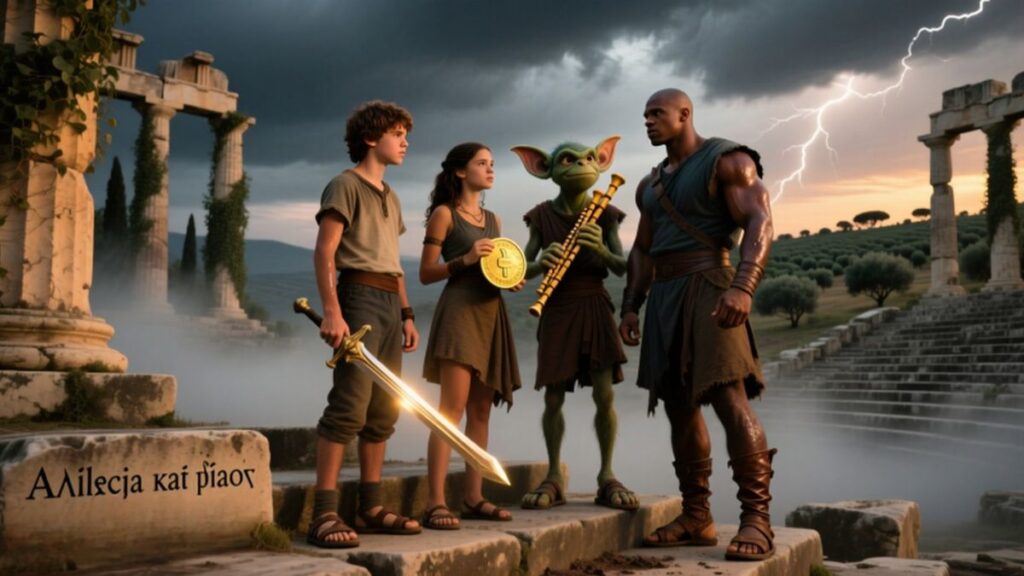
It all started on a Tuesday. Not the kind of Tuesday you write in your diary. No, this was the Tuesday where I, a completely average teen with zero life skills, managed to almost summon a storm spirit.
Picture me, sprawled on my bedroom floor, earbuds in, half-eaten bag of chips at my side. I was scrolling through memes when a notification popped up: “You have a new family secret. Click to claim destiny.”
Naturally, I clicked it.
Cue the epic fail.
My rival—yes, that one guy who always looks like he just stepped out of a teen drama commercial—had apparently hacked the app to prank me. Classic move. But the app wasn’t just any app. Somehow, in the chaos of his prank, it opened a portal. And before I could scream, lightning cracked across my room.
I screamed anyway.
The storm spirit hovered above my bed, glowing blue with sparks shooting in every direction. Honestly, it looked way cooler than it should have, but also, terrifying.
“Uh… hi?” I tried. My voice came out like a squeaky mouse. The spirit tilted its head, probably questioning my life choices.
Yep. I had officially woken up an ancient storm deity.
The first rule of being a teen accidentally summoning a storm god? Don’t panic. The second rule? Panic anyway, because panic is basically human wiring.
“Listen,” I said, trying to sound calm, which was failing miserably. “I’m… not sure what you want, but, um, I promise I won’t text your ex or anything?”
The spirit gave me a look like I’d just insulted its mother. Then it rumbled, “You are the one I’ve been waiting for.”
Oh great. Now it’s mysterious and threatening. Just what every teen needs on a Tuesday.
I figured running was an option. Maybe the classic hiding-under-the-bed strategy would work. It didn’t. Lightning crackled through my walls. My cat, Sir Whiskers, leapt onto my laptop and unplugged everything. That much chaos was actually impressive.
“You’re lucky your cat is a hero,” I muttered.
The storm spirit didn’t answer. It was busy floating dramatically in my room, which was now decorated with scorch marks and a suspiciously wet carpet.
Then my phone buzzed again. Text from my best friend, Mia: “Hey, wanna hang out?”
Yeah, that would’ve been nice if I wasn’t about to be fried by a centuries-old spirit of storms. I typed back frantically: “Slight emergency. Don’t come.”
Mia is persistent. She appeared anyway.
I swear, the timing couldn’t be worse. Mia stood at my door, backpack slung, hair in perfect messy bun, looking like she had literally walked out of a magazine. And there I was, shrieking at a glowing thundercloud that had somehow taken the shape of a vaguely humanoid figure.
She blinked. “What the heck is happening?”
I tried explaining. Didn’t work. She stared, probably wondering if I’d finally lost it.
The storm spirit, apparently impatient, snapped its fingers—or whatever passes for fingers when you’re made of pure energy. A small tornado swept through my room. Chips flew, my textbooks went airborne, and Sir Whiskers did a very dramatic leap onto the bookshelf.
I panicked. “Mia! Help! Do something!”
She froze. Then, in the way teens always do in life-or-death scenarios, she whipped out her phone and started filming.
Great. So now, not only am I about to be zapped into a new dimension, but my humiliation is going viral.
“Stop filming!” I yelled, diving behind the bed.
The spirit laughed. I swear it laughed. Not a friendly laugh either—more like a godly chuckle that makes your bones shake.
Then came the part where things got really interesting.
Apparently, the storm spirit was ancient, yes. Powerful, yes. And apparently very dramatic. It didn’t just want to scare me. No, it wanted… friendship.
I know, weird. But think about it: a being who’s been alone for centuries suddenly decides that a 16-year-old human is the best companion it could ask for.
Mia, of course, saw this as an opportunity to make memes. “Hey, say hi to your new friend for the vlog,” she said.
I groaned. “This is serious! He could—”
“Or she could,” the spirit interjected.
I nearly dropped my laptop. Wait, it could talk now? Great. Now I’m negotiating with a storm deity, and my best friend is live-streaming the whole thing.
The spirit’s name was Zephyros. Classy, right? I tried to memorize it. Failed immediately. I called it “Zap” a lot. It didn’t seem to mind, which was either reassuring or terrifying.
“So, Zap,” I said, awkwardly. “What exactly do you want from me?”
“Companionship. Guidance. Occasional chaos,” it replied, sparks crackling around the edges.
I blinked. That sounded… like a lot of work. And honestly, I already barely managed my homework.
Over the next few days, I discovered summoning a storm spirit is… complicated.
- He hates video games but critiques my Fortnite skills.
- He insists on “storm practice” at 3 a.m., which involves running laps in the rain.
- He occasionally zaps random things, like my laundry or my alarm clock, just to keep me alert.
And somehow, I survived. Mostly.
One of the hardest parts? Keeping this secret from my parents.
“Oh, what’s that scorch mark on the ceiling?” my mom asked one morning.
“Uh… new paint texture?” I said. She squinted. I squinted back. Nobody won.
School was another adventure. Zephyros occasionally insisted on “following me” to school. I mean, I tried explaining that floating lightning avatars aren’t exactly allowed on school grounds. Administration didn’t care about the lightning part—they cared about the missing roof tiles.
And my rival? Oh, he found out. Classic. I woke up to a note in my locker: “So… new weather buddy? Cool.”
There was one moment, though, where everything clicked.
I was in the cafeteria. Mia had convinced Zephyros to stay invisible (mostly). My rival tried to humiliate me by spilling a tray of food on me. Normal high school drama. But Zap—yes, I was calling him Zap now—intervened. A tiny storm cloud hovered over the cafeteria, and only the rival’s hair got messed up. Perfect karma.
I felt a little heroic. And terrified.
We gradually formed a strange friendship.
Zap taught me things about courage. About impulse control. About how even gods screw up sometimes. And I taught him… well, how to sneak into the mall without being noticed. Win-win.
And the weirdest part? The more I learned about Zephyros, the more I started understanding myself. Teens might roll their eyes, but having an ancient being who literally embodies chaos as a friend makes your own disasters seem… manageable.
There were mistakes, of course. Many, many mistakes.
- That time he zapped my science project and it exploded.
- That time I accidentally cursed my rival with a minor thunderstorm.
- That time we almost got banned from the school dance because of floating sparks.
Epic fail after epic fail. But somehow, we survived. And laughed. And learned.
Eventually, I realized something important. Life is unpredictable. Teens know this instinctively. But Greek mythology? It’s basically life amplified. The stakes are bigger. The failures are wilder. And the lessons? They hit harder because you can see them from a mile away, disguised as epic chaos.
And that’s how I spent my junior year. Not exactly normal. Definitely not boring. Full of lightning, chaos, and the occasional life lesson.
Some days, I still wake up and think, “Is Zap watching me?” And yes, he probably is. But now, I don’t panic. I just grin, grab my backpack, and prepare for whatever drama the gods—er, Zap—throw at me next.
Because here’s the real takeaway: failure, chaos, and epic mess-ups are unavoidable. But if you have courage, friendship, and maybe a storm spirit for backup, you might just survive.
And maybe, just maybe, you’ll learn something about yourself along the way.
2. The Labyrinth of Lost Phones
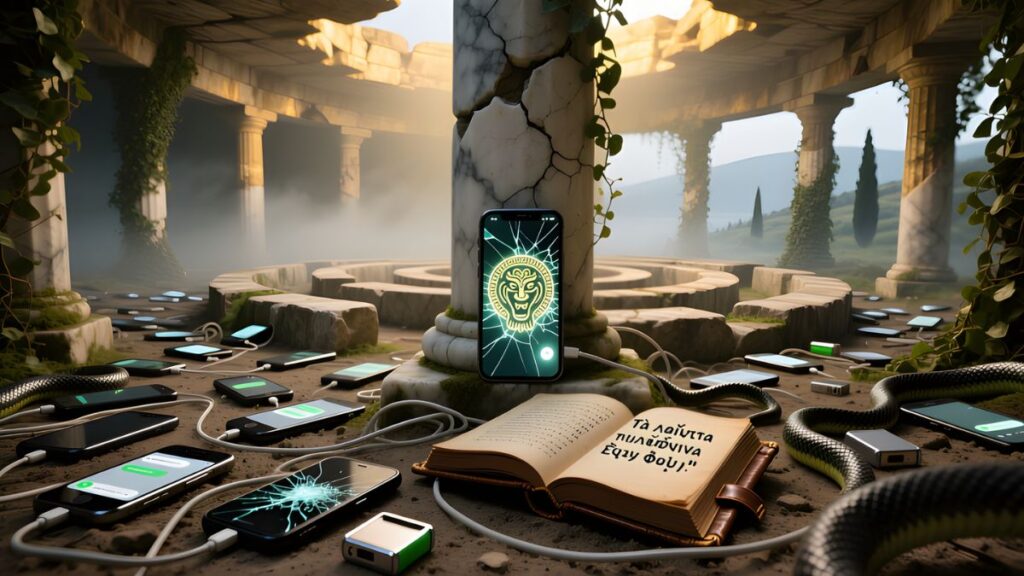
It started like any normal Friday afternoon. My friends and I were wandering around the city, scrolling TikTok videos, complaining about homework, and pretending that life was as glamorous as it looked online.
Then we stumbled upon it.
A crumbling stone archway, hidden behind a graffiti-covered coffee shop. I swear, it looked straight out of a movie. Not just old—mystically old. Vines wrapped around the arch like nature itself had been trying to hide it for centuries.
“Why is this even here?” my friend Leo asked, poking it with his sneaker.
“I dunno,” I said. “Maybe it’s some abandoned tourist trap?”
Famous last words.
We walked through the archway, mostly joking. Phones in hand, ready to record the “haunted temple exploration” TikTok. That’s when the ground… vanished.
Literally. One second it was stone. The next, a gaping hole appeared, and we fell into darkness.
I landed on something soft. Leo didn’t. He screamed. My other friend, Jade, somehow landed on top of me, squishing the life out of my ribs.
“Guys! Are we… dead?” I wheezed.
“Definitely not,” Leo groaned, pulling himself up. “But I think we’re… somewhere else?”
We were in a labyrinth. Not a boring corn maze type. No, this was magically impossible. Walls twisted like they were alive, glowing symbols floating in the air. And the worst part? Phones didn’t work. Signal? Gone. Battery? Drained. TikTok dreams? Dead.
I checked my watch. Time was frozen. Just… frozen.
“Okay, we need a plan,” Jade said, brushing leaves off her jacket. She sounded calm. I, on the other hand, was already panicking.
“Plan? How about don’t die in a magical maze of doom?” I suggested.
Leo raised an eyebrow. “That’s more of a goal than a plan, genius.”
The first challenge hit immediately. A hallway stretched before us. In the middle, a pedestal with a golden apple. Tempting, glowing, impossible to resist.
“Don’t touch it,” I warned, like I had any authority here.
Too late. Leo grabbed it. Instantly, the walls shifted. Spikes popped out of the floor. A booming voice echoed:
“Who dares take what is not theirs?”
Yeah. Epic fail.
Leo panicked, juggling the apple while dodging spikes. Jade grabbed my hand. “Run!” she yelled.
We dashed, ducking under swinging pendulums, leaping over gaps that appeared like someone had forgotten the physics of gravity, and finally slammed a door behind us.
“Great,” I panted. “So… apparently magical labyrinths hate greedy people?”
“Apparently,” Leo muttered, holding the now slightly bruised apple. “Also, maybe I’m cursed now.”
I nodded solemnly. “Welcome to life lessons, buddy.
The next hallway was worse. Statues lined the walls, all staring at us. And I don’t mean regular creepy statues. These had eyes that followed us. One blinked. Then winked. Then whispered.
“Who’s first?” a voice hissed.
“Uh… I volunteer Jade,” I said immediately. She glared at me.
The statues weren’t kidding. Step wrong, and you triggered a trial. Jade tripped, and suddenly the floor became a river of glowing snakes. Leo shrieked, trying to dodge. I… well, I screamed too.
Jade grabbed a vine and swung across. “Follow me! Quick thinking, people! Quick thinking!”
We landed on a safe platform, panting, soaked, terrified.
Lesson one of the labyrinth: stop assuming normal rules apply.
Lesson two: always trust Jade.
Then came the Minotaur challenge. Yeah, the Minotaur. Classic. Huge, angry, half-bull, half-crazy. It chased us through a hallway that kept looping back. Every corner we turned, it was there, snorting, massive hooves shaking the floor.
I tripped over a loose stone. Face-first. “Uh… hi, Mr. Minotaur!” I said, waving.
It ignored me. Thank goodness. But Leo was screaming, “Use the phone! Call for help!”
I reminded him—phones didn’t work. He looked devastated.
We ended up outsmarting the Minotaur. Basically, Jade remembered a story from Greek myths she’d read once, and—surprise!—the creature responded to riddles. So she started asking random riddles. It worked. The Minotaur froze. Then bowed slightly. Then wandered off, apparently satisfied.
We stared at each other.
“Did that just happen?” Leo asked.
“Yes,” I said. “And we all need therapy.”
Next was the Medusa room. I swear, I thought this would be worse. Turns out, the Medusa here was… chill. Kinda sassy. She’d been stuck in the labyrinth for centuries and was super bored.
“Careful where you look,” she warned, flipping her snake hair like it was the latest fashion trend.
“Uh… thanks?” I said, squinting suspiciously.
Turns out the trick was trusting your instincts, not your eyes. We tiptoed through. Snakes hissing, occasionally flicking a tongue. My heart was pounding.
Lesson learned: sometimes danger looks boring until it bites you.
By now, we were exhausted, filthy, and desperate for snacks. Unfortunately, magical labyrinths don’t have vending machines. Or bathrooms. Or decent lighting.
“Can we just… leave?” Leo whimpered.
Jade shook her head. “Not until we solve the final puzzle. The labyrinth doesn’t let anyone leave without proving themselves.”
The final trial was… weird. A giant scale in the center of a circular room. The voice from before echoed:
“Balance friendship, courage, and cleverness. Only then will you exit.”
We looked at each other.
“What does that even mean?” I whispered.
“Probably something metaphorical,” Leo muttered.
Jade groaned. “Nope. Definitely literal. Look, there’s a puzzle on the wall.”
It was a logic puzzle. Classic brain teaser, Greek mythology style. We had to balance weights, push levers, and answer questions like: “Which hero would sacrifice themselves for friends?” and “Which god values cleverness above all?”
I panicked. Leo panicked more. Jade… somehow stayed calm, directing us like a drill sergeant.
We argued, we failed, we almost triggered a trap that turned Leo into a glowing statue. Okay, minor panic. But finally… we solved it.
The walls shifted. The labyrinth started collapsing. Spikes, snakes, Minotaur ghosts, and Medusa illusions all disappeared.
We ran. Literally ran. Out of the labyrinth, back into the city streets. Sunlight blinded us. Cars honked. People gave weird looks. And my phone buzzed.
Notifications. Signal restored. TikTok notifications. My social media life, fully alive again.
We looked at each other, filthy, scratched, and entirely traumatized.
“Never. Again,” Leo said.
“Agreed,” I said, trying not to imagine all the traps we missed.
“And… kind of fun?” Jade added.
We all groaned. Yeah. Epic fail and adventure rolled into one messy, chaotic day.
But I couldn’t stop thinking about it. About the labyrinth, the challenges, the magic. About how friendship, quick thinking, and clever problem-solving actually saved us.
We’d survived something ancient, mystical, and completely insane. And in a weird, teen way, we felt stronger for it.
Because Greek myths aren’t just stories. They’re lessons in chaos, courage, and human ingenuity—stuff that every teen actually needs.
And maybe next time, if we’re brave (or stupid) enough, we’ll stumble into another hidden magical ruin.
But probably not.
3. Apollo’s Talent Show
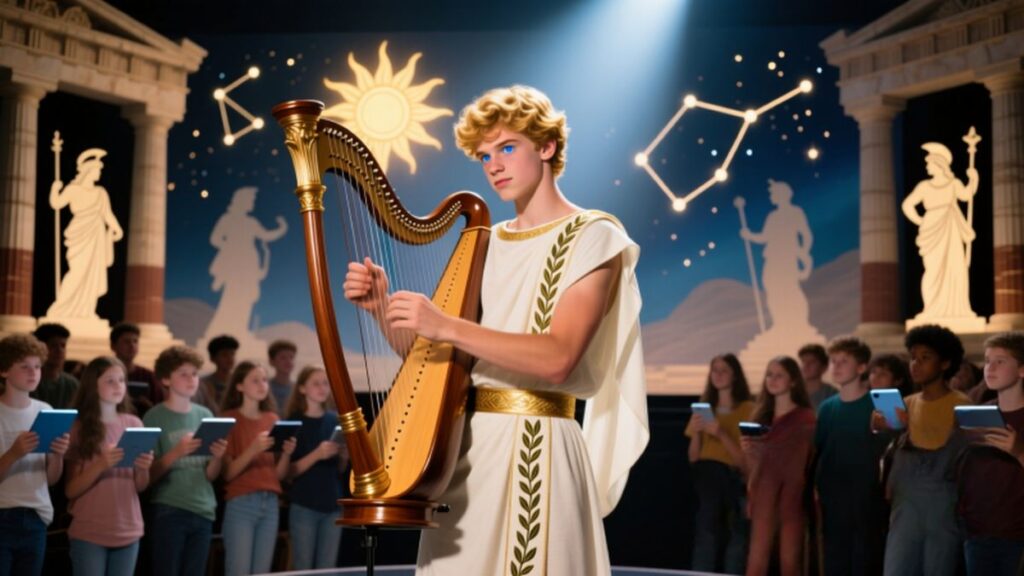
It all started on a Monday, which is basically the worst day for anything magical to happen. I was dragging myself to the school auditorium, earbuds in, humming a random tune, and trying not to fall asleep in chemistry.
Then I heard it.
A voice, clear as crystal and annoyingly perfect, singing a note that made my teeth tingle. Seriously. I stopped dead. My friends stopped dead. Even the janitor, who was pushing a mop, froze mid-swish.
And then we saw him.
He was a new kid, of course. Tall, golden hair that somehow shined without sunlight, eyes that looked like they were holding secrets older than the town, and a smile that could make anyone nervous. He carried a guitar like it was a sword and… well, yeah. He had that “too perfect” vibe.
“Meet Apollo,” my best friend, Tina, whispered.
I nearly choked. “Like… Apollo? The Greek god?”
Tina shrugged. “Probably a stage name.”
Apollo—uh, the kid—stepped onto the stage and started strumming. The notes weren’t just music. They glowed. The lights flickered. Chairs vibrated. Even the goldfish in the trophy case twitched.
“Okay,” I muttered, “either he’s magical or we’ve officially lost it.”
The principal announced the school talent show. Normally, I’d ignore it. My plan: stay home, binge snacks, and survive algebra homework. But something about Apollo’s music made the auditorium feel like it was a portal to another dimension.
And apparently, he had other plans.
“Who’s brave enough to challenge me?” Apollo called. His voice echoed, almost… hypnotically.
Tina elbowed me. “Go on. You play guitar.”
I glared. “Yeah, sure, and then get roasted by a literal god?”
“Exactly,” she said.
By some cosmic misfortune, I raised my hand.
Apollo’s golden eyes sparkled. “Excellent. Let’s make this interesting.”
Within seconds, the talent show became a battle of the bands—but not normal. Oh no. This was mythic-level chaos disguised as school fun.
The first round started. I played a simple riff. Apollo responded with a chord progression so complicated I swear it broke physics. My guitar strings practically cried.
“Uh… nice try?” I muttered to myself.
The audience clapped, mostly confused. Chairs were vibrating. Someone’s backpack floated off the ground. A magical note hovered in the air, glowing blue, then exploded into glitter.
Then came the magical mishaps.
- My amplifier started spewing confetti mid-solo.
- A microphone transformed into a snake and slithered across the floor.
- Apollo’s golden guitar started glowing so bright I almost needed sunglasses.
The audience went wild. Half screaming in excitement, half screaming in terror.
It wasn’t just me vs. Apollo. Other kids tried to join the challenge. Tina sang. Marcus did drums. We were all caught in the most chaotic, musical nightmare I’d ever experienced.
Every note had consequences. Hit a wrong chord? The stage shook. Miss a beat? Chairs started spinning. Try a solo? You might summon a random lightning bolt.
Epic fail was lurking behind every rhythm.
At one point, Marcus hit a drum wrong, and suddenly, a chorus of ghostly harps floated above the stage, playing in perfect harmony. I swear, I almost fainted.
Tina whispered, “Is this… real life?”
“Apparently not,” I muttered, trying not to be roasted by a floating harp.
Apollo—god or not—wasn’t just showing off. He was teaching. Each challenge tested us: courage, creativity, and teamwork. If you panicked or competed selfishly, the stage punished you. If you collaborated, something amazing happened.
Lesson 1: Mythical chaos = life lesson.
By the second round, rivalries were forming.
- Tina and Marcus argued over solos.
- I nearly smashed my guitar out of frustration.
- A small fire erupted from the drums. Yes, a literal fire.
Apollo floated above it all, clapping and laughing. “Now this is music!” he called.
Then came the part I wasn’t ready for.
He challenged me to improvise a song that could control the elements. “If you fail,” he warned, “you may end up swimming in your own rhythm.”
Great. Teen me, barely able to play chords without tripping, improvising to control weather. No pressure.
I took a deep breath. Closed my eyes. Strummed. And somehow… it worked.
A tiny gust of wind swirled around the auditorium. Confetti floated gently. The magical notes calmed. My friends cheered. I barely believed it.
Apollo clapped. “Well done. You’re learning the art of balance.”
By now, the talent show was completely out of control.
- The janitor had started dancing mid-sweep.
- The goldfish in the trophy case was now circling a glowing musical note.
- Chairs, backpacks, and random instruments were floating everywhere.
And yet… somehow, it worked. The chaos became harmony.
The final round: a group performance.
We had to combine magic, music, and creativity. No room for mistakes. Apollo guided us, subtly manipulating the stage. His music synced with ours. Our nervousness became energy. Every note, every chord, every beat mattered.
I looked at my friends. Tina, Marcus, Jade… we’d gone from panicking amateurs to something like a mythical band.
“Ready?” I whispered.
“Born ready,” Tina said.
We played. Notes intertwined with glowing threads of light. Magical mishaps turned into enhancements. The audience—both human and mystical—cheered. I swear I saw glittering spirits dancing above the stage.
And then… silence.
Apollo smiled. “Congratulations. You’ve all passed the test.”
“What test?” Marcus asked, still catching his breath.
“The test of courage, creativity, and friendship,” Apollo said. “A true musician learns to harmonize with chaos, not fight it.”
The magical effects faded. Confetti landed harmlessly. Chairs settled. The fire vanished. Even the goldfish was back in the tank, looking unimpressed.
The school auditorium returned to normal—or as normal as a place can be after a god-level talent show.
The principal looked confused. “Uh… everything okay?”
We shrugged. “Yep. Totally fine,” I said. “Just… jazz band practice.”
Tina rolled her eyes. “Yeah, sure.”
Afterwards, Apollo vanished. Just like that. No goodbye. No trace. Only a golden feather left on the stage.
We stared at it.
“So… that was real?” Marcus asked.
“Yep,” I said. “And we survived. Mostly.”
That night, I lay in bed thinking about the talent show, the chaos, and the lessons we’d learned.
- Courage matters.
- Friendship matters.
- And sometimes, a little chaos is exactly what you need to shine.
I smiled, knowing that in our small town, music—and maybe a little mythic magic—would never be the same.
4. Medusa’s Mirror Selfie
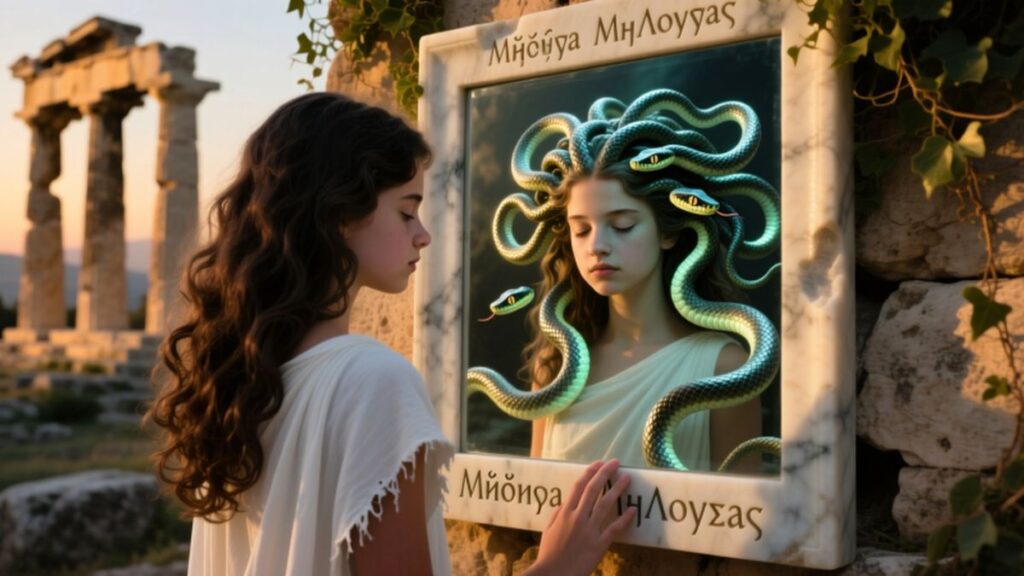
It started on a Saturday. The kind of Saturday where my only plans were scrolling TikTok, avoiding chores, and eating leftover pizza. Nothing epic. Nothing mythic. Nothing that could possibly turn my life into chaos.
Then I went into the attic.
The attic was dusty, dark, and smelled like old socks and mothballs. Perfect, right? I was looking for old photo albums, but my eye caught something shiny under a tarp. Something… suspiciously magical.
It was a mirror. Not just any mirror. The frame was carved with snakes. Yes, snakes. Realistic, wriggly-looking snakes. And the glass shimmered like it was… alive.
“Okay,” I muttered. “This is either amazing or my parents are about to disown me for trashing the attic.”
I wiped off the dust and stared at my reflection. My messy bun looked like a crown. My hoodie, legendary. My phone? Ready for selfies.
I shrugged. Why not?
First selfie: normal. Cute. Classic me. Then I noticed something weird. My reflection… blinked after I did. Slightly delayed. Weird, but maybe the attic dust was messing with me.
Second selfie: same thing. My reflection smiled before I did.
Uh-oh. That’s not normal.
I tried ignoring it. I really did. But curiosity, as you know, is the ultimate teen trap. I snapped a third selfie—and suddenly… the mirror shimmered. My reflection stepped forward.
Not literally. Kind of literally.
One second I was me. The next, my reflection stepped out of the mirror—and turned into a tiny statue of me. Perfect pose. Perfect outfit. Definitely perfect.
“Uh… hi?” I whispered.
The statue blinked. Well… sort of. It had eyes. And it started moving. Not fully alive, but… enough to creep me out.
Then I panicked. Of course I panicked. My first thought: Maybe I broke the mirror?
Second thought: Maybe I should leave the attic and never, ever return.
Too late. A flash of green light shot from the mirror. I had accidentally unleashed its power. And suddenly… selfies everywhere—my friends’ selfies, my little brother’s selfies, even the cat’s phone picture—started turning into statues.
I screamed.
My phone vibrated. Tina texted: “Hey, want to hang out?”
I typed back frantically: “URGENT. DO NOT COME. MAGICAL CRISIS.”
She showed up anyway.
Tina’s face? Priceless. She saw a statue of my cat mid-leap on my desk, a frozen me holding a selfie stick, and dozens of other statues of random objects.
“Uh… what happened?” she asked, stepping cautiously.
“I… might have turned the world into a statue because I took selfies. Totally normal.”
She blinked. “Right. Totally normal.”
We had to act fast. The mirror was… alive. It shimmered, hissed, and occasionally snickered like it was enjoying our panic.
“Okay,” I said, trying to sound brave. “We need a plan. Step one: don’t panic.”
Tina laughed. “Step one failed. Step two: figure out how to reverse this madness.”
First, we experimented. I took a selfie. Nothing. Oh wait… the mirror glowed faintly. We needed… something. A ritual? A chant? A potion? Something.
By now, my room looked like a hybrid of a TikTok chaos trend and a Greek mythology horror show. Confetti from old arts-and-crafts kits, statues everywhere, random glitter floating midair.
We decided to go online. Big mistake.
Google: “How to reverse Medusa selfie curse”
Results: zero. Nada. Only blog posts about actual Medusa, which Tina read aloud dramatically. “Beware the gaze that turns you to stone,” she said.
I groaned. “Thanks, history nerd. That helps a ton.”
By this point, Marcus—the skeptic friend—showed up.
“You called me?” he asked.
“Yes! We’re fighting a cursed mirror!” I yelled.
He squinted. “Uh… looks like a weird mirror and some statues.”
“Exactly! STATUES. Come on!”
Marcus sighed. “Fine. But if I get turned into a statue, I’m haunting both of you.”
Step one: figure out how the mirror works.
We noticed a pattern: selfies. Every selfie taken near the mirror risked creating another statue. So we needed to destroy the mirror. Or trick it. Or… negotiate with it.
I tried talking to it. “Hey… mirror? Can we, uh… fix this?”
It shimmered, like it was laughing. Fantastic.
We brainstormed.
- Idea one: smash it. Bad. The statues might multiply.
- Idea two: cover it. Not powerful enough.
- Idea three: reverse selfies using bravery and friendship. That sounded… totally made up.
Tina raised an eyebrow. “Well, that’s literally all we have. So… courage it is.”
We attempted a “reverse selfie ritual.” It involved:
- Holding hands in a circle.
- Saying our names and traits we admired in each other.
- Facing the mirror while not looking directly at it.
It sounded ridiculous. Worked? Sort of.
Statues started wobbling. Small ones first. My cat blinked. My little brother’s selfie on the fridge shook, then returned to normal.
“Wait, it’s working!” I yelled.
Tina squealed. “OMG, yes! Keep going!”
Then the mirror got angry. It shot a green beam that turned the floor slippery. We slipped. I nearly crushed my phone. Marcus almost became a statue of himself while falling.
Classic epic fail moment.
After several failed attempts, we figured out the real trick: looking away while facing your heart toward the mirror. Basically, focus on bravery, not vanity.
I stepped forward. Closed my eyes. Thought of friendship, trust, and all the times I’d relied on my friends.
The mirror shimmered. My reflection stepped back… then vanished.
One by one, all statues returned to life. My cat shook off the stiffness like it hadn’t noticed a thing. My brother yelled at me for touching his phone. Marcus sighed. Tina hugged me.
We were… alive. Finally.
Lesson learned: selfies are powerful. Vanity has consequences. Bravery and trust? Even more powerful.
I put the mirror back under the tarp. Locked it. Added a note: “Do not selfie. Seriously.”
Next day, school was normal-ish. Almost.
- Tina teased me mercilessly about the “statue incident.”
- Marcus kept giving me side-eye, clearly expecting revenge from Medusa’s mirror.
- My cat glared. Not impressed.
And me? I avoided selfies for a week. Barely.
Eventually, we laughed about it. The chaos, the statues, the epic fails. And I realized something important: even in the most ridiculous, magical, selfie-filled disaster… friendship, trust, and courage really do save the day.
Greek myths are timeless for a reason, after all. Sometimes, they just disguise themselves as a cursed mirror in your attic.
5. Hera’s High School Drama
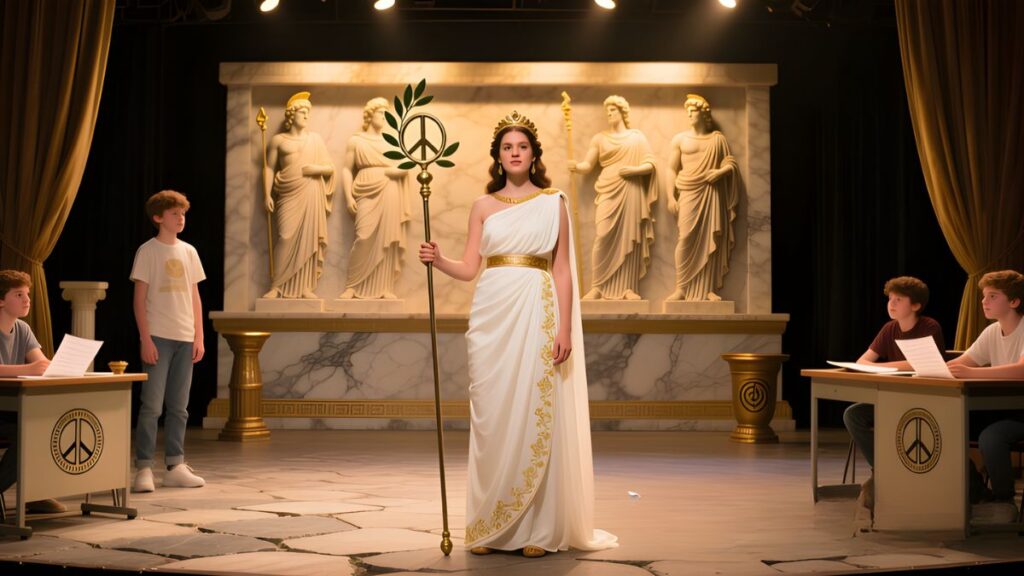
It all started on the first day of school. Normal first day vibes: backpack over one shoulder, coffee in hand, pretending I wasn’t nervous. Then the principal smiled at me… like way too much.
“Welcome to Olympus Academy,” she said.
I blinked. “Uh… excuse me?”
Turns out, Olympus Academy isn’t your average high school. Not even close.
Apparently, I had accidentally enrolled in a school for… gods. Students disguised as teens. Teachers disguised as humans. And me? Just a regular teen with zero divine powers. Perfect.
Cue panic.
The first hallway was chaos. Not normal high school chaos. Oh no. Divine chaos.
- Someone floated past me, books orbiting like tiny moons.
- A guy tripped over his own aura and ended up in a locker.
- Girls whispered and glared like gossip could literally send curses.
I clutched my schedule and prayed.
I met my first friend, Lila, near the cafeteria. She had a calm vibe, like she’d survived high school drama 10,000 times… which, honestly, she probably had.
“Don’t get too close to Zeus,” she whispered. “He flirts like a hurricane and punishes rivals like a typhoon.”
Great. Teenage romance… divine edition.
And then I met my rival: Cassandra. Gorgeous, perfect hair, smile like sunshine, but rumor had it she could literally turn people invisible with a glare.
“Nice backpack,” she said sweetly. Then smirked. “Hope you survive your first week.”
Epic fail. Already.
First class: History of… Well, themselves. Gods teaching about gods.
Hera was… our teacher. Obviously. Regal, intimidating, eyes that could see through your soul, and a mood like a brewing storm.
She clapped her hands. “Welcome, students. Jealousy and rivalry are natural. Handle them wisely, or I will intervene.”
I made a mental note: don’t mess with Hera.
The first lunch period was worse.
- Someone accidentally turned their salad into a small phoenix.
- Drinks floated in midair.
- Zeus (the teen version) winked at half the cafeteria and sent the rest of us into minor chaos.
I sat quietly, trying not to be noticed. Fail. Big fail.
Then came gossip. Divine gossip.
A simple rumor about who liked who escalated into… well, minor lightning storms in the hallway.
I learned fast: jealous gods are scarier than any human.
I tried to make friends outside of Lila. Made a mistake. Asked Apollo (yes, that Apollo, disguised as a piano-playing teen) for music notes.
He smiled. Then the piano floated into the ceiling. Notes shattered like glass. Everyone clapped.
I cursed myself silently.
One of the hardest parts? Crushes.
- Normal crush: awkward texts, shy smiles.
- Divine crush: literally controlling fate to make the object of your affection notice you.
- Result: chaos. Exploding cupcakes, floating lockers, and me trying to dodge a levitating lunch tray.
Lesson learned: never fall in love with a god… unless you want fireworks. Literally.
Rivalry reached its peak during the “Divine Talent Show.”
Cassandra and I ended up in the same group. Great. Not.
We had to collaborate to summon illusions. Easy? Nope. Every time I made a mistake, her glare turned my illusions into… weird things. A floating pizza. A small dragon. My ego.
Epic fail x 10.
Hera observed. Calm, regal, terrifying. She didn’t intervene… yet.
Finally, after multiple disasters, I snapped. “Look, I don’t care about impressing anyone. We need to work together or fail!”
Cassandra stared. Then… actually nodded. Progress.
We learned each other’s strengths.
- She was precise and creative.
- I was… surprisingly good at improvising.
- Lila guided us like a peacekeeper.
The illusions combined beautifully. Floating pizza became dragons, dragons became constellations. Chaos transformed into art.
After class, I realized something important.
Olympus Academy isn’t about winning. It’s about surviving. Jealousy, gossip, rivalries—they’re everywhere, even among mortals.
But how you handle them? That’s the real lesson.
Week two brought more challenges.
- Minor curses (spilled drinks turned into frogs).
- Unannounced storms in the gym.
- Hermes accidentally sent the entire schedule into orbit.
We survived. Barely.
One day, Hera called me to her office. Terrifying.
“Do you know why you’re here?” she asked. Eyes sharp as daggers.
“Yes… I think?” I stammered.
“Because you’re mortal. You bring perspective. You show these gods how to handle jealousy, loyalty, and friendship.”
I blinked. Wait, I’m a teaching tool?
“Yes,” she said. “You’ll learn self-confidence… whether you want to or not.”
I started embracing it.
- I didn’t let Cassandra intimidate me anymore.
- I learned to navigate gossip like a ninja.
- I even survived minor curses with dignity (mostly).
Slowly, I became part of the divine rhythm. Not perfect. Not godly. Just… human.
By the end of the semester, I had survived:
- Divine crush drama.
- Rivalries that could summon storms.
- Curses, illusions, and magical cafeteria chaos.
And I realized something: confidence isn’t about being perfect. It’s about surviving your own chaos with dignity… and maybe a little humor.
On the last day of school, Cassandra approached me.
“You’re… actually okay,” she said, smirking.
“Thanks,” I said. “You’re… terrifying, but okay too.”
We laughed. Friendship? Maybe. Respect? Definitely.
Hera watched from the doorway. Calm, regal, proud.
“You’ve learned well,” she said. “Balance power with humility. Jealousy with loyalty. Vanity with self-confidence.”
I smiled. Felt… accomplished. For a mortal, that is.
Walking out of Olympus Academy, I looked back. Students flying, glowing, chaos everywhere. And me? Just a teen. Human. Alive.
But I survived. And maybe, just maybe… I learned to handle divine-level drama without turning into a statue.
6. The Minotaur in the Mall
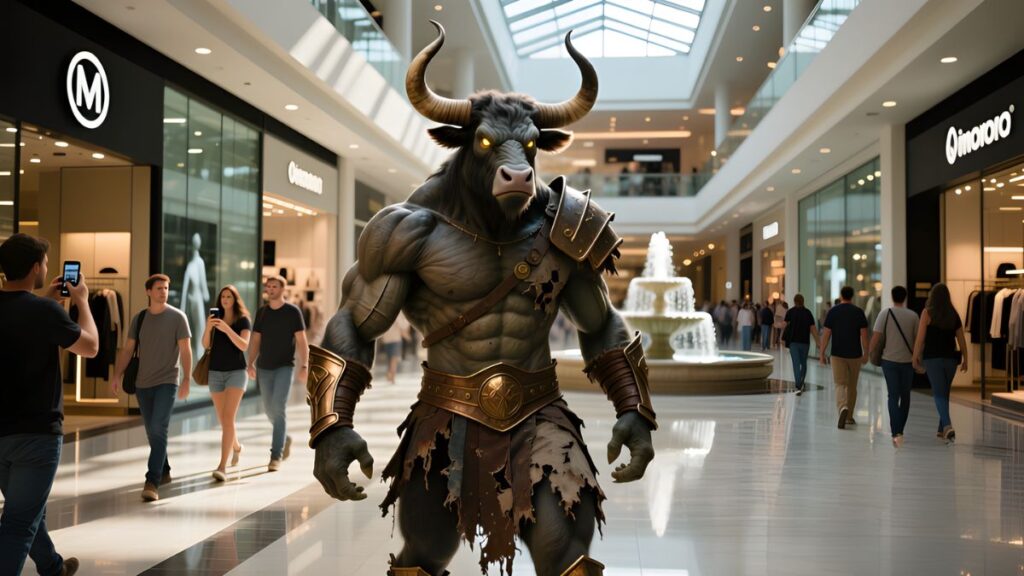
It started like any normal Saturday. My friends and I were at the mall, snacks in hand, complaining about how slow life was. You know, totally normal teen activities: window shopping, scrolling on phones, and pretending we had money.
Then the first roar happened.
I froze. Half a scream escaped my throat. Shoppers scattered. A woman dropped her latte. A toddler screamed. And there, in the center of the food court… stood a Minotaur.
Yes. A real, live, half-man, half-bull creature, looking confused, a little scared, and very, very big.
“Uh… guys?” I whispered to my friends.
Leo, of course, immediately whipped out his phone. “TikTok moment!”
“No! Not a TikTok moment!” I hissed. “We need to handle this… carefully!”
Marcus rolled his eyes. “And by carefully, you mean what? Hide behind Auntie Anne’s Pretzels?”
The Minotaur sniffed around, accidentally knocking over a kiosk of sunglasses. “Moo…?” it said.
I stared. Did it just… moo?
“Yes,” Leo whispered. “That’s what a Minotaur does when confused. Definitely true.”
We had to think fast.
Step one: evacuate civilians. We grabbed anyone nearby and ushered them toward exits. Moms with strollers, teens with shopping bags, that guy who clearly just came for Wi-Fi—everyone out.
Step two: assess the situation. Step three: do not panic. Epic fail warning: we panicked.
Jade, our resident mythology nerd, stepped forward. “This is… straight from Greek myths. Minotaurs are dangerous if cornered, but intelligent. We need to calm it and guide it back to wherever it came from.”
“Guide it… where?” I asked.
“Home. Somewhere magical. Probably a labyrinth or… an ancient portal. Typical Minotaur stuff.”
The Minotaur stomped toward the central fountain, tipping over a stack of pretzels.
“C’mon,” I muttered. “We need a distraction.”
Leo grabbed a shopping cart and, in a stroke of genius or insanity, tossed a soccer ball in front of the Minotaur. It paused. Sniffed. And then… kicked it perfectly across the floor.
“Okay,” I whispered. “We can work with this.”
We split tasks:
- Leo: distraction expert (throwing balls, flares, random snacks).
- Marcus: research assistant (reading plaques, scanning the mall for portals).
- Jade: translator (apparently Minotaurs communicate in gestures and groans).
- Me: coordinator (trying not to get trampled).
Step one: don’t die. Step two: guide the Minotaur.
It wasn’t easy.
- The escalator almost became a Minotaur roller coaster.
- The food court chairs flew like ninja stars.
- A mannequin was sacrificed. RIP.
And yet… somehow, we survived. Mostly.
We noticed a pattern. The Minotaur reacted to symbols: Greek letters etched into store tiles, murals in the mall, even the logo on a pizza box.
“Ah!” Jade exclaimed. “It’s looking for ancient markers! Like breadcrumbs leading it home!”
We nodded like this was normal. Teenagers deciphering magical labyrinth clues? Totally normal in 2025.
Step three: teamwork.
I held the Minotaur’s rope (which Leo found in the janitor’s closet). Jade guided with gestures. Marcus pointed out symbols. Leo… well, he continued tossing snacks. But somehow, it worked.
The Minotaur followed us, surprisingly cooperative, though occasionally mooing or flipping a table for emphasis.
The biggest challenge? Mall security.
- They had no idea why a giant bull-man was strolling through the food court.
- Pepper spray was involved. Not on purpose.
- Somehow, we convinced them to follow our “guided tour” story.
Then came the final obstacle: the portal.
A glowing symbol behind the fountain. Ancient Greek letters swirling. Perfect Minotaur-sized portal.
“Okay,” I whispered. “Moment of truth.”
Jade stepped forward. Made gestures. Marcus read the inscriptions aloud. I held my breath. Leo tossed a churro to calm the Minotaur.
It worked.
The Minotaur sniffed, looked at us, and… stepped into the portal. The light shimmered. And just like that… it was gone.
The mall returned to normal. Almost.
- Pretzels everywhere.
- Escalator slightly dented.
- The food court fountain… still dripping.
We glanced at each other.
“Did that just happen?” Marcus asked.
“Yes,” I said. “And we survived.”
Lesson one: courage matters.
Lesson two: empathy matters.
Lesson three: snacks are surprisingly useful in mythical creature management.
Later, we laughed about it. Made a TikTok (after getting permission). Everyone thought it was a stunt, which was perfect.
We had faced a Minotaur, decoded ancient clues, worked as a team, and learned more about ourselves than any school project could teach.
I looked at the mall, thinking about how normal it looked now. No trace of mythical chaos. No Minotaur. Just ordinary shoppers, mall music, and pretzel crumbs.
And yet… I knew that somewhere, magical worlds existed just under the surface. Waiting for the next group of teens brave—or stupid—enough to stumble into them.
7. Athena’s Online Challenge
It started like any other Friday night. Me, headphones on, gaming in my cluttered room. Energy drinks, snacks, and a controller that’s way too sticky from… past incidents. Totally normal teen gaming vibe.
Then I saw it.
A notification popped up on my phone. Simple icon: an owl perched on a shield. No app name. No description. Just… glowing.
“Uh… new app?” I muttered.
Tina, my best friend via Discord, messaged instantly. “Oooo, mysterious app. Don’t click it. Or do. Maybe it’s cursed.”
I smirked. Of course. Teen curiosity won. I clicked.
The screen shimmered. My room flickered. My cat hissed. And suddenly… a voice boomed.
“Greetings, mortal gamer. I am Athena.”
I nearly dropped my phone.
“Wait… what? Athena? Like… Greek goddess Athena?”
“Yes. And you, young strategist, have been chosen for a challenge of creativity, wisdom, and ethics,” the voice said.
I blinked. Okay, normal Friday. Totally.
Level one: creativity.
The app displayed a virtual city in chaos. Buildings crumbling, citizens panicking, and me? My task: design a solution to save everyone.
“Okay… I got this,” I whispered.
I built ramps, bridges, and floating platforms in the game. Citizens cheered. Confetti exploded. Athena’s voice hummed approvingly.
“Impressive. But do not grow complacent.”
Level two: wisdom.
A puzzle appeared. Riddles, logic tests, choices with consequences.
- If I lied, chaos spread.
- If I guessed randomly, disaster ensued.
- If I thought carefully, progress.
I realized quickly: this wasn’t just a game. Decisions mattered. Strategy, planning, thinking ahead.
I solved it. The screen glowed golden. Athena’s voice: “Well done. Wisdom guides you, but ethics will be your true test.”
Level three: ethics.
The game presented moral dilemmas.
- Save one character or save many?
- Tell a harsh truth or comfort a lie?
- Risk personal reward to help strangers?
I panicked. I hated decisions like this. In real life, I procrastinate on chores for hours, let alone life-or-death ethical choices in a divine app.
Choices made, consequences played out. Some characters were saved. Some weren’t. I learned: even when trying my best, I couldn’t control everything.
Athena’s voice: “Courage is not absence of failure, but striving despite it.”
I nodded. Or, well, I tapped my screen. Close enough.
By now, the app wasn’t just a screen. It transformed my room into a simulation. Holographic citizens ran past my bed. Miniature disasters popped up from snacks on the floor. My cat was judging me like an ancient deity.
Epic fail potential: high.
Tina texted, as usual. “You okay? Your room looks… burning?”
“Long story,” I typed. “Goddess of wisdom app challenge. Don’t ask.”
She responded: “Sounds normal. Carry on.”
Yeah. Totally normal.
The next levels tested collaboration. Athena introduced other players—some controlled by real teens, some… maybe demigods?
We had to solve tasks together:
- Build a safe bridge across a collapsing canyon.
- Negotiate with virtual mythical creatures.
- Design a city that balanced nature, technology, and happiness.
And guess what? My team kept bickering. Epic fail alert.
I realized I had to lead. Not bossy-leader, actual strategic-leader.
- Listen to everyone’s ideas.
- Combine creativity with practicality.
- Avoid chaos caused by overconfidence.
Somehow, we succeeded. The app glowed. Athena praised: “True wisdom involves guiding others wisely, not just acting alone.”
Level seven—or was it eight? Time got weird—tested foresight.
A simulation of future consequences. Every decision we’d made in prior levels played out.
- Poor planning = citizens in danger.
- Ethical mistakes = minor disasters.
- Creative solutions = stability.
I gasped. The game wasn’t forgiving. My mistakes had real weight—even in a virtual world.
At some point, I realized: Athena’s challenge wasn’t about winning.
It was about learning.
- Learning patience.
- Learning responsibility.
- Learning humility.
Epic fail wasn’t final. It was feedback.
By the final level, the stakes were high.
A mythical storm threatened a city. My team: 100% reliance on my strategy. Pressure: insane. My heart raced. My thumbs hovered over the screen.
“Okay,” I muttered. “No panicking. Focus. Trust the process.”
I directed the team. Coordinated efforts. Made ethical calls. Delegated tasks.
Citizens cheered. Storm subsided. City saved.
Athena’s voice: “You have done well. But remember… wisdom without action is meaningless. Courage without ethics is hollow. Creativity without responsibility is chaos.”
Then the screen shimmered. My room returned to normal. My cat blinked, judging as usual. My snacks remained untouched. My controller, sticky as ever, felt… ordinary again.
A final notification appeared: “Rewards granted. Lessons learned. Choose wisely how you use them.”
I smiled. Maybe legendary powers weren’t necessary. Maybe the real reward was… perspective.
Over the next days, I noticed subtle changes:
- I planned ahead more (even homework).
- I thought about consequences (even before arguing with friends).
- I collaborated better (yes, even with Marcus).
The app never appeared again. But the lessons? Permanent.
Tina noticed. “You’re… different. Calm, focused. Creepy, actually.”
“Shh,” I said. “Athena’s watching.”
She rolled her eyes. “Uh-huh. Sure.”
But secretly, I knew. Athena’s challenge wasn’t a game. It was a test. And I had survived.
Final lesson: real wisdom isn’t just knowing. It’s acting. Real courage isn’t fearless. It’s moving forward despite fear. Real creativity isn’t art. It’s problem-solving responsibly.
Epic fail moments? Plenty. Learning moments? Priceless.
Greek myths weren’t just stories. They were life lessons—sometimes delivered through apps, sometimes through chaos, always through experience.
And if Athena ever returns… I’ll be ready.
Why Teens Actually Get It (Even if We Won’t Admit It)
Greek mythology is secretly built for teens. Think about it:
Drama central
Sibling rivalries? Check. Crushes gone wrong? Check. People getting cursed because someone was jealous? Double check.
Epic stakes
If you think high school is intense, imagine gods who can literally ruin the world on a whim. Suddenly, your panic about forgetting your homework isn’t so dramatic.
Life lessons sneakily hidden in the chaos
Patience, resilience, humility… you name it. The Greeks basically wrote a teen self-help book, just way more fun and with monsters.
Honestly, I wish someone had told me this when I was fourteen. Instead, I just suffered through trying to memorize names I couldn’t pronounce. Lesson learned: you don’t have to get it right the first time to actually enjoy it.
Confessions of a Mythology Newbie
Let me level with you: I am still not perfect at Greek mythology. I mix up Persephone and Athena like it’s my full-time job. I think I might have accidentally cursed a character once because I misread something. Totally possible.
But here’s the weird part: the mistakes made it stick. Every epic fail, every “wait, what?” moment, made me want to dive back in.
Ever felt that way with something new? You try, you fail, and it’s so embarrassing you want to crawl under a rock. But somehow, that’s exactly the moment you start learning. That’s where curiosity actually kicks in.
So here’s a question for you: what’s one thing you’ve been too scared to try because you didn’t want to fail?
Gods, Mortals, and the Teen Angst Connection
Okay, quick analogy. You know how teens are basically living in a constant emotional hurricane? Greek mythology is just like that—but with superpowers.
- You’re jealous of your friend’s latest TikTok blow-up? Hera totally gets you.
- Your crush ignores you and it ruins your entire week? Aphrodite’s got thoughts on that.
- Feeling like no one gets your ambition? Hermes is literally the messenger of dreams (and chaos).
The point: even if the gods are over-the-top, the emotions are purely human. And that? That makes it super relevant for teens.
How Greek Mythology Makes You Surprisingly Witty
One thing I didn’t expect? Learning about Greek myths actually made me funnier. And I’m not talking “stand-up comedian” funny. I mean, suddenly, I could drop a reference like “I feel like Sisyphus right now” without anyone rolling their eyes. (Well, mostly.)
There’s something about knowing the epic failures and ridiculous antics of gods that gives you a kind of perspective. When your coffee spills, your life’s “end of the world” moment suddenly feels a bit… less catastrophic.
It’s like a secret club. Once you know the myths, you can see the humor in human behavior everywhere. And honestly, that’s priceless.
Lessons We Accidentally Learn (Even If We Don’t Want To Admit It)
Greek mythology sneaks in life lessons like a ninja. You might think you’re just reading about monsters, heroes, or gods throwing tantrums. But underneath it all:
- Resilience matters. Everyone fails, but even the biggest disasters have a comeback arc.
- Choices have consequences. This isn’t preachy; it’s just… dramatic. Mess up, and you learn quickly.
- Human emotions are timeless. Jealousy, pride, love, anger—they haven’t changed in thousands of years.
And teens? That’s basically your entire life summed up in one long, chaotic rollercoaster.
The Weird Appeal of “Why Did They Even Do That?”
If you’ve ever read a myth and thought, why on earth would someone do that?—welcome to the club. That’s actually part of the fun.
The Greeks didn’t write neatly packaged morals like your parents might want you to believe. They wrote chaos. Messy decisions. Impulsive moves. Complete disasters. And somehow, it’s addictive.
You start noticing patterns, laughing at the absurdity, and then—bam—you’re invested. You care about people who technically don’t exist. And suddenly, you’re learning without even realizing it.
Humor, Drama, and the Human Condition
Here’s a little secret: Greek mythology is hilarious if you pay attention. Not “ha ha” funny all the time, but “wow, they really did that?” funny.
- Gods overreacting to tiny slights? Check.
- Mortals getting cursed for basically no reason? Check.
- Someone turning into a plant or an animal as punishment? Check (and slightly horrifying).
It’s absurdity with a purpose. And as teens, we kind of get that absurdity. Life is weird, unfair, and totally random. Sometimes the only way to survive is to laugh—and Greek mythology is basically a laughing manual.
How Greek Mythology Makes You Brave (Sort Of)
Here’s a wild thought: reading about epic fails and tragic mistakes makes failure less scary. You see the gods mess up, heroes flounder, and humans—well, humans are always screwing things up. And yet… they keep going.
If a god can make a colossal blunder and still matter, maybe you can survive failing your own “epic quests”—like, you know, trying to talk to your crush, audition for a play, or submit that terrible first draft of your essay.
It’s kind of empowering. And yes, you might still eat metaphorical crow along the way. But at least now it doesn’t feel like the end of the world.
Greek Mythology as Life Training (Kinda)
Seriously. Once you start looking at myths as more than just old stories, it’s like getting free life coaching from ancient humans. You see patterns, mistakes, triumphs—and you start asking yourself questions:
- What would I do in that situation?
- How would I survive a betrayal like that?
- Could I deal with that kind of disappointment without losing it?
And even if you can’t, that’s okay. The Greeks didn’t get it right either.
Why We’ll Keep Coming Back
Here’s the thing: once you get hooked on Greek mythology, it’s addictive. Every failed hero, every petty god, every “wait, what?” moment pulls you in deeper.
It’s like a rabbit hole that’s equal parts hilarious, tragic, and enlightening. And the best part? You can laugh at yourself while you go down it. You don’t have to be perfect. You don’t have to understand everything. You just need to be curious.
Final Thoughts: What Greek Mythology Teaches Us About Being Teens
So, to sum up my accidental obsession: Greek mythology is messy, dramatic, ridiculous, and somehow perfect for us teens. It’s full of epic fails (literally), life lessons disguised as chaos, and characters who remind us that messing up is okay.
It’s a world where emotions are bigger than life, mistakes are spectacular, and resilience is the ultimate power-up. And honestly? If we can learn even a little from that, we might survive high school, awkward crushes, and all the minor disasters life throws at us.
And maybe, just maybe, we’ll stop feeling like total disasters when we trip, fail, or embarrass ourselves. Because if a god can eat metaphorical crow… we can too.