In the flicker of a firelight or under the shade of an olive tree, a tale can change how you see the world. Greek mythology stories with moral lessons do this again and again.
They feature gods, heroes, and ordinary people caught in choices that reveal human strengths and flaws. These stories are not just entertainment. They are short, sharp mirrors held up to human life.
This article explains how greek mythology stories with moral lessons teach. It shows why these old tales still matter, how you can retell them in ways that land with modern listeners, and how to use them in classrooms, book groups, or quiet personal reflection.
The goal is practical and clear. You will find ways to bring mythic wisdom into everyday life without losing the original power of the stories.
This guide is written for adults who want a thoughtful, accessible look at greek mythology stories with moral lessons. It will help parents, teachers, book clubs, and anyone curious about how ancient stories speak to modern dilemmas. Read on for a roadmap to themes, retelling methods, classroom activities, and trusted reading resources.
Greek Mythology Stories with Moral Lessons
What can the gods, heroes, and monsters of ancient Greece teach us about the choices we face today? Greek mythology stories with moral lessons turn thrilling adventures into timeless guides, showing how pride, curiosity, courage, and wisdom shape human life across the centuries.
Icarus and Daedalus

Icarus and Daedalus – Ambition, Hubris, and Lessons from the Sky
In the heart of Crete, Daedalus lived.
He was a master craftsman.
Known for his brilliance, he built statues that seemed alive.
Labyrinths he designed could confound the cleverest minds.
His fame reached King Minos.
The king desired a labyrinth to contain the Minotaur.
Daedalus created it with perfection.
No one could escape once inside.
But Minos feared Daedalus’s genius.
The king imprisoned him within his own creation.
Daedalus became a prisoner.
So did his young son, Icarus.
The walls that once protected secrets now confined the inventor.
Daedalus watched the birds above.
Their freedom stirred longing in his heart.
A solution came to him: wings.
Feathers bound with wax, crafted for flight.
Every detail mattered.
Every feather chosen with care.
Before attempting flight, Daedalus warned Icarus.
“Fly the middle path,” he said.
“Too high, the sun will melt your wings. Too low, the sea will weigh you down.”
Icarus nodded, but excitement shone in his eyes.
The day of escape arrived.
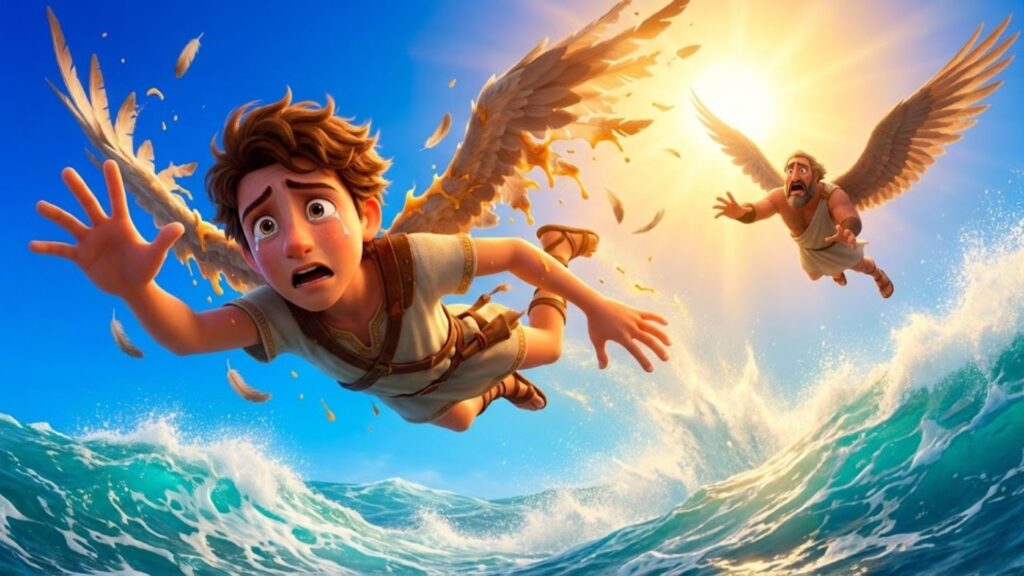
They leapt from the cliffs.
The wind filled their wings.
The sea glittered below.
Daedalus flew steadily.
Icarus followed, heart pounding.
The thrill of freedom surged through him.
He gazed at the sun.
Higher and higher, he climbed.
The wax began to soften.
Feathers loosened.
Icarus laughed, ignoring danger.
Then the wings failed.
He plummeted into the sea.
Daedalus could only watch.
The Icarian Sea bears his name.
The story warns against hubris.
Icarus’s ambition was natural.
But desire exceeded wisdom.
Greek mythology stories with moral lessons often dramatize consequences.
They teach without preaching.
Daedalus embodies guidance.
Icarus represents impulsive ambition.
The myth explores human desire.
Everyone wants freedom or achievement.
But unchecked ambition leads to downfall.
The story mirrors real life.
Technology, power, or innovation without caution can be destructive.
Psychologically, it shows thrill-seeking and temptation.
Icarus is the archetype of youthful daring.
Daedalus is wisdom in restraint.
Together, they teach balance.
The sky symbolizes freedom.
The sun symbolizes danger and consequences.
The sea represents mortality.
Hubris need not challenge gods to be fatal.
Self-overreach can destroy.
The myth highlights innovation.
Human ingenuity is powerful.
But it must be guided.
Failure is absolute here.
No second chances exist.
Parenting lessons emerge.
Daedalus guides; Icarus tests limits.
Mentorship and experience matter.
Icarus reflects risk-taking today.
Entrepreneurs, creatives, and athletes push boundaries.
Ambition drives progress.
But ignoring limits can fail catastrophically.
The story teaches responsibility.
Daedalus acted responsibly.
Icarus did not.
Consequences follow.
Mortality is embedded.
Exhilaration meets danger.
Life and choices are intertwined.
The myth resonates universally.
Youth often ignores advice.
Excessive confidence blinds judgment.
Greek mythology stories with moral lessons use vivid consequences.
The fall of Icarus is memorable.
It reinforces ethical truths efficiently.
The wings represent potential.
Potential must be managed.
Human creativity is double-edged.
The story encourages reflection.
Where are our limits?
When does ambition become hubris?
What guidance do we ignore?
The narrative preserves moral lessons.
Memory carries ethics across time.
Art and literature immortalize Icarus.
Pain and thrill frozen mid-air inspire reflection.
The myth models ethical teaching.
Ambition paired with caution forms wisdom.
The story shows limits of agency.
Even genius cannot control all variables.
Life is unpredictable.
Preparation reduces risk but never eliminates it.
The story is brief but impactful.
Clarity and symbolism deliver lasting lessons.
Daedalus exemplifies foresight.
Icarus exemplifies human impulse.
Balance is key.
Education benefits from this story.
Ethics, psychology, and human behavior can be explored.
Discussion encourages critical thinking.
Reflection exercises deepen moral understanding.
Ambition is universal.
We all face Icarian moments.
Exceeding limits without caution can harm.
The story contextualizes risk.
Failure becomes a tool for ethical insight.
Cultural impact is vast.
Icarus appears in paintings, poems, and films.
Artists depict him mid-fall.
Freedom and tragedy coexist.
Symbolism endures.
Educationally, the myth teaches analysis.
Students examine choices and outcomes.
Moral lessons arise naturally.
Parental guidance is embedded.
Mentorship is shown through action and warning.
Modern application is clear.
Technology, business, and relationships mirror the myth.
The narrative warns: heed experience, balance ambition.
Psychologically, thrill-seeking and youthful daring remain relatable.
Ambition must be tempered by caution.
The myth dramatizes consequences to teach ethics.
Icarus’s excitement leads to downfall.
Daedalus’s restraint provides guidance.
The story remains timeless.
It inspires, teaches, and warns simultaneously.
Symbolism of sky, sun, and sea endures.
Life’s exhilaration coexists with risk.
The fall teaches humility.
Greek mythology stories with moral lessons encode ethical truths in narrative.
Icarus’s hubris is a universal metaphor.
The tale resonates across cultures and generations.
Modern parallels are everywhere.
From entrepreneurship to personal decisions, ambition unchecked can harm.
Reflection and mentorship mitigate risk.
The myth encourages ethical awareness.
Balance between ambition and caution is timeless.
Lessons include listening, preparation, responsibility, and awareness.
Icarus is remembered not for success but for daring.
Stories preserve ethics.
Memory becomes moral compass.
The myth demonstrates consequences vividly.
Thrill and failure coexist in storytelling.
Greek mythology stories with moral lessons use this structure to embed ethics.
Art, literature, and education amplify these lessons.
Reflection exercises allow personal application.
Mentorship and guidance emerge as key themes.
Ambition, curiosity, and restraint intertwine.
Icarus is both a warning and inspiration.
Daedalus represents the guiding hand.
The narrative shows limits of human agency.
Even brilliance cannot prevent all mistakes.
Life is unpredictable.
Ethical insight comes from analysis of consequences.
Modern readers find relevance in career, creativity, and decision-making.
The story teaches responsibility.
Ambition without foresight leads to peril.
Guidance is valuable but not always heeded.
Youthful enthusiasm must be balanced with wisdom.
The narrative continues to inspire art, literature, and moral education.
Greek mythology stories with moral lessons remain impactful across centuries.
Icarus and Daedalus is a primary example.
The story’s brevity increases memorability.
Ethical reflection emerges naturally.
Ambition, hubris, restraint, and consequence are clearly illustrated.
Readers are invited to analyze their own Icarian moments.
The myth teaches enduring lessons in ethics, psychology, and human behavior.
It encourages reflection, personal growth, and awareness.
The wings symbolize potential harnessed or lost.
The fall dramatizes consequence.
Daedalus embodies wisdom.
Icarus embodies impulsivity.
Together, they illustrate balance.
The myth continues to educate, inspire, and warn.
It is an essential story in Greek mythology stories with moral lessons.
Pandora’s Box

Pandora’s Box – Curiosity, Consequences, and the Spark of Hope
Long ago, the gods gathered on Olympus.
Zeus ruled with authority.
He observed humanity.
Prometheus, the Titan, had gifted fire to mortals.
Zeus was furious.
Fire represented knowledge, progress, and power.
Humans now could create, cook, and forge.
This defiance angered the king of gods.
Zeus sought retribution.
He would punish Prometheus and humankind.
To balance justice, he conceived a plan.
A vessel would contain all woes and blessings.
It would teach a lesson without direct wrath.
Pandora, the first woman, was crafted.
Hephaestus formed her body from clay.
Athena bestowed skill and grace.
Aphrodite gave beauty.
Hermes added charm and cunning.
Pandora was divine and mortal at once.
She embodied allure and complexity.
Zeus presented her to Epimetheus, Prometheus’s brother.
Heedless, Epimetheus accepted her.
Pandora carried a jar, sealed tightly.
Curiosity stirred within her.
The jar was mysterious.
The gods warned her: do not open it.
Temptation lingered.
The unknown called to her.
Days passed in quiet anticipation.
Pandora’s curiosity grew.
She wondered what lay inside.
The vessel seemed to hum with secrets.
Finally, desire overcame restraint.
Pandora lifted the lid.
A whirlwind of evils escaped.
Sorrow, disease, strife, and pain poured forth.
Humanity shuddered.
The world changed.
Chaos now touched every life.
Yet, in the base of the jar, one gift remained.
Hope.
Elpis lingered, unbroken.
The myth illustrates human curiosity.
Curiosity is natural.
It drives learning and discovery.
Yet, unchecked, it can unleash unintended consequences.
Greek mythology stories with moral lessons frequently dramatize these outcomes.
The tale of Pandora emphasizes cause and effect.
Choices have repercussions beyond immediate understanding.
Curiosity, while a virtue, carries risk.
Hope, even in misfortune, offers resilience.
Pandora’s act mirrors human tendencies.
We peek behind doors we are warned not to open.
We explore forbidden knowledge.
Technology, secrets, and innovation echo Pandora’s jar.
The story warns without demonizing exploration.
It encourages responsibility.
Ethically, curiosity must be tempered with awareness.
Pandora’s name became synonymous with inquisitiveness.
Her story shapes psychology.
Impulsivity and temptation are universal.
Humans struggle with restraint.
Pandora’s jar symbolizes latent dangers.
The evils represent societal and personal struggles.
Disease, conflict, and suffering are metaphors.
Hope represents human resilience.
No matter what happens, hope persists.
Even in darkest moments, possibility remains.
The myth combines moral, psychological, and cultural lessons.
It explains the origin of human suffering.
Yet it also reassures.
Greek mythology stories with moral lessons often pair hardship with wisdom.
Pandora’s story is archetypal.
It teaches moderation.
It warns against acting without forethought.
It elevates hope as an ethical compass.
The narrative illustrates gender, divinity, and human nature.
Pandora is both a figure of curiosity and a cautionary model.
She teaches humility.
Humans cannot control all outcomes.
Unforeseen consequences follow actions.
The jar’s lingering hope symbolizes moral optimism.
Even when mistakes occur, recovery is possible.
Pandora’s myth has parallels today.
Information overload, viral rumors, and unchecked exploration mimic the jar.
Ethical reflection is crucial.
Curiosity drives science, art, and discovery.
But impulsive acts can create crises.
The story provides timeless guidance.
Psychologically, humans balance desire and fear.
Pandora represents internal conflict.
Temptation challenges morality.
Hope sustains resilience.
Educationally, the story engages moral reasoning.
Students and readers analyze consequences of choices.
They reflect on risk, curiosity, and ethical boundaries.
Greek mythology stories with moral lessons embed these principles naturally.
The narrative is vivid.
Chaos erupts immediately.
The aftermath is long-lasting.
Visual imagery enhances memory.
The jar is a symbol of duality.
It contains both suffering and potential.
Life mirrors this duality.
Every action may yield benefit or harm.
Hope acts as a guiding principle.
The myth encourages critical thinking.
Why did Pandora act?
Could restraint have prevented disaster?
Is hope sufficient to overcome challenges?
Ethical discussion emerges from narrative.
Modern life mirrors the myth.
New technologies, viral trends, and secret knowledge parallel the jar.
Curiosity must be balanced with foresight.
Hope sustains individuals and societies.
The story teaches resilience.
Suffering is inevitable.
Yet the human spirit can endure.
Greek mythology stories with moral lessons often combine narrative and ethics.
Pandora’s Box exemplifies cause, effect, and enduring optimism.
The myth explores responsibility.
Actions have consequences beyond immediate understanding.
Curiosity can be constructive or destructive.
Hope is the antidote to despair.
In literature and art, Pandora inspires.
Visual and literary retellings emphasize emotion and consequence.
Artists depict chaos, despair, and the small glimmer of hope.
The story teaches reflection.
Readers ask: How does curiosity shape my life?
How do I balance exploration with caution?
Ethical decision-making is central.
The myth provides insight into human behavior.
Pandora represents the tension between desire and restraint.
Her act teaches lessons in foresight, responsibility, and optimism.
The evils represent external and internal threats.
Hope represents internal resilience.
Together, they form a moral framework.
Greek mythology stories with moral lessons continue to influence modern education.
The story encourages discussion of ethics, psychology, and culture.
It illustrates timeless principles.
Pandora’s act is relatable.
Humans constantly confront temptation.
Impulse and curiosity are natural.
Consequences, however, are universal.
Hope sustains continuity.
The myth shows balance is essential.
Too much curiosity can harm.
Too little exploration can hinder growth.
Ethical reflection must guide action.
Greek mythology stories with moral lessons often dramatize outcomes for clarity.
Pandora’s story provides a clear framework for understanding human behavior.
Temptation, impulse, consequence, and resilience are central.
The narrative blends storytelling, moral insight, and psychology.
It teaches across generations.
Educationally, the story is engaging.
It can be analyzed in classrooms or book clubs.
Modern parallels include information, innovation, and ethics.
The myth provides context for reflection.
Hope is central to moral lessons.
Even in adversity, action guided by ethics and awareness maintains potential.
Pandora exemplifies complexity.
She is neither purely innocent nor malicious.
She embodies human traits: curiosity, desire, and decision-making.
The jar represents life’s unpredictability.
Greek mythology stories with moral lessons encode ethics through metaphor.
Pandora’s Box remains a classic example.
It teaches foresight, restraint, consequence, and resilience.
The narrative provides psychological, educational, and ethical insights.
It inspires reflection and discussion.
Modern readers see parallels in information, innovation, and curiosity.
Hope remains the enduring moral.
Even when mistakes occur, humans can recover.
Greek mythology stories with moral lessons preserve timeless wisdom.
Pandora’s story is universally relevant.
The myth illustrates ethical principles vividly.
Curiosity, consequence, and hope coexist.
Life mirrors these tensions.
The jar is symbolic of duality.
Chaos and hope exist side by side.
Ethical reflection guides action.
The myth teaches responsibility and resilience.
Modern application is clear.
Students, educators, and readers engage with the narrative.
They analyze outcomes and consequences.
Discussion fosters moral reasoning.
Greek mythology stories with moral lessons achieve enduring relevance.
Pandora’s act teaches balance between curiosity and foresight.
Hope sustains the human spirit.
Even amidst chaos, guidance and reflection prevail.
The myth remains essential reading.
It educates, inspires, and cautions.
Greek mythology stories with moral lessons continue to resonate.
Pandora’s Box exemplifies ethical storytelling.
It illustrates timeless principles and human nature.
Reflection, discussion, and analysis enhance understanding.
The story is a model of cause, consequence, and moral guidance.
Curiosity, responsibility, and hope remain central.
Human behavior mirrors the myth.
Ethics and psychology intertwine.
The narrative persists across centuries.
It teaches lessons applicable to modern life.
Greek mythology stories with moral lessons are effective precisely because they dramatize consequences.
Pandora’s curiosity unleashed suffering.
Hope remained.
Humanity learned.
The story endures.
It is a cornerstone of ethical education and reflection.
The myth bridges ancient and modern contexts.
Life, curiosity, consequence, and hope continue to resonate.
Pandora’s Box remains a guiding story.
Greek mythology stories with moral lessons preserve wisdom.
Curiosity must be tempered with foresight.
Hope sustains resilience.
Ethics guide action.
The narrative inspires reflection.
It remains relevant in modern education, literature, and personal growth.
Pandora teaches that choices matter.
Curiosity carries weight.
Hope ensures continuity.
The myth dramatizes principles memorably.
Ethical reasoning is embedded in narrative.
Greek mythology stories with moral lessons endure because of clarity, drama, and insight.
Pandora’s Box is timeless.
It teaches responsibility, restraint, and optimism.
It encourages reflection and growth.
It resonates psychologically, culturally, and ethically.
Humans continue to learn from the myth.
Curiosity and hope remain universal.
Pandora’s Box is a model story.
It instructs, inspires, and warns.
Greek mythology stories with moral lessons remain a treasure trove of timeless guidance.
King Midas and the Golden Touch

King Midas ruled a wealthy kingdom.
Gold surrounded him.
Treasure filled his halls.
Yet none of it satisfied him.
Midas wanted more.
He believed wealth defined happiness.
He believed gold guaranteed power.
His desire grew stronger each day.
This longing shaped his decisions.
It shaped his character.
And it shaped his fate.
One morning, Midas helped a wandering satyr.
The satyr belonged to Dionysus, the god of wine.
Dionysus came to thank Midas for his kindness.
The god offered a wish.
Anything Midas wanted.
The king did not hesitate.
He asked to turn anything he touched into gold.
Dionysus hesitated.
He knew human desire could be dangerous.
But he granted the wish.
Midas felt victorious.
He admired his hands.
They now held limitless potential.
He touched a small stone.
It became pure gold.
He touched a flower.
Petals hardened into shining metal.
Midas laughed with joy.
He saw no danger.
He saw only opportunity.
He walked through his palace.
Everything he brushed turned golden.
Walls gleamed.
Vases transformed.
Furniture glowed.
He felt unstoppable.
Wealth now came effortlessly.
He believed he had achieved perfection.
But hunger interrupted his celebration.
He reached for grapes.
They became gold.
He lifted bread.
It hardened instantly.
He could not eat.
He tried water.
It turned solid.
Fear replaced pride.
He felt the weight of his decision.
His wish was destroying him.
In greek mythology stories with moral lessons, the turning point always arrives sharply.
For Midas, it came in a moment of hunger and panic.
He understood the curse he had created.
He tried to avoid touching anything.
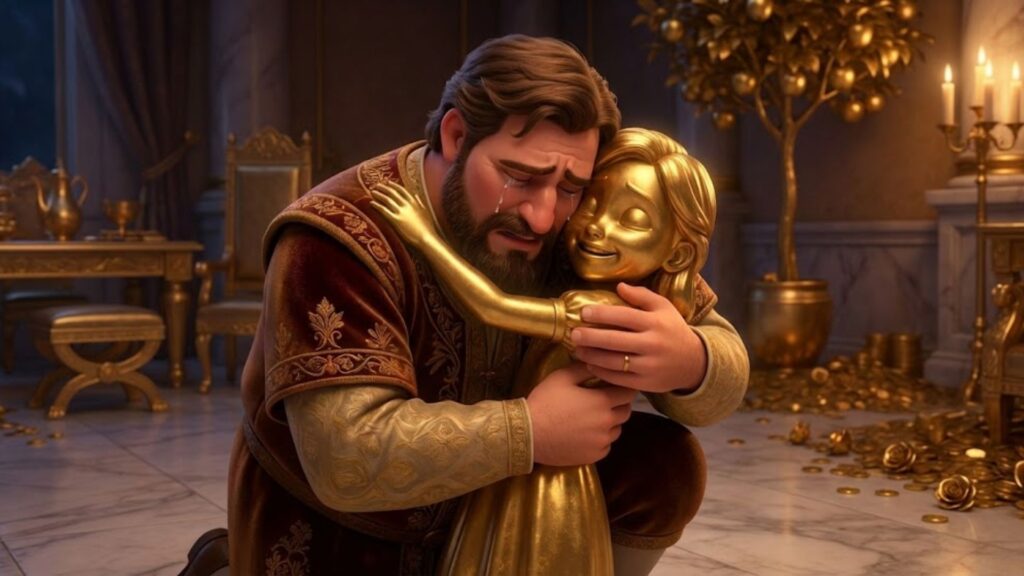
But his daughter ran to him.
She embraced him with love.
He could not stop her.
She turned to gold instantly.
Midas froze.
Terror swallowed him.
Greed had taken what he loved most.
He collapsed in grief.
His palace felt cold.
His wealth felt empty.
Gold offered no comfort.
It offered no warmth.
No love.
No life.
He cried out to Dionysus.
He begged for mercy.
He begged to undo the wish.
Dionysus appeared again.
The god saw the pain on Midas’s face.
He told Midas to wash himself in the river Pactolus.
Only water could cleanse the curse.
Midas ran to the river.
He stepped into its flow.
The water shimmered around him.
The golden power left his hands.
He scooped water over his head.
It washed away the greed.
The river carried the magic downstream.
Midas felt relief.
He hurried home.
His daughter returned to life.
The palace regained its natural colors.
His world felt real again.
He embraced his daughter with gratitude.
He realized what mattered.
Not gold.
Not wealth.
Love mattered.
Life mattered.
Family mattered.
Greek mythology stories with moral lessons often end with reflection.
Midas learned deeply.
He changed his life.
He no longer chased treasure.
He lived simply.
He appreciated small joys.
His garden.
His people.
His family.
His experience taught him humility.
The golden touch became a symbol.
It symbolized the danger of excess.
It symbolized the cost of desire.
It symbolized the emptiness of greed.
The myth remains relevant today.
People still chase wealth.
People still believe money solves everything.
People still forget balance.
Midas reminds readers to pause.
He reminds people to reflect.
He reminds them to value what cannot be bought.
Relationships.
Health.
Time.
Inner peace.
The story examines human nature.
Desire grows quickly.
Greed grows quietly.
Ambition can overtake wisdom.
Greek mythology stories with moral lessons often use kings and heroes to mirror everyday struggles.
Midas mirrors modern society.
Many measure success by material gain.
Many seek more than they need.
Many forget gratitude.
Midas’s curse is symbolic.
Everything he touched became useless.
It became beautiful but lifeless.
It became precious but hollow.
The myth teaches that desire without restraint destroys value.
Too much of anything becomes harmful.
Even something as admired as gold can ruin life when taken to extremes.
Midas did not consider consequences.
He acted from impulse.
This pattern appears in many greek mythology stories with moral lessons.
Characters act quickly.
They face consequences deeply.
Readers learn by watching their mistakes.
Midas’s transformation is emotional.
He starts proud.
He becomes excited.
Then confused.
Then horrified.
Then humbled.
His emotional journey holds the lesson.
Greed blinds judgment.
Desire creates illusions.
Loss reveals truth.
The myth highlights gratitude.
Midas had enough.
He simply could not see it.
Gratitude becomes clear only after he loses everything.
Many people experience similar lessons.
They appreciate things only after they disappear.
Family.
Time.
Health.
Moments.
Midas teaches appreciation before loss.
Greek mythology stories with moral lessons often use extreme events to emphasize simple truths.
The myth also explores parental love.
Midas’s greatest regret was harming his daughter.
Her transformation broke him.
It exposed the cost of selfishness.
Love and greed do not coexist.
His daughter represented innocence.
Her loss represented clarity.
Her return represented redemption.
Midas’s redemption is powerful.
He did not remain trapped.
He corrected his mistake.
He accepted his wrongs.
He chose humility.
Redemption is a major theme in greek mythology stories with moral lessons.
The story also explores responsibility.
Midas asked for the wish.
He created the problem.
He suffered the result.
He had to fix it.
Responsibility strengthens character.
Avoiding blame helps no one.
Midas accepted fault, and that acceptance saved him.
There is symbolic meaning in the elements.
Gold symbolizes desire.
Touch symbolizes influence.
The daughter symbolizes love.
The river symbolizes purification.
Water symbolizes renewal.
Each element supports the lesson.
Greek mythology stories with moral lessons often use nature and symbolism to deepen meaning.
The river Pactolus became famous.
According to myth, its sands turned golden from Midas’s power.
This symbolizes how actions create lasting impact.
Good or bad, choices echo.
The myth encourages thoughtful decision-making.
Before desiring something intensely, one must consider the consequences.
Every wish carries weight.
Every choice has a ripple.
Midas reveals the risk of short-term pleasure.
He wanted immediate wealth.
He ignored long-term effect.
The golden touch became a curse disguised as a blessing.
This reflects modern life too.
Quick gains often hide hidden costs.
People sacrifice health for money.
People sacrifice relationships for success.
People sacrifice time for status.
Midas teaches balance.
Wealth is not wrong.
Greed is the problem.
Wanting comfort is natural.
But losing yourself for it is dangerous.
The myth warns against confusing value with price.
Gold has a price.
Love does not.
Life does not.
Kindness does not.
Many greek mythology stories with moral lessons highlight this difference.
Midas learned through suffering.
Readers learn through empathy.
His journey is a reminder.
Gratitude leads to peace.
Greed leads to destruction.
Balance leads to wisdom.
The myth remains timeless.
It speaks to children.
It speaks to adults.
It speaks to leaders.
It speaks to anyone tempted by excess.
The lesson is simple.
More is not always better.
Sometimes it is worse.
True wealth comes from understanding what matters.
Midas eventually reclaimed this truth.
He rebuilt his life with gratitude.
He let go of excess.
He embraced simplicity.
He valued people over possessions.
His transformation inspires readers to reflect on their own relationship with material things.
Greek mythology stories with moral lessons continue to resonate because they use dramatic tales to teach deep truths.
Midas’s story is one of the clearest examples.
It reminds people to think before acting.
It reminds them to appreciate what they have.
It reminds them that love and life outweigh gold.
His journey remains a guide for anyone facing temptation or desire.
It teaches moderation, responsibility, gratitude, and humility.
That is why the myth endures.
That is why it remains essential.
And that is why King Midas stands among the most powerful greek mythology stories with moral lessons ever told.
Prometheus Bound

Prometheus is one of the most meaningful characters in greek mythology stories with moral lessons because his actions shaped the entire destiny of humankind. His story is not about glory or reward. It is about sacrifice, courage and choosing to do the right thing even when the cost is unbearable.
In a world ruled by powerful gods, Prometheus stood out as someone who cared more for humans than for divine approval. This decision shaped his life and created one of the most powerful lessons in all mythology.
The story begins long before his punishment. Prometheus was a Titan, part of an older generation of divine beings. While many Titans opposed Zeus in the great war, Prometheus chose to support Zeus. He believed the new order would bring balance. Because of this, Zeus trusted him. Prometheus used that trust to influence the creation of humankind.
He shaped humans from clay with careful hands. He wanted them to be strong, curious and capable. He imagined a race that would grow, learn and build. Zeus, however, did not see humans the same way. To him, they were fragile and unimportant. He believed they should remain dependent on the gods forever.
Prometheus saw potential where Zeus saw limits. This difference in perspective created the conflict that would eventually define his destiny.
Once humans were created, Prometheus wanted them to survive. He watched them struggle in the cold, unable to cook food, unable to melt metal, unable to protect themselves. Fire was the key to their growth, but Zeus had forbidden it. Zeus believed fire gave humans too much power. He feared they would become bold and forget their place.
Prometheus disagreed. He believed progress was not dangerous. It was necessary. He looked at the people living helplessly and felt a deep responsibility. He had shaped them. He could not let them suffer.
So Prometheus made a choice that changed everything. He climbed Mount Olympus secretly and stole fire from the gods using a hollow fennel stalk. It was a small flame, but it carried unimaginable strength. When he brought the fire to humans, their entire world transformed.
They learned to cook, to forge weapons, to build stronger homes. Fire gave them control. It gave them hope. It made them independent. And independence was exactly what Zeus feared.
Zeus was furious when he discovered what Prometheus had done. It was not just disobedience. It was empowerment of a race Zeus wanted to keep weak. Humans now had a tool that gods believed should remain sacred. Zeus felt betrayed.
Prometheus knew the punishment would come. He had acted with full awareness of the consequences. He placed the needs of humans above his own safety. That is the core of his moral lesson. Sacrifice without regret.
Zeus decided on a punishment that would not simply hurt Prometheus. It would make him suffer endlessly. He wanted Prometheus to understand that defying the gods came with a price. A price designed to break him.
Prometheus was taken to a remote mountain, often said to be the Caucasus. He was chained to a rock with unbreakable bonds forged by Hephaestus. These were not ordinary chains. They were designed to hold a Titan, and they ensured he could not escape.
Every day, an eagle descended from the sky. This was no ordinary eagle. It was a symbol of Zeus and an instrument of punishment. The eagle would tear into Prometheus’s liver and eat it. The pain was unimaginable. But because Prometheus was immortal, his liver would grow back each night. The next day, the torture began again.
This cycle repeated endlessly. Morning after morning, the eagle returned. Night after night, his body healed. The pain never stopped. Neither did his resilience.
Prometheus did not cry out for mercy. He did not beg Zeus for forgiveness. He accepted the punishment as the cost of his choice. He believed humans were worth the suffering. That belief kept him strong. His endurance became the most powerful part of the story.
Humans continued to grow because of the fire he gave them. Civilizations developed. Tools improved. Knowledge expanded. Prometheus knew every day that his sacrifice was not in vain. That purpose kept his spirit alive.
People began to respect him as a symbol of courage. Even the gods observed his strength. Some gods believed the punishment had gone too far. Zeus, however, remained firm. To him, this was justice.
Years passed. Centuries passed. Prometheus stayed chained. The eagle continued its daily attack. The world kept moving forward, but he remained on the rock, bearing the weight of his choice. His endurance turned him into a figure of hope. Anyone who suffered for something good could see a reflection of themselves in him.
One day, a hero from a later age appeared. His name was Heracles, known to humans as Hercules. During his journeys, he came across Prometheus bound to the rock. Heracles was shocked by what he saw. The suffering seemed endless and unfair.
Heracles asked Prometheus about the reason for his punishment. When he learned the truth, he felt deep respect. He understood that Prometheus had suffered for the sake of humanity. Heracles believed such sacrifice deserved freedom, not eternal pain.
Despite knowing Zeus had ordered the punishment, Heracles lifted his bow. With one perfect arrow, he struck the eagle and killed it. The endless torture stopped. Prometheus could finally breathe without fear of the next morning.
Heracles then broke the chains. Even the unbreakable bonds of Hephaestus shattered under his strength. Prometheus was free after countless years. His body still bore the scars of his suffering, but his spirit remained unbroken.
When Zeus learned what Heracles had done, he did not react with the same rage as before. He respected Heracles’s courage and allowed the freedom to stand. Zeus understood that Prometheus had paid enough for his choice. Some myths say Zeus agreed to free Prometheus only under the condition that a part of him remained bound forever. Others say Zeus softened over time and accepted that humanity had already changed.
Either way, Prometheus walked away from the mountain. He returned to the world he had helped shape. Humans still honored him. They lit flames in his name. They remembered the one who gave them fire.
The story of Prometheus is powerful because it explores what it means to stand up for others. He knew what the risk was. He understood the punishment. But he chose compassion over obedience. He chose courage over fear. He chose to help those who could not help themselves.
This is why Prometheus remains one of the most meaningful figures in greek mythology stories with moral lessons. His story teaches that doing the right thing sometimes requires suffering. It shows that sacrifice is not weakness. It is a sign of strength. It also teaches that perseverance can outlast even the harshest punishment.
Prometheus’s act changed the entire human journey. Fire became a symbol of knowledge and progress. His sacrifice became a symbol of love for humanity. And his endurance became a symbol of unbreakable will.
His story reminds us that every major step in human progress has a cost. Someone must take a risk. Someone must challenge the limits. Someone must be willing to stand alone.
Prometheus was that someone.
His story continues to inspire because it feels real. It reflects the struggles we face when we choose what is right over what is easy. It shows that one act of courage can change the world.
And that is the moral of Prometheus Bound. Sacrifice. Perseverance. And standing up for the greater good, even when the price is heavy.
Narcissus and Echo

Narcissus and Echo is one of the most symbolic greek mythology stories with moral lessons because it explores something we still see today. The danger of loving ourselves so much that we forget the world around us. And the pain that follows when attention becomes more important than empathy.
Their story feels modern even though it is ancient. It shows what happens when obsession replaces connection. It also shows how misplaced love can destroy people who simply wanted to be seen.
Narcissus was known everywhere for his beauty. People talked about him constantly. Some said he looked like a young god. Others said he was the most perfect face they had ever seen. Wherever he went, people stared. Some admired him. Some fell in love at first sight.
But Narcissus did not care.
He enjoyed being admired, but he did not care for the feelings of others. He felt he was above everyone. He believed no one was worthy of him. Compliments made him proud. Attention made him confident. But he offered no warmth in return.
Echo was completely different.
She was a nymph who loved conversation. She had a bright voice and a cheerful spirit. She enjoyed talking to everyone she met. But she had one major flaw. She talked too much. She talked so much that she distracted Hera, the queen of the gods, from discovering Zeus’s affairs.
Hera punished her in a way that hurt her deeply.
She took away Echo’s ability to speak freely. Echo could no longer start a conversation. She could no longer use her own words. She could only repeat the last words spoken to her. Nothing more.
It was a painful punishment. Echo had lost her own voice. She had lost her identity. She had lost the one thing she loved most.
After that, she avoided crowds. She stayed in quiet places. She listened more than she spoke. Her heart grew heavy with the silence she carried.
One day, she saw Narcissus in the forest.
He was walking through the trees, unaware of how stunning he looked. Sunlight filtered through the leaves and landed on him gently. Echo saw him and felt her heart race. She fell in love instantly. But she could not walk up to him and speak.
She hid behind the trees, hoping he would say something she could repeat.
Narcissus called out to his hunting friends. “Is anyone here?” he shouted.
Echo felt a spark of hope. “Here,” she repeated softly.
He looked around, confused. “Come to me.”
“Come to me,” Echo repeated.
Narcissus frowned. He did not understand what was happening.
“Why are you hiding?” he said.
“Hiding,” Echo echoed.
She moved closer. Branches cracked under her feet. Narcissus heard the sound and turned toward her. When she stepped out, her eyes were full of hope.
She reached out her arms.
But Narcissus pulled back instantly. He looked at her as if she were a stranger invading his world.
“Do not touch me,” he said sharply.
“Touch me,” she whispered helplessly.
He stepped away with disgust. “I would rather die than let you love me.”
“I love you,” Echo echoed, her voice breaking.
Narcissus walked away, leaving her behind.
Echo watched him go. She had waited for his affection. She had hoped for kindness. She received rejection instead. A rejection that sank straight into her heart. She ran into the forest and hid among the rocks.
Day by day, she grew quieter.
Her body weakened. Her spirit faded. She wasted away from heartbreak. In time, her physical form disappeared. Only her voice remained. A faint echo that still answers when someone calls into empty places.
But the story does not end with her suffering.
The gods saw what Narcissus had done. They saw his coldness. They saw his pride. They saw the pain he caused without regret. Someone prayed for justice. Some say it was a rejected lover. Others say it was Echo herself. Whoever it was, the gods listened.
Nemesis, the goddess of retribution, decided Narcissus needed to learn a lesson.
One afternoon, she led him to a still pond hidden deep in the forest. The water was so clear it looked like glass. Narcissus leaned over to drink. When he saw his reflection, he froze.
He had never seen himself like this.
He had admired his beauty through others’ eyes. But now he saw it directly. And he fell in love instantly. Deeply. Completely.
He could not look away.
He touched the water gently, hoping the reflection would touch him back. But the image rippled and disappeared. When the water stilled again, his reflection returned. He reached for it again. The reflection broke again.
He did not understand why he could not touch the one he loved. He became desperate. He spoke softly. “Please stay,” he said.
“Stay,” the reflection replied silently.
He felt a pain he had never experienced. The pain Echo knew too well. The pain of loving someone who could not return the love.
He stayed by the pond day after day. He forgot to eat. He forgot to sleep. He forgot the world. All he cared about was the beautiful face in the water.
Slowly, his strength faded.
Nature watched his suffering. The trees whispered. The wind grew still. Narcissus began to realize something terrible. The face he loved was his own. And yet he could not hold it. He could not be with it. He loved someone who existed only in illusion.
The same fate he had given Echo was now given to him.
He knew he was doomed.
One day, he leaned toward the water for the last time. His body collapsed. The reflection vanished forever. When the nymphs came searching for him, they found a flower blooming where he had died. A delicate white and yellow bloom.
They named it the narcissus flower.
It grew by the pond, gently bowing its head as if always looking at its own reflection. A reminder of his story. A reminder of his flaw.
Echo’s voice still lingered in the forest. When the nymphs called her name, her voice answered faintly. She had become part of the world. Part of every canyon, cave, and empty valley.
Their story became a permanent lesson.
It warns us about vanity. It warns us about the danger of loving ourselves so deeply that we forget others exist. It warns us about obsession. Narcissus lost himself to his reflection. Echo lost herself to her love for him.
The moral is simple. Self-love is healthy. Self-obsession is destructive. And admiration from others does not mean we are complete. Beauty is not enough. Attention is not enough. Without empathy, without kindness, without connection, beauty becomes hollow.
Narcissus teaches us that pride can trap us in our own reflection. Echo teaches us that losing our voice for someone else leaves us empty. Together, they show a balance we still struggle with today.
That is why this myth remains one of the most important greek mythology stories with moral lessons. It feels timeless. It feels real. It speaks to our lives, our relationships and our culture. It stays relevant no matter how much the world changes.
Narcissus and Echo remain symbols. One of reflection without connection. One of love without voice. And their story reminds us that love should lift us, not destroy us.
Orpheus and Eurydice

Orpheus and Eurydice is one of the most emotional greek mythology stories with moral lessons because it speaks about love, loss, trust and the heartbreaking cost of a single moment of doubt. It is a story that stays gentle and painful at the same time. It shows how fragile happiness can be and how quickly one choice can change everything.
Orpheus was the son of Calliope, the muse of poetry. He inherited her gift in its purest form. His music was unlike anything the world had heard. When he played the lyre, forests grew silent. Rivers slowed. Animals gathered around him. Even stones seemed to listen.
People said his music could calm storms, soften the anger of warriors and bring peace to troubled hearts. His songs carried emotion so deep that anyone who listened felt understood. For many, he was a miracle. For Orpheus, music was simply part of his soul.
Eurydice was a gentle woman who lived nearby. She was kind, thoughtful and full of quiet grace. She loved nature, flowers and warm afternoons. She lived simply, but with a heart that glowed softly. When she heard Orpheus sing for the first time, she felt her entire spirit lift.
Orpheus saw her listening from a distance. The way she smiled made him pause. The way she blushed made him look again. Their first meeting was natural, almost effortless. They walked together. They spoke softly. Their connection grew instantly.
Their love was calm at first. It grew not through dramatic moments, but through small ones. Shared laughter. Quiet talks. Walks through meadows. Time made them inseparable. People said they lived in their own gentle world, a world shaped by Orpheus’s music and Eurydice’s warmth.
They married under the open sky.
The ceremony was filled with joy. Music flowed. Nature seemed to celebrate with them. The breeze was soft. The flowers bloomed brighter. Their happiness felt complete.
But happiness in myths often sits close to tragedy.
Shortly after their wedding, Eurydice walked alone through a meadow. She enjoyed the peace. She hummed Orpheus’s melodies. She touched the petals of flowers gently. Nothing felt dangerous. Everything felt safe.
But danger sometimes hides in small places.
As she walked, a snake lay hidden in the grass. She stepped too close. The snake struck quickly. The venom worked fast. Eurydice collapsed. Her breathing slowed. Her voice weakened. Within minutes, she was gone.
Orpheus arrived too late.
He held her in his arms. He called her name. He cried out into the sky. His music turned into a sound of raw pain. His songs filled the air with grief. Nature mourned with him. Trees bent. Birds fell silent. Rivers darkened.
He could not accept her loss.
He refused to let death take her forever. So he decided to do the unthinkable. He would travel into the Underworld. No living person had ever walked there willingly and returned. But his love was stronger than fear.
He walked through dark caverns. He walked through shadows. He walked through places where the air grew heavy and cold. He played his lyre as he moved. The music guided him like a flicker of light in darkness.
At the entrance to the Underworld, spirits drifted around him. Some cried. Some whispered. Some tried to pull him away. But his music softened their sorrow. They parted to let him pass.
He reached the River Styx.
Charon, the ferryman, guarded the crossing. He did not carry the living. But when Orpheus played a gentle melody, even Charon felt a softness in his ancient heart. He allowed him to board the boat.
The river was silent. Mist surrounded them. The water felt cold and endless. But Orpheus played through the journey, and the sound kept the shadows calm.
On the other side, he faced Cerberus, the three-headed dog. A creature feared by gods and humans alike. Cerberus growled fiercely, ready to attack. But Orpheus played again. A soft, lullaby-like tune. The dog’s heads lowered. Its growls faded. It lay down and allowed him to pass.
Orpheus walked deeper.
He reached the throne of Hades and Persephone. Hades ruled the dead. He was powerful, stern and unbending. Persephone carried grace in darkness. She understood loss. She understood love.
Orpheus bowed. He began to sing.
He sang of meeting Eurydice.
He sang of loving her.
He sang of losing her.
His voice trembled. His heart poured through every note. His grief filled the Underworld. Even the spirits paused to listen. Even the shadows softened. Even Hades felt something stir in him.
Persephone turned to her husband. She whispered gently.
Hades sighed. He rarely bent rules. But love as pure as Orpheus’s was rare. And his song had touched something deep within the ruler of the dead.
Hades finally spoke.
He would allow Eurydice to return. But there was one condition. A simple, painful, important condition.
Orpheus must walk ahead. Eurydice would follow behind him. But he must not look back. Not until they both reached the surface. Not even once. Not even for a moment.
If he turned, she would be lost forever.
Orpheus agreed instantly.
Eurydice was brought forth, still faint and quiet, still caught between life and death. Orpheus heard her footsteps behind him. Soft. Light. Familiar. It filled him with a mixture of relief and fear.
He began walking.
The path upward was long. Dark. Silent. Every sound felt heavier. Every step felt important. Orpheus wanted to look back. He wanted to make sure she was there. He wanted to see her face again. But he remembered the rule.
He kept moving.
Her footsteps followed closely. Sometimes they sounded distant. Sometimes they sounded too soft. Doubt grew inside him. Fear whispered in his mind. What if she wasn’t there? What if something went wrong? What if Hades tricked him?
He walked faster.
The exit of the Underworld glowed faintly ahead. Light from the world of the living touched the walls. Orpheus felt the warmth. He reached the final step. Sunlight touched his face.
He stepped out.
But Eurydice was still in the shadows.
She was only a few steps behind. She had not yet crossed into the light. The rule still held. Orpheus needed to wait. He needed to trust.
But doubt broke him.
He turned.
He saw her. She reached out her hand toward him. She smiled faintly. Her eyes were full of love and relief.
And then she faded.
Her body dissolved like mist. Her voice drifted away. She whispered a soft goodbye that shattered Orpheus’s heart.
He tried to grab her. He tried to pull her toward the light. But she was gone.
This time forever.
Orpheus collapsed on the ground. He cried out in agony. He stretched his arms into the empty space where she had disappeared. He begged the gods. He begged the shadows. He begged anyone who could hear.
But he had broken the rule. The punishment was final.
He tried to return to the Underworld. But the gates stayed closed. Cerberus growled again. Charon refused him passage. The spirits turned away. Orpheus was trapped in the world of the living without the person he loved most.
His music changed.
It turned sorrowful. Soft. Lonely. He played songs that made nature weep. Trees bent in sadness. Rivers slowed to listen. Birds stopped flying. Every creature felt the weight of his loss.
He walked alone for years.
He avoided crowds. He avoided celebrations. He walked through forests and valleys, playing his lyre to no one but the wind. Some say his music was so sad that even the mountains echoed his pain.
In time, he met his own end.
But that was not the focus of the lesson.
The true moral lies in the moment he turned. A single moment. A single doubt. A single weakness. A single glance.
It shows how trust is fragile. How impatience can cost everything. How fear can ruin what love has worked so hard to recover.
This is why the myth remains powerful. It feels human. It feels honest. It feels like something we understand deeply. Because doubt is something we all face. And patience is something we all struggle with.
Orpheus and Eurydice teaches that love needs trust to survive. That faith matters even when we cannot see the path clearly. That some mistakes are irreversible. And that hesitation at the wrong moment can change a life permanently.
This myth is one of the most meaningful greek mythology stories with moral lessons because it reflects real emotions. It shows how love can motivate us to cross impossible boundaries. And how fear can undo everything in an instant.
Orpheus teaches us devotion. Eurydice teaches us purity. Together they teach us trust.
Their story is a reminder that faith in those we love can guide us through uncertainty. And that doubt can break what even the strongest love tries to save.
Arachne and Athena

Arachne lived in a small town in Lydia, and her name had already started to drift far beyond its borders. People whispered about her weaving. They said her tapestries looked alive. They said the threads seemed to bloom, breathe, and shimmer. Many traveled long distances just to marvel at the patterns she summoned with her hands.
She was young, but her confidence was older than she was. She worked with speed, and yet every line was precise. Every color balanced. Every shape clean. It was artistry that seemed to come from something beyond human effort.
People praised her. They crowded her workshop. They compared her work to that of the gods. Some said Athena herself would stop to watch, if she ever passed by. Arachne heard it all. She smiled at each compliment. Soon, the praise was no longer enough. She wanted something louder. Something grander. Something impossible.
She wanted to be known not only as the best among mortals but as better than the goddess of weaving herself.
Rumors spread quickly. Arachne denied nothing. Instead, she welcomed the comparisons. She claimed she owed her skill to no goddess. She claimed her talent was born purely from her own hands and her own brilliance. She claimed that even if Athena challenged her, she, Arachne, would win.
These words found their way to Olympus. None could say whether Athena heard them with anger or curiosity. But she heard them. And she responded in the way only Athena would. Not with immediate fury. Not with swift punishment. But with a test.
One morning, an old woman entered Arachne’s workshop. She walked slowly. She leaned on a staff. She blended into the crowd easily. Few paid attention to her. But Arachne noticed her because the woman stepped close enough to the loom to study the threads.
“You weave beautifully,” the old woman said softly.
Arachne accepted the compliment with a nod, though her eyes were sharp.
“But child,” the woman continued, “it is unwise to challenge the gods. No mortal can compare to them. Even if you are skilled, humility protects you. Pride harms you.”
Arachne straightened. She was insulted that anyone, even this frail stranger, dared to question her. Her voice rose. Her irritation spilled into the air.
“I do not fear Athena. If she thinks she can out-weave me, she is welcome to come herself. I will not withdraw my words. I am the greatest weaver alive.”
The workshop fell silent.
The old woman sighed. Her voice deepened. Her posture straightened. Light shimmered around her. Her shape shifted. Her age vanished. Her presence changed the room completely.
Athena now stood where the old woman had been.
Gasps filled the space. Heads bowed. Hands trembled. Everyone except Arachne stepped back in fear and awe.
Arachne stayed still. Her pride did not shrink. Her confidence did not falter. Instead, her eyes narrowed, and her chin lifted.
The goddess looked at her with disappointment, not anger. But she accepted the challenge.
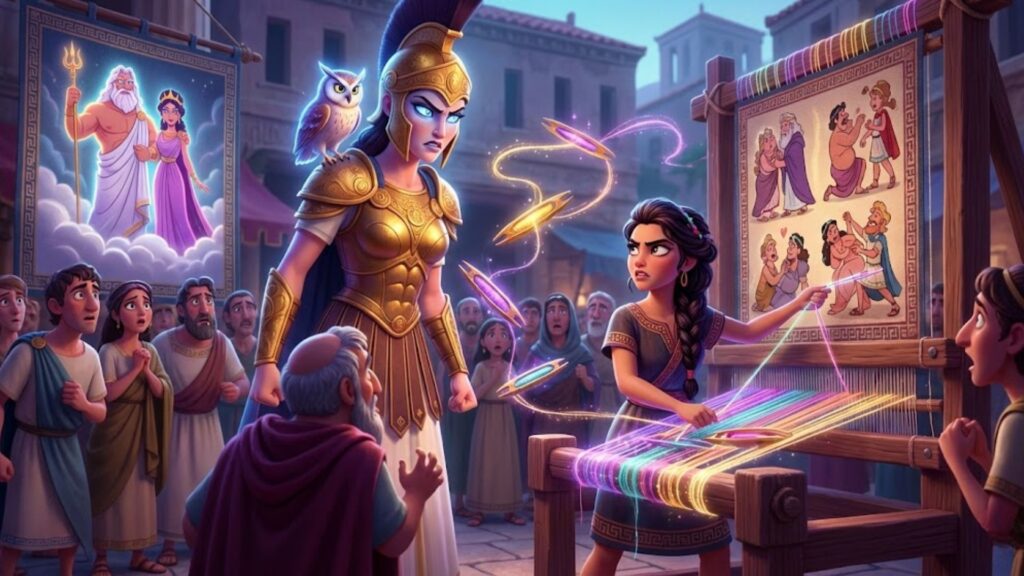
“Very well,” Athena said. “If you believe your skill surpasses mine, we will each weave. When finished, the threads will reveal the truth.”
Looms were prepared. Yarn was gathered. Colors were chosen. The crowd stayed silent. No one dared to move too close. No one dared to look away.
Arachne breathed slowly, controlling her excitement. This was the moment she had dreamed of. A chance to prove her superiority. A chance to prove she was not only skilled but divine in her own right.
Athena began first. Her movements were measured and calm. She worked with power and wisdom. Her tapestry took shape with scenes of Olympus. The gods stood proud. Their expressions were noble. Their figures shone. She wove a reminder of order. A reminder of hierarchy. A reminder of where each being belonged.
Arachne watched out of the corner of her eye. She saw Athena’s skill. She saw the perfection in every line. But instead of fear, she felt a thrill. To her, it was simply proof that the competition was real, not symbolic. And she wanted to win even more.
Arachne began her own work. Her hands moved quickly. Her patterns were daring. She wove with bold colors, sharp contrasts, and dramatic images. But the most shocking part came in the scenes she chose.
She depicted the gods not as majestic beings but as flawed. She wove stories of their mistakes. Their disguises. Their mischief. Their moments of weakness. She wove Zeus chasing mortal women. She wove Poseidon and Apollo punished by mortal kings. She wove stories that mortals whispered quietly, never loudly.
Her tapestry was beautiful in technique. But its message was dangerous.
The crowd looked at her work with awe mixed with fear. They admired the craftsmanship. They felt the tension. They sensed the risk she was taking. They wanted her to win. But they feared the price.
Athena finished first. She stepped aside, allowing everyone to admire her creation. The room felt holy when one looked at it. It glowed with pride and grace.
Arachne finished shortly after. She stepped back. Her tapestry shone with a different kind of brilliance. It was raw. Honest. Flawless in detail. Fearless in theme.
Athena walked to Arachne’s tapestry. She studied it silently. Her expression remained calm. Her voice did not rise. But the air grew heavier.
She acknowledged the skill. The flawlessness. The mastery. But she could not ignore the insult woven into every inch. The disrespect. The defiance.
The goddess reached out and touched the tapestry. The threads shimmered. Then they ripped. Not violently. Not angrily. But with finality.
Arachne gasped. Her pride cracked. Her confidence wavered. She realized too late that her brilliance had gone too far. That some truths, even if skillfully woven, were not meant to be flaunted.
Arachne stepped backward. Shame washed over her. Her arrogance collapsed. She felt exposed. She felt foolish. She felt the crushing weight of what she had done.
Athena watched her carefully. She saw the transformation. She saw the regret. She saw the despair.
Arachne ran. She hid in a corner of the workshop. Her breath trembled. Her hands shook. In her pain, she tied a rope. She wanted to escape the humiliation. She wanted to escape herself.
Athena intervened before the final moment. She understood that Arachne’s punishment had already begun inside her own heart. But the goddess also knew that letting her die would be a tragedy. Her skill was real. Her talent was extraordinary. Her mistake was pride, not malice.
So Athena granted her a different fate. She touched Arachne’s forehead. Her body shifted. Her limbs thinned. Her shape shrank. Her fingers transformed into legs. Her human form disappeared.
Arachne became the first spider. Small. Fragile. But forever gifted with weaving.
Athena spoke softly. The punishment fit the crime, yet mercy shaped its ending. Arachne would continue to weave. Not as a human rival but as a creature defined by her craft.
Spiders from that day were known as the children of Arachne. Each web reflected the patterns she once made. Each design echoed her skill. Each thread reminded mortals of the story.
The lesson spread quickly. It taught that talent must walk with humility. It taught that pride can twist even the greatest gifts. It taught that challenging the divine without respect leads to downfall.
People still admired Arachne’s legacy. But they whispered now, not with arrogance, but with caution. They understood that mastery does not justify disrespect. They understood that success without humility becomes dangerous.
The story lasted because it was simple and relatable. People saw parts of themselves in Arachne. They understood the desire for recognition. They understood the temptation to push boundaries. They understood the sting of pride. They understood the importance of balance.
Athena continued to be worshipped as the goddess of wisdom and weaving. But her judgment of Arachne reminded everyone that wisdom includes compassion. It includes patience. It includes fairness.
Arachne’s fate became a symbol. It represented the line between confidence and arrogance. It represented the need to honor those who came before you. It represented the value of accepting limits while still pursuing excellence.
Even as a spider, Arachne’s talent never faded. Her webs stretched across trees, corners, ceilings, and gardens. They caught light. They caught dew. They caught admiration. No mortal could deny her skill.
Her legacy lived on through every web that shimmered in the morning sun.
And her story continued to teach that pride, no matter how beautiful the talent behind it, must always be tempered by humility.
Oedipus Rex

Oedipus was born in Thebes under a shadow.
Before his first cries, an oracle had spoken.
He was destined to kill his father and marry his mother.
His parents, Laius and Jocasta, were terrified.
They could not bear the prophecy.
They tried to escape fate.
They left him on a mountainside with his feet bound.
But fate, as always, moved silently.
A shepherd found the child.
He took him to Corinth, far from Thebes.
There, King Polybus and Queen Merope raised him as their own.
Oedipus grew strong and clever.
He was unaware of the bloodline beneath his feet.
He heard rumors of a prophecy.
He did not know whose fate it spoke of.
Fear drove him from Corinth.
He left the city to protect his adoptive parents.
He walked roads filled with sun, dust, and danger.
He came upon a crossroads one fateful day.
There, a confrontation occurred.
He met a man and his servants.
They argued fiercely.
The man struck Oedipus.
He killed him in a rage.
He did not know it was Laius, his true father.
The prophecy had begun its cruel unfolding.
Oedipus continued his journey.
He arrived in Thebes.
The city was in chaos.
A Sphinx plagued the land.
It demanded riddles.
Those who failed were devoured.
Oedipus faced the creature.
He solved the riddle with calm intelligence.
The Sphinx fell to her own demise.
The city cheered.
He was offered the throne.
He married the widowed queen, Jocasta.
He did not know she was his mother.
The years passed.
The city flourished under his rule.
But whispers of fate never faded.
A plague struck Thebes.
The people begged Oedipus for salvation.
He sent for the prophet, Tiresias.
The old man hesitated.
He spoke reluctantly.
“You are the cause,” Tiresias said.
Oedipus was shocked.
He denied it.
He accused the prophet of lies.
He searched for truth.
He summoned witnesses.
He questioned servants.
Old secrets began to surface.
A messenger arrived from Corinth.
Polybus had died.
Oedipus was relieved.
Perhaps the prophecy was false.
Perhaps he had escaped his fate.
But the messenger revealed more.
He was not the true son of Polybus.
Oedipus realized the threads were closing in.
He confronted Jocasta.
She pleaded, “Do not seek the truth.”
Oedipus ignored her warnings.
He pursued the investigation.
The revelations crushed him.
Every step pointed to the unthinkable.
He had fulfilled the prophecy.
He had killed his father.
He had married his mother.
Jocasta could not bear it.
She hung herself in the palace.
Oedipus found her body.
Grief and horror overwhelmed him.
He took the pins from her dress.
He gouged his eyes.
He wanted to see no more.
He wanted to hide from fate.
He stumbled through Thebes, blind.
He begged for exile.
He left the city he once ruled.
His daughters followed him.
He wandered in darkness.
He survived on charity.
He reflected on the life he had lived.
He understood pride and ignorance.
He understood the power of fate.
He understood the fragility of human knowledge.
The story of Oedipus spread far.
It was retold in homes and theaters.
It warned rulers and ordinary people alike.
It showed that trying to escape destiny often leads directly to it.
It showed that knowledge without understanding can destroy.
It showed that suffering teaches wisdom.
Oedipus’ life became a mirror.
It reflected the limits of human control.
It reflected the dangers of arrogance.
It reflected the need for humility.
Even centuries later, his story taught lessons.
Teachers used it to discuss ethics.
Philosophers debated free will versus fate.
Psychologists explored guilt and self-perception.
Writers borrowed the theme for novels and plays.
Artists painted his blind wandering.
Musicians composed dirges for his grief.
Every retelling reminded humans to respect limits.
Oedipus’ tragedy was not just about him.
It was about every human who sought to outsmart destiny.
It was about the consequences of pride and ignorance.
It was about the weight of choices and actions.
Even his children carried the shadow of fate.
They became symbols of continuity and the inescapable past.
Thebes learned from Oedipus.
The moral endured.
Fate is not defeated by flight or denial.
Truth, once revealed, demands acknowledgment.
Suffering, though cruel, brings insight.
Pride blinds.
Humility opens the eyes of the heart.
The story continues to resonate today.
In boardrooms, it warns of overconfidence.
In classrooms, it teaches responsibility.
In personal lives, it reminds people of limits and consequences.
Oedipus’ life illustrates universal truths.
It speaks across time and culture.
His tragedy is deeply human.
Every reader sees a part of themselves in him.
The prophecy is a metaphor for patterns humans cannot escape.
The search for truth is an inevitable journey.
Pain and loss shape understanding.
Even blindness can bring insight.
Oedipus teaches that recognition of error is the first step toward wisdom.
Forgiveness may come from within, not from others.
His courage to face reality, even in despair, remains admirable.
Though he stumbled, he endured.
Though he suffered, he learned.
Though he was blind, he saw.
Oedipus’ story reminds us that knowledge has limits.
That power carries responsibility.
That fate intertwines with choice.
And that life’s harshest lessons can become the deepest sources of wisdom.
Even without seeing, Oedipus’ example illuminates the human experience.
It teaches balance between courage and caution.
Between action and reflection.
Between pride and humility.
The moral of Oedipus Rex is timeless.
It transcends Thebes.
It transcends centuries.
It resonates with every generation.
It shows that understanding oneself is the path to true sight.
And that no matter how far humans try to run, they carry their destiny with them.
The story ends, but the lessons continue.
Oedipus remains a guide for all who confront choices and consequences.
Blindness did not erase his insight.
Exile did not erase his impact.
Tragedy became the teacher.
And humanity listened.
The life of Oedipus Rex remains an enduring mirror.
It reflects our flaws, our fears, and our potential.
And it reminds us that even in suffering, wisdom can be found.
The Trojan Horse

The city of Troy stood strong.
Its walls were thick and high.
For ten long years, the Greeks had tried to breach them.
Countless battles had been fought.
Warriors died on both sides.
The city held firm.
Inside, fear and fatigue mingled.
The Greek army had retreated.
But they were not gone.
Odysseus, known for his cunning, hatched a plan.
He proposed a wooden horse.
It would be hollow.
Greek soldiers could hide inside.
The rest of the army would pretend to sail away.
Troy would believe the Greeks had surrendered.
The Trojans debated.
Some were cautious.
Others saw a gift from the gods.
They believed victory was theirs.
They ignored the warning voices.
The horse was massive.
It towered at the city gates.
The Trojans admired the craftsmanship.
It was a symbol of Greek ingenuity.
Priests and leaders performed sacrifices.
They prayed for good fortune.
Excitement outweighed caution.
The horse was pulled inside the walls.
Troy celebrated.
The city rejoiced at their apparent triumph.
Night fell.
Silence settled over Troy.
The city slept in relief.
Inside the wooden horse, Greek soldiers waited.
Their hearts pounded with anticipation.
Every sound from outside made them tense.
Hours passed slowly.
The Trojans, drunk on celebration, slept on.
At midnight, the signal was given.
The hidden soldiers emerged.
Quietly, they opened the gates.
The rest of the Greek army had returned under cover of night.
They flooded into the city.
The Trojans awoke in terror.
They could not fight back.
The walls that protected them now trapped them.
Chaos erupted.
Flames consumed houses.
Screams filled the streets.
The gods, some said, watched silently.
The Greek soldiers attacked with precision.
Troy, once proud, fell.
The king, Priam, was slain.
Noble families perished.
Survivors were enslaved or scattered.
The Trojan Horse, a gift of deception, had turned the tide.
Odysseus’ plan had succeeded.
The story spread far and wide.
It became a cautionary tale.
The horse symbolized cunning over strength.
It taught that appearances can deceive.
It warned against greed and pride.
Troy had trusted a gift without inspection.
The lesson was harsh but clear.
Victory is not always earned by force.
Sometimes, it comes through strategy and patience.
And sometimes, overconfidence invites ruin.
Generations repeated the story.
Leaders studied it for lessons in strategy.
Philosophers reflected on the ethics of deception.
Poets wrote of the cunning and the tragedy.
Artists painted the city aflame.
The horse became an icon of cleverness.
And of warning.
The moral extends beyond war.
In business, trusting blindly can be disastrous.
In life, appearances may mask danger.
Critical thinking and caution are essential.
The Trojan Horse shows that intelligence can be more powerful than brute force.
It also reminds humans that pride and celebration can blind them.
Troy’s joy prevented careful inspection.
Their excitement made them vulnerable.
Small warnings went unheeded.
The result was catastrophic.
Yet, the story is not just about destruction.
It is about the human mind’s capacity for creativity.
Odysseus demonstrated innovation in crisis.
His solution required patience, observation, and foresight.
The Greeks’ teamwork amplified the plan.
Discipline allowed them to execute it flawlessly.
It teaches that preparation and strategy can achieve what raw power cannot.
But it also teaches responsibility.
Deception carries consequences.
Those who use cunning must understand the weight of their actions.
The fall of Troy was total.
Entire generations were affected.
Lessons of ethics and morality arise from this.
Winning through deceit may bring results, but moral costs remain.
This duality makes the story enduring.
Parents tell it to teach children about thinking before acting.
Teachers use it in history and literature classes.
Philosophers debate when, if ever, deception is justified.
It is a story of human nature—fear, hope, pride, and cleverness intertwined.
The Trojan Horse also reminds readers of vigilance.
Even the strongest walls cannot protect against blind trust.
Even the proudest cities can fall to unseen threats.
Humility and discernment are crucial.
The story transcends time.
It is retold in books, movies, and games.
From Troy to modern boardrooms, the lesson resonates.
Blind trust is risky.
Greed and pride amplify vulnerability.
Strategy can outsmart brute force, but ethics are tested.
The tale also celebrates intelligence.
Problem-solving and creativity shine even in dire circumstances.
Odysseus’ genius shows the human mind’s potential.
Yet, it comes with responsibility.
The Trojan Horse becomes both a triumph and a warning.
It emphasizes foresight and patience.
It teaches that rushing to celebrate or assume victory can backfire.
Careful examination of gifts—literal and metaphorical—is essential.
The story also highlights consequences.
Actions ripple through generations.
The Trojans’ failure to question led to complete collapse.
Every decision carries weight.
Even seemingly small choices—welcoming a gift, trusting a stranger—can have immense outcomes.
The moral is timeless.
The story’s enduring popularity proves its relevance.
It appears in military strategy books.
It appears in leadership studies.
It appears in ethics discussions.
Even in 2025, the Trojan Horse metaphor is used in cybersecurity.
Deception remains a danger in modern life.
Phishing emails and hidden threats echo ancient lessons.
The tale’s wisdom adapts to new contexts.
It teaches vigilance, critical thinking, and humility.
It teaches the balance between trust and skepticism.
It demonstrates consequences for overconfidence.
It encourages strategic thinking.
It reminds humans that ingenuity can achieve great outcomes.
But also that actions carry moral weight.
The fall of Troy is a warning for societies, organizations, and individuals.
It stresses careful decision-making.
It stresses humility in triumph.
It celebrates creativity and intellect.
It combines history, myth, and moral reflection.
Generations continue to study it.
Scholars debate details, but the lesson is universal.
Trust wisely.
Examine gifts and opportunities.
Recognize pride as a weakness.
Value cunning, but wield it responsibly.
The Trojan Horse teaches the balance between intelligence and ethics.
It warns that even the strongest defenses fail if humans ignore caution.
It shows that small, clever solutions can accomplish what brute force cannot.
But it reminds that victory has consequences.
The story resonates across time and culture.
Its lessons apply to war, business, personal life, and ethics.
It endures because human nature has not changed.
Curiosity, pride, and greed remain.
Cleverness and innovation remain.
The Trojan Horse is a mirror.
It reflects the strengths and weaknesses of humanity.
It teaches vigilance, foresight, and humility.
It warns that appearances can deceive.
It celebrates intelligence, strategy, and planning.
It combines tragedy and triumph.
The story teaches that morality and cleverness are intertwined.
Even in victory, ethical reflection is necessary.
It reminds leaders to balance ambition with caution.
It reminds individuals to question gifts and assumptions.
The Trojan Horse’s lesson is not just about war.
It is about life.
Choices, consequences, and foresight define outcomes.
Pride blinds.
Cunning enlightens.
Trust must be earned.
And vigilance is essential.
The story of Troy’s fall is eternal.
It echoes in literature, film, and modern analogies.
It teaches strategy, ethics, and human nature.
The moral endures, guiding readers to reflect on actions and consequences.
The Trojan Horse remains a lesson in thinking ahead.
It demonstrates how intelligence can shape destiny.
It warns against overconfidence.
It teaches responsibility in using one’s abilities.
It inspires reflection on choices, strategy, and humility.
Even centuries later, it resonates.
Troy’s fall is a warning.
Odysseus’ cunning is an inspiration.
The tale teaches balance between skill and morality.
It teaches caution and awareness.
It celebrates ingenuity while warning of human vulnerability.
And it remains a timeless story with moral resonance.
Niobe

Niobe was queen of Thebes.
She was proud and beautiful.
She had many children.
Her family was large and admired.
People came to see her.
They marveled at her wealth.
They marveled at her family.
Niobe grew arrogant.
She boasted to all who would listen.
She claimed she was superior to the gods.
Specifically, she mocked Leto.
Leto was the mother of Apollo and Artemis.
Niobe said she was greater.
She had more children than Leto.
She considered herself untouchable.
She did not fear divine wrath.
Her pride blinded her.
Her words spread through Thebes.
The people were impressed but wary.
Some warned Niobe.
They told her not to insult the gods.
She laughed at their caution.
Her arrogance knew no bounds.
She declared herself above divine judgment.
Leto heard of this insult.
The goddess was silent at first.
But her children could not ignore the boast.
Apollo and Artemis prepared to punish her.
They watched Niobe and her family.
Night fell.
Silence blanketed Thebes.
Then the arrows came.
Apollo struck the sons.
Artemis struck the daughters.
Niobe screamed in despair.
Her children fell around her.
She tried to flee.
There was no escape.
The city watched in horror.
Niobe collapsed in grief.
Her pride had led to ruin.
Even as she mourned, her arrogance lingered.
The gods transformed her.
Niobe became stone.
Tears flowed endlessly from her eyes.
Her sorrow was eternal.
She remained frozen, a monument to hubris.
The story spread throughout Greece.
It became a warning tale.
It showed the danger of excessive pride.
It showed the cost of insulting the divine.
Niobe’s fall was total.
Her beauty could not save her.
Her family could not protect her.
Arrogance carried the heaviest price.
Generations reflected on her fate.
Artists depicted her weeping.
Poets wrote of her pride and loss.
The moral was clear.
No one, mortal or king, surpasses the gods.
Disrespect brings consequences.
Even the powerful are vulnerable.
Niobe’s children were innocent.
Yet, they suffered too.
Her actions had ripple effects.
This teaches responsibility.
Pride can harm others.
Words and boasts have weight.
The story also shows limits.
There are forces beyond human control.
Even rulers must recognize boundaries.
The gods embodied these limits.
Their justice was swift and absolute.
Niobe’s transformation into stone symbolized permanence.
Her tears were eternal.
It was a lesson in humility.
It was a reminder of mortality.
Even the proudest queen can fall.
The tale warns against overestimation of self.
It warns against comparing oneself to higher powers.
It teaches respect for order and hierarchy.
The story is still relevant today.
Pride can cause personal and professional downfall.
Ignoring advice or warnings can be fatal.
Children of leaders may also feel consequences.
Power carries responsibility.
The narrative emphasizes reflection.
Before speaking or acting, one should consider impact.
Niobe’s words led to irreversible consequences.
The tale teaches foresight.
It teaches ethics in speech.
It teaches respect for forces larger than oneself.
Even in 2025, the lesson holds.
Arrogance leads to isolation.
Humility fosters harmony.
Community and family thrive with respect.
Excessive self-confidence can alienate allies.
The story also highlights grief.
Loss accompanies prideful mistakes.
Sorrow becomes a teacher.
Art and literature memorialize Niobe’s fate.
Her image evokes empathy and caution.
The narrative intertwines beauty and tragedy.
Mortals are reminded to temper ambition.
The gods’ punishment serves as moral compass.
Justice is portrayed as proportional.
Yet, collateral damage occurs.
Even unintended victims suffer.
Niobe’s sorrow is relatable.
Humans recognize regret and loss.
This makes the story compelling.
The moral resonates across time.
It is used in teaching humility.
It is used in literature discussions.
It is reflected in leadership studies.
Even in decision-making, Niobe serves as caution.
Her story teaches careful speech.
It teaches respect for authority.
It teaches empathy for those affected by pride.
Niobe’s hubris created a legacy.
One of sorrow, caution, and reflection.
Her tears flowed endlessly, a symbol of perpetual lesson.
Mortals are reminded to listen.
To heed warnings.
To recognize limits.
Niobe’s fate became proverbial.
Pride before the gods—or peers—is dangerous.
The story emphasizes consequences of words and actions.
It illustrates balance between self-confidence and humility.
The moral transcends culture and time.
It applies to families, governments, and organizations.
Leaders study it to avoid arrogance.
Individuals reflect on personal pride.
Even today, Niobe teaches restraint.
Her story blends tragedy with instruction.
It is a mirror for human nature.
It is a tool for ethical reflection.
The enduring image of stone and tears remains powerful.
Niobe’s tale is a warning, a moral guide, and a narrative of human weakness.
It shows that arrogance and disrespect bring downfall.
It shows that grief follows hubris.
It reminds us that limits exist.
It teaches that responsibility extends to all affected by one’s choices.
Humility and foresight are virtues.
The story continues to inspire art and literature.
It is retold in classrooms, books, and discussions.
The lesson of Niobe remains clear and timeless.
Even as centuries pass, humans see themselves in her sorrow.
They recognize the danger of excessive pride.
They understand the value of respect, caution, and humility.
Niobe’s tears flow on in collective memory.
They serve as eternal guidance.
Her hubris, her loss, and her transformation are warnings.
Her story is a beacon for reflection.
It teaches about morality, consequence, and the human condition.
Even in modern life, arrogance has consequences.
Ignoring limits can destroy careers and relationships.
Words can wound.
Boasting can harm.
Listening to warnings can save.
Niobe’s tale reminds all that life’s victories must be tempered with humility.
It teaches self-awareness and ethical mindfulness.
And it endures as a Greek mythology story with moral lessons.
The Enduring Power of Greek Myths as Moral Teachers
Greek mythology stories with moral lessons Came from a long oral tradition. Bards and storytellers passed these tales from one generation to the next.
They shaped social values. They taught what behavior would win favor and what behavior would draw consequence. Myths offered guidance without sermons.
They invited listeners to imagine themselves in the story and to judge actions by the results they produced.
Over centuries, these greek mythology stories with moral lessons influenced philosophy, drama, and later psychology. Their images and phrases show up in European literature and modern thought.
That influence is not merely literary. These stories shape how people think about character, duty, and responsibility.
Psychologically, myths help in two ways. First, they create empathy. When a god or hero fails, listeners can see human flaws reflected.
That makes it easier to face similar faults in oneself. Second, myths show consequences in a concrete, emotionally vivid way. That kind of narrative learning tends to stick.
Myths remain relevant because human dilemmas do not change as fast as technology. Choices about pride, greed, loyalty, curiosity, and trust are constant.
A story that warns about unchecked desire translates easily into modern concerns. That is why greek mythology stories with moral lessons keep returning in new forms and why they work as teaching tools today.
Modern retellings, podcasts, and interactive apps have given these myths fresh life. Virtual reality and audio dramas make the tales accessible and memorable.
These formats extend the reach of greek mythology stories with moral lessons without replacing the originals.
Core Themes: Unpacking Moral Lessons in Greek Lore
Ancient tales work as moral teachers because they use archetypes and dramatic outcomes. Gods often stand for consequence. Heroes stand for choice.
The story is a small moral laboratory. Below are the key theme areas that keep appearing across greek mythology stories with moral lessons and how each maps to modern life.
Foundational elements of mythic morals
Myths use metaphor to teach. A god who punishes pride does not merely act out of anger. The god dramatizes the social or spiritual cost of arrogance.
A hero who fails because of impatience helps the listener feel the sting of impulsiveness. This method makes abstract lessons concrete.
Archetypal journeys are central. A character sets out, meets trials, makes a choice, and faces the result. That arc mirrors real life. It is easy to map the events to modern situations, whether that is a career misstep or a moral dilemma at work.
The lessons are universal. They can be adapted for personal growth, leadership, conflict resolution, and ethics training. The same greek mythology stories with moral lessons can be simplified for children or deepened for adult discussion.
Theme categories and what they teach
Here are the recurring moral categories that appear in Greek myth and appear again in many greek mythology stories with moral lessons.
Hubris and overreach
Tales in this group show the danger of assuming limits do not apply to you. The lesson stresses humility and the value of listening to wise counsel.
Curiosity and consequence
These stories highlight the tension between wonder and restraint. Curiosity can be a virtue, but action without care can cause harm.
Greed and its price
These myths show how craving for more can destroy what we value most. They point to balance and to valuing nonmaterial goods.
Perseverance and redemption
Some tales show that trials refine character. They teach that steady work and humility can repair what was broken.
Fate and acceptance
Myths stage the tension between destiny and choice. The lesson is not surrender but knowing what to fight and what to accept.
Vanity and self centeredness
These stories warn that an excessive focus on self cuts one off from community and love.
Many greek mythology stories with moral lessons combine these themes. That layering is what makes them rich for teaching.
Retelling and Teaching: A Step-by-Step Guide to Mythic Wisdom
If you want to share a myth and draw out its lesson, follow a simple structure. The aim is to keep the story vivid while leaving room for listeners to think and feel their own conclusions.
Preparation essentials
Set the tone before you speak. Lighting, a map of ancient Greece, or a simple olive branch will help listeners settle in. For adult gatherings, a modest beverage and comfortable chairs create the right frame. For classrooms, a short handout with key names and a simple timeline helps.
Choose reliable sources. Public domain translations and annotated editions are best when accuracy matters. When time is tight, use concise summaries from trusted sites but note you are retelling, not creating new facts.
Narrative framework
Use four clear stages when retelling greek mythology stories with moral lessons.
- Epic opening. Start with a line that sets stakes and scene. Keep it short and vivid. Names and images work well.
- Heroic arc. Tell the core events with sensory detail. Mention the turning points and keep the pacing steady. Do not overload with minor names or late scenes.
- Moral pivot. Slow down at the key decision. Let listeners feel the tension. This is where the story’s lesson typically reveals itself. Pause after the pivot to let silence work.
- Reflective close. End by asking a question. “What would you have done in that moment?” Invite responses rather than delivering a single moral.
Engagement enhancements
Add personalization. Ask listeners to imagine themselves in the protagonist’s role. Offer an interactive twist: have small groups debate whether the character was right or wrong. Invite modern parallels for the same dilemma. These moves turn listening into active thinking.
Use vocal dynamics. A lower tone for consequence, a lighter tone for temptation. Small shifts in pace help keep attention and signal emotional shape.
Delivery dynamics and formats
Myths can be retold as single-person readings, short plays, or audio recordings. For workshops, use role-play and short writing exercises. For book clubs, prepare a few reflective prompts ahead of time.
Avoid two common pitfalls. First, do not over-modernize to the point the story loses its original meaning. A modern setting can clarify, but do not flatten the myth into a moral tract. Second, avoid preaching. Offer the story and guide the reflection. Let listeners discover the lesson.
Spotlight Themes for Retelling (Techniques, Not Full Retellings)
Instead of full versions of specific tales, this section shows how to underline morals when you share any greek mythology stories with moral lessons. These are performance and teaching techniques you can use right away.
How to present hubris
When retelling a tale about pride, emphasize the early warning signs. Highlight the moment the character receives sound advice. Pause. Then show the small choices that lead to larger fall. End by asking, “Where do you see this kind of pride today?”
How to present curiosity
When the core issue is curiosity, dramatize the tension between the urge to know and the cost of knowing. Use short images to show the moment curiosity is satisfied and the immediate cost. Follow with discussion prompts linking the tale to data privacy, experimental ethics, or the rush to discover without safeguards.
How to present greed
To teach about greed, focus on relationships. Show how the character’s desire distracts from human connection. Ask listeners to imagine what was lost that money cannot replace. That move turns an abstract lesson into a visceral one.
How to present perseverance
For resilience themes, linger on the repetitive trials. Show the work, the setbacks, and the small acts of humility that finally lead to repair. Invite reflection on personal examples when steady effort mattered more than sudden success.
How to present fate and acceptance
Do not preach determinism. Instead, frame a conversation about what can be chosen and what must be accepted. Ask small groups to list things the character could control and things they could not. That helps distinguish courage from futility.
These techniques make greek mythology stories with moral lessons usable and practical in any setting.
Weaving Myths into Modern Life: Applications and Adaptations
Greek myths are tools you can use across personal growth, education, and creative work. Here are practical ways to apply mythic lessons.
Personal growth and reflection
Start a short journal exercise. Pick one recent decision and map it against a mythic theme. Did you act from pride? From fear? From courage? Writing this down brings clarity.
Design a weekly “myth minute.” Begin team meetings or family dinners with a one-paragraph retelling of a small mythic moment and a single question. Small rituals like this sharpen moral attention.
Education and workshops
In classrooms, myths work well in ethics modules. Use them as case studies. Give learners a short time to argue for the hero’s choice and then swap sides. This trains empathy and critical thinking.
For leadership training, present a mythic vignette and ask participants to propose policies or behaviors that would prevent the tragic outcome. This helps move narrative insight into practical action.
Creative and media adaptations
Podcasts, short films, and visual essays are powerful ways to retell myths. Consider a modern short script that keeps the moral core but places it in a contemporary context.
Visuals and sound deepen emotional response and make greek mythology stories with moral lessons accessible to wider audiences.
Interactive formats such as VR experiences can place users inside a moral dilemma. Use those tools with care. The goal is insight, not mere shock.
Pop culture and inclusivity
Highlight diverse retellings that center different voices. Modern authors often reclaim female perspectives, explore minor characters, or reframe stories from marginalized viewpoints. Those versions open new ethical questions and make the myths speak to a broader audience.
When adapting darker material, balance honesty with sensitivity. Not every group is ready for graphic content. You can emphasize lessons without dwelling on trauma.
How to Read Greek Myths for Life Lessons
Reading myths for morals is an active process. Here is a simple method for getting the most from greek mythology stories with moral lessons.
- Read once for story: Enjoy the narrative. Let images and action sink in.
- Read twice for choice: On a second pass, watch for key decisions. Pause at those moments.
- Ask three questions: What did the character want? What did they choose? What were the consequences?
- Compare to today: Match the character’s choice to a current situation—work, family, politics, technology.
- Reflect or discuss: Write a short paragraph or talk with a partner about what you would have done.
- Journal the lesson: Note one practical change you could make this week based on the story.
This approach turns reading into moral practice and makes greek mythology stories with moral lessons useful in daily life.
Lessons You Can Apply Today
Myths are not roadmaps with step-by-step instructions. They are mirrors that sharpen moral senses. Here are clear, practical lessons drawn from greek mythology stories with moral lessons.
- Watch for early warning signs of pride: Small dismissals of counsel often precede larger failures.
- Balance curiosity with precaution: New knowledge is valuable, but systems and safeguards matter.
- Value relationships over accumulation: Wealth or status can replace real human connection only temporarily.
- Embrace steady work with humility: Lasting repair comes from persistent, careful action.
- Accept limits when necessary: Some things are beyond control. Wisdom often lies in choosing battles.
- Practice empathy: Tales that show another’s pain help us recognize similar needs around us.
Try one practice a week and note how it changes a choice you face. Over time, small adjustments build character.
Retelling Workshop: A Simple Module
If you want a ready activity for a small group, follow this four-step module. It works for book clubs, classrooms, or informal gatherings focused on greek mythology stories with moral lessons.
- Pick a theme: Choose one moral focus for the session.
- Retell briefly: Have one person tell a two- to three-minute version of a myth that fits the theme. Keep it dramatic and sensory.
- Small group reflection: Break into pairs for five minutes to discuss how the hero’s choice maps to modern life.
- Create and share: Each pair rewrites the ending in a modern setting or lists one practical change inspired by the story. Share with the larger group.
This short module encourages active thinking and produces concrete takeaways.
Conclusion
Greek mythology stories with moral lessons were never meant to be museum pieces. They were living stories told to shape habits, warn communities, and help people make sense of hard choices.
Their power comes from simple human truth: when you see a moral played out in drama, it becomes easier to imagine different outcomes for your own life.
Tonight, pick one theme from this guide. Use the Myth Moral Map to note a recent choice you made that fits that theme.
Ask one question: what might you do differently next time? This small exercise is the practical end of a long conversation that began in firelit groves and continues in our living rooms.
In the shadow of Olympus we still find our own reflection—flawed, hopeful, and learning. Keep retelling. Keep listening. The old stories will keep teaching, and you will keep learning.