There’s something warm about twinkling lights, the smell of pine, a mug of cocoa — and a story read aloud by someone you love. That combination is simple, but it creates memories that last.
This article will help you choose good Christmas stories read aloud, enjoy them in a way that feels natural, and turn reading time into a holiday tradition your family looks forward to each year.
I keep the language plain and the steps practical. Think of this as a friendly guide you can use tonight, not a long lecture. Let’s get started.
Christmas Stories Read Aloud
Christmas stories read aloud can turn an ordinary evening into something warm and memorable. One voice, one book, and a room that slows down.
The Snow That Remembered Names
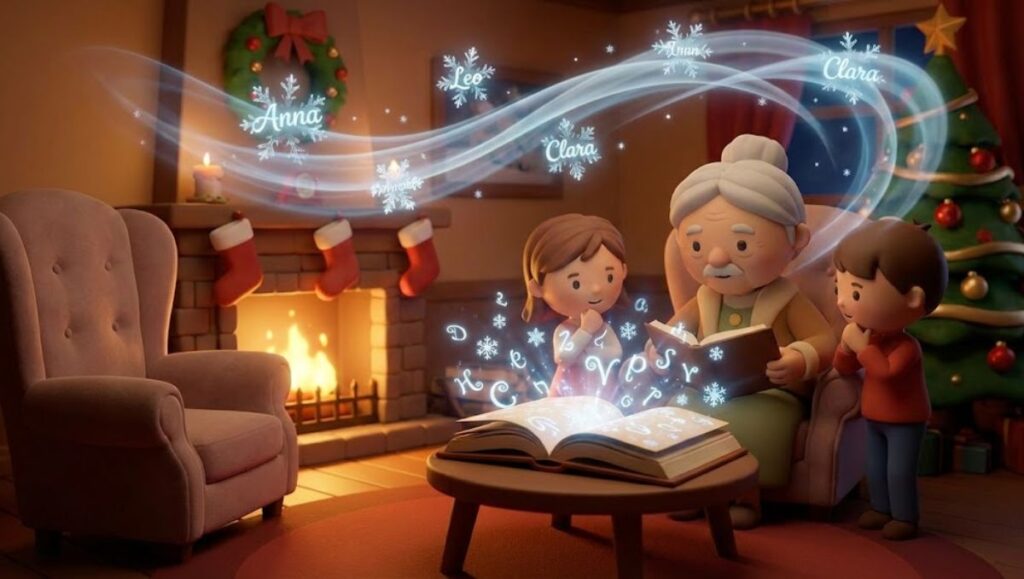
In a quiet village called Frostwood, winter always arrived softly.
Snow didn’t fall loudly there.
It floated.
It drifted.
It whispered.
The people of Frostwood said their snow was special.
They called it the remembering snow.
Because it remembered names.
Every year on the first snowfall, the snow wrote children’s names on rooftops.
Not with ink.
Not with paint.
But with frost.
White letters made of soft, shining snow.
Children would wake up early.
Run to their windows.
And look up.
They laughed when they saw their names.
They pointed.
They waved.
They felt seen.
They felt known.
They felt loved.
But this year, something was different.
A little girl named Elara ran to her window just like always.
She pushed the curtain aside.
She looked up at the roof.
She searched.
She blinked.
No name.
Her roof was blank.
Empty.
Smooth.
Just plain snow.
She thought it was a mistake.
Maybe she looked too fast.
Maybe she looked in the wrong place.
She put on her boots.
Her coat.
Her scarf.
And ran outside.
The air was cold.
The snow was fresh.
Crunchy.
Bright.
She looked up again.
Still nothing.
Her heart felt heavy.
Everyone else’s roofs had names.
She could see them.
“Milo.”
“Anya.”
“Jasper.”
“Lina.”
Names everywhere.
But not hers.
She walked slowly down the street.
She didn’t want anyone to notice.
She didn’t want anyone to ask.
She kept her head down.
She kicked a tiny pile of snow.
Then she heard a soft voice.
“Elara,” it said.
She looked around.
No one was there.
“Elara,” the voice whispered again.
It sounded like wind.
But warmer.
Kinder.
She looked at the snow at her feet.
It shimmered.
Just a little.
“Why isn’t my name there?” she asked the snow.
The snow sparkled.
Then it shifted.
Tiny patterns formed.
Not words.
Not yet.
Just soft, moving lines.
“Names are written for those who are ready,” the snow whispered.
Elara frowned.
“I am ready,” she said.
“I’ve been ready every year.”
The snow swirled gently.
“You must go where names are forgotten,” it said.
Elara’s hands trembled.
“Where?” she asked.
The snow rolled across the ground.
Forming an arrow.
Pointing toward the forest.
The old forest.
The quiet forest.
The forest no one liked to walk through in winter.
Elara swallowed hard.
But she nodded.
She walked back home.
She put on warmer socks.
A thicker coat.
Extra mittens.
Her mother saw her.
“Where are you going?” her mother asked.
“Just… a walk,” Elara said.
Her mother smiled.
“Be careful,” she said.
Elara stepped into the forest.
The trees were tall.
Bare.
Quiet.
Snow rested on every branch.
Her footsteps were soft.
Crunch.
Crunch.
Crunch.
She followed the arrow in the snow.
It kept appearing.
Again and again.
Turning left.
Turning right.
Leading her deeper.
Then she saw it.
A small wooden cabin.
Hidden under snow.
Almost buried.
Smoke came out of the chimney.
Elara walked closer.
The snow stopped making arrows.
The door opened.
And a very old man looked out.
He had white hair.
A white beard.
And eyes like winter sky.
“You came,” he said.
Elara nodded.
“My name didn’t appear,” she said.
The man smiled gently.
“That is why you’re here,” he said.
“Come inside.”
The cabin was warm.
A fire crackled.
A soft blanket was placed around her shoulders.
The man poured warm soup.
He didn’t ask questions.
He just waited.
Finally, he spoke.
“The snow remembers every child,” he said.
“But sometimes… it tests the heart.”
Elara looked down.
“Did I do something wrong?” she asked.
The man shook his head.
“No,” he said.
“You have something to give.”
Elara frowned.
“I don’t have anything special,” she said.
The man stood up.
He walked to a corner.
He pulled back a curtain.
There was a wall.
Covered in names.
Hundreds of names.
Fading.
Cracking.
Almost disappearing.
“These,” he said softly, “are the names of children no one remembers anymore.”
Elara’s chest felt tight.
“Where did they go?” she whispered.
“Lost,” he said.
“In loneliness.”
“In forgotten places.”
He handed her a small cloth pouch.
Inside was shining snow.
Different from normal snow.
Brighter.
Alive.
“You must choose one name,” he said.
“And carry it back.”
Elara looked at the wall.
She saw one name.
Faint.
Almost gone.
“Orin,” she read.
“I choose this one,” she said.
The man nodded.
He touched her shoulder.
“You are ready,” he said.
Elara stepped back outside.
The forest felt different now.
Not scary.
Not cold.
Just quiet.
She held the pouch tightly.
The snow inside glowed.
She walked back through the trees.
Step by step.
The arrow didn’t appear now.
She didn’t need it.
She knew the way.
When she reached the edge of the village, she stopped.
She opened the pouch.
The glowing snow lifted.
Floated into the air.
And scattered across rooftops.
One rooftop shimmered.
A name formed.
“Orin.”
Somewhere in the village, a boy who felt unseen looked up.
And smiled.
Elara felt warmth inside her chest.
She walked back to her own house.
She looked up.
Her breath caught.
There it was.
Her name.
Written in bright, beautiful snow.
“Elara.”
Bigger than all the others.
Brighter than all the others.
She felt tears in her eyes.
Not sad tears.
Warm tears.
Peaceful tears.
She understood now.
The snow didn’t forget her.
It chose her.
Inside the forest cabin, the old man whispered softly.
“She remembers others.”
“That is why the snow remembers her.”
And that night, the snow fell again.
Gently.
Softly.
Quietly.
Remembering every name.
The Silent Sleigh Bell

In a small snowy town called Bright Hollow, there was a little shop that sold old things.
Not broken things.
Not junk.
But things with stories.
The shop smelled like cinnamon.
And pinewood.
And time.
It belonged to a man named Mr. Alden.
Mr. Alden had soft eyes.
And slow hands.
And a smile that looked like it had lived a long life.
On a cold December afternoon, a little boy named Rowan walked into the shop.
He stomped snow off his boots.
He breathed fog into the air.
And he stared.
Because in the middle of the shop, hanging from a wooden beam, was a tiny silver bell.
It was beautiful.
It looked like moonlight.
It looked like snowlight.
It looked like magic.
Rowan pointed.
“What’s that?” he asked.
Mr. Alden looked up.
Ah,” he said.
“The silent sleigh bell.”
Rowan frowned.
“Why is it silent?” he asked.
Mr. Alden lifted it down gently.
“This bell,” he said, “used to hang on Santa’s sleigh.”
Rowan’s eyes grew wide.
“Really?” he said.
Mr. Alden nodded.
“Long ago,” he said.
“It rang louder than any bell in the world.”
Rowan reached out.
“Can I shake it?” he asked.
Mr. Alden paused.
Then nodded.
Rowan took the bell.
He shook it.
Nothing.
No sound.
Not even a tiny jingle.
Rowan shook it harder.
Still nothing.
“It’s broken,” Rowan said.
Mr. Alden shook his head.
“No,” he said.
“It’s sleeping.”
Rowan tilted his head.
“How do you wake it up?” he asked.
Mr. Alden lowered his voice.
“You must give it something it hasn’t heard in a very long time,” he said.
Rowan smiled.
“I can make noise,” he said.
He clapped.
He stomped.
He whistled.
Nothing.
No sound.
Rowan frowned.
“What does it need?” he asked.
Mr. Alden looked out the frosty window.
He spoke softly.
“It needs gratitude.”
Rowan blinked.
“What’s that?” he asked.
Mr. Alden smiled gently.
“It means being thankful,” he said.
“Not for big things.”
“But for small things.”
Rowan thought.
He looked at the bell.
Then he looked back at Mr. Alden.
Rowan held the bell close to his chest.
He took a breath.
“Thank you… snow,” he whispered.
Nothing.
He tried again.
“Thank you… warm coat,” he said.
Nothing.
He felt silly.
Mr. Alden touched his shoulder.
“Say it so your heart means it,” he said.
Rowan closed his eyes.
He thought of his mother.
He thought of soup.
Warm soup.
He thought of his little bed.
He thought of being tucked in.
He whispered.
“Thank you… for feeling safe.”
The bell trembled.
Just a little.
Rowan opened his eyes.
“Did you see that?” he said.
Mr. Alden smiled.
“I did,” he said.
Rowan’s heart began to beat faster.
He held the bell again.
He whispered.
“Thank you… for my mom’s hugs.”
The bell shook softly.
A tiny sound.
Like a breath.
Rowan gasped.
He tried again.
“Thank you… for my warm mittens.”
Jingle.
A very small jingle.
Rowan’s mouth opened in surprise.
It was working.
The bell was waking up.
Mr. Alden’s eyes filled with quiet joy.
Rowan ran out of the shop.
He held the bell tight.
He walked through the snow.
He looked around.
He started to understand.
He walked past the bakery.
He smelled bread.
“Thank you for fresh bread,” he whispered.
Jingle.
He walked past the fire station.
He saw bright lights.
“Thank you for people who help,” he said.
Jingle.
Louder.
He walked past a lonely bench.
An old woman sat there.
Her shoulders were hunched.
Her eyes were tired.
Rowan walked up slowly.
He didn’t know why.
He just felt it.
He held the bell.
“Thank you… for stories my grandma told me,” he said.
The bell rang.
Clear.
Sweet.
The old woman looked up.
She smiled at Rowan.
He smiled back.
And sat next to her.
He didn’t talk.
He didn’t need to.
He just sat.
When Rowan finally stood up, the sky was turning pink.
He walked to the hill at the edge of town.
Snow sparkled everywhere.
He lifted the bell.
He whispered.
“Thank you… for this quiet moment.”
The bell rang.
Loud.
Clear.
Bright.
It sounded like starlight.
It sounded like home.
Far above the clouds, something shifted.
Santa’s sleigh trembled.
His reins flicked.
His reindeer lifted their heads.
“Do you hear that?” Santa said.
A reindeer nodded.
“They’re remembering,” the reindeer said.
Back in the town, Rowan walked home.
He walked into the shop.
Mr. Alden looked up.
The bell rang as Rowan stepped in.
It rang clearly.
Beautifully.
Awake.
Mr. Alden chuckled softly.
“You did it,” he said.
Rowan smiled.
“I didn’t fix it,” he said.
“I just listened to it.”
Mr. Alden nodded.
“That’s how it works,” he said.
Rowan placed the bell gently on the counter.
“Can I take it home?” he asked.
Mr. Alden shook his head kindly.
“It belongs where grateful hearts walk,” he said.
Rowan understood.
He turned to leave.
But the bell rang once more.
Soft.
Sweet.
Like a promise.
That night, far above the clouds, Santa smiled.
Because the sleigh bell was no longer silent.
It had heard gratitude again.
And it would never sleep the same way.
Mrs. Evergreen’s Last Ornament
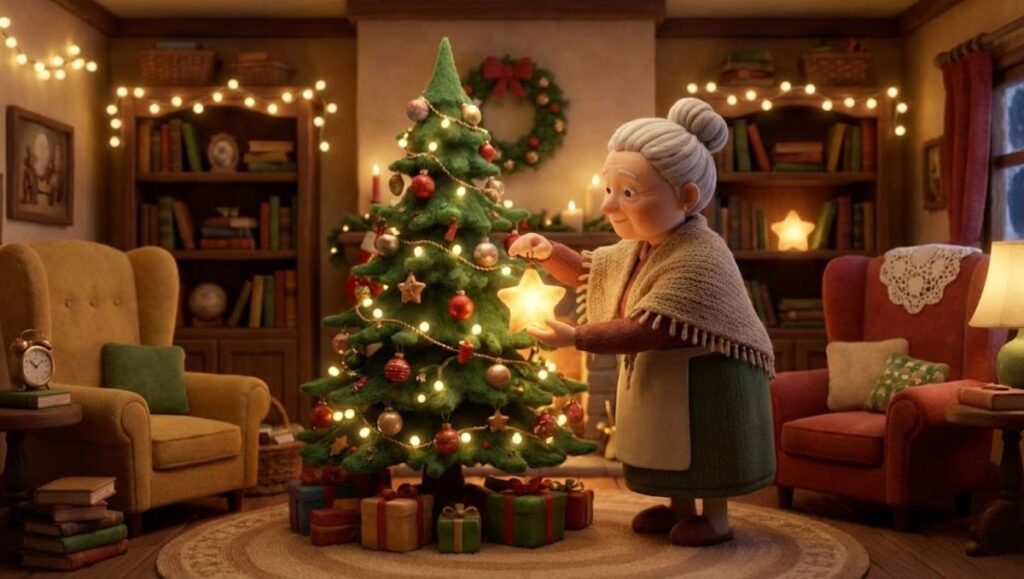
At the edge of a quiet town, there was a small Christmas tree farm.
The trees grew tall.
The snow fell gently.
The wind whispered softly through the branches.
And in a tiny wooden house lived Mrs. Evergreen.
That wasn’t her real name.
But it was what everyone called her.
Because she loved trees.
She talked to them.
She brushed snow from their branches.
She sang to them when no one was listening.
Every winter, families came to her farm.
They laughed.
They chose trees.
They tied them to their cars.
Mrs. Evergreen always smiled.
But she was always alone.
Her little house was warm.
But quiet.
Her fireplace crackled.
But no one sat beside it.
She had a box.
An old wooden box.
It was painted green.
Inside that box was her most precious thing.
Her last ornament.
She never showed it to anyone.
Not ever.
Not even when children begged.
“Please,” they said.
“Just for one second.”
But she always shook her head.
She smiled kindly.
But she said, “No.”
Because this ornament was not just glass.
It was not just shiny.
It was a memory.
It was love.
It was everything she had left.
One snowy morning, something strange happened.
Mrs. Evergreen walked to the box.
She sat by the fire.
She opened the lid.
And the ornament was gone.
Her hands froze.
Her breath stopped.
She looked again.
She lifted the soft cloth.
She searched every corner.
Empty.
Gone.
She felt her legs shake.
She whispered.
“No.”
She sat very still.
That afternoon, children began to arrive.
Families walked through the snow.
They pointed.
They laughed.
They chose their trees.
But Mrs. Evergreen couldn’t smile.
She tried.
But her lips trembled.
A small girl noticed.
Her name was Tilly.
Tilly had bright eyes.
And a soft voice.
She walked slowly toward Mrs. Evergreen.
“Are you okay?” she asked.
Mrs. Evergreen nodded.
“I’m fine,” she said.
But her eyes were wet.
Tilly looked at the little wooden house.
And then at the old woman’s hands.
They were shaking.
Tilly felt something.
Something heavy.
Something sad.
That night, after dinner, Tilly couldn’t sleep.
She told her parents she was tired.
They tucked her in.
They turned out the light.
But she sat up.
She pulled on her boots.
She wrapped a scarf around her neck.
And she slipped outside.
The snow was quiet.
The world felt soft.
She walked back toward the tree farm.
She didn’t know what she was looking for.
She just knew something was wrong.
She walked slowly between the trees.
She looked at the snow.
Something sparkled.
She bent down.
It wasn’t ice.
It wasn’t frost.
It was glass.
A tiny piece of shining glass.
She picked it up.
She walked further.
Another piece.
Then another.
A trail.
Leading toward the woods.
Tilly followed it.
Crunch.
Crunch.
Crunch.
Until she saw them.
Birds.
Little winter birds.
Hopping from branch to branch.
One bird had something shining tied gently around its tiny leg.
Tilly’s eyes widened.
It was the ornament.
The beautiful ornament.
It hung from a snow-dusted branch.
The birds had carried it.
Not to steal it.
But to use it.
They had been decorating their winter home.
Tiny twigs.
Shiny bits.
Soft feathers.
And in the center, the ornament glowed.
Tilly didn’t feel angry.
She felt amazed.
She felt warm.
She carefully untied it.
The birds didn’t fly away.
They watched.
Quiet.
Tilly held the ornament close.
It was a small glass tree.
Inside it, tiny white snow floated.
And inside the snow, two tiny names were written.
“Evergreen” and “Thomas.”
Tilly didn’t know who Thomas was.
But she knew it was important.
The next morning, Tilly knocked on Mrs. Evergreen’s door.
Mrs. Evergreen opened it slowly.
Tilly held out her hands.
“I found it,” she said.
Mrs. Evergreen’s eyes widened.
She pressed her hands to her mouth.
“Oh,” she whispered.
“My Thomas.”
Tilly stepped inside.
The fire was warm.
The room smelled like pine.
Mrs. Evergreen held the ornament.
She sat down slowly.
She ran her fingers over the tiny names.
“I made this with him,” she said.
“My husband.”
“We made it the first Christmas we ever had together.”
Tilly sat quietly.
She listened.
“He said,” Mrs. Evergreen continued, “that as long as this ornament existed, I would never be alone.”
Her voice shook.
“And when he was gone, I kept it hidden,” she said.
“Because I was afraid… to remember.”
Tilly looked up.
“You shouldn’t hide it,” she said softly.
Mrs. Evergreen looked at her.
“Why?” she asked.
Tilly shrugged.
“Because it still works,” she said.
Mrs. Evergreen’s eyes filled with tears.
But not the sad kind.
She stood slowly.
She walked to the window.
She lifted the ornament.
She held it in the light.
And something very soft happened.
Something warm.
Her house didn’t feel empty.
Not anymore.
That afternoon, Mrs. Evergreen did something she had never done before.
She hung the ornament in the front window.
Facing the tree farm.
People walked by.
They stopped.
They smiled.
They felt something.
Something gentle.
Something kind.
Tilly stood in the snow and watched.
Mrs. Evergreen opened the door.
She stepped out.
She held out her hand.
“Would you like some tea?” she asked.
Tilly smiled.
“I’d like that,” she said.
Inside the house, the fire danced.
The ornament shimmered.
And for the very first time in a very long time…
Mrs. Evergreen wasn’t alone anymore.
The Window That Watched Winter
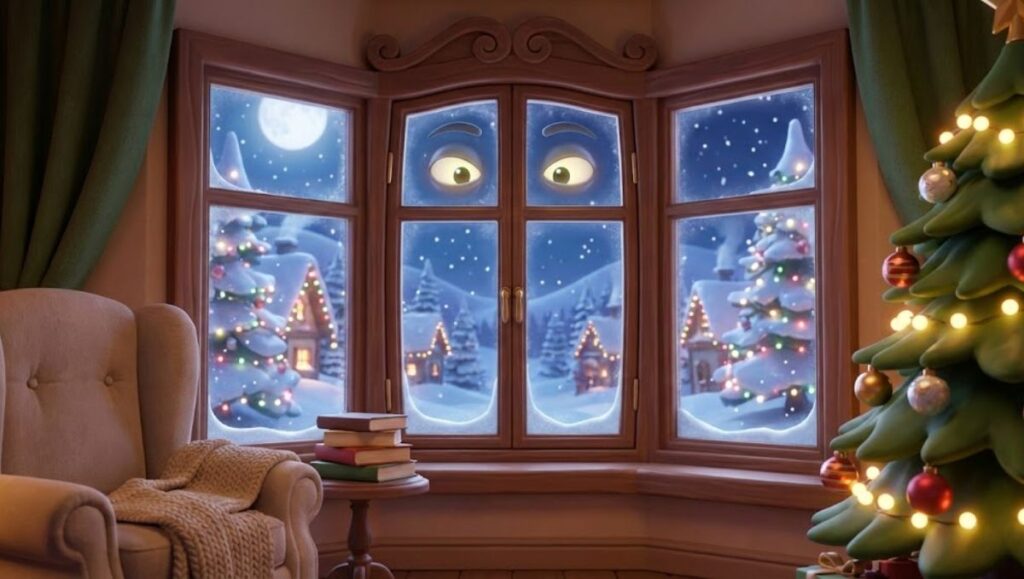
At the end of a quiet street, there was an old, empty house.
Its paint was peeling.
Its roof sagged.
Its gate leaned sideways.
No one went inside.
Everyone walked past it.
Except a little boy named Asa.
Asa liked quiet places.
He liked forgotten things.
He liked listening.
Every day in December, he walked past the house.
And every day, he slowed down.
Because there was one window that looked different.
The glass wasn’t broken.
It wasn’t dark.
It was clear.
Like water.
Like sky.
One late afternoon, Asa stopped.
Snow was falling.
Softly.
Slowly.
He stepped closer.
Very close.
He looked through the glass.
And he gasped.
He wasn’t seeing the empty room.
He was seeing winter.
But not this winter.
Another winter.
A different winter.
Children were skating.
Lanterns were glowing.
A small girl pressed her hands to the inside of the glass.
But she wasn’t looking at Asa.
She was looking through him.
Asa pulled back.
His heart beat fast.
That night, he couldn’t sleep.
He thought of that girl.
He thought of her sad eyes.
The next day, he came back.
The sky was pale.
The snow sparkled.
He looked again.
The scene had changed.
Now he saw a boy.
The same house.
The same room.
But it was warm.
A tree was in the corner.
Candles were glowing.
The boy sat alone.
No one else.
Just him.
He wasn’t crying.
But he looked like he wanted to.
Asa didn’t know why.
But his chest felt tight.
On the third day, Asa brought something with him.
A candy cane.
He pressed it gently to the glass.
The candy cane disappeared.
It slid through.
Like the window was soft.
The boy inside turned around.
He saw it.
His eyes widened.
He picked it up.
He smiled.
The room grew brighter.
Asa stepped back.
He didn’t feel scared.
He felt warm.
On the fourth day, Asa came back with a glove.
Bright red.
Soft.
He pressed it to the glass.
It slipped through.
This time, it appeared in the hands of the little girl.
She laughed.
The lanterns glowed brighter.
On the fifth day, the house looked the same.
But the glass did not show the past.
It showed a woman.
Old.
Tired.
She sat in a wooden chair.
The room was empty.
No tree.
No candles.
No lights.
She stared at the window.
Her eyes looked familiar.
Asa felt it.
He knew it.
This was the girl.
Grown up.
Alone.
Asa swallowed.
He pressed his warm mitten against the glass.
Nothing happened.
The glass stayed cold.
That night, Asa thought hard.
He thought about the candy cane.
The glove.
The smiles.
He understood.
The window wasn’t just showing winter.
It was waiting.
Waiting for kindness.
Waiting to feel remembered.
The next morning, Asa carried something very special.
He carried a small lantern.
A real one.
With a soft, warm candle inside.
He walked to the old house.
Snow crunched under his feet.
He held the lantern gently.
He pressed it to the glass.
The glass warmed.
It softened.
And the lantern slipped through.
Inside the window, the woman’s eyes widened.
Her hands shook.
She stood slowly.
She picked it up.
The light filled the room.
Her face softened.
Her shoulders relaxed.
She smiled.
But she cried too.
The house changed.
The walls looked warmer.
The shadows faded.
Outside, Asa stepped back.
The glass turned plain.
Just glass.
No more moving scenes.
No more glowing winter.
The next day, Asa walked past again.
And something had changed.
The house didn’t look empty.
A small light glowed behind the window.
A soft shadow moved.
A curtain shifted.
Someone was inside.
And they were not alone anymore.
Because one child had noticed.
And one heart had cared.
And the window had finally been seen.
The Pocket Full of Starlight
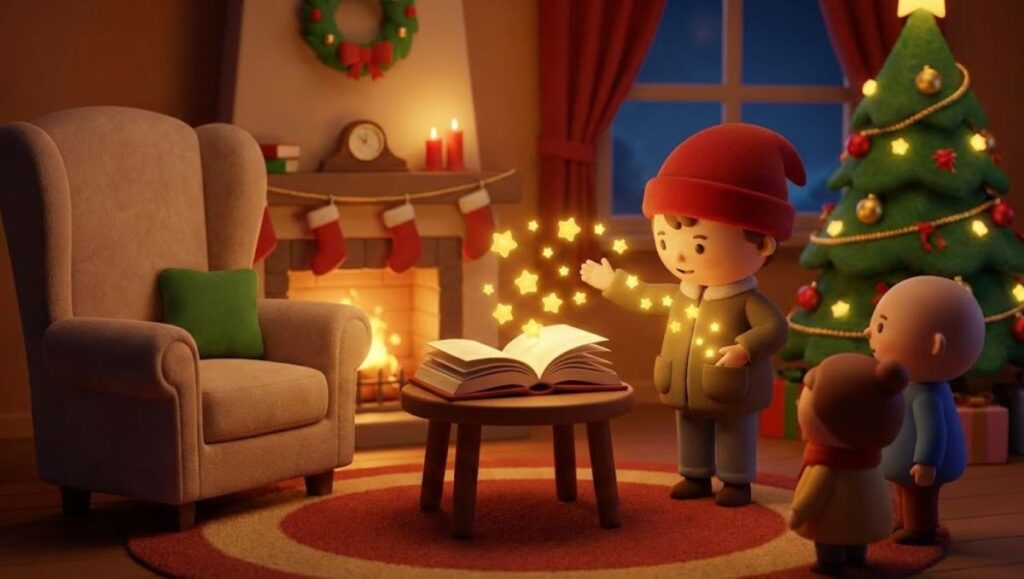
On a quiet winter night, a little child named Noor walked home alone.
The sky was very dark.
The stars were very bright.
The air was very cold.
Noor liked walking slowly.
She liked listening to the snow.
She liked looking up.
That night, one star fell.
Not like a shooting star.
Not fast.
Not loud.
It drifted.
It fluttered.
It whispered.
It landed softly… in her coat pocket.
Noor felt warmth.
A gentle warmth.
She stopped walking.
She reached into her pocket.
Her fingers touched light.
Real light.
Soft light.
Living light.
She pulled her hand out.
There was nothing there.
But when she looked into her pocket…
It glowed.
A tiny glow.
A shy glow.
She gasped.
She covered the pocket with her hand.
The glow stayed.
She pressed her palm gently.
“Hello?” she whispered.
The glow flickered.
Like a tiny heartbeat.
Noor smiled.
She kept walking.
But now, the darkness didn’t feel so dark.
When she reached home, she hid the glow.
She didn’t tell anyone.
Not her mother.
Not her friends.
Not even her cat.
That night, she dreamed of stars.
Soft stars.
Warm stars.
Stars that hummed.
The next day, at school, something felt wrong.
The classroom felt cold.
Not cold like winter.
Cold like lonely.
Noor noticed a boy sitting alone.
His name was Sam.
He never talked.
He never smiled.
He always looked at the floor.
Noor didn’t know why.
But her pocket warmed.
Just a little.
She touched it.
The glow inside pulsed.
Like it wanted something.
Noor hesitated.
Then she leaned a little closer to Sam.
She didn’t speak.
She just let the pocket face him.
The light slipped out.
Soft.
Invisible.
But real.
Sam looked up.
His eyes widened.
He blinked.
He smiled.
Just a small smile.
But the room felt warmer.
That afternoon, Noor walked past a park.
An old swing moved slowly in the wind.
A little girl sat on the ground.
Crying.
Her knees were pulled to her chest.
Noor’s pocket warmed again.
She sat next to the girl.
She didn’t talk.
She just held her coat close.
The light slipped out.
The girl stopped crying.
She wiped her eyes.
She smiled.
“Thank you,” she whispered.
Noor looked down.
Her pocket still glowed.
But a little less.
That night, Noor stood by her window.
She looked up at the sky.
It looked empty.
Dark.
She looked into her pocket.
The glow was smaller.
Dimmer.
But still alive.
“Are you tired?” Noor whispered.
The glow flickered softly.
The next day, it snowed hard.
The town felt heavy.
Quiet.
Gray.
People walked fast.
No one looked at each other.
Noor walked slowly.
Her pocket warmed again.
She walked into a small café.
A tired woman stood behind the counter.
Her eyes looked far away.
Noor stood very close.
She didn’t order anything.
She just waited.
The glow slipped out.
The woman blinked.
She breathed in.
She smiled.
“Happy holidays,” she said softly.
Noor’s pocket glowed nearly half its size.
That evening, Noor sat on her bed.
She opened her pocket as wide as she could.
The light pulsed weakly now.
She felt sad.
“Do you have to go?” she whispered.
The light flickered.
She understood.
The starlight wasn’t meant to stay.
It was meant to travel.
To move.
To touch.
Noor put on her coat.
She stepped outside.
It was very late.
Very quiet.
Very still.
She walked to the tallest hill in town.
Snow sparkled beneath her boots.
The sky stretched wide.
The pocket was barely glowing now.
Noor took a deep breath.
She reached inside.
She pulled the light out.
It floated in the air.
A tiny star.
Small.
Fading.
Noor lifted her hands.
She opened her fingers.
She said nothing.
She didn’t need to.
The tiny star floated upward.
Slowly.
Softly.
Back to the sky.
And in that moment, something amazing happened.
The whole sky grew brighter.
Not with more stars.
But with more warmth.
More softness.
More peace.
Noor went home.
Her pocket was empty.
But she didn’t feel empty.
She felt full.
Full of light.
And all around the town, people felt it.
But they didn’t know why.
All they knew was…
That winter felt kinder.
And the night felt less lonely.
And somewhere inside them…
Something bright had touched their hearts.
The Chimney That Changed Directions

On the quietest street of Hollyville, there was a small red brick house.
It was ordinary.
Except for the chimney.
For years, it had always pointed straight up.
Straight and steady.
No surprises.
But one snowy Christmas Eve, something strange happened.
The chimney twisted.
Slowly at first.
Then faster.
It leaned sideways.
It leaned backward.
It leaned forward.
By the time the town children noticed, it was pointing toward the bakery.
Then toward the park.
Then toward the old oak tree at the end of the street.
People stared.
They scratched their heads.
No one could explain it.
But in one little house, a mouse named Pip noticed first.
Pip was small.
Very small.
He had gray fur and bright black eyes.
He lived in the cracks of the red brick house.
He scurried along the beams, smelling crumbs and listening to the world.
That evening, Pip noticed the chimney moving again.
It tilted.
It spun slightly.
And then stopped.
Straight.
Perfectly straight.
But not over the house.
Over the neighbor’s roof.
Pip squeaked.
He knew something was wrong.
Because he had seen Santa’s sleigh.
Just once, long ago.
It was quiet.
It was fast.
It was magical.
And it went straight down chimneys.
But if a chimney wasn’t straight…
Well, trouble could happen.
And Pip didn’t want trouble.
He climbed the red brick wall.
Up, up, up.
He reached the roof.
He sniffed.
The snow was soft under his tiny feet.
He looked down the chimney.
Dark.
Silent.
Empty.
He twitched his whiskers.
Something was very wrong.
Pip ran down the roof.
Across the snowy street.
To the neighbor’s house.
He climbed inside.
He found the children.
Two little kids, Emma and Leo, were waiting for Santa.
They were asleep.
The fireplace was wide.
The chimney had twisted again.
Now it was pointing toward the frozen pond.
Pip squeaked loudly.
The children stirred.
Emma opened one eye.
“What is it, Pip?” she whispered.
Pip twitched his tail.
He pointed toward the chimney.
Leo rubbed his eyes.
“I think Santa can’t come down,” he whispered.
Emma gasped.
The children quickly got out of bed.
They put on boots, coats, and scarves.
They ran outside into the snow.
Pip led the way.
The chimney wobbled again.
Now it pointed toward the church steeple.
Now toward the town hall.
Now toward the big Christmas tree in the square.
Emma and Leo followed Pip.
They ran from house to house.
Through the snowdrifts.
Past the lampposts.
Past the frozen fountain.
And then they reached the last house.
It was the tallest one on the hill.
Its chimney now pointed perfectly straight.
Straight into the sky.
Pip squeaked happily.
Emma whispered, “We have to help him.”
Leo nodded.
“But how?” he asked.
Pip climbed up the bricks.
He started to nibble at a loose stone.
He pushed.
He pulled.
The chimney wobbled again.
Emma and Leo helped.
They pushed with their tiny hands.
They shook the bricks gently.
The chimney leaned.
It straightened.
It stopped.
Perfect.
Pip jumped down.
He squeaked.
Santa’s sleigh appeared in the sky.
It was silent.
It was magical.
It was bright.
The reindeer landed softly on the snowy roof.
Emma and Leo gasped.
They waved.
Santa waved back.
He winked.
He climbed down the straightened chimney.
He left gifts.
He left a small note.
“Thank you for fixing the path,” it read.
The children smiled.
Pip twitched his whiskers happily.
After Santa left, the chimney stayed straight.
The next morning, the whole town noticed.
The red brick chimney looked normal.
Ordinary.
Steady.
But Emma, Leo, and Pip knew the truth.
Sometimes, even chimneys have adventures.
Sometimes, even chimneys need a little help.
And sometimes, it takes a tiny mouse and two brave children to save Christmas.
The Day Christmas Slept In
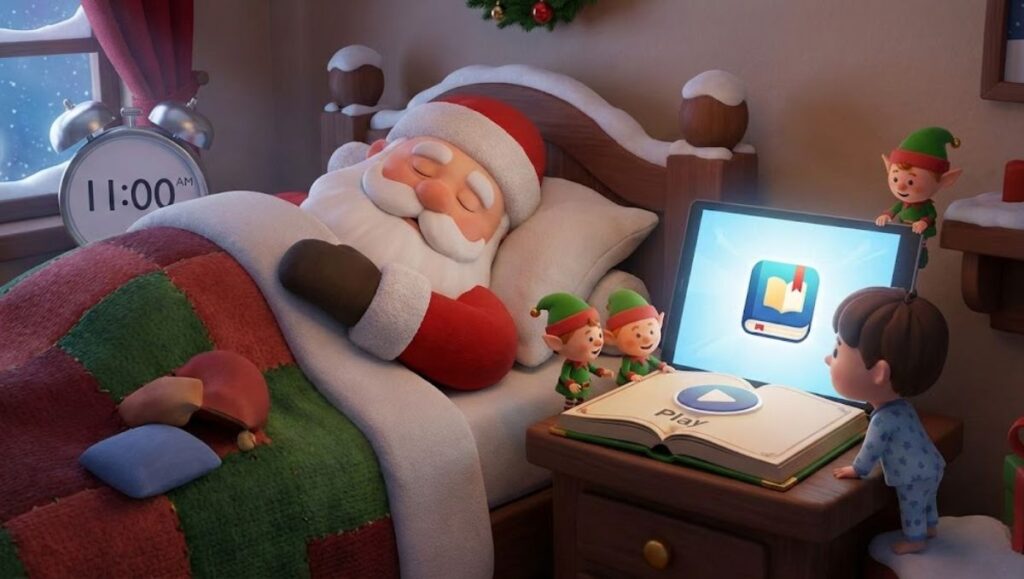
On Christmas morning, something strange happened.
Nothing.
No bells.
No laughter.
No lights.
No smells of cinnamon.
No sound of wrapping paper.
No sound of footsteps.
The world felt… paused.
In a small town called Brightmere, people woke up slowly.
They looked outside.
The sky was gray.
The snow was dull.
The windows were dark.
No twinkling lights blinked.
No wreaths glowed.
Mrs. Pine opened her door.
She looked at her porch.
No presents.
No pine scent.
No sparkle.
She frowned.
“This doesn’t feel like Christmas,” she whispered.
Down the street, a boy named Theo felt it too.
He sat up in bed.
He looked around his room.
No glow from his little star night light.
No red and green shimmer.
Everything looked ordinary.
Flat.
Quiet.
Cold in a different way.
Theo pulled on his sweater.
He walked outside.
The snow didn’t crunch.
It just sat there.
Like it was waiting.
He saw his neighbor, Mia.
She stood on her porch.
Her arms were crossed.
Her face looked confused.
“Do you feel it?” Theo asked.
Mia nodded.
“It’s like Christmas forgot to wake up,” she said.
They walked together down the street.
Other people stepped outside.
Looking.
Listening.
Waiting.
Mr. Bell, who always rang his tiny hand bells, just stood there.
He didn’t ring them.
He held them.
But they didn’t shimmer.
In a small cottage at the edge of town…
Christmas slept.
Not a person.
Not a holiday.
But a warm, glowing spirit.
Wrapped in soft light.
Blinking slowly.
Dreaming.
It had grown tired.
Over the years.
People had stopped smiling at each other.
They rushed.
They scrolled.
They hurried.
They forgot to feel.
And Christmas had grown sleepy.
Back in town, Theo felt something twist in his chest.
“This isn’t right,” he said.
Mia nodded.
They didn’t know what to do.
So they did the only thing that felt natural.
They went to Mrs. Pine’s house.
She looked surprised.
“We made you this,” Theo said.
He held out a tiny paper snowflake.
Mrs. Pine blinked.
Mia handed her a small hug.
Not a big one.
A soft one.
Mrs. Pine’s house warmed.
Just a little.
Down the street, the baker came out.
Theo and Mia walked over.
He looked tired.
They sat with him.
They didn’t ask for cookies.
They just listened to his stories.
The bakery smelled better.
A little.
They walked to Mr. Bell.
They fixed one of his fallen decorations.
He smiled.
It had been a long time since he smiled.
Far away, Christmas shifted.
Just slightly.
Still asleep.
But dreaming nicer dreams.
Theo and Mia kept walking.
They helped carry groceries.
They brushed snow off doorsteps.
They said, “I’m glad you’re here.”
To people who hadn’t heard that in a while.
The sky changed.
Not bright.
But softer.
Lighter.
In the sleeping place of Christmas…
The spirit slowly blinked.
It heard laughter.
Not loud laughter.
Real laughter.
It heard thanks.
Not rushed thanks.
Real thanks.
Back in town, people started to feel warmer.
Mrs. Pine baked bread.
She gave it away.
The baker gave cookies.
Mr. Bell rang his bells.
Softly.
Carefully.
A soft golden shimmer started to appear.
On rooftops.
On windows.
On hands.
Theo and Mia sat on the steps of the church.
They felt tired.
But good tired.
The sky faded into soft pink.
In the hidden place where Christmas slept…
The eyes of Christmas opened.
It stretched like morning light.
It yawned.
It smiled.
It wasn’t tired anymore.
The town felt it.
All at once.
Lights flickered on.
Quietly.
Garlands shimmered.
Soft bells rang.
Not too loud.
Just enough.
Snow crunched now.
Warm cocoa smelled stronger.
Not because of magic alone.
But because people were ready.
Theo looked at Mia.
“Christmas woke up,” he whispered.
Mia smiled.
“No,” she said.
“We woke it up.”
And across the town…
And across the quiet houses…
And across quiet hearts…
Christmas breathed again.
Not because of gifts.
Not because of decorations.
But because kindness remembered how to show up.
And that year…
Christmas didn’t sleep in.
Because hearts woke up first.
Why does reading aloud matter?
When someone reads aloud, something quiet but powerful happens. A voice slows down, a story opens up, and everyone in the room leans a little closer.
Helps the mind
Reading aloud supports vocabulary growth, memory, and clear understanding. Young children hear how sentences flow and how words work together. Older children practise listening and picturing scenes in their mind. Adults follow a steady story and often learn something new.
Supports feelings and calm
Hearing a familiar voice brings comfort. A short read aloud can become a quiet daily moment that lowers stress and strengthens a sense of belonging. These moments help children feel safe and connected.
Brings families together
Reading aloud is an easy way for family members of any age to share time. Grandparents and other older relatives can use it to connect with children in a simple and warm way. These shared stories often become memories that stay.
To begin, you only need your voice and a book. The habit can grow slowly and naturally into a meaningful family tradition.
A short history of why families read at Christmas
Storytelling during winter holidays has a long past. Before books were common, families shared stories by the fire. Carol singing and simple Nativity plays helped people share stories in their homes and in their communities.
In the 1800s, poems and stories such as A Visit from St. Nicholas shaped many Christmas traditions.
Later, stories like A Christmas Carol encouraged people to think about generosity, kindness, and caring for others during the season.
In the 20th century, radio readings and public performances brought Christmas stories into many living rooms.
Today, families enjoy audiobooks and online readings, yet the heart of the tradition remains the same. One person tells a story, and others listen, together, in a warm and quiet moment.
What makes a great Christmas read-aloud story
A great Christmas read aloud does not rely on sparkle or noise. It feels warm, steady, and easy to share, the kind of story everyone leans in to hear.
Warm feeling
The story should create warmth, wonder, or hope. It need not be overly sweet. Honest kindness is enough.
Clear rhythm
Short sentences, repetition, and predictable phrases help listeners follow and remember the story.
Relatable characters
Children and adults connect with characters who feel real, whether they are people or animals, even when the story includes magic.
Simple arc
Give the story a clear problem and a gentle resolution. It does not need a perfect ending, but it should offer comfort.
Ways for listeners to join in
Include lines children can repeat, sounds they can make, or small actions they can copy. That keeps them involved and happy.
A matching tone and pace
Some stories suit playful voices and bold gestures. Others work best read slowly and quietly. Pick the style that fits your group.
How long should a read-aloud be?
Match the story length to the age and energy of the listeners.
Toddlers ages 0 to 3
About one to five minutes. Choose short board books with bold pictures and a clear rhythm.
Preschoolers ages 3 to 5
About five to ten minutes. Simple plots, repetition, and plenty of illustrations work well.
Early readers ages 6 to 8
About ten to twenty minutes. These children enjoy more detail, with enough action and dialogue to keep things moving.
Older children and families ages 9 and above
About twenty to forty five minutes. This is a good stage for reading one chapter each night from a longer book.
For a mixed group, begin with a short picture book for younger children, then add a chapter or a slightly longer scene for older ones. Or choose a story that naturally has moments for different ages.
How to read aloud: simple and effective techniques
You do not need acting skills. A natural approach works well. These tips can help.
Speak slowly and clearly
Do not rush. Pause at punctuation. Give the story space so listeners can follow every moment.
Use gentle variation
Small changes in pitch and pace keep attention. Whisper during quiet parts. Lift your voice slightly during exciting lines. You do not need many character voices, only a light touch.
Look up now and then
Make brief eye contact. Notice how listeners react. If a child starts to say a line, let them join in.
Show the pictures
Hold the book so everyone can see. Encourage children to point out details in the illustrations.
Use simple props if you want
A small bell, a soft light, or a cookie can add fun. Keep props minimal so they support the story rather than distract from it.
Stay calm with interruptions
If someone enters the room or a toddler shifts around, continue with a smile. Small pauses are a natural part of reading together.
Making read alouds feel special without stress
You do not need a big setup. Small, gentle touches are enough to make the moment feel cozy.
Create a reading corner
A blanket, a few pillows, and soft lights can turn any spot into a warm place to sit and listen.
Keep snacks simple
Cocoa, cookies, or cut fruit work well. If sugar makes children active, choose something plain.
Invite family to join in
Let older children read a part. Let a grandparent share a favourite line. Shared voices make it feel more personal.
Build a small countdown
A twelve night series, a twenty four day advent reading, or a weekly family night can create steady excitement.
Pair reading with a short activity
A quick craft, a small drawing, or a short talk about the story helps the moment stay with the listeners.
The aim is warmth and connection, not perfection. A calm and simple routine often becomes the most loved one.
Troubleshooting common problems
Even the coziest read aloud can hit a few bumps. Wiggly kids, bored teens, or mixed ages are normal and easy to handle with small adjustments.
Too much movement
If children cannot sit still, shorten the story. Add small interactive moments. Stand up and act out a short scene to release energy.
Teens not interested
Invite them to take part. Ask them to read a short section or give a quick summary afterward. Do not push. Let them join in a way that feels comfortable.
Mixed ages
Begin with a short picture book for younger children, then follow with a chapter for older ones. You can also choose a story that offers something for every age.
A favourite used too often
Keep the well loved book, but rotate in one or two new titles each year. This keeps the tradition fresh without losing the comfort of old favourites.
Patience matters. The ritual is more important than a perfect session.
Pairing stories with simple learning and kindness
Reading aloud offers a gentle way to learn and to practise small acts of good.
Talk about feelings
Ask how the characters might feel and why. Let children share their thoughts in their own words.
Build vocabulary
Choose one new word from the story. Use it in a simple sentence afterward so it becomes familiar.
Do a small kindness
If the story focuses on giving or helping, follow it with a small action. Write a card for a neighbour or set aside a toy to donate.
These small steps connect the story to real life and help its message stay with the listeners.
The future: using technology without losing the human touch
Audiobooks, online readings, and augmented books can add variety. They are helpful when you are traveling or short on time.
They can support the routine, but they should not replace live reading. A real voice brings warmth, natural pauses, and small personal touches that technology cannot fully offer.
Use technology as a tool rather than a substitute. You can play a favourite audio narrator while everyone listens together, then talk about the story afterward. This keeps the experience shared and human while still enjoying what modern tools provide.
Final Thoughts
Reading aloud at Christmas is simple and meaningful. It does not require perfect acting or special setups. It only needs your voice, a book, and a little time.
If you want a small plan you can use right away:
- Pick one short book from your shelf.
- Create a cozy corner with a blanket and one lamp.
- Serve a simple snack such as a cookie or cocoa.
- Read slowly. Pause where it feels right. Smile. Invite one or two small responses.
- End with a gentle line such as “Let’s do this again tomorrow.”
That is all you need. Small, calm nights grow into a family tradition. Years later, people remember the voice more than the exact words. The real gift is not the book. It is the moment you share together.