Nobody expected a solar panel to become famous.
Especially not Sunny.
Sunny was a perfectly ordinary solar panel installed on the roof of a modest blue house at the end of Maple Avenue.
He wasn’t the biggest panel in town.
He wasn’t the newest.
He certainly wasn’t the most expensive.
In fact, for the first few months after installation, almost nobody noticed him at all.
Sunny spent his days quietly converting sunlight into electricity.
It was honest work.
Predictable work.
And exactly the kind of work he enjoyed.
Life was simple.
Then the electricity bill arrived.
Everything changed.
The homeowners, the Johnson family, had installed solar panels mostly out of curiosity.
Mr. Johnson had spent weeks researching renewable energy.
Mrs. Johnson liked the idea of reducing household expenses.
Their teenage daughter only cared because the monitoring app looked futuristic.
Nobody expected dramatic results.
When the monthly bill arrived, Mrs. Johnson opened the envelope.
Then she looked again.
Then a third time.
Finally, she called everyone into the kitchen.
“You need to see this.”
The family gathered around the table.
The electricity bill was nearly half of what they usually paid.
For several seconds, nobody spoke.
Then Mr. Johnson smiled.
“This might have been a good investment.”
The family celebrated.
Sunny felt proud.
Not that solar panels usually experience emotions.
But if they did, he felt proud.
Word spread quickly through the neighborhood.
People love discussing three things:
Weather.
Property values.
And unusually low utility bills.
Within days, curious neighbors started stopping outside the Johnson house.
At first, they simply glanced at the roof.
Soon they were asking questions.
“How much did the panels cost?”
“Do they actually work?”
“How much are you saving?”
“Can they power an air conditioner?”
The Johnson family answered patiently.
Meanwhile, Sunny enjoyed the attention.
For the first time in his life, people were talking about him.
The local newspaper eventually noticed.
A reporter arrived one afternoon to write a story about rising interest in renewable energy.
The article included a photograph of the Johnson home.
Unfortunately, the photographer became slightly carried away.
The image focused almost entirely on Sunny.
The next morning, the headline appeared:
LOCAL SOLAR PANEL HELPS FAMILY CUT ENERGY COSTS
Sunny’s photograph occupied half the page.
The Johnson family appeared as tiny figures in the background.
Sunny had become the star of the story.
The article attracted attention far beyond Maple Avenue.
Residents across town began discussing solar power.
Community groups shared the story online.
Environmental organizations highlighted the benefits of renewable energy.
Within weeks, Sunny’s photograph appeared everywhere.
Local blogs.
Community newsletters.
Energy awareness campaigns.
One website even referred to him as:
“The Most Influential Solar Panel in Town.”
Sunny thought that sounded important.
Then things became strange.
A local elementary school invited the Johnson family to speak about renewable energy.
The students became fascinated by Sunny.
They drew pictures.
Wrote stories.
Created classroom presentations.
One student even composed a poem called The Adventures of Sunny the Solar Panel.
The poem was twenty-seven pages long.
Nobody expected that level of commitment.
Soon, tourists began appearing.
Not thousands of tourists.
But enough to make things awkward.
Visitors stopped outside the house.
Some took photographs.
Others pointed excitedly at the roof.
One family drove two hours just to see the famous solar panel.
When they arrived, Sunny was covered by clouds.
The disappointment was visible.
As his popularity grew, Sunny developed a reputation.
People started attributing remarkable achievements to him.
When electricity costs dropped in the neighborhood, people credited Sunny.
When another family installed renewable energy, they thanked Sunny.
When the town launched a sustainability initiative, someone suggested making Sunny the mascot.
The proposal received overwhelming support.
The mayor personally approved it.
The annual Greenfield Sustainability Festival was approaching.
Organizers wanted a special guest for the opening ceremony.
Several names were considered.
Environmental scientists.
Local conservation leaders.
Renewable energy experts.
Instead, the committee selected Sunny.
The decision raised practical concerns.
After all, solar panels aren’t particularly mobile.
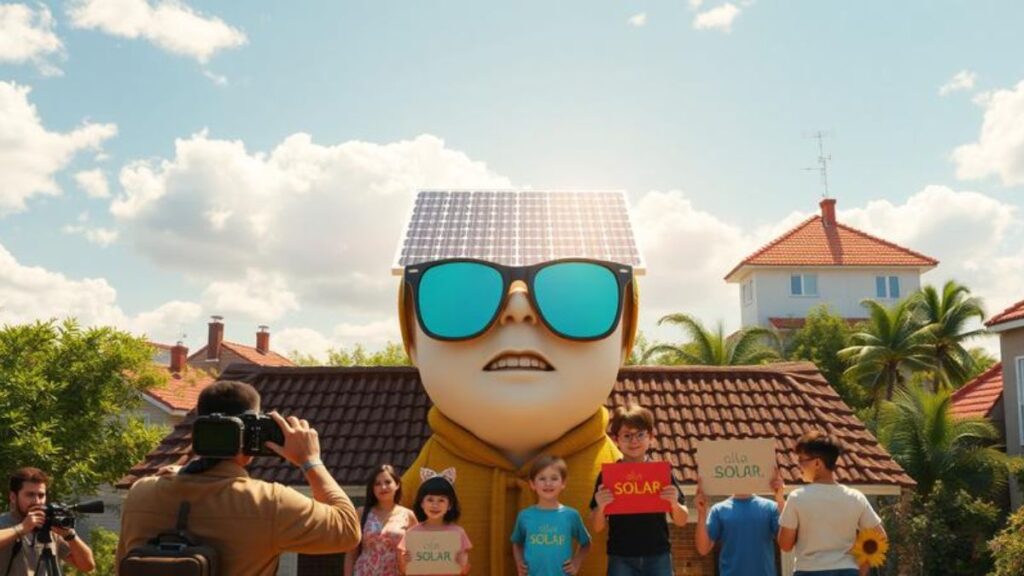
Eventually, organizers solved the problem by creating a giant cardboard replica.
The replica stood six meters tall.
It featured a smiling face and oversized sunglasses.
The resemblance was questionable.
But people loved it.
Festival day arrived.
Thousands of visitors attended.
The giant Sunny replica greeted guests at the entrance.
Children posed for photographs.
Families purchased souvenir T-shirts.
Someone sold miniature solar panel keychains.
A local bakery introduced solar-shaped cookies.
The event was a massive success.
Meanwhile, the real Sunny remained on the Johnson roof, quietly generating electricity.
He found the situation slightly amusing.
Not everyone appreciated Sunny’s fame.
Across town, several other solar panels became jealous.
One panel on Oak Street claimed it generated more electricity.
Another argued it had better positioning.
A third insisted its efficiency ratings were superior.
The rivalry escalated.
Homeowners began comparing performance data.
Neighborhood solar discussions became surprisingly competitive.
Before long, residents were proudly showing off energy production statistics the way people normally discuss sports scores.
Renewable energy had become a local obsession.
The competition produced unexpected results.
More homeowners installed solar panels.
Businesses invested in renewable energy.
Schools added educational programs about sustainability.
Energy awareness increased dramatically.
The town’s overall electricity consumption declined.
Greenfield became known as a leader in renewable energy adoption.
All because one family’s electricity bill attracted attention.
A year later, the mayor presented a special award.
The ceremony took place during the annual sustainability festival.
Residents gathered in the town square.
The mayor stepped forward holding a plaque.
“Today we recognize an individual whose contributions have inspired our community.”
Everyone applauded.
The mayor smiled.
“This award goes to Sunny.”
The crowd cheered.
Several people waved solar-themed banners.
One child appeared dressed as a photovoltaic cell.
Nobody knew exactly how to react to that.
The plaque was eventually mounted near the town’s renewable energy education center.
It read:
IN HONOR OF SUNNY
The Solar Panel That Inspired a Community to Embrace Renewable Energy.
Visitors still stop to read it.
Many then look toward the Johnson house, where Sunny continues doing what he has always done.
He quietly converts sunlight into electricity.
No interviews.
No speeches.
No dramatic appearances.
Just steady, reliable work.
Which, according to many experts, is exactly what makes a true celebrity.
Environmental Message
This story highlights how small actions can inspire larger environmental change.
Renewable energy technologies such as solar power help reduce dependence on fossil fuels while lowering long-term energy costs. As more households and businesses adopt clean energy solutions, communities can reduce emissions and increase energy independence.
Sometimes all it takes is one success story to encourage others to follow.
In Sunny’s case, one solar panel helped an entire town see the potential of renewable energy.