Oliver Oak had spent eighty years being a model citizen.
He provided shade during summer heatwaves.
He offered shelter to birds, squirrels, and the occasional confused cat.
He absorbed carbon dioxide, produced oxygen, reduced noise pollution, and beautified Maple Street without charging anyone a single rupee.
Yet despite his contributions, the residents rarely seemed grateful.
If anything, they complained.
Every autumn, homeowners grumbled about leaves covering their lawns.
Every spring, they blamed Oliver for pollen.
During storms, they worried about falling branches.
One resident even claimed Oliver was responsible for blocking her favorite sunset view.
After decades of criticism, the old oak tree finally had enough.
The breaking point arrived on a warm June morning.
Mrs. Henderson stood beneath his branches holding a rake.
She stared at a small pile of leaves and sighed dramatically.
“This tree is completely useless.”
Oliver couldn’t believe what he had heard.
Useless?
For eighty years he had worked without weekends, holidays, or retirement benefits.
Meanwhile, Mrs. Henderson once spent three days trying to find a television remote that was sitting on her coffee table.
The accusation stung.
Something had to change.
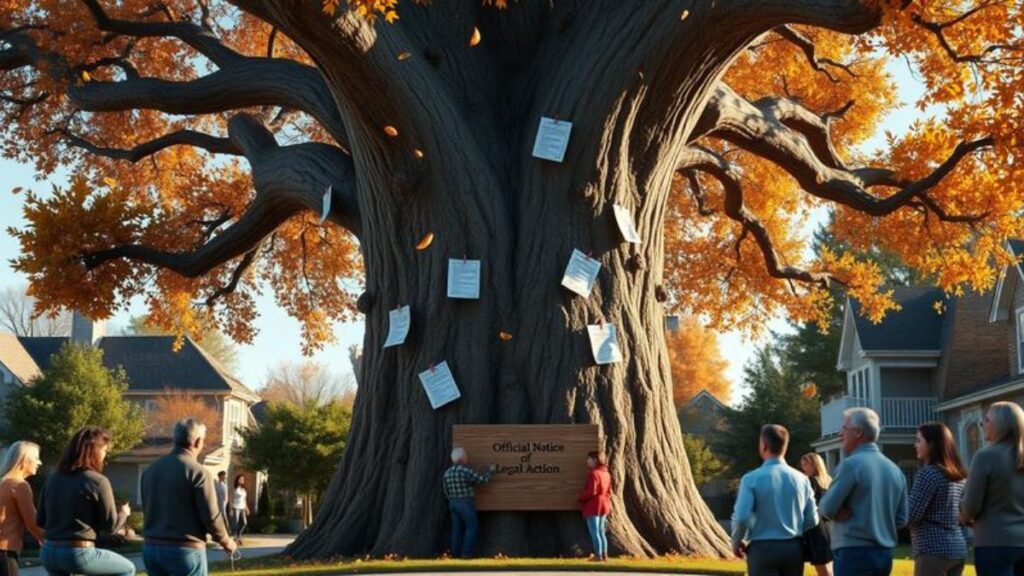
The following Monday, residents woke up to an unusual sight.
A large wooden sign stood beside Oliver’s trunk.
Painted in bold black letters were the words:
OFFICIAL NOTICE OF LEGAL ACTION
Plaintiff: Oliver T. Oak
Defendants: Residents of Maple Street
Charges:
- Chronic Ingratitude
- Excessive Leaf Complaints
- Failure to Appreciate Free Oxygen
- Emotional Distress Caused by Insults
The neighborhood was stunned.
Some assumed local teenagers were playing a prank.
Others blamed social media.
One man insisted it was artificial intelligence.
By lunchtime, however, every mailbox contained a sixty-page legal complaint.
The document was surprisingly detailed.
Apparently, Oliver had been keeping records.
Page twelve listed decades of oxygen production.
Page nineteen documented cooling services provided during summer.
Page twenty-seven contained testimonials from local wildlife.
Page thirty-two featured a chart titled:
THINGS HUMANS HAVE BLAMED ON ME THAT ARE NOT ACTUALLY MY FAULT
The list included:
- Squirrels
- Allergies
- Bad weather
- Slow internet
- Rising property taxes
- One failed marriage
Residents were shocked.
The evidence was difficult to argue with.
News of the lawsuit spread rapidly.
Within days, journalists arrived from across the country.
Environmental activists organized rallies.
Lawyers volunteered to represent the tree.
Television crews broadcast live updates from Maple Street.
Soon, Oliver became the most famous tree in the nation.
The court scheduled an official hearing.
Representing Oliver was Harold.
Harold was a squirrel.
Technically, he had no legal qualifications.
However, he owned a tiny briefcase and spoke with remarkable confidence.
In Harold’s opinion, that was more than enough.
The courtroom was packed.
Residents filled every seat.
Reporters crowded the back rows.
A group of pigeons occupied the windowsill.
Harold climbed onto a chair and adjusted an imaginary tie.
“My client has served this community for eighty years,” he began.
The room fell silent.
“He has improved air quality.”
A few people nodded.
“He has reduced summer temperatures.”
More nodding.
“He has supported local biodiversity.”
The audience listened carefully.
“He has increased property values.”
Suddenly everyone became very interested.
Harold smiled.
“Yet despite all these contributions, the majority of feedback concerns leaves.”
The room grew uncomfortable.
Several residents avoided eye contact.
The neighborhood’s lawyer, Gary Thompson, stood to present the defense.
Unfortunately, Gary specialized in parking disputes.
Environmental law was not his area of expertise.
He cleared his throat.
“Your Honor, the tree drops leaves.”
Silence.
Harold blinked.
“That’s your entire argument?”
Gary checked his notes.
“It also drops acorns.”
The silence became even more awkward.
Even Gary looked disappointed in himself.
The prosecution called its first witness.
A robin named Rebecca.
Rebecca testified that Oliver had provided housing for her family for five generations.
The next witness was a squirrel who praised Oliver’s branch infrastructure.
Then came a family of rabbits who described the tree as “an outstanding community member.”
The final witness surprised everyone.
A local air-conditioning technician.
He presented years of energy data.
Homes located near Oliver required significantly less cooling during summer.
The tree’s shade had saved residents thousands of dollars over the years.
Gasps filled the courtroom.
People suddenly realized they had spent decades complaining about one of the most valuable things in the neighborhood.
As public opinion shifted, residents began reconsidering their position.
Community meetings were held.
For the first time, people discussed what Oliver actually contributed.
Children started creating thank-you cards.
Local schools organized tree appreciation events.
A neighborhood cleanup group formed.
Even Mrs. Henderson seemed embarrassed.
“I may have been slightly unfair,” she admitted.
The statement shocked everyone who knew her.
Eventually, the judge encouraged both sides to negotiate a settlement.
Oliver’s demands turned out to be surprisingly reasonable.
He requested:
- Ten new trees planted within the community.
- Monthly neighborhood cleanups.
- Better protection for local green spaces.
- Public recognition of environmental contributions.
- A permanent reduction in unnecessary leaf complaints.
The final condition sparked intense debate.
Several residents argued that complaining about leaves was a cherished tradition.
Others claimed it was their constitutional right.
After lengthy negotiations, a compromise was reached.
Residents would be allowed one official leaf complaint per season.
No more.
The settlement transformed Maple Street.
Families planted saplings along sidewalks.
Children organized recycling drives.
Community gardens appeared in vacant lots.
Birdhouses were installed throughout the neighborhood.
People spent more time outdoors.
For the first time in years, residents began viewing nature as a partner rather than an inconvenience.
The changes even attracted visitors from neighboring towns.
Many came specifically to see the famous tree that sued an entire street.
Months later, autumn arrived.
Golden leaves drifted gently through the air.
Lawns filled with colorful foliage.
To Oliver’s amazement, nobody complained.
Well, almost nobody.
One resident attempted to file an official grievance regarding acorns.
The paperwork mysteriously vanished.
Harold denied involvement.
Nobody believed him.
At the end of the year, a plaque was installed beside Oliver’s trunk.
It read:
THANK YOU, OLIVER
For eighty years of shade, clean air, beauty, and patience.
Visitors often stopped to read it.
Whenever they did, Oliver’s branches seemed to sway proudly overhead.
Scientists insisted this was simply the wind.
Harold insisted it was satisfaction.
The debate continues to this day.
Environmental Message
This story may be fictional, but its lesson is very real.
Trees provide enormous benefits to communities every day. They improve air quality, reduce urban heat, support wildlife, absorb carbon dioxide, and make neighborhoods healthier and more attractive places to live.
Like the residents of Maple Street, people often notice the inconveniences of nature while overlooking its contributions.
Sometimes it takes a lawsuit from a very patient tree to remind everyone just how valuable the natural world truly is.