The town of Greenfield had always taken pride in being environmentally friendly.
Residents planted trees.
Children participated in annual cleanup drives.
Local businesses encouraged reusable bags.
Even the mayor rode a bicycle to work every Friday, provided the weather was pleasant and there were no steep hills involved.
For years, Greenfield had been trying to earn the title of “Most Sustainable Town in the Region.”
Unfortunately, another town kept winning.
Every single year.
Their rival, Eco Valley, had become the town’s greatest obsession.
Nobody talked about sports.
Nobody talked about politics.
They talked about Eco Valley.
“Did you hear they increased recycling by twenty percent?”
“Apparently their landfill waste dropped again.”
“They’ve won three years in a row.”
The conversations were unbearable.
Something had to change.
And that something arrived in the form of a very enthusiastic mayor.
One Monday morning, Mayor Susan Green called an emergency town meeting.
Residents packed the community center.
The mayor stepped onto the stage with the confidence of someone about to make a terrible decision.
“My fellow citizens,” she announced.
The room grew quiet.
“This year, Greenfield will become the recycling capital of the region.”
Thunderous applause erupted.
The mayor smiled.
To be fair, Greenfield residents applauded almost everything.
“I am launching the Great Greenfield Recycling Competition.”
More applause.
The mayor continued.
“The household that recycles the most materials over the next three months will receive a trophy, a certificate, and eternal neighborhood bragging rights.”
The crowd lost its mind.
People loved trophies.
People loved certificates.
But nothing motivated Greenfield residents more than bragging rights.
The competition began immediately.
At first, everything went surprisingly well.
Residents carefully sorted paper, cardboard, glass, and plastic.
Children reminded parents about recycling rules.
Businesses installed additional collection bins.
The town’s recycling numbers increased dramatically.
Local newspapers celebrated the initiative.
Environmental groups praised the community.
Even Eco Valley seemed impressed.
Unfortunately, success created a problem.
People became competitive.
Very competitive.
Possibly too competitive.
Within two weeks, neighbors began monitoring each other’s recycling bins.
Residents developed complex tracking systems.
Some households created spreadsheets.
Others installed whiteboards in their kitchens.
One family held nightly strategy meetings.
The competition stopped being about helping the environment.
It became about winning.
And Greenfield residents took winning very seriously.
The first sign of trouble appeared outside the home of Mr. Thompson.
A recycling truck arrived to collect materials.
Workers quickly noticed something unusual.
Among the cardboard and plastic bottles sat an old wooden chair.
The crew stared at it.
Mr. Thompson proudly stepped outside.
“Recycling.”
“You can’t recycle that.”
“Why not?”
“It’s a chair.”
Mr. Thompson seemed disappointed.
The chair returned home.
But the idea had been planted.
Soon, residents started questioning everything.
Could old toys be recycled?
What about garden tools?
Broken furniture?
A lawnmower?
A canoe?
Arguments broke out across town.
The local recycling center received hundreds of phone calls.
Employees spent entire days explaining why certain objects could not be placed in recycling bins.
Nobody listened.
Three weeks into the competition, things became much worse.
Mrs. Henderson attempted to recycle an entire garden shed.
The recycling truck driver nearly drove into a mailbox.
“Why is there a shed in your driveway?”
“It’s made of wood.”
“That doesn’t mean it goes in the recycling bin.”
Mrs. Henderson crossed her arms.
“Seems recyclable.”
The driver suddenly understood why people retired early.
The competition escalated.
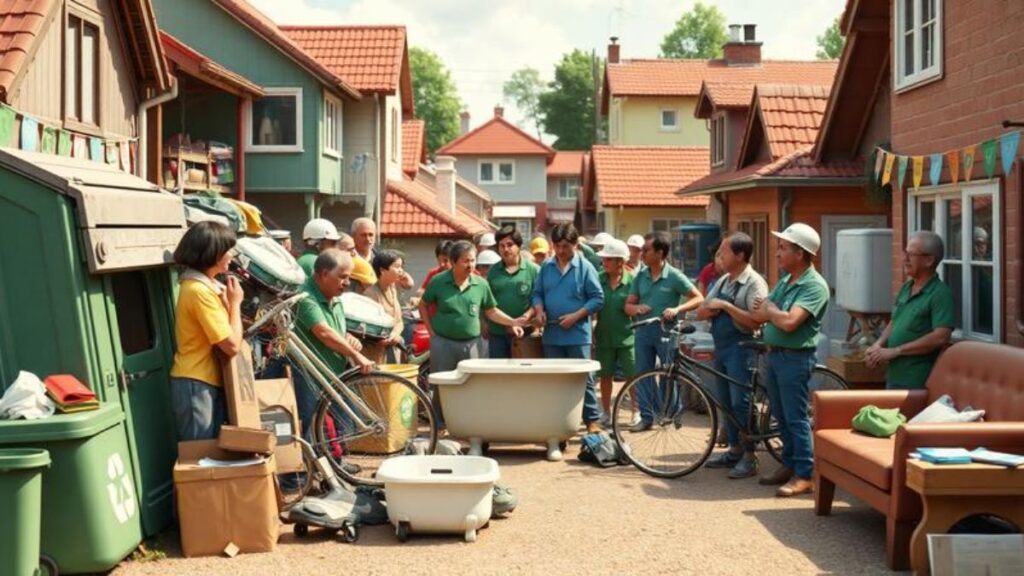
One resident delivered a wheelbarrow full of scrap metal.
Another attempted to recycle a trampoline.
A local mechanic submitted several car doors.
Someone left a bathtub outside the recycling center.
Nobody claimed responsibility.
The bathtub remained there for weeks.
Eventually, it became a flower planter.
The mayor grew concerned.
An emergency meeting was scheduled.
Citizens gathered once again inside the community center.
Mayor Green stepped onto the stage.
“This competition is getting out of hand.”
The audience looked confused.
“Last week someone attempted to recycle a traffic cone.”
A man raised his hand.
“In my defense, it looked recyclable.”
The mayor sighed.
“Yesterday, a resident submitted three fence panels.”
Several people nodded thoughtfully.
The mayor realized the situation was even worse than she had feared.
Determined to restore order, officials released a detailed recycling guide.
The document explained exactly what could and could not be recycled.
The guide was twelve pages long.
Residents treated it like a challenge.
Instead of following the rules, they searched for loopholes.
One family spent two hours debating whether a broken birdhouse counted as wood, construction material, or bird real estate.
Nobody reached a conclusion.
Then came the incident that changed everything.
The recycling center manager arrived at work one morning and discovered something astonishing.
The town’s largest recycling bin was missing.
A frantic search began.
Employees checked storage areas.
Parking lots.
Maintenance buildings.
Nothing.
The recycling bin had vanished.
By afternoon, security footage revealed the truth.
Someone had attempted to recycle the recycling bin.
The news spread across Greenfield within hours.
Residents were horrified.
Not because someone had recycled a recycling bin.
Because nobody had thought of it first.
The mayor immediately called another emergency meeting.
This time, attendance broke records.
Mayor Green walked onto the stage looking exhausted.
She adjusted the microphone.
Took a deep breath.
And made the announcement.
“The Great Greenfield Recycling Competition is officially over.”
The crowd gasped.
A few people cried.
One resident attempted to argue.
The mayor pointed toward a photograph of the missing recycling bin.
The argument ended immediately.
Although the competition ended, something unexpected happened.
The town’s recycling rates remained high.
Residents had developed genuine recycling habits.
People paid more attention to waste.
Families became more aware of environmental issues.
Children learned about sustainability.
Businesses improved waste management practices.
Even Eco Valley admitted Greenfield had made impressive progress.
For the first time, the two towns began sharing ideas instead of competing.
Several months later, Greenfield finally received recognition for its environmental efforts.
The town won a regional sustainability award.
Residents celebrated with a community picnic.
During the ceremony, officials unveiled a special plaque.
The inscription read:
“In Honor of the Great Greenfield Recycling Competition.”
Beneath that was a second line.
“Please Do Not Recycle This Plaque.”
The crowd laughed.
Mostly because nobody could tell if it was a joke or a warning.
Environmental Message
This story highlights an important reality about recycling.
While enthusiasm for sustainability is valuable, effective recycling requires knowledge as well as participation. Contaminated or improperly sorted materials can create challenges for recycling systems and reduce their effectiveness.
The best environmental habits combine good intentions with accurate information.
Fortunately for Greenfield, even a recycling competition disaster helped people become more environmentally aware.
The missing recycling bin was eventually recovered.
Nobody ever admitted responsibility.
Some mysteries are destined to remain unsolved.