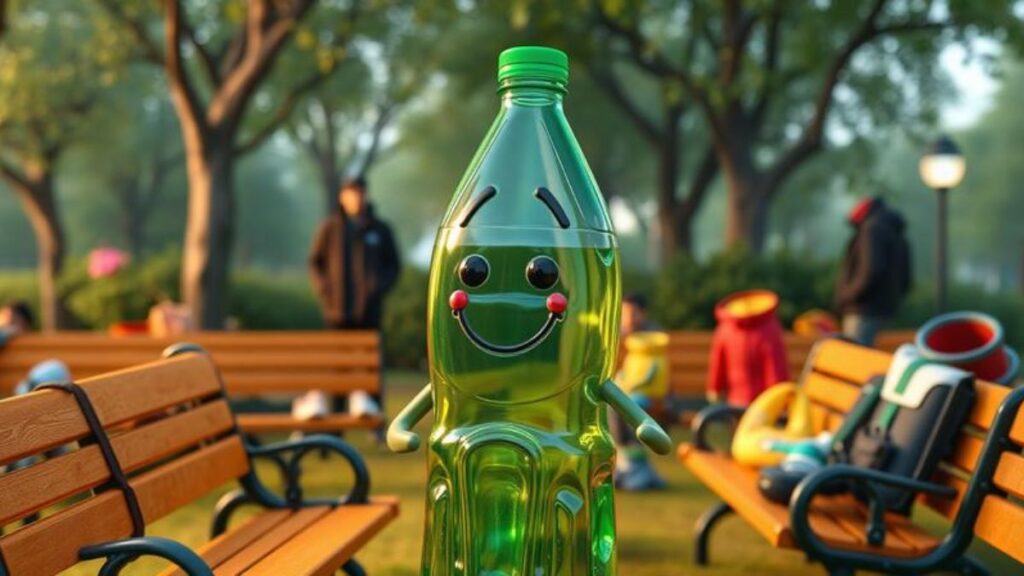
Pete had spent his entire life carrying beverages.
Water.
Juice.
Sports drinks.
Soft drinks.
Flavored water pretending to be healthier than it actually was.
If it needed a bottle, chances were Pete had done the job at some point.
For years, he worked hard without complaint.
He traveled through supermarkets.
Convenience stores.
Vending machines.
School cafeterias.
Sports stadiums.
Airports.
And once, quite mysteriously, a wedding reception.
Pete had seen everything.
Unfortunately, he had also noticed something troubling.
Most plastic bottles had incredibly short careers.
A bottle would be manufactured.
Filled.
Purchased.
Used.
And then discarded.
Sometimes after only a few minutes of service.
To Pete, it seemed unfair.
One afternoon, while sitting inside a recycling bin behind a community center, Pete met an older bottle named Walter.
Walter looked experienced.
His label was faded.
His cap had seen better days.
Most importantly, Walter seemed unusually calm.
“First time in recycling?” Walter asked.
Pete nodded.
“I guess this is the end.”
Walter laughed.
“The end?”
“Of course. What else would it be?”
Walter smiled.
“My friend, this is retirement.”
Pete blinked.
“Retirement?”
“Absolutely.”
Pete looked around the recycling bin.
There were dozens of bottles.
Cans.
Containers.
Cardboard boxes.
Nobody appeared retired.
Everyone looked confused.
Walter explained.
“Humans think our story ends here.”
Pete listened carefully.
“But recycling is simply a career change.”
The idea sounded ridiculous.
Yet Walter seemed sincere.
“Let me tell you something,” Walter continued.
“I used to know a bottle named Sarah.”
“What happened to her?”
“She’s a park bench now.”
Pete nearly rolled over in shock.
“A park bench?”
“Very popular one too.”
Walter nodded proudly.
“People sit on her every day.”
Pete wasn’t sure whether that was impressive or alarming.
Over the following hours, Walter shared more stories.
One former bottle became part of a playground.
Another became carpeting.
Several returned as new bottles.
One particularly ambitious bottle became part of a professional soccer jersey.
Pete couldn’t believe it.
The possibilities seemed endless.
For the first time, recycling didn’t feel like an ending.
It felt like an opportunity.
That evening, Pete had an idea.
A big idea.
A ridiculous idea.
The kind of idea that usually changes everything.
“If bottles can have second careers,” he said, “why don’t we help them prepare?”
Walter looked interested.
“What are you suggesting?”
Pete smiled.
“We create a retirement association.”
The recycling bin fell silent.
Even the aluminum cans stopped rattling.
Pete continued.
“We help bottles understand their options.”
“We provide career guidance.”
“We celebrate successful transitions.”
“We support bottles entering new professions.”
Walter stared at him.
“You want to create a retirement club?”
Pete nodded.
“Exactly.”
The Plastic Bottle Retirement Association officially launched three days later.
Membership grew rapidly.
Apparently, many bottles shared Pete’s concerns about the future.
Weekly meetings were organized.
Guest speakers were invited.
Former bottles returned to share success stories.
The first speaker was Brenda.
Brenda had once contained lemonade.
Now she was part of a public park bench.
The audience listened attentively.
“How’s retirement?” someone asked.
Brenda laughed.
“Retirement? I support six people every afternoon.”
The room applauded.
The next guest speaker was Tony.
Tony had been transformed into a fleece jacket.
His presentation attracted considerable attention.
Especially during winter.
“Any regrets?” Pete asked.
“Only one,” Tony replied.
“People keep describing me as stylish.”
The audience gasped.
Such compliments were rare in the bottle community.
Word of the association spread.
Soon, bottles from neighboring recycling centers joined.
Membership reached hundreds.
Then thousands.
Career fairs were organized.
Educational workshops followed.
The association published newsletters.
One issue featured:
Top Emerging Careers for Retired Bottles
- Park Benches
- Playground Equipment
- Sports Clothing
- Recycled Packaging
- Construction Materials
The article became surprisingly popular.
Meanwhile, humans began noticing something unusual.
Recycling participation increased.
Community awareness improved.
More people sorted waste correctly.
Collection rates climbed.
Environmental groups celebrated the trend.
Nobody realized a bottle retirement movement was secretly responsible.
The association’s greatest achievement came during its first annual conference.
Representatives from recycling facilities around the region attended.
Success stories filled the agenda.
A former bottle who became part of a bicycle helmet delivered the keynote speech.
Another who became carpeting discussed career adaptability.
The audience loved every minute.
Pete watched proudly from the front row.
What had started as a simple conversation inside a recycling bin had become something much larger.
A movement.
Not every bottle embraced the concept.
A few remained skeptical.
One bottle insisted becoming a park bench sounded exhausting.
Another claimed he preferred traditional bottle careers.
Pete respected their opinions.
After all, retirement meant different things to different bottles.
The important thing was having options.
Several years later, the Plastic Bottle Retirement Association became legendary.
Newly recycled bottles often arrived feeling nervous.
Uncertain.
Confused.
Then they heard the stories.
Park benches.
Jackets.
Playgrounds.
Furniture.
New bottles.
Road construction materials.
Suddenly the future seemed exciting.
Pete eventually retired from leadership.
The association held a farewell celebration.
Hundreds of former bottles attended.
Many arrived in their new forms.
Some as clothing fibers.
Others as recycled products.
One was technically part of a traffic barrier.
Nobody questioned it.
The event was emotional.
Pete addressed the crowd one final time.
“When people look at a discarded bottle,” he said, “they often see waste.”
The room listened.
“But every bottle has potential.”
Applause erupted.
Because everyone knew it was true.
Today, Pete’s story is still told wherever recycling takes place.
New bottles learn that disposal is not necessarily the end of the journey.
Sometimes it’s the beginning of something new.
A second chance.
A new purpose.
A completely different career.
And occasionally, if you’re very lucky, a surprisingly comfortable park bench.
Environmental Message
Plastic pollution remains a significant environmental challenge, but recycling helps reduce waste and conserve resources. Recycled plastics can be transformed into a wide range of products, including clothing, construction materials, furniture, packaging, and outdoor equipment.
The story of Pete reminds us that many materials still have value after their first use. By recycling properly, individuals help create a circular economy where resources remain useful for longer rather than ending up in landfills or the natural environment.
Sometimes sustainability is simply about giving old materials the opportunity to start a new chapter.