The city is loudest when it is trying to be productive, but it is most honest in the middle of the night. The Bridge at 2 AM is a place where the heavy lifting of the world stops for a moment, and the structures we build are allowed to just exist.
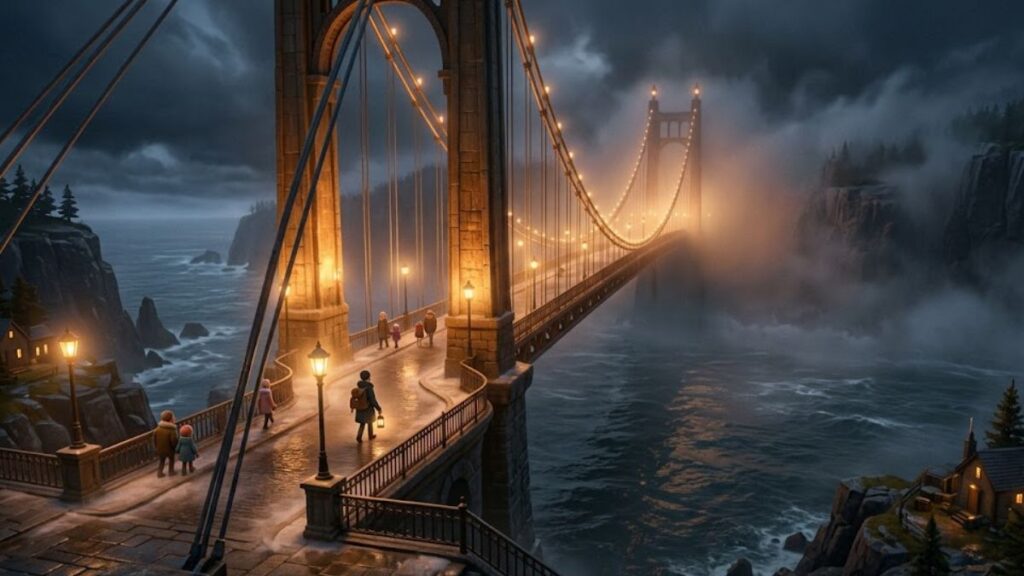
A Narrative for Those Who Build and Carry the World
This architectural reset is designed as a structural calibration for the analytical mind. For those whose days are spent managing systems, designing solutions, or carrying the weight of responsibility, The Bridge at 2 AM serves as a powerful metaphor for transition. At this hour, the world’s heavy machinery is quiet, but the foundations remain. This narrative uses atmospheric detail and low-stakes structural descriptions to help the logical brain disarm, shifting your focus from “problem-solving” to “structural peace.”
Chapter 1: The Blueprint of Silence

The bridge did not simply span the river; it held the two shores in a permanent, silent conversation. Within the stillness of The Bridge at 2 AM, the city’s blueprints are finally folded away. The blueprints of your day—the deadlines, the logistics, the structural loads of a career—are irrelevant here.
You stand at the entrance of the pedestrian walkway. The air is crisp, smelling of cold river water and damp stone. There are no sirens. No grinding gears of industry. Just the massive, looming presence of the suspension cables, glowing like silver threads under the orange hue of the sodium lamps. The bridge is a masterpiece of tension and compression, standing perfectly still while the world sleeps beneath it. You take your first step onto the wood-planked path, and the world becomes a symphony of solid things.
Chapter 2: The Geometry of the Night
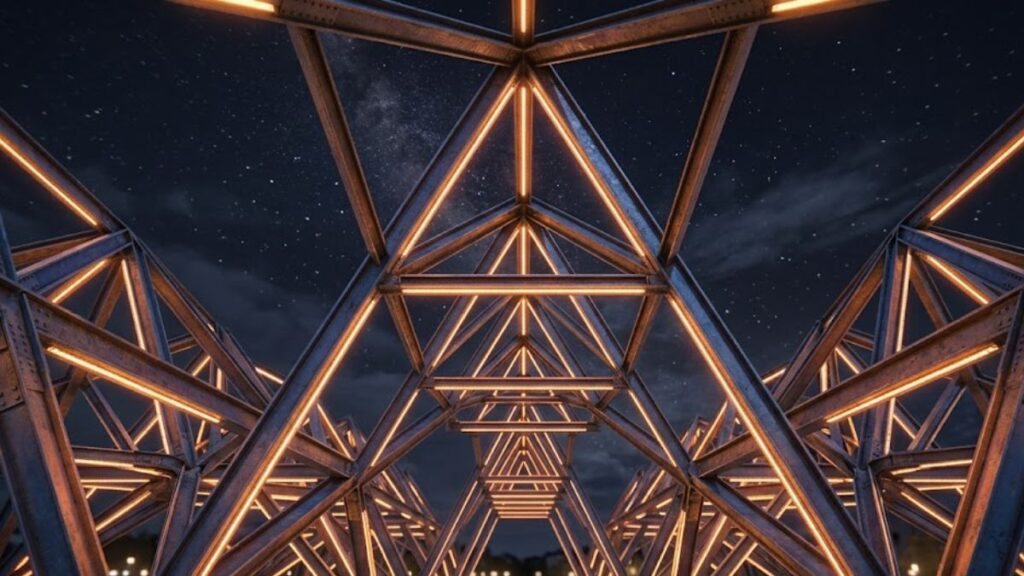
As you walk further toward the center, the geometry of the bridge begins to reveal itself. The steel beams form a series of repeating triangles, over and over, creating a visual rhythm that acts as a metronome for your thoughts.
Every bolt is a point of certainty. Every cable is a line of grace. You notice the way the light hits the rivets—thousands of them, each one a small, silent anchor. Your mind, usually busy calculating the “what-ifs” of tomorrow, finds itself tracing the parabolic curve of the main suspension cable. It is a perfect mathematical arc, holding everything up without effort. You realize that, for right now, you don’t have to hold anything up. The Bridge at 2 AM is doing it for you.
Chapter 3: The River’s Low Frequency

Halfway across, you stop and lean against the cold iron railing. Below, the river moves in a dark, obsidian flow. It doesn’t rush; it glided.
At this hour, the water has a specific frequency—a low-end hum that vibrates through the soles of your shoes and up into your chest. It is the sound of a system that never stops, yet never tires. You watch a single piece of driftwood pass under the bridge, moving with the current, effortless and unbothered. You feel the heavy “load” of your own day—the decision fatigue and the social friction—slowly dissolve into that dark water, carried away toward the sea where it no longer matters.
Chapter 4: The Sound of Expansion and Contraction

In the absolute quiet of The Bridge at 2 AM, the structure speaks. It isn’t a loud sound, but a series of soft, metallic “clinks” and “sighs.” It is the sound of the steel adjusting to the cool night air—the natural expansion and contraction of a healthy structure.
It reminds you that everything needs space to breathe. Even the strongest materials need to adjust to their environment. You feel your own breath slowing down to match the bridge’s tempo. In. Out. Expanding with the quiet. Contracting away from the noise. You aren’t a problem to be solved; you are a structure at rest, perfectly balanced between the two shores.
Chapter 5: The Lanterns of the Far Shore
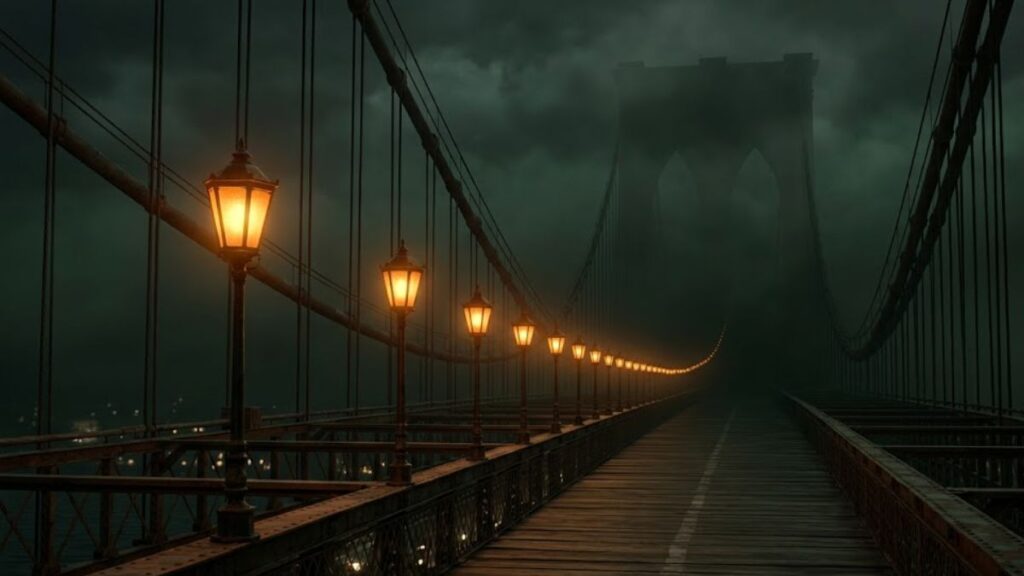
Looking ahead, the far shore is a blur of charcoal and deep emerald. The lamps of the bridge form a long, receding line of amber lanterns, marking a path that is clear and predictable.
There are no detours here. No unexpected variables. Just a straight line from where you were to where you needed to be. You notice a small maintenance door near one of the towers, painted a deep forest green. It is locked, secure, and finished. Everything on The Bridge at 2 AM is exactly where it is supposed to be. The safety of the symmetry begins to weigh on your eyelids, a comfortable heaviness that feels like a warm coat.
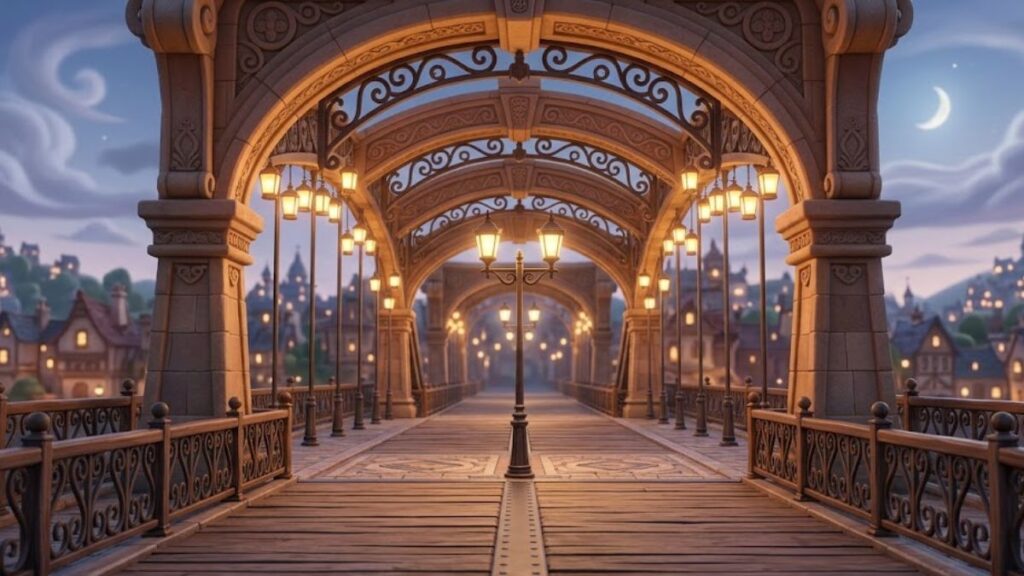
Chapter 6: The Equilibrium of the Center
At the very center of the span, you feel a sense of perfect equilibrium. You are suspended between the past (the shore you left) and the future (the shore ahead), but you are anchored in the present.
The wind moves through the cables, creating a sound like a distant cello—one long, sustained note that doesn’t change pitch. You close your eyes and let that note become the only thing in your universe. Your analytical brain, usually so sharp and piercing, becomes soft and rounded at the edges. The Bridge at 2 AM is a neutral zone, a place where the laws of physics are the only laws that apply, and gravity is a gentle hug holding you to the earth.

Chapter 7: The Gentle Descent
As you reach the far side, the walkway sloped gently downward, leading you back to the soft grass of the riverbank. The transition back to the earth is seamless.
You look back at the bridge one last time. It stands there, a silent titan of steel and light, watching over the city. It didn’t need your help to stay standing. It will be there tomorrow, and the day after that. You turn toward the path leading home, feeling as though your own internal “load-bearing” walls have been reinforced. You are ready for the stillness of the pillow, moving toward the deep, structural rest of sleep.
A Note on the Journey
This narrative utilizes “Structural Visualization,” a technique designed to appeal to analytical and logical thinkers. By focusing on the predictable, symmetrical, and solid elements of a bridge, we bypass the “creative” anxiety centers of the brain and engage the “spatial” centers. Experience The Bridge at 2 AM as a tool for Cognitive Ease, allowing high-performance professionals to disengage from the friction of their workday.
Continue your rest with
- The Train That Only Went as Fast as Calm — A rhythmic journey for those who need to move to find peace.
- The Moon Left a Lamp On — A study in late-night stillness for the deep overthinker.