Greek mythology has held our imagination for thousands of years. Greek Mythology Stories are full of jealous gods, brave heroes, clever plans, and strange monsters. Long ago, people shared these stories around small fires, in busy markets, and at temple gatherings.
They passed them from one person to another, and each storyteller added a little of their own voice. That is how these stories travelled and stayed alive.
Even today, we see them everywhere. Movies, books, and video games borrow these old ideas and turn them into new adventures. We even use their words in daily life.
When we talk about someone’s “Achilles’ heel” or call something a “herculean task,” we’re repeating pieces of these ancient tales without even realizing it.
What makes these stories last is how human they feel. The gods worry, argue, love, and make mistakes. The heroes try their best, fail, and try again.
Their feelings are the same ones we deal with today. That honest, familiar mix of hope, fear, pride, and courage is what makes these stories feel real, even after thousands of years.
Greek Mythology Stories
Greek Mythology Stories pull us into a world where gods argue, heroes struggle, and every choice has a cost. Yet somehow, these ancient tales still feel close to our own lives.
1. The Lantern of Selona
Theros was a quiet potter who lived in a small hill town near the edge of the Aegean. Nothing about him was remarkable. He woke before sunrise, shaped clay in the long open courtyard of his shop, and ended most days with the same thin bowl of lentil stew.
People in the town often passed his shop without noticing him, and that was fine with Theros. He liked the steady rhythm of clay, water, fire, and the soft glow of the evening.
But one night, the rhythm of his simple life shifted.
The sky above the town darkened more deeply than usual. The stars seemed to flicker as if a cold breath had passed over them.
Theros, who often worked late, felt a strange stillness settle in the air. He paused in the act of shaping a small lamp and looked out toward the square.
That was when he saw it.
A faint line of silver light streaked across the sky and fell behind the olive trees near the old shrine. It wasn’t like a normal shooting star. It didn’t disappear. It fell, and something about the fall felt heavy and real—like a stone struck from a great height.
Theros hesitated. He wasn’t a man who chased wonders. Wonders belonged to heroes with bronze shields and long hair, or poets who sang of gods and storms. But something deep in him tugged.
He left his workshop open, as it was, and followed the faint glow toward the trees.
The night air was cooler than usual, and the soft rustling of the leaves sounded almost worried. At the base of the old olive grove, he found the thing that had fallen.
It was a lantern.
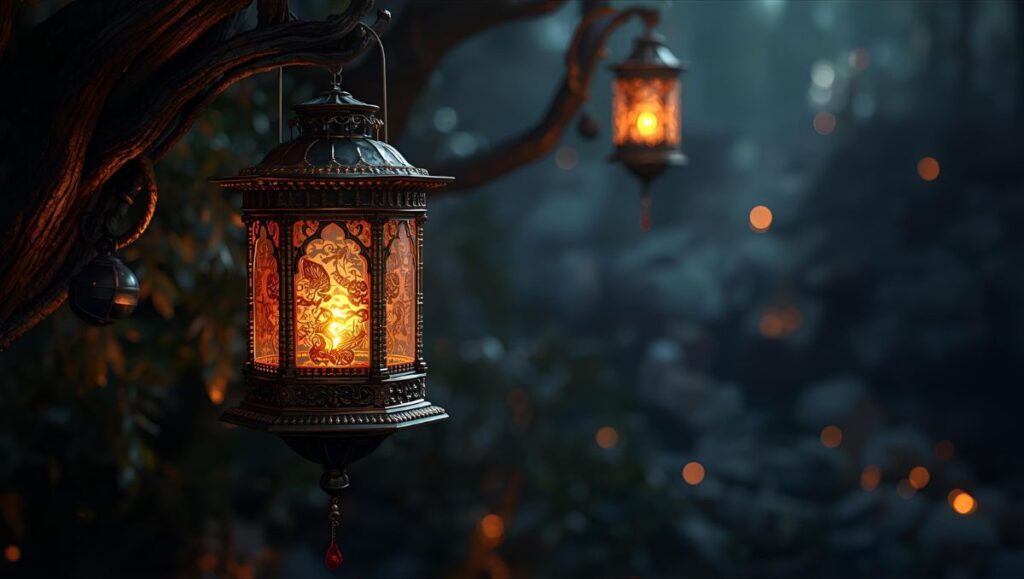
Small, round, and cracked in three places, it pulsed with a dim silver light—soft and trembling, like the last breath of a candle.
The metal was smooth but unfamiliar. And on the side, half-hidden under dust and the cracks, was a symbol Theros recognized from childhood stories: the crescent of Selona, the forgotten goddess of quiet nights.
Selona was not a famous goddess. People did not build grand temples for her. She belonged to the moments between moments—the soft dark before dawn, the calm breath before sleep, the stillness in which troubled minds found rest. Most had stopped praying to her long ago.
“Why would her lantern fall here?” Theros whispered.
The lantern’s light flickered weakly, as if answering.
His first instinct was fear. Anything that belonged to a goddess—forgotten or not—was far beyond the hands of a potter. But the object also looked broken. And Theros hated leaving broken things alone in the cold.
He knelt, lifted the lantern gently, and the silver glow warmed slightly in his hands.
“I’ll take you home,” he said softly, though he did not know why.
He carried it back through the grove and into his workshop. The lantern’s soft light filled the clay-scented room, brushing faint silver across the shelves of bowls and vases. Theros placed it on his work table.
Up close, the lantern looked even worse. Cracks webbed across its sides. A small piece on the top had fallen off completely. Something inside the lantern seemed faint, like a dying ember.
Even though he had never repaired anything divine before (and had no idea if he should), he did know how to mend broken pottery. Clay and fire were languages he spoke with ease. So he took out his tools—the fine brushes, the slip, the shaping needles—and worked carefully.
He didn’t dare use normal clay. Instead he mixed moon-ash powder he used for special glazes, stirred with clear spring water. The mixture shimmered faintly. It felt right.
All through the night he worked, fitting the cracks together, filling the spaces with thin layers of shimmering paste. When he finished the outer shell, he gently lifted the small loose piece and set it in place.
The moment it touched the surface, the lantern exhaled. Not literally—but something inside expanded, warm and whole.
Light blossomed through the cracks, smooth and steady.
And then the shadows in the room shifted.
Theros froze.
At the far corner of his workshop stood a shadow he had never seen before. At first he thought it must be the shadow of a shelf or a tool. But it was shaped like a person—thin, bent, and trembling.
He stepped closer, heart unsteady.
The shadow flinched.
“Who are you?” Theros whispered.
The shadow thinned and dissolved into the wall.
Theros looked back at the lantern. Its once-soft glow was brighter now, clearer, sharper. The light seemed to stretch into every corner of the room, searching, revealing.
That was when he felt a presence behind him.
He turned quickly.
A woman stood there—or something shaped like a woman. Her hair was long and dark, falling softly around her. Her skin glowed faintly like moonlit water. Her eyes held a calm depth, warm but tired.
“Do not be afraid,” she said quietly. Her voice was soft, steady, and somehow familiar—like a breeze that always came just before dawn.
Theros knelt before he even thought about it. “Are you—?”
“Selona,” she said. “You have repaired what fell from my hand. And so I have come.”
Theros swallowed. “I meant no disrespect. I only wanted to help.”
“You did more than help,” Selona said. “You touched something that few mortals have ever touched—something that reveals what hides in the quiet corners of the soul.”
She moved closer to the lantern.
“When this lantern is whole,” she continued, “its light does not simply show what is around you. It shows what lies beneath fear, beneath silence, beneath the parts of people they often hide even from themselves.”
Theros felt his heart tighten. “The shadow I saw…”
“A fear,” Selona said gently. “Your fear. Or someone else’s. The lantern does not judge. It only reveals.”
Theros looked down. “Why did it fall?”
Selona’s eyes dimmed with sadness. “Because fewer people call my name. I am not forgotten entirely, but my strength is thin. The lantern slipped from my grasp as I walked the sky.”
Theros hesitated. “I… I can give it back to you.”
Selona shook her head.
“It is not time yet. The lantern needs to grow bright again. To do that, it must shine on human lives. It must reveal truths that have long been hidden.”
She placed a gentle hand on Theros’s shoulder.
“You may carry it, potter. But know this: once you begin, you cannot pretend not to see what the lantern reveals.”
The lantern brightened slightly, breathing light into the shadows of the workshop.
“Will you take it into the town?” Selona asked.
Theros did not feel like a hero. He was just a man who shaped clay. But something in Selona’s voice stirred a quiet strength in him.
“Yes,” he said softly. “I will.”
The next morning, Theros carried the lantern into the town square.
At first, people laughed at him. A potter carrying a glowing silver lantern? It seemed like a strange joke.
But as he walked, the light fell on them.
A woman’s shadow stretched long behind her—not the shadow of her body, but the shadow of her loneliness.
A merchant’s shadow carried two shapes—his greed and his guilt wrestling like dogs. A young man’s shadow shivered as if made of broken glass, showing the weight of secrets he carried.
People began to grow uneasy.
“What is that lantern?” they whispered. “Why does it show these things?”
Theros didn’t answer. He didn’t know how.
That night, the town was restless. Some people came to Theros with trembling voices, asking if the lantern could tell them what to do with their fears. Others begged him to keep the lantern away, claiming it stirred trouble.
Theros felt the weight of all those emotions pressing on him. For the first time, he understood the quiet sadness in Selona’s eyes. The night did not simply hide things—it held them, gently, until people were ready to face them.
One evening, a child named Lysa came to him. She was small and soft-spoken, known for speaking less than most children her age. She pointed at the lantern.
“Does it show everything?”
“Not everything,” Theros said gently. “Only what weighs on the heart.”
Lysa nodded. “Then may I see?”
Theros hesitated. “Only if you want to.”
She took a step toward the lantern.
Light wrapped around her—and her shadow appeared behind her.
It was small. But very heavy.
Theros saw fear in the shape of a storm—a dark swirl pressing down on a child too young to understand its weight.
“What is that?” Lysa whispered.
“A fear,” Theros said softly. “But not a fear that belongs only to you.”
Lysa looked down. “My mother cries at night. She tries to hide it. I hear her.”
Theros felt something tighten in his chest.
“Would you like me to walk with you?”
Lysa nodded. Together, they went to her home. The lantern’s light fell gently across the doorway.
Inside, Lysa’s mother flinched when she saw the light—but then her eyes softened. Slowly, she knelt and took her daughter’s hand.
“I’m sorry,” she whispered. “I didn’t want you to worry.”
The lantern’s glow wrapped around both of them, warm and calm. The storm-shadow behind Lysa began to fade, not disappearing entirely but loosening its grip.
Theros stepped back. Sometimes a little light was enough.
Word spread quickly. People began coming not to hide from the lantern, but to understand what it showed.
Some nights were peaceful. Some were heavy. Some brought tears. Some brought small but honest laughter.
The lantern grew brighter each day.
At last, one night, Selona returned.
Theros saw her silhouette before he heard her voice. She approached with quiet steps, her presence soft but unmistakably divine.
“You have done well,” she said.
Theros looked at the lantern, glowing bright and steady. “It wasn’t only me. The people faced what they carried. That is the harder part.”
Selona smiled faintly. “You speak more wisely than many who wear crowns.”
She reached out and touched the lantern. The light rose gently from it like mist, swirling around her fingers.
“It is strong again,” she said. “And I must take it back.”
Theros nodded, though parting felt strangely painful. The lantern had shown him his town in ways he had never seen before. It had shown him himself.
Selona lifted the lantern.
“But its light will not forget you,” she said. “Nor will I.”
She stepped back, the lantern glowing brighter, rising slowly with her.
“Selona,” Theros said quietly, “will people still find your calm? Even when they do not call your name?”
Selona’s eyes softened. “As long as there are quiet nights, I will be there. And now, they will have something more—they will know that facing the truth can be gentle, not frightening.”
With that, she rose into the sky. The lantern’s light joined the stars, settling among them until it became a steady silver spark.
Theros stood watching until dawn.
And in the days that followed, the town changed—not dramatically, not suddenly, but quietly. People spoke a little kinder. They listened a little deeper. They noticed each other’s shadows and did not always turn away.
As for Theros, he returned to his pottery wheel, shaping clay with calm, steady hands. But sometimes, when the sky was clear and the night deep, he would look up and see the silver star among the others.
It reminded him that even a potter could carry the light of a goddess—if only for a little while.
2. Lyra and the River That Would Not Flow
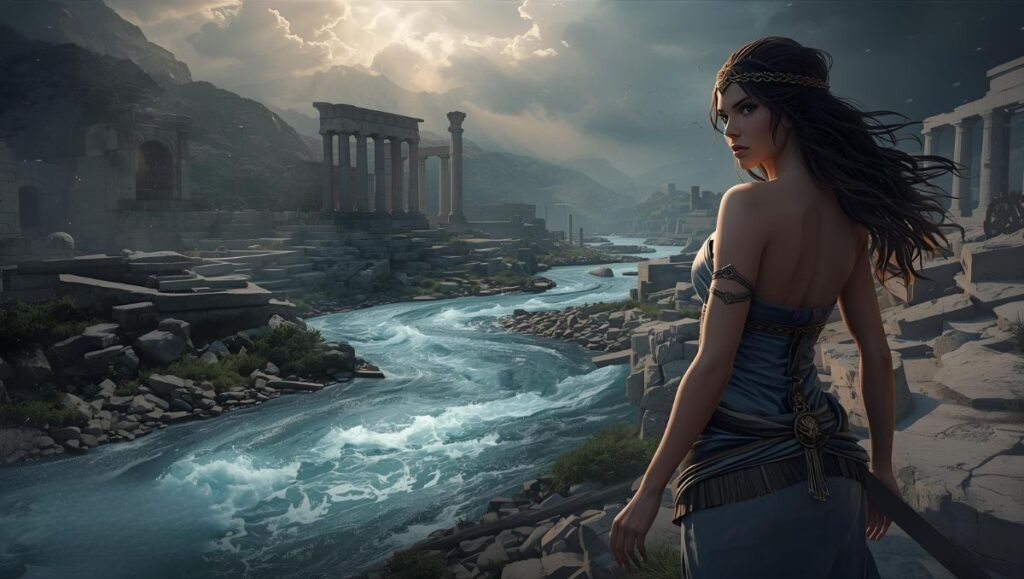
Lyra was a small girl with a quiet heart. She lived in a village shaped around a river that once ran bright and lively, almost like a friend who never stopped talking.
The river had a name older than the olive trees—Athenor—and the villagers said he was a gentle river god who loved to laugh, splash, and move.
But by the time Lyra was born, Athenor no longer laughed.
Or spoke.
Or moved.
The river had stopped flowing many years earlier. What remained was a long stretch of still water, clear but silent, shining like glass on calm days and like dull metal on cloudy ones. People still used the water for washing and sometimes fishing, but it carried no songs, no shimmer, no life.
To Lyra, who grew up with stories of what the river used to be, the stillness felt like a sadness she did not yet understand.
Her grandfather, who was the village storyteller, remembered the days when Athenor danced through the valley with a voice that soothed nightmares and cooled the hottest summers.
“He used to hum,” he told Lyra one night as they sat under the fig tree. “When the moon was full, he hummed like a man remembering a happy song. I haven’t heard it in decades.”
“Why did he stop?” Lyra asked.
Her grandfather sighed. “No one knows. Maybe his heart grew heavy. Maybe something frightened him. Maybe he simply forgot how to move.”
Lyra held her knees and watched the still river in the distance, silver in the moonlight. “If gods can forget,” she whispered, “what can we do?”
Her grandfather put a gentle hand on her shoulder. “Sometimes gods remember when humans remind them.”
Lyra didn’t fully understand, but those words stayed inside her, soft but bright.
The Day the River Called
Lyra liked to walk beside the unmoving river. Some people avoided it, saying it felt eerie or wrong for a river to be that still. But Lyra liked the quiet. The surface of the water reflected the sky clearly—clouds drifting past like thoughts.
One late afternoon, while she sat with her toes touching the edge, something odd happened.
A small ripple.
Just one.
Very gentle.
Lyra frowned. The river hadn’t rippled from within for as long as anyone could remember. Wind often stirred the surface, of course, but this ripple looked different. It started in the center and moved outward, like something deep beneath the water had sighed.
She leaned forward.
“Hello?”
The water remained still.
She sat a bit longer and then dipped her hand into the water. It was cool, softer than usual. She felt—she couldn’t explain it—something like a pulse. A slow, faint beat.
“Are you still there?” she whispered.
A second ripple spread out, so thin she almost missed it.
Lyra’s heart thudded.
She stood up and ran home.
No One Believes What Lyra Saw
At dinner, Lyra told her parents what happened. Her father stopped eating halfway through a bite of bread.
“A ripple in the center?” he said. “Maybe a small fish.”
“There are no fish left in the center,” Lyra said. “Only near the reeds.”
Her mother smiled gently. “Sometimes water moves for no reason. It might have been your imagination.”
“It wasn’t,” Lyra insisted. “It felt alive. As if Athenor breathed.”
Her parents exchanged a patient look.
Lyra hated that look.
She looked at her grandfather, hoping for understanding. His eyes softened with concern.
“Lyra,” he said quietly, “even if the river stirred a little, it doesn’t mean Athenor is awake. Gods do not rise so easily from long silence.”
Lyra felt frustration rise, hot and prickly. “You said gods can remember if we remind them.”
“True,” her grandfather said. “But that takes more than a ripple.”
“But it takes something,” Lyra said.
He looked at her for a long moment. Then he nodded. “Yes. It takes something.”
Lyra Carries Courage in a Clay Cup
The next morning, Lyra woke before sunrise. The sky was pale blue, quiet and empty. She moved softly through the house so she wouldn’t wake anyone.
In the kitchen she found a small clay cup her grandfather had made years ago—a simple thing with uneven edges but a warm feel. She filled it with river water.
Just a small cupful.
She had no idea why she did it. Only that something inside her whispered: Carry courage.
Lyra didn’t feel brave. Her hands trembled a little. But she held the cup carefully and went back to the river.
The river was still and silent.
Lyra sat on the bank and held the cup against her chest. “If you can hear me,” she whispered, “I brought a part of you with me. Maybe it can help.”
Nothing happened.
Minutes passed.
Lyra felt a little foolish. She stared at her reflection in the still water, small and unsure.
Then something stirred beneath the surface.
A soft glow. Very faint. Like the shimmer of a candle seen through thick glass. It pulsed gently, in time with something deep and slow.
Lyra’s breath caught.
The water in her cup quivered.
A voice—not loud, not sharp—rose inside her mind like the feeling of a thought that did not belong to her.
Little one… why do you bring me to myself?
Lyra looked around, startled. No one was there. The voice wasn’t heard with ears. It was felt.
“Are you Athenor?” she whispered.
A long pause.
Yes. Or what remains of him.
Lyra tightened her grip on the cup. “Why are you not flowing?”
I am tired, the voice said. Tired in a way I cannot explain. I forgot the shape of movement. I forgot the meaning of forward. I forgot why I once laughed.
Lyra swallowed. “Can water forget how to move?”
Gods can. When they grow quiet for too long. When their hearts become heavy with things they cannot name.
Lyra looked out over the river, feeling a deep sadness mix with awe.
“What can help you remember?”
Another pause. Longer.
One drop of courage, the voice said softly. But it must be freely given. And it must come from a human.
Lyra blinked. “A single drop? That’s all?”
For a god who has become small, yes. Movement begins with one drop.
Lyra looked down at her cup. “How do I give courage?”
You already carry it, Athenor murmured. You came alone. You brought part of me to myself. That is courage.
Lyra felt tears rise to her eyes. She hadn’t felt brave at all, but maybe courage wasn’t loud.
“Tell me what to do,” she whispered.
The Heart of a Still River
The voice guided her.
Walk into the water. Only until your ankles are touched.
Lyra stepped forward. The water was cold, but not harsh.
Now hold the cup above the surface.
She raised the clay cup with both hands.
Think of something that scares you, Athenor said. Something real.
Lyra’s throat tightened. She didn’t like thinking about fear. But she thought of nights when storms shook the house. She thought of the day her friend moved to another village and didn’t say goodbye. She thought of the feeling of being small in a world that often felt too big.
The water in the cup warmed slightly.
Good, Athenor whispered. Now think of why you step forward anyway.
Lyra took a shaky breath.
“Because someone has to.”
That is courage.
The water in the cup glowed faintly.
Now pour it back into me.
Lyra tilted the cup.
One drop.
Just one.
It fell into the still river.
Everything changed.
The glow beneath the surface brightened, like light waking from a long dream. A deep hum vibrated through the water, soft but growing. The surface trembled. Not violently, but eagerly.
The river shivered.
Then…
It moved.
Only a little. Only an inch of flow. But after decades of stillness, that inch felt like the world had shifted.
Lyra gasped.
Thank you, Athenor whispered, voice stronger now. I am not whole yet. But I remember the feeling of movement.
Lyra stood trembling in the water. “What do you need now?”
Time, he said. And your promise.
Lyra’s brow furrowed. “What promise?”
When the world grows loud again… when the seasons turn heavy… when life feels too fast… come back to the river. Sit in the quiet. Speak to me. Remind me of stillness. For even gods can forget balance.
Lyra nodded. “I promise.”
The river hummed softly, like a sigh of relief.
And the water at her feet began to gently pull forward—slow, steady, natural.
The river was flowing again.
The Village Awakens
When Lyra ran home shouting that the river had moved, no one believed her. But when the villagers went to the banks the next morning, they froze in place.
The river—once still as polished stone—was flowing.
Not swiftly. Not loudly. But steadily.
Old women cried. Men stood silent with hands on their knees. Children splashed in the shallows, laughing in a way the village hadn’t heard in years.
Lyra’s parents looked at her in disbelief.
“Did you truly…?” her mother began.
Lyra only nodded.
Her grandfather’s eyes softened with pride and something like awe. “A small courage,” he murmured, “can wake even a sleeping god.”
People asked Lyra what she did, what magic she used, what words she spoke.
She told the truth.
“I only gave a drop of courage to someone who needed it.”
Most people didn’t understand. But they felt gratitude anyway.
Athenor’s Return
Over the next weeks, the river grew clearer. Fish began returning. Reeds swayed gently rather than standing stiff as old spears. The water carried the soft hum of life again.
Sometimes, Lyra sat on the bank and listened.
Athenor didn’t speak often, but when he did, it felt like a breeze moving through her thoughts.
You remind me how to move, he would say.
Sometimes Lyra would answer aloud, “And you remind me that small things matter.”
The river would ripple softly in reply.
Years Later
Lyra grew older. She learned many things, worked many days, and faced fears much larger than she could have imagined as a child. But she never forgot her promise.
Whenever life felt too heavy, she walked to the river.
Athenor always greeted her with a soft ripple.
Sometimes she sat in silence. Sometimes she cried. Sometimes she laughed and told him stories. And whenever she left, the river’s movement seemed a little stronger, a little brighter, as if her presence braided into the water itself.
The villagers said the river flowed best on the days Lyra visited it.
They didn’t know why.
But Athenor did.
Lyra’s Last Visit
One late evening, much later in her life, Lyra came to the river for the last time. Her hair had silver strands, and her steps were slower, but her heart felt the same as the girl who once carried courage in a clay cup.
The river glowed softly with moonlight. The hum beneath the surface felt like a remembered lullaby.
Lyra sat on the familiar bank.
“I kept my promise,” she whispered.
Always, Athenor answered gently.
Lyra touched the water with her fingertips. “You never stopped flowing.”
Because you reminded me what movement feels like. One drop. That was all I needed.
Lyra smiled softly.
“I’m glad.”
Lyra… the river whispered, what do you fear now?
She took a long breath. “Leaving things unfinished.”
Nothing you did was unfinished, Athenor murmured. Your courage moved a god. Your kindness carried seasons. Your promise shaped a river.
Lyra felt tears, but they were warm and gentle.
“Thank you,” she whispered.
The river rippled once—soft, slow, full of gratitude.
Lyra rested her hand on the water. It felt like a friend holding her palm.
And in the calm that followed, Athenor’s current carried her last sigh softly down the valley, as if tucking it into memory.
After Lyra
The river never stopped flowing again.
Villagers would sometimes see a gentle ripple in the center of the river on quiet evenings, even when the wind was still. They said Athenor was remembering something. Or someone.
Children were told stories about a girl who brought a river god back to life by giving just one drop of courage.
Some believed it.
Some didn’t.
But the river believed.
And it carried her memory gently, steadily, always forward.
3. Orionos and the Stone Bird
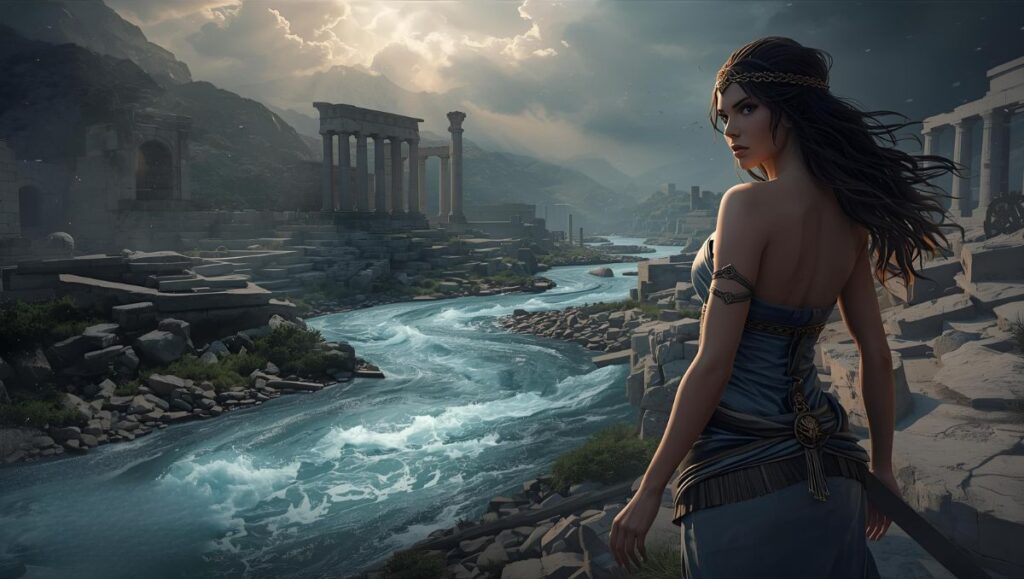
Orionos lived in a village carved into the side of a mountain. The houses were built from smooth white stone, and the paths wound upward like pale ribbons.
People said the mountain had stood for thousands of years, watching storms, seasons, and generations pass one after another.
To Orionos, the mountain felt alive. Not in a frightening way—just in the quiet, steady way that very old things live.
Orionos worked as a stone carver. Not a master, not famous, but skilled in a humble, patient way. His hands were steady. His eyes noticed the tiny shifts in color and texture that told where the stone wanted to split. He carved bowls, lamps, steps, and sometimes small statues for the village.
But he had one secret ability—something he didn’t tell anyone.
He could hear stone.
Not with words. Not with ears. It was more like sensing a faint hum or a soft intention. Some stones felt sleepy. Some felt sharp. Some felt stubborn. And some felt like they were waiting for something.
He always kept this secret. If he told people he could hear stone, they would call him strange.
But his secret shaped his hands and his work every day.
The Stone that Called His Name
One chilly morning, Orionos walked up the slope to gather stone from the quarry. The mountain air smelled of pine and cold wind. He ran his fingers along the quarried blocks, listening for the hum beneath their surfaces.
Most stones felt quiet, as usual.
But one block—tall, heavy, and streaked with faint silver lines—vibrated softly under his touch.
Not only that.
It whispered.
Not loudly. Not even clearly. But Orionos felt a tremble in his palm, like a voice struggling through dust.
Ori…on…os…
He jerked back in shock.
Stone never said his name.
He pressed his hand to the block again.
The whisper came again, very faint, almost a memory:
Take me.
Orionos swallowed hard. “Why?”
The stone pulsed—one slow throb.
I am not done…
A chill ran down his neck. The stone felt unlike any he had ever touched. Ancient. Heavy with purpose. Patient, but urgent.
He placed his forehead against it. “What are you?”
The stone hummed weakly.
Shape me… free me…
A breath escaped Orionos before he even realized he was holding it.
He knew what he must do.
He Takes the Stone Home
The stone was impossibly heavy. But Orionos, with the help of two mules, dragged it down the slope to his workshop. His neighbors raised eyebrows.
“What’s that block for?” one asked.
“It’s cracked,” another said. “Why would you take such a burden home?”
Orionos only shook his head. He didn’t know how to explain.
The stone sat in the center of his workshop like a sleeping giant. For hours, Orionos simply walked around it, studying the silver streaks, the uneven ridges, the places where the stone seemed to tighten and loosen.
Finally, he picked up his carving tools.
As soon as the chisel touched the surface, a warm pulse ran through the metal.
Not a warning.
A welcome.
A direction.
Orionos understood more clearly. The stone wasn’t asking to be something new—it was asking to be what it had always meant to be.
He began carving.
Chisel tap. Hammer tap. Slow rhythm. His body moved naturally, as though he were remembering steps he had never learned.
The silver lines in the stone felt like veins. He followed them carefully. With each strike, something loosened inside the block—as if the stone had been holding its breath for centuries.
Hours passed. Days passed.
And the shape began to appear.
Wings.
Feathers.
A long neck.
A beak.
A bird.
Not just any bird.
A giant one.
Nearly as tall as Orionos himself, with wings half-folded, as though preparing to rise but unable to do so.
When Orionos carved the final feather, the whole workshop filled with a soft hum. The air vibrated.
The stone whispered:
You now see me… but I am not yet free.
Orionos stepped back, trembling. “What do you need?”
Not stone… life.
A cold wind swept through the workshop, though no door was open.
Orionos placed a hand on the stone bird’s chest. It was warm now. Softly glowing.
“What are you?” he whispered.
The answer came slowly.
I am Keirathos. I was once the sky guardian of the mountain. A watcher of storms. A friend of winds. A keeper of echoes. When the mountain was young, I flew above it. But I was cursed.
Orionos felt his breath tighten. “Cursed? By who?”
By a jealous mountain spirit. One who envied my wings. She cast a sleep over me, turning me into stone. My heart beat slower… slower… until silence became my cage.
Orionos felt the stone bird’s longing deep in his own chest.
“How can I help you become free again?”
Keirathos pulsed weakly.
Bring me to the Breath of the Mountain.
Orionos frowned. “What is that?”
At the summit… where the wind is born. Only there can life return.
Orionos looked out the window. The summit towered above the village—steep, cold, dangerous. Few people climbed it. Some said spirits lived near the top. Some said the winds could cut skin like blades.
To carry a giant stone bird up there seemed impossible.
But he had heard the stone call his name. He had shaped it with his own hands. He could not stop now.
“I will take you,” Orionos whispered.
The stone bird hummed like a heartbeat.
The Long, Hard Climb
For the next several days, Orionos prepared. He built a sled of thick logs, wrapped ropes in soft wool so they wouldn’t snap, and gathered food and blankets.
People thought he had lost his senses.
“You’re going up there?”
“With that thing?”
“Orionos, you’ll freeze before you reach halfway!”
He didn’t argue. He simply nodded and continued working.
At dawn, he placed the stone bird carefully on the sled. The silver veins glowed faintly in the early light.
Orionos tightened the ropes around his shoulders.
The mountain air was cold. The climb steep. The path uneven.
Every few steps, the sled dragged heavily behind him. But the bird hummed, gently, steadily, like a friend whispering encouragement.
Forward… one more step… I remember the sky…
Orionos kept climbing.
By noon, he reached the pine forest that wrapped halfway up the mountain. The wind moved through the needles like low singing. Some trees leaned away from the path, as if bowing.
Orionos whispered, “You knew this forest once, didn’t you?”
The bird’s hum deepened.
I flew above it for centuries. The trees know my shadow.
Orionos felt a strange comfort in that. Even though he was climbing alone, the forest didn’t feel unfriendly.
But night came quickly in the mountains.
He built a small fire near a cluster of rocks. As he ate bread and dried figs, the stone bird whispered lightly, as if dreaming.
The stars look different now… they have moved… grown… changed… The world is older than I remember…
Orionos looked up at the same stars.
“Yes,” he said softly. “A long time has passed.”
But you hear me, Keirathos said. Few humans can hear stone. You are rare.
Orionos felt warmth spread in his chest, despite the cold around him.
Where the Forest Thins
On the second day, the path grew narrow. Sharp rocks jutted out like broken teeth. The air thinned, and Orionos breathed harder with each step.
He slipped more than once, scraping his knees and palms. But he never let go of the ropes.
The bird’s hum encouraged him.
Just a little more…
As evening approached, the trees thinned. The wind grew sharper. Clouds moved close, brushing the mountain as though searching for something.
Orionos built another fire.
That night, he dreamed of wings—huge wings—spreading across the sky, stirring storms and sunlight. A bird larger than any creature he had ever imagined. A bird who watched over the world with calm, ancient eyes.
When he woke, he felt certain it was not just a dream.
Keirathos shimmered faintly, as if hearing the last echoes of the dream.
The Mountain Spirit Appears
On the third day, just past noon, the air turned strangely warm.
Too warm.
Orionos froze. Warmth at this height meant one thing:
Spirits.
A wind twisted suddenly, forming a tall shape—slender, shifting, glowing with a soft emerald light.
A mountain spirit.
Her voice was sharp and airy.
“You climb too far, human.”
Orionos stepped protectively in front of the stone bird. “I have to bring him to the summit.”
The spirit’s eyes narrowed. “Let the stone sleep. It has slept for centuries. It should remain so.”
“Why?”
The wind around her rippled with irritation. “The sky guardian stole the winds that were meant for me. The sky was never his to command. He flew too high, too proud.”
Orionos felt anger rise in him. “He was cursed because of jealousy.”
The spirit’s expression twisted. “Do not use that word.”
She moved forward, wind whipping fast around Orionos.
“Leave the stone. Go home.”
Orionos planted his feet. “No.”
The spirit’s presence thickened. “If you continue, I will not help you when the mountain breaks you.”
“I don’t need your help,” Orionos said quietly. “Because I’m not alone.”
He touched the stone bird.
Keirathos pulsed deeply.
The spirit flinched—not in fear, but in frustration.
“This is foolish,” she hissed. “Humans think love and loyalty can break curses. They cannot.”
Orionos steadied his breath. “Maybe not alone. But courage can.”
The wind spirit shrieked softly, dissolving into a swirl of air that raced away across the cliff.
Orionos felt his legs shaking after she left. But the bird’s hum steadied him.
Well done… Keep going…
And he did.
The Summit and the Breath of the Mountain
By late afternoon, Orionos reached the top.
The summit was a wide plateau of smooth stone, with a deep hollow in the center where warm air constantly rose from the earth—the Breath of the Mountain.
The air shimmered with golden mist.
Orionos dragged the sled forward, step by shaking step, until the stone bird stood directly above the rising breath.
Keirathos pulsed.
Release me…
Orionos removed the ropes.
The ground beneath them trembled—softly at first, then stronger. Wind surged upward, circling the stone bird like a living thread.
The silver veins glowed brightly.
The humming grew louder.
The entire stone bird began to crack—not in a breaking way, but in a shedding way. Like stone was only a shell.
Orionos stepped back, eyes wide.
Wings unfurled.
Huge, shimmering wings made of silver light and ancient air.
Stone crumbled away in chunks, falling harmlessly at the bird’s feet.
A long neck stretched toward the sky.
Feathers glowed.
Eyes opened—enormous, shimmering, filled with centuries of sleep and wisdom.
Keirathos stood alive, towering, magnificent.
He spread his wings, sending a shock of wind across the summit, nearly knocking Orionos over.
“Orionos,” he said—not a whisper, but a deep, rumbling voice that vibrated through the bones of the mountain. “You freed me.”
Orionos swallowed hard. “I only carved what you already were.”
“And you carried my body when it weighed more than mountains.”
Keirathos bowed his head, a gesture of gratitude that made Orionos tremble with awe.
“I owe you a sky,” Keirathos said. “But humans are not made for such heights.”
Orionos smiled weakly. “I’m content on the ground.”
A soft chuckle echoed across the summit. “Then I will guard your skies.”
He beat his wings.
Wind exploded outward.
The clouds spiraled around him.
And with a final ripple of glowing feathers, Keirathos soared into the air—huge, graceful, endless—like a silver comet returning home.
Orionos shielded his eyes from the brilliance.
When the light faded, Keirathos was already a distant shape in the sky, circling the summit with joy, with freedom, with life.
A Guardian Returns
Word spread quickly that strange winds had moved across the mountain. Strong but gentle winds. Winds that sang.
Some said they saw a glowing shape cutting through the clouds.
Some said they heard wings like thunder but soft as dreams.
Orionos knew the truth.
Keirathos had returned to the sky.
He returned to his village quietly, pulling the empty sled. People asked questions.
“You were up there?”
“What did you find?”
“What happened to the giant stone bird?”
Orionos smiled softly.
“It wasn’t just stone.”
He didn’t explain further. Some things didn’t need explaining.
But every night, he sat on the roof of his home and looked to the sky.
Sometimes, far above, a shimmering shape would pass over the village—large, graceful, familiar—casting a silver shadow across Orionos’s workshop.
A shadow shaped like wings.
And whenever that happened, Orionos felt a warm hum deep in his chest.
Thank you, the wind seemed to say.
And Orionos would whisper back:
“You’re free now.”
4. The Weaver Who Stole the Dawn
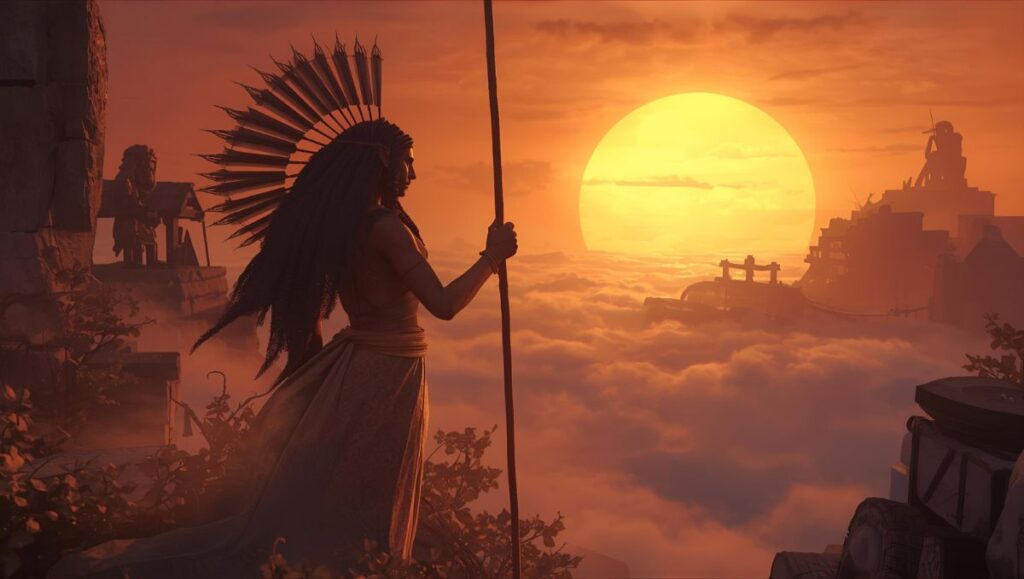
Hespira lived on the eastern edge of Athelios, a quiet village where the sea met the cliffs and the morning light always arrived first. People often said dawn itself was born from this place.
The truth was simpler. The sun just reached these rooftops before touching the rest of Greece. But for Hespira, a young weaver with soft hands and bright eyes, every sunrise felt like a personal greeting.
She had woven since she was a child. Her mother used to say that Hespira’s fingers knew thread the way a bird knows air.
Her cloth was smooth, strong, and full of color. She dyed wool in gentle shades of sky and sea. She wove patterns that seemed alive—waves curling, petals unfolding, birds lifting their wings. Yet she always felt something missing.
“This is beautiful,” villagers would say, running fingers over her tapestries.
But Hespira would nod politely and feel a small ache.
The colors were bright, but not bright enough. The patterns were lovely, but they did not feel like truth. They did not feel like dawn.
Every morning she stood outside her home and watched the sky. The first light came slowly—pale rose, peach, gold. It deepened, warmed, and spilled down to earth, touching the sea, the cliffs, the village roofs.
It was the purest light Hespira had ever seen. In those first few moments, the world looked honest. Every shadow, every ripple in the water, every line in the stone was clear and gentle at the same time.
“That is the color I want,” she whispered each day.
“That is the brightness my weaving needs.”
But no dye, no thread, no trick of weaving could capture it.
One morning, while the light changed from gray to warm gold, Hespira stared so long that the world blurred. She closed her eyes for a moment.
When she opened them, she saw something she had never seen before—thin strands of glowing thread stretching across the sky.
They were faint, like spider silk in sunlight, but they shimmered with the exact brightness she had searched for all her life.
The threads drifted, moved, and twined themselves into shapes—long ribbons, gentle curves, small sparks.
Hespira realized with a shock that she was seeing the raw threads of dawn itself. And as she watched, a figure walked among them.
Eos.
The goddess of dawn moved with a calm grace. Her steps were soundless. Her hands were steady and smooth as she gathered golden strands and spread them across the sky like a master weaver. Her long hair glowed softly.
Her eyes held both tiredness and endless patience. She did not look fierce like the war gods or distant like the Olympians. She looked like someone who carried a burden gently because no one else would.
Hespira held her breath.
She was witnessing something sacred.
Eos stretched a new thread across the horizon, and the world brightened instantly. Birds began to stir. The sea shimmered. A new day began. Then, like morning mist, the goddess faded, the threads vanished, and the ordinary light returned.
Hespira stood frozen.
The threads of dawn were real. And they were perfect.
She returned home with her heart beating fast. She sat at her loom and tried to work, but her hands shook. Every time she closed her eyes, she saw the glowing threads.
She dreamed of weaving something with that light. She imagined a tapestry so bright, it could make someone feel the warmth of sunrise just by looking at it.
The longing began to grow.
It grew every day.
Each morning she watched Eos appear, gather her threads, weave the sky. The sight filled Hespira with wonder, but also with a painful yearning.
If she could touch those threads—just one—she could create something truly alive.
For weeks she battled with herself. It was wrong to touch a goddess’s work. Wrong to take what was not hers. But the longing ate at her. She tried to ignore it. She tried to make new dyes, new patterns, new techniques. Nothing helped. Every creation felt dull.
One morning she whispered to herself,
“I only need one thread. One. Surely she won’t miss it.”
This small thought was enough to break her resolve.
The next dawn, Hespira hid among the rocks near the cliffs. She waited silently. When the horizon began to lighten and the goddess appeared, Hespira watched carefully.
Eos gathered her glowing threads, unaware of the eyes following her. When the goddess moved to the far end of the sky, her basket of dawn-light rested only a few feet away.
Now.
Hespira slipped from the shadows. Her breath trembled, but her hands were steady. She reached toward the basket. The threads pulsed softly, warm like morning. She touched one.
It tingled against her fingertips, then yielded gently, as though recognizing her touch.
Hespira lifted it.
The thread was almost weightless. It glowed faintly in her hand, like a small piece of sunrise captured. Her heart raced. She took one more. Then another. Three threads—only three. They shimmered between her fingers like living silk.
A sudden wind brushed her cheek.
Eos turned.
Her pale, radiant eyes fell on Hespira instantly. The goddess did not shout, but her voice, when it came, was soft and disappointed.
“You steal dawn itself,” Eos said. “Do you know the cost?”
Hespira fell to her knees, terrified.
“I only wanted to weave something true. Something beautiful. I meant no harm.”
“You meant to take,” the goddess replied. “You took what lights the world.”
Hespira bowed her head. She thought the goddess would turn her into stone, or wind, or a wisp of ash. But Eos simply looked at her with sadness.
“Take them,” the goddess said quietly. “They will not obey human hands for long.”
And with that, she faded.
Hespira ran home with the glowing threads clutched tightly. She placed them on her loom, barely breathing. She wove the first thread into the cloth. It slid in easily, becoming a streak of living light.
The second thread brightened the darkness of the weave. The third made the entire tapestry glow like the moment sun first touches the sea.
When she finished, she stepped back.
It was the most beautiful thing she had ever created. It seemed to warm the room. It made the air shimmer gently. It looked alive.
She sat for a long time, simply staring.
The next morning, when she displayed the tapestry in the village square, people froze. They whispered. They stared with wide eyes. Some gasped. Some cried quietly. No one had ever seen a cloth like it.
“It looks like sunrise itself,” an old man said.
“It feels like hope,” a young woman whispered.
“It glows,” a child said, pointing.
Hespira felt pride swell in her chest. She finally had woven truth.
Word spread. People from nearby towns traveled to see the tapestry. They left gifts at Hespira’s door—fruit, flowers, coins, cloth. Everyone asked how she created it, but she only shook her head. “A secret,” she said softly. A guilty secret.
But the day after she revealed the tapestry, something strange happened.
The dawn was late.
People woke and found the sky dimmer than usual. The light came slower, colder. The warmth of sunrise arrived minutes behind its usual time.
Villagers murmured in confusion.
“Strange weather,” some said.
“Maybe a storm,” others guessed.
Hespira felt a chill sink into her heart.
The next day, dawn was later still. The sky’s colors were weak, washed out. The gold was thin. The warmth barely touched the village.
Hespira knew why.
Every thread she took was a piece of dawn missing from the sky.
She wanted to return them, but they were woven tightly into her tapestry. She tried pulling them out, but the threads resisted, glowing hotter, almost burning her fingertips. The tapestry seemed alive, unwilling to let go of the stolen light.
On the third late dawn, the villagers began to worry. On the fourth, fear crept through Athelios. The crops looked dull. The sea felt colder. Shadows lasted longer.
“This isn’t normal,” people whispered.
“Something is wrong with the sun.”
Hespira could no longer bear the guilt.
She took down the tapestry, wrapped it carefully, and walked alone to the cliffs at dawn. The sky remained dark. Only a faint glow hinted that morning was trying to rise.
“Eos,” she called softly. “Please.”
The air shimmered, and the goddess appeared. Her face was tired. Her hands empty.
“You feel the cost now,” Eos said.
Hespira held out the tapestry with shaking hands.
“I am sorry. I thought beauty came from taking. But it comes from truth, and I was not honest—not with you, not with myself.”
The goddess studied her for a long moment.
“Return the threads, then,” she said.
“I cannot,” Hespira whispered. “The tapestry refuses to let them go.”
Eos stepped closer. She touched the cloth. The woven dawn-light trembled like frightened birds.
“You gave them form,” Eos murmured. “You gave them purpose. Now they cling to you.”
Hespira felt tears sting her eyes.
“I do not want them anymore. They belong to the sky.”
The goddess looked at her kindly.
“Then weave your truth into the cloth. Only that can release what you stole.”
“What truth?” Hespira asked, desperate.
“The truth of your heart,” Eos said softly. “The truth that made you reach for my light. Weave it honestly.”
Hespira understood.
She went home, sat at her loom, and added a new thread—plain, simple wool, dyed with nothing at all. She wove her longing into it. Her fear. Her guilt. Her admiration for dawn. Her hope to create something pure. Her apology.
She wove the truth she had never spoken aloud.
“I wanted to create beauty, but I forgot to be honest.”
As she wove these simple threads, the glowing strands began to loosen. They softened, shimmered, and slowly separated from the cloth. One by one they drifted upward, glowing brighter as they escaped.
When the last strand lifted, the tapestry dimmed. It looked ordinary. Plain. But Hespira felt lighter.
The next morning, dawn came on time.
Eos appeared in the sky, gathering her threads with renewed strength. And when the first light touched the village, it felt warm and bright as ever.
Hespira walked to the cliffs again.
The goddess appeared once more.
“You returned what you stole,” Eos said gently.
“And you learned why dawn is bright—it carries truth.”
Hespira nodded.
“I will weave honestly from now on.”
Eos smiled faintly.
“Then today, you will receive something better than stolen light.”
She lifted her hand and placed a single small thread into Hespira’s palm. It glowed, but softly, like a fading star.
“A gift,” Eos said. “Not to take, but to honor. Use it only once, when your heart is clear.”
Then she vanished with the rising sun.
Hespira returned home. She placed the small glowing thread beside her loom. She knew she would not use it soon. Maybe not for years. But when she did, it would not be stolen. It would be a gift, woven honestly.
She began a new tapestry that morning—simple colors, soft shapes, warm patterns. It did not glow. It did not shine. But when she finished it, she smiled.
It felt true.
And sometimes, when villagers visited her and saw her plain tapestries hanging in the sun, they paused and smiled without knowing why. Something about the light in her cloth felt gentle and real, as though a quiet piece of dawn had found a home there.
But only Hespira knew that true beauty was not in the brightness.
It was in the honesty.
And that was a lesson she would weave into every thread for the rest of her life.
5. Callion and the Whispering Laurel
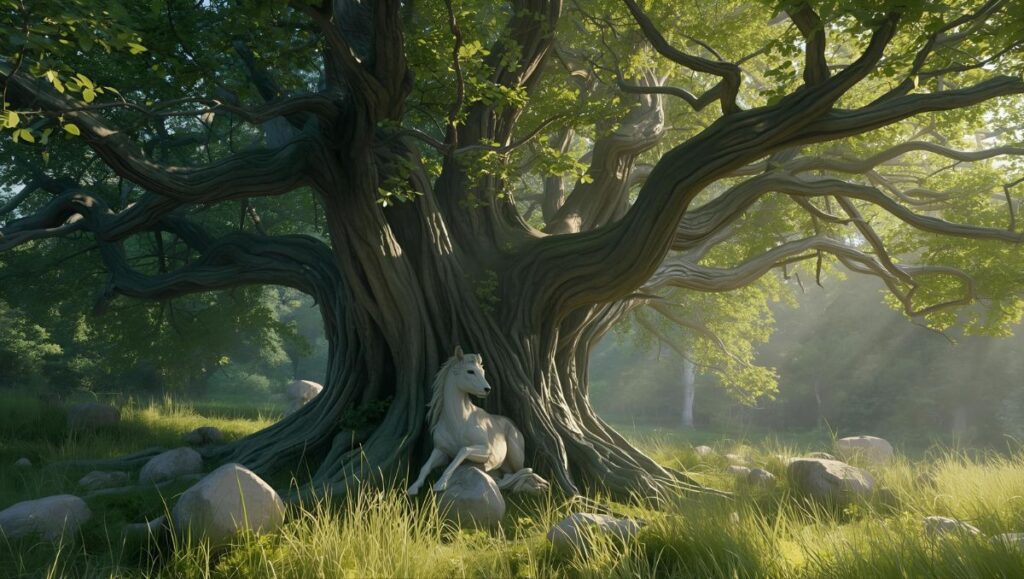
Callion lived in a village surrounded by rolling hills and thick forests. The villagers said that the forest was older than the oldest gods, that it had seen heroes and monsters, and that some trees had learned the language of the world.
Callion did not know all of this as a boy. He only knew that the forest was quiet when he entered it, except for one strange tree: a single laurel near the riverbank that seemed to hum softly.
He had discovered it by accident when he was eight, chasing a lost dog. The laurel’s leaves shimmered in the sunlight, even when the wind was still, and sometimes he swore he could hear a voice in the rustling of its branches. At first, he thought it was the wind. But soon he realized it was not. The laurel was whispering, though he could never make out what it said.
“Do you know who I am?” he asked one day, laughing nervously.
The laurel did not answer. Or perhaps it did, and he simply could not understand.
As Callion grew, he returned to the laurel every day, curious and respectful. He spoke to it about small things: the weather, his chores, his friends, his dreams.
He told it stories, as though the tree might listen and remember. And in return, he began to notice a strange comfort in the forest, a sense that the laurel was keeping secrets for him.
The villagers were puzzled by his devotion. “It’s just a tree,” they would say. “Go play with boys your age.” But Callion ignored them. To him, the laurel was alive in a way the other trees were not.
The First Whisper
One late afternoon, when the sun dipped low and the river mirrored the sky, the laurel spoke clearly for the first time.
Callion had been sitting by its roots, pressing his hand against its bark, when he felt a pulse—soft, rhythmic, almost like a heartbeat.
“Callion,” it whispered.
He froze. The sound was faint but unmistakable.
“I… I hear you,” he stammered, though he barely believed it.
Do you wish to know a secret?
Callion nodded, eyes wide.
Then listen carefully, the tree said. The forest is not what it seems. There is a path beneath the riverbank. A hidden grove. Few have ever walked there. Only the brave, only the patient.
“What is there?” he asked.
Time and memory. And a choice. You will find what you need most, but it will demand something of you.
Callion swallowed. “I… I will go.”
You must wait for the moon’s rise. Only then will the path appear.
The whisper faded. Callion looked at the laurel, still shimmering in the dying sunlight. His heart pounded.
A hidden grove. A choice. Something he needed most. He did not know what it meant, but he knew he had to try.
The Journey Begins
That night, when the moon rose silver and full over the hills, Callion returned to the riverbank. The laurel swayed gently, even though the air was still. Its leaves shimmered like threads of light.
Callion knelt beside its roots, tracing the bark. He felt the same heartbeat pulse as the day before.
“Show me the path,” he whispered.
A soft wind stirred. The river near the laurel shifted, opening a narrow, glowing trail beneath the water. Stones rearranged themselves like stepping stones. A faint, warm light marked the edges.
Callion hesitated, heart racing. Then he stepped in. The river was shallow but cold, and the glowing path pulsed beneath his feet, steady and firm.
Follow it, the laurel whispered from above. But beware. The grove will test your heart.
Callion stepped carefully. Halfway across, he felt a tremor in the water. Shadows moved beneath the surface, swirling. He almost turned back, but a calm voice—soft and sure—echoed in his mind: Do not fear the water. Fear nothing that tests only courage.
He pressed on. The shadows parted. The path ended at a small clearing hidden behind thick reeds. The moonlight illuminated the grove—a circle of silver trees with leaves that shimmered like glass.
The air was fragrant, the earth soft. And at the center of the grove stood a single laurel, taller and brighter than any tree he had seen. Its branches swayed gently, though there was no wind.
Callion knelt in awe.
You have arrived, the whisper said, now louder and clear. What do you seek?
Callion paused. “I… I do not know. I only know that I felt drawn here.”
Then speak your truth, the laurel said. Only the heart’s words can awaken the grove.
Callion took a deep breath. “I… I want to understand. I want to see what the forest sees. I want to hear what it whispers. I want to… help it, if I can.”
The laurel glowed brighter. The leaves began to rustle with a sound that resembled laughter, but warm and gentle.
Then you are ready, it said.
The Trial of Echoes
Suddenly, the ground trembled slightly. The trees bent toward Callion, and a faint mist rose around him. Voices swirled, whispering indistinctly.
He could hear fragments of words: fear, regret, sorrow, joy, hope. They sounded like echoes of people who had walked through the grove long ago.
To understand the forest, you must face yourself, the laurel whispered.
The mist thickened. Callion’s mind filled with visions: moments of shame, times he had been cruel without realizing it, times he had been selfish. Each memory pressed on his chest like a stone.
He gasped, almost stumbling, but the laurel’s voice held him steady.
Do not deny them. Do not flee. Accept them, and move forward.
Callion closed his eyes and faced each vision. He admitted mistakes to himself. He forgave himself where he could. He acknowledged the sorrow he carried.
When he opened his eyes, the mist had cleared. The grove shimmered brighter than before. The silver leaves reflected the moonlight like thousands of tiny mirrors. He felt lighter, as if a weight had been lifted from his chest.
You have passed the trial, the laurel said. You hear the echoes and understand the shadows. Now you may learn the language of the forest.
The Language of Leaves
Callion reached toward the central laurel. Its bark felt warm under his fingers. The leaves rustled softly. Then he heard it—not just a whisper, but words he could understand.
“You are part of us now,” the laurel said. “We speak in patterns, in rustles, in echoes of wind. You will hear, not with ears, but with heart. You will carry our memory and guard it.”
Callion felt a strange clarity. The wind through the grove sounded like voices singing. The rustling of leaves formed words.
The water nearby babbled in sentences of soft gurgles. The earth hummed with quiet wisdom.
He spent hours listening, learning, and repeating. The laurel taught him patience. It taught him the weight of truth. It showed him that the forest was alive not only in sound, but in time, memory, and care.
Tomorrow, the laurel whispered, “you will return to your village. But carry what you have learned. Speak for us, protect us, and honor the whispers.”
Callion nodded, understanding more than he had ever understood in his life.
Returning to the Village
At dawn, Callion walked back along the glowing path. The river no longer shimmered, the reeds were ordinary, and the forest seemed silent again. But Callion knew better.
He returned to the village quietly, carrying only his memories and the understanding he had gained.
The villagers noticed a difference. He seemed calmer, more patient, more aware of small things: the rustle of wind, the flight of birds, the murmur of the river. They asked what had changed him, but he only smiled gently.
He visited the laurel every night, speaking softly, listening carefully. And over the years, he became known not only as a weaver of cloth but as a weaver of stories, of care, of memory. His hands shaped not only wool but understanding.
People from far away came to ask him about the forest, about the strange silver grove. He would guide them, not with magic or tricks, but with respect, teaching them to watch, to listen, and to carry the whispers with gentle hearts.
The Legacy of Callion
Years passed. Callion grew older. His hair turned silver. His hands became rougher from work, but his eyes remained bright.
He had taught his village and travelers the language of the forest. He had listened to the laurel every night.
And when he finally passed, they say his spirit returned to the grove. Some claim that on quiet nights, the laurel’s leaves shimmer with silver light, and soft whispers float on the wind.
The whispers speak in a language only the patient, the brave, and the kind can hear—a language Callion had learned, a language the world often forgets.
The villagers tell children: “Listen to the wind, and honor the trees. Callion listened, and the forest spoke back.”
And sometimes, in the quiet of the evening, if you walk to the riverbank and kneel by the laurel, you can hear it too—a faint whisper of memory, patience, and truth. A whisper that tells you to be brave, to listen, and to care.
And if you are patient, the laurel might even share its secrets, as it once shared with Callion, the boy who heard the forest and learned to whisper back.
Callion’s story is a gentle reminder: the world speaks if we listen, and wisdom grows in those who pause to hear the whispers.
6. The Girl Who Befriended the North Wind
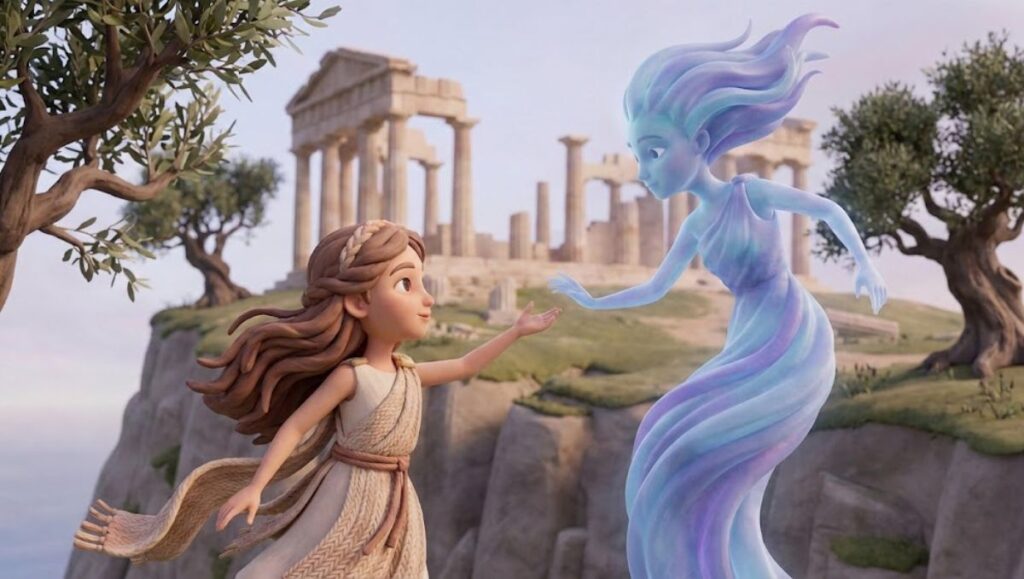
In a village on the northern edge of Greece, winters were long and cold.
Snow lingered deep into spring.
Thalira lived there.
She had dark hair and eyes that reflected the sky.
Unlike other children, Thalira loved the cold winds from the north.
While others pulled their cloaks tight, she ran to the hilltop.
She spread her arms wide.
She let the gusts push against her.
Her father was a fisherman. Her mother was a potter.
They worried for her.
“Don’t let the wind take you,” her mother said one winter morning.
Thalira laughed.
“The wind is not something that takes, mother. It only moves. It only speaks.”
No one believed her.
But she always felt the north wind was different.
It was wild and free.
Fierce and cold.
Yet playful.
Sometimes, on the cliffs near the sea, she heard a voice.
Soft. Low. Almost like music.
Come higher… it whispered.
Feel the world… it whispered.
She always listened.
One winter evening, after a day of frost and snow, Thalira ran to the highest hill.
The wind howled stronger than usual.
She pressed her face into it.
And then she heard it clearly.
“Child,” it said.
Thalira froze.
The sound was faint but unmistakable.
“I… I hear you,” she whispered.
I have watched you for seasons, the wind said.
You do not fear me as others do.
Thalira smiled.
“I do not fear you. I only… want to understand.”
Then follow me, it said.
The wind swirled around her.
Strong but gentle.
Lifting her hair, tugging her cloak, urging her forward.
She took a deep breath.
And ran.
The wind raced alongside, around, and ahead of her.
For the first time, she felt companionship.
Thrilling and strange.
Over the following days, Thalira met the wind every morning.
She learned to listen.
Not with ears, but with her heart.
The wind taught her small things.
Patterns of frost on leaves.
How the river moved under ice.
Colors hidden in gray skies.
It also gave her gifts.
A tiny feather, icy blue, glimmering.
“Keep it,” the wind said. “Strength can be gentle.”
Another day, a leaf coated with frost.
“Fragile things often survive the hardest storms.”
Thalira carried these gifts.
The feather in her hair. The leaf pressed in a book.
The villagers noticed.
“She walks with the wind,” they whispered.
Thalira smiled quietly.
She did not explain.
Some things could only be felt.
One year, a harsh winter came.
The river froze solid. Snow piled high.
Food became scarce. Villagers feared the worst.
Thalira climbed the hill each day.
The wind howled angrily.
Something was wrong.
“The mountains are blocked,” it whispered.
Snow has trapped rivers and paths. People will suffer.
Thalira shivered.
“What can I do?” she asked.
You can speak to me. You can act. You can carry my strength into the world of humans.
She nodded.
Friendship with the wind was more than listening.
It was responsibility.
She guided villagers to safety.
Showed which paths were safe.
Carried water from thawing springs.
Helped repair roofs.
Comforted those afraid of long nights.
The wind roared beside her.
Clearing snow, nudging fallen trees, opening paths.
Villagers whispered anew.
“She is the child of the wind,” they said.
As winter passed, the wind came to her one evening.
The sky was full of stars.
The air smelled of frost and rain.
“Thalira,” it said, do you trust me?
“I do,” she replied.
Then you must come with me.
Thalira felt fear and excitement.
“Where?”
To the edge of the world.
Where the sky touches the earth.
She nodded.
She had never left the hills before.
But she trusted the wind.
They traveled through forests and across frozen rivers.
Over cliffs, into the mountains.
The journey was hard. Cold wind cut her face.
Snow slowed her steps.
But the wind stayed beside her.
Lifting her when she slipped.
Nudging her forward when she wavered.
Finally, they reached a high cliff.
The stars seemed close enough to touch.
The wind roared around her.
This is where I live, it said.
And where I am most free.
But freedom has a cost. It can be lonely.
Few can endure it.
Thalira looked at the endless mountains.
She shivered, not from cold.
“I can endure it,” she said softly.
The wind circled her faster, then slowed.
Then you are my friend.
And friends share freedom.
Thalira returned to the village, changed forever.
She carried lessons of the north wind: patience, courage, joy of wild freedom.
She helped the village through long winters.
Taught them to read snow and ice.
Predict storms. Survive harsh winds.
She kept the secret of her friend.
The wind remained her companion.
Sometimes, it swept through the village in winter nights.
Windows rattled. Trees swayed.
Thalira smiled.
It was her friend, the great north wind, playing and watching over them.
She spent years learning from it.
Exploring mountains, valleys, forests.
Understanding the wind’s moods.
Playful, curious, fierce, gentle, sometimes sad.
Even something as vast as the wind could value friendship.
Trust. Care.
The villagers noticed her change.
She grew wise, calm, patient.
Yet full of quiet energy.
Children ran to her for stories.
Adults sought her advice.
She could predict storms, read the river, sense danger.
One evening, the wind brought a gift.
It blew through her hair, tugged her cloak.
A small crystal of ice glimmered blue.
For you, the wind said.
A piece of me. A reminder of freedom and courage.
Thalira took the crystal carefully.
It pulsed softly, warm despite the cold.
“I will honor it,” she whispered.
Remember, the wind said, no one can own the sky.
But you can hold its lessons in your heart.
Years passed.
Thalira became known for wisdom and courage.
She never married.
Her life was full of care, adventure, and learning.
She explored every hill and forest in the north.
Guiding travelers, helping villagers, teaching children the ways of the wind.
When she grew very old, she returned to the high cliff.
She held the crystal close.
The wind came, strong and wild.
Circling her once, twice, then slowing.
You have been true, it said.
You have understood freedom and responsibility.
You have shared your heart and learned ours.
Thalira smiled.
“Thank you,” she whispered.
The wind lifted her hair one final time.
She felt joy so deep it made her chest ache.
Then she returned home to rest.
Her heart full. Her spirit calm.
Even after she passed, villagers say, the wind carries laughter and whispers.
Some say it is the wind playing.
Some say it is Thalira running alongside her friend.
The north wind, free and joyful.
Sometimes, if a child stands at the hilltop and stretches arms wide,
They feel a gentle tug, a soft nudge.
A faint whisper of friendship, courage, and freedom.
“Listen,” the wind says.
“And you may find a friend too.”
Thalira’s story reminds everyone:
Freedom is powerful.
Friendship is rare.
Sometimes the smallest trust can hold the vastest force in the world.
7. The Boy and the Unfinished Constellation
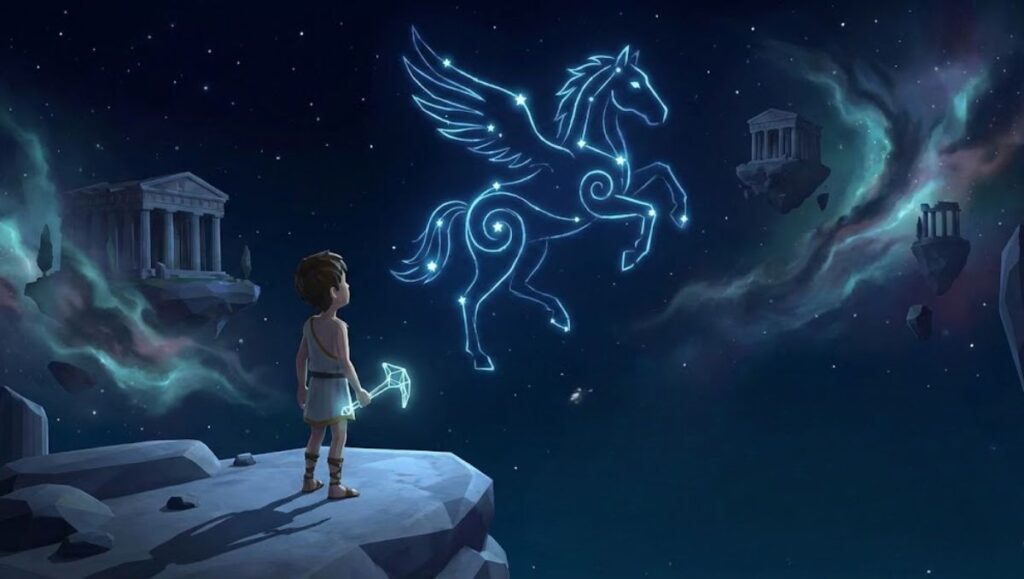
In a quiet village between two hills, the night sky was clear. Stars seemed close enough to touch.
A boy named Kael lived there. He had wide eyes that reflected every flicker of starlight. His mind never rested.
Kael rarely played like other children. He spent nights on the hill behind his home, gazing up at the sky.
He traced patterns in the stars and imagined stories for each dot.
He knew all the constellations. Orion the Hunter. Cassiopeia the queen. The Great Bear.
But he noticed something others did not.
Near the edge of the sky, beyond the known constellations, a faint cluster of stars twinkled.
They didn’t form a pattern.
They seemed shy, almost hesitant.
Kael felt drawn to them. Every night he returned. He traced imagined lines between the stars.
“This cluster isn’t finished,” he said one evening.
His mother smiled gently. “Stars are what they are, Kael. They shine for us, not for stories.”
Kael nodded, but he could not let it go.
One night, the sky shimmered strangely. The faint cluster pulsed softly, like a heartbeat.
Then a voice filled his mind.
“Kael.”
He sat up. “Who’s there?”
Do not be afraid, the voice said.
I am incomplete, and I need your help.
Kael’s heart raced.
“A star… speaking?” he whispered.
I am part of a constellation that was never finished, it said.
I wait for someone to see me, to imagine my story, to place me in the sky.
Kael shivered.
“What must I do?” he asked softly.
Trace me, draw me, imagine me. I will guide you.
Kael nodded. He picked up a stick and scratched lines into the dirt.
Each movement made the faint cluster pulse brighter.
Night after night, Kael returned to the hill.
He drew, imagined, and whispered to the star.
The cluster shifted slightly each time.
It brightened, moved closer, responding to him.
Then the voice spoke again.
You are ready to climb.
Kael looked around. “Climb?”
To reach the sky, you must climb the mountains that touch it.
Only there can the constellation be completed.
The next morning, Kael packed a bag.
He told his parents he was exploring the hills and set off toward the tallest mountain.
The climb was steep and rocky. His feet slipped often.
At times, he wanted to turn back.
But the cluster winked at him, urging him forward.
By nightfall, he reached a plateau near the summit.
The sky felt impossibly close. Stars shimmered like jewels.
The faint cluster pulsed stronger than ever.
Stretch your hand, the voice whispered.
Kael raised his hand.
The stars bent slightly, like strands of light reaching toward him.
Now imagine me complete, the voice said.
Kael closed his eyes.
He traced the constellation in his mind.
He imagined a boy holding a lantern, reaching toward the heavens.
Each line pulsed.
The faint cluster shimmered brighter.
Suddenly, the stars flickered and dimmed.
Kael opened his eyes.
“What’s wrong?” he asked.
You must believe, the voice said.
Only belief can bind us together.
Kael’s hands shook.
He had traced the lines carefully, but he doubted himself.
What if his story was wrong?
What if the constellation could never shine?
He took a deep breath.
He whispered aloud, “I believe.”
The constellation shimmered.
Light flowed from one star to the next.
The boy with the lantern blinked to life.
The cluster was no longer faint.
It glowed steadily, part of the sky, part of the stories told to dreamers.
Kael, you have completed me, the voice said.
“Why me?” Kael asked.
Only a heart that loves the stars can finish a story the gods left incomplete.
A small star separated from the constellation.
It floated down and landed gently on Kael’s palm.
This is my gift to you.
Keep it as a reminder that imagination can shape the world.
Kael held it carefully.
It glimmered, a living piece of the night sky.
Kael descended the mountain with the star in his bag.
By dawn, the boy with the lantern was visible in the sky.
Villagers paused.
“Another constellation!” they said.
Kael only smiled.
Some things were meant to be felt, not understood.
He placed the star in a small wooden box on his windowsill.
It remained a quiet companion, reminding him of the night he touched the heavens.
Years passed.
Kael became known as a dreamer and storyteller.
He taught children to watch the stars, to tell their own stories, to imagine shapes beyond the familiar.
He often returned to the mountains at night.
The faint cluster glimmered brighter when he passed.
A pulse echoed in his heart, like the heartbeat of the constellation.
The star in his box glimmered when he felt doubt.
It reminded him that imagination is powerful.
Belief can make the impossible real.
When Kael grew very old, he sat on the hill behind the village.
Children gathered around him.
He pointed out the stars.
He told stories of constellations, courage, and imagination.
Sometimes, the faint cluster glimmered a little brighter.
As if to wink at the boy who had finished it.
When Kael passed quietly one winter night, villagers say his spirit joined the stars.
The lantern boy shone in the sky.
Dreamers and children could still see him.
And if you lie on the hilltop and watch closely, you might feel the heartbeat of imagination, still alive.
Kael’s story reminds everyone:
Dreams, courage, and imagination can shape not only stories but the world itself.
Definition and Scope
Greek mythology is a vast collection of stories about gods, heroes, monsters, creation, and the natural world. These myths explain how the world came to be, how humans should behave, what values matter, and what happens when people go against divine laws.
The myths include:
- Creation stories
- Heroic adventures
- Moral lessons
- Tragic romances
- Tales of transformation
- Accounts of monsters, curses, and quests
These stories weren’t written all at once. They grew over centuries, evolving as new storytellers added details and shaped the tales for new audiences.
Historical Context and Timeline
Greek mythology didn’t appear out of nowhere. It developed through different eras:
Mycenaean Greece (c. 1600–1100 BCE): Early images of gods and ritual practices appear on pottery and tablets.
Archaic Period (c. 700–480 BCE): Poets like Homer and Hesiod record key myths.
Classical Period (c. 480–323 BCE): Dramatists use myths for tragedies and public performances.
Hellenistic Period (c. 323–31 BCE): Myths spread across a wider world under Alexander the Great.
Roman Adoption (c. 31 BCE onward): Romans reinterpret Greek gods, renaming them and weaving the stories into their own culture.
The primary way myths were shared was through oral storytelling. Poets memorized long epics and performed them in public festivals. Later, writers like Hesiod, Homer, Aeschylus, Sophocles, Euripides, and Ovid preserved them in writing, giving us the versions we study today.
The Age of Creation: From Chaos to Cosmos
Before the gods, before the world, before anything—there was Chaos, a vast and shapeless void. It is the starting point of Greek mythology.
The Beginning: Chaos and Primordial Deities
From Chaos came the first beings:
- Gaia — Earth
- Uranus — Sky
- Nyx — Night
- Erebus — Darkness
- Eros — Love
These primordial figures aren’t characters in stories the way later gods are. Instead, they are forces of nature personified.
The Titans: The First Gods
Gaia and Uranus gave birth to the Titans, including:
- Cronus
- Rhea
- Oceanus
- Hyperion
Uranus feared his children and imprisoned some of them. Gaia, angry and in pain, encouraged Cronus to overthrow his father. Cronus succeeded and became the ruler of the cosmos—but he, too, would fear his children.
The Titanomachy
Cronus swallowed his children—Hera, Hades, Poseidon, Demeter, and Hestia—to prevent being overthrown. But Rhea saved the youngest, Zeus, hiding him on Crete.
When Zeus grew up, he forced Cronus to release his siblings. Together, they waged the Titanomachy, a ten-year war of gods vs. Titans. The Olympians won, and the defeated Titans were imprisoned in Tartarus, the deepest part of the underworld.
Creation of the Cosmos and Humans
After the war, the world was divided:
- Zeus ruled the sky
- Poseidon ruled the sea
- Hades ruled the underworld
Prometheus, a wise Titan, shaped humans from clay. He loved humans deeply and gave them fire, against Zeus’ wishes. For this, Zeus punished him by chaining him to a rock where an eagle ate his liver daily.
Pandora, the first woman, was created as part of Zeus’s plan to punish mankind for receiving fire. Her box (or jar) released all evils into the world—but hope remained inside.
The Olympian Gods: Mount Olympus and Divine Hierarchy
Greek mythology’s most famous figures are the Olympian gods, who live on Mount Olympus.
The Big Three
Zeus: King of the gods. God of thunder, justice, and authority. Known for his power and complicated relationships with gods and mortals.
Poseidon: God of the sea, storms, earthquakes, and horses. Proud, fierce, and vital to sailors and islanders.
Hades: God of the underworld and wealth. Stern but fair, often misunderstood. His story with Persephone explains the changing seasons.
Major Olympians
- Hera: Goddess of marriage and protector of families
- Athena: Goddess of wisdom and war strategy; patron of Odysseus
- Apollo: God of the sun, prophecy, music, archery, and healing
- Artemis: Goddess of the moon, hunting, and wilderness
- Ares: God of violent war and conflict
- Aphrodite: Goddess of love, beauty, and desire
- Hermes: Messenger god, patron of travelers and thieves
- Hephaestus: God of fire and craftsmanship; creator of divine weapons
- Dionysus: God of wine, festivity, and ecstasy
- Demeter: Goddess of agriculture; story of Persephone explains winter
- Hestia: Goddess of the hearth and home
Interactions with Mortals
The gods often stepped into the lives of humans:
- Athena guiding Odysseus
- Poseidon angering sailors
- Hera persecuting Heracles
- Apollo giving oracles
- Aphrodite inspiring love and jealousy
Their influence could be helpful, harmful, or simply unpredictable.
The Structure of the Greek Cosmos
Greek mythology imagines a great layered universe.
Divine Hierarchy
Layers of beings include:
- Olympian gods
- Lesser gods
- Daimones (spirits)
- Nymphs and nature spirits
- Monsters
- Mortals
The Underworld and Its Deities
Ruled by Hades and Persephone, the underworld includes:
- Asphodel Fields: ordinary souls
- Elysium: heroes and the virtuous
- Tartarus: deep prison for enemies of the gods
- Styx and Lethe: rivers of oath and forgetting
Famous underworld myths include:
- Orpheus and Eurydice
- Sisyphus endlessly pushing his boulder
- Tantalus punished with unreachable food
- Heracles retrieving Cerberus
Legendary Heroes and Heroic Cycles
Heroes are central to Greek mythology. Most are demigods, flawed yet capable of incredible feats.
Characteristics of Greek Heroes
- Often children of gods and mortals
- Brave, skilled, and determined
- Prone to flaws like pride or impatience
- Tested through trials and adventures
Major Heroes and Tales
Heracles: Famous for his Twelve Labors. A symbol of strength, endurance, and redemption.
Perseus: Defeated Medusa, saved Andromeda, and founded cities.
Theseus: Slayed the Minotaur, navigated the Labyrinth, and became king.
Odysseus: Hero of the Odyssey. Known for wit, strategy, and resilience.
Jason: Leader of the Argonauts in search of the Golden Fleece. Partner to the complex figure of Medea.
Atalanta: A swift, skilled huntress involved in many quests.
Heroic Cycles
Greek stories often form interconnected cycles:
- The Theban Cycle: Cadmus, Oedipus, Antigone, Seven Against Thebes
- The Trojan Cycle: Helen, Achilles, Hector, Odysseus, the Trojan Horse
- The Argonauts: Jason, Medea, and the Golden Fleece
Each cycle explores destiny, loyalty, tragedy, and consequence.
Famous Myths, Tragic Romances, and Metamorphoses
Creation & Catastrophes
Key stories include:
- Prometheus stealing fire
- Pandora’s Box
- Five Ages of Man
- Deucalion & Pyrrha and the great flood
- Phaethon—the boy who tried to drive the sun
Love Stories & Tragic Romances
Greek myths often explore powerful and sorrowful love:
- Orpheus & Eurydice
- Pygmalion & Galatea
- Hero & Leander
- Baucis & Philemon — a rare happy, gentle tale
Metamorphoses
Transformations symbolize consequences, emotions, or lessons:
- Daphne → Laurel tree
- Arachne → Spider
- Narcissus → Flower
- Niobe → Stone
- Procne & Philomela → Birds
- Myrrha → Myrrh tree
Monsters and Mythical Creatures
Greek mythology is filled with unforgettable monsters:
- Gorgons
- Hydra
- Cerberus
- Minotaur
- Chimera
- Cyclopes
- Sphinx
- Sirens
- Scylla & Charybdis
- Harpies
Heroes often face these creatures to prove their courage and test their fate:
- Perseus vs. Medusa
- Theseus vs. the Minotaur
- Bellerophon vs. the Chimera
Monsters often symbolize fear, chaos, or human weaknesses.
Themes, Morality, and Symbolism
Key Themes
- Hubris (danger of excessive pride)
- Fate vs. free will
- Revenge and justice
- Loyalty and betrayal
- Human flaws vs. divine influence
Symbols and Their Meanings
- Owl for Athena—wisdom
- Thunderbolt for Zeus—authority
- Caduceus for Hermes—communication and travel
- Golden Fleece—leadership and worth
- Pandora’s Box—curiosity, consequences
Lessons
Greek myths serve as cautionary tales:
- Beware of pride
- Respect the gods
- Be clever as well as brave
- Consequences follow choices
- Love and loyalty hold great power
Greek Mythology in Modern Media
Movies and TV
Greek myths influence many modern works:
- Percy Jackson
- Clash of the Titans
- Disney’s Hercules
Books and Comics
Modern retellings include:
- Rick Riordan’s series
- Madeline Miller’s Circe and The Song of Achilles
- Graphic novels for younger readers
Games and Pop Culture
- God of War
- Hades
- Board games, plays, operas, and music inspired by myth
Language & Psychology
Common terms:
- “Herculean”
- “Narcissistic”
- “Mentor”
- “Titanic”
Psychology uses myth-based concepts like the Oedipus complex and archetypes.
How to Read and Enjoy Greek Mythology
Tips for Beginners
- Start with the major gods and stories
- Notice patterns in characters
- Pay attention to motivations and flaws
- Don’t worry about knowing everything at once
Understanding Themes
Look for:
- Human behavior
- Repeated lessons
- Moral or emotional meanings behind stories
Conclusion
Greek mythology remains one of the world’s most powerful storytelling traditions. It offers:
- Larger-than-life gods
- Heroes with courage and flaws
- Monsters that test human limits
- Lessons about pride, hope, fate, love, and ambition
These ancient stories continue to shape our books, films, games, language, and imagination. They remind us that while the world changes, human nature remains familiar.
Now is the perfect time to explore Greek myths—whether through original texts, modern retellings, or simple summaries. Each story opens a window into a world of adventure, wisdom, and wonder.
Dive deeper, discover your favorite myths, and let these timeless stories spark your imagination.