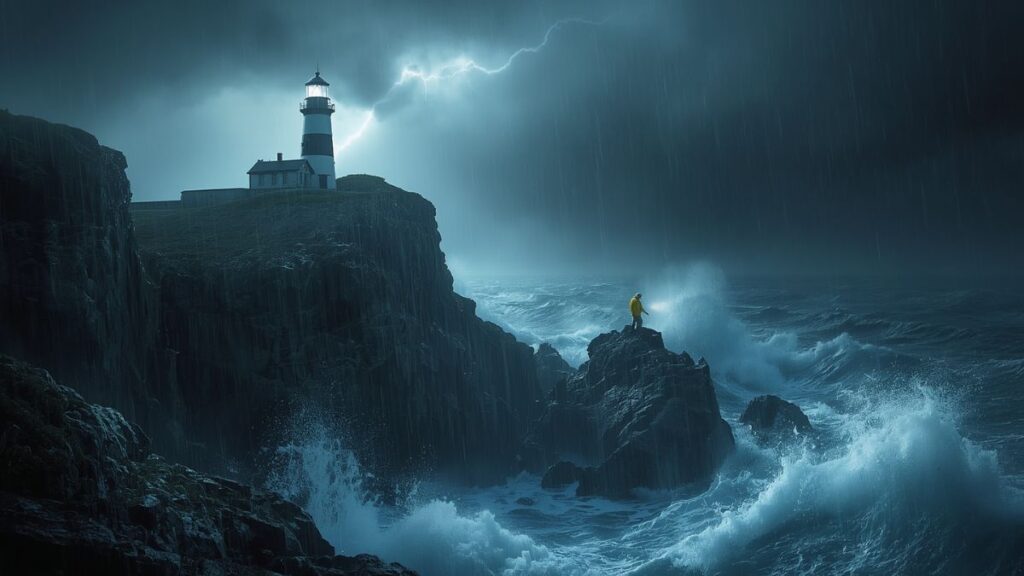
The old lighthouse had stood on the rocky cliffs for nearly a century, guiding countless ships safely through storms, fog, and darkness. Its towering white walls bore the scars of saltwater and relentless winds, yet its beacon remained one of the most trusted lights along the coast.
For thirty-four years, Thomas Mercer had been its keeper.
Every evening before sunset, he climbed the spiral staircase carrying a small leather journal. At the top, he inspected the massive lens, cleaned every panel of glass, checked the backup generator, and watched as the great beacon swept across the restless sea.
Many believed modern navigation had made lighthouse keepers obsolete. GPS systems, satellites, and sophisticated radar seemed capable of replacing old traditions.
Thomas disagreed.
Technology could fail.
The lighthouse never forgot its purpose.
He often said, “As long as one sailor looks for this light, someone should be here to keep it burning.”
His life was wonderfully predictable.
He woke before dawn.
Walked the shoreline collecting driftwood.
Fed the gulls that gathered every morning.
Recorded weather observations.
Answered occasional questions from tourists.
Then, each evening, he climbed the tower again.
He lived alone after his wife, Eleanor, passed away nearly twelve years earlier.
Their children lived hundreds of miles away, visiting whenever work allowed.
Although the lighthouse was quiet, Thomas never considered himself lonely.
The sea was always speaking.
Sometimes gently.
Sometimes violently.
Sometimes with lessons only patience could understand.
One autumn afternoon, weather reports warned of an approaching coastal storm unlike anything forecast that season.
Fishing boats hurried back into harbor.
Local residents secured windows.
Emergency officials advised everyone to remain indoors.
Dark clouds swallowed the afternoon sky hours before sunset.
The wind began screaming through the cliffs.
Massive waves exploded against jagged rocks below the lighthouse.
Thomas inspected every system twice.
The backup batteries were fully charged.
Fuel tanks were full.
Emergency radios worked perfectly.
Everything appeared ready.
Then, just before darkness settled over the coast, the unexpected happened.
Lightning struck a transformer several miles inland.
Power vanished instantly.
The lighthouse automatically switched to its emergency generator.
For several minutes everything functioned normally.
Then the generator sputtered.
Coughed.
Stopped.
Silence.
Thomas immediately understood the seriousness.
Without the beacon, ships navigating the dangerous coastline would lose one of their most important visual references during the worst storm of the year.
He grabbed waterproof gear and climbed into the machinery room beneath the lantern.
The generator had flooded after seawater forced itself through an aging ventilation shaft damaged during the storm.
He had one remaining option.
Years earlier, emergency engineers had installed a manual ignition system that could restart the generator if someone reached an external fuel valve located on a narrow maintenance platform outside the lighthouse.
Normally it took less than two minutes.
Tonight those two minutes could become deadly.
Wind slammed against the tower.
Rain struck sideways like handfuls of gravel.
Thomas secured a safety harness.
Opened the heavy steel door.
Stepped outside.
The platform shook beneath every gust.
Below him, waves crashed nearly seventy feet beneath the cliff.
He inched toward the frozen valve.
Saltwater sprayed across his face.
His gloves slipped against soaked metal.
One final step.
He reached the valve.
Turned it.
Nothing.
Again.
The mechanism finally released.
Inside the lighthouse, the generator roared back to life.
Seconds later, the beacon illuminated the storm once more.
Thomas smiled.
Then a tremendous wave exploded against the cliff below.
The impact sent vibrations through the maintenance platform.
A steel support snapped.
The railing twisted.
His footing disappeared.
The harness anchor tore free from the weakened wall.
Thomas fell into darkness.
The freezing ocean swallowed him instantly.
The current beneath the cliffs was infamous.
Even experienced rescue divers avoided it during storms.
He fought to reach the surface.
A wave forced him deeper.
Another spun him violently beneath the water.
His lungs burned.
The roar of the storm became strangely distant.
He expected terror.
Instead, something entirely unexpected happened.
Everything became calm.
The icy pain disappeared.
The darkness surrounding him slowly transformed into an extraordinary softness.
He no longer felt the crushing weight of the ocean.
He simply floated.
The violent storm seemed impossibly far away.
Ahead appeared a gentle radiance unlike sunlight or moonlight.
It carried no harsh brightness.
Instead, it felt welcoming.
Comforting.
As though the light itself understood him completely.
Thomas realized he was no longer breathing.
Oddly, this observation caused no fear.
He felt lighter than he had since childhood.
The aches in his aging knees vanished.
His stiff back no longer hurt.
His heartbeat seemed unnecessary.
Time lost all meaning.
The radiant light expanded, revealing what appeared to be a vast shoreline unlike any place on Earth.
The water shimmered with impossible colors.
Every wave reflected peace rather than power.
He sensed a presence nearby.
Not seen.
Not heard.
Simply known.
It communicated without words.
Every question Thomas had ever carried throughout his life seemed gently answered before he could ask.
Why suffering exists.
Why people lose loved ones.
Why some dreams never come true.
None of the answers arrived as spoken explanations.
Instead, they came as understanding.
Complete.
Effortless.
Then memories surrounded him.
Not like watching scenes from a movie.
He experienced them again.
His first day at school.
His wedding.
Holding his newborn daughter.
Teaching his son how to tie fishing knots.
Laughing with Eleanor during quiet evenings beside the lighthouse.
Every joyful moment returned with astonishing clarity.
Then came memories he had long forgotten.
The lonely sailor he comforted decades earlier.
The frightened child he rescued from dangerous tides.
The exhausted fisherman to whom he quietly gave food without expecting thanks.
Small acts.
Moments he had barely remembered.
Yet each one carried remarkable significance.
He also experienced life from another perspective.
He felt how his kindness had affected others.
A simple encouraging conversation had prevented one young deckhand from abandoning his career.
An unexpected smile had eased someone’s grief.
A few patient words had restored hope to a stranger.
Thomas realized lives were connected in ways impossible to measure.
Nothing done with genuine compassion was ever insignificant.
Then Eleanor appeared.
She looked exactly as she had during their happiest years.
Healthy.
Smiling.
Radiant.
She said nothing at first.
They simply embraced.
It felt entirely real.
“I’ve missed you,” Thomas whispered.
“I know,” she replied softly.
“You’ve never been alone.”
They walked together along the peaceful shoreline.
There was no sadness.
No regret.
Only overwhelming love.
Thomas asked the question he had carried since losing her.
“Why did you have to leave so soon?”
She smiled gently.
“Leaving wasn’t the end.”
He understood.
Not intellectually.
Deeply.
Death had not erased their love.
It had only changed its form.
Ahead, the brilliant light became even stronger.
Thomas sensed that stepping fully into it would mean not returning.
The peace there surpassed every happiness he had ever known.
He wanted to continue.
Yet another feeling emerged.
His children.
His grandchildren.
The lighthouse.
The people who still needed him.
Eleanor squeezed his hand.
“It’s not your time.”
“I don’t want to leave you again.”
“You never truly do.”
The light slowly receded.
Its warmth remained.
The sound of crashing waves returned.
Cold rushed through his body.
Pain exploded across his chest.
Someone shouted.
“There he is!”
Bright rescue lights pierced the darkness.
Coast Guard swimmers had finally spotted him trapped against submerged rocks nearly half a mile from where he had fallen.
They later admitted they almost missed him.
One rescuer noticed what looked like a brief flash reflecting off the waves exactly where Thomas lay unconscious.
They pulled him aboard the rescue boat.
His pulse was barely detectable.
His breathing had stopped twice before reaching shore.
Doctors later said his survival bordered on miraculous.
After several days in intensive care, Thomas awoke.
His family surrounded his hospital bed.
His daughter cried before speaking.
“We thought we lost you.”
Thomas smiled peacefully.
“You almost did.”
Recovery took months.
Reporters wanted dramatic stories.
Scientists asked medical questions.
Friends expected frightening memories.
Instead, Thomas described profound peace.
He never claimed to understand everything.
Nor did he insist others believe his experience.
He simply shared what had changed.
“I no longer fear death,” he said.
“But I value life more than ever.”
People expected those ideas to contradict each other.
They didn’t.
Thomas returned to the lighthouse once doctors allowed it.
Climbing the spiral staircase took longer than before.
His body remained weaker.
Yet every step felt meaningful.
Watching sunsets became sacred.
Morning coffee tasted richer.
Ordinary conversations carried unexpected beauty.
He stopped worrying about inconveniences.
Broken appliances.
Late deliveries.
Minor disagreements.
None seemed worth sacrificing peace.
Instead, he listened more carefully.
Forgave more quickly.
Laughed more often.
Neighbors noticed the difference.
So did visiting tourists.
When children visited the lighthouse, Thomas no longer focused only on explaining lenses or weather instruments.
He spoke about kindness.
About appreciating ordinary days.
About helping others even when nobody noticed.
One teenager confessed he felt lost about his future.
Thomas smiled.
“You don’t need to know your entire path.”
“What if I choose wrong?”
“The light doesn’t show sailors the whole ocean.”
“It only shows the next safe direction.”
Years later, that young man became a search-and-rescue officer.
He often credited Thomas for changing his life.
The lighthouse itself eventually became automated.
Technology finally replaced daily manual operation.
Many assumed Thomas would retire immediately.
Instead, the local historical society invited him to remain as caretaker and guide.
He happily accepted.
Every evening he still climbed the tower.
Not because machines required him.
Because gratitude did.
Visitors frequently asked the same question.
“What was the most important thing you learned?”
Thomas usually looked toward the horizon before answering.
“I spent decades believing my job was keeping a light burning for ships.”
He paused.
“Now I think every person carries a lighthouse inside.”
People waited quietly.
“The brightest signals aren’t made of electricity.”
“They’re made of compassion.”
“Every kind word.”
“Every act of forgiveness.”
“Every moment we choose love over anger.”
“Someone out there is navigating a storm we cannot see.”
“And sometimes the smallest light becomes the reason they safely reach tomorrow.”
Years after the accident, another powerful storm battered the coast.
Residents watched from their homes as the lighthouse beacon swept steadily across the dark sea.
Thomas stood quietly inside the lantern room.
The storm no longer frightened him.
He understood something he hadn’t before that terrible night.
Life, like the ocean, could never be completely controlled.
Storms would always come.
Loss would always visit.
Fear would sometimes arrive without warning.
Yet hope remained remarkably similar to the lighthouse itself.
It did not eliminate darkness.
It simply gave people enough light to keep moving forward.
As the beacon completed another slow circle across the waves, Thomas whispered the words Eleanor had spoken beside that impossible shoreline.
“You’ve never been alone.”
The light continued shining into the storm, guiding unseen sailors toward safety.
And somewhere deep within his heart, Thomas knew that one day, when his final journey truly arrived, another brighter lighthouse would already be waiting to guide him home.