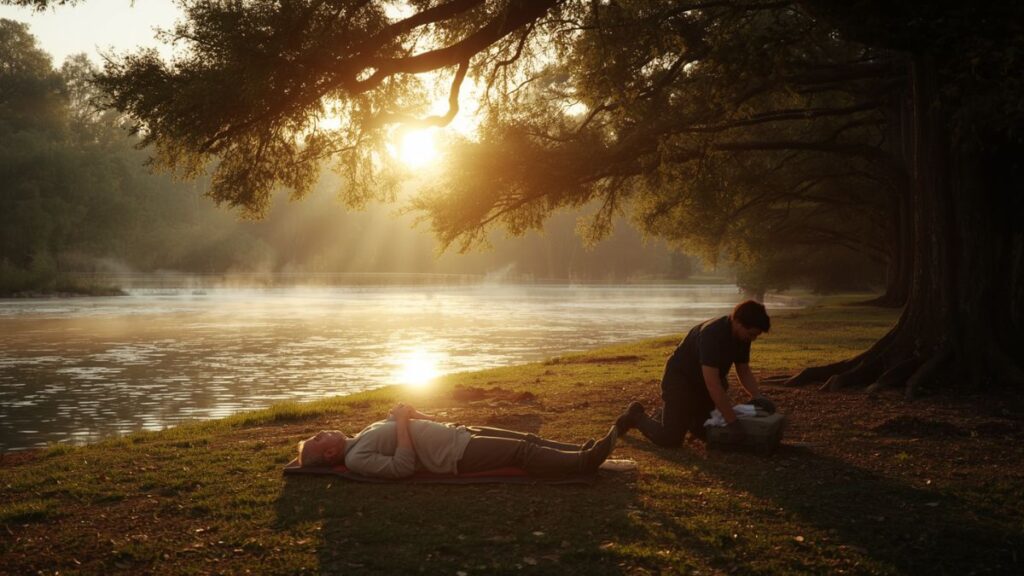
Every morning, before the city fully awakened, Harold Bennett walked the same quiet path through Maple Grove Park.
For nearly twenty years, his routine never changed.
He arrived just before sunrise carrying a small thermos of coffee, greeted the groundskeeper with a cheerful wave, and completed three slow laps around the park’s winding trails before sitting on his favorite wooden bench overlooking the lake.
The park was peaceful at that hour.
Morning mist floated gently across the water.
Ducks glided silently between patches of reeds.
Songbirds greeted the rising sun from towering oak trees.
For Harold, these quiet moments were the perfect way to begin each day.
At seventy-two years old, Harold had spent more than four decades as a beloved schoolteacher.
He taught history at the local middle school, where generations of students remembered him not simply for dates and lessons, but for his kindness.
He believed history was really the story of ordinary people making extraordinary choices.
Every lesson ended with the same reminder.
“One decision today becomes someone else’s history tomorrow.”
Thousands of students had passed through his classroom.
Many still stopped him in grocery stores or restaurants.
Some had become doctors.
Others were mechanics, firefighters, artists, engineers, and parents.
Almost all remembered Mr. Bennett with a smile.
After retiring, Harold found joy in simple routines.
He volunteered twice a week at the community library.
He read bedtime stories at the children’s hospital once a month.
He visited his grandchildren every Saturday.
Life felt wonderfully ordinary.
He often told friends that happiness rarely arrived through grand adventures.
It lived inside everyday moments.
His wife, Margaret, had passed away six years earlier after a long illness.
Her absence never stopped hurting, but Harold refused to let grief define the rest of his life.
Each morning he carried the same photograph of her inside his jacket pocket.
Not because he wished to remain in the past.
Because remembering love made each new day feel like a gift.
On a cool spring morning in early April, Harold followed his familiar routine.
The eastern sky glowed with soft shades of orange and pink.
The air smelled of blooming flowers and freshly cut grass.
He completed his first lap while exchanging greetings with a young jogger who often passed him.
Halfway through his second lap, he paused beside the lake to watch a family of ducks crossing the water.
He smiled.
Then a sharp pain spread across his chest.
At first he assumed it was indigestion.
He took a slow breath.
The pain intensified.
It radiated into his left arm.
His knees weakened.
The coffee thermos slipped from his hand and rolled across the path.
Harold collapsed onto the grass.
The jogger, only a few hundred feet away, heard the sound and immediately turned around.
She rushed toward him.
“Sir? Can you hear me?”
Harold tried to answer.
No words came.
Within seconds, he lost consciousness.
The jogger called emergency services while another early walker, a retired nurse, rushed over to help.
The nurse quickly checked for a pulse.
Nothing.
She immediately began CPR.
Another passerby retrieved the park’s automated external defibrillator from a nearby recreation center.
Minutes later, paramedics arrived.
The heart monitor confirmed cardiac arrest.
Harold’s heart had stopped beating.
They shocked him once.
No response.
They continued CPR.
A second shock.
Still nothing.
The team refused to give up.
After several more minutes of continuous resuscitation, just as the sun finally rose above the trees, Harold’s heart began beating again.
A faint rhythm appeared on the monitor.
His pulse slowly returned.
He was rushed to the hospital.
Doctors stabilized him but warned his family that the next twenty-four hours would be critical.
His children gathered in the intensive care waiting room.
His grandchildren quietly held one another’s hands.
Everyone hoped.
Everyone feared the worst.
Two days later, Harold opened his eyes.
The room was filled with relieved smiles and quiet tears.
His daughter leaned close.
“Dad… you’re back.”
Harold looked around slowly.
Then he smiled.
“I know.”
After several days, his strength gradually returned.
Doctors explained that his heart had stopped for several minutes before circulation was fully restored.
They asked the usual medical questions.
Did he remember collapsing?
Did he remember the ambulance?
The emergency room?
Harold shook his head gently.
“I remember something else.”
His family listened quietly.
Harold took a deep breath before speaking.
“When my heart stopped… I thought everything would become dark.”
“It didn’t.”
He closed his eyes as though searching for words.
“It became brighter than anything I’ve ever seen.”
He described feeling completely separated from pain.
The crushing pressure in his chest disappeared instantly.
His aging joints no longer ached.
Every physical discomfort vanished.
Instead of fear, he experienced overwhelming peace.
He said it felt more natural than anything he had ever experienced during life.
He became aware of himself standing beside a quiet stream.
The water was perfectly clear.
Wildflowers stretched across gentle hills beneath a warm golden sky.
There was no visible sun.
Yet everything glowed with soft light.
The air itself seemed alive.
He heard birds singing melodies unlike anything on Earth.
Every note filled him with joy.
Harold noticed he could think with astonishing clarity.
Every worry that had occupied his mind for years simply disappeared.
Questions that once seemed impossible suddenly felt unimportant.
He sensed a loving presence nearby.
It carried immense wisdom yet complete gentleness.
It spoke without words.
Rather than hearing sentences, Harold simply understood.
He realized he had never been truly alone.
Not during childhood.
Not during difficult years raising children.
Not during Margaret’s illness.
Not even during the lonely evenings after her passing.
Every moment of his life had somehow mattered.
Then memories surrounded him.
Not random memories.
Meaningful ones.
His first day as a teacher.
The nervous excitement of standing before thirty students.
The afternoon he stayed late helping a struggling boy learn to read.
The class trip where he encouraged a shy girl to enter a history competition she later won.
Countless faces appeared.
Students he had almost forgotten.
He saw small moments he barely remembered.
Offering encouragement.
Listening patiently.
Writing thoughtful comments beside homework assignments.
None of those actions had seemed extraordinary.
Yet now he experienced their lasting effects.
He watched one student grow into a physician who later saved hundreds of lives.
Another became a counselor because Harold once convinced him that kindness was strength, not weakness.
A girl who had nearly dropped out of school eventually became a teacher herself after Harold refused to let her believe she wasn’t smart enough.
Harold felt their gratitude.
Not as praise.
As connection.
He understood that every compassionate choice continued influencing the future long after it was made.
Then something remarkable happened.
He experienced moments when he had failed.
Times he lost his temper.
Days when he unintentionally discouraged someone.
But instead of shame, he felt understanding.
He saw how apologies had healed relationships.
How forgiveness had restored trust.
He realized people were never defined by their worst moments if they sincerely chose love afterward.
The peaceful presence communicated another truth.
No sincere act of love is ever wasted.
No genuine kindness disappears.
Even the smallest encouragement can echo across generations.
As Harold continued walking beside the stream, he noticed someone approaching.
Margaret.
She looked exactly as she had on the day they celebrated their twenty-fifth wedding anniversary.
Healthy.
Laughing.
Radiant.
Harold’s eyes filled with tears.
“You look beautiful.”
“So do you,” she replied with a smile.
They embraced.
It felt more real than any dream.
“I’ve missed you every day.”
“I know.”
“I wanted more time.”
“You used every day we had well.”
They walked together through fields filled with flowers.
There was no sadness.
Only peace.
Harold asked the question he had carried since her death.
“Were you frightened?”
Margaret gently shook her head.
“Not for a single moment.”
They spoke without rushing.
Time seemed meaningless.
Eventually they reached a hill overlooking an incredible landscape filled with light stretching farther than Harold could imagine.
He wanted to continue walking.
Every step toward that light filled him with greater joy.
Then Margaret stopped.
She smiled with quiet certainty.
“You still have mornings left.”
Harold looked confused.
“Our grandchildren still need your stories.”
“The library still needs your laughter.”
“There are people who haven’t yet learned the lessons only you can teach.”
“I don’t want to leave.”
“You aren’t leaving forever.”
“You’re simply going back for a while.”
She gently touched his hand.
“When the time is truly right, you won’t be afraid.”
The brilliant light slowly faded.
Warmth remained.
Then came unfamiliar sounds.
Voices.
Alarms.
Someone shouting instructions.
Pain returned.
His chest felt unbearably heavy.
He struggled to breathe.
The hospital ceiling appeared above him.
Doctors later explained that returning to consciousness after prolonged cardiac arrest often involved confusion.
Harold experienced none.
Instead, he felt profound gratitude.
Recovery required months of cardiac rehabilitation.
Walking became tiring.
Climbing stairs demanded patience.
Yet Harold never complained.
Friends noticed something different about him.
He smiled more.
He listened more carefully.
He never seemed rushed.
One afternoon, a neighbor apologized for accidentally damaging Harold’s garden fence.
Before the incident, Harold might have been frustrated.
Instead he laughed softly.
“It’s only wood.”
“We can fix wood.”
“People matter more.”
His grandchildren loved visiting him even more than before.
Instead of watching television together, Harold began asking questions.
“What made you smile today?”
“Who did you help this week?”
“What are you grateful for?”
At first they rolled their eyes playfully.
Soon they looked forward to answering.
Harold also returned to the library.
Children still gathered eagerly for story time.
But now, after every book, he shared one simple thought.
“Every person you meet is carrying a story you cannot see.”
“So be kind.”
Years passed.
Harold became known throughout the community not only as a retired teacher, but as someone whose calm presence comforted others during difficult times.
When neighbors lost loved ones, Harold visited quietly.
He rarely offered complicated explanations.
He simply listened.
Sometimes that mattered most.
A local newspaper eventually interviewed him about surviving cardiac arrest.
The reporter expected dramatic details.
Instead Harold offered something simple.
“I used to believe the purpose of life was accomplishing important things.”
He smiled thoughtfully.
“Now I think the purpose is loving people while we’re accomplishing ordinary things.”
The article spread widely.
Letters began arriving from strangers.
Some shared grief.
Others described fear of death.
Harold answered every letter personally.
He never claimed everyone would experience exactly what he had.
He simply encouraged them not to waste today worrying about tomorrow.
One spring morning, several years after his recovery, Harold returned to the same bench overlooking the lake.
The sun rose slowly above the trees.
Ducks crossed the water exactly as they had on the morning his heart stopped.
He reached into his jacket pocket and removed Margaret’s photograph.
For a long moment, he simply smiled.
A young man sat beside him.
He looked anxious.
After several minutes of silence, he admitted he had recently lost his father.
“I don’t know how to stop being afraid,” the young man confessed.
Harold looked across the peaceful lake before answering.
“I can’t remove your grief.”
“But I can tell you something I learned.”
The young man listened.
“Love doesn’t end where life does.”
Harold’s voice remained gentle.
“And every sunrise is another chance to become the kind of person someone else will remember with gratitude.”
The two men watched the sun climb higher into the morning sky.
Neither spoke again for several minutes.
There was no need.
Some truths were too deep for many words.
As birds filled the air with song and the lake reflected the growing light, Harold quietly thanked God for one more ordinary morning.
Because after seeing what waited beyond his final heartbeat, he had discovered something unexpected.
The greatest miracle was not that his heart had started beating again.
It was that he had been given another sunrise to spend loving the people still walking beside him.