The first snowfall of the season had transformed the northern mountains into a landscape that seemed untouched by time. Pine forests stood draped in white, frozen rivers reflected the pale winter sun, and towering peaks rose silently into the clouds. Few people ventured this deep into the wilderness once winter settled in.
That solitude was exactly why Emily Carter loved it.
At thirty-six, Emily had built a respected career as a nature photographer. While many photographers chased crowded national parks and famous viewpoints, Emily preferred forgotten places where no footprints disturbed the snow.
She believed nature revealed its greatest beauty when no one was watching.
Her photographs had appeared in magazines around the world. Yet awards never motivated her.
She once said, “If even one photograph reminds someone to protect this planet, then carrying forty pounds of camera gear through snow is worth it.”
Every winter, she returned to a mountain locals called Silent Peak.
The mountain earned its name because of its unusual stillness.
Even strong winds seemed quieter there.
Birdsong was rare.
Echoes faded quickly.
Some longtime residents joked that the mountain listened more than it spoke.
Emily laughed at the stories, but she always admitted there was something different about the place.
Silence there felt alive.
She arrived before sunrise with a backpack filled with cameras, lenses, emergency supplies, food, and climbing equipment.
The weather forecast predicted clear skies until late afternoon.
Conditions appeared perfect.
She parked her truck near an abandoned ranger station and began hiking toward the overlook she had photographed many times before.
Fresh powder covered every branch.
The cold air carried the scent of pine and clean snow.
As dawn slowly painted the eastern horizon pink and gold, Emily paused repeatedly to capture the changing light.
Every photograph felt better than the last.
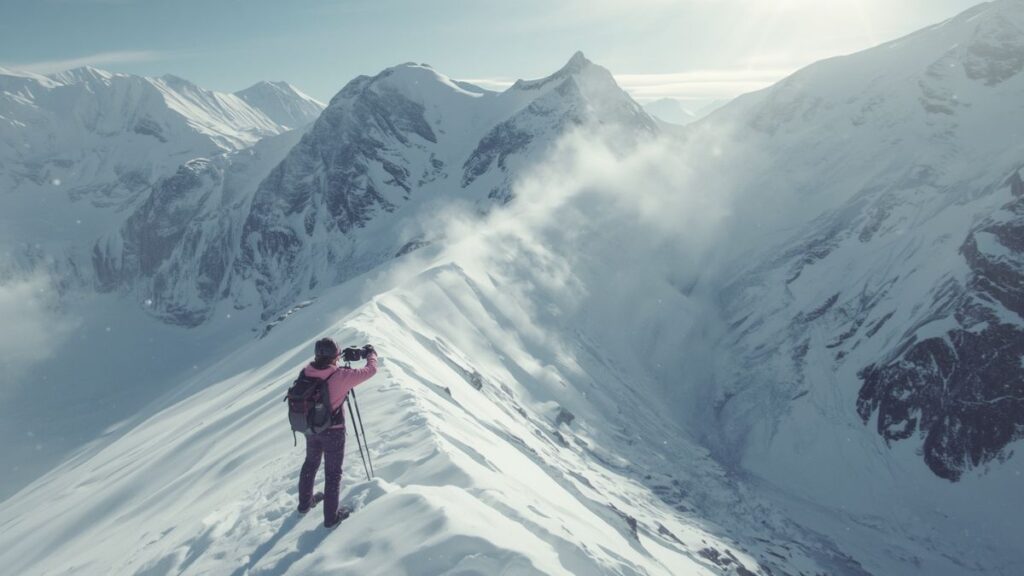
Around midmorning she reached a narrow ridge overlooking a vast untouched valley.
The view stole her breath.
The snow stretched for miles without a single human track.
Towering cliffs surrounded the valley like ancient guardians.
The only movement came from a lone fox crossing the frozen landscape below.
Emily spent nearly two hours photographing the scene from different angles.
She barely noticed time passing.
The mountain remained perfectly still.
Then she heard it.
A faint crack.
Not loud.
Just enough to make her lower the camera.
She scanned the slopes.
Nothing moved.
Perhaps a branch had broken beneath heavy snow.
She resumed photographing.
A second crack echoed across the valley.
Longer this time.
Sharper.
Emily froze.
Years of wilderness experience immediately recognized the sound.
Snowpack shifting.
Her eyes darted toward the upper ridge.
Tiny fractures raced across the snow like spiderwebs spreading over glass.
The entire mountainside seemed to inhale.
Then everything began moving.
At first it looked almost graceful.
Snow slowly slid forward.
Within seconds that gentle movement became an unstoppable wall of white.
Thousands of tons of snow broke free simultaneously.
The avalanche roared with terrifying force.
The sound resembled thunder mixed with crashing waves.
Trees snapped like toothpicks.
Massive boulders disappeared beneath the rushing snow.
Emily ran.
She knew outrunning an avalanche was nearly impossible.
Training took over.
She dropped her heavy backpack.
Tried moving sideways across the slope.
The avalanche accelerated far faster than human legs could carry her.
The wall of snow swallowed everything.
Impact came instantly.
She tumbled violently.
Up became down.
Down became impossible to identify.
Snow filled her mouth.
Her helmet slammed against hidden rocks.
Branches struck her arms.
The crushing weight squeezed every breath from her lungs.
She fought desperately to stay near the surface.
Swimming motions.
Kicking.
Anything.
The avalanche ignored every effort.
Finally, everything stopped.
Complete darkness surrounded her.
Emily couldn’t move.
Snow had hardened around her body like concrete.
One arm remained trapped against her chest.
The other barely reached her face.
By incredible luck, a small air pocket surrounded her mouth.
She inhaled desperately.
Cold air entered her lungs.
Relief lasted only seconds.
She understood the situation.
Completely buried.
Alone.
No witnesses.
No cell signal.
Rescuers would not even know where to begin searching.
Panic surged through her body.
Her breathing quickened.
The air pocket suddenly felt much smaller.
She forced herself to remember avalanche survival training.
Stay calm.
Breathe slowly.
Conserve oxygen.
Avoid unnecessary movement.
Simple instructions.
Nearly impossible to follow.
Minutes passed.
Or perhaps hours.
Darkness erased every sense of time.
Her fingers gradually became numb.
The cold penetrated every layer of clothing.
She thought about her parents.
Her younger brother.
Friends waiting for photographs from the trip.
Regret arrived unexpectedly.
Not for unfinished careers.
Not for missed opportunities.
For postponed conversations.
For assuming there would always be another holiday together.
Another phone call.
Another visit.
She silently wished she had told people she loved them more often.
The air grew thinner.
Every breath required greater effort.
Her heartbeat pounded loudly inside her ears.
Then something changed.
The crushing fear slowly faded.
Not because her situation improved.
Nothing around her had changed.
Instead, an extraordinary calm settled over her.
The darkness surrounding her softened.
The unbearable cold disappeared.
She no longer felt trapped.
Instead, she experienced the curious sensation of floating.
The darkness gradually transformed into a gentle gray mist.
Emily looked around.
She no longer saw snow.
Instead, she stood in an enormous meadow unlike any landscape she had photographed before.
Soft golden light illuminated endless fields of wildflowers despite snow-covered mountains standing peacefully in the distance.
Warm air carried the scent of pine, rain, and blooming flowers all at once.
Every color appeared richer than anything found on Earth.
The sky shimmered with hues she could not describe.
Silence remained.
Yet it no longer felt empty.
It felt complete.
She heard no voice.
Still, she sensed she was not alone.
A loving presence surrounded everything.
It carried no judgment.
Only understanding.
Every worry she had ever held simply disappeared.
Questions that had troubled her for years dissolved without needing answers.
She realized she felt more alive than ever before.
Then memories appeared.
Not as scattered images.
They unfolded like living experiences.
She became a little girl again, chasing butterflies with her grandfather.
She felt the excitement of receiving her first camera.
She relived the moment she photographed an injured eagle recovering after rehabilitation.
She experienced her mother’s laughter during family camping trips.
Each memory carried overwhelming emotion.
Then something remarkable happened.
She began seeing her life through the eyes of others.
She felt the joy people experienced after viewing her photographs.
One image had inspired a teacher to begin an environmental club.
Another encouraged a city council to preserve a forest instead of approving development.
A young woman battling depression had written that Emily’s landscapes reminded her life still contained beauty worth discovering.
Emily had never known.
The letters had arrived years apart.
Some had been misplaced.
Others briefly acknowledged.
Now she understood.
Even work done quietly could ripple far beyond imagination.
The peaceful presence seemed to gently communicate a truth.
Nothing created with love is ever wasted.
No kindness disappears.
No compassion goes unnoticed.
Every sincere act continues long after the moment itself has passed.
Emily then found herself standing beside a crystal-clear lake.
Its surface reflected not her appearance but countless moments from people’s lives.
Parents comforting frightened children.
Doctors encouraging anxious patients.
Friends forgiving old misunderstandings.
Strangers helping strangers.
The world contained far more goodness than headlines ever revealed.
She realized human beings often overlooked ordinary acts of love because they happened quietly.
Yet perhaps those quiet moments held civilization together.
Near the shoreline stood an elderly man she immediately recognized.
Her grandfather.
He had passed away when she was fifteen.
He looked healthy and energetic, just as he had before illness.
He smiled warmly.
“You’ve grown into exactly who you were meant to become.”
Emily rushed forward and embraced him.
The hug felt completely real.
“I’ve missed you every day,” she whispered.
“I know.”
“I wanted you to see everything I’ve photographed.”
He laughed softly.
“I’ve seen every one.”
They walked together along the peaceful lakeshore.
Emily asked countless questions.
Was this heaven?
Was she dead?
Would she stay?
Her grandfather answered gently.
“Some answers are understood better than explained.”
She accepted that.
Oddly, it satisfied her completely.
Ahead, brilliant light shimmered across the water.
Its beauty surpassed anything her camera could ever capture.
She longed to move toward it.
The peace there felt beyond description.
Every burden vanished.
Every fear dissolved.
Then another feeling entered her awareness.
Her younger brother.
He was expecting his first child.
She had promised to teach her future niece or nephew photography one day.
There were forests she still wanted to protect.
People she still needed to encourage.
Her grandfather smiled knowingly.
“You still have pictures left to take.”
“I don’t want to leave.”
“You aren’t leaving.”
“You’re returning.”
The light slowly faded.
The warmth remained.
Suddenly she heard distant sounds.
Faint.
Muffled.
Metal striking snow.
Voices.
Someone shouting.
“This way!”
Pain rushed back into her body.
Cold returned instantly.
She struggled to breathe.
Light pierced the darkness as rescuers broke through the hardened snow.
Fresh air flooded her tiny air pocket.
Hands carefully lifted snow away from her face.
A rescue dog barked excitedly nearby.
Emily blinked against the daylight.
She had been buried for nearly two hours.
Search-and-rescue volunteers later admitted the chances of finding her alive had been extremely small.
Her avalanche beacon had malfunctioned during the slide.
One rescue dog unexpectedly changed direction hundreds of feet away from the planned search grid and began digging frantically.
Its handler almost redirected the dog before noticing unusual behavior.
Doctors treated Emily for hypothermia, bruises, dehydration, and a mild concussion.
Physically, she recovered within weeks.
Emotionally, she was forever changed.
Friends expected nightmares.
Instead, Emily spoke about peace.
She no longer obsessed over deadlines or awards.
Photography became something deeper.
She wanted every image to remind people that life itself was extraordinary.
She began giving presentations at schools.
Students expected technical lessons about cameras.
Instead, she spoke about paying attention.
“Most people think photography is about seeing beautiful places.”
She smiled.
“It isn’t.”
“It’s about noticing beauty that was already there.”
She encouraged families to spend more time outdoors.
To leave phones behind occasionally.
To watch sunsets without rushing home.
To appreciate ordinary mornings.
Her newest photography collection surprised critics.
Instead of dramatic mountain peaks and dangerous cliffs, it featured simple moments.
An elderly couple holding hands.
Children laughing in fresh snow.
A father teaching his daughter to skip stones.
Morning sunlight through kitchen windows.
People questioned the change.
Emily answered honestly.
“I used to chase spectacular landscapes.”
“Now I know the most beautiful moments often happen quietly.”
Years later, she returned to Silent Peak.
Friends worried the experience would reopen painful memories.
Instead, she climbed slowly to the same ridge.
The avalanche scar had healed beneath fresh forests and new snow.
Nature had continued its patient work.
She stood silently for several minutes.
Then she unpacked her camera.
But before taking the first photograph, she closed her eyes.
Not to remember fear.
To remember gratitude.
The shutter clicked.
The mountain remained silent.
Yet this time, Emily understood the silence differently.
It wasn’t empty.
It was full of life waiting to be noticed.
As she descended the trail that afternoon, she realized the greatest picture she had ever captured had never appeared on film.
It was the invisible image carried within her heart.
A reminder that life could change in a single heartbeat.
That love echoed farther than anyone realized.
That hope often survived beneath impossible circumstances.
And that sometimes, beneath the deepest snow and the darkest moments, people discovered a light that no avalanche could ever bury.