
Stories about sacrifice have a special place in literature because they explore one of the most meaningful parts of human life: the willingness to give something up for someone or something we value.
Sacrifice does not always involve dramatic or heroic actions. In everyday life, people make sacrifices in quiet ways. A parent may give up personal comfort to support a child. A friend may give up time to help someone in need. A person may postpone a personal dream to take care of a family member. Someone may even give up an opportunity because doing what is right is more important than personal success.
These experiences can teach powerful moral lessons about love, responsibility, generosity, patience, courage, and selflessness.
A story about sacrifice with a moral lesson usually presents a character who faces a difficult choice. The character wants something for themselves, but another person, responsibility, or principle requires them to make a sacrifice. The decision may be difficult, but it eventually reveals something important about character and values.
What Is a Story About Sacrifice?
A story about sacrifice focuses on a character who willingly gives up something valuable for a greater purpose.
The sacrifice might involve:
- Money
- Time
- Comfort
- Personal opportunities
- Career goals
- Dreams
- Recognition
- Possessions
- Personal happiness
- Safety
- Convenience
The important part is not necessarily what the character gives up. The important part is why they are willing to give it up.
For example, a person might give up a weekend trip to help an elderly parent. Another person might work extra hours to support a family member. A student might give up free time to help a struggling classmate.
These situations show that sacrifice can appear in ordinary life.
Why Stories About Sacrifice Are Important
Sacrifice stories can help readers think about the choices they make in their own lives.
Modern life often encourages people to focus on personal success, comfort, money, and recognition. These things are not necessarily bad, but they can sometimes make people forget the importance of helping others.
A sacrifice story creates a different perspective.
It asks questions such as:
- What would you give up for someone you love?
- Is personal success always more important than helping others?
- When is sacrifice necessary?
- Can sacrifice make a person stronger?
- Is every sacrifice worth making?
- How should people balance their own needs with the needs of others?
These questions make sacrifice stories particularly meaningful for adults.
Story About Sacrifice With Moral Lesson
1. The Last Seat on the Train

Daniel had been waiting for this day for almost three years.
At thirty-two, he had finally been offered an interview for a position he had wanted for a very long time. The company was one of the largest engineering firms in the country, and the job would give him a much better salary, better opportunities, and the chance to work on major projects.
The interview was in another city.
His train was scheduled to leave at 8:15 in the morning.
Daniel arrived at the railway station at 7:40, carrying a small black suitcase and a folder containing his résumé, certificates, and other documents.
He checked his phone.
7:43 a.m.
“Plenty of time,” he thought.
He bought a bottle of water and walked toward the platform.
The station was unusually crowded.
People were carrying bags, children were running between their parents, vendors were calling out to customers, and announcements echoed through the large building.
Daniel looked at the departure board.
His train was on time.
He smiled.
Everything was going according to plan.
He had prepared carefully for the interview.
For several weeks, he had studied the company.
He had practiced answering common interview questions.
He had even bought a new shirt and polished his shoes the night before.
This was more than an ordinary interview.
It was an opportunity he could not afford to lose.
The Long Wait
Daniel found a bench near the platform and sat down.
He looked at his watch.
7:51.
He opened his folder and checked his documents again.
Résumé.
Certificates.
Identification.
Interview invitation.
Everything was there.
He closed the folder.
Then he noticed an elderly woman standing a few meters away.
She was holding a small handbag and looking around nervously.
She appeared to be in her seventies.
Beside her stood a large suitcase.
She looked at the electronic board.
Then she looked at her phone.
Then she looked around again.
Daniel returned his attention to his documents.
A few minutes later, he noticed her again.
She was now walking toward the ticket counter.
She spoke to an employee.
The employee pointed toward another part of the station.
The woman thanked him and walked away.
Daniel thought nothing more of it.
At 8:02, the train announcement was made.
“Passengers traveling on the 8:15 express train are requested to proceed to Platform 4.”
Daniel stood up.
He picked up his suitcase.
He was about to walk toward the platform when he heard a voice behind him.
“Excuse me.”
Daniel turned around.
It was the elderly woman.
“Yes?”
“Do you know if this train stops at Central City?”
Daniel looked at her ticket.
“Yes. It does.”
She smiled with relief.
“Thank you.”
“Are you traveling there?”
“Yes. My granddaughter is in the hospital.”
Daniel paused.
“Oh. I’m sorry to hear that.”
“She had an emergency last night.”
The woman’s voice became quieter.
“I received a call from her mother. They told me to come as quickly as possible.”
Daniel nodded.
“That must be difficult.”
“Yes.”
She looked at the platform.
“I have not traveled alone in many years.”
Daniel smiled.
“You’ll be fine. Just follow the signs.”
The woman nodded.
“Thank you.”
Daniel turned toward the platform.
Then he heard her say:
“I hope I can find a seat.”
Daniel looked back.
The platform was becoming crowded.
His train would probably be full.
He checked his ticket.
His seat was confirmed.
He would have a comfortable journey.
He began walking.
Then he stopped.
Something about the woman’s expression stayed in his mind.
She looked frightened.
Not simply nervous about traveling.
Frightened.
Daniel turned around.
“Excuse me.”
The woman looked at him.
“Would you like me to help you with your suitcase?”
She smiled.
“That would be very kind.”
Daniel picked up the suitcase.
It was heavier than he expected.
“You have everything in here?”
She laughed softly.
“Almost everything I own.”
Daniel carried it toward the platform.
A Difficult Discovery
When they reached Platform 4, the train had not arrived yet.
Daniel placed the woman’s suitcase beside her.
“You can wait here.”
“Thank you.”
Daniel checked his phone.
8:07.
Eight minutes remained.
He looked toward the tracks.
Then he noticed something.
There were no empty seats on the platform.
Every bench was occupied.
The elderly woman was standing.
Daniel looked at his own seat reservation.
He would have a seat on the train.
She did not have a reserved seat.
He wondered whether she had a ticket for general seating.
“Do you have a reserved seat?” he asked.
She shook her head.
“No. I bought the cheapest ticket I could find.”
Daniel looked worried.
“Are you sure you’ll find a seat?”
“I hope so.”
The woman smiled.
“I’ll manage.”
Daniel nodded.
He turned away.
But his thoughts became uncomfortable.
He imagined sitting comfortably for the entire journey while the woman stood.
The journey was almost three hours.
She was elderly.
She was traveling because her granddaughter was seriously ill.
Daniel looked at his interview folder.
He imagined himself sitting in the train, reviewing his notes while the woman stood nearby.
Then he imagined the interview.
The job.
The salary.
The opportunity.
He had worked hard for it.
He had sacrificed weekends.
He had taken extra courses.
He had saved money for professional training.
He had waited years.
Was it really reasonable to give up his seat?
He could not decide.
The Train Arrives
At 8:14, the train appeared.
People stood closer to the edge of the platform.
The elderly woman picked up her handbag.
Daniel held her suitcase.
When the train stopped, the doors opened.
Passengers began entering.
Daniel helped the woman onto the train.
Then he looked for her seat.
There was no seat.
People were already filling the carriage.
Daniel noticed a few empty spaces in the luggage area, but no seats.
The woman stood near the door.
Daniel looked at her.
She smiled.
“I’ll be fine.”
He knew she wasn’t.
He looked at his own seat number.
Carriage 6.
Seat 42.
He could walk there.
He could sit down.
He could prepare for his interview.
Or he could give up the seat.
His heart began beating faster.
He checked the time.
8:17.
The train had already started moving.
Daniel made his decision.
“Come with me.”
The woman looked confused.
“Where?”
“I have a seat.”
“Oh, no.”
“You need it more than I do.”
She shook her head.
“Absolutely not. You must have somewhere important to go.”
“I do.”
“Then you should sit down.”
Daniel smiled.
“I have an interview.”
She looked surprised.
“An interview?”
“Yes.”
“Then you need to prepare.”
“I’ve already prepared.”
She smiled.
“Young man, you should not give up an important opportunity because of me.”
Daniel thought about her words.
Then he said:
“It’s only a train seat.”
The Decision
Daniel took the woman toward his seat.
She tried to refuse again.
But Daniel insisted.
“Please.”
Eventually, she sat down.
Daniel placed her suitcase above the seat.
“Are you comfortable?”
“Yes.”
She looked embarrassed.
“I don’t know how to thank you.”
“You don’t need to.”
Daniel stood in the aisle.
He checked his phone.
The interview was at 11:30.
The train was scheduled to arrive at 10:55.
That gave him thirty-five minutes.
He could still make it.
He leaned against the side of the carriage.
The woman looked up at him.
“You really don’t mind standing?”
“No.”
She studied his face.
“You’re worried.”
Daniel laughed.
“A little.”
“About the interview?”
“Yes.”
“What kind of job?”
“Engineering.”
“Are you an engineer?”
“Yes.”
“My husband was an engineer.”
Daniel smiled.
“Really?”
“Yes. He built bridges.”
“That sounds interesting.”
“He loved his work.”
The woman became quiet.
Then she said:
“He always told me that the strongest structures are built to support others.”
Daniel looked at her.
He smiled.
“That sounds like something an engineer would say.”
She laughed.
A Conversation
For the rest of the journey, Daniel and the woman talked.
Her name was Margaret.
Her granddaughter, Anna, was twenty-one.
She had been involved in an accident the previous evening.
The doctors had said that she was stable, but Margaret wanted to be there.
“She is like my own daughter,” Margaret said.
Daniel nodded.
“I hope she gets better.”
“Thank you.”
Margaret asked about Daniel’s interview.
He told her about the company.
He explained why he wanted the position.
He told her that he had spent years trying to move forward in his career.
“You must really want this job,” Margaret said.
“I do.”
“Then I hope you get it.”
“Thank you.”
Margaret smiled.
“But remember something.”
“What?”
“Whatever happens today, one interview does not decide your entire life.”
Daniel thought about that.
He had spent weeks convincing himself that everything depended on this one opportunity.
Maybe she was right.
The train continued moving.
Daniel occasionally checked his phone.
No delays.
10:45.
They were almost there.
An Unexpected Problem
Suddenly, the train slowed.
Daniel looked outside.
They were approaching the city.
A message appeared on his phone.
Train delayed by fifteen minutes due to traffic near the station.
Daniel’s stomach tightened.
Fifteen minutes.
He would now arrive at 11:10.
He still had twenty minutes before the interview.
He could make it.
But then the train stopped completely.
An announcement came through.
“Due to congestion ahead, this train will remain stationary for approximately ten minutes.”
Daniel closed his eyes.
This was becoming dangerous.
Margaret noticed.
“What happened?”
“We’re delayed.”
“Will you miss your interview?”
“Maybe.”
She looked concerned.
“I’m sorry.”
Daniel shook his head.
“It’s not your fault.”
He checked his phone again.
11:03.
The train still had not moved.
Daniel began thinking about everything he could have done differently.
He should have taken an earlier train.
He should have left home earlier.
He should have planned for delays.
He looked at Margaret.
She was sitting comfortably.
He felt no regret about giving her the seat.
Even if he missed the interview, he knew he had made the right choice.
A Surprising Message
At 11:12, the train finally moved.
Daniel’s phone rang.
It was the company.
“Hello?”
“Is this Daniel?”
“Yes.”
“Hi, this is Laura from Human Resources.”
“Yes.”
“We noticed that your train has been delayed.”
Daniel was surprised.
“How did you know?”
“The interview coordinator received an alert about the train.”
Daniel waited.
“We can move your interview to this afternoon if you can still come.”
Daniel smiled.
“Yes. Absolutely.”
“Good. We’ll see you at 3:00.”
“Thank you so much.”
He ended the call.
Margaret smiled.
“Good news?”
“Yes.”
“The interview?”
“They moved it to this afternoon.”
Margaret looked relieved.
“I told you everything would work out.”
Daniel laughed.
“Maybe you were right.”
At the Hospital
The train arrived at Central City shortly afterward.
Daniel helped Margaret with her suitcase.
She thanked him again.
“I hope your granddaughter gets better.”
“I hope you get the job.”
They stood together on the platform.
Daniel suddenly realized that they had become more than two strangers sharing a train.
They had shared a difficult morning.
Margaret reached into her handbag.
She took out a small photograph.
“This is Anna.”
Daniel looked at the photograph.
A young woman was smiling beside a lake.
“She looks happy.”
“She is.”
Margaret smiled.
“Thank you for helping me today.”
“You’re welcome.”
She held out her hand.
Daniel shook it.
“Good luck with your interview.”
“Good luck at the hospital.”
They walked in different directions.
Daniel headed toward the taxi stand.
Margaret walked toward the hospital entrance.
The Interview
Daniel arrived at the company at 2:35.
He had enough time to prepare.
He sat in the waiting area and reviewed his notes.
At 3:00, he entered the interview room.
The interview lasted almost an hour.
The managers asked difficult questions.
Daniel answered them carefully.
At the end, one interviewer asked:
“Why do you think you are the right person for this position?”
Daniel thought for a moment.
Then he said:
“I’ve spent years developing my technical skills, but I’ve also learned that good engineering is not only about solving technical problems. It’s about understanding how your decisions affect other people.”
The interviewer nodded.
“That is an interesting answer.”
Daniel smiled.
He thought about Margaret.
He thought about the seat.
He thought about her husband’s words.
The strongest structures are built to support others.
The Result
Three days later, Daniel received a phone call.
He had gotten the job.
He sat quietly at his desk after hearing the news.
He was happy.
Very happy.
But he did not feel that his success had come only from his qualifications.
He thought about the train.
He thought about Margaret.
He thought about how close he had come to believing that the interview was the most important thing in his life.
Perhaps it had been important.
But not so important that he had to ignore another person’s needs.
Six Months Later
Six months after the interview, Daniel had settled into his new job.
One afternoon, he received an unexpected email.
It was from Margaret.
She had found his email address through the company after asking for his permission to stay in contact.
The message was short.
Anna is doing much better. She is back at university.
Daniel smiled.
He continued reading.
She remembers the man who gave her grandmother his seat.
Daniel laughed.
Then another message appeared.
She says she wants to meet you someday.
Daniel replied immediately.
He was happy to hear that Anna was recovering.
A week later, Margaret and Anna visited the city.
They met Daniel at a small café near his office.
Anna was walking with a slight limp, but she was smiling.
“So you’re Daniel,” she said.
“Yes.”
“My grandmother has told me everything.”
Daniel laughed.
“Hopefully not everything.”
Margaret smiled.
“She has told me that you gave her your seat on the train,” Anna continued.
“It was nothing.”
Anna shook her head.
“It wasn’t nothing to her.”
Daniel looked at Margaret.
She smiled.
The Lesson Daniel Never Forgot
Years passed.
Daniel continued working as an engineer.
He became a project manager.
Later, he became responsible for a large team.
Whenever someone asked him about the most important lesson he had learned in his career, he rarely talked about engineering.
He talked about a train.
He talked about a woman named Margaret.
He talked about a seat.
And he talked about a decision that had seemed small at the time.
He had once believed that success meant getting what he wanted.
Now he understood something different.
Success was not only about opportunities.
It was also about the person you became while pursuing them.
Sometimes you had to work hard.
Sometimes you had to compete.
Sometimes you had to take risks.
But sometimes you had to stop and notice that another person needed something more than you did.
Years later, Daniel still remembered the words Margaret had shared with him.
“The strongest structures are built to support others.”
He eventually realized that the words applied to much more than engineering.
They applied to families.
Friendships.
Communities.
And life itself.
A strong person was not someone who always stood above everyone else.
A strong person was someone who could support others when they needed help.
And sometimes, supporting someone meant giving up your own seat.
Useful Vocabulary
- Opportunity
A favorable chance to do or achieve something.
Example: The interview was an important opportunity for Daniel. - Reservation
An arrangement that guarantees a particular seat or place.
Example: Daniel had a confirmed seat reservation on the train. - Compassion
A feeling of concern for someone who is suffering and a desire to help.
Example: Daniel showed compassion toward Margaret. - Sacrifice
Giving up something valuable for another person or purpose.
Example: Daniel sacrificed his comfortable seat to help Margaret. - Interview
A formal meeting in which someone is asked questions for a job or another opportunity.
Example: Daniel had an important job interview. - Delayed
Made to happen later than originally planned.
Example: The train was delayed because of congestion. - Elderly
Describing someone who is old or advanced in age.
Example: Margaret was an elderly woman traveling to see her granddaughter. - Responsibility
A duty or obligation to take care of something or someone.
Example: Margaret felt responsible for supporting her granddaughter. - Selflessness
The quality of caring about other people without focusing only on yourself.
Example: Daniel’s decision demonstrated selflessness. - Integrity
The quality of being honest and following strong moral principles.
Example: Daniel’s decision showed that he valued integrity.
Reading Comprehension Questions
- Why was Daniel traveling to another city?
- Why was the interview important to him?
- Who was Margaret?
- Why was Margaret traveling?
- Why did Margaret need a seat on the train?
- What decision did Daniel make?
- Did Daniel regret giving up his seat?
- What caused the train to be delayed?
- How did the company respond to Daniel’s delayed arrival?
- What happened to Margaret’s granddaughter?
- What lesson did Daniel learn from the experience?
- How did Daniel’s understanding of success change?
Discussion Questions
- Would you give up a reserved train seat to someone who needed it more?
- Have you ever sacrificed something important to help another person?
- Do you think helping others can sometimes create unexpected opportunities?
- Is personal success more important than helping someone in need?
- What does true success mean to you?
- Can a small sacrifice have a lasting effect?
- Have you ever received kindness from a stranger?
- Why can difficult choices reveal a person’s character?
Moral of the Story
Sometimes the most valuable opportunities are not the ones we receive, but the opportunities we create for others.
Daniel believed that his job interview was the most important thing in his life that morning. Yet giving up his seat did not destroy his opportunity. Instead, it reminded him that success and compassion can exist together.
The story teaches us that sacrifice does not always mean losing something forever. Sometimes it simply means choosing another person’s immediate need over our own comfort.
A small act of kindness can also have a lasting effect. Daniel gave Margaret a seat for a few hours, but that simple decision created a friendship and changed the way he thought about success.
2. The Baker’s Early Morning Secret

Martha had always believed that a bakery was more than a place where people bought bread.
It was a place where people gathered.
Every morning, before the streets became busy, the smell of warm bread and freshly baked pastries drifted through the small neighborhood. Customers stopped by on their way to work. Parents bought rolls for their children. Older customers sat near the window with coffee and talked about their mornings.
Martha had owned the bakery for nearly fifteen years.
It was not a large business.
There were only six tables near the front window, three employees, two ovens, and a narrow kitchen that became extremely warm during the busiest hours.
But Martha loved it.
She had started the bakery with a small amount of savings after leaving her previous job. During the first few years, she worked almost every day.
She woke before sunrise.
She mixed dough.
She prepared fillings.
She cleaned the ovens.
She served customers.
She counted the day’s money late at night.
There were moments when she wondered whether she had made the right decision.
But slowly, the bakery became successful.
People began recommending it to their friends.
A local office started ordering sandwiches and pastries.
A nearby school began buying bread for special events.
Martha’s customer list grew.
Eventually, she began dreaming about something bigger.
She wanted to expand.
There was an empty shop next door.
If she could rent it, she could turn it into a larger bakery with a bigger kitchen, more tables, and a small area where customers could sit and work.
She had even created a notebook titled:
The New Martha’s Bakery
Inside were pages of calculations.
Renovation costs.
New ovens.
Tables and chairs.
Display cabinets.
Lighting.
Advertising.
Martha had spent years saving money for the expansion.
She was finally close.
Only a few more months, she thought.
Then everything could change.
The Young Assistant
One of Martha’s employees was a young man named Daniel.
Daniel was twenty-three years old and had been working at the bakery for almost two years.
He had started as a part-time assistant.
At first, he knew very little about baking.
He did not know how long dough needed to rest.
He could not tell when bread was properly baked.
He often forgot small things.
But he learned quickly.
Martha taught him patiently.
She showed him how to measure ingredients accurately.
She taught him how to prepare dough.
She explained why temperature mattered.
Most importantly, she taught him that baking required patience.
“You can’t rush bread,” Martha often told him.
“Give it time.”
Daniel smiled whenever she said that.
“You’ve told me that at least a hundred times.”
“And I’ll probably tell you another hundred times.”
Daniel eventually became one of Martha’s most reliable employees.
He arrived early.
He stayed late when necessary.
He treated customers politely.
He also had a natural talent for decorating cakes.
Martha began giving him more responsibility.
One morning, she watched him decorate a birthday cake.
The design was simple but beautiful.
“You have a good eye,” Martha said.
Daniel looked pleased.
“Thanks.”
“One day, you could have your own bakery.”
Daniel smiled.
“Maybe.”
But Martha noticed something about him.
He never talked much about his family.
If someone asked him about his weekend, he usually gave a short answer.
“Just stayed home.”
“Visited family.”
“Nothing special.”
Martha did not press him.
Everyone had private matters.
She understood that.
The Early Morning Discovery
One Tuesday morning, Martha arrived at the bakery at 4:30.
The sky outside was still dark.
She unlocked the front door and entered quietly.
She expected to find the bakery empty.
Instead, she saw Daniel sitting alone at one of the tables.
His head was resting in his hands.
Martha stopped.
“Daniel?”
He looked up quickly.
“Oh. Good morning.”
“What are you doing here so early?”
Daniel stood.
“I wanted to finish some work.”
Martha looked at the clock.
“You usually arrive at six.”
“I know.”
“Is everything okay?”
“Yes.”
His answer came too quickly.
Martha studied his face.
He looked tired.
There were dark circles under his eyes.
“You should get some sleep.”
“I’m fine.”
Martha walked toward the kitchen.
Then she noticed something on the table.
A small envelope.
Daniel quickly picked it up.
Martha did not try to read it.
She simply said:
“Everything really is okay?”
Daniel hesitated.
Then he nodded.
“Yes.”
Martha knew he was not telling the whole truth.
But she decided to leave the matter alone.
For the moment.
The Second Discovery
Over the next few weeks, Martha noticed changes in Daniel.
He stopped buying lunch.
He brought food from home, usually something very simple.
He stopped taking the bus and began walking to work, even on rainy mornings.
Sometimes he stayed after closing.
One evening, Martha returned to the bakery after going home because she had forgotten her notebook.
She found Daniel cleaning the kitchen.
“You don’t have to stay this late,” she said.
“I know.”
“Then why are you still here?”
Daniel looked down.
“I need the extra hours.”
Martha understood.
“Are you having financial problems?”
Daniel was silent.
Finally, he said:
“My mother is sick.”
Martha’s expression softened.
“Is she okay?”
“She needs treatment.”
“Medical treatment?”
Daniel nodded.
“The doctors say she needs several months of treatment. It’s expensive.”
Martha sat down.
“Why didn’t you tell me?”
Daniel looked embarrassed.
“I don’t want anyone to feel sorry for me.”
“I’m not feeling sorry for you.”
Daniel looked at her.
“I’m worried about her.”
He took a deep breath.
“I’ve been working extra hours because I need the money.”
Martha understood why he had been arriving early.
She also understood why he had been walking to work.
“How much do you need?”
Daniel shook his head.
“I’ll manage.”
“Daniel.”
“I’ll manage.”
Martha did not argue.
But that night, she could not stop thinking about him.
Martha’s Dream
The next morning, Martha opened her notebook.
The first page contained her plans for the expansion.
She looked at the numbers.
She had almost enough money.
The shop next door was still available.
The landlord had told her that another business owner was interested.
If Martha waited too long, she might lose the opportunity.
She could finally have the bakery she had dreamed about for years.
A bigger kitchen.
More customers.
More employees.
More income.
A stronger future.
She closed the notebook.
Then she thought about Daniel.
She thought about the tired expression on his face.
She remembered seeing him sitting alone at the table at 4:30 in the morning.
Martha knew what she had to do.
But knowing something was right did not make the decision easy.
The Sacrifice
That afternoon, Martha called the clinic listed on a document Daniel had accidentally left near the kitchen.
She did not ask for private medical information.
She simply wanted to understand the payment process.
The treatment would be expensive.
Very expensive.
Martha returned to her office and looked at her savings account.
She had spent years building that money.
She had gone without vacations.
She had repaired old equipment instead of buying new equipment.
She had worked through holidays.
Every amount she had saved represented a sacrifice.
Now she had to decide whether to use it for herself or someone else.
The next morning, Martha called the landlord.
“I won’t be taking the shop next door.”
The landlord sounded surprised.
“Are you sure?”
“Yes.”
“You’ve been asking about it for more than a year.”
“I know.”
“Another business has offered to take it.”
“Then let them have it.”
After the call ended, Martha sat quietly.
She felt disappointed.
She had wanted that expansion.
But she also felt strangely peaceful.
Later that day, she called Daniel into her office.
“I want you to take some time away from work.”
Daniel looked confused.
“I can’t.”
“You need to help your mother.”
“I need the money.”
“I know.”
Martha placed an envelope on the desk.
Daniel stared at it.
“What is that?”
“Help.”
He immediately shook his head.
“No.”
“You haven’t even opened it.”
“I can’t accept money from you.”
“This isn’t a loan.”
Daniel looked uncomfortable.
“I don’t want charity.”
“It’s not charity.”
“Then what is it?”
Martha smiled.
“It’s an investment.”
“An investment?”
“In you.”
Daniel looked at the envelope again.
Martha continued.
“You’ve worked hard for me. You’ve learned everything I’ve taught you. You’ve become an important part of this bakery.”
Daniel’s eyes became wet.
“But this is too much.”
“I’ve decided not to expand the bakery this year.”
Daniel looked surprised.
“Why?”
“Because there are more important things.”
He immediately understood.
“You used your savings?”
Martha nodded.
“For part of your mother’s treatment.”
Daniel stood silently.
“I don’t know what to say.”
“You don’t have to say anything.”
He wiped his eyes.
“Thank you.”
Martha smiled.
“Take care of your mother.”
The Months That Followed
Daniel took some time away from the bakery.
His mother began treatment.
The months were difficult.
There were good days and bad days.
Sometimes Daniel returned to the bakery only to talk to Martha.
He wanted to work.
Martha told him to focus on his family.
“You have a job here whenever you’re ready.”
Daniel’s mother slowly improved.
The treatment was successful.
Several months later, Daniel returned to the bakery.
He looked healthier.
More confident.
And deeply grateful.
Martha welcomed him back.
“Good to have you here.”
Daniel smiled.
“It’s good to be back.”
He immediately returned to work.
But something had changed.
He worked differently.
He was more patient.
More thoughtful.
He noticed when customers needed help.
He trained new employees.
He started creating new pastry recipes.
Martha noticed his growth.
One afternoon, Daniel brought her a notebook.
“What is this?”
“I’ve been working on something.”
Martha opened it.
Inside were designs for a new bakery concept.
There were sketches of cakes.
Ideas for pastries.
Plans for customer seating.
Martha looked at him.
“What is this?”
“I want to help expand the bakery.”
Martha laughed.
“With what money?”
Daniel smiled.
“Not immediately.”
He pointed to the designs.
“We could start small.”
Martha studied the pages.
Daniel had thought carefully about everything.
Instead of opening another shop, they could rearrange the existing bakery.
They could add a few more tables.
They could improve the display counter.
They could introduce new products.
They could grow slowly.
Martha smiled.
“You’re becoming a businessman.”
Daniel laughed.
“I’m learning.”
A Different Kind of Success
Over the next year, Martha and Daniel worked together.
They improved the bakery gradually.
They introduced new pastries.
They created custom cakes.
They started accepting larger orders.
Daniel developed several popular recipes.
Customers began asking for him by name.
Martha’s bakery became more successful than before.
But the biggest change was not financial.
Martha and Daniel had developed a partnership.
Daniel eventually became a manager.
He also began saving money.
One day, he told Martha:
“I want to open my own bakery someday.”
Martha smiled.
“You should.”
“But I want to do something differently.”
“What?”
“I want to create a small fund to help employees when they have family emergencies.”
Martha looked at him.
“Why?”
Daniel smiled.
“Because someone once helped me when I needed it.”
Martha understood.
The New Bakery
Several years later, Daniel finally opened his own bakery.
It was not enormous.
It was not luxurious.
But it was warm and welcoming.
There was a small sign near the entrance:
Everyone Deserves a Second Chance.
Daniel hired young employees who wanted to learn baking.
He taught them patiently.
He also created an emergency assistance fund for workers facing serious family problems.
Whenever someone asked why he had started it, Daniel gave the same answer.
“Someone helped me once.”
Meanwhile, Martha’s bakery continued to grow.
She never opened the large second location she had originally imagined.
Instead, she kept the original bakery.
She expanded the kitchen.
She added a few tables.
She trained new bakers.
And she became known not only for her bread and pastries, but for the way she treated people.
Years later, Martha visited Daniel’s bakery.
He was standing behind the counter.
When he saw her, his face lit up.
“You came!”
“Of course.”
He gave her a fresh pastry.
“Try this.”
Martha took a bite.
She smiled.
“Very good.”
“Only very good?”
“Excellent.”
Daniel laughed.
They sat together near the window.
Martha looked around the bakery.
“You did it.”
Daniel shook his head.
“We did.”
Martha smiled.
“I only helped you once.”
“No,” Daniel said. “You changed my life.”
Martha looked down.
“I simply did what I thought was right.”
“And that’s exactly why it mattered.”
The Meaning of Sacrifice
Martha had once believed success meant expanding her bakery.
She had imagined a larger building, more customers, and greater profits.
There was nothing wrong with those dreams.
But life taught her that success could have another meaning.
Sometimes success was helping another person stand when they were struggling.
Sometimes it meant giving up something you wanted because someone else needed it more.
Sometimes the most important investment was not in a building or a business.
It was in a person.
Martha’s decision had delayed her dream.
But it had not destroyed it.
Instead, her sacrifice created something she could never have purchased with money.
She helped Daniel continue caring for his mother.
She helped him develop confidence.
She helped him believe that his future could be better.
And Daniel eventually passed that kindness to others.
That was the part Martha valued most.
Her sacrifice had become a chain of kindness.
One person helped another.
That person helped someone else.
And the kindness continued.
A Final Morning
One early morning, years after the events began, Martha stood inside her bakery before sunrise.
The ovens were warming.
The first loaves were rising.
Outside, the streets were quiet.
She looked at the old notebook she had once used for her expansion plans.
She opened it.
The first pages were filled with calculations.
Costs.
Profits.
Renovations.
Plans.
Near the back, she found a blank page.
She picked up a pen and wrote:
Success is not only about what you build for yourself. It is also about what you help others build.
She closed the notebook.
The bakery door opened.
A young employee entered.
“Good morning.”
“Good morning.”
“Ready to start?”
Martha smiled.
“Always.”
The smell of fresh bread slowly filled the bakery.
Another day had begun.
And Martha knew that she had made the right choice.
Lesson From the Story
The Baker’s Early Morning Secret shows that sacrifice does not always mean giving up everything you want. Sometimes it means temporarily putting aside a personal goal because another person needs help.
Martha had worked for years to expand her bakery. When she discovered that Daniel was struggling to pay for his mother’s treatment, she chose compassion over immediate personal success. Her decision delayed her plans, but it helped Daniel and eventually inspired him to help others.
The story reminds us that ambition is valuable, but compassion gives ambition a deeper purpose.
Moral: Success becomes more meaningful when we are willing to help others along the way.
3. The Scholarship He Gave Away

Ethan had spent most of his teenage years believing that hard work would eventually open a door.
He just never knew how large that door might be.
He lived with his mother and younger sister in a small apartment on the edge of town. Money was often tight, but his mother had always made education a priority.
“Your education is something nobody can take away from you,” she often told him.
Ethan believed her.
He studied every evening after finishing his chores. While other students were playing games or watching movies, he was often sitting at the small dining table with a textbook open in front of him.
He was not the smartest student in his school.
But he was one of the most determined.
When he struggled with mathematics, he practiced until he understood it.
When he received a low grade in science, he asked his teacher for help.
When an essay was returned with corrections, he rewrote it.
He rarely complained.
He simply tried again.
His dream was to attend a good university and study engineering.
But he knew that university would be expensive.
His mother worked long hours at a local grocery store.
She could cover the family’s basic expenses, but paying for several years of university was another matter.
That was why Ethan applied for a prestigious scholarship during his final year of school.
The scholarship covered tuition, books, accommodation, and several other educational expenses.
Winning it would completely change his future.
He could attend the university he wanted.
He could study engineering without placing a huge financial burden on his mother.
He could finally take the first major step toward the career he had dreamed about for years.
For months, Ethan worked on his application.
He wrote essays.
Collected recommendation letters.
Prepared for interviews.
And waited.
Then, one Friday afternoon, the principal asked him to come to her office.
Ethan walked down the hallway wondering what he had done.
When he entered the office, the principal was smiling.
“Ethan, I have some wonderful news.”
He looked nervous.
“What happened?”
“You received the scholarship.”
For several seconds, Ethan did not respond.
He thought he had misunderstood her.
“I did?”
The principal laughed.
“Yes. You did.”
Ethan stared at her.
The words finally sank in.
He had won.
The scholarship he had dreamed about was his.
He thanked the principal and walked out of the office.
As he walked through the school hallway, he felt as though his feet were barely touching the floor.
He wanted to tell everyone.
Most of all, he wanted to tell his mother.
When he arrived home, he found her preparing dinner.
“Mom.”
She looked over.
“You’re home early.”
“I got the scholarship.”
She stopped what she was doing.
“The scholarship?”
Ethan nodded.
“I got it.”
His mother smiled.
Then she hugged him.
She was so proud that she began to cry.
“You did it.”
Ethan smiled.
“We did it.”
She shook her head.
“No. You did.”
That evening, they celebrated with a simple dinner.
There was no expensive restaurant.
No large party.
Just Ethan, his mother, and his younger sister sitting around the table.
But to Ethan, it was one of the happiest evenings of his life.
He thought his future had finally become clear.
He would attend university.
He would study engineering.
He would graduate.
He would find a good job.
He would help his family.
Everything seemed possible.
Then, a few days later, Ethan learned something that changed everything.
The Other Student
Her name was Maya.
Ethan had known her for years, although they had never been close friends.
She was quiet.
She always sat near the front of the classroom.
She rarely participated in school activities because she often had to work after classes.
Maya was one of the best students in the school.
In some subjects, she was even better than Ethan.
She loved literature and history.
She also dreamed of going to university.
But one afternoon, Ethan overheard a conversation between two teachers.
“Have you heard about Maya?”
“No. What happened?”
“Her father lost his job several months ago. Their financial situation has become very difficult.”
Ethan stopped walking.
He did not intend to listen.
But then he heard something that made him pause.
“She may have to leave school.”
“She can’t afford the final expenses?”
“Her family can barely afford rent and food.”
Ethan felt uncomfortable.
Maya was about to lose the opportunity she had worked toward for years.
He continued walking.
But he could not stop thinking about her.
The next morning, he saw Maya sitting alone outside the library.
She was holding a stack of books.
Ethan approached her.
“Hi.”
She looked up.
“Hi.”
“Are you okay?”
She smiled slightly.
“Yes.”
He knew she was not telling the truth.
After a moment, he asked:
“Are you going to university next year?”
Maya looked down.
“I don’t know.”
“Why?”
“My family can’t afford it.”
Ethan remained silent.
“I’ve applied for some scholarships,” she continued. “But I haven’t received any offers yet.”
“Maybe you will.”
“I hope so.”
She smiled.
“But I’m trying to be realistic.”
Ethan looked at her.
“What do you mean?”
“My family needs me.”
She closed her book.
“If I can’t afford university, I’ll probably find a full-time job.”
Ethan did not know what to say.
Maya stood.
“I should go.”
She walked away.
Ethan watched her disappear down the hallway.
That afternoon, he went home with a heavy feeling.
A Difficult Question
Ethan opened the scholarship letter.
He read it again.
The scholarship was generous.
It could cover almost everything he needed.
His future seemed secure.
Then he thought about Maya.
What would happen if she had to leave school?
What if she never got another opportunity?
He tried to push the thought away.
He had worked hard for the scholarship.
He deserved it.
That was true.
His mother depended on the opportunity.
That was true too.
He had dreams.
He had plans.
He had worked for years.
Why should he give them up?
Ethan felt frustrated.
He knew there was no simple answer.
He talked to his mother.
“What would you do?”
She looked at him.
“About what?”
“Maya.”
Ethan explained the situation.
His mother listened carefully.
When he finished, she did not immediately answer.
Instead, she asked:
“Do you want to give her the scholarship?”
Ethan looked down.
“I don’t know.”
“That’s okay.”
“I’ve worked so hard for it.”
“I know.”
“I want to go to university.”
“I know.”
“I also don’t want her to lose her chance.”
His mother reached across the table.
“Then you need to decide what you can live with.”
Ethan looked at her.
“What does that mean?”
“Whatever decision you make, you will have to live with it afterward.”
She paused.
“Don’t make the decision because you feel guilty. And don’t make it because you are afraid.”
Ethan remained quiet.
“Make it because you believe it is right.”
Searching for Another Way
The next morning, Ethan went to the school counselor.
He explained Maya’s situation.
“Are there other scholarships?”
The counselor nodded.
“There are several smaller ones.”
“Could she apply for them?”
“Yes.”
“Would they cover enough?”
“Probably not all her expenses.”
Ethan thought for a moment.
“What about emergency financial assistance?”
The counselor looked at him.
“That’s possible.”
“Could the school help her?”
“We might be able to organize something.”
Ethan felt hopeful.
“Can we try?”
The counselor smiled.
“Of course.”
Over the next few weeks, Ethan helped the counselor collect information about scholarships, grants, and educational programs.
He also spoke with several teachers.
They agreed to help Maya apply.
A local community organization offered a small grant.
A teacher organized a fundraising event.
Several former students donated money.
Slowly, things began to change.
But there was still a problem.
Even with all the support, Maya was still short of the amount needed to attend university.
Ethan’s scholarship could solve the problem immediately.
His decision remained.
The Final Choice
The deadline to accept the scholarship approached.
Ethan sat at his desk late one evening.
The scholarship letter was beside him.
He looked at the university brochure.
He imagined himself walking across the campus.
He imagined attending engineering classes.
He imagined graduating.
Then he imagined Maya leaving school.
He thought about all the evenings he had spent studying.
He realized something.
The scholarship had never been the dream.
Education was the dream.
Learning was the dream.
Building a useful career was the dream.
The scholarship was simply one way to reach it.
Maybe there was another way.
It would be harder.
It would take longer.
But perhaps he could find another path.
The next morning, Ethan went to the principal’s office.
“I want to ask about the scholarship.”
The principal smiled.
“Have you decided?”
Ethan nodded.
“Yes.”
“What did you decide?”
“I want to give it up.”
The principal looked surprised.
“You understand what you’re doing?”
“Yes.”
“You worked very hard for this.”
“I know.”
“This scholarship could change your life.”
“I know.”
“Are you certain?”
Ethan took a deep breath.
“Yes.”
He explained Maya’s situation.
The principal listened.
When he finished, she was quiet.
“Have you spoken to Maya?”
“Not yet.”
“Then you should.”
Telling Maya
Ethan found Maya after school.
She was sitting outside the library.
He walked toward her.
“Can I talk to you?”
“Sure.”
Ethan sat beside her.
“I made a decision.”
“About what?”
“The scholarship.”
Maya looked at him.
“You got it, right?”
“Yes.”
“Congratulations.”
“Thank you.”
He paused.
“Then I decided not to accept it.”
Maya looked confused.
“Why?”
Ethan explained everything.
The other scholarships.
The fundraising.
The financial assistance.
And finally, his decision.
Maya stared at him.
“You can’t do that.”
“I already did.”
“You earned it.”
“I know.”
“You deserve it.”
“So do you.”
Maya’s eyes filled with tears.
“I don’t want you to give up your future because of me.”
“I’m not giving up my future.”
Ethan smiled.
“I’m choosing a different path.”
“But what will you do?”
“I’ll find another scholarship.”
“You don’t know if you’ll get one.”
“No.”
He shrugged.
“But I’ll try.”
Maya was silent.
Finally, she said:
“Thank you.”
Ethan smiled.
“Don’t thank me yet.”
“Why?”
“Because now you have to promise me something.”
“What?”
“You have to work as hard as you can.”
Maya laughed through her tears.
“I promise.”
The Unexpected Result
Ethan did not immediately find another scholarship.
For several months, he worked part-time.
He applied to universities with lower tuition.
He submitted applications for smaller scholarships.
He asked teachers for recommendations.
He continued studying.
It was not easy.
There were moments when he regretted his decision.
One evening, he admitted this to his mother.
“I sometimes wonder if I made a mistake.”
His mother smiled.
“That’s normal.”
“What if I can’t afford university?”
“Then we’ll find another way.”
“What if it takes longer?”
“Then it takes longer.”
She looked at him.
“Your path does not have to look like everyone else’s.”
Ethan nodded.
He continued trying.
Eventually, he received an offer from another university.
It was not the university he had originally planned to attend.
But it had an excellent engineering program.
And he received a smaller scholarship.
It covered much of his tuition.
He still needed to work part-time.
But he could go.
When Ethan received the news, he called his mother.
“I got in.”
She laughed.
“I knew you would.”
Maya’s Future
Maya also received good news.
The school had helped her secure several grants.
The community organization provided additional financial support.
She received a scholarship from a local foundation.
Together, the assistance was enough.
She could attend university.
On the day she received the news, she ran to find Ethan.
“I got it!”
Ethan smiled.
“Really?”
“Yes!”
They hugged.
“You did it,” he said.
“We did it,” Maya replied.
Ethan laughed.
“You’re copying me.”
“Maybe.”
Years Later
Years passed.
Ethan graduated from university.
He became an engineer.
His career did not happen exactly as he had imagined.
But he was proud of what he had accomplished.
Maya also graduated.
She became a teacher.
She returned to her hometown and began working at a school.
One afternoon, Ethan received an email from her.
It contained a photograph.
Maya was standing in a classroom surrounded by students.
The message said:
I wanted you to see where your decision helped lead me.
Ethan smiled.
He looked at the photograph for a long time.
He realized that his sacrifice had not simply helped Maya attend university.
It had helped her become the person she wanted to become.
And now she was helping other young people discover their own possibilities.
The Scholarship That Continued
Several years later, Ethan established a small scholarship fund through his company.
It was designed for students who had strong academic potential but faced financial difficulties.
When the first recipient was selected, Ethan attended the ceremony.
A nervous student stood in front of the audience.
The student accepted the scholarship certificate.
“Thank you,” she said.
Ethan smiled.
He remembered himself at her age.
He remembered the excitement of winning the scholarship.
He remembered the fear of giving it away.
And he remembered what his mother had told him.
Make the decision because you believe it is right.
The student shook his hand.
“I won’t waste this opportunity.”
“I know you won’t,” Ethan said.
As the ceremony ended, Ethan looked around the room.
He realized something important.
The scholarship he had given away had not disappeared.
It had simply changed hands.
The opportunity had continued.
And years later, it was still creating new opportunities.
The Real Meaning of Opportunity
Ethan had once believed that success meant securing his own future.
He had worked hard because he wanted to build a better life.
There was nothing wrong with that.
But his experience taught him something deeper.
Sometimes an opportunity becomes more valuable when it is shared.
Giving up the scholarship had not been easy.
It had required uncertainty.
It had required patience.
It had required him to accept that his own path might become more difficult.
But it also gave Maya a chance.
And Maya used that chance to help others.
That was the part Ethan valued most.
His sacrifice had created a chain.
One opportunity had helped one person.
That person had gone on to help many others.
The original scholarship had been worth far more than the amount written on the letter.
Its greatest value was not what it could have given Ethan.
Its greatest value was what it eventually allowed other people to build.
Lesson From the Story
The Scholarship He Gave Away is a story about generosity, education, opportunity, and selflessness.
Ethan worked hard to earn a prestigious scholarship that could have transformed his own future. When he discovered that Maya, another talented student, might have to abandon her education because of financial hardship, he faced a difficult choice.
Instead of simply giving up his dreams, Ethan searched for another solution. He ultimately gave Maya the opportunity she needed and found another path for himself.
The story shows that sacrifice does not always mean losing your future. Sometimes it means accepting a harder path so another person can have a chance.
Moral: A sacrifice that gives another person an opportunity can create a lasting impact.
The Watchmaker’s Last Invention
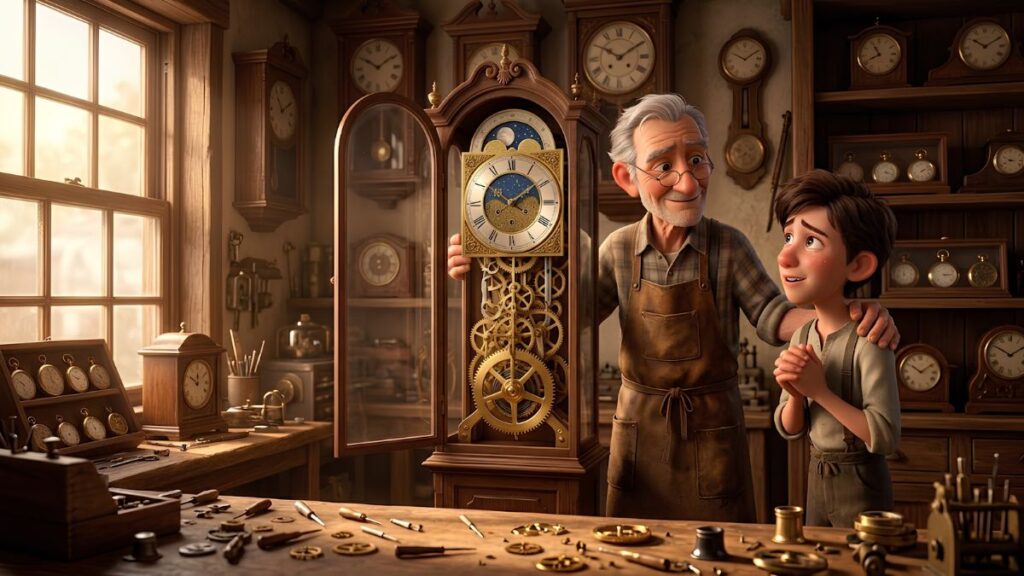
Samuel had spent almost fifty years surrounded by clocks.
His small workshop stood on a narrow street in the oldest part of town. The wooden sign above the door simply read Samuel’s Clock & Watch Shop.
The paint had faded over the years, and the brass letters were no longer as bright as they had once been. But Samuel had never considered replacing the sign.
He liked it exactly as it was.
The shop had belonged to him since he was twenty-six years old.
Inside, dozens of clocks covered the walls.
Some were tall grandfather clocks.
Others were small mantel clocks.
There were brass clocks, wooden clocks, silver clocks, and even a few unusual clocks that Samuel had designed himself.
The quiet ticking of the clocks filled the shop.
Tick.
Tick.
Tick.
To Samuel, it was the sound of time itself.
He could tell when something was wrong simply by listening.
A clock that ticked too quickly.
A clock that hesitated.
A clock whose second hand moved unevenly.
Each one had its own voice.
Samuel had learned the craft from his father, who had learned it from his father.
Making and repairing clocks was more than a profession in their family.
It was a tradition.
It was a way of life.
For many years, Samuel had dreamed of creating something that would be remembered long after he was gone.
He had repaired thousands of watches.
He had restored antique clocks.
He had built hundreds of small mechanisms.
But he had never created the one thing he truly wanted.
His masterpiece.
A clock unlike any other.
The Apprentice
Ten years earlier, a seventeen-year-old boy named Daniel had walked into Samuel’s shop.
Daniel had been fascinated by machines since childhood.
He loved taking things apart.
Unfortunately, he wasn’t always good at putting them back together.
His first attempt at repairing a broken pocket watch had ended with twenty-three tiny pieces scattered across his bedroom floor.
His mother had suggested that he find someone who could teach him properly.
That was how Daniel met Samuel.
At first, Samuel wasn’t interested in taking an apprentice.
He had already taught several young people who had left after a year or two.
They wanted quick success.
They wanted to learn how to repair expensive watches and earn good money.
They didn’t want to spend hours cleaning gears or studying tiny mechanisms.
Daniel was different.
He was patient.
He asked questions.
He listened.
Most importantly, he wasn’t afraid of making mistakes.
Samuel eventually offered him a place in the workshop.
“Come tomorrow morning at eight,” Samuel told him.
Daniel smiled.
“I’ll be here.”
“You’d better be.”
Daniel arrived at seven forty-five.
Samuel looked at the clock.
“You’re early.”
“I didn’t want to be late.”
Samuel nodded.
“Good.”
That was the beginning of their relationship.
Over the next ten years, Daniel learned almost everything Samuel knew.
He learned how to clean delicate gears.
He learned how to polish brass.
He learned how to repair broken springs.
He learned how to identify old mechanisms.
He learned that patience was more important than speed.
Samuel became more than Daniel’s employer.
He became his teacher, mentor, and eventually a close friend.
But Samuel also noticed something else.
Daniel had talent.
A great deal of it.
He understood mechanical systems naturally.
Sometimes he found solutions Samuel had not considered.
One afternoon, Daniel repaired a complicated clock that Samuel had been struggling with for two days.
Samuel watched him work.
“You’ve improved.”
Daniel smiled.
“Because of you.”
Samuel shook his head.
“Not entirely.”
Daniel looked surprised.
“You taught me everything.”
“I showed you where to look. You learned how to see.”
Daniel didn’t fully understand what Samuel meant.
Years later, he would.
Samuel’s Greatest Project
When Samuel turned seventy-two, he began working on a secret project.
He didn’t tell Daniel what he was doing.
Every evening after the shop closed, Samuel remained in the workshop.
He locked the front door.
Then he sat at his workbench.
For months, he designed a complicated mechanical clock.
It would have no batteries.
No electrical components.
Everything would work through carefully designed gears, springs, weights, and pendulums.
But there was something unusual about it.
The clock would display more than the time.
It would also show the phases of the moon, the date, the position of the seasons, and a small mechanical representation of the movement of the stars.
Samuel wanted it to be beautiful.
He wanted it to be precise.
Most of all, he wanted it to be his final great creation.
He worked on it for three years.
Some nights he stayed in the workshop until midnight.
Sometimes he became frustrated.
Sometimes he threw a piece of metal into the waste bin and started again.
Daniel often noticed the lights still burning when he passed the shop after dinner.
“What are you working on?” Daniel asked one evening.
“Nothing you need to worry about.”
Daniel laughed.
“That sounds suspicious.”
Samuel smiled.
“You’ll see.”
Finally, after years of work, the clock was almost finished.
Samuel polished the wooden case.
He adjusted the gears.
He tested the pendulum.
He checked every measurement.
When he finally started the mechanism, the entire clock came alive.
The gears began turning.
The hands moved.
Tiny stars rotated behind a glass panel.
A miniature moon slowly changed position.
Samuel stood silently in front of it.
Daniel entered the workshop.
He stopped.
“What is that?”
Samuel smiled.
“My life’s work.”
Daniel walked closer.
He stared at the clock.
“It’s incredible.”
Samuel nodded.
“I’ve wanted to build it for most of my life.”
“When will you show it to people?”
“There is an exhibition next month.”
Daniel smiled.
“You should enter it.”
“I will.”
Samuel looked at the clock.
“If everything goes well, this may be the last thing I ever build.”
Daniel became quiet.
“You still have plenty of time.”
Samuel smiled.
“I hope you’re right.”
Daniel’s Dream
Daniel had a dream of his own.
He wanted to open his own workshop.
For years, he had imagined having a small store where he could repair watches, build clocks, and teach young people the way Samuel had taught him.
He had even chosen a name.
Daniel’s Mechanical Workshop.
But dreams required money.
Daniel had saved as much as he could.
He had enough for rent and basic furniture.
He had found a small building that could become a workshop.
But he didn’t have the tools he needed.
Professional watchmaking tools were expensive.
Precision lathes.
Specialized screwdrivers.
Microscopes.
Gear cutters.
Measuring instruments.
A professional polishing machine.
Daniel calculated the cost several times.
He was still far from having enough.
One evening, Samuel noticed Daniel looking at a catalog.
“What are you studying?”
“Tools.”
“For your workshop?”
Daniel nodded.
“I’ve found a place I can afford, but the equipment is too expensive.”
“How much do you need?”
Daniel hesitated.
“More than I have.”
Samuel looked at him.
“How much more?”
Daniel gave him the amount.
Samuel was surprised.
It was a large sum.
“That’s difficult.”
“I know.”
“Have you considered a loan?”
“Yes.”
“And?”
“The bank wants security I don’t have.”
Samuel nodded.
Daniel closed the catalog.
“I’ll keep saving.”
Samuel didn’t say anything.
But that night, he thought about the conversation.
He looked at his great clock.
He imagined it displayed at the exhibition.
Perhaps a museum would buy it.
Perhaps a wealthy collector would offer a large amount of money.
Perhaps it would become famous.
It was everything he had dreamed of.
But another thought entered his mind.
Daniel.
The Difficult Decision
The exhibition was only two weeks away.
Samuel was polishing the clock when Daniel entered the workshop.
“Samuel, I have good news.”
Samuel looked up.
“What happened?”
“I found another investor.”
“That’s excellent.”
“He’s willing to help me buy the equipment.”
Samuel smiled.
“That’s wonderful.”
Daniel hesitated.
“But there’s a problem.”
“What?”
“He wants a large percentage of the business.”
Samuel understood.
“He wants control?”
“Not exactly. But close to it.”
Daniel looked frustrated.
“I don’t want to build my workshop only to discover that someone else owns most of it.”
Samuel nodded.
“Then don’t accept.”
“But I don’t have many choices.”
Samuel looked at his clock.
For the first time, he wondered whether his masterpiece could solve Daniel’s problem.
The thought frightened him.
The clock represented decades of work.
It represented his youth.
His father’s teachings.
His identity as a craftsman.
If he sold it, he might never see it again.
Samuel spent the next several days thinking.
He barely slept.
He would look at the clock and remember every night he had spent building it.
Then he would think about Daniel.
He remembered the seventeen-year-old boy who had arrived early on his first day.
He remembered Daniel staying late to repair difficult mechanisms.
He remembered Daniel helping customers.
He remembered the first clock Daniel had built entirely by himself.
Samuel realized something.
The purpose of his life’s work had never been simply to create beautiful clocks.
It had been to preserve the craft.
And Daniel was part of that future.
The Exhibition
The day of the exhibition arrived.
Samuel carefully transported the clock to the city hall.
People gathered around it.
They admired the craftsmanship.
They asked questions.
A museum director spent nearly twenty minutes examining the mechanism.
“This is extraordinary,” she said.
Samuel smiled.
“Thank you.”
“Would you consider selling it?”
Samuel hesitated.
“I might.”
The director gave him her card.
“We would be very interested.”
Samuel placed the card in his pocket.
That evening, he returned to his workshop.
Daniel was there.
“How did the exhibition go?”
“Very well.”
“Did people like the clock?”
“They loved it.”
Daniel smiled.
“I’m happy for you.”
Samuel looked at him.
“Daniel, how much do you still need for your workshop?”
Daniel was surprised.
“Why?”
“Just tell me.”
Daniel gave him the amount.
Samuel nodded.
It was almost exactly what the museum had offered for the clock.
Daniel looked at him.
“You aren’t thinking…”
Samuel interrupted.
“I’ve made my decision.”
“No.”
Daniel shook his head.
“You can’t sell that clock.”
“Why not?”
“Because you’ve spent your whole life making it.”
“Exactly.”
Daniel looked confused.
Samuel smiled.
“I’ve spent my life learning this craft. The clock is important to me. But you are part of what comes next.”
Daniel’s eyes filled with tears.
“I can’t take your masterpiece.”
“You’re not taking it.”
Samuel looked at the clock.
“I’m choosing what I want my work to accomplish.”
Daniel shook his head.
“There must be another way.”
“There may be.”
Samuel handed him the museum director’s card.
“But I have decided to sell the clock.”
Daniel stared at the card.
“Why?”
Samuel smiled.
“Because a clock can measure time, but it cannot create a future.”
A New Beginning
The museum purchased Samuel’s clock.
It became part of a permanent mechanical arts exhibition.
Samuel visited it occasionally.
Seeing it behind glass felt strange.
For decades, it had stood beside his workbench.
Now hundreds of people saw it every month.
But Samuel didn’t regret selling it.
The money helped Daniel purchase the equipment he needed.
A few months later, Daniel opened his own workshop.
The sign above the door read:
Daniel’s Mechanical Workshop
Samuel attended the opening ceremony.
There were only a few guests.
Daniel gave a short speech.
“I would not be standing here without my teacher.”
He looked at Samuel.
“Samuel taught me that repairing a clock isn’t only about fixing gears. It’s about understanding how every small part works together.”
Everyone applauded.
Samuel smiled.
After the ceremony, Daniel showed him the workshop.
The tools were arranged carefully.
A new workbench stood near the window.
Several clocks were already waiting for repair.
Samuel examined the equipment.
“You have everything you need.”
Daniel smiled.
“Almost.”
“What’s missing?”
Daniel pointed toward the wall.
There was a large empty space.
“I want to put something there.”
“What?”
Daniel smiled.
“You’ll see.”
The Gift That Returned
A year later, Samuel received a package.
Inside was a beautiful wooden box.
He opened it.
There was a small mechanical clock.
It wasn’t nearly as complicated as his masterpiece.
But it was beautifully made.
A note sat beside it.
For the person who taught me that the best things we create are meant to continue beyond us.
Samuel smiled.
He turned the clock over.
Engraved on the back were the words:
Time Given Is Never Lost.
Samuel placed the clock beside his window.
He looked at it every morning.
Daniel had not copied his design.
He had created something of his own.
That made Samuel happier than any award could have.
The Final Lesson
Years passed.
Samuel eventually stopped working full-time.
His hands were not as steady as before.
His eyesight had weakened.
But he continued visiting Daniel’s workshop.
Sometimes he sat in the corner and watched the younger craftsmen work.
Daniel had begun teaching apprentices of his own.
One afternoon, a young apprentice struggled with a complicated mechanism.
Daniel patiently showed him what to do.
Samuel watched.
He smiled.
He suddenly understood that his real masterpiece had never been the clock.
It had been Daniel.
And perhaps Daniel’s greatest achievement would not be his own workshop either.
Perhaps it would be the people he taught.
The knowledge they would pass on.
The skills that would survive.
The craft that would continue.
Samuel had spent years believing that his legacy would be a beautiful machine.
Instead, his legacy became something much larger.
It became a chain of knowledge.
One person teaching another.
One generation helping the next.
One sacrifice creating another opportunity.
One act of generosity keeping a tradition alive.
Samuel looked at the young apprentice.
Then he looked at Daniel.
The clocks around the workshop continued ticking.
Tick.
Tick.
Tick.
Samuel smiled.
Time had taken many things from him.
His youth.
His strength.
His eyesight.
Eventually, it would take everything.
But time had also taught him something important.
The things we keep for ourselves eventually disappear.
The things we give to others can continue long after we are gone.
And sometimes, the greatest thing a person can create is not something that sits behind glass.
It is something that lives in another person’s hands.
Moral of the Story
Sometimes the greatest legacy is not what we keep, but what we give to the next generation.
Samuel believed his masterpiece would be the mechanical clock he spent years creating. In the end, he realized that helping Daniel continue the craft was more valuable than keeping the clock for himself.
True success is not always measured by what we achieve or own. Sometimes it is measured by the opportunities we create for others.
5. The Empty Chair at Dinner
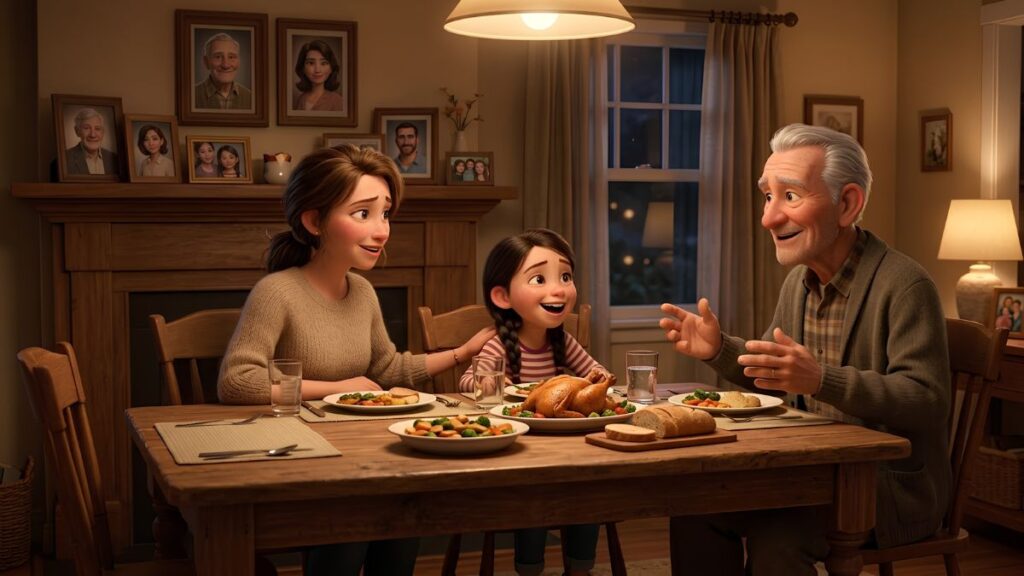
Rebecca had always believed that if she worked hard enough, she could build a better life for her daughter.
She didn’t expect life to become easy.
She simply wanted it to become a little more comfortable.
For years, Rebecca had lived with her eight-year-old daughter, Lily, in a small apartment above a busy street.
The apartment had one bedroom, a tiny kitchen, a narrow living room, and a balcony barely large enough for two chairs.
It wasn’t terrible.
But it wasn’t the home Rebecca dreamed of giving her daughter.
She wanted Lily to have her own bedroom.
She wanted a quiet neighborhood.
She wanted a small garden where Lily could grow flowers.
Most of all, she wanted them to have a place where they could feel settled.
So Rebecca worked two jobs.
During the day, she worked at a medical office.
In the evenings, she worked several hours at a grocery store.
She often came home after Lily had gone to bed.
Some nights, she was so tired that she barely had enough energy to prepare dinner.
But she kept going.
Every month, she placed part of her earnings into a separate savings account.
She called it the New Home Fund.
Whenever she felt exhausted, she looked at the number.
It reminded her why she was working so hard.
One evening, Lily sat beside her at the kitchen table.
“Mom?”
“Yes?”
“When are we moving?”
Rebecca smiled.
“Hopefully soon.”
“Will I have my own room?”
“Yes.”
“Really?”
“Really.”
“Can I choose the color?”
Rebecca laughed.
“Within reason.”
Lily smiled.
“I want blue.”
“Of course you do.”
Lily leaned against her mother.
“I can’t wait.”
Rebecca hugged her.
“Neither can I.”
At that moment, Rebecca believed the future was finally beginning to take shape.
She didn’t know that everything was about to change.
Her Father’s Call
Rebecca’s father, George, lived about forty minutes away.
He was seventy-eight years old and had lived alone since his wife passed away several years earlier.
George was independent.
He liked doing things himself.
He repaired small things around his house.
He cooked simple meals.
He went to the local market.
He watered his plants every morning.
Whenever Rebecca asked if he needed help, he always gave the same answer.
“I’m fine.”
Rebecca knew what that meant.
It meant:
I don’t want to be a burden.
She visited him whenever she could.
But with two jobs and a young daughter, her visits had become less frequent.
She called him on Sundays.
Sometimes they spoke for ten minutes.
Sometimes they talked for an hour.
George never complained.
Then one Tuesday evening, Rebecca’s phone rang.
It was her father’s number.
She answered immediately.
“Hi, Dad.”
There was a pause.
“Rebecca?”
“Yes?”
“I need to tell you something.”
Her father’s voice sounded different.
“What happened?”
“I fell.”
Rebecca immediately stood up.
“Are you hurt?”
“I’m okay.”
“Where are you?”
“At home.”
“Did you see a doctor?”
“Yes.”
“What did they say?”
George explained that he had slipped in the bathroom.
He had injured his leg and needed to rest.
The doctor had also told him that living alone might no longer be safe.
Rebecca felt a tightness in her chest.
“I’ll come over.”
“You don’t have to tonight.”
“I’m coming.”
She arranged for Lily to stay with a neighbor and drove to her father’s house.
When she arrived, George was sitting in a chair in the living room.
His leg was elevated.
He looked tired.
Rebecca hugged him.
“Why didn’t you tell me how serious this was?”
“I didn’t want to worry you.”
“You should have called.”
“I know.”
She sat beside him.
For a few minutes, neither of them spoke.
Then George said:
“The doctor thinks I shouldn’t live alone anymore.”
Rebecca looked at him.
“What do you want to do?”
George looked toward the window.
“I don’t know.”
The Decision
Over the next few weeks, Rebecca tried to find a solution.
She looked at assisted living facilities.
She checked the cost of home care.
She spoke with relatives.
Nothing seemed simple.
The facilities were expensive.
Home care would also cost more than she could afford.
George didn’t want to leave his house.
“I’ve lived here for thirty-five years,” he said.
“I know.”
“I don’t want to move.”
Rebecca understood.
But she also knew that leaving him alone wasn’t safe.
One evening, she sat at her kitchen table after Lily had gone to bed.
The savings account statement was in front of her.
She had finally saved enough for the apartment she wanted.
She had found a place in a quieter neighborhood.
It had two bedrooms.
It had a small balcony.
There was even a park nearby.
It was exactly what she and Lily had dreamed about.
Rebecca stared at the numbers.
Then she thought about her father sitting alone in his house.
She closed her eyes.
She knew what she had to do.
The next morning, she called him.
“Dad?”
“Yes?”
“I’ve been thinking.”
“About what?”
“You should come live with us.”
There was silence.
“I can’t do that.”
“Why?”
“I don’t want to interfere with your life.”
“You won’t.”
“You have Lily.”
“I know.”
“You work two jobs.”
“I know.”
“You need your own home.”
Rebecca looked at the apartment around her.
“We’ll figure it out.”
George sighed.
“Rebecca…”
“I want you with us.”
He didn’t answer.
After a moment, Rebecca heard his voice.
“Are you sure?”
“Yes.”
The Empty Chair
George moved into Rebecca’s apartment two weeks later.
There wasn’t much space.
His bed had to be placed in the living room.
Lily gave up one of her storage shelves for his belongings.
The small kitchen became more crowded.
The hallway became difficult to navigate.
Rebecca’s life changed immediately.
She had to wake up earlier.
She prepared meals for three people.
She helped her father with medication.
She took him to medical appointments.
She worked during the day.
She worked again in the evening.
And she tried to be a mother to Lily.
Sometimes she felt exhausted.
Sometimes she wondered whether she had made the wrong decision.
One Friday evening, Rebecca came home from her second job.
She was carrying groceries.
Her shoulders hurt.
Her feet hurt.
She opened the door.
Lily was sitting at the table doing homework.
George was reading a newspaper.
“You’re home,” Lily said.
“Yes.”
Rebecca placed the groceries on the counter.
She looked around the apartment.
There was barely any room.
She thought about the new apartment she had wanted.
The quiet neighborhood.
Lily’s bedroom.
The garden.
Everything suddenly felt far away.
George looked at her.
“You okay?”
Rebecca forced a smile.
“I’m fine.”
He nodded.
But he knew.
That evening, they had dinner together.
The table was small.
There were three chairs.
Rebecca sat on one side.
Lily sat opposite her.
George sat between them.
It was crowded.
But they ate together.
After dinner, Lily helped her grandfather clear the plates.
Rebecca watched them.
She smiled.
For the first time that evening, she felt less tired.
Learning to Live Together
The first few months were not easy.
George had his routines.
Rebecca had hers.
Lily had hers.
They often got in each other’s way.
George liked to wake up early.
Rebecca needed sleep.
Lily liked watching television after school.
George preferred quiet.
Rebecca wanted everyone to eat dinner together.
Sometimes George wanted to eat later.
Small disagreements became common.
One morning, Rebecca found George trying to repair a broken kitchen drawer.
“Dad!”
He looked up.
“What?”
“You shouldn’t be doing that.”
“It’s just a drawer.”
“You could hurt yourself.”
“I’m not helpless.”
Rebecca stopped.
She realized her words had sounded harsher than she intended.
“I’m sorry.”
George put down the screwdriver.
“I know you’re worried.”
“I am.”
He smiled.
“Your mother used to worry about me too.”
Rebecca smiled.
“She worried about everyone.”
“She did.”
For a moment, they remembered her mother.
The conversation softened.
Later that day, George repaired the drawer.
Rebecca didn’t complain.
Lily and Her Grandfather
Something unexpected began to happen.
Lily and George became very close.
At first, they simply watched television together.
Then George started telling her stories about his childhood.
He told her about riding a bicycle to school.
He told her about his first job.
He told her about meeting Rebecca’s mother.
Lily loved the stories.
“Tell me another one.”
“I’ve already told you that one.”
“I like that one.”
George laughed.
“You’ve heard it five times.”
“I don’t care.”
Rebecca often listened from the kitchen.
She realized she had never heard some of these stories herself.
One evening, Lily asked:
“Grandpa, what was Mom like when she was little?”
George looked at Rebecca.
Rebecca laughed.
“Don’t tell her everything.”
George smiled.
“Oh, I have plenty of stories.”
Lily sat closer.
“Tell me.”
Rebecca shook her head.
“Traitor.”
They all laughed.
For the first time in weeks, Rebecca felt completely relaxed.
The Cost of Sacrifice
Months passed.
Rebecca continued saving money, but the amount grew slowly.
She had given up the apartment she wanted.
She had delayed her plans.
Sometimes she felt frustrated.
One evening, she received an email from the landlord of the apartment she had originally planned to rent.
The apartment was still available.
The message said:
If you’re still interested, please contact us.
Rebecca stared at the screen.
For a moment, she imagined moving.
She imagined Lily’s bedroom.
She imagined her father having a quiet room.
She imagined having more space.
Then she looked into the living room.
George was sitting with Lily.
They were playing a board game.
Lily was laughing.
George was pretending to be angry because he had lost.
Rebecca smiled.
She closed the email.
Maybe someday.
But not now.
The Dinner
A year after George moved in, Rebecca cooked a special dinner.
It wasn’t a birthday.
It wasn’t a holiday.
She simply wanted to celebrate being together.
She prepared George’s favorite meal.
Lily decorated the table.
George insisted on wearing a clean shirt.
“Why are we having a celebration?” he asked.
“Because we can.”
They sat down.
Rebecca looked around the table.
Her father.
Her daughter.
Three generations.
The apartment was still small.
The walls were still old.
The kitchen was still cramped.
But the table felt different.
It felt like home.
George raised his glass.
“I want to say something.”
Rebecca smiled.
“What?”
“Thank you.”
Rebecca shook her head.
“You don’t need to thank me.”
“I do.”
He looked at her.
“I know you gave up a lot for me.”
Rebecca looked down.
“Don’t.”
“I mean it.”
George’s voice became softer.
“You had plans.”
“I still have plans.”
“Maybe.”
He smiled.
“But you changed them because of me.”
Rebecca reached across the table.
“I didn’t lose anything.”
George looked at her.
“I gained time with you.”
He became quiet.
Lily looked between them.
Then she smiled.
“Can we eat now?”
They all laughed.
A New Opportunity
Two years later, George’s health improved enough that he became more independent.
He could walk without assistance.
He could help around the apartment.
He even started cooking occasionally.
Rebecca’s financial situation also improved.
She had received a promotion at her main job.
She no longer needed the second job every evening.
For the first time in years, she had free time.
One Saturday morning, she took Lily to look at houses.
They found a small home in a quiet neighborhood.
It wasn’t luxurious.
But it had two bedrooms.
It had a small garden.
And there was a park nearby.
Lily looked at the garden.
“Can I plant flowers?”
Rebecca smiled.
“Yes.”
George stood beside them.
“Maybe I’ll plant tomatoes.”
Lily laughed.
“Grandpa, you can have your own section.”
Rebecca looked at the house.
She realized that her dream had not disappeared.
It had simply taken longer.
And somehow, it had become better.
The Empty Chair
Years later, George passed away peacefully.
He had lived long enough to see Lily graduate from school.
He had watched Rebecca move into the home she had once dreamed about.
He had planted tomatoes in the garden.
He had sat at the dinner table hundreds of times.
After his funeral, Rebecca returned home.
That evening, she prepared dinner.
Out of habit, she placed three plates on the table.
Then she stopped.
There were only two people now.
Rebecca and Lily.
She slowly removed one plate.
She looked at the empty chair.
For a moment, she could almost hear her father’s voice.
She remembered his stories.
His jokes.
His complaints about the television.
His habit of asking for more food even when he wasn’t hungry.
She remembered the cramped apartment.
The difficult mornings.
The tired evenings.
She remembered all the things she had once thought she had sacrificed.
Her plans.
Her money.
Her time.
And then she realized something.
Those years had not been stolen from her.
They had been given to her.
The time she spent caring for her father had become some of the most meaningful time of her life.
She sat down.
Lily reached across the table and held her hand.
“Are you okay?”
Rebecca smiled through her tears.
“Yes.”
She looked at the empty chair.
“I was just thinking about Grandpa.”
Lily smiled.
“He loved sitting there.”
“I know.”
They ate dinner together.
The chair remained empty.
But the memories filled the room.
What Rebecca Finally Understood
Rebecca had once believed that sacrifice meant giving something up.
And sometimes it did.
She had given up an apartment.
She had delayed financial goals.
She had changed her plans.
She had spent countless hours caring for someone else.
But she eventually realized that sacrifice could also be an investment in something that money could never buy.
Time.
Connection.
Memories.
Love.
Her father had not needed a perfect final chapter.
He had needed his daughter.
And Rebecca had been there.
Years later, when she thought about those difficult years, she didn’t remember the crowded apartment as much as she remembered the dinner table.
She remembered Lily laughing.
She remembered George telling stories.
She remembered the sound of three people talking at once.
She remembered ordinary evenings that had seemed insignificant at the time.
Those ordinary evenings had become precious memories.
Lesson From the Story
The Empty Chair at Dinner shows that some sacrifices may delay our plans, but they can also give us something far more valuable.
Rebecca wanted to provide a better home for her daughter. When her elderly father could no longer safely live alone, she chose to bring him into her home instead.
The decision was difficult.
It changed her plans.
It created financial and emotional pressure.
But it also gave Rebecca precious years with her father that she might never have had otherwise.
The story reminds us that life does not always follow the schedule we create for ourselves.
Sometimes we have to pause our plans for the people we love.
And sometimes, when we look back, we discover that the moments we thought were interruptions were actually some of the most important moments of our lives.
Moral: Some sacrifices may delay our plans, but the time we give to loved ones can become more valuable than anything we hoped to achieve.
6. The Carpenter’s Best Table
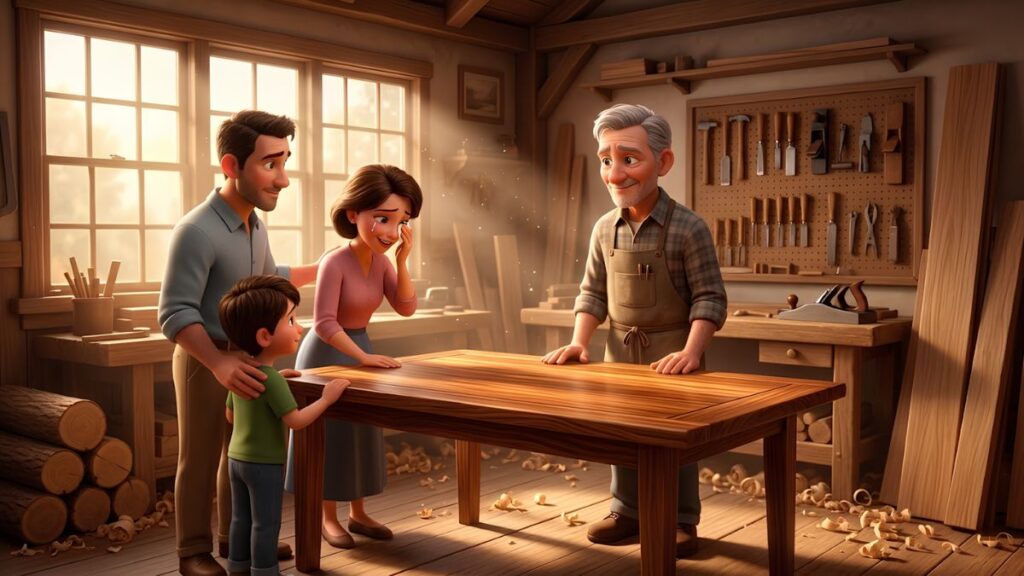
Thomas had spent most of his life working with wood.
He could tell the difference between oak and walnut simply by looking at the grain.
He knew when a piece of timber had been dried properly.
He could hear a problem in a drawer before he could see it.
And he believed that a well-made piece of furniture should last long enough to become part of a family’s story.
His workshop stood at the end of a quiet street.
It wasn’t large.
There was one main workbench, several shelves filled with tools, a small office in the corner, and stacks of carefully stored wood along the walls.
The smell of sawdust and polished timber filled the air.
Thomas had built chairs, cabinets, bookshelves, doors, desks, and dining tables.
But there was one thing he had never built.
A table that he considered worthy of his finest work.
That was about to change.
The Competition
A regional furniture competition was being held in the city.
Carpenters from different towns would enter their best pieces.
The winning piece would receive an award, a large cash prize, and an invitation to display the work at a prestigious furniture exhibition.
Thomas had wanted to enter for years.
But he had always found a reason to wait.
One year, he had been too busy.
Another year, he didn’t have the right materials.
Then his workshop had needed repairs.
Now, at sixty, Thomas finally decided it was time.
“I’m entering this year,” he told his daughter, Anna.
She smiled.
“Are you sure?”
“Yes.”
“You’ve been talking about it for years.”
Thomas laughed.
“That’s exactly why I’m doing it.”
He had already imagined the table.
It would be large enough for eight people.
The legs would be carefully shaped by hand.
The surface would be smooth but would still show the natural beauty of the wood.
There would be no unnecessary decorations.
Thomas wanted the table to look simple.
But every detail would be perfect.
He knew exactly what wood he wanted to use.
A rare, beautifully aged hardwood that he had purchased several years earlier.
He had been saving it for a special project.
This was that project.
The Best Wood
The wood was expensive.
Very expensive.
Thomas had only enough of it to build one large table.
If he made a mistake, he would not have enough material to start again.
He spent several days examining every board.
He measured them.
He checked the grain.
He marked the best sections.
Then he began.
For weeks, the workshop became his entire world.
He arrived early.
He worked until evening.
Sometimes he stayed late.
Every cut had to be precise.
Every joint had to fit perfectly.
He refused to rush.
A small mistake could ruin the entire piece.
Anna occasionally visited the workshop.
“How is it going?”
Thomas would smile.
“Slowly.”
“That’s all you say.”
“Good work takes time.”
She looked at the unfinished table.
“It already looks beautiful.”
“It’s not finished.”
“You always say that.”
Thomas smiled.
“A carpenter should never be satisfied too early.”
The Neighbors
Thomas lived next door to a family named the Carters.
There was a father named James, his wife Maria, and their two children, Ben and Sophie.
They had lived in the neighborhood for years.
Thomas often saw them outside.
James helped neighbors repair fences.
Maria organized community events.
Their children sometimes played in the street with other kids.
They weren’t wealthy.
But they were always willing to help others.
One Saturday evening, Thomas was closing his workshop when he noticed smoke in the distance.
At first, he thought someone was burning leaves.
Then he saw flames.
The fire was coming from the Carter family’s house.
Thomas ran outside.
Several neighbors were already gathering.
Firefighters arrived quickly.
Thomas stood helplessly at the edge of the street.
The family was safe.
But the house was badly damaged.
Much of the roof was destroyed.
Several rooms had been burned.
The windows were broken.
The family had lost most of their furniture.
Maria stood outside holding Sophie.
James looked toward the house in silence.
Thomas walked over.
“Are you all right?”
James nodded.
“We’re safe.”
He looked at the house.
“But we lost almost everything.”
Thomas didn’t know what to say.
So he placed a hand on James’s shoulder.
“We’ll help you.”
James looked at him.
“Thank you.”
The Morning After
The next morning, the neighborhood came together.
People brought clothes.
Someone brought blankets.
Another neighbor brought food.
A local store donated household supplies.
Thomas helped remove damaged furniture from the house.
As he carried a broken chair outside, he noticed the dining room.
There was almost nothing left.
The dining table was gone.
The chairs were gone.
The shelves were damaged.
Thomas looked at the empty room.
He remembered the table in his workshop.
The finest table he had ever planned to build.
The table that might win the competition.
He shook the thought away.
“This isn’t my problem,” he told himself.
But the thought returned.
Over and over.
The Choice
That evening, Thomas stood in his workshop.
The unfinished table was in front of him.
He placed his hand on the wood.
He had spent weeks shaping it.
The competition was only three weeks away.
If he continued, he could finish it.
He could enter.
Maybe he could win.
The prize money would help him.
The recognition would be meaningful.
His name could become known outside the town.
But then he thought about the Carter family’s empty dining room.
He imagined James, Maria, Ben, and Sophie eating dinner without a proper table.
He thought about family dinners.
Birthday celebrations.
Homework.
Holiday meals.
Conversations.
A dining table was not simply furniture.
It was where families gathered.
Thomas sat down.
He looked at the wood again.
There was enough to build the competition table.
There was also enough to build a simpler dining table for the Carters.
But not both.
He could either finish his masterpiece or use the wood to help his neighbors.
Thomas knew what he wanted to do.
He simply didn’t want to admit it.
A Difficult Conversation
The next morning, Anna came into the workshop.
She noticed that her father was sitting quietly.
“What happened?”
Thomas looked at her.
“I’ve made a decision.”
“About the competition?”
“Yes.”
Anna waited.
“I’m not going.”
She stared at him.
“What?”
“I’m going to use the wood for the Carters.”
Anna was silent.
“But Dad, you’ve waited years for this.”
“I know.”
“You could win.”
“Maybe.”
“You could finally get the recognition you deserve.”
Thomas smiled.
“Maybe.”
Anna looked frustrated.
“Then why would you give it up?”
Thomas looked toward the unfinished table.
“Because they need a table more than I need an award.”
Anna didn’t answer.
Thomas continued.
“I’ve built many tables in my life. But if I spend my entire life building things only for myself, what have I really accomplished?”
Anna looked at him.
After a moment, she smiled.
“I think Mom would agree with you.”
Thomas smiled.
“She probably would.”
Building a Different Table
Thomas began again.
But this time, he wasn’t building the table he had originally imagined.
He was building something for another family.
He changed the design.
He made it simpler.
He focused on strength and practicality.
He carefully shaped the legs.
He reinforced the joints.
He sanded the surface until it was smooth.
He didn’t care about impressing judges.
He cared about making something the family could use for years.
While he worked, neighbors occasionally stopped by.
“What are you building?”
“A dining table.”
“For the competition?”
Thomas shook his head.
“For the Carters.”
People smiled.
Word spread through the neighborhood.
Soon everyone knew what Thomas was doing.
A local photographer even visited.
“Would you mind if I take some photographs?”
Thomas shook his head.
“Why?”
“It’s a wonderful story.”
Thomas smiled.
“I’d rather you photograph the family when they’re sitting at the table.”
The Competition Day
The day of the competition arrived.
Thomas didn’t go.
Instead, he carried the finished table to the Carter family’s temporary home.
James opened the door.
He stared at the table.
“Thomas…”
“I thought you could use this.”
Maria came into the room.
She covered her mouth.
“Where did you get the wood?”
Thomas smiled.
“It was in my workshop.”
James understood.
“You used the competition wood.”
Thomas nodded.
“You shouldn’t have done that.”
“Maybe.”
“You could have won.”
Thomas smiled.
“Maybe.”
James shook his head.
“I don’t know how to thank you.”
“You don’t have to.”
Maria touched the table.
“It’s beautiful.”
Thomas looked at it.
“It isn’t my best table.”
Maria smiled.
“I think it is.”
The First Dinner
The Carter family invited Thomas to dinner.
They didn’t have much.
But they wanted to use the new table.
Maria prepared a simple meal.
James brought drinks.
The children helped arrange the plates.
Thomas sat at the table.
For the first time, he saw the table being used exactly as he had imagined.
People were gathered around it.
They were talking.
They were laughing.
Sophie told a funny story about school.
Ben complained about vegetables.
Everyone laughed.
Thomas looked around.
The table was already becoming part of the family’s story.
He smiled.
“This is better than a competition.”
James looked at him.
“What?”
Thomas shook his head.
“Nothing.”
The Unexpected Recognition
Several weeks later, Thomas received a letter.
He opened it in his workshop.
It was from the organizers of the furniture competition.
They had heard about what he had done.
Several people from the neighborhood had written to the organizers.
The competition committee had decided to create a special award.
The letter invited Thomas to attend a ceremony.
The award was called the Community Craftsmanship Award.
Thomas smiled.
He had never expected recognition.
At the ceremony, the organizers told the story of the table.
Thomas was given a small wooden plaque.
He accepted it quietly.
Then he said something that surprised everyone.
“I didn’t build that table to win an award.”
He paused.
“I built it because a family needed somewhere to sit together.”
The audience applauded.
Thomas looked down at the plaque.
Then he smiled.
The recognition was nice.
But it wasn’t why he had made the choice.
What the Award Meant
After the ceremony, a reporter approached Thomas.
“How does it feel to receive recognition after giving up your chance to win the main competition?”
Thomas thought about the question.
“I suppose it feels good.”
“Do you regret giving up the competition?”
“No.”
“Not even a little?”
Thomas smiled.
“No.”
He looked toward the audience.
“An award is something you hang on a wall.”
He paused.
“A table is something people gather around.”
The reporter smiled.
“That’s a powerful way to put it.”
Thomas shrugged.
“I’m a carpenter, not a philosopher.”
They laughed.
A New Kind of Success
The story of Thomas’s table spread through the town.
People began asking him to build furniture for community projects.
A school asked him to build tables for its library.
A local shelter asked him to repair damaged furniture.
A community center asked him to teach young people basic woodworking.
Thomas agreed.
He discovered that he enjoyed teaching almost as much as building.
Anna eventually joined him in the workshop.
She had always loved watching her father work.
Now she wanted to learn.
“What should I make first?”
Thomas handed her a piece of wood.
“A small stool.”
“That’s boring.”
Thomas smiled.
“Then make it interesting.”
She laughed.
Over time, Anna learned the craft.
She discovered what her father had known for decades.
Woodworking wasn’t just about cutting wood.
It was about patience.
Measurement.
Care.
Mistakes.
Correction.
And pride in doing something properly.
The Table Years Later
Five years later, Thomas visited the Carter family.
The children had grown.
Ben was now in college.
Sophie was preparing for her final year of school.
The family had rebuilt their house.
The dining room was beautiful.
But the table was still there.
The same table Thomas had built.
There were scratches on the surface.
One corner had been repaired.
The wood had darkened with age.
But it was still strong.
Thomas touched the surface.
“You kept it.”
James laughed.
“Of course.”
Maria smiled.
“We’ve had hundreds of dinners at this table.”
Sophie said:
“And hundreds of arguments.”
Everyone laughed.
Thomas looked at the table.
He realized that it had become something far more valuable than the competition piece he had once imagined.
It had become part of their family history.
The Best Table
That evening, Thomas returned to his workshop.
Anna was working at the bench.
She looked up.
“How was your visit?”
“Good.”
“How’s the table?”
“Still standing.”
She smiled.
“That’s good.”
Thomas looked around the workshop.
His tools.
His wood.
His unfinished projects.
His awards.
His photographs.
He thought about the competition he had missed.
He no longer wondered what might have happened if he had entered.
He already knew.
He might have won.
He might have lost.
Perhaps someone else would have built the winning table.
Perhaps his name would have appeared in a newspaper.
Perhaps the prize money would have helped his business.
But none of those possibilities mattered as much anymore.
Because he had seen something more important.
He had seen a family sitting together around something he had built.
He had seen children doing homework at that table.
He had seen birthdays celebrated around it.
He had seen arguments followed by laughter.
He had seen ordinary dinners become memories.
Thomas smiled.
That was the real prize.
The Lesson
Years later, when young carpenters asked Thomas about the best piece of furniture he had ever made, he always gave the same answer.
“The best table I ever built was the one I almost didn’t build.”
They expected him to describe his finest craftsmanship.
Instead, he told them about the Carter family.
He told them about the fire.
He told them about the competition.
And he told them about the choice.
Sometimes the young carpenters were surprised.
“But you could have won.”
Thomas always smiled.
“Perhaps.”
“Don’t you wish you’d entered?”
“No.”
“Why?”
Thomas would look toward the workshop door.
“Because recognition disappears.”
He would point toward the furniture around them.
“But kindness stays.”
The young carpenters would usually become quiet.
Thomas would then pick up a piece of wood and return to work.
He knew that craftsmanship mattered.
He still believed in doing excellent work.
He still took pride in beautiful furniture.
But he had learned something that no competition could teach.
The value of something is not always determined by its price, its appearance, or the recognition it receives.
Sometimes the greatest value comes from knowing that something you created made another person’s life a little better.
The table Thomas built never won a major competition.
It never stood in a gallery.
It never received a gold medal.
But it stood in a family home.
It held plates.
It held birthday cakes.
It held homework.
It held cups of tea.
It held conversations.
It held memories.
And for Thomas, that was more than enough.
Moral of the Story
Doing something good is valuable even when nobody gives you an award for it.
Thomas gave up his chance at recognition so he could use his valuable wood to help a family that had lost almost everything in a house fire.
His sacrifice reminded him that success is not always about prizes, money, or public recognition. Sometimes the most meaningful achievements are the ones that quietly improve another person’s life.
7. The Photograph He Never Sold

Daniel had always believed that photographs were more than pictures.
A photograph could capture a face that would otherwise be forgotten.
It could preserve a house that might someday disappear.
It could hold a moment that would never happen again.
That was why he had become a photographer.
But passion did not always pay the bills.
Daniel lived in a small apartment above an old bookstore and worked freelance jobs whenever he could find them. He photographed weddings, family celebrations, local events, products for small businesses, and occasionally landscapes for magazines.
Some months were good.
Others were difficult.
Lately, the difficult months had become more common.
His camera equipment needed repairs.
His rent was due.
Several clients had delayed payments.
Daniel had started wondering whether following his passion had been a mistake.
Then, one rainy afternoon, everything changed.
The Old Photograph
Daniel was photographing items inside an old house that was being prepared for renovation.
The owner had asked him to take pictures of the rooms and some of the antiques before the furniture was moved.
The house had been empty for years.
Dust covered the shelves.
Old newspapers were stacked in corners.
There were faded paintings on the walls.
Daniel enjoyed places like this.
They had stories.
While photographing a wooden cabinet, he noticed a small drawer that wouldn’t open.
He tried again.
Nothing.
He pulled harder.
The drawer suddenly came loose.
Behind it was a narrow space.
Inside was an old envelope.
Daniel carefully removed it.
There was no name on the outside.
Inside was a photograph.
It showed a young woman standing beside a man and a little boy.
They were standing in front of the same house.
The photograph was old, perhaps fifty or sixty years old.
The people were smiling.
Daniel studied their faces.
There was something unusual about the photograph.
It wasn’t professionally printed.
It looked like someone had taken it carefully and preserved it.
On the back, written in faded handwriting, were four words:
“Our last summer together.”
Daniel felt a strange sadness.
He didn’t know who the people were.
But clearly, the photograph meant something.
A Valuable Discovery
That evening, Daniel showed the photograph to a friend who worked at an antique store.
His friend examined it carefully.
“This could be valuable.”
Daniel looked surprised.
“How valuable?”
“Possibly quite a lot.”
“Why?”
“The photograph itself isn’t necessarily rare. But the people in it might be connected to a known family from this area.”
Daniel frowned.
“What makes you think that?”
His friend pointed to the house.
“This property belonged to the Harrison family decades ago. They were one of the oldest families in the town.”
Daniel looked at the photograph again.
“Do you know what happened to them?”
“Not much.”
“Could the photograph be worth something?”
“To the right collector, perhaps.”
Daniel remained quiet.
His friend continued.
“You should find out who they are.”
Daniel nodded.
But when he returned home, he couldn’t stop thinking about something else.
His bank account.
He needed money.
A lot of money.
If the photograph was worth what his friend suggested, selling it could solve several of his immediate problems.
He could repair his camera.
He could pay his rent.
He could catch up on bills.
Maybe he could even afford better equipment.
Daniel placed the photograph on his desk.
He stared at it.
Then he whispered:
“What should I do with you?”
The Easy Choice
The next morning, Daniel searched online for information about the Harrison family.
He found several references.
The family had lived in the town for generations.
One of the men in the photograph might have been Thomas Harrison.
Thomas had worked at a local railway company.
His wife was named Eleanor.
They had one son.
Daniel searched for records of their son.
The information became confusing.
Some records suggested that the family had moved away.
Others indicated that the boy had disappeared.
Daniel became more interested.
He searched newspaper archives.
He found an article from decades earlier.
It mentioned that a young man named Samuel Harrison had disappeared after leaving town.
His family had searched for him.
But no one had ever discovered what happened.
Daniel looked at the photograph again.
The little boy standing between the two adults could have been Samuel.
If that was true, the photograph might be the only surviving picture of him from that period.
Suddenly, the photograph seemed much more important.
Daniel considered selling it.
Then he imagined someone buying it and placing it in a private collection.
The photograph could disappear again.
The family might never know it existed.
Daniel leaned back in his chair.
He had a difficult choice.
The Search
Daniel decided to look for the family.
At first, he told himself that he would spend only a few days.
He searched public records.
He contacted the local historical society.
He visited the library.
He spoke with older residents.
Most people knew very little.
Then he met an elderly woman named Margaret.
She had lived in the town for almost seventy years.
When Daniel showed her the photograph, she became quiet.
“I know that house,” she said.
“Do you recognize the people?”
She looked closely.
“The woman is Eleanor Harrison.”
Daniel’s heart beat faster.
“And the boy?”
Margaret nodded slowly.
“That’s Samuel.”
“You’re sure?”
“I remember hearing about him.”
“What happened?”
Margaret sighed.
“Nobody really knew.”
Daniel asked if she knew where the family had gone.
Margaret thought for a moment.
“Thomas died here. Eleanor eventually moved away.”
“Do you know where?”
“No.”
But she remembered something.
“Eleanor had a sister who lived in another state.”
Daniel wrote down the name.
It was another small clue.
Following the Trail
The search took Daniel much longer than he expected.
He contacted libraries.
He searched old directories.
He examined newspaper archives.
He sent emails to historical societies.
He even visited neighboring towns.
Weeks passed.
Then months.
During that time, Daniel’s financial problems became worse.
His camera needed an expensive repair.
A major client canceled a contract.
He started considering selling some of his equipment.
One evening, his friend from the antique store called.
“I have someone interested in the photograph.”
Daniel knew what that meant.
“How much?”
The friend told him the amount.
Daniel sat silently.
It was enough to solve almost all his immediate financial problems.
He could pay his rent.
Repair his camera.
Buy groceries.
He could stop worrying for a while.
“Do you want me to arrange the sale?” his friend asked.
Daniel looked at the photograph on his desk.
He thought about the little boy.
He thought about the words on the back.
Our last summer together.
“No,” Daniel said.
His friend was surprised.
“Are you sure?”
“Yes.”
“That’s a lot of money.”
“I know.”
“Why don’t you sell it?”
Daniel looked at the photograph.
“Because someone may still be looking for him.”
The Unexpected Letter
A few weeks later, Daniel received an email.
It was from a woman named Clara.
She had found his message on a historical society website.
Her grandmother had been Eleanor Harrison’s sister.
Clara had heard stories about Samuel.
She had never seen a photograph of him.
Daniel’s hands trembled as he read the message.
He replied immediately.
He explained where he had found the photograph.
He attached a carefully scanned copy.
Clara responded within an hour.
She asked:
“Can I see the original?”
Daniel knew immediately that he had found the right person.
He agreed to meet her.
The Reunion
Clara lived several hours away.
Daniel drove there on a Saturday morning.
He carried the photograph in a protective folder.
When he arrived, Clara was waiting outside her home.
She was an elderly woman with silver hair and kind eyes.
“Are you Daniel?”
“Yes.”
She looked at the folder.
“Is that it?”
Daniel nodded.
She took a deep breath.
“May I?”
“Of course.”
Clara opened the folder.
She saw the photograph.
For several seconds, she said nothing.
Then tears appeared in her eyes.
“That’s him.”
Daniel felt a lump in his throat.
“Samuel?”
She nodded.
“That’s my uncle.”
She touched the photograph gently.
“I’ve heard stories about him all my life.”
She sat down.
“My grandmother searched for him for years.”
Daniel listened.
“What happened?”
Clara explained that Samuel had left town as a young man after an argument with his father.
He had planned to return.
But he never did.
Over the years, the family received a few letters.
Then the letters stopped.
No one knew where he had gone.
Clara had always hoped that one day they might discover more.
“Did you ever have a photograph of him?” Daniel asked.
“No.”
She looked at the photograph.
“This is the first one.”
The Story Behind the Picture
Clara studied the back of the photograph.
She recognized the handwriting immediately.
“That’s my grandmother’s writing.”
Daniel showed her the words.
“Our last summer together.”
Clara closed her eyes.
“My grandmother told me about that summer.”
“What did she say?”
“She said everyone was happy.”
Clara smiled sadly.
“Samuel was planning to leave town to find work. His father didn’t want him to go.”
Daniel looked at the photograph.
“Did he ever come back?”
“No.”
“Do you know where he went?”
Clara shook her head.
“Not exactly.”
Daniel had found part of the story.
But there was still more to discover.
Another Search
Clara asked Daniel if he would help her search for Samuel.
He agreed.
They searched records together.
They discovered that Samuel had traveled west.
There were employment records showing that someone with his name had worked at a railway station.
Then they found a marriage record.
Samuel had married a woman named Rose.
They had two children.
Daniel and Clara continued searching.
Eventually, they discovered that Samuel had lived a long life under the same name.
He had died decades earlier.
Clara cried when she learned the news.
Not because Samuel had died.
But because they had finally found him.
“He had a family,” she whispered.
Daniel nodded.
“And children.”
Clara smiled through her tears.
“He didn’t disappear from the world.”
“No.”
“He just disappeared from us.”
The Photograph Returns Home
Clara asked Daniel how much he wanted for the photograph.
He shook his head.
“Nothing.”
She looked at him.
“You spent months searching.”
“I know.”
“You drove here.”
“I know.”
“You could have sold it.”
Daniel smiled.
“I could have.”
“Why didn’t you?”
He thought for a moment.
“Because it belonged with you.”
Clara held the photograph against her chest.
“I don’t know how to thank you.”
“You don’t need to.”
She smiled.
“Would you at least let me pay for your travel?”
Daniel laughed.
“That I might accept.”
They both smiled.
Before he left, Clara asked one more question.
“Can I have your address?”
“Why?”
“I want to send you something.”
Daniel agreed.
The Unexpected Package
Two weeks later, Daniel received a package.
Inside was a handwritten letter.
Clara thanked him for returning the photograph.
There was also a small envelope.
Inside was an old newspaper clipping.
It contained a photograph of a young Samuel standing beside a railway station.
At the bottom was a short note.
“He spent his life working, raising a family, and helping people. We never knew where he was, but now we know he was safe.”
Daniel smiled.
There was also something else.
A check.
Daniel immediately called Clara.
“I can’t accept this.”
“You don’t know how much?”
“No.”
“You should.”
Daniel looked at the amount.
It wasn’t enormous.
But it was enough to cover the camera repair.
“Why are you doing this?”
Clara laughed softly.
“Because you returned something to my family that money could never replace.”
Daniel accepted.
A Different Kind of Success
The story of the photograph eventually became known in the local community.
People contacted Daniel.
Some asked him to help find old family photographs.
Others brought him boxes of letters and photographs they had discovered in attics and storage rooms.
Daniel began offering a small service.
He helped people identify old photographs and reconnect them with their families.
Sometimes he earned money.
Sometimes he didn’t.
But he continued.
He had discovered that his photography work could do more than capture new memories.
It could help restore old ones.
Years later, Daniel still kept a copy of the photograph.
Not the original.
The original belonged to Clara’s family.
Daniel had scanned it before returning it.
He kept the digital copy in a folder marked:
The Photograph I Never Sold.
Whenever he looked at it, he remembered the choice he had made.
He could have sold the photograph.
It would have solved several problems.
Instead, he had spent months searching for strangers.
At the time, some people thought he was foolish.
Perhaps they were right.
From a financial perspective, selling it would have made sense.
But money had never been the only measure of value.
The Meaning of the Photograph
Daniel eventually understood something important.
The photograph itself was only paper.
Its monetary value could be calculated.
Someone could put a price on it.
Someone could buy it.
Someone could sell it again.
But its emotional value was different.
To Clara, it was a connection to her grandmother.
To the family, it was a missing piece of their history.
To Daniel, it became a reminder that some opportunities should not be measured by money.
He had not become richer by keeping the photograph.
He had become richer by returning it.
The Lesson
One evening, a young photographer asked Daniel:
“What’s the most valuable photograph you’ve ever taken?”
Daniel smiled.
“Actually, it wasn’t one I took.”
He told the young photographer about the old photograph.
“Did you sell it?”
“No.”
“Why?”
“Because it belonged to someone else.”
The young photographer nodded.
“Was it difficult to give up the money?”
“Yes.”
“Do you regret it?”
Daniel smiled.
“Not for a second.”
He looked at the photograph on his computer screen.
“Some things have a price.”
He paused.
“But that doesn’t mean they have a value.”
The young photographer thought about his words.
Daniel continued working.
He knew that photographs could preserve faces.
They could preserve places.
They could preserve moments.
But sometimes, they could do something even more important.
They could bring people back to a part of their history they thought was gone forever.
And that was worth more than money.
Moral of the Story
Some things have a value that money cannot measure.
Daniel could have sold the old photograph and used the money to solve his financial problems. Instead, he chose to search for the family connected to it.
His decision cost him time and money, but it eventually reunited a family with an important piece of its history.
The story reminds us that integrity often requires us to make difficult choices. What is financially valuable is not always what is personally or emotionally valuable.
Sometimes, the most meaningful thing we can do is return something precious to the person who truly belongs with it.
Sacrifice Does Not Always Mean Losing Everything
One common misunderstanding is that sacrifice must involve a major loss.
That is not always true.
Sometimes sacrifice is very small.
A person may sacrifice an hour of free time to help a friend move.
A parent may sacrifice sleep to care for a sick child.
A colleague may sacrifice a lunch break to help another employee finish an important task.
A person may sacrifice a personal purchase so they can save money for something their family needs.
These actions may seem ordinary, but they can have a significant emotional impact.
The value of a sacrifice often comes from the intention behind it.
Different Types of Sacrifice in Stories
Stories about sacrifice can explore many different forms of selflessness.
1. Sacrifice for Family
Family is one of the most common themes in sacrifice stories.
Parents, grandparents, siblings, and children may make difficult choices for one another.
A parent may work long hours to provide better opportunities for their children.
An older sibling may postpone personal plans to support a younger brother or sister.
A family member may give up an important opportunity to care for someone who needs help.
These stories often emphasize love, responsibility, and loyalty.
2. Sacrifice for Friendship
Friendship can also require sacrifice.
A good friend may give up personal time to help someone through a difficult situation.
They may travel a long distance, offer financial assistance, provide emotional support, or stand beside a friend during a challenging period.
Such stories show that genuine friendship is not only about enjoying good moments together. It is also about being present when things become difficult.
3. Sacrifice for a Dream
Sometimes a character sacrifices something in the present to achieve a meaningful goal in the future.
A student may give up entertainment to study.
An aspiring entrepreneur may sacrifice comfort while building a business.
An athlete may sacrifice free time to train.
A writer may sacrifice leisure to complete a book.
These stories can teach readers that meaningful achievements often require patience, discipline, and temporary discomfort.
4. Sacrifice for Others
A character may sacrifice something without having a close relationship with the person they help.
For example, someone may give money to a stranger, return a valuable possession, or spend hours helping someone they have never met.
This type of story emphasizes compassion and generosity.
5. Sacrifice for Honesty and Principles
Sacrifice can also involve doing what is right even when it comes with a personal cost.
A person may refuse an unfair advantage.
An employee may report wrongdoing despite the risk of criticism.
A business owner may choose honesty instead of making extra money through deception.
These stories show that moral principles sometimes require people to give up comfort, money, status, or opportunities.
The Difference Between Sacrifice and Self-Neglect
An important part of writing meaningful sacrifice stories is understanding that sacrifice does not mean completely ignoring your own needs.
Healthy sacrifice involves making a thoughtful choice for something that matters.
Constantly giving up everything for everyone else can become unhealthy.
A strong moral story can therefore explore balance.
The lesson does not have to be:
“Always sacrifice yourself for others.”
A more meaningful lesson might be:
“Understand what truly matters, and be willing to give up something when helping others is more important than temporary personal comfort.”
This creates a more realistic message for adult readers.
The Role of Conflict in a Sacrifice Story
A sacrifice becomes meaningful when the character faces a difficult choice.
If giving something up is easy, the emotional impact may be limited.
Conflict creates tension.
For example, imagine a character who receives an important career opportunity in another city at the same time that a parent becomes dependent on their support.
The character now faces a difficult decision.
Should they accept the opportunity?
Should they stay home?
Can they find another solution?
There may not be an easy answer.
This kind of conflict allows the story to explore sacrifice in a realistic way.
Sacrifice and Personal Growth
A strong sacrifice story usually changes the character.
At the beginning, the character may be focused primarily on themselves.
They may care about money, success, comfort, recognition, or personal goals.
After facing a difficult situation, their priorities change.
They may realize that:
- Relationships are more valuable than possessions.
- Time cannot always be recovered.
- Helping someone can be more meaningful than receiving praise.
- Success is not only about personal achievement.
- Difficult choices can reveal a person’s true character.
This transformation gives the story emotional depth.
Sacrifice and Love
Love is one of the strongest reasons characters make sacrifices.
A mother may sacrifice her career for her children.
A father may work long hours to provide for his family.
A husband or wife may postpone personal plans to support their partner.
A friend may sacrifice comfort to stay beside someone during a difficult period.
These stories demonstrate that love is often expressed through actions rather than words.
Someone may say, “I care about you.”
But sacrifice demonstrates that care in a tangible way.
Sacrifice and Responsibility
Not every sacrifice comes from emotion.
Sometimes responsibility requires sacrifice.
A person may have responsibilities toward:
- Children
- Parents
- Family
- Employees
- Friends
- Community
- Students
- Customers
- Society
A character might not want to make a particular sacrifice, but they understand that someone is depending on them.
This creates a different kind of moral conflict.
The character learns that responsibility sometimes means doing what is necessary rather than what is easiest.
The Hidden Value of Small Sacrifices
One of the most powerful ideas in sacrifice stories is that small sacrifices can create lasting effects.
A person may give up an afternoon to teach someone a skill.
That person may later use the skill to improve their life.
A parent may sacrifice time to listen to a child.
Years later, the child may remember that moment as one of the most important experiences of their childhood.
A friend may make a small financial sacrifice to help someone through a difficult month.
The amount may seem insignificant, but the emotional value can be enormous.
This teaches readers that sacrifice should not be measured only by money or size.
Sacrifice and Gratitude
Many sacrifice stories also explore gratitude.
Sometimes the person receiving the sacrifice does not understand its value immediately.
A child may not realize how much a parent gave up for them until they become an adult.
A friend may only recognize someone’s support years later.
An employee may eventually understand the opportunity created by a mentor.
This delayed understanding can create powerful emotional moments.
It reminds readers that people often appreciate sacrifices more deeply when they gain maturity and experience.
Sacrifice Without Recognition
Another powerful theme is sacrifice without praise.
Some characters help others without expecting recognition.
They do not want awards.
They do not want attention.
They simply believe that helping is the right thing to do.
This creates an important moral lesson about genuine generosity.
A sacrifice made only for recognition may lose some of its moral strength.
A sacrifice made because something truly matters demonstrates character.
The Emotional Impact of Sacrifice Stories
Sacrifice stories can create strong emotions because readers recognize situations from their own lives.
Readers may think about:
- Their parents
- Their children
- Their partners
- Their friends
- Their teachers
- Their grandparents
- People who helped them during difficult periods
The story becomes more than entertainment.
It becomes a reflection of real relationships and decisions.
This is why sacrifice is such a powerful theme for adult storytelling.
How a Moral Lesson Emerges Naturally
The moral lesson should not feel forced.
Instead of simply telling readers what they should learn, the story should allow the events to demonstrate the lesson.
For example, instead of writing: “People should always help their families.”
A story can show a character choosing to support a family member during a difficult period and later realizing how meaningful that decision was.
The reader understands the lesson through the character’s experience.
This makes the moral more memorable.
Common Moral Lessons in Sacrifice Stories
Stories about sacrifice can teach many different lessons.
- Love Requires Action: True love is often demonstrated through actions rather than words.
- Helping Others Has Value: A person’s generosity can make a meaningful difference in another person’s life.
- Success Sometimes Requires Sacrifice: Important goals often require people to give up temporary comfort.
- Character Is Revealed by Difficult Choices: A person’s values become clearer when they face difficult decisions.
- Material Things Are Not Always the Most Valuable: Money and possessions can be replaced, but meaningful relationships and time may not be.
- Kindness Can Have Lasting Effects: A small sacrifice can influence someone long after the original event.
- Responsibility Requires Courage: Sometimes doing what is right requires giving up something personally valuable.
- Gratitude Comes With Understanding: People may not immediately recognize what others have sacrificed for them.
Sacrifice in Everyday Life
Sacrifice does not belong only in dramatic stories.
It exists in everyday life.
Parents wake up early to prepare meals.
Workers stay late to complete important responsibilities.
Friends travel long distances to attend important events.
Grandparents spend time caring for grandchildren.
Students give up entertainment to prepare for exams.
People donate money or time to community causes.
These actions may never become famous stories, but they still demonstrate the value of sacrifice.
Why Adults Connect With Sacrifice Stories
Adults often face complicated responsibilities.
They may have to balance:
- Career and family
- Personal goals and relationships
- Financial needs and generosity
- Freedom and responsibility
- Ambition and health
- Personal comfort and the needs of others
Because of these challenges, sacrifice stories can feel especially relatable to adult readers.
They recognize that life rarely offers perfect choices.
Sometimes every option involves giving something up.
The real question becomes what is worth sacrificing and why.
Sacrifice and Difficult Decisions
A good sacrifice story should not make every decision appear simple.
Real life is complicated.
A character may genuinely want two things that cannot happen at the same time.
For example, they may want to pursue a career opportunity while also caring for a family member.
The story becomes meaningful when the character considers the consequences of each choice.
This allows readers to think about their own priorities.
The strongest sacrifice stories do not simply tell readers what decision is correct.
They encourage readers to consider what they value most.
The Importance of Motivation
The reason behind the sacrifice matters.
Two characters can make the same sacrifice for completely different reasons.
One might act out of love.
Another might act because they fear criticism.
Another might sacrifice something to gain recognition.
Another might do it because they believe it is morally right.
Understanding motivation makes a character more realistic.
It also creates opportunities for deeper moral lessons.
Sacrifice and Long-Term Consequences
The best sacrifice stories often show what happens afterward.
A character may initially regret their decision.
They may wonder whether they made the right choice.
Over time, however, they may discover an unexpected benefit.
Perhaps the sacrifice strengthens a relationship.
Perhaps it helps another person succeed.
Perhaps it teaches the character something about themselves.
Perhaps it inspires someone else to act generously.
This shows that the value of sacrifice is sometimes understood only with time.
When Sacrifice Becomes an Inspiration
One person’s sacrifice can inspire another person.
For example, a child may see a parent’s dedication and later develop the same sense of responsibility.
A student may remember a teacher’s support and eventually help another student.
A friend who receives unexpected kindness may later repeat that kindness.
This creates a chain of positive actions.
The original sacrifice may affect far more people than the person who made it initially expected.
Sacrifice and Moral Courage
Sometimes sacrifice requires courage.
A person may risk rejection, financial loss, embarrassment, or inconvenience because they believe something is right.
Moral courage is particularly powerful in stories because the character must act despite fear.
This teaches readers that courage does not mean having no fear.
It means being willing to act according to one’s values even when the decision is difficult.
What Makes a Sacrifice Story Memorable?
A memorable sacrifice story usually contains several elements:
- A relatable character
- A meaningful problem
- A difficult choice
- Something valuable at stake
- An emotional sacrifice
- A believable consequence
- Personal growth
- A clear but natural moral lesson
When these elements work together, the story becomes emotionally engaging rather than simply instructional.
Lessons Readers Can Take From Sacrifice Stories
Readers can take many practical lessons from this type of storytelling.
- Think Beyond Immediate Comfort: The easiest choice is not always the most meaningful choice.
- Value Relationships: People often matter more than possessions or temporary achievements.
- Give Without Always Expecting Something Back: True generosity does not always require recognition.
- Understand Other People’s Sacrifices: Someone may have given up more than you realize to support you.
- Make Thoughtful Choices: Sacrifice should be intentional rather than automatic.
- Learn From Difficult Decisions: Even painful choices can teach valuable lessons.
- Remember That Time Is Valuable: Giving someone your time can be one of the most meaningful forms of sacrifice.
How Sacrifice Can Change a Person
A character who makes a meaningful sacrifice may become more mature.
They may become:
- More compassionate
- More responsible
- More patient
- More grateful
- Less selfish
- More courageous
- More understanding
This character development is often the heart of the story.
The sacrifice is not only about what the character gives up.
It is also about who the character becomes afterward.
Sacrifice and the Meaning of Success
Some stories use sacrifice to challenge the traditional idea of success.
Success is often measured through money, promotions, possessions, or social status.
But sacrifice stories can suggest another definition.
A person may be successful because they helped someone.
They may be successful because they protected a relationship.
They may be successful because they remained honest during a difficult situation.
They may be successful because they used their opportunities to improve someone else’s life.
This broader idea of success can create powerful moral storytelling.
Conclusion
A Story About Sacrifice With Moral Lesson can explore some of the deepest aspects of human character. Sacrifice can involve money, time, comfort, opportunities, dreams, or personal ambitions, but its true meaning comes from the reason behind the choice.
The strongest stories do not portray sacrifice as simple suffering. Instead, they show the difficult decisions people make because they value something more important than temporary personal comfort.
For adult readers, these stories can provide meaningful reflections on family, friendship, responsibility, love, honesty, patience, courage, and personal growth.
Most importantly, sacrifice stories remind us that some of the most valuable things in life cannot be measured by money or possessions. Time, trust, relationships, kindness, and love often carry a much greater value.
A meaningful sacrifice may seem small when it happens, but its impact can last for years.
That is what makes stories about sacrifice so powerful: they show that sometimes giving something up can reveal what truly matters.