
After a long day, sometimes you do not need a long conversation, an elaborate date, or an exciting activity. A few quiet minutes together can be enough to make the evening feel special. Short bedtime stories to read to your boyfriend can be a simple and meaningful way to slow down, relax, and end the day on a warm note.
Reading a short story to your boyfriend can create a peaceful bedtime routine while giving both of you something gentle to share before sleep. The right story can make him smile, help him relax, remind him that he is loved, or simply give him a pleasant thought to carry into his dreams.
These stories do not need to be complicated. A short fable, romantic tale, comforting story, or gentle story with a meaningful lesson can be enough.
What Are Short Bedtime Stories to Read to Your Boyfriend?
Short bedtime stories to read to your boyfriend are brief, relaxing stories designed to be enjoyed during the quiet moments before sleep.
Unlike long novels or complicated stories with numerous characters and plotlines, bedtime stories usually have a simple structure. They often focus on one central idea, emotion, relationship, or experience.
A bedtime story for your boyfriend might be:
- Romantic
- Sweet and affectionate
- Funny and playful
- Calming
- Inspirational
- Emotional
- Imaginative
- Nostalgic
- Wholesome
- Built around a simple moral lesson
The purpose is not necessarily to tell an extraordinary story. Instead, the goal is to create a peaceful experience that you can share together.
A story that takes only five or ten minutes to read can become a small nightly ritual that both of you look forward to.
7 Short Bedtime Stories to Read to Your Boyfriend
1. The Boy Who Saved a Seat Under the Stars

There was once a young man named Noah who had a quiet habit that nobody quite understood.
Every evening, just before the sky became completely dark, he would walk to the top of a small hill outside his town.
The hill was not particularly impressive.
There were no famous landmarks there.
No restaurants.
No beautiful buildings.
No crowds.
Just a wide grassy field, an old wooden bench, and a clear view of the night sky.
Noah loved it.
He would arrive shortly before sunset and sit on the bench while the last sunlight disappeared behind the distant hills.
Then the stars would slowly appear.
One.
Then another.
Then dozens.
Eventually, the entire sky would seem to sparkle.
But there was something unusual about Noah’s visits.
He never sat in the middle of the bench.
He always sat on one side.
The other side remained empty.
Every evening.
Without exception.
Some people in the town had noticed.
The baker had noticed.
The postman had noticed.
Even the old man who walked his dog along the hill had noticed.
One evening, the old man finally asked.
“Why do you always leave half the bench empty?”
Noah smiled.
“I’m saving it.”
“For what?”
“For someone.”
The old man laughed.
“Someone specific?”
Noah looked toward the sky.
“Not yet.”
The old man shook his head.
“You young people have strange ideas.”
Noah laughed.
“Maybe.”
Then they went their separate ways.
Noah continued his evening ritual.
He would sit.
He would watch.
And he would leave the other half of the bench empty.
Nobody knew why.
The truth was that Noah had once heard a story from his grandfather.
His grandfather had told him that when he was young, he used to sit beneath the stars with his future wife.
They had not had much money.
They had not traveled to famous places.
They had not owned expensive things.
But they had a favorite hill.
Every night they would sit there and talk.
Sometimes they talked for hours.
Sometimes they said almost nothing.
His grandfather had once told Noah:
“The best memories aren’t always the loud ones.”
Noah had never forgotten those words.
So he had begun visiting the hill.
At first, he went because he liked the stars.
Then he started imagining what it would be like to share the view with someone he loved.
He imagined someone sitting beside him.
Someone who did not need entertainment every minute.
Someone who could enjoy silence.
Someone who would look at the stars and feel peaceful.
He did not know who that person would be.
He simply believed that one day, perhaps, she would arrive.
So he saved the seat.
Years passed.
Noah met people.
He went on dates.
He made friends.
He fell in love once.
It did not work out.
He was disappointed.
For several weeks, he stopped visiting the hill.
One evening, however, he found himself walking there again.
He sat on his usual side.
The empty space beside him seemed larger than before.
He looked at the stars.
“Maybe I was foolish,” he whispered.
There was no answer.
Only the wind.
He went home.
The next evening, he returned.
And the next.
Slowly, the disappointment became lighter.
He realized something.
He had been imagining love as a destination.
As though one day someone would arrive and suddenly make everything complete.
But the hill had taught him to enjoy his own company too.
The stars did not become less beautiful because he watched them alone.
The evening did not become meaningless.
The quiet did not become empty.
He still hoped to share those moments with someone someday.
But he no longer needed that to enjoy them.
Then, one autumn evening, something unexpected happened.
Noah arrived at the hill later than usual.
The sky was already turning purple.
He walked toward the bench.
Someone was sitting there.
A woman.
She had a small notebook in her hands.
She was looking upward.
Noah stopped.
She noticed him.
“Oh,” she said.
“Sorry. Is this your seat?”
Noah smiled.
“Not exactly.”
She moved slightly.
“You can sit.”
Noah sat on his usual side.
For several minutes, neither spoke.
The first stars appeared.
The woman closed her notebook.
“Beautiful, isn’t it?”
Noah looked upward.
“Very.”
“I come here when I need to think.”
“So do I.”
She smiled.
“Then I suppose we’re both here for the same reason.”
“Maybe.”
Her name was Clara.
She had recently moved to the town for work.
She had discovered the hill by accident while walking one evening.
She liked the quiet.
Noah told her that he came there often.
“How often?”
“Almost every night.”
Clara looked at the empty space between them.
“You always sit on that side?”
“Yes.”
“Why?”
Noah hesitated.
Then he smiled.
“It’s a long story.”
“I like long stories.”
So Noah told her.
He explained what his grandfather had said.
He told her about the bench.
He told her that he had always imagined sharing the stars with someone.
Clara listened without laughing.
When he finished, she looked toward the sky.
“That’s actually very sweet.”
Noah smiled.
“I thought people might find it strange.”
“It is strange.”
He laughed.
“But in a good way.”
They stayed until late that evening.
They talked about childhood.
Favorite books.
Family.
Dreams.
Places they wanted to visit.
Things they were afraid of.
Things they had never told anyone.
When Clara finally stood to leave, she looked at Noah.
“I’ll see you tomorrow?”
Noah smiled.
“I hope so.”
She smiled back.
“Goodnight.”
“Goodnight.”
The next evening, Clara returned.
The evening after that, she returned again.
Soon, the hill became theirs.
They still sat on the same bench.
Noah still arrived first.
But now he no longer needed to leave the other side empty.
Someone was there.
They developed little traditions.
On clear nights, they counted stars.
On cloudy nights, they made up stories about what the sky looked like behind the clouds.
When the moon was full, they tried to take photographs.
Their photographs were never very good.
They laughed about that.
Sometimes they talked for hours.
Sometimes they simply sat quietly.
And gradually, Noah discovered something important.
He had always imagined that sharing the stars with someone would make the experience more beautiful.
He was right.
But not for the reason he expected.
Clara did not make the stars brighter.
She made him notice them more carefully.
She would point out shapes he had never seen.
She would notice the color of the sunset.
She would stop suddenly when the first evening star appeared.
She made him pay attention.
And Noah realized that love often worked that way.
It did not necessarily create new beauty.
Sometimes it helped you notice the beauty that was already there.
Months passed.
Their relationship became deeper.
They learned each other’s habits.
Clara discovered that Noah always forgot to carry an umbrella.
Noah discovered that Clara pretended not to be afraid of spiders.
Clara learned that Noah became quiet when he was worried.
Noah learned that Clara hummed softly whenever she was happy.
They were not perfect.
They disagreed sometimes.
They misunderstood each other.
They occasionally became annoyed.
But they kept talking.
They kept returning to the hill.
One winter evening, Clara arrived looking unusually quiet.
Noah noticed immediately.
“What’s wrong?”
She shook her head.
“Nothing.”
He waited.
After a while, she said:
“I’m afraid.”
“Of what?”
“Of losing this.”
Noah looked at her.
“What do you mean?”
“This.”
She gestured toward the hill.
“The bench. The stars. Us.”
Noah smiled gently.
“Why would you lose it?”
“Because good things don’t always stay.”
Noah was silent.
He understood.
He had felt the same fear before.
So he reached for her hand.
“Maybe we shouldn’t worry about how long it lasts.”
Clara looked at him.
“What should we do instead?”
“Be here.”
She smiled.
“Right now?”
“Right now.”
They sat together.
The sky was clear.
The stars were bright.
Neither of them spoke for a long time.
Years later, the old wooden bench was replaced.
The grass around the hill changed.
The town grew.
New houses appeared.
The bakery changed owners.
The old man with the dog was gone.
But Noah and Clara still visited the hill.
Sometimes they brought their children.
Sometimes they came alone.
One evening, many years after they first met, Noah and Clara sat on the same hill.
Noah looked at the stars.
Then he looked at Clara.
“Do you remember the first night you sat here?”
She laughed.
“Of course.”
“You took my seat.”
“I thought it was public.”
“It was.”
“Then technically, you had no right to complain.”
“I didn’t complain.”
“You were surprised.”
“I was.”
She smiled.
Then she looked toward the bench.
“You really were saving that seat.”
“I was.”
“For me?”
Noah thought about it.
“Not specifically.”
Clara raised an eyebrow.
“No?”
“I didn’t know you existed.”
She laughed.
“Then who were you saving it for?”
Noah looked at her.
“Someone who would make sitting here feel different.”
Clara smiled.
“Did I?”
“Yes.”
“How?”
Noah looked toward the stars.
“Before you, I came here to look at the sky.”
“And now?”
“Now I come here to remember everything.”
Clara leaned against his shoulder.
The stars appeared one by one.
The hill was quiet.
The town lights glowed far below.
Noah held her hand.
He thought about how strange life was.
He had spent years saving a seat for someone he had never met.
And yet the real gift had not been finding someone to sit beside him.
The real gift had been learning how to appreciate the empty seat too.
Because before Clara arrived, the empty seat had taught him patience.
It had taught him hope.
It had taught him that being alone did not mean being incomplete.
And when Clara finally arrived, he was ready to share his peace rather than ask her to create it for him.
That was the difference.
He did not need someone to complete his life.
He wanted someone with whom he could share it.
The stars continued shining above them.
Clara closed her eyes.
“Noah?”
“Yes?”
“Thank you for saving the seat.”
He smiled.
“Thank you for sitting in it.”
They stayed there a little longer.
There was nowhere else they needed to be.
No great adventure waited for them.
No dramatic event needed to happen.
They simply sat beneath the stars.
Together.
And sometimes, that was more than enough.
Moral of the Story
The right person does not have to complete your life. Love is often about finding someone with whom you can share the peace, beauty, and ordinary moments you have already learned to appreciate.
A Gentle Thought Before Sleep
If you are reading this story to your boyfriend tonight, pause for a moment after the ending.
Look at him.
You do not need to say anything complicated.
You could simply tell him:
“I’m glad you’re here.”
Sometimes those four words can mean more than a long speech.
Love does not always need dramatic declarations.
Sometimes it is sitting beside someone after a long day.
Sometimes it is listening.
Sometimes it is remembering their favorite things.
Sometimes it is sharing silence.
And sometimes it is simply saving a little space in your life for someone you love.
Tonight, let the world become quiet.
Let tomorrow wait.
For a few minutes, there is nothing to accomplish.
There is only this moment.
Two people.
A little peace.
And perhaps, somewhere above you, a sky full of stars.
2. The Little Café That Stayed Open Late

There was a small café at the end of a quiet street.
It was not famous.
It did not have expensive furniture, fashionable decorations, or a large menu.
It had only six tables, a narrow wooden counter, a few hanging lamps, and a large window overlooking the street.
But there was something special about the café.
It stayed open late.
Every evening, long after the other shops had closed, its warm lights remained glowing against the darkness.
The café belonged to a woman named Elena.
She had inherited it from her grandmother, who had opened the place many years earlier.
Elena knew most of the regular customers by name.
She knew who liked strong coffee.
She knew who wanted extra sugar.
She knew who preferred tea.
She knew who liked to sit near the window.
And she knew who sometimes came in without wanting to talk.
One of those customers was a young man named Daniel.
Daniel first discovered the café on a rainy Tuesday evening.
He had been working late.
His phone battery was almost dead.
His clothes were damp from the rain.
His mind was filled with unfinished tasks.
He had spent the entire day moving from one responsibility to another.
When he finally left his office, he did not want to go home immediately.
He wanted somewhere quiet.
As he walked through the rain, he noticed the café.
The lights were still on.
He looked through the window.
Only one person was sitting inside.
An elderly man was reading a newspaper near the counter.
Daniel opened the door.
A small bell rang above him.
Elena looked up.
“Good evening.”
“Good evening.”
“You can sit anywhere.”
Daniel chose the table beside the window.
Elena brought him a menu.
He looked at it without much interest.
“What would you recommend?”
She smiled.
“Hot chocolate.”
Daniel looked surprised.
“Hot chocolate?”
“You look like you need it.”
He laughed for the first time that day.
“Is it that obvious?”
“A little.”
He ordered the hot chocolate.
A few minutes later, Elena placed the cup in front of him.
The drink was warm.
Steam rose gently from the surface.
Daniel took a sip.
It was sweet.
Comforting.
Exactly what he needed.
He remained at the café for almost an hour.
He did not work.
He did not check his phone.
He simply sat by the window and watched the rain.
Before leaving, he thanked Elena.
“Goodnight.”
“Goodnight.”
He stepped outside.
Then he stopped.
He looked back at the glowing café.
Something about it felt peaceful.
The following week, Daniel returned.
Then he returned again.
Soon, he became a regular.
He usually arrived around nine-thirty.
Sometimes he came after work.
Sometimes after a difficult meeting.
Sometimes simply because he did not want to go home yet.
Elena never asked too many questions.
She would simply smile.
“The usual?”
Daniel would nod.
“Please.”
She always remembered.
One evening, Daniel arrived looking particularly tired.
Elena placed his drink on the table.
“You’ve had a difficult day.”
Daniel looked at her.
“How did you know?”
“You forgot to say hello.”
He smiled.
“I suppose that means it was a bad one.”
She nodded.
“Very bad.”
He took a sip.
For a while, neither spoke.
Then Elena said:
“You don’t have to explain.”
Daniel looked up.
“What?”
“You don’t have to tell me what happened.”
He smiled.
“Thank you.”
She walked away.
Daniel sat quietly.
For some reason, those few words made him feel better.
He did not need to explain himself.
He did not need to pretend everything was fine.
He could simply sit.
Over the next few months, the café became part of Daniel’s life.
He started noticing little things.
The clock above the counter was always five minutes slow.
The old man near the window came every Thursday.
A stray cat sometimes appeared outside the back door.
Elena always played quiet music after ten.
And whenever it rained, the café smelled faintly of cinnamon.
Daniel began to look forward to those evenings.
One night, he asked Elena:
“Why do you stay open so late?”
She looked at the clock.
“Because some people need somewhere to go.”
“At midnight?”
“Especially at midnight.”
Daniel smiled.
“That’s a strange business strategy.”
Elena laughed.
“My grandmother used to say that a café isn’t only a place for coffee.”
“What is it then?”
“A place where people can breathe.”
Daniel remembered those words.
A place where people can breathe.
He thought that was exactly what he had been doing.
Breathing.
For one or two hours each evening, he could stop being the person who had to solve everything.
He could simply be Daniel.
Then one evening, something unexpected happened.
Daniel entered the café and noticed that Elena was sitting alone at one of the tables.
She looked tired.
He had never seen her sitting down during business hours.
“Are you okay?” he asked.
She smiled.
“I’m fine.”
Daniel looked at her.
“You don’t look fine.”
She laughed.
“Now you sound like me.”
He sat across from her.
“What happened?”
Elena hesitated.
“My grandmother passed away.”
Daniel became quiet.
“I’m sorry.”
“Thank you.”
She looked around the café.
“She built this place.”
“I know.”
“Sometimes I think I hear her voice.”
Daniel smiled gently.
“What does she say?”
Elena looked toward the counter.
“She tells me I’m making the coffee too strong.”
Daniel laughed.
Elena laughed too.
For a moment, the sadness became lighter.
Then she said:
“She also told me never to close the café early.”
“Why?”
“She said someone might need it.”
Daniel looked around.
The café was empty.
“Even when nobody is here?”
Elena nodded.
“Especially then.”
That evening, Daniel stayed longer than usual.
He helped Elena clean the tables.
They talked.
She told him about her grandmother.
He told her about his family.
They discovered that they had both experienced difficult years.
They discovered that both had learned to hide stress behind smiles.
They discovered that neither was very good at asking for help.
By the time they finished cleaning, it was almost midnight.
Daniel stood near the door.
“Goodnight.”
Elena smiled.
“Goodnight.”
He hesitated.
“Thank you.”
“For what?”
“For letting me sit here all those nights.”
She looked at him.
“You never needed permission.”
Daniel smiled.
He left.
After that evening, something changed.
Daniel and Elena became friends.
Not suddenly.
Not dramatically.
It happened slowly.
He would ask how her day had been.
She would ask about his work.
They began sharing small stories.
Sometimes they laughed.
Sometimes they disagreed.
Sometimes they sat in silence.
Daniel eventually realized that he had begun looking forward to seeing Elena more than he looked forward to his evening drink.
One rainy night, he arrived late.
The café was almost empty.
Elena was preparing to close.
She looked at the clock.
“You’re late.”
“I know.”
“I thought you weren’t coming.”
Daniel smiled.
“You were waiting?”
Elena looked away.
“Maybe.”
He sat down.
She brought him his usual drink.
“Thank you.”
They sat together near the window.
Rain covered the glass.
Streetlights reflected on the wet road.
Daniel looked at Elena.
“Can I ask you something?”
“Of course.”
“Why do you always remember what people need?”
She thought for a moment.
“Because sometimes people don’t know how to ask.”
Daniel nodded.
“That’s true.”
She looked at him.
“Why do you always come here?”
He considered giving his usual answer.
Because the coffee was good.
Because it was quiet.
Because he liked the atmosphere.
But he decided to tell the truth.
“Because I feel like I can stop pretending.”
Elena smiled.
“You don’t have to pretend with me.”
Daniel looked down at his cup.
He felt something shift inside him.
For months, he had thought of the café as a place where he could escape the world.
But perhaps it was becoming something else.
A place where he felt understood.
A place where he could be himself.
A place where someone noticed when he was tired.
A place where someone remembered his favorite drink.
And perhaps that was why he kept returning.
A few weeks later, Daniel asked Elena if she wanted to walk after closing.
She agreed.
They walked slowly through the quiet streets.
The rain had stopped.
The air smelled fresh.
They talked about childhood dreams.
Elena had once wanted to become a painter.
Daniel had once wanted to travel the world.
Neither had followed those dreams exactly.
But neither felt disappointed anymore.
They were discovering that life did not always have to follow the plans they made when they were younger.
Sometimes it created something unexpected.
They stopped beside a small bridge.
The river beneath them reflected the streetlights.
Daniel looked at Elena.
“I’m glad I found your café.”
She smiled.
“I’m glad you came in that rainy night.”
“Why?”
“Because you looked like someone who needed a place to breathe.”
Daniel laughed.
“Was I that obvious?”
“Very.”
They stood quietly.
Then Daniel reached for her hand.
She held it.
Nothing dramatic happened.
There was no music.
No fireworks.
No grand declaration.
Just two people standing beside a quiet river after a long day.
And somehow, that was enough.
Months passed.
Daniel continued working.
Elena continued running the café.
Their lives remained busy.
But every evening they could, they found time for each other.
Sometimes they stayed at the café until closing.
Sometimes they walked home together.
Sometimes they simply sat by the window.
The café remained small.
The menu remained simple.
The clock remained five minutes slow.
But it became more than a café.
It became their place.
Years later, Daniel would sometimes tell people about it.
He would say:
“I once found a little café that stayed open late.”
They would ask:
“What was special about it?”
Daniel would smile.
“The coffee was good.”
They would laugh.
“That’s all?”
He would shake his head.
“No.”
He would think about those rainy evenings.
The warm lights.
The quiet music.
The window covered with raindrops.
The first cup of hot chocolate.
The conversations.
The silence.
The feeling of being understood.
Then he would say:
“It was a place where I learned that sometimes you don’t need someone to solve your problems.”
“You just need someone willing to sit with you while you carry them.”
And that was what Elena had given him.
Not answers.
Not solutions.
Just company.
Sometimes, that was the most comforting gift of all.
One winter evening, many years after Daniel had first walked into the café, the two of them sat together after closing.
The streets were quiet.
Snow had begun falling outside.
Elena turned off most of the lights.
Only one small lamp remained above their table.
Daniel looked through the window.
“Do you remember the first night I came here?”
Elena smiled.
“You were soaking wet.”
“And miserable.”
“Very miserable.”
“You gave me hot chocolate.”
“You needed it.”
Daniel laughed.
“Did you know then?”
“Know what?”
“That I would keep coming back?”
Elena shook her head.
“No.”
“Did you think I was strange?”
“A little.”
They both laughed.
Daniel reached across the table.
He took her hand.
“I’m glad you kept the café open.”
Elena smiled.
“I’m glad you came inside.”
Outside, the snow continued falling.
Inside, the café was warm.
For a moment, neither spoke.
There was nothing left to say.
They simply sat together.
And Daniel realized that perhaps this was what home felt like.
Not necessarily a house.
Not necessarily a city.
Not necessarily a place.
Sometimes home was simply the person beside you who made you feel that you could finally stop carrying everything alone.
The little café stayed open late that night.
Not because there were customers waiting.
Not because there was money to be made.
But because two people wanted a few more quiet minutes together.
And sometimes, that was reason enough.
Moral of the Story
Sometimes love is not about solving someone’s problems. It is about giving them a safe place to rest, breathe, and feel understood.
A Gentle Thought Before Sleep
If you are reading this story to your boyfriend tonight, let the ending settle for a moment.
You do not need to say anything grand.
You might simply hold his hand.
Ask him how his day really was.
Or tell him that he does not have to carry everything alone.
Everyone has difficult days.
Everyone becomes tired.
Everyone sometimes needs a quiet place where they do not have to explain themselves.
Being that place for someone you love can be one of the gentlest forms of love.
So tonight, let the day end.
The work can wait.
The unanswered messages can wait.
Tomorrow’s responsibilities can wait.
For now, you are together.
The room is quiet.
The night is passing slowly.
And there is nowhere else you need to be.
Rest.
Breathe.
And remember that sometimes the greatest comfort is simply knowing someone is there.
3. The Letter He Never Knew He Needed
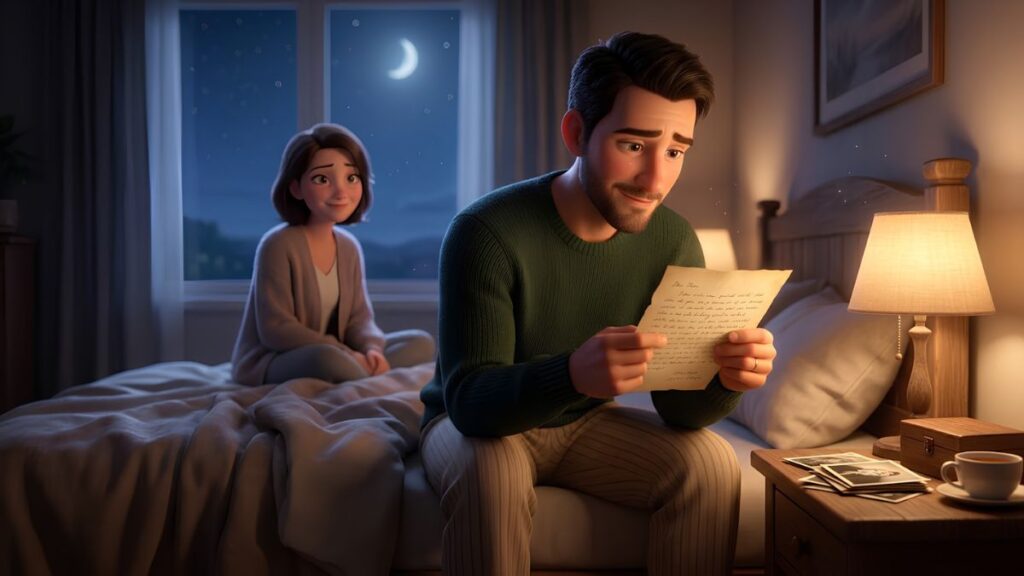
Daniel had always been good at appearing strong.
If someone asked him how he was doing, he usually answered with the same words.
“I’m fine.”
Sometimes he was.
Sometimes he wasn’t.
But he had become so accustomed to keeping difficult feelings to himself that eventually, even he could not tell the difference.
He worked hard.
He kept his promises.
He helped his family.
He showed up when his friends needed him.
If something went wrong, he tried to fix it.
If someone needed advice, he tried to give it.
And when life became difficult, he simply told himself to keep going.
People admired him for it.
“You are strong.”
“You never give up.”
“You always know what to do.”
Daniel smiled whenever he heard those words.
But secretly, there were nights when he wondered whether anyone would notice if he stopped being strong for a while.
One Friday evening, after a particularly exhausting week, Daniel returned home later than usual.
He dropped his keys on the table.
He took off his jacket.
Then he sat quietly on the edge of his bed.
His apartment was completely silent.
There were no messages waiting for him.
No calls.
No work that absolutely needed to be done.
For the first time all week, he had nothing demanding his attention.
And somehow, that made him feel even more tired.
He looked around the room.
On the shelf stood several old photographs.
One showed him as a child.
Another showed his parents.
Another showed Daniel and his childhood best friend, Ethan.
Daniel smiled.
Ethan had been his closest friend growing up.
They had gone to school together.
Played football together.
Studied together.
Dreamed about the future together.
Then adulthood had happened.
They had moved to different cities.
Their calls became less frequent.
Their lives became busy.
They still cared about each other.
But they no longer spoke every week.
Sometimes they went months without talking.
Daniel looked at the photograph.
“I wonder how you’re doing,” he whispered.
The next morning, Daniel received a message.
It was from Ethan.
I found something that belongs to you.
Daniel smiled.
What is it?
A few minutes later, another message arrived.
Come visit when you can. I’ll show you.
Daniel was curious.
So the following weekend, he drove to Ethan’s town.
They spent the afternoon talking.
They laughed about school.
They remembered ridiculous things they had done as teenagers.
They talked about people they had lost touch with.
They talked about life.
Eventually, Ethan disappeared into another room.
When he returned, he was carrying a small wooden box.
He placed it on the table.
“Do you remember this?”
Daniel looked at it.
“No.”
Ethan opened the box.
Inside were several old photographs, a school badge, a broken watch, and a folded piece of paper.
Daniel picked up the paper.
“What is this?”
Ethan smiled.
“Open it.”
Daniel unfolded it.
At the top was his own name.
Dear Daniel,
He looked at Ethan.
“Who wrote this?”
“You did.”
Daniel stared at him.
“What?”
“You wrote it when we were seventeen.”
Daniel laughed.
“I did not.”
“You did.”
Ethan pointed toward the bottom of the page.
There was Daniel’s old handwriting.
Daniel sat down.
He began reading.
The letter was written to his future self.
It started simply.
If you are reading this, you are probably older than I am now.
Daniel smiled.
He continued.
I don’t know what your life looks like.
Maybe you have the job we talked about.
Maybe you live in a big city.
Maybe you have a family.
Maybe none of those things happened.
Daniel’s smile faded slightly.
He kept reading.
But I hope you remember something.
You don’t have to become someone important to be someone worthy.
Daniel stopped.
He read the sentence again.
Then again.
Ethan watched quietly.
Daniel continued.
I hope you still laugh easily.
I hope you still make time for people you love.
I hope you don’t become so busy trying to build a good life that you forget to enjoy the one you have.
Daniel swallowed.
The words were simple.
But they felt strangely powerful.
He continued.
And if life becomes difficult, please remember that you are allowed to be tired.
You don’t always have to be strong.
Daniel stopped reading.
He looked away.
For several seconds, he said nothing.
Ethan quietly placed a hand on his shoulder.
Daniel continued.
If you make mistakes, forgive yourself.
If you fail, try again.
If you lose someone, remember the good times instead of only the sadness.
And if you ever feel like nobody believes in you, remember that the seventeen-year-old version of you does.
At the bottom were a few final words.
I hope you are proud of yourself.
Not because of how much you have achieved.
But because of the kind of person you became.
Daniel folded the letter.
He looked down at it.
“I forgot I wrote this.”
Ethan smiled.
“That’s why I kept it.”
Daniel laughed softly.
“Why didn’t you give it to me years ago?”
“I forgot about it too.”
They both laughed.
But Daniel’s eyes were wet.
He quickly wiped them.
Ethan noticed.
He did not comment.
They sat quietly.
After a while, Daniel said:
“I don’t think I’ve been very kind to myself.”
Ethan looked at him.
“What do you mean?”
“I keep thinking I should be doing more.”
“More than what?”
“More than I am.”
Ethan smiled.
“You have always been like that.”
Daniel looked at the letter.
“Maybe seventeen-year-old me understood something I forgot.”
“What?”
“That life isn’t just about becoming successful.”
Ethan nodded.
“Maybe.”
They spent the rest of the afternoon together.
Before Daniel left, Ethan gave him the letter.
“You should keep it.”
Daniel placed it carefully inside his wallet.
“Thank you.”
“Don’t lose it.”
“I won’t.”
On the drive home, Daniel thought about the letter.
He thought about the boy who had written it.
That boy had no idea what the future would bring.
He did not know about the difficult years.
He did not know about the failures.
He did not know about the responsibilities.
He did not know about the nights when Daniel would feel exhausted and wonder whether he was doing enough.
But that boy had believed in him anyway.
Daniel smiled.
When he reached home, he placed the letter on his bedside table.
He read it again before going to sleep.
The words felt different the second time.
They no longer sounded like advice from his younger self.
They sounded like kindness.
The next morning, Daniel made a small change.
He woke up without immediately checking his phone.
He made breakfast.
He sat near the window.
He drank his coffee slowly.
It was an ordinary morning.
Nothing extraordinary happened.
But Daniel noticed it.
He noticed the sunlight.
The sound of birds.
The warmth of the cup.
The quiet.
He realized how often he had rushed through moments like this.
The following week, he called his parents.
They talked for nearly an hour.
He called another old friend.
He apologized to someone he had been avoiding.
He went for a walk without taking his phone.
He cooked dinner instead of ordering food.
He laughed at a silly video.
He went to bed earlier.
None of these things changed his life dramatically.
But something inside him began to soften.
He started recognizing that his life did not need to become perfect before he was allowed to appreciate it.
One evening, several months later, Daniel was sitting at home with his girlfriend, Maya.
She noticed the old letter on the table.
“What is that?”
Daniel smiled.
“A letter.”
“From whom?”
“Me.”
She laughed.
“You write letters to yourself?”
“I did when I was seventeen.”
She opened it carefully.
“Can I read it?”
Daniel hesitated.
Then he nodded.
She read it.
When she finished, she looked at him.
“This is beautiful.”
Daniel smiled.
“I forgot how hopeful I used to be.”
Maya touched his hand.
“You’re still hopeful.”
“Sometimes I don’t feel that way.”
“Maybe you just need reminders.”
Daniel looked at her.
“That’s what the letter was.”
She smiled.
“Then keep it.”
“I will.”
Maya leaned against him.
They sat quietly.
Daniel looked at the letter again.
He suddenly understood something.
The letter was not valuable because of the paper.
It was valuable because someone had written it with complete faith in the person Daniel would become.
And that person was him.
His younger self had not known whether Daniel would become wealthy.
He had not known whether Daniel would have a successful career.
He had not known whether everything would work out.
He had simply hoped that Daniel would remain kind.
That was enough.
Years later, Daniel kept the letter.
The paper became slightly worn.
The folds became softer.
The ink faded a little.
But he never threw it away.
Whenever life became difficult, he read it.
Whenever he succeeded at something, he read it.
Whenever he felt lost, he read it.
Eventually, he began writing letters to himself more often.
Not long letters.
Just a few lines.
Sometimes he wrote:
You are doing better than you think.
Sometimes:
Rest today. You don’t need to solve everything.
Sometimes:
Remember to call your family.
Sometimes:
Be proud of how far you’ve come.
And sometimes:
You are allowed to be happy without having a perfect life.
The letters became a quiet tradition.
One evening, many years later, Daniel found himself sitting beside his own teenage son.
His son had had a difficult day.
A school project had gone badly.
He was frustrated.
“I’m not good enough,” the boy said.
Daniel looked at him.
He remembered himself at that age.
He remembered the letter.
He remembered the boy who had believed in his future self.
Daniel put his arm around his son.
“You’re allowed to have a bad day.”
His son looked at him.
“But I failed.”
“Yes.”
“Doesn’t that mean I’m not good enough?”
“No.”
Daniel smiled.
“It means you failed at something.”
His son looked confused.
“That’s different.”
“How?”
“Because failing at something doesn’t mean you are a failure.”
His son became quiet.
Daniel continued.
“You don’t have to be perfect to make me proud.”
The boy looked down.
Then he leaned against his father.
Daniel smiled.
For a moment, he understood that perhaps the greatest thing his seventeen-year-old self had given him was not the letter.
It was the reminder that people need encouragement.
Sometimes we spend years waiting for someone else to tell us that we are doing enough.
But sometimes, we also need to learn how to tell ourselves.
That night, after his son had gone to bed, Daniel returned to his room.
He opened the old wooden box.
Inside was the original letter.
He unfolded it carefully.
The first line was still there.
Dear Daniel,
He smiled.
Then he whispered:
“Thank you.”
He thought about the young boy who had written those words.
He wished he could go back and tell him something.
You were right.
Life became difficult.
You made mistakes.
You lost people.
You changed.
You became tired.
You achieved some things and failed at others.
You did not become the perfect person you imagined.
But you became someone who learned to keep going.
Someone who learned to love.
Someone who learned to forgive.
Someone who learned that being strong does not mean never feeling weak.
Someone who learned that success means very little if you cannot appreciate the people beside you.
Someone who finally understood that he did not need to earn his own worth.
Daniel folded the letter.
He placed it back in the box.
Then he turned off the light.
The room became quiet.
He lay down.
For once, he did not think about everything he needed to accomplish tomorrow.
He simply remembered the words of the boy he had once been.
I hope you are proud of yourself.
Daniel smiled in the darkness.
“I am,” he whispered.
And with that thought resting gently in his mind, he closed his eyes.
Moral of the Story
Sometimes you need someone to remind you of your worth, but you can also learn to become that voice for yourself. You do not have to be perfect or endlessly strong to deserve kindness, rest, and love.
A Gentle Thought Before Sleep
If you are reading this story to your boyfriend tonight, let the story end quietly.
You might tell him something simple.
“I’m proud of you.”
He may hear those words often.
Or perhaps he rarely hears them.
Either way, they can mean a great deal.
The person you love may carry responsibilities you do not always see.
He may have worries he does not talk about.
He may sometimes question whether he is doing enough.
He may appear confident while quietly wondering whether he is falling behind.
Tonight can be a reminder that he does not have to have everything figured out.
He does not have to win every battle.
He does not have to be strong every moment.
He is allowed to rest.
He is allowed to make mistakes.
He is allowed to change his plans.
And he is allowed to be proud of how far he has already come.
So let the night become quiet.
Let tomorrow wait.
For tonight, there is nothing he needs to prove.
Nothing you need to fix.
Just two people sharing a peaceful moment.
And sometimes, that is exactly what the heart needs.
4. The House Where the Rain Always Sounded Different

There was a small house at the edge of a quiet village where the rain always seemed to sound different.
Nobody could explain why.
It was not the oldest house in the village.
It was not the most beautiful.
It did not have a magnificent garden or a spectacular view.
It was simply a small countryside house with white walls, a red roof, wooden windows, and a narrow porch facing a field.
But whenever it rained, the house seemed to become another world.
The sound of rain against the roof was soft.
The windows became covered with tiny drops.
The wooden floors smelled faintly of earth and old books.
And the whole house seemed to invite anyone inside to slow down.
Years earlier, a young couple named Oliver and Sophie had discovered the house almost by accident.
They had been traveling through the countryside during a long weekend.
Neither of them had planned to stay there.
They had simply wanted to drive somewhere quiet.
They were tired of crowded streets, noisy restaurants, and busy schedules.
So they had packed a few clothes, put some music on in the car, and driven without a strict destination.
On the second afternoon, the sky suddenly became dark.
Then the rain began.
At first, it was only a few drops.
Then the rain became heavier.
Within minutes, the road ahead was almost impossible to see.
Oliver slowed the car.
“We should probably find somewhere to stop.”
Sophie looked through the windshield.
“I agree.”
A few minutes later, they saw a small wooden sign.
ROOMS AVAILABLE
Behind it stood the little house.
Oliver parked near the porch.
They ran through the rain and knocked on the door.
An elderly woman opened it.
“You look soaked.”
Sophie laughed.
“We noticed.”
The woman smiled.
“I have one room left.”
“That would be perfect.”
The woman showed them inside.
The house was warm.
A small fireplace crackled in the corner.
There were books on the shelves.
Old photographs hung on the walls.
A kettle whistled softly in the kitchen.
The rain continued outside.
Oliver looked around.
“I think we got lucky.”
The woman smiled.
“People usually do when they stop rushing.”
Neither Oliver nor Sophie understood what she meant.
Not yet.
That evening, the rain became heavier.
They had planned to explore the village.
Instead, they stayed inside.
Sophie made tea.
Oliver found an old board game.
They sat near the fireplace and played.
They laughed when Oliver lost repeatedly.
“This game is terrible,” he said.
“You just don’t know how to play.”
“I know exactly how to play.”
“You’ve lost four times.”
“That proves nothing.”
Sophie laughed.
Later, they cooked a simple dinner in the little kitchen.
Nothing fancy.
Just pasta, vegetables, and bread.
But it tasted wonderful.
Perhaps it was because they were hungry.
Perhaps it was because they had cooked it together.
Or perhaps it was because there was nowhere else they needed to be.
After dinner, they sat near the window.
The rain was still falling.
Sophie rested her head on Oliver’s shoulder.
“Do you hear that?”
“The rain?”
“Yes.”
“It sounds nice.”
She smiled.
“It sounds different here.”
Oliver laughed.
“Rain is rain.”
“No.”
She looked toward the window.
“Listen.”
They were quiet.
Drops tapped against the roof.
Water flowed through the gutters.
Wind moved through the trees.
Somewhere in the distance, thunder rolled softly.
Oliver listened.
After a while, he smiled.
“You’re right.”
“What?”
“It does sound different.”
Sophie smiled.
“I knew it.”
They stayed awake late that night.
They talked about everything.
Childhood.
Family.
Work.
Dreams.
Things they were afraid to admit.
Plans they had postponed.
Places they wanted to visit.
At one point, Sophie asked:
“Are you happy?”
Oliver looked at her.
“Right now?”
“Yes.”
He thought about it.
“Very.”
She smiled.
“Me too.”
The next morning, the rain stopped.
They had breakfast on the porch.
The sky was clear.
Birds sang in the trees.
Neither wanted to leave.
But they had to return home.
Before leaving, Sophie looked back at the house.
“We should come here again.”
Oliver nodded.
“We will.”
They did.
But not immediately.
Life became busy.
Oliver’s work became demanding.
Sophie started a new project.
Their weekends filled with responsibilities.
They still loved each other.
They still spent time together.
But somehow, the days became faster.
Months passed.
Then years.
Their relationship remained strong, but both began feeling that something was missing.
They went to restaurants.
They watched movies.
They traveled occasionally.
They bought gifts.
They celebrated birthdays.
Yet sometimes they would sit together at the end of the day and realize they had spent hours beside each other without really talking.
One evening, after a particularly stressful week, Sophie looked at Oliver.
“Do you remember the little house?”
Oliver knew immediately which one she meant.
“The rainy weekend?”
She nodded.
“I miss it.”
“So do I.”
“What if we go back?”
Oliver looked at the calendar.
“Next weekend?”
Sophie smiled.
“Next weekend.”
So they returned.
The house looked almost exactly as they remembered it.
The same red roof.
The same wooden windows.
The same porch.
The same quiet field.
The elderly woman was still there.
When she opened the door and saw them, she smiled.
“I wondered when you’d come back.”
Sophie laughed.
“You remember us?”
“I remember everyone who leaves happier than they arrived.”
Oliver smiled.
“Then I suppose we made an impression.”
She showed them to the same room.
The bed was still there.
The little wooden table.
The old lamp.
The window overlooking the field.
That evening, it began to rain.
Sophie stood near the window.
Oliver joined her.
For a moment, neither spoke.
Then Sophie smiled.
“Do you hear it?”
Oliver laughed softly.
“The rain?”
“Yes.”
“It still sounds different.”
They sat together.
This time, they did not play a game.
They did not watch television.
They did not check their phones.
They simply listened.
After a while, Oliver said:
“I think I know why it sounds different.”
Sophie looked at him.
“Why?”
“Because we are different here.”
She smiled.
“What do you mean?”
“We don’t have anywhere to rush to.”
Sophie thought about it.
“You might be right.”
They talked that night.
Not about work.
Not about schedules.
Not about bills.
They talked about themselves.
About what they wanted.
About what they had forgotten.
Oliver admitted that he had been feeling exhausted.
Sophie admitted that she had been feeling lonely even when they were together.
Neither blamed the other.
They simply listened.
And somehow, listening was enough to make the distance between them smaller.
The following morning, they walked through the village.
They bought bread from a small bakery.
They watched children playing in the square.
They sat beside a pond.
They had lunch at a tiny restaurant.
Nothing extraordinary happened.
Yet the entire day felt special.
On Sunday evening, they returned to the house.
Rain began falling again.
They sat on the porch.
Sophie leaned against Oliver.
“Do you remember what we talked about the first time?”
Oliver smiled.
“Almost everything.”
“What did you think then?”
“That I wanted to stay here forever.”
She laughed.
“You didn’t tell me that.”
“I was trying to sound practical.”
“You failed.”
He laughed.
They watched the rain.
Then Sophie said:
“I think we should make this a tradition.”
“Come here every year?”
“Yes.”
“Even when we’re old?”
“Especially then.”
Oliver took her hand.
“Deal.”
Years passed.
They kept their promise.
Every year, they returned to the little house.
Sometimes they stayed for a weekend.
Sometimes only for one night.
Sometimes it rained.
Sometimes it didn’t.
But they always slowed down.
They remembered to talk.
They remembered to listen.
They remembered that their relationship was not only about planning a future.
It was also about experiencing the present.
Eventually, they brought their children.
The children loved the house.
They ran through the field.
They played board games.
They asked questions about the old photographs.
One rainy evening, their daughter asked:
“Why do you both like this place so much?”
Sophie looked at Oliver.
He smiled.
Then she said:
“Because this is where we learned how to slow down.”
Their daughter looked confused.
“Slow down from what?”
“Everything.”
The little girl looked toward the rain.
“Why?”
Oliver answered.
“Because sometimes life becomes so busy that you forget to notice the people sitting beside you.”
Their daughter thought about that.
Then she climbed onto the sofa between them.
“Then let’s listen.”
They all became quiet.
Rain tapped against the roof.
Their son joined them.
The family sat together.
No television.
No phones.
No distractions.
Just the sound of rain.
And somehow, the house felt even warmer than before.
Many years later, when Oliver and Sophie were older, they returned to the house alone.
Their children had grown up.
Their lives had changed.
The village had changed too.
The elderly woman who owned the house had passed away.
Her daughter now managed the property.
The house looked smaller than Oliver remembered.
Perhaps the house had not changed.
Perhaps he had.
They sat beside the same window.
Rain began falling.
Sophie smiled.
“It still sounds different.”
Oliver laughed.
“I was going to say the same thing.”
They held hands.
For a while, they listened.
Then Oliver said:
“Do you remember our first night here?”
“Yes.”
“We thought the rain sounded different.”
Sophie smiled.
“Maybe it always did.”
“Maybe.”
They looked at each other.
Oliver understood something he had not understood when he was young.
The rain had never been the important part.
The house had never been the important part.
What mattered was that the house had given them permission to stop.
To sit.
To listen.
To talk.
To remember each other.
The world outside had always been noisy.
There had always been deadlines.
Bills.
Responsibilities.
Messages.
Problems.
Plans.
But inside that little house, they had learned that love needed quiet too.
Not because silence solved everything.
But because silence gave people room to hear one another.
Sophie rested her head on Oliver’s shoulder.
“Are you happy?”
He smiled.
“Right now?”
She nodded.
“Very.”
“Me too.”
The rain continued.
The evening became darker.
The house grew quieter.
Oliver closed his eyes.
He listened to the rain.
And for a moment, he was young again.
A young man sitting beside the woman he loved.
No plans.
No worries about tomorrow.
Just warmth.
Rain.
And the feeling that he was exactly where he needed to be.
Moral of the Story
The happiest moments are not always the exciting ones. Sometimes the most precious memories come from slowing down, being present, and appreciating the simple moments you share with someone you love.
A Gentle Thought Before Sleep
If you are reading this story to your boyfriend tonight, let the ending remind you that you do not always need to plan something special.
You do not need a perfect date.
You do not need an expensive gift.
You do not even need to leave home.
Sometimes happiness can be as simple as sitting together after a long day.
Talking.
Laughing.
Listening to the rain.
Sharing a blanket.
Holding hands.
Or simply being quiet without feeling the need to fill the silence.
The person beside you may not remember every place you visited.
But he may remember how safe and peaceful he felt when he was with you.
So tonight, let everything else wait.
Let the messages remain unanswered for a little while.
Let tomorrow take care of itself.
Listen to the quiet.
Listen to the rain if it is falling outside.
And remember that some of life’s most beautiful memories are created when nothing special is happening at all.
Sometimes, ordinary moments become extraordinary simply because you shared them with the person you love.
5. The Man Who Wanted to Give Her the Moon

There was once a young man named Adrian who believed that love had to be proven through extraordinary things.
He was not a bad man.
Quite the opposite.
He was thoughtful, hardworking, and deeply devoted to the woman he loved.
Her name was Lily.
Adrian loved everything about her.
He loved the way she laughed when something surprised her.
He loved how she became completely focused whenever she was reading.
He loved that she remembered small details about people.
He loved how she could turn an ordinary afternoon into something memorable simply by being happy.
And because he loved her so much, Adrian was always trying to find ways to make her happy.
He brought her flowers.
He bought her favorite desserts.
He planned surprise dinners.
He searched for beautiful gifts whenever an important date approached.
Whenever Lily thanked him, he smiled.
But secretly, Adrian worried.
He wondered whether he was doing enough.
One evening, while walking home together, Lily pointed toward the sky.
“Look.”
Adrian looked up.
The moon was enormous.
It hung above the rooftops, bright and silver against the dark sky.
“It’s beautiful,” Lily said.
Adrian smiled.
“Yes.”
She watched it for a moment.
“I wish I could keep nights like this forever.”
Adrian looked at her.
An idea entered his mind.
It was a ridiculous idea.
An impossible idea.
But Adrian was young and very much in love.
He decided he would find a way to give Lily the moon.
He did not know how.
But he was determined.
The next morning, he began researching.
Could someone buy a piece of land on the moon?
Could someone name a star?
Could someone purchase a telescope powerful enough to make the moon appear closer?
Could he arrange some kind of spectacular surprise?
He spent hours searching.
He found companies offering certificates claiming to name stars.
He found moon-shaped jewelry.
He found paintings.
He found lamps.
He found enormous decorations shaped like the moon.
But none of them felt right.
He did not want to give Lily a symbol of the moon.
He wanted to give her the real thing.
Of course, that was impossible.
Still, Adrian kept trying.
He contacted an astronomer.
The astronomer laughed kindly.
“You cannot give someone the moon.”
“I know.”
“Then why are you asking?”
Adrian thought about it.
“Because I love her.”
The astronomer smiled.
“Then perhaps you’re looking for the wrong gift.”
Adrian did not understand.
“What do you mean?”
“You are trying to give her something you cannot own.”
“Yes.”
“Why not give her something you can?”
Adrian thought about that.
“What?”
The astronomer shrugged.
“Your time.”
Adrian thanked him.
But he was still not satisfied.
He wanted something extraordinary.
Something Lily would never forget.
So he began planning.
He found a beautiful hill outside the city.
From there, the moon appeared enormous.
He imagined decorating the entire hill with lanterns.
He imagined music.
A beautiful dinner.
Flowers.
A photographer.
Maybe even a small orchestra.
He spent weeks planning.
He wanted the evening to be perfect.
Finally, the day arrived.
Adrian picked Lily up.
She looked surprised.
“Where are we going?”
“It’s a surprise.”
She smiled.
They drove outside the city.
The sun was beginning to set.
When they reached the hill, Lily stepped out of the car.
She looked around.
There were lanterns glowing softly along the path.
A small table had been prepared.
There were flowers.
A blanket.
A basket of food.
And above them, the moon was beginning to rise.
Lily looked at Adrian.
“You did all this?”
He smiled.
“I wanted to give you something special.”
She walked slowly toward the blanket.
“This is beautiful.”
Adrian felt relieved.
They ate dinner.
They listened to music.
They talked.
They laughed.
But Adrian kept watching Lily.
He wanted to know whether she was impressed enough.
At one point, she noticed.
“Why are you looking at me like that?”
“I’m just happy.”
She smiled.
“I’m happy too.”
The moon rose higher.
Adrian finally brought out a small box.
Lily looked curious.
“What’s that?”
He opened it.
Inside was a delicate necklace with a tiny silver moon.
She smiled.
“It’s beautiful.”
“I wanted to give you the moon.”
She laughed softly.
“You did?”
“Well…”
He looked embarrassed.
“Not exactly.”
She touched the necklace.
“It’s lovely.”
But Adrian still felt dissatisfied.
He looked toward the real moon.
“I wish I could give you that one.”
Lily became quiet.
Then she looked at him.
“Why?”
“Because you deserve something extraordinary.”
She smiled.
“Do I?”
“Yes.”
“Why?”
“Because I love you.”
Lily reached for his hand.
“Adrian, you don’t need to give me the moon.”
He smiled.
“I know.”
“No, I don’t think you do.”
She turned toward him.
“You keep trying to make every moment extraordinary.”
Adrian looked down.
“Is that bad?”
“No.”
She squeezed his hand.
“But sometimes I just want an ordinary evening with you.”
He looked at her.
“What do you mean?”
“I mean this.”
She gestured around them.
“The food is wonderful.”
“The flowers are beautiful.”
“The necklace is lovely.”
“But do you know what my favorite part is?”
Adrian shook his head.
“You sitting beside me.”
He smiled.
“You could have told me that.”
“I’ve been trying.”
He laughed.
“I suppose I’ve been busy.”
“Very busy.”
They both laughed.
Lily looked toward the moon.
“Do you remember our first date?”
“Of course.”
“What did we do?”
“We walked around the old market.”
“And then?”
“We got lost.”
“You got us lost.”
“I prefer to say we explored.”
She laughed.
“Then we ate noodles from a tiny street stall.”
“Yes.”
“And do you remember what happened?”
“You spilled sauce on your shirt.”
“Because you made me laugh.”
Adrian smiled.
“That was a good night.”
“It was.”
Lily looked at him.
“We didn’t have flowers.”
“No.”
“No fancy restaurant.”
“No.”
“No lanterns.”
“No.”
“No moon necklace.”
“Definitely no moon necklace.”
She smiled.
“But I remember that night more clearly than any expensive date we’ve had.”
Adrian looked toward the ground.
He finally understood.
He had been trying to create perfect memories.
But Lily had never asked for perfection.
She wanted presence.
She wanted him.
The next morning, Adrian made a change.
He stopped trying so hard to impress her.
Instead, he started paying attention.
He noticed when she was tired.
He listened when she talked.
He remembered small things.
He learned when she wanted advice and when she simply wanted someone to listen.
He started making breakfast on ordinary mornings.
He sometimes left small notes for her.
Not elaborate love letters.
Just little messages.
Have a good day.
Don’t forget to eat lunch.
I’m thinking about you.
Good luck today.
He discovered that these tiny gestures made Lily happier than many of his expensive surprises.
One Saturday morning, Lily woke up early.
Adrian was already in the kitchen.
“What are you doing?”
“Breakfast.”
She looked at the table.
There were pancakes.
They were slightly burned.
She smiled.
“You cooked?”
“Yes.”
“Should I be worried?”
He laughed.
“Probably.”
She sat down.
They ate together.
The pancakes were not perfect.
The coffee was too strong.
Adrian had forgotten to buy syrup.
And yet Lily smiled throughout the entire meal.
Later that afternoon, they went for a walk.
They stopped at a park.
Children were playing.
Dogs ran across the grass.
Someone was playing guitar nearby.
Nothing extraordinary happened.
But Lily seemed happy.
Adrian finally understood.
Love did not need to be spectacular to be meaningful.
One evening, months later, they were sitting on their balcony.
The moon was visible again.
Adrian looked at it.
Then at Lily.
“Do you still want the moon?”
She laughed.
“I never wanted the moon.”
“I know.”
He smiled.
“I was a little foolish.”
“A little.”
“Maybe very foolish.”
“Definitely very foolish.”
They laughed.
Then Lily rested her head on his shoulder.
“Do you know what I want?”
“What?”
“This.”
“What?”
“You.”
She looked at him.
“Not the perfect version of you.”
Adrian smiled.
“Good.”
“Not the version who spends all his time planning surprises.”
“Even better.”
“Just you.”
He held her hand.
“That’s something I can give you.”
She smiled.
“Exactly.”
Years passed.
They traveled together.
They built a home.
They had difficult days.
They had wonderful days.
They disagreed.
They forgave each other.
They changed.
They grew.
But whenever Adrian saw the moon, he remembered that evening on the hill.
The night he had tried to give Lily something impossible.
And the night she taught him something far more valuable.
One evening, many years later, Adrian and Lily were sitting outside their home.
The moon was full.
Their children had gone to bed.
The neighborhood was quiet.
Adrian looked up.
“You know what?”
“What?”
“I still can’t give you the moon.”
Lily smiled.
“I know.”
“But I can sit here and look at it with you.”
She leaned against him.
“That’s better.”
They sat together.
The moonlight spread across the garden.
The night was still.
Adrian thought about how much his understanding of love had changed.
When he was younger, he had believed love meant giving someone extraordinary things.
Now he understood that love was often much quieter.
It was making tea when someone was tired.
It was remembering how they liked their coffee.
It was listening to the same story for the third time.
It was waiting when they needed time.
It was staying when things became difficult.
It was laughing together over burned pancakes.
It was sitting under the moon without needing to say anything.
He looked at Lily.
“Are you happy?”
She smiled.
“Very.”
“Even without the moon?”
She laughed.
“Especially without the moon.”
Adrian laughed too.
Then he took her hand.
The moon continued shining above them.
Neither of them owned it.
Neither needed to.
It was enough that they could look at it together.
And perhaps that was the real lesson.
Some of the most beautiful things in life cannot be owned.
They can only be experienced.
A sunset.
A song.
A quiet evening.
A laugh.
A memory.
A moment beside someone you love.
You cannot keep them forever.
But you can be present while they happen.
And sometimes, that is even better than possessing them.
Adrian looked at Lily again.
She smiled.
He smiled back.
There was no grand gesture.
No expensive gift.
No perfect speech.
Only two people sitting together beneath the moon.
And for Adrian, that was finally enough.
Moral of the Story
Love is not measured by how much you can give someone. Sometimes the greatest gift is your time, attention, presence, and willingness to share ordinary moments together.
A Gentle Thought Before Sleep
If you are reading this story to your boyfriend tonight, remember that he does not need to give you the moon.
And you do not need to give him the world.
Sometimes you can simply give each other your attention.
Put away the phone.
Turn down the lights.
Sit close.
Talk about your day.
Laugh about something silly.
Or simply enjoy the silence together.
The best moments in a relationship are not always the ones that look impressive from the outside.
Sometimes they are the moments nobody else sees.
A quiet conversation.
A shared joke.
A hand held under the blanket.
A sleepy smile.
A simple “I’m glad you’re here.”
Those moments may seem ordinary.
But one day, they may become the memories you treasure most.
So tonight, don’t worry about making everything perfect.
Just be together.
The moon is already shining.
You don’t need to give it away.
You only need to look at it together.
6. The Two Lanterns by the Sea

In a small coastal village surrounded by green hills and quiet fields, there lived a young man named Elias.
His village stood on one side of a wide bay.
Across the water, on the opposite shore, was another village.
During the day, the two villages could see each other clearly.
At night, however, the distance between them seemed much greater.
The sea became dark.
The hills became shadows.
And the only lights visible across the water were the small lamps glowing from houses along the opposite shore.
Elias lived with his mother in a modest house near the harbor.
His father had been a fisherman.
Every morning, he would take his boat into the sea.
Every evening, he would return before sunset.
Elias had grown up listening to stories about the water.
He knew which parts of the bay were dangerous.
He knew where the fishermen usually went.
He knew how to read the weather.
But more than anything, he loved the sea at night.
There was something peaceful about it.
The waves moved slowly.
The air smelled of salt.
The stars reflected on the dark water.
And across the bay, tiny lights shimmered in the distance.
One evening, when Elias was twenty-three, he stood outside his home holding a small lantern.
His father had given it to him years earlier.
It was old.
The metal was slightly scratched.
The glass was imperfect.
But Elias loved it.
That night, he lit the lantern and placed it beside the window.
He had no particular reason for doing so.
He simply liked the warm glow.
Then he noticed something.
Across the bay, another lantern appeared.
It was small.
A single golden light in the darkness.
Elias wondered who had lit it.
The next night, the same thing happened.
He placed his lantern beside the window.
A little later, the distant lantern appeared.
Again.
The following night, Elias waited.
At almost the same time, the light appeared.
He smiled.
Perhaps someone on the other side had a habit similar to his.
Perhaps they liked watching the sea too.
He did not know.
But he began looking forward to it.
Every night, he lit his lantern.
Every night, the distant lantern appeared.
Weeks passed.
Then months.
Elias never met the person behind the light.
He did not even know whether it was a man or a woman.
But somehow, the little lantern became part of his evening.
When he had a good day, he lit his lantern.
When he had a difficult day, he lit it.
When he felt lonely, he lit it.
And every night, somewhere across the bay, another light answered.
One winter evening, Elias’s father went fishing and did not return.
A storm had appeared unexpectedly.
Boats were forced back toward shore.
Most returned safely.
His father’s boat did not.
For hours, Elias and his mother waited near the harbor.
The wind became stronger.
Rain fell heavily.
The sea became violent.
Eventually, the rescue boats returned.
His father’s boat had been damaged.
But he was alive.
He had been forced to shelter on a small island farther out in the bay.
He returned the next morning.
Elias hugged him so tightly that neither of them spoke.
That evening, Elias sat beside the window.
His hands were shaking.
He lit the lantern.
Across the water, the other light appeared.
For some reason, Elias felt calmer.
He imagined someone over there sitting beside their own window.
Maybe they had also had a difficult day.
Maybe they were watching the sea.
Maybe they were simply glad to see his light.
He whispered:
“Thank you.”
Of course, the person across the bay could not hear him.
But saying it made him feel better.
Years passed.
Elias became a fisherman himself.
He spent long days at sea.
Sometimes the weather was kind.
Sometimes it was not.
Sometimes he returned home exhausted.
But whenever he could, he looked toward the opposite shore.
And there it was.
The lantern.
One evening, while repairing his fishing nets, Elias mentioned it to his mother.
“Do you know who lives across the bay?”
She looked at him.
“Where?”
“Near the old lighthouse.”
She thought for a moment.
“There are several houses there.”
“The one with the lantern.”
His mother smiled.
“You’ve been watching that light for years.”
Elias laughed.
“Have I?”
“Yes.”
“Do you know who it belongs to?”
“No.”
Elias looked toward the sea.
“Neither do I.”
His mother smiled.
“Perhaps that’s why you like it.”
“Why?”
“Because you can imagine.”
Elias thought about that.
Maybe she was right.
The light was not a person he knew.
It was simply a reminder that someone was there.
And sometimes, that was enough.
Then one spring, something changed.
For three nights, the distant lantern did not appear.
Elias noticed immediately.
The first night, he assumed the person had forgotten.
The second night, he wondered if they were away.
By the third night, he became concerned.
He stood at the window for a long time.
The opposite shore remained dark.
He felt strangely disappointed.
He had never spoken to this person.
He had never met them.
Yet their absence made the night feel different.
The next evening, the lantern still did not appear.
Elias decided to ask someone.
The following morning, he took a boat across the bay.
When he reached the opposite village, he walked toward the old lighthouse.
There was a small house nearby.
An elderly woman was sitting outside.
Elias approached.
“Excuse me.”
She looked up.
“Yes?”
“I have a question.”
“Go ahead.”
“Do you know who lives in the house near the lighthouse?”
The woman smiled.
“Which house?”
“The one with the lantern.”
She laughed.
“There are many lanterns around here.”
“The one that is lit every evening.”
The woman’s expression changed.
“Oh.”
She understood.
“You mean Mara.”
Elias felt his heart beat faster.
“Mara?”
“Yes.”
“Is she okay?”
The woman nodded.
“She injured her ankle a few days ago. She can’t climb the stairs to the window.”
Elias smiled with relief.
“Is she at home?”
“Yes.”
He thanked the woman.
Then he walked to the house.
He knocked.
After a moment, a young woman opened the door.
She was holding a walking stick.
“Yes?”
Elias hesitated.
“Are you Mara?”
She looked surprised.
“Yes.”
“I’m Elias.”
She stared at him.
Then her eyes widened.
“The lantern.”
Elias smiled.
“You know?”
“I wondered who you were.”
They both laughed.
For the first time in years, the two lanterns had become two people.
Mara invited him inside.
They sat near the window.
Elias looked at the familiar lantern.
“You’ve been lighting it all this time.”
She nodded.
“You too.”
“Why?”
Mara thought for a moment.
“When I was younger, my mother used to say that the sea feels less lonely when you can see a light on the other side.”
Elias smiled.
“My father used to say something similar.”
“Really?”
“He said a light in the darkness doesn’t have to guide you home. Sometimes it simply needs to remind you that home exists.”
Mara smiled.
“That’s beautiful.”
They talked for hours.
They discovered that they had both watched the same sunsets.
Both had listened to the same storms.
Both had seen the same moon reflected on the water.
They had been separated by only a few miles of sea.
Yet for years, each had unknowingly been part of the other’s routine.
Mara told him that she had started lighting the lantern after her father died.
She had felt lonely.
The village seemed too quiet.
One evening, she had noticed Elias’s light across the water.
She had lit hers in response.
“It made me feel like I wasn’t alone,” she said.
Elias looked at her.
“That’s exactly how I felt.”
After that evening, they began visiting each other.
Sometimes Elias crossed the bay.
Sometimes Mara came to his village.
They walked along the shore.
They drank tea.
They talked about their lives.
They laughed about how long they had known each other without ever actually meeting.
“You know what I find funny?” Mara said one evening.
“What?”
“We spent years saying goodnight to each other without knowing each other’s names.”
Elias laughed.
“Maybe that’s why it worked.”
“Why?”
“We didn’t have to say anything.”
They smiled.
Their relationship grew slowly.
There was no rush.
No dramatic promise.
No sudden declaration.
They simply enjoyed being together.
One summer evening, they sat near the sea.
The sun had just disappeared.
The sky was turning purple.
Mara leaned against Elias.
“Do you remember the first night you saw my lantern?”
“Yes.”
“What did you think?”
“I thought someone across the water was watching the stars.”
She smiled.
“I was.”
“And you?”
She looked at him.
“I thought someone was reminding me that I wasn’t alone.”
Elias took her hand.
“You never were.”
Years later, they married.
They built a small home near the coast.
It had two windows facing the sea.
Every evening, they lit a lantern.
Sometimes they lit two.
One near each window.
Their children grew up hearing the story.
“Why do you light those every night?” their daughter once asked.
Mara smiled.
“Because your father and I used to send lights to each other before we met.”
Her daughter looked confused.
“How did you send them?”
“We didn’t.”
“But you said you sent them.”
“We sent them without words.”
The little girl thought about that.
Then she smiled.
“That’s nice.”
“It was.”
One night, many years later, Elias and Mara sat outside their home.
The sea was calm.
The stars were bright.
Their children were grown.
The village was quiet.
Mara looked across the water.
“I can still see the old lighthouse.”
Elias nodded.
“Me too.”
“Do you ever miss those days?”
He thought about it.
“Sometimes.”
“Why?”
“Because everything felt mysterious.”
Mara smiled.
“We didn’t even know each other.”
“No.”
“And yet you were part of my life.”
“You were part of mine.”
They sat quietly.
Then Elias looked at the lantern beside them.
“Do you think we would have met if we hadn’t lit those lanterns?”
Mara smiled.
“Maybe.”
“Maybe not.”
She rested her head against his shoulder.
“Either way, I’m glad we did.”
The sea moved gently in front of them.
A soft wind passed through the grass.
Across the bay, lights appeared one by one.
Elias watched them.
He remembered being young.
Sitting alone by the window.
Wondering who was behind the distant glow.
He had once believed the lantern was simply a sign that someone else existed.
Now he understood something deeper.
Sometimes we do not need to know everything about someone to feel connected to them.
Sometimes a small sign is enough.
A message.
A kind word.
A hand held in silence.
A light across the water.
The world can feel enormous.
People can feel far away.
Life can become lonely.
But somewhere, someone may be thinking of you.
Someone may be hoping you are okay.
Someone may be waiting for you to come home.
And sometimes, love begins before two people ever meet.
It begins with the quiet feeling that there is another light shining somewhere in the darkness.
Mara squeezed Elias’s hand.
“Ready for bed?”
He smiled.
“Almost.”
She looked toward the sea.
“One more minute?”
“Of course.”
They sat together.
The lantern beside them glowed softly.
The sea moved beneath the stars.
Across the bay, another light flickered.
And then another.
And another.
The darkness was no longer empty.
It was filled with small lights.
Small reminders.
Small promises.
Small signs that people were there.
Elias looked at Mara.
She smiled.
They did not need to say goodnight.
The lanterns said it for them.
Moral of the Story
Even when someone feels far away, a small sign of care can bring comfort. Sometimes knowing that another person is there is enough to make the darkness feel less lonely.
A Gentle Thought Before Sleep
If you are reading this story to your boyfriend tonight, think about how many small ways people say, “I’m here.”
A message asking how your day went.
A cup of tea left beside the bed.
A hand reaching for yours.
A quiet goodnight.
A simple reminder to rest.
Love does not always arrive through dramatic words.
Sometimes it appears as a small light in an ordinary moment.
So before you sleep, let your boyfriend know that he does not have to face everything alone.
You do not need to solve every problem tonight.
You do not need to plan tomorrow.
Just let him know that someone is beside him.
Someone cares.
Someone is thinking of him.
And sometimes, that little reminder is enough.
The night may be dark outside.
But there is always a light somewhere.
And if he ever feels lost, he can remember that there is someone waiting to see him safely home.
7. The Last Train Home

The last train left the city at 11:47 every night.
Most people who boarded it were tired.
Some were office workers returning home after long shifts.
Some were students carrying heavy backpacks.
Some were shopkeepers closing their stores.
Some were simply people who had stayed out longer than they intended.
The train was never crowded at that hour.
Its carriages were usually quiet, with only a handful of passengers scattered across the seats.
That particular Thursday night, a man named Noah boarded the last train home.
He had had one of those days that seemed to contain three days inside it.
He had arrived at work early.
He had attended meetings.
He had dealt with problems that were not his fault.
He had answered emails that seemed endless.
He had stayed late to finish an assignment.
And when he finally left the office, he discovered that it had started raining.
By the time he reached the station, his shoes were wet.
His shoulders were tense.
His phone was almost out of battery.
And he had no desire to speak to anyone.
He boarded the train and found a seat beside the window.
The doors closed.
The train moved.
Noah leaned his head against the glass.
Outside, the city slipped past in a blur of lights.
For the first few minutes, he simply watched.
Traffic lights.
Closed shops.
Apartment buildings.
Rain shining on the streets.
Everything looked different from the train.
The city that had felt loud and exhausting only an hour earlier now seemed strangely peaceful.
Noah closed his eyes.
He wanted to sleep.
But then someone sat across from him.
He opened his eyes.
It was a woman about his age.
She carried a small brown handbag and wore a dark coat.
Her hair was slightly wet from the rain.
She looked tired too.
She placed her bag beside her and looked toward the window.
For several minutes, neither spoke.
The train moved through the darkness.
Then the woman smiled.
“Long day?”
Noah looked at her.
“Very.”
She laughed softly.
“Me too.”
Noah smiled.
“I suppose that’s why we’re on the last train.”
“Probably.”
They returned to silence.
But it was not an uncomfortable silence.
There was something strangely easy about sitting across from a complete stranger.
No expectations.
No history.
No reason to impress each other.
After a few minutes, the woman looked at him again.
“Do you always take this train?”
“No.”
“Then what happened tonight?”
Noah smiled.
“Work.”
She nodded.
“That explains everything.”
He laughed.
“What about you?”
“Work.”
“So we’re both victims.”
“Apparently.”
They laughed quietly.
The train continued.
The woman introduced herself.
“Emma.”
“Noah.”
“Nice to meet you.”
“You too.”
The conversation could have ended there.
Instead, it continued.
Emma asked what Noah did for work.
He told her.
She told him about her job.
They talked about the city.
Then the weather.
Then travel.
Then food.
Then childhood.
The conversation moved naturally from one subject to another.
It was not deep at first.
But gradually, they began sharing things they did not normally tell strangers.
Noah told her that he had once wanted to become a writer.
“What happened?” Emma asked.
“Life.”
She smiled.
“That’s a common answer.”
“I suppose I became busy.”
“Do you still write?”
“Sometimes.”
“Why only sometimes?”
He looked out the window.
“I don’t know.”
Emma thought for a moment.
“Maybe you should.”
He smiled.
“Maybe.”
Then Noah asked her the same question.
“What did you want to do when you were younger?”
Emma smiled.
“I wanted to travel.”
“Did you?”
“A little.”
“Not enough?”
“Never enough.”
She laughed.
“I always thought I’d travel everywhere.”
“Where have you been?”
She named several places.
Noah listened.
“Which was your favorite?”
She thought about it.
“A small town near the sea.”
“Why?”
“Because nobody there seemed to be in a hurry.”
Noah smiled.
“I think I would like that.”
“Maybe you would.”
The train passed through another station.
A few passengers got off.
The carriage became even quieter.
Rain tapped gently against the windows.
Emma looked at Noah.
“Do you ever feel like your life is moving faster than you are?”
He looked at her.
“All the time.”
She nodded.
“Me too.”
They became quiet again.
Noah looked at the reflection of their faces in the window.
There was something familiar about her.
He could not explain it.
Her voice.
Her smile.
The way she looked down slightly when she laughed.
Something about her seemed familiar.
But he assumed it was simply coincidence.
Perhaps she reminded him of someone from his past.
The train continued through the night.
Emma opened her bag and took out an old photograph.
She looked at it for a moment.
Noah noticed.
“Family?”
She nodded.
“My mother.”
“She looks kind.”
“She was.”
Emma smiled sadly.
“She passed away a few years ago.”
“I’m sorry.”
“Thank you.”
She looked at the photograph.
“She used to tell me that life has strange timing.”
“What do you mean?”
“She believed people meet each other when they’re supposed to.”
Noah smiled.
“That’s a nice idea.”
“I think so too.”
“What did she mean by it?”
Emma looked at him.
“She said sometimes you can meet someone too early.”
“And then?”
“You aren’t ready.”
“For what?”
“For them.”
Noah considered that.
“That’s interesting.”
“She said if something is meant to return, it finds a way.”
The words stayed with Noah.
He looked out the window.
The train passed beneath a bridge.
Darkness briefly surrounded them.
Then the lights returned.
Emma folded the photograph and placed it back inside her bag.
“What about you?” she asked.
“What?”
“Do you believe people can find their way back to each other?”
Noah thought about it.
“I don’t know.”
“Why not?”
“Because people change.”
Emma nodded.
“That’s true.”
“Sometimes two people might have been right for each other once, but not anymore.”
“Also true.”
“So maybe people don’t return.”
Emma smiled.
“Maybe they do.”
The train continued.
Noah felt strangely comfortable.
He could not remember the last time he had talked to someone this openly.
Eventually, the announcement came.
Next station: Riverside.
Emma looked up.
“That’s mine.”
Noah felt a strange disappointment.
“Oh.”
She smiled.
“I suppose all good conversations have to end.”
“Apparently.”
The train slowed.
Emma stood.
She picked up her bag.
Noah looked at her.
That feeling of familiarity returned.
Stronger this time.
He stared at her face.
Then something happened.
Emma looked at him.
Her eyes widened.
“Wait.”
Noah stood.
“What?”
She stared at him.
“Have we met before?”
Noah laughed nervously.
“I was thinking the same thing.”
Emma shook her head.
“No. I mean…”
She looked closely at him.
“Do you remember the old community library?”
Noah froze.
“What?”
“The library near Green Street.”
He stared at her.
Then suddenly, a memory returned.
He was sixteen again.
Sitting at a library table.
Writing in a notebook.
There had been a girl sitting across from him.
She had been reading a book.
They had spoken several times.
They had shared notes.
They had laughed.
One afternoon, she had told him she was moving away.
He remembered being disappointed.
Then life had continued.
He had never seen her again.
Noah looked at Emma.
“Emma?”
She smiled.
“Noah?”
They both stared at each other.
Then they laughed.
It was unbelievable.
“You were the girl from the library.”
“And you were the boy who wanted to become a writer.”
Noah shook his head.
“I can’t believe this.”
Emma laughed.
“You used to write stories.”
“You remember?”
“Of course.”
“What did you write about?”
“Everything.”
She smiled.
“You once wrote a story about a boy who wanted to build a house on the moon.”
Noah laughed.
“I completely forgot that.”
“I didn’t.”
The train stopped.
The doors opened.
People moved through the station.
But neither of them stepped outside.
The doors began closing.
Emma looked at Noah.
“I guess I missed my stop.”
Noah smiled.
“I guess you did.”
The train started moving again.
They both laughed.
Neither cared.
For the next several minutes, they sat together remembering the past.
They talked about the library.
Their old neighborhood.
Their school.
Their dreams.
They realized they had lived in different cities for years.
They had both experienced relationships.
Career changes.
Family responsibilities.
Failures.
Successes.
Losses.
Growth.
And somehow, after all those years, they had ended up sitting across from each other on the last train home.
Emma looked at him.
“Do you know what’s strange?”
“What?”
“If we had met five years ago, we might not have recognized each other.”
“Maybe.”
“If we had met ten years ago…”
“We would have been completely different.”
She nodded.
“Exactly.”
Noah looked at her.
“Maybe your mother was right.”
Emma smiled.
“About what?”
“Timing.”
She looked out the window.
“Maybe.”
The train continued.
Neither of them wanted the journey to end.
Eventually, the announcement came again.
Final station.
They looked at each other.
“This is it,” Emma said.
Noah nodded.
The train slowed.
The station was almost empty.
They stepped onto the platform.
Rain was still falling lightly.
For a moment, they simply stood there.
Neither knew what to say.
They had found each other again after years.
But now came the difficult question.
What happens next?
Emma smiled.
“Do you still write?”
“Sometimes.”
“Will you write tomorrow?”
Noah smiled.
“I think I will.”
She nodded.
“Good.”
Then she looked at him.
“What about you?”
“What?”
“Are you still going to travel?”
She smiled.
“Maybe.”
“Where?”
She thought for a moment.
“Somewhere where nobody is in a hurry.”
Noah smiled.
“I know a place.”
“Really?”
“No.”
She laughed.
“But we can find one.”
Emma looked at him.
“Together?”
“Why not?”
She smiled.
The rain became slightly heavier.
Noah opened his umbrella.
They stood beneath it together.
Neither rushed.
The station was almost empty.
The last train waited behind them before beginning its return journey.
Noah suddenly realized something.
The day that had felt exhausting only a few hours earlier now seemed strangely valuable.
If he had left work earlier, he would not have taken the last train.
If he had taken another route, he would not have met Emma.
If he had chosen to stay home, he would not have heard her voice again.
If she had taken an earlier train, they would have missed each other.
So many tiny decisions had brought them to that platform.
He smiled.
“Funny how life works.”
Emma looked at him.
“What?”
“Nothing.”
He shook his head.
“Just thinking.”
“About what?”
“How close we came to never meeting again.”
Emma smiled.
“Maybe we weren’t supposed to.”
Noah looked at her.
“Until now.”
She nodded.
“Until now.”
They exchanged phone numbers.
Then they walked toward the exit together.
At the corner, they stopped.
Emma looked at him.
“Goodnight, Noah.”
“Goodnight, Emma.”
She turned to leave.
Then Noah called her.
“Emma.”
She turned.
“Yes?”
He smiled.
“Don’t disappear for another ten years.”
She laughed.
“I won’t.”
Then she walked away.
Noah watched until she disappeared into the rain.
He stood there for a moment.
Then he smiled.
The next morning, he woke earlier than usual.
He made coffee.
He opened an old notebook.
The first blank page stared back at him.
For years, he had told himself he would write again someday.
Now he finally began.
He wrote about a train.
A rainy night.
A woman with an old photograph.
A man who had forgotten how to dream.
And two people who discovered that some stories are not finished simply because they have been paused.
Sometimes they are waiting for the right chapter.
Days became weeks.
Noah and Emma began seeing each other.
They did not rush.
They talked.
They walked.
They visited the old library.
The library had changed.
The shelves were different.
The tables were newer.
But the corner where they had once sat was still there.
Emma stood beside it.
“Do you remember?”
Noah smiled.
“Everything.”
She looked at him.
“Do you think we were supposed to meet again?”
He thought about it.
“I think we were supposed to become the people we needed to be first.”
Emma smiled.
“That’s a better answer.”
They stood quietly.
Outside, the evening light faded.
Years had passed between them.
But somehow, the connection remained.
Not because they had stayed the same.
But because they had changed.
They had grown.
They had learned.
They had become more patient.
More understanding.
More aware of what mattered.
Perhaps that was why their second meeting felt different.
The first time, they had been children trying to understand life.
Now they were adults who had experienced enough of it to appreciate one another.
And perhaps that was the secret.
Sometimes people do not return to us because the past was perfect.
They return because the present finally gives us the chance to understand what we could not understand before.
Noah never forgot the last train.
Whenever he boarded it, he remembered that night.
Sometimes life can feel like a long journey.
You may think you are simply trying to get home.
You may believe that nothing meaningful is happening.
You may be tired.
You may feel as though you are moving through the same dark stations every day.
And then, unexpectedly, someone sits across from you.
A familiar smile.
A forgotten memory.
A conversation.
A second chance.
A new beginning.
You realize that perhaps the journey was never as empty as you thought.
Perhaps you were simply waiting for the right person to recognize you.
And sometimes, the right person arrives when neither of you is looking.
Not when you are younger.
Not when everything is easy.
Not when life is perfect.
But when you are finally ready.
That night, Noah and Emma walked home beneath the rain.
They did not know exactly where their story would lead.
They did not need to.
For the first time in a long time, Noah was not worried about the future.
He was simply grateful for the present.
The last train disappeared into the darkness behind them.
Its windows glowed warmly against the night.
And somewhere between the station and home, Noah realized that sometimes the most unexpected journeys are the ones that bring us exactly where we were meant to be.
Moral of the Story
Some connections need time, distance, and growth before they can find their way back to us. What feels like an ending may simply be a pause before the right moment arrives.
A Gentle Thought Before Sleep
If you are reading this story to your boyfriend tonight, let its message settle gently.
Not everything in life happens when we expect it to.
Some dreams take longer.
Some friendships change.
Some opportunities return years later.
Some people enter our lives, leave, and unexpectedly find their way back.
You do not have to force everything to happen immediately.
Sometimes the best things arrive when you are finally ready to appreciate them.
So tonight, let tomorrow wait.
You have already traveled far enough today.
Rest beside the person you love.
Let the worries of the day become quieter.
There is no need to know exactly where the next train is going.
For tonight, it is enough to know that you are on your way home.
And perhaps somewhere along the journey, life is quietly bringing something beautiful back to you.
Why Read a Bedtime Story to Your Boyfriend?
Bedtime stories are often associated with childhood, but adults can enjoy them too. In a relationship, reading to each other can create a different kind of intimacy.
When you read a story aloud to your boyfriend, you are giving him your attention.
You are creating a moment without the distractions of work, social media, notifications, and everyday responsibilities.
Even a very simple story can become meaningful because of the way you share it.
It Creates a Peaceful End to the Day
Many people go to bed while their minds are still busy.
They may be thinking about work, money, responsibilities, conversations, or plans for tomorrow.
A gentle story can help shift attention away from those concerns.
Instead of thinking about everything that happened during the day, you can spend a few minutes listening to something calm and enjoyable.
This can make bedtime feel more intentional.
It Gives You Quality Time Together
Modern relationships can become busy.
You may spend the entire day together but still have very little uninterrupted time.
Reading a story creates a small space where you can simply be together.
You can sit beside each other, share a blanket, turn down the lights, and enjoy a few quiet minutes before going to sleep.
It does not require an expensive plan.
It does not require going anywhere.
The simplicity is part of its charm.
It Can Make Him Feel Loved
Reading to someone requires attention.
When you choose a story specifically because you think your boyfriend will enjoy it, the gesture can feel personal.
You are essentially saying:
“I thought about you.”
“I wanted to share this with you.”
“I want you to have a peaceful night.”
Small gestures like these can become meaningful parts of a relationship.
It Can Become a Bedtime Tradition
A couple can turn bedtime stories into a regular tradition.
You might read one story every night.
Or you might read only on weekends.
You could take turns choosing stories.
One night you read to him, and the next night he reads to you.
Over time, these small routines can become memories associated with your relationship.
Years later, you may remember those quiet evenings more fondly than some of the bigger events you experienced together.
What Makes a Good Bedtime Story for Your Boyfriend?
Not every short story works equally well at bedtime.
A good bedtime story should usually feel easy to follow and emotionally comfortable.
Keep the Story Simple
A bedtime story does not need a complicated plot.
Too many characters, unexpected twists, or confusing timelines can make a story feel like work rather than relaxation.
A simple story with one central idea is often more effective.
Choose a Gentle Pace
Bedtime is not usually the best time for intense action.
Stories involving constant danger, arguments, frightening situations, or stressful conflicts may keep the listener alert rather than relaxed.
A slower story can create a more peaceful atmosphere.
Include Emotional Warmth
A bedtime story can focus on friendship, love, kindness, companionship, personal growth, memories, or hope.
These themes naturally suit a quiet evening.
Give the Story a Satisfying Ending
A bedtime story should ideally leave your boyfriend with a pleasant feeling.
The ending might be romantic, comforting, funny, hopeful, or thoughtful.
The story does not necessarily need a dramatic conclusion.
Sometimes the best ending is simply one that makes you smile before turning off the light.
How Long Should a Bedtime Story Be?
There is no perfect length.
However, short stories are particularly convenient because they can fit naturally into a nighttime routine.
A 2-minute bedtime story can work when you are both already tired.
A 5-minute story gives you enough time for a small plot and emotional ending.
A 10-minute bedtime story can be useful when you want a longer shared moment without committing to a full-length story.
The important thing is that the story feels enjoyable rather than like an obligation.
When Is the Best Time to Read to Your Boyfriend?
The easiest time is usually after you have finished the day’s responsibilities.
You might read:
- After dinner
- Before turning off the lights
- While lying in bed
- During a weekend evening
- After a long conversation
- During a relaxing weekend morning
- While traveling together
- During a quiet night at home
You can also create a consistent bedtime routine.
For example:
Get comfortable → turn down the lights → put phones away → read a short story → talk for a few minutes → say goodnight → sleep.
The routine itself can become comforting.
How to Make Bedtime Story Reading More Romantic
You do not need to make the experience complicated.
A few small details can change the atmosphere.
Dim the Lights
Soft lighting immediately makes the environment feel calmer.
A bedside lamp or warm ambient light can work well.
Put Your Phones Away
Notifications can quickly break the mood.
Even ten minutes without checking your phones can make the experience feel more personal.
Get Comfortable
You can sit together on the bed or couch.
If you are reading to him, let him relax while you read.
Use a Gentle Voice
Your reading voice does not need to sound theatrical.
A calm, natural voice is often more relaxing.
Slow down slightly and allow small pauses between paragraphs.
Choose a Story That Fits His Mood
If he had a stressful day, choose something calming.
If he is feeling playful, choose something funny.
If he is feeling emotional, a warm romantic story may be more appropriate.
The best story is often the one that matches the moment.
How to Read a Bedtime Story Naturally
You do not need professional storytelling skills.
Simply focus on making the experience comfortable.
Start slowly.
Read clearly.
Give yourself permission to pause.
If a particular sentence makes you smile, let yourself smile.
If your boyfriend reacts to something in the story, you can briefly talk about it.
The experience does not have to be perfectly scripted.
In fact, small spontaneous moments can make it feel more intimate.
Should You Choose Romantic or Calming Stories?
It depends on what you want from the evening.
If you want to strengthen the romantic atmosphere, choose a love story.
If your boyfriend has had a stressful day, a calming fable may be better.
If you both want to laugh, choose something funny.
You can also alternate.
For example:
- Monday: Calming story
- Tuesday: Romantic story
- Wednesday: Funny story
- Thursday: Inspirational story
- Friday: Romantic fable
- Saturday: Longer bedtime story
- Sunday: Gentle story with a moral
This keeps the routine from becoming repetitive.
Short Bedtime Stories Can Strengthen Emotional Connection
One of the most valuable aspects of bedtime storytelling is the opportunity to slow down together.
Relationships are built through many small interactions.
A story does not have to change your relationship overnight.
Instead, it can create another opportunity to connect.
You might discover that your boyfriend enjoys certain characters.
He may have a favorite type of story.
A particular story might remind him of childhood.
Another might lead to a conversation about his dreams or experiences.
These conversations can become just as meaningful as the story itself.
Bedtime Stories Can Encourage Conversation
Sometimes a story gives you an easy way to talk about things that might otherwise remain unspoken.
For example, a story about a character learning to trust someone might lead to a conversation about trust.
A story about pursuing dreams might encourage you to discuss your future together.
A story about appreciating simple moments might remind you both to think about the experiences you enjoy most.
You do not have to force these conversations.
Simply allow them to happen naturally.
Make the Stories Personal
One of the sweetest ways to make bedtime stories meaningful is to connect them to your relationship.
You might choose a story that reminds you of:
- Your first meeting
- Your first date
- A trip you took together
- A funny misunderstanding
- A difficult period you overcame
- A favorite place
- A shared dream
- An inside joke
You can even adapt a fictional story so that certain details resemble your relationship.
This can make an ordinary bedtime story feel much more personal.
Why Short Stories Work Better Than Long Stories at Bedtime
Long stories can be enjoyable, but bedtime is different from regular reading time.
A short story allows you to reach a satisfying conclusion before either person becomes too tired.
It also makes the experience easier to repeat.
If you read a 10-minute story every evening, the routine is manageable.
A 60-minute story every night may eventually feel like another responsibility.
Short stories are flexible.
You can always read another one when you have more time.
Avoid Making Bedtime Reading Feel Like Homework
The most important thing is to keep the experience enjoyable.
You do not need to read every night.
You do not need to finish a certain number of stories.
You do not need to analyze every moral.
If either of you is extremely tired, it is perfectly fine to skip the story.
The purpose is relaxation and connection.
Once it begins feeling like an obligation, it loses much of its charm.
Create a Collection of Favorite Bedtime Stories
If you discover stories that your boyfriend particularly enjoys, keep them together.
You could create a personal collection organized by mood:
- For Romantic Nights: Stories about love, companionship, memories, and affection.
- For Stressful Days: Calming fables about patience, rest, and letting go.
- For Funny Nights: Lighthearted stories designed to make you laugh.
- For Difficult Times: Inspirational stories about courage and perseverance.
- For Quiet Weekends: Longer stories with beautiful settings and deeper themes.
Having different categories makes it easier to choose a story based on the evening.
The Importance of the Storytelling Experience
Ultimately, bedtime stories are not only about the words on the page.
They are about the experience.
Your boyfriend may not remember every character.
He may not remember every detail of the plot.
But he may remember how it felt to lie beside you while you read.
He may remember your voice.
He may remember laughing together.
He may remember how peaceful the room felt.
He may remember that you took a few minutes from your busy day to simply be with him.
Those moments can become part of the emotional history of your relationship.
How to Choose the Right Story for Tonight
Before choosing a story, think about your boyfriend’s mood.
Ask yourself:
- Has he had a stressful day? Choose a calming story.
- Does he need encouragement? Choose an inspirational fable.
- Do you both want to laugh? Choose something funny.
- Do you want a romantic atmosphere? Choose a gentle love story.
- Are you both feeling nostalgic? Choose a story about childhood, memories, or home.
- Do you simply want to relax? Choose a quiet story with a peaceful setting and a soft ending.
This small amount of thought can make the reading experience feel much more personal.
Short Bedtime Stories Are About More Than Sleep
Although bedtime stories can help create a relaxing atmosphere, their value goes beyond helping someone fall asleep.
They can become a way of expressing affection.
They can encourage meaningful conversations.
They can create shared memories.
They can give couples a reason to slow down.
They can also remind you that intimacy is often found in simple moments.
You do not always need a grand romantic gesture.
Sometimes sitting beside the person you love and reading a short story is enough.
Final Thoughts
Short bedtime stories to read to your boyfriend can turn an ordinary evening into a small shared experience.
Whether you choose a romantic tale, a calming fable, a funny story, or a meaningful story about life, the most important part is the moment you create together.
Keep the atmosphere comfortable.
Choose stories that suit his mood.
Read slowly.
Put away distractions.
And allow the evening to unfold naturally.
The story may last only a few minutes, but the feeling it creates can last much longer.
Sometimes love is not found in grand gestures.
Sometimes it is found in the quiet moments at the end of an ordinary day, when two people are together, the world is finally quiet, and one person says:
“Let me read you a little story before you fall asleep.”