
A story about sacrifice with moral lesson teaches us that love, kindness, and compassion often require putting someone else’s happiness before our own. Sacrifice is not always about giving away money or making extraordinary efforts. Sometimes, it means giving up a personal dream, sharing something valuable, forgiving someone, or quietly helping another person without expecting anything in return.
These stories remind readers that the greatest acts of sacrifice are often performed by ordinary people. A parent may sacrifice personal comfort for a child’s future, a friend may give up an opportunity to help someone succeed, and a stranger may make a small decision that changes another person’s life forever.
In this collection, you will discover meaningful short stories about sacrifice, each carrying an important moral lesson about love, family, friendship, generosity, and humanity. These stories are suitable for children, students, teenagers, and adults who enjoy inspirational stories with thoughtful endings.
What Is the Moral of a Story About Sacrifice?
The central moral of a story about sacrifice is that genuine love and kindness sometimes require us to give up something valuable for the well-being or happiness of others.
However, sacrifice does not mean ignoring your own needs or allowing others to take advantage of you. A meaningful sacrifice comes from compassion, responsibility, and a sincere desire to make a positive difference.
The most important lessons include:
- Love requires action: True love is often demonstrated through thoughtful actions rather than words.
- Kindness makes a difference: Even a small sacrifice can bring happiness to someone facing difficulties.
- Family comes first: Parents and family members often make personal sacrifices to support one another.
- Selflessness builds relationships: Caring about others strengthens friendships and communities.
- Giving brings happiness: Helping others can create a deeper sense of fulfillment than receiving something for yourself.
Inspirational Story About Sacrifice With Moral Lessons
The following original stories explore different forms of sacrifice. Each story offers an emotional experience and a meaningful lesson that readers can apply to everyday life.
1. The Mother’s Last Piece of Bread
A Story About a Mother’s Unconditional Love and Sacrifice

There are some sacrifices that never make a sound. They happen quietly, behind closed doors, without applause or recognition. A mother skipping a meal so her child can eat, staying awake through the night to care for a sick child, or giving up her dreams to create a better future for her family are examples of love that words can never fully describe.
This is the story of Martha, a poor widow who had very little to offer her son except her endless love. One cold winter evening, a small piece of bread would reveal the depth of her sacrifice and teach her son a lesson he would remember for the rest of his life.
A Small House Filled With Big Dreams
Martha lived in a quiet village with her eight-year-old son, Daniel. Their house stood at the end of a narrow dirt road, surrounded by old trees and small gardens.
It was not a beautiful house. The roof leaked whenever it rained, the wooden windows allowed cold air to enter during winter, and the kitchen contained only a few old utensils.
But Martha never allowed their financial difficulties to make Daniel feel unwanted or unhappy.
She had lost her husband when Daniel was only three years old. Since then, she had raised her son alone.
Her husband had once worked as a carpenter, but after his death, Martha had struggled to find a stable source of income. She eventually began sewing clothes for wealthy families in the village.
Every morning, she woke before sunrise, prepared a simple breakfast for Daniel, and walked to the houses where people needed clothes repaired.
She returned home late in the evening, often with tired hands and aching shoulders.
Despite her difficult routine, she always made time for Daniel.
She helped him with his homework, listened to his school stories, and encouraged him to dream about becoming a teacher.
“Mother, when I grow up, I will buy you a big house,” Daniel once promised.
Martha laughed gently.
“I don’t need a big house, sweetheart. I only want you to become a kind and honest person.”
Daniel did not understand why his mother said that. To him, a big house seemed like the perfect reward for all her hard work.
The Difficult Winter
That year, winter arrived earlier than usual.
The temperature dropped sharply, and the village experienced several days of freezing weather. Many families struggled to manage their daily expenses.
Martha’s work also became irregular.
Some families postponed their clothing orders, while others delayed payments. She had almost no savings left.
One morning, Daniel asked for money to buy a new notebook.
His old notebook was completely filled, and his teacher had instructed him to bring another one.
Martha checked the small box where she kept her money. There were only a few coins.
She counted them twice.
She could either buy a notebook or purchase food for the evening.
After thinking for a moment, she decided to buy the notebook.
“Your education is important,” she whispered to herself.
She bought it from the village shop and placed it carefully inside Daniel’s school bag.
When Daniel returned home, he was delighted.
“Mother! Look, I have a new notebook!”
Martha smiled.
“Now promise me you will fill it with wonderful things.”
“I promise!”
She watched him begin writing his lessons and felt that every difficulty was worth enduring if it helped him move closer to his dreams.
However, the money left in her purse was no longer enough to purchase a proper meal.
The Last Piece of Bread
One evening, Martha returned home after a long day of work.
Her hands were trembling from the cold, and her stomach was empty. She had spent the entire afternoon repairing a large order of clothes but had received less money than expected.
On her way home, she stopped at a small bakery and purchased one loaf of bread.
It was all she could afford.
When she entered the house, Daniel was sitting near the window, waiting for her.
“Mother! You’re home. I’m very hungry.”
Martha placed her sewing bag on the floor and gently touched his head.
“Have you finished your homework?”
“Yes, but I was waiting for you so we could eat together.”
His words brought a smile to her tired face.
She placed the bread on the kitchen table and cut it into two pieces.
One piece was considerably larger than the other.
She placed the larger piece in front of Daniel and kept the smaller one for herself.
Daniel looked at both pieces.
“Mother, why is yours so small?”
Martha quickly replied, “Because I ate something at the house where I was working.”
It was not true.
She had not eaten since morning.
But she did not want her son to worry about her.
Daniel accepted the explanation and began eating.
Martha sat opposite him, pretending to enjoy her small piece of bread. She watched him carefully as he ate.
Every time he took a bite, she felt relieved.
At least her child was not going to bed hungry.
After finishing his food, Daniel drank some water and went to his room.
“Good night, Mother.”
“Good night, sweetheart. Sleep well.”
Martha waited until she heard him fall asleep.
Then she returned to the kitchen.
On the table was the tiny piece of bread she had barely touched. She picked it up, looked at it for a moment, and finally put it inside a small cloth.
She decided to save it for breakfast.
She drank a glass of water and went to bed.
Her stomach hurt from hunger, but she felt comforted knowing Daniel had eaten.
A Discovery the Next Morning
The following morning, Daniel woke up earlier than usual.
He was searching for his school bag when he noticed something on the kitchen shelf.
It was a small piece of bread wrapped in a clean cloth.
Beside it was a handwritten note.
Daniel recognized his mother’s handwriting immediately.
The note said:
“My dear Daniel,
I have saved this piece of bread for you. Eat it before going to school so that you have enough energy to study.
Never forget that your dreams are important. Work hard, stay kind, and always believe in yourself.
With all my love,
Mother.”
Daniel read the note twice.
Then he remembered the previous evening.
His mother had said she had eaten at work, but he had not seen her bring any food home.
He looked at the small piece of bread and suddenly understood.
His mother had given him almost everything she had.
She had gone to sleep hungry so he could eat.
Daniel felt tears forming in his eyes.
He ran toward his mother’s bedroom.
“Mother!”
Martha woke up immediately.
“What happened, sweetheart? Are you alright?”
Daniel climbed onto the bed and hugged her tightly.
“Why didn’t you eat yesterday?”
Martha was surprised.
Daniel continued, “You gave me the bigger piece because you wanted me to eat. But you were hungry too.”
Martha gently wiped his tears.
“Don’t worry about me, my dear. I am your mother. Taking care of you makes me happy.”
Daniel shook his head.
“But I don’t want you to stay hungry for me.”
Martha hugged him.
For a few moments, neither of them spoke.
They simply held each other.
Finally, Daniel said something that made Martha smile.
“From today, we will share everything equally. Even if we have only one piece of bread, we will eat it together.”
Martha kissed his forehead.
“That is a wonderful promise.”
A Promise That Changed His Life
After that morning, Daniel began noticing the little things his mother did for him.
He noticed how she woke up early to prepare his breakfast, how she repaired his old school uniform instead of buying new clothes, and how she sometimes pretended not to be tired when he wanted to play.
He began helping her with simple household tasks.
He cleaned the kitchen, collected firewood, arranged her sewing materials, and kept his schoolbooks organized.
Whenever Martha returned home, he welcomed her with a glass of water.
These were small actions, but they made her feel that her efforts were appreciated.
One afternoon, Daniel returned from school with exciting news.
His teacher had announced a scholarship examination for students who performed well academically.
The scholarship would cover school fees and provide additional educational support.
Daniel wanted to participate.
Martha was delighted, but she also worried.
“Are you sure you can prepare for it, sweetheart? The examination will be difficult.”
Daniel smiled.
“I want to try. You have worked so hard for me. I want to make you proud.”
Martha hugged him.
“You already make me proud every day.”
The Road to Success
Daniel studied harder than ever.
He woke up early, completed his homework, and spent his evenings reading books from the village library.
Martha supported him in every possible way.
Sometimes, she stayed awake late into the night sewing clothes so she could afford his examination materials.
She never complained.
Daniel also remembered the lesson of sharing. Whenever he had extra food, he offered some to his friends. When a classmate could not afford a pencil, Daniel shared his own.
He had learned that even when people have very little, they can still give something meaningful.
A few months later, the scholarship results were announced.
Daniel had secured one of the highest scores in the village.
His teacher personally visited their house to congratulate him.
“Martha, your son has a bright future. You should be very proud of him.”
Martha’s eyes filled with tears.
She looked at Daniel and remembered the countless nights when she had wondered whether her sacrifices would ever make a difference.
Now she had her answer.
Her son was growing into the kind of person she had always hoped he would become.
The Day Daniel Returned
Years passed.
Daniel continued studying and eventually became a schoolteacher.
He worked in a nearby town but visited his mother every weekend.
As his income increased, he repaired their old house, purchased comfortable furniture, and ensured Martha no longer needed to work.
One evening, he returned home carrying a small package.
“Mother, I have something for you.”
Martha opened it.
Inside was a beautiful photograph of the two of them standing outside their newly renovated house.
Below the photograph was a small wooden frame containing a handwritten message:
“The woman who gave me her last piece of bread gave me everything I needed to build my future.”
Martha became emotional.
Daniel sat beside her.
“Do you remember that winter evening when we shared the bread?”
She nodded.
“I remember every detail,” she replied.
Daniel smiled.
“I never forgot it. That evening taught me something no school could have taught me. It taught me that real love is not measured by how much we own, but by how much we are willing to give.”
Martha held his hand.
“You have become a good man, Daniel. That is all I ever wanted.”
Daniel hugged her.
He finally understood that the greatest gift his mother had given him was not food, clothing, or education alone.
It was an example of unconditional love.
And he spent the rest of his life trying to live by the lesson she had taught him.
Moral of the Story
A parent’s sacrifice is often invisible, but its impact can last a lifetime. The smallest acts of love, such as sharing the last piece of bread, can teach lessons more powerful than wealth or expensive gifts.
We should never take our parents’ efforts for granted. Their sacrifices deserve our gratitude, respect, and care.
The greatest expression of love is not always what we say. Sometimes, it is what we quietly give up to make someone else’s life better.
2. The Boy Who Gave Up His Dream
A Heartwarming Story About Sacrifice, Brotherly Love, and Selflessness

Dreams give people a reason to work hard, overcome difficulties, and believe in a better future. But sometimes, life presents situations in which we must choose between personal ambitions and the happiness of someone we love.
This is the story of Oliver, a talented young football player who dreamed of becoming a professional athlete. Football was more than a hobby to him. It was his passion, his escape from everyday difficulties, and the future he had imagined since childhood.
However, when his younger brother received an opportunity that could change his life, Oliver faced a difficult decision. He had to decide whether to follow his own dream or make a sacrifice for someone who had always looked up to him.
What happened next taught both brothers that true success is not always about achieving personal goals. Sometimes, it is about helping someone else achieve theirs.
A Boy With a Beautiful Dream
Oliver was a seventeen-year-old boy who lived with his family in a small village surrounded by green fields and narrow roads.
His family was not wealthy. His father, James, worked as a daily wage laborer, while his mother, Helen, managed the household and occasionally earned extra money by stitching clothes for neighbors.
They lived in a small house with two bedrooms, an old kitchen, and a courtyard where the family spent most of their evenings.
Although their financial circumstances were difficult, Oliver had a happy childhood.
He especially loved playing football.
Every morning before school, he would take an old football and practice near the village playground. After finishing his homework, he returned to the field and continued playing until sunset.
His football boots were old and slightly damaged, but he took great care of them.
They were the first proper football boots his father had purchased for him after saving money for several months.
Oliver treated them like a precious possession.
Whenever he played, he imagined himself wearing a professional football uniform, entering a huge stadium, and hearing thousands of people cheering.
His younger brother, Ethan, often watched him practice.
Ethan was twelve years old and admired Oliver more than anyone else.
He would sit near the edge of the football ground, watching every movement and celebrating whenever Oliver scored a goal.
“One day, I will play like you,” Ethan would say.
Oliver always laughed.
“You can become even better than me if you practice every day.”
Ethan believed every word.
To him, Oliver was not just an older brother. He was his hero.
The Dream Begins to Come True
One afternoon, the village school organized an inter-school football tournament.
Several teams from nearby villages participated. Oliver was selected as the captain of his school team because of his exceptional playing skills.
The tournament attracted many people.
Parents, teachers, and local sports enthusiasts gathered around the ground to watch the matches.
Oliver played brilliantly.
He scored two goals in the semifinal and assisted the winning goal in the final.
His team won the tournament.
As Oliver lifted the trophy, Ethan ran onto the field and hugged him.
“You’re the best player in the village!” Ethan shouted.
Oliver laughed and lifted his younger brother into the air.
But something even more important happened that day.
A football coach named Daniel, who worked with a regional sports academy, had attended the tournament.
He had been watching Oliver closely.
After the award ceremony, he approached the boy.
“What’s your name?”
“Oliver, sir.”
“How long have you been playing football?”
“Since I was six years old.”
The coach nodded.
“You have excellent natural ability. Have you ever considered joining a professional football academy?”
Oliver could hardly believe what he was hearing.
“Yes, sir. That is my biggest dream.”
The coach handed him a small card.
“Our academy is organizing selection trials next month. I would like you to participate.”
Oliver felt as if his dream had suddenly become real.
He ran home and told his parents everything.
His father smiled proudly.
“Perhaps this is the opportunity you have been waiting for, son.”
His mother hugged him.
“We will do everything we can to support you.”
That night, Oliver could barely sleep.
For the first time, he believed that becoming a professional footballer might actually be possible.
The Opportunity of a Lifetime
The following month, Oliver attended the academy selection trials.
Hundreds of talented young players had arrived from different towns and villages.
Some wore expensive sports uniforms and carried professional football equipment. Others had personal coaches and years of formal training.
Oliver felt slightly nervous.
He had never played in such a competitive environment.
However, when the trial began, he forgot about everything else.
He focused entirely on the game.
He ran, passed, defended, and scored whenever he had an opportunity.
At the end of the selection process, the coaches announced the names of the successful candidates.
Oliver was among them.
He had been selected for a two-year development program.
The academy offered professional coaching, accommodation, and access to competitive tournaments.
It was exactly the opportunity he had dreamed about.
But there was one condition.
His family had to arrange an admission and training deposit of $1,200 within three weeks.
For Oliver’s family, this was an enormous amount of money.
His father earned only enough to manage their monthly expenses. His mother had some savings, but they were nowhere near sufficient.
Still, the family refused to lose hope.
James approached relatives and asked for financial assistance. Helen reduced household expenses and started taking additional sewing orders.
Oliver also began helping at a local shop after school.
Every day, he reminded himself that he was getting closer to his dream.
Then, something unexpected happened.
Ethan’s Unexpected Opportunity
One evening, Ethan returned home from school carrying an envelope.
He looked unusually excited.
“Mother! Father! I have some wonderful news!”
Everyone gathered around him.
His school had nominated him for a regional science scholarship program.
Ethan had performed exceptionally well in mathematics and science. His teachers believed he had the potential to become a successful engineer.
The scholarship would cover most of his educational expenses, including school fees, books, and accommodation for a special science program.
It was a life-changing opportunity.
But there was a problem.
The family needed to arrange money for travel, registration, and other initial expenses.
Ethan’s parents were delighted, but their happiness was mixed with worry.
They were already struggling to arrange Oliver’s academy deposit.
They simply could not afford both opportunities.
That night, James and Helen sat together in the kitchen.
Their voices were quiet, but Oliver could hear parts of their conversation from the next room.
“What should we do?” Helen asked.
“Both boys deserve their opportunities,” James replied.
“I know, but we don’t have enough money.”
James remained silent.
“We can perhaps ask the academy for more time,” Helen suggested.
“We have already tried. They need the deposit before the deadline.”
The conversation continued for several minutes.
Oliver lay awake, staring at the ceiling.
He knew exactly what was happening.
His family had to choose between his football academy and Ethan’s educational scholarship.
He also knew that Ethan’s opportunity might disappear if they could not arrange the money.
A Difficult Decision
The next morning, Oliver went to the football ground earlier than usual.
He carried his old football and practiced alone.
He scored several goals, but his mind was elsewhere.
He remembered how excited he had felt when the coach selected him. He remembered imagining himself playing professionally and making his parents proud.
He also remembered Ethan’s expression when he received the scholarship letter.
His younger brother had been happier than he had ever seen him.
Oliver sat on the grass and looked at the football boots beside him.
He had worked for years to reach this stage.
Giving up the opportunity would hurt.
But he could not ignore his brother’s future.
That evening, he approached his father.
“Father, I want to talk to you.”
James looked up from the newspaper.
“Of course, son. What happened?”
Oliver took a deep breath.
“I think we should use the money for Ethan’s scholarship.”
His father was surprised.
“What are you saying? This is your opportunity too.”
Oliver looked toward the courtyard where Ethan was studying.
“I know, but Ethan has a chance to receive a good education. If he misses this opportunity, he may not get another one.”
James shook his head.
“We will find a way. I don’t want you to give up your dream.”
Oliver smiled sadly.
“Father, I am not giving up on football. I can continue practicing here. I might get another opportunity someday.”
His father looked at him for a long time.
He knew how much football meant to his son.
“Are you sure about this?”
Oliver nodded.
“Yes, Father. I want Ethan to have his chance.”
James put his hand on Oliver’s shoulder.
“You have a very big heart, son.”
Ethan Discovers the Truth
Oliver thought the conversation would remain between him and his parents.
But Ethan had overheard part of it.
He was standing near the doorway when Oliver said he wanted the family to use the money for his scholarship.
Later that evening, Ethan approached his older brother.
“Oliver, is it true?”
Oliver looked confused.
“What?”
“Are you giving up the football academy because of me?”
Oliver did not answer immediately.
Ethan’s eyes filled with tears.
“I don’t want to go if you cannot follow your dream.”
Oliver sat beside him.
“Listen, Ethan. Your scholarship is important. You have worked hard for it.”
“But you have worked hard too.”
“I know.”
“Then why should you lose your opportunity?”
Oliver smiled gently.
“Sometimes, we cannot have everything at the same time. But that doesn’t mean we stop trying.”
Ethan lowered his head.
“I always wanted to see you become a professional footballer.”
Oliver placed his hand on his brother’s shoulder.
“And I always wanted to see you become successful. We both have dreams, Ethan. There is nothing wrong with helping each other reach them.”
Ethan began crying.
Oliver hugged him.
“Don’t feel guilty. Promise me something instead.”
“What?”
“Study hard. Make the most of this opportunity. Never waste the chance we are working so hard to give you.”
Ethan nodded.
“I promise.”
That night, the brothers sat together for a long time.
They talked about their childhood memories, their future plans, and all the things they wanted to achieve.
For Oliver, it was one of the most emotional evenings of his life.
The Day the Academy Opportunity Passed
A week later, Oliver received a message from the football academy.
The deadline for the admission deposit was approaching.
He read the message several times.
He had not told the academy about his family’s financial difficulties.
Finally, he wrote a polite reply explaining that he would not be able to join the program.
The response from the academy was brief.
They thanked him for his interest and wished him success in the future.
Oliver placed his phone on the table.
He felt disappointed.
For several minutes, he sat silently.
His mother noticed his expression.
“Are you alright, sweetheart?”
Oliver nodded.
“Yes, Mother.”
But Helen knew he was hurting.
She sat beside him and held his hand.
“I know this was difficult for you.”
Oliver looked down.
“I just hope I made the right decision.”
Helen hugged him.
“One day, you will understand how much your kindness means to this family.”
The following week, Ethan began preparing for his scholarship program.
His parents arranged the necessary money, and he was officially enrolled.
When Ethan left for the city, Oliver accompanied him to the bus station.
He helped carry his luggage and checked that he had packed everything.
Before boarding, Ethan turned toward his brother.
“I will make you proud.”
Oliver smiled.
“You already have.”
As the bus pulled away, Oliver waved until it disappeared from view.
He felt a mixture of sadness and happiness.
His own opportunity had passed, but his brother’s journey had just begun.
Life After Sacrifice
Life returned to its usual routine.
Oliver continued playing football in the village.
However, without access to professional coaching, he found it difficult to improve his skills.
He practiced whenever possible and occasionally played in local tournaments.
To support his family, he began working part-time at a sports shop.
He enjoyed the job because it allowed him to stay connected to football.
The shop owner noticed his knowledge of the game and offered him additional responsibilities.
Oliver began helping young customers choose football equipment and occasionally gave advice to children who wanted to improve their skills.
Over time, he realized that he enjoyed teaching others.
He started organizing informal football sessions for children in the village.
Every evening, a group of young players gathered at the ground.
Oliver taught them how to pass, defend, control the ball, and work as a team.
He never charged them money.
He simply wanted to give other children the opportunity to learn football, even if they could not afford professional coaching.
Meanwhile, Ethan worked extremely hard at his science program.
He regularly called home to share his progress.
He performed well in examinations and eventually received another scholarship for university.
His parents were incredibly proud.
But Ethan never forgot why he had received that opportunity.
Whenever he called Oliver, he asked about his football training.
“Are you still practicing?”
“Of course,” Oliver replied.
“Have you thought about joining another academy?”
“Not yet. I am busy teaching the village children.”
Ethan smiled.
“You always find a way to stay close to football.”
Oliver laughed.
“It is impossible to keep me away from it.”
A Letter That Changed Everything
Several years passed.
Ethan completed his engineering degree and secured a position at a respected company.
His first salary was not particularly large, but he had already decided how he wanted to spend a part of it.
He returned to the village during a holiday and asked Oliver to meet him at the football ground.
When Oliver arrived, Ethan was standing beside a small table.
On it was a neatly wrapped package.
“What is this?” Oliver asked.
“Something I have wanted to give you for years.”
Oliver opened the package.
Inside was a pair of professional football boots, along with a letter.
He looked surprised.
“Why did you buy these?”
Ethan smiled.
“Read the letter first.”
Oliver unfolded the paper.
It said:
“Dear Oliver,
When we were young, you gave up an opportunity that meant everything to you so I could follow my dream.
I have never forgotten that day.
You told me that I should work hard and make the most of the opportunity. I have tried to do exactly that.
But I also know that you never stopped loving football.
You sacrificed your chance to help me build my future. Now I want to help you build yours.
I have saved enough money to enroll you in a professional coaching certification program.
I know you enjoy teaching children, and I believe you can become an excellent coach.
You helped me reach my dream. Please allow me to help you continue yours.
With love,
Ethan.”
Oliver stopped reading.
His eyes filled with tears.
He looked at his younger brother.
“You didn’t have to do this.”
Ethan smiled.
“I wanted to.”
Oliver hugged him tightly.
For a long moment, neither brother said anything.
The boy who had once given up his dream for his younger brother was now receiving an opportunity to pursue a different version of it.
A New Beginning
Oliver enrolled in the coaching program.
He studied training methods, player development, sports psychology, and team management.
It was challenging, but he enjoyed every part of the experience.
After completing his certification, he returned to the village and established a small football training center.
His goal was simple.
He wanted to provide affordable football coaching to children who had talent but lacked resources.
The center began with only twelve students.
Within a year, the number grew to forty.
Some children came from nearby villages, while others traveled long distances to attend his sessions.
Oliver treated every student with patience and respect.
He never judged children by the quality of their equipment or their family’s financial circumstances.
He remembered how it felt to have a dream but lack the resources to pursue it.
Therefore, he created a small fund to provide free training, shoes, and equipment to children who needed financial assistance.
One afternoon, a young student approached him.
“Coach, do you think I can become a professional footballer one day?”
Oliver smiled.
“Why not?”
“But my family cannot afford expensive training.”
Oliver looked at the boy.
“Listen carefully. Your family’s financial situation does not decide how far your determination can take you. We will work together and find a way.”
The boy smiled.
Oliver recognized the same excitement in his eyes that he had once felt as a child.
He realized that although his journey had taken an unexpected direction, his love for football had never disappeared.
He was still helping people reach their dreams.
And that was something he could be proud of.
The Brothers Meet Again
A few years later, the village organized a special football tournament to celebrate the success of Oliver’s training center.
Ethan attended the event with his parents.
The football ground was full of children, families, and local residents.
Oliver’s students played several exciting matches.
One of his young players scored the winning goal in the final.
The crowd cheered loudly.
Ethan watched his brother standing beside the field, smiling proudly.
After the match, he approached him.
“Coach Oliver, congratulations!”
Oliver laughed.
“Thank you, Engineer Ethan.”
They hugged.
Ethan looked around at the children.
“You have created something wonderful here.”
Oliver nodded.
“These children remind me why I fell in love with football.”
Ethan became thoughtful.
“Do you ever regret not joining the academy?”
Oliver looked at the children running around the field.
For a moment, he considered the question.
Then he smiled.
“Sometimes I wonder what might have happened if I had gone. But I don’t regret helping you. And I certainly don’t regret what we have built here.”
Ethan looked emotional.
“You changed my life.”
Oliver shook his head.
“We changed each other’s lives.”
Their father, James, had been listening nearby.
He approached his sons and placed one hand on each of their shoulders.
“I am proud of both of you,” he said.
“Oliver taught us that success is not always about reaching the highest position. Sometimes it is about helping others climb.”
That evening, the family sat together under the open sky.
They talked about the past and laughed about their childhood memories.
Oliver looked at Ethan and realized something important.
He had once believed that his dream could only come true in one way.
But life had shown him that dreams can change shape.
Sometimes, helping another person succeed can open an entirely different path toward happiness.
The sacrifice he had made as a teenager had not ended his journey.
It had given his journey a new purpose.
And that was worth more than any trophy.
Moral of the Story
The story of Oliver and Ethan teaches us that true love is not always about putting ourselves first. Sometimes, supporting the dreams of our loved ones requires patience, generosity, and personal sacrifice.
However, sacrifice does not mean abandoning our ambitions forever. Oliver discovered a new path that allowed him to continue pursuing his passion while helping others.
The most important lessons from this story are:
- Family support matters: Families become stronger when members encourage one another and share opportunities.
- True love is selfless: Genuine love sometimes means making difficult decisions for someone else’s future.
- Dreams can change direction: Not achieving a particular goal does not mean losing the opportunity to find happiness.
- Success is not always personal: Helping others achieve their dreams can be a meaningful form of success.
- Gratitude inspires kindness: Ethan remembered his brother’s sacrifice and eventually found a way to support him in return.
The greatest sacrifice is not always giving up something forever. Sometimes, it is stepping aside for someone you love while continuing to believe that your own journey still has a purpose.
3. The Old Man and the Umbrella
A Heartwarming Story About Kindness, Sacrifice, and Friendship

Sometimes, the smallest acts of kindness create the biggest changes in people’s lives. A kind word, a helping hand, or a few minutes spent comforting someone can make a difficult day feel much easier.
We often believe that making a difference requires money, influence, or extraordinary abilities. But the truth is that even an ordinary person with a generous heart can change someone’s life through a simple act of compassion.
This is the story of George, an elderly man who lived alone in a quiet village. After losing his wife and watching his children move away, his days had become lonely and repetitive. He rarely spoke to anyone and had slowly become accustomed to spending most of his time alone.
One rainy afternoon, however, he noticed a little schoolgirl standing helplessly outside her school gate. She had no umbrella and was struggling to protect her books from the heavy rain.
George had only one old umbrella, but he decided to share it.
He had no idea that this small decision would change not only the girl’s day but also the rest of his life.
A Quiet Life in a Small Village
George was seventy-two years old and lived in a modest house at the end of a peaceful village road.
His house was surrounded by a small garden filled with roses, jasmine, and a few fruit trees. A wooden bench stood beneath an old mango tree, where he often sat in the mornings with a cup of tea.
The house had once been full of laughter.
His wife, Margaret, had loved gardening, cooking, and welcoming neighbors. Their two children had grown up in that house, playing in the garden and filling every room with their cheerful voices.
But time had changed everything.
Margaret had passed away several years earlier after a long illness. Their children had moved to different cities for work and visited only occasionally.
George understood that his children had responsibilities of their own. He never complained about their busy schedules, but he missed having someone to talk to during the day.
After breakfast, he usually watered the plants, read the newspaper, and sat near the window.
Sometimes, he watched children walking to school.
Their laughter reminded him of his own childhood and the years when his family had been together.
He enjoyed seeing their excitement, especially when they ran along the road carrying colorful schoolbags.
However, he rarely interacted with anyone.
The neighbors considered him a quiet but polite man. He would greet people with a smile, but he seldom started conversations.
His days passed peacefully, although there was a loneliness inside him that he had learned to hide.
The Umbrella That Had Seen Better Days
George owned an old black umbrella.
It had been with him for nearly fifteen years. The handle was scratched, the fabric had faded slightly, and one of its metal ribs had been repaired several times.
It was not particularly attractive, but it still worked.
Margaret had purchased it for him on their twenty-fifth wedding anniversary.
She had given it to him with a playful smile.
“Now you have no excuse to get wet when you forget to check the weather.”
George had laughed.
“I never forget anything.”
Margaret had raised an eyebrow.
“You forgot our anniversary last year.”
They had both burst into laughter.
After Margaret’s death, George kept the umbrella carefully near the entrance of the house.
It reminded him of her.
Whenever it rained, he used it and remembered the woman who had shared so many beautiful years with him.
Sometimes, he wondered how many rainy afternoons they had walked together under that umbrella.
He never imagined that it would eventually become the beginning of a new friendship.
A Rainy Afternoon
One Thursday afternoon, dark clouds gathered over the village.
George was sitting near his window, reading a newspaper, when he noticed the wind becoming stronger.
Within minutes, heavy rain began falling.
The road outside became wet, and small puddles formed near the school entrance.
George looked toward the nearby school.
Classes had just finished, and children were leaving the building.
Most of them carried umbrellas or wore raincoats.
Some were being collected by their parents, while others hurried toward nearby houses.
Then George noticed a little girl standing alone near the school gate.
She was approximately nine years old and wore a blue school uniform. Her schoolbag was hanging from one shoulder, and she was holding several books tightly against her chest.
She looked worried.
The girl had no umbrella.
She tried standing beneath the small roof near the entrance, but the rain was blowing sideways.
Every few moments, she looked toward the road, hoping the weather would improve.
George watched her for several minutes.
He wondered whether someone was coming to collect her.
Perhaps her parents were delayed.
Perhaps she lived nearby and was waiting for the rain to stop.
But the rain only became heavier.
George looked toward the umbrella near his door.
He hesitated.
The weather was unpleasant, and he had already planned to stay inside for the rest of the afternoon.
Going outside meant getting wet and walking through the rain.
His knees were not as strong as they used to be, and he knew the journey might be uncomfortable.
Then he looked again at the little girl.
She was now trying to cover her head with her schoolbag.
George remembered his own granddaughter, who was about the same age.
He imagined how worried he would feel if she were standing alone in the rain.
Without thinking any further, he picked up his umbrella.
A Simple Act of Kindness
George opened the front door and stepped outside.
The cold rain immediately touched his face.
He slowly walked toward the school gate, carefully avoiding the slippery patches along the road.
When he reached the girl, he smiled.
“Hello, young lady. Are you waiting for someone?”
The girl looked up.
“Yes, sir. My mother is supposed to collect me, but I think she is late.”
George glanced at the sky.
“That looks like quite a long wait. Would you like to share my umbrella?”
The girl hesitated.
“Are you sure, sir?”
George nodded.
“Of course. There is enough room for both of us.”
He moved the umbrella over her head.
The girl smiled with relief.
“Thank you very much.”
“You’re welcome. Where do you live?”
The girl mentioned a nearby street.
George recognized the area.
“That is not too far. I can walk with you until you reach home.”
The girl looked at him gratefully.
They began walking together.
George held the umbrella slightly toward the girl to ensure her school uniform and books remained dry.
Unfortunately, this meant that his own shoulder was exposed to the rain.
The girl noticed.
“Sir, you’re getting wet.”
George laughed gently.
“I have been caught in many storms during my lifetime. A little rain won’t hurt me.”
She smiled.
For the first time that afternoon, she no longer looked frightened.
A Conversation Along the Road
As they walked, George tried to make the girl feel comfortable.
“What is your name?”
“Emma.”
“That’s a lovely name. What class are you in?”
“Fourth grade.”
“And what is your favorite subject?”
Emma thought for a moment.
“Science. I like learning about stars and planets.”
George smiled.
“Then perhaps one day you will become an astronaut.”
Emma laughed.
“I want to become a scientist. I want to discover something that helps people.”
George looked at her with admiration.
“That is a wonderful dream.”
Emma asked him about his family.
George explained that he had two children who lived in different cities.
“Do you have grandchildren?” Emma asked.
“Yes, I have a granddaughter about your age. Her name is Lily.”
“Do you see her often?”
George looked toward the road.
“Not as often as I would like. She lives quite far away.”
Emma became quiet for a moment.
Then she said, “You must miss her.”
George smiled sadly.
“Yes, sometimes I do.”
The little girl did not know what to say.
After a few moments, she began talking about her school friends, her science teacher, and a small plant she was growing in a pot at home.
George listened patiently.
He had not enjoyed such a cheerful conversation in a long time.
When they finally reached Emma’s street, she pointed toward a small blue house.
“That is my home.”
George walked with her to the gate.
“Here we are. I hope your mother is home now.”
Emma thanked him again.
“Thank you for helping me, Mr. George.”
George was surprised.
“How do you know my name?”
Emma smiled.
“I have seen you watering your garden. My mother told me that you are Mr. George.”
He laughed.
“Well, now you know that I am also the man with the old umbrella.”
Emma giggled.
Then she ran inside.
George waited until he saw the front door close before turning back toward his house.
The rain was still falling.
His coat was wet, his shoes were muddy, and his shoulder was completely soaked.
But he was smiling.
An Unexpected Visitor
The following afternoon, George was watering his roses when he heard someone knocking on his front door.
He opened it and found Emma standing outside with a woman.
The woman was holding a small gift bag.
“Good afternoon,” she said warmly. “You must be Mr. George.”
George nodded.
“Yes. How can I help you?”
The woman smiled.
“I am Emma’s mother. She told me what you did yesterday. Thank you for helping her get home safely.”
George waved his hand.
“It was nothing. She was standing in the rain, and I happened to have an umbrella.”
Emma stepped forward.
“Mother, this is the man who shared his umbrella with me.”
George smiled.
The mother handed him the gift bag.
“We wanted to thank you. Emma was frightened because she thought she would have to walk home alone in the rain. You made her feel safe.”
Inside the bag was a beautiful new umbrella.
It was dark blue with a comfortable wooden handle.
George looked surprised.
“Oh, you really didn’t need to do this.”
Emma’s mother replied, “Please accept it. It is just a small way of showing our gratitude.”
George accepted the gift.
“Thank you. This is very kind of you.”
Emma looked toward the garden.
“Can I see your flowers?”
George laughed.
“Of course. Would you like a little tour?”
Emma nodded enthusiastically.
George showed her the rose bushes, the jasmine plants, and the small vegetable patch behind the house.
Emma was especially interested in the butterflies visiting the flowers.
“Your garden is beautiful,” she said.
George smiled.
“My wife loved gardening. Most of these flowers were planted by her.”
“Where is she now?”
George paused.
“She passed away a few years ago.”
Emma looked at him sympathetically.
“I’m sorry.”
George gently nodded.
“Thank you, sweetheart.”
Before leaving, Emma asked whether she could visit again.
George was delighted.
“Of course. You are always welcome.”
The Beginning of a Beautiful Friendship
A few days later, Emma returned.
This time, she brought a small packet of flower seeds.
“Mr. George, I found these at the gardening shop. Can we plant them?”
George was surprised by her enthusiasm.
“Certainly. What kind of flowers are they?”
“Sunflowers!”
George smiled.
“Then we should find a sunny place for them.”
Together, they prepared a small patch of soil near the garden fence.
George showed Emma how to make small holes, place the seeds carefully, and cover them with soil.
He explained that plants needed water, sunlight, and patience to grow.
Emma listened carefully.
“How long will they take to become flowers?”
“That depends on the weather and how well we care for them.”
Emma nodded.
“Then I will visit every week to check on them.”
George smiled.
“That sounds like a good plan.”
From that day onward, Emma began visiting George regularly.
Sometimes, she came after school to water the plants.
On other days, she brought a drawing, a book, or a small story about something interesting that had happened in her classroom.
George enjoyed every visit.
He began preparing lemonade for her and occasionally baked simple cookies.
Emma, in return, brought him little gifts.
One day, she gave him a handmade greeting card.
Another time, she brought a photograph of her school science project.
George placed every gift carefully on a shelf in his living room.
For the first time in several years, his house felt alive again.
The Loneliness Begins to Disappear
As the weeks passed, George noticed a change in himself.
He no longer spent the entire afternoon sitting quietly near the window.
He began looking forward to Emma’s visits.
He cleaned the garden, repaired the old wooden bench, and planted new flowers.
Sometimes, he even prepared small activities for Emma.
He taught her how to identify different plants and explained why certain flowers attracted butterflies.
Emma loved hearing stories about his younger days.
George told her about his first job, his wedding, and the many journeys he had taken with Margaret.
One afternoon, Emma asked him a question.
“Mr. George, were you happy when you were young?”
George laughed.
“Very happy. I had a wonderful wife and two children. We didn’t have much money, but we had each other.”
Emma looked thoughtful.
“Then you must have many beautiful memories.”
George nodded.
“Yes. And now I am making new ones.”
Emma smiled.
The little girl did not fully understand how important those words were.
But George did.
He had spent years believing that the happiest part of his life was already behind him.
Emma had reminded him that happiness could arrive unexpectedly, even during old age.
A Difficult Day
One Monday afternoon, Emma did not visit.
George assumed she might be busy with schoolwork.
The following day, she did not come either.
He wondered whether she had gone somewhere with her parents.
On Wednesday, he noticed that the flowers near the gate were still dry.
Emma usually watered them whenever she visited.
He began to worry.
On Thursday, he walked toward Emma’s house.
He knocked on the door.
Her mother opened it.
“Good afternoon, Mr. George. Please come in.”
George looked concerned.
“Is Emma alright? I haven’t seen her for several days.”
Her mother sighed.
“She has been unwell. She caught a bad cold and has been resting at home.”
George nodded.
“I hope she feels better soon.”
“Thank you. She keeps asking about the garden and the sunflowers.”
George smiled.
“Please tell her that the flowers are doing well. I will visit again when she feels better.”
Before leaving, he placed a small basket of fresh oranges on the table.
“These might help her feel better.”
Emma’s mother thanked him.
That evening, George returned home and looked at the sunflower patch.
Several tiny green shoots had appeared.
He smiled.
He decided that he would save the biggest sunflower for Emma.
A Surprise for Emma
After a few more days, Emma recovered.
One Saturday morning, George heard a familiar voice calling from outside.
“Mr. George!”
He opened the door.
Emma was standing at the gate with a bright smile.
George was delighted.
“Welcome back! I was wondering when you would visit.”
Emma ran toward him.
“I missed the garden!”
George laughed.
“Then you must come and see something.”
He took her to the sunflower patch.
The tiny green shoots had grown into young plants.
Emma looked amazed.
“They are getting bigger!”
George nodded.
“Yes. They have been waiting for you.”
Emma examined the plants carefully.
“Do you think they will flower soon?”
“I believe so.”
She looked at him.
“Mr. George, thank you for visiting my house when I was sick. My mother told me you brought oranges.”
George smiled.
“That is what friends do.”
Emma suddenly hugged him.
George was surprised but gently returned the hug.
It was a small moment, but it meant more to him than any expensive gift.
The Umbrella Becomes a Symbol
A few months later, the village experienced another rainy season.
One afternoon, Emma visited George carrying the blue umbrella her mother had given him.
“Mr. George, can we use this today?”
George smiled.
“Why? Is someone waiting outside in the rain?”
Emma shook her head.
“I just want to walk with you. I like the sound of the rain when we are together.”
George laughed.
“Then let’s go.”
They walked slowly along the village road.
The old man held the umbrella while Emma walked beside him.
As they passed the school gate, George noticed another young child standing under the roof.
The child was holding a wet schoolbag and looking worried.
George stopped.
“Would you like to share our umbrella?”
The child looked relieved.
“Really?”
“Of course.”
Emma smiled.
She moved closer to George to make more room.
The three of them continued walking together.
George realized that kindness had a way of spreading.
His decision to help Emma had created a friendship, and that friendship had encouraged him to help someone else.
The old umbrella had become a symbol of something much bigger than protection from rain.
It represented the idea that no one should feel alone when someone nearby has the ability to help.
A Special Birthday
One year after their first meeting, Emma invited George to her birthday celebration.
He was surprised when he received the invitation.
“Are you sure your family won’t mind an old man attending?”
Emma laughed.
“You’re not just an old man. You’re my friend.”
George smiled.
He purchased a small gift for her and arrived at the celebration in the afternoon.
The house was decorated with colorful balloons and flowers.
Emma introduced him to her friends.
“This is Mr. George. He is the person who helped me when I was stuck in the rain.”
Her friends greeted him warmly.
During the celebration, Emma brought out a large handmade card.
It showed a drawing of two people standing beneath an umbrella.
Above the drawing were the words:
“Thank you for being my friend.”
George looked at the card for a long time.
His eyes became moist.
Emma noticed.
“Do you like it?”
George nodded.
“It is one of the most beautiful gifts I have ever received.”
Emma hugged him.
George finally understood that he had received something far more valuable than a new umbrella.
He had found friendship, companionship, and a renewed sense of belonging.
A Letter From the Heart
That evening, after returning home, George placed Emma’s birthday card beside a photograph of Margaret.
He sat quietly for several minutes.
Then he took out a piece of paper and began writing.
The letter was addressed to his late wife.
“My dear Margaret,
Today, I met a little girl who has brought happiness back into my life.
Do you remember the old umbrella you gave me on our anniversary?
I used it to help her during a rainy afternoon.
I never imagined that such a small act would lead to a beautiful friendship.
She visits the garden, listens to my stories, and reminds me of the happiness we once shared.
Sometimes, I think you would have loved her.
You always believed that kindness was never wasted.
I finally understand what you meant.
The umbrella you gave me has protected more than one person from the rain. It has helped me open my heart again.
I miss you every day, but I am grateful for the new memories life has allowed me to make.
With love,
George.”
He folded the letter and placed it inside a small wooden box.
Then he looked toward the window.
Rain was falling gently outside.
For the first time in many years, he did not feel lonely.
The Real Meaning of the Umbrella
Years later, Emma grew into a confident young woman who continued to visit George.
She eventually pursued her dream of becoming a scientist.
George remained one of the most important people in her life.
Whenever she faced a difficult decision, she remembered the old man who had once stopped in the rain to help her.
She learned from him that kindness did not require wealth or recognition.
It only required someone to notice another person’s difficulty and choose to help.
George also changed.
He began participating in village activities, visiting neighbors, and volunteering at the local school.
He often carried his blue umbrella whenever he went outside.
One day, a neighbor asked him why he still carried it everywhere.
George smiled.
“Because you never know when someone might need a little shelter.”
The neighbor laughed.
But George was serious.
He had learned that a person’s life could change through a moment of kindness.
And he wanted to be ready whenever another opportunity appeared.
The old man had once believed that his happiest years were behind him.
But a rainy afternoon had taught him something beautiful.
It is never too late to make a new friend, help another person, or bring happiness into someone’s life.
Sometimes, all it takes is one umbrella and a willingness to share it.
Moral of the Story
The story of The Old Man and the Umbrella teaches us that small acts of kindness can create extraordinary changes in people’s lives.
George did not have great wealth, extraordinary strength, or special abilities. He simply noticed someone who needed help and decided to do something about it.
His small sacrifice eventually gave him something he had been missing for years: friendship and companionship.
The important lessons from this story include:
- Kindness costs very little: Helping someone does not always require money. Sometimes, our time and attention are enough.
- Small actions have lasting effects: A simple gesture can create memories and relationships that last for years.
- Friendship has no age limit: Meaningful friendships can begin at any stage of life.
- Compassion brings people together: Helping others creates trust, understanding, and stronger communities.
- Kindness inspires kindness: When someone experiences genuine compassion, they may feel encouraged to pass it forward.
- It is never too late to find happiness: New friendships and meaningful experiences can enter our lives unexpectedly.
The greatest lesson is that we do not need to change the entire world to make a difference. Sometimes, changing one person’s difficult afternoon is enough to make the world a little kinder.
4. The Teacher Who Sold Her Necklace
A Heartwarming Story About Sacrifice, Education, and Selfless Love
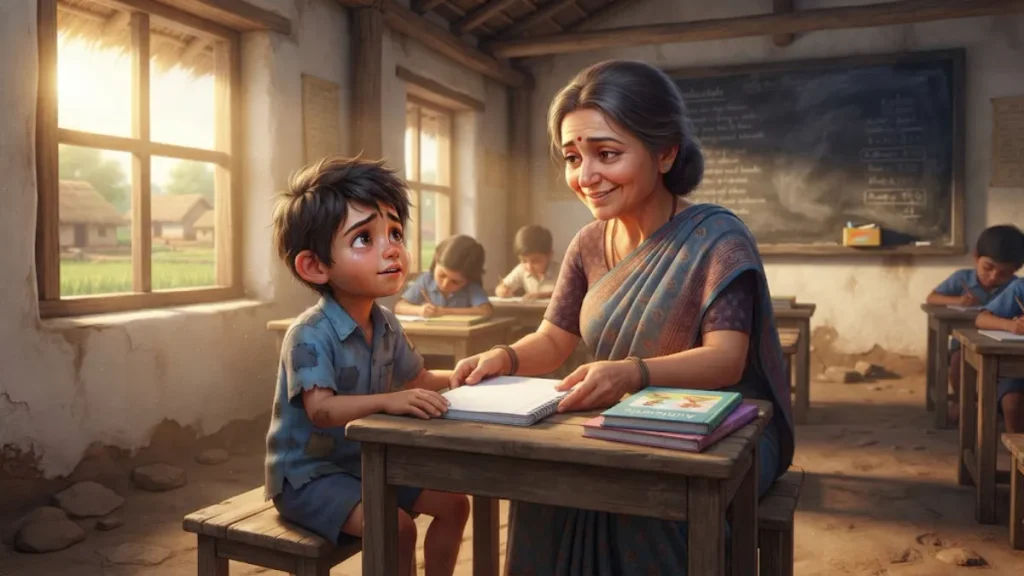
A good teacher does much more than explain lessons from textbooks. A truly dedicated teacher recognizes the hidden potential in every student, encourages those who have lost confidence, and sometimes makes personal sacrifices to help a child build a better future.
For some students, a teacher becomes more than an educator. They become a guide, a supporter, and sometimes the person who believes in them when nobody else does.
This is the story of Mrs. Eleanor, a kind and hardworking village teacher who believed that financial difficulties should never prevent a child from receiving an education. Among her students was Samuel, a bright young boy whose intelligence was greater than his family’s financial resources.
Samuel loved learning, but his parents could barely afford food, let alone notebooks and school supplies. When his teacher discovered that he was attending school without proper materials, she made a decision that would change his life.
She sold something she treasured deeply to give him an opportunity to continue his education.
What Samuel did with that opportunity became a beautiful reminder of the power of kindness, sacrifice, and a teacher’s love.
A Teacher Who Believed in Every Child
Mrs. Eleanor had been teaching for more than twenty years at a small village school.
She was in her late forties and lived in a modest house near the school. Her husband, Thomas, worked as a clerk in a nearby town, and they had one daughter who was studying at university.
Eleanor was not a wealthy woman, but she was known throughout the village for her kindness and dedication.
She believed that every child had something special inside them.
Some students were naturally good at mathematics, while others enjoyed reading, drawing, or understanding how things worked. She never compared children or made anyone feel inferior because of their abilities.
Her classroom was simple.
It had wooden desks, an old blackboard, a few cupboards filled with books, and large windows that allowed sunlight to enter during the morning.
The walls were decorated with handmade charts created by students.
Eleanor often stayed after school to help children who needed additional attention.
Sometimes, she even purchased pencils or notebooks for students whose parents could not afford them.
Other teachers occasionally asked why she spent so much time and personal money helping students.
She always gave the same answer.
“Education should open doors, not remind children of the doors they cannot afford to enter.”
She genuinely believed those words.
And among all her students, there was one boy who reminded her why she had chosen teaching as her profession.
His name was Samuel.
The Boy Who Loved Learning
Samuel was eleven years old and lived with his parents and younger sister in a small house at the edge of the village.
His father worked as a laborer on nearby farms. His mother occasionally cleaned houses and helped other families with household work.
Their income was irregular.
Some months were manageable, but during difficult seasons, they struggled to purchase even basic necessities.
Samuel understood his family’s circumstances.
He never demanded expensive toys, new clothes, or unnecessary things.
Instead, he loved going to school.
He was especially interested in mathematics and science.
He often asked questions that surprised his classmates.
Why did the moon change its shape? How did birds know where to migrate? Why did some plants grow faster than others?
His teachers admired his curiosity.
Mrs. Eleanor noticed that Samuel was particularly attentive during lessons.
Whenever she explained a difficult concept, he listened carefully and tried to understand the reasoning behind it.
One afternoon, she asked the class to solve a challenging mathematics problem.
Most students struggled.
Samuel raised his hand.
“Yes, Samuel?”
He walked to the blackboard and carefully explained the solution.
Eleanor smiled.
“Excellent work. You understood the problem very well.”
The class applauded.
Samuel returned to his seat with a shy smile.
He enjoyed those moments, but there was something that worried him.
He did not have enough school supplies.
His notebooks were almost full, his pencils were very short, and his schoolbag had a broken strap.
He often borrowed books from classmates.
Although he never complained, Mrs. Eleanor had begun noticing these difficulties.
A Secret Behind the Classroom Desk
One morning, Eleanor was walking between the desks when she noticed Samuel writing something.
She stopped beside him.
“Samuel, what are you writing?”
The boy quickly covered his notebook.
“Nothing, teacher.”
She gently smiled.
“Don’t worry. I am not here to scold you. May I see?”
Samuel slowly moved his hand.
Eleanor looked down.
He was writing his mathematics lesson on the blank space at the bottom of an old newspaper.
There were no proper pages left in his notebook.
She examined the newspaper carefully.
Some parts were torn, and the paper had already been used for other writing.
“Where is your notebook, Samuel?”
He looked down.
“I finished it, teacher.”
“Why haven’t you brought a new one?”
The boy remained silent.
Eleanor understood that something was wrong.
She pulled a chair beside him.
“Tell me honestly. Is there a problem?”
Samuel hesitated before answering.
“My father hasn’t received his wages for two weeks. Mother says we have to wait before buying anything extra.”
Eleanor felt a deep sadness.
“Does that mean you don’t have money for notebooks?”
Samuel nodded.
“I can manage, teacher. I can write on the back of old papers.”
He tried to smile.
But Eleanor could see that he was embarrassed.
She gently touched his shoulder.
“You should never feel ashamed of your circumstances. You are here to learn, and that is what matters.”
Samuel looked up.
“Will you still allow me to attend class?”
Eleanor was surprised by the question.
“Of course! This classroom belongs to every student. You never need to ask permission to learn.”
Samuel smiled.
But Eleanor knew that kind words alone would not solve his problem.
She wanted to help him.
The Dream That Seemed Too Expensive
Later that week, the school announced an academic competition for students from different villages.
The winners would receive educational scholarships and an opportunity to attend a special science program in the nearby city.
Mrs. Eleanor immediately thought of Samuel.
He had the intelligence and curiosity to perform exceptionally well.
She approached him after class.
“Samuel, I want you to participate in the competition.”
The boy looked surprised.
“Me, teacher?”
“Yes, you. I believe you have the ability to do very well.”
Samuel smiled, but his excitement quickly disappeared.
“I don’t think I can.”
“Why not?”
“I don’t have the books needed to prepare. The competition includes subjects we haven’t studied in class.”
Eleanor understood his concern.
She explained that the school library had some useful books, and she could help him prepare after school.
Samuel looked hopeful.
“Really?”
“Of course. But you must promise me that you will work hard.”
“I promise!”
For the next several days, Samuel stayed after school.
Eleanor helped him solve difficult problems, explained scientific concepts, and gave him practice questions.
He made excellent progress.
His confidence improved, and he began believing that he could compete with students from wealthier families.
However, another problem appeared.
The competition required students to purchase a preparation workbook, a science project kit, and some basic stationery.
The total cost was beyond what Samuel’s family could afford.
When he explained this to Eleanor, she tried to find a solution.
She checked the school’s small student support fund, but it had already been used to purchase uniforms for several children.
She considered asking other teachers, but most of them were also struggling financially.
That evening, she returned home feeling worried.
The Necklace in the Wooden Box
Eleanor entered her bedroom and placed her handbag on the table.
Her husband, Thomas, was sitting nearby, reading a newspaper.
“You look worried,” he said.
Eleanor explained Samuel’s situation.
She told him about the competition, the boy’s intelligence, and his inability to purchase the required materials.
Thomas listened patiently.
“He sounds like a hardworking child,” he said.
“He is. I have rarely seen such curiosity and determination.”
“Can the school help him?”
“I checked. There are no funds available right now.”
Thomas thought for a moment.
“Perhaps we can help him ourselves.”
Eleanor smiled.
“I was thinking the same thing, but we have our own expenses. Our daughter’s university fees are due next month.”
Thomas nodded.
They could not afford to spend much money.
Eleanor went to her cupboard and opened a small wooden jewelry box.
Inside were a few old photographs, some personal keepsakes, and a gold necklace.
She picked it up carefully.
It was the necklace Thomas had given her on their tenth wedding anniversary.
She remembered the day he had presented it.
They had not been wealthy, but Thomas had saved money for several months to purchase it.
Eleanor had treasured it ever since.
She looked at the necklace for a long time.
Then she turned toward her husband.
“Do you remember when you gave me this?”
Thomas smiled.
“Of course. You were so surprised that you nearly dropped the box.”
Eleanor laughed softly.
“I have kept it safe for all these years.”
Thomas looked at her.
“Why are you taking it out now?”
She took a deep breath.
“I think I know how we can help Samuel.”
Thomas understood immediately.
“Eleanor, are you thinking of selling it?”
She nodded.
“I know what it means to me. But this boy’s future means something too.”
Thomas remained silent.
He understood how much she valued the necklace.
Finally, he said, “If you believe this is the right thing to do, I will support you.”
Eleanor held his hand.
“Thank you.”
That night, she placed the necklace back inside its box.
But she had already made her decision.
The Sacrifice
The following morning, Eleanor visited a jewelry shop in the nearby town.
She carried the necklace carefully inside a small cloth pouch.
The shopkeeper examined it and offered her a reasonable price.
Eleanor accepted.
She felt a little emotional as she handed over the necklace.
It had been a treasured possession for many years.
But she reminded herself why she was doing this.
She was not simply selling a piece of jewelry.
She was investing in a child’s opportunity.
With the money, she purchased several notebooks, textbooks, pencils, a schoolbag, the required preparation workbook, and materials for Samuel’s science project.
She also purchased a small geometry box.
After returning home, she arranged everything neatly.
She placed the items inside the new schoolbag.
Then she wrote a small note.
It read:
“Dear Samuel,
Never allow difficult circumstances to make you believe that your dreams are too big.
Keep learning, keep asking questions, and always believe in your abilities.
Someone believes in your future.
With best wishes.”
She did not sign her name.
She wanted Samuel to focus on his opportunity rather than feel that he owed her something.
A Gift That Changed Everything
The following morning, Samuel arrived at school as usual.
He entered the classroom and placed his old bag beneath the desk.
Mrs. Eleanor was arranging some papers.
“Good morning, teacher.”
“Good morning, Samuel. I have something for you.”
She pointed toward a new schoolbag placed on his desk.
Samuel looked confused.
“What is this?”
“Open it.”
He slowly unzipped the bag.
Inside were new notebooks, pencils, textbooks, a geometry box, and the preparation workbook.
He stared at everything.
For a few seconds, he could not speak.
Then he found the small note.
He read it carefully.
“Teacher, who gave me these things?”
Eleanor smiled.
“Someone who believes you have a bright future.”
Samuel looked at her.
“Is it from the school?”
“Perhaps you should focus on using them well rather than worrying about where they came from.”
Samuel’s eyes filled with tears.
“Thank you, teacher.”
Eleanor gently replied, “You don’t need to thank anyone right now. Just promise me that you will work hard and make the most of this opportunity.”
Samuel nodded.
“I promise.”
He hugged his new schoolbag as if it were the most precious gift in the world.
That day, he wrote his lessons in a proper notebook for the first time in several weeks.
He felt confident and happy.
For Mrs. Eleanor, seeing that smile was worth more than any necklace.
The Road to the Competition
Samuel began preparing seriously.
Every afternoon, he stayed after school to study.
Mrs. Eleanor guided him through the preparation workbook and helped him understand difficult concepts.
She also encouraged him to participate in discussions and ask questions.
At first, Samuel was nervous.
The competition included students from several schools, many of whom had access to private tutoring and expensive educational materials.
But Eleanor reminded him that intelligence was not determined by the price of someone’s books.
“Samuel, preparation and determination matter more than expensive supplies. Focus on what you know, and never be afraid to learn something new.”
He took her advice seriously.
His confidence improved with every passing day.
He practiced mathematics problems, read science books, and prepared a small project about water purification using simple household materials.
Eleanor was impressed by his creativity.
One afternoon, she examined his project.
“How did you come up with this idea?”
Samuel explained that he wanted to help families who did not have access to clean drinking water.
Eleanor smiled proudly.
“That is exactly how a scientist thinks. You are not just learning information. You are thinking about how to use it to help people.”
Samuel felt encouraged.
He wanted to make her proud.
The Day of the Competition
The competition was held at a large school in the nearby city.
Samuel had never visited such a big educational institution before.
The building had modern classrooms, a science laboratory, a library, and a large playground.
Students arrived wearing clean uniforms and carrying expensive backpacks.
Samuel looked around nervously.
He began wondering whether he truly belonged there.
Mrs. Eleanor had accompanied him.
She noticed his expression.
“Are you nervous?”
“A little, teacher.”
“That is perfectly normal. Remember, you have prepared well. Just do your best.”
Samuel nodded.
The first round involved a written examination.
He read each question carefully and began answering.
Some questions were difficult, but he remembered the concepts Eleanor had taught him.
He completed the paper before the deadline.
The second round involved presenting a science project.
Samuel explained his water purification model confidently.
He described how different materials could help remove visible impurities from water and why access to clean drinking water was important.
The judges listened attentively.
One of them asked, “Why did you choose this topic?”
Samuel replied, “Because I have seen families struggle to get clean water. I want to learn science that can solve real problems.”
The judges exchanged impressed looks.
Samuel had spoken from personal observation rather than memorized information.
The Unexpected Result
After several hours, the competition organizers announced the results.
Students gathered inside the main hall.
Samuel stood beside Mrs. Eleanor, holding his project model.
He was nervous.
The organizer began announcing the names of the winners.
Third place went to a student from another school.
Second place was awarded to a student from the city.
Then the organizer announced the first-place winner.
“Samuel, from the village school!”
For a moment, Samuel did not move.
Mrs. Eleanor gently pushed his shoulder.
“Go on, Samuel. That’s your name!”
The boy walked toward the stage with a huge smile.
The audience applauded.
He received a certificate, a trophy, and a full scholarship for the next academic year.
Mrs. Eleanor watched from the audience with tears in her eyes.
She remembered the day she had found him writing on the back of old newspapers.
Now he was standing on a stage, being recognized for his intelligence and hard work.
When Samuel returned, he hugged her.
“I did it, teacher!”
Eleanor smiled.
“Yes, you did. You worked hard for this.”
Samuel looked at the trophy.
“But I couldn’t have done it without you.”
Eleanor gently replied, “You had the ability all along. I only helped you find the opportunity to show it.”
The Secret Behind the Gift
Samuel returned to the village as a winner.
His parents were extremely proud.
His father, who had worried that he might never be able to provide enough educational support, became emotional when he saw the scholarship certificate.
His mother hugged him tightly.
“We always knew you were special, son.”
Samuel smiled.
But something still bothered him.
He wanted to know who had purchased his school supplies.
He suspected that Mrs. Eleanor knew more than she was saying.
One afternoon, he approached her after class.
“Teacher, may I ask you something?”
“Of course.”
“Who bought those books and the schoolbag for me?”
Eleanor smiled.
“Why are you asking again?”
“Because I want to thank that person properly.”
She looked at him for a moment.
Then she decided to tell him the truth.
“Samuel, I purchased them for you.”
His eyes widened.
“You did?”
Eleanor nodded.
“But why?”
She explained that she had sold a personal possession to arrange the money.
Samuel became quiet.
“What did you sell?”
Eleanor hesitated.
Then she told him about the necklace.
Samuel looked shocked.
“Your necklace? The one you wore during the school celebration?”
Eleanor nodded.
“It was a gift from my husband. I treasured it, but I believed helping you continue your education was more important.”
Samuel’s eyes filled with tears.
“Teacher, I am so sorry. You should not have had to do that.”
Eleanor gently held his shoulders.
“Please don’t feel sorry. I made that decision because I wanted to help you. You have done nothing wrong.”
“But it was special to you.”
“Yes, it was. But helping someone build a better future can also be special.”
Samuel looked at her.
“I promise I will never forget what you have done for me.”
Eleanor smiled.
“I don’t expect you to repay me. Just remember to help someone else when you have the opportunity.”
Those words stayed with Samuel.
Years of Hard Work
The scholarship changed Samuel’s educational journey.
He continued studying with determination.
His teachers noticed his curiosity and encouraged him to participate in additional academic programs.
He eventually secured admission to a respected university, where he studied medicine.
It was not an easy journey.
There were difficult examinations, long nights, financial challenges, and moments when he questioned whether he could succeed.
Whenever he felt discouraged, he remembered Mrs. Eleanor.
He remembered her words about believing in himself.
He also remembered the day she had sold her necklace to purchase his school supplies.
That memory became a source of motivation.
He promised himself that he would never allow financial difficulties to stop him from learning.
He completed his medical degree and began working at a hospital.
During his early years as a doctor, he often treated patients who could not afford expensive medical care.
He understood their struggles because he had experienced financial hardship himself.
Whenever possible, he offered free consultations and helped families find affordable treatment.
He also supported children from low-income families who wanted to continue their education.
He had learned that one act of kindness could influence an entire lifetime.
A Surprise Visit
Nearly fifteen years after the day of the competition, Samuel returned to his village.
He had become a successful doctor and was working at a respected hospital.
His first visit was to his old school.
The building had changed slightly.
Some classrooms had been renovated, and the school had a new library.
However, the old wooden desks were still there.
Samuel walked toward the classroom where he had once studied.
Mrs. Eleanor was sitting at her desk, checking notebooks.
She had grown older, and her hair had turned almost completely gray.
But her smile was exactly the same.
“Good afternoon, teacher.”
She looked up.
For a moment, she did not recognize him.
Then her eyes widened.
“Samuel?”
He smiled.
“Yes, teacher. It’s me.”
She stood up and hugged him.
“My goodness! Look at you!”
Samuel laughed.
“I came to visit the person who changed my life.”
Eleanor became emotional.
She asked about his studies, his work, and his family.
Samuel told her everything.
He explained how he had become a doctor and how he now helped children who struggled financially.
Eleanor listened proudly.
“You have done very well, Samuel.”
He shook his head.
“I learned from the best.”
The Necklace Returns
Before leaving, Samuel brought out a small gift box.
“Teacher, I have something for you.”
Eleanor looked surprised.
“What is it?”
“Please open it.”
Inside was a beautiful gold necklace.
It was simple but elegant.
Eleanor looked at it carefully.
Samuel smiled.
“I learned how much the necklace you sold meant to you. I wanted to give you something special.”
Her eyes filled with tears.
“Samuel, you didn’t need to do this.”
“I know. But I wanted to.”
He continued, “You sold something precious to give me a chance. I cannot return the years you spent helping me, but I hope this reminds you that your kindness never disappeared.”
Eleanor held the necklace carefully.
For a moment, she could not speak.
Then she hugged him.
“Seeing the person you have become is already the greatest gift you could give me.”
Samuel smiled.
“But I still want you to keep it.”
She accepted the gift.
However, what touched her most was not the necklace itself.
It was knowing that the boy she had once helped was now helping others.
A New Beginning for Other Children
Samuel did not stop after visiting his former teacher.
He met the school principal and proposed creating a small educational support fund for students from financially struggling families.
He wanted children to have access to notebooks, textbooks, uniforms, and other basic supplies.
The school agreed to support the initiative.
Samuel contributed money every year and encouraged other former students to participate.
Within a few years, the program had helped dozens of children.
Some received school supplies, while others received assistance with examination fees and educational materials.
Mrs. Eleanor was delighted.
One afternoon, she visited the school’s new library.
She saw a young boy sitting at a desk, reading a science book.
His uniform was old, and his schoolbag looked worn.
But he was reading with great concentration.
Eleanor approached him.
“What are you reading?”
The boy looked up.
“A book about space, teacher. I want to become an astronaut.”
She smiled.
“That is a wonderful dream.”
The boy hesitated.
“But my family cannot afford many books.”
Eleanor looked toward the library shelf.
“Well, you are in the right place. We have many books here, and you are welcome to read them.”
The boy smiled.
“Thank you, teacher.”
As she watched him return to his book, Eleanor remembered Samuel.
She realized that the kindness she had shown one student had grown into something much bigger.
It had become an opportunity for many children.
The Lesson That Never Ended
Years later, Samuel established a small charitable organization dedicated to supporting education in rural communities.
He often visited schools and spoke to students about determination, gratitude, and the importance of helping others.
Whenever he told his own story, he mentioned Mrs. Eleanor.
He never described her simply as a teacher.
He called her the person who taught him that education was not only about acquiring knowledge. It was also about using that knowledge to make life better for others.
At one school event, Samuel stood before a group of students and shared a memory.
“When I was young, I could not afford proper notebooks. I thought my circumstances would prevent me from achieving my dreams. But one teacher believed in me. She sacrificed something valuable so I could continue learning.”
He paused.
“She never asked me to repay her. She only asked me to help someone else when I had the opportunity.”
The students listened quietly.
Samuel continued.
“Today, I want all of you to remember something. You may not have enough money to buy expensive books or attend the best schools. But your circumstances do not decide your worth or your potential. Keep learning, keep trying, and never be ashamed of asking for help.”
At the back of the hall, Mrs. Eleanor was listening.
She had been invited as a special guest.
Samuel looked toward her and smiled.
“Everything I have achieved began with a teacher who believed that every child deserved a chance.”
The audience applauded.
Eleanor wiped away a tear.
She had once sold a necklace to help one struggling student.
But the real treasure was what that student had become.
And the lesson continued through every child whose life he touched.
Moral of the Story
The story of The Teacher Who Sold Her Necklace teaches us that education can transform lives, but sometimes a little kindness is needed to help someone access that opportunity.
Mrs. Eleanor’s sacrifice demonstrated that a teacher’s responsibility can extend beyond textbooks and examinations. By believing in Samuel and helping him overcome financial difficulties, she changed the direction of his future.
The most important lessons from this story are:
- Education should be accessible to everyone: A child’s financial circumstances should never determine their potential.
- A good teacher can change a life: Encouragement and support can help students discover abilities they never knew they had.
- Kindness creates lasting impact: A small sacrifice can influence someone’s future for many years.
- Believe in people’s potential: Sometimes, all a struggling person needs is someone who believes they can succeed.
- Give back to society: When someone helps us during difficult times, we should pass that kindness forward whenever possible.
- True wealth is measured by our actions: The value of a person is not determined by possessions but by the positive difference they make in others’ lives.
The greatest reward for a teacher is not an expensive gift or public recognition. It is seeing a student succeed, become a good human being, and use that success to help others.
5. The Friend Who Stayed Behind
A Heartwarming Story About True Friendship and Sacrifice

Friendship is not only about sharing happy moments, celebrating achievements, or spending time together. True friendship becomes meaningful when life becomes difficult and someone chooses to stand beside another person, even when walking away would be easier.
This is a heartwarming story about two friends who set out on an important journey together. One of them had a dream he had worked toward for years. But when an unexpected situation threatened to change everything, his friend made a sacrifice that revealed the real meaning of loyalty.
A Friendship Built on Trust
Daniel and Michael had been friends since childhood. They grew up in a small town surrounded by green fields, narrow roads, and quiet hills. Their families lived only a few streets apart, and they had attended the same school since they were six years old.
Although their personalities were different, they understood each other better than most people.
Daniel was ambitious, practical, and determined. He believed that hard work could change a person’s life. Whenever he faced a problem, he tried to find a solution instead of complaining.
Michael was more relaxed and thoughtful. He enjoyed helping people and often put the needs of others before his own. He was the kind of person who would stop to help a stranger repair a bicycle or carry groceries for an elderly neighbor.
They had different dreams, but they shared one promise.
When they were teenagers, they had sat beside the river one summer evening and talked about their future.
“One day, we will leave this town and see the world,” Daniel had said.
Michael smiled. “And no matter where we go, we will always look out for each other.”
Daniel had laughed and held out his hand.
“Deal.”
They shook hands, not knowing how important that promise would become.
The Opportunity of a Lifetime
Years passed, and the two friends entered adulthood.
Daniel worked as an assistant architect in a small construction company. He was talented, but he wanted more opportunities. His greatest dream was to study advanced architectural design at a respected institute in another city.
He spent evenings preparing his portfolio, learning new software, and studying design principles. His salary was modest, so he saved almost every extra rupee.
Michael worked at a local community center. He organized activities for children, helped older residents with everyday tasks, and occasionally worked as a photographer at local events.
He was happy with his work, although he sometimes wondered what life might have been like if he had pursued his own ambitions more aggressively.
One afternoon, Daniel received an email that changed everything.
He had been selected for a competitive six-month professional training program in a large city. The program included practical training, mentorship, and the possibility of a permanent position afterward.
There was only one problem.
He had to reach the institute before the registration deadline. If he missed the first day, his place would be offered to another candidate.
Daniel was excited. He immediately called Michael.
“I got in!” he shouted as soon as his friend answered.
Michael could hear the excitement in his voice.
“You mean the architecture program?”
“Yes! I got selected. I still cannot believe it.”
Michael laughed happily.
“I knew you would. You worked so hard for this.”
Daniel explained that the institute was several hours away. He had already booked a bus ticket, but he was nervous about traveling alone with his portfolio and luggage.
Michael offered to accompany him.
“I will come with you,” he said.
“You don’t have to. I can manage.”
“I know you can. But you have waited years for this opportunity. I am not letting you begin the journey without someone cheering for you.”
Daniel smiled.
Their childhood promise was about to become part of another important memory.
The Journey Begins
On Friday morning, the two friends left their town before sunrise.
The weather was pleasant. A cool breeze moved through the trees, and the roads were relatively empty.
Daniel carried a backpack, a small suitcase, and a carefully arranged portfolio containing his architectural drawings.
Michael carried only a shoulder bag with a few personal belongings.
They planned to reach the city by afternoon. Daniel would complete his registration the next morning, and Michael would return home after helping him settle into a temporary room.
During the journey, they talked about their childhood memories.
They remembered the time they had missed a school bus, the football match they had lost by one goal, and the evening they had spent building a wooden treehouse that collapsed before they could finish it.
“You remember how confident we were about that treehouse?” Michael asked.
Daniel laughed.
“We thought we could build anything.”
“Perhaps we still can.”
Daniel looked out of the window.
“I hope so. This program could change my life.”
Michael nodded.
“It will. Just don’t forget the people who helped you reach there.”
Daniel turned toward him.
“I could never forget you.”
For a while, everything seemed perfect.
Neither of them knew that their journey would soon take an unexpected turn.
An Unexpected Accident
Around midday, their bus reached a narrow road passing through a hilly area.
Dark clouds had gathered, and rain began falling heavily. The driver slowed down as the road became slippery.
A few minutes later, the bus stopped suddenly.
Passengers leaned forward in their seats.
“What happened?” someone asked.
The driver opened the door and stepped outside.
There had been a minor accident ahead. A small delivery vehicle had skidded near a roadside barrier. Its driver was sitting on the ground, holding his leg.
People gathered around the vehicle, but the rain made it difficult to see clearly.
Daniel looked at his watch.
“We should not lose too much time,” he said. “I have to register tomorrow.”
Michael looked toward the injured driver.
“He needs help.”
“Someone will help him. The emergency services are probably on their way.”
Michael stood up.
“I am going to check.”
Daniel sighed but followed him outside.
The injured man was in his late fifties. His name was Mr. Thomas, and he had been delivering medical supplies to a nearby village.
His leg appeared injured, and he was struggling to stand.
A few people had gathered, but nobody seemed sure what to do.
Michael crouched beside him.
“Are you all right? Can you tell me where it hurts?”
The man pointed toward his ankle.
“I think I twisted it badly. My phone fell somewhere, and I cannot reach my family.”
Michael checked the man’s condition and asked another passenger to call for medical assistance.
Daniel glanced at his watch again.
“We need to get back on the bus,” he said quietly.
Michael looked up.
“Give me a minute.”
The Difficult Choice
A few minutes later, the emergency service informed the passengers that help would take longer because the road ahead was blocked by a fallen tree.
The bus driver announced that passengers could wait or arrange another way to continue their journey.
Daniel felt his stomach tighten.
He could not afford to miss registration.
He had worked for years for this opportunity. He had borrowed money to cover the travel and initial accommodation expenses. Missing the deadline would mean losing everything.
Michael, however, was focused on Mr. Thomas.
The injured man was becoming increasingly uncomfortable. His phone was missing, and he had no one nearby to contact.
Michael noticed a small medical center sign a short distance away.
“I can take him there,” he said.
Daniel stared at him.
“How? The road is slippery, and the bus may leave soon.”
“I will find a local vehicle.”
“Michael, listen to me. I have to reach the city today.”
“I know.”
“Then why are you talking about staying here?”
Michael looked at his friend.
“Because this man needs someone right now.”
Daniel became frustrated.
“We cannot solve every problem we see. Someone else can help him.”
Michael did not argue.
He simply looked at the injured man, who was trying unsuccessfully to move his leg.
Then he made a decision.
“Daniel, you should continue your journey. I will stay here until he gets proper help.”
Daniel was shocked.
“What? No. You came with me.”
“And I am glad I did.”
“You cannot just stay here. What about your return journey? What about your work?”
Michael smiled gently.
“I will manage.”
Daniel shook his head.
“This is not fair. I cannot leave you here.”
Michael placed a hand on his friend’s shoulder.
“You are not leaving me. You are going toward your dream. I am choosing to help someone who cannot move forward without assistance.”
For a moment, Daniel had no answer.
The bus driver called out that the passengers who wanted to continue needed to board.
Daniel looked at the bus, then at Michael.
He felt torn between his responsibility to his future and his loyalty to his friend.
The Friend Who Stayed Behind
Michael helped Mr. Thomas move away from the roadside and toward a small sheltered area.
He used his own phone to contact the man’s family. He also arranged for a local shopkeeper to help find a vehicle that could take him to the medical center.
Daniel stood nearby, holding his suitcase.
“You are really doing this?” he asked.
Michael nodded.
“Yes.”
“At least let me stay until help arrives.”
Michael shook his head.
“If you stay, you might miss your opportunity. I know how much this means to you.”
“But you will be alone.”
“I am not afraid of being alone for a few hours.”
Daniel looked down at his portfolio.
He had imagined this journey many times. He had pictured Michael sitting beside him when he reached the city, helping him find the institute, and celebrating when he completed registration.
He had never imagined that the journey would divide them.
A local shopkeeper finally arrived with a small vehicle. Michael helped Mr. Thomas sit inside and placed a folded jacket beneath his injured leg.
Before leaving, the older man held Michael’s hand.
“I do not know how to thank you, young man.”
Michael smiled.
“You do not have to. Just take care of yourself.”
Daniel approached his friend.
“I should stay,” he said.
Michael looked directly at him.
“No. Go.”
“Michael…”
“Daniel, listen. If you miss this opportunity, you will regret it for years. I did not come this far with you just to watch you give up.”
Daniel’s eyes became wet.
“But you sacrificed your entire day for a stranger.”
Michael smiled.
“Perhaps today, I was exactly where I needed to be.”
The bus driver called again.
Daniel slowly picked up his suitcase.
He wanted to say something meaningful, but every sentence seemed too small.
Finally, he hugged Michael.
“Thank you,” he whispered.
Michael returned the hug.
“Now go build something wonderful.”
Daniel boarded the bus.
As it moved away, he looked through the window. Michael was standing beside the roadside vehicle, waving at him.
Daniel waved back until the road curved and his friend disappeared from view.
A Journey Filled With Guilt
The rest of the journey felt different.
Daniel reached the city later than expected. He found a small guesthouse near the institute and checked into his room.
Although he was physically exhausted, he could not sleep.
He kept thinking about Michael.
Was his friend safe?
Had Mr. Thomas reached the medical center?
Had Michael found a way to return home?
Daniel called him several times, but there was no answer.
He sent messages, too.
“Did you reach the medical center?”
“Are you okay?”
“Please call me when you can.”
Hours passed.
The following morning, Daniel woke early and prepared for registration. He organized his documents and checked his portfolio one final time.
But his thoughts were elsewhere.
He wondered whether he should have stayed.
He imagined Michael waiting alone beside the road, trying to arrange transportation in the rain.
Then his phone rang.
It was Michael.
Daniel answered immediately.
“Where are you? Are you all right?”
Michael laughed.
“Relax. I am fine.”
“What happened yesterday?”
“I took Mr. Thomas to the medical center. His family arrived later that evening. They were very grateful.”
“And you?”
“I found a bus back home.”
Daniel felt relieved.
“Why didn’t you answer my calls?”
“My phone battery died. I charged it at the medical center.”
Daniel was silent for a moment.
“Michael, I feel terrible.”
“Why?”
“Because I left you.”
Michael’s voice became softer.
“You did not leave me. I asked you to go.”
“But I should have stayed.”
“No, Daniel. You should be at your registration. That is why we made the journey.”
Daniel looked at his documents.
For the first time since arriving in the city, he felt a little lighter.
“Thank you for understanding.”
Michael replied, “There is nothing to understand. Friends do not always have to make the same choices. Sometimes one person moves forward while the other helps someone else.”
A New Beginning
Daniel completed his registration successfully.
The training program was challenging. He spent long hours working on design projects, learning from experienced architects, and improving his technical skills.
Whenever he faced a difficult assignment, he remembered Michael’s words.
“Go build something wonderful.”
The sentence became his motivation.
Over the following months, Daniel called Michael regularly. They discussed work, family, and their old town. Michael never complained about the journey or the inconvenience he had experienced.
In fact, he rarely mentioned the incident.
But Daniel never forgot it.
One evening, after completing an important project, Daniel received an unexpected email. The institute had selected him for an advanced internship with a well-known architectural firm.
He was thrilled.
He called Michael immediately.
“I got the internship!”
Michael cheered loudly.
“I knew you would!”
Daniel laughed.
“I want you to come to the city. I am going to celebrate, and you are coming with me.”
Michael hesitated.
“I have work this weekend.”
“Take a day off. I will pay for your ticket.”
“You do not need to do that.”
“I know. But I want to.”
Michael finally agreed.
A few days later, he arrived in the city.
Daniel was waiting at the station with a huge smile. He hugged his friend and took him to a small restaurant overlooking a busy street.
They ordered dinner and spent hours talking.
After the meal, Daniel gave Michael a small gift.
It was a framed photograph of the two of them standing beside the river where they had made their childhood promise.
Beneath the photograph, Daniel had written:
Some people walk beside you toward your dreams. Others stay behind to help someone who has fallen. Both kinds of people make the journey worthwhile.
Michael read the message quietly.
Then he smiled.
“You did not need to give me this.”
Daniel shook his head.
“I know. But I wanted you to understand something.”
“What?”
“That day, I thought I was the one who needed help reaching my destination. But you taught me something more important. Success means very little if we forget to care about other people along the way.”
Michael looked at his friend.
“I only did what I thought was right.”
“And that is exactly why I respect you.”
The Unexpected Reward
A few weeks later, Daniel learned that the injured delivery driver, Mr. Thomas, had recovered and returned to work.
He had also contacted Michael to thank him again.
But the story did not end there.
Mr. Thomas happened to know the director of a local charitable organization that supported young people interested in community development. After hearing about Michael’s kindness, he recommended him for a position with the organization.
Michael was invited for an interview.
He was nervous because he had never considered working for a larger organization. He had always believed that his small community center was the right place for him.
However, he decided to attend.
During the interview, he spoke honestly about his experience helping people and the importance of building trust within a community.
The organization was impressed.
They offered him a position coordinating community support programs across several villages.
Michael accepted.
The new role gave him more responsibility and an opportunity to help even more people.
When he told Daniel the news, his friend was overjoyed.
“See? Good things happen to good people.”
Michael laughed.
“Not always.”
“Perhaps not always. But your kindness made a difference.”
Michael paused.
“I think the real reward was knowing that someone who needed help did not have to face a difficult moment alone.”
Daniel agreed.
He realized that his friend had never helped Mr. Thomas because he expected a reward. He had helped because he believed it was the right thing to do.
That was what made his sacrifice meaningful.
The Promise That Never Changed
Years later, Daniel became a successful architect. He worked on schools, hospitals, libraries, and community buildings.
Michael continued working with the charitable organization, helping families and improving access to essential services.
Although their careers took different directions, their friendship remained strong.
They still visited their hometown whenever they could. They still walked beside the river where they had made their childhood promise.
One evening, they sat together on the same old bench.
Daniel looked at Michael and said, “Do you remember the day you stayed behind?”
Michael smiled.
“Of course.”
“I think about it more often than you realize.”
“Why?”
“Because I used to believe that success meant reaching your destination as quickly as possible. That day taught me that the way we treat people matters just as much as where we end up.”
Michael looked toward the river.
“We both reached somewhere important that day.”
Daniel nodded.
“You helped a stranger, and I reached my dream.”
“And we both learned something.”
They sat quietly for a while.
The sun slowly disappeared behind the trees, leaving a golden reflection on the water.
Daniel finally spoke.
“Thank you for being the friend who stayed behind.”
Michael smiled.
“And thank you for being the friend who kept moving forward.”
They laughed.
Their friendship had survived distance, changing careers, and the challenges of adulthood. But the memory of that rainy afternoon remained one of the most important moments in their lives.
It reminded them that true friendship is not measured by how often two people walk side by side. It is measured by the trust that remains even when their paths temporarily separate.
And sometimes, the greatest act of friendship is allowing someone you love to move forward while you stay behind to do what is right.
Moral of the Story: True Friendship Means Putting People Before Convenience
The moral of The Friend Who Stayed Behind is that true friendship is built on kindness, loyalty, understanding, and selfless actions. A real friend does not always think about personal comfort or immediate rewards. Sometimes, friendship means making a difficult choice because someone else needs help.
Michael could have continued his journey with Daniel, but he chose to help an injured stranger. His decision showed that kindness should not depend on whether someone is a friend, relative, or stranger.
Daniel also learned an important lesson: pursuing personal dreams is valuable, but success becomes more meaningful when we remain compassionate toward others.
Important Lessons From the Story
- True friendship requires understanding: Good friends respect each other’s decisions, even when those decisions are difficult.
- Kindness should come without expectations: Helping someone is meaningful even when there is no reward.
- People matter more than convenience: A few hours of inconvenience can make a lasting difference in someone’s life.
- Success is not everything: Personal achievements become more valuable when combined with compassion and humanity.
- Small actions can create big changes: Michael’s decision helped an injured man and eventually opened new opportunities.
- Real friendship can survive distance: Friends do not need to be together every moment to remain connected.
What Does This Story Teach Us About Sacrifice?
This story teaches us that sacrifice is not always about giving away money, possessions, or personal dreams. Sometimes, it means giving someone your time, attention, comfort, or support when they need it most.
Michael sacrificed his planned journey because he recognized that another person needed immediate help. He did not consider his action heroic. He simply believed that helping was the right thing to do.
His decision reminds us that the value of a person is often revealed through small choices made when nobody is watching.
6. The Daughter Who Canceled Her Journey
A Heart-Touching Story About Family, Love, and Sacrifice

Sometimes, life gives us an opportunity we have dreamed about for years. We prepare for it, make plans, and imagine how wonderful everything will be when the day finally arrives. But just when we are ready to take the next step, an unexpected responsibility may remind us that life is not only about personal success.
This is a heartwarming story about a daughter who had planned a special journey abroad. She had worked hard, saved money, and waited patiently for the opportunity. However, when her elderly father suddenly needed her support, she faced a difficult decision.
Would she follow her dream or stay beside the person who had spent his entire life caring for her?
Her choice would teach her family an unforgettable lesson about love, gratitude, and sacrifice.
A Daughter With a Big Dream
Emma lived with her father, Robert, in a peaceful town surrounded by green hills and quiet streets. She was twenty-eight years old and worked as a graphic designer at a small advertising company.
Her mother had passed away several years earlier, leaving Emma and Robert to depend on each other. Robert was a retired schoolteacher who had spent more than thirty years educating children.
He was a quiet, hardworking man who believed that education and independence could change a person’s life.
Emma had inherited many of his qualities. She was determined, thoughtful, and ambitious. She wanted to build a successful career and experience the world beyond her small hometown.
For years, she had dreamed of visiting Europe.
She imagined walking through the beautiful streets of Paris, seeing the historic buildings of Rome, visiting art galleries, and taking photographs of places she had previously seen only in books.
It was not simply a holiday for her. It represented freedom, personal growth, and a reward for years of hard work.
After saving money for almost three years, Emma finally booked a three-week trip.
Her departure date was only ten days away.
She had purchased her flight tickets, reserved accommodation, arranged travel insurance, and prepared a detailed itinerary. Her passport and travel documents were safely stored in a folder on her desk.
She was happier than she had been in a long time.
Every evening, she discussed her plans with her father.
“First, I will spend four days in Paris,” she told him one evening while showing him photographs on her laptop. “Then I will visit Florence and Rome.”
Robert adjusted his reading glasses and looked at the pictures.
“That building is beautiful,” he said.
“That is the Eiffel Tower, Dad.”
“I know what it is,” he replied with a smile. “I was only pretending to be surprised.”
Emma laughed.
Robert was genuinely happy for his daughter. He knew how much the journey meant to her.
“You have worked hard for this,” he told her. “You should enjoy every moment.”
Emma smiled.
“I wish you could come with me.”
Robert shook his head.
“My traveling days are mostly over. But I want you to see the world. You are young, and there is so much waiting for you.”
Emma hugged him.
She had no idea that those words would soon become part of a difficult decision.
The Father Who Never Asked for Anything
Robert had always been a supportive father.
When Emma was a child, he walked her to school every morning. He helped her with homework, attended school events, and encouraged her to participate in activities even when she lacked confidence.
When she wanted to study design, some relatives questioned her decision.
They believed she should choose a more traditional career.
Robert defended her.
“Let her study what she loves,” he had said. “A person should have the courage to build a life that feels meaningful.”
When Emma received her first job, Robert celebrated by preparing her favorite dinner.
When she moved into a better position at work, he bought a small cake and placed a handwritten note beside it.
It read:
I am proud of the person you are becoming.
Emma kept that note inside her desk drawer.
After her mother passed away, Robert never complained about managing the household alone. He learned to cook simple meals, take care of the garden, and handle everyday responsibilities.
Even as he grew older, he tried not to burden his daughter.
Whenever Emma offered to help him with something, he usually replied, “I can manage.”
He believed that a good parent should support a child’s independence rather than become an obstacle to it.
Emma loved him deeply, but like many young adults, she sometimes became so busy with work and personal plans that she forgot how much he depended on her companionship.
She assumed there would always be more time for family conversations, evening walks, and shared meals.
The upcoming journey had made her especially excited, and she spent most of her free time preparing for it.
Then something unexpected happened.
The Evening Everything Changed
One evening, Emma returned home later than usual.
She had spent the afternoon shopping for travel essentials and had purchased a new suitcase.
As she entered the house, she noticed that the living room lights were switched off.
“Dad?” she called.
There was no response.
She walked toward his bedroom and found him sitting on the edge of his bed.
His face looked pale, and he seemed unusually tired.
“Are you feeling okay?” she asked.
Robert tried to smile.
“I am fine. Just a little tired.”
Emma placed her shopping bags on the floor.
“You don’t look fine.”
Robert explained that he had been feeling weak for several days. He had also experienced dizziness that afternoon.
Emma immediately became concerned.
“Why didn’t you tell me?”
“I did not want to disturb you. You have been busy with your preparations.”
Emma looked at him with disappointment.
“Your health is more important than my travel preparations.”
She helped him sit comfortably and called their family doctor.
After hearing about his symptoms, the doctor advised that Robert should be examined at the hospital as soon as possible.
Emma arranged transportation, collected his medical documents, and accompanied him.
The hospital visit took several hours.
After a series of tests, the doctor explained that Robert needed further evaluation and treatment. His condition was not immediately life-threatening, but his health required careful attention.
He would need regular medical appointments, medication management, and someone to help him with daily activities for a while.
Emma listened carefully.
She asked questions about his treatment, recovery, and the support he would need at home.
Then the doctor mentioned something that made her think about her upcoming journey.
“Your father should not be left alone during the initial recovery period. It would be better if a family member could stay with him.”
Emma nodded.
She knew exactly what that meant.
Her trip was only a few days away.
The Journey She Had Waited Years For
That night, Emma sat at the kitchen table with her travel folder in front of her.
Her flight was scheduled for the following week.
She looked at the confirmation email, the hotel reservations, and the list of places she wanted to visit.
Everything was ready.
She had imagined this journey so many times that canceling it seemed almost impossible.
She had worked overtime to save money. She had postponed other expenses and avoided unnecessary purchases. She had spent countless evenings researching destinations and planning her route.
The thought of losing the opportunity made her heart sink.
But whenever she looked toward her father’s bedroom, she remembered the doctor’s words.
He needed someone.
Emma opened her phone and checked the cancellation policies for her flight and accommodation.
Some reservations could be changed, but others were non-refundable.
She calculated how much money she might lose.
The amount was significant.
For a few minutes, she wondered whether she could find another solution.
Perhaps a relative could stay with her father. Perhaps she could ask a neighbor to check on him. Perhaps she could shorten the trip and return earlier.
But Robert needed more than occasional visits. He needed someone who could accompany him to appointments, prepare meals, and notice if his condition changed.
Emma finally closed her laptop.
She walked to her father’s room.
Robert was awake.
“Are you worried about your trip?” he asked.
Emma tried to smile.
“A little.”
“You should not cancel it because of me.”
She sat beside him.
“Dad, the doctor said you need support.”
“I will be fine. We can ask Mrs. Wilson next door to check on me.”
“She has her own family. I cannot expect her to take care of everything.”
Robert looked at his daughter.
“You have worked too hard to give up this opportunity.”
Emma held his hand.
“I know. But I cannot enjoy a journey while constantly worrying about whether you are safe.”
Robert became quiet.
He understood her concern, but he did not want her to sacrifice something important because of him.
A Conversation Between Father and Daughter
The following morning, Robert asked Emma to sit with him in the garden.
The garden was his favorite place. He had planted roses, lavender, and small flowering shrubs over the years. Even when his health was good, he spent at least an hour there every morning.
Emma brought him a cup of tea and sat beside him.
For a while, they watched a small bird moving between the branches.
Then Robert spoke.
“When your mother was alive, she always wanted you to travel.”
Emma smiled.
“She used to say that I would become an artist who traveled the world.”
“She believed you could do anything.”
Robert paused.
“Do you remember your first school trip?”
Emma laughed.
“I cried because I thought you would forget to pick me up.”
“I waited outside the school gate for two hours.”
“You were there before everyone else.”
“Of course. I did not want my little girl to feel alone.”
Emma looked at him affectionately.
Robert continued.
“I have always wanted you to live a full life. I never wanted you to feel responsible for my happiness.”
Emma became emotional.
“You are not a responsibility, Dad. You are my family.”
“I know, sweetheart. But I also know how much this trip means to you.”
Emma looked toward the garden.
“I have waited years for it. But I cannot leave you when you need me.”
Robert took a slow breath.
“Sometimes parents have to make sacrifices for their children. It is part of loving them. But children should not feel that they must give up their own lives to repay their parents.”
Emma listened carefully.
His words made her realize that the decision was not as simple as choosing between a trip and her father.
She wanted to be there for him because she loved him, not because she felt obligated.
And she wanted to make sure he understood that.
“I am not giving up my life,” she said gently. “I am changing my plans. There is a difference.”
Robert looked at her.
“Are you sure?”
Emma nodded.
“Yes. We will get through this together.”
He squeezed her hand.
For the first time since his illness began, Robert looked genuinely peaceful.
Canceling the Journey
Two days later, Emma made her final decision.
She contacted the airline and asked whether her flight could be rescheduled. Unfortunately, the ticket conditions allowed only a limited change, and the available dates were not suitable.
She also contacted the hotels and tour providers.
Some agreed to provide partial refunds. Others offered travel credits that she could use later.
Although she lost some money, she managed to recover a portion of her expenses.
Then she opened her travel folder.
The folder contained everything she had prepared for the journey: tickets, hotel confirmations, maps, photographs, and a handwritten list of places she wanted to see.
She carefully removed the documents and placed them inside a drawer.
Her suitcase remained near the bedroom door.
She had packed most of her clothes already. A pair of walking shoes, a camera, and a small travel journal were sitting on top.
She looked at them for a long time.
Then she slowly unpacked the suitcase.
She folded each item and returned it to the wardrobe.
When Robert noticed what she had done, he became emotional.
“Emma, you really canceled it?”
She smiled.
“Yes.”
“Because of me?”
“Because I want to be here.”
Robert looked down.
“I am sorry.”
Emma immediately sat beside him.
“Please do not apologize. You have spent your entire life making sure I had opportunities. Let me take care of you for a while.”
Robert reached for her hand.
“I never wanted to become a reason for you to stop living your dreams.”
“You are not stopping my dreams, Dad. You are part of them.”
He could not hold back his tears.
Emma hugged him.
It was one of those moments when neither person needed to say anything more.
The Days of Care and Patience
The following weeks were not easy.
Robert needed help with several everyday activities. Emma adjusted her work schedule so she could spend more time at home.
She accompanied him to medical appointments, prepared his meals, organized his medication, and helped him move around the house.
Some days were better than others.
On good mornings, Robert sat in the garden and talked about his teaching days.
On difficult afternoons, he became frustrated because he could not do everything independently.
Emma learned to be patient.
She understood that losing independence could be emotionally difficult for someone who had spent most of his life taking care of others.
One evening, Robert tried to carry a small box from the living room to the kitchen.
Emma noticed and quickly stepped forward.
“Let me help you.”
“I can carry it.”
“I know you can, but the doctor said you should avoid lifting heavy things.”
Robert sighed.
“I do not want to depend on you for everything.”
Emma placed the box on the table.
“You are not depending on me for everything. We are simply helping each other.”
Robert looked disappointed.
Emma sat beside him.
“Do you remember when I broke my arm as a child?”
Robert smiled faintly.
“You climbed a tree after I told you not to.”
“I was eight!”
“And you insisted you could climb higher than your brother.”
They both laughed.
Emma continued.
“You helped me get dressed, carried my schoolbag, and made sure I did not feel helpless. Did you ever think I was a burden?”
“Never.”
“Then please do not think that about yourself.”
Robert looked at his daughter and nodded.
That evening, he allowed her to help without arguing.
The Journey That Began at Home
As the weeks passed, Robert’s health gradually improved.
He became stronger and started taking short walks in the garden.
Emma returned to a more regular work schedule, although she continued helping him with his recovery.
One afternoon, while sorting through some old photographs, she found a picture of herself standing beside her mother at a railway station.
She was only seven years old.
Her mother was holding a small suitcase, and Emma was wearing a bright yellow dress.
Robert looked at the photograph.
“Your mother loved that day,” he said.
Emma smiled.
“We were going to visit Grandma.”
“She packed three bags for a two-day trip.”
Emma laughed.
“She always carried too many things.”
Robert studied the photograph for a moment.
“Your mother believed that every journey gave us something new. She used to say that we should never stop exploring.”
Emma placed the photograph on the table.
“I still want to travel.”
“Then you should.”
“Maybe next year.”
Robert smiled.
“Why next year? When I recover completely, we can plan something together.”
Emma looked surprised.
“You want to travel?”
“Perhaps a small trip. Somewhere peaceful. I would like to see the sea again.”
Emma’s face brightened.
“We could visit the coast.”
“That sounds wonderful.”
For the first time since canceling her European trip, Emma began to imagine another journey.
It might not be the one she had originally planned, but it could become something equally meaningful.
An Unexpected Gift
A few months later, Robert’s health had improved considerably.
He was able to walk without assistance and had returned to his morning gardening routine.
One Sunday, Emma was preparing breakfast when Robert entered the kitchen carrying a small envelope.
“What is this?” she asked.
“Something for you.”
She opened it.
Inside was a travel voucher and a handwritten letter.
Emma looked confused.
“Where did you get this?”
Robert smiled.
“I spoke to your aunt. She helped me arrange it.”
The voucher was for a short holiday at a seaside resort. It covered accommodation and travel expenses for two people.
Emma looked at her father.
“You planned this?”
Robert nodded.
“I know you canceled your journey because I needed you. I also know that you still want to see the world.”
He handed her the letter.
Emma opened it and began reading.
My dear Emma,
You have given me more care and patience than I could ever ask for. When you canceled your journey, I felt grateful, but I also felt sad that you had to change your plans.
I want you to remember that your dreams matter. Taking care of your family should not mean forgetting yourself.
I cannot give you back the weeks you spent caring for me, but I hope we can make new memories together.
This time, let us travel as father and daughter. I want to see the sea with you, walk along the shore, and listen to your stories about the places you still want to visit.
With all my love,
Dad.
Emma’s eyes filled with tears.
She hugged him tightly.
“You did not have to do this.”
Robert smiled.
“I wanted to.”
A Different Kind of Journey
A few weeks later, Emma and Robert traveled to a quiet seaside town.
It was not Paris or Rome, but Emma did not mind.
They stayed in a small hotel overlooking the ocean. Every morning, they walked along the beach, watched fishing boats return to shore, and enjoyed breakfast at a little café near the water.
Robert was especially happy.
He had not traveled for years, and the simple experience of sitting beside the sea made him feel young again.
One evening, they watched the sunset from a wooden bench.
Emma held her father’s hand.
“Do you know something?” she said.
“What?”
“I used to think that my dream journey would be the most memorable experience of my life.”
Robert looked at her.
“And now?”
She smiled.
“Now I think this one might be.”
Robert laughed.
“Because I am such wonderful company?”
“That too.”
They watched the waves move gently toward the shore.
Emma realized that the original journey had not disappeared. She could still visit Europe someday. She could still explore the cities she had dreamed about and experience everything she had planned.
But she had gained something she had not expected.
She had spent precious time with her father, listened to stories she had never heard before, and discovered how much joy could exist in an ordinary day.
The canceled journey had become a different kind of adventure.
The Dream That Was Never Lost
A year later, Emma finally traveled to Europe.
This time, she had a new photograph in her suitcase: one of herself and her father standing beside the sea.
She visited Paris, Florence, and Rome. She photographed historic buildings, explored art galleries, and filled her travel journal with memories.
But every evening, she called Robert.
She told him about the places she visited and shared photographs of the streets, museums, and cafés.
Robert listened with excitement.
When Emma returned home, she brought him a small souvenir from every city.
There was a miniature Eiffel Tower from Paris, a handmade bookmark from Florence, and a postcard from Rome.
Robert placed them on a shelf in the living room.
“Now I have traveled through your eyes,” he said.
Emma smiled.
“And one day, we will travel together again.”
Robert nodded.
He knew that his daughter had not abandoned her dreams. She had simply learned that life was about more than reaching destinations.
As Emma looked at the souvenirs on the shelf, she remembered the day she had unpacked her suitcase and canceled her flight.
At the time, she had thought she was losing something important.
But she had gained a deeper understanding of love.
She had learned that sacrifice does not always mean giving up a dream forever. Sometimes, it means adjusting the timing, choosing compassion, and making room for the people who have helped shape our lives.
Her father had given her the courage to follow her dreams.
She had given him something just as valuable in return: the comfort of knowing he was not alone.
And that was a journey neither of them would ever forget.
Moral of the Story: Love Sometimes Means Putting Family First
The moral of The Daughter Who Canceled Her Journey is that genuine love involves understanding, gratitude, and caring for family members when they need us. Emma had worked hard for her dream vacation, but when her father became unwell, she chose to support him during his recovery.
Her decision was not about abandoning her ambitions. It was about recognizing that some moments in life deserve our attention more than personal plans.
The story also reminds us that sacrifice should come from love rather than guilt. Robert did not want his daughter to give up her dreams permanently. He wanted her to enjoy life while remaining connected to the people who mattered most.
Important Lessons From the Story
- Family deserves our time and attention: Loved ones may need our support during difficult periods, even when life is busy.
- Love is expressed through actions: Emma showed her affection by being present, providing care, and supporting her father’s recovery.
- Dreams can wait without disappearing: Postponing a personal goal does not mean giving it up forever.
- Parents also need emotional support: Older parents may struggle with losing independence and need patience, reassurance, and understanding.
- Sacrifice should come from genuine care: Helping family members should be an expression of love, not simply an obligation.
- Ordinary moments can become precious memories: A quiet walk, a shared meal, or a conversation can sometimes mean more than an expensive holiday.
What Does This Story Teach Us About Family Sacrifice?
This story teaches us that family sacrifice is often found in everyday decisions. It may involve changing travel plans, adjusting work schedules, giving time, or offering emotional support when someone is struggling.
Emma’s decision shows that being there for a loved one can be more meaningful than following a carefully planned schedule.
However, the story also highlights an important balance. Caring for family should not require someone to permanently abandon personal ambitions. Healthy family relationships allow people to support one another while continuing to grow and pursue their dreams.
7. The Farmer Who Saved His Neighbor’s Field
A Heartwarming Story About Kindness, Sacrifice, and Humanity
Kindness is easy when life is comfortable, but its real value becomes clear when helping someone requires time, effort, or personal sacrifice. Sometimes, a person must choose between protecting what belongs to them and helping someone whose life is in danger of falling apart.
This is a heartwarming story about two neighboring farmers whose fields were separated by a narrow irrigation channel. One farmer had worked hard for years to build a successful agricultural life, while the other was struggling after several difficult seasons.
When a powerful storm threatened to destroy an entire harvest, one farmer made a decision that could have cost him his own crops. His choice showed that humanity and compassion are more valuable than temporary gains.
Two Farmers, Two Different Lives
In a peaceful village surrounded by green fields and distant hills, two farmers lived next to each other.
Their names were Thomas and Henry.
Thomas was a hardworking farmer in his early forties. He owned a large piece of land that had been passed down through his family. Over the years, he had improved the soil, installed an irrigation system, and learned modern farming techniques.
His fields were known throughout the village for producing healthy crops.
Thomas was careful with money and rarely took unnecessary risks. He believed that farming required patience, discipline, and good planning.
Henry, on the other hand, was an older farmer who had inherited a much smaller piece of land. He had spent most of his life working on it with his wife and two children.
He was honest, kind, and generous, but the last few years had been difficult.
Unpredictable rainfall had damaged his crops several times. The cost of seeds and fertilizers had increased, and he had borrowed money to keep his farm running.
Despite his difficulties, Henry never complained.
Every morning, he walked through his field, checked the plants, and tried to find ways to improve the next harvest.
Thomas and Henry had known each other for many years. Their families occasionally exchanged vegetables, tools, and farming advice.
However, they were not particularly close.
Thomas respected Henry’s dedication, but he sometimes thought his neighbor was too generous and careless with his resources.
Henry, meanwhile, admired Thomas’s success but never felt jealous of it.
He often told his children:
“Your neighbor’s success should inspire you, not make you bitter.”
The two farmers lived peacefully beside each other, unaware that one difficult season would completely change their relationship.
A Difficult Season for Henry
That year, the village experienced an unusually dry summer.
The rainfall arrived late, and the soil became hard and dry. Farmers struggled to keep their crops alive.
Thomas had prepared for the difficult season. He had installed a water storage system and repaired his irrigation pipes before planting.
His crops survived the dry weather reasonably well.
Henry was not as fortunate.
His water storage tank was old, and a section of his irrigation channel had developed cracks. He had planned to repair it, but the cost was more than he could afford at the time.
He hoped the rains would arrive soon.
For several weeks, he used whatever water he could collect to keep his crops alive.
His wife, Martha, worried about their situation.
“Henry, we should not spend all our savings trying to save this harvest,” she said one evening.
Henry looked at the field through the window.
“If we lose these crops, we may not have enough money to plant again.”
Martha understood his concern.
Their family depended on the harvest to pay household expenses, repay loans, and cover their children’s education.
Henry promised to find a solution.
He visited a few local farmers and asked whether they could lend him some equipment. He also spoke with a supplier about repairing the irrigation channel in installments.
Unfortunately, no one could offer immediate help.
The next morning, Henry stood at the edge of his field and looked at the dry plants.
He felt helpless.
But he refused to give up.
The Warning in the Sky
One afternoon, Thomas noticed something unusual in the sky.
Dark clouds were gathering over the distant hills.
The wind had become stronger, and the temperature had dropped suddenly.
He checked the weather forecast on his phone.
A severe storm was expected that evening.
Thomas immediately began preparing his farm. He secured equipment, moved stored materials to higher ground, and checked the drainage channels.
His irrigation system was working properly, but he knew that heavy rainfall could still create problems.
As he walked toward the boundary between his property and Henry’s field, he noticed that Henry was repairing a section of the old irrigation channel.
“Looks like we are going to get a lot of rain,” Thomas said.
Henry looked toward the clouds.
“That is what I am hoping for. My crops need water.”
Thomas examined the channel.
“Be careful. The water may rise quickly.”
Henry smiled.
“A little rain will be good for the farm.”
Thomas nodded, but he was not convinced.
He had seen storms cause serious damage before. Rainfall could help crops, but too much water could destroy an entire harvest.
Before returning home, Thomas pointed toward a narrow drainage path.
“Make sure that channel is clear. If the water has nowhere to go, it could flood your field.”
“I will check it,” Henry replied.
Thomas continued walking.
He had no idea how important that warning would become.
The Storm Arrives
By evening, the sky had turned almost black.
Thunder echoed across the village, and strong winds moved through the trees.
Rain began falling heavily.
At first, everyone welcomed it. The dry fields desperately needed water, and the farmers hoped the rainfall would improve the harvest.
But the rain did not stop.
Within an hour, small streams began forming along the village roads.
Water flowed down the hills and collected in low-lying areas.
Thomas stood near his farmhouse window, watching the storm.
He noticed that water was beginning to gather near the boundary of his property.
He quickly put on his raincoat and went outside.
His first concern was the drainage system. If the channels became blocked, the water could enter his fields and damage the crops.
He walked toward the main irrigation channel with a flashlight.
The rain was so heavy that he could barely see a few meters ahead.
When he reached the boundary, he noticed something worrying.
A large section of the drainage channel had collapsed.
Mud, stones, and broken branches were blocking the water’s path.
The water was beginning to overflow toward Henry’s field.
Thomas immediately understood the danger.
Henry’s land was slightly lower than his own. If the water continued flowing in that direction, the entire field could become flooded.
He tried calling Henry, but the call did not connect.
Thomas looked at the rising water.
He knew he had very little time.
A Choice That Could Cost Him Everything
Thomas rushed toward Henry’s farmhouse.
When he arrived, Henry was standing outside with a shovel, trying to clear a smaller drainage opening.
“What are you doing out here?” Thomas shouted over the rain.
Henry looked surprised.
“The water is entering the field. I am trying to redirect it.”
Thomas pointed toward the collapsed channel.
“The main drainage path is blocked. The water is flowing toward your land.”
Henry looked toward the field.
His face changed immediately.
He had spent months trying to save the crops. If the field flooded, the entire harvest could be lost.
“We need to open the channel,” Henry said.
Thomas nodded.
“Yes, but we need more tools and help.”
They returned to the damaged section.
The situation was worse than Thomas had expected.
Water was moving rapidly through the narrow passage, carrying mud and branches with it. A small wooden barrier had broken, making the flow even stronger.
Thomas examined the area.
There were two possible ways to stop the flooding.
The first was to build a temporary barrier along the boundary of his own field. This would protect his crops but push more water toward Henry’s property.
The second was to redirect the water through a drainage path that crossed a corner of Thomas’s land.
However, the second option required removing part of the protective soil embankment around his own field.
Doing so could allow water to enter his crops.
Thomas stood silently for a moment.
He had worked for years to protect his land. His harvest was valuable, and his family depended on it.
If he opened the embankment, he could damage his own crops.
Henry looked at him.
“We should build a barrier on your side,” he said. “I do not want your field to suffer because of mine.”
Thomas shook his head.
“That would send all the water toward your crops.”
“I will manage somehow.”
Thomas looked at his neighbor.
He knew Henry was trying to protect him from a financial loss.
But he also knew that Henry could not afford to lose another harvest.
After a brief pause, Thomas made his decision.
“We are opening the drainage path through my land.”
Henry stared at him.
“Are you sure?”
“Yes. We can repair my embankment later.”
“But your crops…”
Thomas picked up his shovel.
“Your family needs this harvest. We can save both fields if we work quickly.”
Working Through the Night
The two farmers began digging through the rain.
They removed mud, stones, and broken branches from the blocked channel.
Thomas called a few nearby farmers for assistance. Some arrived with shovels and ropes, while others brought sandbags and wooden boards.
The work was exhausting.
The ground was slippery, the rain continued falling, and the water level kept rising.
Every few minutes, someone had to stop and catch their breath.
Henry was especially worried about Thomas.
“Take a break,” he said. “You have already done more than enough.”
Thomas continued digging.
“We can rest when the water is moving in the right direction.”
They worked together to remove a section of the protective embankment.
As soon as the opening became large enough, water began flowing through the new drainage path.
For a few moments, everyone watched carefully.
The water moved away from Henry’s field and toward a lower storage area on Thomas’s property.
The pressure on the damaged channel began to decrease.
But another problem appeared.
The temporary drainage path was too narrow. Water was accumulating faster than it could pass through.
Thomas realized they needed to widen it.
He looked at the land around him.
The path would have to pass through a section where he had planted young vegetables.
Opening it further would destroy part of that crop.
Henry noticed his expression.
“Thomas, stop. We have already saved my field.”
Thomas looked at the water.
“Not yet. The pressure is still building.”
“But you will lose your own crops.”
Thomas put down his shovel and looked at Henry.
“Listen to me. Crops can be planted again. A family cannot easily recover from losing everything.”
Henry became silent.
Thomas continued working.
The other farmers joined him, and together they widened the drainage path.
After another hour, the water finally began flowing safely away from both fields.
The immediate danger had passed.
The farmers stood in the rain, exhausted and covered in mud.
Henry looked toward his field.
The crops were wet and some plants had been damaged, but the entire harvest had survived.
He turned toward Thomas.
His neighbor’s field had suffered more damage. Part of the vegetable crop had been washed away, and the protective embankment was completely broken.
Henry struggled to speak.
“You saved my farm.”
Thomas wiped rainwater from his face.
“We saved it together.”
The Morning After the Storm
The next morning, the village looked completely different.
Small branches were scattered along the roads. Some fields were covered with standing water, and a few farm structures had been damaged.
Farmers walked through their properties, checking the damage.
Thomas and Henry met near the boundary.
The sunlight had returned, but both men looked exhausted.
Henry’s field had survived, although a few sections needed attention.
Thomas’s field had suffered significant damage. Several rows of vegetables had been destroyed, and part of the soil embankment needed rebuilding.
Henry felt responsible.
“If you had not opened your land, none of this would have happened to your crops,” he said.
Thomas examined the damaged area.
“It is not as bad as it looks.”
“You lost a large part of your vegetables.”
“Yes, but the rest of the field is safe.”
Henry looked down.
“I do not know how I can repay you.”
Thomas smiled.
“You do not have to repay me.”
“But you made a sacrifice for my family.”
Thomas placed a hand on his neighbor’s shoulder.
“Today it was your field. Tomorrow it could be mine. We live beside each other, Henry. We should not behave as if our problems belong to us alone.”
Henry looked at him with gratitude.
He had spent years worrying about his own farm, his debts, and his family’s future.
Now he understood that the strength of a farming community did not come only from fertile soil or good weather.
It also came from people who were willing to help one another.
A Neighbor’s Gratitude
Over the following days, Henry tried several times to thank Thomas.
He offered to help repair the damaged embankment and brought fresh vegetables from his surviving crops.
Thomas accepted the help but refused any payment.
One morning, Henry arrived at Thomas’s farm with his two children.
They carried tools, wooden boards, and bags of soil.
“We have come to repair your drainage channel,” Henry said.
Thomas looked surprised.
“You do not need to do that.”
Henry smiled.
“You helped save our harvest. Now let us help repair yours.”
Thomas laughed.
“All right. But you will have to accept lunch afterward.”
Henry agreed.
The families worked together throughout the day.
Henry’s children helped remove damaged plants, while Thomas’s wife prepared food for everyone.
By evening, the embankment was stronger than before.
The two farmers stood beside the repaired channel.
Thomas looked at Henry.
“It is better than the original.”
Henry smiled.
“Perhaps we should have worked together on it from the beginning.”
Thomas nodded.
“Perhaps.”
That simple conversation marked the beginning of a stronger friendship.
The Village Learns About the Sacrifice
News of the storm spread throughout the village.
People discussed the damaged roads, flooded fields, and farmers who had lost parts of their harvest.
Soon, everyone heard about how Thomas had opened his land to save Henry’s crops.
Some villagers praised his generosity.
Others wondered why he had risked his own harvest for someone else’s benefit.
At the village market, one man asked Thomas:
“Why did you not protect your own crops first? You could have built a barrier and avoided the damage.”
Thomas replied calmly.
“Because the water would have destroyed Henry’s entire field.”
“But you worked hard for your harvest.”
“So did he.”
The man looked confused.
Thomas continued.
“Farming is uncertain. One year, we may have more than enough, and another year, we may lose everything. If we only care about our own land, what kind of community are we building?”
The conversation became quiet.
Another farmer spoke.
“Thomas is right. We often wait until someone asks for help, but sometimes we should recognize the problem before it becomes too late.”
The villagers began discussing ways to improve the village drainage system.
They agreed to organize a community effort to clean the main channels before every rainy season.
The local council was also approached about repairing weak sections of the irrigation network.
What began as one farmer’s sacrifice eventually encouraged the entire village to work together.
A Harvest Shared With Gratitude
Months passed.
The weather improved, and both farmers planted new crops.
Thomas had to work harder to recover the damaged section of his land, but he managed to produce a reasonable harvest.
Henry’s crops also grew well.
When harvest season arrived, Henry invited Thomas and his family to dinner.
The table was filled with freshly prepared vegetables, bread, and homemade dishes.
After dinner, Henry brought out a small basket.
Inside were the best vegetables from his harvest.
“I want you to take these,” he said.
Thomas smiled.
“Henry, we have already shared so much food this year.”
“This is different. These are from the field you helped save.”
Thomas accepted the basket.
Henry then called his children forward.
His younger son held a small wooden plaque.
It had been made by a local carpenter.
The plaque read:
To the neighbor who opened his field so our family could keep its harvest. We will never forget your kindness.
Thomas looked at it for a long moment.
He was deeply moved.
“You should not have done this,” he said.
Henry smiled.
“We wanted to.”
Thomas thanked the family and placed the plaque carefully in his farmhouse.
From that day onward, the two families shared more than a boundary line.
They shared tools, advice, meals, celebrations, and responsibilities.
Whenever one farmer faced a problem, the other was ready to help.
A Lesson That Lasted for Generations
Years later, Thomas’s son asked him about the wooden plaque in the farmhouse.
“Why do we keep this old thing?” the boy asked.
Thomas took it down and cleaned the dust from its surface.
“It reminds me of something important.”
“What?”
“That land is valuable, but people are more valuable.”
He explained the story of the storm, the damaged irrigation channel, and the night he had chosen to open his embankment.
His son listened carefully.
“But Dad, you lost part of your crops. Wasn’t that difficult?”
Thomas nodded.
“Of course it was. I had worked hard for them.”
“Then why did you do it?”
Thomas looked toward the fields outside.
“Because Henry’s family needed help, and I had a way to make a difference. Sometimes doing the right thing costs us something. But that does not make it the wrong choice.”
His son thought about the answer.
Thomas continued.
“When you have enough to help someone who is struggling, do not always ask what you will receive in return. Ask whether your help can prevent someone from losing something important.”
The boy looked at the plaque again.
He understood that it was not simply a decoration.
It represented a moment when one farmer had chosen humanity over personal gain.
And that lesson would remain with the family for many years.
The Field That Became a Symbol of Friendship
As time passed, the two farms continued to flourish.
The repaired drainage channel became a shared project. Thomas and Henry maintained it together and encouraged other farmers to do the same.
The village also developed a stronger habit of helping families during difficult farming seasons.
When a farmer became ill, neighbors helped with the harvest. When equipment broke down, others offered spare tools. When heavy rainfall damaged a field, people worked together to repair it.
The village gradually became a place where cooperation was valued as much as individual success.
One evening, Thomas and Henry stood at the boundary between their farms.
The sun was setting, and the crops moved gently in the evening breeze.
Henry looked at the drainage channel.
“Do you remember that terrible storm?”
Thomas laughed.
“How could I forget?”
Henry smiled.
“I used to think that your land and mine were two separate things.”
Thomas looked toward the fields.
“They are separate on paper. But when the rain comes, the water does not care about boundaries.”
Henry nodded.
“And neither should we.”
The two farmers stood quietly, watching the sunset.
Thomas had lost part of his harvest that night, but he had gained something much more valuable.
He had strengthened a friendship, helped protect a family, and reminded an entire village that kindness could create lasting change.
His neighbor’s field had survived because he was willing to risk his own.
And from that day forward, the two farmers understood that the greatest harvest was not always the one gathered from the soil.
Sometimes, it was the trust, friendship, and goodwill that grew between people.
Moral of the Story: Helping Others Is More Valuable Than Personal Gain
The moral of The Farmer Who Saved His Neighbor’s Field is that true kindness sometimes requires personal sacrifice. Thomas risked damaging his own crops to prevent his neighbor Henry from losing his entire harvest.
He understood that success is not only about protecting personal wealth or property. It is also about using what we have to support people who are facing difficult situations.
His decision helped save Henry’s livelihood and inspired the entire village to become more cooperative.
Important Lessons From the Story
- Kindness requires action: Feeling sympathy for someone is meaningful, but taking practical steps to help can make a real difference.
- People are more valuable than possessions: Crops, money, and property can be replaced, but a person’s livelihood and well-being may be difficult to restore.
- Helping others strengthens communities: When neighbors support each other, everyone becomes better prepared to face unexpected challenges.
- Sacrifice can inspire others: Thomas’s decision encouraged the entire village to work together and improve its drainage system.
- Do not expect rewards for kindness: Thomas helped Henry because it was the right thing to do, not because he expected anything in return.
- Cooperation creates lasting relationships: Sharing resources, knowledge, and effort builds trust between people.
What Does This Story Teach Us About Sacrifice and Kindness?
This story teaches us that sacrifice is not always about giving away money or making dramatic life-changing decisions. Sometimes, it means risking something valuable to protect another person from hardship.
Thomas could have protected his own crops by directing the floodwater toward Henry’s field. Instead, he chose a solution that required him to accept a personal loss.
His actions show that kindness becomes powerful when it is supported by courage and responsibility.
The story also reminds us that communities become stronger when people stop treating every problem as someone else’s responsibility.
8. The Grandfather’s Wooden Chair
A Touching Story About Love, Respect, and Sacrifice
Some of the most valuable things in a family are not expensive possessions. They are ordinary objects that carry memories of people, love, and moments that cannot be repeated.
An old chair, a handwritten letter, or a small photograph may seem unimportant to someone who does not understand its history. But for a family, such objects can hold the memories of an entire lifetime.
This is a heartwarming story about a grandfather, his wooden chair, and a young boy who slowly discovers the meaning behind his grandfather’s attachment to it.
Through an unexpected sacrifice, the boy learns that love is not always expressed through grand gestures. Sometimes, it is found in the things we preserve, the people we care for, and the memories we choose to pass on.
The Old Man and His Favorite Chair
In a quiet village surrounded by green fields and narrow country roads lived an elderly man named George.
He was seventy-eight years old and had spent most of his life working as a carpenter. His hands were rough, his hair was completely white, and his face carried the gentle expression of someone who had experienced both happiness and hardship.
George lived in a modest house with his son Daniel, daughter-in-law Sarah, and his ten-year-old grandson, Oliver.
The house was not particularly large, but it was filled with family photographs, handmade furniture, and objects that George had collected over the years.
Among all these possessions, one item was especially important to him.
It was an old wooden rocking chair.
The chair stood beside the living room window, facing a small garden where George grew roses and lavender. Its wooden arms were smooth from years of use, and its surface had several scratches and faded patches.
One of its legs had been repaired more than once.
The rocking mechanism made a soft creaking sound whenever someone sat in it.
To everyone else, the chair looked old and uncomfortable.
To George, it was priceless.
He spent most of his mornings sitting in it, drinking tea, reading newspapers, and watching birds in the garden.
Every evening, he used to sit there with Oliver and tell him stories about his childhood.
Oliver loved those moments.
He would sit on a small cushion beside the chair and listen to stories about distant places, difficult journeys, old village traditions, and the adventures George had experienced as a young man.
Sometimes, George would place a hand on the wooden armrest and smile.
“This chair has heard more stories than anyone in this house,” he would say.
Oliver never fully understood what he meant.
He simply thought his grandfather loved an old piece of furniture.
But the chair had a history that Oliver had never heard.
A Chair Made With Love
One rainy afternoon, Oliver was sitting beside his grandfather when he noticed a small carved design beneath the chair’s armrest.
It looked like two initials joined together.
“Grandpa, what does this mean?” he asked.
George leaned forward and looked at the carving.
For a moment, his expression changed.
Then he smiled.
“Those are your grandmother’s initials.”
Oliver looked surprised.
“Grandma’s?”
George nodded.
“Yes. I made this chair many years ago, when your grandmother and I were newly married.”
He ran his fingers over the old wooden surface.
“At that time, we did not have much money. We lived in a small rented house, and most of our furniture was borrowed or secondhand.”
Oliver listened carefully.
“Your grandmother loved sitting near the window. She enjoyed watching the garden, especially when the flowers opened in spring.”
“So you made this chair for her?”
“Exactly.”
George explained that he had spent several weeks collecting suitable wood and designing a comfortable chair.
He wanted to give his wife something special, even though he could not afford an expensive gift.
He worked late into the night, carefully shaping the wooden arms and carving the small initials beneath one side.
When he finally finished it, he placed a soft cushion on the seat and brought it home.
His wife, Margaret, was delighted.
She sat in the chair and began rocking gently.
“George, this is the most beautiful gift anyone has ever given me,” she had said.
He remembered her smile as clearly as if it had happened yesterday.
Oliver looked at the chair with new interest.
“Did Grandma sit here every day?”
“Almost every day,” George replied.
“Even when she became old?”
George nodded.
“Especially then.”
He paused before adding:
“After she passed away, I kept the chair because it reminded me of her. When I sit here, I sometimes feel as though she is still beside me.”
Oliver looked at his grandfather.
For the first time, he understood that the chair was not simply furniture.
It was a reminder of someone George had loved deeply.
The Family’s Changing Needs
As the years passed, the family home became busier.
Daniel worked long hours at a local engineering company, while Sarah managed the household and worked part-time as a teacher.
Oliver was growing older and had become increasingly interested in computers, sports, and video games.
He still loved his grandfather, but he spent less time listening to his stories.
George noticed the change but never complained.
He understood that children had their own interests and that the world was different from the one he had grown up in.
However, the family began facing a practical problem.
The house needed some renovation.
The living room was becoming crowded, and Daniel wanted to replace the old furniture with a modern sofa and a larger television.
One evening, Daniel discussed the changes with Sarah.
“The wooden chair takes up too much space,” he said. “We should replace it with something more comfortable.”
Sarah looked toward the living room.
“Your father has been sitting there for years. I do not think he will want to give it up.”
Daniel sighed.
“I know it means something to him, but it is old and worn out. We could buy him a new recliner.”
Sarah understood his point.
She also knew that George had become emotionally attached to the chair.
“We should talk to him before making any decision,” she suggested.
Daniel agreed.
The following weekend, he approached his father.
“Dad, we are thinking about changing the living room furniture.”
George looked up from his newspaper.
“That sounds fine.”
“We want to make more space. The old chair is taking up quite a bit of room.”
George looked at the chair.
“What about it?”
“Perhaps we could move it to storage or donate it. We can buy you a new one.”
George remained silent.
After a moment, he replied gently:
“I do not need a new chair, Daniel. This one is still comfortable.”
Daniel did not want to upset him.
“We are only trying to make things easier.”
“I understand.”
The conversation ended, but Daniel could tell that his father was not happy.
The Boy Who Did Not Understand
Oliver had overheard part of the conversation.
Later that afternoon, he asked his father why the old chair could not simply be replaced.
Daniel explained that the chair belonged to George and that it had emotional value.
Oliver shrugged.
“But Grandpa can sit in a new chair. It will be more comfortable.”
Daniel smiled.
“That is true, but sometimes objects remind people of someone they love.”
Oliver thought about it for a moment.
Then he asked:
“Is it because Grandma used to sit there?”
Daniel nodded.
“Yes. Your grandfather made that chair for her when they were young.”
Oliver looked toward the living room.
He had never met his grandmother. She had passed away before he was born.
He knew her only through photographs and the stories his grandfather told.
He sometimes wondered what she had been like.
“Did Grandma really love the chair?” he asked.
Daniel smiled.
“She loved the person who made it.”
Oliver did not fully understand the difference.
To him, the chair was simply old wood.
He could not imagine why anyone would become emotional about a piece of furniture.
But a few days later, something happened that changed his understanding.
The Night the Chair Was Damaged
One evening, a strong storm passed through the village.
Rain hit the windows, and powerful winds moved through the garden.
Daniel was away on a work assignment, while Sarah was preparing dinner.
Oliver was playing with a toy car in the living room.
George was sitting in his wooden chair, reading a book.
Suddenly, a strong gust of wind blew through an open window.
A flowerpot on the windowsill fell and struck the side of the chair.
The pot broke, scattering soil and pieces of clay across the floor.
George quickly stood up.
The chair had been damaged.
One of its wooden arms had cracked, and a small section of the carved design had broken away.
George stared at it.
For several seconds, he did not move.
Oliver rushed toward him.
“Grandpa, are you okay?”
George nodded slowly.
But his eyes were fixed on the damaged chair.
Sarah entered the room and immediately began cleaning the broken flowerpot.
“We can repair it,” she said.
George ran his fingers over the cracked wood.
“That carving…” he whispered.
Sarah looked closer.
The small initials beneath the armrest had been partly damaged.
George sat on the nearby sofa.
He looked deeply upset.
Oliver had never seen his grandfather like that.
Usually, George remained calm even when things went wrong. He rarely raised his voice and never complained about minor problems.
But now he seemed close to tears.
Oliver sat beside him.
“Grandpa, why are you so sad? Dad can buy you another chair.”
George looked at him.
For a moment, he said nothing.
Then he gently replied:
“Some things cannot be replaced by buying something new.”
Oliver lowered his eyes.
He still did not understand completely, but he realized that the damage meant much more to his grandfather than he had imagined.
A Memory Hidden Inside the Wood
The next morning, George asked Oliver to help him move the chair into a small workshop behind the house.
The workshop had belonged to George for decades.
It contained old tools, wooden boards, brushes, jars of polish, and several unfinished furniture pieces.
George placed the damaged chair near the workbench.
“Would you like to help me repair it?” he asked.
Oliver looked surprised.
“Can I?”
“Of course. You can help me clean the wood and prepare the polish.”
George opened an old wooden toolbox.
Inside were several tools that he had used throughout his career.
He picked up a small carving tool and began examining the damaged armrest.
As he worked, he told Oliver more about the chair.
He explained that Margaret had helped him choose the wood.
She had wanted the chair to be strong enough to last for many years.
She had also suggested adding a small curved design to make the armrests more comfortable.
“She always had better ideas than I did,” George said with a smile.
Oliver laughed.
“Really?”
“Absolutely. I was a carpenter, but she was the designer.”
George continued working.
He told Oliver about the evenings he and Margaret had spent sitting beside the window.
Sometimes they talked for hours. Sometimes they simply listened to the rain.
When their son Daniel was born, Margaret would rock him in the chair.
Years later, when Daniel became a father, she had held Oliver in the same chair.
George’s voice softened.
“Your grandmother used to say that a home becomes special because of the people who share it, not because of the furniture inside.”
Oliver listened carefully.
He imagined his grandmother sitting in the chair, holding his father as a baby, and smiling at the garden.
Suddenly, the chair seemed much more important.
The Grandfather’s Quiet Sacrifice
While repairing the chair, George noticed that some of the wooden joints had become weak.
The damage was not limited to the broken armrest. Several parts needed attention.
He knew that a proper restoration would take time and money.
However, he had another concern.
The family was planning to renovate the living room, and Daniel had recently mentioned that the household budget was tight.
George did not want his son to spend money repairing an old chair.
He decided to use his own savings.
For several years, he had been keeping a small amount of money aside from his retirement income.
He had originally planned to use it for a special gift for Oliver when he finished school.
But he now thought the money might be better spent repairing the chair.
He contacted an old carpenter friend who specialized in restoring antique furniture.
The friend examined the chair and explained that it could be repaired, but the work would require several days.
George agreed.
When Daniel found out, he became concerned.
“Dad, why are you spending your savings on this chair? We can help pay for the repair.”
George shook his head.
“I have enough.”
“But you should not have to pay for something we damaged.”
George smiled.
“It was an accident. Nobody is responsible.”
Daniel looked at the chair.
“I still do not understand why it means so much to you.”
George placed a hand on the wooden armrest.
“Your mother and I built our life together with very little money. We did not have expensive things, but we had each other. This chair reminds me of those years.”
Daniel became quiet.
His father continued.
“When I look at it, I remember your mother laughing, holding you as a baby, and sitting beside me after long days of work. It reminds me of the home we created.”
Daniel finally understood.
He had been looking at the chair as an old piece of furniture.
His father saw an entire lifetime inside it.
A Secret From the Workshop
Over the next few days, Oliver began spending more time in the workshop.
He enjoyed watching the carpenter restore the damaged wood.
The old man explained how to remove scratches, strengthen joints, and polish the surface without destroying its original appearance.
Oliver learned that restoring something required patience.
He also discovered that the chair had several small details he had never noticed.
There were tiny carvings along the backrest, a curved pattern near the legs, and a small heart-shaped mark hidden beneath the seat.
“Grandpa, what is this?” Oliver asked.
George leaned closer.
His expression softened.
“Your grandmother carved that.”
Oliver looked surprised.
“Grandma made part of the chair?”
George nodded.
“She wanted to leave her own mark on it.”
Oliver smiled.
“Then it was made by both of you.”
George laughed.
“Yes. I suppose it was.”
That afternoon, Oliver asked his grandfather if he could learn some basic woodworking.
George was delighted.
He gave him a small piece of wood and showed him how to smooth its surface with sandpaper.
Oliver worked carefully.
At first, he made several mistakes. The edges became uneven, and he pressed too hard in some places.
But George encouraged him.
“Do not rush. Wood teaches patience.”
Oliver kept trying.
By the end of the afternoon, he had made a small wooden heart.
It was not perfect, but he was proud of it.
George examined it.
“That is beautiful.”
Oliver smiled.
“I want to give it to you.”
George accepted the little heart and placed it on the workbench.
“Then I will keep it with the chair.”
The Day the Chair Returned
After several days of careful work, the restoration was complete.
The chair looked stronger and cleaner, but it had not lost its original character.
The scratches were still visible in a few places, and the wood retained its warm, aged appearance.
The small carving had been repaired.
The chair was no longer damaged, but it still looked like the same chair George had made decades earlier.
The carpenter delivered it to the house on a Saturday afternoon.
George stood near the living room window, waiting.
When the chair was placed in its original position, he slowly walked toward it.
He ran his hand along the armrest and examined the repaired carving.
Then he sat down.
The chair rocked gently.
Its familiar creaking sound returned.
George closed his eyes and smiled.
For a moment, he seemed lost in memory.
Oliver stood beside him.
“Does it feel the same, Grandpa?”
George opened his eyes.
“Almost exactly the same.”
Oliver smiled.
“Good. Because I did not want your chair to disappear.”
George looked at him.
“What made you change your mind?”
Oliver glanced at the chair.
“I thought it was just old furniture. But now I know it is part of our family story.”
George’s eyes became moist.
He reached out and pulled Oliver close.
“You have learned something important.”
Oliver sat beside the chair.
“What?”
George smiled.
“Sometimes, the things that look ordinary to us are precious to someone else. We should try to understand before deciding something has no value.”
A Gift From the Grandson
A few weeks later, Oliver approached his father with an idea.
He wanted to create a small display near the wooden chair.
He planned to place an old photograph of George and Margaret beside it, along with a short description of how the chair had been made.
Daniel liked the idea.
Together, they selected a photograph from an old family album.
It showed George and Margaret standing outside their first home. George was holding a wooden toolbox, and Margaret was smiling beside him.
Oliver wrote a small note:
This chair was made by Grandpa George for Grandma Margaret when they were young. It has been part of our family for many years. Grandma sat here, Dad was held here as a baby, and Grandpa still enjoys sitting here every day. It reminds us that love can live in the smallest things.
He placed the note in a simple wooden frame.
George read it slowly.
Then he looked at Oliver.
“You wrote this?”
Oliver nodded.
“I wanted everyone to know why the chair matters.”
George hugged him.
It was a small gesture, but it meant more to him than an expensive gift.
He had spent years preserving the chair because it reminded him of Margaret.
Now his grandson had helped preserve the story behind it.
The Chair Becomes a Family Tradition
As Oliver grew older, the wooden chair became a familiar part of family life.
Whenever relatives visited, they noticed it near the window.
Some asked about its age. Others admired its craftsmanship.
George enjoyed telling its story.
He explained how he had made it for Margaret, how she had helped design it, and how it had remained with the family through different stages of life.
Oliver often added his own details.
He talked about the storm, the broken flowerpot, and the days he had spent helping restore the chair.
Sometimes, he sat beside his grandfather and asked questions about the past.
George answered patiently.
He told him about his childhood, his first job, the day he met Margaret, and the challenges he had faced while raising a family.
The chair became a place where stories were shared.
Years later, when Oliver was old enough to understand the value of family history, he began helping his grandfather maintain the chair.
He polished the wood, checked the joints, and made sure it remained in good condition.
George was proud of him.
One afternoon, while sitting together in the garden, Oliver asked:
“Grandpa, what will happen to the chair when you are no longer here?”
George looked at him gently.
“I hope someone in the family will take care of it.”
Oliver nodded.
“I will.”
George smiled.
“Then I know it will be safe.”
The Final Lesson
Many years passed.
George eventually became too weak to spend long periods sitting in the garden. His health gradually declined, and the family began taking more responsibility for his care.
But he continued asking Oliver to sit beside him whenever possible.
The wooden chair remained near the window.
One afternoon, George called Oliver into the living room.
“Come and sit with me for a while,” he said.
Oliver pulled a small stool beside the chair.
George looked at the old wood.
“Do you remember when you thought this chair should be replaced?”
Oliver smiled.
“Yes. I was wrong.”
George shook his head gently.
“You were not wrong. You simply did not know its story.”
He placed his hand on Oliver’s shoulder.
“That is something I want you to remember. Before you judge something, try to understand where it came from and what it means to someone else.”
Oliver nodded.
George continued.
“People are like this chair in some ways. You cannot understand their whole story just by looking at them. Everyone carries memories, struggles, and love that may not be visible.”
Oliver held his grandfather’s hand.
“I will remember.”
George smiled.
“Good.”
They sat quietly for a while.
The afternoon sunlight entered through the window, falling across the wooden floor.
The chair rocked gently.
Oliver looked at his grandfather and realized that the most valuable thing about the chair was not its age, its design, or the wood from which it had been made.
It was the love and memories it represented.
He understood that preserving the chair was also a way of honoring the people who had built his family’s life.
And from that day onward, he promised himself that he would never allow the story behind it to be forgotten.
Moral of the Story: True Value Lies in Memories, Love, and Sacrifice
The moral of The Grandfather’s Wooden Chair is that the value of something cannot always be measured by its price, appearance, or usefulness. Some objects carry deep emotional meaning because they remind people of loved ones and important moments in their lives.
George’s wooden chair represented his marriage, the memories of his late wife, and the life they had built together. Although the chair was old and damaged, he was willing to spend his savings to restore it because its emotional value was greater than its material worth.
Oliver also learned that understanding another person’s feelings requires patience and respect.
Important Lessons From the Story
- Memories are more valuable than material possessions: An ordinary object can become priceless when it carries memories of someone we love.
- Respect the emotions of older family members: Their attachment to certain belongings often comes from experiences we may not fully understand.
- Love can be preserved through small things: Photographs, letters, handmade gifts, and furniture can help keep family memories alive.
- Patience creates understanding: Oliver learned the real meaning of the chair only after listening to his grandfather’s story.
- Family traditions connect generations: Sharing stories and preserving meaningful objects help younger generations understand their family history.
- Sacrifice is an expression of love: George used his personal savings to restore something that held precious memories of his wife.
What Does This Story Teach Us About Family and Sacrifice?
This story teaches us that family sacrifice is not always about giving up major opportunities or making dramatic decisions. Sometimes, it means investing time, effort, and resources to protect something meaningful to someone we love.
George’s decision to restore the chair showed how deeply he valued the memories of his wife. Oliver’s willingness to learn its history showed that love and respect can be passed from one generation to another.
The story also reminds us not to judge people or their belongings without understanding their stories. Something that appears old or unimportant to one person may represent a lifetime of happiness to another.
What Do These Stories Teach Us About Sacrifice?
Each story presents a different example of selflessness. Together, they show that sacrifice can take many forms.
| Story | Type of sacrifice | Main moral lesson |
|---|---|---|
| The Mother’s Last Piece of Bread | A parent’s comfort | Appreciate parental love |
| The Boy Who Gave Up His Dream | Personal opportunity | Support your loved ones |
| The Old Man and the Umbrella | Time and comfort | Small kindness matters |
| The Teacher Who Sold Her Necklace | Personal possession | Education changes lives |
| The Friend Who Stayed Behind | Physical effort | True friendship requires loyalty |
| The Daughter Who Canceled Her Journey | Personal plans | Be present for family |
| The Farmer Who Saved His Neighbor’s Field | Personal resources | Generosity inspires others |
| The Grandfather’s Wooden Chair | A treasured possession | Love gives meaning to giving |
Why Are Stories About Sacrifice Important?
Stories about sacrifice help readers understand emotions and human relationships through simple, relatable situations.
They are especially valuable because they encourage people to think beyond their personal needs and consider how their actions affect others.
1. They develop empathy: Readers learn to understand the difficulties and feelings of other people.
2. They teach gratitude: Stories about parents, teachers, and friends remind us to appreciate people who support us.
3. They encourage kindness: Even small acts of generosity can inspire readers to help someone in their daily lives.
4. They build emotional intelligence: Readers learn about love, responsibility, patience, forgiveness, and compassion.
5. They encourage positive decisions: Moral stories help children and adults understand that personal choices can have a lasting impact on others.
What Is the Difference Between Sacrifice and Selflessness?
Sacrifice means giving up something valuable, such as time, comfort, money, or an opportunity, for an important reason. Selflessness means considering the needs and well-being of others rather than focusing only on personal benefits.
The two ideas are closely connected, but they are not exactly the same.
For example, a mother working extra hours to support her child’s education makes a sacrifice. A person helping an elderly neighbor without expecting anything in return demonstrates selflessness.
Both values encourage compassion and stronger human relationships.
However, healthy sacrifice should not require someone to permanently ignore their own well-being. Helping others is meaningful when it comes from genuine care rather than pressure, fear, or exploitation.
Frequently Asked Questions About Stories of Sacrifice
What is a good story about sacrifice with a moral lesson?
“The Mother’s Last Piece of Bread” is a meaningful story about sacrifice. It follows a poor mother who gives her last piece of bread to her hungry son. The story teaches readers that parental love is often expressed through silent sacrifices and that we should appreciate the people who care for us.
What is the main moral of sacrifice stories?
The main moral is that genuine love, kindness, and compassion sometimes require putting another person’s needs before our own. Sacrifice teaches generosity, gratitude, responsibility, and empathy.
Why is sacrifice important in life?
Sacrifice is important because it helps people build stronger relationships, support their families, and contribute positively to society. Thoughtful sacrifices can make a meaningful difference in someone else’s life.
What is an example of sacrifice in everyday life?
A student helping a struggling classmate instead of spending all their free time playing games, a parent working hard to support their children’s education, or a friend giving time to support someone during a difficult period are examples of everyday sacrifice.
What do children learn from stories about sacrifice?
Children learn kindness, sharing, gratitude, patience, empathy, and responsibility. These stories help them understand why caring for others is important.
Can sacrifice make a person happy?
Yes. Meaningful sacrifice can create happiness because helping someone achieve their goals or overcome difficulties can bring emotional satisfaction. However, sacrifice should be balanced with personal needs and healthy boundaries.
What is the best example of selfless love in a moral story?
A parent making personal sacrifices to provide a better future for their child is one of the strongest examples of selfless love. It demonstrates patience, commitment, and care without expecting immediate rewards.
Conclusion: The True Meaning of Sacrifice
Sacrifice is one of the most beautiful expressions of love, kindness, and humanity. It reminds us that life is not only about what we achieve for ourselves but also about the positive difference we make in the lives of others.
The stories in this collection show that sacrifice does not always require extraordinary actions. Sometimes, it is as simple as sharing a meal, offering an umbrella, helping a friend, supporting a student’s education, or spending time with an elderly family member.
The most important lesson is that genuine sacrifice comes from the heart. We should learn to care for others, appreciate the sacrifices people make for us, and offer help whenever we can.
After all, the greatest measure of a person’s life is not just what they receive, but also what they willingly give to make someone else’s life better.