Western short stories transport readers to a world of dusty frontier towns, open plains, isolated ranches, rugged mountains, horseback journeys, and difficult choices. These stories often explore life in the American West through characters who must survive harsh environments, confront danger, protect their communities, or make difficult moral decisions.
Unlike longer Western novels, Western short stories have limited space to develop their characters and conflicts. This makes them especially effective when they focus on one central event, one important decision, or one transformation.
This guide explores the genre in detail without including individual stories. It explains what Western short stories are, their history, major characteristics, common themes, settings, characters, plot structures, and why they continue to appeal to modern readers.
What Are Western Short Stories?
Western short stories are fictional narratives set primarily in the American West or in a similar frontier environment. They commonly take place during the 19th century, particularly during the period of westward expansion, settlement, ranching, mining, and the development of frontier towns.
The genre often features:
- Cowboys and ranchers
- Outlaws and lawmen
- Sheriffs and deputies
- Prospectors and miners
- Horse riders and travelers
- Settlers and homesteaders
- Indigenous characters
- Frontier families
- Small-town residents
- Soldiers and scouts
However, Western stories are not simply stories about cowboys and guns. At their strongest, they examine freedom, justice, survival, courage, loyalty, loneliness, responsibility, and the consequences of personal choices.
A Western short story may involve a gunfight, but it may just as easily center on a difficult journey, a conflict between neighbors, a family trying to survive, or a character deciding whether to do what is right.
A Brief History of the Western Short Story
The Western literary tradition developed alongside America’s fascination with the frontier.
During the 19th century, newspapers, magazines, dime novels, and other popular publications helped create romanticized images of frontier life. Stories about cowboys, explorers, outlaws, gold seekers, and frontier communities became increasingly popular.
As the American West became part of popular culture, writers began creating fictional versions of frontier life.
Short fiction became particularly important because magazines and newspapers provided an accessible way for readers to encounter these stories.
Over time, Western fiction developed beyond simple adventure stories.
Early Western tales often emphasized:
- Adventure
- Gunfights
- Horseback riding
- Exploration
- Outlaws
- Frontier danger
Later writers increasingly explored:
- Moral ambiguity
- Social conflict
- Isolation
- Family relationships
- Psychological struggles
- Changing communities
- The consequences of violence
- The disappearance of the frontier
Modern Western short stories can also reinterpret the traditional genre by presenting perspectives that were often overlooked in older Western fiction.
Why Western Short Stories Are Different
One of the defining strengths of a short story is its concentration.
A Western novel may follow a character for months or years.
A Western short story may focus on a single afternoon.
For example, a story might revolve around:
- A stranger arriving in town
- A missing horse
- A confrontation between two ranchers
- A sheriff facing a difficult decision
- A family crossing dangerous territory
- A traveler caught in a storm
- A rancher protecting his property
- An outlaw reconsidering his life
- A character returning to an old town
The limited length forces the writer to remove unnecessary events and focus on what matters most.
7 Western Short Stories
The Last Lantern in Dry Creek
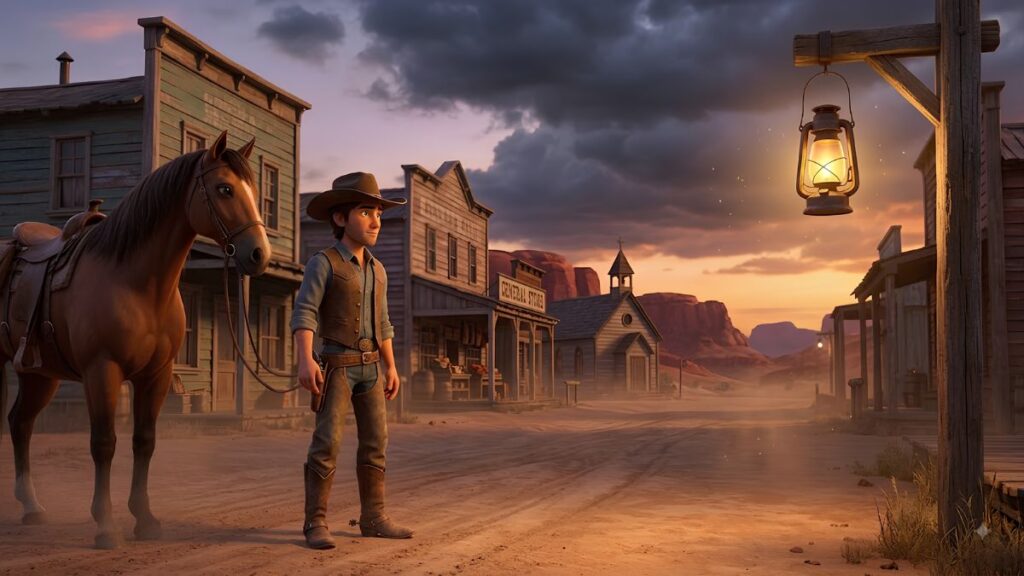
The sun was sinking behind the red hills when Daniel Mercer first saw Dry Creek.
From the top of a long, dusty trail, he could see the entire town below him. A row of wooden buildings stood along a wide dirt street. There was a general store, a blacksmith’s shop, a small hotel, a church, and several houses with empty porches.
Smoke rose from only two chimneys.
Daniel pulled his horse to a stop.
“So this is Dry Creek,” he said quietly.
He had heard about the town for years.
Once, Dry Creek had been a busy frontier settlement. Travelers stopped there on their way west. Cattlemen bought supplies at the general store. Miners passed through carrying gold from the hills. The town’s small hotel was often full.
But the railroad had been built farther north.
The miners had moved away.
The cattle trails had changed.
Slowly, people had left.
Now only a few families remained.
Daniel had come to Dry Creek because his uncle had left him a small ranch outside town.
He had never met his uncle very well. The old man had lived alone for many years and had died during the previous winter.
Daniel had spent the last month working on his old ranch in another territory. When the letter arrived informing him about the inheritance, he decided to travel to Dry Creek and see what had been left to him.
He expected an empty piece of land.
He did not expect a mystery.
As Daniel rode into town, he noticed something unusual.
At the end of the main street stood an old iron lantern.
It was attached to a tall wooden post beside the road.
The lantern looked ancient.
Its glass was dusty.
Its metal frame was covered with rust.
Daniel wondered why anyone had bothered to keep it standing.
He rode past it and continued toward the hotel.
A wooden sign above the entrance read:
DRY CREEK HOTEL
Daniel tied his horse outside.
Inside, an elderly woman stood behind the reception desk.
She looked up.
“You’re late.”
Daniel smiled.
“Late for what?”
She studied him.
“You must be Daniel Mercer.”
“Yes, ma’am.”
“Your uncle’s nephew.”
“That’s right.”
“My name is Martha Bell. I run this place.”
Daniel looked around the quiet lobby.
“Do you have a room?”
Martha laughed.
“You can have any room you want.”
Daniel smiled.
“I’ll take the cheapest.”
“They’re all the same price these days.”
She handed him a key.
“Room four.”
Daniel picked up his bag.
Before walking upstairs, he asked:
“Is the town always this quiet?”
Martha looked toward the window.
“Quieter than it used to be.”
“What happened?”
“A little bit of everything.”
Daniel waited.
Martha sighed.
“The railroad went north. The mine closed. People followed the work.”
“That explains the empty buildings.”
“Yes.”
Daniel looked through the window.
His eyes stopped on the old lantern.
“What about that?”
Martha followed his gaze.
“The lantern?”
“Yes.”
“It’s been there longer than I have.”
“Does it still work?”
Martha was silent for a moment.
Then she said:
“No.”
Daniel nodded.
He carried his bag upstairs.
That night, the town became completely silent.
Daniel lay in bed listening to the wind.
He had expected the usual sounds of a frontier town.
Horses.
Wagons.
People talking.
Doors opening and closing.
Instead, there was almost nothing.
He eventually fell asleep.
Then, sometime after midnight, he woke.
Something had disturbed him.
Daniel sat up.
He listened.
There it was.
A faint sound outside.
He got out of bed and walked to the window.
At first, he saw nothing.
Then he noticed a small light at the end of the street.
The old lantern was glowing.
Daniel stared at it.
The lantern that Martha had said no longer worked was shining brightly in the darkness.
He opened the window.
A cold wind entered the room.
He leaned outside.
The light was definitely coming from the lantern.
Daniel quickly put on his boots and coat.
He went downstairs.
Martha was sitting in the lobby.
She looked at him without surprise.
“You saw it.”
Daniel stopped.
“You knew?”
Martha nodded.
“What is happening?”
She looked toward the window.
“The lantern comes on sometimes.”
“Sometimes?”
“Every night.”
Daniel frowned.
“You said it didn’t work.”
“It doesn’t.”
“Then how is it glowing?”
Martha shook her head.
“I don’t know.”
Daniel walked toward the door.
“I’m going to take a look.”
Martha stood.
“Don’t.”
Daniel turned.
“Why not?”
“Because people have tried before.”
“And?”
“They never found anything.”
Daniel smiled.
“I’ll be careful.”
He stepped outside.
The night air was cold.
The lantern glowed at the end of the street.
Daniel walked toward it.
As he approached, the light suddenly disappeared.
He stopped.
The street was dark again.
Daniel examined the lantern.
There was no oil inside.
There was no wick.
There was no candle.
Nothing.
He touched the metal frame.
It was cold.
He looked around.
No one was nearby.
Daniel returned to the hotel.
Martha was waiting.
“Well?”
“Nothing.”
She nodded.
“That is what everyone says.”
Daniel went upstairs.
But he couldn’t sleep.
The next morning, he visited the general store.
The store was run by a thin man named Samuel Reed.
Daniel bought coffee, flour, and a few other supplies.
Then he asked:
“Do you know anything about the lantern at the end of the street?”
Samuel stopped counting the coins in his hand.
“The lantern?”
“Yes.”
Samuel looked at him carefully.
“You saw it?”
“Last night.”
The shopkeeper sighed.
“Then you’ve been here long enough.”
“What does that mean?”
Samuel leaned against the counter.
“The lantern has been part of Dry Creek for a long time.”
“How long?”
“Nobody knows exactly.”
“Who lights it?”
“No one.”
Daniel frowned.
“That’s impossible.”
Samuel smiled.
“That’s what I said when I was young.”
“And?”
“And I eventually stopped asking.”
Daniel wasn’t satisfied.
“Does anyone know why it appears?”
Samuel’s expression changed.
“Some people say it warns the town.”
“Warns it about what?”
“Trouble.”
Daniel looked toward the window.
“Has something happened every time?”
“Not every time.”
“What happened the last time?”
Samuel became quiet.
“A flood.”
Daniel looked surprised.
“A flood?”
“Yes. Twenty years ago.”
“But this town is surrounded by dry land.”
“Usually.”
Samuel explained that heavy rain had fallen in the hills for several days.
The creek had risen rapidly.
Most people had ignored the danger.
But the lantern had appeared three nights before the flood.
“People saw it?”
“Everyone.”
“And the night before the flood?”
Samuel nodded.
“It burned brighter than ever.”
Daniel thought about the previous night.
“Did people leave?”
“Some did.”
“Did they survive?”
“All of them.”
Daniel stared at him.
Samuel continued.
“That’s why people still respect the lantern.”
Daniel thanked him and left the store.
He spent the rest of the morning exploring the land he had inherited.
His ranch was about two miles outside town.
It was larger than he expected.
There was an old farmhouse, a barn, a well, and several acres of dry grassland.
The farmhouse needed repairs.
The barn needed a new roof.
But the land itself was good.
Daniel decided he could make a life there.
That evening, he returned to Dry Creek.
The sky was unusually dark.
Clouds were gathering over the distant hills.
Daniel looked at the old lantern.
It remained dark.
He went into the hotel.
Martha was preparing dinner.
“Storm coming?”
She looked toward the window.
“Looks like it.”
“Does it rain often?”
“Not enough.”
Daniel smiled.
“That’s good for my ranch.”
Martha did not smile.
“Not always.”
Daniel looked at her.
“What do you mean?”
“Dry Creek has two kinds of weather.”
“Two?”
“Too little rain and too much.”
That night, Daniel ate dinner with Martha.
They talked about his uncle.
Martha told him that his uncle had been a quiet man.
“He didn’t talk much,” she said.
“Was he happy?”
“I think so.”
“Did he ever mention the lantern?”
Martha looked at him.
“Your uncle believed it was important.”
“Did he know why it worked?”
“No.”
Daniel leaned forward.
“Did he ever investigate?”
“He spent years trying.”
“What did he discover?”
“Nothing.”
Daniel sighed.
Then Martha added:
“But he did find something.”
“What?”
“A notebook.”
Daniel’s expression changed.
“Where is it?”
Martha stood.
“Your uncle gave it to me before he died.”
She walked into a back room and returned with an old leather notebook.
Daniel opened it.
The pages were filled with handwritten notes.
Dates.
Weather conditions.
Names.
Observations about the lantern.
Daniel read silently.
One entry caught his attention.
September 14. Lantern appeared. No rain. Strange wind from the west.
Another:
October 3. Lantern appeared. Cattle became restless before dawn.
Another:
May 19. Lantern appeared. Creek rose two days later.
Daniel turned several pages.
Then he found a more recent entry.
August 7. The lantern appeared again. Something is coming.
Daniel looked at the date.
It had been written only weeks before his uncle died.
“What does this mean?”
Martha shook her head.
“I don’t know.”
Daniel continued reading.
Then he noticed something.
The entries did not simply describe the lantern.
They described wind direction, cloud movement, animal behavior, and changes in the creek.
His uncle had been studying the town’s environment.
Daniel looked up.
“Maybe the lantern isn’t causing anything.”
Martha raised an eyebrow.
“What do you mean?”
“Maybe it’s connected to something else.”
“Like what?”
“I don’t know yet.”
Over the next few days, Daniel studied the notebook.
He walked along the creek.
He examined the hills.
He checked the old water channels.
He spoke with people who had lived in Dry Creek for decades.
He began noticing patterns.
The lantern appeared before unusual weather.
It appeared when the wind changed.
It appeared when animals became restless.
It appeared when the air became unusually cold.
But there was still one question.
How did it light?
Then, one evening, Daniel discovered something.
He was walking near the old church when he noticed a narrow metal pipe running beneath the street.
He followed it.
It disappeared underground near the lantern.
Daniel returned to the hotel and asked Martha about it.
She frowned.
“That’s part of the old water system.”
“Water system?”
“From when the town was larger.”
Daniel returned to the lantern.
He examined the ground.
There were old pipes beneath the street.
Some were broken.
Others were still connected.
He followed the line toward the hills.
After nearly an hour, he found an old stone structure.
It was half buried beneath dirt.
Inside was a small chamber.
Daniel discovered an old reservoir.
The water level was rising.
He suddenly understood.
The lantern was connected to the old system.
But how?
He returned to town.
That evening, the wind became stronger.
The clouds grew darker.
Then the lantern came on.
Daniel ran toward it.
This time, he noticed something.
The light was not coming from a flame.
It was a reflection.
A thin beam of moonlight passed through a gap in the clouds and struck a polished piece of metal inside the lantern.
The metal reflected the light, making the lantern appear to glow.
Daniel stared.
The mystery was finally beginning to make sense.
But there was still something else.
Why did it happen only before storms?
Because the clouds changed the moonlight.
The wind moved the clouds.
The rising water changed the position of the old mechanism beneath the lantern.
It was an old warning system.
When the reservoir filled, water pressure moved a hidden metal arm.
The arm adjusted the reflector.
The lantern then caught the moonlight.
Daniel smiled.
The lantern wasn’t magic.
It was an ingenious invention created by people who had understood the land.
But the danger was real.
Daniel remembered the rising reservoir.
He ran toward the creek.
The water was moving faster.
He returned to town and warned everyone.
“There’s going to be a flood.”
Some people doubted him.
Others remembered the lantern.
Martha believed him immediately.
They moved the horses and cattle to higher ground.
They warned the families living near the creek.
They closed the lower road.
For several hours, nothing happened.
Then the rain began.
It came down heavily.
The creek rose.
Water rushed through the valley.
But this time, the people of Dry Creek were ready.
No one was injured.
By morning, the storm had passed.
The town was muddy and damaged, but it was still standing.
Daniel returned to the lantern.
It was dark again.
Martha stood beside him.
“You solved it.”
Daniel shook his head.
“Your town solved it a long time ago.”
“What do you mean?”
“Someone built this system for a reason. People simply forgot how it worked.”
Martha smiled.
“Your uncle would have liked that answer.”
Daniel looked toward the hills.
He understood something important.
Dry Creek had not survived because it was lucky.
It had survived because people had paid attention.
They had watched the land.
They had learned from storms.
They had built systems to protect one another.
And even though the town had become smaller, that knowledge had not completely disappeared.
A few weeks later, Daniel decided to stay.
He repaired the farmhouse.
He fixed the barn.
He began raising cattle.
He also helped the townspeople repair the old warning system.
They cleaned the pipes.
They repaired the reservoir.
They restored the lantern.
And they placed a small sign beneath it:
THE LAST LANTERN OF DRY CREEK
WATCH. LISTEN. PREPARE.
The lantern continued to stand at the end of the street.
Sometimes it glowed.
Sometimes it did not.
But whenever it did, the people of Dry Creek paid attention.
Years later, travelers would ask Daniel about the strange lantern.
He would smile and tell them:
“It’s not a ghost.”
“Then what is it?”
“It’s a reminder.”
“A reminder of what?”
Daniel would look down the dusty street.
“That a small light can make a big difference when people know how to see it.”
Lesson From the Story
The Last Lantern in Dry Creek is a Western story about hope, community, observation, and the importance of preserving knowledge.
Daniel initially believes the mysterious lantern may be supernatural, but he eventually discovers that it is part of an old warning system designed by the town’s earlier residents. The lantern represents more than a strange frontier mystery. It represents the knowledge and cooperation that helped a small community survive difficult conditions.
The story also shows that progress does not always mean abandoning the past. Sometimes older ideas contain valuable knowledge that can still help people today.
Most importantly, the people of Dry Creek learn that preparation and cooperation can turn a dangerous situation into a manageable one.
The Silver Bell at Midnight
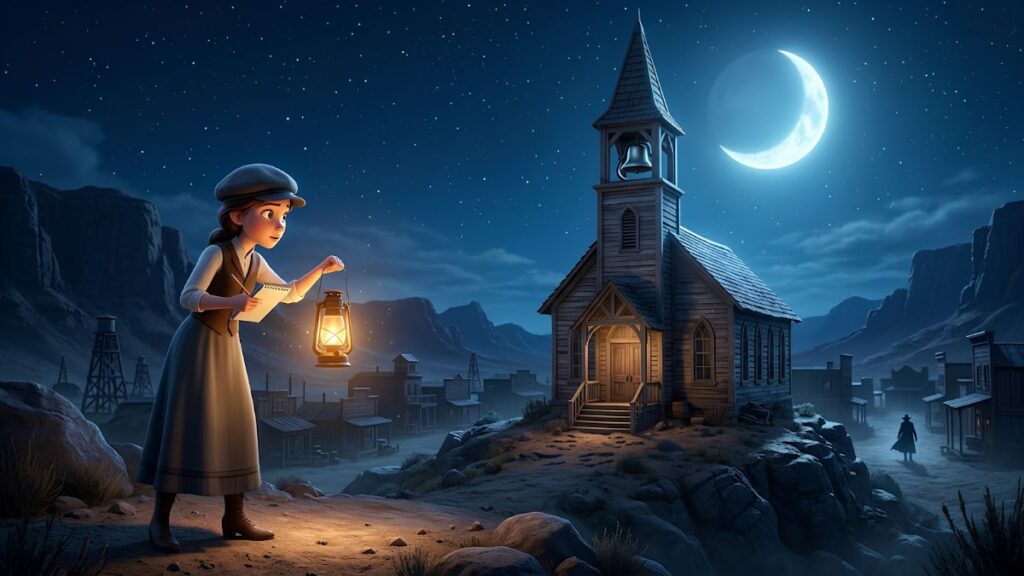
In the small mining town of Red Creek, people knew better than to walk near the abandoned church after dark.
The church stood on a rocky hill beyond the last row of wooden houses. Its windows were broken, its wooden doors hung crookedly, and weeds had grown through the cracks in the stone steps. Nobody had used the building for more than twenty years.
Yet every night at exactly midnight, a bell rang from its empty tower.
One clear autumn evening, a young newspaper reporter named Clara Morgan heard it herself.
She was sitting at her desk in the office of the Red Creek Gazette when the sound reached her through the open window.
Ding.
She looked at the clock.
12:00.
A second ring followed.
Ding.
Clara stood up.
Everyone in Red Creek had heard stories about the bell. Some said it was a ghost. Others believed that an old miner had hidden gold beneath the church before disappearing.
Clara had never believed either story.
But she was a reporter.
And unexplained stories were exactly the kind of stories she liked.
She grabbed her coat, a lantern, and her notebook.
Then she walked toward the hill.
The Abandoned Church
The moon was bright enough to illuminate the narrow trail leading up the hill.
Clara could see the church in the distance.
It looked even more frightening at night.
She stopped near the bottom of the hill and listened.
Nothing.
Then the bell rang again.
Ding.
The sound seemed to come from the church tower.
Clara continued walking.
When she reached the building, she pushed open the old wooden door.
It creaked loudly.
Inside, the church smelled of dust and damp wood.
Broken benches covered the floor.
A large painting had fallen from the wall.
Clara raised her lantern.
She looked toward the tower stairs.
They were old, but they appeared strong enough to climb.
She took a step.
Then another.
Halfway up, she noticed something scratched into the wooden wall.
A date.
October 17, 1891.
Clara wrote it in her notebook.
At the top of the stairs, she found the bell.
It was smaller than she had expected.
It was made of silver-colored metal and hung from an old wooden frame.
But there was something strange about it.
The rope attached to the bell was not moving.
Clara stared at it.
“How did you ring?” she whispered.
The bell remained still.
She touched it.
Cold.
Very cold.
Then she heard a noise below.
Clara froze.
Someone was inside the church.
She quickly lowered her lantern.
Footsteps moved across the floor.
Someone was walking toward the stairs.
Clara held her breath.
The footsteps stopped.
Then they moved away.
She waited several minutes before carefully looking down.
Nobody was there.
She hurried down the stairs and stepped outside.
The moonlight made the church look empty again.
But Clara knew she had not imagined the footsteps.
Someone else had been there.
An Old Story
The next morning, Clara visited the town library.
She asked the librarian, Mrs. Wilson, about the church.
“Do you know anything about the bell?”
Mrs. Wilson looked at her.
“The silver bell?”
Clara nodded.
“You’ve heard about it?”
“Everyone has.”
“Do you know why it rings?”
Mrs. Wilson shook her head.
“No one knows.”
“What about the church?”
Mrs. Wilson thought for a moment.
“The church was built in 1878. It served the miners and their families.”
“What happened?”
“There was an accident in the Silver Queen Mine in 1891.”
Clara leaned forward.
“How many people died?”
“Twenty-three.”
She wrote the number down.
“And one man disappeared.”
“Who?”
“Samuel Reed.”
Clara looked up.
“Was he a miner?”
“Yes. But he was also the church treasurer.”
“What happened to him?”
“People believed he stole money from the church before disappearing.”
“How much?”
Mrs. Wilson lowered her voice.
“Almost twenty thousand dollars.”
For a moment, Clara said nothing.
Twenty thousand dollars was an enormous amount of money in those days.
“Was the money ever found?”
“No.”
Clara felt a sudden excitement.
“And the bell?”
Mrs. Wilson sighed.
“That is where the story becomes strange.”
“What happened?”
“On the night Samuel disappeared, the church bell rang twelve times at midnight.”
“And?”
“The next morning, Samuel was gone.”
Clara looked at her notebook.
“Did anyone ever search the church?”
“Many times.”
“Nothing?”
“Nothing.”
Clara closed her notebook.
“Thank you.”
Mrs. Wilson looked concerned.
“Clara, don’t let an old story get you into trouble.”
Clara smiled.
“I’ll be careful.”
The Newspaper Clue
Back at the newspaper office, Clara searched through old editions of the Red Creek Gazette.
After several hours, she found an article from October 19, 1891.
The headline read:
MINER MISSING AFTER SILVER QUEEN DISASTER
The article described Samuel Reed as a respected church treasurer.
But one sentence caught Clara’s attention.
“Before his disappearance, Mr. Reed reportedly expressed concern about someone stealing money from the mine.”
Clara read the sentence again.
The old story said Samuel had stolen money.
But the newspaper suggested something different.
Perhaps Samuel had discovered the thief.
She searched for later articles.
Three days after Samuel disappeared, another article appeared.
A witness claimed that Samuel had been seen near the abandoned church shortly before midnight.
Clara’s eyes widened.
The church.
The bell.
The missing money.
The disappearance.
There had to be a connection.
Returning at Midnight
That evening, Clara decided to return to the church.
This time she brought a camera.
She arrived at 11:30.
The church was silent.
She entered and climbed the tower.
At 11:55, she heard a faint noise.
A metallic click.
Clara looked at the bell.
Nothing.
Then the clock on her watch reached midnight.
Ding.
The bell moved slightly.
Clara stared.
Ding.
She looked around.
There was no rope being pulled.
The bell continued ringing.
Twelve times.
After the final ring, Clara heard something below.
Footsteps.
Again.
But this time, she was ready.
She quickly moved down the stairs.
A shadow disappeared through the church doorway.
Clara ran outside.
The figure was already moving down the hill.
“Stop!”
The person did not stop.
Clara followed.
But she couldn’t catch him.
At the bottom of the hill, the stranger disappeared behind a group of trees.
Clara returned to the church.
She was breathing heavily.
Then she noticed something on the ground.
A small metal object.
She picked it up.
It was an old key.
The Hidden Door
The next morning, Clara returned to the church in daylight.
She searched every room.
Near the back of the building, she found a wooden cabinet.
The key fit its lock.
Inside were old church records.
Clara carefully removed them.
One record contained a handwritten note from Samuel Reed.
She read it slowly.
“The money is not where they believe it is. I have hidden proof beneath the place where the bell watches over us.”
Clara’s heart began beating faster.
Beneath the bell.
She returned to the tower.
She examined the floor.
At first, she found nothing.
Then she noticed that one wooden board was newer than the others.
She lifted it.
Underneath was a narrow opening.
Inside was a small metal box.
Clara pulled it out.
The box was locked.
The key opened it.
Inside were documents, several old photographs, and a leather pouch.
The pouch contained gold coins.
But the documents were more important.
They showed that money had been stolen from the Silver Queen Mine.
Samuel had discovered the theft.
The person responsible was the mine’s former manager, Thomas Hale.
Clara recognized the name.
Hale’s grandson still lived in Red Creek.
And he was one of the wealthiest men in town.
Someone Else Is Looking
Clara had barely finished reading the documents when she heard footsteps.
She turned.
A man stood in the doorway.
It was Arthur Hale.
Thomas Hale’s grandson.
Arthur was an older man who owned several properties around Red Creek.
“What did you find?” he asked.
Clara closed the box.
“Nothing.”
Arthur smiled.
“You’re a terrible liar.”
Clara stepped backward.
“Why are you here?”
“I’ve been looking for that box for years.”
“Why?”
“Because my grandfather hid the truth.”
Clara stared at him.
Arthur continued.
“He stole the money. Samuel found out.”
“And Samuel?”
“He tried to expose him.”
“What happened to Samuel?”
Arthur looked away.
“My grandfather confronted him.”
“Did he kill him?”
“No.”
Arthur shook his head.
“Samuel escaped. But he disappeared afterward.”
“Where did he go?”
“I don’t know.”
Clara looked at the documents.
“Then why did you want the box?”
“Because those documents could destroy my family.”
Arthur reached toward her.
“Give them to me.”
Clara refused.
“No.”
Arthur’s expression hardened.
“You don’t understand what you’re dealing with.”
“I understand enough.”
She picked up the box.
Then she ran.
The Secret Tunnel
Clara hurried down the tower stairs.
Arthur followed.
She reached the church floor and saw an old wooden door behind the altar.
She opened it.
A narrow passage led beneath the building.
Clara entered.
Arthur stopped at the doorway.
“Don’t go down there!”
She ignored him.
The passage was dark and damp.
Clara used her lantern.
After several minutes, she reached a small underground room.
Inside was a wooden chair, an old table, and a collection of papers.
There was also a photograph.
Clara picked it up.
It showed Samuel Reed standing beside a young woman.
On the back was written:
Sarah, Red Creek, 1892.
Clara realized that Samuel had survived.
The newspaper had never discovered the truth.
He had escaped town and started a new life.
But why had he left the evidence behind?
A second note answered the question.
Samuel had written that he feared returning because Thomas Hale had threatened him.
He had hidden the documents so that one day the truth could be discovered.
Clara suddenly understood the purpose of the bell.
It wasn’t a ghost.
It was a signal.
The Mechanism
Clara returned to the bell tower.
She examined the bell more carefully.
Behind the wooden frame, she found a system of small gears connected to a hidden weight.
The mechanism had been designed to release the weight at midnight.
That caused the bell to ring automatically.
But why?
Clara looked at the gears.
A small metal plate had been attached to the mechanism.
On it were the initials:
S.R.
Samuel Reed.
He had built the mechanism.
Perhaps he had wanted the bell to remind the town that the truth had not disappeared.
Every midnight, the bell rang.
Every night, it remembered.
The Truth Comes Out
Clara returned to the newspaper office.
She wrote the entire story.
She included the original newspaper articles, Samuel’s notes, the mine documents, and the evidence connecting Thomas Hale to the theft.
The next morning, the Red Creek Gazette published the story.
The town was shocked.
Arthur Hale disappeared for several days.
But eventually, he returned.
He gave Clara one final piece of information.
“My grandfather kept another diary,” he said.
“Where?”
“In my family’s old house.”
The diary confirmed everything.
Thomas Hale had stolen the mine money.
Samuel Reed had discovered him.
The money had been hidden near the church.
Samuel had escaped after receiving threats.
The gold found beneath the church was only part of the stolen fortune.
The rest was eventually recovered from an abandoned mine shaft.
A Different Kind of Treasure
Years later, the old church was restored.
The town turned it into a historical museum.
The silver bell remained in the tower.
It no longer rang automatically every night.
Instead, the town rang it once each year to remember the miners who had died in the Silver Queen disaster.
Clara became the editor of the Red Creek Gazette.
She often visited the church.
One evening, she stood beneath the bell and looked through the tower window.
The sun was setting behind the hills.
She thought about Samuel Reed.
He had been accused of stealing.
For decades, people believed a lie.
But he had hidden the truth where someone might eventually find it.
The treasure had been valuable.
The gold had been valuable.
But the truth was worth more.
Clara smiled.
The silver bell had never been a warning about ghosts.
It had been a reminder.
Secrets can remain hidden for years.
But truth has a way of making itself heard.
And sometimes, all it takes is one person willing to listen.
Lesson From the Story
The Silver Bell at Midnight shows that truth can survive even when people try to hide it. Clara’s curiosity and determination helped uncover a mystery that had remained unsolved for decades.
The story also warns against greed. The stolen fortune brought fear, suspicion, and suffering to many people, while honesty ultimately restored the truth.
For readers, especially those who enjoy Western mysteries, the story combines suspense, adventure, historical secrets, hidden treasure, and the atmosphere of a small frontier town.
Theme: Mystery, greed, and truth.
The Ranch Beyond the Red Hills
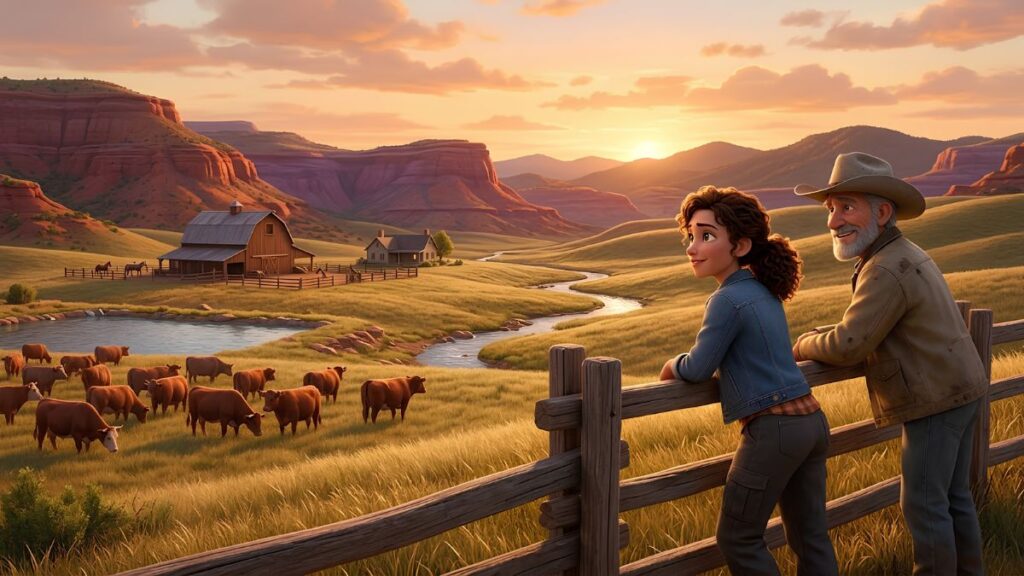
The first thing Clara noticed when she arrived at the ranch was how quiet it was.
Not peaceful.
Quiet.
There was a difference.
The wind moved through the dry grass with a soft whisper, but there was no sound of running water. No birds gathered near the old wooden trough beside the barn. Even the cattle seemed restless, moving slowly from one patch of shade to another beneath the burning afternoon sun.
Clara pulled her horse to a stop and looked across the land.
The ranch had belonged to her grandfather.
She had not visited it in almost fifteen years.
Now, after his death, it was hers.
The property stretched across several hundred acres beyond a range of red hills. There was an old farmhouse, a weathered barn, a small stable, and a long fence separating Clara’s land from the neighboring ranch.
Her grandfather had always called the place Red Hills Ranch.
As a child, Clara had loved the name.
She remembered riding horses across the open land, chasing rabbits through the grass, and listening to her grandfather tell stories beside the fireplace.
But those memories belonged to another time.
Now the ranch looked tired.
The grass was brown.
The wooden fences needed repairs.
Several sections of the roof were damaged.
Most worrying of all, the water troughs were nearly empty.
Clara climbed down from her horse.
She walked toward the nearest trough and looked inside.
There was barely enough water for a few animals.
“This can’t be right,” she whispered.
Her grandfather had always been careful with water.
He had built several small channels that carried water from a spring in the hills toward the ranch.
According to everything Clara remembered, the spring had always been reliable.
She walked toward the house.
An old ranch hand named Samuel was waiting for her on the porch.
He had worked for Clara’s grandfather for more than thirty years.
“You made it,” Samuel said.
Clara smiled.
“I’m glad you’re still here.”
Samuel nodded.
“Your grandfather was a good man.”
“He was.”
Clara looked toward the fields.
“What happened to the water?”
Samuel’s expression became serious.
“That’s the problem.”
“What do you mean?”
“The spring is producing less water every month.”
Clara frowned.
“Could the drought have caused it?”
“Maybe partly.”
Samuel pointed toward the red hills.
“But there’s another problem.”
“What problem?”
“The water coming from the hills isn’t reaching us like it used to.”
Clara looked at him.
“Why?”
Samuel shook his head.
“That’s what we’re trying to figure out.”
A Growing Problem
Over the next few days, Clara inspected the ranch.
The situation was worse than she had expected.
The cattle were losing weight.
The crops were struggling.
The water storage tanks were almost empty.
If nothing changed, the ranch would not survive another summer.
Samuel showed Clara the old water channels.
“They used to carry plenty of water,” he explained.
Clara crouched beside one of them.
The channel was dry.
She followed it uphill.
Several hundred yards away, she found a section where the earth had been disturbed.
There were fresh tire tracks nearby.
Clara stood up.
“Who owns the land beyond this?”
Samuel hesitated.
“The Carter family.”
Clara remembered the name.
The Carters owned the neighboring ranch.
Her grandfather had never liked them.
Clara remembered hearing arguments between the two families when she was young.
“What happened between them?” she asked.
Samuel sighed.
“It’s an old story.”
“I want to hear it.”
“Your grandfather believed the Carters had taken water from the spring years ago.”
“Did they?”
“Your grandfather thought so.”
“And the Carters?”
“They said they had done nothing.”
Clara looked toward the neighboring ranch.
“Do they still have water?”
Samuel nodded.
“They have enough.”
Clara became suspicious.
She remembered the dry water channel.
She remembered the tire tracks.
Then she noticed something else.
A narrow pipe disappeared into the ground near the border fence.
“What’s that?”
Samuel looked at it.
“I don’t know.”
Clara stood.
“Let’s follow it.”
The Two Ranches
The pipe led toward the Carter property.
Clara and Samuel followed it until they reached a small wooden structure hidden behind some bushes.
Inside was an old pump.
Samuel stared at it.
“I’ve never seen this before.”
Clara examined the equipment.
It was old but still functioning.
A pipe ran from the pump toward the Carter ranch.
Clara felt anger rising inside her.
“They are stealing our water.”
Samuel wasn’t convinced.
“We don’t know that.”
“What else could it be?”
“We should talk to them.”
Clara shook her head.
“After all these years, I don’t think they’ll tell us the truth.”
She returned to the ranch.
That evening, she stood on the porch watching the sunset.
The red hills turned orange beneath the fading light.
She thought about her grandfather.
He had spent his entire life fighting to protect the ranch.
Clara wondered whether she was now facing the same battle.
The next morning, she rode toward the Carter ranch.
An older man named Henry Carter met her near the barn.
He looked at Clara for several seconds.
“You must be John Miller’s granddaughter.”
“Yes.”
“Clara.”
“Yes.”
Henry nodded.
“I remember you.”
Clara dismounted.
“I need to talk to you about the water.”
Henry’s face became serious.
“I thought you might.”
“You’re taking water from our spring.”
Henry shook his head.
“No.”
“I found a pump connected to our water channel.”
“That pump belongs to us.”
“Then why is it connected to our water?”
Henry stared at her.
“Because it isn’t connected to your water.”
Clara frowned.
“What?”
“Come with me.”
Henry walked toward the red hills.
Clara followed.
They rode for almost an hour before reaching a narrow valley.
At the bottom was a small spring.
But this spring was different.
It was almost completely dry.
Henry pointed toward the hillside.
“There used to be another stream here.”
Clara looked around.
“What happened?”
“Part of the hill collapsed two years ago.”
“Why didn’t anyone tell us?”
Henry gave her a tired smile.
“Your grandfather wouldn’t have listened.”
Clara was surprised.
“What does that mean?”
“He believed we were stealing his water.”
“Were you?”
“No.”
Henry pointed toward the rocks.
“The collapse changed the underground water path.”
Clara looked at the ground.
“So the water moved?”
“Exactly.”
Henry explained that the underground spring system had once carried water toward both ranches.
After the collapse, the water began flowing in a different direction.
Some of it reached the Carter ranch.
Very little reached Clara’s property.
Clara looked toward the hills.
“So you weren’t stealing our water.”
“No.”
“Then what is the pump doing?”
Henry sighed.
“We installed it to collect the small amount of water reaching our side.”
Clara was silent.
The truth was more complicated than she had expected.
A Family Rivalry
That evening, Clara spoke with Samuel.
“So my grandfather was wrong.”
Samuel looked uncomfortable.
“Perhaps.”
“Why didn’t anyone try to solve this?”
“Pride.”
Clara sighed.
“That’s a terrible reason.”
“It caused a lot of trouble.”
Clara looked through an old box of documents her grandfather had left behind.
Inside were maps, letters, and handwritten notes about the ranch.
She found an old map of the water system.
The map showed several underground channels.
One line caught her attention.
It appeared to run beneath the red hills before splitting toward both ranches.
Clara studied it carefully.
“Samuel.”
“Yes?”
“Look at this.”
He leaned over the map.
“What?”
“This channel.”
Samuel looked closely.
“It runs beneath the hill.”
“Exactly.”
Clara traced the line with her finger.
“What if we could redirect the water?”
Samuel looked skeptical.
“How?”
“I don’t know yet.”
The next morning, Clara returned to Henry.
She showed him the map.
Henry studied it.
“My father had a map like this.”
“Do you still have it?”
“Yes.”
He went inside his house and returned with an old rolled piece of paper.
When they placed both maps together, they discovered something surprising.
The maps were almost identical.
But Henry’s map showed something Clara’s did not.
A small underground channel beneath the red hills.
Henry pointed at it.
“This might be the original water route.”
Clara looked at him.
“If we could reopen it, water could reach both ranches again.”
Henry nodded.
“But the tunnel may have collapsed.”
“Then we repair it.”
Henry looked toward her.
“That won’t be easy.”
“I know.”
“But it might be possible.”
Working Together
For the first time in decades, the two families began working together.
Clara brought workers from her ranch.
Henry brought workers from his.
They cleared rocks from the hillside.
They repaired old channels.
They inspected the underground passage.
The work was slow.
Some days they made only a little progress.
Other days they discovered another problem.
The tunnel was blocked in several places.
The ground was unstable.
The old pipes had rusted.
But neither side gave up.
One afternoon, Clara was working beside Henry when he stopped.
“Listen.”
Clara became quiet.
At first, she heard nothing.
Then she heard it.
A faint sound.
Water.
They looked at each other.
Henry smiled.
“It’s still there.”
They cleared another section of the tunnel.
A small stream of water appeared.
Clara laughed.
“We found it.”
Henry nodded.
“But this isn’t enough.”
They needed to create a system that would distribute the water fairly.
Instead of fighting over the spring, they designed a shared reservoir.
The water would flow into the reservoir first.
From there, it would be divided between the two ranches.
Both families would have access.
Both would also have responsibility for maintaining the system.
For the first time, the old rivalry began to disappear.
A New Beginning
Several weeks later, the water began flowing again.
The troughs on Clara’s ranch slowly filled.
The cattle had fresh water.
The grass began recovering.
The Carter ranch also benefited.
Neither family had everything they wanted.
But both had enough.
One evening, Clara stood beside the reservoir with Henry.
The sun was setting behind the red hills.
“I used to think my grandfather was protecting the ranch,” Clara said.
“He was.”
“But he spent years believing you were the enemy.”
Henry looked toward the water.
“My father believed the same thing about him.”
Clara smiled sadly.
“All those years wasted.”
“Sometimes people inherit problems along with property.”
Clara looked at him.
“What do you mean?”
“Your grandfather inherited the argument from his father.”
Henry paused.
“I inherited it from mine.”
Clara smiled.
“Maybe we can choose not to pass it on.”
Henry nodded.
“I think we just did.”
The next spring, the ranch looked completely different.
Green grass covered the fields.
The cattle were healthy.
The water channels were working.
The old barn had been repaired.
Clara had also planted trees near the reservoir.
She wanted the land to remain healthy for future generations.
The two ranches continued sharing the water system.
There were still disagreements from time to time.
But now they talked about them.
They no longer assumed the worst.
They no longer allowed an old family rivalry to control their decisions.
A Young Visitor
One afternoon, Henry’s grandson visited the ranch.
He was a boy named Daniel.
He looked at the reservoir with curiosity.
“Was this always here?”
Clara smiled.
“No.”
“Who built it?”
“Both ranches.”
“Why?”
“Because we needed to work together.”
Daniel looked confused.
“Didn’t the families hate each other?”
Clara laughed.
“They did.”
“Why?”
“Because they believed the other family was taking something from them.”
“Were they?”
“No.”
Daniel looked at the water.
“So they were fighting over something they didn’t understand?”
Clara nodded.
“That’s one way to put it.”
Daniel thought about that.
“That’s silly.”
Clara smiled.
“Sometimes adults can be very good at making simple things complicated.”
Daniel laughed.
The Lesson of the Red Hills
Years later, Clara would often remember the summer when she inherited the ranch.
At first, she had thought she was facing an enemy.
She believed the neighboring ranch was stealing her water.
But the truth was more complicated.
The problem had not been caused by greed.
It had been caused by nature, misunderstanding, and years of mistrust.
Neither family had all the answers.
Neither family had all the water.
But together, they found a solution.
Clara learned that survival was not always about fighting for what belonged to you.
Sometimes survival meant sharing.
Sometimes it meant listening.
And sometimes it meant putting aside an old argument long enough to discover the truth.
The red hills remained standing above the ranches.
The wind still moved through the grass.
The cattle still gathered near the water.
But now, instead of two families watching each other with suspicion, there were two ranches connected by a shared reservoir.
The water that had once divided them now brought them together.
And Clara knew that was the greatest inheritance her grandfather had ever given her.
Not the ranch.
Not the land.
Not the old farmhouse.
The chance to choose a different future.
Lesson From the Story
The Ranch Beyond the Red Hills shows that old conflicts can sometimes continue because people inherit assumptions without questioning them. Clara initially believed the neighboring rancher was stealing water, but she eventually discovered that the real problem was a damaged underground water system and years of misunderstanding.
By choosing cooperation instead of continuing the family rivalry, Clara and Henry found a solution that benefited both ranches.
The story highlights the importance of cooperation, communication, understanding, and putting aside old conflicts. Sometimes the best way to protect what matters is not to fight harder, but to work together.
The Stranger at Coyote Station
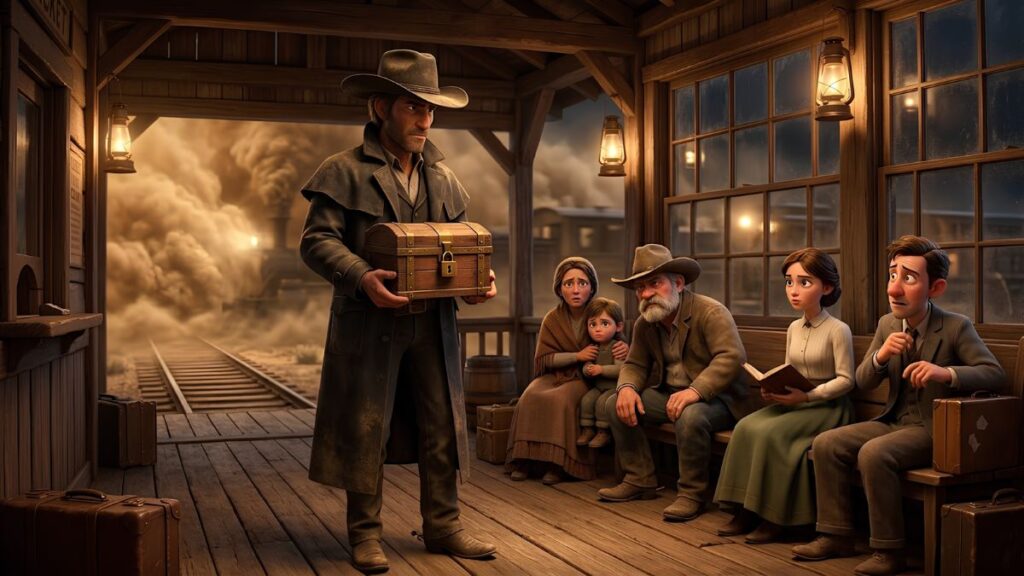
The afternoon train was supposed to arrive at Coyote Station at three o’clock.
By three-thirty, it had not arrived.
By four, the passengers had stopped checking the station clock.
By four-thirty, a powerful dust storm had covered the tracks beyond the station, and the stationmaster had announced that the train would not be moving until the weather improved.
Coyote Station was not much more than a small wooden building beside the railway line.
There was a waiting room with six wooden benches, a ticket counter, a rusty stove, and a large window overlooking the empty desert.
On ordinary days, passengers rarely stayed there for more than a few minutes.
That afternoon was different.
The dust storm had turned the sky brown.
Wind pushed clouds of sand against the windows.
The railway tracks disappeared into the distance.
Everyone was trapped.
Among the passengers was a mysterious traveler.
He had arrived at the station shortly before the storm began.
He was a tall man wearing a dark coat, dusty boots, and a wide-brimmed hat.
He carried only one piece of luggage.
A small wooden box.
The box was old.
Its surface was scratched and darkened with age.
A heavy brass lock held it shut.
The stranger kept one hand close to the box whenever someone came near.
He had purchased a ticket to a town several hundred miles away.
When the stationmaster asked what was inside the box, the stranger simply smiled.
“Something that belongs to me.”
The stationmaster raised an eyebrow.
“Important?”
“Very.”
He said nothing more.
The other passengers began to notice him.
There were five people waiting for the train.
A woman named Clara Whitmore was traveling east to visit her sister.
A traveling salesman named Mr. Briggs carried two large leather cases.
An older rancher named Samuel Cole sat near the stove.
A young schoolteacher named Evelyn Hart read a book beside the window.
And there was a quiet man named Walter Crane.
Walter had said almost nothing since arriving.
He wore a gray coat and carried a small suitcase.
The stranger sat alone in the corner.
His wooden box rested beside his boots.
For nearly an hour, nobody spoke to him.
Then the dust storm grew stronger.
The entire building shook.
The stationmaster walked to the window.
“We won’t be going anywhere for a while,” he said.
Mr. Briggs sighed.
“How long?”
“Could be an hour. Could be all night.”
“All night?”
The stationmaster nodded.
“The tracks need to be inspected before the train can move.”
A nervous silence filled the room.
Clara looked toward the stranger.
He seemed completely calm.
He sat with his arms crossed, watching the locked wooden box.
Finally, Mr. Briggs spoke.
“You traveling far?”
The stranger looked up.
“Yes.”
“Where?”
“East.”
Mr. Briggs smiled.
“So am I.”
The stranger nodded.
Mr. Briggs pointed toward the box.
“What’s in there?”
The stranger’s expression changed slightly.
“Nothing that concerns you.”
Mr. Briggs laughed.
“No offense meant.”
“None taken.”
But the conversation ended there.
The storm continued.
An hour later, the station lights began flickering.
The stationmaster checked the oil lamps.
“We may lose the electricity.”
Clara looked worried.
“Is that common?”
“During storms like this.”
He lit two lamps and placed them around the waiting room.
The room became darker.
Outside, the wind howled.
Sand struck the windows like rain.
Then something unexpected happened.
The wooden box moved.
It had been sitting beside the stranger’s boots.
The vibration of the station caused it to slide slightly across the floor.
The stranger immediately grabbed it.
He pulled it close.
Evelyn noticed.
“So it really is important,” she said.
The stranger looked at her.
“Yes.”
“What is it?”
He hesitated.
“A piece of history.”
Mr. Briggs laughed.
“History isn’t usually locked in a box.”
The stranger stared at him.
“Sometimes it is.”
Nobody spoke after that.
A Strange Question
Later that evening, the stationmaster brought everyone coffee.
The passengers gathered around the stove.
The stranger remained in his corner.
Walter Crane watched him carefully.
Eventually, Walter stood up.
He walked toward the stranger.
“Have we met before?”
The stranger looked at him.
“No.”
Walter studied his face.
“You look familiar.”
“Many people look familiar.”
Walter smiled faintly.
“Perhaps.”
He returned to his seat.
But the stranger’s hand tightened around the wooden box.
Evelyn noticed.
So did Clara.
Something was wrong.
The storm continued for another hour.
At about eight o’clock, the stationmaster announced that the train would not arrive until morning.
The passengers prepared to spend the night at the station.
Some complained.
Others accepted the situation.
Mr. Briggs opened one of his cases and removed a small bottle.
“Anyone want a drink?”
The stationmaster shook his head.
“No drinking in the station.”
Briggs laughed.
“Worth asking.”
He returned the bottle to his case.
Then he noticed something.
A small mark on the stranger’s wooden box.
It was a symbol carved into the wood.
Briggs stared at it.
His face suddenly became serious.
The stranger noticed.
“What?”
“Nothing.”
Briggs looked away.
But the stranger continued watching him.
A few minutes later, Walter walked over to Briggs.
“You know that mark?”
Briggs looked uncomfortable.
“No.”
“You seemed surprised.”
“I wasn’t.”
Walter leaned closer.
“Who is that man?”
Briggs glanced toward the stranger.
“I don’t know.”
“Are you sure?”
Briggs frowned.
“Why are you asking?”
Walter did not answer.
Instead, he returned to his seat.
The stranger watched both men.
He knew something was happening.
The Locked Box
Near midnight, the storm became even stronger.
The windows rattled.
The station door shook in its frame.
Everyone was tired.
Clara had fallen asleep on one of the benches.
Evelyn was reading by lamplight.
Samuel Cole was sitting near the stove with his hat pulled low over his eyes.
The stationmaster was checking the railway equipment.
Only three people remained fully awake.
The stranger.
Walter Crane.
And Mr. Briggs.
The stranger suddenly stood.
He picked up the wooden box.
Walter watched him.
“Going somewhere?”
The stranger looked toward the door.
“I need some air.”
Walter frowned.
“Outside?”
“Yes.”
“In this storm?”
The stranger smiled.
“I’ve lived through worse.”
He walked toward the door.
Before he could open it, Briggs stepped in front of him.
“Wait.”
The stranger stopped.
“What do you want?”
Briggs stared at the box.
“I know what that is.”
The room became silent.
Walter stood.
The stranger’s expression hardened.
“Do you?”
Briggs nodded.
“That symbol belonged to the Red Mesa gang.”
The stranger said nothing.
Samuel Cole suddenly looked up.
“The Red Mesa gang?”
The name meant something to him.
Everyone knew the story.
Twenty years earlier, a group of outlaws had robbed a train carrying gold shipments.
The gang disappeared afterward.
Some members were killed.
Others escaped.
The stolen gold was never recovered.
According to the old stories, the gang had hidden their money somewhere in the desert.
Many people had searched for it.
Nobody had found it.
Briggs pointed toward the box.
“That mark belonged to their leader.”
The stranger looked at him.
“And what makes you think I have anything belonging to them?”
“Because I saw that symbol years ago.”
“Where?”
“On a man who was dying.”
The stranger’s eyes narrowed.
“Who?”
Briggs hesitated.
“Daniel Voss.”
The room became completely silent.
The stranger’s face changed.
Samuel Cole stood.
“Daniel Voss?”
Briggs nodded.
“He was the leader of the Red Mesa gang.”
The stranger slowly placed the box on the table.
Then he looked at Briggs.
“You knew him?”
“Yes.”
“How?”
Briggs took a deep breath.
“I was there the night the train was robbed.”
Nobody moved.
The Secret
Briggs explained that he had been a young railway employee twenty years earlier.
The Red Mesa gang had attacked a train outside Coyote Station.
They had taken a shipment of gold.
But something had gone wrong.
A guard had fought back.
Several outlaws were killed.
The survivors escaped into the desert.
Daniel Voss disappeared with the gold.
“He had a map,” Briggs said.
“A map?”
“Yes.”
“Do you know where the gold is?”
Briggs looked at the wooden box.
“I think you do.”
The stranger said nothing.
Walter suddenly stepped forward.
“You’ve been looking for this box, haven’t you?”
Briggs looked at him.
“I don’t know what you’re talking about.”
Walter smiled.
“You recognized the symbol immediately.”
Briggs became angry.
“Stay out of this.”
Walter’s hand moved toward his coat.
The stranger noticed.
“Don’t.”
Walter stopped.
The stationmaster returned to the room.
“What is going on?”
Nobody answered.
Then the stranger said:
“My name is Thomas Reed.”
Briggs looked surprised.
“Reed?”
Thomas nodded.
“Daniel Voss was my father.”
Clara woke up.
Evelyn lowered her book.
Samuel stared at Thomas.
“You’re his son?”
“Yes.”
“What happened to him?”
Thomas looked at the wooden box.
“He died when I was young.”
“Did he tell you where the gold was?”
Thomas shook his head.
“No.”
“Then what’s inside the box?”
Thomas opened the lock.
Everyone leaned forward.
Inside was an old collection of papers.
There was no gold.
No money.
No jewelry.
Only papers.
Thomas removed one carefully.
“This belonged to my father.”
Briggs stepped closer.
“What does it say?”
Thomas unfolded the paper.
It was a hand-drawn map.
A red line crossed the desert.
At the end of the line was a small circle.
Underneath it were three words.
Coyote Station.
Everyone stared.
“The gold is here?” Evelyn asked.
Thomas shook his head.
“No.”
He pointed toward the map.
“This is why I came.”
A Hidden Truth
Thomas explained that his father had spent the last years of his life trying to make amends for what he had done.
He had never told Thomas where the gold was.
Instead, he had given him the box and told him never to open it until he was old enough to understand.
Inside the box were letters.
The letters revealed that the Red Mesa gang had never hidden the gold for themselves.
After the robbery, Daniel Voss had discovered that another gang member had planned to kill everyone and take the entire fortune.
Daniel had hidden the gold before the betrayal could happen.
But he had never returned for it.
“Why?” Clara asked.
Thomas looked down.
“Because he realized what the money had cost.”
He explained that his father had eventually decided that the gold should be returned.
But he had died before he could do it.
“So why bring it here?” Samuel asked.
Thomas pointed to the map.
“My father left clues.”
He explained that Coyote Station had once been different.
The original station had been destroyed years earlier.
The current building had been constructed over part of the old railway property.
According to his father’s notes, the gold was hidden somewhere near the original station.
Briggs stared at Thomas.
“You expect us to believe this?”
“No.”
Thomas closed the box.
“I don’t need you to believe me.”
Briggs suddenly grabbed the box.
Thomas reacted quickly.
The two men struggled.
The box fell to the floor.
The lid opened.
Papers scattered everywhere.
Walter moved toward Briggs.
“Let it go.”
Briggs pulled a small pistol from his coat.
Everyone froze.
The stationmaster raised his hands.
“Put that away.”
Briggs looked around the room.
“I’ve spent twenty years searching for that gold.”
Thomas stared at him.
“You weren’t looking for the gold.”
“What?”
“You were looking for my father.”
Briggs’s expression changed.
Thomas continued.
“You blamed him for everything.”
Briggs lowered the pistol slightly.
“You don’t know anything.”
“I know he wasn’t the only one involved.”
Briggs looked at the floor.
Thomas picked up one of the letters.
“This letter says another man betrayed the gang.”
Briggs became pale.
“Who?”
Thomas looked at him.
“You.”
The Real Secret
Briggs said nothing.
Thomas explained that his father had discovered the betrayal before the final robbery.
Briggs had secretly worked with another gang member.
They had planned to take the gold for themselves.
But Daniel had stopped them.
The robbery had collapsed.
Briggs had spent years blaming Daniel Voss.
Now he wanted the gold.
“You knew my father had left clues,” Thomas said.
Briggs’s voice became quiet.
“How?”
“I found your name in his letters.”
Briggs looked at the papers.
He finally lowered the gun.
“I never meant for anyone to die.”
Samuel shook his head.
“That doesn’t change what happened.”
“No.”
Briggs sat down.
For the first time, he looked old and tired.
The Morning Train
The storm finally ended shortly after sunrise.
The desert outside Coyote Station was covered in sand.
The railway workers inspected the tracks.
The morning train arrived several hours late.
Before leaving, Thomas returned the papers to his box.
He did not search for the gold.
Instead, he handed the map to the stationmaster.
“What will you do with it?” the stationmaster asked.
Thomas looked toward the desert.
“My father wanted the truth to be known.”
Samuel nodded.
“And the gold?”
Thomas smiled.
“If it still exists, it belongs to someone other than me.”
“Who?”
“The families of the people who lost everything because of the robbery.”
The stationmaster looked impressed.
“That could take years to sort out.”
“Then it will take years.”
Thomas picked up his box.
Walter approached him.
“You knew someone here would recognize the box, didn’t you?”
Thomas smiled.
“I suspected.”
“Then why come?”
“Because secrets don’t stay buried forever.”
Walter nodded.
Thomas boarded the train.
Before stepping inside, he looked back at Coyote Station.
The storm had passed.
The sky was clear.
The desert stretched endlessly toward the horizon.
Thomas smiled and disappeared into the train.
A Different Kind of Treasure
Weeks later, workers discovered an old underground storage room beneath the remains of the original station.
Inside were several rusted metal containers.
The containers held gold coins and old railway certificates.
The fortune had been found.
But Thomas did not claim it.
Instead, the authorities began tracing the families connected to the original robbery.
Some of the money was returned to descendants of the people who had been robbed.
The rest was placed into a historical trust.
As for Mr. Briggs, he was arrested for carrying an illegal weapon and questioned about his involvement in the old robbery.
His confession helped explain what had happened twenty years earlier.
The truth finally became known.
Coyote Station became famous.
People traveled there to hear the story.
But the people who had been there that night remembered something else.
They remembered the stranger with the locked wooden box.
They remembered the dust storm.
They remembered the questions.
And they remembered how quickly greed could turn ordinary people against one another.
Thomas never returned to Coyote Station.
He had not come looking for gold.
He had come looking for the truth.
And he had found it.
Sometimes the greatest treasure is not something that can be placed in a box.
Sometimes it is the truth that finally sets people free.
Lesson From the Story
The Stranger at Coyote Station shows how secrets can remain hidden for years, but the truth can eventually come to light. The story also explores how greed can lead people toward betrayal while honesty can help repair the damage caused by past mistakes.
Thomas could have kept the hidden fortune for himself, but he chose to uncover the truth and make sure the money was handled fairly. His decision shows that wealth is not always the most important reward.
For readers, the story also highlights the importance of patience, careful observation, trust, and good judgment when facing an uncertain situation.
The Sheriff Who Rode Away
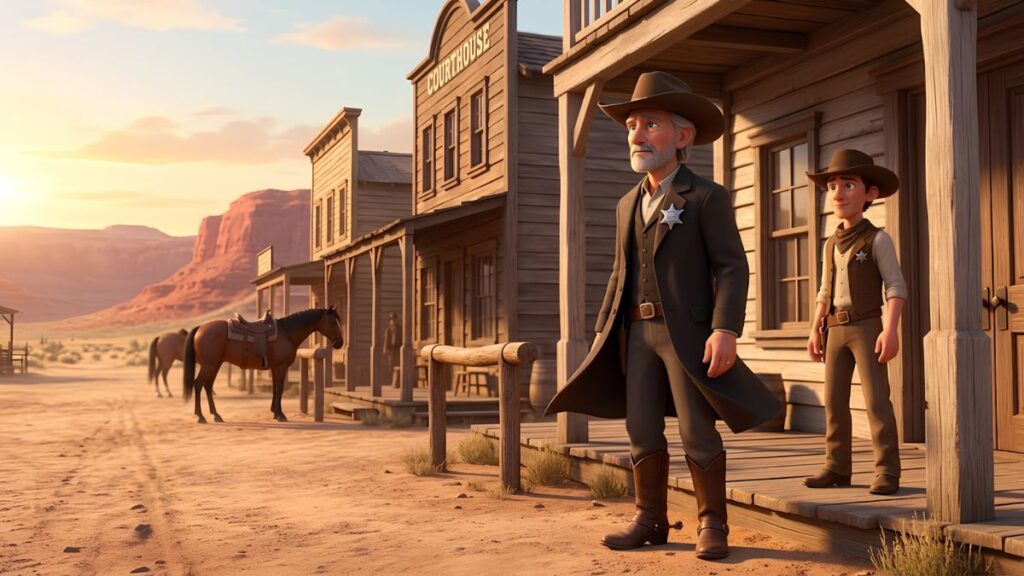
For twenty-seven years, Sheriff Elias Boone had been the law in the small frontier town of Mercy Creek.
He had arrived when the town was little more than a row of wooden buildings beside a dusty road. There had been a general store, a blacksmith’s workshop, a small hotel, a church, and a saloon that seemed to attract more trouble than customers.
Over the years, Mercy Creek had changed.
The wooden buildings had been repaired and replaced. Families had grown. Children had become adults. The railway had brought new businesses and new travelers.
But Sheriff Boone had remained.
He had seen the town through droughts, floods, robberies, cattle disputes, and more than a few arguments that had begun in the saloon and ended in the street.
People trusted him.
At least, most of them did.
Boone was a quiet man in his late sixties. His hair had turned completely gray, and his face was marked by years of sun and wind. He rarely raised his voice.
He didn’t need to.
When Sheriff Boone walked into a room, people usually became quieter.
He believed that the law should be firm, but he also believed that people deserved a chance to change.
That belief had earned him respect.
It had also created enemies.
One cold morning in early spring, Deputy Samuel Carter entered the sheriff’s office and found Boone standing beside his desk.
There was a travel bag on the floor.
Sam stopped.
“What’s that?”
Boone looked at him.
“I’m leaving.”
Sam stared at him.
“Leaving?”
“Yes.”
“For how long?”
Boone picked up his hat.
“I’m not sure.”
Sam looked at the travel bag again.
“You’re quitting?”
Boone nodded.
“After twenty-seven years?”
“After twenty-seven years.”
Sam shook his head.
“You can’t just leave.”
Boone smiled faintly.
“Seems I can.”
“Where are you going?”
“West.”
“That doesn’t tell me anything.”
“It isn’t supposed to.”
Sam stepped closer.
“You’re the sheriff.”
“Not for much longer.”
Sam couldn’t understand.
Boone had never talked about retiring.
There had been no announcement.
No celebration.
No farewell.
Nothing.
“What happened?” Sam asked.
Boone looked toward the window.
“Nothing happened.”
Sam knew immediately that the answer wasn’t true.
Something had happened.
He just didn’t know what.
A Strange Decision
By noon, word had spread throughout Mercy Creek.
The sheriff was leaving.
People gathered outside the sheriff’s office.
The town’s storekeeper, Henry Wallace, was one of the first to arrive.
“You’re really doing this?”
Boone nodded.
Henry looked disappointed.
“Who’s going to keep order?”
“You are.”
Henry laughed.
“I sell flour and coffee.”
“You’ll have to learn.”
Others came to say goodbye.
Some shook Boone’s hand.
Some asked him to stay.
An old rancher named Thomas Reed stood silently for several minutes before finally saying:
“You’ve been here longer than most of us.”
Boone smiled.
“That’s why it’s time to go.”
Thomas frowned.
“That doesn’t make sense.”
Boone didn’t answer.
At sunset, Boone returned to his office.
Sam was waiting.
“You’re still here.”
“So are you.”
Sam folded his arms.
“I’m not leaving until you tell me why.”
Boone sighed.
“Sam, sometimes a man knows when it’s time to move on.”
“That isn’t a reason.”
“It is for me.”
Sam looked at him carefully.
“You’re running from something.”
Boone’s expression changed.
Only for a moment.
But Sam noticed.
“I’ve spent enough time asking questions,” Boone said.
“Then answer one.”
“What?”
“Why now?”
Boone looked at his desk.
After several seconds, he said quietly:
“Because something I thought was finished isn’t finished.”
Sam waited.
But Boone said nothing more.
The Old Crime
Twenty years earlier, Mercy Creek had been shaken by a robbery.
The town bank had been robbed late one evening.
Two men had entered through the back door.
The bank manager had been forced to open the safe.
Before the robbers left, the manager was shot.
He survived, but barely.
The thieves escaped with a large amount of money.
One suspect was arrested within two days.
His name was Caleb Mercer.
Mercer had been a young ranch hand who worked outside town.
He had no money, no family, and a reputation for getting into fights.
Most people believed he was guilty.
The evidence seemed strong.
Someone had seen him near the bank that night.
His horse had been found near the road leading away from town.
And part of the stolen money had been discovered in a room he rented.
Mercer was arrested and eventually sent to prison.
The second robber was never found.
The case became one of the town’s oldest mysteries.
People stopped talking about it after a few years.
But Sheriff Boone never forgot.
Neither did Sam.
He had heard the story many times.
But there was something he had never understood.
Boone had been sheriff at the time.
And everyone said he had personally investigated the crime.
So why was he leaving now?
A Visit to the Records Office
The next morning, Sam went through the sheriff’s records.
He found the old bank robbery file.
The papers were yellow with age.
He read through the reports.
Witness statements.
Bank records.
Arrest papers.
Court documents.
Then he found something unusual.
A handwritten note.
It had been written by Boone.
Sam read it carefully.
Mercer is not telling the whole truth.
Sam frowned.
There was another note.
Someone else was involved.
And another.
Protecting the wrong person may be worse than accusing the wrong one.
Sam sat back.
For twenty years, Boone had believed Caleb Mercer might have been innocent.
But why had he never reopened the case?
Sam continued reading.
Near the bottom of one page was a name.
Clara Bell.
Sam recognized the name.
Clara Bell was an elderly woman who lived outside town.
She had once worked as a housekeeper for the family of a wealthy ranch owner.
Sam remembered seeing her occasionally in town.
He closed the file.
Then he understood something.
Boone wasn’t leaving because he was tired.
He was leaving because of the old robbery.
The Sheriff’s Secret
Sam found Boone at the stable.
The sheriff was preparing his horse.
“You knew Mercer was innocent.”
Boone stopped.
He didn’t turn around.
“Where did you hear that?”
“I read your notes.”
Boone sighed.
“I should have burned those years ago.”
“Why didn’t you tell anyone?”
“Because I couldn’t prove it.”
“You could have reopened the case.”
Boone turned toward him.
“And what would that have changed?”
“Everything.”
“No.”
Boone shook his head.
“Not everything.”
Sam stepped closer.
“Who really robbed the bank?”
Boone looked away.
“I don’t know.”
“You know something.”
“I know enough.”
Sam waited.
Finally, Boone spoke.
“Mercer wasn’t one of the robbers.”
Sam stared at him.
“Then why did you arrest him?”
“I didn’t.”
“What?”
“Mercer wasn’t arrested because of my investigation.”
Boone paused.
“The town leaders wanted someone to blame. The bank wanted the story closed. People wanted a villain.”
“And you let it happen?”
Boone’s face tightened.
“Yes.”
Sam was shocked.
“You knew an innocent man was going to prison.”
“I suspected he was innocent.”
“That’s not the same thing.”
“No.”
Boone looked down.
“But I should have done more.”
The room became quiet.
“Why didn’t you?”
Boone took a deep breath.
“Because someone came to me.”
“Who?”
“I can’t tell you.”
“Why?”
“Because I gave my word.”
Sam shook his head.
“Twenty years ago?”
“Yes.”
“Why are you still protecting this person?”
Boone looked at him.
“Because the person I promised to protect wasn’t the criminal.”
Sam didn’t understand.
“Then who was?”
Boone didn’t answer.
Clara Bell
Sam found Clara Bell that afternoon.
She lived in a small farmhouse several miles outside Mercy Creek.
When she opened the door, she looked at Sam carefully.
“You’re Boone’s deputy.”
“Yes.”
“Is he leaving?”
Sam nodded.
Clara’s expression became sad.
“I knew this day would come.”
Sam’s eyes narrowed.
“You know why he’s leaving.”
She looked toward the road.
“Come inside.”
They sat at a small wooden table.
Clara poured tea.
For several minutes, neither spoke.
Finally, she said:
“The sheriff has carried a heavy burden for a long time.”
“What burden?”
“The truth.”
Sam leaned forward.
“Tell me.”
Clara folded her hands.
“The night the bank was robbed, I was working at the Bell Ranch.”
“What did you see?”
“Two men arrived after dark.”
“Who?”
“I recognized one.”
Sam waited.
“Who was it?”
Clara looked toward the window.
“Jonathan Bell.”
Sam knew the name.
Jonathan Bell had been Clara’s employer.
He had also been one of the richest men in the county.
He had died several years earlier.
“Why would he rob the bank?”
“He wasn’t stealing for himself.”
“Then who?”
Clara shook her head.
“He had debts. Serious ones.”
Sam listened.
“Jonathan planned the robbery with another man. But something went wrong.”
“What happened?”
“One of the men shot the bank manager.”
“And Mercer?”
“Mercer saw them.”
Sam’s eyes widened.
“Caleb Mercer witnessed the robbery?”
“Yes.”
“Then why didn’t he tell anyone?”
“Because he was afraid.”
“Of Jonathan Bell?”
Clara nodded.
“Jonathan threatened him.”
Sam stood.
“Why didn’t you tell Sheriff Boone?”
“I did.”
“Then Boone knew.”
“Yes.”
“Why didn’t he arrest Jonathan Bell?”
Clara’s eyes filled with sadness.
“Because Jonathan had already disappeared.”
Sam stared at her.
“Disappeared?”
“He left town that night.”
“Then where did the stolen money go?”
Clara looked at him.
“That is the part Sheriff Boone never told anyone.”
The Hidden Money
According to Clara, Jonathan Bell had taken most of the stolen money with him.
But he had not taken all of it.
A portion had been hidden.
“Where?” Sam asked.
Clara shook her head.
“I don’t know.”
“But Boone does?”
“I think so.”
“Why would he hide the truth?”
“Because the person who helped Jonathan was still alive.”
Sam immediately understood.
“Who?”
Clara whispered a name.
Sam froze.
The person was someone he had known his entire life.
Someone respected in Mercy Creek.
Someone who had recently announced plans to build a new business in town.
Sam returned to Mercy Creek immediately.
He found Boone packing the last of his belongings.
“You knew.”
Boone looked at him.
“About what?”
“Jonathan Bell.”
Boone closed his bag.
“I wondered how long it would take.”
“You knew who helped him.”
“Yes.”
“Who?”
Boone hesitated.
Then he said:
“Henry Wallace.”
Sam stared at him.
The storekeeper.
The man who had stood outside the sheriff’s office asking Boone not to leave.
“That can’t be true.”
“It is.”
“Why?”
“Because Henry was young then. He worked at the bank.”
Sam remembered.
Henry had been a bank clerk twenty years earlier.
“He helped Jonathan enter the building.”
Boone nodded.
“And the money?”
“Henry knew where Jonathan hid it.”
Sam felt angry.
“Then why didn’t you arrest him?”
Boone looked tired.
“Because Henry wasn’t the one who shot the bank manager.”
“That doesn’t excuse him.”
“No.”
“Then why protect him?”
Boone’s voice became quiet.
“Because Henry’s daughter was dying.”
Sam stared.
Boone continued.
“Henry stole the money because he believed he could use it to pay for her treatment.”
“That doesn’t make it right.”
“No.”
“But you let him go.”
“I gave him one chance to make things right.”
“Did he?”
Boone nodded.
“Every dollar he earned afterward was used to repay what was stolen.”
Sam was silent.
“He spent twenty years trying to repair the damage,” Boone said.
“But the truth still matters.”
“I know.”
“Then why leave?”
Boone looked toward the door.
“Because I don’t know whether forgiveness and justice can exist together.”
The Choice
Sam went to see Henry.
He found him standing behind the counter of his store.
“Henry.”
The old man looked up.
“Deputy.”
“We need to talk.”
Henry’s face changed.
He knew immediately.
“About the bank?”
“Yes.”
Henry slowly sat down.
“How much did Boone tell you?”
“Enough.”
Henry closed his eyes.
“I wondered if this day would come.”
“You helped rob the bank.”
“Yes.”
“You knew Mercer was innocent.”
“Yes.”
“And you stayed silent.”
Henry nodded.
“I was ashamed.”
“Why didn’t you confess?”
“Because I was afraid.”
“Of prison?”
Henry looked down.
“Of losing everything.”
Sam remained silent.
Henry continued.
“My daughter died two years after the robbery.”
Sam’s expression softened.
“But I kept working.”
“Why?”
“To repay what I had done.”
“Did you?”
“I don’t know.”
Henry reached beneath the counter and removed an old metal box.
Inside were records.
Payments.
Receipts.
Names.
Amounts.
He had spent twenty years quietly returning money.
Not all of it.
But much of it.
“I can’t undo what happened,” Henry said.
“No.”
“But I can stop pretending it didn’t.”
The Sheriff Returns
That evening, Sam returned to Boone.
“You can’t leave.”
Boone looked at him.
“I’ve already decided.”
“No.”
Sam placed Henry’s records on the desk.
“Henry confessed.”
Boone stared at the papers.
“He did?”
“Yes.”
Boone sat down.
For a long moment, he said nothing.
Then he removed his badge.
Sam thought he was going to leave it on the desk.
Instead, Boone pinned it back onto his shirt.
“Perhaps,” he said quietly, “I still have one thing left to do.”
“What?”
“Tell the truth.”
The next morning, Sheriff Boone called a town meeting.
Almost everyone came.
He stood in front of the courthouse.
For the first time in twenty years, he told the people of Mercy Creek what had happened.
He told them about the robbery.
He told them about Caleb Mercer.
He told them about Henry.
And he admitted his own failure.
“I believed I could protect people from the consequences of their actions,” Boone said.
“But sometimes protecting someone from justice only delays the damage.”
The crowd was silent.
Henry stood near the back.
He stepped forward.
“I was guilty,” he said.
Nobody spoke.
“I cannot change what I did. But I can finally admit it.”
Someone in the crowd shouted:
“Why didn’t you tell us twenty years ago?”
Henry looked down.
“Because I was afraid.”
The room remained quiet.
Then an old man near the front spoke.
“Mercer deserved better.”
Boone nodded.
“Yes.”
That was all he said.
A Different Kind of Justice
The town reopened the old case.
Caleb Mercer had died years earlier, far from Mercy Creek.
But his name was cleared.
The bank’s records were corrected.
The town placed a small plaque outside the courthouse.
It read:
Justice may be delayed, but truth should never be forgotten.
Henry faced legal consequences for his role in the robbery.
But because he had cooperated, returned much of what had been taken, and had no involvement in the shooting, the court showed him some mercy.
It wasn’t complete forgiveness.
It wasn’t complete punishment.
It was something in between.
A chance to accept responsibility and continue making things right.
As for Sheriff Boone, he did not leave Mercy Creek.
He stayed another year.
Not because he had to.
Because he wanted to help repair what he had failed to repair before.
One morning, Sam found him outside the courthouse.
“You still planning to ride west?”
Boone smiled.
“Eventually.”
“When?”
“When the road feels right.”
Sam laughed.
“You’re impossible.”
Boone placed his hat on his head.
“Maybe.”
He looked toward the distant hills.
“I spent twenty-seven years thinking being sheriff meant protecting people.”
“And now?”
“Now I think it means telling the truth, even when the truth hurts.”
Sam nodded.
“That sounds like justice.”
Boone smiled.
“No.”
He looked toward the courthouse.
“That sounds like redemption.”
Lesson From the Story
The Sheriff Who Rode Away shows that justice is not always simple. Sheriff Elias Boone believed he was protecting people by keeping an old secret, but eventually he realized that hiding the truth could cause another kind of harm.
The story also explores forgiveness and redemption. Henry Wallace made a serious mistake, but he spent years trying to repair the damage. His actions did not erase his crime, but they showed that people can accept responsibility and work toward becoming better.
For readers, the story offers an important lesson: doing the right thing is sometimes difficult, especially when the truth is painful. But accepting responsibility, seeking forgiveness, and correcting past mistakes can lead to redemption.
The Map Under the Floorboards
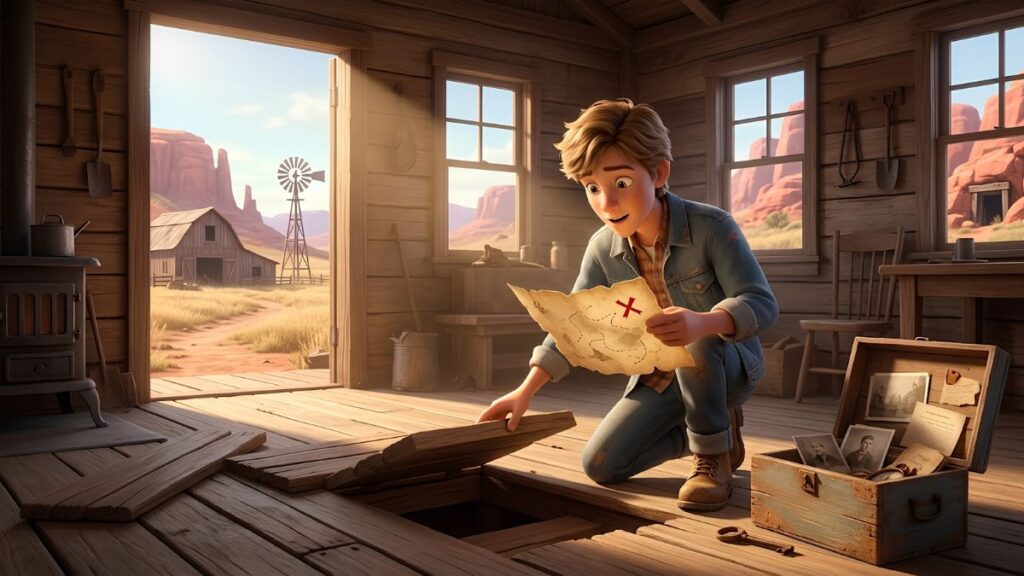
Eli Carter had always believed that old houses kept secrets.
His grandfather used to say that every house had a story, but some stories were buried so deeply that only someone patient enough could find them.
Eli had never understood what he meant.
That changed the summer he discovered the map.
Eli was seventeen years old and had been spending his summer helping his uncle repair an old farmhouse on the edge of a small Western town. The house had belonged to Eli’s great-grandfather, Samuel Carter, who had died many years earlier.
The farmhouse stood several miles outside town.
It was surrounded by dry grass, tall cottonwood trees, and distant red hills that seemed to glow when the afternoon sun touched them.
The property had once been part of a much larger ranch.
Now only the farmhouse, an old barn, a broken windmill, and several acres of dry pasture remained.
Eli’s uncle planned to repair the house and eventually sell the property.
Eli had volunteered to help because he wanted something different from another summer spent in town.
He also liked old things.
He liked old photographs, old tools, old books, and especially old stories.
The farmhouse had plenty of all four.
One Monday morning, Eli was repairing the wooden floor in one of the upstairs bedrooms.
Several boards had become loose over the years.
He removed the damaged boards carefully and placed them against the wall.
Underneath one section, he noticed something unusual.
There was a narrow wooden box hidden between two floor beams.
Eli stopped working.
“What’s that?”
He carefully reached down and pulled the box free.
It was covered in dust.
There was no lock.
Inside, he found an old pocketknife, several yellowed photographs, and a folded piece of paper.
Eli unfolded the paper.
At first, he thought it was simply an old drawing.
Then he realized it was a map.
The map showed the farmhouse, the nearby hills, a dry creek, and several landmarks that Eli recognized.
A red X had been drawn in the hills.
Underneath it were four words:
The Carter Mine.
Eli stared at the paper.
A mine?
He had never heard of a mine on the property.
He looked at the map again.
Near the red X was a handwritten note.
What lies beneath the red stone belongs to those who remember.
Eli felt a sudden rush of excitement.
He folded the map and put it carefully into his pocket.
When his uncle returned from town that afternoon, Eli showed it to him.
His uncle studied the paper silently.
“You’ve never heard of a mine?” Eli asked.
His uncle shook his head.
“No.”
“But this says Carter Mine.”
“I’ve heard stories about your great-grandfather searching for gold.”
Eli’s eyes widened.
“Gold?”
His uncle laughed.
“Don’t get too excited. People have been searching for gold in these hills for generations.”
“Did Great-Grandfather find anything?”
“Not that I know of.”
Eli unfolded the map again.
“Then why would someone hide this?”
His uncle looked at the red X.
“I don’t know.”
For several minutes, neither of them spoke.
Finally, his uncle said, “If you’re thinking about following this map, be careful.”
“I will.”
“Promise me.”
“I promise.”
The next morning, Eli packed water, food, a flashlight, a compass, and the map.
He didn’t plan to search for gold.
At least, that was what he told himself.
He simply wanted to find out whether the mine really existed.
He followed the map toward the red hills.
The first landmark was an enormous cottonwood tree beside a dry creek.
Eli found it easily.
The second was a large boulder shaped like a sleeping animal.
That was harder.
He walked through the hills for almost an hour before finding it.
Behind the boulder was a narrow trail.
Eli followed it.
The trail became steeper.
The dry grass gave way to rocks and thorny bushes.
Eventually, Eli reached a small valley surrounded by red stone.
He looked at the map.
The red X was nearby.
Then he saw something.
A wooden post stood between two rocks.
It was almost completely buried in dirt.
Eli cleared the dirt away with his hands.
Carved into the wood were two letters.
S.C.
Samuel Carter.
Eli’s great-grandfather.
He felt certain he was standing in the right place.
He searched the surrounding rocks.
After several minutes, he noticed a narrow opening beneath a large red stone.
It was almost completely hidden by bushes.
Eli moved the branches aside.
Behind them was a dark hole.
An old mine entrance.
He switched on his flashlight.
The tunnel disappeared into darkness.
Eli hesitated.
He remembered his uncle’s warning.
He also remembered the note on the map.
He decided not to enter.
Instead, he examined the entrance from outside.
Near the opening, he noticed something unusual.
Fresh footprints.
Someone had been there recently.
Eli’s excitement disappeared.
If the mine had been forgotten for decades, why were there fresh footprints?
He stepped backward.
Suddenly, he heard a sound behind him.
A stone rolled down the hill.
Eli turned quickly.
Nobody was there.
He waited.
Nothing.
He picked up his backpack and returned to town.
That evening, Eli told his uncle about the footprints.
His uncle became serious.
“Did anyone see you?”
“I don’t think so.”
“You shouldn’t go back alone.”
“Why?”
His uncle looked at the map.
“Because if someone else knows about that mine, they may not want anyone finding it.”
Eli looked at him.
“Do you think there’s really gold?”
His uncle shook his head.
“I don’t know.”
“Then what do you think is there?”
His uncle pointed at the old photographs from the box.
“Your great-grandfather wasn’t the only person interested in those hills.”
Eli examined the photographs.
One showed Samuel Carter standing beside three men.
Another showed a group of miners outside a wooden building.
On the back of the photograph was a date from nearly seventy years earlier.
Eli noticed something else.
One of the men in the photograph had a familiar face.
He looked like someone Eli had seen around town.
“Who is this?”
His uncle leaned closer.
“That’s Henry Bell.”
“Do you know him?”
“Not personally.”
“Does he still have family here?”
His uncle nodded.
“The Bell family owns the ranch on the other side of the hills.”
Eli suddenly remembered the fresh footprints.
The Bell ranch.
He wondered whether someone from that family had been searching for the mine.
The following morning, Eli went to the town library.
He wanted to learn more before doing anything else.
The librarian, Mrs. Harper, had lived in the area all her life.
When Eli asked about Samuel Carter, she brought out several old newspapers.
“You’ll find some interesting things here,” she said.
Eli spent hours reading.
He discovered that Samuel Carter had worked as a rancher but had once joined a small group of miners searching for gold.
The group had found something valuable.
But before they could return to town, one of the miners disappeared.
The newspapers never explained what happened to him.
The mine was eventually abandoned.
Eli kept reading.
Then he found an article that made his heart beat faster.
It mentioned a disagreement between Samuel Carter and Henry Bell.
The disagreement concerned ownership of a mine.
According to the article, both men claimed that the land belonged to their families.
But the matter was never settled.
Eli copied the information into his notebook.
When he returned home, he found his uncle waiting outside.
“There you are.”
“What’s wrong?”
“Someone came by asking about the farmhouse.”
“Who?”
“A man named Victor Bell.”
Eli froze.
“Bell?”
His uncle nodded.
“He said his family has old records concerning the land.”
“What did you tell him?”
“Nothing.”
Eli showed him the newspaper notes.
His uncle read them carefully.
“We need to find out what this mine is really about.”
The next day, Eli and his uncle returned to the hills together.
They followed the map.
This time, Eli carried the map while his uncle carried a flashlight and climbing equipment.
They reached the mine entrance.
The fresh footprints were still there.
His uncle examined them.
“Someone has been coming here.”
They entered carefully.
The tunnel was narrow at first.
Old wooden supports crossed the ceiling.
Dust covered the ground.
The walls were marked with faded scratches.
After several minutes, they reached a larger chamber.
Eli shone his flashlight around.
There were old mining tools scattered across the floor.
A rusted lantern.
A broken shovel.
Several wooden crates.
Then Eli noticed a metal box.
It was hidden behind a fallen beam.
His uncle moved the beam aside.
Inside the box were documents.
Old property records.
Letters.
And a small leather pouch.
Eli opened it.
Inside were several gold-colored stones.
His uncle examined one.
“This isn’t gold.”
Eli looked disappointed.
“What is it?”
“Pyrite. Fool’s gold.”
Eli laughed.
“So the legendary mine wasn’t full of gold?”
“Maybe not.”
His uncle unfolded one of the documents.
His expression changed.
“What?”
He handed the paper to Eli.
It was a land survey.
According to the document, the mine was not actually located on either the Carter ranch or the Bell ranch.
It was on land that had once belonged to both families under an old shared agreement.
Eli read the document again.
“So neither family owns the mine.”
“Correct.”
Then they found another letter.
It had been written by Samuel Carter.
The letter explained everything.
Samuel had discovered that the mine contained very little gold.
But he had also discovered something more important.
The mine was connected to an underground spring.
The water flowed beneath the hills and supplied both ranches.
Years earlier, the families had agreed to share the water.
Samuel had hidden the documents because he feared that someone would destroy the agreement in order to control the water.
Eli looked at his uncle.
“So the treasure wasn’t gold.”
His uncle smiled.
“The real treasure was water.”
Suddenly, they heard footsteps outside.
They turned off their flashlights.
Someone was approaching the mine.
Eli and his uncle stayed silent.
A man’s voice echoed through the tunnel.
“I know you’re in there.”
Eli recognized it.
Victor Bell.
His uncle whispered, “Stay behind me.”
Victor entered the chamber.
He looked around.
“You found the documents.”
Eli stepped forward.
“We know about the water.”
Victor stared at him.
For a moment, nobody spoke.
Then Victor sighed.
“My family has been looking for these papers for years.”
“Why?”
“Because the spring is running dry.”
Eli looked at his uncle.
Victor continued.
“The Bell ranch has been losing water for months. We thought your family had redirected it.”
“We didn’t.”
“I know that now.”
Victor looked tired.
“My grandfather believed the Carters had hidden something.”
Eli held up the land document.
“The water belongs to both families.”
Victor nodded.
“Then we need to work together.”
They returned to town with the documents.
Over the following weeks, the Carter and Bell families investigated the old water system.
They discovered that a section of the underground channel had collapsed.
The problem wasn’t theft.
It was damage.
Both ranches had been losing water because the spring’s natural path had been blocked.
The families worked together to repair the channel.
Slowly, water began flowing again.
The ranches survived.
The old argument between the families finally ended.
Eli kept the map.
But he no longer thought of it as a treasure map.
It was something more valuable.
It was a reminder of what his great-grandfather had understood many years earlier.
Treasure was not always something that could be sold.
Sometimes it was something that helped people survive.
Sometimes the greatest discovery was not finding something valuable.
It was understanding what was valuable in the first place.
Months later, Eli returned to the farmhouse.
He placed the old map in a wooden frame and hung it on the wall.
Underneath it, he wrote a small note:
The greatest treasures are not always buried. Some are meant to be shared.
He smiled.
His grandfather had been right.
Old houses really did keep secrets.
But sometimes, the secret was not about the past.
Sometimes, it was there to teach the future.
Lesson From the Story
The Map Under the Floorboards teaches that valuable discoveries are not always about money or gold. Eli begins his adventure believing the mysterious map may lead to a forgotten fortune. Instead, he discovers an underground water source and an old agreement that could protect two families from losing their ranches.
The story also shows how greed and family conflicts can hide the truth. By investigating the past and sharing what they discover, Eli and his uncle help the Carter and Bell families understand that cooperation is more valuable than competition.
For readers, especially those learning English, the story provides practical vocabulary connected with adventure, property, family history, exploration, conflict, and problem-solving.
The most important lesson is simple: sometimes the greatest treasure is the knowledge that helps people work together and protect what truly matters.
Common Settings in Western Short Stories
Setting is one of the most important elements of Western fiction.
The environment is often more than a background. It can directly influence the characters and the plot.
Frontier Towns
Small frontier towns are common settings.
A town may contain:
- A general store
- A saloon
- A stable
- A sheriff’s office
- A blacksmith
- A hotel
- A church
- A small bank
- A train station
Because communities are small, everyone may know everyone else.
A stranger entering town can immediately create curiosity or suspicion.
Ranches
Ranches provide another classic Western setting.
Stories set on ranches can explore:
- Hard work
- Family relationships
- Livestock
- Land ownership
- Drought
- Financial difficulties
- Conflicts with neighboring ranchers
- Isolation
Ranch life can also provide opportunities to explore the relationship between people and the land.
Open Plains
The wide-open landscape is a defining feature of many Western stories.
The plains can symbolize:
- Freedom
- Possibility
- Loneliness
- Danger
- Uncertainty
A character traveling across a large empty landscape may have nowhere to seek help when something goes wrong.
Mountains and Deserts
Mountains and deserts introduce physical challenges.
Characters may face:
- Extreme temperatures
- Lack of water
- Difficult terrain
- Dangerous animals
- Sudden storms
- Getting lost
- Injuries
The landscape can become an important source of conflict.
Mining Towns
Gold and silver mining communities can provide settings filled with opportunity and tension.
Stories in mining towns may involve:
- Prospectors
- Mine owners
- Workers
- Gambling
- Financial disputes
- Competition
- Claims to valuable land
- Dangerous working conditions
The desire for wealth can also motivate characters to make questionable decisions.
Common Characters in Western Short Stories
Western fiction contains many recognizable character types.
The Cowboy
The cowboy is one of the genre’s most recognizable figures.
However, cowboys can be portrayed in many different ways.
A cowboy may be:
- A ranch worker
- A cattle driver
- A lonely traveler
- A skilled horseman
- A reluctant hero
- A former outlaw
- A young person searching for independence
The Sheriff
The sheriff often represents law and order.
But Western stories frequently make the sheriff’s job complicated.
A sheriff may have to decide between:
- Law and friendship
- Justice and revenge
- Personal safety and public responsibility
- Strict rules and compassion
The Outlaw
Outlaws are common Western characters, but they do not always have to be simple villains.
A story may portray an outlaw as:
- Cruel and dangerous
- Desperate
- Misunderstood
- Regretful
- Protective of someone
- Trying to change
This creates opportunities for moral complexity.
The Rancher
Ranchers often represent independence and hard work.
Their conflicts may involve:
- Land
- Money
- Livestock
- Family
- Drought
- Rival ranchers
- Changing economic conditions
The Stranger
The mysterious stranger is a particularly useful Western character.
A stranger arriving in town immediately creates questions.
Who is this person?
Why did they come?
What are they hiding?
Are they dangerous?
Do they have a connection to someone in town?
The stranger can quickly introduce mystery and tension into a short story.
The Settler
Settlers allow Western stories to explore the challenges of building a new life.
They may struggle with:
- Isolation
- Weather
- Lack of supplies
- Difficult travel
- Financial pressure
- Conflict with other settlers
- Protecting their families
Major Themes in Western Short Stories
Although Western fiction is associated with action and adventure, its strongest stories often revolve around deeper themes.
Justice
Justice is one of the most common themes.
A character may have to decide whether justice should come through official law or personal action.
This creates questions such as:
- What happens when the law cannot protect someone?
- Is revenge the same as justice?
- Should a person follow the law even when the law seems unfair?
- Can someone forgive a serious wrongdoing?
Freedom
The open frontier is often associated with personal freedom.
Characters may want to escape:
- Social expectations
- Difficult relationships
- Poverty
- The law
- Their past
- Restrictions imposed by society
But Western stories can also show that freedom comes with responsibility.
Survival
Life in the frontier environment can be physically difficult.
Characters may have to survive:
- Harsh weather
- Hunger
- Injury
- Isolation
- Dangerous journeys
- Conflict with other people
- Limited resources
Survival stories often reveal a character’s true personality.
Courage
Courage is another central theme.
A character does not necessarily need to win a fight to demonstrate courage.
Courage can mean:
- Facing danger
- Protecting another person
- Admitting a mistake
- Standing up against injustice
- Continuing after failure
- Returning to a dangerous place
- Making an unpopular decision
Loyalty
Western communities often depend heavily on trust.
A character may be tested when a friend, family member, employer, or community needs help.
Loyalty can become especially complicated when it conflicts with justice.
Loneliness
The Western landscape provides a natural environment for exploring loneliness.
A character living far from other people may experience:
- Isolation
- Homesickness
- Loss
- Emotional distance
- Difficulty forming relationships
A short Western story can use this loneliness to create a quiet and emotional narrative.
Redemption
Many Western characters have complicated pasts.
A former outlaw may try to become an honest person.
A violent character may attempt to protect someone.
A dishonest character may finally choose to tell the truth.
Redemption gives characters opportunities to change.
The Role of Morality
Western stories often place characters in situations where there is no easy answer.
For example, a character might discover that a close friend has committed a crime.
Should the character protect the friend?
Or report the crime?
Another character might have an opportunity to take revenge.
Should they do it?
These situations make Western short stories more interesting because the conflict is not always simply good versus evil.
Instead, the story may explore different ideas of right and wrong.
Violence in Western Short Stories
Violence is historically associated with the Western genre, but it does not have to dominate the story.
A strong Western can create tension without constant violence.
Suspense can come from:
- A threatening conversation
- A character approaching town
- A missing person
- A dangerous journey
- A secret being discovered
- A confrontation that may become violent
In many cases, the anticipation of violence can be more powerful than the violence itself.
The Importance of Horses
Horses are strongly connected to traditional Western fiction.
They can serve practical and symbolic purposes.
A horse may represent:
- Freedom
- Independence
- Travel
- Survival
- Companionship
For characters living far from towns, horses can also be essential for transportation.
A lost, injured, or stolen horse can therefore become a significant plot problem.
Western Dialogue
Dialogue helps establish the atmosphere of a Western story.
Characters may speak in short, direct sentences.
Dialogue can communicate:
- Confidence
- Suspicion
- Authority
- Fear
- Friendship
- Threats
- Respect
Writers should avoid making every character sound identical.
A sheriff, rancher, young traveler, and experienced outlaw should ideally have different personalities and speaking styles.
Western Short Stories and the Hero’s Journey
Many Western stories follow a basic transformation.
A character begins in one situation.
Something disrupts that situation.
The character faces a challenge.
They make difficult choices.
They experience consequences.
Finally, they emerge changed.
For a short story, this structure can be compressed into a small number of important scenes.
A Simple Western Story Structure
Beginning: Introduce the character, setting, and problem.
Rising conflict: The problem becomes more serious.
Decision: The character must make an important choice.
Climax: The character faces the central challenge.
Resolution: The consequences of the decision become clear.
Ending: The character or situation changes.
This structure works particularly well for short Western fiction because it keeps the story focused.
Western Mystery Stories
Western fiction can easily overlap with mystery.
A story might involve:
- A missing horse
- A stolen object
- A mysterious traveler
- A hidden identity
- A suspicious death
- A missing person
- A secret from the past
The Western setting adds another layer to the mystery because characters may be isolated and far from modern investigative resources.
Western Adventure Stories
Adventure is another major category.
Characters may travel through:
- Deserts
- Mountains
- Plains
- Rivers
- Frontier settlements
They may encounter obstacles that force them to think creatively.
Adventure-focused Western short stories often emphasize movement, danger, discovery, and survival.
Western Romance
Romance can also appear within Western fiction.
A relationship may develop between:
- Neighbors
- Travelers
- Ranchers
- Settlers
- Childhood friends
- People from rival families
Romantic Western stories can explore how relationships develop in challenging environments.
Western Stories for Younger Readers
Western themes can also be adapted for children and younger readers.
These stories can focus on:
- Friendship
- Courage
- Problem-solving
- Responsibility
- Adventure
- Animals
- Helping others
- Perseverance
A child-friendly Western does not need to rely on violence or dangerous confrontations.
Instead, it can focus on solving mysteries, helping a family, finding a lost animal, or overcoming a difficult journey.
Modern Western Short Stories
Modern Western fiction does not necessarily need to take place in the 1800s.
Contemporary Western stories can explore life in present-day rural communities.
They may include:
- Modern ranchers
- Small-town families
- Rural communities
- Contemporary law enforcement
- Environmental challenges
- Family businesses
- Changing communities
The genre can therefore continue to explore traditional Western themes while addressing modern concerns.
Why Readers Enjoy Western Short Stories
Western short stories offer several qualities that make them appealing.
Strong Atmosphere
The setting immediately creates a distinctive atmosphere.
A dusty road, quiet town, isolated ranch, or enormous open landscape can establish the mood within a few paragraphs.
Clear Conflict
Western stories often introduce conflict quickly.
Readers can understand what the character wants and what stands in the way.
Memorable Characters
The genre naturally produces strong character types, from determined ranchers to mysterious strangers.
Moral Questions
Many Western stories ask readers to think about justice, responsibility, courage, and personal choices.
Fast-Paced Narratives
Because they are short, these stories often move quickly.
There is little room for unnecessary scenes.
What Makes a Good Western Short Story?
A successful Western short story generally needs more than a Western setting.
It should have a compelling central conflict.
The main character should want something.
There should be an obstacle preventing them from getting it.
The character should face meaningful consequences.
The setting should influence the story rather than simply decorate it.
Most importantly, the ending should provide some form of emotional or narrative resolution.
Tips for Writing Western Short Stories
If you are creating your own Western short story, begin with a simple central idea.
For example:
A rancher discovers that someone has been stealing his horses.
From that basic idea, you can develop:
- Who is stealing them?
- Why?
- How does the rancher discover the truth?
- Who can he trust?
- What happens when he confronts the person?
- What does he learn?
Keep the story focused on one major conflict.
Create a Strong Main Character
Give the protagonist:
- A clear goal
- A personal weakness
- A reason to care
- A difficult decision
- Something to lose
Make the Setting Matter
Instead of simply saying that the story takes place in the West, use the environment.
Weather, distance, terrain, animals, and isolation should affect what happens.
Avoid Unnecessary Characters
Short stories have limited space.
Only introduce characters who contribute meaningfully to the plot.
Build Tension Gradually
Do not reveal every important detail immediately.
Give readers questions that encourage them to continue reading.
End With Meaning
A satisfying ending does not always need to be happy.
It should make the events of the story feel worthwhile.
Western Short Stories as English-Learning Material
Western stories can also be useful for adults and students learning English.
They provide vocabulary related to:
- Travel
- Nature
- Work
- Animals
- Weather
- Relationships
- Conflict
- Emotions
- Law
- Communities
However, the vocabulary should match the learner’s level.
For beginners, simple Western stories with straightforward sentences can provide accessible reading practice.
Intermediate learners can explore more descriptive stories and dialogue.
Advanced learners can read stories containing historical language, symbolism, complex characterization, and moral ambiguity.
Questions Readers Can Ask After Reading
To understand a Western short story more deeply, readers can consider:
- Who is the main character?
- What does the character want?
- What prevents the character from achieving the goal?
- How does the setting influence the story?
- What is the central conflict?
- What decision does the character make?
- What consequences follow?
- What does the character learn?
- What theme does the story explore?
- How does the ending change the reader’s understanding of the story?
Final Thoughts
Western short stories are much more than tales of cowboys, horses, outlaws, and frontier towns. The genre provides a powerful setting for exploring universal human experiences such as courage, justice, freedom, survival, loyalty, loneliness, responsibility, and personal growth.
Their short format makes them especially effective because each story can concentrate on one important conflict and one meaningful character journey.
Whether set on a remote ranch, in a dusty frontier town, across an open plain, or in a modern rural community, Western fiction continues to offer opportunities for adventure, suspense, mystery, emotion, and reflection.
The strongest Western short stories leave readers with more than the memory of an exciting event. They leave them thinking about the choices people make when circumstances become difficult and what those choices reveal about who they really are.