
Hard work is a simple idea, but it can be one of the most difficult lessons for children to understand. Young learners often see the final result without seeing everything that happened before it. They may see someone win a competition, receive a good grade, perform well on stage, or become excellent at a skill without realizing how much practice came before that achievement.
A short story on hard work leads to success can make this lesson easier to understand. Through an engaging character and a realistic challenge, children can see how effort, patience, practice, and determination can gradually turn a difficult goal into an achievable one.
The message does not have to be that every person who works hard will become the winner. A more meaningful lesson is that hard work helps people improve, overcome obstacles, build confidence, and reach goals that may initially seem impossible.
What Does “Hard Work Leads to Success” Mean?
The phrase does not mean that success happens automatically whenever someone works hard.
Instead, it highlights the relationship between consistent effort and improvement.
Someone who wants to learn a new skill may struggle at first. They may make mistakes and feel frustrated. However, if they continue practicing, learn from those mistakes, and adjust their approach, they are likely to become better.
For children, this can apply to almost anything:
- Learning mathematics
- Improving reading skills
- Practicing handwriting
- Learning an instrument
- Playing a sport
- Drawing or painting
- Preparing for a competition
- Learning a new language
- Completing a difficult school project
The result may not appear immediately, but effort can create progress.
Why This Lesson Matters for Children
Children are still developing their understanding of effort and achievement.
Some may believe that people are simply born good at certain things.
A child might say:
“I can’t draw.”
“I am bad at math.”
“I can’t run fast.”
“I’ll never be good at this.”
A story can challenge these beliefs without making the lesson feel like a lecture.
When children see a character struggle with something and gradually improve through practice, they can begin to understand that ability can develop.
The important question changes from:
“Am I good at this?”
to:
“What can I do to get better?”
That is a much more productive way of thinking.
7 Short Story on Hard Work Leads to Success
The Little Gardener

Maya had always loved plants.
Whenever she visited her grandmother, she spent hours walking around the garden. She liked touching the soft leaves, smelling the flowers, and watching bees move from one plant to another.
One summer, Maya decided that she wanted to grow a garden of her own.
She had a small piece of empty land behind her house. It wasn’t very large, but she thought it would be enough for a few vegetables.
“I’m going to grow tomatoes, carrots, and beans,” she announced at breakfast.
Her father smiled.
“That sounds like a good project.”
“I’ll have vegetables ready in a few weeks.”
Her father laughed gently.
“Gardens need time.”
Maya nodded.
“I know.”
But secretly, she thought it would be easy.
She imagined herself walking into the garden after a few days and finding large green plants covered with vegetables.
She didn’t realize how much work would be involved.
Preparing the Garden
That Saturday morning, Maya went outside with a small shovel.
The garden area was covered with grass and weeds.
She looked at it for a moment.
“This is going to take longer than I thought.”
Her father helped her remove the larger weeds.
They pulled them from the ground one by one.
Some had deep roots.
Others broke when Maya pulled them.
After an hour, she was tired.
Her hands were dirty, and her back hurt.
“Can we stop?” she asked.
“Of course,” her father said. “You don’t have to finish everything today.”
Maya sat on the grass.
She looked at the small area they had cleared.
It wasn’t much, but it was a beginning.
The next morning, Maya returned to the garden.
She removed more weeds.
On Monday, she worked for another twenty minutes.
On Tuesday, she cleared another small section.
By the end of the week, most of the garden was ready.
Maya was proud.
She had expected the garden to appear immediately, but she had learned that even preparing the soil required patience.
Planting the Seeds
Maya went to a local garden shop with her father.
She bought tomato, carrot, and bean seeds.
The shop owner explained how to plant them.
“Don’t put the seeds too deep,” she said. “And make sure they have enough space.”
Maya listened carefully.
When she returned home, she made small holes in the soil.
She placed the seeds inside and covered them gently.
Then she watered the garden.
She stood back and looked at the soil.
Nothing had changed.
“I can’t see anything,” she said.
Her father smiled.
“Seeds don’t grow instantly.”
“How long will it take?”
“It depends on the plant.”
Maya looked at the soil again.
She felt disappointed.
She had imagined green plants appearing immediately.
Instead, the garden looked exactly as it had the day before.
Still, she decided to check it every morning.
On Monday, nothing.
On Tuesday, nothing.
On Wednesday, still nothing.
By Thursday, Maya was becoming impatient.
“Maybe the seeds aren’t going to grow.”
Her father said, “Give them time.”
So Maya continued watering them.
The First Sprout
On Saturday morning, something looked different.
Maya ran outside.
She noticed a tiny green shape pushing through the soil.
“Dad!”
Her father came outside.
“What happened?”
“Look!”
He bent down.
A tiny sprout had appeared.
“It grew!”
Her father smiled.
“That’s your first plant.”
Maya was excited.
She checked the rest of the garden.
A few days later, more sprouts appeared.
The beans were growing quickly.
The tomatoes were smaller.
The carrots were still hidden beneath the soil.
Maya began spending more time in the garden.
She watered the plants every morning.
She removed weeds.
She checked the leaves for insects.
She made sure the plants received enough sunlight.
She started keeping a small notebook.
Every day, she wrote down what she noticed.
Monday: Two new bean leaves.
Tuesday: Tomato plant is taller.
Wednesday: No major changes.
Thursday: One new tomato leaf.
Maya began to understand something important.
Not every day brought a visible change.
Sometimes she worked hard and saw almost nothing happen.
But that didn’t mean her work was useless.
The plants were still growing.
The First Problem
A few weeks later, Maya noticed small holes in some of the leaves.
She became worried.
“Something is eating my plants.”
She looked closely.
There were tiny insects under several leaves.
Maya wanted to remove them immediately.
Instead, she asked her grandmother for advice.
Her grandmother visited the garden.
“These are small garden pests,” she explained.
“What should I do?”
“There are several ways to protect your plants. First, remove the damaged leaves and check the plants regularly.”
Maya followed her grandmother’s advice.
She also learned how to keep the garden healthy without harming helpful insects.
For the next several days, she checked the plants carefully.
The work was tiring.
Sometimes she wanted to ignore the garden.
But she remembered how much effort she had already put into it.
So she continued.
A Difficult Week
One week, Maya became very busy.
She had schoolwork to finish.
She had a science project.
She also had a birthday party to attend.
On Monday, she forgot to water the garden.
On Tuesday, she was too tired.
On Wednesday morning, she remembered.
She ran outside.
The soil was dry.
Some of the leaves were beginning to droop.
Maya felt terrible.
“I ruined everything.”
Her father came outside.
“You haven’t ruined anything.”
“But I forgot to water them.”
“Plants can recover. Take care of them today.”
Maya watered the garden carefully.
She checked each plant.
By the next morning, the leaves looked healthier.
Maya felt relieved.
She realized that being successful didn’t mean never making mistakes.
It meant noticing mistakes and doing something about them.
The Garden Gets Bigger
As the weeks passed, the garden changed.
The tiny sprouts became strong plants.
The bean plants grew tall.
The tomato plants developed yellow flowers.
The carrot leaves became thick and green.
Maya was amazed.
She remembered the first day when the garden had been nothing but weeds and empty soil.
Now it was full of life.
One afternoon, she saw the first tiny green tomato.
She called her father.
“Look!”
He smiled.
“That’s exciting.”
“How long until it’s ready?”
“Not long.”
Maya checked the tomato every day.
It slowly became larger.
Then it began changing color.
Green became light orange.
Light orange became red.
Finally, one morning, Maya carefully picked it.
She held it in her hand.
Her first tomato.
She had grown it herself.
A Lesson About Patience
Maya washed the tomato and cut it into slices.
She shared it with her family.
Her mother smiled.
“It tastes wonderful.”
Maya laughed.
“I think it tastes better because I grew it.”
Her father nodded.
“You worked hard for it.”
Maya looked outside at the garden.
She realized that the tomato represented much more than a vegetable.
It represented weeks of effort.
She had cleared weeds.
Prepared the soil.
Planted seeds.
Watered the plants.
Removed pests.
Made mistakes.
Corrected them.
And waited.
The result had not appeared overnight.
It had developed slowly.
The Unexpected Challenge
Just when Maya thought everything was going perfectly, a strong storm arrived.
Dark clouds covered the sky.
The wind became stronger.
Rain began falling heavily.
Maya looked out the window.
“My plants!”
She ran outside with her father.
The wind was bending the tomato plants.
Some leaves had fallen.
One of the bean plants had broken.
Maya felt like crying.
After the storm passed, she walked through the garden.
Several plants were damaged.
“This is terrible.”
Her father put a hand on her shoulder.
“Some plants may recover. Let’s see what we can save.”
They carefully supported the tomato plants.
They removed broken branches.
They cleaned fallen leaves.
Maya spent the entire afternoon repairing the garden.
The next day, she checked the plants again.
Some had recovered.
Others had not.
The broken bean plant was beyond saving.
Maya was disappointed.
“I worked so hard.”
Her father nodded.
“I know.”
“Why did this happen?”
“Sometimes things happen that we can’t control.”
Maya was quiet.
She had learned another lesson.
Hard work did not guarantee that everything would always go perfectly.
But hard work gave her the ability to recover when things went wrong.
The Harvest
Summer continued.
The garden produced more vegetables.
Maya picked beans.
She pulled carrots from the soil.
She collected tomatoes.
Her family had more vegetables than they could eat.
Maya placed some in baskets.
Her mother suggested giving some to their neighbors.
Maya liked the idea.
She carried a basket to an elderly neighbor who lived nearby.
“These are from my garden.”
The neighbor smiled.
“You grew these?”
“Yes.”
“They look wonderful.”
“Thank you.”
The neighbor thanked Maya and later sent her a small jar of homemade jam.
Maya was surprised.
She had started the garden because she wanted to grow vegetables.
Now it had given her something more.
She had learned about patience, responsibility, failure, recovery, and generosity.
A New Goal
At the end of summer, Maya looked at her garden.
It was not perfect.
Some plants had died.
Some vegetables were smaller than expected.
A few had been damaged by insects.
But overall, the garden had been successful.
Maya decided she wanted to make it even better the following year.
She opened her notebook.
She wrote:
Next year:
- Plant more tomatoes.
- Give carrots more space.
- Build support for the beans.
- Water early in the morning.
- Protect plants from pests.
- Start planting earlier.
Her father read the list.
“You’ve already become a better gardener.”
Maya smiled.
“I made lots of mistakes.”
“That’s how you learned.”
She looked at the garden.
“When I started, I thought success meant getting vegetables quickly.”
“And now?”
Maya thought for a moment.
“Now I think success means continuing even when things are difficult.”
Her father smiled.
“That is a very good lesson.”
The Following Spring
When spring arrived the next year, Maya started another garden.
This time, she was prepared.
She knew how to prepare the soil.
She knew how much water the plants needed.
She knew that some seeds would grow faster than others.
She knew that problems would appear.
Most importantly, she knew not to expect instant results.
Her new garden grew better than the first one.
Maya was not more successful because she was suddenly talented.
She was successful because she had learned from her previous experience.
Every day of work had taught her something.
Every mistake had improved her skills.
Every difficult moment had made her more patient.
And every small success had encouraged her to continue.
The School Project
One day, Maya’s teacher announced a school project.
Each student had to create something that demonstrated a skill they had developed.
Maya decided to present her garden.
She brought photographs showing the garden at different stages.
The first photograph showed empty soil.
The next showed tiny sprouts.
Then there were larger plants.
Finally, there was a photograph of her family standing beside the garden.
Maya explained how long it had taken.
“I learned that plants don’t grow because you want them to grow,” she told the class.
“You have to take care of them every day.”
Her teacher smiled.
“What else did you learn?”
Maya answered:
“I learned that hard work doesn’t always give you results immediately. Sometimes you have to keep working before you can see what your effort is doing.”
The classroom became quiet.
Then her classmates applauded.
Maya smiled.
She had started with a small patch of empty ground.
But the lessons she had learned were much bigger than her garden.
The Little Gardener’s Success
Years later, Maya still remembered her first garden.
She never forgot how impatient she had been when the seeds refused to appear.
She never forgot the excitement of seeing the first green sprout.
She never forgot the storm that damaged her plants.
Most importantly, she never forgot how she had continued.
Whenever she faced a difficult challenge at school, she remembered the garden.
When a difficult subject seemed impossible, she practiced.
When she made mistakes, she tried to understand them.
When progress seemed slow, she reminded herself that some things needed time.
She understood that success was rarely one big moment.
More often, it was the result of many small efforts repeated over time.
One morning, Maya stood in her garden and looked at the plants.
She smiled.
The garden had taught her something that would stay with her for the rest of her life.
Hard work may not produce instant results, but consistent effort can eventually turn a small beginning into something wonderful.
Useful Vocabulary
- Gardener
A person who takes care of plants and gardens.
Example: Maya wanted to become a better gardener. - Sprout
A young plant that has just begun growing from a seed.
Example: Maya was excited when she saw the first sprout. - Harvest
The process of collecting crops or vegetables when they are ready.
Example: Maya collected tomatoes during the harvest. - Patient
Able to wait without becoming frustrated.
Example: Maya learned to be patient while waiting for her plants to grow. - Consistent
Continuing to do something regularly.
Example: Consistent care helped Maya’s garden grow. - Effort
The energy or work someone uses to accomplish something.
Example: Maya’s effort helped her create a successful garden. - Pests
Small insects or animals that can damage plants.
Example: Maya had to protect her plants from pests. - Recover
To return to a healthy or normal condition after difficulty or damage.
Example: Some plants recovered after the storm. - Responsibility
A duty or task that someone is expected to take care of.
Example: Taking care of the garden became Maya’s responsibility. - Persistence
Continuing to try even when something is difficult.
Example: Maya’s persistence helped her become a successful gardener.
Reading Comprehension Questions
- Why did Maya want to create a garden?
- What did Maya have to do before she could plant the seeds?
- Why did Maya become impatient after planting the seeds?
- What happened when the first sprouts appeared?
- What problem did Maya discover on the plants?
- What happened when Maya forgot to water the garden?
- How did the storm affect the garden?
- What did Maya learn from the damaged plants?
- Why did Maya keep a gardening notebook?
- What did Maya learn about hard work and success?
Discussion Questions
- Have you ever worked hard on something that took a long time to complete?
- Why is patience important when trying to achieve a goal?
- Can mistakes help people become better at something?
- What should you do when you do not see results immediately?
- Why is consistency important for success?
- What is one goal you would be willing to work on every day?
Lesson From the Story
The Little Gardener teaches that success rarely happens immediately. Maya begins with an empty patch of land and expects quick results, but she soon discovers that meaningful progress requires preparation, patience, regular effort, and the ability to recover from setbacks.
The garden also teaches Maya that hard work does not mean everything will always go according to plan. Her plants face insects, neglect, and a damaging storm. Instead of giving up, she learns from each problem and continues caring for the garden.
The story’s central message is simple: small efforts repeated consistently can eventually create significant results. Success is often built through patience, practice, mistakes, and persistence rather than one sudden achievement.
The Garden That Wouldn’t Grow

Daniel had always dreamed of having a beautiful garden.
Behind his small house was an empty piece of land. It was not very large, but Daniel imagined rows of vegetables, colorful flowers, and fruit trees growing there.
One spring morning, he decided to turn his dream into reality.
He bought seeds for tomatoes, carrots, beans, and sunflowers. He also bought a few gardening tools and a small watering can.
Daniel was excited.
“This summer, I’ll have the best garden in the neighborhood,” he said.
He prepared the soil carefully. He removed stones, pulled out weeds, and made several straight rows.
Then he planted the seeds.
Every morning, Daniel went outside to check his garden.
For the first few days, nothing happened.
He looked at the soil.
Still nothing.
After one week, he became impatient.
“Why aren’t they growing?”
His neighbor, Mrs. Wilson, was an experienced gardener. She noticed Daniel looking disappointed.
“Don’t worry,” she said. “Plants need time.”
“I’ve been waiting for a week.”
Mrs. Wilson smiled.
“A week isn’t very long for a garden.”
Daniel continued watering the soil.
Another week passed.
Tiny green shoots finally appeared.
Daniel was delighted.
“They’re growing!”
He spent even more time in the garden.
But then he noticed a problem.
Some plants were growing slowly.
Others were being eaten by insects.
Several tomato plants looked weak.
Daniel became frustrated.
“I must be doing something wrong.”
Mrs. Wilson came over and examined the plants.
“You’re taking good care of them,” she said. “But gardening takes patience. You also need to learn what each plant needs.”
She showed Daniel how to identify harmful insects.
She explained how much water the plants needed.
She taught him how to support the tomato plants with wooden sticks.
Daniel listened carefully.
The next morning, he changed his routine.
He watered the plants at the right time.
He removed weeds regularly.
He checked the leaves for insects.
He added compost to the soil.
Most importantly, he did not give up.
Some mornings, he felt tired.
Some afternoons, the weather was extremely hot.
There were days when he looked at the garden and wondered whether all his work was worth it.
But he continued.
Weeks passed.
The plants became stronger.
The tomato plants grew taller.
The beans began climbing their supports.
The sunflowers reached above Daniel’s shoulders.
Then one morning, Daniel discovered his first red tomato.
He picked it carefully.
He couldn’t stop smiling.
“This is amazing.”
He took the tomato inside and showed it to his family.
His daughter laughed.
“You grew that yourself?”
“Yes.”
Daniel cut the tomato into several pieces so everyone could taste it.
It wasn’t the biggest tomato they had ever seen.
It wasn’t perfect.
But to Daniel, it tasted better than any tomato he had ever bought.
The garden continued to grow.
By the end of summer, Daniel had more vegetables than his family could eat.
He gave some to his neighbors.
He gave tomatoes to Mrs. Wilson.
She smiled when she saw them.
“Now you’re becoming a real gardener.”
Daniel laughed.
“I still have a lot to learn.”
“You always will.”
Daniel looked at his garden.
He thought about the first weeks when nothing seemed to happen.
If he had stopped then, he would never have seen the results.
He realized that success was often like gardening.
You planted the seed.
You worked every day.
You waited.
You made mistakes.
You learned.
And eventually, the results appeared.
Not immediately.
Not magically.
But because you kept working.
The Next Challenge
The following spring, Daniel decided to make his garden even better.
He wanted to grow pumpkins.
He bought several packets of pumpkin seeds and planted them in a large section of the garden.
He remembered everything Mrs. Wilson had taught him.
He prepared the soil.
He watered the plants carefully.
He removed weeds.
He watched for insects.
But after several weeks, the pumpkin plants were still small.
Daniel became worried.
One evening, he looked at the plants and thought about giving up.
Then he remembered his first garden.
The plants had also grown slowly at first.
So he continued.
Day after day.
Week after week.
Eventually, the pumpkin plants began spreading across the garden.
Small yellow flowers appeared.
Then tiny pumpkins appeared beneath the leaves.
Daniel was thrilled.
He continued caring for them.
By autumn, several large pumpkins were growing in the garden.
His daughter helped him pick them.
“Dad, you really did it!”
Daniel smiled.
“I just kept working.”
His daughter looked at the garden.
“So hard work really works?”
Daniel nodded.
“But there’s something else.”
“What?”
“You have to keep learning too.”
He explained that working hard without learning from mistakes could make things difficult.
His first garden had taught him that.
He had worked hard, but he also had to change his methods.
He had to listen to advice.
He had to be patient.
He had to understand what the plants needed.
That was what made his hard work successful.
A Lesson for Daniel’s Daughter
Daniel’s daughter, Emma, was twelve years old.
She had recently started learning the piano.
At first, she was excited.
She imagined herself playing difficult songs perfectly.
But after a few weeks, she became frustrated.
The songs were harder than she expected.
Her fingers made mistakes.
Sometimes she forgot the notes.
One evening, she closed her piano book.
“I can’t do this.”
Daniel looked at her.
“Why not?”
“I’m practicing, but I’m still making mistakes.”
Daniel smiled.
“Come outside with me.”
They walked into the garden.
He pointed toward the pumpkins.
“Do you remember when I planted these?”
“Yes.”
“Did they become pumpkins the next day?”
Emma laughed.
“No.”
“Did they become pumpkins after one week?”
“No.”
“What happened?”
“You kept taking care of them.”
“Exactly.”
Daniel looked at her.
“Learning the piano is similar.”
Emma was quiet.
“You won’t become excellent after practicing for a few days. You need time.”
“But what if I keep making mistakes?”
“Then learn from them.”
“What if I get frustrated?”
“Take a short break, then try again.”
“What if I want to quit?”
Daniel smiled.
“Remember the garden.”
Emma laughed.
“The garden?”
“Yes. The garden.”
Emma returned to the piano that evening.
She practiced the difficult section again.
She made mistakes.
But this time, she didn’t become angry.
She slowed down.
She practiced one part at a time.
After several attempts, she finally played the section correctly.
She looked at her father.
“I did it!”
Daniel smiled.
“I knew you could.”
The Importance of Small Steps
Over the next few months, Emma continued practicing.
She did not practice for hours every day.
Instead, she practiced consistently.
Twenty minutes here.
Thirty minutes there.
Sometimes she focused on difficult songs.
Sometimes she practiced basic exercises.
Slowly, she improved.
One year later, Emma performed at a school event.
She played a song in front of hundreds of people.
Daniel sat in the audience.
As she played, he remembered the day she had wanted to quit.
He felt proud.
After the performance, Emma ran toward him.
“Did you like it?”
“I loved it.”
“I was nervous.”
“I couldn’t tell.”
Emma smiled.
“I remembered what you said.”
“What?”
“Remember the garden.”
Daniel laughed.
“That garden has taught us both a lot.”
What Daniel Learned
Daniel’s garden became one of the most successful gardens in the neighborhood.
But he never considered himself the best gardener.
There was always something new to learn.
Some years were easier than others.
Sometimes the weather damaged his plants.
Sometimes insects destroyed part of the garden.
Sometimes his harvest was smaller than expected.
But Daniel never saw those problems as reasons to stop.
Instead, he treated them as lessons.
He learned about soil.
He learned about weather.
He learned about different plants.
He learned from experienced gardeners.
And every year, his garden became a little better.
One evening, Daniel sat outside and looked at the garden.
The sun was beginning to set.
Rows of vegetables stretched across the soil.
Flowers moved gently in the evening breeze.
He thought about the empty piece of land he had seen years earlier.
At that time, it had looked like nothing.
Now it was full of life.
The difference was not magic.
It was work.
Small actions repeated over a long period had created something beautiful.
Daniel smiled.
He knew that the same principle applied to almost everything in life.
A student improves by studying regularly.
An athlete improves by training consistently.
A musician improves by practicing.
A worker develops skills by learning and working.
A business grows through patience and effort.
Success rarely appears overnight.
It usually begins with a small decision.
Start.
Then continue.
Useful Vocabulary
- Impatient
Wanting something to happen quickly.
Example: Daniel became impatient when the plants did not grow immediately. - Gardener
A person who grows and takes care of plants.
Example: Mrs. Wilson was an experienced gardener. - Seed
A small part of a plant from which a new plant can grow.
Example: Daniel planted tomato seeds in the soil. - Harvest
The process of collecting crops when they are ready.
Example: Daniel had a large harvest of vegetables. - Consistently
Doing something regularly over a period of time.
Example: Emma practiced the piano consistently. - Frustrated
Feeling upset because something is difficult or not going as expected.
Example: Daniel felt frustrated when some plants became weak. - Patience
The ability to wait calmly without becoming upset.
Example: Gardening taught Daniel the importance of patience. - Improve
To become better at something.
Example: Emma continued practicing because she wanted to improve. - Effort
The physical or mental energy used to do something.
Example: Success often requires effort and determination. - Determination
The decision to continue trying despite difficulties.
Example: Daniel’s determination helped him build a successful garden.
Reading Comprehension Questions
- Why did Daniel decide to start a garden?
- What vegetables and flowers did he initially plant?
- Why did Daniel become frustrated?
- How did Mrs. Wilson help him?
- What changes did Daniel make to his gardening routine?
- Why was Daniel especially happy about his first tomato?
- What new challenge did Daniel take on the following year?
- Why did Emma want to quit playing the piano?
- How did Daniel use the garden to encourage Emma?
- What did Daniel learn about success?
Discussion Questions
- Have you ever worked hard for something that took a long time to achieve?
- Why do people sometimes give up before seeing results?
- Is hard work enough to achieve success, or do we also need to learn and change?
- How can small daily actions lead to a big result?
- What is one skill you would like to improve through regular practice?
- How can failure or mistakes help us become better?
Lesson From the Story
The Garden That Wouldn’t Grow teaches that success often requires patience, consistent effort, learning, and determination. Daniel did not see immediate results after planting his seeds. Instead, he continued working, learned from his mistakes, and adjusted his approach.
His experience also helped him teach Emma an important lesson. Whether someone is growing a garden, learning an instrument, studying a subject, developing a career, or building a new skill, progress takes time.
Hard work may not produce immediate results, but consistent effort can eventually turn a small beginning into something meaningful.
The Broken Robot

Mia loved building things.
Whenever her father brought home an old electronic device, Mia wanted to know how it worked. She enjoyed taking things apart, studying the pieces, and trying to put them back together.
Sometimes she succeeded.
Sometimes she didn’t.
Once, she spent an entire afternoon trying to repair an old alarm clock. When she finally finished, the clock displayed the wrong time.
Her father laughed.
“At least it works.”
Mia smiled.
“I’ll fix it properly next time.”
She wasn’t afraid of mistakes.
So when her science teacher announced a school competition, Mia immediately became interested.
The Science Competition
One Monday morning, Mr. Harris stood in front of the classroom.
“Our school is holding a science and technology competition next month,” he announced.
Students began talking excitedly.
“You can build almost anything,” the teacher continued, “as long as you can explain how it works and why you built it.”
Mia immediately knew what she wanted to make.
“A robot,” she whispered.
Her friend Lily looked at her.
“A robot?”
“Yes.”
“Can you build one?”
Mia smiled.
“I don’t know yet.”
That was part of what made the idea exciting.
After school, Mia went home and told her parents.
“I want to build a robot for the competition.”
Her father looked impressed.
“That sounds ambitious.”
“I know.”
“Do you know how to build one?”
“Not really.”
Her father smiled.
“Then you’ll have to learn.”
Mia nodded.
“That’s okay.”
She opened her notebook.
At the top of the first page, she wrote:
MY ROBOT PROJECT
Underneath, she wrote:
Goal: Build a robot that can move forward, turn, and avoid obstacles.
She stared at the sentence.
It looked difficult.
But she was excited.
Making a Plan
The next day, Mia visited the school library.
She searched for beginner robotics books.
She also watched educational videos with her teacher’s permission.
She learned that robots required several important parts.
They needed motors.
They needed wheels.
They needed a power source.
They needed a controller.
They also needed sensors if they were going to detect objects.
Mia wrote everything down.
She didn’t understand all of it.
But she decided to learn one part at a time.
Her father helped her order a beginner robotics kit.
When the box arrived, Mia opened it immediately.
Inside were wires, wheels, motors, sensors, screws, and a small control board.
There were so many pieces that Mia didn’t know where to begin.
She spread everything across the table.
“This is going to be difficult.”
Her father smiled.
“That’s why it’s a good project.”
The First Attempt
Mia followed the instructions carefully.
She connected the motors.
She attached the wheels.
She connected the wires to the controller.
Then she inserted the batteries.
She stepped back.
“Okay.”
She pressed the power button.
Nothing happened.
Mia waited.
Still nothing.
She pressed the button again.
Nothing.
She looked at her father.
“It doesn’t work.”
“What do you think went wrong?”
“I don’t know.”
“Then let’s find out.”
They checked the wires.
One wire was connected incorrectly.
Mia fixed it.
She pressed the button again.
The robot moved.
For about two seconds.
Then it stopped.
Mia laughed.
“It moved!”
Her father smiled.
“That counts as progress.”
Mia looked at the robot.
It had moved only a few centimeters.
But she was excited.
Her first robot had moved.
A Bigger Problem
The following day, Mia tried again.
This time, the robot moved across the table.
Then it suddenly turned left.
It hit a pencil.
The robot continued moving.
It pushed the pencil across the table.
Mia quickly turned it off.
“What happened?”
She checked the instructions.
She checked the wires.
She checked the motors.
Everything looked correct.
She tried again.
The robot turned left.
Again.
And again.
Mia became frustrated.
“It keeps doing the same thing.”
Her father suggested checking whether both motors were working at the same speed.
Mia tested them.
One motor was moving faster than the other.
“That explains it!”
She adjusted the settings.
Then she tried again.
This time, the robot moved straight.
Mia smiled.
She had solved the problem.
Learning From Mistakes
Over the next several days, Mia’s robot gave her plenty of problems.
Sometimes a wire came loose.
Sometimes a wheel stopped turning.
Sometimes the robot moved too quickly.
Sometimes it didn’t move at all.
The sensor was especially difficult.
Mia wanted the robot to stop whenever something was in front of it.
She connected the sensor.
She placed a book in front of the robot.
The robot moved directly into it.
“Stop!”
Mia quickly turned it off.
She checked the sensor.
Maybe she had connected it incorrectly.
She tried again.
The same thing happened.
Mia became frustrated.
“I don’t understand.”
She wanted to give up.
The competition was getting closer.
Other students were already showing their projects.
One student was building a model bridge.
Another was creating a weather station.
Mia’s robot still couldn’t reliably avoid a book.
She closed her notebook.
“Maybe I chose a project that is too difficult.”
Asking for Help
The next morning, Mia showed the robot to Mr. Harris.
“I’m stuck.”
He looked at the robot.
“What’s happening?”
“The sensor isn’t working properly.”
“Have you checked the connection?”
“Yes.”
“Have you tested the sensor separately?”
“No.”
Mr. Harris smiled.
“That’s your next step.”
He explained that when something didn’t work, it was better to test one part at a time.
Mia followed his advice.
She disconnected the sensor from the rest of the robot.
Then she tested it.
The sensor worked.
“So the sensor isn’t the problem.”
“Exactly.”
Mia checked the program controlling the sensor.
She found a small mistake.
One setting was incorrect.
She changed it.
Then she connected everything again.
She placed a book in front of the robot.
The robot moved toward it.
Then stopped.
Mia’s eyes became wide.
“It worked!”
Mr. Harris smiled.
“You solved it.”
Mia nodded.
She suddenly understood something important.
The problem had not meant she was bad at robotics.
It simply meant she hadn’t found the right solution yet.
The Robot Gets Better
Mia spent the next two weeks improving her robot.
She gave it a name.
Robo-One.
She painted a small number one on its side.
She built a stronger base.
She adjusted the wheels.
She improved the sensor.
She programmed it to move forward.
If it detected an object, it would stop.
Then it would turn and continue in another direction.
It wasn’t perfect.
Sometimes it turned too far.
Sometimes it became confused near corners.
But Mia kept testing it.
She created a small obstacle course in her living room.
She used books, boxes, cups, and toy blocks.
Every time the robot failed, she wrote down what happened.
Test 1: Hit the box.
Problem: Turned too late.
Solution: Adjust sensor distance.
Test 2: Stopped too early.
Problem: Sensor too sensitive.
Solution: Change setting.
Test 3: Worked successfully.
Mia began enjoying the process.
She no longer saw mistakes as failures.
They were information.
Every mistake told her something about the robot.
Competition Day
Finally, competition day arrived.
Mia carried Robo-One into the school hall.
There were tables everywhere.
Each student had a project.
Parents and teachers walked around looking at the displays.
Mia looked at the other projects.
Some were impressive.
For a moment, she felt nervous.
Then she looked at Robo-One.
She remembered how it had refused to move on the first day.
She remembered the wires.
The broken connections.
The sensor problem.
The hours of testing.
She smiled.
“Whatever happens today, I know how much work I put into this.”
Mr. Harris walked over.
“Ready?”
“I think so.”
The Demonstration
When it was Mia’s turn, she placed Robo-One at the beginning of the obstacle course.
A group of judges stood nearby.
Mia explained her project.
“This is Robo-One. It uses motors to move the wheels and a sensor to detect objects in front of it.”
One judge asked:
“What happens when it sees an obstacle?”
“It stops, turns, and continues in another direction.”
“Can you demonstrate?”
Mia nodded.
She pressed the button.
Robo-One moved forward.
The judges watched carefully.
It approached the first obstacle.
The robot stopped.
It turned.
Then continued.
Mia smiled.
It approached the second obstacle.
Again, it stopped.
It turned.
Then moved forward.
The robot completed the course.
Mia felt relieved.
But then something unexpected happened.
As Robo-One approached the final corner, one wheel slowed down.
The robot began turning in the wrong direction.
Mia’s heart dropped.
“Come on.”
The robot moved closer to the wall.
For a moment, it looked as if it would crash.
Mia quickly used the control button.
The robot stopped.
She adjusted its position.
Then she restarted it.
Robo-One turned correctly.
It crossed the finish line.
The judges applauded.
Mia smiled.
She hadn’t performed perfectly.
But she had solved the problem.
The Results
Later that afternoon, the judges announced the winners.
Mia stood with the other students.
Third place went to a student who had built a water filtration model.
Second place went to the weather station project.
Then the teacher announced first place.
“The winner of this year’s science and technology competition is…”
Mia held her breath.
“Robo-One, created by Mia.”
Mia couldn’t believe it.
Her classmates applauded.
Lily hugged her.
“You won!”
Mia laughed.
“I can’t believe it.”
Mr. Harris smiled.
“You earned it.”
Mia looked at Robo-One.
She thought about how many times it had failed.
If she had given up when the robot first refused to move, none of this would have happened.
What Success Really Meant
That evening, Mia placed the trophy beside Robo-One.
Her father looked at it.
“You’re very proud.”
“I am.”
“What are you most proud of?”
Mia thought about the question.
“The trophy is nice.”
Her father laughed.
“But?”
“But I think I’m more proud that I didn’t quit.”
Her father nodded.
“That is probably the most important part.”
Mia agreed.
She had learned that success was not simply about winning.
The real achievement had been everything she had learned along the way.
She had learned how to research.
She had learned how to solve problems.
She had learned how to ask for help.
She had learned how to test different solutions.
Most importantly, she had learned to keep going when something didn’t work.
A New Project
A few weeks later, Mia started thinking about her next project.
She opened her notebook.
At the top of a fresh page, she wrote:
NEXT PROJECT
She had no idea what she would build.
But she knew one thing.
It would probably fail several times.
And that was okay.
She now understood that failure wasn’t the opposite of success.
Sometimes, failure was part of the path toward success.
Mia looked at Robo-One sitting on her desk.
It was no longer just a robot.
It was a reminder.
Every loose wire had taught her something.
Every failed test had helped her improve.
Every problem had forced her to think.
Every small success had encouraged her to continue.
Mia smiled and picked up her pencil.
She was ready to begin again.
Useful Vocabulary
- Ambitious
Something that requires a lot of effort or skill.
Example: Building a robot was an ambitious project for Mia. - Controller
A device or system used to control another machine.
Example: The robot needed a controller to operate its motors. - Sensor
A device that detects changes or objects around it.
Example: The sensor helped the robot detect obstacles. - Obstacle
Something that blocks movement or makes something difficult.
Example: The robot had to avoid several obstacles. - Frustrated
Feeling upset because something is difficult or not working.
Example: Mia became frustrated when the robot kept failing. - Adjust
To change something slightly so it works better.
Example: Mia adjusted the robot’s settings. - Test
To try something to see whether it works correctly.
Example: Mia tested the sensor separately. - Solution
An answer to a problem.
Example: Mia eventually found a solution to the sensor problem. - Improve
To make something better.
Example: Mia continued to improve her robot. - Persistence
Continuing to try even when something is difficult.
Example: Mia’s persistence helped her complete the project.
Reading Comprehension Questions
- Why did Mia want to build a robot?
- What was the robot supposed to do?
- What happened during Mia’s first attempt?
- Why did the robot keep turning left?
- What problem did Mia have with the sensor?
- How did Mr. Harris help Mia?
- Why did Mia create an obstacle course?
- What happened during the competition?
- What prize did Mia win?
- What did Mia believe was more important than winning the trophy?
Discussion Questions
- Have you ever tried to build or create something difficult?
- What do you usually do when something does not work?
- Why is asking for help sometimes important?
- Can mistakes help us learn?
- Why is persistence important when learning a new skill?
- What is something you would like to learn even though it might be difficult?
Lesson From the Story
The Broken Robot shows that success often comes after many failed attempts. Mia’s robot did not work perfectly at the beginning. She encountered loose wires, uneven motors, programming mistakes, and sensor problems.
Instead of giving up, she investigated each problem, asked for help, tested different solutions, and continued improving her project.
The story teaches an important lesson: failure is not proof that you cannot succeed. It can provide information that helps you find a better solution. Hard work becomes even more valuable when it is combined with patience, learning, and persistence.
The Little Bakery

Sofia had always loved baking.
When she was a child, she often stood beside her grandmother in the kitchen and watched her make bread, cookies, cakes, and pastries.
Her grandmother used simple ingredients.
Flour.
Sugar.
Butter.
Eggs.
Milk.
But somehow, she could turn those ingredients into something wonderful.
“Baking is not magic,” her grandmother used to say. “It is patience, practice, and care.”
Sofia remembered those words many years later.
By the time she was twenty-eight, she had a good office job.
She earned a comfortable salary and had a stable routine.
But she wasn’t happy.
Every morning, she went to work.
Every afternoon, she answered emails.
Every evening, she returned home tired.
She often thought about her grandmother’s kitchen.
One evening, Sofia opened an old box of recipes.
Inside were handwritten notes from her grandmother.
She read one of them.
Grandma’s Cinnamon Bread
Sofia smiled.
She decided to bake it.
The first loaf was terrible.
It was too hard.
The second was too sweet.
The third looked beautiful but tasted bland.
Sofia almost gave up.
Then she remembered her grandmother’s words.
Patience, practice, and care.
She tried again.
After several attempts, she finally made a soft, delicious loaf.
Her family loved it.
Her brother asked:
“Where did you buy this?”
Sofia laughed.
“I made it.”
“You should sell it.”
The idea stayed in her mind.
A Difficult Decision
For several weeks, Sofia thought about starting a small bakery.
She knew it would be difficult.
She had no business experience.
She didn’t know how much equipment cost.
She didn’t know how to attract customers.
And she certainly wasn’t ready to leave her job immediately.
So she made a plan.
Instead of quitting her job, she would start small.
She would bake during the weekends.
She would sell bread and cookies to friends, coworkers, and neighbors.
If people liked them, she would slowly grow the business.
Her first weekend was exhausting.
On Saturday morning, Sofia woke up at 5:00.
She prepared the dough.
She measured every ingredient carefully.
She baked several loaves of bread.
Then she made cookies.
By noon, her kitchen was full of flour.
Her feet hurt.
Her arms were tired.
But she was happy.
She packed the baked goods into small boxes.
Then she delivered them to her first customers.
By the end of the day, everything had sold.
Sofia couldn’t believe it.
She had made her first small profit.
It wasn’t much money.
But it was proof that her idea might work.
The First Problem
The following weekend, Sofia doubled her production.
She expected to sell twice as much.
But only half of the customers ordered.
Sofia had too much bread left.
She looked at the boxes in her kitchen.
“What am I going to do with all of this?”
She called her brother.
He suggested taking some to a local community center.
Sofia donated the extra bread.
She also realized something important.
She couldn’t simply make more products and hope people would buy them.
She needed to understand what customers wanted.
So she started asking questions.
“What kind of bread do you like?”
“How sweet do you prefer your cookies?”
“What pastries would you like to see?”
The answers surprised her.
Many customers wanted healthier bread.
Others wanted smaller portions.
Some wanted pastries that were easy to take to work.
Sofia listened carefully.
She changed her recipes.
She created smaller packages.
She added a whole-grain bread option.
She introduced simple breakfast pastries.
Sales gradually improved.
Learning About Business
Sofia knew how to bake.
But she didn’t know much about running a business.
So she started studying.
After work, she watched business courses online.
She learned about pricing.
She learned about expenses.
She learned about packaging.
She learned about marketing.
She learned how to calculate profit.
She created a spreadsheet to track every sale.
At first, the numbers were confusing.
But she practiced.
Slowly, she understood.
She realized that selling a product for $5 did not mean she had made $5.
She had to pay for flour.
Sugar.
Butter.
Eggs.
Electricity.
Packaging.
Transportation.
And many other expenses.
Sofia began calculating her costs carefully.
She adjusted her prices.
She also searched for suppliers who could provide ingredients at better prices.
She wasn’t just becoming a better baker.
She was becoming a business owner.
The Name
One evening, Sofia remembered her grandmother.
She thought about the old recipe book.
She opened it again.
On the first page was her grandmother’s handwriting.
Sofia smiled.
She decided to name her business:
Grandma’s Oven.
The name felt personal.
It reminded her why she had started.
She designed a simple logo.
She created social media pages.
She photographed her bread and pastries.
She posted pictures online.
At first, very few people followed the page.
Sofia felt disappointed.
But she continued.
She posted regularly.
She shared baking tips.
She showed how her bread was made.
She introduced new products.
She answered customer questions.
Slowly, more people discovered the bakery.
A Big Opportunity
One morning, Sofia received an email.
A small café in the city had seen her social media page.
The café owner wanted to try her bread.
Sofia was nervous.
This could become a large order.
She prepared carefully.
She baked several samples.
She checked every loaf.
She packaged everything neatly.
Then she delivered the samples to the café.
The owner tasted the bread.
“This is very good.”
Sofia smiled.
“Thank you.”
“We’re interested in ordering from you.”
Sofia couldn’t believe it.
“How many loaves would you need?”
“About fifty each week.”
Fifty.
Sofia had never made that many for one customer.
She went home and looked at her small kitchen.
“How am I going to do this?”
Working Harder
The first large order was difficult.
Sofia had to wake up earlier.
She needed better equipment.
She had to organize her kitchen more efficiently.
She made mistakes.
One morning, she accidentally added too much salt to a large batch of dough.
The entire batch had to be thrown away.
Sofia felt terrible.
That mistake had cost her money.
But instead of becoming discouraged, she wrote down what happened.
She created a checklist.
Before baking each batch, she would check every ingredient.
She also purchased a larger mixer.
She reorganized her workspace.
She created a schedule.
Soon, production became easier.
The café was happy with the bread.
The orders continued.
The First Employee
After several months, Sofia realized she couldn’t do everything herself.
She was working at the office during the day.
She was baking in the evenings.
She was preparing orders early in the morning.
She was delivering products.
She was answering customers.
She was managing finances.
She was exhausted.
Her brother noticed.
“You need help.”
“I know.”
“Hire someone.”
Sofia hesitated.
“I can’t afford a full-time employee.”
“You don’t need one.”
She hired a local student to help for a few hours each weekend.
The difference was immediate.
Sofia could focus on baking and planning while the student helped with packaging and cleaning.
As the business grew, Sofia hired another part-time worker.
The bakery became more organized.
Leaving Her Job
Two years had passed since Sofia first baked her grandmother’s cinnamon bread.
Grandma’s Oven was now serving several cafés and dozens of individual customers.
Sofia was still working at her office job.
One evening, she looked at her business numbers.
The bakery was earning enough to support her.
She sat quietly for several minutes.
She had dreamed about this moment.
But now that it had arrived, she was nervous.
Leaving a stable job was a big decision.
She talked to her family.
She reviewed her savings.
She calculated her expected income.
Finally, she made her decision.
She would leave her office job.
Her last day was emotional.
Her coworkers wished her well.
One colleague said:
“You’re brave.”
Sofia smiled.
“I don’t know if I’m brave.”
“What are you, then?”
Sofia thought for a moment.
“Maybe I’m just ready.”
The First Bakery
Six months later, Sofia opened a small bakery.
It wasn’t large.
There were only a few tables.
The kitchen was compact.
The decoration was simple.
But the smell of fresh bread filled the room every morning.
Above the counter was a framed photograph of Sofia’s grandmother.
Underneath it was a small handwritten message:
Patience, practice, and care.
On opening day, customers lined up outside.
Some were old customers.
Some had discovered the bakery online.
Some were simply curious.
Sofia stood behind the counter and watched people enter.
She felt nervous.
Then she smiled.
This was the dream she had worked toward for years.
A Young Customer
One afternoon, a young girl entered the bakery with her mother.
The girl looked at the cakes in the display case.
“Mom, look!”
Sofia smiled.
The girl pointed toward a cinnamon roll.
“Can I have that one?”
Her mother laughed.
“Yes.”
Sofia carefully placed the cinnamon roll in a bag.
The girl looked at Sofia.
“Did you make it?”
“Yes.”
“Are you the owner?”
Sofia smiled.
“I am.”
The girl looked impressed.
“I want to have a bakery when I grow up.”
Sofia laughed.
“You can.”
The girl looked at the cakes again.
“Is it hard?”
Sofia thought about the question.
“Yes,” she said.
The girl’s expression changed.
“But it’s possible,” Sofia added.
She gave the girl the cinnamon roll.
“Just remember to keep learning and keep trying.”
The girl smiled.
“I will.”
Looking Back
That evening, after the bakery closed, Sofia sat alone at one of the tables.
She looked around.
The bakery was quiet.
The ovens had stopped.
The tables were clean.
The day’s last customer had gone home.
Sofia thought about her first loaf of bread.
It had been hard and tasteless.
She remembered how frustrated she had felt.
She remembered the weekends spent baking.
The failed recipes.
The wasted ingredients.
The early mornings.
The business lessons.
The mistakes.
The difficult decisions.
None of it had happened quickly.
Her success had been built from hundreds of small actions.
Bake one loaf.
Learn one recipe.
Serve one customer.
Improve one mistake.
Find one new customer.
Learn one business skill.
Try again.
And again.
And again.
Sofia smiled.
Her grandmother had been right.
Baking wasn’t magic.
Neither was success.
Success was built through patience, practice, learning, and hard work.
The Next Generation
Several years later, Sofia’s bakery became well known in the city.
She expanded the menu.
She trained new employees.
She began teaching weekend baking classes.
One of her students was the young girl who had visited the bakery years earlier.
The girl was now a teenager.
During the class, she struggled with a bread recipe.
“I can’t get it right.”
Sofia smiled.
“What’s wrong?”
“I’ve tried three times.”
Sofia handed her another bowl.
“Then try a fourth.”
The girl laughed.
“But what if it doesn’t work?”
“Then we’ll try again.”
The girl looked at her.
“You really believe that?”
Sofia nodded.
“I know it.”
She remembered the first time she had heard those words from her grandmother.
And now she was passing them on.
Useful Vocabulary
- Recipe
A set of instructions for preparing food.
Example: Sofia found her grandmother’s old recipe. - Ingredient
One of the foods or substances used to make a dish.
Example: Sofia carefully measured every ingredient. - Profit
Money earned after business expenses have been paid.
Example: Sofia made a small profit from her first weekend of sales. - Supplier
A person or company that provides products or materials.
Example: Sofia searched for reliable ingredient suppliers. - Customer
A person who buys something from a business.
Example: Sofia asked her customers what products they wanted. - Production
The process of making goods or products.
Example: Sofia improved her production process as orders increased. - Opportunity
A favorable situation that provides a chance to achieve something.
Example: The café order was a major opportunity for Sofia. - Employee
A person who works for a business or organization.
Example: Sofia eventually hired her first employee. - Expand
To become larger or increase in size or activity.
Example: Sofia eventually expanded her bakery. - Determination
The ability to continue working toward a goal despite difficulties.
Example: Sofia’s determination helped her build a successful business.
Reading Comprehension Questions
- Why did Sofia decide to start baking again?
- What happened when she first tried making her grandmother’s bread?
- Why did Sofia decide not to leave her office job immediately?
- What did Sofia learn from selling her first products?
- Why did she begin studying business?
- How did Sofia get her first large café order?
- What problems did she experience as production increased?
- Why did Sofia hire employees?
- What made Sofia decide to leave her office job?
- What did Sofia believe was responsible for her success?
Discussion Questions
- Have you ever dreamed of starting your own business?
- Why can starting something new be difficult?
- Do you think people need to take risks to achieve success?
- How can mistakes help someone improve?
- Why is it important to understand both your strengths and weaknesses?
- What small steps can someone take toward a big goal?
- Is talent more important than practice?
- How can patience help someone achieve a long-term goal?
Lesson From the Story
The Little Bakery shows that success rarely happens overnight. Sofia had a dream, but turning that dream into a successful business required much more than talent.
She had to practice her baking, learn from failed recipes, understand her customers, study business, manage money, solve problems, and continue working even when progress was slow.
Her journey demonstrates that hard work becomes powerful when it is combined with patience, learning, planning, and persistence.
A big achievement may look like one successful moment from the outside, but behind it are often hundreds of small efforts that nobody sees.
The Garden That Almost Failed

Daniel had always wanted to grow a garden.
When he was younger, he remembered visiting his grandfather’s house during summer vacations. His grandfather had a large vegetable garden behind the house.
There were tomatoes, carrots, beans, cucumbers, onions, peppers, and many different flowers.
Daniel loved walking between the rows of plants.
His grandfather often gave him simple jobs.
“Water these plants.”
“Remove those weeds.”
“Check if the tomatoes are ready.”
Daniel never thought much about the work.
To him, gardening was simply something his grandfather enjoyed.
Years later, Daniel moved to a small house of his own.
Behind the house was an empty piece of land.
One spring morning, he looked at it and remembered his grandfather’s garden.
“I should grow something here.”
He imagined walking outside and picking fresh vegetables for dinner.
The idea made him excited.
But Daniel had never actually managed a garden by himself.
He knew very little about soil, seeds, watering, pests, or plant diseases.
Still, he decided to try.
The First Attempt
Daniel bought several packets of seeds.
Tomatoes.
Carrots.
Beans.
Lettuce.
He also bought a shovel, a watering can, gardening gloves, and a few bags of soil.
On Saturday morning, he began working.
He dug the soil.
He planted the seeds.
He watered everything.
By the afternoon, he was exhausted.
He looked at the garden proudly.
“That’s it,” he said. “Now I just have to wait.”
For the next few days, Daniel checked the garden every morning.
Nothing happened.
After one week, he saw a few tiny green shoots.
He became excited.
“They’re growing!”
He watered them carefully.
But a few days later, the weather became extremely hot.
Daniel was busy at work and forgot to water the garden one evening.
The next morning, several plants looked weak.
He watered them immediately.
But some of the small plants did not recover.
Daniel felt disappointed.
Learning From Failure
Daniel decided to search for information.
He learned that different plants needed different amounts of water.
Some needed direct sunlight.
Others preferred partial shade.
He discovered that watering too much could also damage plants.
He learned about soil quality.
He learned about compost.
He learned about insects.
The more he studied, the more he realized how little he knew.
For a moment, he considered giving up.
“This is too much work.”
Then he remembered his grandfather.
His grandfather had never expected a garden to become perfect immediately.
He had worked on it every year.
He had experienced bad weather.
He had lost crops.
He had tried different methods.
Daniel decided to continue.
Starting Again
The following weekend, Daniel removed the plants that had died.
He improved the soil with compost.
He created small rows for the vegetables.
He bought new seeds.
This time, he made a schedule.
Every morning before work, he would check the plants.
Every evening, he would inspect the soil.
Once a week, he would remove weeds.
He also kept a notebook.
He wrote down when he planted each seed.
He recorded how much he watered.
He noted the weather.
He wrote down which plants looked healthy.
At first, the notebook seemed unnecessary.
But after a few weeks, Daniel began noticing patterns.
The tomatoes grew best in one part of the garden.
The lettuce needed more shade.
The beans required more support.
The carrots grew slowly but steadily.
Daniel was learning.
The Unexpected Problem
Just when things seemed to be improving, Daniel noticed holes in the leaves.
Something was eating his plants.
He looked carefully.
There were small insects underneath the leaves.
Daniel felt frustrated.
“Not again.”
He searched for information.
He learned that some insects could damage vegetables quickly.
He didn’t want to use harsh chemicals, so he researched safer methods.
He removed the insects by hand.
He cleaned the affected leaves.
He added plants that could attract helpful insects.
It took time.
But gradually, the problem became smaller.
Daniel realized that gardening was teaching him something important.
Problems did not always mean failure.
Sometimes problems simply meant he needed a different approach.
The First Tomato
Several weeks later, Daniel noticed something exciting.
A tiny green tomato had appeared on one of his plants.
He stared at it.
His first tomato.
He took a photograph.
Then he sent it to his sister.
Look!
She replied:
Congratulations!
Daniel smiled.
The tomato grew larger every day.
Eventually, it turned red.
Daniel picked it carefully.
He carried it into the kitchen.
He washed it.
Then he cut it into slices.
He took a bite.
It wasn’t the best tomato he had ever tasted.
But to Daniel, it was special.
He had grown it himself.
More Work
The garden continued to grow.
But Daniel’s work did not become easier.
There were weeds.
There were insects.
There were dry days.
There were heavy rains.
Sometimes birds damaged the plants.
Sometimes a plant became sick.
Every problem required attention.
Daniel had imagined gardening as planting seeds and waiting for vegetables.
Now he understood that successful gardening required constant care.
He also realized something else.
The garden was teaching him patience.
He could not make a plant grow faster simply because he wanted it to.
He couldn’t pull on the leaves and tell them to grow.
He couldn’t force the vegetables to become ready.
He had to provide the right conditions and wait.
A Difficult Summer
That summer was unusually hot.
Temperatures stayed high for several weeks.
Daniel’s garden struggled.
The leaves of some plants became dry.
The soil lost moisture quickly.
Daniel had to water the garden early in the morning and again in the evening.
He installed a simple drip irrigation system.
He added mulch around the plants to help the soil retain moisture.
The work took several weekends.
Daniel was tired.
One evening, he sat beside the garden.
“I don’t know if this is worth it.”
He looked at the small plants.
They seemed weak.
He thought about all the time he had spent.
Maybe he should stop.
Then he noticed something.
A few tomato plants were still healthy.
The beans were growing.
The carrots were developing underground.
Not everything was failing.
Daniel stood up.
“Okay,” he said. “Let’s keep going.”
The Harvest
The weather finally became cooler.
The plants recovered.
Daniel began harvesting vegetables.
First came the lettuce.
Then the beans.
Then the carrots.
The tomatoes followed.
Every morning, he filled a small basket.
Soon, he had more vegetables than he could eat.
He gave some to his neighbors.
He gave some to his sister.
He even took a basket to his workplace.
His coworkers were surprised.
“You grew all of this?”
Daniel smiled.
“Yes.”
“How?”
Daniel laughed.
“Mostly by making mistakes.”
The Community Garden
One of Daniel’s neighbors, Mrs. Wilson, had watched him working all summer.
One afternoon, she approached him.
“You’ve done a good job.”
“Thank you.”
“I noticed you struggled at the beginning.”
Daniel laughed.
“I definitely did.”
“But you didn’t quit.”
“No.”
She pointed toward the empty land beside her house.
“I have some gardening tools you can borrow if you ever need them.”
Daniel thanked her.
They began talking about gardening.
Mrs. Wilson had been growing vegetables for more than twenty years.
She taught Daniel several useful techniques.
Daniel shared what he had learned about drip irrigation.
They realized that they could help each other.
Eventually, several neighbors became involved.
They created a small community garden project.
Each person grew something different.
One neighbor planted herbs.
Another grew flowers.
Someone else planted pumpkins.
Daniel grew tomatoes and beans.
They shared tools.
They exchanged seeds.
They helped one another when someone was away.
The empty land became a lively garden.
Daniel’s New Goal
The following spring, Daniel didn’t simply repeat what he had done the previous year.
He improved his methods.
He planned the garden before planting.
He tested the soil.
He selected plants suitable for the local weather.
He created a watering schedule.
He started composting food waste.
He kept better records.
This time, his garden was much healthier.
The previous year’s failures had become lessons.
Daniel understood that hard work alone was not enough.
He needed to work intelligently.
He needed to observe.
He needed to learn.
He needed to adjust.
A Visit From His Grandfather
One summer afternoon, Daniel’s grandfather came to visit.
He walked slowly through the garden.
He looked at the tomatoes.
Then the beans.
Then the flowers.
Finally, he smiled.
“You’ve done well.”
Daniel smiled.
“I learned from you.”
His grandfather shook his head.
“No. You learned from the garden.”
Daniel laughed.
“That’s probably true.”
His grandfather picked up a tomato.
“When I first started gardening, I lost almost everything.”
“Really?”
“Of course.”
“I thought you always knew what you were doing.”
His grandfather laughed.
“Nobody does at the beginning.”
Daniel looked at him.
“So how did you become good at it?”
His grandfather answered simply.
“I kept working.”
Those words stayed with Daniel.
The Bigger Lesson
Daniel realized that the garden was more than a hobby.
It had changed how he thought about difficult problems.
Before, when something went wrong, he often became frustrated.
He wanted quick results.
If he couldn’t succeed immediately, he sometimes thought he wasn’t capable.
The garden had taught him differently.
A seed did not become a plant overnight.
A plant did not produce fruit immediately.
A healthy garden required preparation, effort, patience, and repeated care.
Success worked in much the same way.
You could plant an idea.
You could work toward a goal.
But you still needed time.
You needed to learn from mistakes.
You needed to continue when results were slow.
And sometimes, you needed to change your approach.
Helping Others
A few months later, Daniel began teaching gardening to children at a local community center.
He showed them how to plant seeds.
One child asked:
“How long will it take?”
Daniel smiled.
“Longer than you think.”
The children laughed.
“Why?”
“Because good things take time.”
He gave each child a small pot.
“Take care of it every day.”
The children planted their seeds.
Every week, they checked the plants.
Some grew quickly.
Some grew slowly.
Some didn’t grow at all.
Daniel used the experience to teach them about patience.
“When something doesn’t work,” he told them, “don’t immediately think you’re bad at it.”
“Try to understand what went wrong.”
“Then try again.”
Looking Back
Several years had passed since Daniel first planted his garden.
The garden was now larger and more productive.
He had learned to grow many different vegetables.
He had become confident.
But he still made mistakes.
Sometimes a crop failed.
Sometimes insects appeared.
Sometimes the weather caused problems.
The difference was that Daniel no longer saw failure as the end.
He saw it as information.
Every unsuccessful season taught him something.
Every mistake helped him improve.
One evening, Daniel stood at the edge of his garden.
The sun was setting.
The plants moved gently in the evening breeze.
He remembered his first garden.
The weak plants.
The dead seedlings.
The insects.
The hot summer.
The moment when he almost quit.
If he had stopped then, none of this would exist.
The garden had not succeeded because everything went perfectly.
It had succeeded because Daniel kept working.
A New Seed
Before going inside, Daniel planted a new row of seeds.
He covered them with soil.
Then he watered them.
He didn’t know exactly how they would grow.
Some might become strong plants.
Some might fail.
But he wasn’t worried.
He had learned the most important lesson.
You cannot control every result.
But you can control whether you keep learning and working.
Daniel smiled and closed the garden gate.
Tomorrow, he would check the soil.
The day after that, he would check again.
And eventually, something would grow.
Because success, like a garden, begins with a small effort.
Then another.
And another.
Until one day, you look back and realize how far you have come.
Useful Vocabulary
- Garden
An area where plants, flowers, fruits, or vegetables are grown.
Example: Daniel wanted to create a vegetable garden. - Seed
A small part of a plant from which a new plant can grow.
Example: Daniel planted several vegetable seeds. - Harvest
The process of collecting crops when they are ready.
Example: Daniel began the harvest when the vegetables were ready. - Soil
The earth in which plants grow.
Example: Daniel improved the soil with compost. - Weed
A wild plant growing where it is not wanted.
Example: Daniel removed weeds from the garden every week. - Crop
Plants grown for food or another useful purpose.
Example: Some of Daniel’s crops were damaged by the heat. - Irrigation
A system or method of supplying water to plants.
Example: Daniel installed a simple irrigation system. - Patient
Able to wait calmly for something without becoming frustrated.
Example: Gardening taught Daniel to become more patient. - Improve
To make something better.
Example: Daniel improved his gardening methods every year. - Persistence
The ability to continue doing something despite difficulties.
Example: Daniel’s persistence helped him build a successful garden.
Reading Comprehension Questions
- Why did Daniel want to start a garden?
- What did Daniel remember about his grandfather’s garden?
- What problems did Daniel experience during his first attempt?
- Why did Daniel start keeping a gardening notebook?
- What was eating the leaves of his plants?
- How did Daniel deal with the insect problem?
- Why did Daniel almost give up during the hot summer?
- What did Daniel learn from his first unsuccessful season?
- How did Daniel’s garden eventually become part of the community?
- What did Daniel’s grandfather say about becoming good at gardening?
Discussion Questions
- Have you ever tried to learn something that was difficult at first?
- Why is it important to learn from mistakes?
- Do you think hard work is enough to achieve success?
- How can patience help someone reach a long-term goal?
- Have you ever wanted to give up but decided to continue?
- Why is changing your approach sometimes necessary?
- What can people learn from failure?
- What is one goal that requires patience and persistence?
Lesson From the Story
The Garden That Almost Failed shows that success does not always come from getting everything right the first time. Daniel’s first garden had many problems, but instead of giving up, he studied, experimented, corrected his mistakes, and continued working.
His garden eventually became successful because he treated every problem as an opportunity to learn.
The story reminds us that hard work is most effective when it is combined with patience, persistence, learning, and the willingness to improve. A small effort repeated consistently can eventually produce results that seem impossible at the beginning.
The Farmer’s Long Wait
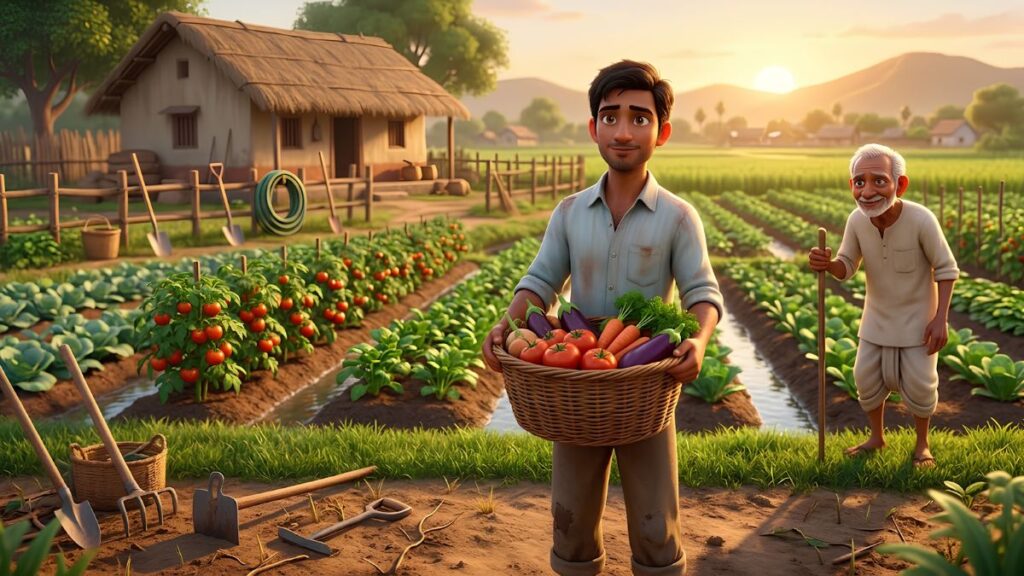
Ravi had always dreamed of owning a successful farm.
He grew up in a small village where farming was part of everyday life. His father grew wheat, rice, and vegetables on a small piece of land outside the village.
As a child, Ravi often helped after school.
He carried water.
He removed weeds.
He helped collect vegetables.
Sometimes he complained about the work.
“Why do we have to do this every day?”
His father would smile.
“Because plants don’t grow only when we feel like working.”
Ravi never forgot those words.
Years later, Ravi decided to start a farm of his own.
He had saved money for several years while working in a nearby town. Eventually, he bought a small piece of unused land.
It was not an impressive property.
The soil was dry.
There were stones everywhere.
The land had not been properly cultivated for years.
When Ravi first looked at it, even he wondered whether he had made a mistake.
His friend Arjun looked at the land and shook his head.
“This will take a lot of work.”
“I know.”
“There is almost nothing growing here.”
“I know that too.”
“Then why buy it?”
Ravi smiled.
“Because I don’t need it to be successful today.”
He looked across the empty field.
“I just need to make it successful over time.”
The First Weeks
Ravi began by clearing the land.
He removed stones.
He pulled out weeds.
He repaired an old fence.
He dug small channels to help carry water across the field.
The work was exhausting.
At the end of each day, his back hurt and his hands were covered in dirt.
Some evenings, he wondered whether farming was really the right choice.
But every morning, he returned.
He slowly improved the soil by adding compost.
He studied which crops grew well in the local climate.
He talked to experienced farmers.
He learned about irrigation.
He learned about pests.
He learned how important timing was.
Ravi realized that farming required much more knowledge than he had expected.
He didn’t pretend to know everything.
Instead, he asked questions.
Planting the First Crop
After several weeks of preparation, Ravi finally planted his first crop.
He chose vegetables that could grow relatively quickly.
He planted tomatoes, onions, peppers, and beans.
When he finished planting, he stood in the middle of the field.
The land still looked almost empty.
Small seeds were hidden beneath the soil.
Nothing seemed to be happening.
His neighbor, Mr. Singh, walked past.
“Have you planted everything?”
“Yes.”
“When will you harvest?”
Ravi laughed.
“Not for a while.”
Mr. Singh smiled.
“That is the hardest part.”
“What?”
“Waiting.”
Ravi nodded.
He understood.
But he didn’t yet know how difficult waiting would actually be.
Nothing Seems to Happen
For the first few days, Ravi checked the field every morning.
Nothing.
On the fifth day, he saw tiny green shoots.
He smiled.
“They’re growing.”
He watered them carefully.
The plants slowly became larger.
Ravi became more confident.
Then the weather changed.
Heavy rain arrived unexpectedly.
Water collected in part of the field.
Several young plants were damaged.
Ravi felt frustrated.
He had spent weeks preparing the land.
Now part of his work was disappearing.
He walked through the field after the rain.
Some plants were lying flat.
Others had been washed away.
For the first time, Ravi thought seriously about quitting.
A Difficult Conversation
That evening, Ravi visited his father.
“I think I made a mistake.”
His father listened quietly.
“What happened?”
“The rain damaged the crops.”
“Did all of them die?”
“No.”
“Can you save the remaining plants?”
“Probably.”
“Then why are you thinking about quitting?”
Ravi didn’t answer.
His father smiled.
“Farming teaches you something that many people don’t understand.”
“What?”
“You can work hard and still face problems you cannot control.”
Ravi looked at him.
“But that doesn’t mean your work was wasted.”
His father continued.
“You repair what you can. You learn from what happened. Then you continue.”
Ravi nodded.
The next morning, he returned to the field.
Learning From the Rain
Ravi studied the damaged area.
He realized that the water had collected because the drainage channels were not deep enough.
Instead of simply planting again, he fixed the problem.
He dug better channels.
He moved some plants to higher areas.
He improved the soil.
Then he replanted.
This time, he was more careful.
The work was slow.
But the field began recovering.
Ravi understood an important lesson.
Hard work did not mean repeating the same action again and again.
Sometimes hard work meant identifying a problem and finding a better solution.
The First Harvest
Several months later, Ravi harvested his first vegetables.
The harvest was smaller than he had expected.
Still, he was proud.
He loaded the vegetables into his small truck and drove to the local market.
At first, he stood quietly near the other farmers.
Experienced sellers called out to customers.
They knew which buyers wanted which vegetables.
Ravi was new.
He didn’t have regular customers.
By the afternoon, he had sold most of his vegetables.
The amount of money he earned wasn’t large.
But it was enough to cover some of his expenses.
When he returned home, he counted the money carefully.
He smiled.
It wasn’t a fortune.
But it was the result of months of work.
The Second Season
The following season, Ravi planted more crops.
This time, he planned everything more carefully.
He kept records.
He wrote down planting dates.
He recorded rainfall.
He noted which crops grew best.
He tracked his expenses.
He studied market prices.
He also invested in better irrigation equipment.
His friends noticed the changes.
“You’re taking this very seriously,” Arjun said.
Ravi laughed.
“I learned that farming doesn’t forgive laziness.”
Arjun smiled.
“That’s true.”
The second harvest was better.
Ravi earned more money.
He used part of it to improve the farm.
He bought better tools.
He repaired the storage building.
He improved the irrigation system.
He didn’t spend everything he earned.
He understood that success needed to be reinvested.
Another Setback
Just when Ravi believed things were going well, insects attacked his crops.
He noticed the problem one morning.
Several leaves were damaged.
Some plants were already becoming weak.
Ravi immediately contacted an agricultural expert.
He learned how to identify the insects and control them safely.
But some of the crops were already badly damaged.
Once again, Ravi faced a loss.
He was angry.
He had worked harder than ever.
Why did problems keep appearing?
That evening, he sat beside the field.
For several minutes, he simply watched the plants.
Then he remembered his father’s words.
“You can work hard and still face problems you cannot control.”
Ravi stood up.
The next morning, he started working again.
Success Takes Time
Years passed.
Ravi continued improving the farm.
Each season taught him something new.
Some harvests were excellent.
Some were disappointing.
There were years of heavy rain.
There were years of drought.
There were years when market prices were low.
But Ravi never stopped learning.
His farm gradually became more productive.
He began growing different crops.
He planted fruit trees.
He built a small greenhouse.
He started selling directly to local shops.
Eventually, restaurants in the nearby town began buying his vegetables.
Ravi hired two workers.
Then three.
His small farm had become a successful business.
The Farmer Who Waited
One afternoon, a young man named Sameer visited Ravi’s farm.
Sameer wanted to become a farmer.
He looked across the fields.
“Your farm is amazing.”
Ravi smiled.
“Thank you.”
“How long did it take?”
Ravi thought for a moment.
“Years.”
Sameer looked surprised.
“I thought you became successful quickly.”
Ravi laughed.
“No.”
“What did you do?”
“I worked.”
“Every day?”
“Not perfectly every day.”
Ravi pointed toward the fields.
“But I kept returning.”
Sameer looked at the crops.
“What was the most difficult part?”
Ravi smiled.
“Waiting.”
“Waiting?”
“Yes. You can plant today, but you cannot harvest tomorrow.”
Sameer nodded.
Ravi continued.
“You have to keep working even when you cannot see the result yet.”
A Bigger Farm
As Ravi’s business grew, he bought another piece of land.
It was larger than his original farm.
This time, he knew exactly what he needed to do.
He tested the soil before planting.
He planned the irrigation.
He studied the market.
He created a detailed farming schedule.
He didn’t make the same mistakes he had made years earlier.
His experience had become one of his greatest advantages.
The new farm performed well.
Ravi’s business continued growing.
But he still remembered the first field.
The dry soil.
The stones.
The damaged crops.
The small first harvest.
Those difficult years had taught him lessons that success alone could never teach.
Helping Other Farmers
Ravi eventually began helping other farmers in his village.
He shared his knowledge about irrigation.
He explained how he kept records.
He showed farmers how he improved his soil.
He encouraged young people who wanted to enter agriculture.
One young farmer told him:
“I don’t know if I can succeed.”
Ravi smiled.
“I didn’t know either.”
“What should I do?”
“Start.”
“And then?”
“Learn.”
“And after that?”
“Keep working.”
The Meaning of Success
One evening, Ravi stood at the edge of his original farm.
The sun was setting behind the fields.
He remembered the day he had first bought the land.
It had looked empty.
Some people had told him he was wasting his money.
Others had suggested that he find an easier job.
But Ravi had believed that the land could become something valuable.
Not because he expected instant success.
Because he was willing to work for it.
He realized that success was not one big moment.
It had been thousands of small decisions.
Getting up early.
Repairing a broken irrigation channel.
Studying the soil.
Asking questions.
Replanting after the rain.
Dealing with insects.
Going to the market.
Saving money.
Trying again.
Each individual action had seemed small.
Together, they had changed his life.
The Next Generation
Years later, Ravi’s son began helping him on the farm.
One morning, his son complained.
“Why do we have to work so early?”
Ravi smiled.
The question sounded familiar.
He remembered asking his own father the same thing.
“Because plants don’t grow only when we feel like working.”
His son looked confused.
Ravi laughed.
“You’ll understand one day.”
They walked through the field together.
The morning sunlight spread across the crops.
Ravi looked at his son.
He realized that the most valuable thing he could give him was not money.
It was patience.
It was discipline.
It was the understanding that meaningful success takes time.
The Long Wait
Ravi never forgot the years when he had almost given up.
Those years were important.
Without them, he might never have learned patience.
Without the failed crops, he might never have learned to adapt.
Without the difficult seasons, he might never have developed the confidence he had later.
The farm had grown slowly.
So had Ravi.
One seed at a time.
One lesson at a time.
One successful harvest at a time.
And every difficult season had made the next one a little easier.
Ravi looked across the field and smiled.
The waiting had been worth it.
Useful Vocabulary
- Harvest
The process of collecting crops when they are ready. - Irrigation
A system used to provide water to crops. - Crop
A plant grown for food or another useful purpose. - Soil
The earth in which plants grow. - Drainage
A system for removing excess water from an area. - Productive
Able to produce a large amount of something useful. - Invest
To spend money, time, or effort with the expectation of gaining something valuable later. - Reinvest
To put money earned from something back into that same activity or business. - Adapt
To change your approach so you can deal with a new situation. - Persistence
The ability to continue working despite difficulties.
Reading Comprehension Questions
- Why did Ravi want to start his own farm?
- What condition was the land in when Ravi bought it?
- What happened after Ravi planted his first crop?
- Why were some of the plants damaged by rain?
- What did Ravi learn from the drainage problem?
- What happened during the second farming season?
- How did Ravi respond when insects attacked his crops?
- How did Ravi’s farm change over the years?
- Why did Ravi believe waiting was an important part of farming?
- How did Ravi eventually help other farmers?
Discussion Questions
- Why does success often take longer than people expect?
- Have you ever worked toward something that required a lot of patience?
- How can failure help someone improve?
- Why is it important to adapt when a plan does not work?
- Do you think hard work is more important than talent?
- What does “keep working even when you cannot see the result” mean to you?
Lesson From the Story
The Farmer’s Long Wait shows that success rarely happens immediately. Ravi faces failed crops, difficult weather, insects, financial challenges, and uncertainty, but he continues learning and improving.
His success comes from hard work, patience, persistence, adaptability, and the willingness to keep going when results are slow.
Like a seed that needs time before it becomes a harvest, meaningful goals often require consistent effort before the results become visible.
The Boy Who Could Not Run Fast

Ethan loved watching races.
Whenever his school held a sports day, he stood near the track and cheered for the runners. He admired the way they moved, with their arms swinging, their feet moving quickly, and their faces filled with determination.
Secretly, Ethan wished he could run like them.
But whenever he joined a race, he finished near the end.
Some children laughed.
“Maybe running isn’t your thing,” one boy said.
Ethan pretended not to care, but the words stayed in his mind.
On his way home, he kept thinking about the race.
“Maybe he’s right,” he thought.
When he reached home, his mother noticed that he was unusually quiet.
“What happened?”
Ethan dropped his schoolbag on the floor.
“I was slow again.”
His mother sat beside him.
“Did you finish the race?”
“Yes.”
“Did you give up?”
“No.”
She smiled.
“Then you did something important.”
Ethan looked confused.
His mother continued.
“Being good at something is not always where you begin. Sometimes it is where you decide to continue.”
Those words gave Ethan something to think about.
A New Decision
That evening, Ethan made a decision.
He would become a better runner.
He knew he couldn’t suddenly become the fastest student in school.
So he decided to start with a small goal.
He would run every morning.
The next day, Ethan woke up thirty minutes earlier than usual.
He put on his running shoes and went outside.
The street was quiet.
He started running.
At first, everything seemed easy.
After a minute, his breathing became heavier.
After two minutes, his legs began to hurt.
By the time he reached the end of the street, he was exhausted.
He stopped and put his hands on his knees.
“I can’t even run for five minutes.”
For a moment, he felt disappointed.
Then he remembered his mother’s words.
He had decided to continue.
So he walked home.
The next morning, he tried again.
Keeping Track
After several days, Ethan realized that simply running wasn’t enough.
He needed a plan.
He bought a small notebook.
On the first page, he wrote:
My Running Progress
Every morning, he recorded how far he ran and how long it took.
At first, his times were slow.
But after a week, he noticed something.
His breathing was slightly better.
He could run a little farther.
His legs did not feel quite as tired.
The improvement was small.
But it was improvement.
Ethan became excited.
He had discovered something important.
Hard work didn’t always produce dramatic results immediately.
Sometimes progress was so small that you could only see it by comparing today’s effort with yesterday’s.
Meeting Mrs. Collins
One morning, Ethan was running near his neighborhood park when an older woman noticed him.
Her name was Mrs. Collins.
She lived nearby and often walked around the park.
“You’re out early,” she said.
Ethan smiled.
“I’ve been training.”
“For what?”
“Running.”
Mrs. Collins smiled.
“I used to coach young athletes.”
Ethan stopped.
“Really?”
“Yes.”
“Could you give me some advice?”
Mrs. Collins nodded.
“Of course.”
She watched him run for a few seconds.
“You’re trying to run too fast.”
Ethan looked surprised.
“But I want to become faster.”
“You will. But first, you need to learn how to control your pace.”
She taught him how to warm up properly.
She showed him simple stretches.
She explained how to keep his shoulders relaxed and use his arms correctly.
She also told him something important.
“Don’t train as hard as possible every day.”
“Why?”
“Because your body also needs time to recover.”
Ethan began following her advice.
The First Improvement
After several weeks, Ethan’s running improved.
He could run farther without stopping.
His breathing was better.
His legs were stronger.
Most importantly, he felt more confident.
One Saturday, Mrs. Collins timed him while he ran around the park.
When Ethan finished, she smiled.
“You’ve improved.”
“How much?”
“Enough to prove that your training is working.”
Ethan looked at his notebook.
His time was better than it had been when he started.
He felt proud.
Not because he was the fastest.
Because he was better than he had been before.
The Difficult Race
A few weeks later, Ethan entered another practice race.
This time, he felt confident.
He stood at the starting line with several other students.
The whistle blew.
Everyone started running.
Ethan remembered what Mrs. Collins had taught him.
Don’t start too fast.
Keep your pace.
Stay focused.
For the first part of the race, he ran steadily.
Then another runner passed him.
Ethan became nervous.
He tried to speed up.
His feet moved faster.
His breathing became heavier.
Then suddenly, his foot caught the edge of the track.
He fell.
His knee hit the ground.
The race continued without him.
Ethan sat on the track feeling humiliated.
He wanted to cry.
One of the teachers helped him stand.
“Are you hurt?”
“My knee hurts.”
The teacher took him to the school nurse.
Luckily, the injury wasn’t serious.
But Ethan felt worse emotionally than physically.
He had worked hard.
And now he had fallen in front of everyone.
Wanting to Quit
That evening, Ethan sat on his bed.
His running shoes were beside him.
He didn’t want to look at them.
“I should stop,” he said.
His mother entered the room.
“What happened?”
“I fell.”
“I heard.”
“Everyone saw me.”
His mother sat beside him.
“Are you seriously injured?”
“No.”
“Then you’ll recover.”
“But I failed.”
His mother shook her head.
“You fell. That’s different from failing.”
Ethan looked at her.
“You’ve been working hard for weeks,” she said.
“One bad moment doesn’t erase all of that.”
Ethan didn’t answer.
His mother continued.
“Success isn’t about never falling. It’s about what you do after you fall.”
Those words stayed with him.
Starting Again
Ethan rested for several days.
When his knee felt better, he went back to the park.
He didn’t run immediately.
He walked.
Then he jogged slowly.
The first day back was difficult.
He was afraid of falling again.
But he continued.
Mrs. Collins saw him.
“You came back.”
Ethan smiled.
“I almost didn’t.”
“But you did.”
“Yes.”
She nodded.
“That’s the important part.”
Ethan continued training.
This time, he was more careful.
He paid attention to his footing.
He didn’t try to run faster than he could control.
He learned from his mistake.
A New Goal
Ethan had originally wanted to become the fastest runner in his class.
Now his goal was different.
He wanted to beat his own personal best.
Every week, he tried to improve his time by a small amount.
Sometimes he succeeded.
Sometimes he didn’t.
When he failed to improve, he didn’t become angry.
He simply continued training.
His notebook became filled with numbers.
Week 1.
Week 2.
Week 3.
Week 4.
Then Week 8.
Then Week 10.
When Ethan looked at the first page, he couldn’t believe how much he had changed.
Sports Day
Several months later, the school announced its annual sports day.
Ethan entered the running race.
Some of his classmates remembered him from previous races.
One boy smiled.
“Are you racing again?”
“Yes.”
“You know you’re still not the fastest.”
Ethan smiled.
“I know.”
The boy looked surprised.
“Then why race?”
Ethan thought for a moment.
“Because I want to see how much I’ve improved.”
The race began.
Ethan didn’t think about the other runners.
He didn’t worry about who was watching.
He focused on his breathing.
He remembered his training.
He kept a steady pace.
One runner passed him.
Then another.
But Ethan didn’t panic.
He continued.
Near the final stretch, he heard the crowd cheering.
He pushed himself a little harder.
His legs were tired.
His breathing was heavy.
But he kept going.
He crossed the finish line.
He wasn’t first.
He wasn’t second.
He wasn’t even third.
He finished fourth.
But when he looked at the clock, his eyes widened.
It was his fastest time ever.
The Biggest Victory
Mrs. Collins was waiting near the track.
“You did it.”
Ethan smiled.
“I came fourth.”
“You did.”
“I thought I’d be disappointed.”
“Are you?”
Ethan shook his head.
“No.”
He looked at his notebook.
“I beat my best time.”
Mrs. Collins smiled.
“That’s your real victory.”
Ethan understood.
For months, he had been comparing himself with other runners.
Now he realized that his biggest competition had always been himself.
The boy who once struggled to run to the end of the street had become someone who could finish a race with confidence.
Helping Another Runner
Later that afternoon, Ethan noticed a younger student sitting near the track.
The boy looked upset.
Ethan walked over.
“Are you okay?”
“I was last in my race.”
Ethan sat beside him.
“I used to be last too.”
“Really?”
“All the time.”
“What did you do?”
“I kept practicing.”
The boy looked at him.
“Did you become the fastest?”
Ethan smiled.
“No.”
“Then why did you keep going?”
“Because I wanted to become better.”
The boy thought about it.
Ethan continued.
“You don’t have to be the best today. Just try to be a little better next time.”
The boy smiled.
“Okay.”
Ethan stood up.
“See you next year.”
Years of Progress
Ethan continued running.
He never became obsessed with being the fastest person.
Instead, he enjoyed improving.
He joined the school’s running club.
He learned more about training.
He helped younger students.
He competed in local races.
Sometimes he won.
Sometimes he lost.
But he no longer saw losing as proof that he wasn’t good enough.
Every race taught him something.
Every difficult workout made him stronger.
Every mistake showed him what he could improve.
He had learned that success wasn’t always about standing on the highest step of a podium.
Sometimes success meant doing something you once thought was impossible.
Looking Back
One morning, several years after his first race, Ethan returned to the same street where he had started training.
He stood at the end of the road.
He remembered how exhausted he had been after running just a few minutes.
He smiled.
Then he started running.
He reached the end without stopping.
It felt easy now.
But Ethan knew it had not always been easy.
It had taken hundreds of mornings.
Thousands of steps.
Many difficult workouts.
Several disappointing races.
One painful fall.
And countless moments when he had wanted to quit.
The difference was simple.
He had continued.
The Lesson
Ethan finally understood what his mother had meant.
Being good at something wasn’t always where you began.
Sometimes it was where you decided to continue.
Hard work had not made him perfect.
It had made him persistent.
Practice had not removed every obstacle.
It had taught him how to overcome them.
Failure had not stopped him.
It had taught him how to begin again.
And every small improvement had brought him closer to the person he wanted to become.
Ethan looked down the road and smiled.
He still wasn’t the fastest runner.
But he was no longer the boy who believed that being slow meant he could never succeed.
He had learned something much more valuable.
Success belongs not only to those who start with talent, but also to those who are willing to keep working.
Useful Vocabulary
- Determination
The strong decision to continue working toward a goal. - Training
Regular practice designed to improve a skill or ability. - Progress
Improvement that happens over time. - Pace
The speed at which someone moves or works. - Recovery
The process of returning to normal after tiredness or injury. - Improve
To become better at something. - Persistent
Continuing to do something despite difficulties. - Competition
A situation in which people try to perform better than others. - Confidence
The belief that you can do something successfully. - Achievement
Something successfully completed through effort or ability.
Reading Comprehension Questions
- Why did Ethan want to become a better runner?
- What did his mother tell him about continuing?
- Why did Ethan start keeping a notebook?
- Who helped Ethan improve his running technique?
- What happened during Ethan’s practice race?
- Why did Ethan want to quit?
- How did Ethan respond after recovering from his injury?
- What was Ethan’s new goal?
- What position did Ethan finish in during the final race?
- Why was Ethan proud of his final result?
Discussion Questions
- Have you ever struggled to become good at something?
- Why is regular practice important?
- What can people learn from failure?
- Is being the best always the same as being successful?
- Why is comparing yourself with your past self sometimes more useful than comparing yourself with others?
- What is one skill you would like to improve through hard work?
Lesson From the Story
The Boy Who Could Not Run Fast shows that hard work is not always about becoming the best immediately. Ethan begins as a slow runner, faces disappointment, suffers an injury, and even considers quitting. Instead of giving up, he continues practicing and learns from his mistakes.
His greatest achievement is not winning a race. It is developing discipline, confidence, patience, and persistence.
The story reminds us that progress can be slow, but consistent effort can turn a weakness into a strength. Sometimes the most important victory is simply becoming better than the person you were yesterday.
Success Often Begins With a Difficult First Step
Most goals have an uncomfortable beginning.
The first attempt may feel confusing.
The character may not know what to do.
They may make mistakes.
They may even wonder whether continuing is worth the effort.
This is where a good story can become relatable.
Instead of introducing a character who is immediately successful, the story can begin with uncertainty.
The character has a goal but does not yet have the skills needed to reach it.
That gap creates the central challenge.
The character must decide whether to remain discouraged or begin working toward improvement.
The Importance of Repeated Effort
Hard work becomes meaningful when it is repeated.
One practice session rarely creates mastery.
One page of reading does not instantly make someone an excellent reader.
One day of studying does not guarantee a perfect test score.
Progress usually comes from returning to the task again and again.
A story can demonstrate this through a series of small moments.
The character practices.
The character makes a mistake.
The character tries again.
The character improves slightly.
Then the character practices again.
Eventually, the small improvements become noticeable.
This is one of the strongest ways to communicate the idea that success is built over time.
Small Improvements Matter
Children sometimes overlook small achievements because they are focused on the final goal.
Suppose a child is learning to ride a bicycle.
On the first day, they may only balance for a few seconds.
That might seem insignificant.
But the next day, they may balance for ten seconds.
Later, they may travel a few meters.
Eventually, they can ride independently.
Each stage matters.
A story about hard work can show this kind of progression.
The character does not suddenly become successful.
Instead, the character becomes slightly better each time.
This teaches children to recognize progress even when it seems small.
Hard Work Does Not Mean Never Resting
It is also important to present a healthy understanding of hard work.
Working hard does not mean constantly working without breaks.
Children need sleep, recreation, family time, and opportunities to relax.
A good story should therefore focus on consistent effort, rather than exhaustion.
For example, a character might practice for thirty minutes every afternoon instead of trying to practice for six hours in one day.
This approach makes the lesson more realistic.
It also shows children that successful habits can be sustainable.
When Talent Is Not Enough
Natural ability can give someone a useful starting point, but talent alone does not guarantee achievement.
A child may naturally be good at drawing but stop improving because they never practice.
Another child may struggle with drawing initially but spend time learning shapes, proportions, shading, and techniques.
After months of practice, the second child may improve dramatically.
This creates an important contrast.
Talent can help you start, but effort helps you develop.
Stories can communicate this idea without suggesting that talented children are less deserving of success.
The focus should remain on the value of continued learning.
Hard Work Requires Patience
One of the biggest obstacles children face is impatience.
They may practice something once and expect immediate improvement.
When improvement does not happen, they may decide that they are incapable.
A story can challenge this assumption.
The main character might become frustrated because their first attempts do not work.
Instead of giving up, they learn to wait, practice, and keep improving.
The story can show that some goals require time.
This is especially important for skills that develop gradually.
Mistakes Can Become Useful
A character’s mistakes can be an important part of the story.
For example, a child preparing for a school competition might make several errors during practice.
Instead of treating those mistakes as proof of failure, the character can examine what went wrong.
Perhaps they practiced the wrong technique.
Perhaps they did not understand an instruction.
Perhaps they rushed.
Once the problem is identified, the character can change their approach.
This gives children a valuable message:
A mistake can provide information about what to improve next.
Persistence During Difficult Moments
Every meaningful goal eventually becomes difficult.
This is often where persistence matters most.
A character may feel like quitting after repeated failures.
The story can slow down at this point and show the character’s internal struggle.
They may think:
“Maybe I’m not good enough.”
“I don’t think I can do this.”
“I should stop trying.”
Then something changes.
The character remembers why the goal matters.
They ask for help.
They try a different method.
They take a short break and return to the task.
They decide to make one more attempt.
This turning point can make the lesson much more powerful.
Asking for Help Is Also Part of Hard Work
Hard work should not be presented as doing everything alone.
Sometimes the smartest thing a character can do is ask for guidance.
A teacher may explain a difficult concept.
A coach may correct a technique.
A parent may provide encouragement.
A friend may offer a useful idea.
The character still has to put in the effort, but support can make that effort more effective.
This teaches children that asking for help is not a sign of weakness.
It is often part of learning.
The Difference Between Effort and Results
One of the most important ideas in this type of story is that effort and results are not always perfectly connected.
A child can work hard and still lose a competition.
A student can study carefully and still make mistakes on a test.
An athlete can train consistently and still finish second.
That does not mean the effort was wasted.
The character may have gained knowledge, confidence, discipline, experience, or a new skill.
A strong story therefore avoids promising:
“Work hard and you will always win.”
Instead, it can teach:
“Work hard and you give yourself a better chance to improve and succeed.”
Success Can Have Different Meanings
Winning is only one form of success.
A character can succeed by:
- Improving a skill
- Overcoming fear
- Completing a difficult task
- Becoming more confident
- Learning from failure
- Reaching a personal goal
- Helping someone else
- Developing a positive habit
- Refusing to give up
This broader definition makes stories about hard work more realistic.
It also allows children with different abilities and experiences to connect with the lesson.
A Character’s Journey Is More Important Than the Ending
The most interesting part of a hard-work story is often the journey.
At the beginning, the character may lack confidence.
In the middle, they face challenges.
Near the end, they realize that their effort has changed them.
The final achievement becomes evidence of that growth.
For example, a character might enter a school race hoping to win.
Even if they do not finish first, they may discover that they can run farther than they thought possible.
The real success is the progress they made.
How Hard Work Builds Confidence
Confidence often grows from experience.
When children repeatedly practice and see improvement, they gain evidence that their effort works.
A story can show this gradually.
At first, the character may need encouragement from others.
Later, the character begins encouraging themselves.
Eventually, they approach difficult tasks with greater confidence.
This is a valuable transformation because the character’s greatest achievement may not be the trophy or certificate.
It may be the belief:
“I can learn difficult things if I keep trying.”
The Role of Goals
A clear goal gives the character a reason to work hard.
The goal should be meaningful but understandable.
For example:
- Learn to play a song
- Complete a difficult project
- Improve a test score
- Prepare for a race
- Enter an art competition
- Learn to ride a bicycle
- Build something for a school fair
Once the goal is established, each action in the story can connect to it.
This creates a clear narrative direction.
Breaking a Big Goal Into Smaller Tasks
Large goals can feel overwhelming.
A character may initially think:
“I have so much to learn.”
A better approach is to divide the goal into smaller steps.
For example, a student preparing for a difficult exam could:
- Identify difficult topics.
- Practice one topic at a time.
- Review mistakes.
- Ask questions.
- Take practice tests.
- Track improvement.
The story can show how a large challenge becomes manageable when divided into smaller actions.
What Happens When the Character Wants to Quit?
This can be one of the most important moments in the story.
The character should have a believable reason for feeling discouraged.
Maybe progress is slow.
Maybe another person is better.
Maybe the character has failed several times.
Maybe the task is taking longer than expected.
The character’s decision to continue should feel earned.
Instead of suddenly becoming motivated, they can remember their goal and decide to take one more small step.
That makes the story more realistic.
The Moment of Success
The final achievement should connect directly to the hard work shown throughout the story.
If the character has spent the entire story practicing a skill, the final scene can allow them to demonstrate that skill.
The reader should be able to see the connection:
Practice → Improvement → Confidence → Achievement
The success feels satisfying because the reader has witnessed the work behind it.
What Children Can Learn From the Story
A well-written story can leave children with several lessons:
- Keep Trying: Difficulty does not automatically mean that something is impossible.
- Practice Matters: Repeated practice can improve skills.
- Mistakes Are Normal: Everyone makes mistakes while learning.
- Progress Takes Time: Improvement may happen slowly.
- Ask for Help: Guidance can make difficult tasks easier.
- Do Not Compare Too Much: Everyone begins from a different starting point.
- Celebrate Small Wins: Small improvements are worth recognizing.
- Stay Patient: Good results often require time.
Questions Parents Can Ask After Reading
Parents can turn the story into a simple conversation.
They might ask:
- What was the character trying to achieve?
- Why was the goal difficult?
- What mistakes did the character make?
- What helped the character improve?
- When did the character feel like giving up?
- Why did the character continue?
- What does success mean to the character?
- What did the character learn?
- Have you ever worked hard to improve at something?
- What is one skill you would like to improve?
These questions help children connect the story’s message to their own lives.
Classroom Activities Based on the Theme
Teachers can extend the lesson with simple activities.
- My Hard Work Goal: Students choose one realistic goal and write it down.
- Three Steps to Success: Students list three actions they can take to move toward that goal.
- My Progress Timeline: Students create a timeline showing where they started and how they improved.
- Mistake and Lesson: Students describe one mistake and identify something they learned from it.
- Encouragement Wall: Each student writes an encouraging sentence for someone who is working toward a difficult goal.
These activities help turn an abstract moral into something practical.
How Parents and Teachers Can Encourage Hard Work
Adults can reinforce the message by praising effort and strategies, not only final results.
Instead of saying: “You’re so smart.”
They can say: “You kept practicing even when that was difficult.”
Instead of: “You got the highest score.”
They can say: “You prepared carefully and improved your understanding.”
This helps children recognize the value of effort.
It also reduces the pressure to succeed perfectly every time.
Avoid Making Hard Work Feel Like Punishment
Children are more likely to develop healthy habits when effort is connected with purpose.
Hard work should not always be presented as: “Do this because you have to.”
Instead, children can understand: “I am practicing because I want to improve.”
That difference can change how they view challenges.
A good story should therefore make the character’s goal meaningful.
The character works hard because something matters to them.
Why This Theme Works Well for Children’s Stories
The idea of hard work leading to success is flexible enough to fit many different characters and settings.
It can work with:
- School stories
- Sports stories
- Adventure stories
- Friendship stories
- Animal stories
- Family stories
- Competition stories
- Inspirational stories
- Everyday-life stories
The setting can change, but the central lesson remains understandable.
A child struggles.
The child makes an effort.
The child learns.
The child continues.
The child grows.
That simple pattern can create a memorable story without making the message feel overly complicated.
Final Takeaway
A short story on hard work leads to success should show more than a character simply working hard and receiving a reward. The strongest stories explore the process behind achievement: uncertainty, mistakes, practice, patience, setbacks, encouragement, and gradual improvement.
Children should come away understanding that they do not need to be perfect when they begin.
They do not need to succeed immediately.
They do not need to be naturally talented at everything.
They need to be willing to learn and keep moving forward.
The most important lesson is simple:
Success is often not one big moment. It is the result of many small efforts made consistently over time.
When children learn to value those small efforts, they can approach difficult tasks with greater patience, confidence, and determination.