Curiosity is often called the foundation of learning.
Unfortunately for the students of Class 7-B, curiosity is also occasionally the foundation of chaos.
This particular lesson began three days before Diwali.
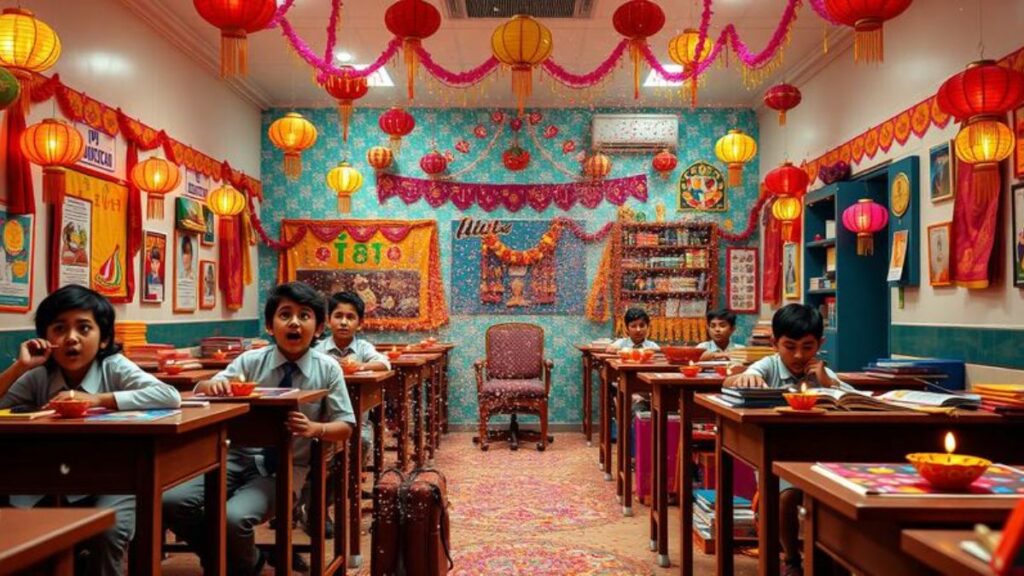
The school had already transformed into a festive wonderland.
Colorful lanterns hung from classroom doors.
Paper diyas decorated bulletin boards.
Teachers had temporarily stopped reminding students that final exams were approaching.
Life was good.
Very good.
Especially for Aarav.
Aarav loved science.
Not the kind of science that stayed neatly inside textbooks.
He preferred experiments.
Questions.
Observations.
And unfortunately, experiments that teachers never approved in advance.
His friends often described him as a scientist.
His teachers usually described him as “the reason new school rules exist.”
Both descriptions were accurate.
On Tuesday morning, Mrs. Verma announced a special Diwali activity.
“Tomorrow,” she said, “we will discuss the history and science behind traditional diyas.”
Most students nodded politely.
Aarav’s eyes lit up.
Science.
And diyas.
Together.
This was exactly the sort of combination that caused trouble.
By lunch break, he had already started thinking.
How much oil does a diya need?
Why do some diyas burn longer than others?
Does the shape affect the flame?
What happens if multiple diyas are placed together?
Could a pattern of diyas create more light than a single large lamp?
These were excellent scientific questions.
The problem was that Aarav rarely stopped at questions.
He preferred answers.
And he preferred finding answers immediately.
That afternoon, he gathered his closest friends.
Rohan, Meera, and Kabir.
“I have an idea,” he announced.
The group immediately became nervous.
They had heard those words before.
Every adventure.
Every disaster.
Every unexpected meeting with the principal.
Had started with those exact words.
Meera folded her arms.
“What kind of idea?”
“A science experiment.”
That sounded harmless.
At least initially.
“What are we studying?”
Aarav lowered his voice dramatically.
“Diyas.”
The others exchanged glances.
“So?”
“We’re going to discover which diya design is scientifically superior.”
Silence.
Then Kabir asked the obvious question.
“Why?”
Aarav looked genuinely surprised.
“Because nobody knows.”
“People have been using diyas for thousands of years.”
“Exactly,” Aarav replied.
“It’s time somebody conducted proper research.”
The confidence in his voice was alarming.
The next day, the experiment officially began.
Aarav arrived carrying a notebook labeled:
DIYA RESEARCH PROJECT
Inside were charts.
Tables.
Predictions.
Observations.
Even hand-drawn diagrams.
He had clearly spent hours preparing.
His friends were impressed.
Slightly worried.
But impressed.
The first phase of the experiment seemed perfectly reasonable.
Students compared different types of diyas.
Large ones.
Small ones.
Wide ones.
Deep ones.
Traditional designs.
Modern designs.
They recorded measurements.
Made predictions.
Discussed results.
Mrs. Verma was delighted.
“This is excellent scientific thinking,” she said.
The students felt proud.
Aarav felt unstoppable.
That was the beginning of the problem.
Because success encouraged him to think bigger.
Much bigger.
By lunchtime, he had developed a new theory.
“What if multiple diyas affect each other?”
The group stared.
“What does that mean?” asked Meera.
“We need more testing.”
“How much more?”
Aarav smiled.
The smile worried everyone.
“A lot more.”
The following morning, students arrived to discover that Aarav had expanded the project significantly.
His desk was covered with diagrams.
Rows of measurements.
Complex calculations.
One page simply contained the phrase:
MAXIMUM DIYA EFFICIENCY MODEL
Nobody knew what it meant.
Not even Aarav.
But it sounded scientific.
And that was enough.
The real trouble started during the practical demonstration.
Mrs. Verma had allowed students to bring decorative clay diyas for observation purposes.
The instructions were simple.
Observe.
Compare.
Discuss.
Nothing else.
Aarav heard something completely different.
Experiment.
Investigate.
Discover.
Change history.
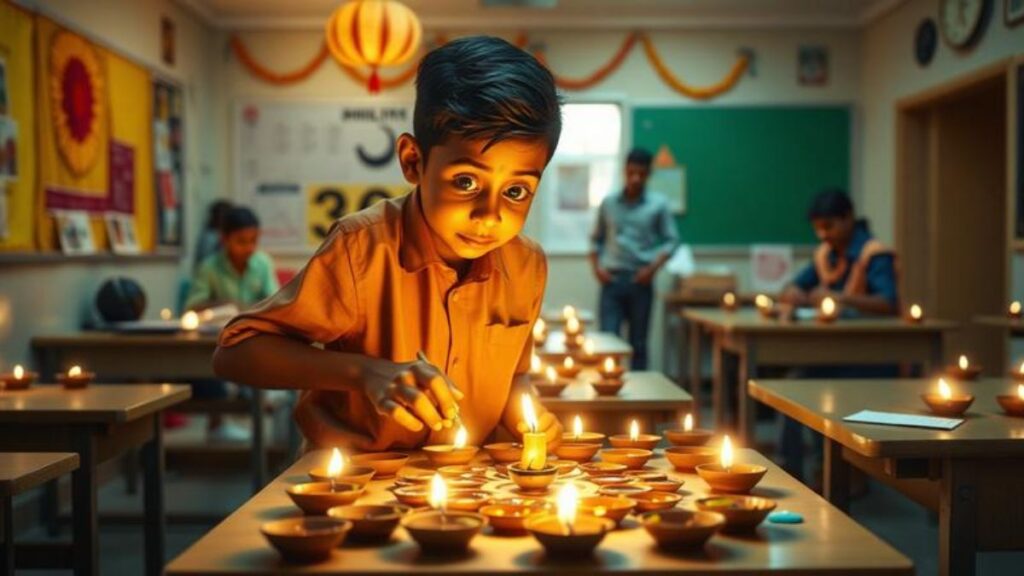
By the beginning of class, he had organized dozens of diyas into carefully arranged patterns.
Circles.
Squares.
Triangles.
Spirals.
One design looked suspiciously like a football field.
Another resembled an alien crop circle.
A third looked like he had simply become distracted halfway through.
Students gathered around.
Curiosity spread quickly.
Soon everyone wanted to participate.
Suggestions flew through the room.
“What if we make a bigger circle?”
“What if we arrange them by size?”
“What if we create a giant smiley face?”
“What if we spell the school name?”
The experiment grew larger.
And larger.
And larger.
At this point, the classroom no longer resembled a science lesson.
It resembled a Diwali exhibition designed by highly enthusiastic architects.
Unfortunately, enthusiasm tends to attract attention.
Mrs. Verma left the room briefly to collect materials.
During her absence, the project evolved dramatically.
When she returned five minutes later, she stopped at the doorway.
The sight before her was extraordinary.
Every available desk had become part of the experiment.
Students were measuring distances.
Drawing charts.
Recording observations.
Debating flame placement theories.
One group was discussing “advanced diya optimization.”
Another was calculating “light distribution patterns.”
Nobody had permission for any of this.
Yet everyone looked remarkably professional.
Mrs. Verma blinked.
Twice.
“What,” she asked slowly, “is happening here?”
The room became silent.
Aarav stood up.
“As you can see, ma’am, we have expanded the scope of the research.”
Mrs. Verma looked around.
The experiment now occupied nearly half the classroom.
Even her desk contained a diagram.
“Expanded?”
“Yes, ma’am.”
She pointed toward a large chart.
“What is that?”
Aarav smiled proudly.
“Our preliminary findings.”
The teacher examined the paper.
It contained dozens of scientific terms.
Most appeared completely invented.
One heading read:
THEORY OF DECORATIVE LUMINOSITY ENHANCEMENT
Another read:
MULTI-DIYA COOPERATIVE ILLUMINATION MODEL
Mrs. Verma tried very hard not to laugh.
The students looked so serious.
So dedicated.
So completely convinced they were conducting groundbreaking research.
Finally she asked the most important question.
“Have you actually learned anything?”
The room became quiet.
Aarav thought carefully.
Then he nodded.
“Yes.”
“What?”
“We learned that science becomes more interesting when you’re curious.”
The teacher smiled.
It was a surprisingly good answer.
Other students began sharing observations.
Some discussed how shape affected oil capacity.
Others explained how design influenced airflow.
Several students talked about traditional craftsmanship.
What had started as chaos had accidentally become education.
Very unusual education.
But education nonetheless.
Mrs. Verma looked around the room.
The experiment was completely out of control.
Yet every student was engaged.
Every student was thinking.
Every student was learning.
That combination was difficult to criticize.
She finally made her decision.
“The experiment ends today.”
The students groaned.
“But…”
Hope returned instantly.
“…you may present your findings tomorrow.”
The classroom erupted with excitement.
For the next twenty-four hours, students worked harder than they had all month.
Charts were improved.
Conclusions were written.
Presentations were prepared.
The following day, they presented their research to the entire class.
The results were surprisingly impressive.
The project explained:
- How traditional diyas work
- Why oil matters
- How design affects burn time
- The cultural importance of diyas
- Basic scientific principles behind flame behavior
Even the principal stopped by to watch.
When the presentations ended, he applauded.
“I’ve never seen students so excited about clay lamps.”
Neither had anyone else.
At the end of the week, Aarav received special recognition.
Not for creating the perfect experiment.
Not for making a scientific breakthrough.
But for inspiring curiosity.
Years later, students still remembered the Diya Science Experiment.
Not because of the results.
Not because of the charts.
Not because of the complicated theories.
They remembered it because it turned an ordinary classroom lesson into an adventure.
And that is often where the best learning begins.
Moral of the Story
Curiosity is one of the most powerful tools for learning. When students ask questions, explore ideas, and think creatively, even the simplest subjects can become exciting discoveries.