Diwali is one of the most joyful festivals for children. It brings glowing diyas, colorful rangoli, sweets, family gatherings, new clothes, and exciting celebrations. But beyond the decorations and fireworks, Diwali also teaches children meaningful values such as kindness, honesty, generosity, courage, and the victory of good over evil.
Short Diwali stories for kids are a wonderful way to explain the meaning of the festival through simple characters, fun adventures, and memorable lessons. These stories help young readers understand why people celebrate Diwali and encourage them to share happiness with others.
Whether you are a parent looking for a bedtime story, a teacher planning a classroom activity, or someone searching for festive stories for children, these short Diwali tales offer an enjoyable way to celebrate the festival.
Why Are Diwali Stories Important for Kids?
Diwali stories help children understand the traditions and values behind the festival. Instead of learning only about decorations and celebrations, children discover why light, goodness, and kindness are important.
Here are a few reasons to share Diwali stories with children:
- Teach the meaning of Diwali: Stories explain the significance of Lord Rama’s return to Ayodhya and other traditions associated with the festival.
- Encourage good habits: Children learn the importance of honesty, sharing, helping others, and respecting family members.
- Build cultural awareness: Traditional and modern stories introduce children to Indian customs, celebrations, and values.
- Develop imagination: Colorful characters, magical adventures, and festive settings make reading enjoyable.
- Create family memories: Parents and grandparents can share stories that bring generations together.
10 Short Diwali Stories for Kids with Moral Lessons
The following stories are written in simple language for young readers. Each one has an engaging storyline and a meaningful lesson that children can remember.
1. The Little Diya That Never Gave Up
SHORT DIWALI STORY FOR KIDS · MORAL STORY ABOUT SELF-CONFIDENCE
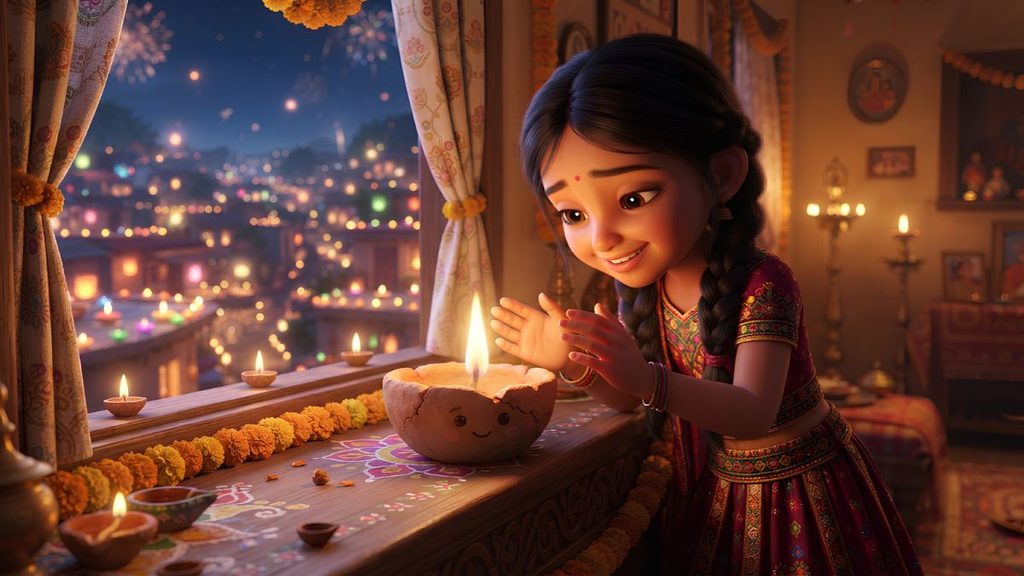
In a small village in India, there lived a little clay diya named Chotu. Every year, as Diwali approached, the villagers visited the local market to buy beautiful lamps for their homes.
Some diyas were large and colorful. Others had beautiful golden designs, sparkling decorations, and attractive patterns. Everyone wanted to buy the prettiest diya for the festival.
Chotu was different. He was small, slightly uneven, and had a tiny crack near his edge.
One day, all the diyas were placed together in a shop window.
A beautifully decorated diya looked at Chotu and laughed.
“Look at you! Nobody will choose such a tiny lamp. You are too small to shine brightly.”
Another diya joined the conversation.
“Even if someone buys you, your little flame will hardly be noticed!”
Chotu felt sad. He looked at his reflection in the shop window and wished he were bigger and more beautiful.
Just then, a little girl named Meera entered the shop with her mother.
Meera was looking for diyas to decorate her home.
She carefully examined the colorful lamps, but something caught her attention. It was Chotu, sitting quietly in the corner.
“Mother, I like this little one,” she said.
Her mother picked him up and smiled.
“Are you sure? There are much prettier ones here.”
Meera nodded.
“Yes! He looks special.”
Chotu was delighted. For the first time, someone had chosen him without caring about his size or appearance.
That evening, Meera placed Chotu near her bedroom window. She filled him with oil, carefully placed a cotton wick inside, and lit his little flame.
Chotu began glowing warmly.
Suddenly, a strong breeze entered through the open window. Several nearby candles flickered, and a few diyas went out.
Meera quickly closed the window, but she noticed that Chotu’s little flame was still shining.
She gently protected him with her hands.
“Your light may be small, Chotu, but it makes my room feel beautiful,” she whispered.
Chotu felt happier than ever.
Outside, hundreds of lamps were glowing across the village. Some were bigger, some were brighter, but every little flame added to the beauty of the celebration.
Chotu finally understood something important.
He did not need to be the biggest or prettiest diya to make a difference. He only needed to shine with the light he had.
Meera smiled as she watched his warm glow.
“Happy Diwali, my little friend!”
And Chotu continued shining proudly throughout the evening.
Moral of the Story
Never underestimate yourself because of your size, appearance, or abilities. Everyone has something special to offer. Even a small act of kindness can bring warmth and happiness into someone’s life.
2. The Boy Who Shared His Diwali Sweets
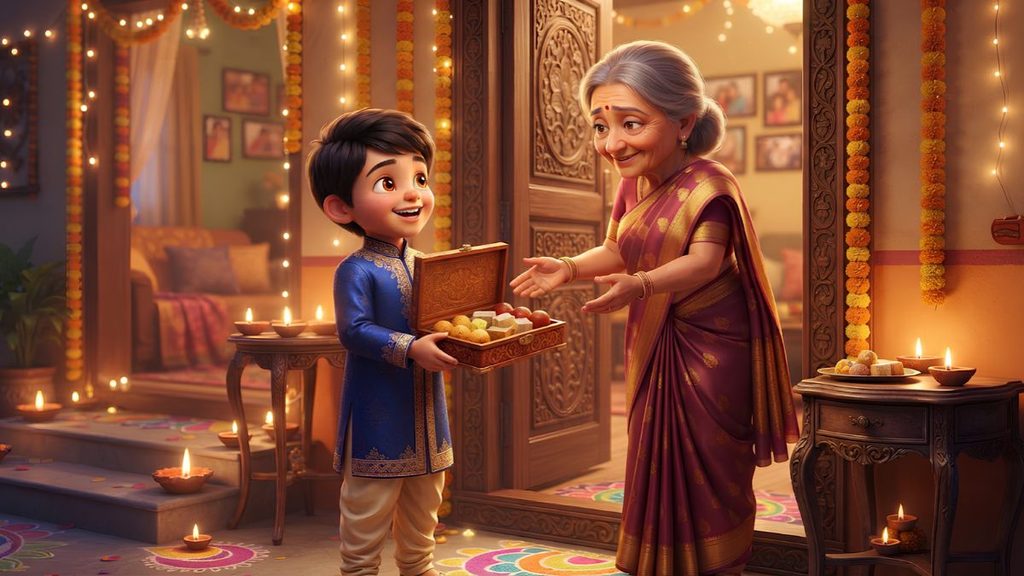
SHORT DIWALI STORY FOR KIDS · MORAL STORY ABOUT SHARING AND KINDNESS
Aarav was a cheerful little boy who loved Diwali more than any other festival. He enjoyed decorating the house, making colorful rangoli with his mother, and lighting tiny diyas with his father.
But there was one thing he loved even more than the decorations.
Sweets!
Every Diwali, his mother prepared delicious laddoos, barfis, kaju katli, and gulab jamuns. Aarav could hardly wait for the festival because he knew the kitchen would be filled with his favorite treats.
This year was especially exciting. His grandmother had prepared a big box of homemade sweets and given it to him.
“These are specially for you, Aarav,” she said with a smile.
Aarav hugged the box happily.
“Thank you, Grandma! I’ll enjoy every single one.”
He carried the box to his bedroom and placed it carefully on his study table. He planned to eat a few sweets every day so that they would last throughout the festival.
That evening, while looking outside his bedroom window, Aarav noticed something.
His elderly neighbor, Mrs. Sharma, was sitting alone on her balcony.
Mrs. Sharma lived by herself because her children worked in another city. Aarav often saw her watering plants or reading a newspaper, but he rarely saw visitors at her home.
He remembered that Mrs. Sharma had once given him a small chocolate when he helped her carry groceries.
Aarav looked at the sweet box on his table.
He wondered whether he should share some of his favorite treats with her.
At first, he hesitated.
“What if I give her too many sweets? Then I’ll have fewer for myself,” he thought.
He opened the box and counted the laddoos.
There were twelve.
He could easily share four or five and still have plenty left.
Then he remembered something his grandmother always said:
“Happiness becomes bigger when you share it with others.”
Aarav smiled and picked up the box.
He went to Mrs. Sharma’s house and gently knocked on the door.
Mrs. Sharma opened it with a surprised expression.
“Aarav! What a lovely surprise. Is everything all right?”
Aarav held out the box.
“Happy Diwali, Grandma! I brought you some sweets.”
Mrs. Sharma looked inside and smiled warmly.
“Oh, my dear! You didn’t have to do that.”
“I wanted to share them with you,” Aarav replied.
Mrs. Sharma’s eyes filled with happiness.
“Thank you, Aarav. You have made my Diwali special.”
She invited him inside and offered him a piece of homemade chocolate cake she had prepared earlier.
Aarav happily accepted.
Soon, his parents noticed that he was missing and came looking for him. When they discovered where he was, they joined the little celebration.
Aarav’s mother brought some more sweets, while his father helped Mrs. Sharma arrange a few diyas near her entrance.
Before long, the small house was filled with laughter and festive cheer.
They shared stories, enjoyed delicious food, and watched the glowing lights outside.
When Aarav returned home, his grandmother asked him how many sweets were left.
“Not as many as before,” he replied with a grin.
“Then why are you smiling so much?”
Aarav thought for a moment.
“Because I had fewer sweets, but much more happiness!”
His grandmother laughed and hugged him.
That Diwali, Aarav discovered that sharing something small could make a big difference in someone’s life.
Moral of the Story
Sharing brings people closer and makes happiness grow. A small gift, a plate of sweets, or a kind visit can make someone’s festival more special. Diwali becomes more meaningful when we remember people who might otherwise celebrate alone.
3. The Magic of the Forgotten Rangoli
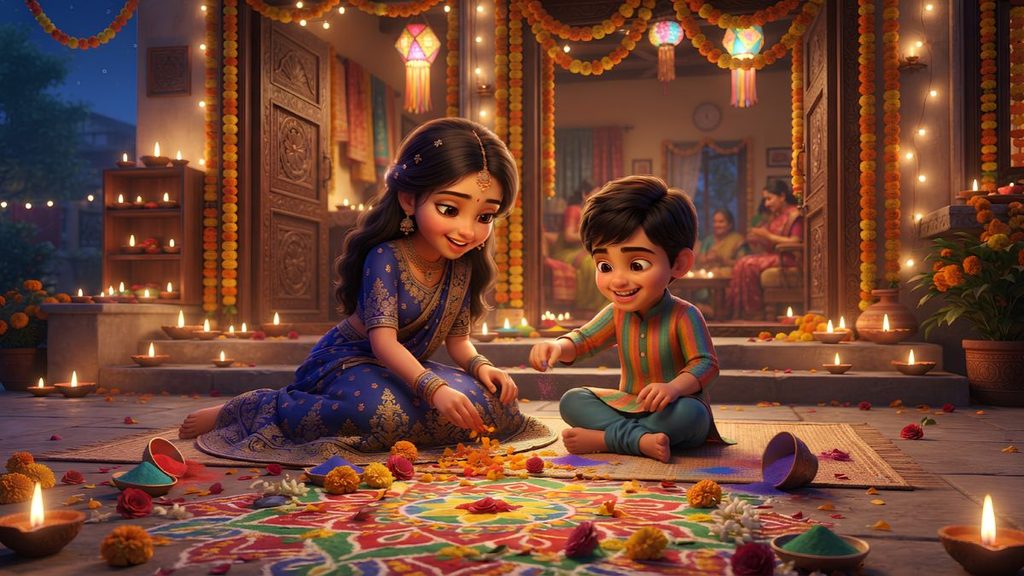
DIWALI STORY ABOUT FORGIVENESS AND TEAMWORK
Riya loved making rangoli more than anything else about Diwali. Every year, she decorated the entrance of her house with beautiful patterns made from colorful powders, flower petals, and tiny clay lamps.
This year, she had an even bigger plan. She wanted to create the most beautiful rangoli in the neighborhood. She had spent several days looking at designs and choosing the perfect colors. Finally, she had settled on a large peacock design with bright blue feathers, green patterns, and a beautiful circle of orange and yellow flowers.
On Diwali morning, Riya carefully arranged all her colored powders in small bowls near the entrance. She was excited to begin.
“Nobody should touch these bowls,” she warned her younger brother, Kabir. “I have everything ready, and I don’t want anything to get spoiled.”
Kabir nodded. He was only five years old and loved watching his sister make rangoli. He wanted to help, but Riya thought he was too young to handle the delicate design.
A few minutes later, while playing nearby, Kabir accidentally bumped into a small table. Before he could stop it, several bowls of colored powder fell onto the floor. Blue, yellow, pink, and green powders mixed together, creating a messy patch across Riya’s carefully prepared space.
Riya turned around and gasped.
“Kabir! What have you done? You have ruined everything!”
Kabir froze. His eyes filled with tears.
“I’m sorry, Didi. I didn’t mean to,” he said quietly.
But Riya was too angry to listen.
“Go away! I don’t want your help anymore.”
Kabir slowly walked toward the garden and sat near the entrance. Riya tried to collect the remaining colors, but she was still upset. Her beautiful peacock design seemed impossible now.
After some time, she noticed Kabir sitting alone. He was arranging fallen flower petals into a small pattern on the ground.
Riya walked closer.
“What are you doing, Kabir?”
Kabir looked up nervously.
“I’m making a rangoli for you. I know I spoiled your colors, but I wanted to make something beautiful too.”
Riya looked down at his little creation. The petals were uneven, the circles were not perfect, and a few flowers were pointing in different directions. Yet, Kabir had carefully arranged each one with his tiny hands.
“Do you like it?” he asked.
Riya felt sorry for shouting at him. She realized that Kabir had not spoiled her rangoli on purpose. He had simply wanted to be part of something he admired.
She sat beside him and smiled.
“It’s beautiful, Kabir. But what do you say if we make a much bigger one together?”
Kabir’s face immediately brightened.
“Really? I can help?”
“Of course! This time, you can choose the flower colors.”
Together, they collected the remaining powders and fresh petals from the garden. Riya made the large circles and patterns, while Kabir carefully filled them with flowers. Sometimes he placed the wrong color in a space, and sometimes the petals fell out of place. Instead of getting angry, Riya showed him how to fix them.
By evening, their rangoli was complete. It was not the perfect peacock design Riya had originally planned. It was a colorful mixture of flowers, patterns, and little creative surprises.
Their parents came outside and admired their work.
“This is the most beautiful rangoli we have ever had!” their mother said.
Kabir proudly held Riya’s hand.
“We made it together!”
Riya smiled. She had wanted to create the best rangoli in the neighborhood, but she had discovered something more valuable. The best part of Diwali was not making everything perfect. It was sharing happy moments with the people she loved.
That night, as the diyas glowed around their colorful rangoli, Riya realized that a small mistake had given her a wonderful memory.
Moral of the Story
Forgiveness and teamwork can turn mistakes into beautiful memories. Sometimes, the most meaningful creations are not perfect, but they are made with love.
4. The Secret Behind the Brightest Diwali
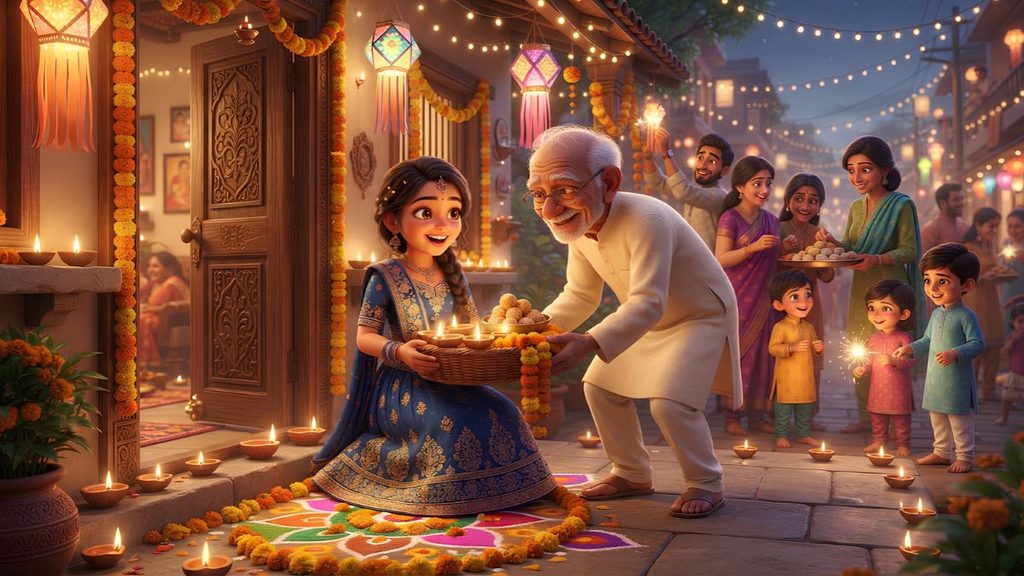
DIWALI STORY ABOUT KINDNESS AND THE TRUE MEANING OF HAPPINESS
Eight-year-old Anaya loved Diwali more than any other festival. She loved the colorful decorations, delicious sweets, beautiful clothes, and especially the thousands of little lights that appeared in every street.
Every year, her family decorated their house with clay diyas, colorful lanterns, and sparkling lights. But this year, Anaya had a special wish.
“I want our house to be the brightest house in the entire neighborhood!” she announced.
Her father laughed. “That sounds like a big challenge. How are you going to do that?”
“More lights, Papa! Lots and lots of lights!” Anaya replied excitedly.
Her parents helped her buy strings of colorful electric lights, decorative lanterns, and several boxes of clay diyas. Anaya spent the entire afternoon decorating the balcony, windows, garden, and entrance.
When evening arrived, she switched on every light. Her house looked beautiful. Colorful bulbs flashed along the balcony, lanterns glowed near the windows, and tiny diyas illuminated the entrance.
Anaya stood outside proudly.
“Look, Papa! I think we have the brightest house!”
Her father smiled, but before he could answer, Anaya noticed something across the street.
An old man named Mr. Verma was sitting alone outside his small house. His entrance was dark, and there were no decorations around his door. Unlike the other houses, his home looked unusually quiet.
Anaya remembered seeing him in the neighborhood many times. He rarely came outside, and most children did not know much about him.
“Papa, why hasn’t Mr. Verma decorated his house?” she asked.
Her father explained gently, “His family lives in another city. He doesn’t have anyone visiting him this Diwali, and perhaps he doesn’t feel like celebrating alone.”
Anaya looked at her brightly decorated home. Suddenly, all those lights seemed a little less exciting.
“Can we give him some diyas?” she asked.
“Of course,” her father replied.
Anaya picked up a small basket and filled it with clay diyas, flowers, and a box of homemade sweets. She crossed the street with her father and knocked on Mr. Verma’s door.
The old man opened it slowly.
“Happy Diwali, Uncle!” Anaya said with a big smile. “We brought something for you.”
Mr. Verma looked surprised.
“For me? Oh, that’s very kind of you.”
Anaya handed him the basket.
“We thought your house needed some lights too. Would you like us to help decorate?”
For a moment, Mr. Verma did not say anything. Then his eyes filled with happiness.
“I would love that, little one.”
Anaya and her father began placing diyas near the entrance. Mr. Verma brought out an old lantern that had belonged to his wife. He carefully cleaned it and placed it beside the door.
As they worked, he shared stories about the Diwali celebrations he used to enjoy with his family. Anaya listened with curiosity, asking questions and laughing at his funny memories.
Soon, their neighbors noticed the little gathering. One family brought sweets, another brought flowers, and a few children came over to help decorate.
By the time they finished, Mr. Verma’s house was glowing with beautiful lights. More importantly, it was filled with laughter and friendly conversation.
Mr. Verma invited everyone to share sweets. He even brought out some homemade snacks that he had prepared earlier.
Anaya looked around and smiled.
Her own house still had more lights and decorations than anyone else’s, but Mr. Verma’s small home seemed to shine the brightest.
Later that night, her father asked, “So, Anaya, did we win the brightest house competition?”
Anaya shook her head happily.
“I found something better, Papa. The brightest Diwali is the one where nobody feels left out.”
Her father hugged her proudly.
That evening, Anaya learned that lights could brighten a house, but kindness could brighten someone’s entire world.
Moral of the Story
The true beauty of Diwali lies in kindness, sharing, and bringing happiness to others. A little act of love can make someone’s festival brighter than a thousand decorative lights.
5. The Honest Little Shopkeeper
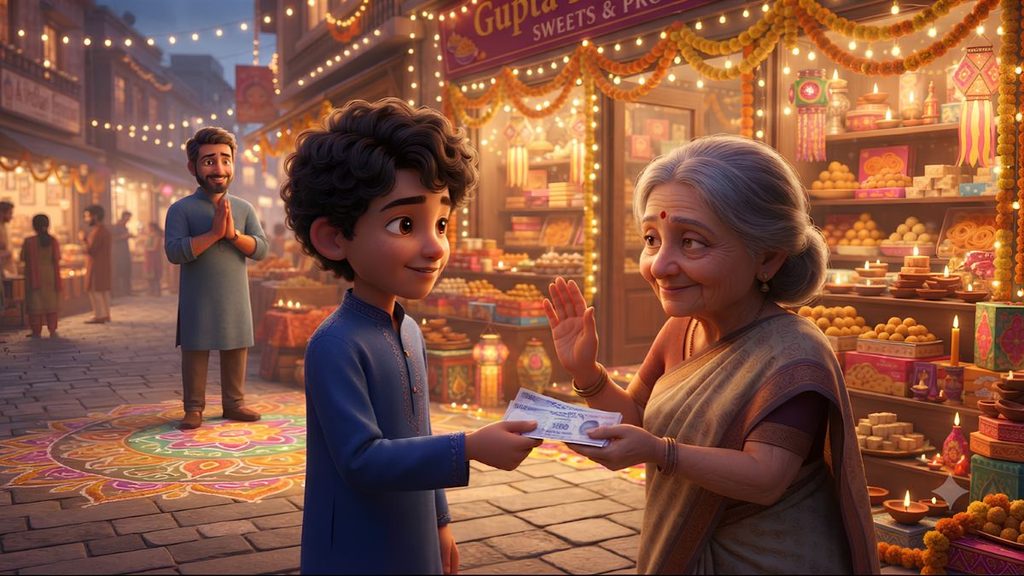
DIWALI STORY ABOUT HONESTY AND INTEGRITY
Ten-year-old Rohan helped his father run a small grocery and sweets shop in their neighborhood. Every year, just before Diwali, the shop became busy with customers buying sweets, diyas, candles, decorations, and gifts.
Rohan loved this time of year. The shop was filled with colorful boxes, the smell of fresh jalebis, and cheerful customers preparing for the festival.
His father often allowed him to help with simple tasks, such as arranging packets, handing over sweets, and counting small amounts of money.
“Remember, Rohan,” his father always reminded him, “people trust our shop. Always be honest with them, even when nobody is watching.”
Rohan nodded. He knew honesty was important, but he had never faced a situation where it was difficult to follow that advice.
One afternoon, his father had to visit the wholesale market to collect fresh supplies. Before leaving, he asked Rohan to look after the shop for an hour.
“Can you manage until I return?” he asked.
“Yes, Papa! Don’t worry,” Rohan replied confidently.
The shop was quiet at first, but soon several customers arrived. Rohan carefully packed sweets, sold candles, and helped people choose decorations.
A little later, an elderly woman entered the shop. She wanted to buy a box of laddoos and a packet of diyas.
“How much is everything, beta?” she asked.
Rohan calculated the total and told her the price. The woman handed him a five-hundred-rupee note.
While returning the change, Rohan accidentally gave her two hundred rupees extra.
The woman collected her shopping and walked away without noticing.
Rohan looked at the money remaining in the cash box. He quickly realized his mistake.
“Oh no! I gave her too much change,” he whispered.
He looked toward the street. The woman was already walking away and was almost at the corner.
For a moment, Rohan wondered what to do. His father might never discover the mistake. The extra money could simply remain in the shop’s earnings.
But then he remembered his father’s words.
“People trust our shop.”
Without wasting another moment, Rohan ran outside.
“Grandmother! Please wait!”
The woman turned around, surprised to see him running toward her.
“Is something wrong, beta?”
“I’m sorry. I accidentally gave you two hundred rupees extra. Please take the correct change.”
He returned the money and explained what had happened.
The woman looked at him with admiration.
“You ran all the way here just to return this money?”
Rohan smiled shyly.
“It wasn’t mine to keep, Grandma.”
The woman gently patted his head.
“Your father has raised a very honest boy. Shops can sell beautiful things, but not every shopkeeper has such a good heart.”
She returned to the shop a few minutes later and bought another box of sweets.
“This one is for you and your father,” she said. “Consider it a Diwali gift.”
When Rohan’s father returned, he heard the entire story from the woman, who was still there praising his son.
His father smiled proudly and placed a hand on Rohan’s shoulder.
“I’m proud of you, beta. You could have kept that money, but you chose to do the right thing.”
Rohan felt happier than he had ever felt after making a sale.
That evening, his father gave him a small clay diya and placed it on the shop counter.
“This diya is for your honesty,” he said.
Rohan watched its little flame flicker in the evening breeze. He understood that honesty might not always bring immediate rewards, but it always gave something more valuable: trust and self-respect.
As customers continued arriving to buy their Diwali supplies, Rohan helped his father with a big smile.
He had discovered that the most valuable thing in their shop was not the sweets, decorations, or money. It was the trust people placed in them.
Moral of the Story
Honesty is more valuable than money. Doing the right thing, even when nobody is watching, builds trust and earns genuine respect.
6. The Diwali Without Firecrackers
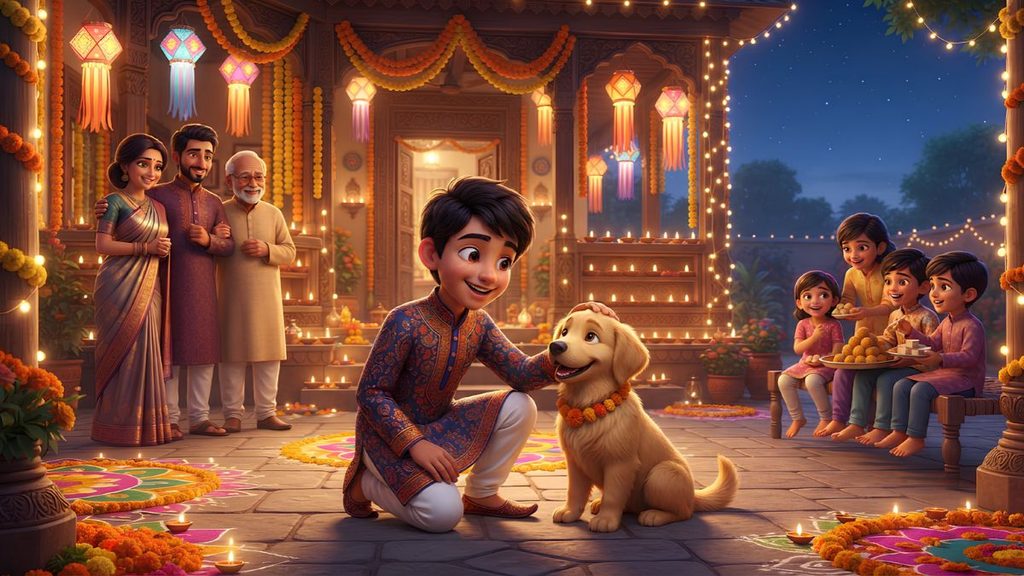
DIWALI STORY ABOUT KINDNESS, NATURE, AND ANIMAL CARE
Nine-year-old Ishaan loved Diwali, especially the sound of firecrackers lighting up the night sky. Every year, he waited eagerly for the evening when he could burst crackers with his friends.
A few days before Diwali, Ishaan visited the local market with his father. The streets were full of colorful decorations, sweet shops, and stalls selling fireworks.
“Papa, can we buy the biggest box of firecrackers this year?” Ishaan asked excitedly.
His father smiled. “Let’s first decide what we really need. Remember, Diwali is about celebrating happiness, not just making noise.”
Ishaan looked a little disappointed, but he followed his father around the market.
When they returned home, he noticed his neighbor, Mrs. Mehta, sitting near her garden. She was trying to calm her little dog, Bruno, who was hiding under a chair.
“What’s wrong with Bruno?” Ishaan asked.
Mrs. Mehta gently stroked the frightened dog.
“He gets very scared whenever he hears loud firecrackers. Last year, he hid for hours and refused to eat his dinner.”
Ishaan felt sorry for Bruno, but he still wondered whether skipping fireworks would make Diwali less exciting.
That evening, his grandfather visited their home. Ishaan told him about Bruno and asked, “Dadu, if we don’t burst crackers, will it still feel like Diwali?”
Grandfather smiled and invited him to sit beside him.
“Let me tell you something, Ishaan. When I was young, we celebrated Diwali by cleaning our homes, lighting diyas, preparing sweets, and visiting our neighbors. We enjoyed the festival without needing loud fireworks every moment.”
“But everyone enjoys firecrackers,” Ishaan replied.
“Some people do,” Grandfather explained. “But think about the small children, elderly people, birds, and animals. Loud sounds can frighten them. Smoke can also make it difficult for people to breathe. A little thoughtfulness can make the celebration happier for everyone.”
Ishaan thought about Bruno hiding under the chair. He imagined how frightened the little dog must feel when the entire neighborhood became noisy.
The next morning, he made a decision.
“Papa, I don’t want to buy firecrackers this year. Can we spend that money on something else?”
His father looked pleasantly surprised.
“What would you like to do?”
“I want to decorate our house with more diyas and lights. And I want to give some sweets to the children who live near us.”
His father agreed, and they spent the afternoon preparing for the celebration.
Ishaan helped his mother make colorful rangoli, arranged clay diyas around the entrance, and decorated the balcony with lanterns. He also prepared small gift bags filled with sweets for his friends.
When evening arrived, the house looked magical. Instead of the loud noise of fireworks, the family enjoyed music, laughter, and the warm glow of hundreds of little lights.
Ishaan also invited his friends to celebrate together.
At first, a few children wondered why he had not bought any crackers. But when they saw the beautiful decorations and delicious sweets, they quickly joined the celebration.
Later, Ishaan visited Mrs. Mehta with a small box of sweets.
“Happy Diwali, Aunty! I decided not to burst firecrackers this year because I didn’t want Bruno to feel frightened.”
Mrs. Mehta smiled with gratitude.
“That is very thoughtful of you, Ishaan.”
Bruno slowly came out from behind the chair and wagged his tail. Ishaan gently patted him.
As he returned home, Ishaan looked at the glowing diyas along the street. He realized that Diwali could be just as exciting without loud explosions.
In fact, this year felt even more special because he had helped make the festival comfortable for others.
That night, as his family enjoyed sweets together, Ishaan proudly announced, “This was my happiest Diwali ever!”
His grandfather smiled.
“Now you understand the real brightness of the festival.”
Moral of the Story
A thoughtful celebration can bring happiness to everyone. We can enjoy Diwali with lights, sweets, music, and kindness while being considerate of animals, elderly people, children, and the environment.
7. The Lost Puppy on Diwali Night
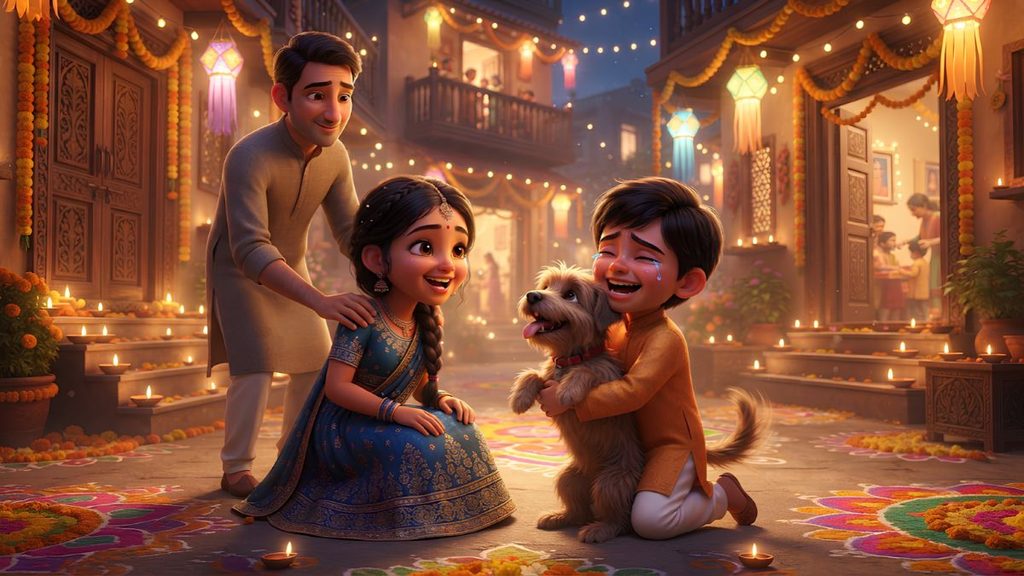
DIWALI STORY ABOUT COMPASSION AND HELPING OTHERS
It was Diwali evening, and the entire neighborhood was glowing with colorful lights. Houses were decorated with marigold garlands, beautiful rangolis, and rows of tiny clay diyas. Children ran through the streets in their new clothes, while families prepared sweets and welcomed guests.
Among them was a seven-year-old girl named Meera. She loved animals and often fed the stray dogs and cats in her neighborhood.
That evening, Meera was helping her mother arrange sweets on a plate when she heard a faint sound coming from outside.
“Mother, did you hear that?” she asked.
Her mother listened carefully.
“It sounds like a puppy crying.”
Meera quickly walked toward the gate. Near a parked scooter, she noticed a tiny brown puppy hiding behind a flowerpot. It was trembling and looked frightened.
“Oh, you poor little thing!” Meera whispered.
She slowly approached the puppy, but it moved backward and let out another frightened cry.
Meera sat down a little distance away.
“Don’t be scared. I won’t hurt you.”
After a few moments, the puppy cautiously came closer. Meera noticed that it had a red collar around its neck, which meant it probably belonged to someone.
“Maybe someone is looking for you,” she said gently.
She called her father, who came outside with a small bowl of water. The puppy was thirsty and drank eagerly. Meera also brought a little food from the kitchen.
While the puppy ate, her father examined its collar. There was a small metal tag attached to it, but the writing was difficult to read.
He wiped it carefully and discovered a name and phone number.
“Look, Meera! We may be able to find its family.”
Her father called the number, but nobody answered.
Meera became worried.
“What if the puppy has been lost for a long time?”
“Let’s not give up,” her father replied. “We can ask the neighbors if anyone recognizes it.”
They walked through the nearby streets, asking people whether they had seen the puppy before. However, the festival was in full swing, and most families were busy celebrating.
Suddenly, Meera heard someone calling loudly from the other side of the street.
“Chiku! Chiku! Where are you?”
A young boy was walking with his mother, looking worried. His eyes were red, and he seemed close to tears.
Meera immediately looked at the puppy.
“Is your puppy’s name Chiku?” she asked.
The boy turned around.
“Yes! Have you seen him?”
Meera smiled and gently pointed toward the little puppy sitting beside her father.
“Is this your Chiku?”
The boy ran toward them with excitement.
“Chiku! I found you!”
The puppy recognized his voice and began wagging its tail. It jumped toward the boy, who carefully picked it up and hugged it tightly.
The boy’s mother thanked Meera and her father.
“Chiku got frightened by the loud sounds outside and slipped through our gate. We have been searching everywhere.”
Meera smiled.
“I’m glad he is safe. Please keep him close tonight. There are many people and loud sounds outside.”
The boy promised to take better care of Chiku.
Before leaving, he turned to Meera.
“Thank you for helping my best friend. I was so worried.”
Meera felt happy. She had not planned to spend her Diwali evening searching for a lost puppy, but she was glad she had heard its little cry.
When she returned home, her mother asked, “Did you find out where the puppy belonged?”
“Yes! His family was looking for him. He is safe now.”
Her mother hugged her.
“You gave someone a very special Diwali gift tonight.”
Meera looked at the glowing diyas outside her house and smiled.
She had received sweets, new clothes, and beautiful decorations that evening. But the happiest moment came from helping a little puppy find its way home.
Moral of the Story
Kindness means caring for those who cannot always ask for help. A small act of compassion can bring happiness and comfort to both people and animals.
8. The Grandmother’s Diwali Lantern
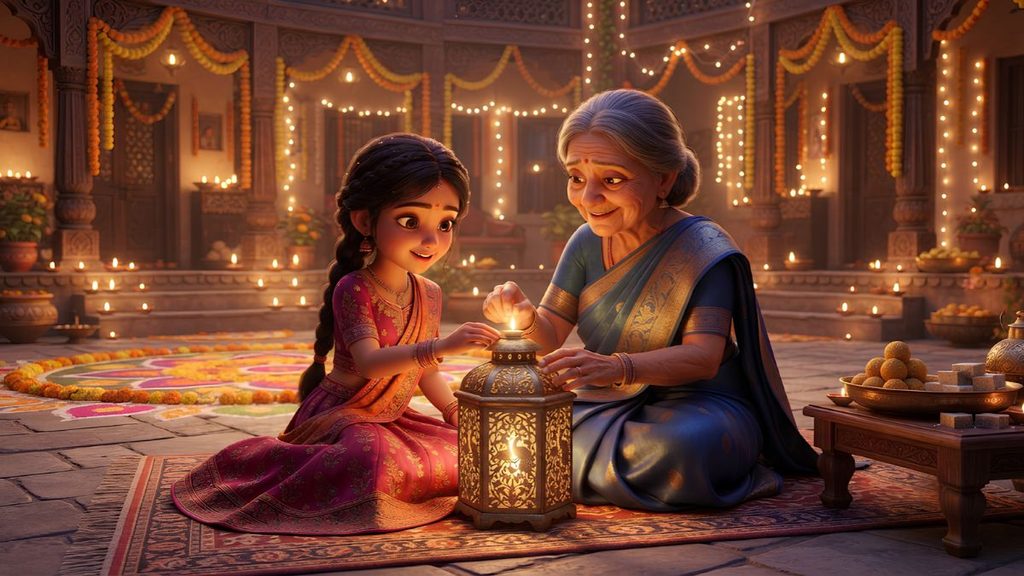
DIWALI STORY ABOUT FAMILY LOVE AND TRADITIONS
Every Diwali, eight-year-old Tara looked forward to visiting her grandmother’s house. It was her favorite place during the festival because Grandma always had something special planned.
Some years, they made sweets together. Other years, they decorated the courtyard with flowers and colorful rangoli. But Tara’s favorite tradition was lighting an old lantern that Grandma kept carefully wrapped in a piece of soft cloth.
The lantern was made of brass, with beautiful patterns carved into its sides. Although it was old and slightly faded, it still looked magical when a small candle was placed inside.
“Grandma, why don’t we buy a new lantern this year?” Tara asked one afternoon. “There are so many beautiful ones in the market.”
Grandma smiled and gently wiped the lantern with a clean cloth.
“This one is more precious to me than any new lantern.”
Tara looked at it curiously.
“Why? Is it very expensive?”
Grandma laughed.
“No, my dear. Its value is not in its price. It carries a beautiful memory.”
Tara moved closer.
“Will you tell me the story?”
Grandma sat beside her and held the lantern carefully.
“Many years ago, when your grandfather and I were newly married, we lived in a small house. We didn’t have much money, and our first Diwali together was very simple. We couldn’t afford expensive decorations or electric lights.”
“What did you do?” Tara asked.
“Your grandfather made this lantern for me. He worked on it for several evenings, carefully shaping the metal and carving these little patterns. On Diwali night, he placed a candle inside and hung it outside our tiny home.”
Grandma paused and smiled at the memory.
“When he lit it, the whole entrance seemed to glow. It wasn’t the brightest lantern in the neighborhood, but to me, it was the most beautiful gift in the world.”
Tara touched one of the carved patterns.
“Did you keep it all these years?”
“Yes. Every Diwali, we light it to remember that happiness does not come from expensive things. It comes from love, care, and the memories we create together.”
Tara looked at the lantern differently now. It was no longer just an old decoration. It was a little piece of her grandparents’ story.
That evening, Tara helped Grandma clean the lantern. She carefully removed the dust from its corners while Grandma prepared a small candle.
“Can I light it this year?” Tara asked.
“Of course,” Grandma replied.
They placed the lantern near the courtyard entrance. Tara carefully lit the candle, and a warm golden glow spread through the carved patterns.
The light looked beautiful against the evening sky.
Just then, Tara noticed her younger cousin standing nearby.
“Why are you looking at it so carefully?” she asked.
“I have never seen a lantern like this,” he replied.
Tara smiled.
“Come, I’ll tell you its story.”
She explained how her grandfather had made it for Grandma during their first Diwali together. Her cousin listened with wide eyes.
Soon, other family members gathered around. Grandma shared more memories of earlier Diwali celebrations, and everyone listened with interest.
Tara realized that the lantern had brought the family together in a way that no expensive decoration could.
Before going to bed, she made a promise.
“Grandma, I want to keep this lantern safe. One day, I’ll light it for my children and tell them its story too.”
Grandma hugged her lovingly.
“That would make me very happy.”
As the little lantern continued glowing in the courtyard, Tara understood that some traditions were worth keeping forever.
The lantern was old, but the love and memories it carried would never grow old.
Moral of the Story
Family traditions connect generations and keep precious memories alive. The most valuable gifts are often not expensive things, but the love and stories behind them.
9. The Little Girl Who Saved Her Diwali Money
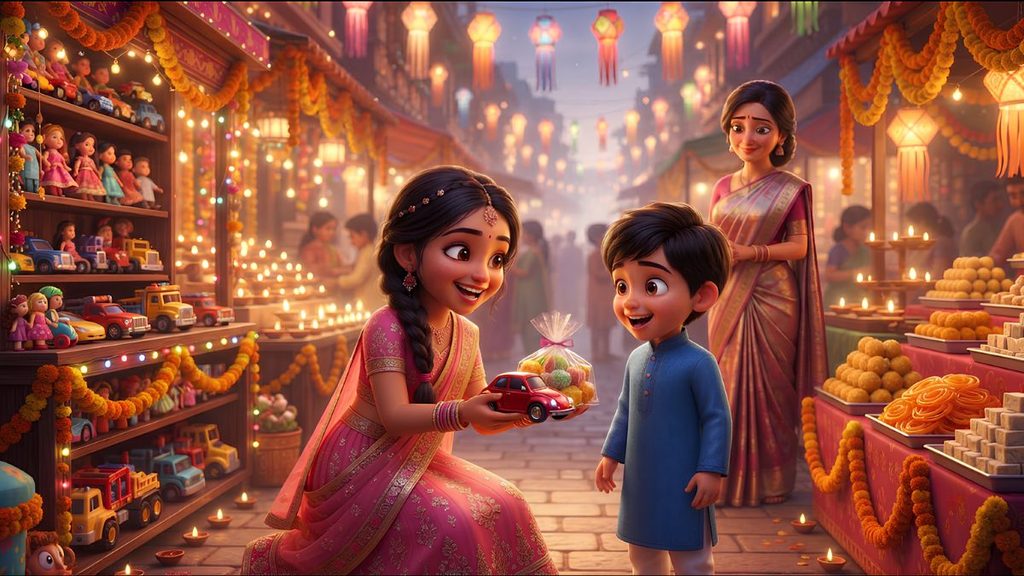
DIWALI STORY ABOUT GENEROSITY AND THE JOY OF GIVING
Seven-year-old Siya loved everything about Diwali. She enjoyed decorating the house, making colorful rangoli with her mother, and helping her father arrange clay diyas along the balcony.
But there was one thing she looked forward to more than anything else: her Diwali pocket money.
Every year, her parents gave her a little money to spend on whatever she wanted. Sometimes she bought toys, sometimes chocolates, and sometimes pretty hair accessories.
This year, Siya had already decided what she wanted.
“I am going to buy the biggest doll in the toy shop!” she announced at breakfast.
Her mother smiled.
“That sounds exciting. But remember, you can also save your money if you want something special later.”
Siya nodded, although she had no intention of saving it.
A few days before Diwali, her father gave her a small envelope containing five hundred rupees.
“Here is your Diwali gift, little one. Spend it wisely.”
Siya was delighted. She carefully placed the money inside her favorite pink purse and began planning her shopping trip.
The next afternoon, she went to the market with her mother. The streets were crowded with families buying sweets, decorations, and gifts. Colorful toys filled the shop windows, and Siya quickly spotted a beautiful doll wearing a pink dress.
“Look, Mumma! That’s the one I want!”
She entered the shop and asked the shopkeeper for its price. Unfortunately, the doll cost more than the money she had saved.
Siya felt disappointed.
“Maybe I should buy something smaller,” she said.
As they walked toward another shop, she noticed a little boy sitting beside a roadside stall. He was watching other children choose colorful toys, but he had nothing in his hands.
His clothes were old, and he looked rather sad.
Siya asked her mother, “Why isn’t he buying anything?”
Her mother gently explained, “Perhaps his family cannot afford extra things this year. Festivals can be difficult for some people.”
Siya looked at the boy again. He was holding a tiny broken toy car and trying to fix one of its wheels.
For a moment, she thought about her own pink purse. She had enough money to buy a small toy or some sweets, but she wondered whether she could do something more meaningful.
“Can we talk to him?” she asked.
Her mother agreed.
They approached the boy and introduced themselves. His name was Aman. He explained that he was helping his father at the stall and had come to the market to see the Diwali decorations.
“Do you like toys?” Siya asked.
Aman smiled.
“Yes, but I don’t have any new ones. That’s okay. I like watching the lights and decorations.”
Siya felt something change inside her.
She looked at the nearby toy shop and then at the money in her purse.
“Mumma, can I buy something for Aman?”
Her mother smiled.
“That is a lovely thought. You can decide what you would like to give him.”
Siya returned to the toy shop and chose a small red toy car. She also bought a packet of sweets with the remaining money.
When she handed them to Aman, his eyes widened.
“Are these really for me?”
“Yes! Happy Diwali!” Siya replied.
Aman held the toy car carefully, as if it were the most precious gift he had ever received.
“Thank you! I will keep it safe.”
Siya smiled. She no longer felt sad about not buying the pink doll. Instead, she felt happier than she had expected.
On the way home, her mother asked, “Don’t you regret spending your pocket money?”
Siya shook her head.
“I can buy another doll some other time. But I wanted Aman to have something special for Diwali too.”
Her mother hugged her proudly.
That evening, Siya helped decorate the house with diyas and flowers. She told her father about Aman, and he praised her thoughtful decision.
Siya still had no new doll, but she had gained something much more meaningful: the happiness of making another child smile.
And as she watched the little diyas glowing outside her home, she understood that the best Diwali gifts were not always the ones we received.
Sometimes, they were the ones we gave.
Moral of the Story
True happiness comes from sharing and caring for others. Even a small gift can make someone’s festival special when it is given with love.
10. The Little Star of Ayodhya
DIWALI STORY ABOUT COURAGE, KINDNESS, AND THE LIGHT OF GOODNESS
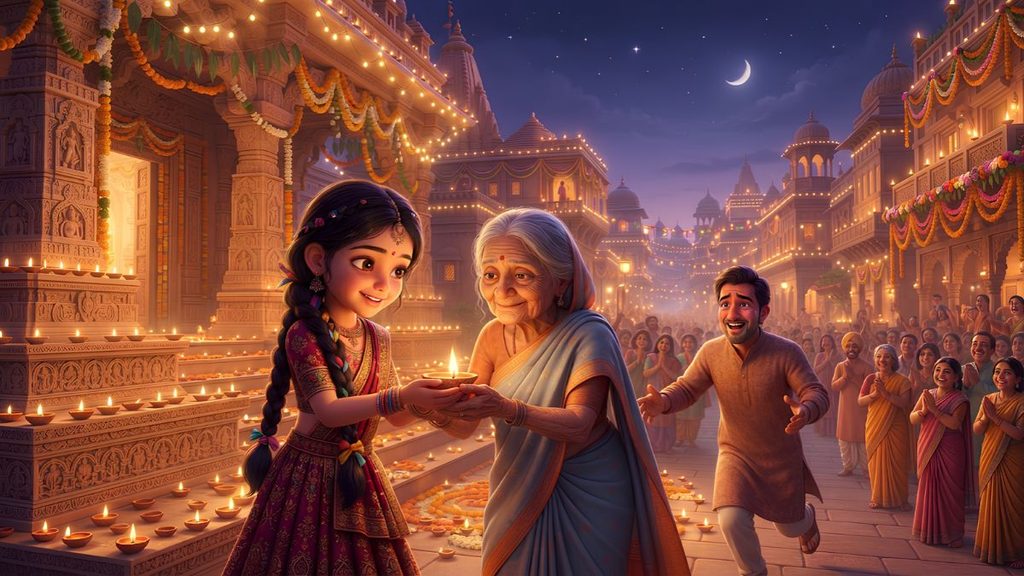
Long ago, in the beautiful city of Ayodhya, everyone was preparing for a very special celebration. After many years away, Lord Rama was returning home with Goddess Sita and Lakshmana.
The people of Ayodhya were filled with happiness. They cleaned their homes, decorated their doorways with flowers, and prepared rows of tiny clay lamps to welcome their beloved prince.
Among the excited people was a little girl named Tara. She lived with her parents in a small house near the main road.
Tara wanted to help with the celebrations just like everyone else. Her mother gave her a small clay diya and a little bowl of oil.
“Take good care of this lamp, Tara,” her mother said. “Tonight, every little light will help welcome Lord Rama home.”
Tara carefully held the diya.
“I will make sure it shines brightly!” she promised.
As evening approached, the streets of Ayodhya began glowing with thousands of lamps. People gathered along the roads, singing joyful songs and waiting for Lord Rama’s arrival.
Tara placed her diya outside their house. But just as she was about to light it, a strong breeze blew through the street.
The tiny flame went out.
“Oh no!” Tara exclaimed.
She tried lighting it again, but another gust of wind extinguished the flame.
Her father noticed her disappointment.
“Don’t worry, little one. You can place it somewhere more protected.”
Tara moved the diya near the doorway, where the wind was weaker. This time, the flame stayed alive.
She smiled proudly and looked down the road.
Suddenly, she noticed an elderly woman standing alone near a tree. The woman was carrying a small basket and seemed confused.
Tara walked toward her.
“Grandmother, are you looking for someone?”
The woman smiled weakly.
“I came to see the celebration, but I cannot find my family. I am afraid I may have lost my way.”
Tara looked toward the crowded street. Everyone was excited, and the noise made it difficult to hear anything.
“Don’t worry,” Tara said gently. “I will help you.”
She took the woman’s hand and guided her toward a quieter corner. Then she asked a nearby shopkeeper whether he recognized her.
The shopkeeper looked carefully and remembered seeing the woman’s family near the temple. He pointed them toward the gathering place.
Tara accompanied the woman until they reached the temple courtyard.
A young man immediately ran toward them.
“Mother! We have been searching everywhere!”
The elderly woman hugged her son with relief.
“Thank you, little girl,” she said to Tara. “You have helped me find my family.”
Tara smiled and returned home.
By then, the entire city was glowing with beautiful lamps. People were cheering as they heard that Lord Rama had arrived.
Tara quickly checked her little diya. It was still burning near the doorway.
Her mother noticed her smiling face.
“Your lamp is shining beautifully, Tara.”
Tara looked at the little flame.
“Mother, I think I understand something now. The lamps make the streets bright, but helping someone makes their heart happy.”
Her mother hugged her.
“That is the brightest light of all, my child.”
That night, as Ayodhya celebrated the return of Lord Rama, Tara felt proud. Her little diya was only one among thousands, but she had also helped bring light into someone’s life.
Years later, people would remember the grand celebration of Ayodhya and the beautiful tradition of lighting diyas on Diwali.
And Tara would always remember that the smallest person could make a big difference through kindness.
Moral of the Story
True light comes from goodness, compassion, and helping others. Just as a small diya can brighten a dark corner, even a small act of kindness can brighten someone’s life.
What Do Children Learn from Diwali Stories?
Diwali stories introduce children to important values through simple and memorable situations. Although each story has different characters, they share several common lessons.
| Value | What children learn |
|---|---|
| Kindness | Help people, animals, and those who need support. |
| Honesty | Always tell the truth and return things that do not belong to you. |
| Generosity | Share happiness, food, and gifts with others. |
| Courage | Stand up for what is right. |
| Teamwork | Work together and respect other people’s ideas. |
| Environmental care | Celebrate responsibly and avoid unnecessary waste. |
| Family love | Value time spent with family and loved ones. |
How to Make Diwali Storytelling Fun for Kids
Reading a story is enjoyable, but parents and teachers can make storytelling even more exciting by adding simple activities.
Use different character voices
Give each character a unique voice. Speak softly for a little diya, use an excited voice for a child, and create a gentle voice for a grandmother. This keeps young listeners interested.
Use puppets and handmade props
Make simple paper puppets of the story characters. You can also use a clay diya, paper lantern, or colorful rangoli design as a storytelling prop.
Ask questions after the story
Ask children what they learned from the characters. For example, after reading the story about sharing sweets, ask, “How would you make someone feel special during Diwali?”
Encourage children to draw their favorite scene
Let children draw a glowing diya, a beautiful rangoli, a family celebration, or their favorite story character. This helps develop creativity and improves their understanding of the story.
Let children create their own endings
Pause before the end of a story and ask children what they think should happen next. Their answers can make storytelling more interactive.
Frequently Asked Questions About Short Diwali Stories for Kids
What are some good short Diwali stories for kids?
Some good short Diwali stories for children include The Little Diya That Never Gave Up, The Boy Who Shared His Diwali Sweets, The Magic of the Forgotten Rangoli, The Honest Little Shopkeeper, and The Little Star of Ayodhya. These stories teach kindness, honesty, sharing, courage, and the importance of Diwali.
What is the moral of Diwali stories?
The central moral of many Diwali stories is that good triumphs over evil and light overcomes darkness. They also teach children to be kind, honest, generous, respectful, and helpful towards others.
Why do we celebrate Diwali with diyas?
In the traditional story of Lord Rama’s return to Ayodhya after fourteen years of exile and his victory over Ravana, people welcomed him by lighting rows of lamps. Diyas have since become an important symbol of light, hope, and the victory of good over evil in many Diwali celebrations.
Which Diwali story is suitable for preschool children?
Simple stories such as The Little Diya That Never Gave Up, The Boy Who Shared His Diwali Sweets, and The Lost Puppy on Diwali Night are suitable for younger children. They use familiar characters, easy language, and straightforward moral lessons.
How can parents teach children the meaning of Diwali?
Parents can explain Diwali through traditional stories, family celebrations, lighting diyas safely, making rangoli, sharing sweets, and helping people in need. Connecting festival traditions with everyday values makes the meaning easier for children to understand.
Are Diwali stories suitable for bedtime reading?
Yes. Short Diwali stories are excellent for bedtime reading, especially when they have gentle characters, simple language, and positive endings. They allow children to enjoy the festive spirit while learning meaningful lessons before going to sleep.
Conclusion
Diwali is more than a festival of lights. It is a celebration of hope, kindness, family, and the victory of good over evil. Sharing short Diwali stories with children helps them understand these values in a way that is simple, enjoyable, and memorable.
From a little diya that refuses to give up to a child who discovers the joy of sharing, every story offers a lesson worth remembering.
This Diwali, take a few minutes to read a story with your children. Let them ask questions, imagine the characters, and discover the meaning behind the celebration.
Because the most beautiful light of Diwali is not just the one that shines in our homes, but the goodness we share with others.