
Falling asleep is not always as easy as getting into bed and turning off the lights. After a busy day, the mind can remain active, replaying conversations, planning tomorrow, or simply jumping from one thought to another.
For many adults, reading a gentle story before bed can provide a simple way to slow down.
Stories to read to fall asleep do not need complicated plots, dramatic twists, or exciting adventures. In fact, the most effective bedtime stories are often calm, predictable, atmospheric, and easy to follow.
A quiet story gives the mind something pleasant to focus on while gradually encouraging a slower pace.
Whether you prefer cozy homes, peaceful nature, gentle romance, light humor, nostalgic memories, or simple everyday routines, there are many types of stories that can work well as part of a relaxing nighttime routine.
What Are Stories to Read to Fall Asleep?
Stories to read to fall asleep are written primarily to create a peaceful mental atmosphere before bedtime.
Unlike stories designed to keep readers turning pages late into the night, sleep-friendly stories usually avoid excessive suspense, frightening situations, complicated mysteries, and intense emotional conflict.
The purpose is not necessarily to find out what happens next.
Instead, the reader can enjoy the setting, characters, descriptions, and gentle progression of ordinary events.
A story might describe someone preparing tea on a rainy evening, walking beside a quiet lake, organizing an old bookshelf, preparing a simple dinner, or returning home after a peaceful day.
The narrative can move slowly.
There may be little conflict.
The ending can feel natural and reassuring.
This makes the story easier to read when the goal is relaxation rather than excitement.
7 Different Types of Stories to Read to Fall Asleep Free
1. The Passenger in Coach Seven
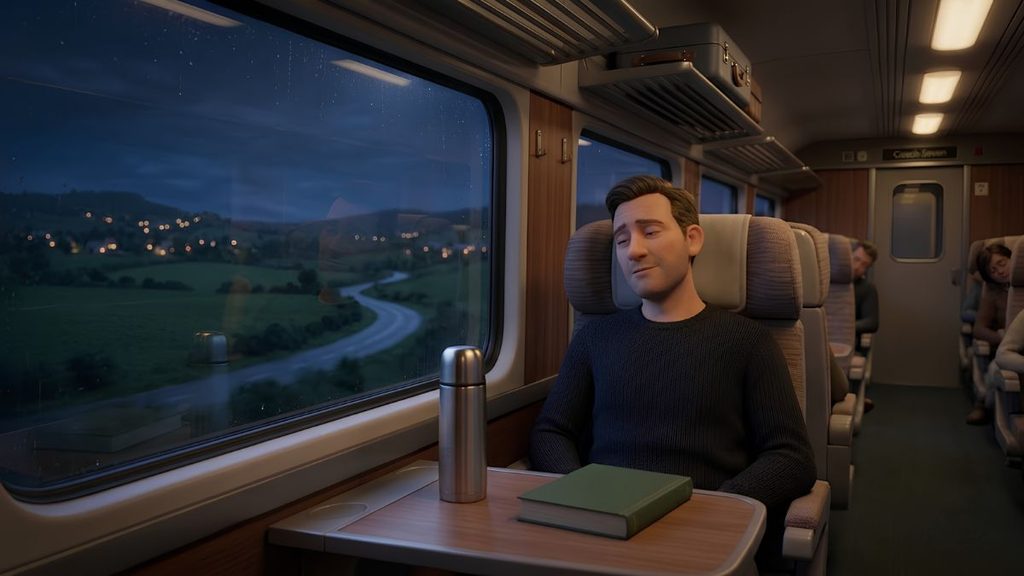
The station was almost empty when Daniel arrived.
It was a little after nine in the evening.
The last light of the day had disappeared from the sky, leaving only a deep blue color above the station roof.
A few lamps illuminated the platform.
Their light reflected softly on the polished rails.
Somewhere beyond the station building, a train moved slowly through the darkness.
Daniel stood near the information board with a small suitcase beside him.
He was traveling to a town several hours away.
There was no particular urgency.
He could have traveled the following morning, but he preferred the night train.
There was something peaceful about traveling while the rest of the world was becoming quiet.
Daniel checked his ticket.
Coach Seven.
Seat 18.
He looked up at the large clock hanging above the platform.
9:14.
The train would arrive at 9:30.
He had sixteen minutes to wait.
Daniel found an empty bench.
He sat down.
His suitcase rested beside his feet.
The station was quiet enough that he could hear the occasional sound of footsteps.
A woman walked across the platform carrying a paper bag.
An elderly man stood near a pillar and looked at his watch.
A station employee pushed a small trolley toward the far end of the platform.
Then everything became quiet again.
Daniel leaned back.
He looked toward the tracks.
The rails disappeared into the darkness.
Two parallel lines extending farther than he could see.
A light appeared in the distance.
It became brighter.
The train was approaching.
Daniel stood.
The sound grew slowly.
The train entered the station without rushing.
Its windows were illuminated.
Some compartments were almost empty.
Others contained only one or two passengers.
The train stopped.
Daniel found Coach Seven.
He lifted his suitcase.
Then stepped inside.
The corridor was warm.
The lights were soft.
There was a faint smell of fabric, coffee, and clean wood.
Daniel looked at his ticket again.
He walked down the corridor.
Seats passed on either side.
Most were empty.
A man was sleeping near the window.
A woman was reading a magazine.
Another passenger was looking at his phone.
Daniel found Seat 18.
It was beside the window.
Exactly what he had hoped for.
He placed his suitcase in the storage area above the seat.
Then sat down.
The window reflected his face.
Beyond it, the platform was still visible.
A few people stood outside.
The station clock showed 9:28.
Daniel settled into his seat.
He removed his jacket.
Folded it carefully.
Then placed it beside him.
The train gave a small movement.
A minute later, the doors closed.
The platform began to move.
Slowly at first.
Then faster.
The station lights passed one after another.
Daniel watched them.
The train left the station.
Within a few minutes, the buildings became fewer.
The city lights stretched along the horizon.
Then they disappeared.
The countryside began.
Daniel rested his head against the window.
Outside was darkness.
Occasionally, a distant light appeared.
A farmhouse.
A road.
A small cluster of houses.
Then nothing again.
The train continued.
Its wheels made a steady sound.
Click.
Click.
Click.
The rhythm was almost regular.
Daniel found it calming.
He took a small book from his bag.
He opened it.
But after reading two pages, he found himself looking outside again.
There was not much to see.
That was part of the appeal.
Dark fields.
Occasional trees.
Distant lights.
The reflection of the carriage.
Daniel closed the book.
He put it back into his bag.
A conductor walked through the coach.
“Tickets, please.”
Daniel handed his ticket over.
The conductor checked it.
“Coach Seven. Seat eighteen.”
Daniel nodded.
The conductor returned the ticket.
“Have a pleasant journey.”
“Thank you.”
The conductor continued down the corridor.
Daniel looked outside.
The train passed a small station.
There was no platform light near the tracks.
Only a few lamps.
Two people stood waiting.
The train slowed.
Stopped.
One passenger from Coach Seven stepped off.
A man entered.
He carried a dark blue bag.
He walked down the corridor.
Daniel watched him briefly.
The man found an empty seat several rows away.
Then sat down.
The train started moving again.
Daniel returned his attention to the window.
The countryside continued.
At ten fifteen, a small announcement came through the speakers.
The next stop would be in approximately forty minutes.
Daniel looked at his watch.
He had been traveling for less than an hour.
It already felt longer.
Not because the journey was boring.
Because time seemed slower on the train.
There was no need to think about where he was going.
The train knew the route.
He only needed to sit.
Daniel closed his eyes for a moment.
The sound of the wheels continued.
Click.
Click.
Click.
The carriage moved gently.
He opened his eyes again.
The lights inside the coach had been dimmed slightly.
The passenger with the blue bag was reading.
The man near the window was still asleep.
The woman with the magazine had closed it.
She was looking out into the darkness.
Daniel reached into his bag.
He had brought a small thermos of tea.
He opened it.
The smell of tea filled the air around him.
He poured some into the cup attached to the thermos.
The tea was still warm.
He took a sip.
Then another.
He held the cup between both hands.
Outside, a line of trees passed beside the train.
Their shapes appeared briefly in the faint moonlight.
Then disappeared.
Daniel took another sip.
The train entered a tunnel.
For several seconds, the window became completely black.
The reflection of the carriage became clearer.
Daniel could see the overhead lights.
The empty seats.
His own face.
Then the train emerged.
The countryside returned.
The moon was visible now.
It was low in the sky.
A pale circle above the fields.
Daniel watched it.
For a while, it seemed to move alongside the train.
Of course, it was only an illusion.
But Daniel enjoyed it.
The train passed another village.
Several houses had their lights on.
One house had a bright kitchen window.
Another had a small lamp near the front door.
Then the village disappeared.
The train continued.
At eleven o’clock, the conductor returned.
This time, he walked quietly through the coach.
Daniel watched him check the carriage.
He adjusted one of the curtains.
Then continued toward the next coach.
Daniel looked at the clock.
11:03.
He had several hours left.
He was not tired yet.
But he was becoming comfortable.
The seat was warm.
The movement of the train was steady.
The lights were soft.
The countryside outside was dark.
Everything seemed designed to make the journey feel slower.
Daniel put his thermos away.
Then took out a small notebook.
He had originally planned to write down some thoughts about his trip.
Instead, he simply wrote the date.
Then the name of the station where he had boarded.
Then:
“Coach Seven.”
He paused.
He smiled.
There was nothing else to write.
He closed the notebook.
The train continued.
Around eleven-thirty, the woman across the aisle stood.
She took a bottle of water from her bag.
Then walked toward the end of the coach.
She returned a few minutes later.
She sat down.
The coach became quiet again.
Daniel looked at the window.
The glass was slightly cool.
He placed his hand against it.
Outside, the darkness was uninterrupted.
Every now and then, a distant light appeared.
Then vanished.
He began noticing the spaces between the lights.
The darkness itself became familiar.
At midnight, the train stopped at a small station.
The platform was almost empty.
Only one lamp near the station building was illuminated.
Daniel could see a small sign.
The station name was written in white letters.
Two passengers got off.
Nobody entered Coach Seven.
The doors closed.
The train waited for another minute.
Then began moving.
Daniel watched the station disappear.
The train passed beyond the platform.
Then the tracks curved.
The station lights vanished completely.
The train returned to darkness.
Daniel leaned back.
His eyes were becoming heavy.
He did not close them yet.
He wanted to watch the countryside.
The train passed a river.
For a few seconds, moonlight appeared on the water.
The river looked like a long silver line.
Then trees blocked the view.
Daniel smiled.
He wondered how many rivers the train crossed during the night.
He did not know.
It did not matter.
The train moved on.
Around twelve thirty, the passenger with the blue bag closed his book.
He placed it inside his bag.
Then leaned his head against the window.
Within a few minutes, he was asleep.
Daniel looked around.
Almost everyone in Coach Seven was sleeping now.
The carriage seemed even quieter.
Only the sound of the train remained.
Click.
Click.
Click.
Daniel closed his eyes.
The movement of the carriage gently rocked him.
He opened them again.
The train was still moving.
He looked outside.
A few stars were visible above the dark horizon.
He watched them.
Then his eyes closed once more.
This time, he did not open them for several minutes.
When he did, the train was slowing down.
Another station.
The platform lights passed slowly.
A few people were waiting.
The train stopped.
Daniel looked at the clock.
1:17.
Several passengers got off.
A new passenger entered Coach Seven.
She carried a small suitcase.
She walked quietly down the corridor.
Daniel watched her find an empty seat.
Then he looked away.
The doors closed.
The train moved again.
The woman soon fell asleep.
Daniel adjusted his seat.
He lowered it slightly.
Then pulled the small blanket from his bag.
He covered his legs.
The train continued.
Outside, the night seemed deeper now.
There were fewer lights.
Fewer villages.
Longer stretches of open land.
Daniel looked at the darkness.
He no longer tried to follow the landscape.
He simply watched.
The movement of the train became almost hypnotic.
The carriage swayed gently.
The wheels maintained their steady rhythm.
Daniel closed his eyes.
This time, sleep came closer.
He was not completely asleep.
But he was no longer fully awake either.
His thoughts became slower.
He thought about the station.
The bench.
The clock.
The train arriving.
Coach Seven.
Seat 18.
The first lights disappearing.
The moon above the fields.
The quiet station at midnight.
The sound of the wheels.
All of these thoughts moved through his mind without needing to connect.
The train continued carrying him through the night.
At some point, Daniel opened his eyes.
The carriage was still dark.
The passenger across the aisle was sleeping.
The conductor sat at the far end, looking quietly through a small window.
Daniel looked outside.
The horizon had begun to change.
Very slightly.
The darkness was becoming lighter.
Morning was still far away.
But somewhere beyond the fields, the first hint of dawn had appeared.
Daniel watched.
The train continued.
A small village appeared.
Its lights were still on.
Smoke rose from one chimney.
Perhaps someone was already awake.
Perhaps a bakery was preparing bread.
Perhaps a farmer was starting the morning.
The train passed the village.
Then the countryside opened again.
Daniel closed his eyes.
He was finally tired.
He let his head rest against the seat.
The train continued through the darkness.
There was nothing left for him to do.
No decisions.
No directions.
No schedules to manage.
The train was following its tracks.
He only had to remain in his seat.
The gentle movement continued.
Click.
Click.
Click.
Daniel breathed slowly.
His hands rested loosely in his lap.
His suitcase remained safely above him.
The book was inside his bag.
The thermos was closed.
Everything was in its place.
The train continued toward the morning.
And Daniel slept.
Several hours later, sunlight began appearing across the countryside.
The train moved through fields covered with morning mist.
Daniel was still asleep.
The passenger with the blue bag was asleep too.
The woman across the aisle had opened her curtains.
She was looking outside.
The conductor walked quietly through the coach.
The train continued toward its destination.
Coach Seven remained peaceful.
The wheels maintained their steady rhythm.
Click.
Click.
Click.
And somewhere between one quiet station and the next, the night journey slowly became morning.
2. The Last Room in the Museum
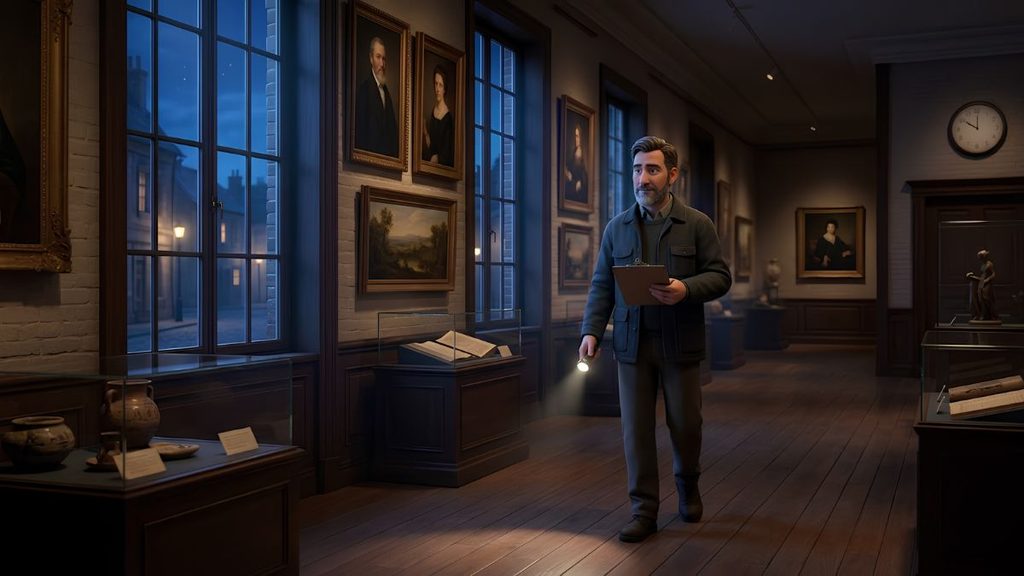
At seven o’clock in the evening, the museum became quiet.
The final visitors had already left.
Daniel stood behind the reception desk and watched the last family walk through the glass doors. The father held the door open while his daughter followed him outside, carrying a small paper bag from the museum shop.
Daniel waited until they had disappeared down the steps.
Then he looked at the clock.
7:03.
The museum officially closed at seven.
For Daniel, however, the evening had only just begun.
He was the evening caretaker of the small Hawthorne Museum, an old stone building located near the center of town.
It was not a large museum.
There were only twelve galleries.
One contained paintings.
Another displayed old maps.
There was a room dedicated to local pottery.
There were wooden tools, old photographs, musical instruments, clocks, furniture, and several cabinets filled with small objects from the surrounding villages.
Daniel had worked there for eleven years.
He knew every room.
He knew which floorboard creaked near the west gallery.
He knew which window took longer to close during humid weather.
He knew which display lights needed a few seconds before becoming fully bright.
Most importantly, he knew the evening routine.
Every night was almost exactly the same.
And Daniel liked it that way.
He picked up the small clipboard from the reception desk.
The closing checklist was attached to it.
He looked at the first item.
Main entrance.
The visitors were gone.
The front doors were already locked.
Daniel walked over to them anyway.
He checked the handle.
Locked.
He checked the second door.
Locked.
Then he returned to the desk.
The museum was silent.
Daniel could hear the faint hum of the heating system.
Somewhere upstairs, a clock ticked.
He looked at the checklist again.
Next:
Gallery One.
He picked up a small flashlight.
The museum lights were still on, but Daniel always carried the flashlight during his final walk.
He entered Gallery One.
It contained paintings from the nineteenth and early twentieth centuries.
During the day, the room was usually busy.
Visitors walked slowly from one painting to another.
Some read the information cards.
Others stood quietly in front of landscapes.
At night, the room felt completely different.
The paintings remained exactly where they had been during the day.
The chairs were still arranged along the walls.
The information cards stood beneath the frames.
Nothing had changed.
Daniel walked slowly through the room.
He checked each display.
One painting showed a countryside road.
Another showed a harbor.
A third showed a group of trees beside a lake.
Daniel stopped briefly in front of the lake painting.
He had seen it thousands of times.
Still, he liked it.
The water was calm.
The sky was pale.
There was a small wooden boat near the shore.
Daniel moved on.
At the far end of the gallery was a tall window.
He checked the latch.
Closed.
He made a small mark on the checklist.
Gallery One was finished.
He switched off the lights.
The room became dark.
Daniel stepped into the hallway.
The illuminated hallway seemed brighter now.
He continued.
Gallery Two contained old maps.
Large maps covered several walls.
There were maps of the town from different decades.
There were maps of nearby villages.
There was even a map showing the old railway line before it had been rebuilt.
Daniel entered the room.
The temperature was slightly cooler.
He checked the windows.
All closed.
He checked the display cases.
Locked.
He walked along the walls.
The maps remained quiet beneath the glass.
Daniel had once spent an entire afternoon reading an old map of the town.
Some streets no longer existed.
Some roads had different names.
Several buildings had disappeared.
Others were still standing.
He had found it interesting.
But tonight he did not stop.
He only checked the room.
Then switched off the lights.
The gallery disappeared into darkness.
Daniel continued.
The third gallery contained pottery.
Small bowls.
Large jars.
Plates.
Cups.
Some were simple.
Some had painted patterns.
Daniel checked the humidity display.
Everything was normal.
He wrote down the reading.
Then walked toward the far wall.
There was a small wooden stool beneath a window.
Daniel had placed it there himself.
Sometimes, during quiet afternoons, he sat on it during his break.
Tonight it was empty.
He checked the window.
Closed.
He switched off the lights.
Then walked back into the hallway.
The museum was becoming darker one room at a time.
Daniel enjoyed this part of the evening.
During the day, the building belonged to visitors.
At night, it belonged to quietness.
He continued through the galleries.
In the fourth room were old household objects.
A wooden table.
Several chairs.
A sewing machine.
A kitchen scale.
An iron.
A collection of old cooking utensils.
Daniel checked the display case.
Locked.
He looked at the windows.
Closed.
Then turned off the lights.
The fifth gallery contained clocks.
This room was always slightly louder than the others.
Not because of visitors.
Because several of the clocks still worked.
Tick.
Tick.
Tick.
Different rhythms filled the room.
Some were slow.
Some were fast.
One clock made a faint clicking sound every few seconds.
Daniel stood near the entrance and listened.
He had become used to the sound over the years.
It no longer seemed like noise.
It was simply part of the museum.
He checked the temperature.
Normal.
He checked the windows.
Closed.
Then he turned off the lights.
The clocks continued ticking in darkness.
Daniel smiled.
He left the room.
By now, only the hallway lights remained on.
He walked toward the next gallery.
The sixth room contained musical instruments.
There was an old piano.
Several violins.
A wooden flute.
A brass horn.
A collection of small drums.
Daniel checked the display cases.
Everything was secure.
He looked at the piano.
The lid was closed.
He checked it anyway.
Closed.
He walked toward the windows.
All secure.
Then he switched off the lights.
The piano disappeared into the darkness.
Daniel continued.
The next room contained photographs.
Black-and-white pictures lined the walls.
Old streets.
Old shops.
Families standing outside houses.
People sitting beside bicycles.
Farmers in fields.
Children standing near a school.
Daniel knew some of the places.
He recognized several streets.
The photographs had been taken decades before he was born.
Yet the town looked familiar.
He walked slowly through the gallery.
The final photograph showed the main square.
The square looked almost unchanged.
Daniel stopped.
He looked at it for a few seconds.
Then continued.
He checked the window.
Closed.
Lights off.
Door closed.
He moved to the next gallery.
The eighth room was smaller.
It contained books.
Old journals.
Letters.
Ledgers.
Printed newspapers.
Daniel checked the glass cases.
Everything was secure.
He adjusted one information card that had moved slightly during the day.
Then he smiled.
That was all.
He switched off the lights.
The hallway became darker.
Daniel looked at his checklist.
Eight galleries completed.
Four remained.
He continued upstairs.
The staircase was wide and wooden.
His shoes made a quiet sound against the steps.
Step.
Step.
Step.
At the top, he reached Gallery Nine.
This room contained furniture.
A wooden bed.
A small desk.
A wardrobe.
A rocking chair.
A bedside table.
Everything had been arranged to resemble a bedroom from many years ago.
Daniel checked the curtains.
Closed.
The window was locked.
The wardrobe doors were secure.
He walked around the room.
The rocking chair stood near the fireplace.
Daniel paused beside it.
He had always liked that chair.
It looked comfortable.
But he had never sat in it.
Museum rules were museum rules.
He smiled to himself.
Then switched off the lights.
Gallery Ten contained farming equipment.
A wooden plow.
Several tools.
Baskets.
A wheel.
Old storage containers.
Daniel checked the room.
Everything was fine.
The air smelled faintly of old wood.
He checked the windows.
Closed.
Then turned off the lights.
Gallery Eleven was the smallest room upstairs.
It contained a collection of personal objects.
A pocket watch.
A fountain pen.
A pair of spectacles.
A small leather purse.
Several keys.
A collection of buttons.
Daniel checked each case.
Then closed the curtains.
He looked at the final display.
A simple wooden box.
Nothing unusual.
Just a wooden box.
Daniel had seen it many times.
He checked the lock.
Secure.
Then turned off the light.
Now only Gallery Twelve remained.
The last room.
Daniel looked at his watch.
8:11.
He had been walking through the museum for more than an hour.
He could have completed the inspection faster.
But he preferred taking his time.
There was no reason to hurry.
He walked toward the final room.
The door was slightly farther down the hallway.
A small brass plaque was mounted beside it.
Gallery Twelve: The Founders’ Room.
Daniel opened the door.
The room was dimly lit.
There were several wooden cabinets.
A large desk.
Two chairs.
A wall clock.
And a tall window overlooking the town.
This was Daniel’s favorite room in the museum.
Not because anything particularly important was displayed there.
It was simply quiet.
The room had an old-fashioned atmosphere.
The wooden desk was polished.
The chairs were comfortable-looking.
The walls were painted a soft cream color.
The window was tall and narrow.
Daniel walked toward it.
He looked outside.
The town was beginning to settle into the evening.
Streetlights glowed along the road.
A few cars moved through the intersection.
Several apartment windows were illuminated.
Daniel could see the lights of a bakery across the street.
The bakery was closed, but someone was still inside.
Probably cleaning.
Daniel looked at the clock on the wall.
8:17.
He checked the window latch.
Closed.
Then he turned toward the desk.
There was nothing to do.
The desk was already neat.
The chairs were in place.
The cabinet doors were closed.
The display cases were locked.
Daniel walked around the room slowly.
He checked everything.
Then returned to the door.
He stood there for a moment.
The museum was almost completely dark now.
Only the corridor lights remained.
Daniel turned off the light in Gallery Twelve.
The room became dark.
He closed the door.
Then stood in the hallway.
For a few seconds, he did nothing.
He listened.
The clocks downstairs were still ticking.
The heating system hummed softly.
The building made small settling sounds.
Wood changed slightly with the temperature.
It was an old building.
Daniel had learned not to worry about its sounds.
He walked downstairs.
At the bottom of the staircase, he turned off the remaining hallway lights.
The museum became dark.
Daniel used his flashlight.
He walked toward the reception desk.
He placed the flashlight beside the clipboard.
Then looked at the checklist.
Every box had been completed.
He had one final task.
Final security check.
Daniel walked back toward the main entrance.
He checked the doors again.
Locked.
He checked the side entrance.
Locked.
He checked the emergency exit.
Secure.
Then returned to reception.
He looked at the clock.
8:31.
The evening had passed quietly.
Daniel sat behind the desk for a moment.
He opened his thermos.
He poured himself a little tea.
The museum was dark around him.
He drank slowly.
Outside, the town continued its evening.
A bus passed.
A bicycle moved along the pavement.
Someone laughed somewhere near the square.
Then the sounds faded.
Daniel finished his tea.
He closed the thermos.
Put it into his bag.
Then stood.
He switched off the reception light.
The museum was completely dark now.
He walked toward the front door.
The moonlight from outside entered through the glass.
Daniel unlocked the door.
Stepped outside.
Then locked it again.
He stood on the steps for a moment.
The museum behind him was quiet.
Twelve galleries.
Thousands of objects.
Hundreds of years of ordinary human life.
Everything was safely inside.
Daniel looked up at the old stone building.
Then walked home.
The streets were quiet.
The museum lights remained off.
Inside, the clocks continued to tick.
The paintings remained on the walls.
The maps remained beneath their glass.
The chairs remained where they had been placed.
The old piano remained closed.
The wooden rocking chair remained beside the fireplace.
And in the last room, the tall window reflected the moonlit town.
Nothing happened.
Nothing needed to happen.
The museum simply rested through the night.
And tomorrow morning, when the doors opened again, the first visitors would walk through the entrance.
They would look at the paintings.
Read the maps.
Admire the old furniture.
Listen to the clocks.
And Daniel would be there to welcome them.
But for tonight, the museum was quiet.
The doors were locked.
The lights were off.
Everything was in its place.
And the old building settled gently into sleep.
3. The Night Observer
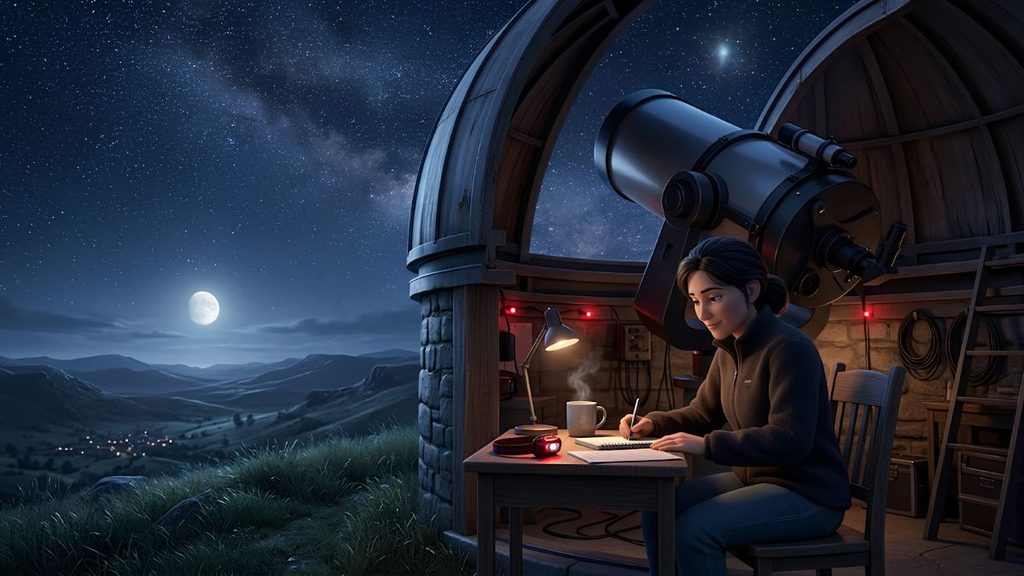
Clara arrived at the hilltop observatory a little before sunset.
The road leading up the hill was narrow and quiet.
On one side were tall grasses.
On the other side were scattered trees.
Beyond them, the land stretched toward the horizon in long, gentle slopes.
Clara drove slowly.
She knew the road well.
She had traveled along it almost every evening for the past six years.
At the top of the hill stood the observatory.
It was a small, round building with a silver-colored dome.
During the day, it looked almost ordinary.
At night, however, when the dome opened and the telescope pointed toward the sky, the building seemed to belong to another world.
Clara parked beside the entrance.
She turned off the engine.
For a moment, she remained inside the car.
The evening was quiet.
A soft breeze moved through the grass.
Somewhere nearby, a bird called once.
Then everything became still again.
Clara stepped out.
She collected her canvas bag from the passenger seat.
Inside were her notebook, a thermos, several pencils, a small flashlight, and a book she had been reading during her breaks.
She locked the car.
Then walked toward the observatory.
The metal door opened with a familiar sound.
Clara stepped inside.
The building was cool.
She switched on the small hallway light.
The observatory contained a narrow office, a storage room, a washroom, and the main observation chamber.
The telescope stood in the center of the chamber.
It was large but simple.
Clara had used it so many times that she knew every part of it.
She placed her bag on the desk.
Then looked at the clock.
6:07 p.m.
There was still plenty of daylight.
The first thing she did every evening was check the weather.
She opened the small window beside the desk.
The sky was mostly clear.
There were a few thin clouds near the western horizon.
Clara wrote in her notebook.
August 25.
6:08 p.m.
Clear sky. Light breeze. Thin clouds west.
She checked the thermometer.
Then wrote down the temperature.
There was no need to hurry.
The stars would not become visible for some time.
Clara walked toward the telescope.
She checked the tripod.
Secure.
The mount.
Secure.
The cables.
Connected.
She checked the control panel.
Everything was working.
She adjusted one small knob.
Then another.
The telescope was ready.
Clara stepped away.
She looked through the open doorway.
The sky was beginning to change color.
The sun was still above the horizon, but its light had become softer.
The grass around the observatory moved gently in the wind.
Clara returned to the desk.
She filled the kettle.
There was a small electric kettle in the office.
She switched it on.
While waiting, she opened her notebook.
There were pages and pages of observations.
Some contained precise measurements.
Others contained simple notes.
Clouds.
Wind.
Visibility.
Moon.
Temperature.
She liked keeping records.
There was something satisfying about writing down the same information each evening.
The kettle clicked.
Clara made tea.
She used the same blue mug every night.
She poured the water.
Added the tea.
Then carried the mug to the observation chamber.
She placed it on a small table beside the telescope.
The tea was too hot to drink immediately.
Clara waited.
Outside, the sky slowly darkened.
The sun disappeared behind the hills.
A thin line of orange remained along the horizon.
Clara stood near the doorway.
She watched.
There was nothing unusual about the sunset.
It was simply the end of another day.
The orange became pink.
The pink became violet.
The violet became deep blue.
Clara took a sip of tea.
It was warm now.
She returned to her desk.
At 7:02, she opened the observatory roof.
The mechanism moved slowly.
The dome separated along its center.
Metal moved with a quiet mechanical hum.
A section of the roof opened.
Above her was the evening sky.
Clara always enjoyed this moment.
The building felt different when the roof was open.
There was no ceiling above the telescope.
Only the sky.
She adjusted the telescope toward a familiar area.
Then checked the controls.
Everything was ready.
Clara sat down.
She opened her notebook.
The first stars were beginning to appear.
One near the horizon.
Then another.
Then several more.
Clara wrote down the time.
7:18 p.m.
First visible stars.
She looked through the telescope.
The image came into focus.
A bright point of light appeared.
She adjusted the focus slightly.
Then stopped.
The view was clear.
She wrote down her observation.
There was no great discovery.
She was not searching for something unknown.
She was simply observing familiar objects.
That was enough.
The evening continued.
Clara drank her tea slowly.
The sky grew darker.
More stars became visible.
At first, only a few.
Then dozens.
Then hundreds.
The longer she looked, the more she noticed.
Some stars were bright.
Others were faint.
Some appeared almost white.
Others seemed slightly warmer in color.
Clara moved the telescope carefully.
She followed her usual list.
One observation.
Then another.
She recorded the time.
Adjusted the telescope.
Looked again.
Made another note.
The work was repetitive.
She liked that.
There was comfort in repetition.
At eight o’clock, she checked the temperature again.
She wrote it down.
Then looked toward the horizon.
The thin clouds had moved.
The western sky was now clear.
The breeze had become slightly cooler.
Clara put on a light sweater.
Then returned to the telescope.
She looked through it.
A familiar cluster of stars came into view.
She watched for several minutes.
Then moved the telescope.
Outside the observatory, the countryside was almost completely dark.
The nearest town was several kilometers away.
Its lights created a faint glow near the horizon.
But the hilltop remained quiet.
Clara could hear the wind.
She could hear the occasional click of the telescope’s motor.
And sometimes, from somewhere below the hill, she could hear a distant dog.
Nothing else.
At 8:40, Clara made another cup of tea.
She had brought enough for the entire evening.
The second cup was slightly stronger.
She carried it outside.
There was a small wooden bench near the observatory entrance.
Clara sat there.
She held the mug in both hands.
The sky was enormous above her.
She looked upward.
The Milky Way was faintly visible.
She knew that people often expected the night sky to look dramatic.
But Clara preferred the quieter view.
The sky did not need to perform.
It simply existed.
Stars remained in their places.
The Earth continued turning.
The night moved forward.
Clara took a sip of tea.
Then another.
A few clouds appeared above the northern hills.
They moved slowly.
She watched them.
The clouds covered a few stars.
Then moved away.
Clara smiled.
She returned inside.
At 9:15, she wrote:
Clouds moving north. Visibility still good.
She turned the page.
There were many blank pages ahead.
She liked that too.
There was always another evening.
Another sky.
Another page.
She returned to the telescope.
The moon had not yet risen.
Clara knew approximately when it would appear.
Until then, she continued observing.
She adjusted the telescope.
Looked.
Recorded.
Adjusted again.
Looked.
Recorded.
The hours moved quietly.
At ten o’clock, she checked the time.
She realized she had been watching the same region of sky for almost twenty minutes.
She did not mind.
There was no reason to move quickly.
She leaned back in her chair.
The telescope stood quietly beside her.
The roof remained open.
The stars were bright.
She closed her eyes for a few seconds.
Then opened them.
The night air was cool.
She could smell grass after the evening breeze.
Clara looked upward again.
A shooting star crossed the sky.
It lasted only a moment.
A small white line.
Then it disappeared.
Clara did not make a wish.
She simply watched.
She waited a few seconds.
Nothing else happened.
That was perfectly fine.
She wrote the time in her notebook.
Then returned to her observations.
At 10:45, the moon appeared.
It rose slowly behind the eastern hills.
At first, Clara could see only a pale glow.
Then the upper edge appeared.
Then more.
The moon climbed above the horizon.
Its light spread across the fields.
The observatory roof became faintly illuminated.
Clara stood outside.
She watched the moon rise.
It was not full.
It was not especially large.
It was simply the moon.
Clara looked at it for a long time.
Then returned to the telescope.
She adjusted the equipment.
The moonlight made some stars less visible.
But many remained.
She wrote:
Moon visible. Light increasing.
She took another sip of tea.
The tea had cooled.
She drank it anyway.
At eleven o’clock, Clara began her final observations.
She did not have many left.
She checked the telescope.
Recorded the temperature.
Noted the wind.
Checked visibility.
Then sat quietly.
The observatory had become completely peaceful.
The town lights seemed distant.
The road below was empty.
The hill was dark.
The sky remained clear.
Clara opened her notebook.
She read through the evening’s notes.
They were ordinary.
Temperature.
Clouds.
Time.
Stars.
Moon.
Wind.
Nothing remarkable.
She closed the notebook.
Then placed the pencil on top.
She looked through the telescope one last time.
A familiar group of stars filled the view.
Clara watched them.
Then slowly moved the telescope back toward its resting position.
She switched off the tracking system.
The telescope became still.
She closed the notebook.
Then stood.
The night was almost over for her.
Clara walked toward the roof controls.
She pressed the button.
The dome began closing.
Slowly.
The opening became smaller.
The stars disappeared from view.
The moon vanished behind the metal roof.
The observatory became an ordinary building again.
Clara switched on the small interior light.
She looked around.
Everything was in order.
She checked the telescope.
Covered.
Control panel off.
Windows secure.
Door ready to close.
She returned to the office.
The clock showed 11:28.
She put her notebook into her bag.
Then packed the thermos.
She washed her blue mug.
Placed it upside down on the drying rack.
Turned off the kettle.
Checked the small heater.
Off.
She walked through the building one final time.
The observation chamber was quiet.
The telescope stood beneath its cover.
The chairs were pushed in.
The desk was clear.
Everything was ready for tomorrow.
Clara switched off the lights.
She stepped outside.
The night air felt cooler now.
She locked the door.
Then stood on the hilltop.
The moon was higher in the sky.
The stars remained visible around it.
Clara looked toward the horizon.
The town was quiet.
A few lights remained.
She could see the road winding down the hill.
Her car waited near the entrance.
She walked toward it.
Before getting inside, she looked back at the observatory.
The silver dome reflected a little moonlight.
Tomorrow evening, she would return.
She would unlock the door.
Check the weather.
Record the temperature.
Prepare the telescope.
Make tea.
Open the roof.
Watch the stars.
Write everything down.
Then close the roof again.
It would be another ordinary night.
Clara liked that thought.
She got into her car.
Started the engine.
Then slowly drove down the hill.
Behind her, the observatory became smaller.
The stars remained above it.
The telescope was resting inside.
The notebook was safely in her bag.
The night continued.
Nothing extraordinary had happened.
There had been no discovery.
No mystery.
No adventure.
Only the slow movement of the sky.
And for Clara, that was enough.
The road carried her gently downward.
The town waited below.
The observatory rested quietly on the hill.
And above it all, the stars continued shining in their familiar places.
4. The Afternoon of Small Repairs
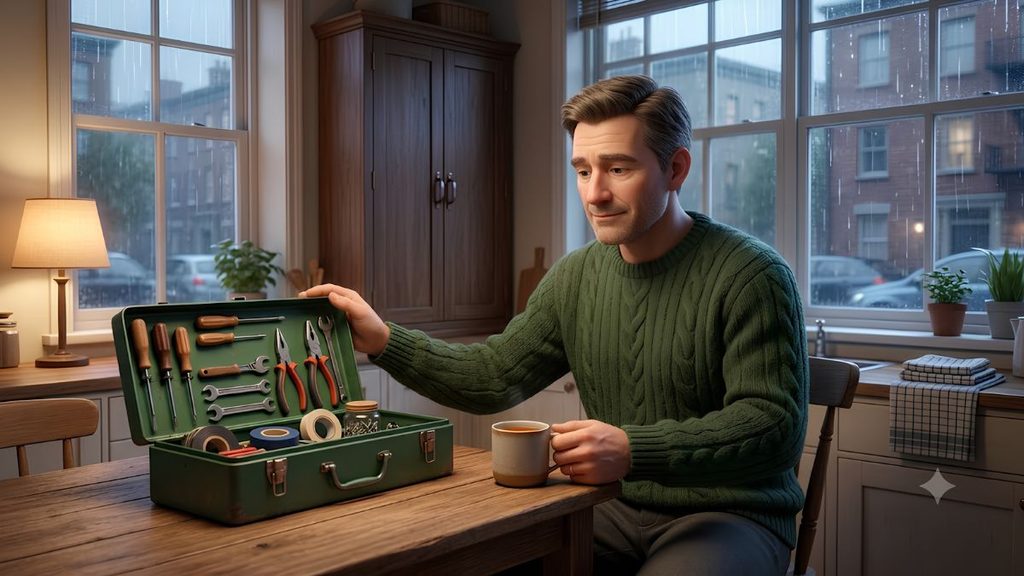
Rain began shortly after lunch.
Martin noticed it while standing at the kitchen window.
At first, only a few drops touched the glass.
Then more appeared.
Within several minutes, the rain had become steady.
The sky turned gray.
The buildings across the street looked softer through the wet window.
Martin stood there with a cup of tea in his hand.
He had planned to go for a walk that afternoon.
But the rain changed his mind.
There was no reason to hurry outside.
He had nowhere he needed to be.
So he finished his tea and looked around the apartment.
It was a quiet Saturday afternoon.
The apartment was clean enough.
The dishes had already been washed.
The laundry was folded.
The books on the shelf were mostly arranged.
But Martin began noticing several small things that needed attention.
The handle on the kitchen cupboard was loose.
The bedroom door made a faint squeaking sound.
One drawer in the hallway cabinet did not close properly.
The light bulb in the study seemed dim.
And the small clock on the living room wall had stopped.
None of these things were urgent.
They had been waiting for him for days.
Perhaps weeks.
Martin had simply never found the time to deal with them.
Now, with the rain falling outside, he thought it might be a good afternoon to take care of a few.
He placed his cup in the sink.
Then walked to the small storage cupboard near the entrance.
His toolbox was on the bottom shelf.
Martin opened the cupboard.
He moved a few cleaning supplies aside.
Then pulled out the toolbox.
It was an old metal box with a dark green handle.
He placed it on the kitchen table.
The rain continued outside.
Soft at first.
Then slightly heavier.
Martin opened the toolbox.
Inside were screwdrivers, pliers, a small hammer, measuring tape, screws, nails, washers, a roll of electrical tape, a small bottle of oil, and several other things he had collected over the years.
He did not need all of them.
Probably only a few.
But he liked seeing them together.
He picked up a screwdriver.
Then walked toward the kitchen cupboard.
The handle was attached with two small screws.
Martin opened the cupboard.
Then closed it.
He opened it again.
The handle moved slightly.
He placed one hand around it.
Yes.
It was definitely loose.
Martin took the screwdriver.
He tightened the first screw.
Turn.
Turn.
Turn.
Then he tightened the second.
Turn.
Turn.
He tested the handle.
It was firm.
He opened the cupboard.
Closed it.
Opened it again.
Everything worked properly.
Martin smiled.
One repair finished.
He returned the screwdriver to the toolbox.
The rain continued.
Drops moved slowly down the kitchen window.
Martin stood there for a moment.
The sound was pleasant.
A steady patter against the glass.
He decided not to turn on the radio.
The rain was enough.
His next task was the bedroom door.
Martin walked down the hallway.
He opened the door.
A faint squeak came from the hinge.
He opened it again.
Squeak.
He closed it.
Then opened it once more.
Squeak.
Martin smiled.
He had become so used to the sound that he sometimes did not notice it.
Today, however, he had decided to fix it.
He returned to the toolbox.
He picked up the small bottle of oil.
Then took a piece of cloth.
Back in the bedroom, he placed the cloth beneath the hinge.
He added a tiny drop of oil.
Then moved the door.
Open.
Close.
Open.
Close.
The hinge made a softer sound.
Martin added another small drop.
He moved the door again.
Open.
Close.
This time there was almost no sound.
He waited.
Then opened it again.
Nothing.
The door moved quietly.
Martin wiped the hinge with the cloth.
Then put the cloth aside.
He opened and closed the door twice more.
Silence.
Another small repair finished.
He looked through the bedroom window.
Rain covered the glass.
The sky was still gray.
A tree across the street moved gently in the wind.
Martin returned to the hallway.
His third task was the drawer.
It belonged to a small wooden cabinet near the entrance.
The drawer had been difficult to close for some time.
Martin pulled it open.
It moved halfway.
Then stopped.
He pulled slightly harder.
The drawer came forward.
Inside were batteries, old keys, spare buttons, receipts, and a few things Martin had not looked at in years.
He placed the contents on the cabinet.
Then examined the drawer.
One side seemed slightly uneven.
Martin took the measuring tape from the toolbox.
He measured the inside.
Then the outside.
He checked the wooden runners.
One of them had become loose.
He found the correct screwdriver.
Then tightened the small screw.
He tested the drawer.
It moved more easily.
He tightened another screw.
Tested again.
Better.
He cleaned a little dust from the wooden runner.
Then applied a small amount of wax.
He pushed the drawer inward.
It moved smoothly.
He pulled it open.
Then closed it again.
Smooth.
Martin opened it one final time.
He began putting the contents back.
He kept the batteries together.
Placed the spare buttons into a small container.
Put the keys in one corner.
The old receipts went into the recycling.
He found a pencil.
He sharpened it.
Then placed it in the drawer.
When everything was back inside, the drawer closed completely.
Martin stood back.
The cabinet looked the same as before.
But now the drawer worked properly.
He liked that.
The rain became heavier.
For a few minutes, Martin simply listened.
The apartment was quiet.
Rain tapped against the windows.
Water moved through the gutters outside.
Occasionally, a car passed along the wet street.
Its tires made a soft rushing sound.
Martin decided to make another cup of tea.
He put the kettle on.
While waiting, he looked at the toolbox.
There were still several things inside.
But he did not need to repair everything.
The afternoon was not a project.
It was simply a collection of small tasks.
The kettle clicked.
Martin made another cup.
He sat at the kitchen table.
The rain continued.
He drank slowly.
After a while, he looked toward the study.
The light there was not working properly.
He finished his tea.
Then carried the cup to the sink.
He washed it.
Afterward, he walked into the study.
The lamp on the desk was switched on.
The light was dim.
Martin looked at the bulb.
It was old.
He switched the lamp off.
Then unplugged it.
He went to the storage cupboard.
There was a box of spare bulbs on the top shelf.
He took one down.
Then returned to the study.
He placed the new bulb on the desk.
He removed the old one.
Then screwed the new one into place.
He plugged the lamp back in.
Switched it on.
The light was brighter.
Not dramatically brighter.
Just enough.
Martin adjusted the angle of the lamp.
Then placed the old bulb into a small box for disposal.
He looked at the desk.
The brighter light made the room feel warmer.
Outside, the rain continued to fall.
Martin sat in the chair.
He opened a book.
For several minutes, he read.
The rain provided a steady background.
He turned a page.
Then another.
The room was warm.
The lamp was bright.
The chair was comfortable.
He could have remained there for the rest of the afternoon.
But he remembered the wall clock.
The clock had stopped two days earlier.
Martin stood.
The clock hung above the living room bookshelf.
He brought a small step stool from the kitchen.
Then carefully removed the clock from the wall.
He placed it on the table.
The clock had stopped at 2:17.
Martin opened the back.
The battery was empty.
He smiled.
That was an easy one.
He opened the battery drawer.
Found a new battery.
Inserted it.
The second hand moved.
Tick.
Tick.
Tick.
Martin adjusted the time.
The clock was seven minutes slow.
He moved the hands forward.
Then hung the clock back on the wall.
Tick.
Tick.
Tick.
The sound was familiar.
He had not realized how much he missed it.
Martin stood beneath the clock.
He listened.
The rain outside.
The clock inside.
Two quiet rhythms.
He returned the step stool.
Then put the empty battery into a small recycling container.
He looked at the toolbox.
Most of the tools were still there.
He began putting them away.
Screwdrivers first.
Then pliers.
Then measuring tape.
The oil bottle.
The hammer.
The small screws.
He checked each compartment.
Nothing had been left out.
When everything was arranged, he closed the toolbox.
Then wiped the top with a cloth.
He carried it back to the storage cupboard.
Placed it on the bottom shelf.
The cupboard door closed.
Martin stood in the hallway.
The afternoon was moving toward evening.
He looked around the apartment.
The kitchen cupboard handle was firm.
The bedroom door was quiet.
The hallway drawer moved smoothly.
The study lamp was bright.
The wall clock was ticking.
Nothing had changed dramatically.
The apartment looked almost exactly the same.
But several little things were working better.
Martin liked that.
He walked toward the kitchen.
The rain had begun to soften.
Instead of heavy drops, there was now a gentle tapping against the window.
The sky remained gray.
But the darkness had not yet arrived.
Martin opened the curtains slightly.
The street below was wet.
Puddles reflected the buildings.
A person walked past holding an umbrella.
A bus moved slowly through the intersection.
Water splashed beneath its wheels.
Then the street became quiet again.
Martin closed the curtains.
He turned on the small lamp in the living room.
The room filled with warm light.
He made one final cup of tea.
Then sat in his favorite chair.
The wall clock continued ticking.
Tick.
Tick.
Tick.
The bedroom door remained silent.
The cupboard handle stayed firmly in place.
The drawer was neatly organized.
The study lamp waited on the desk.
Everything was ready.
Martin picked up his book.
He opened it.
Outside, the rain continued.
He read for several minutes.
The words became slower.
His eyes grew heavier.
He looked at the clock.
5:42.
The afternoon had passed without him noticing.
He closed the book.
The rain had almost stopped.
A few drops remained on the window.
The clouds were beginning to lighten.
Martin stood.
He carried his cup to the kitchen.
Washed it.
Then wiped the counter.
He checked the cupboard handle.
Firm.
He smiled.
There was no reason to check it again.
But he did.
He opened the cupboard.
Closed it.
Everything was fine.
He walked to the bedroom.
Opened the door.
No squeak.
Closed it.
No sound.
He returned to the hallway.
Opened the drawer.
It moved smoothly.
Closed it.
Perfect.
Martin looked at the wall clock.
Tick.
Tick.
Tick.
He stood there listening.
The apartment seemed different.
Not because anything had changed dramatically.
It simply felt a little more complete.
The rain had stopped.
Outside, the clouds were beginning to separate.
A pale evening light appeared between them.
Martin opened the window slightly.
Cool air entered.
The smell of wet pavement drifted inside.
He stood there for a moment.
Then closed the window.
The afternoon was finished.
He put the toolbox away.
The small repairs were done.
Tomorrow, there would probably be another little thing to fix.
There was always something.
A loose screw.
A drawer.
A hinge.
A light bulb.
Something small.
Something ordinary.
Martin did not mind.
There was comfort in knowing that small things could be taken care of slowly.
One at a time.
Without rushing.
Without making the task larger than it needed to be.
He turned on the living room lamp.
Then sat down again.
The clock continued ticking.
The apartment was quiet.
Outside, the wet street reflected the first evening lights.
Martin opened his book.
He read another page.
Then another.
And as the evening settled around the apartment, the repaired door stayed quiet, the cupboard remained firm, the drawer moved smoothly, and the clock continued its steady rhythm.
Tick.
Tick.
Tick.
There was nothing else to repair.
Nothing else to arrange.
Nothing else to hurry toward.
The day could simply become evening.
And Martin could sit quietly and let the rain disappear from the windows.
5. Three Letters Before Bed
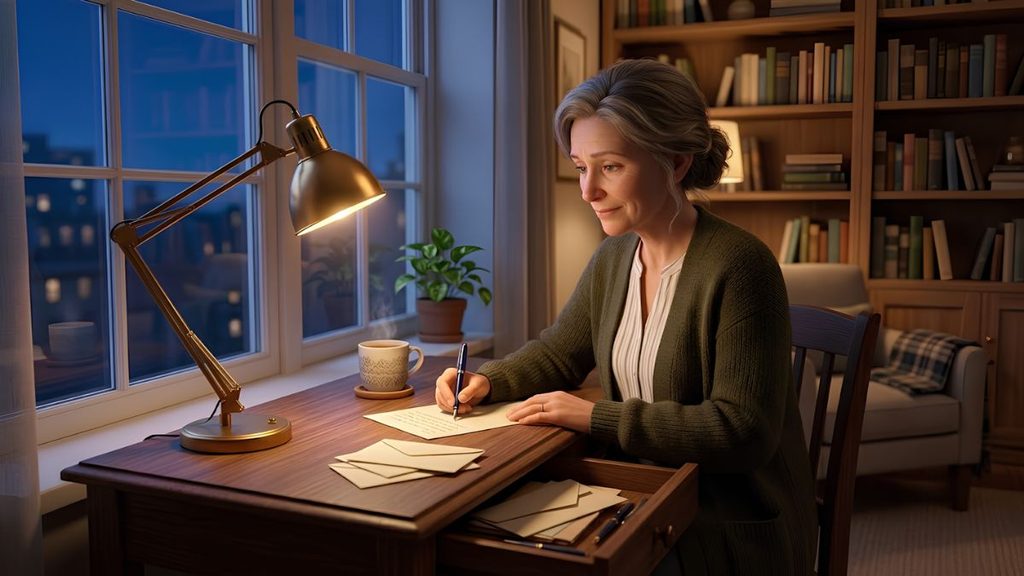
By eight o’clock, the evening had become quiet.
Eleanor sat near the window of her apartment and watched the last traces of daylight disappear between the buildings.
The sky was pale gray-blue.
A few windows across the street were already glowing with warm yellow light.
Someone on the floor below closed a balcony door.
A car passed slowly along the road.
Then the street became quiet again.
Eleanor looked at the clock.
8:07 p.m.
She had already finished dinner.
The dishes were washed.
The kitchen was clean.
The curtains were partly closed.
There was nothing she needed to do.
Still, she did not feel ready for bed.
She wanted to spend another hour doing something quiet.
She looked toward the small writing desk beside the living room window.
The desk had been there for several years.
It was made of dark wood and had three drawers.
On top were a small lamp, a glass of pens, a notebook, and a wooden tray for paper.
Eleanor had not written a proper letter in several weeks.
She had sent messages.
She had answered emails.
She had made telephone calls.
But she had not sat down and written something by hand.
That evening, she decided to write three letters.
Nothing important.
Nothing urgent.
Just three ordinary letters.
She stood from her chair.
Then walked toward the desk.
The first thing she did was clear the surface.
She moved the notebook to one side.
Then picked up the pen holder.
She wiped a little dust from the desk with a soft cloth.
The wood felt smooth beneath her fingers.
She opened the first drawer.
Inside were several envelopes.
Some were white.
Some were cream.
There were large envelopes and small ones.
Eleanor chose three cream-colored envelopes.
She placed them neatly on the desk.
Then opened the second drawer.
This drawer contained stationery.
She looked through the papers.
There were sheets with small flowers printed around the edges.
There were plain white sheets.
There were pale blue sheets.
She chose three plain sheets.
She placed them beside the envelopes.
Then she opened the third drawer.
Inside was her fountain pen.
It had a dark blue body and a silver-colored cap.
Eleanor picked it up carefully.
She had owned it for many years.
She removed the cap.
Then checked the ink.
There was still enough.
She found a scrap of paper.
She wrote a few words.
The ink flowed smoothly.
She smiled.
Everything was ready.
Eleanor switched on the desk lamp.
The room became warmer.
The lamp illuminated the wooden surface.
Outside, the sky had become darker.
The first letter would be to her old friend Thomas.
Thomas lived in another town.
They had known each other for many years.
They occasionally spoke on the phone.
Sometimes they exchanged messages.
But Eleanor thought it would be nice to send him an ordinary letter.
She placed the first sheet of paper directly in front of her.
Then she sat down.
She held the pen.
For a moment, she did nothing.
She looked at the blank page.
There was no particular reason to hurry.
She began.
She wrote slowly.
She asked Thomas how he was.
She mentioned the weather.
She wrote about a small café that had recently opened near her apartment.
She described the new bookshelf she had bought for the living room.
She told him that one of her houseplants had finally produced a new leaf.
None of these things were important.
That was precisely why she enjoyed writing about them.
The letter moved from one ordinary subject to another.
She wrote about the neighbor’s dog.
She wrote about a book she had recently finished.
She mentioned that the bakery near the corner had started opening earlier in the mornings.
Then she paused.
She read what she had written.
It looked different from a message on a phone.
The words were uneven.
Some letters were larger than others.
There was a tiny ink mark near the bottom of the page.
Eleanor liked it.
It looked human.
She continued.
A few minutes later, she reached the bottom of the page.
She added a final sentence.
Then signed her name.
Eleanor placed the pen on the desk.
She folded the paper carefully.
First once.
Then again.
She slid it into the first envelope.
Then sealed the envelope.
She turned it over.
On the front, she wrote Thomas’s name and address.
She wrote slowly.
When she finished, she placed the envelope on the left side of the desk.
One letter finished.
Eleanor looked at the clock.
8:34.
She had spent almost half an hour on one letter.
She did not mind.
There was still plenty of evening left.
She poured herself a glass of water.
Then returned to the desk.
The second letter would be a thank-you note.
Eleanor had received a small package a few days earlier.
Inside had been a handmade bookmark from a former colleague named Margaret.
It was nothing expensive.
Just a simple bookmark made from thick paper with a pressed flower in the center.
Eleanor had sent a quick message thanking Margaret.
But she felt that the bookmark deserved something more personal.
She took the second sheet of paper.
Placed it in front of her.
Then began writing.
She thanked Margaret for the bookmark.
She described how she had already placed it inside the book she was currently reading.
She wrote that the flower looked beautiful between the pages.
Then she mentioned how useful the bookmark was.
She wrote a few more sentences.
She told Margaret that she hoped her garden was doing well.
She asked whether the roses had survived the recent heat.
Then she wrote a small note about the coming autumn.
Nothing dramatic.
Nothing complicated.
Just a few friendly thoughts.
Eleanor paused.
She looked at the page.
The handwriting seemed slightly smaller than it had been in the first letter.
She continued.
The fountain pen made a soft sound as it moved across the paper.
Scratch.
Pause.
Scratch.
Pause.
Outside, the wind moved through the trees.
A few leaves brushed against the window.
Eleanor listened.
Then returned to her letter.
When she reached the bottom of the page, she signed her name.
She folded the paper.
Placed it into the second envelope.
Sealed it.
Then wrote Margaret’s name and address.
She placed the second envelope beside the first.
Two letters.
She leaned back in her chair.
The room was very quiet.
The only sound was the clock on the wall.
Tick.
Tick.
Tick.
Eleanor looked at the two envelopes.
She thought about how slowly the evening had passed.
It was only 9:02.
She still had time for the third letter.
She stood and walked to the kitchen.
She filled the kettle.
While waiting for the water to boil, she looked outside.
The street was almost empty.
A cyclist passed beneath a streetlight.
A person walked a dog along the pavement.
The dog stopped to sniff a tree.
The person waited patiently.
Then they continued.
Eleanor smiled.
The kettle clicked.
She made a cup of tea.
She returned to the writing desk.
The third letter would be to someone who had recently moved away.
Her former neighbor, David, had moved to another city two months earlier.
They had not been especially close.
They had lived in the same building for almost eight years.
They had exchanged greetings in the hallway.
Sometimes they had talked near the mailboxes.
David had helped Eleanor carry a heavy box once.
Eleanor had watered his plants while he was away.
It had been a simple neighborly relationship.
After he moved, Eleanor realized how familiar his presence had been.
She decided to send him a short letter.
She took the third sheet of paper.
This time, she chose to write about the building.
She described the new paint in the hallway.
She mentioned that the elevator was still making the same strange noise.
She wrote that the downstairs bakery had changed its opening hours.
She told him that the old tree beside the entrance was still there.
She described the sparrows that gathered near it every morning.
She smiled as she wrote.
There was something pleasant about describing ordinary things to someone who already understood them.
David would know exactly which tree she meant.
He would remember the elevator.
He would probably remember the bakery.
He would understand why she mentioned the small mailbox near the entrance that never closed properly.
Eleanor continued writing.
She told him that the building felt a little quieter without him.
Then she stopped.
She wondered whether that sounded too sentimental.
After a moment, she left the sentence.
It was true.
She continued.
She wished him well in his new home.
She asked whether he had settled into the new neighborhood.
She hoped he was enjoying his new job.
Then she added one final sentence.
She hoped they would speak again sometime.
Eleanor signed her name.
She looked at the three letters.
The desk lamp cast a warm circle of light over them.
She placed the third letter into its envelope.
Sealed it.
Then wrote David’s name and address.
Three letters were now sitting together.
Eleanor placed them in a neat row.
She looked at them for a moment.
Three simple envelopes.
Three ordinary messages.
Three small connections between people.
She checked the clock.
9:41.
She had been writing for almost two hours.
The tea beside her had gone cold.
Eleanor picked up the cup.
She took a sip.
It was very cold.
She laughed softly.
Then carried it to the kitchen.
She washed the cup.
Returned to the desk.
The three envelopes were still there.
Eleanor checked each address.
Thomas.
Margaret.
David.
Everything was correct.
She decided to put the letters beside the front door.
That way, she would remember to take them with her in the morning.
She gathered the envelopes.
Then walked through the apartment.
The living room was dim.
Only the desk lamp remained on.
She switched it off.
The room became quiet.
Eleanor placed the letters on the small table beside the front door.
She put her keys next to them.
Then she looked at the arrangement.
Keys.
Letters.
Handbag.
Everything she needed for the morning.
She turned off the hallway light.
Then returned to the living room.
She stood by the window.
The city was quiet now.
Some windows were still lit.
Others were dark.
A bus moved slowly in the distance.
Its headlights disappeared around a corner.
Eleanor closed the curtains.
Then turned toward the kitchen.
She checked the stove.
Off.
The kettle.
Off.
The lights.
Off.
She walked to the bathroom.
Brushed her teeth.
Washed her face.
Then changed into comfortable clothes.
The apartment became quieter with every small action.
When she returned to the bedroom, the clock showed 10:08.
She placed her fountain pen inside the drawer.
Closed it.
The desk was ready for tomorrow.
The three letters were waiting by the door.
She turned off the bedroom light.
Then climbed into bed.
For a few moments, she listened.
The building was quiet.
Somewhere above her, a floorboard creaked.
A car passed outside.
Then there was silence again.
Eleanor closed her eyes.
She thought briefly about the letters.
Thomas would probably receive his at the end of the week.
Margaret might write back.
David might call.
Or perhaps they would simply send short replies.
It did not matter.
The letters had been written.
That was enough.
There was something calming about knowing that three ordinary thoughts were now on their way to three different people.
The words would travel slowly.
From the apartment.
To the mailbox.
To the post office.
Then along roads and railways.
Eventually, they would reach their destinations.
Eleanor smiled.
She turned onto her side.
The room was dark.
The curtains were closed.
The apartment was still.
Outside, the city continued quietly.
Inside, everything was ready for the night.
The desk was clean.
The pen was put away.
The envelopes were waiting by the door.
The clock moved steadily forward.
Tick.
Tick.
Tick.
Eleanor breathed slowly.
She thought about the simple evening.
A blank sheet of paper.
A fountain pen.
A cup of tea.
Three envelopes.
Three ordinary letters.
Nothing extraordinary had happened.
There had been no important announcement.
No unexpected news.
No great event.
Just words written carefully on paper.
And perhaps that was what made the evening feel complete.
Sometimes a quiet day did not need anything more.
A person could sit at a desk.
Write a few sentences.
Fold a piece of paper.
Seal an envelope.
Place it beside the door.
Then turn off the light.
Eleanor closed her eyes.
The clock continued ticking.
The three letters waited patiently for morning.
And slowly, peacefully, the apartment settled into sleep.
6. Closing the Wooden Workshop
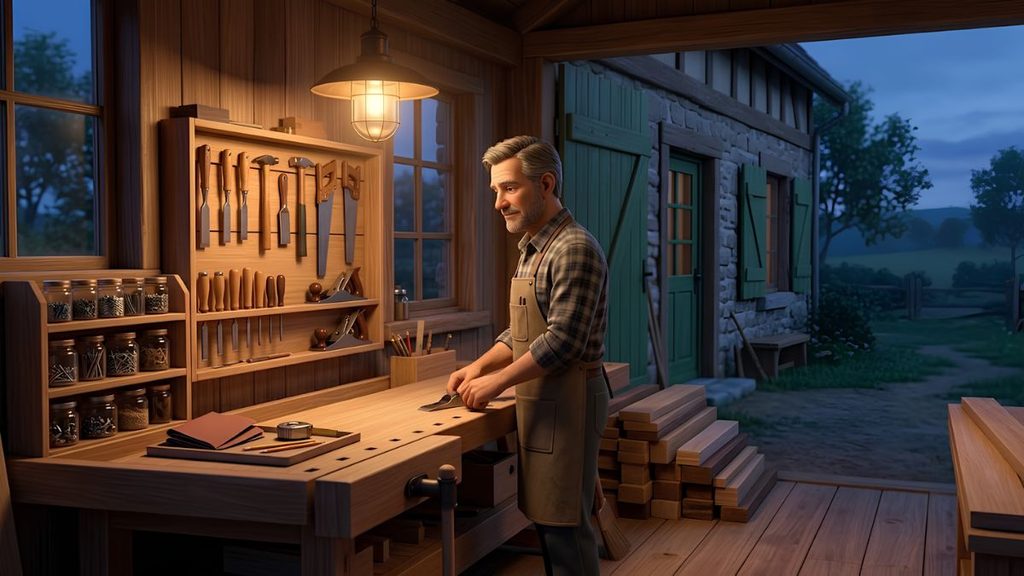
Every evening at half past six, Henry closed his workshop.
The workshop stood behind his house, at the end of a short gravel path.
It was a small wooden building with two windows, a green door, and a sloping roof that had been repaired several times over the years.
Inside were shelves, cupboards, hand tools, pieces of timber, jars of screws, tins of polish, rolls of sandpaper, and a long wooden workbench.
During the day, the workshop could be busy.
Henry sometimes made shelves.
Sometimes he repaired chairs.
Sometimes he built small tables.
On other days, he simply worked on whatever project happened to be waiting for him.
But the evening routine was always the same.
At half past six, he stopped working.
He put everything away.
Then he closed the workshop.
That evening, the clock on the wall showed 6:29.
Henry looked at it.
One minute remained.
He finished the last small task on the workbench.
He had been smoothing the edge of a narrow piece of oak.
He ran his fingers along the wood.
It felt smooth.
He placed the sandpaper on the bench.
Then he looked at the clock again.
6:30.
Time to close.
Henry smiled.
He never liked leaving a workshop untidy.
Not because someone would complain.
There was nobody to complain.
He simply preferred returning to a clean workspace the following morning.
He picked up the small hand plane he had been using.
It was old.
The wooden handle had become darker from years of use.
Henry wiped it carefully with a cloth.
Then placed it on the second shelf.
He always kept the hand planes together.
The largest one went on the left.
The medium one in the center.
The small one on the right.
Henry placed the tool exactly where it belonged.
Then stepped back.
The shelf looked neat.
He turned toward the workbench.
There were several tools lying across it.
A screwdriver.
Two pencils.
A measuring tape.
A small hammer.
A square.
A chisel.
A soft brush.
Henry began putting them away.
The screwdriver went into a wooden container.
The hammer went into the tool rack.
The square was placed beside the measuring tools.
The chisel was wiped with a cloth before being returned to its holder.
The pencils went into a small cup.
The measuring tape was rolled back inside its case.
Henry moved slowly.
There was no reason to hurry.
The workshop would still be there tomorrow.
He picked up the brush.
A few small pieces of sawdust had gathered near the edge of the workbench.
Henry brushed them into his hand.
Then dropped them into the waste container.
He wiped the surface of the bench.
The cloth moved from one end to the other.
Left.
Right.
Left.
Right.
The wood became clean.
Henry liked the feeling of a clean workbench.
It meant the day was finished.
He placed the cloth beside the sink.
Then opened the first drawer.
Inside were screws.
Hundreds of them.
Large screws.
Small screws.
Brass screws.
Silver screws.
Long screws.
Short screws.
They were separated into small compartments.
Henry checked them.
One compartment was nearly empty.
He opened a small box from the shelf.
Inside were replacement screws.
He poured a few into the compartment.
The small metal pieces made a soft sound as they fell.
Henry counted them.
There were enough.
He closed the drawer.
Then opened the next one.
Nails.
The same routine.
He checked the compartments.
Everything was in order.
He closed the drawer.
The workshop was quiet.
Outside, the evening light was fading.
Through the windows, Henry could see the trees behind the house.
The leaves moved gently.
A bird sat on the fence.
For a moment, Henry watched it.
The bird remained still.
Then it flew away.
Henry returned to his work.
He walked to the shelf containing pieces of wood.
There were several short boards left from previous projects.
He sorted them by size.
Long pieces went on the lower shelf.
Medium pieces went above them.
Small pieces were placed in a wooden box.
Henry picked up one small piece.
It was a piece of walnut.
Dark brown.
Smooth.
He turned it over in his hand.
He remembered using the larger board from which it had been cut to make a small table.
The table had been finished several months earlier.
The leftover piece had remained in the workshop ever since.
Henry placed it into the box.
It might be useful someday.
Or it might remain there for years.
That was fine.
Wood had patience.
Henry walked toward the opposite wall.
A broom stood beside the door.
He picked it up.
Then began sweeping the floor.
The workshop floor was wooden.
Small pieces of sawdust had gathered beneath the workbench.
Henry swept them slowly.
Back and forth.
The broom made a soft brushing sound.
The pile became larger.
He moved it toward the door.
Then swept beneath the shelves.
More sawdust appeared.
He collected it.
The floor became clean.
Henry looked around.
There were still a few small pieces near the corner.
He swept those too.
When he finished, he placed the broom against the wall.
The waste container was nearly full.
Henry carried it outside.
He emptied it into the larger bin.
Then returned to the workshop.
The evening air was cooler now.
The sky had become pale blue.
A few clouds were visible above the trees.
Henry stood at the doorway.
He could smell the grass.
Somewhere in the distance, someone was cooking dinner.
A faint smell of wood smoke drifted through the air.
Henry returned inside.
There were still a few things to check.
He walked toward the sink.
The small basin was clean.
He turned the tap on briefly.
Water ran.
Then he turned it off.
He wiped the sink with a cloth.
Next, he checked the old measuring tape hanging beside the door.
The tape was several years old.
The numbers were slightly faded.
Henry pulled it out.
One meter.
Two meters.
Three meters.
The tape extended across the workshop.
He looked at the markings.
Still accurate enough.
He pressed the release.
The tape rolled back into its case.
Click.
Henry hung it back on the hook.
Then he checked the clock.
6:52.
He had already spent more than twenty minutes closing the workshop.
He did not mind.
The routine was part of his evening.
He walked to the small cabinet near the back wall.
Inside were jars of screws, washers, nails, and small pieces of hardware.
Henry checked each label.
He did not need to rearrange anything.
Everything was already organized.
Still, he moved one jar slightly to the left.
Then another.
He liked the labels facing forward.
He closed the cabinet.
Next came the sandpaper.
There were several sheets on the workbench.
Henry picked them up.
He sorted them by roughness.
The coarser sheets went into one folder.
The finer sheets went into another.
He folded two sheets carefully.
Then placed them in the appropriate drawer.
The remaining pieces were still usable.
He stacked them neatly.
The workshop was becoming more orderly.
Henry looked at the workbench.
Nothing remained except a small wooden box.
He opened it.
Inside was a collection of pencils.
He sharpened two.
The pencil shavings fell into his hand.
He placed the sharpened pencils in the cup.
Then emptied the shavings into the waste bin.
He closed the box.
The workbench was empty.
Henry liked that.
An empty workbench meant a fresh beginning tomorrow.
He walked toward the windows.
The first window was closed.
He checked the latch.
Secure.
The second window was slightly open.
Henry closed it.
He checked the latch.
Secure.
Outside, the sky was darker now.
The bird from earlier had disappeared.
The trees were still.
Henry turned toward the shelves.
One final thing remained.
The tools.
He checked the main tool rack.
Everything was present.
Saw.
Hammer.
Chisels.
Clamps.
Planes.
Screwdrivers.
Measuring tools.
Nothing was missing.
Henry did not need to count them.
He knew where everything belonged.
He simply looked.
Satisfied, he turned off the small lamp above the workbench.
The workshop became dim.
Only the light from the ceiling remained.
Henry walked toward the switch.
Before turning it off, he looked around.
The wooden shelves.
The workbench.
The neatly arranged tools.
The stacked timber.
The small containers.
The clean floor.
Everything was ready.
He switched off the ceiling light.
The workshop became dark.
Henry opened the door.
The evening air entered.
He stepped outside.
Then he remembered the shutters.
He went back inside.
There were two wooden shutters on the windows.
Henry closed the first.
Then the second.
The workshop became completely enclosed.
He walked toward the door.
Before closing it, he looked around one last time.
The darkness felt peaceful.
He knew exactly what the workshop would look like tomorrow morning.
The sunlight would enter through the windows.
He would open the shutters.
Turn on the light.
Make a cup of tea.
Then decide what to work on.
Perhaps the oak shelf.
Perhaps the small table.
Perhaps something else.
There was no need to decide tonight.
Henry closed the door.
He locked it.
Then tested the handle.
Secure.
He put the key into his pocket.
The gravel path was quiet beneath his shoes.
He walked toward the house.
The sky was nearly dark.
A few stars were beginning to appear.
Behind him, the workshop stood quietly among the trees.
Henry reached the back door of the house.
He removed his shoes.
Then entered the kitchen.
His wife, Clara, was preparing dinner.
She looked at him.
“Finished?”
Henry nodded.
“Finished.”
He washed his hands.
Then sat at the kitchen table.
Clara placed a cup of tea in front of him.
Henry held it with both hands.
The tea was warm.
He took a slow sip.
For several minutes, neither of them said anything.
The house was quiet.
The kitchen smelled of dinner.
Outside, the evening continued.
Henry looked toward the back window.
He could just see the outline of the workshop in the darkness.
He knew that everything was ready.
The tools were in their places.
The floor was clean.
The wood was sorted.
The screws were organized.
The shutters were closed.
The door was locked.
There was nothing else to do.
Henry finished his tea.
Later that evening, after dinner, he walked upstairs.
He changed into comfortable clothes.
Then sat beside the bedroom window for a few minutes.
The moon was rising.
The trees were dark against the sky.
He thought about the workshop.
Not about any particular project.
Just the quiet process of putting everything away.
There was something satisfying about ending the day properly.
The work did not need to be finished.
The workshop did not need to be perfect.
It only needed to be ready.
Henry turned off the bedroom lamp.
He got into bed.
The house became quiet.
Outside, the workshop rested behind the trees.
Inside it, the tools waited.
The measuring tape hung beside the door.
The pencils stood in their cup.
The sandpaper was folded neatly.
The pieces of wood rested on their shelves.
The workbench was clean.
The floor was swept.
Everything had its place.
Tomorrow morning, Henry would return.
He would unlock the door.
Open the shutters.
Let in the morning light.
He would make tea.
Then he would begin again.
But tonight, there was nothing more to do.
The workshop could remain quiet.
The house could settle.
The trees could move gently in the night breeze.
And Henry could sleep.
7. The Last Ferry Across the Bay

The last ferry left the harbor at 8:45.
Thomas arrived at the terminal a few minutes early.
There was no need to hurry.
He had finished work earlier than usual, but instead of taking the bus around the bay, he had decided to take the ferry.
The crossing took about forty minutes.
The bus took slightly less.
Thomas preferred the ferry.
There was something pleasant about sitting on the water at the end of the day.
The harbor was already becoming quiet when he arrived.
Most of the shops along the waterfront had closed.
A small café near the terminal still had its lights on.
Through the window, Thomas could see two people sitting at a table.
One was reading.
The other was looking at a phone.
Thomas walked toward the ferry terminal.
The pavement was still damp from a short shower earlier in the evening.
Small reflections of lamps appeared in the wet surface.
He checked the departure board.
8:45 p.m.
Bay Crossing.
On time.
Thomas put his hands into his coat pockets.
He stood near the railing and watched the water.
The bay was calm.
Small waves moved toward the edge of the harbor.
A few boats were tied to their moorings.
Their ropes moved gently against the wooden posts.
The ferry was waiting farther along the pier.
It was a medium-sized vessel with a white upper deck and rows of windows.
Several lights were already shining inside.
Thomas looked at his watch.
8:39.
Six minutes remained.
A crew member walked along the pier carrying a small radio.
Another crew member checked a rope.
Everything appeared ordinary.
At 8:41, the boarding gate opened.
Thomas joined the small line.
There were perhaps fifteen passengers.
A woman carrying a handbag.
An older man with a newspaper.
A young couple speaking quietly.
A man holding a paper cup.
Two people who looked like they had just finished work.
Thomas boarded.
He walked inside.
The ferry was warm.
The windows reflected the interior lights.
There were rows of seats arranged along both sides of the cabin.
Thomas chose a seat beside the window.
It was near the back.
From there, he could see the harbor.
He placed his bag on the floor.
Then sat down.
The seat was comfortable.
He looked at the clock above the doorway.
8:43.
Two minutes.
A crew member walked through the cabin.
He checked the passengers.
Then disappeared toward the front.
Thomas looked outside.
The harbor lights reflected across the water.
A yellow light.
Then another.
Then a long row of small lights along the shore.
At 8:45, the doors closed.
The ferry gave a low mechanical sound.
The engine started.
Thomas felt a slight vibration beneath his feet.
The vessel moved away from the pier.
Slowly.
Very slowly.
The harbor began to move behind him.
Thomas watched through the window.
The terminal became smaller.
The café lights moved farther away.
The lamps along the pier became a line of glowing dots.
The ferry turned gently.
The open bay appeared ahead.
Thomas leaned back in his seat.
The engine made a steady sound.
Not loud.
Just a deep, continuous hum.
The ferry moved forward.
A few passengers were talking quietly.
The older man opened his newspaper.
The woman with the handbag looked out of the window.
The young couple sat together near the front.
The man with the paper cup took a drink.
Thomas reached into his bag.
He had brought a small thermos.
He opened it.
Tea.
Still warm.
He poured some into the lid.
Then held it in both hands.
The ferry continued across the bay.
Behind them, the harbor grew smaller.
Thomas could still see the terminal.
Then the café.
Then the buildings.
The lights became tiny.
Eventually, they blended together.
He took a sip of tea.
It was warm and mild.
He looked at the water.
The ferry moved through it smoothly.
A soft wake followed behind the vessel.
Thomas watched the white line of foam stretch across the dark water.
Then disappear.
He checked his watch.
8:54.
Only nine minutes had passed.
The crossing already felt slower than usual.
Thomas liked that.
During the day, time seemed to move quickly.
Meetings.
Messages.
Traffic.
Phone calls.
Tasks.
But on the ferry, there was nothing he needed to do.
He did not have to answer anything.
He did not have to make a decision.
He only had to sit.
The ferry moved.
The water moved.
The lights moved.
That was enough.
Thomas looked toward the front of the cabin.
A crew member was checking the windows.
He walked slowly from one side to the other.
Then disappeared through a door.
A few minutes later, he returned.
Everything was routine.
Thomas took another sip of tea.
The ferry was now well away from the harbor.
The opposite shore was visible in the distance.
The lights there appeared small.
Some were white.
Some were yellow.
A few were red.
Thomas wondered which buildings they belonged to.
He could not tell.
He did not try very hard.
It was pleasant not knowing.
The older man turned a page of his newspaper.
The paper made a soft rustling sound.
The woman near the window adjusted her coat.
The young couple had become quiet.
The ferry continued.
9:02.
Thomas looked at the water again.
The surface was darker now.
Only the ferry lights illuminated the water immediately around the vessel.
The moon was hidden behind clouds.
A few stars appeared above the bay.
Thomas looked up.
The clouds moved slowly.
One star disappeared.
Another appeared.
He returned his attention to the water.
The ferry engine maintained its steady rhythm.
Hum.
Pause.
Hum.
Pause.
It was almost like background music.
Thomas finished his tea.
He closed the thermos.
Then placed it back into his bag.
He looked around the cabin.
There were fewer passengers than before.
One person had moved upstairs.
Another had fallen asleep near the front.
The older man had folded his newspaper.
He was looking out of the window.
Thomas smiled.
Everyone seemed to be doing their own quiet thing.
The ferry was like a small moving room.
Warm.
Steady.
Protected from the cool night outside.
Thomas leaned his head against the window.
The glass was cool.
He watched the distant shoreline.
It was getting closer.
Not quickly.
Just gradually.
A few lights became clearer.
He could now distinguish individual buildings.
A tall apartment block.
A small tower.
A row of houses along the water.
A street lined with lamps.
The shoreline remained still while the ferry moved toward it.
Thomas thought about how strange it was.
The lights seemed to be approaching.
But they were not moving.
The ferry was.
He watched them quietly.
9:15.
The ferry had crossed more than half the bay.
A crew member walked through the cabin again.
He checked the passengers.
Then looked through the front window.
Thomas heard the faint sound of a door closing.
The ferry continued.
Outside, the water moved gently.
There were no large waves.
No strong wind.
Just a calm night.
Thomas pulled his coat closer around himself.
He was not cold.
It was simply comfortable.
He looked down at his hands.
Then at the window.
Then back at the water.
There was no need to fill the time.
The crossing was the activity.
He could simply watch.
The lights on the opposite shore became brighter.
Thomas could now see cars moving along a road.
Their headlights appeared as small lines.
One car stopped at an intersection.
Another continued.
A bus passed behind a row of buildings.
Then disappeared.
The ferry moved closer.
9:24.
The crossing was nearly finished.
Thomas felt a small change in the movement of the ferry.
The engine seemed quieter.
The shoreline was now much clearer.
The harbor entrance was visible.
Several lamps marked the edge of the water.
Thomas gathered his bag.
But there was still no reason to stand.
He remained seated.
He watched.
The ferry entered the harbor.
The water became even calmer.
Buildings surrounded the vessel on both sides.
The reflections of lights stretched across the surface.
Yellow.
White.
Orange.
Red.
The colors moved slightly with the water.
Thomas found himself watching one reflection.
It belonged to a lamp on the pier.
The light stretched downward.
A small wave broke the reflection.
It disappeared.
Then returned.
The ferry slowed.
The engine changed its sound.
The vessel moved toward the terminal.
Thomas looked at his watch.
9:29.
The trip had taken forty-four minutes.
He had barely noticed.
The ferry approached the dock.
A crew member stepped outside.
He prepared the rope.
Thomas watched through the window.
The ferry moved closer.
Closer.
Then stopped.
The rope was secured.
The engine became quiet.
For a moment, nobody moved.
Then the doors opened.
Passengers stood.
The woman with the handbag collected her things.
The older man folded his newspaper and placed it under his arm.
The young couple walked toward the exit.
Thomas picked up his bag.
He waited for the small line to move.
Then stepped outside.
The air was cooler than before.
He walked down the ramp.
The terminal was quiet.
A few lamps illuminated the pavement.
There was another café nearby.
It was closed.
Its chairs were stacked against the wall.
Thomas walked toward the exit.
He turned around once.
The ferry remained at the dock.
Its windows were still glowing.
A crew member walked along the deck.
Another checked the ropes.
The vessel would remain there until morning.
Thomas looked at the bay.
The water was calm.
Across the dark surface, the lights of the harbor reflected in long, broken lines.
He took a slow breath.
The evening had been ordinary.
He had boarded a ferry.
Sat by a window.
Drunk tea.
Watched the harbor disappear.
Watched another harbor approach.
Nothing had happened.
And that was exactly what he had wanted.
Thomas walked toward the street.
The road ahead was quiet.
He could hear his shoes against the pavement.
A few windows were illuminated in the apartment buildings.
Somewhere nearby, a clock struck the half hour.
Thomas continued walking.
The ferry behind him remained still.
The water moved gently beneath it.
The lights continued reflecting across the bay.
Soon, the ferry would begin another journey.
But for tonight, Thomas had reached the other side.
He walked home slowly.
There was no need to hurry.
The evening was quiet.
The streets were almost empty.
The bay was behind him.
The lights of the ferry grew smaller in the distance.
Thomas thought about the crossing.
Forty-four minutes.
Nothing unusual.
Nothing exciting.
Just a quiet journey across dark water.
He smiled.
Sometimes that was enough.
He reached his building.
Opened the door.
Walked upstairs.
Inside his apartment, everything was quiet.
He placed his bag on the table.
Removed his coat.
Then made one final cup of tea.
He stood beside the window while the water boiled.
From there, he could not see the bay.
But he could see a small part of the night sky.
Thomas poured his tea.
Then sat down.
The day was over.
The ferry was behind him.
The crossing was finished.
Outside, the city settled into sleep.
And somewhere across the bay, the last ferry waited quietly at the harbor.
Why Reading Before Bed Can Feel Relaxing
Reading can create a transition between daytime activities and nighttime rest.
During the day, people often move between work, conversations, responsibilities, notifications, entertainment, and other activities.
Going directly from those activities to trying to sleep can sometimes feel abrupt.
A few pages of calm reading can provide a quieter transition.
A bedtime story can also shift attention away from everyday concerns.
Instead of thinking about tomorrow’s schedule, a reader might focus on a character walking through a garden or sitting beside a window while rain falls outside.
The story becomes a gentle point of attention.
For this reason, the atmosphere of a bedtime story can be just as important as its plot.
What Makes a Good Sleep Story?
Not every enjoyable story is necessarily suitable for bedtime.
A good sleep story generally has several characteristics.
A Slow Pace
A slow narrative gives readers time to settle into the story.
The character does not need to rush from one event to another.
Small actions can receive attention.
For example, preparing a cup of tea can include choosing the mug, filling the kettle, waiting for the water, adding the tea, and sitting beside the window.
These details may seem ordinary, but that is precisely what makes them useful for bedtime reading.
Low Conflict
Stories filled with arguments, danger, suspense, or major surprises can encourage alertness.
Sleep-friendly stories generally keep conflict to a minimum.
There might be a small problem, such as a character trying to repair a chair or organize a room, but the problem does not need to create anxiety.
The reader should feel that everything is under control.
Predictable Structure
Predictability can be comforting.
A character wakes up, prepares breakfast, goes for a walk, returns home, makes dinner, reads, and goes to bed.
The reader knows roughly where the story is heading.
There is no need to constantly anticipate a twist.
Gentle Descriptions
Descriptions of ordinary surroundings can make a story feel immersive without being stimulating.
A writer might describe:
- Rain against a window
- Leaves moving in the wind
- A warm kitchen
- A quiet village street
- A cup of tea
- Moonlight across a floor
- A train passing through the countryside
- Waves reaching a beach
- A small garden at dusk
These details create mental imagery while maintaining a calm pace.
A Reassuring Ending
A bedtime story does not necessarily need a dramatic conclusion.
A character can simply finish their evening, turn off the light, get into bed, and fall asleep.
The ending should feel complete without demanding further attention.
Different Types of Stories to Read to Fall Asleep
Adults have different preferences, so a useful bedtime-story collection should include several styles.
Cozy Bedtime Stories
Cozy stories are built around warmth and familiarity.
They might take place in a small cottage, quiet apartment, bookstore, café, country inn, or neighborhood bakery.
The character might prepare dinner while rain falls outside.
Someone might spend an evening reading beside a fireplace.
Another story might follow a traveler staying at a quiet countryside inn.
The setting creates most of the experience.
Cozy stories are particularly suitable for readers who want comfort and familiarity before sleep.
Romantic Bedtime Stories
Romantic bedtime stories can focus on affection without relying on dramatic relationship problems.
A couple might prepare dinner together.
Someone might leave a note beside their partner’s morning coffee.
Two people might walk through a quiet neighborhood after dinner.
A couple living in different cities might exchange a gentle goodnight message.
The romance can remain understated.
Small gestures often create a more relaxing atmosphere than intense declarations or relationship conflicts.
Nature Stories
Nature provides endless material for peaceful bedtime storytelling.
A character might walk beside a river at sunset.
Someone might sit beside a mountain lake.
Another person might spend an evening listening to rain in a countryside cottage.
The story can focus on natural sounds and observations.
The movement of clouds.
The sound of leaves.
A distant bird.
Water flowing over stones.
Wind passing through trees.
The changing colors of the sky.
Nature stories are especially useful for readers who enjoy atmospheric descriptions.
Funny Bedtime Stories
Bedtime reading does not always have to be serious.
Gentle humor can provide a pleasant way to end the day.
Funny sleep stories might involve an overly confident cat, a neighbor who takes gardening extremely seriously, an amusing misunderstanding, or a character attempting a very ordinary task in an unnecessarily complicated way.
The humor should remain light.
Stories filled with chaos, embarrassment, arguments, or constant surprises may be less suitable for someone trying to wind down.
Gentle Fantasy Stories
Fantasy can offer an escape from everyday life without creating excitement.
Imagine a small village where the stars appear unusually close to the rooftops.
Or a quiet library where books softly rearrange themselves overnight.
A gardener might discover a moonlit garden that only blooms after midnight.
A friendly dragon might operate a bakery that opens before sunrise.
The fantasy provides imagination while the peaceful setting maintains the bedtime mood.
Nostalgic Stories
Nostalgic stories focus on memories and familiar places.
A character might return to an old neighborhood.
Someone might discover a box of photographs.
An old recipe might remind a person of family dinners.
A familiar song might bring back memories of a summer many years ago.
Nostalgia can create emotional warmth when the story focuses on comforting details rather than sadness.
Stories Based on Everyday Life
One of the simplest approaches to bedtime storytelling is to focus on ordinary routines.
There is no need for an extraordinary event.
A character can simply move through an ordinary day.
They wake up.
Make breakfast.
Water the plants.
Go to the local shop.
Return home.
Prepare dinner.
Wash the dishes.
Read for a while.
Then go to bed.
The writer can slow down each activity and describe it gently.
For example, preparing breakfast might involve hearing the kettle, opening the curtains, spreading butter on toast, and watching sunlight move across the kitchen table.
The ordinary details become the story.
Slow Travel Stories
Travel stories are often associated with adventure, but they can also be incredibly peaceful.
A slow travel story might follow a passenger on an evening train.
The train leaves a small station.
It passes fields.
Then a village.
Then a river.
At another station, a few passengers leave.
Others enter.
Someone reads a newspaper.
Another person looks out the window.
The train continues.
There is no race toward a destination.
The journey itself becomes the experience.
Other possibilities include quiet ferry rides, countryside bus journeys, peaceful road trips, or slow walks through unfamiliar towns.
Stories About Quiet Hobbies
Hobbies can provide natural story structures.
A character might spend an afternoon:
- Painting
- Gardening
- Knitting
- Repairing furniture
- Making pottery
- Writing in a journal
- Developing photographs
- Restoring an old clock
- Arranging flowers
- Building a bookshelf
The story can focus on the process rather than the result.
The character prepares the workspace.
Collects the materials.
Begins slowly.
Makes small adjustments.
Takes a break.
Continues.
Eventually, they put everything away.
This predictable sequence can create a satisfying rhythm.
Peaceful Animal Companion Stories
Animals can add emotional warmth without turning a story into children’s fiction.
An adult bedtime story might follow someone and their elderly dog during an evening walk.
Another might describe a person feeding a neighborhood cat every evening.
A retired gardener might spend afternoons watching birds from a porch.
Someone living near a stable might visit an old horse each evening.
The animal does not need to cause trouble.
Its presence is enough.
The relationship becomes the gentle emotional center of the story.
Quiet Workplace Stories
Work can also become a peaceful bedtime setting when the focus is on routine.
A librarian might open a small library every morning.
A museum caretaker might prepare quiet galleries before visitors arrive.
A bookstore employee might arrange new books on shelves.
A gardener might water plants in a public garden.
A hotel receptionist might prepare the lobby for the evening.
These stories can be surprisingly relaxing because the tasks are familiar and predictable.
The character completes one responsibility after another until the workday comes to an end.
Peaceful Evening Stories
Evening itself provides a natural structure for a bedtime story.
The character returns home as the sun sets.
They close the curtains.
Turn on a small lamp.
Prepare a warm drink.
Change into comfortable clothes.
Read for a while.
Prepare a simple dinner.
Wash the dishes.
Water the plants.
Look at the night sky.
Then turn off the lights.
Eventually, the character goes to bed.
The story mirrors the reader’s own transition toward sleep.
Historical Stories Without Drama
Historical settings can also work well when they focus on ordinary life.
Instead of battles, political events, or major historical figures, the story can follow an ordinary person.
A village baker might prepare bread before sunrise.
A shopkeeper might open a small store.
A gardener might tend an estate.
A letter writer might spend an afternoon at a wooden desk.
A family might prepare dinner in an old countryside home.
Historical details add atmosphere while the quiet activities maintain a relaxing pace.
How to Choose the Right Story Before Bed
The best story depends on your mood.
If you feel mentally tired, choose something simple and familiar.
Try: everyday routine or cozy stories.
If you want emotional warmth, choose a gentle relationship story.
Try: romantic or animal companion stories.
If you want to escape into imagination, choose something slightly more imaginative.
Try: gentle fantasy stories.
If your mind feels restless, natural imagery may help create a slower rhythm.
Try: nature or slow travel stories.
If you want to finish the day with a smile, choose something light.
Try: gentle funny stories.
If you feel reflective, choose a story centered on memories.
Try: nostalgic stories.
How Long Should a Bedtime Story Be?
There is no universal ideal length.
Some readers prefer a story that takes only a few minutes.
Others enjoy longer stories that gradually become slower and quieter.
Short stories can be useful when you are already tired.
Medium-length stories can provide more time to settle down.
Long stories may work well when reading is an established part of your nighttime routine.
The important factor is not simply word count.
A 1,000-word peaceful story can feel more suitable for bedtime than a 2,000-word story filled with suspense.
Pacing matters.
Why Predictable Stories Can Be Comforting
Many forms of entertainment are designed around uncertainty.
Readers are encouraged to wonder what will happen next.
Bedtime stories can take a different approach.
Predictability can become part of the appeal.
The reader may already understand that the character will finish dinner, clean the kitchen, read a book, and go to bed.
There is no need to stay alert for a surprise.
The story can become almost like a familiar nighttime ritual.
This is one reason repetitive or deliberately uneventful stories can be appealing to adults.
Creating a Relaxing Reading Environment
The story is only one part of the bedtime experience.
Your surroundings can also influence how relaxing reading feels.
Consider keeping the room comfortable and relatively quiet.
Dim lighting can make reading feel more like an evening activity than daytime work.
A comfortable chair or bed can make it easier to settle in.
You may also want to keep your phone away from the immediate reading area if notifications tend to interrupt your concentration.
A warm drink can become another part of the ritual.
The goal is to create a clear transition between daytime activity and nighttime relaxation.
Should Bedtime Stories Have a Plot?
They can, but they do not need a complicated one.
A simple plot is often enough.
For example:
A character finds an old chair that needs repairing.
They clean it.
Sand the wood.
Apply polish.
Replace the cushion.
Then sit beside the window and read.
That is a complete story.
There is a beginning.
There is a sequence of activities.
There is a satisfying conclusion.
Nothing dramatic needs to happen.
For bedtime storytelling, atmosphere and rhythm can sometimes matter more than plot complexity.
What to Avoid in Sleep-Friendly Stories
If the goal is relaxation, certain elements may be less suitable.
- Excessive Suspense: Constant questions and cliffhangers can encourage readers to continue reading instead of becoming sleepy.
- Frightening Scenes: Horror, disturbing imagery, and threatening situations can make it harder to relax.
- Major Conflict: Arguments, dangerous situations, and emotional confrontations can create unnecessary tension.
- Complicated Plotlines: Too many characters, timelines, locations, or mysteries can require significant mental attention.
- Sudden Twists: Unexpected developments may pull the reader out of a calm state.
- Overly Intense Emotional Scenes: Deep grief, anger, betrayal, or heartbreak may not be appropriate immediately before sleep.
This does not mean bedtime stories must be emotionless.
They can still contain warmth, affection, reflection, and gentle emotion.
The key is moderation.
Reading Stories Instead of Scrolling Before Bed
Many people spend part of their evening looking at phones or other screens.
Replacing some of that time with reading can create a more deliberate nighttime routine.
Instead of moving rapidly between unrelated posts, videos, messages, and notifications, reading keeps attention on one continuous experience.
A calm story can also provide a natural stopping point.
When the chapter ends, you can close the book or stop reading.
This makes the activity easier to separate from the rest of the day.
Making Bedtime Stories Part of a Nightly Routine
A consistent routine can make bedtime feel more predictable.
For example:
9:00 PM: Finish dinner.
9:15 PM: Wash dishes and tidy the kitchen.
9:30 PM: Prepare a warm drink.
9:35 PM: Dim the lights.
9:40 PM: Begin reading.
10:00 PM: Put the book away.
10:05 PM: Prepare for bed.
The exact schedule does not matter.
What matters is creating a gradual transition.
The story becomes one small part of that transition.
Final Thoughts
Stories to read to fall asleep do not need to be extraordinary.
Sometimes the most relaxing stories are about ordinary things.
A person preparing tea.
A quiet train moving through the countryside.
An elderly dog taking an evening walk.
A librarian arranging books.
Someone cooking soup while rain falls outside.
A gardener watering plants at sunset.
A person sitting beside a window with a book.
These stories give the mind somewhere peaceful to rest.
The best sleep stories generally move slowly, avoid unnecessary conflict, use comforting descriptions, and end with a sense of completion.
There is no pressure to discover a mystery or follow an exciting adventure.
The reader can simply settle into the story, enjoy its atmosphere, and allow the narrative to gradually become quieter.
Sometimes, a story does not need to take you somewhere extraordinary.
It only needs to help you leave the busyness of the day behind.