
Stories about sacrifice teach us that some of the most meaningful things in life come from putting others before ourselves. Whether it is a parent making sacrifices for a child, a friend giving up something valuable to help someone, or a stranger choosing kindness over personal gain, these stories remind us that true generosity comes from the heart.
Sacrifice does not always mean giving away money or making a life-changing decision. Sometimes, it means sharing your time, letting go of personal comfort, forgiving someone, or standing beside another person during a difficult moment.
In this collection, you will discover original stories about sacrifice with moral lessons. Each story explores kindness, love, friendship, responsibility, courage, and the importance of thinking beyond personal happiness.
What Are Stories About Sacrifice With Moral Lessons?
Stories about sacrifice with moral lessons are meaningful tales in which characters give up something valuable, such as time, comfort, money, opportunities, or personal happiness, to help others or protect something important.
These stories show how selfless actions can change lives and teach readers about compassion, gratitude, responsibility, and unconditional love.
Some common examples include:
- A mother working extra hours to support her child’s education.
- A friend giving up an important opportunity to help someone in need.
- A person sharing limited resources with a stranger.
- A sibling accepting personal responsibility to protect another sibling.
- An elderly person sacrificing personal comfort to make someone else’s life easier.
- A community coming together to help a family overcome hardship.
The most powerful sacrifice stories do not simply show someone losing something. They reveal why that sacrifice matters and how it affects the people involved.
Stories About Sacrifice With Moral Lessons
1. The Last Piece of Bread
Category: A Moral Story About Kindness, Generosity, and Selflessness
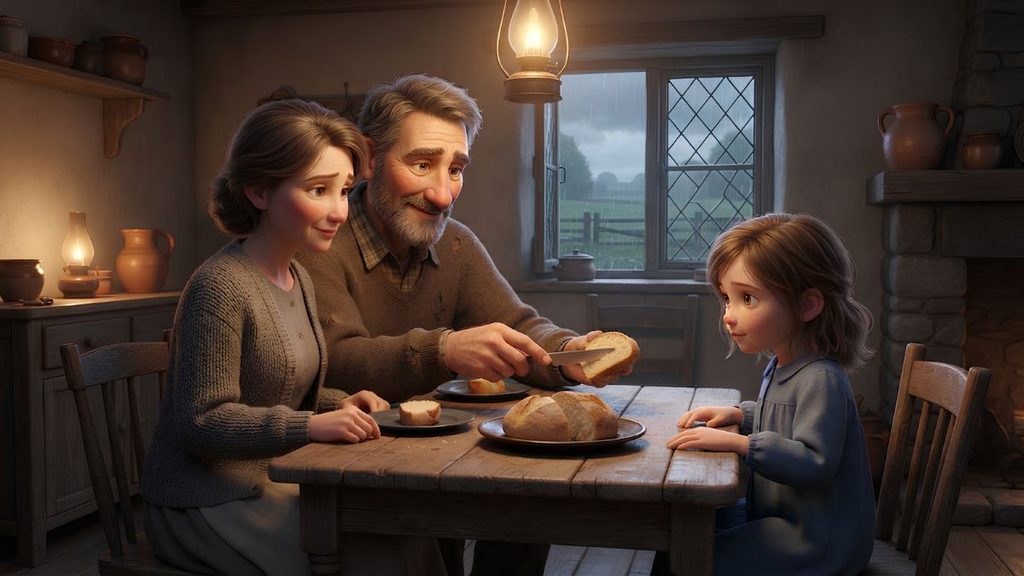
In a small village surrounded by green fields and winding country roads, there lived a hardworking farmer named Thomas Wilson. He owned a modest piece of land where he grew wheat, potatoes, and seasonal vegetables. His farm was not particularly large, but it had provided enough for his family to live comfortably for many years.
Thomas lived in a little cottage with his wife, Eleanor, and their eight-year-old daughter, Lily. Their home had an old wooden roof, a small garden, and a kitchen where Eleanor prepared warm meals every evening.
The family did not have much money, but they were happy. Thomas believed that a peaceful home, a loving family, and honest work were worth more than expensive possessions.
Every morning, he woke before sunrise, packed a simple lunch, and headed towards his fields. Lily often accompanied him during the summer holidays, asking endless questions about plants, insects, and the changing seasons.
Thomas enjoyed teaching her.
“Remember, Lily,” he once told her while planting seeds, “a farmer cannot force a seed to grow. He can only give it good soil, water, and patience.”
Lily smiled.
“Just like you help me learn?”
“Exactly like that.”
Those simple mornings were some of Thomas’s happiest memories.
When Hard Times Arrived
One year, the village experienced an unusually long period of heavy rainfall. At first, the farmers welcomed the rain because their crops needed water. But after several weeks, the situation became worrying.
The streams overflowed, the roads turned muddy, and water began collecting in the fields.
Thomas tried everything he could to protect his crops. He built temporary drainage channels, moved his tools to higher ground, and worked late into the evening.
Unfortunately, nature had other plans.
One night, a powerful storm swept across the village. By morning, much of Thomas’s farmland was underwater. His young wheat plants had been destroyed, and several vegetable beds were completely ruined.
He stood in the middle of his field, looking at the damage.
After months of hard work, almost everything was gone.
The other farmers were facing similar problems. Some had lost their entire harvest, while others had damaged barns and broken equipment.
Thomas returned home that afternoon without saying much.
Eleanor immediately understood that something was wrong.
“How bad is it?” she asked.
Thomas sat down and removed his muddy boots.
“Bad enough that we will have to be careful with money for a while.”
Eleanor placed a comforting hand on his shoulder.
“We will manage. We always do.”
But managing became harder than either of them expected.
Without crops to sell, Thomas had almost no income. He began looking for temporary work around the village, but many other farmers were doing the same.
The family started reducing its expenses. They stopped buying unnecessary items, postponed repairs to the cottage, and carefully planned every meal.
A few weeks later, the situation became even more difficult.
One evening, Eleanor placed a small loaf of bread on the kitchen table.
It was the last loaf they had until Thomas could earn some money or find another source of food.
Thomas divided it into three pieces.
He gave the largest piece to Lily, a smaller piece to Eleanor, and kept the smallest for himself.
Lily looked at her father’s portion.
“Papa, why is your piece so small?”
Thomas smiled.
“I had a big lunch today, sweetheart. You need more energy because you have school tomorrow.”
Lily accepted the explanation and began eating.
But Eleanor knew the truth.
Thomas had not eaten a proper meal since the previous morning. He had quietly given away part of his own food so that his daughter would not feel hungry.
Later that night, when Lily was asleep, Eleanor spoke to him.
“You cannot keep doing this, Thomas. You need food too.”
Thomas looked towards the bedroom.
“I know. But she is growing. I cannot watch her go hungry.”
Eleanor held his hand.
“We will find a way. We have to look after each other.”
Thomas nodded, although he had no idea how they would manage the coming days.
A Difficult Choice on the Road
The following morning, Thomas woke early and walked towards the village market.
He had heard that a shopkeeper was looking for someone to repair wooden carts and farm equipment. The work would not pay much, but it could provide enough money to buy groceries.
Thomas wanted to reach the market before anyone else.
As he walked along the muddy road, he noticed an elderly woman sitting beside a broken wooden cart.
It was Mrs. Wilson, an elderly neighbour who lived alone at the far end of the village. She had no close family nearby and usually managed her daily tasks independently.
Today, however, she looked helpless.
Her cart had lost one of its wheels, and a basket of vegetables had fallen onto the muddy ground.
Thomas stopped.
“Good morning, Mrs. Wilson. Are you all right?”
The elderly woman looked up.
“Oh, Thomas. I am fine, but this old cart has finally decided to give up on me.”
Thomas examined the damaged wheel.
“Did it break while you were carrying the vegetables?”
“Yes. I was trying to get these home before the rain started again.”
Thomas glanced at the sky. Dark clouds were gathering in the distance.
He also remembered the job opportunity at the market.
If he stopped to help, he might arrive too late.
For a moment, he considered continuing along the road. His own family was struggling, and he could not afford to lose another opportunity.
Then he looked at Mrs. Wilson.
She was an elderly woman standing alone in the cold, with vegetables scattered around her and no way to move the cart.
Thomas sighed gently.
“Don’t worry. Let’s see what we can do.”
He placed his bag beside a tree and began collecting the vegetables. Some had become muddy, but most were still usable.
After that, he examined the broken wheel and discovered that one of its wooden supports had come loose.
He removed a small tool from his bag and began repairing it.
The work took longer than expected.
His hands became dirty, and his back started aching, but he continued until the wheel was secure enough to carry the vegetables.
Finally, he helped Mrs. Wilson push the cart towards her cottage.
When they arrived, she thanked him repeatedly.
“You have been very kind, Thomas. I don’t know what I would have done without you.”
Thomas smiled.
“It was nothing. Anyone would have helped.”
Mrs. Wilson looked at him carefully.
“Have you had breakfast?”
Thomas hesitated.
“Not really. I was heading to the market to look for work.”
The elderly woman noticed his tired expression and understood that something was wrong.
“Come inside for a moment. I have some soup warming on the stove.”
Thomas politely refused.
“I don’t want to trouble you.”
“You have already spent your morning helping me. The least I can do is offer you a warm meal.”
Thomas eventually agreed.
Inside the cottage, Mrs. Wilson served him a bowl of vegetable soup with two slices of freshly baked bread.
Thomas ate slowly, grateful for the warmth and the food.
For the first time in several days, he felt comfortably full.
Before leaving, he thanked her.
“I hope I can repay your kindness someday.”
Mrs. Wilson smiled.
“Don’t worry about repaying me. Just remember how it feels when someone helps you.”
Thomas returned home that afternoon, disappointed that he had missed the opportunity at the market.
However, he did not regret helping his neighbour.
He believed he had done the right thing.
A Small Act of Kindness Comes Back
A few days later, someone knocked on Thomas’s cottage door.
When Eleanor opened it, she found Mrs. Wilson standing outside with a large basket.
“Good morning, Eleanor. I brought a few things for your family.”
The basket contained bread, potatoes, carrots, onions, and a small jar of homemade jam.
Eleanor was surprised.
“Oh, Mrs. Wilson. You didn’t have to bring all this.”
“I wanted to. Thomas helped me when I needed it.”
Thomas came into the room and greeted his neighbour.
Mrs. Wilson placed the basket on the table.
“I also wanted to tell you something. I spoke to Mr. Harris, the shopkeeper. He needs someone who understands wooden carts and farm equipment. I told him about your work, and he would like to meet you.”
Thomas looked surprised.
“Really?”
“Yes. I explained that you repaired my cart in the rain without expecting anything in return. He said he would be happy to give you a chance.”
Thomas felt a wave of relief.
He had been worried about finding work, and now an opportunity had appeared unexpectedly.
The next morning, he visited Mr. Harris’s shop.
The shopkeeper examined some of Thomas’s previous work and asked a few questions about his experience.
After a short conversation, he offered Thomas a temporary position repairing carts, wooden shelves, and farm tools.
The pay was modest, but it was steady.
Thomas accepted immediately.
When he returned home, Lily ran towards him.
“Papa! Did you find a job?”
Thomas lifted her into his arms.
“Yes, sweetheart. I did.”
Eleanor smiled with relief.
That evening, the family shared a proper dinner. There was vegetable soup, fresh bread, and enough food for everyone.
For the first time in weeks, nobody had to worry about how much they could eat.
Lily Learns the Meaning of Generosity
A few days later, Lily noticed the basket that Mrs. Wilson had brought.
She asked her father why the elderly woman had given them so much food.
Thomas explained what had happened on the road.
Lily listened carefully.
“But Papa, we didn’t have much food ourselves. Why did you stop to help her?”
Thomas sat beside her.
“Because she needed help, Lily.”
“But we needed help too.”
Thomas nodded.
“That is true. Sometimes life becomes difficult for everyone. But that doesn’t mean we should stop caring about other people.”
Lily thought for a moment.
“Does that mean we should always give away what we have?”
Thomas smiled.
“Not always. We must also look after ourselves and our family. But if we have an opportunity to make someone’s difficult day a little easier, we should try.”
He paused before continuing.
“Kindness is not about giving away everything. It is about remembering that other people have feelings and struggles just like we do.”
Lily looked down at her hands.
She remembered the evening when her father had given her the largest piece of bread.
“Papa, were you really hungry that night?”
Thomas looked at Eleanor, who was standing nearby.
He did not want to hide the truth.
“Yes, sweetheart. I was hungry.”
Lily’s eyes filled with tears.
“Then why did you say you had already eaten?”
Thomas gently hugged her.
“Because I wanted you to have enough.”
Lily hugged him tightly.
“I wish I had shared my bread with you.”
Thomas smiled.
“That would have been very kind of you. But you must never feel guilty for accepting the love and care your family gives you.”
Eleanor joined them, and the three shared a quiet family moment.
Kindness Spreads Through the Village
As the weeks passed, Thomas continued working at Mr. Harris’s shop.
His income was still limited, but it helped the family recover from the difficult period.
He also began helping other farmers repair damaged equipment whenever he had free time.
Mrs. Wilson, meanwhile, started sharing vegetables from her garden with neighbours who were struggling.
One afternoon, Lily noticed that a young boy from her school had forgotten his lunch.
She opened her lunchbox and offered him half of her sandwich.
The boy smiled gratefully.
Lily remembered her father’s words.
Kindness was not about how much someone owned. It was about being willing to share.
Soon, other children began doing the same. They shared snacks, helped one another with homework, and looked after younger students during breaks.
The villagers also started organizing small food collections for families affected by the flooding.
Some donated vegetables, others contributed bread, and a few farmers offered temporary work to people who had lost their crops.
The village slowly became stronger.
One evening, Mrs. Wilson visited Thomas’s cottage again.
She sat with Eleanor while Thomas repaired a wooden chair.
“Your husband is a good man,” she said.
Eleanor smiled.
“He has always believed that helping others is simply part of being a good neighbour.”
Mrs. Wilson nodded.
“And now the whole village seems to be learning that lesson.”
Thomas overheard their conversation and laughed.
“I only repaired one cart. I didn’t expect everyone to start talking about kindness.”
Mrs. Wilson smiled.
“Sometimes, Thomas, people need to see one person do something good before they remember that they can do it too.”
The Harvest of a Different Kind
Several months later, the heavy rains finally ended.
The fields began drying, and the farmers slowly returned to their work.
Thomas managed to prepare a portion of his land for the next planting season. He was careful with his expenses and worked hard to rebuild what had been lost.
The following harvest was not particularly large, but it was enough to support his family.
On the day he collected his first basket of fresh vegetables, he brought it home and placed it on the kitchen table.
Lily ran towards him.
“Papa, does this mean we have a good harvest?”
Thomas smiled.
“It means we have another chance to begin.”
That evening, Eleanor baked a fresh loaf of bread.
When she placed it on the table, Thomas divided it into three equal pieces.
This time, nobody received a smaller portion.
Lily looked at the bread and smiled.
“Papa, do you remember the last piece of bread?”
Thomas nodded.
“Of course.”
Lily picked up her piece and broke it in half.
She placed one half on her father’s plate.
“Now we can share it equally.”
Thomas looked at his daughter with pride.
He realized that she had understood something much more important than the value of food or money.
She had learned that kindness could begin with a small decision, even when life was difficult.
Years later, Lily became a teacher. She often told her students the story of the last piece of bread.
She explained that her father had taught her one of life’s most important lessons: generosity is not measured by how much a person gives, but by the thought and compassion behind the gift.
Thomas’s little act of kindness had helped Mrs. Wilson, but its influence reached much further.
It changed the way Lily understood generosity. It encouraged neighbours to support one another. And it reminded an entire village that nobody should have to face difficult times alone.
The family never forgot that winter.
They remembered the destroyed crops, the empty kitchen shelves, and the small loaf of bread that had seemed so precious.
But most importantly, they remembered how one act of kindness created another.
Moral of the Story
True generosity does not depend on wealth. Even when life is difficult, sharing what little we have can make a meaningful difference in someone else’s life. Sometimes, the smallest act of kindness inspires an entire community to become more compassionate.
2. The Dream He Put on Hold

Daniel Brooks had dreamed of becoming a professional pianist since he was six years old.
His love for music began on a rainy afternoon when his father brought home an old second-hand piano. The instrument had a few scratches, two slightly damaged keys, and a wooden finish that had lost its shine. But to Daniel, it was the most beautiful thing in the world.
His father, Robert, had placed it beside the living room window.
“One day, you will play something beautiful on this,” he had told him.
Daniel did not understand what that meant at the time. He simply enjoyed pressing the keys and listening to the different sounds.
As he grew older, his interest became a passion.
He began taking piano lessons, practising every evening and learning increasingly difficult compositions. Sometimes, he spent so much time playing that his mother had to remind him to finish his homework.
His younger sister, Sophie, often sat nearby, listening to him practise.
“Can you play something happy?” she would ask.
Daniel would smile and play a cheerful melody.
Their home was not wealthy, but it was filled with music, laughter, and the warmth of family.
However, life changed when Daniel was fifteen.
His father, Robert, became seriously ill and passed away after a long period of treatment.
The loss deeply affected the family.
Daniel’s mother, Margaret, suddenly became responsible for raising two children on her own. She worked as a nurse at a local hospital, taking extra shifts whenever possible to pay for household expenses, school fees, and Daniel’s music lessons.
Daniel understood that things were difficult.
He started helping around the house, preparing meals when his mother worked late, and making sure Sophie completed her homework.
Although he missed his father terribly, he tried to remain strong.
Whenever he sat at the piano, he remembered the promise his father had made.
He wanted to become a musician not only because he loved music but also because he wanted to make his father proud.
The Opportunity of a Lifetime
Years passed.
Daniel became one of the most talented young pianists at his school. His music teacher, Mr. Anderson, often encouraged him to apply for professional training.
“You have something special, Daniel,” he once said. “You understand music beyond the notes. You make people feel something when you play.”
Daniel appreciated the encouragement, but he knew professional music education was expensive.
He did not want his mother to spend more money on him.
Still, Mr. Anderson persuaded him to apply to the prestigious Westbridge Music Academy in another city.
The academy offered advanced training in piano performance, music theory, composition, and professional performance.
Daniel completed the application, submitted recordings of his performances, and waited anxiously for a response.
Several weeks later, a letter arrived.
He had been accepted.
Even better, the academy offered him a partial scholarship because of his exceptional performance during the selection process.
Daniel read the letter three times to make sure he had understood it correctly.
He ran into the kitchen.
“Mom! I got in!”
Margaret was preparing dinner when he handed her the letter.
She read it carefully, and her face lit up.
“Oh, Daniel! This is wonderful!”
Sophie came running into the room.
“What happened?”
Daniel held up the letter.
“I got accepted into the music academy!”
Sophie jumped with excitement.
“You’re going to become a famous pianist!”
For a few minutes, the entire family celebrated.
Margaret hugged her son and kissed his forehead.
“Your father would have been so proud.”
Daniel smiled, but his happiness was soon interrupted by an uncomfortable reality.
The scholarship covered only part of the tuition fees. Accommodation, transportation, meals, and other expenses were still his responsibility.
He calculated the costs that evening.
The amount was much higher than he had expected.
He knew his mother could not afford everything.
At the same time, Sophie was preparing for her final school examinations. She needed additional tutoring and educational materials to improve her chances of getting into a good college.
Daniel looked at the numbers on the paper.
For the first time, his dream seemed further away than ever.
A Difficult Decision
Over the following days, Daniel became unusually quiet.
He continued practising the piano, but he no longer spoke excitedly about the academy.
Margaret noticed the change.
One evening, she found him sitting alone in the living room, staring at the acceptance letter.
“What’s troubling you?” she asked.
Daniel folded the letter and placed it on the table.
“I have been calculating the expenses. Even with the scholarship, it is too expensive.”
Margaret sat beside him.
“We will work something out.”
“Mom, you are already working so hard. I cannot ask you to take on more shifts just to send me away.”
Margaret looked at him.
“You are not asking for anything unreasonable. This is your future.”
Daniel shook his head.
“And what about Sophie? She needs support too. Her exams are coming up, and she wants to attend college.”
Sophie had been listening from the hallway.
She entered the room.
“I can manage, Daniel. You should go.”
Daniel smiled at his sister.
“I know you can manage, but I don’t want you to miss opportunities either.”
The conversation continued for some time, but Daniel had already started thinking about another option.
He could postpone his admission and find a job.
He could earn money, support his sister’s education, and perhaps apply to the academy again in the future.
The next morning, he visited Mr. Anderson.
“I think I need to postpone my admission,” Daniel said.
His teacher looked disappointed.
“Is it because of the money?”
Daniel nodded.
“I have a family to look after. I cannot leave everything to my mother.”
Mr. Anderson leaned back in his chair.
“I understand your responsibilities, Daniel. But I hope you do not mistake a temporary delay for the end of your dream.”
Daniel appreciated his words.
However, he had made his decision.
He contacted the academy and requested a deferral. Unfortunately, because of the scholarship conditions, he could not be certain that the same financial support would be available later.
It was a difficult choice, but he believed it was necessary.
Working Instead of Studying
Daniel found a part-time job at a local music store.
The owner, Mr. Collins, needed someone who could help customers, organize instruments, and assist with basic piano lessons.
Daniel was perfect for the position.
He began working in the mornings and teaching beginner piano lessons in the afternoons.
In the evenings, he helped Sophie with her studies.
His days became exhausting.
He often returned home with aching feet and barely enough energy to practise.
Still, he continued.
Whenever he received his salary, he divided the money into three parts.
One portion went towards household expenses, another was saved for Sophie’s education, and the remaining amount covered his personal needs.
He stopped buying new clothes, avoided unnecessary outings, and used his old music books instead of purchasing new ones.
His piano practice also changed.
He could no longer spend four or five hours playing every day. Instead, he practised for thirty minutes whenever he found time.
Sometimes, he played quietly late at night after everyone had gone to bed.
The old piano remained beside the living room window.
Its scratched wooden surface reminded him of his childhood and his father’s promise.
One evening, Margaret found him playing a slow melody.
“You haven’t played that piece in months,” she said.
Daniel stopped.
“I was trying to remember it.”
Margaret sat beside him.
“Do you regret postponing the academy?”
Daniel remained silent for a moment.
“Sometimes. But when I see Sophie studying, I know why I made the decision.”
Margaret held his hand.
“You are a wonderful brother, Daniel. But I want you to remember something. Your happiness matters too.”
Daniel smiled.
“I know, Mom. I haven’t forgotten my dream. I just need a little more time.”
Sophie Discovers the Truth
Sophie had noticed how much Daniel had changed.
He no longer spent time with his old friends, rarely went out, and often looked tired.
She also noticed that he had stopped buying things he once enjoyed.
One afternoon, while looking for an old school notebook, she found a folder containing Daniel’s academy documents.
Inside was a letter explaining the scholarship and the admission deferral.
She read it carefully.
Only then did she understand how much her brother had given up.
That evening, she confronted him.
“Why didn’t you tell me you postponed your admission?”
Daniel looked surprised.
“I thought you knew.”
“I knew you were working, but I didn’t know you had given up the academy because of me.”
Daniel shook his head.
“I didn’t give up because of you, Sophie. I made a decision because our family needed support.”
“But I could have studied without extra tutoring. I could have found cheaper books. You didn’t have to do all this.”
Daniel smiled gently.
“You have your own dreams. I want you to have the opportunities I didn’t have at your age.”
Sophie began crying.
“I don’t want to reach my goals if it means you lose yours.”
Daniel moved closer and hugged her.
“Listen to me. I am proud of you. I want you to study, work hard, and build a future you love. And I will continue working towards mine too.”
Sophie hugged him tightly.
That evening, she made a promise to herself.
She would study as hard as possible, not because she felt guilty, but because she wanted to make the most of the opportunities her family was working so hard to provide.
An Unexpected Opportunity
Months passed.
Sophie prepared for her examinations with renewed determination. Daniel continued working at the music store and teaching piano lessons.
One of his students was a young boy named Oliver.
Oliver was not particularly confident. He often made mistakes during lessons and became frustrated whenever he could not play a piece correctly.
Daniel was patient with him.
Instead of criticizing his mistakes, he encouraged him to practise slowly.
“Music is not a race, Oliver. You don’t have to play everything perfectly on the first attempt.”
Oliver’s father, Mr. Bennett, occasionally watched the lessons.
He worked as a music producer and had connections with several professional musicians.
One afternoon, he approached Daniel.
“I have been listening to your playing during the lessons,” he said. “You are very talented.”
Daniel thanked him politely.
Mr. Bennett continued.
“I am looking for someone to assist a pianist who works with our studio. The position involves arranging music, organizing practice sessions, and helping with basic production work. Would you be interested?”
Daniel was surprised.
“I would love to, but I don’t have professional experience.”
“That can be taught. Your understanding of music and your ability to work with students are already valuable.”
Daniel asked for a few days to consider the offer.
He discussed it with Margaret and Sophie.
Both encouraged him to accept.
The new opportunity did not involve attending the academy, but it would allow him to learn directly from experienced musicians.
He accepted the position.
His responsibilities included organizing sheet music, assisting during recording sessions, preparing instruments, and observing professional performances.
At first, he felt nervous.
But he learned quickly.
The studio introduced him to a different side of music. He discovered how compositions were arranged, how recordings were produced, and how professional musicians prepared for performances.
Most importantly, he began playing regularly again.
His dream had not disappeared.
It had simply taken a different route.
The Sister’s Success
Around the same time, Sophie received the results of her final examinations.
She had achieved excellent marks.
A few weeks later, she was offered a scholarship to a respected college.
The scholarship covered most of her tuition fees, significantly reducing the financial burden on the family.
When she received the news, she ran towards Daniel.
“I got it! I got the scholarship!”
Daniel lifted her into a hug.
“I knew you could do it!”
Margaret joined them, and the three celebrated together.
For Daniel, Sophie’s success meant more than academic achievement.
It meant that the sacrifices made by the family had created an opportunity.
Sophie eventually moved to another city for college.
Before leaving, she gave Daniel a small gift.
It was a framed photograph of the three of them standing beside their old piano.
Underneath the photograph, she had written:
“You helped me follow my dream. I hope you never stop following yours.”
Daniel looked at the message for a long time.
He placed the photograph beside the piano.
The Music Finally Returns
Three years later, Daniel was working regularly with professional musicians.
He had become an assistant music arranger and was gradually developing his own compositions.
One evening, Mr. Bennett informed him about an upcoming local concert.
“We are organizing a small performance featuring young musicians. I would like you to perform one of your original pieces.”
Daniel was surprised.
“Me? On stage?”
“Yes. You have spent years helping other musicians. It is time people heard your work.”
Daniel initially hesitated.
He had performed in school concerts, but never at a professional event.
Still, he accepted.
For several weeks, he worked on a composition inspired by his family.
He called it A Promise by the Window.
The piece began with a gentle melody, representing his childhood. It gradually became more emotional, reflecting the difficult years after his father’s death. Towards the end, the music became brighter and more hopeful.
Daniel wanted it to tell the story of a family that had faced hardship but never stopped supporting one another.
On the evening of the concert, Margaret and Sophie arrived early.
Sophie had travelled from college specifically to attend.
Daniel walked onto the stage and looked towards the audience.
For a moment, he felt nervous.
Then he saw his mother and sister sitting in the front row.
He placed his hands on the piano keys and began playing.
The room became quiet.
As the melody developed, Daniel remembered his father’s old piano, his mother’s sacrifices, and the years he had spent working instead of studying.
He remembered the dreams he had postponed and the people who had encouraged him to continue.
When the final notes faded, the audience applauded.
Margaret was crying.
Sophie stood up and clapped enthusiastically.
Daniel smiled.
For the first time in years, he felt that he was standing exactly where he belonged.
After the concert, he hugged his mother.
“Do you think Dad would have liked it?” he asked.
Margaret smiled through her tears.
“He would have loved every second.”
Daniel looked at Sophie.
“And you? Did you enjoy it?”
Sophie laughed.
“I think you should become famous now. I want to tell everyone that my brother is a pianist.”
They all laughed.
A Dream Shared by Three People
Daniel’s journey did not end with that concert.
He continued working, composing music, and performing whenever opportunities arose.
Eventually, he saved enough money to enrol in a professional music programme while continuing his job.
He had not followed the exact path he once imagined, but he had found a way to combine his responsibilities with his passion.
Years later, he became a respected pianist and music teacher.
He never forgot the difficult period when he had postponed his education to support his family.
Nor did he regret the decision.
He understood that his mother’s sacrifices had made his childhood possible, and his own sacrifices had helped Sophie build her future.
But he also learned that love should not mean permanently abandoning personal dreams.
A family grows stronger when its members support one another, make thoughtful compromises, and encourage each other to keep moving forward.
One evening, Daniel returned home and sat beside the old piano.
The framed photograph of his mother and sister was still beside it.
He gently opened the piano cover and began playing the melody he had written years earlier.
This time, he played it without sadness.
He played it with gratitude.
The dream he had once put on hold had finally found its way back into his life.
And he knew that the most beautiful part of his journey was not the concert, the applause, or the recognition.
It was the family that had stood beside him through every difficult decision.
Moral of the Story
Family sacrifice is not about abandoning personal dreams forever. It is about supporting one another through difficult times, making thoughtful compromises, and finding ways to grow together. True love gives people the strength to keep believing in their own future while helping the people they care about build theirs.
3. The Friend Who Gave Up the Trophy

Oliver and James had been best friends since they were six years old. They lived on the same street, attended the same school, and spent nearly every afternoon playing football in the small park behind their houses.
Their personalities were quite different.
Oliver was energetic, confident, and competitive. He loved scoring goals and dreamed of becoming a professional footballer. Whenever he played a match, he gave everything he had.
James, on the other hand, was quieter and more thoughtful. He was not always the strongest player, but he understood the game well. He could recognize opportunities, encourage his teammates, and remain calm when everyone else became nervous.
Despite their differences, they made an excellent team.
Oliver often joked that James was the brain behind their football skills, while James said Oliver was simply too stubborn to stop running after the ball.
They laughed about everything.
Their friendship was built on years of shared memories, including broken windows, muddy shoes, missed penalties, and countless afternoons spent practising in the park.
But one thing mattered more than anything else to both boys: their school football tournament.
Every year, Westbrook School organized a football championship. Teams from different classes competed for a silver trophy, medals, and the chance to represent the school in a regional tournament.
For Oliver, winning the championship had become a personal dream.
He had played in three previous tournaments but had never won the final. Twice his team had been eliminated in the semifinals, and once they had lost in the final by a single goal.
This year, he wanted things to be different.
He had trained throughout the summer, improved his shooting skills, and worked hard to become the team’s leading striker.
James supported him throughout the journey.
Neither of them knew that this tournament would teach them something far more important than winning.
The Tournament Begins
The school announced the tournament schedule at the beginning of the new academic year.
Oliver was selected as the team’s captain, while James was appointed vice-captain.
Their coach, Mr. Harris, was pleased with their progress.
“You two understand each other better than most professional players,” he told them during practice. “If you play as a team, we have a real chance this year.”
Oliver grinned.
“We are going to bring that trophy home, sir.”
James laughed.
“Let’s win the first match before planning the celebration.”
The team trained hard.
Every afternoon, the boys practised passing, defending, shooting, and positioning. Oliver focused on improving his speed and accuracy, while James worked on building better attacking combinations.
Their first match was against Eastwood School.
Oliver scored two goals, and James assisted with both. Their team won comfortably.
The second match was more challenging, but they managed another victory.
By the time they reached the quarterfinals, the entire school had started talking about them.
Students gathered near the football field to watch their matches. Teachers congratulated the players, and even the school principal attended one of their games.
Oliver was enjoying every moment.
He began imagining himself lifting the trophy in front of the cheering crowd.
James was equally happy, although he reminded Oliver that there were still several matches to play.
“We have to stay focused,” he said.
Oliver nodded.
“Don’t worry. I can already see us holding that trophy.”
An Unexpected Injury
Two weeks before the final, the team was practising an important attacking move.
Oliver received a pass near the penalty area and attempted to change direction quickly.
As he turned, he collided with another player and fell awkwardly.
He immediately felt pain in his ankle.
“Don’t move,” Mr. Harris said, rushing towards him.
James ran across the field.
“Oliver, are you okay?”
Oliver tried to stand but quickly sat down again.
The coach called for assistance, and Oliver was taken to a nearby clinic.
The doctor examined his ankle and recommended rest.
Fortunately, the injury was not serious, but Oliver would need to avoid intense training for several days.
He was disappointed.
The tournament was approaching its most important stage, and he did not want to miss any matches.
James visited him that evening.
He brought a football magazine and some snacks.
“How is the ankle?” James asked.
“Better, but the doctor says I cannot train for a week.”
“At least it isn’t a serious injury.”
Oliver sighed.
“What if I cannot play in the final?”
James tried to encourage him.
“You will recover. We still have time.”
Oliver looked away.
“I have worked too hard for this. I cannot miss the final.”
James understood how much the tournament meant to him.
He promised to keep the team motivated and make sure they continued practising.
For the next few days, Oliver attended training sessions but remained on the sidelines.
James took on additional responsibilities. He organized practice drills, helped younger players, and discussed strategies with the coach.
The team continued winning.
Eventually, they reached the final.
Oliver’s ankle had improved, and the doctor allowed him to return to light training. Everyone hoped he would be fit enough to play.
Then something happened that changed everything.
The News That Changed the Match
One Friday evening, Oliver was helping his mother prepare dinner when his phone rang.
It was his uncle.
His father, who worked at a construction site in another city, had suffered an accident.
He had been taken to a hospital for treatment.
Oliver’s mother immediately began making arrangements to travel.
Oliver stood silently in the kitchen.
His father had always supported his football dream. Although his work often kept him away, he tried to attend important matches whenever possible.
In fact, Oliver had been especially excited about this year’s final because his father had promised to attend.
Now, everything had changed.
His mother informed him that they needed to leave early the following morning.
The hospital was several hours away, and she did not want to travel alone.
Oliver looked at the clock.
The football final was scheduled for Saturday afternoon.
He felt trapped between two important things.
He wanted to be with his father, but he also knew how much the team depended on him.
He called James.
“Something has happened,” Oliver said as soon as his friend answered.
James listened carefully while Oliver explained the accident.
“Is your father okay?” James asked.
“We don’t know yet. Mom wants me to travel with her tomorrow.”
“Then you should go.”
Oliver became quiet.
“But the final is tomorrow.”
James was surprised by the response.
“Oliver, your father is in the hospital. The match can wait.”
“I know, but we have worked so hard. The entire team is counting on me.”
James took a deep breath.
“Your teammates need you, but your father needs you too.”
Oliver rubbed his forehead.
“I don’t know what to do.”
James thought for a moment.
“Go with your mother. I will speak to the coach.”
Oliver did not answer immediately.
“Are you sure?”
“Of course. We are friends. I don’t want you worrying about football while your family is going through something difficult.”
Oliver thanked him.
But the decision was still painful.
James Makes a Difficult Decision
The following morning, James arrived at school earlier than usual.
He went directly to Mr. Harris’s office.
The coach was reviewing the team’s final strategy when James entered.
“Sir, Oliver will not be able to play today.”
Mr. Harris looked concerned.
“What happened?”
James explained the situation.
The coach immediately expressed sympathy for Oliver and his family.
“That is unfortunate. We will have to make some changes to the team.”
James nodded.
“I would like to take Oliver’s position.”
Mr. Harris looked at him carefully.
“Are you sure? Your ankle is still recovering.”
James had injured his ankle during an earlier practice session. Although he had returned to light training, the coach had not yet cleared him for a full match.
“I know, sir. But I can manage.”
Mr. Harris shook his head.
“I don’t want you making your injury worse. We have other players who can fill the position.”
James understood the concern.
However, he had another idea.
He wanted to play, but he also knew that the team needed more than just a replacement striker.
He offered to reorganize the formation, placing a younger player in Oliver’s position and helping the team from the midfield.
The coach agreed to consider it.
During the next practice session, James worked closely with the replacement player, teaching him Oliver’s usual movements and explaining how the team could create scoring opportunities.
He spent hours reviewing the team’s strategy.
His ankle began hurting again, but he did not complain.
He wanted his friends to have the best possible chance of winning.
The Final Match
Saturday afternoon arrived.
The school football ground was crowded with students, parents, and teachers.
Banners decorated the fences, and the school band played music near the entrance.
Westbrook School was facing Riverside Academy, a strong team known for its disciplined defence.
The match was expected to be difficult.
James stood with his teammates near the centre of the field.
He looked towards the empty place where Oliver usually stood during team photographs.
He wished his friend could have been there.
Before the match began, Mr. Harris gathered everyone together.
“I know Oliver cannot be with us today, but we are playing for the entire team. Remember what we have practised. Trust each other, communicate, and never give up.”
James encouraged the younger players.
“Don’t worry about making mistakes. Just play your game.”
The referee blew the whistle.
The match began.
Riverside Academy dominated the first few minutes. Their players moved quickly, controlled possession, and created several attacking opportunities.
Westbrook struggled to settle into the game.
James tried to organize the midfield, but the opposing team kept pressing.
After twenty minutes, Riverside scored.
The Westbrook supporters became quiet.
James encouraged his teammates.
“We still have time. Keep moving!”
Gradually, the team found its rhythm.
A few minutes before halftime, James intercepted a pass and moved the ball towards the right side.
The younger striker received it, passed to another player, and created an opportunity near the penalty area.
Westbrook scored.
The crowd erupted.
The score was now 1-1.
During halftime, the players gathered around Mr. Harris.
The coach praised their determination but reminded them to remain careful.
James was exhausted.
His ankle was beginning to hurt, and he could feel the strain of playing an important match without enough recovery.
Still, he continued.
The second half was even more competitive.
Both teams created opportunities, but neither could score.
As the final minutes approached, James noticed that one of his teammates was struggling.
He moved closer and encouraged him to keep going.
Then, with just a few minutes remaining, Westbrook received a free kick near the edge of the penalty area.
The crowd became silent.
James positioned himself near the goal.
The ball was kicked towards the centre.
A Riverside defender attempted to clear it, but the ball bounced towards James.
He had an opportunity to shoot.
For a moment, he considered taking the shot himself.
But he noticed a teammate standing in a better position.
James passed the ball.
The teammate struck it cleanly.
The ball flew past the goalkeeper and into the net.
Westbrook had taken the lead.
The final whistle blew moments later.
They had won.
The players rushed towards one another, celebrating their victory.
James smiled, but he was too exhausted to jump with them.
His ankle was hurting badly.
Mr. Harris approached him.
“You played brilliantly, James.”
James looked at the scoreboard.
“We did it, sir.”
A Victory Without His Best Friend
The team gathered around the silver trophy.
The school principal congratulated the players and invited the captain to lift it.
Since Oliver was absent, James was asked to accept the trophy.
He walked towards the stage slowly.
The crowd began cheering.
But just before lifting the trophy, James looked towards the entrance of the ground.
He imagined Oliver standing there, smiling and celebrating with everyone.
He remembered the afternoons they had spent practising, the goals they had scored together, and the promise they had made to win the championship.
He felt happy, but something was missing.
James picked up the trophy and held it for a moment.
Then he turned towards his teammates.
“This belongs to all of us,” he said. “But I want to dedicate this victory to someone who helped us reach the final and who could not be here today.”
The crowd became quiet.
“Oliver has been our captain and our friend. He worked incredibly hard for this tournament. Today, he is with his father, where he should be. We won this match as a team, but I want him to know that we never forgot him.”
The players applauded.
James then asked the principal whether the team could keep the trophy until Oliver returned.
The principal agreed.
The celebration continued, but James felt that the most important moment had not yet happened.
He needed to speak to his friend.
The Hospital Visit
Oliver and his mother arrived at the hospital late Saturday morning.
His father had undergone treatment and was being monitored by the medical team.
Fortunately, the doctors were optimistic about his recovery.
Oliver spent most of the day beside his father’s bed.
He was relieved to see him awake and able to speak.
“How is the football team?” his father asked.
Oliver smiled faintly.
“They are playing the final today.”
His father looked at him.
“And you are here?”
Oliver nodded.
“I couldn’t leave Mom to travel alone, and I wanted to see you.”
His father gently squeezed his hand.
“You made the right decision.”
Oliver looked down.
“I wish I could have played, though.”
His father smiled.
“There will be many more matches. But there is only one family, and you should never feel bad about being here.”
Oliver remained with him until evening.
Later, his phone began ringing.
It was James.
“Where are you?” James asked excitedly.
“At the hospital. Dad is doing better.”
James sounded relieved.
“That’s wonderful! I have something to tell you.”
Oliver smiled.
“Did you win?”
James laughed.
“Of course we did!”
Oliver sat up.
“Really?”
“We won 2-1. And you won’t believe what happened.”
James described the match, the final goal, and the celebration.
Oliver listened with a mixture of happiness and disappointment.
“I’m proud of you, mate.”
James paused.
“There’s something else. We kept the trophy for you.”
Oliver was silent.
“What do you mean?”
“I want you to be there when we celebrate properly. This victory belongs to you too.”
Oliver felt his eyes filling with tears.
“Thank you, James.”
“Don’t thank me. Just come back when you can.”
The Trophy That Meant More Than Winning
A few days later, Oliver returned to school.
His father was recovering, and his mother had decided to stay with him at the hospital for a little longer.
As Oliver entered the school playground, he noticed his teammates waiting near the football field.
James stood in the middle, holding the silver trophy.
The moment Oliver approached, everyone began cheering.
James walked towards him.
“Welcome back, Captain.”
Oliver looked at the trophy.
“You actually waited for me?”
James smiled.
“We couldn’t celebrate properly without you.”
Oliver examined the trophy and then looked at his friend.
“But you played the final. You helped the team win. You should have received it.”
James laughed.
“I did receive it. I just think it belongs to all of us.”
Oliver shook his head.
“You know what? I think you deserve it more than anyone.”
James looked surprised.
“Why?”
“Because you gave up your chance to play your best position, took care of the team, and made sure I could be with my father without worrying about the match.”
James shrugged.
“That’s what friends do.”
Oliver hugged him.
For a moment, neither of them said anything.
Then Oliver stepped back.
“I owe you one.”
James smiled.
“You can start by buying me a burger.”
They both laughed.
The team joined them, and they took a photograph together with the trophy.
It became one of their favourite memories.
The Lesson That Stayed With Them
Years passed.
Oliver eventually became a football coach, while James pursued a career in sports management.
They remained close friends, even after moving to different cities.
Whenever they met, they remembered the tournament final.
Oliver often joked that James had become a better captain than he had ever been.
James would reply that Oliver was still the only person he knew who could turn a simple football match into a life-changing event.
But both remembered the deeper lesson.
Winning the trophy had made them happy, but the decisions they made during that difficult week had taught them something much more valuable.
Oliver learned that personal achievements could wait when someone he loved needed him.
James learned that friendship was not about receiving recognition or taking someone’s place. It was about helping people through difficult moments, even when doing so required personal sacrifice.
The silver trophy eventually found a place in the school display cabinet.
Students admired it and read the names of the winning team.
But for Oliver and James, the trophy represented something much greater than a football championship.
It reminded them that loyalty, compassion, and friendship were worth more than any prize.
And whenever someone asked Oliver about the most important match he had ever played, he never spoke about a goal or a victory.
He spoke about the friend who taught him that being there for someone mattered more than lifting a trophy.
Moral of the Story
True friendship means putting someone’s needs before personal recognition. A real friend does not simply celebrate your victories. They stand beside you when life becomes difficult, support your decisions, and remind you that some things are more important than winning.
4. The Old Carpenter’s Final Gift
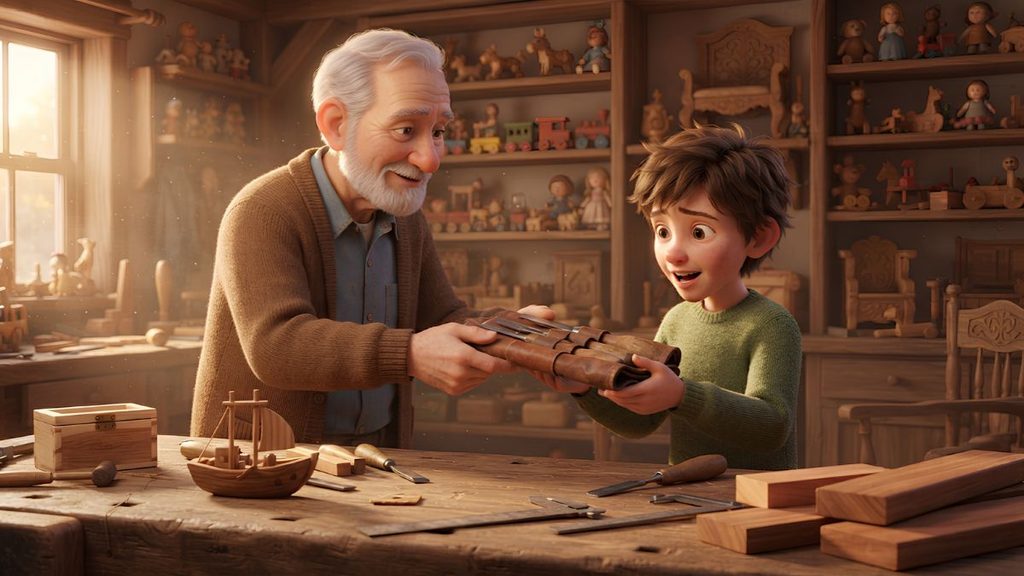
In a quiet countryside town called Willowbrook, there stood a small wooden workshop at the end of a narrow street. Its faded blue door had been there for decades, and above it hung a simple sign that read “Henry’s Woodworks.”
The workshop belonged to an old carpenter named Henry Miller.
Henry had spent more than forty years working with wood. He could repair almost anything, from broken chairs and damaged tables to old wooden doors and delicate furniture.
His hands were rough from years of working with tools, but they were remarkably skilled. He understood the character of different types of wood and could often identify a problem simply by running his fingers along a damaged surface.
People from nearby villages regularly visited his workshop.
Some came to repair furniture, while others wanted handmade cabinets, wooden toys, or decorative items for their homes.
Henry never considered himself a wealthy man. His workshop earned enough to pay his bills, maintain his tools, and live comfortably.
But he was proud of his work.
Every object he made carried a little piece of his patience and experience.
Henry lived alone in a modest cottage not far from the workshop. His wife, Margaret, had passed away several years earlier, and his only son, Michael, had moved abroad for work.
Although Henry missed his family, he never complained about his circumstances.
He had his workshop, a few close neighbours, and a lifetime of memories.
Every morning, he unlocked the blue door, opened the windows, and allowed the smell of freshly cut wood to fill the room.
For Henry, the workshop was more than a place of business.
It was his home away from home.
The Boy With the Broken Boat
One afternoon, while Henry was repairing an old dining table, he heard a hesitant knock on the workshop door.
He looked up.
A young boy stood outside holding a small wooden toy boat.
The boy was around ten years old, with untidy brown hair and a worried expression.
“Good afternoon,” Henry said warmly. “Can I help you?”
The boy entered slowly.
“My name is Peter. I wanted to ask if you could repair something.”
Henry placed his tools aside.
“Let’s have a look.”
Peter carefully placed the boat on the workbench.
It was a beautiful little object, although one side had cracked and its wooden sail had broken.
Henry examined it.
“Who made this?”
Peter looked down.
“My father.”
Henry glanced at the boy.
“Is it important to you?”
Peter nodded.
“My father made it for me before he passed away. We used to play with it in the little stream behind our house.”
Henry understood immediately.
The boat was not simply a toy. It was a reminder of someone Peter loved deeply.
“Can you repair it?” the boy asked.
Henry gently turned the boat in his hands.
“I believe I can.”
Peter hesitated.
“How much will it cost?”
Henry looked at the boy’s worried expression and smiled.
“Nothing.”
Peter appeared confused.
“But I don’t have much money. I can bring some next week.”
Henry shook his head.
“Some things are more valuable than money. This boat is one of them.”
He asked Peter to return the following afternoon.
That evening, Henry carefully repaired the cracked side, replaced the broken sail, and polished the wooden surface.
He worked slowly because he wanted the boat to look as close to its original condition as possible.
The following day, Peter returned.
When Henry handed him the repaired boat, the boy’s face lit up.
“It’s beautiful!”
He examined the little sail and ran his fingers along the polished wood.
“It looks just like it did before.”
Henry smiled.
“Your father made it with care. I simply helped it last a little longer.”
Peter thanked him repeatedly.
Before leaving, he asked whether he could visit the workshop again.
Henry nodded.
“Of course. My door is always open.”
A Friendship Begins
Peter returned the following week.
This time, he did not bring anything to repair. Instead, he stood near the workshop entrance, watching Henry work.
“Would you like to learn something?” Henry asked.
Peter immediately nodded.
Henry showed him how to sand a small piece of wood.
He explained that the purpose was not simply to make the surface smooth but to prepare it for whatever came next.
“Never rush the preparation,” he said. “A good finish begins long before you apply the polish.”
Peter listened carefully.
Over the following weeks, he became a regular visitor.
Sometimes he helped Henry organize small wooden pieces. On other days, he watched him repair furniture or create simple objects.
Henry taught him how to identify different types of wood, measure pieces accurately, and understand the purpose of basic tools.
He also explained the importance of patience.
“Woodworking is not about forcing something into shape,” Henry often said. “It is about understanding what the material can become.”
Peter enjoyed every lesson.
He began creating small wooden objects, starting with simple blocks and gradually moving towards more complicated designs.
His first attempt at making a toy car was uneven and had wheels of different sizes.
Henry examined it seriously.
“Well, this is certainly an interesting design.”
Peter looked disappointed.
“Is it bad?”
Henry smiled.
“No. It is your first attempt. Every good carpenter has made something crooked at some point.”
Peter laughed.
Henry helped him correct the measurements.
Slowly, Peter improved.
Their friendship grew naturally. Peter began sharing stories about school, his mother, and the things he missed doing with his father.
Henry rarely interrupted.
He understood that sometimes people needed someone who would simply listen.
For Henry, the boy’s visits also brought something unexpected.
His quiet workshop no longer felt quite so empty.
He began looking forward to the sound of Peter’s footsteps outside the blue door.
A Family Facing Difficulties
Peter lived with his mother, Anna, in a small rented house near the town market.
Since her husband’s death, Anna had been struggling to manage household expenses.
She worked part-time at a grocery store, but the income was not enough to cover everything comfortably.
Peter knew his mother was worried about money, although she tried not to show it.
One afternoon, Henry noticed that Peter seemed unusually quiet.
“Something bothering you?” he asked.
Peter hesitated.
“My mother has been working late. She says the shop has reduced everyone’s hours, and she is worried about paying the rent.”
Henry put down his measuring tape.
“That sounds difficult.”
Peter nodded.
“I wish I could help her.”
Henry thought for a moment.
“What if I gave you a little work here?”
Peter looked surprised.
“Really?”
“Nothing too difficult. You can help me organize materials, clean the workbench, and prepare small pieces for sanding. I will pay you for your time.”
Peter smiled.
“I would love that!”
Henry made sure the work was suitable for Peter’s age. He never allowed him to use dangerous machinery or handle sharp tools without close supervision.
He wanted the boy to learn safely while earning a little pocket money.
A few days later, Henry also spoke to Anna.
He explained that Peter enjoyed learning woodworking and offered her some paid administrative work at the workshop.
She could help organize customer orders, prepare invoices, and manage simple records.
Anna was surprised by his generosity.
“Mr. Miller, you have already done so much for Peter. I don’t know how to thank you.”
Henry smiled.
“Your son has brought some life back into this old workshop. I think we are helping each other.”
Anna accepted the offer.
For the first time in months, she felt that things might become a little easier.
The News That Changed Everything
As time passed, Henry began noticing that his health was not as strong as before.
He sometimes felt tired after standing for long periods. His hands occasionally became stiff, and climbing the workshop stairs was becoming difficult.
At first, he ignored the symptoms.
He had worked for decades and believed that a little discomfort was normal.
But one morning, he became dizzy while lifting a heavy wooden panel.
Fortunately, he managed to sit down before falling.
A neighbour who had come to collect a repaired cabinet noticed his condition and insisted that he visit a doctor.
After a medical examination, Henry learned that he needed to reduce his working hours and avoid physically demanding work.
The doctor advised him to rest more frequently and take his health seriously.
Henry returned to the workshop feeling thoughtful.
He looked around at the tools, furniture, wooden shelves, and unfinished projects.
He had spent most of his adult life building this place.
Now he was being asked to slow down.
The idea of closing the workshop made him uncomfortable.
He had no intention of working until he could no longer stand, but he also did not want his knowledge and experience to disappear.
That evening, he sat at home and looked through an old photograph album.
One picture showed him standing beside his father in a small woodworking shed.
Henry remembered being a young boy, watching his father repair a broken table.
His father had once told him:
“A good craftsman does not keep every skill to himself. He teaches someone else, so the work can continue.”
Henry had never forgotten those words.
Now, he began thinking about Peter.
The Final Gift
A few days later, Henry invited Peter and Anna to the workshop.
Peter entered carrying a small wooden box he had made himself.
“Look what I finished!” he said proudly.
Henry examined it.
The box was simple, but its edges were neatly joined, and the lid fitted properly.
“You have improved a lot,” Henry said.
Peter smiled.
“Your lessons helped.”
Henry placed the box carefully on the workbench.
Then he turned towards Anna.
“I wanted to talk to both of you about something.”
He explained that his doctor had advised him to reduce his working hours and eventually retire from the business.
Peter looked disappointed.
“Does that mean the workshop will close?”
Henry nodded slowly.
“I haven’t decided what to do with everything yet.”
He walked towards a cabinet and opened a drawer.
Inside were several carefully maintained hand tools, including a small carving knife, a wooden mallet, measuring instruments, and a set of chisels.
Henry picked up the carving tools.
“These belonged to my father. He gave them to me when I was learning the trade.”
He placed them in front of Peter.
“I would like you to have them.”
Peter stared at the tools.
“Me?”
Henry nodded.
“You have shown patience, curiosity, and respect for the work. Those qualities matter more than natural talent.”
Peter looked towards his mother.
“Are you sure, Mr. Miller?”
Henry smiled.
“Very sure.”
But that was not the only gift.
Henry had also arranged for Peter to continue learning woodworking through a local community workshop. He offered to donate several of his tools and materials so that other young people could learn practical skills.
He wanted his experience to benefit more than one person.
Anna became emotional.
“Henry, you are giving away so much of what you worked your entire life to build.”
Henry looked around the workshop.
“I am not losing it. I am passing it on.”
Peter hugged him.
“I promise I will take care of these tools.”
Henry gently patted his shoulder.
“I know you will.”
A Workshop With a New Purpose
Henry did not close the workshop immediately.
Instead, he gradually reduced his work and began preparing it for a new purpose.
He contacted the town council and proposed creating a small woodworking space for children and young adults.
The idea was simple.
Young people could learn practical skills, understand basic craftsmanship, and create useful objects under proper supervision.
The council liked the idea and helped arrange a suitable space in an unused community building.
Henry donated several workbenches, tools, wooden materials, and instructional books.
A local carpenter volunteered to help run the sessions.
Other residents contributed supplies and offered to teach additional skills.
Peter was among the first students.
He helped arrange the materials, prepare simple projects, and welcome new learners.
Henry visited regularly, although he no longer worked full-time.
He enjoyed watching young people discover the satisfaction of making something with their own hands.
One afternoon, a girl named Emily struggled to assemble a small wooden birdhouse.
She became frustrated when the pieces did not fit.
Peter approached her.
“Would you like some help?”
Emily nodded.
Peter examined the pieces and explained how she could correct the measurements.
Henry watched from a nearby chair.
He smiled.
The boy who had once entered his workshop with a broken toy boat was now helping someone else learn.
That was exactly what Henry had hoped would happen.
The Gift That Kept Growing
Several months later, the community woodworking programme organized a small exhibition.
Children displayed wooden toys, picture frames, birdhouses, and decorative boxes they had created.
Families and residents visited the exhibition, admiring the work.
Henry was invited as the guest of honour.
He arrived wearing his favourite brown jacket and carrying a walking stick.
Peter greeted him at the entrance.
“Mr. Miller! You came!”
“Of course. I wouldn’t miss this.”
Peter guided him towards a display table.
There, in the centre, stood a small wooden boat.
It was not the original toy his father had made, but a new boat Peter had created himself.
It had a polished wooden body, a carefully shaped sail, and a tiny inscription on the underside.
Henry picked it up and examined it.
“You made this?”
Peter nodded.
“I wanted to make something that reminded me of the first boat you repaired.”
Henry looked at him with pride.
Peter continued.
“I used to think you had only repaired my father’s toy. But you gave me something much more important. You taught me that I could create things myself.”
Henry’s eyes became moist.
He placed the boat back on the table.
“You did the hard work, Peter. I only showed you where to begin.”
Anna joined them.
She thanked Henry for the opportunities he had given her son.
But Henry looked around at the exhibition.
He saw children proudly showing their work to their parents. He saw volunteers explaining techniques and neighbours encouraging one another.
For a moment, he felt that the workshop had become bigger than he had ever imagined.
His old tools were helping an entire community.
A Legacy Beyond Possessions
As the years passed, Peter continued learning woodworking.
He eventually completed professional training and opened a small workshop of his own.
His business became known for handmade furniture, wooden toys, and carefully restored antiques.
But Peter never forgot where he had started.
Every year, he volunteered at the community workshop and taught young people the skills Henry had taught him.
He also offered free lessons to children from families who could not afford professional classes.
Above the entrance to his workshop, he placed a wooden sign with a simple message:
“A skill becomes a legacy when it is shared.”
Henry lived long enough to see Peter establish his business.
One afternoon, Peter invited him to visit the new workshop.
The place was bright, organized, and filled with the smell of freshly cut wood.
Henry walked around slowly, examining the furniture.
He noticed his father’s old carving tools displayed in a glass cabinet.
Peter had taken excellent care of them.
“Do you still use them?” Henry asked.
“Of course. I use them whenever I work on something special.”
Henry smiled.
Peter then showed him a small collection of wooden toys made by children at the community centre.
Some were imperfect, but each one was unique.
Henry picked up a little wooden horse.
“Who made this?”
“A seven-year-old boy who joined the programme last month.”
Henry laughed.
“It has a very interesting shape.”
Peter smiled.
“I told him the same thing when he made it. He is already planning his next project.”
Henry looked around.
He understood that the greatest part of his life’s work was no longer contained inside his old workshop.
It lived in Peter’s skills, in the children learning to build things, and in the people who had discovered confidence through craftsmanship.
He had spent decades making furniture that would last for years.
But the knowledge he had shared would last much longer.
Moral of the Story
The greatest legacy is not always wealth or possessions. Sharing knowledge, skills, opportunities, and kindness can change someone’s future. A gift becomes truly valuable when it helps another person grow and inspires them to pass that generosity on to others.
5. The Nurse Who Stayed Behind

An inspiring moral story about courage, compassion, sacrifice, and putting others before personal comfort.
In a small town surrounded by green fields and winding roads, there was a community hospital called Willow Creek Medical Centre. It was not a large hospital with modern equipment and hundreds of doctors. It had only a few wards, a small emergency department, and a dedicated team of nurses who worked long shifts to care for the people of the town.
Among them was a nurse named Clara Bennett.
Clara was thirty-four years old and had worked at the hospital for nearly ten years. She was known for her patience, gentle smile, and ability to comfort frightened patients. She remembered the names of elderly people who visited regularly, knew which children were afraid of injections, and always found a few encouraging words for families waiting outside the emergency room.
Her colleagues often joked that Clara could make even the most difficult night shift feel manageable.
But behind her warm personality was a woman who had quietly put many of her own plans on hold.
Clara lived with her younger brother, Ethan, who was studying engineering. Their parents had passed away several years earlier, and Clara had taken responsibility for helping him complete his education. She worked extra shifts whenever possible and carefully managed their household expenses.
She had once dreamed of travelling, studying advanced nursing, and working in a large city hospital. However, family responsibilities had delayed those plans.
Clara did not complain. She believed that difficult periods were temporary and that helping someone through a challenging time was never a wasted effort.
She did not know that one particular night would test that belief more than anything before.
The Storm That Changed Everything
It was a cold evening in November when dark clouds gathered over Willow Creek. The weather forecast had warned of heavy rain, but nobody expected the storm to become so severe.
By eight o’clock, strong winds were shaking trees, rain was pouring across the roads, and electricity had begun flickering throughout the town.
Clara was finishing her shift when the hospital director, Dr. Morris, received an emergency call.
A major road accident had occurred near the old river bridge. A passenger bus travelling from the neighbouring district had skidded on the wet road and overturned near a roadside barrier.
Several passengers were injured.
The nearest large hospital was almost an hour away, and the ambulance service was already struggling to reach the accident site because of flooding.
Willow Creek Medical Centre immediately prepared its emergency ward.
Clara had already completed twelve hours of duty. Her feet hurt, her shoulders were aching, and she had promised Ethan that she would be home for dinner.
She looked at the clock.
Then she heard the ambulance siren.
Without waiting for anyone to ask, she tied her hair back, put on a fresh pair of gloves, and returned to the emergency room.
“Clara, you should go home,” said Nurse Helen, who was preparing the treatment beds. “You’ve been working since morning.”
Clara looked toward the entrance.
“Let’s get the beds ready first. We can discuss going home later.”
Within minutes, the first ambulance arrived.
The emergency room filled with frightened passengers, injured children, worried relatives, and exhausted medical staff.
Some patients had minor injuries, while others needed immediate attention. The hospital’s small team moved quickly, treating wounds, monitoring breathing, preparing medicines, and contacting specialists.
Clara worked without stopping.
She comforted a young boy who was crying for his mother. She helped an elderly passenger who could barely speak because of shock. She assisted Dr. Morris during emergency treatment and kept track of patients who needed to be transferred.
For hours, the hospital remained unusually busy.
And the storm outside continued to grow stronger.
A Difficult Decision
Around midnight, the situation became more complicated.
The main road connecting Willow Creek to the neighbouring city was flooded. The river had risen dangerously, and authorities had temporarily closed the bridge.
The hospital director gathered the remaining staff.
“We have received information that more injured passengers may arrive,” he said. “The town’s emergency services are stretched. We need everyone available.”
Clara glanced at the staff room.
Several nurses had already worked long hours. One had a small child waiting at home. Another had elderly parents who depended on her.
Dr. Morris looked at Clara.
“You have done enough tonight. I can arrange for someone to take over your patients. You should rest.”
Clara shook her head gently.
“Let me finish helping with the patients who are already here.”
She was not trying to appear brave. She simply knew that the hospital needed every pair of capable hands.
At around one in the morning, a nurse brought her a message.
The ambulance carrying three critically injured passengers was stuck near a flooded section of road. The emergency team needed guidance about where to take them once the route became accessible.
Clara contacted the ambulance staff and helped coordinate the transfer.
One of the passengers was a young woman named Sarah, who had been travelling with her six-year-old daughter, Lily.
Sarah had suffered serious injuries and was unconscious when she arrived.
Lily, fortunately, had only a few cuts and bruises. But she was terrified.
She sat on a chair near the treatment room, holding a small stuffed rabbit.
“Is my mother going to wake up?” she asked Clara.
Clara crouched beside her.
“The doctors are taking good care of your mother. You are safe here, and we are going to look after you too.”
“Can I sit with her?”
“Not right now, sweetheart. But I’ll come and tell you how she is doing.”
Clara arranged a blanket and some warm milk for Lily. She also asked another nurse to keep an eye on her while the doctors treated Sarah.
A few minutes later, Clara returned to the emergency room.
There were still many people who needed help.
The Nurse Who Refused to Leave
By three in the morning, the storm had become even worse. Rainwater had entered parts of the hospital parking area, and the electricity supply failed completely.
The emergency generator started, but the director announced that it could only support essential equipment for a limited period.
The staff had to make difficult decisions about where to use their available resources.
Clara checked on the patients in the emergency ward. Some were stable, but others needed continuous monitoring. She helped move two patients away from a section of the building where water was beginning to seep through the windows.
Then she noticed an elderly man sitting alone near the corridor.
His name was Mr. Walter Reed. He had been travelling on the bus when the accident happened. His injuries were not life-threatening, but he was confused and frightened.
“Where is my wife?” he kept asking.
Clara checked his admission notes and learned that his wife had been taken to another hospital before the bridge was closed.
“She is receiving treatment, Mr. Reed. We are trying to contact the other hospital.”
He looked at Clara with tired eyes.
“She doesn’t like hospitals. She gets frightened when I am not there.”
Clara pulled a chair beside him.
“Then we will keep trying to reach her. You are not alone here.”
She stayed with him until another nurse was able to take over.
At four in the morning, Clara finally checked her phone. She had missed several calls from Ethan.
She stepped into the staff room and called him back.
“Clara! Where are you?” Ethan asked immediately. “The news says the roads are flooded. I was worried.”
“I’m at the hospital. We had a serious accident, and the emergency ward is full.”
“Are you safe?”
“Yes, I’m fine. Don’t worry.”
“You promised you would be home tonight.”
Clara closed her eyes for a moment. She had forgotten about their dinner plans.
“I’m sorry, Ethan. I couldn’t leave.”
There was silence on the other end.
“I understand,” he finally said. “Just please take care of yourself.”
Clara smiled faintly.
“I will. You should try to sleep.”
But she knew she would not be sleeping anytime soon.
The Moment Everything Became Personal
At five in the morning, the ambulance carrying the remaining injured passengers finally reached the hospital.
Among them was a young man named Daniel, who had suffered a serious leg injury. His condition was stable, but he was in considerable pain.
As Clara helped prepare him for examination, she noticed that he was repeatedly asking about his younger sister.
“She was sitting beside me,” he said. “Please tell me she is here.”
Clara checked the incoming patient list.
His sister had been admitted to a nearby medical centre with minor injuries. The hospital staff had already contacted her family.
“She is safe,” Clara told him. “She is being looked after.”
Daniel’s eyes filled with tears.
“Thank you. I thought I had lost her.”
Clara gently adjusted his blanket.
“Try to rest. You both have made it through a very difficult night.”
For a moment, she thought about how easily an ordinary journey could turn into a life-changing event. People had left their homes expecting to reach their destinations. Some had been travelling to visit family, others were returning from work, and a few were simply going home.
Now they were all depending on strangers to help them recover.
Clara looked around the crowded ward. She saw tired doctors, worried relatives, nurses moving from bed to bed, and patients trying to remain hopeful.
She felt exhausted, but she also understood why she had stayed.
Her work was not simply about giving medicines or checking temperatures. Sometimes it meant becoming the reassuring voice someone needed when everything familiar had suddenly disappeared.
At six in the morning, Dr. Morris approached her.
“Clara, you need to rest. We have enough staff now that the next team has arrived.”
Clara nodded.
“I’ll finish checking on the patients, and then I’ll go.”
“That is an order,” he said with a tired smile. “You have done more than enough.”
For the first time that night, Clara allowed herself to sit down.
A Promise to a Little Girl
Before leaving, Clara remembered Lily.
She walked toward the children’s waiting area and found the little girl asleep on a chair, still holding her stuffed rabbit.
A hospital volunteer had placed a blanket over her.
Clara checked Sarah’s condition with the doctor. The surgery had been successful, and Sarah was stable. She would need time to recover, but the doctors were hopeful.
Clara gently woke Lily.
“Hello, sweetheart.”
Lily rubbed her eyes.
“Is my mother okay?”
“Your mother is doing better. The doctors have taken good care of her.”
“Can I see her now?”
“Yes. I’ll take you to her room.”
Lily held Clara’s hand as they walked down the corridor. When she entered the room, she saw her mother resting in bed with a bandage around her arm.
“Mom!” she whispered.
Sarah opened her eyes and smiled weakly.
Lily rushed to her bedside, careful not to disturb her injuries.
Clara watched from the doorway. She did not interrupt their moment.
A few seconds later, Sarah looked toward her.
“Are you the nurse who looked after my daughter?”
Clara nodded.
“She was very brave.”
Sarah’s eyes became wet.
“Thank you. I don’t know what would have happened if she had been alone.”
Clara smiled.
“She did very well. She even helped us by being patient while we looked after you.”
Lily looked up.
“She promised she would tell me when you were better. And she did.”
Sarah reached for her daughter’s hand.
Clara felt a quiet warmth in her heart. It was not the excitement of receiving praise or recognition. It was the simple satisfaction of knowing that a frightened child had found comfort during a terrible night.
She wished them both well and finally walked toward the staff entrance.
Outside, the rain had stopped.
The sky was beginning to turn pale with the first light of morning.
The Unexpected Recognition
When Clara reached home, Ethan was waiting in the kitchen.
He had prepared breakfast and left a cup of tea on the table. Clara looked surprised.
“You should have gone to college,” she said. “You didn’t need to wait for me.”
Ethan smiled.
“I know. But I thought you might come home hungry.”
Clara sat down and removed her shoes. For the first time in many hours, she could feel how tired she really was.
Ethan placed a plate in front of her.
“I saw the news. They said the local hospital helped dozens of passengers. They also mentioned that the staff worked through the night.”
Clara took a sip of tea.
“Everyone did their part. The doctors, nurses, ambulance drivers, volunteers. It wasn’t just me.”
Ethan looked at her carefully.
“You always say that. But I know how much you give to other people. Sometimes I worry that you forget to look after yourself.”
Clara smiled.
“Perhaps I do sometimes.”
“Then promise me something.”
“What?”
“Promise that you won’t always put yourself last.”
Clara looked at her younger brother. She knew he was not asking her to stop helping people. He simply wanted her to remember that her own well-being mattered too.
“I promise I’ll try,” she said.
For the next few days, the hospital remained busy as patients recovered and families searched for missing belongings. Clara returned to work after taking a proper day of rest.
One afternoon, Dr. Morris called her into his office.
“I wanted to speak with you about the night of the accident,” he said.
Clara assumed he wanted to discuss the emergency arrangements.
Instead, he handed her a letter.
It was from Sarah, the young mother who had been injured in the accident.
Sarah had written that she remembered very little from that frightening night, but she remembered Clara’s kindness toward Lily. She described how the nurse had made her daughter feel safe when everything around them seemed uncertain.
At the end of the letter, Sarah had written:
“I cannot thank you enough for caring for my daughter when I could not. You helped me through the most frightening night of my life.”
Clara read the letter twice.
Dr. Morris continued.
“The hospital management has decided to recognize the emergency team’s efforts. Your name has been recommended for a service award.”
Clara looked uncomfortable.
“Doctor, everyone worked hard that night.”
“Yes, they did. And everyone deserves recognition. But accepting appreciation does not take anything away from your colleagues.”
Clara smiled and thanked him.
She was pleased, but the letter meant more to her than the award.
It reminded her that small acts of care could stay with people long after a difficult moment had passed.
A New Beginning
A few months later, the hospital organized a small gathering to thank the staff who had helped during the accident.
Sarah attended with Lily. She had recovered well, although she still needed occasional medical check-ups.
When she saw Clara, Lily ran toward her.
“You’re the nurse who helped us!”
Clara laughed and hugged her gently.
“How are you, Lily?”
“I’m good! And look what I brought.”
Lily handed Clara a small drawing. It showed a hospital, a little girl holding a stuffed rabbit, and a nurse standing beside her.
At the top, Lily had written a simple message: “Thank you for staying.”
Clara looked at the drawing for a long moment.
She had received certificates before. She had been praised by doctors and patients. But this little picture touched her more deeply than any formal recognition.
Sarah approached her.
“Lily talks about you quite often. She says you were the kindest person in the hospital.”
Clara smiled.
“She was very brave that night.”
Sarah shook her head.
“You gave her something important. You made her feel that someone was there for her.”
Clara looked at Lily, who was now showing the drawing to another nurse.
She understood then that the most meaningful part of her work was not always visible in medical reports or hospital records. Sometimes it was found in a child’s restored confidence, an elderly patient’s peaceful smile, or a family member’s relief after hearing that someone they loved was safe.
Later that year, Clara applied for an advanced nursing course that she had postponed for several years.
This time, Ethan encouraged her to take the opportunity.
“You have spent years helping other people build better lives,” he told her. “Now let us help you build yours.”
Clara enrolled in the programme while continuing her work at Willow Creek Medical Centre.
She did not abandon her responsibilities or stop caring for others. Instead, she learned that helping people and looking after herself could exist together.
Whenever new nurses joined the hospital, Clara shared the story of the storm.
She told them about the frightened passengers, the flooded roads, the exhausted medical team, and the little girl who had waited for her mother.
But she always ended with the same thought:
“Being a nurse is not just about knowing what to do. It is also about remembering that every patient is someone’s whole world. Sometimes, staying beside them for a few extra minutes can make all the difference.”
And whenever Lily visited the hospital for a check-up, she would look for Clara.
She never forgot the nurse who had stayed behind when the storm made everyone else want to go home.
Moral of the Story
True compassion means being present when someone needs help most, even when doing so requires personal sacrifice.
6. The Farmer Who Saved the Village School

An inspiring moral story about generosity, education, community responsibility, and sacrificing personal comfort for a better future.
In a quiet village called Meadowbrook, surrounded by green fields, winding dirt roads, and tall trees, stood a small school that had served generations of children.
The school was not impressive. Its walls were faded, its wooden windows were old, and the playground had more patches of dry grass than green. There were only four classrooms, a small library, and a modest office where the headmaster kept attendance records and examination papers.
Yet, for the children of Meadowbrook, it was a special place.
It was where they learned to read, write, count, ask questions, and imagine a future beyond the boundaries of their village.
For many families, the school was their children’s only affordable opportunity to receive a proper education.
Among the people who cared deeply about the school was a farmer named Samuel Carter.
Samuel was fifty-two years old and had spent almost his entire life working on his family’s farmland. He was not wealthy, but he was respected throughout the village for his honesty, patience, and willingness to help others.
He lived in a modest farmhouse with his wife, Martha, and their teenage daughter, Emily.
Every morning, Samuel woke before sunrise, checked his crops, fed his animals, and worked in the fields until evening. His life was simple, and he rarely spent money on anything beyond household necessities and farming equipment.
But Samuel had one belief that he repeated whenever someone asked him about the importance of education.
“Land can feed a family for generations, but education can give a child the knowledge to build a better future.”
He had learned this lesson from his father, who had worked hard to send him to school despite having very little money.
Samuel never forgot the sacrifices his father had made.
And he certainly never forgot the small village school that had given him the foundation for his life.
The School in Trouble
One Monday morning, Samuel was returning from the market when he noticed several parents standing outside the school gate.
Some were talking quietly, while others looked worried.
He stopped his tractor and approached them.
“What happened?” he asked.
A woman named Mrs. Wilson turned toward him.
“Haven’t you heard? The school may have to close.”
Samuel looked surprised.
“Close? Why?”
She explained that the school building had become unsafe. The roof was leaking, the wooden beams were weakening, and several classroom walls had developed cracks.
During the previous rainy season, water had entered two classrooms and damaged books, desks, and teaching materials.
The headmaster, Mr. Thompson, had requested repairs from the district education office several times. However, the available funds were limited, and the school had not received approval for a major renovation.
Now the authorities had warned that if the building was not repaired soon, the children would have to attend a school in the neighbouring town.
That school was nearly twelve kilometres away.
For families with bicycles, reliable transport, or enough money for daily travel, the arrangement might have been manageable.
For many others, it would be extremely difficult.
Some children walked to school. Others helped their parents with household responsibilities before attending classes. A few came from families who could not afford additional transport expenses.
Mrs. Wilson sighed.
“My son is only eight. I don’t know how I will send him to the other town every day.”
Another parent added, “Some children may simply stop going to school.”
Samuel looked through the gate.
He could see children sitting in the courtyard, unaware that the place they loved might soon disappear.
He remembered his own childhood.
He remembered the excitement of receiving his first schoolbook, the teacher who encouraged him to study, and the lessons that had helped him become confident enough to manage his farm.
He looked at the damaged roof and felt a deep sadness.
“Has anyone spoken to the headmaster?” he asked.
“He has been trying everything,” Mrs. Wilson replied. “But the school needs more money than the village can arrange.”
Samuel nodded slowly.
“I will speak to him.”
A Farmer’s Difficult Situation
That evening, Samuel visited Mr. Thompson at the school.
The headmaster was sitting in his office, surrounded by old registers, repair estimates, and letters from the education department.
He looked tired.
“Samuel, I am glad you came,” he said. “I wish I had better news.”
Samuel examined the repair estimates.
The roof needed replacement in several sections. Some walls required reinforcement, windows needed repairs, and the electrical wiring had to be inspected.
The total cost was far beyond what the school committee could afford.
“How much time do we have?” Samuel asked.
“Perhaps two months. After that, the authorities may refuse to allow classes in this building.”
Samuel remained quiet.
He wanted to help, but he was not a wealthy businessman. He was a farmer whose income depended on weather, crop prices, and harvests.
That year had already been difficult.
A long dry spell had reduced the yield from one of his fields. Fertilizer prices had increased, and he had borrowed money to repair his tractor.
He was also saving for Emily’s future education.
He could not simply write a cheque for the entire repair cost.
Still, he asked Mr. Thompson to give him a few days.
“I don’t know what I can arrange yet,” Samuel said, “but I don’t want the children to lose their school without a fight.”
On his way home, he thought about the problem.
He knew that helping the school could affect his own family.
But he also knew that if the school closed, the consequences would be felt for years.
Some children might continue their education elsewhere. Others might not.
He wondered how many young people would lose opportunities simply because their families could not afford the journey.
When he reached home, Martha noticed that he was unusually quiet.
“Is something wrong?” she asked.
Samuel explained what he had learned.
Martha listened carefully.
“That is terrible,” she said. “But what can we do? We are already managing our own expenses.”
Samuel looked at the dinner table.
“I know. I am not saying we should give away everything we have. I just want to find a way to help.”
Martha understood her husband’s feelings, but she also worried about their finances.
“We have Emily’s college expenses to think about. We cannot put her future at risk.”
Samuel nodded.
“You’re right. We must be careful.”
That night, neither of them had an easy answer.
The Idea That Changed Everything
The next morning, Samuel visited his fields earlier than usual.
He walked along the boundary of his farmland and stopped near an unused section that had remained unplanted for several seasons.
It was a small piece of land, but it had fertile soil and access to a water source.
As he looked across it, an idea came to him.
He could use that land to grow vegetables for the market.
Instead of selling the entire harvest, he could donate a portion of the income to the school repair fund.
He could also ask other farmers to contribute whatever they could.
It would not solve the problem immediately, but it could become the beginning of a larger effort.
Samuel returned home and shared his idea with Martha.
She considered it carefully.
“Growing vegetables will require extra work,” she said.
“I know.”
“And the income is not guaranteed.”
“I know that too.”
Martha looked at him.
“Then why are you so determined?”
Samuel smiled gently.
“Because I remember what it felt like to have a school that welcomed me every morning. I don’t want these children to lose that opportunity.”
Martha was silent for a moment.
Then she said, “If we are going to do this, we should do it properly. I can help you manage the accounts and speak to the women’s group. They may be able to organize a small fundraising market.”
Samuel smiled.
“That would make a real difference.”
Emily, who had been listening from the doorway, joined the conversation.
“I can help too. I could make posters for the school campaign.”
Samuel looked at his daughter with pride.
“Then perhaps we already have our first team.”
The family decided to call their effort the Save Our School Project.
It was a simple name, but it represented something important to everyone in Meadowbrook.
When the Village Came Together
Samuel began by clearing the unused farmland.
He borrowed a few tools, purchased affordable vegetable seeds, and prepared the soil. He chose crops that could grow within a relatively short period and would sell well at the local market.
His workdays became longer.
He still managed his regular farm, but he now spent his evenings preparing the additional plot.
Martha helped keep records of expenses and expected income. Emily created colourful posters explaining why the school needed support.
They placed the posters near the market, community hall, and village shops.
At first, only a few people showed interest.
Some villagers believed the project would fail. Others thought the repair costs were simply too high for a small community to manage.
One afternoon, a shopkeeper named Mr. Harris approached Samuel.
“I appreciate what you are trying to do,” he said, “but do you really think selling vegetables will repair an entire school?”
Samuel wiped the sweat from his forehead.
“Perhaps not by itself. But every contribution brings us closer.”
Mr. Harris looked at the small field.
“And what if the harvest is poor?”
“Then we will have to find another way.”
The shopkeeper shook his head.
“You are taking a big risk.”
Samuel smiled.
“Education is also a risk. Families spend money and years helping children study without knowing exactly where life will take them. But we do it because the opportunity matters.”
Mr. Harris did not respond immediately.
A few days later, he offered to sell Samuel’s vegetables at his shop without charging the usual display fee.
It was the first unexpected contribution.
Soon, other villagers began helping.
A retired carpenter offered to repair broken classroom doors. A local electrician agreed to inspect the wiring at a reduced cost. A group of parents organized a weekend cleaning drive.
The women’s group, led by Martha, arranged a small food market where homemade bread, cakes, and preserves were sold to raise money.
Children from the school made drawings and displayed them at the market.
The project was beginning to grow.
Samuel had hoped to raise a small amount of money through his vegetable plot.
Instead, his idea had encouraged the entire village to participate.
The Sacrifice Behind the Harvest
However, the work was not easy.
Several weeks later, a sudden spell of heavy rain damaged part of Samuel’s vegetable crop.
Some plants were destroyed, and others developed disease.
Samuel stood in the field, looking at the damaged rows.
He had spent money on seeds, fertilizer, and irrigation. He had also worked long hours preparing the land.
Now, much of that effort seemed wasted.
For the first time, he wondered whether he had taken on too much.
That evening, he told Martha what had happened.
“We may not earn what we expected,” he said. “The repair fund will be smaller.”
Martha placed a hand on his shoulder.
“We have already raised money through the market. The carpenters and electricians are helping too. This project does not depend on one harvest.”
Samuel looked worried.
“I still feel responsible. I started this.”
“You started something good,” Martha replied. “But you do not have to carry the entire village on your shoulders.”
Her words helped him understand something he had overlooked.
The purpose of his effort had never been to become the only person responsible for saving the school.
It was to encourage people to work together.
The following morning, Samuel returned to the field.
He removed damaged plants, saved what he could, and replanted the empty rows.
He also approached neighbouring farmers and asked whether they could contribute small quantities of produce for the next market.
Several agreed.
One farmer donated potatoes. Another offered fresh milk. A third contributed a few baskets of apples.
The next weekend, the village market raised more money than the previous one.
Samuel realized that even when one person’s effort faced difficulties, a community could keep moving forward.
An Unexpected Setback
Just as the project began gaining momentum, the school received another worrying notice.
An inspection had revealed that one classroom wall was weaker than originally expected.
The authorities advised the school to stop using that section until proper reinforcement was completed.
The repair estimate increased.
Mr. Thompson called an emergency meeting with the village committee.
“We have raised a considerable amount,” he explained, “but we still do not have enough to complete everything safely.”
The room fell silent.
One parent suggested collecting money from every household.
Another proposed borrowing from a local lender.
Samuel listened carefully.
He knew that many families were already struggling with their own expenses. Asking everyone to contribute equally would be unfair.
Then he spoke.
“We should first identify what is essential. The roof, structural repairs, and electrical safety must come before painting or new furniture.”
Mr. Thompson agreed.
“We can divide the work into stages, but the building must be safe before children return to the affected classrooms.”
Samuel offered to sell a small portion of his stored grain to contribute toward the additional cost.
It was a difficult decision.
That grain had been kept as a financial cushion for the coming months. Selling it would leave his family with less security if another poor harvest occurred.
Martha understood the importance of the school, but she also knew what the decision meant.
“Are you certain?” she asked him that evening.
Samuel took a long breath.
“I am not comfortable doing it. But the repairs cannot wait forever.”
Martha looked at him.
“Then we should make sure the money is used properly. Let us ask for written estimates and keep records of every payment.”
Samuel smiled.
“Agreed.”
They decided to contribute only what they could reasonably afford, while continuing to seek support from the community and local organizations.
Their sacrifice was real, but it was thoughtful rather than careless.
The Children Who Refused to Give Up
While the adults worked on the repairs, the children were not sitting quietly.
Emily and her classmates decided to organize a small event called the School Hope Fair.
They prepared handmade bookmarks, greeting cards, paintings, and simple craft items.
The teachers helped them arrange the event in the village community hall.
The children also performed a short play about the importance of education.
One of the youngest students, a boy named Oliver, stood on the stage and delivered a few nervous sentences.
“Our school is where we learn to dream. We want to keep learning here. Please help us save it.”
His words moved many people.
Parents, shopkeepers, and visitors contributed money. Some purchased the children’s crafts, while others donated books and stationery.
A former student named Rebecca, who now worked as a teacher in the neighbouring city, heard about the campaign and visited Meadowbrook.
She had studied at the same school years earlier.
When she saw the damaged classrooms, she offered to help contact an educational charity that supported rural schools.
A few weeks later, the charity agreed to provide a grant toward essential structural repairs.
It was not enough to cover every expense, but it reduced the pressure on the village.
The community’s efforts were finally producing results.
The School Opens Its Doors Again
After several weeks of hard work, the repairs were completed.
The roof was strengthened, damaged walls were reinforced, windows were replaced, and the electrical system was made safer.
The classrooms were cleaned and painted. The old library received new shelves, and donated books were arranged neatly.
The playground was cleared of broken branches and debris.
The school looked brighter than it had in years.
On the morning of its reopening, children gathered outside the gate with their parents.
Mr. Thompson stood near the entrance and welcomed everyone.
He thanked the village committee, the teachers, the local businesses, the volunteers, the former students, and everyone who had contributed.
Then he invited Samuel to say a few words.
Samuel looked uncomfortable standing in front of such a large crowd.
He was more comfortable talking to people in a field than speaking into a microphone.
Still, he stepped forward.
“I am happy that our school is opening again,” he began. “But I want everyone to remember something. This school was not saved by one farmer. It was saved by a village that refused to give up on its children.”
The crowd applauded.
Samuel continued.
“I planted vegetables because I wanted to help. But the shopkeepers, parents, teachers, former students, and children all did their part. Everyone gave something. Some gave money, some gave time, and others shared their skills.”
He paused and looked at the children.
“The greatest thing we have protected is not this building. It is your opportunity to learn.”
The children smiled.
Then Mr. Thompson invited Samuel to cut the ribbon.
As the gate opened, the children rushed toward their classrooms.
Emily walked beside her father.
“Are you happy, Dad?” she asked.
Samuel looked at the school.
“Very happy.”
“Was it worth all the extra work?”
He smiled.
“Look around. What do you think?”
Emily watched the children entering the classrooms.
“I think it was.”
Samuel placed his hand gently on her shoulder.
“Then you understand.”
A Legacy That Continued for Years
The school reopening became an important moment in Meadowbrook’s history.
But the story did not end there.
The village committee decided to establish a small maintenance fund so that future repairs would not become such a serious problem.
Farmers contributed produce whenever possible. Local businesses donated supplies, and former students helped the school purchase books and learning materials.
Samuel continued farming his additional vegetable plot, although he no longer worked on it as intensely as before.
He had learned that helping the community did not require one person to sacrifice everything. It required people to share responsibility.
Emily eventually completed her education and became a teacher.
Years later, she returned to Meadowbrook and began teaching at the same school her father had helped save.
On her first day, she stood outside the classroom and looked at the familiar building.
The walls had been painted again, the library was larger, and the playground was filled with children.
Samuel, now older and slower in his movements, visited the school that afternoon.
Emily welcomed him into her classroom.
“Do you remember this place?” she asked.
Samuel smiled.
“I remember when the roof was leaking and everyone thought the school might close.”
Emily nodded.
“I remember the vegetable field too.”
Samuel laughed.
“That field caused me more trouble than I expected.”
“But it also helped save this school.”
He looked at the children sitting at their desks.
“Yes. But remember, it was never just about the vegetables.”
Emily understood.
Her father had not simply donated money or sold grain. He had shown the village that a meaningful change could begin with one person’s willingness to act.
And perhaps the greatest reward was that the children who once feared losing their school were now growing into adults who could help the next generation.
The little school in Meadowbrook continued to stand, not because it was wealthy or famous, but because the people of the village believed that every child deserved a chance to learn.
Samuel had planted seeds in his field.
But the seeds that mattered most were the ones he had planted in the hearts of his neighbours.
Moral of the Story
A meaningful sacrifice can change the future of an entire community, especially when it protects opportunities for the next generation.
What Do These Stories Teach Us About Sacrifice?
The stories above demonstrate that sacrifice takes different forms. Some characters give up money, others postpone personal dreams, and some offer their time, comfort, or opportunities to help someone else.
Here are the most important lessons readers can take from them.
Love Is Expressed Through Actions
Love is not only about saying kind words or making promises. It is also about showing up when someone needs help.
Parents, siblings, friends, and partners often make sacrifices because they genuinely care about another person’s happiness and well-being.
Kindness Does Not Depend on Wealth
The farmer in The Last Piece of Bread had very little, yet he still helped someone in need.
This reminds us that generosity is not limited to people with financial resources. Time, attention, encouragement, and practical assistance can be equally valuable.
True Friendship Requires Loyalty
The story of Oliver and James shows that friendship is not simply about celebrating victories together.
A meaningful friendship also involves understanding, patience, and support during difficult situations.
Knowledge Is Worth Sharing
The old carpenter’s decision to teach Peter demonstrates that sharing knowledge can be more valuable than giving material possessions.
Skills and opportunities can help someone build an independent and successful future.
Sacrifice Can Strengthen Communities
The farmer who saved the village school reminds us that communities become stronger when people contribute towards a shared goal.
A single act of generosity can encourage others to participate and create lasting improvements.
Selflessness Should Be Balanced With Self-Respect
Sacrifice is meaningful when it comes from genuine care and thoughtful decisions. However, constantly ignoring personal needs, accepting mistreatment, or damaging one’s well-being is not a healthy expression of love.
A good sacrifice should help others without making someone feel that their own life has no value.
Why Are Stories About Sacrifice Important?
Stories about sacrifice help readers understand emotions and situations that are sometimes difficult to explain in everyday conversations.
They encourage us to look beyond personal interests and consider how our actions affect other people.
These stories are especially valuable for children because they introduce important values through simple characters and relatable situations. Adults can also appreciate them because they explore family responsibilities, personal decisions, friendship, and the challenges of doing what is right.
Reading stories about sacrifice can help develop:
- Empathy: Understanding what other people might be experiencing.
- Gratitude: Appreciating the efforts and kindness of others.
- Generosity: Learning to share resources, time, and opportunities.
- Responsibility: Understanding that some decisions require putting important duties first.
- Courage: Finding the strength to make difficult but meaningful choices.
- Community spirit: Recognizing the importance of helping others.
Frequently Asked Questions About Stories of Sacrifice
What is a good moral story about sacrifice?
A good moral story about sacrifice shows a character giving up something valuable to help another person or protect something important. For example, The Last Piece of Bread teaches that even people with limited resources can show kindness by sharing what they have.
What is the main moral lesson of sacrifice?
The main moral lesson of sacrifice is that love, compassion, and generosity sometimes require putting another person’s needs before personal comfort or convenience. However, meaningful sacrifice should also respect personal well-being and dignity.
What are some examples of sacrifice in everyday life?
Everyday examples include parents working extra hours to support their children, friends giving their time to help someone through a difficult situation, siblings supporting each other’s education, and neighbours helping families during emergencies.
Why is sacrifice important in relationships?
Sacrifice can strengthen relationships because it demonstrates commitment, understanding, and genuine care. When people make thoughtful compromises for one another, they build trust and develop stronger emotional connections.
What is the difference between sacrifice and selfishness?
Sacrifice involves giving up something for a meaningful reason or to support someone else. Selfishness involves prioritizing personal interests without considering how one’s actions affect others. Healthy relationships require a balance between personal needs and consideration for others.
Can a small sacrifice make a big difference?
Yes. Small sacrifices can have meaningful effects. Sharing a meal, giving someone your time, helping a struggling neighbour, or offering emotional support can change someone’s day and sometimes even their life.
Conclusion: The True Meaning of Sacrifice
Stories about sacrifice remind us that the value of a person is not measured only by what they achieve or possess, but also by what they are willing to do for others.
The farmer who shared his last piece of bread, the brother who supported his sister, the friend who put family before a trophy, and the carpenter who passed on his knowledge all demonstrated different forms of generosity.
Their actions teach us that meaningful sacrifice does not always require grand gestures. Sometimes, the most powerful sacrifices are quiet decisions that nobody notices.
Ultimately, the greatest lesson is simple: when we care enough to make thoughtful sacrifices for others, we help create a world built on kindness, compassion, and understanding.
Whether shared with children, family members, or friends, these stories can inspire readers to appreciate the people who support them and recognize opportunities to make a positive difference in someone else’s life.