
The life of Prophet Muhammad (peace be upon him) continues to inspire millions of people around the world. His honesty, compassion, patience, humility, and generosity are remembered through countless stories that have been shared for generations.
One of the most effective ways to learn about his character is through Small Stories About Prophet Muhammad. These brief narratives make important lessons easy to understand while highlighting values that remain relevant in everyday life.
Although many of these stories are simple, they contain powerful messages about kindness, forgiveness, respect, gratitude, and service to others. They show how ordinary moments can reveal extraordinary character.
This article explores the importance of Small Stories About Prophet Muhammad, the lessons they teach, and why they continue to be shared across cultures and generations.
Why Small Stories About Prophet Muhammad Remain Popular
Stories have always been an effective way to teach important values.
Many people are drawn to Small Stories About Prophet Muhammad because they are easy to read, memorable, and meaningful. Instead of focusing only on major historical events, these stories often highlight everyday interactions that demonstrate excellent character.
Readers appreciate these stories because they:
- Are simple and easy to understand
- Teach valuable moral lessons
- Help explain Islamic values through practical examples
- Are suitable for readers of all ages
- Encourage reflection and personal growth
The simplicity of these stories is one of their greatest strengths. Even a brief incident can contain lessons that remain relevant for a lifetime.
What Makes These Stories Meaningful
The lasting appeal of Small Stories About Prophet Muhammad comes from their focus on universal human values.
Many stories involve situations such as:
- Helping those in need
- Showing kindness to neighbors
- Speaking truthfully
- Practicing patience during difficulties
- Forgiving others
- Treating people fairly
These experiences are familiar to people everywhere, which makes the lessons easy to relate to and apply in daily life.
Important Lessons Found in Small Stories About Prophet Muhammad
Kindness
Kindness appears throughout the life of Prophet Muhammad (peace be upon him).
His interactions with family members, friends, visitors, and even strangers reflected compassion and concern for others.
These stories remind readers that small acts of kindness can leave lasting impressions.
Honesty
Long before receiving prophethood, Prophet Muhammad (peace be upon him) was known for his honesty and trustworthiness.
Stories emphasizing truthfulness encourage readers to value integrity in all aspects of life.
Patience
Patience is another common theme in Small Stories About Prophet Muhammad.
Rather than reacting with anger during difficult situations, he often responded with wisdom and understanding.
These stories teach the importance of self-control and perseverance.
Generosity
Generosity is not measured only by wealth.
Many stories show how helping others, sharing resources, and supporting the community are important aspects of good character.
Forgiveness
Some of the most powerful stories involve forgiveness.
Instead of seeking revenge, Prophet Muhammad (peace be upon him) often chose mercy and compassion, setting an example that continues to inspire readers today.
Small Stories About Prophet Muhammad
Discover inspiring Small Stories About Prophet Muhammad that highlight kindness, honesty, patience, and compassion through simple yet meaningful lessons that continue to guide and inspire readers of all ages.
The Honest Merchant

Long before people knew Muhammad (peace be upon him) as a prophet, they knew him for something else.
They knew him as a man whose word could be trusted.
In the busy trading city of Makkah, trust was valuable.
Merchants traveled across deserts carrying goods from distant lands. Caravans arrived loaded with textiles, spices, leather, perfumes, and other products. Buyers and sellers negotiated prices in crowded markets where fortunes could be gained or lost through a single agreement.
In such an environment, reputation mattered.
People remembered who spoke truthfully.
People remembered who fulfilled promises.
And people remembered who treated others fairly.
Among the merchants of Makkah, Muhammad had earned a reputation unlike any other.
Many people called him Al-Amin.
The Trustworthy.
It was not a title he claimed for himself.
It was a title given to him by others.
A title earned through years of honesty.
Every morning, the marketplace came alive before the sun climbed high into the sky.
Merchants opened their stalls.
Travelers arrived from nearby settlements.
Customers moved between rows of goods examining fabrics, tools, and food.
Voices filled the air.
The sounds of bargaining echoed across the market.
Some merchants exaggerated the quality of their products.
Others hid flaws from potential buyers.
A few were willing to bend the truth if it meant earning more money.
Such practices were not uncommon.
Yet Muhammad conducted business differently.
When a customer asked about an item, he answered honestly.
If a product contained a defect, he mentioned it.
If another merchant offered a better option, he did not hesitate to say so.
Some people wondered why.
Surely complete honesty would cost him sales.
Surely there were opportunities to increase profits by withholding certain details.
Yet Muhammad never seemed interested in gaining wealth through deception.
For him, honesty was not a strategy.
It was a principle.
One afternoon, a traveler arrived in Makkah after a long journey.
Dust covered his clothing.
His face showed signs of exhaustion.
He entered the market searching for supplies before continuing his travels.
After speaking with several merchants, he approached Muhammad.
The traveler examined a piece of cloth.
It appeared well-made and durable.
“Is this your finest cloth?” he asked.
Muhammad looked at the fabric carefully.
“It is good quality,” he replied. “But I have another piece that may serve your needs better.”
The traveler seemed surprised.
“Even if it costs less?”
Muhammad nodded.
“If it is more suitable, then yes.”
The traveler purchased the recommended cloth.
Before leaving, he paused.
“Most merchants would have sold me the more expensive item.”
Muhammad smiled.
“A fair transaction benefits both people.”
The traveler remembered those words.
Years later, he still spoke about the encounter.
Stories like this spread throughout Makkah.
Not because they were dramatic.
Because they were consistent.
Again and again, people encountered the same honesty.
The same fairness.
The same reliability.
Over time, trust grew.
When travelers needed someone to safeguard valuable belongings, they often chose Muhammad.
When merchants required a reliable business partner, they sought him out.
When disagreements arose, people respected his judgment.
Trust, once earned, continued growing.
One day, a wealthy merchant prepared to send goods on a trading journey.
The cargo represented a significant investment.
Entrusting it to the wrong person could result in major losses.
Many individuals would have welcomed the opportunity.
Yet the merchant selected Muhammad.
The decision surprised no one.
His reputation had become widely known.
Throughout the journey, Muhammad conducted business carefully and honestly.
Every transaction was handled fairly.
Every agreement was respected.
Every responsibility was fulfilled.
When the caravan returned, the merchant was pleased.
Not only had the business been successful, but everything had been conducted with integrity.
The merchant’s confidence had been justified.
Experiences like these strengthened Muhammad’s reputation.
Yet what made his character remarkable was that honesty remained important even when no one was watching.
Many people behave ethically when observed.
Character reveals itself most clearly when opportunities for dishonesty appear.
Imagine a merchant discovering an error that would benefit him financially.
Imagine a buyer who would never notice a hidden defect.
Imagine a situation where deception could go undetected.
These moments test integrity.
For Muhammad, the choice remained the same.
Truthfulness was not dependent on convenience.
It was not dependent on supervision.
It was not dependent on personal gain.
It reflected who he was.
As years passed, people increasingly associated his name with trust.
Visitors to Makkah heard stories about him.
Residents relied upon him.
Neighbors respected him.
Even those who disagreed with him on various matters often acknowledged his honesty.
That reputation became one of his most valuable assets.
Not because it generated wealth.
Because it generated confidence.
Trust cannot be purchased.
It cannot be demanded.
It cannot be created overnight.
It develops gradually through consistent actions.
Day after day.
Decision after decision.
Promise after promise.
Muhammad understood this.
Every truthful statement strengthened trust.
Every fulfilled commitment reinforced confidence.
Every fair transaction contributed to a reputation built over many years.
One evening, after the marketplace had grown quiet, an older merchant sat speaking with a younger trader.
The younger man admired successful merchants and hoped to build his own business.
“What is the secret?” he asked.
“How does someone earn lasting success?”
The older merchant considered the question.
“There are many important skills,” he replied.
“Knowledge. Patience. Hard work.”
He paused briefly.
“But none are more important than trust.”
The younger merchant listened carefully.
The older man pointed toward the marketplace.
“Look around. Goods come and go. Wealth rises and falls. Markets change.”
Then he added,
“But trust remains valuable in every generation.”
The lesson reflected what many people had already observed in Muhammad.
His reputation had not been built through clever marketing.
Nor through impressive speeches.
It had been built through consistent honesty.
Over time, that honesty influenced others.
People noticed.
Some began conducting business more fairly.
Others reconsidered practices they previously viewed as acceptable.
Good character often spreads quietly.
One example encourages another.
One honest action inspires another.
Years later, when people reflected on Muhammad’s life, many remembered this reputation.
Before leadership.
Before major historical events.
Before his message reached communities far beyond Makkah.
People remembered honesty.
They remembered reliability.
They remembered trustworthiness.
These qualities formed the foundation of his character.
The title Al-Amin carried significance because it represented years of consistent behavior.
A title alone means little.
Character gives it meaning.
Today, the story continues to resonate because its lesson remains timeless.
Modern life may look very different from the marketplaces of ancient Arabia.
Businesses use technology.
Transactions occur instantly.
Communication spans continents.
Yet the value of honesty remains unchanged.
Customers still value truthful information.
Employers still value integrity.
Communities still depend upon trust.
Relationships still grow stronger through reliability.
The circumstances evolve.
The principle endures.
Many people spend years pursuing success.
Yet lasting respect often comes from something simpler.
Keeping promises.
Speaking truthfully.
Acting fairly.
Doing the right thing even when it would be easier not to.
These qualities build reputations that outlast wealth and status.
That is why the story of the Honest Merchant continues to be remembered.
Not because it focuses on profits.
Not because it highlights business achievements.
Because it demonstrates the enduring power of character.
In the busy marketplace of Makkah, countless transactions occurred every day.
Most were forgotten.
Yet people remembered the merchant who treated others fairly.
The merchant who spoke truthfully.
The merchant whose word could be trusted.
And through those everyday actions, Muhammad (peace be upon him) earned a reputation that would be remembered for generations.
Lesson
Honesty builds trust and respect that can last a lifetime. A truthful reputation is earned through consistent actions, and once established, it becomes one of the most valuable qualities a person can possess.
The Woman Who Needed Help
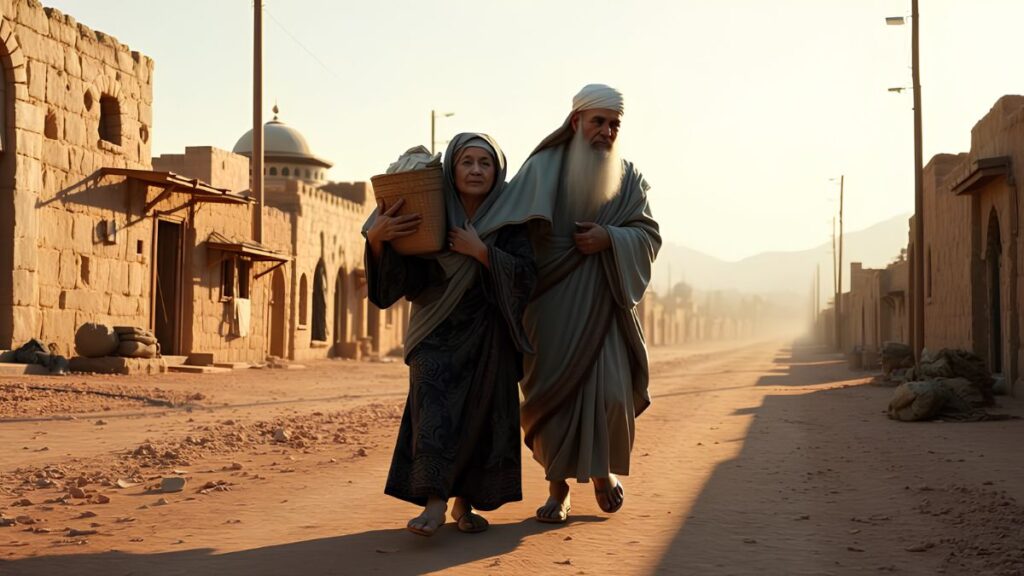
The streets of Makkah were already busy when the elderly woman stepped out of her small home.
The morning sun had begun to rise above the city, casting long shadows across the dusty paths that connected homes, markets, and gathering places. Merchants were preparing their stalls. Travelers moved through the streets. Neighbors greeted one another as they began another day.
The woman adjusted the cloth covering her head and looked down at the bundle resting beside her doorway.
It wasn’t particularly large.
But for someone her age, it was heavy enough.
Years had slowly weakened her strength.
Tasks that once seemed simple now required effort.
Carrying water.
Walking long distances.
Lifting supplies.
Even ordinary errands could become difficult.
She sighed softly.
The bundle needed to be moved across the city to a relative’s home.
There was no avoiding the journey.
Yet she wasn’t looking forward to it.
As she stood there wondering what to do, she noticed a man walking nearby.
His appearance was simple.
Nothing about him suggested wealth or importance.
He walked calmly through the street, greeting people as he passed.
The woman called out.
“Young man.”
He stopped immediately and turned toward her.
“Yes?”
“Would you help me carry this bundle?”
The man glanced at the package and then smiled.
“Of course.”
Without hesitation, he lifted it onto his shoulder.
The woman felt relieved.
“Thank you,” she said.
“Which way shall we go?” he asked.
She pointed toward a distant section of the city.
The man nodded.
Then they began walking together.
The woman appreciated the assistance.
Yet as they traveled through the streets, her thoughts turned toward a subject she often discussed with others.
Recently, many people in the city had been talking about Muhammad.
Some supported him.
Others opposed him.
Opinions seemed divided.
The elderly woman happened to belong to the second group.
She had heard rumors.
She had listened to criticism.
She had formed strong opinions based largely on what others told her.
And like many people, she rarely questioned those assumptions.
As they walked, she began speaking.
“Have you heard about Muhammad?” she asked.
The man carrying the bundle looked at her calmly.
“Yes,” he replied.
The woman shook her head.
“I don’t understand why people follow him.”
The man listened quietly.
She continued.
Some of her comments reflected misunderstandings.
Others repeated rumors she had heard from neighbors.
A few were openly critical.
Yet throughout the conversation, the man remained silent.
He did not interrupt.
He did not argue.
He did not become angry.
Instead, he simply continued carrying the heavy bundle.
The woman barely noticed.
She was too focused on sharing her opinions.
Street after street, they continued their journey.
The city slowly awakened around them.
Shopkeepers opened doors.
Children played in narrow alleyways.
People exchanged greetings.
The man remained patient throughout.
Whenever the woman needed to stop and rest, he waited.
Whenever she spoke, he listened respectfully.
His calm demeanor never changed.
Eventually, they reached a quieter section of the city.
The relative’s home was nearby.
The elderly woman felt relieved.
The journey had taken longer than expected.
Without assistance, she might never have completed it alone.
The man carefully lowered the bundle near the entrance.
“There we are,” he said kindly.
The woman smiled.
“You’ve been very helpful.”
“It was no trouble.”
For a moment, they stood quietly.
Then curiosity led her to ask a question.
“What is your name?”
The man answered simply.
“I am Muhammad.”
The woman froze.
For several seconds, she said nothing.
Surely she had misunderstood.
The name echoed in her mind.
Muhammad.
The same person she had criticized throughout the entire journey.
The same person she had spoken against while he carried her belongings.
The same person who had listened patiently without a single harsh word.
Suddenly, everything felt different.
She remembered her comments.
Her assumptions.
Her criticism.
Embarrassment washed over her.
The man standing before her did not resemble the image she had formed in her mind.
He had shown patience.
Respect.
Kindness.
Generosity.
Not once had he responded with anger.
Not once had he attempted to humiliate her.
Not once had he treated her poorly despite hearing her criticism.
The contrast was impossible to ignore.
The woman lowered her gaze.
“I spoke unfairly,” she said quietly.
Muhammad (peace be upon him) responded gently.
“You spoke according to what you believed.”
There was no bitterness in his voice.
No resentment.
Only calm understanding.
The woman’s eyes filled with emotion.
For years, she had assumed character could be judged through rumors and opinions.
Now she realized how mistaken she had been.
True character is revealed through actions.
And the actions she had witnessed that day spoke louder than any story she had heard.
She looked at the bundle resting beside the doorway.
The task had been difficult for her.
Yet this man had carried it without complaint.
He had given his time freely.
He had listened respectfully.
He had responded to criticism with patience.
The lesson felt larger than the moment itself.
Muhammad wished her well and prepared to leave.
The woman watched him walk away.
His pace remained steady.
His posture relaxed.
Soon he disappeared into the busy streets once again.
Yet the encounter remained with her.
Long after he was gone.
In the days that followed, she thought about the journey often.
Not because carrying a bundle was remarkable.
People helped one another every day.
What made the experience memorable was the kindness behind it.
Many people are kind when treated kindly.
Many people remain patient when praised.
The greater challenge is maintaining good character when faced with criticism.
That was what impressed her most.
She began paying closer attention to how she formed opinions.
How often had she accepted rumors without verification?
How often had she judged someone without truly knowing them?
How often had assumptions replaced understanding?
The experience encouraged reflection.
And reflection encouraged growth.
Over time, she shared the story with others.
Not to draw attention to herself.
But to explain what she had learned.
Whenever people spoke harshly about someone they barely knew, she remembered the journey.
Whenever gossip spread through conversations, she remembered the journey.
Whenever assumptions replaced firsthand experience, she remembered the journey.
The lesson remained simple.
People should be judged by their actions rather than rumors.
Kindness should not depend upon receiving kindness in return.
Respect should not disappear when disagreements arise.
Years later, the story continued to be shared because of its timeless message.
Every generation encounters misunderstandings.
Every community experiences disagreements.
Every person eventually faces criticism.
The response to those situations often reveals character.
It is easy to be kind when circumstances are favorable.
It is more difficult when treated unfairly.
Yet that is often when kindness matters most.
The story also reminds readers that small acts of service can have unexpected impacts.
Muhammad (peace be upon him) did not deliver a lengthy speech.
He did not engage in an argument.
He did not attempt to prove a point through debate.
Instead, he helped carry a bundle.
A simple act.
An ordinary act.
Yet it changed someone’s perspective more effectively than any argument could have.
Actions possess a unique power.
People may forget words.
They may forget opinions.
But they often remember how someone treated them.
The elderly woman certainly did.
What began as an ordinary request for assistance became an unforgettable lesson about patience, humility, and compassion.
The memory remained long after the bundle reached its destination.
And the lesson continues to resonate today.
In a world where disagreements are common and judgments are often made quickly, the story encourages a different approach.
Listen before reacting.
Help without expecting praise.
Treat others with dignity.
Respond to criticism with patience.
Allow actions to reflect character.
These values remain as meaningful now as they were then.
The journey across the city eventually ended.
The bundle was delivered.
The task was completed.
Yet something far more important had occurred along the way.
An assumption had been challenged.
A heart had been softened.
And a powerful lesson had been learned.
Lesson
True kindness does not depend on how others treat us. Real character is revealed when we choose patience, respect, and compassion even in difficult situations. Small acts of kindness often leave the deepest and most lasting impressions.
Sharing Food With Others
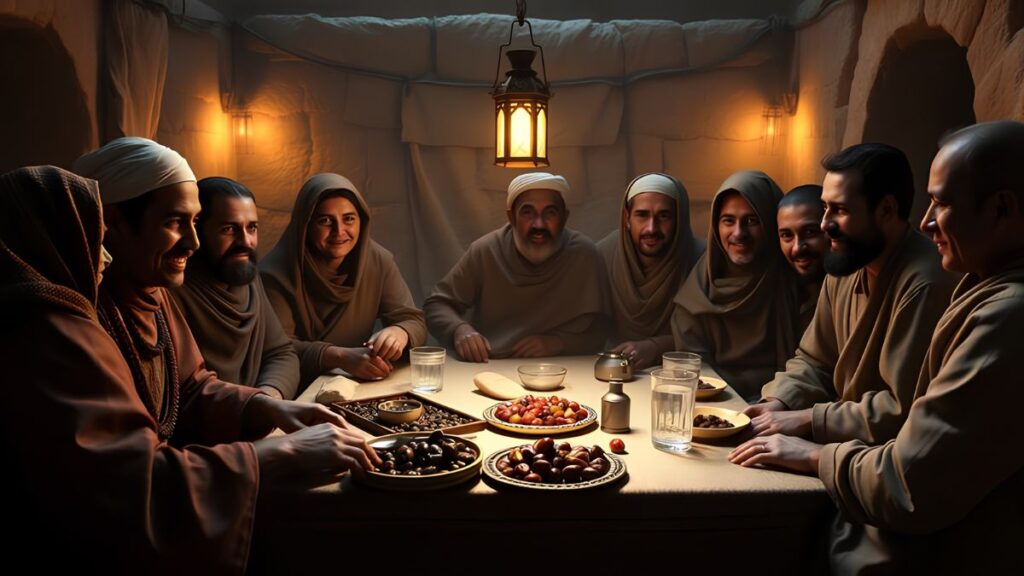
The sun was beginning to set over Madinah.
The heat of the day slowly faded, replaced by a gentle evening breeze that moved through the narrow streets and courtyards of the city. Families returned to their homes after a day of work. Merchants packed away their goods. Children finished their games and followed the familiar calls of their parents.
For many households, evening meant gathering for a meal.
Some families had plenty.
Others had very little.
Yet despite these differences, one value remained deeply rooted within the community.
People looked after one another.
This spirit of generosity was encouraged by Prophet Muhammad (peace be upon him), who taught that food was not merely something to satisfy hunger. It was also a means of strengthening relationships, supporting neighbors, and expressing gratitude for blessings.
One evening, a man arrived at the mosque looking tired and hungry.
His clothing showed signs of travel.
Dust covered his sandals.
The long journey had clearly exhausted him.
After greeting those present, he explained that he had little food and nowhere to stay.
Such situations were not uncommon.
Travelers frequently arrived in Madinah seeking assistance, guidance, or simply a place to rest before continuing their journeys.
The community understood that travelers often depended upon the kindness of strangers.
When Prophet Muhammad (peace be upon him) learned of the visitor’s situation, arrangements were made to help him.
The traveler was not treated as an inconvenience.
Nor was he viewed as a burden.
Instead, people considered how they could assist.
Several individuals offered what they could.
Some had food.
Others had space in their homes.
Each contribution, no matter how small, carried value.
The traveler was welcomed and cared for.
That evening became one of many examples demonstrating the importance of hospitality and generosity.
The lesson extended beyond a single meal.
It reflected a broader attitude toward sharing resources and caring for others.
In those days, life was not always easy.
Many families possessed only modest means.
Food was valuable.
Every loaf of bread mattered.
Every date mattered.
Every meal required effort.
Yet despite limited resources, people were encouraged to share.
The principle seemed simple.
If a person had enough for themselves, perhaps they could help someone else as well.
Even a small amount could make a difference.
One afternoon, a young boy walked through the marketplace carrying a basket of dates.
The basket was not full.
His family had harvested only a modest amount that season.
As he passed through the streets, he noticed an elderly man sitting nearby.
The man appeared tired.
Perhaps he had been working.
Perhaps he had traveled a long distance.
Whatever the reason, he looked hungry.
The boy paused.
He looked at the dates.
Then he looked at the man.
Without hesitation, he approached and offered a handful.
The elderly man smiled warmly.
“Thank you.”
The boy returned the smile and continued walking.
The exchange lasted only a few seconds.
Yet moments like these helped shape the culture of the community.
People learned that generosity did not require wealth.
It required willingness.
A person with little could still share.
A person with limited means could still help.
A small gift could carry great meaning.
Prophet Muhammad (peace be upon him) frequently emphasized this idea.
The value of generosity was not measured solely by quantity.
Intentions mattered.
Sacrifice mattered.
Compassion mattered.
A simple meal shared sincerely could hold tremendous significance.
This perspective transformed the way many people viewed giving.
Instead of focusing on how much they possessed, they considered how they could help.
One family might share bread.
Another might share dates.
Someone else might offer water.
Each contribution strengthened bonds within the community.
Over time, these acts created a culture of mutual support.
Neighbors knew one another.
Families checked on one another.
People paid attention to those facing hardship.
No system was perfect.
Challenges remained.
Poverty still existed.
Difficulties still arose.
Yet generosity helped ease many burdens.
One evening, a woman prepared dinner for her family.
The meal was simple.
A few pieces of bread.
Some dates.
A small portion of food carefully divided among household members.
As preparations were nearly complete, a knock sounded at the door.
The woman opened it.
Outside stood a visitor.
The guest appeared hungry and uncertain.
Without hesitation, the family welcomed him inside.
The meal was shared.
Everyone received a little less than originally planned.
Yet no one complained.
The presence of a guest was viewed as an opportunity to show kindness.
The visitor left feeling grateful.
The family remained grateful as well.
They understood that generosity often enriches both the giver and the receiver.
Stories like these became common within the community.
Children observed them.
Parents taught them.
Neighbors practiced them.
Over time, sharing food became more than a charitable act.
It became a reflection of character.
People understood that meals could bring individuals together.
Conversations occurred around food.
Friendships developed around food.
Support was often expressed through food.
When someone experienced hardship, neighbors frequently arrived with meals.
When travelers appeared, food was offered.
When celebrations occurred, food was shared widely.
The simple act of eating together helped strengthen relationships.
Years passed.
The community continued growing.
New families arrived.
New friendships formed.
The city evolved.
Yet the principle remained constant.
Food was not meant to be hoarded while others suffered nearby.
Blessings carried responsibilities.
Those who possessed resources were encouraged to consider the needs of others.
One particularly dry season tested the community.
Harvests were smaller than usual.
Resources became more limited.
Many families worried about the future.
Yet even during difficult times, acts of generosity continued.
Perhaps the portions were smaller.
Perhaps meals were simpler.
But people still shared.
These moments revealed an important truth.
Generosity becomes most meaningful when circumstances are challenging.
Sharing abundance is valuable.
Sharing during scarcity often requires greater sacrifice.
That sacrifice demonstrates sincerity.
It reflects genuine concern for others.
The lessons taught by Prophet Muhammad (peace be upon him) encouraged precisely this kind of character.
Generosity was not viewed as an occasional action reserved for special situations.
It was intended to become a habit.
A way of living.
A natural response to the needs of others.
The impact extended beyond individual meals.
Communities became stronger.
Trust increased.
Relationships deepened.
People felt less isolated during difficult times.
Knowing that others cared created a sense of belonging.
Years later, many people continued sharing stories about meals that had brought individuals together.
Not because the food itself was extraordinary.
Because the kindness behind it was memorable.
A loaf of bread shared with a neighbor.
A bowl of food offered to a traveler.
Dates given to someone in need.
These gestures remained meaningful long after the meals were finished.
The stories survived because they reflected values that transcend time and place.
Modern life may look very different from seventh-century Madinah.
Cities are larger.
Technology shapes daily routines.
Communities function differently.
Yet the underlying lesson remains remarkably relevant.
People still experience loneliness.
Families still face hardships.
Neighbors still need support.
Acts of generosity continue to make a difference.
A shared meal can still strengthen relationships.
A thoughtful gesture can still brighten someone’s day.
A simple act of kindness can still create lasting memories.
This is one reason stories about sharing food remain so powerful.
They remind readers that generosity is accessible to everyone.
One does not need great wealth to make a meaningful contribution.
Kindness often begins with whatever resources are available.
A meal.
A snack.
A drink.
A seat at the table.
The value lies not only in what is given but in the spirit with which it is shared.
As the years passed, countless meals were shared throughout the community.
Most were ordinary.
Many were simple.
Yet together they formed something extraordinary.
A culture built upon compassion.
A community strengthened through generosity.
A tradition of caring for others.
These lessons continue inspiring people today.
Whether through large acts of charity or small everyday gestures, the principle remains unchanged.
Sharing what we have, even when it seems limited, can create meaningful connections and positive change.
And often, the kindness behind the gift matters far more than the size of the gift itself.
Lesson
Generosity often matters more than the amount being given. A small meal shared with sincerity can strengthen relationships, support those in need, and create lasting bonds within a community. Even limited resources can become a source of great kindness when people choose to share them with others.
The Visitor at the Door

The evening air in Madinah had begun to cool.
After a long day beneath the desert sun, people gradually returned to their homes. The streets became quieter as families gathered for their evening meals. Lamps were lit. Conversations drifted through courtyards. The city settled into the peaceful rhythm that often arrived after sunset.
For many households, dinner was simple.
Resources were not always plentiful.
Some families had enough.
Others managed with very little.
Yet despite the challenges of daily life, one value remained deeply respected throughout the community.
A guest was never meant to feel unwanted.
Hospitality was considered an important expression of kindness, generosity, and respect.
One evening, a traveler arrived in Madinah.
The journey had been long.
Dust covered his clothes.
His face reflected fatigue from many days on the road.
Like many travelers before him, he had come seeking assistance and a place to rest.
Travel in those days was difficult.
Roads stretched across deserts and open land.
Journeys often lasted days or even weeks.
Food could become scarce.
Water was precious.
Travelers frequently depended upon the goodwill of strangers.
The man eventually made his way to the gathering where Prophet Muhammad (peace be upon him) was present.
After greeting those around him, he explained his situation.
He was tired.
Hungry.
And far from home.
The community listened carefully.
Everyone understood the challenges travelers faced.
Helping those in need was considered a shared responsibility.
Yet on this particular evening, circumstances were not easy.
Resources were limited.
Many households had only enough food for their own families.
Even simple meals required careful planning.
Still, the visitor’s need could not be ignored.
Prophet Muhammad (peace be upon him) encouraged those present to consider how they might help.
The request was not treated as a burden.
Instead, it was viewed as an opportunity to demonstrate kindness.
Among those listening was a man who quietly considered the situation.
His family did not have much.
The meal waiting at home was modest.
Enough for the household, but not much more.
Yet he understood the importance of hospitality.
He approached and offered to welcome the traveler into his home.
The visitor gratefully accepted.
Together they walked through the streets of Madinah toward the man’s house.
Along the way, the host thought about the meal waiting for them.
He knew there was very little food available.
Certainly not enough for everyone to eat comfortably.
Yet he remained determined to ensure that the guest felt welcomed.
When they arrived, the host greeted his family and quietly explained the situation.
The household immediately understood.
The guest’s comfort became a shared concern.
No one complained.
No one suggested turning the visitor away.
Instead, they discussed how best to care for him.
The meal was prepared.
Simple food was placed before the guest.
The family focused on making him feel comfortable and valued.
Hospitality was not measured by the size of the meal.
It was reflected in the attitude with which it was offered.
The traveler noticed the warmth of the welcome.
He noticed the kindness in their words.
He noticed the effort they made to ensure he felt at ease.
Those gestures meant as much as the food itself.
For someone far from home, simple kindness can provide tremendous comfort.
The evening passed peacefully.
The guest shared stories from his journey.
The family listened with interest.
Conversations flowed naturally.
Laughter occasionally filled the room.
For a short time, strangers became companions.
The traveler no longer felt alone.
This was one of the hidden strengths of hospitality.
It provided more than food.
It created connection.
It transformed unfamiliar places into welcoming spaces.
It reminded people that they were valued.
The next morning, the traveler prepared to continue his journey.
Before leaving, he expressed sincere gratitude.
The kindness shown to him would remain in his memory long after the trip ended.
The family wished him safe travels.
Then they returned to their daily routines.
To outside observers, the event may have seemed ordinary.
A guest arrived.
A meal was shared.
A traveler continued his journey.
Yet beneath the simplicity of the story lies an important lesson.
Hospitality often has the greatest impact during difficult circumstances.
Welcoming others when resources are abundant is valuable.
Welcoming others when resources are limited reflects a deeper level of generosity.
The people of Madinah understood this principle well.
Their hospitality was not dependent upon wealth.
It was rooted in compassion.
They recognized that every person carries unseen burdens.
A traveler may be exhausted.
A visitor may be lonely.
A guest may be worried about the future.
Simple kindness can ease those burdens.
For this reason, hospitality became an important part of community life.
Visitors were greeted warmly.
Travelers received assistance.
Guests were treated with dignity and respect.
The goal was not to impress others with wealth or luxury.
The goal was to make people feel welcomed.
Many years later, stories like this continued to be shared.
Not because of elaborate feasts or grand celebrations.
Because they demonstrated values that remain meaningful across generations.
People remember how they are treated.
Long after details fade, kindness often remains.
A welcoming smile.
A warm greeting.
A shared meal.
A place to rest.
These gestures can leave lasting impressions.
The story also highlights an important aspect of generosity.
Many people assume generosity requires abundance.
They imagine that meaningful giving is only possible when resources are plentiful.
Yet stories from the life of Prophet Muhammad (peace be upon him) frequently challenge that assumption.
True generosity is often measured by willingness rather than wealth.
A person with little can still be generous.
A family facing challenges can still show kindness.
Hospitality begins with intention.
The desire to care for another person.
The desire to make someone feel valued.
The desire to offer comfort when possible.
These qualities remain accessible to everyone.
As communities grow and modern life becomes increasingly busy, the lesson remains relevant.
People still move to unfamiliar places.
Travelers still face challenges.
Neighbors still experience difficult times.
Many individuals feel isolated or overlooked.
Acts of hospitality continue to provide comfort and connection.
Inviting someone to share a meal.
Checking on a neighbor.
Welcoming a newcomer.
Offering assistance during difficult times.
These actions strengthen communities and build meaningful relationships.
The story reminds readers that kindness does not need to be complicated.
Often, the most memorable gestures are surprisingly simple.
A door opened.
A meal shared.
A guest welcomed.
A traveler cared for.
Through such actions, people communicate an important message:
“You matter.”
That message can have a lasting impact.
The visitor eventually completed his journey.
The family continued with their lives.
The evening became part of the countless small moments that shape strong communities.
Yet the lesson endured.
Hospitality is more than tradition.
It is a practical expression of compassion.
It turns strangers into friends.
It transforms houses into homes.
It creates belonging.
And it reminds people that even during difficult circumstances, kindness remains possible.
The people involved in the story may not have considered their actions extraordinary.
They simply responded to a need.
Yet those ordinary actions continue to inspire because they reveal something timeless about human character.
When people choose generosity over selfishness and welcome over indifference, communities become stronger.
Lives become brighter.
And simple acts of kindness create memories that last far longer than the meal itself.
Lesson
Hospitality is a powerful form of kindness. Making people feel welcomed, valued, and cared for can have a lasting impact, even when resources are limited. Often, it is not the size of the gift that matters most, but the warmth and sincerity with which it is offered.
The Lost Trust

The city of Makkah was built on relationships.
Merchants depended on one another. Travelers relied on guides. Families supported relatives. Business agreements were often made with little more than a conversation and a promise.
In such a world, trust was one of the most valuable possessions a person could have.
Money could be lost.
Goods could be damaged.
Fortunes could change.
But trust, once broken, was difficult to restore.
For this reason, people paid close attention to character.
They observed how others behaved.
They remembered promises.
They noticed who spoke honestly and who did not.
Among the people of Makkah, one man became widely known for his reliability.
That man was Muhammad (peace be upon him).
Long before prophethood, many people referred to him as Al-Amin, meaning “The Trustworthy.”
It was not a title awarded through wealth or influence.
It was earned through years of honesty, fairness, and consistent behavior.
People trusted him because experience had taught them that he could be trusted.
Whenever disputes arose, many sought his judgment.
Whenever agreements were made, his word carried weight.
Whenever valuable belongings needed protection, people often placed them in his care.
His reputation spread throughout the city.
Even individuals who disagreed with him on certain matters acknowledged his honesty.
Trust transcended differences.
People knew that when Muhammad accepted a responsibility, he would fulfill it.
One hot afternoon, a merchant prepared for a long trading journey.
The route stretched across difficult terrain.
The trip would take weeks.
Perhaps months.
Travelers often faced uncertainty.
Storms could delay caravans.
Roads could become dangerous.
Unexpected challenges frequently appeared.
The merchant owned several valuable items he did not wish to carry.
Some were personal belongings.
Others held significant financial value.
Leaving them unattended would be risky.
Taking them along could be equally dangerous.
After considering his options, he chose to leave the possessions with Muhammad.
The decision required little thought.
He trusted him completely.
When the merchant arrived, he carefully handed over the items.
“Muhammad,” he said, “I may be gone for some time. Would you keep these safe until I return?”
Muhammad accepted the responsibility.
The merchant thanked him and departed with peace of mind.
The journey ahead remained uncertain.
But he had no concerns about his belongings.
They were in trustworthy hands.
Weeks passed.
Then months.
Eventually the merchant returned to Makkah.
The journey had been successful, but exhausting.
After greeting family and friends, one of his first tasks was retrieving the items he had entrusted to Muhammad.
When he arrived, everything was returned exactly as it had been received.
Nothing was missing.
Nothing had been altered.
Nothing had been damaged.
The merchant smiled.
The outcome was exactly what he expected.
Yet that expectation itself revealed something important.
Trust had become so firmly established that honesty was assumed.
Muhammad’s reputation was not built upon occasional good deeds.
It was built upon consistency.
People knew what to expect because they had witnessed the same integrity repeatedly.
This pattern continued throughout his life.
Again and again, individuals placed their confidence in him.
Again and again, that confidence proved justified.
One day, a young man asked an older resident of Makkah a simple question.
“Why do so many people trust Muhammad?”
The older man thought for a moment before answering.
“Because he has given them every reason to.”
The young man waited for more.
The older man continued.
“Trust is not created through words alone. It grows through actions. Every promise kept. Every responsibility fulfilled. Every truthful statement. Over time, people learn who they can rely upon.”
The lesson remained with the young man.
Years later, he would remember those words whenever questions of character arose.
Trust develops slowly.
Yet it influences nearly every part of life.
Families depend upon trust.
Friendships depend upon trust.
Communities depend upon trust.
Without it, relationships become fragile.
With it, relationships become strong.
The people of Makkah understood this well.
Perhaps that is why Muhammad’s reputation became so widely respected.
He demonstrated that trustworthiness was not limited to major decisions.
It appeared in everyday behavior.
How he spoke.
How he conducted business.
How he treated others.
How he fulfilled obligations.
Small actions accumulated over time.
Together they created confidence.
This principle became especially important during difficult periods.
Life is relatively easy when circumstances are favorable.
Character becomes clearer when challenges arise.
Moments of pressure reveal priorities.
They reveal whether a person remains committed to honesty when dishonesty would be easier.
Muhammad’s commitment never wavered.
His integrity remained steady regardless of circumstance.
People noticed.
And because they noticed, trust continued growing.
One evening, a group of merchants gathered after a busy day in the marketplace.
As often happened, conversation turned toward business.
Someone mentioned a recent dispute involving a dishonest trader.
The disagreement had caused financial losses and damaged several relationships.
The merchants discussed the situation thoughtfully.
Eventually, one of them said,
“The loss of money can be recovered.”
Several others nodded.
Then he added,
“But the loss of trust is far more difficult.”
Everyone understood what he meant.
Wealth can be rebuilt.
Possessions can be replaced.
Trust requires something different.
It requires time.
Consistency.
Patience.
And integrity.
Those qualities had become closely associated with Muhammad.
His reputation demonstrated that trust is earned through countless ordinary choices.
A person does not suddenly become trustworthy.
Trustworthiness develops gradually.
Each truthful action contributes.
Each fulfilled responsibility strengthens confidence.
Each act of integrity adds another layer.
Years later, stories about his honesty continued to circulate.
Parents shared them with children.
Teachers discussed them with students.
Community leaders pointed to them as examples of good character.
The stories survived because their lessons remained relevant.
Human societies continue to depend upon trust.
Businesses require trust.
Friendships require trust.
Families require trust.
Communities require trust.
Technology may change.
Cultures may evolve.
Yet the importance of trust remains constant.
Modern life provides countless opportunities to demonstrate reliability.
Returning borrowed items.
Keeping promises.
Meeting responsibilities.
Being truthful even when honesty is inconvenient.
Respecting confidential information.
Acting fairly when nobody is watching.
These actions may seem small individually.
Yet together they shape reputation.
The same principle applied in Makkah centuries ago.
And it applies today.
One reason the story of trustworthiness continues to resonate is that everyone has experienced both sides of trust.
Most people know what it feels like to rely upon someone dependable.
Most people also know the disappointment that follows broken promises.
These experiences highlight the importance of integrity.
Trust creates security.
It creates confidence.
It allows people to cooperate and build meaningful relationships.
Without trust, uncertainty grows.
With trust, communities flourish.
The story of Muhammad’s reputation as Al-Amin reminds readers that character often develops quietly.
There may be no applause.
No public recognition.
No immediate reward.
Yet every honest choice contributes to something valuable.
Over time, people begin to notice.
Confidence grows.
Respect develops.
Relationships strengthen.
The impact extends far beyond individual actions.
Perhaps this is why so many people entrusted their belongings to him.
The valuables themselves mattered.
But the deeper significance lay elsewhere.
Every item represented confidence.
Every responsibility reflected trust.
Every act of safekeeping demonstrated reliability.
And every fulfilled responsibility reinforced the reputation that had already become widely known.
The story is not merely about possessions.
It is about character.
It is about honoring commitments.
It is about recognizing that trust, once earned, becomes one of life’s greatest assets.
Long after money is spent and material possessions fade, a reputation for honesty can continue influencing others.
People remember integrity.
People remember reliability.
People remember those whose actions consistently matched their words.
That was the foundation of Muhammad’s reputation.
Not wealth.
Not status.
Not power.
Trust.
Built patiently over many years through honesty and responsibility.
And because that trust was honored again and again, it became one of the defining qualities remembered throughout history.
Lesson
Trustworthiness is one of the foundations of strong relationships. Trust is earned through consistent honesty, reliability, and integrity. Every promise kept and every responsibility fulfilled helps build confidence that can last a lifetime.
Kindness to Children
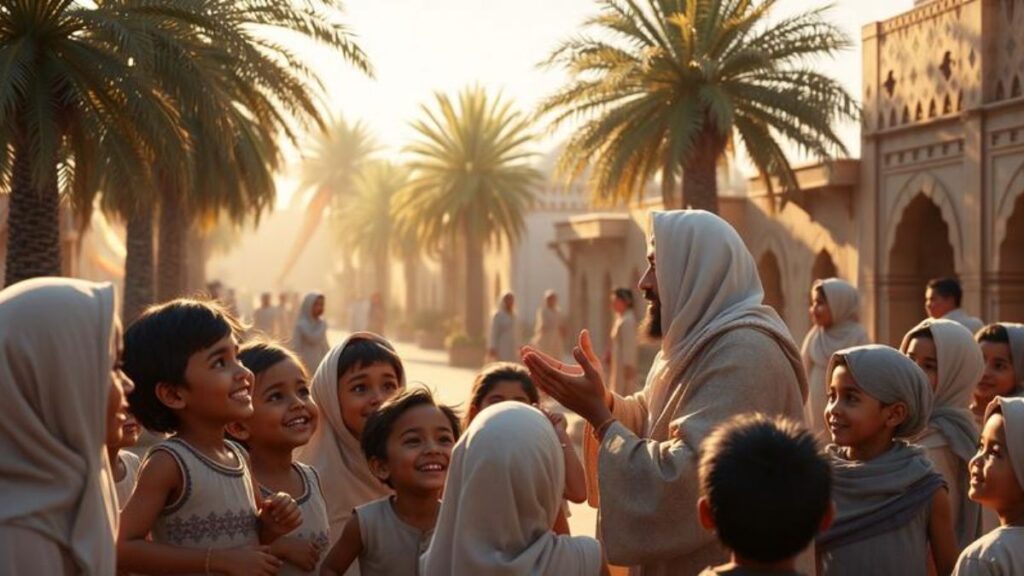
The streets of Madinah were filled with life.
Merchants arranged their goods in the marketplace. Neighbors greeted one another as they passed through narrow pathways. Families went about their daily routines, and children filled the city with energy and laughter.
Some chased one another through open spaces.
Others played games with sticks, stones, or simple handmade toys.
Their laughter echoed between homes and courtyards, adding warmth to everyday life.
For many adults, children were often expected to remain quiet and stay out of the way.
Yet Prophet Muhammad (peace be upon him) viewed children differently.
He understood that children were not merely future members of society.
They were important members of the community in the present.
They deserved kindness.
They deserved patience.
And they deserved respect.
One afternoon, a group of children were playing near a pathway as people moved through the city.
They laughed loudly as they raced each other beneath the afternoon sun.
Most adults walking by paid little attention.
Some smiled briefly before continuing on their way.
Others were focused on their work and responsibilities.
Then the children noticed Prophet Muhammad (peace be upon him) approaching.
Immediately, several of them stopped playing.
Their faces brightened.
Rather than simply walking past, he greeted them warmly.
“Peace be upon you.”
The children eagerly returned the greeting.
Some stepped closer.
Others smiled shyly.
A few continued standing back, curious but hesitant.
Muhammad (peace be upon him) spoke to them kindly and asked about their games.
The children answered excitedly.
What may have seemed like a small interaction left a lasting impression.
The children felt seen.
They felt valued.
Someone important had taken the time to acknowledge them.
For a child, such moments can be deeply meaningful.
Children often remember how adults make them feel.
Years later, details may fade.
Yet feelings of kindness and respect frequently remain.
This was one reason these interactions became memorable.
They demonstrated that leadership and compassion could exist together.
Many people associate leadership with authority.
They imagine leaders issuing instructions or making decisions.
Yet true leadership often includes listening.
It includes understanding.
It includes showing concern for others regardless of age or status.
Muhammad (peace be upon him) consistently demonstrated these qualities.
One day, a young boy approached him carrying a small bird.
The child was proud of his pet and cared for it deeply.
Like many children, he enjoyed talking about the things that mattered most to him.
Some adults might have dismissed the conversation.
After all, they had more important concerns.
More serious responsibilities.
More pressing matters.
Yet Muhammad listened.
He understood that what seemed small to an adult could feel important to a child.
Listening communicated respect.
Respect strengthened confidence.
The boy felt heard.
And because he felt heard, the interaction remained meaningful.
On another occasion, children gathered nearby while adults were engaged in conversation.
The adults discussed important matters.
Trade.
Family concerns.
Community issues.
Topics that seemed far removed from childhood interests.
Yet when children approached, they were not treated as interruptions.
Muhammad welcomed them warmly.
He understood that kindness shown during childhood could influence a person’s confidence and character for years to come.
Small gestures mattered.
A greeting.
A smile.
A kind word.
A moment of attention.
These simple actions often carried more significance than people realized.
As the years passed, many children grew up remembering such moments.
They remembered being greeted respectfully.
They remembered being treated with patience.
They remembered feeling valued.
These experiences helped shape how they viewed themselves and others.
One particularly warm afternoon, a young boy sat quietly near a gathering.
Unlike the other children, he wasn’t playing.
He seemed distracted.
Thoughtful.
Perhaps even a little sad.
Many adults passed without noticing.
Yet Muhammad observed him.
He approached gently and spoke with him.
The conversation was simple.
The details were not extraordinary.
What mattered was the attention.
The willingness to notice.
The willingness to care.
Sometimes kindness begins with awareness.
Noticing when someone needs encouragement.
Recognizing when someone feels overlooked.
Taking time to listen.
Children are often especially sensitive to these moments.
They quickly recognize genuine concern.
And they remember it.
The community of Madinah gradually learned from these examples.
Parents observed them.
Neighbors observed them.
Teachers observed them.
Many began treating children with greater patience and understanding.
The impact extended beyond individual interactions.
It influenced the broader culture of the community.
Children were increasingly viewed not as inconveniences but as individuals deserving respect.
This perspective strengthened families.
It strengthened relationships.
And it helped create an environment where young people could develop confidence and character.
One evening, a father returned home after a difficult day.
Work had been exhausting.
Problems demanded attention.
His mind remained occupied with responsibilities.
As he entered the house, his young daughter ran toward him excitedly.
She wanted to tell him about her day.
At first, he barely listened.
His thoughts remained elsewhere.
Then he remembered the examples he had witnessed.
The kindness.
The patience.
The willingness to give children attention.
So he stopped.
He knelt beside her.
And he listened.
The story she shared was simple.
Perhaps even ordinary.
Yet to her, it mattered.
And because he listened, she felt important.
Years later, moments like that often become cherished memories.
Children rarely remember every gift they receive.
They rarely remember every toy or possession.
But they often remember being listened to.
They remember being encouraged.
They remember feeling loved and respected.
These are the experiences that help shape identity.
The lessons taught through kindness to children remain remarkably relevant today.
Modern life is often busy.
Schedules are full.
Responsibilities compete for attention.
Many adults feel constantly distracted.
Yet children continue needing the same things they always have.
Patience.
Encouragement.
Guidance.
Respect.
Time.
The examples from the life of Prophet Muhammad (peace be upon him) remind readers that meaningful interactions do not always require grand gestures.
Often, simple moments matter most.
Greeting a child warmly.
Listening carefully.
Offering encouragement.
Showing patience when mistakes occur.
These actions help children develop confidence.
They help children feel valued.
And they contribute to healthy emotional growth.
Another important lesson emerges from these stories.
Respect should not be reserved only for adults.
Children deserve dignity as well.
Treating young people with respect teaches them how to respect others.
Showing kindness teaches kindness.
Demonstrating patience teaches patience.
Children often learn more from examples than instructions.
The behavior they experience frequently influences the behavior they later demonstrate.
This is why compassion toward children carries such long-term significance.
Its effects extend beyond a single moment.
They ripple outward into families, friendships, and communities.
The child who feels respected often grows into an adult who respects others.
The child who experiences kindness often becomes someone who shows kindness.
The child who is listened to often learns to listen.
These lessons continue across generations.
As the sun set over Madinah each evening, children returned to their homes after a day of learning, playing, and exploring.
Some carried memories of conversations.
Others remembered smiles or greetings.
Many remembered moments when they felt valued.
To adults, those interactions may have seemed ordinary.
To children, they often meant much more.
This gentle approach to leadership revealed an important truth.
Greatness is not measured solely by major achievements.
It is also reflected in everyday compassion.
In taking time to notice others.
In offering encouragement.
In treating every person with dignity.
Including the youngest members of society.
The stories of kindness toward children continue to inspire because they highlight universal values.
Compassion.
Patience.
Respect.
Understanding.
These qualities remain just as important today as they were centuries ago.
And they remind us that investing time and kindness in children is one of the most meaningful ways to strengthen individuals, families, and communities.
Lesson
Respecting children helps build confidence and character. Simple acts of kindness, patience, and attention can leave lasting impressions and help young people grow into compassionate, confident, and respectful adults.
Forgiving an Enemy

The afternoon sun hung high above the city.
People moved through the streets, attending to their daily responsibilities. Merchants welcomed customers into their shops. Families gathered in their homes. Travelers arrived from distant places carrying stories of the roads they had crossed.
Life continued as it always had.
Yet beneath the ordinary rhythm of daily life, people carried memories.
Some memories brought happiness.
Others brought pain.
And among the most difficult memories were those involving conflict.
Throughout history, disagreements have existed between individuals, families, and communities. Hurt feelings, misunderstandings, and acts of injustice often leave lasting wounds.
When people are wronged, the desire for revenge can feel natural.
Many believe that retaliation restores dignity.
Many assume that responding to harm with equal harm demonstrates strength.
Yet Prophet Muhammad (peace be upon him) often showed a different path.
Again and again, he demonstrated that forgiveness could achieve what anger and retaliation could not.
His examples taught that mercy is not weakness.
Rather, it often requires greater strength than revenge.
One day, a man approached a gathering with visible hesitation.
His expression revealed uncertainty.
Perhaps even fear.
Those nearby recognized him.
In the past, he had spoken harshly.
He had opposed people.
He had caused difficulties.
Many remembered his actions clearly.
Some believed he deserved criticism.
Others believed he deserved punishment.
The man himself likely expected hostility.
After all, people often receive the same treatment they have previously shown to others.
Yet as he approached, he was met with calmness.
Not anger.
Not humiliation.
Not revenge.
Instead, he encountered dignity and mercy.
The reaction surprised him.
Perhaps it surprised others as well.
The situation offered an opportunity for retaliation.
Many people would have seized it.
Many would have reminded him of past mistakes.
Many would have demanded repayment for previous wrongs.
Yet forgiveness changed the outcome entirely.
The man left with a different understanding.
Mercy had accomplished what hostility never could.
It opened the door to reflection.
It created the possibility of reconciliation.
And it demonstrated a powerful truth:
People often change more through kindness than through punishment.
This lesson appeared repeatedly throughout the life of Prophet Muhammad (peace be upon him).
When opportunities for revenge arose, he frequently chose forgiveness.
This choice did not mean ignoring wrongdoing.
Nor did it mean pretending harmful actions never occurred.
Rather, it reflected a belief that healing relationships often produces better outcomes than prolonging conflict.
One evening, two neighbors became involved in a disagreement.
What began as a minor misunderstanding gradually grew into a larger conflict.
Words were exchanged.
Feelings were hurt.
Pride prevented either person from taking the first step toward peace.
Days passed.
Then weeks.
Neither neighbor spoke to the other.
The distance between them continued growing.
Eventually, an elder from the community visited both men.
He listened patiently to their concerns.
Each believed he had been treated unfairly.
Each felt justified in his anger.
After hearing both sides, the elder shared a simple observation.
“If each of you waits for the other to apologize first, this conflict may never end.”
The neighbors remained silent.
Then he added,
“Someone must choose peace before peace can exist.”
The words lingered in their minds.
Gradually, they began reconsidering their positions.
Eventually, one neighbor took the first step.
The disagreement ended.
The relationship began healing.
The elder’s lesson reflected a broader principle often demonstrated through forgiveness.
Someone must be willing to break the cycle of hostility.
Someone must choose reconciliation over retaliation.
Forgiveness provides that opportunity.
Stories of mercy and forgiveness remained powerful because they addressed a universal human experience.
Everyone experiences disappointment.
Everyone encounters conflict.
Everyone eventually faces situations involving hurt or injustice.
The challenge lies in deciding how to respond.
Anger often encourages immediate reactions.
Forgiveness requires patience.
Anger seeks repayment.
Forgiveness seeks resolution.
Anger frequently prolongs conflict.
Forgiveness creates opportunities for peace.
This does not mean forgiveness is easy.
In fact, it can be extraordinarily difficult.
Letting go of resentment often requires tremendous emotional strength.
People naturally remember painful experiences.
They remember insults.
They remember betrayals.
They remember unfair treatment.
Choosing forgiveness does not erase those memories.
Rather, it changes how a person responds to them.
It allows healing to begin.
One young man once asked a respected teacher,
“What is the stronger action: taking revenge or forgiving someone?”
The teacher smiled thoughtfully.
“Anyone can react in anger,” he replied.
“But controlling anger requires discipline.”
The young man listened carefully.
The teacher continued.
“Revenge may satisfy emotions for a moment. Forgiveness often creates peace that lasts much longer.”
The lesson stayed with him for years.
As he grew older, he encountered situations that tested his patience.
At times, he wanted to respond harshly.
At times, he wanted others to experience the same hurt he had felt.
Yet he remembered the teacher’s words.
And often, choosing forgiveness produced better outcomes than retaliation ever could.
The examples set by Prophet Muhammad (peace be upon him) encouraged similar reflection.
People observed how mercy transformed situations.
They witnessed how compassion reduced hostility.
They saw how forgiveness sometimes changed hearts.
One of the most remarkable aspects of forgiveness is its ability to free both individuals involved.
The person receiving forgiveness may experience relief, gratitude, and motivation to improve.
The person extending forgiveness may experience freedom from resentment and anger.
Both benefit.
Both move forward.
Without forgiveness, conflict often lingers.
Negative emotions remain active.
Relationships remain damaged.
Communities remain divided.
Forgiveness helps break that cycle.
This principle proved valuable not only in personal relationships but also within broader communities.
Families remained stronger when members practiced forgiveness.
Friendships lasted longer when people learned to overlook minor mistakes.
Communities became more united when reconciliation replaced hostility.
The effects extended far beyond individual situations.
Modern life continues presenting opportunities to practice these lessons.
Disagreements occur in workplaces.
Misunderstandings arise among friends.
Conflicts develop within families.
Social media and technology sometimes amplify tensions rather than reduce them.
In such an environment, forgiveness remains highly relevant.
Choosing understanding over retaliation.
Choosing patience over anger.
Choosing reconciliation over division.
These decisions can significantly improve relationships and emotional well-being.
Of course, forgiveness does not always mean immediate reconciliation.
Trust may require time to rebuild.
Boundaries may still be necessary.
Wisdom remains important.
Yet forgiveness allows people to move forward without carrying the full weight of resentment.
It creates space for healing.
It creates opportunities for growth.
And it prevents anger from controlling future decisions.
One evening, as the city settled into silence, an elderly man sat outside his home reflecting on his life.
He thought about old friendships.
Old disagreements.
Old regrets.
Some memories brought smiles.
Others brought sadness.
As he reflected, he realized that many of his happiest relationships had survived because someone had chosen forgiveness.
Perhaps he had been forgiven.
Perhaps he had forgiven others.
Either way, mercy had preserved connections that anger might have destroyed.
The realization filled him with gratitude.
He understood something that many people discover only after years of experience.
Forgiveness does not change the past.
But it can transform the future.
This understanding lies at the heart of many stories about Prophet Muhammad (peace be upon him).
His willingness to forgive demonstrated extraordinary character.
It showed confidence rather than weakness.
Wisdom rather than impulsiveness.
Compassion rather than hostility.
These examples continue inspiring people because the need for forgiveness remains universal.
Every generation faces conflict.
Every person experiences disappointment.
And every community benefits when people choose mercy over revenge.
The stories endure because they remind readers that strength is not always found in retaliation.
Sometimes the greatest strength appears in restraint.
In patience.
In understanding.
And in the willingness to forgive when revenge seems easier.
Through such choices, relationships can heal.
Communities can grow stronger.
And peace can replace conflict.
Lesson
Forgiveness can be more powerful than retaliation. Choosing mercy over revenge often requires great strength, but it creates opportunities for healing, reconciliation, and lasting peace that anger alone cannot achieve.
Helping the Poor
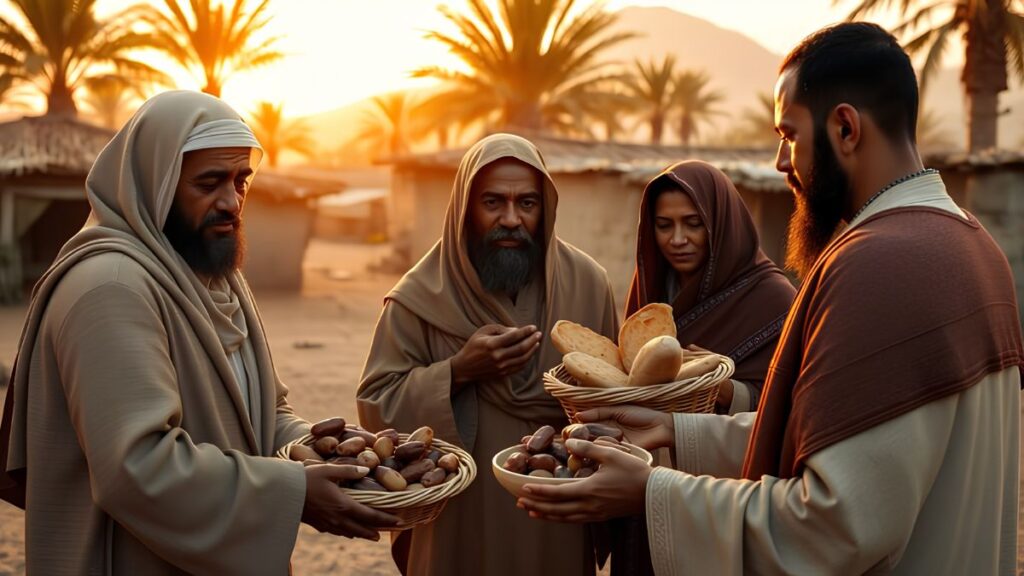
The morning sun rose slowly over Madinah.
Its golden light spread across the city, illuminating homes, markets, and pathways that connected the growing community. Merchants prepared for another day of trade. Farmers headed toward their fields. Families began their daily routines.
To many people, the city appeared peaceful and prosperous.
Yet beneath the surface, not everyone enjoyed the same circumstances.
Some families had enough food for the week.
Others worried about their next meal.
Some owned businesses and property.
Others struggled to provide even the basic necessities.
Poverty was a reality that many people faced.
For this reason, helping those in need became an important part of community life.
Prophet Muhammad (peace be upon him) consistently encouraged compassion toward people facing hardship.
Helping the poor was not viewed as an occasional act reserved for special occasions.
It was considered an ongoing responsibility.
People were encouraged to notice those around them.
To pay attention.
To care.
And to assist whenever possible.
One morning, a man arrived at the mosque seeking help.
His clothing showed signs of wear.
His face reflected exhaustion.
Life had not been easy for him.
A series of hardships had left him struggling to support his family.
As he spoke, those listening could hear the concern in his voice.
He was not asking for luxury.
He was not seeking comfort.
He simply hoped to provide food and necessities for his household.
The community listened carefully.
People understood that difficult circumstances could affect anyone.
Health problems.
Poor harvests.
Unexpected expenses.
Loss of employment.
Life often changed without warning.
Helping others during those moments was considered both an act of kindness and a responsibility.
Several people immediately offered assistance.
One contributed food.
Another provided clothing.
Someone else offered practical help.
Each contribution was different.
Yet together, they eased the man’s burden.
The assistance may have seemed small to those giving it.
To the recipient, however, it made a significant difference.
This was one of the important lessons frequently emphasized by Prophet Muhammad (peace be upon him).
No act of kindness should be considered too small.
Even modest assistance can have a meaningful impact on someone’s life.
One afternoon, a young boy accompanied his father through the marketplace.
The streets were crowded.
Merchants called out to customers.
People moved between stalls carrying goods and supplies.
As they walked, the boy noticed an elderly man sitting quietly near the edge of the market.
His clothing appeared worn.
His expression seemed tired.
The boy slowed his pace.
“Father,” he asked, “why is that man sitting alone?”
His father looked in the direction the boy pointed.
“He is facing difficult circumstances,” he replied gently.
The boy remained silent for a moment.
Then he reached into the small pouch he carried.
Inside were a few dates he had saved for later.
Without hesitation, he walked over and offered them to the elderly man.
The man smiled warmly.
“Thank you.”
The boy smiled back and returned to his father.
The gift had been small.
Only a few dates.
Yet the lesson was enormous.
Kindness does not depend upon age.
Nor does generosity depend upon wealth.
Even children can make a difference.
The father recognized this.
As they continued walking, he felt proud.
Not because of the value of the gift.
But because his son had learned compassion.
Throughout the community, stories like this occurred regularly.
A neighbor shared food.
A traveler received assistance.
A struggling family found support.
A child offered help.
Each act contributed to a culture of care.
People began to understand that strong communities are built when individuals look beyond their own needs.
One evening, a woman prepared a simple meal for her family.
The ingredients were modest.
The portions were carefully measured.
Resources were limited.
As she finished cooking, she remembered a nearby widow who lived alone.
Life had been difficult for the elderly woman.
She had little family support and often struggled with daily tasks.
The woman looked at the meal.
Then she quietly set aside a portion.
Before serving dinner to her own family, she delivered the food to her neighbor.
The widow accepted it with gratitude.
The gesture required only a few minutes.
Yet it provided comfort, nourishment, and reassurance.
Sometimes helping the poor involves more than meeting physical needs.
It reminds people that they have not been forgotten.
Loneliness often accompanies hardship.
Knowing that someone cares can be just as important as receiving assistance.
This understanding became deeply rooted within the community.
People learned to pay attention.
Who seemed worried?
Who appeared hungry?
Who needed support?
Compassion began with awareness.
One day, a merchant completed a successful week of business.
Sales had been strong.
Profits exceeded expectations.
As he counted his earnings, he reflected on how fortunate he had been.
He knew others were not experiencing the same success.
Rather than focusing solely on personal gain, he decided to share part of his earnings with families facing difficulties.
The decision brought him satisfaction.
Not because he expected praise.
But because he understood that blessings carried responsibilities.
This principle appeared frequently in the teachings and example of Prophet Muhammad (peace be upon him).
Wealth was viewed not merely as a personal possession but also as an opportunity to help others.
Generosity strengthened communities.
It reduced hardship.
It encouraged gratitude.
And it reminded people that success becomes more meaningful when shared.
Years passed.
The city continued growing.
New families arrived.
New challenges emerged.
Yet the importance of helping those in need remained unchanged.
People continued supporting one another through difficult times.
The assistance was not always dramatic.
Often it appeared in small, ordinary acts.
A loaf of bread.
A few dates.
A shared meal.
A helping hand.
Words of encouragement.
Simple gestures frequently produced significant results.
One elderly man often told younger members of the community a lesson he had learned during his lifetime.
“Never underestimate small acts of kindness.”
Whenever he shared those words, people listened.
Then he explained.
“There were times when I needed help. Sometimes assistance came in large ways. But often it came through small actions. A kind word. A simple meal. Someone checking on me. Those things mattered more than people realized.”
His experiences reflected a truth many had discovered.
When people face hardship, even modest support can provide hope.
It can reduce stress.
It can restore dignity.
It can remind someone that they are not alone.
Modern life continues to demonstrate the same lesson.
Around the world, people encounter financial difficulties, health challenges, and unexpected hardships.
Communities remain strongest when individuals support one another.
Helping the poor does not always require great wealth.
Sometimes it involves sharing time.
Sometimes it involves offering skills.
Sometimes it involves listening.
Sometimes it involves providing encouragement.
The form may vary.
The impact remains significant.
Another important lesson emerges from these stories.
Compassion should not be limited to moments when assistance feels convenient.
True generosity often requires effort.
It requires attention.
It requires willingness to act.
The people of Madinah understood this well.
They did not view helping others as a rare event.
It became part of daily life.
Part of community culture.
Part of personal responsibility.
Children observed these examples and learned from them.
They saw adults sharing food.
They witnessed neighbors helping neighbors.
They watched people support those facing hardship.
These lessons shaped their understanding of compassion.
Over time, those children grew into adults who continued the tradition.
The cycle of kindness continued from one generation to the next.
This is one reason stories about helping the poor remain powerful.
They remind readers that meaningful change often begins with simple actions.
Many people believe their contributions are too small to matter.
Yet history repeatedly demonstrates otherwise.
Communities improve through countless individual acts of kindness.
One meal.
One gift.
One conversation.
One helping hand.
Together, these actions create powerful results.
The life and example of Prophet Muhammad (peace be upon him) consistently emphasized this principle.
Compassion was not reserved for special circumstances.
It was intended to become a way of life.
A habit.
A perspective.
A commitment to caring for others.
As the sun set over Madinah each evening, families gathered in their homes.
Meals were shared.
Conversations unfolded.
Children listened to stories and lessons.
Among those lessons, one remained especially important:
People thrive when they help one another.
Communities grow stronger when compassion becomes a shared value.
And small acts of assistance often have consequences far greater than anyone initially realizes.
The stories continue to inspire because their message remains timeless.
Every generation encounters people facing hardship.
Every generation has opportunities to help.
And every generation benefits when kindness becomes a regular part of everyday life.
Lesson
Small acts of assistance can make a significant difference. Helping those in need does not always require great wealth or resources. Consistent compassion, generosity, and attention to others can strengthen communities and improve lives in meaningful ways.
Respect for Neighbors
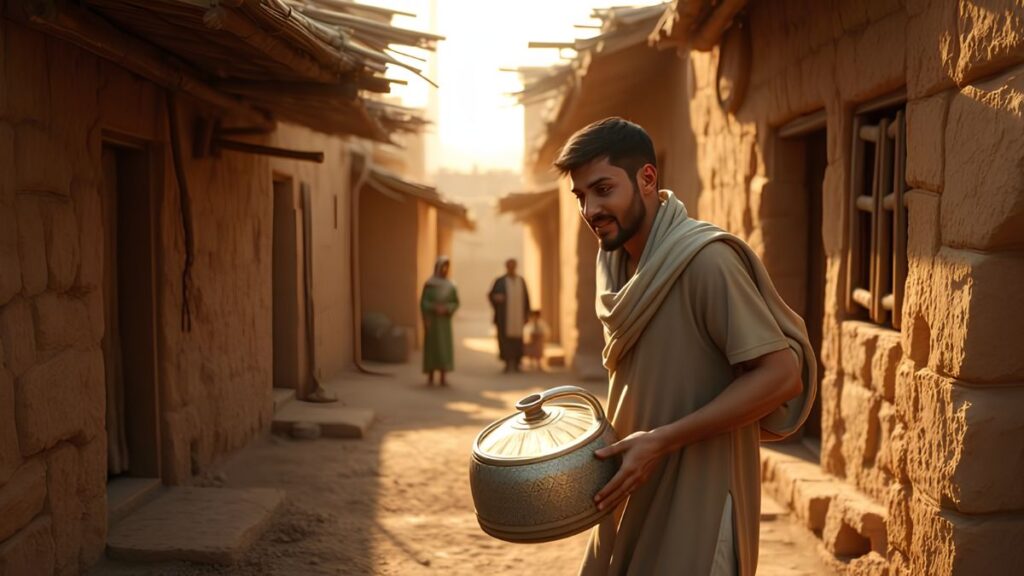
The city of Madinah was more than a collection of homes and streets.
It was a community.
Families lived close to one another. Children played together in open spaces. Merchants greeted familiar customers each day. People shared celebrations, supported one another during hardships, and often knew the stories of those living nearby.
In such a community, neighbors played an important role in daily life.
They were often the first to notice when someone needed help.
They were the first to hear good news.
And they were often the first to offer support during difficult times.
For this reason, Prophet Muhammad (peace be upon him) consistently encouraged people to treat their neighbors with kindness, respect, and consideration.
Being a good neighbor was not viewed as an optional act of generosity.
It was considered an important part of good character.
One morning, a man stepped outside his home and noticed that his elderly neighbor was struggling to carry a heavy container of water.
The old man moved slowly.
The weight clearly exceeded what he could comfortably manage.
Without being asked, the younger man walked over and offered assistance.
Together they carried the container to the neighbor’s home.
The task required only a few minutes.
Yet it made the elderly man’s day much easier.
As they finished, the old man smiled gratefully.
The younger man returned home feeling satisfied.
Not because he expected praise.
But because helping a neighbor simply felt like the right thing to do.
This spirit of mutual support appeared frequently throughout the community.
People understood that small acts of kindness strengthened relationships.
A community became stronger when neighbors looked after one another.
One afternoon, a woman preparing lunch noticed that smoke was not rising from the chimney of a nearby home.
Normally, her neighbor cooked at that time every day.
The absence seemed unusual.
Concerned, she decided to check on her.
When she arrived, she discovered that the neighbor had been feeling unwell.
Simple tasks had become difficult.
The visit provided comfort.
Soon, other neighbors learned of the situation and offered assistance as well.
Some helped with meals.
Others helped with errands.
A few simply stopped by to provide companionship.
No single gesture solved every problem.
Yet together, these acts of kindness eased a difficult situation.
The woman recovered feeling supported rather than isolated.
Stories like this reflected an important principle.
Respect for neighbors involves more than avoiding harm.
It also includes actively caring about their well-being.
Paying attention.
Offering help.
Showing concern.
These actions strengthen the bonds that hold communities together.
One evening, a young boy asked his father a question.
“Why do you always greet our neighbors first when we leave the house?”
His father smiled.
“Because neighbors matter.”
The boy looked curious.
His father continued.
“We share the same streets. We hear each other’s joys and difficulties. We help each other when needed. Respect begins with simple things like greetings, kindness, and consideration.”
The boy nodded thoughtfully.
Years later, he would remember that conversation.
The lesson stayed with him because it was reinforced by example.
Children often learn kindness not only through words but through observation.
They watch how adults treat others.
They notice acts of generosity.
They remember moments of compassion.
The community of Madinah provided many such examples.
One day, a merchant returned home after a successful week in the marketplace.
Business had gone well.
His family would enjoy a comfortable meal that evening.
As preparations began, he remembered a neighboring family facing financial difficulties.
Their circumstances had become challenging.
Without drawing attention to himself, he sent a portion of the meal to their home.
The gesture was simple.
The neighbors accepted it gratefully.
No announcement was made.
No recognition was sought.
It was merely one neighbor helping another.
Such actions became common because people understood a basic truth:
Communities thrive when individuals care about more than themselves.
This lesson was emphasized repeatedly through the teachings and example of Prophet Muhammad (peace be upon him).
Neighborly kindness was viewed as a reflection of faith, character, and compassion.
One elderly resident of Madinah often shared stories with younger generations.
Whenever children gathered around him, he would remind them of something important.
“A good neighbor is a blessing.”
The children would listen carefully.
Then he would explain.
“A good neighbor notices when you need help. They celebrate your happiness. They comfort you during sadness. They make life easier.”
As the children grew older, many discovered the truth of those words for themselves.
Strong relationships with neighbors brought comfort and stability.
One particularly dry season tested the community.
Water became harder to obtain.
Harvests were smaller.
Families faced increasing challenges.
Yet during this difficult period, neighbors worked together.
People shared resources.
They checked on one another.
They offered assistance whenever possible.
The hardship affected everyone.
But mutual support helped reduce the burden.
When difficulties arise, communities often reveal their true character.
The people of Madinah demonstrated that cooperation and compassion could help people endure even challenging circumstances.
Years later, stories from that period continued to be remembered.
Not because of the hardship itself.
But because of how people responded to it.
Another example occurred when a traveler temporarily settled near a group of homes.
The man knew very few people.
Everything around him felt unfamiliar.
Recognizing this, several neighbors introduced themselves.
They welcomed him warmly.
They offered directions, advice, and assistance.
Their kindness transformed what could have been an isolating experience into a positive one.
The traveler later remarked that he had arrived feeling like a stranger and soon felt like part of the community.
That transformation occurred because neighbors chose kindness.
The lesson remains relevant today.
Modern life often moves quickly.
People become busy with work, responsibilities, and personal concerns.
In some places, neighbors rarely interact.
Individuals may live side by side for years without truly knowing one another.
Yet the need for community has not disappeared.
People still benefit from kindness.
They still appreciate support.
They still value relationships built upon trust and respect.
Simple actions continue making a difference.
Greeting neighbors warmly.
Checking on someone who seems unwell.
Offering help when needed.
Being considerate of others.
These behaviors contribute to healthier and stronger communities.
One reason stories about neighborly kindness remain powerful is that they focus on ordinary moments.
Most people will never lead armies or make historic decisions.
Yet everyone has opportunities to be a good neighbor.
Everyone can show respect.
Everyone can offer assistance.
Everyone can contribute to the well-being of those living nearby.
The impact of these actions often extends further than expected.
A small gesture may brighten someone’s day.
A kind word may provide encouragement.
A helping hand may ease a burden.
Collectively, such actions create environments where people feel valued and supported.
As the sun set each evening over Madinah, families returned to their homes.
Children finished their games.
Neighbors exchanged greetings.
Lights appeared in windows and courtyards.
The city settled into a peaceful rhythm shaped by countless acts of everyday kindness.
Many of those acts were small.
A greeting.
A shared meal.
A helpful gesture.
A visit to check on someone’s well-being.
Yet together they created something remarkable.
A strong community.
The teachings and example of Prophet Muhammad (peace be upon him) encouraged precisely this kind of environment.
A place where people cared for one another.
A place where neighbors treated each other with respect.
A place where compassion was not reserved for special occasions but practiced daily.
These lessons continue inspiring people because they address a timeless human need.
Everyone wants to feel respected.
Everyone benefits from kindness.
And every community becomes stronger when neighbors support one another.
The story of neighborly respect reminds us that building a better society often begins close to home.
Not through grand actions.
But through simple, consistent acts of care and consideration.
Lesson
Strong communities are built through mutual care and respect. Simple acts of kindness toward neighbors, such as offering help, showing consideration, and checking on their well-being, create stronger relationships and a more supportive community for everyone.
Patience During Difficult Times

Life is rarely free from challenges.
Every generation experiences moments of uncertainty, hardship, and disappointment. Plans do not always unfold as expected. Losses occur. Obstacles appear without warning. Even the strongest individuals face situations that test their patience and resolve.
The life of Prophet Muhammad (peace be upon him) was no exception.
Throughout his life, he encountered difficulties that would have discouraged many people. Yet one of the qualities that consistently defined his character was patience.
His example demonstrated that patience is not simply waiting for problems to disappear.
It is the ability to remain calm, hopeful, and committed to doing what is right even when circumstances are difficult.
This lesson became a source of inspiration for many people around him.
One particularly difficult season affected the community in Madinah.
Resources became limited.
Several families struggled to meet their daily needs.
Merchants faced challenges in trade.
Farmers worried about their harvests.
The future seemed uncertain.
During such times, anxiety could easily spread from one person to another.
People naturally worried about what might happen next.
One evening, a group of men gathered together after finishing their work.
Their conversation focused on the hardships they were facing.
Some expressed frustration.
Others spoke about their fears.
The challenges seemed overwhelming.
As the discussion continued, an older member of the community listened quietly.
When the others finished speaking, he offered a simple observation.
“Difficult times do not last forever.”
The group became silent.
The man continued.
“What matters is how we respond while they are here.”
His words reflected an important lesson often demonstrated through the life of Prophet Muhammad (peace be upon him).
Patience does not eliminate hardship.
It changes how people endure it.
Rather than allowing difficulties to create despair, patience helps people maintain perspective and continue moving forward.
This understanding became especially important during moments of uncertainty.
One morning, a young man approached an elder seeking advice.
The young man had worked hard for months on a business venture.
He had invested time, energy, and resources.
Yet despite his efforts, the results were disappointing.
Nothing seemed to go according to plan.
Frustration filled his heart.
“I don’t understand,” he said.
“I worked hard. I did everything I could. Why are things not improving?”
The elder listened carefully.
Then he replied.
“Growth often happens more slowly than we expect.”
The young man looked unconvinced.
The elder smiled.
“Have you ever planted a seed?”
“Of course,” the young man answered.
“Then you know that nothing appears immediately. The seed requires time. The roots develop before the plant becomes visible. Progress is often happening even when we cannot see it.”
The lesson remained with the young man.
Over time, he began viewing difficulties differently.
Rather than seeing every setback as failure, he learned to view challenges as part of a longer journey.
Patience helped him continue.
Stories like these reflected a broader principle.
Life often unfolds gradually.
Many worthwhile achievements require perseverance.
Without patience, people may abandon their goals too soon.
With patience, they often discover opportunities that were previously hidden.
Throughout history, countless individuals have faced moments when giving up seemed easier than continuing.
Yet perseverance frequently produced better outcomes.
This was one reason patience remained such an important virtue.
It provided stability during uncertain times.
Another example occurred when a traveler became stranded far from home.
His journey had been carefully planned.
Yet unexpected circumstances changed everything.
Supplies became limited.
Progress slowed.
Frustration grew.
For several days, the traveler focused entirely on what had gone wrong.
He complained constantly.
He worried about every delay.
The more he focused on his frustration, the more exhausted he became.
Eventually, he met another traveler who seemed remarkably calm despite facing similar difficulties.
Curious, he asked how the man remained so peaceful.
The traveler replied,
“I cannot control every obstacle. I can only control how I respond to them.”
The answer surprised him.
Yet it contained an important truth.
Patience often begins by accepting what cannot immediately be changed.
Once people stop fighting reality, they can focus on constructive action.
This mindset frequently leads to better decisions.
It reduces unnecessary stress.
And it creates space for wisdom.
The life of Prophet Muhammad (peace be upon him) offered many examples of this principle.
Challenges were met with determination rather than despair.
Difficulties were faced with calmness rather than panic.
Setbacks were approached with faith and perseverance.
These qualities inspired others to respond similarly.
One afternoon, a father sat beneath the shade of a tree with his son.
The boy had become upset after losing a simple game with his friends.
To him, the disappointment felt enormous.
Nothing seemed fair.
Nothing seemed right.
The father listened patiently.
Then he picked up a small stone and handed it to the boy.
“What do you see?” he asked.
“A stone.”
The father nodded.
“If you hold it close to your eyes, it blocks everything else.”
The boy raised the stone and laughed.
His father was right.
The stone filled most of his vision.
“Now place it in your hand and hold it farther away.”
The boy did so.
Suddenly the stone seemed much smaller.
The father smiled.
“Many problems are like that. When we focus only on them, they appear larger than they truly are. Patience helps us step back and see the bigger picture.”
The boy never forgot the lesson.
Years later, he shared it with his own children.
Simple wisdom often travels across generations.
Patience became especially important during times of conflict.
Disagreements naturally arise between people.
Misunderstandings occur.
Emotions become intense.
In such moments, immediate reactions often create additional problems.
Anger encourages people to speak without thinking.
Frustration encourages impulsive decisions.
Patience creates space.
It allows emotions to settle.
It allows reason to return.
And it often prevents situations from becoming worse.
Many people eventually discover that decisions made in anger are frequently regretted later.
Patience helps avoid those regrets.
One merchant learned this lesson after a customer accused him unfairly.
The accusation was public and embarrassing.
His first instinct was to respond harshly.
He wanted to defend himself immediately.
Yet he remembered the examples he had learned throughout his life.
So he paused.
He remained calm.
Instead of arguing, he listened carefully.
Eventually, the misunderstanding became clear.
The situation was resolved peacefully.
Had he reacted in anger, the outcome may have been very different.
His patience protected both his reputation and the relationship.
This principle remains relevant in modern life.
People still face disappointments.
Careers encounter obstacles.
Relationships experience difficulties.
Unexpected problems arise.
The need for patience has not diminished.
If anything, it has become even more important.
Modern society often encourages immediate results.
People expect quick answers.
Quick solutions.
Quick success.
Yet many worthwhile outcomes still require time.
Personal growth takes time.
Trust takes time.
Learning takes time.
Healing takes time.
Patience allows these processes to unfold naturally.
Another important aspect of patience is hope.
Patience is not passive resignation.
It involves believing that improvement remains possible.
Without hope, patience becomes difficult.
With hope, perseverance becomes easier.
This connection between patience and hope appeared repeatedly in the examples set by Prophet Muhammad (peace be upon him).
Even during difficult periods, optimism remained.
Faith remained.
The belief that challenges could eventually be overcome remained.
These attitudes helped strengthen individuals and communities alike.
One elderly man once reflected on the lessons he had learned throughout his life.
When asked what quality had helped him most, he answered without hesitation.
“Patience.”
The person asking seemed surprised.
“More than intelligence? More than strength?”
The old man smiled.
“Patience helped me use both wisely.”
His answer captured something profound.
Patience supports good judgment.
It strengthens relationships.
It encourages perseverance.
It allows people to endure difficulties without losing hope.
For this reason, stories about patience continue inspiring readers centuries later.
They remind us that hardship is often temporary.
That challenges can teach valuable lessons.
And that calm perseverance frequently produces better outcomes than frustration or anger.
As the sun set over Madinah each evening, families gathered together after long days of work.
Some celebrated successes.
Others faced ongoing difficulties.
Yet life continued moving forward.
The examples of patience they witnessed helped guide them through both joyful and challenging times.
Those lessons remain valuable today.
Every person encounters moments when patience is tested.
The response chosen during those moments often shapes the outcome.
By remaining calm, maintaining hope, and continuing to do what is right, people increase their ability to navigate difficulties successfully.
Patience may not remove every obstacle.
But it often provides the strength needed to overcome them.
Lesson
Patience often leads to better outcomes than anger or frustration. Remaining calm, hopeful, and persistent during difficult times helps people make wiser decisions, maintain stronger relationships, and navigate challenges with greater resilience.
Why Readers Connect With Small Stories About Prophet Muhammad
Readers continue to connect with Small Stories About Prophet Muhammad because they focus on experiences that feel deeply human.
These stories frequently explore:
- Compassion
- Integrity
- Humility
- Gratitude
- Service
- Forgiveness
- Community
- Personal responsibility
The emotional simplicity of these narratives allows readers to focus on the lesson rather than the complexity of the situation.
As a result, the stories remain memorable and meaningful.
Educational Value of Small Stories About Prophet Muhammad
Parents, teachers, and community leaders often use stories as teaching tools because they make lessons easier to understand and remember. Rather than presenting values as abstract concepts, stories show how those values can be practiced in real-life situations.
For this reason, Small Stories About Prophet Muhammad remain a valuable educational resource for readers of all ages.
Teaching Moral Values
Stories provide practical examples of honesty, kindness, responsibility, patience, and respect.
Instead of simply telling readers what is right or wrong, the stories demonstrate these values through actions and everyday interactions. This approach makes the lessons more meaningful and easier to apply in daily life.
Encouraging Reflection
Many stories encourage readers to think beyond the events themselves.
After reading a story, people often consider how they would respond in a similar situation. This reflection can help develop empathy, improve decision-making, and strengthen personal values.
Building Character
Positive examples can inspire personal growth and ethical behavior.
By learning about acts of generosity, forgiveness, humility, and compassion, readers are encouraged to develop these qualities in their own lives. Over time, repeated exposure to positive role models can contribute to stronger character development.
Making History Accessible
Stories bring historical figures and events to life in an engaging and relatable way.
Rather than focusing only on dates and historical facts, Small Stories About Prophet Muhammad present meaningful moments that help readers better understand the people, culture, and circumstances of the time.
Improving Memory and Understanding
Stories are often easier to remember than lists of facts or instructions.
The combination of characters, events, and lessons helps readers retain information for longer periods. This is one reason storytelling has been used as an educational method throughout history.
Connecting Lessons to Everyday Life
Many of the situations found in these stories involve common human experiences such as helping others, speaking truthfully, showing patience, or treating people with respect.
Because these situations are familiar, readers can more easily connect the lessons to their own daily lives and experiences.
Encouraging Meaningful Discussions
Stories naturally create opportunities for conversation.
Parents, teachers, and community leaders often use Small Stories About Prophet Muhammad as starting points for discussions about values, behavior, and personal responsibility. These conversations can help deepen understanding and encourage thoughtful reflection.
Supporting Readers of All Ages
One of the greatest strengths of storytelling is its broad appeal.
Children enjoy the simple narratives and clear lessons, while older readers often appreciate the deeper wisdom and practical guidance contained within the stories. This makes them effective educational tools across multiple age groups.
Although each story is unique, several themes appear repeatedly throughout Small Stories About Prophet Muhammad. These recurring themes help readers better understand the values and character that continue to inspire people around the world.
Compassion
Compassion is one of the most prominent themes found in these stories.
Many accounts highlight concern for the well-being of others, including family members, neighbors, travelers, children, and those facing hardship. These stories demonstrate the importance of empathy, kindness, and treating others with care and respect.
Humility
Despite being highly respected by those around him, Prophet Muhammad (peace be upon him) consistently demonstrated humility.
Many stories emphasize modest behavior, simple living, and a willingness to serve others without seeking recognition. These examples remind readers that true leadership is often accompanied by humility rather than pride.
Service
Helping others is a recurring lesson in Small Stories About Prophet Muhammad.
Whether assisting a neighbor, supporting someone in need, or contributing to the community, acts of service are frequently highlighted. These stories encourage readers to look for opportunities to help others through both large and small actions.
Gratitude
Gratitude appears throughout many stories and teachings.
Readers often encounter examples of appreciating blessings, expressing thankfulness, and recognizing the value of everyday gifts. These stories encourage a positive outlook and greater appreciation for what one has.
Justice
Fairness and ethical decision-making are important themes in many narratives.
Stories involving honesty, trust, responsibility, and equal treatment demonstrate the importance of acting with integrity. These lessons continue to be relevant in personal relationships, workplaces, and communities.
Mercy
Mercy is another powerful theme found in Small Stories About Prophet Muhammad.
Many stories show patience, forgiveness, and understanding when dealing with mistakes or conflicts. Rather than responding with harshness, these examples often highlight compassion and the desire to promote reconciliation.
Honesty
Truthfulness is a central value reflected in numerous stories.
Even before prophethood, Muhammad (peace be upon him) was known for his honesty and trustworthiness. Stories focusing on truthful behavior remind readers that integrity is essential for building trust and strong relationships.
Patience
Life often presents challenges, difficulties, and moments of uncertainty.
Many stories illustrate patience during hardships and the importance of remaining calm during difficult circumstances. These lessons encourage perseverance and self-control when facing obstacles.
Generosity
Generosity extends beyond financial assistance.
Stories frequently highlight sharing, hospitality, and helping others with available resources. They demonstrate that generosity can be expressed through time, effort, kindness, and support as well as material gifts.
Respect for Others
Respect is evident in interactions with family, friends, neighbors, visitors, and members of the community.
These stories emphasize treating people with dignity regardless of age, background, or social status, reinforcing the importance of mutual respect in everyday life.
Common Themes Found in Small Stories About Prophet Muhammad
Although each story is unique, several themes appear repeatedly throughout Small Stories About Prophet Muhammad. These recurring themes help readers better understand the values and character that continue to inspire people around the world.
Compassion
Compassion is one of the most prominent themes found in these stories.
Many accounts highlight concern for the well-being of others, including family members, neighbors, travelers, children, and those facing hardship. These stories demonstrate the importance of empathy, kindness, and treating others with care and respect.
Humility
Despite being highly respected by those around him, Prophet Muhammad (peace be upon him) consistently demonstrated humility.
Many stories emphasize modest behavior, simple living, and a willingness to serve others without seeking recognition. These examples remind readers that true leadership is often accompanied by humility rather than pride.
Service
Helping others is a recurring lesson in Small Stories About Prophet Muhammad.
Whether assisting a neighbor, supporting someone in need, or contributing to the community, acts of service are frequently highlighted. These stories encourage readers to look for opportunities to help others through both large and small actions.
Gratitude
Gratitude appears throughout many stories and teachings.
Readers often encounter examples of appreciating blessings, expressing thankfulness, and recognizing the value of everyday gifts. These stories encourage a positive outlook and greater appreciation for what one has.
Justice
Fairness and ethical decision-making are important themes in many narratives.
Stories involving honesty, trust, responsibility, and equal treatment demonstrate the importance of acting with integrity. These lessons continue to be relevant in personal relationships, workplaces, and communities.
Mercy
Mercy is another powerful theme found in Small Stories About Prophet Muhammad.
Many stories show patience, forgiveness, and understanding when dealing with mistakes or conflicts. Rather than responding with harshness, these examples often highlight compassion and the desire to promote reconciliation.
Honesty
Truthfulness is a central value reflected in numerous stories.
Even before prophethood, Muhammad (peace be upon him) was known for his honesty and trustworthiness. Stories focusing on truthful behavior remind readers that integrity is essential for building trust and strong relationships.
Patience
Life often presents challenges, difficulties, and moments of uncertainty.
Many stories illustrate patience during hardships and the importance of remaining calm during difficult circumstances. These lessons encourage perseverance and self-control when facing obstacles.
Generosity
Generosity extends beyond financial assistance.
Stories frequently highlight sharing, hospitality, and helping others with available resources. They demonstrate that generosity can be expressed through time, effort, kindness, and support as well as material gifts.
Respect for Others
Respect is evident in interactions with family, friends, neighbors, visitors, and members of the community.
These stories emphasize treating people with dignity regardless of age, background, or social status, reinforcing the importance of mutual respect in everyday life.
These recurring themes contribute to the lasting relevance of Small Stories About Prophet Muhammad. Their lessons continue to inspire readers by promoting values that strengthen individuals, families, and communities across generations.
The Importance of Representation Through Storytelling
Stories help preserve values and traditions across generations.
For many readers, Small Stories About Prophet Muhammad provide a meaningful introduction to Islamic teachings while also highlighting universal principles that resonate with people from different backgrounds.
The lessons found within these stories extend beyond historical events.
They encourage readers to:
- Practice kindness
- Value honesty
- Show patience
- Help others
- Forgive mistakes
- Build stronger communities
These timeless principles remain relevant regardless of age, culture, or background.
The Lasting Impact of Small Stories About Prophet Muhammad
One reason these stories continue to be shared is that they demonstrate how character is often revealed through everyday actions.
Grand achievements may inspire admiration, but small acts of honesty, compassion, generosity, and patience often leave the deepest impact.
The examples found in Small Stories About Prophet Muhammad show that meaningful change frequently begins with simple actions.
A kind word.
A helping hand.
A truthful statement.
A moment of patience.
A gesture of forgiveness.
These small actions can influence individuals, families, and communities in lasting ways.
Conclusion
The enduring popularity of Small Stories About Prophet Muhammad reflects their ability to educate, inspire, and guide readers through simple yet powerful lessons.
By highlighting honesty, kindness, patience, generosity, forgiveness, and compassion, these stories continue to serve as valuable examples of good character.
Whether shared in homes, schools, mosques, books, or online communities, they remain an important way of preserving meaningful teachings and encouraging personal growth.
Their messages are timeless, their lessons are practical, and their impact continues to reach new generations of readers around the world.