Short bedtime stories for adults are a wonderful way to slow down, escape everyday stress, and enjoy a peaceful moment before falling asleep. Unlike complicated novels or suspenseful stories, bedtime stories are usually gentle, comforting, and easy to follow. They take readers into quiet villages, beautiful gardens, peaceful cottages, rainy evenings, and familiar places where nothing urgent needs to happen.
After a long day of work, responsibilities, and endless thoughts, sometimes all you need is a few minutes of peaceful storytelling. A short bedtime story can offer that little escape. You don’t need to solve a mystery, follow a complicated plot, or stay awake to discover what happens next. You can simply relax and enjoy the moment.
Whether you enjoy romantic stories, nostalgic memories, peaceful adventures, gentle humor, or stories about ordinary people finding happiness in simple things, there is something comforting about reading a little before going to sleep.
In this collection, you’ll discover different types of short bedtime stories for adults, along with original stories designed to create a calm and relaxing nighttime reading experience.
What Are Short Bedtime Stories for Adults?
Short bedtime stories for adults are brief, relaxing narratives written for mature readers who want to enjoy storytelling before going to sleep. They generally focus on peaceful situations, relatable emotions, simple experiences, and satisfying endings rather than intense conflicts or complicated storylines.
Unlike traditional children’s bedtime stories, adult bedtime stories often explore themes such as:
- Love, relationships, and companionship.
- Childhood memories and nostalgia.
- Quiet countryside living and nature.
- Everyday happiness and simple pleasures.
- Personal reflection and emotional comfort.
- Gentle romance and meaningful connections.
- Peaceful travel and imaginary destinations.
Most importantly, these stories don’t need dramatic conclusions. Sometimes, a story about someone enjoying a cup of tea beside a rainy window can be just as enjoyable as an elaborate adventure.
Short Bedtime Stories for Adults
1. The Little Café That Stayed Open Late
An original short bedtime story for adults | Theme: Friendship, kindness, and finding belonging
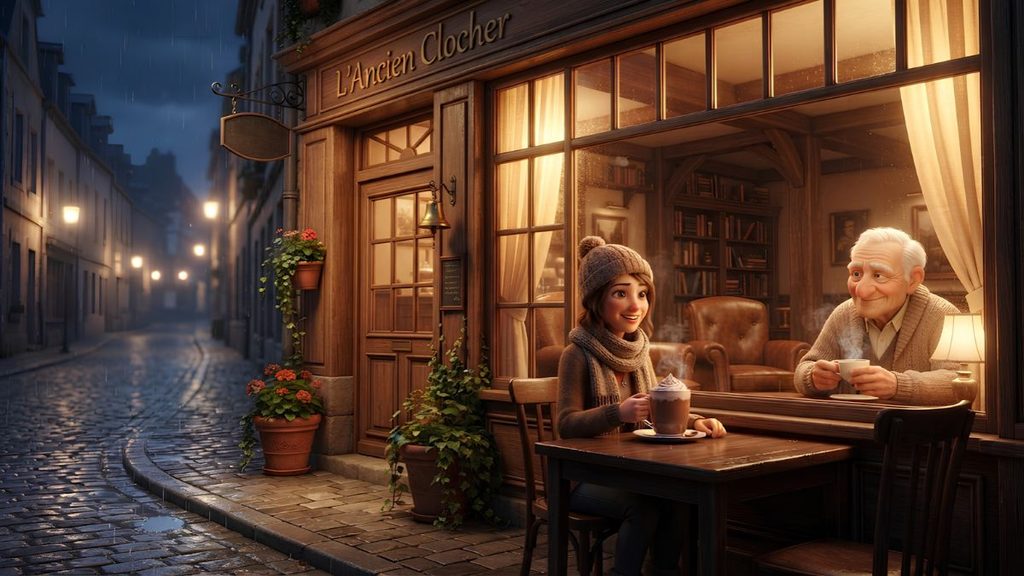
There was a little café at the end of Willow Street that seemed to belong to another time.
Its wooden door had a small brass bell that rang whenever someone entered, the windows were decorated with tiny flowerpots, and an old-fashioned clock hung above the counter. During the day, the café was filled with the familiar sounds of coffee machines, conversations, and occasional laughter. People stopped by before work, couples shared pastries during lunch, and elderly neighbors gathered near the window to discuss the weather.
But the café became something entirely different after nine in the evening.
The streets grew quiet, the nearby shops turned off their lights, and the occasional passing car disturbed the peaceful silence. Inside, however, a warm golden light continued to shine.
Arthur, the café’s owner, had never been particularly fond of closing early.
He was seventy-two years old and had spent almost four decades running the little establishment. His hair had turned completely white, his reading glasses were permanently hanging around his neck, and his hands moved with the confidence of someone who had prepared thousands of cups of coffee.
Arthur lived in a small apartment above the café. He had no particular reason to stay downstairs after closing time, but he enjoyed the atmosphere. He liked wiping the wooden tables, arranging the chairs, and listening to the quiet ticking of the clock.
Every evening, he prepared one final cup of coffee and sat beside the window.
It had become his favorite part of the day.
The Unexpected Visitor
One Thursday evening, rain began falling over Willow Street.
Arthur was preparing to close the café when he heard the familiar brass bell above the entrance.
A young woman stepped inside, carrying a small handbag and wearing a damp grey coat. She looked around as if she wasn’t entirely sure whether the café was still open.
“Good evening,” Arthur said, placing his cleaning cloth on the counter. “Are you looking for something?”
“Actually, I was hoping to find a place where I could sit for a few minutes,” she replied. “Is your café still open?”
Arthur glanced at the clock.
It was nearly ten.
“For someone escaping this weather, we can certainly make an exception.”
The woman smiled with relief.
“My name is Emily,” she said.
“Arthur. And what would you like?”
Emily looked at the menu, although she didn’t seem particularly interested in choosing anything.
“Hot chocolate, please.”
Arthur prepared the drink and placed it on a small wooden table near the window. He also brought a plate containing two homemade biscuits.
Emily thanked him and wrapped her hands around the warm cup.
For several minutes, neither of them spoke.
Outside, rainwater flowed along the edges of the pavement. A streetlamp reflected against the wet road, and the occasional raindrop slid down the café window.
Arthur returned to cleaning the counter.
Eventually, Emily broke the silence.
“I moved here three weeks ago,” she said. “I’m still trying to get used to the city.”
Arthur nodded.
“New city?”
“New everything, actually. New apartment, new job, new neighborhood. I thought moving would be exciting, but sometimes it feels a little lonely.”
Arthur understood more than she expected.
He had lived in the same neighborhood for most of his adult life, but he remembered arriving there as a young man with two suitcases and very little money.
“Give it time,” he said. “A place becomes familiar slowly. First, you recognize the streets. Then you recognize the people. Eventually, someone starts recognizing you.”
Emily laughed softly.
“That sounds nice.”
“It is,” Arthur replied. “Especially when they remember how you like your coffee.”
A Familiar Table
Emily finished her hot chocolate and prepared to leave.
Before she reached the door, Arthur handed her a small paper bag.
“What’s this?” she asked.
“Two biscuits for tomorrow morning.”
Emily tried to pay for them, but Arthur shook his head.
“Consider it a welcome gift.”
She thanked him and stepped into the rainy street.
The following evening, she returned.
This time, the weather was clear, and she arrived carrying a book.
Arthur recognized her immediately.
“Hot chocolate again?”
“How did you guess?”
“Experience,” he replied.
She laughed and sat at the same table near the window.
Over the following weeks, Emily became a regular visitor.
Sometimes she arrived after work, sometimes during the afternoon, and occasionally just before closing. She always chose the same table and ordered the same hot chocolate.
Arthur began recognizing her footsteps before the doorbell rang.
He learned that she worked in a publishing office, enjoyed old novels, and had a habit of forgetting her umbrella whenever it rained.
Emily, in turn, learned that Arthur had owned the café since his thirties, that he once wanted to become a musician, and that he considered cinnamon biscuits the greatest invention in the history of baking.
Their conversations became longer.
Some evenings, Emily talked about her work. Other evenings, Arthur shared stories about the neighborhood when it was filled with little shops and family-run businesses.
They never planned these conversations.
They simply happened.
The Evening the Café Felt Empty
One Monday, Emily didn’t arrive.
Arthur assumed she had a busy day.
On Tuesday, the chair beside the window remained empty.
By Wednesday, he began wondering whether something had happened.
He caught himself looking toward the door whenever the brass bell moved.
On Thursday, he prepared an extra cup of hot chocolate out of habit.
But nobody entered.
Arthur sat beside the window and watched the evening traffic.
For the first time in many years, the café felt unusually quiet.
He remembered how Emily had described feeling lonely when she first moved to the city. He wondered whether she had become busy with work or perhaps found another place to spend her evenings.
He didn’t want to interfere, but he hoped she was doing well.
Then, just before ten, the brass bell rang.
Emily entered, carrying a large cardboard box.
Arthur stood up.
“Well, look who’s finally remembered where we are!”
Emily laughed.
“I’m sorry. Work has been terribly busy.”
She placed the box on the counter.
“I brought something.”
Arthur opened it and discovered several books.
“I remembered you saying that you wanted to start a small reading corner in the café,” Emily explained. “I thought these might help.”
Arthur looked at the books and then at her.
“I mentioned that once?”
“Three weeks ago.”
He smiled.
“Apparently, you listen better than I do.”
Emily helped him arrange the books on a small shelf near the window. They placed a handwritten sign above it that read:
Take a book. Enjoy a cup. Stay as long as you like.
The following evening, two customers noticed the new shelf. One borrowed a novel, while another left a book of poetry in exchange.
Within a month, the little reading corner became one of the café’s most popular features.
A Place to Belong
Winter gradually gave way to spring.
The flowerpots outside the café began filling with fresh blooms, and the evenings became warmer.
Emily had made several friends by then. She occasionally brought coworkers to the café, introduced Arthur to people from her neighborhood, and even organized a small evening book club.
Arthur enjoyed seeing the place become lively again.
One Friday, Emily arrived with two friends.
“Arthur, these are Daniel and Sophie. I’ve told them so much about your café that they finally wanted to see it themselves.”
Arthur welcomed them and prepared three cups of hot chocolate.
“First visit?” he asked.
Daniel nodded.
“Then the biscuits are complimentary.”
Sophie laughed.
“Does everyone get special treatment here?”
“Only people who arrive with good company,” Arthur replied.
The evening passed with conversations, laughter, and the gentle sound of rain beginning outside.
After her friends left, Emily remained for a few minutes.
“Arthur, do you ever get tired of staying open so late?” she asked.
He looked around the café.
The empty cups, the bookshelves, the wooden tables, and the warm lights all seemed familiar in a way that made him smile.
“Sometimes,” he admitted. “But then someone walks through that door, and I remember why I enjoy it.”
Emily looked toward the window.
“I think this place helped me feel at home.”
Arthur gently placed a clean cup on the counter.
“Perhaps that’s what a good café is supposed to do.”
She smiled and prepared to leave.
Before stepping outside, she turned around.
“See you tomorrow?”
Arthur nodded.
“Same table?”
“Of course.”
The brass bell rang as she disappeared into the quiet street.
Arthur switched off the lights near the counter but left the small lamp beside the window glowing.
He prepared his final cup of coffee and sat down.
Outside, Willow Street was peaceful. A light breeze moved the flowers, and the wet pavement reflected the golden glow from the café.
Arthur took a slow sip.
He had spent most of his life believing that he owned a little café.
But perhaps the truth was simpler.
He had built a place where people could arrive as strangers and slowly become familiar faces.
And sometimes, that was the most beautiful thing a person could leave behind.
That night, the café closed a little later than usual.
And the little lamp beside the window continued shining.
2. The Garden Behind the Old House
An original bedtime story for adults | Theme: Nostalgia, patience, memories, and finding happiness in simple things
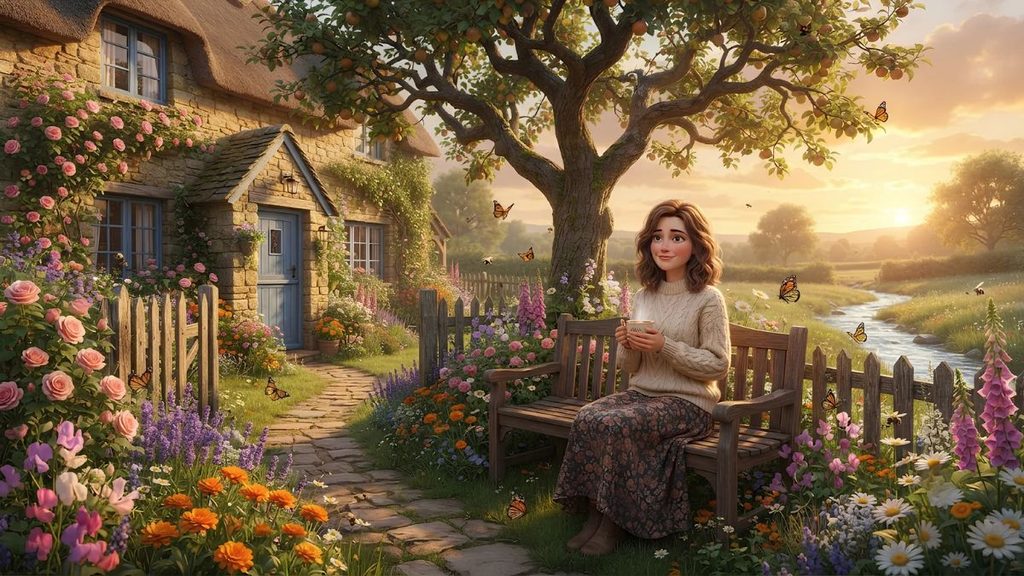
At the end of a narrow country road, surrounded by tall trees and fields of wildflowers, stood an old stone house with a blue wooden door.
The house had belonged to three generations of the Bennett family. Its walls were covered with climbing ivy, the windows had white wooden frames, and a little stone pathway led from the front gate to the entrance.
Behind the house was a garden.
It was once the most beautiful garden in the village, filled with roses, lavender, tulips, and fruit trees. A small wooden bench stood beneath an old apple tree, and a narrow stream ran along the far end of the property.
But time had changed everything.
The flowers had disappeared beneath weeds, the wooden fence had begun to fall apart, and the garden paths were almost impossible to recognize.
The house had remained empty for nearly two years after the death of its previous owner, an elderly woman named Margaret Bennett.
Her granddaughter, Sophie, had finally returned to settle the family property.
Sophie was thirty-four and worked as an accountant in a busy city. Her life revolved around deadlines, office meetings, grocery shopping, and the endless responsibilities of adulthood.
She had not visited the old house in almost six years.
When she was younger, however, she had spent nearly every summer there.
She remembered running barefoot through the garden, eating apples directly from the tree, and helping her grandmother water the flowers.
Those summers had always seemed endless.
Now, standing in the overgrown garden, Sophie found it difficult to imagine that the place had once been so beautiful.
She looked around and sighed.
There was a lot of work to do.
The First Morning
Sophie decided to begin cleaning the garden the following morning.
She woke early, prepared a cup of tea, and stepped outside wearing an old pair of gardening gloves.
The morning air was cool, and a thin layer of mist rested over the surrounding fields.
Birds were singing somewhere in the trees.
She picked up a pair of pruning shears and began removing the dry branches from the rose bushes.
The work was harder than she expected.
Some plants had grown in completely unexpected directions. Others had become tangled with weeds, while a few appeared to have died entirely.
By lunchtime, her back was aching, and she had barely cleared one corner.
She sat on an old stone step and looked at the unfinished work.
For a moment, she considered hiring someone to take care of everything.
But then she noticed a small purple flower growing between two broken stones.
It was delicate, almost hidden beneath the weeds.
Sophie leaned closer.
She recognized it immediately.
Lavender.
Her grandmother had always planted lavender along the garden pathway.
A small smile appeared on Sophie’s face.
Perhaps the garden wasn’t as forgotten as it seemed.
She returned to work.
By sunset, she had cleared a narrow section near the old apple tree.
It wasn’t much, but it was a beginning.
A Memory Beneath the Apple Tree
The following afternoon, Sophie decided to explore the garden more carefully.
She walked toward the old apple tree, whose branches extended over a large portion of the lawn.
Its trunk was thick and slightly twisted, and several small branches had grown unevenly over the years.
Beneath it stood the wooden bench she remembered from childhood.
The paint had almost disappeared, and one of its legs was slightly loose.
Sophie brushed away the fallen leaves and sat down.
For a few minutes, she simply listened.
The wind moved gently through the branches. Somewhere nearby, water flowed along the little stream.
She remembered her grandmother sitting on that same bench every evening.
Margaret had never seemed to be in a hurry.
She could spend an entire afternoon trimming roses or watching butterflies move between the flowers.
When Sophie was younger, she often asked why her grandmother spent so much time in the garden.
Margaret would smile and say, “Because beautiful things deserve attention.”
At the time, Sophie thought it was simply something older people said.
She had been more interested in television, friends, and the excitement of growing up.
Now, sitting beneath the same tree, she understood the words differently.
She looked at the neglected garden and felt a strange connection to it.
Both had been left behind by the passage of time.
Perhaps restoring the garden would help her rediscover something she had forgotten about herself.
That evening, she decided not to rush the work.
She would give the garden as much time as it needed.
The Wooden Box
A week passed.
Sophie had already removed most of the weeds near the house and repaired a small section of the wooden fence.
She also bought several new plants from a nursery in the neighboring village.
One afternoon, while moving an old stone planter, she discovered a small wooden box buried beneath a pile of leaves.
It was dusty and slightly damaged, but the lid opened easily.
Inside were several packets of flower seeds, a pair of old gardening gloves, and a folded piece of paper.
Sophie recognized her grandmother’s handwriting immediately.
The note read:
Dear Sophie,
If you ever find this little box, I hope you have decided to spend some time in the garden.
These are some of my favorite flowers. I collected their seeds over the years, hoping they would continue growing long after I was gone.
Gardens are funny things. They never demand perfection. They only need a little patience, some care, and someone willing to return tomorrow.
Plant something whenever you feel lost. Watch it grow whenever you need hope.
With love,
Grandma Margaret.
Sophie read the note twice.
She sat on the garden path, holding the paper carefully.
For the first time since arriving at the house, she felt tears forming in her eyes.
She missed her grandmother.
She missed the afternoons spent baking in the kitchen, the smell of fresh bread, and the sound of Margaret calling her inside whenever the evening became cold.
The house had preserved many of those memories, but the garden seemed to hold something more personal.
It was where her grandmother had spent so much of her life.
Sophie placed the note back inside the wooden box.
Then she opened the seed packets.
There were marigolds, sweet peas, forget-me-nots, and several varieties of wildflowers.
She decided to plant them all.
Learning to Slow Down
The next few weeks became a new routine.
Sophie woke early, made breakfast, and spent the morning working in the garden.
She repaired the bench beneath the apple tree, cleared the old stone pathway, and planted the seeds along the garden borders.
She also discovered a small wooden gate at the far end of the property.
Beyond it was the stream she remembered from childhood.
It was still flowing gently between the grass and stones.
Sophie cleaned the pathway leading toward it and placed two small flowerpots beside the gate.
As the days passed, something unexpected happened.
She began enjoying the quiet.
Back in the city, she had always measured her days by how much she accomplished. A successful day meant finishing assignments, answering emails, attending meetings, and completing everything on her list.
In the garden, progress looked different.
Some mornings, she spent an hour watering plants.
Other days, she simply sat beneath the apple tree.
There were no deadlines.
No notifications.
No one asking whether something had been completed.
The garden followed its own rhythm.
Sophie began noticing details she had never paid attention to before.
The way sunlight moved across the grass in the morning. The sound of raindrops falling on broad leaves. The small birds that visited the fence every afternoon.
She even began recognizing individual butterflies.
One was almost entirely white, while another had bright orange markings.
She started calling the orange one Charlie.
It became a little game to see whether Charlie would return the following day.
One morning, while drinking tea near the kitchen window, Sophie realized that she had not checked her work emails before breakfast in nearly two weeks.
It felt surprisingly wonderful.
The First Flowers
Early summer arrived with warm afternoons and longer evenings.
The garden had begun changing.
Small green shoots appeared where Sophie had planted her grandmother’s seeds. The lavender bushes were becoming fuller, and several roses had started opening.
One morning, she stepped outside and noticed the first marigold.
Its bright orange petals stood proudly above the surrounding leaves.
Sophie smiled.
A few days later, the sweet peas began flowering along the fence.
The garden was slowly returning to life.
She invited her childhood friend, Daniel, to visit.
Daniel had grown up in the same village and remembered Margaret’s garden very well.
When he arrived, he stood near the entrance for a moment.
“I can’t believe this is the same place,” he said.
Sophie laughed.
“Neither can I.”
They walked along the restored pathway and stopped beneath the apple tree.
Daniel looked toward the flowerbeds.
“Your grandmother would have loved this.”
Sophie nodded.
“I found something she left behind.”
She showed him the little wooden box and the handwritten note.
Daniel read it quietly.
Then he looked around.
“She always believed the garden would take care of whoever looked after it.”
Sophie smiled.
“Maybe she was right.”
They spent the afternoon talking about their childhood.
They remembered climbing trees, collecting apples, and trying to build a wooden treehouse that never quite worked.
For a while, it felt as though nothing had changed.
The old house, the garden, and the familiar countryside seemed to have brought back a little piece of their younger selves.
The Garden at Sunset
By late summer, the garden had become the most beautiful part of the property.
Roses climbed along the wooden fence, lavender filled the air with its familiar fragrance, and colorful flowers surrounded the old apple tree.
The wooden bench had been repaired and painted a soft green.
A little birdbath stood near the entrance.
Every evening, Sophie sat there with a cup of tea.
Sometimes she read a book.
Sometimes she watched the clouds.
And occasionally, she did absolutely nothing.
One evening, as the sun slowly disappeared behind the distant fields, she noticed the orange butterfly resting on a marigold.
Charlie had returned.
Sophie smiled and leaned back against the bench.
She thought about the months she had spent restoring the garden.
At first, she had believed she was simply repairing an old family property.
But somewhere along the way, the garden had changed her too.
It had taught her that not everything needed to happen quickly.
That beautiful things could take time.
That memories could live in ordinary places.
And that sometimes, the most meaningful work was simply caring for something without expecting anything in return.
She looked toward the old house.
The kitchen window was glowing warmly, and a gentle breeze moved through the flowers.
For the first time in years, Sophie felt completely at home.
She finished her tea, stood up, and watered the plants one last time.
Then she walked slowly toward the house.
Behind her, the garden remained peaceful beneath the evening sky.
The flowers would continue growing.
The stream would continue flowing.
And tomorrow morning, there would be another reason to step outside.
Sophie smiled as she closed the blue wooden door.
She no longer thought of the garden as something her grandmother had left behind.
It was something they had created together, separated only by time.
And every flower that bloomed was another little reminder that love, like a garden, could continue growing long after the person who first planted it was gone.
3. The Train to Somewhere Quiet
An original bedtime story for adults | Theme: Finding peace, slowing down, self-discovery, and enjoying life’s simple moments

A Journey Without a Destination
Daniel had always been a man who believed in schedules.
His mornings began at six-thirty, followed by a quick breakfast, a shower, and a hurried drive to the office. His afternoons disappeared into meetings, reports, and phone calls. By the time he returned home, he was usually too tired to do anything other than eat dinner and prepare for another busy day.
Even his weekends had become crowded with responsibilities.
There were groceries to buy, bills to pay, household repairs to arrange, and messages that somehow required immediate attention.
At thirty-eight, Daniel had a comfortable apartment, a respectable job, and enough money to enjoy an occasional holiday. Yet, whenever someone asked him how life was going, his answer was almost always the same.
“Busy, but good.”
He had repeated those words so often that he had stopped thinking about what they actually meant.
One Friday evening, Daniel returned home later than usual. He loosened his tie, placed his laptop on the dining table, and stood beside the kitchen window.
Outside, the city was moving as it always did.
Cars waited at traffic signals, people hurried along the pavements, and shopkeepers prepared to close their shutters. Somewhere in the distance, a train horn sounded.
Daniel watched the passing lights.
He suddenly remembered something his father used to say.
“Sometimes, the best journeys are the ones you don’t plan.”
His father had loved travelling by train. He believed that road trips were about reaching places, but train journeys were about enjoying everything in between.
Daniel hadn’t thought about those words in years.
That night, instead of opening his laptop, he searched for the nearest railway station.
He didn’t have a destination in mind.
He simply wanted to travel somewhere quiet.
The Ticket to an Unknown Place
The following morning, Daniel woke earlier than usual.
He prepared a cup of coffee, packed a small backpack, and drove to the railway station.
The station was already busy.
Porters moved between platforms, families searched for their coaches, and vendors called out the names of tea and snacks.
Daniel walked toward the ticket counter.
“Where would you like to go, sir?” the clerk asked.
Daniel looked at the electronic departure board.
Several trains were scheduled to leave within the next hour. One was heading toward a coastal town, another toward a large industrial city, and a third was travelling through the countryside toward a small railway junction.
He chose the third one.
“One ticket, please.”
The clerk printed the ticket and handed it over.
Daniel looked at the destination.
He had never heard of the town before.
For some reason, that made him happy.
He found his platform and boarded the train just before departure.
His compartment was surprisingly quiet. A few passengers were reading newspapers, an elderly couple shared a packet of biscuits, and a young student was listening to music.
Daniel placed his backpack on the luggage rack and settled beside the window.
As the train began moving, the city slowly disappeared behind them.
Tall buildings gave way to smaller houses, then open fields, trees, and distant hills.
Daniel leaned back.
For the first time in months, he had nowhere urgent to be.
The Man Across the Seat
About an hour into the journey, an elderly gentleman entered the compartment and took the seat opposite Daniel.
He carried a small leather suitcase and wore a neatly pressed brown jacket.
“Good morning,” the gentleman said.
“Good morning.”
The man opened a newspaper and began reading.
For some time, they remained silent.
Then the elderly gentleman noticed Daniel looking outside.
“Beautiful morning for travelling,” he remarked.
Daniel nodded.
“Yes. I haven’t travelled like this in a long time.”
“Business trip?”
“No. Actually, I don’t have any particular reason to be going anywhere.”
The gentleman folded his newspaper.
“That’s interesting.”
Daniel laughed.
“I suppose it sounds strange.”
“Not at all. Sometimes people travel because they need to reach somewhere. Other times, they travel because they need a little distance from where they are.”
Daniel looked at him.
The gentleman smiled.
“My name is Robert.”
“Daniel.”
They shook hands.
Robert explained that he had been visiting his daughter in the city and was now returning to his hometown.
He had worked as a railway engineer for nearly forty years before retiring.
“You must have travelled on hundreds of trains,” Daniel said.
“Thousands, probably,” Robert replied. “And I still enjoy looking out of the window.”
Daniel asked whether he ever became bored with the same scenery.
Robert chuckled.
“Never. The landscape changes with the seasons. The people change. Even familiar places look different depending on the weather.”
He pointed toward a field where several cows were grazing.
“Look at that. Someone might pass it every morning and never notice it. But for me, that’s a perfectly good reason to enjoy the journey.”
Daniel smiled.
He began paying closer attention to the scenery.
There were small houses surrounded by gardens, children playing near village roads, farmers working in distant fields, and trees moving gently in the breeze.
Nothing extraordinary was happening.
Yet everything seemed strangely beautiful.
A Stop in the Countryside
Around noon, the train stopped at a small station.
Robert looked at his watch.
“I have about twenty minutes before my connecting train. Would you like to get some tea?”
Daniel glanced at the platform.
There was a small tea stall near the entrance, with wooden benches and a faded yellow sign.
“Why not?”
They stepped down.
The station was much quieter than the one Daniel had left that morning.
A few passengers were waiting beneath the platform roof, and a station employee was sweeping fallen leaves near the tracks.
Daniel ordered two cups of tea.
Robert found a wooden bench, and they sat facing the railway line.
The tea was served in small paper cups. It was simple, slightly sweet, and wonderfully warm.
Robert looked toward the distant fields.
“When I was young, I used to take this route every summer. My parents lived in a village nearby.”
Daniel asked whether he had enjoyed those journeys.
“Very much. My mother always packed homemade food. My father would buy newspapers at the station. I used to spend the entire journey looking for different birds.”
“What happened to that village?”
“Some things changed. Some remained exactly the same.”
Robert paused.
“That’s life, I suppose. You spend years moving forward, and then one day you realize how much you would like to visit a few places again.”
Daniel thought about his childhood.
He remembered summer afternoons at his grandparents’ house, the sound of ceiling fans, and the smell of freshly prepared meals.
He remembered playing outside until someone called him home.
Those memories seemed to belong to another lifetime.
Yet, sitting on that little railway platform, they felt unusually close.
A whistle sounded in the distance.
Robert stood up.
“My train is arriving.”
Daniel shook his hand.
“It was nice meeting you.”
Robert smiled.
“Enjoy the rest of your journey, Daniel. And don’t forget to look outside.”
He boarded his train and disappeared behind the closing doors.
Daniel returned to his compartment.
For some reason, the journey felt different now.
The Town at the End of the Line
By late afternoon, Daniel’s train reached its final destination.
The town was called Bellford.
It was a small countryside settlement surrounded by green hills, old stone houses, and narrow streets.
Daniel stepped onto the platform and looked around.
There was no rush.
No crowds pushing toward the exit.
No loud announcements competing with conversations.
Just a quiet station, a few waiting passengers, and the sound of birds somewhere near the station roof.
He walked toward the main road.
A small bakery stood near the station entrance. Daniel bought a warm pastry and asked the shopkeeper whether there was anywhere pleasant to walk.
“Follow the road past the old church,” the woman replied. “It will take you toward the river.”
Daniel thanked her and continued walking.
The town seemed to move at a completely different pace.
A man was painting his front gate. Two children were riding bicycles near a little park. An elderly woman was arranging flowers outside her house.
Nobody appeared particularly busy.
Daniel eventually reached the river.
A narrow wooden bridge crossed the water, and a walking path followed the riverbank through a small stretch of countryside.
He sat on a bench beneath a tree.
The water moved slowly over smooth stones.
A few ducks floated near the opposite bank.
Daniel took out his phone, looked at the screen, and then placed it back inside his pocket.
He didn’t need to photograph everything.
He didn’t need to share the moment with anyone.
He could simply enjoy being there.
For nearly an hour, he sat beside the river.
The afternoon sunlight gradually softened, and the shadows of the trees stretched across the path.
Daniel felt a sense of calm that he hadn’t experienced in a long time.
It wasn’t excitement.
It wasn’t happiness in the usual sense.
It was simply the feeling of having enough.
The Little Guesthouse
Before sunset, Daniel realized that the last train back would not leave for several hours.
He decided to find somewhere to stay for the night.
Near the town square, he discovered a small guesthouse called The Willow Inn.
It had a wooden entrance, flowerpots beneath the windows, and a welcoming sign hanging beside the door.
The owner, a middle-aged woman named Clara, greeted him.
“Looking for a room?”
“Just for one night, if you have anything available.”
Clara showed him a simple room overlooking a small garden.
It contained a comfortable bed, a wooden wardrobe, a reading lamp, and a little table beside the window.
Daniel immediately liked it.
After unpacking, he went downstairs for dinner.
The dining room was nearly empty.
Clara served him vegetable soup, freshly baked bread, and a warm apple dessert.
He ate slowly, enjoying every bite.
When he finished, he asked whether there was anything interesting to see in the town the following morning.
Clara smiled.
“There’s a walking path toward the old mill. It takes about forty minutes. The view is lovely, especially when the morning mist is still around.”
Daniel thanked her.
Later, he returned to his room.
He opened the window slightly and listened to the quiet sounds of the town.
Somewhere outside, a dog barked once.
A distant clock struck nine.
The curtains moved gently in the evening breeze.
Daniel lay on the bed and realized something surprising.
He wasn’t thinking about Monday’s meetings.
He wasn’t worried about the emails waiting in his inbox.
He wasn’t planning the following week.
For once, his mind had become quiet.
He switched off the lamp and fell asleep.
The Morning Without an Alarm
Daniel woke naturally the next morning.
There was no alarm ringing beside his bed.
Soft sunlight entered through the curtains, and birds were singing in the garden.
He washed his face, dressed comfortably, and went downstairs.
Clara had prepared breakfast.
There was toast, fresh fruit, coffee, and a small bowl of homemade jam.
Daniel ate beside the window.
After breakfast, he followed the walking path toward the old mill.
The countryside was covered in a thin layer of morning mist.
Grass sparkled with dew, and the trees appeared almost silver in the early sunlight.
He walked slowly, occasionally stopping to admire the scenery.
When he reached the old mill, he discovered a small wooden bridge crossing a stream.
The mill itself was no longer operating, but its stone walls remained standing.
Daniel sat on a nearby rock.
He thought about the life he had built in the city.
There were many things he appreciated about it. His work provided security, his apartment was comfortable, and he had people who cared about him.
But somewhere along the way, he had forgotten to enjoy the spaces between his responsibilities.
He had treated rest as something that needed to be earned.
He had postponed simple pleasures until the next holiday, the next weekend, or the next milestone.
Perhaps that was why he had felt so tired.
He didn’t need to abandon his life or make any dramatic decisions.
He simply needed to leave a little room for himself within it.
The Journey Home
By noon, Daniel returned to the guesthouse, collected his backpack, and thanked Clara for her hospitality.
He walked back to the railway station.
This time, he knew exactly which train he needed.
As he settled beside the window, he looked at the small town one last time.
The bakery was still open.
A man was watering flowers outside his house.
The church clock marked the beginning of another ordinary afternoon.
Daniel smiled.
The train began moving.
The countryside slowly unfolded beyond the window, just as it had the previous day.
He thought about Robert, the elderly railway engineer, and remembered his advice.
Don’t forget to look outside.
Daniel watched the fields pass.
He watched the trees, the little houses, and the distant hills.
He even noticed a group of children waving toward the train.
He waved back.
The journey home felt peaceful.
When he finally returned to the city, everything was exactly as he had left it.
The traffic was busy, the streets were crowded, and his apartment still needed cleaning.
His work emails were waiting.
But something had changed.
Daniel no longer felt that every moment needed to be filled.
He began taking evening walks without checking his phone. He started having breakfast without opening his laptop. And once a month, he reserved a day for an unplanned journey.
Sometimes he visited a nearby village.
Sometimes he travelled to a quiet lake.
Occasionally, he simply boarded a train and watched the countryside pass.
He never became a different person.
He still worked hard, paid his bills, and followed his responsibilities.
But he had learned something important.
Life wasn’t only about reaching the next destination.
Sometimes, it was about enjoying the journey.
And whenever the city became too noisy, Daniel remembered a little railway station, a warm cup of tea, and an elderly man who had reminded him that there was no hurry to get everywhere.
Somewhere beyond the busy roads and crowded platforms, there was always another quiet place waiting.
And sometimes, the best thing a person could do was simply buy a ticket and go.
4. The Letter in the Kitchen Drawer
An original bedtime story for adults | Theme: Family, memories, love, and the comfort of home
An Unexpected Discovery
Rain had been falling over the little town of Ashford since early morning.
It wasn’t a heavy storm, just a gentle autumn rain that made the streets look darker and the gardens smell fresh. Water slipped from the rooftops, small puddles gathered along the pavement, and the occasional car passed through the quiet neighborhood.
Sophie Bennett stood in the kitchen of her childhood home, holding a cardboard box filled with old photographs.
She had returned to the house three days earlier to organize her late mother’s belongings. The house had remained mostly untouched since her mother’s passing, and Sophie wanted to sort through everything before deciding what to keep.
She was thirty-six years old and lived in a nearby city, where she worked as a graphic designer. Her apartment was modern, comfortable, and filled with things she had purchased herself.
But this house was different.
It contained pieces of a life she had almost forgotten.
There was the wooden dining table where her family had eaten Sunday lunch, the old clock that sometimes stopped working, and the curtains her mother had sewn by hand.
Even the kitchen smelled familiar.
Sophie opened a cupboard and discovered a collection of old tea cups. She remembered using them during family gatherings when she was a child.
She smiled at the memory.
After placing the cups inside a box, she began cleaning the lower kitchen drawers.
The first contained old kitchen utensils.
The second was filled with faded recipe cards, rubber bands, and several unused candles.
The third drawer was difficult to open.
Sophie pulled it gently.
Something shifted inside.
Behind a pile of folded tablecloths, she discovered a small cream-colored envelope.
It had her name written on the front.
The handwriting was unmistakable.
It belonged to her mother.
Sophie stopped moving.
For several seconds, she simply stared at the envelope.
Then she carefully picked it up.
The Handwriting She Remembered
The envelope was slightly yellow around the edges, and the paper had softened with age.
There was no date written on it.
Sophie sat at the kitchen table and turned it over.
It hadn’t been sealed properly.
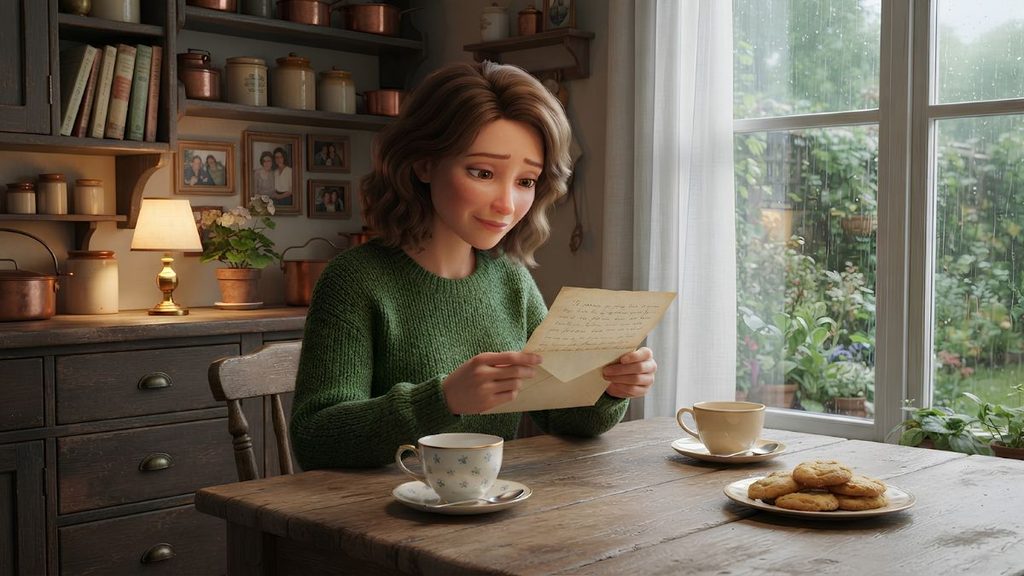
She slowly opened the envelope and unfolded the letter inside.
The first line made her smile.
My dear Sophie,
She recognized the handwriting immediately. The rounded letters, the slightly uneven spacing, and the small heart her mother always drew above the letter i.
Sophie began reading.
If you are reading this, you have probably found your way into the kitchen drawers again.
I always knew you would. You were never very good at leaving things where they belonged.
Sophie laughed quietly.
Her mother had always teased her about being untidy.
She continued reading.
I hope you are doing well. I hope your work is going nicely, and I hope you are remembering to eat proper meals instead of surviving on biscuits and coffee.
Sophie shook her head.
Even from beyond the years, her mother seemed to know exactly what she was doing.
The letter continued with ordinary observations.
Her mother wrote about the garden, the weather, and the neighbor’s new puppy. She mentioned that the old apple tree had produced fewer apples that year, but the flowers near the kitchen window had grown beautifully.
Then Sophie reached a sentence that made her pause.
I know you are busy building your own life, and I am proud of you for that. But remember that home is always a place where you are welcome to rest.
Sophie read it again.
Then she lowered the paper.
Rain tapped gently against the kitchen window.
For a moment, the house seemed completely still.
The Years That Passed Too Quickly
Sophie remembered leaving home at twenty-two.
She had been excited about moving to the city. She wanted independence, professional success, and the freedom to make her own decisions.
Her mother had helped her pack.
They had folded clothes, arranged books, and carefully wrapped a small collection of kitchen items.
On the morning Sophie left, her mother had prepared her favorite breakfast.
“Don’t forget to call when you arrive,” she had said.
“I will, Mum.”
And Sophie had called.
At first, she called almost every day.
Later, the calls became shorter and less frequent.
There were always reasons.
Work was busy.
The train tickets were expensive.
She had an important project.
She would visit next month.
Her mother never complained.
Whenever Sophie called, she asked about her job, her apartment, and whether she was eating properly.
Occasionally, she mentioned that the garden was looking beautiful or that she had tried a new recipe.
Sophie always intended to visit more often.
But life seemed to move faster every year.
There were promotions, deadlines, friendships, relationships, and countless little responsibilities.
The visits became occasional.
The phone calls became weekend conversations.
And eventually, she began realizing how many ordinary moments she had missed.
Sophie looked toward the empty chair near the kitchen window.
Her mother used to sit there every afternoon, drinking tea and reading the newspaper.
She could almost hear her voice.
“Are you hungry? There’s something in the fridge.”
Sophie folded the letter carefully.
She had discovered many photographs over the past few days, but this small piece of paper felt more valuable than all of them.
It was as though her mother had left behind a little conversation waiting to happen.
A Familiar Afternoon
Sophie decided to make tea.
She opened the cupboard and selected two cups without thinking.
Then she paused.
For years, her mother had used the same blue cup with tiny white flowers painted around the edge.
Sophie found it near the back of the shelf.
She placed it beside her own cup.
The kettle began to whistle.
Outside, the rain continued falling.
Sophie prepared the tea exactly as her mother used to make it, adding a little milk and one spoonful of sugar.
She also found a packet of biscuits in the pantry.
The kitchen slowly filled with the familiar smell of tea.
For a moment, Sophie felt as though she had travelled backward in time.
She remembered sitting at the table after school, talking about her day while her mother prepared dinner.
She remembered rainy afternoons when they baked cakes together.
She remembered the little arguments about leaving wet towels on the bathroom floor.
At the time, those moments had seemed ordinary.
Now, they felt precious.
Sophie opened the letter again and continued reading.
There are a few things I want you to remember.
First, don’t spend your entire life waiting for the perfect moment. There will always be something unfinished.
Second, call the people you love, even when you have nothing important to say.
And finally, never feel guilty about resting. You don’t have to be productive every minute to deserve a peaceful life.
Sophie smiled through her tears.
Her mother had always been practical, but she had a way of making simple advice sound important.
The final paragraph was shorter.
I don’t know when you will find this letter, but I hope it makes you smile. And if you happen to be drinking tea while reading it, please remember that I would have liked another cup too.
Sophie placed the letter on the table.
For a long time, she sat quietly.
Then she looked toward the second cup.
“Well, Mum,” she whispered, “I made you one anyway.”
The Garden Outside
Later that afternoon, Sophie decided to step outside.
The rain had stopped, and the garden was covered in tiny droplets of water.
The roses near the fence were beginning to fade, but the lavender bushes still looked healthy.
Her mother had spent countless hours caring for that garden.
Sophie walked along the stone pathway and stopped near a small wooden bench.
There was an old bird feeder hanging from the tree.
She remembered helping her mother fill it with seeds during winter.
A little brown bird landed nearby, looked around, and began pecking at the ground.
Sophie smiled.
She sat on the bench and watched the garden.
Her mother had never been someone who needed expensive holidays or elaborate celebrations. She enjoyed ordinary things.
A freshly prepared meal.
A sunny afternoon.
A good book.
A phone call from someone she loved.
Sophie wondered whether she had spent too much time searching for happiness in places that were far away.
Perhaps some of the things she wanted most had always been waiting in familiar places.
She returned to the house and placed the letter in a small wooden box.
Alongside it, she kept an old photograph of her mother standing in the garden.
She didn’t want to lose either of them.
A Small Promise
The following morning, Sophie woke early.
The rain had disappeared, and sunlight entered through the kitchen curtains.
She prepared breakfast, opened the windows, and began sorting through the remaining cupboards.
This time, she worked slowly.
She kept the old tea cups, several recipe books, and a small collection of family photographs.
She also decided to keep the kitchen table.
It had scratches, faded paint, and one slightly uneven leg, but she couldn’t imagine the house without it.
Before leaving that afternoon, Sophie took one last walk through the rooms.
She checked the windows, turned off the lights, and picked up the wooden box containing her mother’s letter.
Then she stopped near the kitchen drawer.
She opened it once more.
For a moment, she considered putting the letter back where she had found it.
But she changed her mind.
She placed it inside her handbag.
It would travel home with her.
The Letter That Continued to Give
Several weeks passed.
Sophie returned to her apartment and resumed her usual routine.
Work became busy again, emails arrived, and her calendar filled with appointments.
But something had changed.
She began making small adjustments.
On Sundays, she prepared proper meals instead of ordering takeaway.
She started calling her family more frequently, even if the conversations lasted only a few minutes.
She also bought a small plant for her apartment and placed it beside the kitchen window.
One evening, while organizing her desk, she found the letter again.
She unfolded it and read the final paragraph.
I hope it makes you smile.
Sophie smiled.
Then she took a photograph of the letter and placed it inside a digital folder named “Home.”
She didn’t want to forget the feeling of that rainy afternoon.
Months later, Sophie invited her brother and a few relatives to visit the old family house.
They spent the afternoon preparing food, sharing stories, and looking through photographs.
Someone found an old picture of their mother wearing a gardening hat.
Everyone laughed.
The kitchen was filled with voices again.
At one point, Sophie prepared tea and brought out the familiar blue cup with tiny white flowers.
Her brother noticed it.
“You kept Mum’s favorite cup?”
“Of course,” Sophie replied.
He smiled and sat down.
“She would have liked that.”
Sophie looked around the kitchen.
The old table was still there. The curtains still moved gently near the window, and the little garden outside was beginning to bloom again.
She realized that her mother had left behind much more than a house and a collection of belongings.
She had left behind habits, recipes, memories, and little pieces of wisdom that continued to shape the lives of the people she loved.
That evening, after everyone had gone, Sophie sat alone at the kitchen table.
She placed the letter beside her cup of tea.
Outside, the sky was turning dark.
A gentle breeze moved through the garden, and the first evening lights appeared along the quiet road.
Sophie read the letter one final time.
Then she folded it carefully and returned it to the wooden box.
She no longer felt that she had discovered something unfinished.
The letter had arrived late, perhaps, but its message had reached her at exactly the right moment.
She finally understood what her mother had meant.
Home wasn’t simply a place with familiar furniture, old photographs, or a garden filled with memories.
Home was the feeling of being loved without needing to prove anything.
It was knowing that somewhere, someone had once prepared your favorite meal, remembered your little habits, and hoped you would always have a place to rest.
Sophie finished her tea and turned off the kitchen light.
Before going upstairs, she glanced toward the window.
The garden was quiet beneath the evening sky.
And somewhere in the little wooden box, a simple handwritten letter continued holding all the warmth of a mother’s love.
That night, Sophie slept peacefully.
For the first time in a long while, she didn’t feel that she had left something important behind.
She had finally brought a little piece of home with her.
5. The Man Who Collected Sunsets
A Short Bedtime Story for Adults | Theme: Memories, Friendship, and the Beauty of Letting Go

Every evening, just before the sun began to disappear beneath the horizon, an elderly man named Henry walked down a narrow path leading to the beach.
He carried no bag, no camera, and no notebook. He never brought anything to eat or drink. All he carried was a small wooden walking stick and the quiet excitement of someone looking forward to meeting an old friend.
The beach was usually peaceful at that hour. A few fishermen returned with their boats, couples walked along the water’s edge, and children gathered seashells before their parents called them home.
Henry always chose the same spot, near a large piece of driftwood that had been resting on the sand for as long as anyone could remember. He would sit there, place his walking stick beside him, and watch the sky change.
Some evenings, the sun painted the clouds orange and gold. On others, the horizon turned pink, purple, and deep blue. Occasionally, the sky remained pale and quiet, as though the day were simply tired and ready for bed.
Henry loved every version.
One evening, while he was watching the sunlight shimmer across the water, a little boy approached him.
The boy was perhaps eight years old. He wore a yellow sweater and carried a red plastic bucket filled with shells.
“Excuse me, sir,” he said.
Henry turned with a smile.
“Good evening, young man. Have you come to watch the sunset?”
The boy shook his head.
“I was collecting shells, but I keep seeing you sitting here every evening. Why do you come here?”
Henry looked toward the horizon.
“I’m collecting sunsets.”
The boy glanced at the empty space around him.
“But you don’t have a bucket.”
Henry chuckled.
“That’s because I don’t collect things you can put inside a bucket.”
The boy sat down beside him, curious.
“Then how do you collect them?”
Henry took a moment before answering.
“With my eyes, my thoughts, and my memory. Every sunset is different. I watch it carefully, enjoy it while it lasts, and carry the feeling with me when I go home.”
The boy looked at the sky again.
“But the sunset disappears.”
“Yes,” Henry replied gently. “That’s what makes it special.”
The boy thought about this for a while. Then he placed his bucket beside him and watched the remaining sunlight.
“Do you think this one is special?”
Henry smiled.
“I think every sunset deserves a name. What would you call this one?”
The boy studied the clouds. They were glowing orange near the horizon, while the upper sky had turned a soft shade of purple.
“Maybe… the Golden Blanket.”
Henry nodded thoughtfully.
“The Golden Blanket. That’s a wonderful name.”
From that evening onward, the boy began joining Henry at the beach.
His name was Oliver, and he lived with his parents in a small house a few streets away. His father worked at the harbour, and his mother managed a little grocery shop near the main road.
Oliver had plenty of energy during the day. He liked running, playing football, climbing trees, and asking questions that sometimes left adults searching for answers.
But when he sat beside Henry, something changed. He became quieter. He watched the waves, listened to the distant cries of seabirds, and learned to notice things he had never paid attention to before.
Henry taught him that sunsets did not always need to be bright to be beautiful.
One evening, the sky was covered with thick grey clouds. The sun appeared only as a faint orange glow behind them.
Oliver frowned.
“This isn’t a very good sunset.”
Henry adjusted his coat and looked toward the sea.
“Why not?”
“Because there are no beautiful colours.”
Henry pointed toward the horizon.
“Look carefully. Can you see that little silver line where the clouds meet the water?”
Oliver leaned forward.
“Yes.”
“And look at the light behind those clouds. It is still there, even though we cannot see all of it.”
Oliver watched silently.
“What should we call this one?” Henry asked.
The boy considered the question.
“The Quiet Evening.”
Henry smiled.
“Then the Quiet Evening it shall be.”
Their collection grew.
There was the Purple Ocean, when the entire horizon seemed to dissolve into shades of violet. There was the Evening of a Thousand Colours, when thin clouds reflected pink, orange, yellow, and red. There was the Silver Goodbye, when the setting sun shone through a curtain of rain.
Some sunsets were spectacular. Others were so ordinary that most people walked past without noticing them.
But Henry and Oliver never missed an opportunity to appreciate one.
As the weeks passed, their conversations became longer.
Oliver asked Henry about his childhood, his favourite places, and the people he had known. Henry told him about the fishing village before the harbour became busy, about the old lighthouse that had once guided boats through storms, and about his wife, Margaret.
“Did she like sunsets too?” Oliver asked one evening.
Henry’s smile softened.
“More than anyone I have ever known.”
“Did you watch them together?”
“Almost every evening. Margaret used to say that the sky was the world’s way of reminding us to slow down.”
Oliver looked at him.
“Do you miss her?”
Henry nodded.
“Every day.”
For a little while, neither of them spoke.
Then Henry continued.
“But when I watch the sunset, I remember the evenings we spent together. I remember her laughter, the way she held her cup of tea, and how she always guessed what colour the clouds would turn next.”
“Does that make you sad?”
“Sometimes,” Henry answered honestly. “But it also makes me grateful. I cannot bring those evenings back, but I can still be thankful that they happened.”
Oliver did not fully understand everything Henry said, but he understood that the old man was remembering someone he loved.
He moved a little closer and rested his red bucket in the sand.
After that evening, Oliver sometimes brought an extra biscuit from home. Henry occasionally brought two small apples. They shared these simple treats while watching the sky change.
Their friendship became part of the beach’s quiet routine.
The fishermen began recognising them. A woman who walked her dog every evening started waving whenever she passed. Even the children playing near the water learned that the old man and the boy were the sunset collectors.
Then, one Thursday afternoon, Oliver arrived looking unusually quiet.
Henry noticed immediately.
“Something on your mind?”
Oliver sat beside him and began drawing circles in the sand with a small stick.
“My father says we’re moving.”
Henry looked at him.
“Moving where?”
“To another town. He got a new job near the mountains. We have to leave next week.”
For a moment, Henry said nothing.
Oliver continued drawing.
“I don’t want to go. I like this beach. And I like watching sunsets with you.”
Henry placed his walking stick beside the driftwood.
“New places can be difficult at first,” he said. “But they can also become special in ways you don’t expect.”
“What if I forget our sunsets?”
Henry smiled.
“Then you will have to collect new ones.”
Oliver looked disappointed.
“But they won’t be the same.”
“No,” Henry agreed. “They won’t. That’s the wonderful thing about them. No two sunsets are exactly alike, just as no two places or moments in life are exactly the same.”
Oliver looked toward the water.
“Will you still come here?”
“Every evening I can.”
“And you’ll keep collecting them?”
“Of course.”
Oliver nodded, though he still seemed unhappy.
That evening, they watched the sun disappear behind a thin line of clouds. Neither tried to name it. They simply sat together, listening to the waves.
Before leaving, Oliver took a small shell from his bucket and placed it beside Henry.
“So you remember me,” he said.
Henry picked it up carefully.
“I don’t think I’ll need a shell for that, Oliver.”
The boy smiled.
“But keep it anyway.”
Henry promised he would.
The following week, Oliver and his family left the village.
The beach returned to its familiar quietness. Henry still walked down the narrow path every evening, carrying his walking stick and looking forward to the sunset.
At first, he missed Oliver’s questions.
He missed hearing the names the boy invented for the colours in the sky. He even missed the little red bucket that always seemed to be full of shells, sand, and sometimes things that did not belong on a beach.
But he continued his evening walks.
He watched the Golden Blanket return in a different shade. He collected another Purple Ocean and discovered a new sunset that reminded him of the colour of Margaret’s favourite scarf.
One evening, he sat beside the driftwood and noticed the small shell Oliver had given him resting in his coat pocket.
He took it out and placed it beside him.
The tide moved gently across the sand. The sky turned peach, then rose, then a soft shade of blue.
Henry smiled.
He had spent many years collecting sunsets, but he had never thought much about what happened to them afterward. He had simply enjoyed them and allowed them to become part of his memories.
Now he understood that the best things we collect are often the ones we cannot keep.
A few weeks later, a postcard arrived at his home.
The front showed a beautiful sunset over a distant mountain lake. The water reflected the evening sky, making it look as though the mountains were floating between two golden horizons.
Henry turned the postcard over.
There was a short message written in uneven handwriting.
Dear Henry,
I found a new place to collect sunsets. The mountains make them look different, and sometimes the clouds turn pink just before dinner.
Yesterday, I saw one that looked like the Golden Blanket. I think you would have liked it.
I’m still collecting them. Just like you taught me.
Your friend,
Oliver
Henry read the message twice.
Then he placed the postcard on the small table near his favourite chair. He looked at it for a long time, smiling quietly.
That evening, he walked to the beach as usual.
The sky was unusually clear. A golden light stretched across the water, and the waves carried it toward the shore.
Henry sat beside the driftwood and took Oliver’s shell from his pocket.
He placed it gently on the sand.
“Another beautiful one,” he whispered.
The sun slowly disappeared, leaving a soft purple glow behind.
Henry did not take a photograph. He did not try to hold on to the moment.
He simply watched.
Somewhere far away, perhaps beside a mountain lake, a little boy was doing exactly the same thing.
And that thought made the evening even more beautiful.
When the last light faded, Henry picked up his walking stick and began the slow walk home.
He carried no bucket, no camera, and no collection he could show anyone.
But he carried years of golden evenings, a friendship that had travelled beyond the beach, and the quiet knowledge that beautiful moments do not need to last forever to remain with us.
Sometimes, the best way to keep something is simply to enjoy it while it is here.
And tomorrow evening, if the weather was kind, there would be another sunset waiting to be collected.
The End.
6. The Bakery on a Rainy Street
A Short Bedtime Story for Adults | Theme: Kindness, Belonging, and the Comfort of Simple Moments
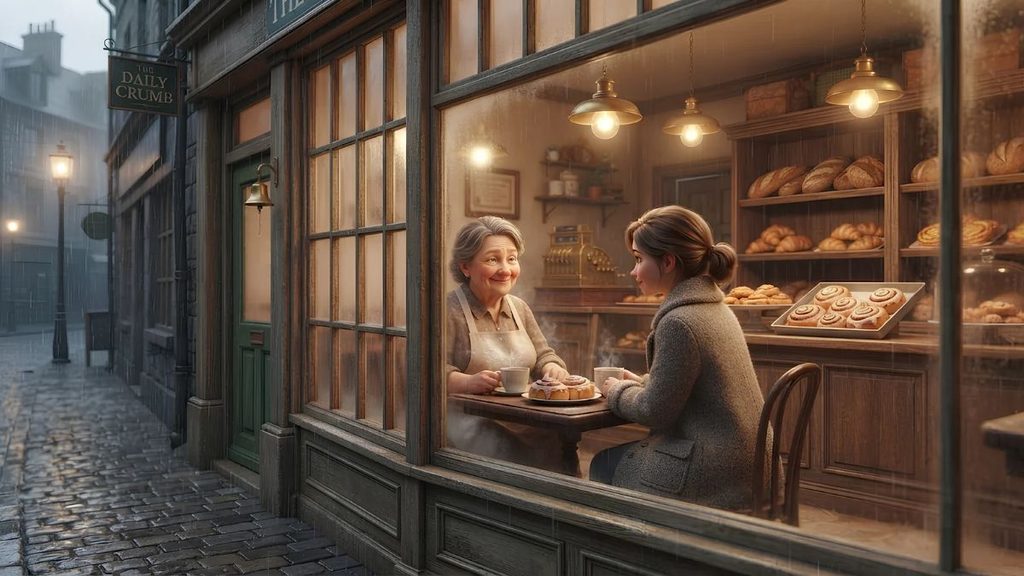
Rain had been falling over the little town of Bellwood since early morning.
It was not a heavy storm, but a steady, gentle rain that covered the streets with a silver shine. Water slipped from rooftops, collected along the pavement, and formed tiny rivers beside the old stone buildings.
Most people hurried through the streets with umbrellas held above their heads. Shopkeepers watched the weather through their windows, hoping the clouds would clear before evening.
But on a narrow street near the town square, one little bakery remained warm and welcoming.
Its name was The Golden Crust.
The bakery had a green wooden door, two large windows, and a small brass bell that rang whenever someone entered. Inside, the air was always filled with the smell of freshly baked bread, cinnamon rolls, and warm butter.
It belonged to a woman named Clara.
Clara was fifty-eight years old and had owned the bakery for nearly twenty years. She had inherited it from her parents, who had opened the shop when she was still a child.
The bakery was not particularly large or fashionable. Its wooden shelves were slightly uneven, the floor creaked near the counter, and the walls carried faint marks from years of use.
But people loved it.
They came for the bread, certainly, but they also came for the feeling that something in the world remained familiar.
Every morning, Clara unlocked the green door at six o’clock. She prepared the dough, warmed the ovens, arranged the pastries, and placed a fresh pot of coffee near the window.
By eight, the first customers usually arrived.
However, rainy days were different.
People stayed indoors, delivery drivers arrived late, and the usual morning crowd became smaller.
On this particular afternoon, Clara had barely served six customers.
She stood behind the counter, wiping a clean wooden surface for the second time, when she noticed a young woman standing outside the window.
The woman wore a grey coat and carried a large brown handbag. Her hair was slightly wet, and she seemed uncertain whether to come inside.
Clara watched as she looked at the bakery’s sign, then at the rain, and finally at the door.
A moment later, the brass bell rang.
“Good afternoon,” Clara said warmly. “Come in before the rain decides to follow you.”
The woman smiled faintly.
“Thank you. I think it already has.”
She brushed a few raindrops from her coat.
“Would you like something warm?” Clara asked.
The woman looked at the display.
“What do you recommend?”
“On a day like this? Cinnamon rolls. They are especially good when the weather is gloomy.”
“Then I’ll have one.”
Clara placed a cinnamon roll on a small plate and poured a cup of tea.
“Would you like to sit by the window?”
The woman nodded.
She took the table nearest the glass and placed her handbag beside the chair. For several minutes, she simply watched the rain.
Clara returned to the kitchen, but she noticed that the woman was not eating.
After a while, she approached the table.
“Is everything all right?”
The woman looked up.
“Oh, yes. The roll is lovely. I’m just enjoying the quiet.”
Clara smiled.
“That’s what rainy afternoons are for.”
The woman introduced herself as Anna. She had recently moved to Bellwood after accepting a job at a nearby publishing company.
She had been living in a rented apartment for three weeks, but she still felt like a visitor.
“I thought moving here would be exciting,” Anna explained. “A new job, a new town, a fresh start. But after work, I usually go home and sit alone. I haven’t really met anyone.”
Clara listened without interrupting.
“Starting again can take time,” she said. “Sometimes a new place needs to become familiar before it feels like home.”
Anna looked around the bakery.
“It feels familiar here already.”
Clara laughed softly.
“Then perhaps you have found your first familiar place.”
Anna finished her tea and left just before the rain stopped.
She thanked Clara, paid for her food, and promised to return.
Clara did not think much about the conversation until the following afternoon.
At around four o’clock, the brass bell rang again.
Anna entered, carrying the same brown handbag.
“One cinnamon roll, please,” she said.
“Of course,” Clara replied. “Would you like your usual table?”
Anna smiled.
“I suppose it is becoming my usual table.”
And so, a small routine began.
Anna visited the bakery every afternoon after work. Sometimes she ordered cinnamon rolls. On other days, she chose apple pastries or a slice of lemon cake.
She usually sat beside the window with a book or notebook.
Clara began recognising her footsteps before the door opened. She learned that Anna liked tea without sugar, preferred the corner table, and always asked for an extra napkin.
In return, Anna learned a little about Clara.
She discovered that Clara’s husband, Peter, had passed away several years earlier. They had run the bakery together, and he had been responsible for most of the bread recipes.
Clara still used his old recipe book, which was kept in a drawer beneath the counter.
“He never measured anything properly,” Clara said one afternoon. “He would add a little flour, then another handful, and insist that the dough would tell him when it was ready.”
“Did it?”
“Most of the time.”
They both laughed.
Anna also discovered that Clara had a habit of keeping a small plate of leftover pastries near the back door.
“What are those for?” Anna asked.
“For anyone who needs them.”
“Anyone?”
“Anyone who comes by hungry and doesn’t have enough money. There is no need to make a big announcement about it.”
Anna looked at the plate.
“That’s very kind.”
Clara shrugged.
“Peter believed that a bakery should never be a place where someone leaves hungry.”
Anna remembered those words long after she had gone home.
As autumn slowly turned into winter, the rainy afternoons became colder.
The streets were often empty by evening, and the bakery’s windows began fogging from the warmth inside.
Anna continued visiting.
Sometimes she stayed for only fifteen minutes. On other days, she worked on her writing for an hour, occasionally looking up to watch people passing outside.
One afternoon, she noticed an elderly man standing near the bakery’s entrance.
He was wearing a thin brown jacket and holding a folded newspaper. His shoes were wet, and he kept looking through the window at the display of bread.
He did not enter.
Clara noticed him too.
She opened the door and called gently.
“Good evening, Mr. Lewis. Come inside. You’re getting soaked.”
The man shook his head.
“I was only passing by.”
“Then you can pass by from inside for a moment.”
He hesitated before stepping into the bakery.
Clara disappeared into the kitchen and returned with a small paper bag.
“Here. Fresh bread and two rolls.”
Mr. Lewis looked uncomfortable.
“I can’t pay for these today.”
“I didn’t ask you to.”
“But…”
“Peter would be disappointed if I let you walk away hungry.”
The old man lowered his eyes.
“Thank you, Clara.”
He held the bag carefully, as though it contained something much more valuable than bread.
After he left, Anna looked at Clara.
“Does he come here often?”
“Not every day. He used to work at the railway station. His pension isn’t much, and he lives alone.”
Anna watched the man disappear into the rain.
“People must really appreciate what you do.”
Clara returned to arranging the pastries.
“I don’t do anything extraordinary. I simply have more bread than I need sometimes.”
But Anna knew there was something extraordinary about it.
A few weeks later, Clara developed a bad cold.
It was nothing serious, but she was tired and had been coughing for several days. She tried to continue working, though her daughter insisted she should close the bakery for a little while.
Clara refused.
“People depend on their morning bread,” she said.
Her daughter reminded her that people could survive without cinnamon rolls for two days.
Clara was not convinced.
Anna learned about Clara’s illness when she arrived one afternoon and found the bakery unusually quiet.
Clara was sitting behind the counter with a blanket over her shoulders.
“You should be at home,” Anna said.
“I am at home. This is my second home.”
“Then your second home needs someone to look after it.”
Clara smiled.
“I’ve managed this place for twenty years.”
“And perhaps you can let someone help you for one afternoon.”
Anna offered to help with the simple tasks. Clara was reluctant at first, but eventually agreed to let her serve customers, arrange the packaged bread, and take payments.
Anna had never worked in a bakery, but she quickly learned the routine.
She greeted customers, wrapped pastries, and kept the counter clean. When someone asked for a particular loaf, she called Clara from the kitchen.
By closing time, she was tired but happy.
The next afternoon, Anna returned.
This time, she brought a friend from work.
The day after that, she brought another colleague.
Soon, several people from the publishing company had discovered The Golden Crust.
The bakery became busier, and Clara began recognising new faces.
Some customers came for bread. Others came for coffee and conversation. A few simply wanted somewhere warm to sit while the rain passed.
Anna had unknowingly helped the bakery become a gathering place again.
One evening, after the last customer had left, Anna sat beside the window with a cup of tea.
The rain had stopped, and the streetlights were reflecting in the puddles.
Clara came out of the kitchen carrying two slices of apple cake.
“One for you,” she said, placing a plate on the table.
“You didn’t have to.”
“I know. That’s why I did.”
Anna laughed.
They sat together for a while, listening to the gentle ticking of the wall clock.
“Clara,” Anna said eventually, “do you ever think about selling the bakery?”
Clara looked surprised.
“Why would I do that?”
“Well, you’ve been here for so many years. It must be difficult to manage everything.”
Clara looked around the room.
“Sometimes I get tired. Sometimes my knees hurt, and sometimes I wonder how many more mornings I can wake up before sunrise.”
She paused.
“But then someone comes in asking for their favourite bread, or a child presses their nose against the window to look at the cakes, or an old friend stops by for tea.”
She smiled.
“And I remember why I stay.”
Anna looked at the green door and the little brass bell.
“I think places like this are important.”
“They are,” Clara said. “Not because of the walls or the furniture. It’s because of the people who pass through them.”
For a moment, Anna thought about the person she had been when she first arrived in Bellwood.
She had imagined that finding a new home meant finding a beautiful apartment, a successful job, and a comfortable routine.
But now she understood that belonging could begin with something much smaller.
A warm cup of tea.
A familiar window.
Someone who remembered how you liked your coffee.
A place where you were welcomed even when you had nothing important to say.
Winter arrived, bringing colder mornings and occasional snow.
The Golden Crust remained open, although Clara began closing an hour earlier in the evenings.
Anna still visited after work.
Mr. Lewis continued stopping by, and Clara kept a small plate near the back door. The publishing company employees had become regular customers, and the bakery’s little tables were often occupied.
One December afternoon, Anna arrived carrying a small package.
“I have something for you,” she said.
Clara opened it carefully.
Inside was a framed photograph of the bakery.
Anna had taken it on the rainy afternoon when they first met. The windows were glowing with warm light, the green door stood slightly open, and raindrops covered the pavement outside.
Underneath the photograph, Anna had written a small message:
Some places make the world feel warmer.
Clara looked at it for a long time.
“It’s beautiful,” she whispered.
“I thought you might like it.”
Clara placed the photograph on the shelf behind the counter, beside an old picture of Peter.
“Now I have two reminders of why this place matters.”
Anna smiled.
Outside, the first snowflakes of the season began falling.
The street grew quiet as people hurried home. Inside the bakery, the ovens were cooling, the lights glowed softly, and the smell of cinnamon lingered in the air.
Clara poured two cups of tea.
Anna sat at her usual table.
Neither felt the need to talk.
They simply watched the snow falling beyond the window, enjoying the warmth of the little bakery.
And as evening settled over Bellwood, The Golden Crust continued doing what it had always done best.
It offered people something warm to eat, somewhere comfortable to sit, and a small reminder that even on the coldest or loneliest days, kindness could make an ordinary place feel like home.
The End.
7. The Last Light in the Apartment Building
A Short Bedtime Story for Adults | Theme: Neighbourhood, Human Connection, and Finding Comfort in Ordinary Life
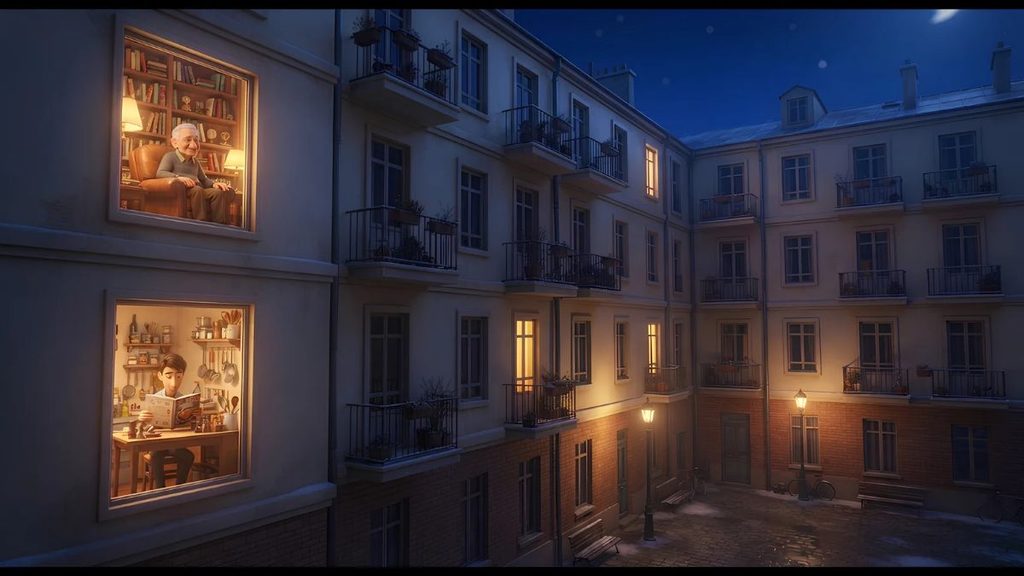
At the end of a quiet street stood an old apartment building with six floors, a narrow entrance, and a small garden that had seen better days.
Its walls were painted a pale cream colour, although years of rain and sunlight had left them faded. The lift made a soft rattling sound whenever it moved, and the staircase had a wooden handrail that creaked beneath every step.
The building was not beautiful, but it had something that newer buildings often lacked.
It had memories.
Families had lived there for generations. Children had learned to ride bicycles in the courtyard, neighbours had shared meals during festivals, and elderly residents had spent countless afternoons talking beside the entrance.
But over the years, people had begun moving away.
Some moved into larger homes. Others relocated for work. A few apartments remained empty for months.
The building gradually became quieter.
One of its oldest residents was a man named Edward Miller, who lived alone in apartment 602.
Edward was seventy-two years old. He had retired from his job as a school librarian and had lived in the building for almost thirty years.
His wife, Margaret, had passed away five years earlier. Their daughter lived in another city with her family, and although she called regularly, Edward preferred not to trouble her with his everyday worries.
He had developed a simple routine.
He woke at seven, prepared tea, read the newspaper, watered the plants on his balcony, and took a short walk in the afternoon.
In the evening, he cooked something simple, listened to the radio, and sat near his living-room window.
There was one thing Edward always did before going to bed.
He looked across the apartment building.
One by one, the lights in the windows disappeared.
Apartment 101 went dark first. The family living there usually went to bed early because their two children had school in the morning.
Apartment 204 stayed lit a little longer. A young couple often watched television until midnight.
On the fourth floor, someone regularly worked late at a desk near the window.
But eventually, every window became dark.
Except one.
Edward’s.
He was almost always the last person awake.
He never considered this unusual. He enjoyed the quiet hours after midnight, when the traffic outside faded and the building seemed to settle into sleep.
Sometimes he read a book. Sometimes he listened to the rain. Occasionally, he simply watched the empty street.
His warm yellow lamp remained visible through the window.
It was a small light, but from the opposite building, it looked like a little star resting above the street.
One Tuesday evening, Edward noticed something unusual.
A light was still glowing on the third floor.
It belonged to apartment 305, which had been empty for nearly six months.
Edward looked more carefully.
A young man was sitting near the window, surrounded by cardboard boxes.
He appeared tired. His shirt sleeves were rolled up, and a cup of tea sat beside him.
Edward smiled.
A new neighbour.
The following morning, he saw the young man near the entrance.
“Good morning,” Edward said.
The man looked up.
“Good morning.”
“Have you moved into 305?”
“Yes. Just yesterday. I’m Daniel.”
“Welcome to the building. I’m Edward, from the sixth floor.”
Daniel smiled politely.
“Nice to meet you.”
“Settling in?”
“Trying to. There are still a few boxes left.”
Edward chuckled.
“Moving always takes longer than expected. Especially when you discover how many things you own.”
Daniel laughed.
They exchanged a few more words before going their separate ways.
Edward thought little about the conversation, but that evening he noticed the light in apartment 305 again.
Daniel was still unpacking.
Over the next few days, Edward began noticing Daniel’s routine.
He left for work early, returned around seven, and often spent his evenings near the window with a laptop.
Sometimes he ate dinner while looking at his phone. On other nights, he sat quietly with a cup of tea.
Edward recognised the look of someone who was still trying to make an unfamiliar place feel like home.
One rainy evening, Edward was preparing vegetable soup when he heard a knock at his door.
He opened it and found Daniel standing outside.
“Sorry to disturb you,” Daniel said. “Do you happen to know where I can find a screwdriver? I need to fix a loose shelf.”
Edward smiled.
“Of course. Come in for a moment.”
He walked to a small cupboard and returned with a box containing several tools.
“Take whatever you need.”
“Thank you. I’ll return it tomorrow.”
“There’s no hurry.”
Daniel looked around the apartment.
It was neat and comfortable. A bookshelf covered one wall, and several framed photographs rested on a small table.
“Have you lived here long?” Daniel asked.
“Long enough to know which staircase makes the least noise.”
Daniel laughed.
Edward handed him the screwdriver.
“By the way, I made too much soup. Would you like a bowl?”
Daniel hesitated.
“Are you sure?”
“Absolutely. I don’t think soup improves by sitting in a refrigerator for three days.”
Daniel accepted.
They sat at the small dining table and talked for nearly an hour.
Daniel explained that he had recently started a new job in the city. He had moved away from his hometown and was still getting used to living alone.
His parents lived several hundred kilometres away, and most of his friends were scattered across different cities.
“I thought I’d enjoy having my own place,” Daniel admitted. “But sometimes I return from work and realise I haven’t spoken to anyone all day.”
Edward nodded.
“Living alone and feeling lonely are not always the same thing. But sometimes they do arrive together.”
Daniel smiled.
“That’s exactly how it feels.”
Edward told him about his years in the building, about the old neighbours, and about the time the residents had organised a summer garden party in the courtyard.
“People used to know one another here,” he said. “We shared food, borrowed sugar, and argued about whose turn it was to clean the staircase.”
“What happened?”
“Life happened. People moved, children grew up, and everyone became busy.”
Daniel looked toward the window.
“That’s a little sad.”
“Perhaps. But buildings have a way of welcoming new people.”
When Daniel left, he promised to return the screwdriver.
Edward washed the empty soup bowl and placed it on the kitchen shelf.
For the first time in several evenings, he felt that the apartment was not quite as quiet as before.
A few weeks passed.
Daniel returned the screwdriver, and occasionally he stopped by to say hello.
Sometimes he brought a newspaper. Sometimes he shared a small packet of biscuits from the shop downstairs.
Edward began looking forward to these short visits.
One Saturday morning, Daniel noticed the old man struggling with a large flowerpot near the balcony.
“Would you like some help?” he called from the doorway.
Edward looked over his shoulder.
“That would be wonderful. This plant has decided it wants to live somewhere else.”
Together, they moved the flowerpot and arranged the balcony plants.
Daniel discovered that Edward had a small collection of herbs, including mint, basil, and rosemary.
“Do you cook with these?”
“Whenever I remember to.”
Daniel laughed.
“Then you should give me some lessons. I can barely make anything beyond toast and eggs.”
Edward looked amused.
“Toast and eggs are a respectable beginning.”
That afternoon, they made a simple vegetable dish together.
Daniel chopped the vegetables while Edward explained how his wife had taught him to cook.
He spoke about Margaret with affection, describing how she always added a little extra garlic and insisted that food tasted better when shared.
Daniel listened.
He did not offer advice or try to change the subject. He simply allowed Edward to remember.
Sometimes, that was all a person needed.
As autumn arrived, the evenings became cooler.
Daniel’s work grew busier, and he began returning home later than usual.
Edward noticed that the light in apartment 305 often remained on until after midnight.
One evening, he looked across the courtyard and saw Daniel sitting at his desk with his head resting in one hand.
The young man looked exhausted.
The next afternoon, Edward prepared a small container of vegetable soup and walked downstairs.
Daniel opened the door wearing a tired expression.
“Hello, Edward.”
“I thought you might appreciate something warm.”
Daniel looked at the container.
“You didn’t have to do that.”
“I know. That’s why I did.”
Daniel smiled and invited him inside.
The apartment was still partly unfinished. A few boxes remained near the wall, and a small dining table stood beside the window.
“I’ve been working late,” Daniel explained. “There’s a project at the office, and I haven’t had much time to cook.”
Edward nodded.
“Work has a way of occupying every empty corner if we let it.”
Daniel laughed quietly.
“I think it has occupied all of mine.”
Edward looked at him.
“Remember to leave a little space for yourself.”
Daniel thanked him.
Before leaving, Edward noticed a photograph on the table.
It showed Daniel standing with an older couple in front of a house surrounded by trees.
“Your parents?”
“Yes. I visited them last summer.”
“They look happy.”
“They are. My mother keeps asking when I’ll come home again.”
“Perhaps you should visit them soon.”
Daniel nodded.
“I’ve been thinking about it.”
Edward returned upstairs, feeling glad that he had stopped by.
A few days later, the building experienced a power cut.
It happened just after nine in the evening.
The lights flickered once, twice, and then disappeared.
The lift stopped between floors, the hallway became dark, and the familiar sounds of televisions and kitchen appliances vanished.
Edward was sitting in his armchair when the room suddenly went black.
He reached for a small torch kept in the drawer beside him.
Outside, the entire street had gone dark.
He walked to the window and looked across the courtyard.
No lights.
Not even the familiar glow from apartment 305.
Then he heard a knock.
It was Daniel.
“Edward? Are you all right?”
“Perfectly fine. I have a torch and a very comfortable chair.”
Daniel laughed.
“I thought I’d check.”
“Come in. I have some candles.”
Edward lit two candles and placed them on the dining table.
Daniel brought a small packet of biscuits from his apartment.
They sat together, listening to the rain beginning outside.
Without television, phones, or electric lights, the evening felt strangely peaceful.
Daniel looked around the room.
“It’s funny. We spend so much time surrounded by noise that silence feels unusual.”
Edward nodded.
“When I was young, evenings were often like this. People sat together, talked, played cards, or simply listened to the rain.”
“Do you miss those days?”
“Sometimes. But I don’t think the past was better in every way. It was simply different.”
They talked about books, travel, food, and the places they hoped to visit.
Daniel told Edward about a small town near the mountains where he had spent childhood holidays.
Edward described the seaside village where he and Margaret had once stayed for an entire summer.
For a while, the years between them seemed to disappear.
When the electricity finally returned, the lights flickered back on.
Daniel stood up.
“I should get back downstairs.”
Edward smiled.
“Thank you for keeping me company.”
Daniel paused.
“I think you were keeping me company too.”
Winter arrived quietly.
The residents of the building began decorating their balconies with small lights. Someone placed a wreath near the entrance, and the smell of warm food occasionally drifted through the hallway.
Daniel visited his parents during the holidays and returned with a box of homemade sweets.
He shared them with Edward.
In return, Edward gave him an old cookbook that had belonged to Margaret.
“It’s full of recipes,” he explained. “Some are written in her handwriting, and others are just notes I made after she corrected me.”
Daniel opened the book carefully.
“Are you sure you want me to have it?”
“I think it would be happier in a kitchen than on my bookshelf.”
Daniel thanked him.
The following weekend, he made one of the recipes and brought a portion upstairs.
It was not perfect. The vegetables were slightly overcooked, and he had added too much salt.
Edward tasted it and nodded thoughtfully.
“Not bad.”
Daniel looked relieved.
“Really?”
“Yes. But Margaret would have told you to use less salt.”
They both laughed.
One evening, Edward did not switch on his usual living-room lamp.
He had fallen asleep in his armchair after reading a book.
When he woke, it was nearly eleven.
He looked toward the window.
The apartment building was mostly dark.
But there was a warm light glowing on the third floor.
Daniel was sitting near his window, reading the old cookbook.
Edward smiled.
He reached for the lamp beside his chair and switched it on.
Across the courtyard, Daniel noticed the familiar yellow glow.
He looked up, smiled, and raised his hand.
Edward raised his in return.
Neither needed to say anything.
For a moment, two small lights shone across the quiet courtyard, connecting two apartments separated by several floors and many years.
Edward sat back in his chair.
He thought about Margaret, about the old neighbours who had moved away, and about the young man who had arrived with a few cardboard boxes and a tired expression.
He realised that the building was not becoming emptier.
It was simply changing.
New people were arriving with new stories, new routines, and new reasons to leave their lights on at night.
Perhaps that was how a home stayed alive.
Not through its walls or furniture, but through the small connections people made without even noticing.
Before going to bed, Edward stood beside the window one last time.
Most of the apartment lights had disappeared.
The young couple on the second floor had switched off their television. The family downstairs had gone to sleep. The late-night worker on the fourth floor had finally closed a laptop.
Only two lights remained.
Edward’s yellow lamp and Daniel’s small desk light.
Edward smiled.
For years, he had believed that he was always the last person awake in the building.
Now he knew he was not.
And somehow, that made the night feel warmer.
He turned off his lamp and walked toward his bedroom.
Across the courtyard, Daniel continued reading for a little while longer.
Outside, the street rested beneath the quiet winter sky.
The old apartment building stood peacefully, holding its many stories within its faded walls.
And somewhere between the sixth floor and the third, a simple friendship had made the darkness feel a little less empty.
The End.
Why Do Adults Enjoy Reading Short Bedtime Stories?
Bedtime storytelling isn’t limited to children. Adults can enjoy it just as much, particularly when their daily routines leave little room for relaxation.
Here are some reasons why short bedtime stories have become an appealing nighttime activity.
They Help You Disconnect From Daily Responsibilities
Work emails, financial concerns, household responsibilities, and tomorrow’s plans can make it difficult to switch off at night.
Reading a gentle story gives your attention something different to focus on. Instead of thinking about unfinished tasks, you can spend a few minutes imagining a quiet beach, a beautiful garden, or a peaceful evening in a small village.
They Create a Relaxing Bedtime Routine
A consistent bedtime routine can help signal that the day is coming to an end. Reading a short story before bed can become a pleasant part of that routine.
You don’t need to spend an hour reading. Even five to ten minutes with a calming story can provide a welcome break from screens and everyday distractions.
They Bring Back Beautiful Memories
Some of the most comforting stories remind us of familiar experiences.
An old family home, the smell of freshly prepared food, a familiar railway station, or the sound of rain against a window can bring back memories that we haven’t thought about in years.
Nostalgic bedtime stories allow adults to revisit those moments through gentle storytelling.
They Encourage Imagination
A peaceful story can transport you somewhere completely different without requiring you to leave your bed.
You might imagine a little cottage surrounded by flowers, a quiet seaside town, or a train slowly passing through green countryside.
These imaginary settings offer a pleasant alternative to the constant stimulation of everyday digital life.
They Offer Emotional Comfort
Not every story needs to teach a lesson or deliver a powerful message. Sometimes, readers simply want to experience kindness, companionship, love, and peaceful moments.
Gentle stories can provide that emotional comfort without demanding too much attention.
Different Types of Short Bedtime Stories for Adults
Everyone has different preferences when it comes to nighttime reading. Some people enjoy romance, while others prefer humorous situations or peaceful stories about nature.
Here are some popular categories worth exploring.
Relaxing Bedtime Stories
Relaxing bedtime stories focus on quiet environments and ordinary experiences. They often feature peaceful homes, beautiful landscapes, gentle weather, and characters enjoying simple pleasures.
Examples include:
- A quiet evening in a countryside cottage.
- A gardener enjoying the first rain of the season.
- An old bookstore closing for the night.
- A peaceful afternoon beside a lake.
These stories are ideal for readers who prefer gentle narratives without unexpected twists.
Romantic Bedtime Stories
Romantic bedtime stories for adults explore affection, companionship, emotional connections, and meaningful relationships.
They don’t always need dramatic declarations of love. A couple preparing dinner together, two old friends meeting after many years, or someone remembering their first conversation with a loved one can create a beautiful romantic atmosphere.
Popular ideas include:
- A letter that arrived twenty years late.
- The couple who never stopped taking evening walks.
- A quiet dinner beneath the stars.
- The little café where two strangers met.
Funny Bedtime Stories
Who says bedtime stories always need to be serious?
Funny bedtime stories introduce lighthearted situations, amusing characters, and everyday misunderstandings. They are perfect for adults who enjoy ending their day with a smile.
Some ideas include:
- The neighbor who talked to his plants.
- The man who accidentally became the village’s unofficial detective.
- A cat that believed it owned the entire neighborhood.
- The grandmother who secretly won every family competition.
Nostalgic Bedtime Stories
Nostalgic stories take readers back to simpler times. They often explore childhood friendships, family traditions, old neighborhoods, and memories of people who made life special.
These stories can be particularly meaningful for adults who enjoy reflective and emotionally warm storytelling.
Nature-Inspired Bedtime Stories
Nature-inspired stories revolve around forests, mountains, rivers, gardens, rain, and changing seasons.
Their settings are often peaceful, with very little conflict. The natural surroundings become an important part of the storytelling experience.
Examples include:
- The forest that whispered at night.
- A little house beside a flowing river.
- The last snowfall of winter.
- A garden that bloomed after years of neglect.
How to Choose the Best Bedtime Stories for Your Mood
The best short bedtime story is not necessarily the most popular one. It is the story that matches how you feel at the end of the day.
Here is a simple guide to choosing your next nighttime read.
| Your mood | Recommended story type |
|---|---|
| Feeling mentally exhausted | Peaceful countryside stories |
| Missing someone | Romantic and nostalgic stories |
| Wanting to smile | Gentle humorous stories |
| Feeling overwhelmed | Nature-inspired stories |
| Wanting companionship | Warm relationship stories |
| Looking for something different | Gentle adventure stories |
| Feeling reflective | Emotional everyday-life stories |
You can also experiment with different storytelling styles. Some evenings call for a romantic story, while others are better suited to a quiet description of a rainy afternoon.
How Long Should a Short Bedtime Story Be?
A short bedtime story for adults can be anywhere from 300 to 1,000 words, depending on the reader’s preference and the storytelling style.
However, there is no fixed word count that makes a story suitable for bedtime.
Consider these approximate reading durations:
| Story length | Estimated reading time |
|---|---|
| 100–250 words | 1–2 minutes |
| 250–500 words | 2–4 minutes |
| 500–750 words | 4–6 minutes |
| 750–1,000 words | 6–8 minutes |
| 1,000–1,500 words | 8–12 minutes |
These are estimates and will vary according to reading speed.
For someone who wants a quick nighttime escape, a 300–500-word story may be sufficient. Readers who enjoy longer narratives might prefer stories that take around ten minutes to finish.
Tips for Enjoying Bedtime Stories Before Sleeping
You don’t need an elaborate setup to enjoy bedtime storytelling. A few small changes can make the experience more comfortable.
- Choose a peaceful story: Avoid stories with intense suspense, disturbing situations, or complicated plots if your goal is to wind down.
- Keep the lighting comfortable: Use a soft bedside lamp rather than bright overhead lighting.
- Put away unnecessary distractions: Try to avoid switching between stories, notifications, social media, and videos.
- Read at your own pace: There is no need to finish a story in one sitting. Stop whenever you feel ready.
- Consider audiobooks: If you prefer listening, choose a calm narrator and comfortable volume. Set a sleep timer so the audio doesn’t continue unnecessarily.
- Make it a regular habit: Reading around the same time each evening can help establish a consistent wind-down routine.
Research has found that bedtime reading may improve self-reported sleep quality. One randomized trial involving 991 participants found that 42% of those who read before bed reported improved sleep, compared with 28% of those who did not. However, individual experiences vary, and bedtime stories are not a treatment for persistent sleep problems. PubMed+2
Are Bedtime Stories for Adults Better Than Watching TV Before Bed?
For people who want a quieter nighttime routine, reading a bedtime story can be a useful alternative to watching television.
Television often involves bright screens, advertisements, dramatic scenes, and continuous stimulation. A peaceful story, on the other hand, allows readers to control the pace and stop whenever they want.
Printed books can be particularly convenient because they don’t require screen exposure. If you prefer reading on a phone or tablet, consider reducing screen brightness and using comfortable lighting.
The goal isn’t to make bedtime reading another responsibility. It should feel like something enjoyable rather than another task on your daily schedule. Sleep Foundation+1
Frequently Asked Questions About Short Bedtime Stories for Adults
What are the best short bedtime stories for adults?
The best short bedtime stories for adults are peaceful, engaging, and easy to follow. Romantic stories, nostalgic memories, countryside adventures, nature-inspired narratives, and gentle humorous stories are popular choices.
Can adults read bedtime stories before sleeping?
Yes. Bedtime stories aren’t exclusively for children. Adults can enjoy short stories as part of a relaxing nighttime routine. Reading before bed may also help some people improve their perceived sleep quality.
How many minutes should I spend reading bedtime stories?
You can spend anywhere from five to fifteen minutes reading before bed. The ideal duration depends on your preference, available time, and reading speed. Even a short story can provide an enjoyable break.
Are bedtime stories good for stress relief?
Peaceful bedtime stories may help some readers temporarily shift their attention away from daily worries. Stories featuring nature, companionship, familiar surroundings, and positive experiences can create a comforting reading experience. However, they should not be considered a substitute for professional support when stress or anxiety becomes persistent.
Can I listen to bedtime stories instead of reading them?
Absolutely. Audiobooks and narrated bedtime stories are convenient alternatives for people who prefer listening. Choose a gentle narrator, keep the volume comfortable, and consider using a sleep timer.
What type of bedtime stories help adults relax?
Stories with simple plots, familiar settings, gentle emotions, and reassuring endings are often suitable. Peaceful cottage stories, romantic evenings, rainy-day memories, and nature-inspired narratives are good examples.
Are there romantic bedtime stories for adults?
Yes. Romantic bedtime stories often explore companionship, emotional connections, meaningful conversations, and lasting relationships. They can be sweet, nostalgic, humorous, or emotionally touching without necessarily involving dramatic situations.
Where can I find free short bedtime stories for adults?
You can find free bedtime stories on storytelling websites, online reading platforms, blogs, and audiobook channels. Look for collections featuring relaxing, romantic, nostalgic, and peaceful stories.
Are short bedtime stories suitable for people who have trouble sleeping?
They may be a helpful addition to a calming bedtime routine, but they do not treat insomnia. If you regularly struggle to fall asleep or stay asleep, consider discussing the problem with a healthcare professional.
Conclusion: End Your Day With a Little Story
Life can become surprisingly busy, even when we don’t realize how much time we spend worrying about tomorrow. Between professional responsibilities, personal commitments, and everyday challenges, finding a few quiet moments for ourselves can feel like a luxury.
Short bedtime stories for adults offer a simple way to enjoy those moments.
You might spend one evening exploring a peaceful countryside cottage, another remembering an old friendship, and another smiling at a humorous story about an ordinary person having an unusual day.
There is no right or wrong way to enjoy bedtime storytelling. You don’t need to finish every story, remember every character, or search for a deeper meaning.
Sometimes, all you need is a comfortable place, a quiet evening, and a few beautiful sentences.
Let the day come to an end, leave tomorrow’s worries for tomorrow, and enjoy one little story before closing your eyes.