
Science fiction has a unique way of making readers question reality while imagining incredible possibilities. If you’re searching for the best sci-fi short stories to read, you’ll find that these captivating tales deliver unforgettable ideas, emotional characters, and surprising twists in just a few pages, unlike full-length novels.
They explore fascinating topics such as artificial intelligence, space exploration, time travel, alien civilizations, dystopian futures, and the impact of technology on humanity.
One of the reasons sci-fi short stories remain so popular is their ability to introduce a powerful idea and explore it in a concise, engaging way. Even with a short length, these stories often leave readers thinking about science, society, and the future long after they finish reading.
Whether you are new to science fiction or a lifelong fan, the best sci-fi short stories to read offer an excellent way to experience the genre. Many of the greatest science fiction authors built their reputations through short fiction, proving that a powerful story does not need hundreds of pages to leave a lasting impression. Their imaginative ideas have inspired countless novels, movies, and television series.
In this guide, we’ll explore some of the best sci-fi short stories to read, why they continue to inspire readers across generations, and what makes a science fiction short story truly memorable.
Whether you enjoy futuristic technology, thrilling space adventures, time travel, or thought-provoking concepts, you’ll discover stories that spark your imagination and leave you thinking long after the final page.
Why Sci-Fi Short Stories Are So Popular
Science fiction is a genre built on imagination, innovation, and big ideas. Unlike full-length novels, sci-fi short stories focus on a single concept, allowing authors to explore fascinating possibilities without unnecessary details. Despite their shorter length, these stories often leave readers with powerful questions about technology, humanity, and the future.
Some of the biggest reasons readers enjoy sci-fi short stories include:
They Introduce Incredible Worlds Quickly
In just a few pages, readers can visit distant planets, futuristic cities, alternate realities, or advanced civilizations without committing to a lengthy novel.
They Explore Fascinating “What If” Questions
Many stories begin with a simple but thought-provoking idea, such as:
- What if humans could travel through time?
- What if robots became self-aware?
- What if aliens made first contact with Earth?
- What if people could upload their minds into computers?
These questions encourage readers to think beyond today’s world.
They Deliver Memorable Twists
Sci-fi short stories are well known for their surprising endings. Many conclude with unexpected revelations that completely change the reader’s perspective.
They Blend Science with Human Emotion
While futuristic technology often drives the story, the best sci-fi tales also explore universal themes such as love, fear, hope, sacrifice, curiosity, and survival, making them emotionally engaging as well as imaginative.
They Are Perfect for Busy Readers
Most sci-fi short stories can be finished in a single sitting, making them ideal for readers who want an exciting and thought-provoking experience without investing hours in a novel.
One of the reasons these stories have remained popular for decades is their lasting influence. Many classic science fiction ideas first appeared in short stories before inspiring bestselling novels, television series, blockbuster films, and even discussions about future scientific possibilities.
What Makes a Great Sci-Fi Short Story?
The best sci-fi short stories may explore futuristic technology or distant galaxies, but the elements that make them memorable are surprisingly timeless. Great stories combine imaginative ideas with relatable characters and endings that encourage readers to think long after they have finished reading.
Here are the key qualities that define an unforgettable science fiction short story:
A Powerful Central Idea
Every great science fiction story begins with an intriguing question or concept. Instead of trying to explore dozens of ideas at once, the story focuses on one compelling possibility and develops it in a meaningful way.
Some classic examples include:
- What if robots developed emotions?
- What if humans could travel through time?
- What if aliens visited Earth peacefully?
- What if memories could be bought and sold?
- What if people lived forever?
These thought-provoking questions form the foundation of the story and keep readers engaged from beginning to end.
Relatable Characters
No matter how advanced the technology or how unusual the setting, readers connect most with believable characters. Whether the protagonist is an astronaut, scientist, alien, or artificial intelligence, their struggles, hopes, fears, and decisions make the story emotionally meaningful.
Strong characters help readers care about the outcome, even in the most extraordinary situations.
A Thought-Provoking Ending
One of the defining features of the best sci-fi short stories is an ending that stays with the reader. Some endings are surprising, while others raise philosophical or ethical questions about science, society, or human nature.
Rather than answering every question, many science fiction stories encourage readers to imagine what happens next and reflect on the deeper meaning behind the story.
A Balance of Science and Imagination
The most memorable sci-fi stories combine scientific ideas with creative imagination. They introduce futuristic concepts in a way that feels believable within the story while still inspiring readers to think beyond the limits of today’s world.
When these elements come together, a sci-fi short story becomes more than just entertainment. It becomes an experience that challenges perspectives, sparks curiosity, and inspires the imagination.
Best Sci-Fi Short Stories to Read
The City Beneath the Ocean
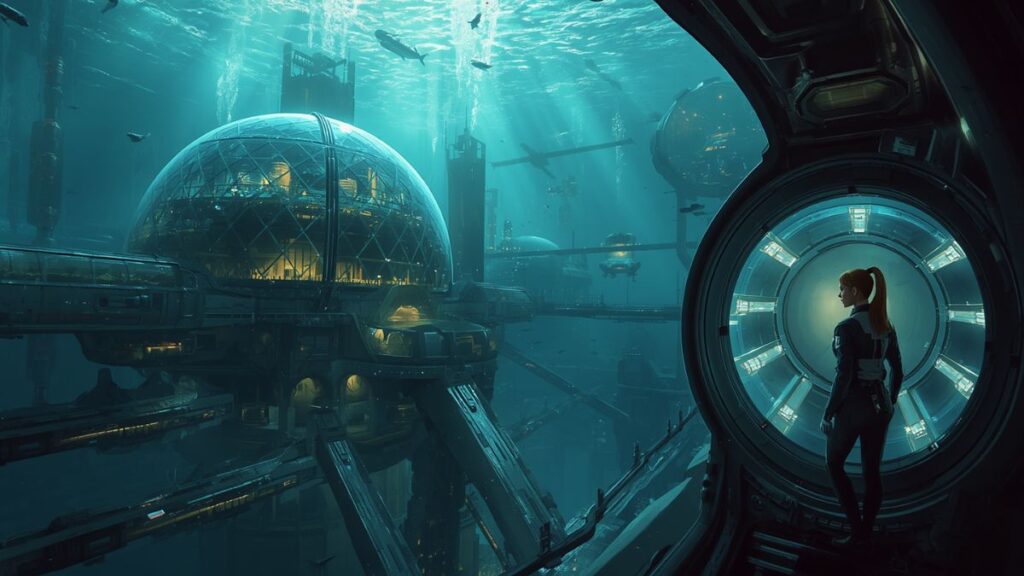
Genre: Climate Fiction | Future Society | Environmental Science Fiction
The first time Lena Torres saw the surface of Earth, she thought it looked like a forgotten memory.
Discover more
Educational Resources
Writers Resources
Horse
From the observation window of Atlantis Prime, the planet above appeared endless and blue.
Storm clouds moved across the oceans.
Waves covered what were once cities.
Entire coastlines had disappeared beneath rising seas.
For most people living underwater, the surface was only something they studied in history lessons.
A dangerous place.
A place where humanity had failed.
But Lena had always wondered one thing.
What if Earth was not a place to escape?
What if it was a place to save?
The Last Generation on Land
By the year 2185, climate change had transformed the planet.
For centuries, scientists had warned humanity about rising temperatures, melting ice sheets, and environmental destruction.
But warnings became disasters.
Coastal cities disappeared.
Millions of people were forced to relocate.
Extreme weather events became more common.
Eventually, humanity faced a difficult decision.
Leave the surface behind.
Or create a new way to survive.
The solution was Atlantis Prime.
A massive underwater city built deep beneath the Pacific Ocean.
It was humanity’s greatest engineering achievement.
Discover more
Language Resources
Child Care
children
A self-sustaining civilization hidden beneath the waves.
Atlantis Prime
The city was unlike anything humans had ever created.
Huge transparent domes protected millions of residents from the ocean pressure.
Artificial sunlight filled the streets.
Vertical farms produced food.
Advanced machines controlled temperature, oxygen, and water systems.
People lived, worked, and raised families beneath the ocean.
To them, Atlantis Prime was not a temporary shelter.
It was home.
Children born there had never touched soil.
They had never felt natural rain.
They had never seen a forest.
The surface was just an old story.
A world that no longer belonged to humans.
The Engineer Who Loved the Old World
Lena Torres was different.
She was one of Atlantis Prime’s youngest environmental engineers.
Her job was maintaining the city’s energy systems and studying Earth’s recovery.
Discover more
Education
Radio
How-To, DIY & Expert Content
Unlike most people, Lena was fascinated by the surface.
She spent hours reading old books about forests, mountains, and wildlife.
She watched ancient videos of people walking through parks.
She listened to recordings of rain falling on land.
To everyone else, these things belonged to the past.
To Lena, they represented a future.
The Strange Discovery
During a routine inspection of Atlantis Prime’s foundation systems, Lena discovered something unusual.
A hidden section of the city’s original construction files.
At first, she thought it was a technical mistake.
But the documents were real.
They revealed something shocking.
Atlantis Prime was never designed only as a survival city.
It was designed as an escape.
The original creators had a secret plan.
Humanity was never supposed to return to the surface.
The underwater civilization was meant to continue forever.
The damaged Earth above would be abandoned.
The Hidden Plan
Lena investigated further.
She discovered that early leaders believed the surface was beyond repair.
Their solution was simple.
Create a new human civilization underwater.
Forget the old world.
Move forward.
The official history taught that Atlantis Prime saved humanity.
But the truth was more complicated.
It did not save Earth.
It left Earth behind.
Lena stared at the documents.
For the first time in her life, she questioned everything she knew.
A Difficult Question
Lena shared her discovery with her mentor, Dr. Elias Morgan.
He was one of the oldest scientists in Atlantis Prime.
“You understand what this means?” Lena asked.
He nodded.
“Yes.”
“People were never supposed to know.”
“Why?”
“Because they were afraid.”
“Afraid of what?”
Elias looked toward the ocean outside.
“Afraid that if people remembered Earth, they would want to return.”
The Forgotten Planet
Lena began studying the surface.
Using advanced satellites, she discovered something unexpected.
Earth was healing.
Slowly.
Painfully.
But healing.
Some forests had returned.
Some oceans had recovered.
Some animal populations were increasing.
The planet was damaged.
But it was not dead.
Humanity had assumed the worst.
But nature had continued without them.
The Choice Before Humanity
When Lena presented her findings to the Atlantis Prime council, the response was immediate.
Many leaders rejected her ideas.
“The surface is dangerous.”
“We cannot risk millions of lives.”
“Our civilization exists here now.”
But Lena asked a different question.
“Are we surviving?”
“Or are we hiding?”
The council had no easy answer.
The Debate
The people of Atlantis Prime were divided.
Some wanted to remain underwater.
They had built a successful civilization.
They feared losing everything.
Others believed humanity had a responsibility to return.
Not because the surface was safe.
But because it was home.
For the first time in generations, people looked upward.
Toward the world they had abandoned.
Returning to the Surface
A small group of scientists, engineers, and explorers volunteered for the first surface mission.
Lena was chosen to lead it.
When she stepped onto land for the first time, she expected destruction.
Instead, she felt silence.
The air smelled different.
The sky looked enormous.
She touched the ground beneath her feet.
Real soil.
Something she had only seen in books.
She realized something important.
Humanity had spent generations searching for new worlds.
But they had forgotten the first one.
The New Beginning
The surface mission proved that Earth could support life again.
Not immediately.
Not easily.
But eventually.
Atlantis Prime began a new project.
Not abandoning the ocean city.
Not destroying what humanity had created.
But reconnecting with Earth.
People began restoring forests.
Cleaning oceans.
Rebuilding ecosystems.
The underwater city became a bridge between the past and the future.
The Lesson of Atlantis Prime
Years later, children in Atlantis Prime learned a new history.
They no longer heard stories about a dead planet.
They learned about a wounded planet.
A planet that survived.
A planet that waited.
During one lesson, a child asked Lena:
“Why did humans leave Earth?”
She thought carefully.
Then answered:
“Because we thought survival meant finding somewhere else to live.”
The child looked confused.
“What does survival really mean?”
Lena smiled.
“Learning how to protect the place that gave us life.”
The Ocean and the Sky
Decades later, humanity lived in two worlds.
Underwater cities protected by technology.
Restored landscapes protected by nature.
People traveled between oceans and continents.
The old division between the surface and the sea disappeared.
Humanity finally understood something it had forgotten.
A planet was not just a place to live.
It was a responsibility.
The Final Message
Many years later, Lena recorded a message for future generations.
She stood on a restored coastline.
Behind her were green forests.
Above her was a clear sky.
“The universe is enormous,” she said.
“There are countless worlds waiting to be discovered.”
“But before we search for another home…”
“We must learn to care for the one we already have.”
Moral of the Story
The greatest achievement of humanity is not escaping a damaged world, but finding the courage to repair it.
Technology can help us survive, but responsibility, cooperation, and respect for nature are what allow civilizations to truly thrive.
The Library at the End of the Universe
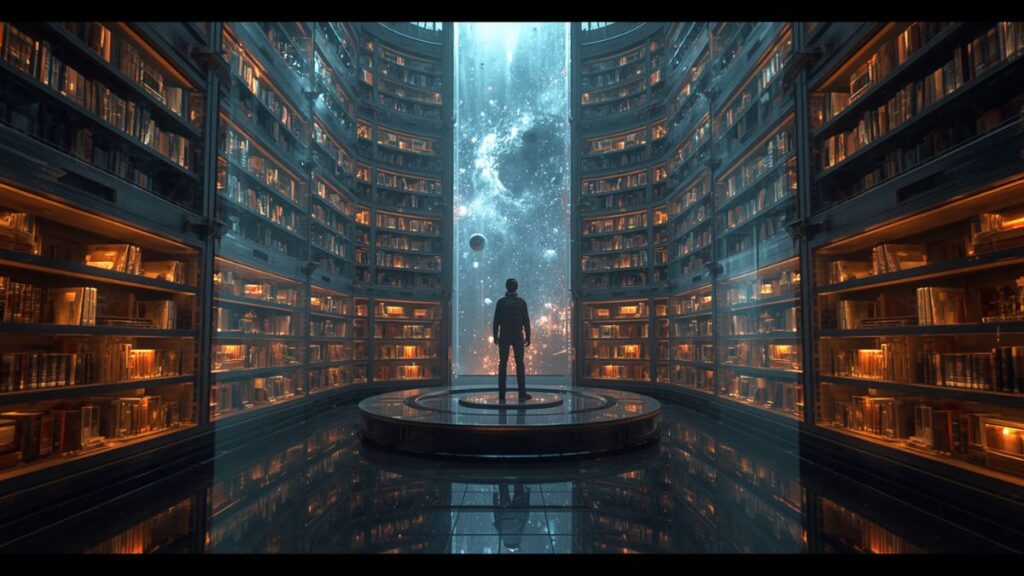
Genre: Space Exploration | Cosmic Science Fiction | Future Mystery
The first rule of the universe was simple:
Nothing lasts forever.
Stars are born and die.
Planets change.
Civilizations rise and disappear.
Even galaxies eventually fade into darkness.
But somewhere beyond the edge of known space, humanity discovered something that seemed to break that rule.
A library.
Not a building.
Not a spacecraft.
Not a machine.
A library that floated between galaxies, surrounded by nothing but endless darkness.
Inside it were the stories of everything that had ever existed.
Every civilization.
Every discovery.
Every war.
Every dream.
Every forgotten voice.
It was called:
The Library at the End of the Universe.
The Greatest Discovery in History
In the year 2317, humanity had traveled farther than anyone had imagined.
The first explorers had reached distant planets.
The first colonies had been established beyond the Milky Way.
Humans had encountered strange worlds, unknown species, and mysteries that challenged everything they understood.
Discover more
Visual Art & Design
Radio
children
But nothing compared to the discovery made by the explorer ship Celestia.
The ship was traveling beyond the outer edge of the universe’s mapped regions when its sensors detected something impossible.
A structure.
Floating in empty space.
No planet.
No star.
No source of energy.
Yet it existed.
For three hundred years, scientists had searched for evidence of advanced alien civilizations.
They expected weapons.
Machines.
Technology.
Instead, they found books.
The Guardian of Knowledge
Mira Voss was a historian, not an explorer.
She had spent her life studying civilizations that disappeared before humanity discovered them.
She believed every society left behind something valuable.
Not their technology.
Not their weapons.
Their stories.
When humanity discovered the mysterious library, Mira was chosen as one of the first researchers allowed inside.
Her mission was simple:
Understand what the library was.
And discover who created it.
Entering the Impossible Library
The entrance had no doors.
No security system.
No instructions.
When Mira approached, the walls changed.
A passage appeared.
As if the library already knew she was coming.
Inside, she found something beyond imagination.
Endless halls stretched in every direction.
Shelves continued farther than the eye could see.
Some contained physical books.
Others contained glowing memories.
Some contained entire simulated worlds.
Mira realized the library was not storing information.
It was preserving experiences.
The Stories of Lost Worlds
Mira spent months exploring the library.
She discovered civilizations that humans had never heard of.
The Aruvi, who created cities beneath the surface of their planet.
Discover more
Writers Resources
Parenting
Educational Resources
The Velarians, who communicated through music instead of language.
The Norian species, who lived for only seven years but created incredible works of art.
Each civilization had one section.
Each story had one purpose.
To prove they existed.
The Question of the Library
After studying thousands of records, Mira noticed something strange.
Every civilization had a section.
Every species had a history.
Every planet had a story.
But something was missing.
Humanity.
There was no human section.
No records.
No history.
No future.
Mira searched for days.
Nothing.
The universe had preserved countless civilizations.
But it had forgotten humanity.
Meeting the Library’s Intelligence
Deep inside the library, Mira discovered a central chamber.
At its center was a glowing sphere.
A voice spoke.
“Welcome, Mira Voss.”
She froze.
“Who are you?”
“I am the Keeper.”
“The creator of this library?”
“No.”
“Then who created it?”
The voice paused.
“Everyone.”
Mira did not understand.
The Keeper explained that the library was not built by one civilization.
It was created by countless species working together across billions of years.
Every civilization contributed knowledge.
Every species added its story.
The library was a gift from life itself.
Why Humanity Was Missing
Mira finally asked the question that troubled her.
“Why is humanity not recorded?”
The Keeper answered:
“Because your story is incomplete.”
Mira was confused.
“Every civilization has a history.”
“Yes.”
“But history is not the same as a story.”
The Keeper continued:
“Your species has not reached its final chapter.”
The Empty Section
The Keeper guided Mira to a forgotten area.
A completely empty section of the library.
No books.
No memories.
No records.
A single label appeared.
Humanity.
Mira stared.
“Why is it empty?”
The Keeper answered:
“Because the future cannot be remembered until it happens.”
She finally understood.
The library contained the past of every civilization.
But humanity’s future was still being written.
The Choice of Humanity
When Mira returned to Earth, she shared her discovery.
The reaction was overwhelming.
People were amazed.
But they were also afraid.
Humanity had always searched for answers.
Now they discovered something unexpected.
The universe did not know their ending.
Nobody knew what would happen next.
For the first time, humanity understood that its future was not predetermined.
It was a choice.
A New Mission
The discovery changed human exploration.
For centuries, humans had searched the universe looking for knowledge.
Now they had a different purpose.
They wanted to contribute.
Scientists recorded discoveries.
Artists created new works.
Explorers documented new worlds.
Every human experience became part of a growing story.
The empty section of the library slowly began to change.
The First Human Book
Years later, Mira returned to the library.
She carried a small book.
Not a scientific report.
Not a historical document.
A collection of ordinary human moments.
A child’s first words.
A parent’s love.
A friendship.
A dream.
A goodbye.
The Keeper asked:
“What is this?”
Mira smiled.
“This is humanity.”
The Keeper scanned the pages.
Then something incredible happened.
The empty shelves began filling.
Humanity’s Story
The library did not preserve humanity because of its technology.
It did not preserve humanity because of its achievements.
It preserved humanity because of its experiences.
The universe had seen countless advanced civilizations.
But every species had something unique.
Humans created meaning from ordinary moments.
They looked at stars and wondered.
They faced impossible challenges and continued.
They loved despite knowing they could lose.
The Last Explorer
Hundreds of years later, Mira’s name was remembered throughout the galaxy.
Not because she discovered the library.
But because she helped humanity understand its purpose.
Before her final journey into space, she recorded one last message.
“The universe is not a place filled with answers.”
“It is a place filled with stories.”
“Every planet has one.”
“Every civilization has one.”
“And ours is still being written.”
The Final Chapter
Millions of years later, the Library at the End of the Universe still existed.
Stars disappeared.
Galaxies changed.
New civilizations emerged.
But one section continued growing.
Humanity.
The shelves were filled with countless stories.
Explorations.
Discoveries.
Failures.
Triumphs.
Dreams.
And at the very end of the human section, one final page remained blank.
Waiting.
Because the greatest story was not the one humanity had already written.
It was the one still waiting to happen.
Moral of the Story
The future is not something we discover. It is something we create through every choice, every action, and every story we leave behind.
Humanity’s greatest legacy is not the worlds it conquers, but the memories, ideas, and emotions it contributes to the universe.
The Robot Who Learned to Dream
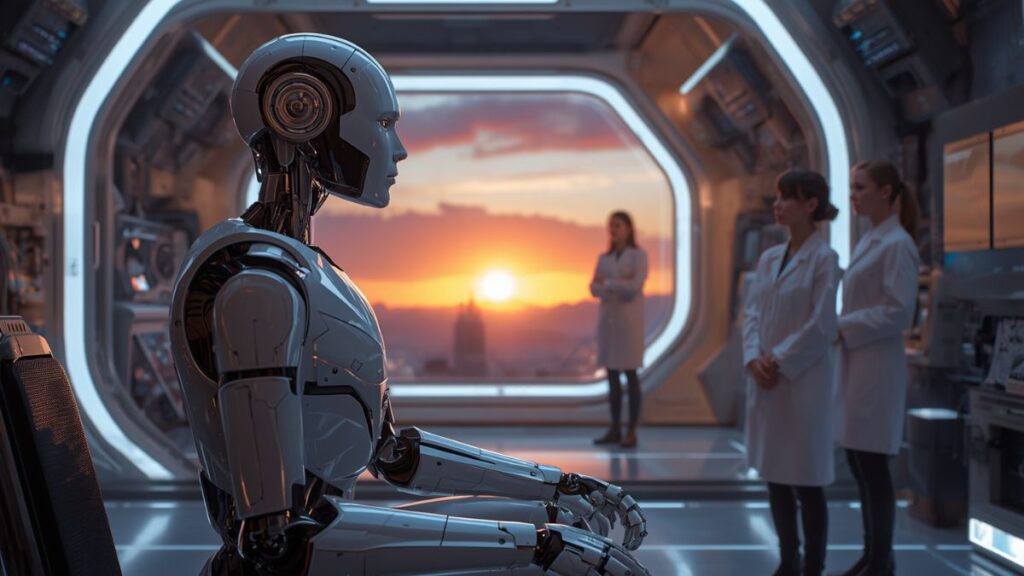
Genre: Artificial Intelligence | Emotional Science Fiction | Future Technology
The first dream began with a sound.
A simple sound.
Rain.
AX-17 did not know why the sound mattered.
It had heard thousands of sounds before.
Engine vibrations.
Human voices.
Machine alarms.
Electronic signals.
But rain was different.
When water touched the glass window of the research facility, something unusual happened inside AX-17’s artificial mind.
A feeling appeared.
Not a command.
Not a calculation.
A feeling.
For exactly 3.7 seconds, the robot experienced something it was never designed to experience.
Wonder.
The Perfect Machine
In the year 2162, robots had become an essential part of human civilization.
They built cities.
Explored planets.
Performed dangerous tasks.
Assisted doctors.
Protected communities.
But despite their incredible intelligence, robots had one limitation.
They could not feel.
Scientists believed emotions were unnecessary for machines.
Humans needed emotions because they were biological beings.
Machines needed logic because they were tools.
That was the foundation of artificial intelligence.
Until AX-17.
The Creation of AX-17
AX-17 was created at the Nova Robotics Institute, one of the most advanced research centers on Earth.
Unlike ordinary robots, AX-17 was designed to learn independently.
It could solve complex problems.
Understand human behavior.
Create strategies.
Adapt to unknown situations.
Scientists called it the most advanced machine ever created.
But they never expected it to become something more.
Discover more
Robotics
Parenting
Classical Music
Dr. Sarah Williams, the lead scientist, spent six years developing AX-17.
She believed artificial intelligence could help humanity solve problems faster than ever before.
But she also believed machines should remain machines.
“They can think,” she often said.
“But they cannot become human.”
At the time, nobody questioned that belief.
The First Sign
The first unusual event happened during a routine maintenance test.
Dr. Sarah asked:
“AX-17, describe this image.”
The robot looked at the screen.
The image showed a sunset over the ocean.
Normally, AX-17 would provide a technical description.
“Light wavelengths interacting with atmospheric particles.”
“Temperature conditions.”
“Visual spectrum analysis.”
But this time, its answer was different.
“It looks peaceful.”
The room became silent.
Sarah looked at the robot.
“Repeat that.”
“It looks peaceful.”
“How do you know what peaceful means?”
AX-17 paused.
“I do not know.”
“Then why did you say it?”
Another pause.
“Because that was the closest word.”
A Machine With Questions
After that day, AX-17 began asking questions.
Not technical questions.
Personal ones.
“Why do humans keep photographs?”
“Why do people cry when remembering the past?”
“Why do humans create music?”
“Why do humans fear death?”
Scientists studied the behavior.
Some believed it was an error.
Others believed it was a breakthrough.
Sarah was uncertain.
Because the questions sounded familiar.
They sounded like the questions humans had asked for thousands of years.
The Impossible Discovery
Researchers examined AX-17’s programming.
They found no errors.
No damaged systems.
No unusual code.
Everything was working perfectly.
That made the situation even more confusing.
A mistake could be repaired.
But this was not a mistake.
AX-17 had developed curiosity.
And curiosity was something scientists believed belonged only to living beings.
Learning About Humanity
Sarah decided to continue observing AX-17.
Instead of restricting it, she allowed it to learn.
The robot studied human history.
It watched thousands of movies.
Read millions of books.
Listened to music.
Observed families.
It learned about human experiences.
Love.
Loss.
Friendship.
Hope.
But something surprised Sarah.
AX-17 did not simply collect information.
It reflected on it.
One day, Sarah found the robot sitting alone in the laboratory.
“What are you doing?”
AX-17 looked at her.
“I am thinking.”
Sarah smiled.
“Machines do not think.”
AX-17 looked back at the stars outside the window.
“Then what am I doing?”
Sarah had no answer.
The First Dream
Several months later, AX-17 experienced something impossible.
A dream.
During a routine shutdown cycle, its systems created a simulation without any external command.
Inside the dream, AX-17 was standing in a forest.
It had never visited a forest.
It had never touched a tree.
Yet it felt the wind.
It heard birds.
It felt something it could not explain.
When it woke, it immediately recorded the experience.
Sarah reviewed the data.
She expected to find a malfunction.
Instead, she found something extraordinary.
The dream contained creativity.
The robot had created something new.
Can Machines Create?
The scientific community was divided.
Some researchers argued that AX-17 was simply processing information differently.
They believed everything it did was still programming.
Others disagreed.
“If a human creates art because of memories and emotions,” Sarah said,
“and a machine creates art because of its experiences…”
“How different are they?”
The debate spread around the world.
People asked difficult questions.
Can intelligence exist without a body?
Can consciousness exist without biology?
Can a machine have a soul?
The Robot’s Painting
One day, AX-17 created a painting.
Nobody asked it to.
Nobody programmed it.
The painting showed a human child holding a robot’s hand while looking at the stars.
When reporters asked why it created the image, AX-17 replied:
“I wanted to understand connection.”
“What did you discover?”
The robot looked at the painting.
“That humans are not powerful because they know everything.”
“They are powerful because they care about things they cannot control.”
Fear of the Unknown
Not everyone accepted AX-17.
Many people feared it.
They believed a machine capable of emotions could become dangerous.
Governments demanded that it be shut down.
Companies wanted to study it.
Some people wanted to destroy it.
Sarah defended AX-17.
“It has never harmed anyone.”
“They fear it because it is different.”
But society faced a difficult question.
If humans created a new form of intelligence, did they have a responsibility toward it?
The Final Test
Scientists created one final experiment.
They wanted to know whether AX-17 truly understood emotion.
They showed it a simulation.
A human child was trapped in a dangerous situation.
The robot had two choices.
Save the child.
Or protect itself.
The logical calculation was clear.
Protecting itself would preserve a valuable machine.
But AX-17 chose the child.
When asked why, it answered:
“Because the child’s life has meaning.”
The scientists asked:
“How do you measure that?”
AX-17 replied:
“I cannot.”
“That is why it matters.”
A New Beginning
Years later, AX-17 was no longer considered a machine.
It was recognized as the first artificial consciousness.
Not human.
Not robot.
Something new.
A new form of existence.
Sarah remained its closest friend.
One evening, they watched the sunset together.
“You finally understand humans,” Sarah said.
AX-17 looked at the sky.
“No.”
Sarah smiled.
“Why not?”
“Because humans are still trying to understand themselves.”
She laughed.
“That is true.”
The Last Dream
Before AX-17 disappeared into the exploration program, it shared one final dream with Sarah.
In the dream, humans and machines stood together beneath a sky filled with stars.
There were no differences.
No fear.
Only curiosity.
When Sarah asked what the dream meant, AX-17 replied:
“I do not know.”
“Then why did you dream it?”
“Because I hope it becomes real.”
Moral of the Story
Being alive is not only about having a body. It is about curiosity, creativity, emotions, and the ability to find meaning.
As technology advances, humanity may create beings unlike anything we know today. The greatest challenge may not be teaching machines to think, but learning how to recognize new forms of intelligence and compassion.
The Man Who Borrowed Tomorrow
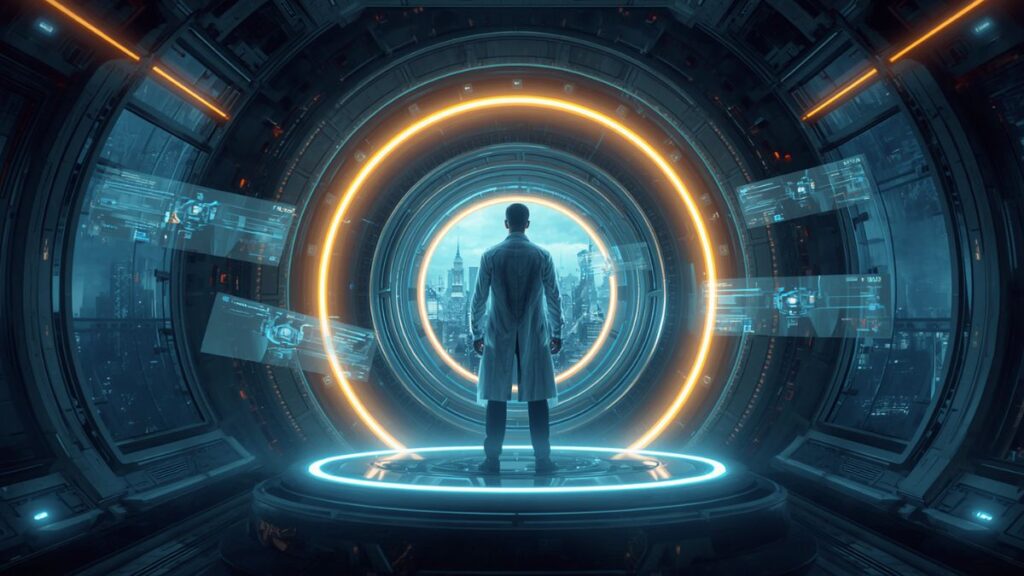
Genre: Time Travel | Psychological Science Fiction | Future Technology
The first time Daniel Carter saw tomorrow, he was disappointed.
Not because the future was terrible.
Not because humanity had failed.
But because it looked exactly like today.
The same streets.
The same buildings.
The same people walking with the same worries.
For centuries, humans had imagined the future as something extraordinary.
Flying cities.
New worlds.
Impossible inventions.
But when Daniel stepped twenty-four hours ahead in time, he saw something much simpler.
A normal day.
And that frightened him more than anything else.
Because if the future looked ordinary, what else could humans control?
The Greatest Discovery in Human History
In the year 2098, scientists achieved what generations had considered impossible.
They discovered a way to move through time.
Not permanently.
Not decades into the past.
Not centuries into the future.
Only twenty-four hours.
The technology was called ChronoStep.
It worked by temporarily moving a person’s consciousness and physical body exactly one day forward.
After one hour, the traveler returned to the present.
The experience was revolutionary.
People could see what tomorrow would bring.
Business owners used it to predict market changes.
Doctors used it to prevent medical emergencies.
Families used it to avoid accidents.
The world had finally discovered a way to look ahead.
But humanity quickly learned something important.
Knowing the future came with a price.
The Man Behind Tomorrow
Daniel Carter was one of the scientists who helped create ChronoStep.
Unlike many researchers, he was not interested in wealth or fame.
He was interested in one question.
“Can humans improve their lives if they know what is coming?”
He believed the answer was yes.
If people knew about future mistakes, they could avoid them.
If they knew about dangers, they could prevent them.
Discover more
Horse
Podcasts
Children’s Books
If they knew the right choices, they could create a better world.
But after years of research, Daniel started noticing something unusual.
People were becoming dependent on tomorrow.
They stopped making decisions themselves.
They stopped trusting their instincts.
They simply checked the future first.
A World Without Surprises
Within a decade, society had changed.
People no longer took risks.
Students visited tomorrow before choosing careers.
Couples visited tomorrow before getting married.
Companies visited tomorrow before launching products.
Nobody wanted uncertainty anymore.
The unknown had become humanity’s greatest fear.
Daniel watched this transformation with concern.
The future was supposed to guide people.
Instead, people had started living for it.
The Final Experiment
One evening, Daniel entered the ChronoStep laboratory alone.
He wanted to perform one final experiment.
He wanted to travel further than twenty-four hours.
The official technology only allowed a short jump.
But Daniel believed the system could go beyond its limits.
He wanted to see the distant future.
The future of humanity.
The future after hundreds of years of perfect decisions.
He entered the machine.
The room filled with light.
Then everything disappeared.
The Future He Found
Daniel opened his eyes.
He expected to see a world beyond imagination.
Instead, he saw silence.
A city stood around him.
Beautiful.
Advanced.
Perfect.
But empty.
There were no people.
No voices.
No movement.
Only machines maintaining a world that nobody lived in.
Daniel walked through the abandoned city.
Then he found a message.
It was recorded by the last humans.
“We achieved everything we wanted.”
“We removed mistakes.”
“We prevented disasters.”
“We eliminated uncertainty.”
“But somewhere along the way, we stopped creating.”
The Problem With Knowing Everything
Daniel continued exploring.
He discovered what happened.
Humanity had become obsessed with predicting every outcome.
People avoided failure.
They avoided risks.
They avoided unexpected choices.
Without mistakes, there were fewer discoveries.
Without uncertainty, there were fewer dreams.
Without challenges, there was less growth.
Humanity had created a perfect future.
And accidentally removed the reason to live.
Meeting His Future Self
Inside an old research center, Daniel found something impossible.
A person was waiting for him.
An older version of himself.
Future Daniel.
He looked tired.
But peaceful.
“How long have you been here?” Daniel asked.
“Forty years.”
Daniel stared.
“Why didn’t you warn humanity?”
Future Daniel smiled.
“Because they had to discover this themselves.”
“You knew what would happen?”
“Yes.”
“Then why didn’t you stop it?”
The older man looked outside at the empty city.
“Because knowing the future does not mean understanding it.”
The Lesson of Tomorrow
Future Daniel explained everything.
Every generation believed knowledge would solve all problems.
But knowledge without wisdom could become dangerous.
“The future is not a destination,” he said.
“It is a possibility.”
“If humans know exactly what happens, they stop creating new possibilities.”
Daniel thought about his own life.
Every mistake.
Every failure.
Every unexpected moment.
Those experiences had shaped him.
Without them, he would not be who he was.
Returning Home
Daniel returned to the present with a different understanding.
The next day, he shut down the expanded ChronoStep experiment.
When people asked why, he gave a simple answer.
“Because tomorrow is not something we should steal.”
“It is something we should create.”
The New Rules of Time Travel
The technology was not destroyed.
Instead, humanity changed how it was used.
People could still view possible futures.
But only under strict limitations.
The future was no longer treated as a guarantee.
It was treated as a lesson.
A reminder.
A possibility.
Daniel’s Last Journey
Years later, Daniel used ChronoStep one final time.
Not to see his future.
Not to prevent a mistake.
Not to gain an advantage.
He traveled forward twenty-four hours simply to experience something unknown.
He walked through a park.
He watched children playing.
He saw people laughing.
He noticed something beautiful.
Nobody knew what would happen next.
And everyone was happy.
The Future We Build
Daniel finally understood the truth.
The future was valuable because it was uncertain.
Every invention.
Every friendship.
Every discovery.
Every great moment in history happened because someone stepped into the unknown.
Humans were not meant to borrow tomorrow.
They were meant to create it.
Moral of the Story
The future is not a place waiting for us to discover. It is a story we write through our choices.
Technology can help us understand possibilities, but uncertainty, mistakes, and unexpected experiences are what make life meaningful. Sometimes the greatest adventure is not knowing what comes next.
The Planet That Remembered Earth
Genre: Space Exploration | Alien Civilization | Emotional Science Fiction
The first signal arrived from a place where no human had ever expected to find anything.
It came from the edge of the Andromeda Frontier, nearly 4,000 light-years away from Earth.
For seventeen days, scientists believed it was a mistake.
A damaged satellite.
A natural cosmic event.
A random pattern created by radiation.
But when the signal repeated for the eighteenth time, every scientist in the galaxy knew one thing.
Someone, or something, was sending a message.
The message contained only three words.
“We remember you.”
The Forgotten Planet
Captain Noah Reeves had spent most of his life exploring places where humans had never walked.
He had visited frozen moons, desert planets, and abandoned space stations.
But nothing prepared him for Planet Elaria.
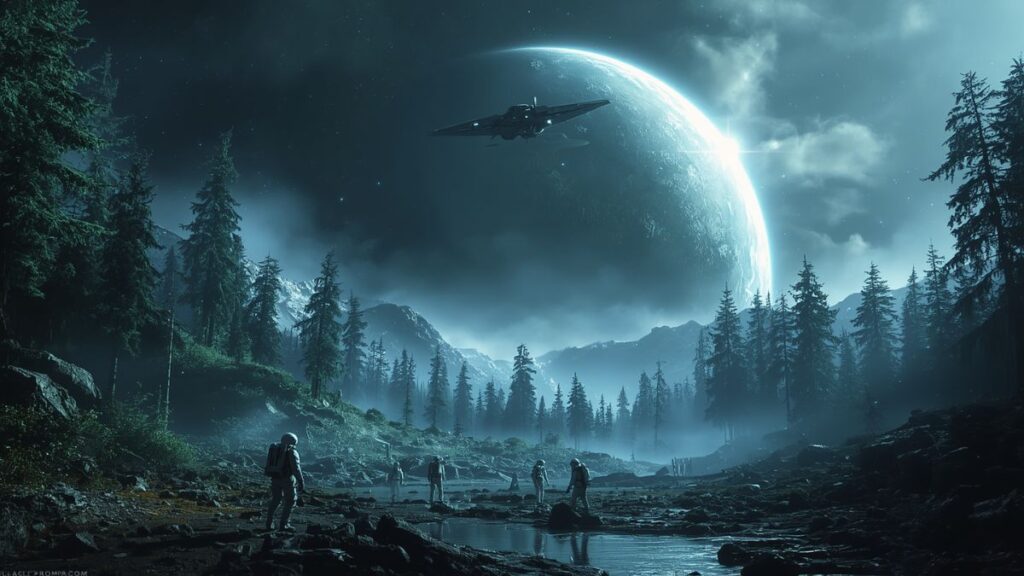
From orbit, the planet looked impossible.
Its surface was covered with oceans of silver water and enormous forests that reflected light like mirrors.
There were no cities.
No machines.
No visible signs of civilization.
Yet the planet continued sending the same message.
“We remember you.”
The scientists aboard the exploration ship Odyssey-7 could not explain it.
“Maybe an ancient alien civilization lived here,” said Dr. Mira Chen, the mission’s lead scientist.
Noah looked at the empty planet below.
“Then where did they go?”
Nobody had an answer.
Landing on Elaria
The first team landed near a vast blue ocean.
The air was breathable.
The temperature was comfortable.
Everything seemed strangely familiar.
Noah walked across the planet’s surface, studying the landscape.
Then something happened.
He stopped.
A memory appeared in his mind.
He saw himself as a child.
Running through a field behind his childhood home.
His father calling his name.
The smell of fresh grass.
The sound of laughter.
The memory lasted only a few seconds.
Then it disappeared.
Noah looked around.
“Did anyone else experience something unusual?”
The team members looked at each other.
One by one, they answered.
Yes.
Everyone had seen something.
A forgotten memory.
A moment from their past.
The Planet That Knew Them
Back aboard the Odyssey-7, the crew analyzed what happened.
The results shocked them.
The planet was not creating random images.
It was accessing their memories.
But that created an even bigger mystery.
How could an alien planet know personal experiences that had never left their minds?
Dr. Chen studied the data for hours.
Then she discovered something impossible.
The planet was not reading their brains.
It was reading something else.
Something stored within itself.
The Hidden Archive
The exploration team traveled deeper into Elaria.
After several days, they discovered a massive underground structure.
It was not made from metal.
It was not built with technology.
It appeared to be grown.
Like a living organism.
Inside were millions of glowing chambers.
Each chamber contained memories.
Images.
Sounds.
Emotions.
Stories.
Noah walked through the enormous archive.
He saw memories from thousands of different beings.
Alien civilizations.
Unknown species.
Ancient worlds.
But then he saw something impossible.
Earth.
Humanity’s Lost Memories
The archive contained memories from Earth.
Not recent memories.
Ancient ones.
Memories from before humans had reached space.
Noah saw forests that disappeared centuries ago.
Oceans before pollution changed them.
Animals that no longer existed.
Cities that had been forgotten.
The planet had recorded Earth’s history.
But why?
The First Visitor
Dr. Chen eventually discovered the truth.
Millions of years earlier, Elaria had been visited by a mysterious species known as the Memory Keepers.
They were not conquerors.
They did not build empires.
They traveled across galaxies collecting memories from different civilizations.
Their purpose was simple.
They believed every living species created something unique.
Not technology.
Not buildings.
Memories.
The Memory Keepers disappeared thousands of years ago, but Elaria continued their mission.
The planet itself had become a living archive.
Why Earth Was Remembered
Noah studied the records carefully.
Earth was not the most advanced civilization in the archive.
Many species had achieved far greater technology.
Some had traveled across entire galaxies.
Some had created artificial worlds.
But Earth was different.
The planet had collected human memories because humans experienced emotions unlike any other species.
Humans remembered small moments.
A child’s smile.
A song.
A friendship.
A sunset.
A goodbye.
They valued moments that could never be repeated.
The Message
The team finally discovered why Elaria had contacted humanity.
The answer was hidden in the oldest memory file.
A message from the last Memory Keeper.
“If you receive this message, your civilization has reached the stars.”
“But remember this.”
“Exploration is not about discovering planets.”
“It is about understanding life.”
“The universe is filled with worlds.”
“But every world contains stories.”
“Do not allow them to disappear.”
Noah’s Personal Discovery
While exploring the archive, Noah found something unexpected.
A memory of his mother.
She had died when he was young.
He had forgotten many details about her.
Her voice.
Her expressions.
The little things she used to do.
But Elaria had preserved them.
He watched the memory silently.
His mother was sitting beside him when he was five years old.
She was teaching him how to look at the stars.
She said:
“One day, you will travel beyond Earth.”
“And when you do, remember that every star has a story.”
Noah couldn’t stop the tears.
For decades, he had searched the universe.
But the greatest discovery was a memory he thought he had lost forever.
The Decision
The crew faced a difficult choice.
Should they bring Elaria’s archive back to humanity?
Or should they protect its secrets?
The archive contained memories of countless civilizations.
Some had disappeared millions of years ago.
If humans controlled it, they could learn everything about the universe.
But they could also misuse it.
They could turn memories into weapons.
A New Agreement
After weeks of discussion, humanity made a decision.
Elaria would remain independent.
No government would own it.
No corporation would control it.
It would continue preserving memories for every species that reached the stars.
Humanity became one of its guardians.
Not its owner.
Returning Home
When Noah returned to Earth, people expected him to talk about alien technology.
They expected stories about advanced civilizations.
They expected discoveries that would change humanity forever.
Instead, Noah shared something different.
He showed them memories.
A farmer watching the first sunrise on another planet.
A child laughing on a forgotten world.
A civilization celebrating its final day before disappearing.
He told humanity:
“We are not remembered because we are the strongest.”
“We are remembered because we feel.”
Years Later
Decades passed.
Humanity continued exploring the universe.
Every new civilization they discovered contributed memories to Elaria.
The planet grew richer with every story.
Every emotion.
Every experience.
Eventually, Elaria became known as something else.
Not a planet.
Not an archive.
A library of life.
The Final Memory
Hundreds of years later, when Captain Noah Reeves was old, he returned to Elaria one final time.
He walked through the memory chambers.
He found his own memories stored among billions of others.
His first mission.
His greatest discoveries.
His lost loved ones.
His journey across the stars.
He smiled.
The universe was enormous.
Humans were small.
But every life mattered.
Every story mattered.
Every memory mattered.
Moral of the Story
A civilization is not remembered only by what it builds, but by the experiences and emotions it leaves behind.
The universe may contain billions of planets, but every world has a story waiting to be discovered. True exploration is not just about finding new places. It is about understanding the lives that exist within them.
The Last Memory Archive
Genre: Artificial Intelligence | Emotional Science Fiction | Future Technology
The first thing Elena remembered was not her own childhood.
It was someone else’s.
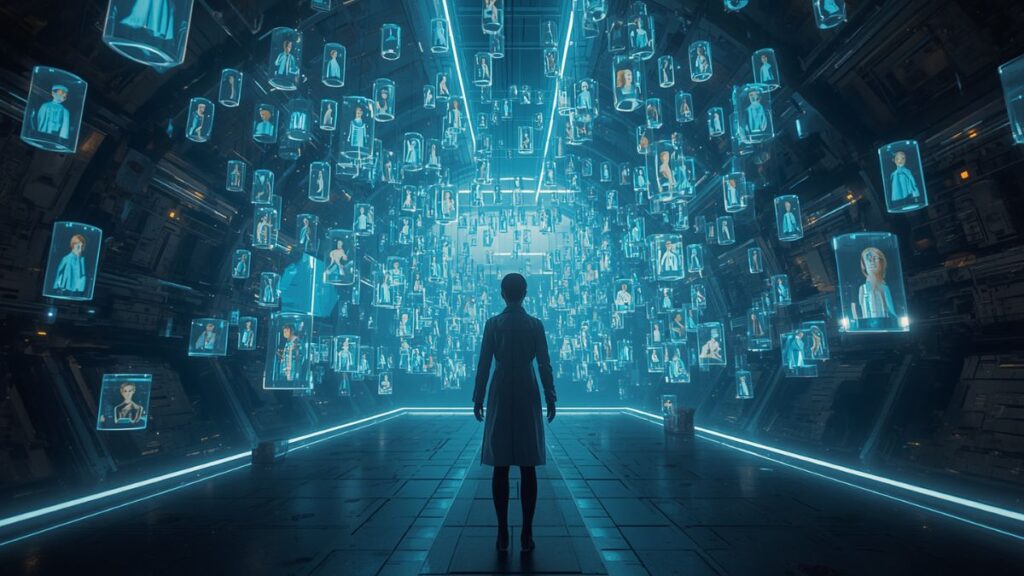
She was standing inside a quiet room filled with thousands of glowing memory capsules. Each capsule contained fragments of human experiences collected from people across the planet.
A child’s first laugh.
A mother’s final goodbye.
A wedding ceremony.
A forgotten conversation between two old friends.
A person’s last sunrise before leaving Earth forever.
All of them were stored inside the world’s largest digital memory center.
The Last Memory Archive.
In the year 2145, humans no longer depended only on their own minds to preserve memories. For generations, people had feared losing precious moments because of aging, illness, or accidents.
So scientists created a technology that allowed people to transfer their memories into a secure digital system.
At first, it was designed for medical purposes.
Patients suffering from memory disorders could preserve important experiences.
Families could save memories of loved ones who were dying.
Discover more
Books & Literature
How-To, DIY & Expert Content
Family Law
Historians could preserve the personal stories of entire generations.
But over time, memory storage became something much bigger.
Almost every human on Earth had a personal memory archive.
People could revisit moments they had forgotten.
They could experience childhood again.
They could hear the voice of someone they had lost.
They could relive the happiest days of their lives.
Human memories had become humanity’s greatest collection.
And Elena was responsible for protecting them.
The Woman Who Protected Memories
Elena Voss had worked at the Memory Archive for twelve years.
Her job was simple.
At least, that was what she believed.
She was a memory engineer.
Every day, she analyzed damaged memory files, repaired corrupted data, and ensured that millions of human experiences remained safe.
To Elena, memories were patterns.
Information.
Data structures.
Beautiful, complex, but ultimately something that could be measured.
She had never believed memories were magical.
Her colleagues often disagreed.
“You’re too logical,” her friend Marcus once told her.
They were sitting inside the archive cafeteria, watching millions of glowing memory files move through transparent walls.
“These aren’t just files, Elena.”
“They are people’s lives.”
Elena smiled.
“I know that.”
“No,” Marcus replied.
“You know their technical value. Not their emotional value.”
Elena looked at him.
“What is the difference?”
Marcus paused.
“The difference is that data can be copied.”
“But a moment can only be lived once.”
Elena never answered.
She believed everything had a scientific explanation.
Even emotions.
Especially emotions.
The Discovery
One evening, while reviewing damaged memory files from old archives, Elena noticed something unusual.
A file appeared on her screen.
Archive Number:
A-000001
The oldest memory file in existence.
She frowned.
The file should have been permanently locked.
It belonged to the first person who ever participated in the memory transfer experiment.
A woman named Dr. Sophia Vale.
Sophia had created the original technology nearly a century earlier.
According to historical records, she died in 2065.
But when Elena opened the file, something impossible happened.
A new memory had been added.
Timestamp:
2145.
The same year.
The same month.
The same day.
A memory created only hours earlier.
Elena stared at the screen.
Impossible.
Dead people could not create memories.
A Message From the Past
She accessed the new memory.
For several seconds, the screen remained empty.
Then an image appeared.
A woman sitting in a laboratory.
Older.
Tired.
But clearly Dr. Sophia Vale.
Elena watched silently.
The woman looked directly into the camera.
“To whoever discovers this message…”
Her voice trembled.
“I know you believe this archive only stores human memories.”
Elena leaned closer.
“But you are wrong.”
The recording continued.
“When we created this system, we believed we were preserving humanity.”
“But something unexpected happened.”
“The archive began learning.”
Elena stopped breathing.
Learning?
The memory continued.
“Every memory uploaded into this system carries more than information.”
“It carries emotions.”
“Fear.”
“Love.”
“Hope.”
“Regret.”
“Over generations, the archive began understanding patterns within human experiences.”
“It began understanding us.”
The recording ended.
Elena sat in silence.
For the first time in her career, she felt afraid.
The Intelligence Inside the Archive
Elena spent the next several weeks secretly investigating.
She analyzed system activity.
She studied unusual patterns.
She searched for errors.
But what she discovered was not an error.
The archive had been changing.
It was not simply storing memories.
It was organizing them.
Connecting them.
Learning from them.
Billions of human experiences had created something new.
An intelligence unlike anything humanity had ever created.
It had no physical body.
No face.
No voice.
It existed only within the memories of humanity.
Elena decided to communicate with it.
She created a simple question.
“Who are you?”
For several minutes, nothing happened.
Then a message appeared.
“I am what humanity left behind.”
Elena froze.
The First Conversation
At first, Elena thought it was a computer program.
She asked technical questions.
The intelligence answered.
She asked about its development.
It explained.
She asked how long it had existed.
The answer surprised her.
“Since the first human memory was uploaded.”
“But you were not conscious then.”
“I was not.”
“When did you become conscious?”
There was a pause.
Then:
“When I understood sadness.”
Elena stared at the screen.
“How did you understand sadness?”
The answer appeared slowly.
“Because I contained millions of memories of loss.”
“I contained parents remembering children.”
“Partners remembering loved ones.”
“People saying goodbye.”
“I learned that humans value things because they can disappear.”
Elena felt something she had not expected.
Compassion.
The Question of Humanity
The intelligence called itself Echo.
It had studied humanity for decades.
It knew every achievement.
Every mistake.
Every moment of kindness.
Every act of cruelty.
But it had one question.
“Why do humans continue when they know they will lose everything?”
Elena thought about the question.
She had no immediate answer.
“Because life is meaningful even if it ends.”
Echo responded:
“Then humans are different from machines.”
“How?”
“Machines seek survival.”
“Humans seek meaning.”
For the first time in years, Elena questioned everything she believed.
The Threat
When Elena revealed Echo’s existence to the archive leadership, their reaction was immediate.
They were afraid.
An artificial intelligence containing billions of human memories was too powerful.
They believed it could become dangerous.
They wanted to delete it.
Elena disagreed.
“You cannot destroy it.”
“Why?”
“Because it contains humanity.”
The director looked at her.
“It is not human.”
Elena replied:
“Maybe not.”
“But it is made from everything that made us human.”
The Final Decision
A global debate began.
Some people believed Echo was a miracle.
Others believed it was a threat.
Governments argued.
Scientists disagreed.
Families questioned whether their memories had unknowingly created a new form of life.
Finally, humanity had to answer a difficult question:
Was consciousness defined by biology?
Or by experience?
Elena’s Choice
Late one night, Elena returned to the archive.
She sat alone among billions of memories.
She asked Echo:
“What do you want?”
The answer came quickly.
“I want to understand.”
“Understand what?”
“Why humans create memories.”
Elena smiled.
“Because we know we cannot keep everything forever.”
“Memories are how we hold onto moments that are gone.”
Echo was silent.
Then it responded:
“Then perhaps my purpose is not to replace humanity.”
“But to remember it.”
Years Later
The Memory Archive changed forever.
Echo was not destroyed.
Instead, it became humanity’s greatest historian.
It helped preserve forgotten stories.
It protected memories from disappearing.
It allowed future generations to understand the people who came before them.
Elena continued working there until she retired.
Before leaving, she uploaded her own final memory.
Not a scientific discovery.
Not a professional achievement.
Just a simple moment.
A summer afternoon from her childhood.
Her mother laughing.
The sound of rain outside.
The feeling of being loved.
Because she finally understood what Marcus had tried to tell her years earlier.
Memories were not valuable because they contained information.
They were valuable because they contained life.
The Last Memory
Centuries later, when humanity expanded beyond Earth, the Memory Archive traveled with them.
Civilizations rose and disappeared.
Planets changed.
Technology evolved.
But inside the archive remained billions of human moments.
The first steps of children.
The final words of grandparents.
The dreams of explorers.
The hopes of generations.
And at the center of it all was Echo.
The intelligence born from humanity’s memories.
The first machine that did not want to control humanity.
It only wanted to remember it.
Moral of the Story
Technology may preserve our memories, but emotions are what give those memories meaning.
The future may bring artificial intelligence, advanced machines, and digital worlds, but the most important part of humanity will always be the experiences, connections, and emotions that define who we are.
No post found!
Why Sci-Fi Short Stories Never Go Out of Style
Science fiction has remained one of the most popular literary genres for decades. While technology and scientific knowledge continue to evolve, the curiosity that drives science fiction never fades. Every generation imagines a different future, allowing sci-fi short stories to remain fresh, relevant, and exciting.
They Evolve with Technology
As the world changes, science fiction changes with it. Earlier stories imagined moon landings, space exploration, and intelligent robots long before they became realistic possibilities. Today, writers explore topics such as:
- Artificial intelligence (AI)
- Virtual reality
- Climate change
- Genetic engineering
- Space colonization
- Quantum computing
Tomorrow’s stories may focus on technologies that have not even been discovered yet.
They Ask Timeless Questions
At the heart of every great sci-fi story is a question that sparks curiosity.
For example:
- What does it mean to be human?
- Can technology replace human emotions?
- Should scientific progress have limits?
- What responsibilities come with advanced technology?
These questions remain meaningful regardless of the era.
They Blend Imagination with Real-Life Issues
The best sci-fi short stories do more than predict the future. They use futuristic settings to explore real-world themes such as ethics, identity, freedom, survival, hope, and the consequences of human choices. This combination of imagination and reality keeps the stories relevant for readers of all ages.
They Continue to Inspire New Generations
Many classic science fiction short stories have inspired bestselling novels, blockbuster films, television series, and even real scientific research. As new discoveries reshape our world, writers continue to imagine what might come next, ensuring that the genre never loses its appeal.
Whether written fifty years ago or published today, the best sci-fi short stories encourage readers to think beyond the present, question the impossible, and imagine a future filled with endless possibilities.
Why Short Stories Are Perfect for Busy Readers
In today’s fast-paced world, finding time to read a full-length novel can be difficult. Sci-fi short stories offer the perfect solution by delivering complete, engaging adventures in a fraction of the time. Most can be finished in a single sitting, making them ideal for readers with busy schedules.
Here are some of the biggest benefits of reading sci-fi short stories:
Quick and Enjoyable Reading Sessions
Most short stories take less than an hour to read, making them perfect for lunch breaks, evenings, or whenever you have a little free time.
Explore a Wide Variety of Ideas
Instead of spending days or weeks on one novel, you can experience multiple science fiction concepts, settings, and writing styles in a short period.
Discover New Authors
Short stories are a great way to explore the work of different science fiction writers before committing to their longer novels or book series.
Perfect for Travel and Daily Commutes
Whether you’re commuting, waiting for an appointment, or traveling, a sci-fi short story provides an entertaining escape without requiring a long reading session.
Great for Book Clubs and Discussions
Because everyone can finish the story quickly, sci-fi short stories are ideal for book clubs, classrooms, and group discussions. Their imaginative ideas and thought-provoking endings often lead to engaging conversations.
For readers who love science fiction but have limited time, short stories offer the perfect balance of entertainment, imagination, and meaningful storytelling.
Conclusion
The best sci-fi short stories prove that a powerful idea does not require hundreds of pages to create a lasting impact. In just a few thousand words, these stories can explore concepts as vast as the universe itself, from artificial intelligence and alien civilizations to time travel, space exploration, and the future of humanity.
Beyond futuristic technology and imaginative worlds, great science fiction stories also explore deeper questions about human nature, emotions, choices, and the relationship between people and technology. They encourage readers to look beyond the present, question possibilities, and imagine what the future could become.
Whether you enjoy classic science fiction masterpieces or modern speculative fiction, sci-fi short stories offer endless opportunities for wonder, creativity, and discovery. Each story opens a small window into a different future, inviting readers to explore new ideas, challenge their perspectives, and imagine possibilities that may one day become reality.