There is something wonderfully intimate about telling someone a story before bedtime. When the day finally becomes quiet, phones are put away, lights are dimmed, and the world seems to slow down, a few gentle words can create a sense of comfort that lasts long after the conversation ends.
Cute paragraph stories to make her fall asleep are especially suitable for couples who want to end the day with affection, warmth, and a little imagination. These stories do not need complicated plots or dramatic twists. Instead, they can focus on small romantic moments, cozy settings, thoughtful gestures, peaceful adventures, and the simple happiness of being together.
A short bedtime story can help her relax while also making her feel remembered and appreciated. Whether you are talking to your girlfriend over a phone call, sending her a bedtime message, or sitting beside her as she gets ready to sleep, the right story can turn an ordinary goodnight into a memorable moment.
This article explores what makes these stories special, the different themes you can use, how to make them romantic without becoming overly dramatic, and why simple stories can be so effective at bedtime.
What Are Cute Paragraph Stories to Make Her Fall Asleep?
Cute paragraph stories are short, gentle narratives designed to create a warm and relaxing feeling before sleep.
Unlike traditional stories that depend heavily on suspense, conflict, or complicated plots, bedtime stories for your girlfriend usually work better when they have:
- A peaceful setting
- Likeable characters
- A gentle romantic connection
- Simple language
- Warm emotions
- A comforting ending
- A slow and relaxing pace
The purpose isn’t necessarily to surprise the listener.
The purpose is to make her smile, feel cared for, and gradually become comfortable enough to fall asleep.
A story might be about a couple walking beneath the stars, discovering a tiny bookstore, sharing hot chocolate during a rainy evening, visiting a quiet beach, or finding an old letter that reminds them how much they mean to each other.
The story can be fictional, but the emotions should feel real.
Cute Paragraph Stories to Make Her Fall Asleep
1. The Little Café That Stayed Open for Two

Characters: Sophie and Oliver
Sophie discovered the café on a night when she had forgotten how to slow down.
It had been raining since late afternoon.
Not the gentle kind of rain that people enjoy while sitting beside a window with a book.
It was heavy rain.
The kind that turned sidewalks into mirrors and made every passing car splash water against the curb.
Sophie had spent the entire day at work.
Three meetings.
Two deadlines.
One argument with her manager.
And an email she wished she had never opened.
By the time she left the office, she was exhausted.
She pulled her coat tighter around herself and hurried toward the train station.
Her umbrella had broken twenty minutes earlier.
Her shoes were soaked.
Her phone battery was at four percent.
And she still had nearly an hour before the next train.
Sophie sighed.
“Wonderful.”
She walked down a narrow street she had never noticed before.
She wasn’t even sure why she had turned there.
Perhaps she was simply looking for shelter.
That’s when she saw the café.
It was tiny.
Almost hidden between two old buildings.
A small wooden sign hung above the door.
There was no name on it.
Only a golden drawing of a coffee cup.
Warm light spilled through the windows.
Sophie stopped.
She checked her phone.
10:47 p.m.
She looked at the café again.
The place seemed strangely inviting.
She opened the door.
A small bell rang.
Warm air surrounded her.
She immediately smelled cinnamon, coffee, and chocolate.
An elderly woman stood behind the counter.
“Good evening.”
Sophie smiled.
“Are you still open?”
The woman nodded.
“For you.”
Sophie looked around.
There were only four tables.
Three were empty.
At the fourth sat a young man reading a book.
He had dark-brown hair, blue eyes, and a charcoal sweater.
He looked up.
Their eyes met.
He smiled politely.
Sophie chose the table near the window.
“Hot chocolate, please.”
The woman nodded.
“Marshmallows?”
Sophie smiled.
“Definitely.”
She sat down.
The young man returned to his book.
Rain tapped against the glass.
For the first time that day, Sophie felt calm.
A few minutes later, the woman brought her hot chocolate.
Sophie wrapped both hands around the cup.
The warmth traveled through her fingers.
She closed her eyes.
“This is exactly what I needed.”
The young man looked up.
“Bad day?”
She opened her eyes.
“Very.”
He smiled.
“Mine too.”
She glanced at his book.
“What are you reading?”
He showed her the cover.
“An old novel.”
“Is it good?”
“I’ve read it three times.”
“Then you must really like it.”
“I like the ending.”
“Why?”
He thought for a moment.
“Because it reminds me that people don’t always know where they’re going.”
Sophie smiled.
“That sounds like something I need to hear.”
He closed the book.
“I’m Oliver.”
“Sophie.”
“Nice to meet you.”
“You too.”
They returned to their drinks.
For a while, neither spoke.
It wasn’t awkward.
It was comfortable.
The rain continued outside.
Eventually, Oliver asked:
“Do you come here often?”
Sophie laughed.
“I’ve never seen this place before.”
“Neither have I.”
She looked at him.
“What?”
“I’ve been coming here for months.”
“But you’ve never seen it before?”
“No.”
She frowned.
“That doesn’t make sense.”
Oliver smiled.
“That’s because the café doesn’t make sense.”
Before Sophie could ask what he meant, the elderly woman walked toward their table.
She placed a small plate of cookies between them.
“On the house.”
Sophie smiled.
“Thank you.”
The woman looked at Oliver.
Then at Sophie.
“Two tonight.”
“What does that mean?” Sophie asked.
The woman smiled.
“You’ll understand.”
Then she returned to the counter.
Sophie looked at Oliver.
“Is she always like that?”
“Pretty much.”
“What does she mean by two?”
Oliver shrugged.
“I stopped asking.”
They continued talking.
About work.
Books.
Travel.
Favorite foods.
Childhood memories.
The conversation felt strangely easy.
Sophie eventually discovered that Oliver worked as a graphic designer.
He discovered that she loved photography.
She showed him some pictures on her phone.
He looked carefully.
“These are beautiful.”
“Really?”
“Yes.”
“I just take pictures for fun.”
“Why don’t you do it seriously?”
She laughed.
“Because I’m not good enough.”
Oliver looked at her.
“Who told you?”
“No one.”
He smiled.
“That’s usually how it happens.”
She remembered that sentence.
They talked until midnight.
Then 12:30.
Then 1:00.
Eventually, Sophie looked at the clock.
She suddenly realized something.
“The café hasn’t closed.”
Oliver smiled.
“It never does.”
“Really?”
“Not on rainy nights.”
She looked outside.
The rain had become heavier.
“How do you know?”
“I’ve tried leaving.”
“And?”
“The door doesn’t open.”
Sophie laughed.
“You’re joking.”
“Try.”
She stood.
Walked toward the door.
Turned the handle.
It opened immediately.
Oliver stared.
Sophie looked back.
“Works for me.”
He laughed.
“Maybe it likes you.”
She smiled.
The elderly woman appeared again.
“Your train will be here soon.”
Sophie looked at the clock.
2:15 a.m.
“My train?”
The woman nodded.
Sophie checked her phone.
The battery was dead.
She couldn’t check the schedule.
A few minutes later, she thanked the woman and stepped outside.
Oliver followed.
The rain had stopped.
The street was empty.
Sophie looked back.
The café was gone.
She froze.
There were only two old buildings.
No café.
No golden sign.
Nothing.
Oliver stood beside her.
“Interesting.”
Sophie looked at him.
“Where did it go?”
He smiled.
“I told you.”
She laughed nervously.
“This is impossible.”
“Probably.”
They walked toward the station together.
Sophie expected the train to be delayed.
Instead, it arrived exactly on time.
She turned toward Oliver.
“Will I see you again?”
He smiled.
“I hope so.”
“How?”
“I don’t know.”
She laughed.
“That’s reassuring.”
He took out his phone.
“Give me your number.”
She did.
The train arrived.
Sophie stepped inside.
Oliver stood on the platform.
“Goodnight, Sophie.”
“Goodnight, Oliver.”
The train doors closed.
As the train moved away, Sophie looked out the window.
Oliver was still standing there.
He waved.
She waved back.
The next morning, Sophie woke up thinking about the café.
She wondered if she had imagined it.
Then she saw the cookie on her bedside table.
She didn’t remember bringing it home.
She smiled.
Oliver texted her.
Did you sleep?
She replied:
Not much. I was thinking about the impossible café.
He answered:
Maybe it wasn’t impossible.
Their first date happened a week later.
They met at a normal café.
It was bright.
Crowded.
Completely ordinary.
Sophie looked around.
“No magic.”
Oliver laughed.
“Give it time.”
They talked for hours.
Then they met again.
And again.
Their relationship grew slowly.
Neither rushed.
They enjoyed small things.
Sunday walks.
Long conversations.
Movie nights.
Bookstores.
Breakfast together.
Sometimes they returned to the street where the magical café had appeared.
But it was never there.
Months passed.
One rainy evening, Sophie was having another terrible day.
She arrived home exhausted.
Oliver was waiting outside her apartment.
He held two cups of hot chocolate.
She smiled.
“You remembered.”
“Of course.”
They sat beside her window.
Rain fell outside.
Sophie leaned against him.
“Do you remember the first night?”
“Every detail.”
“The café.”
“The cookies.”
“The woman.”
“The train.”
She smiled.
“And you.”
Oliver kissed her forehead.
“I remember you being soaked.”
“Thank you.”
“I remember you complaining about your shoes.”
“I hated those shoes.”
“And I remember you saying you weren’t good enough at photography.”
Sophie looked at him.
“I don’t say that anymore.”
“Good.”
She smiled.
Over the following years, Sophie became a professional photographer.
Oliver encouraged her.
He never pushed.
He simply reminded her that her work mattered.
She eventually held her first exhibition.
Oliver was there.
He stood beside her while people walked through the gallery.
One of the photographs was a rainy street at night.
At the end of the street stood a tiny glowing café.
The title was:
Two on a Rainy Night
Oliver stared at it.
“You painted this?”
“No.”
“You photographed it?”
She smiled.
“Maybe.”
He looked at her.
“Was it the café?”
“Yes.”
“But…”
“How?”
“I don’t know.”
He laughed.
The photograph became one of her most popular pieces.
People asked about it.
Sophie never explained.
She simply said:
“Sometimes you see something beautiful once, and it stays with you.”
Years passed.
Sophie and Oliver eventually married.
They bought a small house.
It had a large kitchen and a reading room.
Oliver filled the shelves with books.
Sophie filled the walls with photographs.
They traveled.
They built memories.
They grew older.
But every time it rained heavily, they remembered the café.
One evening, many years after their first meeting, they were driving through the countryside.
Rain began falling.
Oliver looked at Sophie.
“Should we stop?”
She smiled.
“Where?”
“You know where.”
They drove toward the old street.
Sophie wasn’t sure why.
Perhaps she simply wanted to see.
The buildings were still there.
The street was nearly empty.
Rain fell softly.
They stepped out of the car.
Nothing.
No café.
Sophie laughed.
“Maybe it was only once.”
Then she noticed something.
A golden glow between the buildings.
She grabbed Oliver’s hand.
“Wait.”
They walked toward it.
The café stood there.
Exactly as they remembered.
The wooden sign.
The warm windows.
The little golden coffee cup.
Sophie opened the door.
The bell rang.
The elderly woman was still behind the counter.
She smiled.
“Welcome back.”
Sophie stared.
“You haven’t aged.”
The woman laughed.
“Neither have you.”
Oliver looked at Sophie.
They sat at the same table.
The woman brought two hot chocolates.
This time, there were two cookies.
Sophie smiled.
“Why does this place exist?”
The woman looked at them.
“It doesn’t always.”
“Why did it appear for us?”
“Because you needed somewhere to stop.”
Sophie thought about that.
“Stop what?”
“Running.”
She looked at Oliver.
The woman continued.
“You were both rushing through life.”
Sophie smiled.
“Maybe.”
“You needed one rainy night to remember that life isn’t only about getting somewhere.”
Oliver held Sophie’s hand.
“Sometimes it’s about sitting down.”
The woman nodded.
“Exactly.”
They stayed for hours.
They talked about their lives.
Their marriage.
Their dreams.
Their mistakes.
Their favorite memories.
When they finally stood to leave, Sophie looked back.
“Will we see you again?”
The woman smiled.
“When you need to.”
They walked outside.
The rain had stopped.
The café disappeared.
Again.
Sophie laughed.
“I suppose that’s goodbye.”
Oliver shook his head.
“No.”
“What?”
“Some places don’t need to be visited to remain special.”
She smiled.
They returned home.
That night, they sat by their bedroom window.
Rain began falling again.
Sophie placed two cups of hot chocolate on the table.
Oliver looked at her.
“You know what I like most about that café?”
“What?”
“It taught us something.”
“What?”
“We don’t always need a magical place to have a magical evening.”
Sophie smiled.
She leaned against him.
“You’re right.”
They sat quietly.
Rain tapped against the glass.
The house was warm.
The lights were soft.
Their favorite music played quietly in the background.
Oliver wrapped a blanket around her.
Sophie closed her eyes.
“This is nice.”
“Very.”
She smiled.
“Do you think the café is somewhere out there?”
“Probably.”
“Waiting for us?”
“Maybe.”
She laughed softly.
“Would you go back?”
Oliver kissed her forehead.
“Only if you came with me.”
Sophie smiled.
“Then maybe someday.”
Outside, the rain continued.
Inside, they stayed together.
And somewhere in a quiet street that may or may not have existed, a tiny café waited behind two old buildings.
Its golden lights remained warm.
Its windows reflected the rain.
Its elderly keeper prepared two cups of hot chocolate.
And whenever two tired people needed somewhere to stop, breathe, and remember what truly mattered, the little café would open its door.
Because perhaps that was its real magic.
It didn’t appear for people who needed coffee.
It appeared for people who needed comfort.
For people who had forgotten how to slow down.
For people who needed someone to sit beside them.
And sometimes, if they were lucky, they left with more than a warm drink.
They left with a new memory.
A new friendship.
A new beginning.
Or perhaps, like Sophie and Oliver, they left with someone they would spend the rest of their life loving.
And on rainy nights, when the world outside became quiet, they would remember that first evening.
Two strangers.
Two cups of hot chocolate.
One impossible café.
And a simple reminder that sometimes the best moments in life begin when you stop running and finally sit down.
2. The Blanket Beside the Window

Characters: Amelia and Noah
Amelia had one of those days when everything seemed to go wrong at once.
It started with her alarm.
She had forgotten to charge her phone, so it died during the night.
She woke up twenty minutes late.
She rushed through breakfast.
She couldn’t find her keys.
When she finally found them, she realized she had forgotten her wallet.
Then the bus arrived early.
She missed it.
By the time Amelia reached work, she was already exhausted.
And it wasn’t even nine in the morning.
The rest of the day didn’t improve.
A project she had spent weeks working on needed unexpected changes.
A meeting lasted twice as long as expected.
Someone accidentally deleted an important file.
Her manager asked her to stay late.
By six in the evening, Amelia simply wanted to disappear.
She walked home through a light drizzle.
Her shoes were uncomfortable.
Her shoulders hurt.
Her head was full of unfinished thoughts.
She opened the door to her apartment.
“Finally.”
She dropped her bag on the floor.
The apartment was quiet.
Noah wasn’t home yet.
Amelia sighed.
She changed into comfortable clothes and sat on the sofa.
She stared at the wall.
For a few minutes, she didn’t move.
Then she heard the front door.
Noah walked in carrying a grocery bag.
He stopped when he saw her.
“Hey.”
“Hi.”
He immediately knew something was wrong.
“Bad day?”
Amelia nodded.
“Very.”
He put the bag down.
“Do you want to talk about it?”
She shook her head.
“Not yet.”
“Okay.”
He didn’t ask again.
Instead, he walked into the kitchen.
Amelia heard cupboards opening.
Water running.
A kettle clicking on.
She smiled faintly.
Noah always knew when not to ask questions.
A few minutes later, he returned.
He was carrying a cup of tea.
“Chamomile.”
Amelia looked at him.
“How did you know?”
“You drink it when you’re stressed.”
She took the cup.
“Thank you.”
He sat beside her.
They were quiet.
The rain outside became heavier.
Drops tapped against the windows.
Amelia stared outside.
“I feel like I’ve been running all day.”
Noah nodded.
“Then stop.”
She looked at him.
“Stop?”
“For tonight.”
He stood.
“Come with me.”
“Where?”
“Bedroom.”
She followed him.
When she entered the bedroom, she stopped.
Beside the window was a small reading chair.
Noah had placed a thick knitted blanket over it.
There was a pillow.
A small lamp.
A tray with tea.
Her favorite cookies.
And a book she had been meaning to read.
Amelia stared.
“What is this?”
“Your emergency recovery station.”
She laughed.
Despite everything, she laughed.
Noah smiled.
“I thought you might need it.”
She touched the blanket.
“You did all this?”
“Mostly.”
“Mostly?”
“The cat helped.”
“We don’t have a cat.”
“Then I did all of it.”
She smiled.
Noah handed her a small folded piece of paper.
“What’s this?”
“Read it.”
She opened it.
There was only one sentence.
You don’t have to fix everything tonight.
Amelia’s eyes filled with tears.
She looked at him.
“That’s all?”
“That’s all.”
She hugged him.
He held her.
For several moments, neither spoke.
The rain continued outside.
Eventually, Amelia sat beside the window.
She pulled the blanket around herself.
Noah sat on the floor beside her.
“You can stay here as long as you want.”
“What about you?”
“I’ll stay too.”
She smiled.
“Even if I complain?”
“Especially then.”
She laughed.
The evening slowly became peaceful.
Amelia told him about her day.
Not every detail.
Just enough.
He listened.
He didn’t interrupt.
He didn’t offer solutions.
He simply listened.
When she finished, she looked at him.
“I feel better.”
“Good.”
“You know what I realized?”
“What?”
“Sometimes I don’t want advice.”
“I know.”
“I just want someone to sit beside me.”
“I know that too.”
She smiled.
“You’re good at this.”
“At sitting?”
“At understanding me.”
He shrugged.
“I pay attention.”
She looked at the rain.
“That’s rare.”
They sat together.
Eventually, Noah brought dinner.
They ate beside the window.
Nothing fancy.
Soup.
Bread.
Tea.
But it tasted wonderful.
Perhaps because Amelia was finally relaxed.
Perhaps because she was hungry.
Or perhaps because someone had prepared it with care.
After dinner, Noah turned off the bright lights.
Only the small lamp remained.
The room became warm and quiet.
Amelia opened her book.
She read a few pages.
Then she stopped.
“What?”
Noah asked.
“I’m tired.”
“Then sleep.”
“I haven’t finished the chapter.”
“The chapter will still be there tomorrow.”
She smiled.
“You’re right.”
She closed the book.
She leaned back.
The rain grew softer.
Noah pulled the blanket around her shoulders.
“You know what?”
“What?”
“This might be my favorite place.”
“The chair?”
“Yes.”
“Why?”
“Because I can hear the rain.”
“And?”
She looked at him.
“And you’re here.”
Noah smiled.
He kissed her forehead.
“Then it’s my favorite place too.”
The next morning, Amelia woke up feeling different.
The problems hadn’t disappeared.
Her work still needed to be completed.
The project still needed changes.
Her alarm still hadn’t been charged.
But something inside her felt lighter.
She looked at the chair beside the window.
The blanket was still there.
The cup had been removed.
The book was closed.
The handwritten note remained.
She picked it up.
You don’t have to fix everything tonight.
She smiled.
She put it inside her wallet.
From that day onward, the blanket became a small tradition.
Whenever Amelia had a difficult day, she sat beside the window.
Sometimes Noah joined her.
Sometimes she sat alone.
But the blanket was always there.
Weeks passed.
Then months.
One evening, Noah came home exhausted.
Amelia noticed immediately.
“Bad day?”
He dropped his bag.
“Terrible.”
She smiled.
“Come with me.”
He followed her to the bedroom.
The blanket was waiting beside the window.
Amelia had added two pillows.
She had placed his favorite book beside the chair.
And there was a cup of tea.
Noah looked at her.
“You remembered.”
“Of course.”
He smiled.
“You don’t have to fix everything tonight.”
He laughed.
“I remember that.”
He sat down.
She wrapped the blanket around him.
Then she sat beside him.
They listened to the rain.
Neither spoke.
After a while, Noah said:
“I think I understand now.”
“What?”
“Why you like this place.”
She looked at him.
“It’s quiet.”
“Exactly.”
He looked outside.
“The world feels far away.”
Amelia nodded.
“That’s what I needed.”
They stayed there until the rain stopped.
Their little window corner became a place where they could escape the noise of everyday life.
Not forever.
Just for a while.
They didn’t need to solve anything.
They didn’t need to make plans.
They didn’t need to talk about work.
They could simply sit.
Together.
One Saturday morning, Amelia suggested something.
“Let’s make the window corner better.”
Noah looked confused.
“Better?”
“Yes.”
“What does it need?”
“More blankets.”
“Obviously.”
“More pillows.”
“Definitely.”
“Plants.”
“Okay.”
“Books.”
“We already have books.”
“More books.”
“Now you’re being unreasonable.”
She laughed.
They spent the afternoon decorating.
They added a small wooden shelf.
They placed photographs on it.
One was from their first vacation together.
Another was from a rainy afternoon.
Another was a picture of them laughing at a restaurant.
They added a tiny lamp.
A vase of flowers.
A soft rug.
When they finished, Amelia stood back.
“It’s perfect.”
Noah nodded.
“It is.”
Years later, when they moved into a larger house, Amelia worried about losing the little corner.
But Noah found a way.
He recreated it beside the biggest window in their new living room.
The same blanket.
The same chair.
The same little wooden shelf.
The same handwritten note.
By then, the paper had become slightly worn.
But the words were still visible.
You don’t have to fix everything tonight.
One evening, Amelia found Noah sitting there.
He was older now.
His hair had a little gray in it.
She smiled.
“Thinking?”
“Always.”
“About what?”
He looked at the blanket.
“How much has changed.”
She sat beside him.
“Everything.”
“Almost.”
She leaned against him.
“The blanket didn’t.”
He smiled.
“Neither did you.”
She laughed.
“I’ve changed.”
“Of course.”
“Then what do you mean?”
“You still make this place feel like home.”
She rested her head against his shoulder.
Outside, rain began falling.
They listened.
For a while, neither spoke.
Then Amelia said:
“Do you remember the first night?”
“Every detail.”
“I was so tired.”
“You were.”
“I thought I had to solve everything.”
“You did.”
“And then you gave me that note.”
He smiled.
“Best note I ever wrote.”
She laughed.
“You wrote four words.”
“Five.”
She looked at him.
“What?”
“You forgot ‘tonight.'”
She smiled.
“Five words.”
They laughed together.
The rain continued.
The room became darker.
Noah pulled the blanket around both of them.
Amelia closed her eyes.
“Do you think people understand how important little things are?”
“Probably not.”
“Why?”
“Because little things don’t look important when you’re doing them.”
She opened her eyes.
“What do you mean?”
“A cup of tea.”
“A blanket.”
“A handwritten note.”
“Someone sitting beside you.”
“They seem ordinary.”
He looked at her.
“But when you’re having the worst day you’ve had in months, they’re everything.”
Amelia smiled.
“I think you’re right.”
They stayed together.
The rain became softer.
The house grew quiet.
Amelia felt sleepy.
She whispered:
“Can we stay here a little longer?”
“Of course.”
She closed her eyes.
Noah held her hand.
The blanket kept them warm.
The rain kept falling.
And for once, neither of them had anywhere else to be.
The next morning, sunlight entered through the window.
Amelia woke beneath the blanket.
Noah was still beside her.
She smiled.
“Good morning.”
“Morning.”
“Did we fall asleep here?”
“Apparently.”
She laughed.
“Comfortable?”
“Very.”
She looked at the little shelf.
At the photographs.
At the note.
At the blanket.
At the person sitting beside her.
And she realized something.
Home wasn’t necessarily a house.
It wasn’t a room.
It wasn’t a particular chair beside a particular window.
Home was the feeling of being able to stop.
To breathe.
To be tired without apologizing.
To be sad without pretending.
To be quiet without feeling alone.
To know that someone would sit beside you even when they couldn’t make your problems disappear.
That was what Noah had given her on that rainy night.
Not a solution.
Not advice.
Just a place to rest.
And perhaps that was one of the most beautiful forms of love.
Years later, the blanket became softer from use.
The corners began to fray.
Amelia refused to replace it.
“No.”
Noah laughed.
“It’s falling apart.”
“It’s sentimental.”
“It’s a blanket.”
“It’s our blanket.”
He smiled.
“Fine.”
They kept it.
And every rainy evening, they returned to their window.
Sometimes they talked.
Sometimes they read.
Sometimes they watched the rain.
Sometimes they fell asleep.
But the ritual remained.
Because life would always have difficult days.
There would always be deadlines.
Unexpected problems.
Bad news.
Long meetings.
Missed buses.
Broken phones.
Things that couldn’t be controlled.
But there would also be warm tea.
Soft blankets.
Quiet rooms.
Kind words.
And someone willing to stay.
One night, as Amelia prepared for bed, she noticed the old note sitting beside the lamp.
She picked it up.
The paper was almost worn through.
She turned it over.
On the back, she wrote something new.
Then she placed it beside the original message.
Noah noticed.
“What did you write?”
She smiled.
“Read it.”
He picked it up.
It said:
And you never have to face tomorrow alone.
He looked at her.
She smiled.
He hugged her.
Outside, rain tapped softly against the window.
Inside, the room was warm.
The blanket waited.
The lights were low.
And two people who had learned the value of quiet comfort sat together, knowing that tomorrow would bring new challenges.
But tonight was simple.
Tonight was peaceful.
Tonight they didn’t need to fix anything.
They only needed to rest.
Together.
3. The Garden That Bloomed for Her

Characters: Clara and Ethan
Clara had always believed that gardens were meant to be seen during the day.
Flowers needed sunlight.
Trees needed warmth.
Birds needed morning.
That was what she thought.
Until she discovered the garden that bloomed only at midnight.
It happened during a summer she would never forget.
Clara had recently moved to the countryside after leaving her job in the city.
She hadn’t planned to stay long.
She only wanted somewhere quiet.
Somewhere she could breathe.
The little cottage belonged to her grandmother.
It had been empty for several years.
The house was old but charming.
There were wooden floors, a stone fireplace, wide windows, and a small porch overlooking a field.
Behind the cottage stood a garden.
Or what used to be a garden.
During the day, it looked abandoned.
The grass was tall.
The flower beds were empty.
Vines climbed the walls.
An old iron gate stood at the far end.
Clara found a key in a drawer.
She tried it.
The gate opened.
Beyond it was a garden that looked as though time had forgotten it.
There were stone paths hidden beneath weeds.
A dry fountain stood in the center.
An enormous oak tree spread its branches across the sky.
Clara walked around.
She found an old wooden bench beneath the tree.
She brushed away dust.
Then she noticed a small inscription carved into the wood.
Come back when the moon is high.
Clara smiled.
“Grandmother’s strange sense of humor.”
She returned to the cottage.
That night, she couldn’t sleep.
The countryside was too quiet.
No traffic.
No neighbors.
No city noise.
Only the sound of insects outside.
At 11:58 p.m., Clara heard something.
A soft chime.
She sat up.
Another chime.
She looked toward the window.
A faint golden light seemed to glow behind the cottage.
She got out of bed.
She walked downstairs.
Then outside.
The garden was shining.
Clara stopped.
The abandoned flower beds were filled with flowers.
Hundreds of them.
Some were blue.
Some were white.
Some were golden.
Some looked almost silver beneath the moonlight.
Tiny lights floated through the air.
Fireflies.
The garden smelled of jasmine and roses.
Clara whispered:
“How?”
She stepped through the gate.
As she walked, flowers opened around her.
One after another.
It was as though the garden knew she was there.
Then she heard footsteps.
Clara turned.
A young man stood near the old fountain.
He had dark-brown hair, blue eyes, and a gentle smile.
He was holding a small lantern.
“You’re early.”
Clara stared.
“Who are you?”
“Ethan.”
“What are you doing here?”
“I could ask you the same thing.”
“It’s my garden.”
He smiled.
“Apparently.”
“Do you live nearby?”
“About a mile away.”
“How do you know about this place?”
“My grandfather told me.”
“About the garden?”
He nodded.
“What did he say?”
“That it blooms when someone needs it.”
Clara looked around.
“Needs what?”
Ethan smiled.
“That’s different for everyone.”
Clara looked at him suspiciously.
“Do you always talk like that?”
“Only when I’m standing in magical gardens.”
She laughed.
It was the first time she had laughed in weeks.
Ethan noticed.
“You needed that.”
“What?”
“To laugh.”
She became quiet.
“Maybe.”
He didn’t ask more.
They walked through the garden together.
Clara noticed something strange.
Every flower seemed to have a different glow.
“Why are they different?”
“Memories.”
“What?”
“Each flower represents a memory.”
“Whose?”
“Yours.”
Clara stopped.
“Mine?”
Ethan nodded.
She approached a small white flower.
The moment she touched it, she remembered her grandmother.
She was six years old.
She was sitting in this very garden.
Her grandmother was teaching her how to plant roses.
Clara smiled.
“I remember this.”
Ethan watched.
“What happened?”
“My grandmother told me that flowers don’t hurry.”
“What did she mean?”
“I don’t know.”
“Maybe you’ll understand someday.”
They continued walking.
Clara touched another flower.
She remembered riding a bicycle as a child.
Another brought back the smell of her mother’s kitchen.
Another reminded her of her first day at school.
The garden was filled with pieces of her life.
Some memories were happy.
Some were painful.
One flower showed her leaving home for university.
Another showed her sitting alone in her city apartment.
Another showed her crying after losing a job she had loved.
Clara stepped away.
“I don’t want to see that.”
Ethan didn’t force her.
“Then don’t.”
She looked at him.
“Can I really choose?”
“Yes.”
She sat on the old bench.
Ethan sat beside her.
For a while, they said nothing.
Eventually Clara whispered:
“I came here because I didn’t know what else to do.”
Ethan nodded.
“Sometimes that’s enough.”
“What?”
“Sometimes you don’t need a plan.”
She looked at him.
“You sound like someone who has learned that the hard way.”
He smiled.
“Maybe I have.”
Over the next few nights, Clara returned to the garden.
Ethan was always there.
Sometimes they walked.
Sometimes they talked.
Sometimes they simply sat beneath the oak tree.
The garden became their secret place.
Clara began remembering things she had forgotten.
Her love of painting.
Her childhood dreams.
Her grandmother’s stories.
The joy she used to feel when walking barefoot through grass.
She realized that somewhere along the way, she had become too busy trying to build a successful life to actually enjoy living it.
One night, she asked Ethan:
“What does your flower look like?”
“My flower?”
“Your memories.”
He smiled.
“I don’t know.”
“Why?”
“I’ve never touched one.”
“Why not?”
“Because I’m afraid.”
Clara looked at him.
“Of what?”
“Remembering.”
She understood.
“Maybe you don’t have to do it alone.”
He looked at her.
“Maybe.”
They walked deeper into the garden.
At the center was a small pond.
The water reflected the stars.
Beside it grew a single red flower.
Ethan stopped.
“That’s new.”
Clara looked at it.
“What does it mean?”
He shook his head.
“I don’t know.”
She touched the flower.
Nothing happened.
Then Ethan touched it.
The garden changed.
For a moment, Clara saw a little boy standing beside his grandfather.
The boy was Ethan.
He was holding a wooden toy boat.
His grandfather was teaching him how to carve.
Then the memory disappeared.
Ethan wiped his eyes.
“I haven’t thought about that day in years.”
Clara smiled.
“Now you remember.”
He nodded.
“Thank you.”
They sat beside the pond.
Ethan told her about his grandfather.
About how he had taught him to build things.
About how he always said that broken things could be repaired.
Clara smiled.
“My grandmother said something similar.”
“What?”
“That people are like gardens.”
Ethan looked at her.
“How?”
“They need patience.”
He smiled.
“I like that.”
As the weeks passed, Clara’s life changed.
She began painting again.
At first, she painted small things.
Flowers.
Trees.
Windows.
Then she painted the garden.
She painted Ethan.
She painted memories.
She painted herself as a child.
She painted the life she had forgotten she wanted.
Ethan became her favorite subject.
“You keep painting me.”
“You keep standing there.”
“I’m very photogenic.”
“You are not.”
He laughed.
Their friendship became something deeper.
One evening, Clara was sitting beneath the oak tree when Ethan arrived.
He had something behind his back.
“What is that?”
“A surprise.”
He handed her a small wooden box.
She opened it.
Inside was a tiny hand-carved flower.
“You made this?”
He nodded.
“My grandfather taught me.”
Clara touched it carefully.
“It’s beautiful.”
“It’s for you.”
“Why?”
“Because you reminded me that memories aren’t always something to fear.”
She smiled.
“Thank you.”
She kissed his cheek.
They both became quiet.
Then they laughed.
The garden seemed to glow brighter.
That night, the flowers bloomed more intensely than ever.
Clara looked around.
“What is happening?”
Ethan smiled.
“Maybe the garden knows.”
“Knows what?”
“That something changed.”
She took his hand.
“I think something did.”
They walked beneath the glowing trees.
Eventually, they reached a clearing.
There was one empty patch of earth.
Nothing grew there.
Clara looked at it.
“Why is there nothing here?”
Ethan shrugged.
“Maybe it’s waiting.”
“For what?”
“I don’t know.”
They sat beside it.
Clara thought about all the memories she had seen.
The happy ones.
The painful ones.
The forgotten ones.
Then she realized something.
“Maybe this isn’t a memory garden.”
Ethan looked at her.
“What is it?”
“A garden of memories we already have.”
“And?”
She smiled.
“Maybe that empty space is for memories we haven’t made yet.”
Ethan looked at the empty ground.
“Maybe.”
They didn’t know it then, but they were right.
Years later, that empty patch would hold something beautiful.
But for now, they simply sat there.
Together.
The following year, Clara decided to stay in the countryside.
She turned the cottage into a small art studio.
Ethan helped renovate it.
They painted walls.
Repaired windows.
Built shelves.
Planted flowers.
Their lives became simple.
Not perfect.
But peaceful.
Clara sold paintings.
Ethan opened a small woodworking workshop.
They ate dinner together.
They walked through the garden.
They watched the stars.
And every night at midnight, the flowers bloomed.
One summer evening, Clara found Ethan standing in the empty patch of earth.
“What are you doing?”
He smiled.
“Planting something.”
“What?”
He showed her a tiny seedling.
“It’s a rose.”
She smiled.
“Why here?”
“Because this is where we left room for the future.”
She knelt beside him.
Together, they planted it.
They watered it.
They waited.
Days passed.
Nothing happened.
Weeks passed.
Still nothing.
Clara became impatient.
“Maybe it won’t grow.”
Ethan smiled.
“Flowers don’t hurry.”
She looked at him.
Then laughed.
“My grandmother.”
He nodded.
“Exactly.”
They waited.
Months passed.
Then one spring morning, Clara woke to find Ethan standing beside the bed.
“Come outside.”
“Why?”
“Just come.”
She followed him.
The garden was glowing.
The rose had bloomed.
It was unlike any flower they had ever seen.
Its petals were pale gold.
Tiny lights floated around it.
Clara stared.
“It’s beautiful.”
Ethan smiled.
“It’s ours.”
She touched the petals.
A memory appeared.
But it wasn’t from the past.
It was from the future.
Clara saw herself and Ethan years later.
Older.
Sitting beneath the oak tree.
Still holding hands.
Still laughing.
Still together.
The vision disappeared.
Clara’s eyes filled with tears.
“What did you see?”
Ethan asked.
She smiled.
“Us.”
“Older?”
“Much older.”
He laughed.
“Did we look happy?”
“Very.”
He took her hand.
“Good.”
They stood beside the rose.
The garden glowed around them.
That evening, Clara painted it.
The painting became one of her most meaningful works.
She titled it:
The Flower We Hadn’t Met Yet
Years passed.
Clara and Ethan grew older.
The cottage changed.
The garden grew.
The rose became enormous.
The little tree they planted together became tall.
The empty places slowly filled with flowers.
But Clara always remembered the first night.
The night she thought her life was over.
The night she discovered that she wasn’t lost.
She was simply waiting.
Waiting for something new.
Waiting to remember herself.
Waiting to meet someone who would walk beside her.
One evening, many years later, Clara sat beneath the oak tree.
Her hair had turned silver.
Ethan sat beside her.
The garden was blooming.
He held her hand.
“Do you remember the first night?”
She smiled.
“Of course.”
“You were scared.”
“I was.”
“You almost left.”
“I know.”
“What changed your mind?”
She looked around.
“The flowers.”
He laughed.
“Not me?”
“You came later.”
He smiled.
“Fair enough.”
She leaned against him.
“Do you remember the empty patch?”
“Yes.”
“And the rose?”
“Still there.”
She looked toward it.
The golden rose was blooming beautifully.
“I think that was the garden’s way of teaching us something.”
“What?”
“That not every beautiful thing has already happened.”
Ethan nodded.
“Some things are waiting.”
“Exactly.”
They sat quietly.
The moon rose above the trees.
Flowers opened one by one.
Fireflies floated through the garden.
The cottage windows glowed warmly.
Clara closed her eyes.
She could hear the wind.
She could smell the flowers.
She could feel Ethan’s hand in hers.
Everything felt peaceful.
She whispered:
“I’m glad I stayed.”
Ethan kissed her forehead.
“So am I.”
They remained there until midnight.
The garden bloomed around them.
And Clara understood something she had spent years learning.
Life does not always follow the plans we make.
Sometimes we lose things.
Sometimes we change direction.
Sometimes we become strangers to ourselves.
But that doesn’t mean the story is finished.
A garden may look empty in winter.
That doesn’t mean it is dead.
A flower may take months to bloom.
That doesn’t mean it has forgotten how.
And a person may feel lost for a while.
That doesn’t mean they have no future.
Sometimes they simply need time.
Patience.
A little hope.
And perhaps someone willing to sit beside them while they wait.
Clara opened her eyes.
The stars were shining above the garden.
Ethan was still beside her.
She smiled.
“Tomorrow, let’s plant something new.”
He smiled back.
“What?”
“We’ll decide in the morning.”
“Why not tonight?”
“Because some things should be allowed to wait.”
He laughed softly.
“Fair enough.”
They stood.
Slowly, they walked back toward the cottage.
Behind them, the midnight garden continued glowing.
Flowers opened beneath the moon.
The golden rose moved gently in the breeze.
And somewhere among the countless blossoms was the promise of another memory.
One that hadn’t happened yet.
One they hadn’t imagined.
One they would discover together.
Because that was the secret Clara finally understood.
The most beautiful flowers in life are not always the ones we remember.
Sometimes they are the ones still waiting to bloom.
4. The Star That Followed Them Home

Characters: Lily and Daniel
Lily first noticed the star on an ordinary Tuesday evening.
There was nothing particularly special about that night.
The weather was cool.
The streets were quiet.
And the sun had disappeared behind the hills nearly an hour earlier.
Lily and Daniel were walking home after dinner.
They had eaten at a little restaurant in the center of town, where they had spent nearly two hours talking about everything and nothing.
They had discussed a movie they wanted to watch.
They had argued playfully about which dessert was better.
Daniel had insisted that chocolate cake was superior.
Lily had defended cheesecake with surprising seriousness.
Eventually, they had ordered both.
Now they were walking home beneath a clear sky.
Daniel held Lily’s hand.
She leaned gently against his arm.
“That was a lot of cake,” she said.
“You ordered both.”
“You encouraged me.”
“I supported your decision.”
She laughed.
“You’re impossible.”
“Yet you keep walking beside me.”
“Unfortunately.”
He smiled.
They continued down the quiet road.
Then Lily stopped.
“Wait.”
Daniel stopped too.
“What?”
She pointed upward.
“Look.”
Daniel looked.
At first, he saw nothing unusual.
Then he noticed it.
A single star was shining brighter than the others.
Much brighter.
Lily stared.
“That’s beautiful.”
Daniel smiled.
“Yes.”
“It looks closer than the others.”
“Maybe it’s watching us.”
She laughed.
“Watching us?”
“Maybe.”
“That’s creepy.”
“Then perhaps it’s our personal night-light.”
Lily smiled.
“That’s better.”
They continued walking.
After a few steps, Lily looked back.
The star was still there.
She laughed.
“It’s following us.”
Daniel looked upward.
“It really is.”
“See?”
“Maybe it likes us.”
“Or maybe it likes you.”
“Jealous?”
“Of a star?”
“Perhaps.”
She laughed again.
The moment was silly.
Small.
Almost meaningless.
But Lily remembered it.
The next evening, she looked for the star.
Daniel noticed.
“Looking for your friend?”
“Maybe.”
He looked upward.
“There.”
The same star.
Bright.
Clear.
Waiting above them.
Lily smiled.
“See?”
“Maybe it really is following us.”
From then on, they searched for it whenever they were together at night.
Sometimes it was easy to find.
Sometimes clouds covered the sky.
Sometimes city lights made the stars difficult to see.
But whenever the sky was clear, the bright star was there.
It became their little tradition.
They called it their star.
They never tried to discover its scientific name.
They never looked up its coordinates.
They didn’t want to.
Knowing everything about it might have made it less magical.
Instead, they simply accepted that somewhere above them was a tiny light they could look for together.
Months passed.
One evening, Lily had a difficult day at work.
She called Daniel.
“I don’t want to talk about it.”
“Okay.”
“Can we walk?”
“Of course.”
They met outside her apartment.
The weather was cold.
Daniel brought a scarf for her.
They walked without discussing the problem.
After several minutes, Lily looked upward.
“Is it there?”
Daniel checked.
“Not yet.”
The sky was cloudy.
They kept walking.
Eventually, the clouds separated.
A bright point appeared.
Lily smiled.
“There.”
Daniel squeezed her hand.
“I knew it would show up.”
“How?”
“It always does.”
She leaned against him.
“I wish people were like stars.”
“What do you mean?”
“You could always know where they were.”
He looked at her.
“You know where I am.”
She smiled.
“Yes.”
They continued walking.
That night, Daniel didn’t ask what had happened at work.
He simply stayed beside her.
Sometimes love was like that.
It didn’t demand explanations.
It simply remained present.
A year later, Daniel and Lily moved into their first apartment together.
It was small.
The kitchen was barely big enough for two people.
The bedroom window faced another building.
The living room had one large window overlooking the street.
But they loved it.
They bought secondhand furniture.
They argued about where to put the sofa.
They assembled a bookshelf incorrectly.
They ordered pizza when they were too tired to cook.
They laughed.
They learned.
They built a home.
One evening, they were unpacking boxes.
Lily found an old photograph.
It showed them standing beneath the night sky.
She smiled.
“Our first star.”
Daniel took the photograph.
“I remember that night.”
“So do I.”
He placed the photograph on the shelf.
“Should we go outside?”
“Why?”
“To check on it.”
She laughed.
They walked to the balcony.
The sky was clear.
They looked upward.
There it was.
Their star.
Lily smiled.
“It came with us.”
Daniel wrapped his arms around her.
“Maybe we brought it with us.”
She looked at him.
“That’s impossible.”
“Probably.”
She smiled.
“I like that idea.”
Years passed.
Their lives became busier.
They both worked long hours.
There were bills.
Responsibilities.
Appointments.
Family gatherings.
Unexpected problems.
Some days they barely had time to talk.
But every once in a while, one of them would look at the sky.
“Found it.”
The other always knew what they meant.
Their star remained part of their relationship.
Then came the first big change.
Daniel received a job offer in another country.
It was an opportunity he had dreamed about for years.
But it meant leaving.
For a while.
Lily was happy for him.
She really was.
But she was scared.
One evening, they sat on the balcony.
The city lights stretched below them.
Lily looked at the sky.
“Do you think it’ll still be there?”
Daniel knew what she meant.
“The star?”
She nodded.
“Of course.”
“But I’ll be on the other side of the world.”
“And?”
“Will we see the same one?”
He smiled.
“Maybe not at the same time.”
She looked at him.
“But it’s still the same sky.”
She smiled.
“That’s true.”
Daniel took her hand.
“We’ll look for it.”
They made a promise.
Whenever they felt lonely, they would look for their star.
The following month, Daniel left.
The first few weeks were difficult.
Their calls were often interrupted by poor connections.
Their schedules didn’t match.
Sometimes one was awake while the other was sleeping.
Sometimes they went an entire day without talking.
One night, Lily stood on her balcony.
The sky was clear.
She searched.
There.
Their star.
She smiled.
She sent Daniel a message.
Found it.
A few minutes later, his reply arrived.
Me too.
She looked at the screen.
Then at the sky.
She smiled.
They were thousands of kilometers apart.
But they were looking at the same light.
That thought made the distance feel smaller.
Daniel eventually returned home.
They celebrated with dinner.
Then they walked through their old neighborhood.
Nothing seemed different.
The same café.
The same bookstore.
The same park.
They walked along the road where they had first seen the star.
Lily stopped.
“Do you remember?”
Daniel smiled.
“The cheesecake argument?”
She laughed.
“No.”
“The star.”
“Yes.”
They looked up.
Clouds covered the sky.
Nothing was visible.
Lily waited.
“Maybe it’s hiding.”
Daniel squeezed her hand.
“Maybe.”
They continued walking.
A few minutes later, the clouds moved.
A single star appeared.
Bright.
Clear.
Lily smiled.
“There.”
Daniel looked at her.
“I missed this.”
She leaned against him.
“Me too.”
A few years later, they decided to travel.
They wanted to see the mountains.
They rented a small cabin far away from the city.
The night sky there was unlike anything they had ever seen.
Thousands of stars filled the darkness.
Lily stood outside in amazement.
“It’s beautiful.”
Daniel smiled.
“Can you find ours?”
She looked around.
There were too many.
“I’m not sure.”
They searched.
Five minutes.
Ten minutes.
Twenty.
Nothing.
Lily laughed.
“I think we lost it.”
Daniel took her hand.
“Maybe that’s okay.”
She looked at him.
“Why?”
“Because there are so many other stars.”
She smiled.
“But I still want ours.”
They searched again.
Then Lily saw something.
“Wait.”
She pointed.
There.
One star was brighter than the others.
She smiled.
“I found it.”
Daniel laughed.
“Of course you did.”
They sat on the porch.
A blanket covered their legs.
They drank hot chocolate.
The mountain air was cold.
The stars filled the sky.
Lily rested her head against Daniel.
“Do you ever wonder why we kept looking for it?”
He thought about it.
“Because it became ours.”
“Even though it isn’t actually ours.”
“Doesn’t matter.”
She smiled.
“True.”
They sat quietly.
Eventually, Lily fell asleep against his shoulder.
Daniel stayed there.
He looked at the star.
Then at her.
And he understood something.
The star wasn’t special because it was brighter than every other star.
It was special because they had given it meaning.
They had turned a tiny point of light into a symbol of something bigger.
A reminder.
That no matter how far apart they were, they were still beneath the same sky.
Years later, Lily and Daniel had children.
Their daughter, Sophie, loved the night sky.
One evening, she stood outside with her parents.
“Which star is ours?”
Lily smiled.
“That one.”
Sophie looked.
“How do you know?”
“We just do.”
“Why?”
Daniel laughed.
“It’s a long story.”
Sophie sat down.
“Tell me.”
So they told her.
They told her about the restaurant.
The cheesecake.
The walk home.
The first time they saw the bright star.
The promise they made.
The distance.
The mountains.
The years.
Sophie listened carefully.
When they finished, she looked upward.
“Does it really follow you?”
Lily smiled.
“Maybe.”
Sophie thought about that.
“Can I have a star?”
Daniel laughed.
“Of course.”
“Which one?”
“Choose one.”
Sophie pointed toward another bright star.
“That one.”
“Why?”
“Because it looks happy.”
Lily smiled.
“Then that’s your star.”
From that night onward, Sophie had her own star.
The family began looking at the sky together.
Sometimes they saw all of them.
Sometimes clouds hid everything.
But the tradition continued.
Many years later, Lily and Daniel were old.
Their children had grown up.
Their home was quieter.
The balcony had become their favorite place again.
One evening, Lily brought two cups of tea outside.
Daniel was already sitting there.
She sat beside him.
The sky was clear.
“Can you see it?”
Daniel looked upward.
“Yes.”
Their star was still there.
Bright.
Steady.
Familiar.
Lily smiled.
“Do you think it’s really been following us all these years?”
Daniel took her hand.
“I think we’ve been following it.”
She laughed.
“Maybe.”
They watched it quietly.
Lily thought about everything that had happened.
Their first apartment.
Their first trip.
Their wedding.
Their children.
Their difficult years.
Their happy years.
The moments when they were together.
The moments when they were far apart.
Through all of it, the star had remained.
Not because it had promised anything.
Not because it knew them.
But because they had chosen to look for it.
She rested her head against Daniel’s shoulder.
“I don’t think I’ll ever get tired of it.”
“Me neither.”
They sat there for a long time.
Then Lily whispered:
“Do you remember what you said the first night?”
Daniel smiled.
“What?”
“You said it might be our personal night-light.”
He laughed.
“I was right.”
She closed her eyes.
“Maybe.”
The night became quieter.
The stars seemed brighter.
The wind moved gently through the trees.
Daniel pulled a blanket around her.
She smiled.
“Perfect.”
“Comfortable?”
“Very.”
They stayed there together.
No conversation was necessary.
The star remained above them.
Steady.
Patient.
Unchanging.
And Lily finally understood why she had always loved it.
It wasn’t really about the star.
It was about everything that happened beneath it.
The first meeting.
The first laugh.
The first walk.
The first goodbye.
The first reunion.
The promises.
The ordinary evenings.
The difficult nights.
The beautiful mornings.
All of it had happened under the same enormous sky.
And perhaps that was what made their little tradition so meaningful.
Life changes.
People grow.
Homes change.
Cities change.
Years disappear.
But sometimes, a tiny familiar light remains.
A reminder that even when everything else feels different, something can still feel the same.
Lily squeezed Daniel’s hand.
“Goodnight.”
“Goodnight.”
They went inside.
The balcony door closed.
The house became quiet.
Outside, the star continued shining.
And somewhere beneath that same sky, countless other people were looking upward too.
Perhaps someone was falling in love.
Perhaps someone was missing someone.
Perhaps someone was beginning a new journey.
Perhaps someone was simply standing beside the person they loved.
The star didn’t know.
It didn’t need to.
It simply continued shining.
And for Lily and Daniel, that was enough.
Because sometimes love doesn’t need grand promises.
Sometimes it is simply knowing that no matter where life takes you, there will always be something that reminds you of home.
For them, that reminder was a little star.
A tiny light in a vast sky.
A light they had noticed on an ordinary Tuesday evening.
A light they had jokingly called their own.
A light that followed them from one home to another, across cities and countries, through years and seasons.
Or perhaps it hadn’t followed them at all.
Perhaps they had simply carried the memory of it wherever they went.
Either way, whenever they looked upward, they found the same comfort.
The same little light.
The same feeling.
And the same quiet thought:
Wherever we are, we are still beneath the same sky.
5. The Book With the Blank Ending

Characters: Emma and Lucas
Emma loved old bookstores.
She liked the smell of them.
She liked the dusty shelves.
She liked the handwritten notes people sometimes left inside forgotten books.
Most of all, she liked the feeling that every book had once belonged to someone.
Someone had carried it home.
Someone had turned its pages.
Someone had stayed awake too late reading it.
Someone had probably cried over it.
And then, for one reason or another, the book had ended up on a shelf.
Waiting.
Emma often wondered about those people.
Who were they?
What had their lives been like?
What had happened after they closed the final page?
One rainy Saturday evening, Emma wandered into a secondhand bookstore she had never visited before.
She hadn’t planned to buy anything.
She simply wanted somewhere warm to escape the rain.
The bookstore was narrow and quiet.
A small bell rang when she opened the door.
“Good evening.”
Emma looked toward the counter.
An elderly man smiled at her.
“Looking for something?”
“Not really.”
He nodded.
“Those are often the best visits.”
Emma smiled.
She walked deeper into the store.
The shelves were tall.
Some reached almost to the ceiling.
She ran her fingers across the spines.
Mystery.
Poetry.
History.
Romance.
Travel.
Then she noticed a small section marked:
Forgotten Stories.
Emma smiled.
“That’s dramatic.”
She pulled out a book.
It was old.
The cover was dark blue.
There was no title.
No author’s name.
Only a tiny silver symbol resembling an open door.
She opened it.
The first page contained a handwritten sentence.
Every story has an ending. Except the ones that are still being written.
Emma frowned.
Interesting.
She turned the page.
The story began.
It was about a young woman named Clara who lived in a small coastal town.
She loved books.
She walked along the beach every morning.
She dreamed of traveling.
Then one day, she met a young man named Daniel in a bookstore.
Emma smiled.
It sounded familiar.
She kept reading.
Clara and Daniel became friends.
Then they fell in love.
They traveled together.
They argued.
They forgave each other.
They moved to another city.
They bought a small apartment.
They built a life.
Emma became completely absorbed.
She didn’t notice someone standing nearby.
“Good book?”
She looked up.
A young man was standing beside the shelf.
He had brown hair and blue eyes.
He held three books.
Emma smiled.
“Very.”
He glanced at the cover.
“What’s it called?”
“I don’t know.”
“No title?”
“No.”
He looked at the book.
“Interesting.”
“I’m Emma.”
“Lucas.”
They shook hands.
“Do you come here often?” Lucas asked.
“Sometimes.”
“I’ve never seen that book before.”
“Neither have I.”
He smiled.
“Maybe it was waiting for you.”
Emma laughed.
“That’s a little mysterious.”
“Old bookstores are allowed to be mysterious.”
She looked at him.
“You believe that?”
“Absolutely.”
They talked for a few minutes.
Then Lucas returned to his books.
Emma continued reading.
The story was beautiful.
The characters grew older.
Their relationship changed.
They experienced difficulties.
But they remained together.
Eventually, Emma reached the final chapter.
She turned the page.
And stopped.
The rest of the book was blank.
Not one word.
Not one sentence.
Nothing.
Emma turned another page.
Blank.
Another.
Blank.
She checked the back.
Nothing.
She looked at the bookstore owner.
“Excuse me.”
The old man approached.
“Yes?”
“Do you know why this book has no ending?”
He smiled.
“Does it need one?”
“Of course.”
“Why?”
“Because I want to know what happens.”
The man nodded.
“Most people do.”
“Who wrote it?”
He shrugged.
“I don’t know.”
“Where did it come from?”
“Someone left it here many years ago.”
Emma looked at the blank pages.
“That’s frustrating.”
The old man smiled.
“Perhaps.”
Lucas appeared beside her.
“What’s wrong?”
She showed him the pages.
He looked at the book.
“Maybe the printer ran out of ink.”
Emma laughed.
“Very funny.”
He sat beside her.
“How does the story end?”
“It doesn’t.”
“Maybe that’s the point.”
She looked at him.
“Why would someone write a whole book and leave the ending blank?”
Lucas thought about it.
“Maybe they couldn’t decide.”
“Or?”
“Maybe they wanted someone else to decide.”
Emma looked down.
“Who?”
He smiled.
“Whoever found it.”
Emma bought the book.
Lucas helped her carry it home because the rain had become heavier.
When they reached her apartment building, she looked at him.
“Thank you.”
“You’re welcome.”
She held the book.
“Do you want to know what I think?”
“About the ending?”
“Yes.”
“What?”
“I think Clara and Daniel stayed together.”
Lucas smiled.
“That’s your ending?”
“For now.”
“For now?”
She nodded.
“I want to think about it.”
He smiled.
“Fair enough.”
Emma went upstairs.
That night, she placed the book on her bedside table.
She couldn’t stop thinking about it.
The next morning, she wrote her own ending.
Clara and Daniel moved to a little house beside the sea.
They planted flowers.
They adopted a dog.
They spent evenings watching the sunset.
They grew old together.
Emma closed the book.
She felt satisfied.
But a strange thought remained.
Maybe she hadn’t really finished the story.
Maybe she had simply chosen one possibility.
A few days later, Emma returned to the bookstore.
Lucas was there.
He was holding a book about photography.
“You’re back.”
“I am.”
“Did you finish your mysterious book?”
“Yes.”
“And?”
“I wrote an ending.”
He smiled.
“Can I hear it?”
She told him.
Lucas listened.
Then he asked:
“Why that ending?”
“Because it feels peaceful.”
He nodded.
“Good reason.”
“What would you have written?”
He thought.
“I don’t know.”
“Come on.”
“Maybe they traveled.”
“Where?”
“Everywhere.”
“That’s not an ending.”
“Exactly.”
Emma smiled.
They began arguing playfully about the book.
Should Clara and Daniel have children?
Should they stay by the sea?
Should they travel?
Should they open a bookstore?
Should they become artists?
Should they live in the mountains?
The conversation lasted nearly an hour.
Eventually, Emma realized something.
She had forgotten that she was talking to someone she barely knew.
Lucas had become easy to talk to.
They met again the following week.
Then again.
And again.
Sometimes they talked about the book.
Sometimes they talked about everything else.
Their conversations became longer.
Their walks became common.
They visited cafés.
They went to museums.
They watched old movies.
They discovered that they both loved quiet places.
They both hated crowded restaurants.
They both liked rainy weather.
And neither of them could agree about which dessert was best.
One evening, Emma opened the mysterious book again.
Lucas was sitting beside her.
“Look.”
“What?”
“The story.”
She pointed.
The final blank pages were still blank.
“Yes?”
“I’ve been thinking.”
“That’s dangerous.”
She laughed.
“Maybe the ending isn’t missing.”
Lucas looked at her.
“Maybe it’s waiting.”
“For what?”
“For something to happen.”
He smiled.
“Like what?”
She didn’t answer.
Instead, she looked at him.
Months passed.
Emma and Lucas became a couple.
Their relationship grew naturally.
There were no dramatic declarations.
No perfect moments.
Just hundreds of small ones.
He brought her coffee.
She remembered his favorite pastries.
They shared umbrellas.
They argued about movies.
They apologized.
They laughed.
They learned each other’s habits.
One rainy evening, Lucas stayed at Emma’s apartment.
They sat on the sofa.
The mysterious book lay between them.
Emma opened it.
The final pages were still blank.
Lucas looked at her.
“What if we write something?”
“Like what?”
“Our story.”
She laughed.
“That’s incredibly cheesy.”
“Probably.”
She smiled.
“How would we start?”
Lucas picked up a pen.
He stared at the page.
Then he wrote:
Two people met in a bookstore on a rainy evening.
Emma read it.
She smiled.
“That’s not bad.”
Lucas handed her the pen.
“Your turn.”
She added:
Neither of them knew it at the time, but they had just found the beginning of something beautiful.
They looked at each other.
Then laughed.
They didn’t write anything else that night.
The page remained mostly blank.
But somehow, it didn’t feel empty anymore.
Years passed.
Emma and Lucas married.
They moved into a small house.
It had a reading room.
Emma placed the mysterious book on the highest shelf.
They traveled.
They built careers.
They made mistakes.
They learned.
They grew.
Every few years, they returned to the bookstore.
The old owner always recognized them.
One day, Emma asked him:
“Do you know who wrote the book?”
He smiled.
“Perhaps.”
“Who?”
“Does it matter?”
“Yes.”
He looked at Lucas.
Then back at Emma.
“Some books aren’t written by one person.”
Emma frowned.
“What does that mean?”
He smiled.
“You’ll understand.”
Years later, Emma and Lucas had children.
Their daughter loved books.
Their son loved drawing.
One rainy evening, Emma found her daughter sitting in the reading room.
The mysterious book was open.
“Mom?”
“Yes?”
“Why is this book unfinished?”
Emma smiled.
“Because the ending wasn’t written.”
“Why?”
“Maybe the writer wanted someone else to finish it.”
Her daughter thought about that.
“Can I?”
Emma laughed.
“Of course.”
The girl picked up a pencil.
She drew a house.
A garden.
Two people.
A dog.
A tree.
Then she wrote beneath it:
They were happy.
Emma looked at the drawing.
She smiled.
“That’s a lovely ending.”
Her daughter looked at her.
“Is it true?”
Emma glanced toward Lucas.
He was standing in the doorway.
She smiled.
“I think so.”
Many years later, Emma found the book again.
Her children were grown.
The house was quieter.
She and Lucas were older.
She sat beside the window.
The book rested on her lap.
The pages they had written were now filled with their handwriting.
Their daughter’s drawing.
Their son’s sketches.
Little notes.
Dates.
Memories.
The final pages were no longer blank.
But there was still one page left.
Emma looked at it.
Lucas sat beside her.
“What are you thinking?”
“About the ending.”
“What ending?”
She showed him the page.
He smiled.
“Do you want to write it?”
“I don’t know.”
“Why not?”
“Because I’m not sure stories should end.”
Lucas looked at her.
“What do you mean?”
“Every time we think we’ve reached an ending, something else begins.”
He smiled.
“That’s true.”
Emma looked at the page.
She wrote:
And they continued.
Lucas laughed.
“That’s it?”
“That’s it.”
“That’s your great ending?”
She nodded.
“Because it’s honest.”
He kissed her forehead.
“I like it.”
They closed the book.
That night, Emma couldn’t sleep.
She went downstairs.
Lucas was already there.
He was sitting by the window.
She joined him.
“Still awake?”
“Yes.”
“Why?”
He smiled.
“Thinking about the book.”
“Me too.”
They sat quietly.
Outside, rain fell.
Emma looked at him.
“Do you remember when we met?”
“Of course.”
“You thought the book was waiting for me.”
“It was.”
“How do you know?”
“Because if you hadn’t found it, we wouldn’t have met.”
She smiled.
“That’s not how books work.”
“Maybe not.”
“But I like believing it.”
He took her hand.
“So do I.”
They stayed by the window.
The rain became softer.
Emma thought about all the blank pages.
How frustrating they had seemed that first night.
She had wanted answers.
She wanted to know what happened to Clara and Daniel.
She wanted a perfect ending.
But now she understood.
The blank pages had never been incomplete.
They had been an invitation.
An invitation to imagine.
To choose.
To create.
To continue.
Life was much the same.
Nobody received the final chapter in advance.
Nobody knew exactly what tomorrow would bring.
There were blank pages everywhere.
A new job.
A new city.
A new friendship.
A new love.
A new dream.
A difficult decision.
A second chance.
Sometimes the uncertainty was frightening.
But it was also beautiful.
Because blank pages meant possibility.
Emma leaned against Lucas.
“What do you think is on our next page?”
He smiled.
“I don’t know.”
“Does that scare you?”
“A little.”
She nodded.
“Me too.”
He squeezed her hand.
“But I think we’ll write it together.”
She smiled.
“That’s enough.”
The next morning, Emma returned to the reading room.
She opened the book.
The final page was still there.
Blank.
She picked up a pen.
For a moment, she considered writing something.
Instead, she closed the book.
She didn’t need to.
The story was still happening.
She walked into the kitchen.
Lucas was making breakfast.
He looked at her.
“Good morning.”
“Good morning.”
“What are you smiling about?”
“Nothing.”
He raised an eyebrow.
“That’s suspicious.”
She laughed.
“I was just thinking.”
“About?”
“The book.”
“Again?”
“Always.”
He smiled.
She walked toward him.
“Do you know what I finally understand?”
“What?”
“The best part wasn’t finding the book.”
“What was it?”
“Finding someone to write the blank pages with.”
Lucas smiled.
He kissed her forehead.
“Breakfast?”
“Yes.”
They sat together.
Outside, the rain continued.
Inside, the kitchen was warm.
The mysterious book remained upstairs.
Its pages held decades of memories.
Some were written in Emma’s handwriting.
Some in Lucas’s.
Some in the handwriting of their children.
But the final page remained blank.
And perhaps it always would.
Because some stories aren’t meant to have a final sentence.
Some stories are meant to continue quietly, one ordinary day at a time.
A morning cup of coffee.
A shared laugh.
A rainy afternoon.
A difficult conversation.
A forgiving smile.
A walk beneath the stars.
A hand reaching for another hand.
A promise made.
A dream pursued.
A new memory created.
And every night, when Emma and Lucas went to bed, they knew there would be another page waiting in the morning.
They didn’t know what it would say.
They didn’t need to.
They had each other.
And sometimes, that is the most beautiful ending a story can have.
Or perhaps it isn’t an ending at all.
Perhaps it is simply another blank page.
Waiting to be written.
6. The Midnight Train Home

Characters: Elena and James
Elena had always been afraid of missing trains.
She liked arriving early.
Very early.
If a train was scheduled for 8:00, Elena would arrive at 7:30.
If someone told her the station was only a ten-minute walk away, she would leave twenty minutes early.
She liked schedules.
She liked knowing where she was going.
She liked knowing when she would arrive.
That was why the night she missed the last train was particularly frustrating.
It had been raining all evening.
Elena had stayed late at work because of an unexpected project.
When she finally left the office, she hurried toward the station.
Her shoes were wet.
Her coat was damp.
Her phone battery was nearly dead.
She reached the platform just in time to see the last train pulling away.
“No.”
She ran toward it.
The train disappeared into the darkness.
Elena stopped.
She stood beneath the station roof, breathing heavily.
She checked the timetable.
No more trains tonight.
She looked at the clock.
11:47 p.m.
“Perfect.”
The station was almost empty.
A cleaner pushed a cart down the far platform.
A few lights flickered overhead.
Elena sat on a bench.
She took out her phone.
Two percent battery.
She texted her brother.
Missed the train. I’ll find a taxi.
The message sent.
The phone died.
She sighed.
Rain tapped against the station windows.
Then she heard something.
A whistle.
Elena looked up.
Another train was approaching.
She stood.
Confused, she walked toward the platform.
There was no train listed on the timetable.
Yet there it was.
An old-fashioned train.
Dark green carriages.
Brass details.
Warm golden lights glowing through the windows.
It moved silently into the station.
It stopped directly in front of her.
The doors opened.
Elena looked around.
No one else seemed to notice.
She stepped inside.
The carriage was beautiful.
Polished wooden walls.
Soft lamps.
Velvet seats.
Brass luggage racks.
Old photographs hanging between the windows.
It looked like a train from another century.
A man sat near the window.
He had short brown hair and blue eyes.
He looked up.
“You’re late.”
Elena frowned.
“Excuse me?”
He smiled.
“Not late for the train.”
He gestured toward the empty seat opposite him.
“Late for everything else.”
Elena stared at him.
“Who are you?”
“James.”
“I’m Elena.”
“Nice to meet you.”
She sat down.
The doors closed.
The train began moving.
Elena looked out the window.
The station disappeared.
She checked her phone.
Still dead.
She looked at James.
“Where is this train going?”
He shrugged.
“I don’t know.”
“What do you mean?”
“I got on twenty minutes ago.”
“You don’t know where you’re going?”
“No.”
Elena stared at him.
“That’s concerning.”
James smiled.
“Probably.”
She laughed despite herself.
“You don’t seem worried.”
“I was.”
“And now?”
“Now I’m curious.”
Elena looked out the window.
The station lights disappeared.
They were traveling through darkness.
Then the landscape changed.
Moonlit fields appeared outside.
A river reflected the stars.
Far away, mountains rose beneath a silver sky.
Elena whispered:
“Where are we?”
James looked out.
“I don’t know.”
The train moved faster.
But somehow, it didn’t feel frightening.
It felt peaceful.
A conductor appeared.
He wore a dark uniform with silver buttons.
“Tickets, please.”
Elena looked confused.
“I don’t have one.”
The conductor smiled.
“You do.”
He pointed toward her coat pocket.
She reached inside.
Her fingers touched something.
She pulled out a small paper ticket.
Her name was printed on it.
ELENA MARLOWE
Below her name was a single word:
HOME
She stared.
“What does this mean?”
The conductor smiled.
“You’ll find out.”
James looked at his own ticket.
His said:
JAMES CARTER
And beneath it:
HOME
He laughed.
“Apparently we’re both going home.”
Elena looked at him.
“Where is home?”
James shook his head.
“I don’t know.”
The conductor moved on.
Elena looked at the ticket again.
“That’s strange.”
“Very.”
She placed it carefully in her pocket.
The train continued.
Outside, the scenery became increasingly beautiful.
They passed forests covered in mist.
Small villages with warm lights.
Fields of lavender.
A lake reflecting the moon.
At one point, they crossed a bridge high above a valley.
Elena pressed her hand against the glass.
“This is beautiful.”
James smiled.
“Yes.”
She looked at him.
“Why don’t I feel scared?”
“Maybe because you’re supposed to be here.”
She smiled.
“That doesn’t make sense.”
“Maybe it doesn’t have to.”
They eventually reached a dining carriage.
A warm golden light filled the room.
There were only a few passengers.
An elderly couple sat together.
A woman read a book.
A young boy slept against his mother’s shoulder.
James and Elena sat at a small table.
A waiter brought them tea.
Neither had ordered it.
Elena laughed.
“Does this train always do things like this?”
James took a sip.
“Maybe it knows what we need.”
She looked at him.
“That’s unsettling.”
“You’re still drinking the tea.”
She smiled.
“Fair point.”
They talked.
James told her he worked as an architect.
Elena told him she worked in publishing.
He had always dreamed of traveling.
She had always dreamed of writing a book.
“Then why haven’t you?”
“I don’t know.”
“What’s stopping you?”
“Life.”
He nodded.
“That’s a common excuse.”
“Is that what you’re doing?”
“What?”
“Using life as an excuse.”
He smiled.
“Maybe.”
They talked until the tea became cold.
Neither noticed.
Around 1:30 a.m., the train slowed.
Outside the window was a small village.
It looked peaceful.
Every house had a warm light in the window.
Smoke rose from chimneys.
A bakery sign glowed on a corner.
Elena looked at James.
“Do you think we can get off?”
“Probably.”
“Should we?”
He looked at her.
“Do you want to?”
She thought.
“No.”
“Then we don’t.”
The train continued.
Elena smiled.
“You’re surprisingly easy to travel with.”
“You’re surprisingly difficult to travel with.”
She laughed.
“Why?”
“You keep asking where we’re going.”
“Because I want to know.”
“And I think that’s the problem.”
“What?”
“You’re always trying to know the destination.”
She became quiet.
He continued.
“Maybe sometimes you should enjoy the journey.”
She looked out the window.
“That’s very philosophical.”
“Thank you.”
“I wasn’t complimenting you.”
“I know.”
They laughed.
Later, Elena found herself falling asleep.
She leaned against the window.
James noticed.
“Comfortable?”
“Very.”
“You can sleep.”
“What if I miss something?”
He smiled.
“I’ll wake you.”
She closed her eyes.
The train rocked gently.
The sound of the wheels became rhythmic.
She heard James turning pages in a book.
The lights were soft.
The carriage was warm.
For the first time in months, Elena wasn’t thinking about tomorrow.
She wasn’t thinking about work.
She wasn’t thinking about schedules.
She wasn’t thinking about deadlines.
She simply listened.
Eventually, she fell asleep.
When Elena woke, she saw something extraordinary.
The train was traveling through a field of glowing flowers.
Thousands of them.
They looked like tiny lanterns.
James was sitting beside her.
“Did I sleep long?”
“About an hour.”
She looked outside.
“Where are we?”
“I don’t know.”
She smiled.
“You’re very consistent.”
He laughed.
The conductor walked through the carriage.
“It’s almost time.”
Elena looked at him.
“Time for what?”
“Home.”
She looked at her ticket.
The word still remained.
HOME.
“What happens when we arrive?”
The conductor smiled.
“You’ll know.”
The train entered a tunnel.
Everything became dark.
Elena looked at James.
For some reason, she suddenly felt nervous.
“What if I don’t want to go?”
“Then don’t.”
“What?”
“You can stay.”
“Can you?”
“I think so.”
She looked at him.
“Would you?”
He smiled.
“I don’t know.”
The train emerged from the tunnel.
The landscape changed.
Elena gasped.
They were looking at a sunrise.
The sky was turning pink and gold.
A quiet sea stretched toward the horizon.
A small coastal town sat beside the water.
The train began slowing.
Elena felt something strange.
She recognized the place.
“My grandmother lived here.”
James looked at her.
“You’ve been here?”
“When I was a child.”
She stared outside.
“I haven’t been back in years.”
The train stopped.
The doors opened.
Elena stepped onto the platform.
James followed.
The station was empty.
The train waited behind them.
Elena looked toward the town.
She could see the little house where her grandmother had lived.
The garden.
The old stone wall.
Everything.
She hadn’t realized how much she missed it.
James stood beside her.
“You okay?”
She nodded.
“I think I understand.”
“What?”
“My ticket.”
HOME.
It wasn’t telling her where she lived.
It was reminding her where she belonged.
Elena looked at James.
“What about you?”
He smiled.
“I think I know too.”
He pointed toward a small house on a nearby hill.
“My grandparents lived there.”
She stared.
“You’re from here?”
“Apparently.”
They laughed.
The train whistle sounded.
Elena turned.
“Are we supposed to get back on?”
The conductor stood in the doorway.
“You can.”
“What happens if we don’t?”
“You stay.”
She looked at James.
He looked at her.
Neither moved.
The train waited.
Then the conductor smiled.
“Some journeys are meant to end.”
The doors closed.
The train slowly moved away.
Elena watched until it disappeared.
Then she looked at James.
“So…”
“So.”
“Where do we go now?”
He smiled.
“Maybe we walk.”
She laughed.
They began walking toward the town.
They spent the morning exploring.
Elena found her grandmother’s old house.
The garden was overgrown.
The front door was locked.
But she stood outside for a long time.
She remembered childhood summers.
Her grandmother making pancakes.
Old stories.
Warm blankets.
Rainy afternoons.
James stood quietly beside her.
Eventually, Elena said:
“I thought I had forgotten this place.”
“You didn’t.”
“I guess I just stopped thinking about it.”
“Sometimes that’s the same thing.”
She smiled.
They continued walking.
Later, they sat at a small café overlooking the sea.
The sun was high now.
The mysterious train was gone.
The magical landscape had disappeared.
Everything looked ordinary.
Yet Elena felt different.
She looked at James.
“Do you think that train was real?”
He smiled.
“I don’t know.”
“Did we imagine it?”
“Maybe.”
“Both of us?”
“Maybe.”
She laughed.
“That’s not helpful.”
“I never said I was helpful.”
They sat quietly.
Then Elena said:
“I think I want to write my book.”
James looked at her.
“Really?”
“Yes.”
“What changed?”
She looked toward the sea.
“I realized I’ve spent years waiting for the right time.”
“And?”
“There may never be a perfect time.”
He smiled.
“That’s true.”
“What about you?”
“What about me?”
“Your dream.”
He looked at the town.
“I think I want to travel.”
“Then travel.”
“Maybe I will.”
She smiled.
“Good.”
They stayed in the coastal town for several days.
They talked.
They walked.
They explored.
They laughed.
Eventually, they returned to the city.
They exchanged numbers.
Then they said goodbye.
For several weeks, they stayed in touch.
They talked every evening.
Then they met again.
Then again.
Their relationship grew slowly.
Not because of the mysterious train.
But because they had discovered that they enjoyed being together.
Years later, Elena finished her book.
James traveled to twelve countries.
Eventually, he asked her to travel with him.
She said yes.
They visited mountains.
Cities.
Islands.
Villages.
They stayed in tiny hotels.
They slept beneath unfamiliar stars.
They missed flights.
They got lost.
They laughed.
They argued.
They made up.
They lived.
And every once in a while, when they were tired or uncertain, Elena would say:
“Maybe the midnight train is coming.”
James would smile.
“Maybe.”
One winter evening, years later, they were sitting in a train station.
They were traveling home after a long journey.
Their train had been canceled.
Elena looked at the clock.
11:47 p.m.
She laughed.
“What?”
James asked.
“Nothing.”
She looked at him.
“Do you remember?”
He smiled.
“The first train?”
“Yes.”
They sat quietly.
Rain tapped against the station windows.
Then they heard a whistle.
Elena looked up.
James looked at her.
An old-fashioned green train appeared.
Golden lights glowed through its windows.
Elena stood.
“No.”
James smiled.
“It can’t be.”
The train stopped.
The doors opened.
The same conductor stood there.
He looked exactly as he had years before.
“Tickets, please.”
Elena reached into her coat pocket.
There was a ticket.
She showed it to him.
The word beneath her name had changed.
It no longer said:
HOME.
It said:
TOGETHER.
She looked at James.
His ticket said the same thing.
The conductor smiled.
“Ready?”
Elena laughed.
“Where are we going?”
The conductor shook his head.
“Wherever you need to go.”
James took her hand.
They stepped aboard.
The train began moving.
Outside, the world became a blur of moonlight.
Elena rested her head against James.
“Do you think we’ll ever know where this train goes?”
He smiled.
“I hope not.”
“Why?”
“Because then it wouldn’t be an adventure.”
She closed her eyes.
The train rocked gently.
The lights were warm.
The seats were comfortable.
The night was quiet.
And Elena finally understood what the mysterious journey had been trying to teach her all those years ago.
Home wasn’t always a place.
Sometimes it was a person.
Sometimes it was a memory.
Sometimes it was a dream you had forgotten.
Sometimes it was the courage to begin again.
And sometimes it was simply the feeling you had when you were sitting beside someone who made an uncertain journey feel safe.
The train continued into the night.
James held her hand.
Elena smiled.
She didn’t ask where they were going.
For once, she didn’t need to know.
She was exactly where she wanted to be.
And that was enough.
Outside the window, moonlight covered the hills.
A river shimmered beneath the stars.
Tiny villages slept peacefully.
The world seemed endless.
The train moved quietly through the darkness.
And somewhere ahead was another morning.
Another place.
Another chapter.
Another beginning.
Elena closed her eyes.
James whispered:
“Sleep.”
She smiled.
“Wake me when we arrive.”
He kissed her forehead.
“I will.”
But perhaps they never truly arrived.
Perhaps that was the secret.
Perhaps the midnight train wasn’t meant to take people to a destination.
Perhaps it existed to remind tired travelers that they didn’t need to know every turn their lives would take.
Sometimes they only needed to sit down.
Look out the window.
Hold someone’s hand.
And let the journey continue.
So Elena slept.
James stayed beside her.
The train carried them beneath a sky filled with stars.
And for the first time, neither of them cared where they were going.
Because they had finally discovered something more important.
They were going there together.
7. The House Where Dreams Were Kept
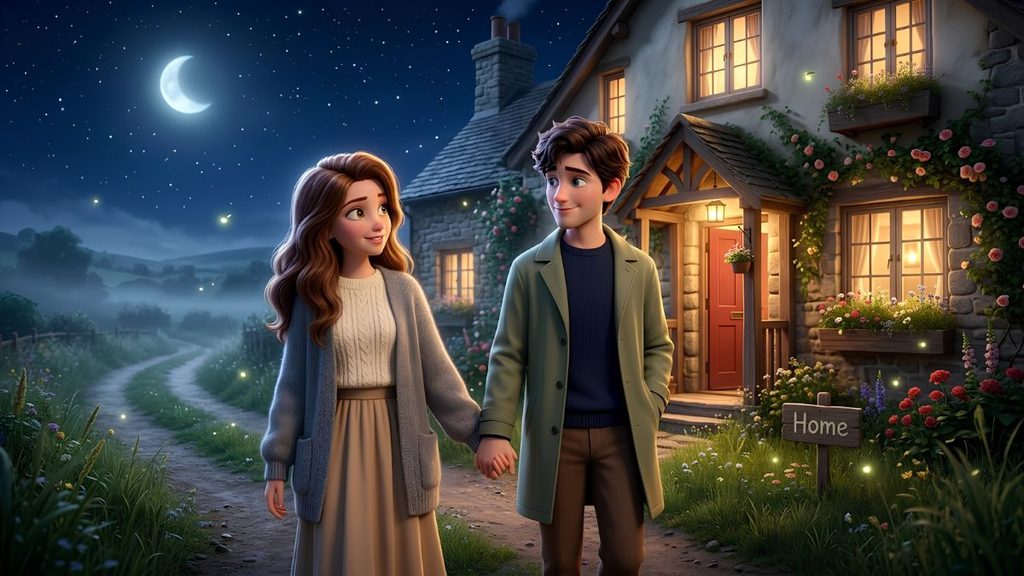
Characters: Grace and Henry
Sophie first saw the little house on a Sunday morning.
She wasn’t looking for it.
In fact, she wasn’t looking for anything at all.
She had simply decided to take a walk.
The countryside around her town was peaceful, especially early in the morning.
The roads were quiet.
Birds sang from the trees.
Mist floated above the fields.
Sophie loved walking when she had too much to think about.
And lately, she had been thinking about everything.
Her job.
Her future.
Her family.
Her apartment.
Her plans.
The strange feeling that her life looked perfectly fine from the outside but somehow didn’t feel like hers anymore.
She had spent years following a plan.
Study.
Work.
Save money.
Build a career.
Buy a home.
Eventually settle down.
The plan had always seemed sensible.
But somewhere along the way, Sophie had forgotten to ask herself what she actually wanted.
That morning, she followed a narrow lane she had never noticed before.
The road curved between tall trees.
She continued walking.
After several minutes, she saw a wooden sign.
It pointed down a smaller path.
There was only one word carved into it:
Home.
Sophie smiled.
“That’s a little dramatic.”
She followed the path anyway.
At the end of the lane stood a small house.
It was beautiful.
Not grand.
Not luxurious.
Just beautiful.
White walls.
Green shutters.
A stone chimney.
Flowers beneath the windows.
A little wooden porch.
An old oak tree beside the garden.
Smoke rose gently from the chimney.
Sophie stopped.
Someone lived there.
She wondered who.
Then the front door opened.
A young man stepped outside.
He had dark-brown hair, blue eyes, and wore a simple navy sweater.
He noticed Sophie.
“Hello.”
She smiled awkwardly.
“Hi.”
“Are you lost?”
“Maybe.”
He laughed.
“That’s usually how people end up here.”
“Do people often get lost?”
“Not really.”
“Then I’m special.”
“Apparently.”
He smiled.
“I’m Oliver.”
“Sophie.”
“Nice to meet you.”
“Nice to meet you too.”
She looked at the house.
“It’s beautiful.”
“Thank you.”
“Do you own it?”
He nodded.
“My grandmother left it to me.”
“How long have you lived here?”
“About two years.”
Sophie looked toward the garden.
“It feels peaceful.”
“It is.”
She glanced back toward the lane.
“I should probably go.”
Oliver nodded.
“You’re welcome to stay for tea.”
She hesitated.
“I don’t know you.”
“That’s true.”
“That sounded strange.”
“It did.”
She laughed.
“Maybe another time.”
“Fair enough.”
Sophie walked away.
After a few steps, she turned.
Oliver was still standing on the porch.
He waved.
She waved back.
Then she continued home.
But she couldn’t stop thinking about the house.
The following Sunday, Sophie returned.
She told herself she was simply taking another walk.
But she knew better.
Oliver was sitting on the porch reading.
He looked up.
“You came back.”
“I did.”
“Tea?”
She smiled.
“Tea.”
They sat on the porch.
The garden smelled of roses.
Oliver poured tea into two old ceramic cups.
Sophie looked around.
“You really live here alone?”
“Yes.”
“Don’t you get lonely?”
“Sometimes.”
“Then why stay?”
He looked toward the garden.
“Because I like it here.”
She understood.
They talked for hours.
Oliver told her about his grandmother.
She had planted most of the flowers.
She had painted the shutters green.
She had built the little birdhouse near the tree.
She had taught Oliver how to bake bread.
“She sounds wonderful.”
“She was.”
“What happened to her?”
Oliver smiled sadly.
“She got old.”
Sophie nodded.
“I’m sorry.”
“Don’t be.”
He looked around.
“She left me this.”
Sophie smiled.
“That’s a good reason to stay.”
Oliver nodded.
“What about you?”
“What about me?”
“Why do you keep walking?”
She thought.
“I don’t know.”
“Maybe you do.”
She looked at him.
“Maybe I’m trying to find something.”
“What?”
“I don’t know yet.”
Oliver smiled.
“Then you’re in the right place.”
Their Sunday meetings became a habit.
Sophie visited every week.
Sometimes Oliver made tea.
Sometimes they walked.
Sometimes they worked in the garden.
They planted herbs.
They repaired the fence.
They painted flower pots.
They cooked together.
They talked about their dreams.
Sophie discovered that Oliver had once wanted to become a musician.
He had played piano as a child.
But he had stopped after his grandmother became ill.
“Do you still play?”
“Sometimes.”
“Can I hear?”
“Maybe.”
One evening, he sat at the old piano in the living room.
Sophie sat nearby.
He played a gentle melody.
It was beautiful.
When he finished, Sophie was quiet.
“What?”
“Nothing.”
“You look emotional.”
“It was beautiful.”
He smiled.
“My grandmother used to love that song.”
“What’s it called?”
“It doesn’t have a name.”
“Why?”
“I never named it.”
Sophie thought for a moment.
“Then call it Home.”
Oliver looked at her.
“Home?”
“Yes.”
He smiled.
“I like that.”
One rainy afternoon, Sophie arrived at the cottage upset.
Oliver knew immediately.
“What happened?”
“Nothing.”
“That’s not true.”
She sat down.
“My company wants me to move.”
“Where?”
“Another city.”
“Do you want to go?”
“I don’t know.”
“What would you lose?”
She thought.
“My apartment.”
“That’s replaceable.”
“My friends.”
“They can visit.”
“My routine.”
“You can build another.”
She looked at him.
“And this.”
Oliver became quiet.
He understood.
Sophie looked toward the window.
“I don’t know why this place matters so much.”
“Maybe because you feel safe here.”
She nodded.
“Maybe.”
“Then ask yourself something.”
“What?”
“If you didn’t have to impress anyone, what would you choose?”
She didn’t answer.
She went home thinking about it.
The next morning, Sophie called her employer.
She turned down the transfer.
It wasn’t easy.
She had to accept that her career might move more slowly.
Some people told her she was making a mistake.
But she felt lighter.
That weekend, she told Oliver.
“I stayed.”
He smiled.
“Here?”
“In the city.”
“Good.”
She looked at him.
“Was that the right choice?”
He smiled.
“Only you can answer that.”
She laughed.
“You always say that.”
“Because it’s true.”
She walked closer.
“You’re frustrating.”
“I’ve been told.”
She smiled.
Then she kissed him.
It was gentle.
Unexpected.
And somehow completely right.
Oliver looked surprised.
Sophie laughed.
“What?”
“I wasn’t expecting that.”
“Neither was I.”
He smiled.
“Should we do it again?”
She nodded.
“Probably.”
They kissed again.
The garden outside swayed in the evening breeze.
Months passed.
Their relationship grew.
Sophie began spending more time at the cottage.
She brought books.
Clothes.
Plants.
Eventually, Oliver cleared a drawer for her.
Then another.
Then half the wardrobe.
Sophie laughed.
“I think I’m moving in.”
“Are you?”
“Maybe.”
He smiled.
“Take your time.”
One evening, they sat on the porch.
The sky was filled with stars.
Sophie looked down the lane.
“Do you know why your grandmother put that sign there?”
“What sign?”
“The one that says Home.”
Oliver thought.
“I think she wanted people to find this place.”
“Why?”
“She believed everyone needed somewhere to rest.”
Sophie smiled.
“She was right.”
A year later, they decided to renovate the cottage.
The roof needed repairs.
The kitchen was old.
The bedroom windows didn’t close properly.
They worked together.
It took months.
There were arguments.
There were mistakes.
There were days when nothing went right.
One afternoon, Sophie dropped a box of paint.
It spilled across the floor.
She stared at the mess.
Oliver stared too.
Then they both started laughing.
“This isn’t funny,” Sophie said between laughs.
“No.”
“We’re going to have to clean this.”
“Yes.”
“Why are you laughing?”
“Because you’re laughing.”
She smiled.
They cleaned together.
That night, they sat on the unfinished floor eating takeout.
Sophie looked around.
“Do you regret it?”
“What?”
“Choosing this?”
Oliver shook his head.
“No.”
“Not even once?”
“Not even once.”
She smiled.
“Me neither.”
When the renovation was finished, the cottage looked different.
But it still felt the same.
The green shutters remained.
The old oak tree remained.
The garden remained.
The piano remained.
The sign at the end of the lane remained.
One evening, Sophie stood outside.
Oliver joined her.
“Look.”
She pointed.
The garden was glowing with tiny lights.
Fireflies.
“Beautiful.”
He took her hand.
“Yes.”
She looked at the cottage.
“I think I understand now.”
“What?”
“Home isn’t the house.”
Oliver smiled.
“What is it?”
She looked at him.
“It’s the person who makes you want to stay.”
He kissed her forehead.
“That’s a good answer.”
Years later, they had children.
The little house became noisy.
There were toys everywhere.
Shoes by the door.
Drawings on the refrigerator.
Books on the stairs.
Laughter in every room.
Sophie sometimes missed the quiet.
But she loved the noise.
Oliver built a swing beneath the oak tree.
Their children spent hours there.
The garden grew larger.
They planted vegetables.
They built a small pond.
They added more flowers.
The house slowly became filled with memories.
Birthdays.
Christmas mornings.
Rainy afternoons.
Summer dinners.
Late-night conversations.
Arguments.
Forgiveness.
Life.
One evening, Sophie sat on the porch watching her children play.
Oliver brought her tea.
She smiled.
“Remember when I first came here?”
“Yes.”
“You thought I was lost.”
“You were.”
She laughed.
“Maybe.”
He sat beside her.
“Do you think you found what you were looking for?”
She looked at the house.
The garden.
The children.
Then him.
“Yes.”
“What was it?”
She smiled.
“A place where I didn’t have to pretend.”
Oliver took her hand.
“That’s home.”
Many years passed.
The children grew up.
They left for university.
Then jobs.
Then lives of their own.
The house became quiet again.
Sophie and Oliver grew older.
The garden became their favorite place.
They spent mornings drinking tea beneath the oak tree.
They spent evenings watching sunsets.
They still argued about small things.
They still laughed.
They still danced in the kitchen when their favorite song played.
One evening, Sophie found the old wooden sign at the end of the lane.
It was faded.
The letters were worn.
She touched it.
Oliver stood beside her.
“It needs replacing.”
“Maybe.”
“Want me to make a new one?”
She shook her head.
“No.”
“Why?”
“Because I like this one.”
“Even though it’s old?”
“Especially because it’s old.”
She smiled.
“It reminds me of where everything started.”
Oliver wrapped an arm around her.
They stood together.
The lane stretched behind them.
The cottage waited at the end.
Warm lights glowed through the windows.
Sophie looked at the house.
“I used to think home was somewhere you were supposed to find.”
Oliver looked at her.
“And now?”
“Now I think you build it.”
He smiled.
“With what?”
She squeezed his hand.
“With ordinary days.”
One winter night, snow began falling.
Sophie and Oliver sat beside the fireplace.
The house was quiet.
The children were visiting for Christmas.
Their grandchildren were asleep upstairs.
The fire crackled.
Oliver looked toward Sophie.
“Tired?”
“A little.”
“Happy?”
She smiled.
“Very.”
He reached for her hand.
She leaned against him.
Outside, snow covered the garden.
The old oak tree stood beneath the moonlight.
The little wooden sign at the end of the lane was barely visible.
But the house was warm.
Safe.
Full of life.
Sophie closed her eyes.
“Do you remember the first time you made me tea?”
“Yes.”
“It was terrible.”
Oliver laughed.
“You drank it.”
“I was being polite.”
“You came back the next week.”
“I liked the house.”
“Not me?”
She opened one eye.
“Maybe a little.”
He smiled.
She closed her eyes again.
“Oliver?”
“Yes?”
“I’m glad I took that walk.”
He kissed her forehead.
“Me too.”
The fire continued burning.
Snow continued falling.
The house grew quieter.
And Sophie realized that the life she had once been afraid to choose had become the life she treasured most.
It wasn’t perfect.
It hadn’t followed a carefully designed plan.
There had been difficult days.
There had been disappointments.
There had been moments when she wondered whether she had chosen correctly.
But happiness had never been about making the perfect decision.
It had been about noticing the beautiful things along the way.
A cup of tea.
A garden.
A song.
A rainy afternoon.
A shared joke.
A hand reaching for hers.
A person who stayed.
A little house at the end of a quiet lane.
Sophie opened her eyes.
Oliver was asleep beside her.
She smiled.
She pulled the blanket over him.
Then she looked toward the window.
Snowflakes drifted through the moonlight.
Everything was peaceful.
She whispered:
“Goodnight.”
Oliver, half asleep, answered:
“Goodnight.”
She smiled.
The fire slowly faded.
The house settled into silence.
Outside, the little lane disappeared beneath the snow.
But the warm light in the cottage remained.
And anyone walking down that road on a cold winter night would see it glowing at the end.
A small light.
A warm window.
A welcoming door.
A reminder that somewhere, someone had built a home.
Not from bricks.
Not from furniture.
Not from perfect plans.
But from love.
From patience.
From forgiveness.
From ordinary moments repeated until they became a lifetime.
And at the end of the lane, the little house continued to stand.
Quiet.
Warm.
Waiting.
Just as it had always been.
Because sometimes the place we spend our whole lives searching for isn’t somewhere far away.
Sometimes it is waiting at the end of a road we almost didn’t take.
Sometimes it begins with a wrong turn.
A simple conversation.
A cup of tea.
A shared laugh.
And sometimes, if we’re lucky, we discover that the person standing beside us was the destination all along.
Why Tell Her a Cute Story Before Bed?
A bedtime story can be much more than entertainment.
It can become a small nightly ritual that gives both partners something positive to look forward to.
It Creates a Sense of Closeness
Even when you and your girlfriend are physically apart, a story can make the distance feel smaller.
Instead of simply saying:
“Goodnight, sleep well.”
you can take her into a peaceful little world for a few minutes.
The experience feels more personal because you are giving her your time and attention.
It Helps End the Day Positively
People often carry the day’s worries into bed.
Work problems, unfinished tasks, difficult conversations, and everyday responsibilities can make it difficult to relax.
A gentle story can shift attention away from those concerns.
A calm narrative gives the mind something pleasant to focus on.
It Can Make Her Feel Special
A personalized story can communicate something that a generic goodnight message cannot.
You are essentially saying:
“I thought about you enough to create this little moment for you.”
That can make a simple bedtime routine feel meaningful.
It Encourages Relaxation
Stories with slow pacing, peaceful imagery, and reassuring endings can create a calmer atmosphere.
Instead of introducing suspense or frightening situations, bedtime stories can focus on comforting details such as rain against a window, moonlight, warm blankets, quiet gardens, peaceful beaches, or soft music.
It Creates a Shared Memory
Couples often remember small moments more vividly than expensive dates.
A particular story you tell repeatedly can eventually become part of your relationship.
Years later, she might remember the story about the little café, the midnight walk, or the cottage beside the sea.
What Makes a Story Cute Rather Than Overly Romantic?
There is a difference between being affectionate and being overly dramatic.
Cute bedtime stories generally work best when romance appears naturally.
Instead of constantly describing intense emotions, focus on small gestures.
For example, a character might:
- Remember how their partner takes their coffee
- Leave a blanket on the couch
- Save the last piece of cake
- Write a tiny note
- Wait for them after work
- Bring their favorite snack
- Hold their hand during a walk
- Leave a light on for them
- Listen when they had a difficult day
These details can communicate affection without making the story feel exaggerated.
The romance becomes believable because it resembles real relationships.
How Long Should a Bedtime Story Be?
There is no fixed length.
The ideal length depends on how you plan to use the story.
Very Short Stories
Around 100 to 300 words can work well for a quick bedtime message.
These are suitable when she is already tired.
Medium Stories
Around 500 to 1,000 words provide enough room for a small plot and emotional ending without becoming too lengthy.
Longer Stories
Stories of 1,500 to 2,000 words can work well when you want to spend more time talking together before sleep.
However, longer doesn’t automatically mean better.
For bedtime storytelling, the pacing matters more than the word count.
Keep the Beginning Gentle
The opening of a bedtime story should immediately establish a peaceful atmosphere.
Instead of beginning with an intense conflict, consider starting with:
- A quiet evening
- A warm bedroom
- A peaceful beach
- A sleepy village
- A rainy afternoon
- A moonlit garden
- A cozy café
- A couple returning home
The first paragraph should make the listener feel comfortable.
For example, a story might begin with a couple returning home after a long day. The lights are low, the rain is falling outside, and one partner prepares tea while the other changes into comfortable clothes.
Nothing dramatic has happened yet.
That’s exactly the point.
The listener can relax into the story.
Use Simple and Comforting Language
Bedtime stories should be easy to follow.
Long sentences filled with complicated descriptions can make the story feel like an article rather than a bedtime tale.
Use natural language.
Keep paragraphs reasonably short.
Let the story breathe.
Instead of constantly introducing new characters, locations, and conflicts, focus on one central relationship or experience.
A simple story can often feel more intimate than a complicated one.
Add Small Romantic Details
Small details are one of the easiest ways to make a story feel cute.
Imagine a boyfriend remembering that his girlfriend always gets cold at night.
Instead of making a huge romantic gesture, he quietly places an extra blanket beside her.
She notices.
She smiles.
That’s enough.
Other small moments might include:
- Fixing her pillow
- Remembering her favorite dessert
- Holding her hand during a walk
- Leaving a note beside her phone
- Saving a seat beside the window
- Making breakfast
- Listening to her favorite song
- Remembering an important date
- Bringing flowers without a special reason
These moments can make the characters feel like a real couple.
Give the Story a Peaceful Ending
The ending is particularly important when the goal is to help someone fall asleep.
Avoid finishing with a major cliffhanger.
Avoid ending with a frightening discovery.
Avoid introducing a dramatic problem in the final paragraph.
Instead, bring the story gently toward rest.
The characters might:
- Watch the stars
- Fall asleep together
- Listen to rain
- Sit beside a fireplace
- Walk home beneath the moon
- Share a quiet goodnight
- Watch the sunrise
- Rest beside each other
The final paragraphs should feel softer than the beginning.
The story should gradually settle.
Make the Girlfriend Feel Like the Main Character
If you are telling a story directly to your girlfriend, consider making the female character resemble her in personality.
You don’t need to use her real name.
Instead, you can incorporate little qualities she recognizes.
For example, perhaps she loves books.
The story could involve a mysterious bookstore.
If she loves beaches, the characters could discover a quiet coastal cottage.
If she loves flowers, the story could take place in a magical garden.
This makes the story feel personal without requiring a complicated plot.
Use Imagination Without Losing Emotional Realism
Cute bedtime stories can contain magical elements while still feeling emotionally believable.
For example, imagine a magical moon that shines brighter whenever someone feels loved.
The fantasy is fictional.
But the emotion behind it is real.
The best stories often combine ordinary experiences with one imaginative element.
A normal bedroom can contain a magical window.
An ordinary train can travel through a dreamlike landscape.
A familiar garden can bloom at midnight.
A simple letter can arrive from the future.
This balance keeps the story imaginative without making it confusing.
How to Make Bedtime Stories More Romantic
Romance doesn’t need to dominate every sentence.
Instead, let it appear naturally through the characters’ actions.
A good romantic bedtime story might include:
Affection: Characters show genuine care for each other.
Comfort: One person helps the other feel safe after a difficult day.
Humor: Small playful moments make the relationship feel natural.
Memories: The characters remember meaningful moments together.
Hope: The ending leaves them looking forward to tomorrow.
Trust: The relationship feels emotionally secure.
This combination often creates a warmer experience than constant romantic declarations.
Stories Should Feel Safe and Comforting
Because these stories are intended for bedtime, emotional safety matters.
Avoid unnecessary conflict.
Avoid frightening scenes.
Avoid intense arguments that remain unresolved.
Avoid endings where something terrible happens.
Instead, if the story includes a problem, resolve it gently.
For example, if the couple has an argument, they can eventually communicate, understand each other, and fall asleep peacefully.
The goal is to leave the listener feeling calm.
Cute Bedtime Stories Can Work for Long-Distance Couples
Bedtime storytelling can be particularly meaningful when couples are separated by distance.
A phone call can become a shared bedtime ritual.
One person can read the story while the other listens.
The story doesn’t have to mention the distance directly.
Sometimes it can simply create a shared imaginary space.
For example, you might imagine the two characters sitting together beside a fireplace even though the real couple is in different countries.
That can create a sense of closeness.
You can also personalize the story with details from your relationship, such as a favorite restaurant, memorable trip, shared joke, or place you both want to visit.
How to Tell a Bedtime Story Over a Phone Call
If you’re reading the story aloud, your delivery matters almost as much as the writing.
Speak slowly.
Keep your voice soft.
Pause between paragraphs.
Don’t rush through dialogue.
You can slightly lower your volume toward the ending.
Avoid suddenly becoming loud or overly animated.
The goal is to create a peaceful rhythm.
A simple routine could be:
Start: Ask about her day.
Transition: Tell her you have a little story for her.
Story: Read slowly for several minutes.
Ending: Finish with a comforting line.
Goodnight: Tell her to relax and sleep well.
This can become a lovely nightly tradition.
Personalization Makes the Story More Meaningful
A generic story can be enjoyable.
A personalized story can feel special.
You can personalize a story by including:
- Her favorite color
- Her favorite flower
- A place she loves
- Her favorite food
- A shared memory
- A nickname
- A dream she has
- A hobby she enjoys
- A place she wants to visit
For example, instead of writing about an unnamed girl walking through a garden, you could create a character who loves lavender and dreams of visiting France.
The details don’t need to dominate the story.
A few carefully chosen references can be enough.
Avoid Turning Every Story Into a Love Confession
A collection becomes more interesting when every story has a slightly different emotional purpose.
One story might focus on comfort.
Another might focus on adventure.
Another could be funny.
Another could be magical.
Another could explore a shared future.
Another could focus on gratitude.
Another could simply be about two people enjoying an ordinary evening.
This variety prevents the stories from feeling repetitive.
Final Thoughts
Cute paragraph stories to make her fall asleep are ultimately about creating a feeling rather than simply telling a story.
The best ones are gentle, imaginative, affectionate, and easy to follow. They allow your girlfriend to forget the day’s stress for a few minutes and enter a peaceful little world where everything feels warm and safe.
Whether the story takes place in a magical garden, a quiet seaside cottage, a cozy apartment, a moonlit train, or an ordinary bedroom, the central idea remains the same: two people finding comfort in each other’s presence.
You don’t need a complicated plot.
You don’t need a dramatic ending.
Sometimes all you need is a quiet night, a sweet story, and a few carefully chosen words that remind her how special she is.
And when the final paragraph ends with the characters settling down beneath the stars, listening to the rain, or simply holding hands in silence, the story has done exactly what a good bedtime story should do.
It has made the night feel a little softer.