There is something wonderfully intimate about sharing a story before going to sleep. When the day finally becomes quiet and there are no deadlines, notifications, or responsibilities demanding attention, a bedtime story can create a small private world for two people.
A long bedtime story for girlfriend can be more than simple entertainment. It can be a romantic way to relax together, express affection, explore imagination, and end the day with a beautiful thought.
Whether you are reading aloud over a phone call, sitting together in bed, or sending a story as a thoughtful goodnight message, the right story can turn an ordinary evening into a memorable experience.
This guide explores what makes a long bedtime story special, the different themes you can choose, how to make stories romantic without becoming overly complicated, and how to create the perfect bedtime storytelling experience.
What Is a Long Bedtime Story for Girlfriend?
A long bedtime story for girlfriend is an extended fictional story designed to be read or listened to during the evening or before sleep.
Unlike a very short goodnight story, a longer story has enough space to develop:
- Interesting characters
- A meaningful setting
- Emotional moments
- Romantic connections
- Gentle conflict
- Personal growth
- A satisfying ending
- A calming final message
The story does not necessarily have to be intensely romantic.
In fact, bedtime stories often work better when romance is naturally woven into the plot rather than making every paragraph about the relationship.
A fantasy adventure, magical journey, emotional romance, funny couple story, or gentle mystery can all become wonderful bedtime reading.
The most important quality is the feeling the story leaves behind.
A good bedtime story should make your girlfriend feel comfortable, appreciated, entertained, or emotionally connected.
Long Bedtime Story for Girlfriend Free
1. The Moonlight Café
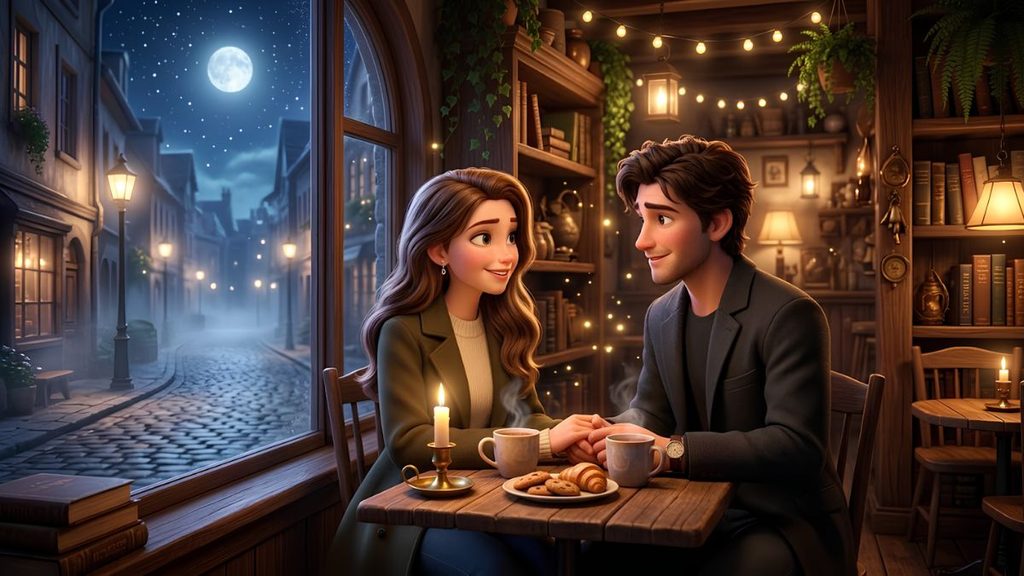
Characters: Sophie and Daniel
Theme: Unexpected love, comfort, and finding home
There was a street in the oldest part of Bellmere that most people avoided after midnight.
During the day, it was ordinary.
There was a flower shop with blue shutters, a small bakery that sold warm bread, an antique store filled with clocks, and several narrow apartment buildings with balconies covered in flowers.
But after midnight, the street became strangely quiet.
The shops closed.
The lights disappeared.
The sidewalks emptied.
And according to an old local story, something unusual happened there once every few weeks.
A small café appeared.
Nobody knew when it had been built.
Nobody knew who owned it.
And nobody could find it during the day.
The café was called the Moonlight Café.
Sophie had heard the story when she was a child.
Her grandmother had told her about it one winter evening.
“Never look for it,” her grandmother had said.
“Why?”
“Because it doesn’t appear for people who are looking.”
Sophie had laughed.
“Then how do people find it?”
Her grandmother smiled.
“It finds them.”
Sophie had never believed the story.
Until one rainy Thursday night.
She was twenty-seven years old and had just finished one of the worst days she could remember.
Her manager had criticized her work.
A project she had spent weeks preparing had been delayed.
Her train had stopped between stations.
And when she finally arrived home, she discovered that the heating system in her apartment had stopped working.
She stood in the hallway holding her wet umbrella.
“Wonderful,” she whispered.
She looked at her phone.
11:47 p.m.
She didn’t want to go upstairs yet.
She didn’t want to sit alone in her cold apartment.
So she decided to walk.
The rain had almost stopped.
The streets were nearly empty.
Sophie pulled her coat tighter and began walking through the old part of town.
She passed the bakery.
Closed.
The flower shop.
Closed.
The antique store.
Closed.
Then she noticed something strange.
There was a warm golden light at the end of the street.
She frowned.
She had walked this road hundreds of times.
There had never been a café there.
Yet tonight, there was a small wooden building with glowing windows.
Above the door hung a sign.
THE MOONLIGHT CAFÉ
Sophie stopped.
She stared at it.
Her grandmother’s story suddenly came back to her.
She laughed quietly.
“This can’t be real.”
But it was there.
She checked her phone.
12:03 a.m.
Sophie walked closer.
The windows were fogged from the warmth inside.
She could see shelves filled with books.
A fireplace.
Small wooden tables.
And someone sitting behind the counter.
She hesitated.
Then she opened the door.
A tiny bell rang.
The person behind the counter looked up.
He was a young man with dark brown hair and warm eyes.
“Good evening,” he said.
Sophie looked around.
“Are you open?”
He smiled.
“Only tonight.”
She frowned.
“What does that mean?”
He shrugged.
“Exactly what it sounds like.”
Sophie almost laughed.
“Can I have tea?”
“Of course.”
“What kind?”
“What do you like?”
She thought.
“Something warm.”
He smiled.
“I can do that.”
He turned toward a collection of tea jars.
Sophie watched him.
“You seem very confident.”
“I’ve had practice.”
“Making tea?”
“Knowing what people need.”
She raised an eyebrow.
“That’s a strange thing to say.”
“Maybe.”
He prepared a cup.
A few minutes later, he placed it in front of her.
Sophie took a sip.
Her eyes widened.
“This is perfect.”
“I know.”
She smiled.
“How?”
The young man shrugged.
“Sometimes people tell you what they need without saying it.”
Sophie looked at him.
“What’s your name?”
“Daniel.”
“I’m Sophie.”
“I know.”
She froze.
“You know my name?”
Daniel smiled.
“No.”
He pointed to her bag.
There was a small name tag attached to it.
Sophie laughed.
“Right.”
She sat at a table near the fireplace.
Daniel returned to the counter.
For a while, they said nothing.
Sophie drank her tea.
The rain tapped softly against the windows.
The fire crackled.
The café smelled of cinnamon and old books.
Eventually, Daniel asked:
“Bad day?”
Sophie looked at him.
“That obvious?”
“A little.”
She smiled.
“Yes.”
“Do you want to talk about it?”
“Not really.”
“That’s okay.”
He returned to his book.
Sophie looked around.
“Are there usually many customers?”
“No.”
“Why?”
Daniel looked at her.
“The café doesn’t appear for everyone.”
“Who does it appear for?”
He smiled.
“People who need it.”
Sophie remembered her grandmother’s words.
It finds them.
She looked toward the window.
“How long has this place been here?”
“Longer than I have.”
“Who owns it?”
Daniel hesitated.
“I don’t know.”
“You don’t know?”
“I work here.”
“Every night?”
“No.”
“Then when?”
“When the café appears.”
Sophie laughed.
“You’re serious.”
“Very.”
She looked around.
“How often does it appear?”
“Whenever it is needed.”
“That’s not an answer.”
“It’s the only answer I have.”
Sophie smiled.
For the first time that day, she felt relaxed.
She stayed for another hour.
They talked about books.
Music.
Travel.
Childhood memories.
Daniel told her he had always wanted to visit the sea.
Sophie told him she had always wanted to see the northern lights.
Eventually, she looked at the clock.
1:42 a.m.
“I should go.”
Daniel nodded.
“Of course.”
She stood.
“Thank you.”
“For the tea?”
“For everything.”
He smiled.
“Come again.”
Sophie looked toward the window.
“Will you be here?”
“Maybe.”
“That’s not reassuring.”
Daniel laughed.
“Then come and find out.”
Sophie left.
She walked home through the quiet streets.
When she reached the corner, she turned around.
The café was still visible.
Its windows glowed warmly.
She smiled.
Then she continued home.
The next morning, she returned to the street.
There was no café.
Only an empty brick wall.
She stared.
“No way.”
She checked the address.
It was correct.
She asked the florist nearby.
“Excuse me, has there ever been a café here?”
The woman shook her head.
“No.”
“Are you sure?”
“Very.”
Sophie walked away confused.
For the next two weeks, she thought about Daniel.
She told herself it was because the café had been unusual.
But deep down, she knew it was something else.
She wanted to see him again.
One Friday night, she walked through the old street at midnight.
Nothing.
Another Friday.
Nothing.
She almost gave up.
Then, on a cold Tuesday night, she saw the golden light.
The café was there.
Sophie smiled.
She opened the door.
The bell rang.
Daniel looked up.
“I wondered when you’d come back.”
Sophie stared.
“You remember me?”
“Of course.”
She sat at the same table.
“Tea?”
“Please.”
Daniel prepared it without asking what she wanted.
She took a sip.
Perfect again.
“You remembered.”
“I remember important things.”
Sophie smiled.
They talked for hours.
This time, Sophie told him about her family.
Daniel told her about his childhood.
She discovered that he was afraid of heights.
He discovered that she hated mushrooms.
She discovered that he could play the piano.
He discovered that she secretly loved terrible romantic movies.
Their conversations became easier.
The café became their place.
Whenever it appeared, Sophie came.
Sometimes they talked.
Sometimes they read books together.
Sometimes they simply sat near the fireplace.
Weeks passed.
Then months.
Sophie began looking forward to the café more than anything else.
One night, Daniel asked:
“Why do you keep coming back?”
She smiled.
“You know why.”
“I want to hear you say it.”
Sophie looked at him.
“Because I like being here.”
“Only here?”
She understood what he meant.
She looked down.
“I like being with you.”
Daniel smiled.
“I like being with you too.”
The café seemed warmer that night.
Outside, snow began falling.
They stood near the window.
Sophie watched the snow.
“I’ve always wanted to see the northern lights.”
Daniel smiled.
“Maybe someday.”
“Maybe.”
They looked at each other.
Neither spoke.
Then Daniel gently took her hand.
It was the first time.
Sophie smiled.
The night seemed to become quieter.
After that, something changed.
Their relationship slowly became more than friendship.
They began meeting outside the café whenever possible.
They walked through the city.
They visited bookstores.
They shared breakfasts.
They watched sunsets.
But there was one strange problem.
Daniel couldn’t explain where he lived.
Whenever Sophie asked, he changed the subject.
One evening, she finally said:
“Daniel, where do you go when the café disappears?”
He looked away.
“I don’t know.”
“What do you mean?”
“I wake up somewhere else.”
“Where?”
“Sometimes in a hotel.”
“Sometimes?”
“Sometimes an apartment.”
“Whose apartment?”
“I don’t know.”
Sophie stared at him.
“That’s impossible.”
“I know.”
“Are you even real?”
Daniel looked hurt.
“I hope so.”
She immediately regretted the question.
“I’m sorry.”
He smiled.
“It’s okay.”
But the mystery remained.
Then one night, the café didn’t appear.
Sophie waited.
12:00.
12:30.
1:00.
Nothing.
She walked home disappointed.
The following night, nothing.
Then another.
A week passed.
Sophie became worried.
She returned to the old street every night.
Nothing.
Then one evening, she noticed a small envelope on the pavement.
Her name was written on it.
She opened it.
Inside was a handwritten note.
Meet me where we first met.
Sophie immediately knew where.
The old street.
She ran there.
The café was glowing.
She opened the door.
Daniel stood behind the counter.
Sophie rushed toward him.
“What happened?”
“The café was gone.”
“I know.”
“Why?”
Daniel looked at her.
“Because it had served its purpose.”
“What does that mean?”
He took her hand.
“The café appears when people need something.”
Sophie frowned.
“What did I need?”
Daniel smiled.
“Someone to remind you that life can still surprise you.”
“And now?”
“Now you don’t need the café.”
“Why?”
“Because you have me.”
Sophie stared at him.
She felt tears in her eyes.
“Is that why it disappeared?”
“I think so.”
She looked around the café.
Suddenly, she understood.
The café wasn’t meant to last forever.
It had brought two people together.
That was enough.
She hugged Daniel.
He held her tightly.
They stayed that way for a long time.
The fireplace crackled.
Snow fell outside.
Neither wanted the moment to end.
Eventually, Daniel whispered:
“Come on.”
“Where?”
“Home.”
Sophie smiled.
“Where is home?”
He looked at her.
“Wherever you are.”
They left the café together.
This time, Sophie didn’t look back.
The next morning, the café was gone.
It never appeared again.
But Sophie didn’t feel sad.
Because she finally understood the secret.
The Moonlight Café had never really been a place.
It had been a moment.
A doorway.
A chance encounter.
A reminder that sometimes life places exactly the right person in front of you when you least expect it.
Years later, Sophie and Daniel lived in a small house on the edge of the city.
Their home had a tiny kitchen filled with plants.
There were books everywhere.
Daniel finally visited the sea.
Sophie finally saw the northern lights.
They traveled together.
They laughed.
They argued.
They forgave each other.
They grew together.
And every winter, on the first snowy night, they made tea and sat beside the window.
One evening, Sophie looked outside.
The snow was falling softly.
She smiled.
“Do you ever miss the café?”
Daniel thought about it.
“Sometimes.”
“Me too.”
He took her hand.
“But I’m glad it disappeared.”
“Why?”
“Because if it had stayed, maybe we would have kept going there.”
Sophie smiled.
“And now?”
“Now we don’t need a magical café.”
She leaned against him.
“Why?”
Daniel kissed her forehead.
“Because we made our own.”
Sophie looked around their warm little house.
The books.
The tea.
The soft lights.
The rain against the windows.
The person beside her.
She smiled.
“You’re right.”
Outside, the snow continued falling.
Inside, they sat together quietly.
And for a moment, Sophie remembered the first night she had entered the Moonlight Café.
She remembered the mysterious tea.
The warm fireplace.
The strange books.
And the young man behind the counter who had somehow known exactly what she needed.
She realized something then.
Sometimes life doesn’t give us what we ask for.
It gives us what we didn’t know we needed.
Sophie had thought she needed somewhere to escape from a terrible day.
Instead, she had found someone to share all the ordinary days that came afterward.
And perhaps that was the real magic.
Not the café.
Not the midnight appearances.
Not the mysterious books.
Not even the glowing lights.
The real magic was finding someone who could turn an ordinary evening into something worth remembering.
Daniel squeezed her hand.
“Tea?”
Sophie smiled.
“Always.”
He stood and walked toward the kitchen.
She watched him disappear around the corner.
Then she looked out the window at the snow.
The city was quiet.
The night was peaceful.
And somewhere, perhaps on another forgotten street, another golden door was opening for someone who needed it.
But Sophie no longer needed to search.
She had already found what she was looking for.
She had found home.
And home was sitting in the kitchen, making two cups of tea.
Moral: Sometimes home is not a place. It is the person who makes you feel understood.
2. The Boy Who Saved the Stars
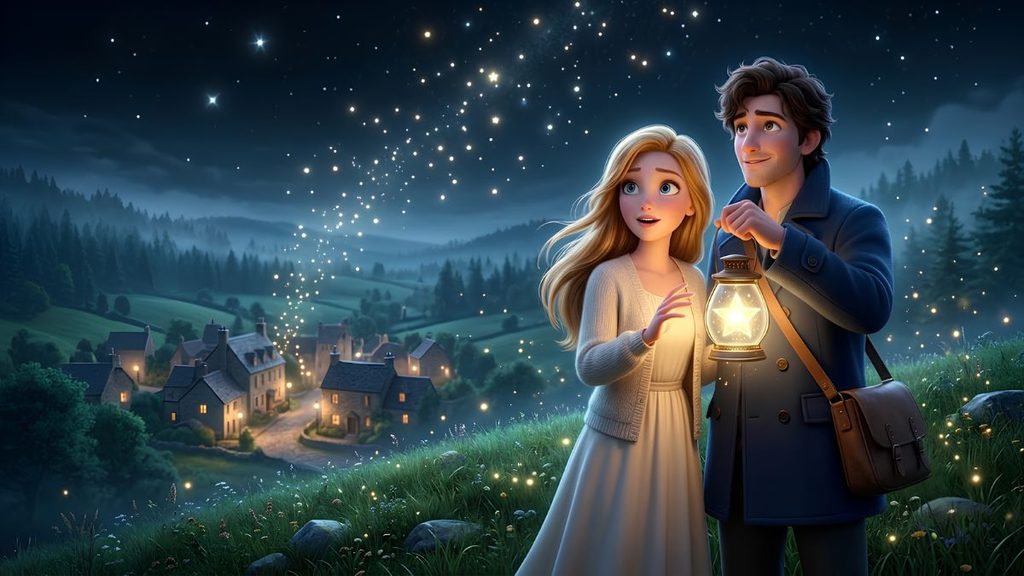
Characters: Amelia and Oliver
Theme: Dreams, courage, and romantic devotion
Amelia had always believed that the stars were trying to tell people something.
She didn’t know what.
She simply believed they were.
When she was little, she would lie on the grass outside her parents’ farmhouse and stare at the night sky until her mother called her inside.
“Amelia, it’s late.”
“Just five more minutes.”
“You said that twenty minutes ago.”
“Then five more.”
Her mother would laugh.
Eventually, she would carry a blanket outside and sit beside her.
Together, they would watch the stars.
Amelia’s father had once told her that every star was a distant sun.
Her grandmother had a different explanation.
“Stars are memories,” she had said.
“Memories of what?”
“People who loved deeply.”
Amelia had loved that explanation.
As she grew older, she never stopped looking at the sky.
Whenever she felt happy, she looked at the stars.
Whenever she felt sad, she looked at the stars.
Whenever she didn’t know what to do, she looked at them.
The stars never answered.
But somehow, they always made her feel better.
Then one autumn evening, the stars began disappearing.
At first, nobody noticed.
There had been clouds in the sky.
Then came rain.
Then fog.
But when the weather cleared, Amelia looked upward and immediately knew something was wrong.
There were fewer stars.
Far fewer.
She stood outside her cottage with a blanket around her shoulders.
“Where did they go?”
The following night, there were even fewer.
The night after that, fewer still.
People in the village began talking.
Some said it was pollution.
Others blamed unusual weather.
Scientists came from the nearest city.
They studied the sky.
They checked their instruments.
They could find no explanation.
The stars were simply disappearing.
Every night.
One by one.
Amelia became frightened.
She started going outside every evening.
She counted the stars.
Twenty-three.
Then nineteen.
Then twelve.
Then seven.
Soon, only three remained.
The village became unusually quiet after sunset.
People no longer sat outside.
Children stopped playing in the streets.
Everyone was looking upward.
Waiting.
Wondering which star would disappear next.
One cold evening, Amelia climbed the hill behind the village.
She carried a lantern.
She sat beneath an old oak tree.
Above her were only three stars.
Three tiny points of light in an enormous black sky.
She whispered:
“Please don’t disappear.”
The wind moved through the branches.
Nothing happened.
Then she saw something.
A light falling from the sky.
Amelia stood.
The light moved quickly downward.
It disappeared behind the forest.
She grabbed her lantern.
“That wasn’t a star.”
She started running.
The forest was dark.
Branches scratched against her coat.
Leaves covered the ground.
She followed the faint glow.
Eventually, she reached a clearing.
Someone was standing there.
A young man.
He wore a dark travel coat and carried a leather satchel.
In his hands was a small glass lantern.
Inside it was a glowing light.
Amelia stopped.
“Who are you?”
The stranger turned.
“My name is Oliver.”
“What are you doing here?”
He looked at the lantern.
“Trying to save a star.”
Amelia stared.
“That’s impossible.”
Oliver smiled sadly.
“So is losing the stars.”
She walked closer.
Inside the lantern, a tiny golden light floated like a miniature sun.
“Is that really a star?”
“Yes.”
“How did you catch it?”
“I didn’t.”
“What happened?”
“It fell.”
“Why?”
Oliver looked toward the sky.
“Something is pulling them down.”
Amelia looked upward.
“What’s pulling them?”
“I don’t know.”
“Then how are you going to save them?”
Oliver opened his satchel.
Inside were several tiny glass bottles.
Each contained a faint glow.
Amelia stared.
“How many have you saved?”
“Seven.”
“Seven?”
“I’ve been traveling for months.”
“Where did you come from?”
Oliver hesitated.
“Far away.”
“How far?”
“Far enough that I stopped measuring.”
Amelia smiled despite herself.
“You’re strange.”
“I’ve been told that.”
She looked at the lantern again.
“What happens to the stars after you catch them?”
“I return them.”
“How?”
“I haven’t figured that part out.”
Amelia laughed.
Oliver looked surprised.
“What?”
“Nothing.”
“You laughed.”
“Because you’re traveling around the world collecting fallen stars without knowing how to put them back.”
“When you say it like that, it sounds foolish.”
“It is.”
He smiled.
“Probably.”
They sat beneath the tree.
Oliver explained what he had discovered.
The stars weren’t disappearing.
They were falling.
Something had changed in the world.
Something was pulling the stars toward the earth.
As each one fell, it became weaker.
If they weren’t returned to the sky before dawn, they would lose their light completely.
Amelia looked at the bottles.
“How many stars are left?”
Oliver looked up.
“Three.”
She felt her heart sink.
“Then we don’t have much time.”
“No.”
“Can I help?”
Oliver looked at her.
“You don’t even know me.”
“I know.”
“Then why?”
She looked toward the sky.
“Because I don’t want the stars to disappear.”
Oliver smiled.
“Fair enough.”
The next morning, they left the village.
Oliver had a map.
But it wasn’t an ordinary map.
It showed places where stars had fallen.
The first location was beyond the northern mountains.
They traveled for two days.
Along the way, Amelia learned more about Oliver.
He had grown up near the coast.
His mother had been an astronomer.
She had spent her life studying stars.
When Oliver was young, she told him that stars were not simply lights in the sky.
“They are reminders,” she had said.
“Reminders of what?”
“That even things impossibly far away can still give us light.”
Oliver had remembered those words.
When the stars began falling, he decided he couldn’t simply watch.
So he left home.
He traveled from village to village.
He found fallen stars.
He protected them.
He carried them in glass lanterns.
But he didn’t know how to return them.
“You’ve been doing this alone?” Amelia asked one evening.
“Yes.”
“Why?”
Oliver shrugged.
“Nobody else believed me.”
Amelia looked at him.
“I believe you.”
“I know.”
They smiled.
Their journey continued.
At the northern mountain, they found the first clue.
A strange silver stone was embedded in the ground.
Oliver knelt beside it.
“This is pulling the stars.”
“How?”
“I don’t know.”
Amelia touched it.
The stone was cold.
Then she heard something.
A whisper.
She pulled her hand away.
“What?”
Oliver looked at her.
“Did you hear that?”
“Hear what?”
She looked at the stone.
“It sounded like someone crying.”
Oliver became serious.
They spent the afternoon studying the stone.
Eventually, Amelia noticed symbols carved into its surface.
They looked like stars.
But each star had a line connecting it to another.
Oliver examined them.
“It’s a map.”
“Of the sky?”
“No.”
He pointed.
“Of the earth.”
The lines formed a pattern.
Amelia recognized it.
“The old observatory.”
“What?”
“There is an abandoned observatory on the western hill.”
Oliver looked at the map.
“That’s where we go.”
They traveled through the night.
By sunrise, they reached the observatory.
It had been abandoned for decades.
Its roof was broken.
Vines covered the walls.
Inside, they found an enormous telescope.
Beside it was a book.
Oliver opened the book.
The pages were filled with drawings of stars.
At the final page was a warning.
When people stop looking upward, the stars begin falling.
Amelia frowned.
“What does that mean?”
Oliver read the next line.
A star shines because someone remembers it.
They looked at each other.
Amelia suddenly understood.
“The stars are disappearing because people stopped believing in them.”
“That doesn’t make sense.”
“Maybe it doesn’t have to.”
Oliver shook his head.
“There has to be something else.”
Amelia pointed toward the sky.
“Look.”
The three remaining stars were flickering.
One disappeared.
Two remained.
Oliver’s face changed.
“We’re running out of time.”
They carried the fallen stars toward the highest mountain.
According to the old book, the stars could be returned from the summit.
But there was a problem.
The mountain was dangerous.
The path was covered in ice.
The wind was fierce.
By the time they reached the final climb, Amelia was exhausted.
“We should stop.”
“We can’t.”
“We’ll freeze.”
Oliver looked at her.
“Then we’ll keep moving.”
She smiled.
“You’re stubborn.”
“So are you.”
They continued.
At midnight, they reached the summit.
The sky was almost completely black.
Only two stars remained.
Oliver placed the glass lanterns on the snow.
“We need to light them.”
“How?”
He opened the old book.
There was one final instruction.
A star returns when someone remembers why it matters.
Amelia stared at the words.
“That’s it?”
“I think so.”
She closed her eyes.
She thought about her childhood.
Her mother carrying blankets outside.
Her father explaining the stars.
Her grandmother telling her they were memories.
She thought about every night she had looked upward.
Every difficult day when the sky had comforted her.
She opened her eyes.
“Stars matter because they remind us that we’re not alone.”
Nothing happened.
Oliver looked at her.
“Keep going.”
Amelia continued.
“They give us light even though they’re far away.”
The lantern glowed.
One of the fallen stars rose slightly.
Amelia smiled.
“They remind us that something beautiful can exist beyond what we can reach.”
The light grew brighter.
Oliver stepped forward.
“I remember my mother.”
His voice trembled.
“She taught me that distant light still matters.”
The lantern opened.
The star flew upward.
It crossed the sky.
Then stopped.
It began shining.
One star.
Then another.
Then another.
All across the horizon, tiny points of light appeared.
The sky began filling.
Amelia stared upward.
“Oliver.”
He looked.
Thousands of stars were returning.
The darkness disappeared.
The night sky became brighter than either of them had ever seen.
Amelia laughed.
Oliver laughed too.
They stood together beneath the stars.
After a few moments, Oliver turned toward her.
“Thank you.”
“For what?”
“For believing me.”
She smiled.
“You saved the stars.”
“We saved them.”
Amelia looked at him.
“You’re right.”
The next morning, they returned to the village.
People came outside.
They stared at the sky.
Children cheered.
Adults cried.
Nobody understood exactly what had happened.
Amelia and Oliver never told everyone the whole story.
Some things were better kept as memories.
Oliver stayed in the village.
He no longer needed to travel.
He found work helping the village school.
Amelia continued studying the stars.
They spent evenings together.
Sometimes they talked.
Sometimes they sat silently.
And sometimes they climbed the hill behind the village.
One night, months later, Amelia asked:
“Do you still think stars are memories?”
Oliver smiled.
“Yes.”
“Whose?”
“Maybe everyone’s.”
She looked at him.
“And what do you think our star would remember?”
Oliver thought.
“Tonight?”
“Yes.”
He smiled.
“It would remember you asking too many questions.”
She laughed.
“And you?”
“Me?”
“Your star.”
He looked upward.
“I think it would remember the night I met you.”
Amelia became quiet.
“Why?”
“Because that’s when the world became brighter.”
She smiled.
“You’ve become very romantic.”
“I’ve had a good teacher.”
“Who?”
He pointed toward the sky.
“The stars.”
She laughed.
They sat together beneath the oak tree.
The same tree where Amelia had once begged the stars not to disappear.
Now the sky was full of them.
Every star seemed brighter.
Every constellation looked sharper.
And Amelia realized something.
Maybe her grandmother had been right.
Maybe stars really were memories.
Maybe every light in the sky carried a story.
Maybe the stars that had fallen had not been lost.
Maybe they had simply needed someone to remember why they mattered.
She rested her head against Oliver’s shoulder.
“Do you think they’ll ever fall again?”
“Probably.”
“What will we do?”
“Save them.”
“Together?”
“Always.”
She smiled.
Above them, the stars continued shining.
Far away.
Beautiful.
Untouchable.
Yet somehow close enough to give light.
And whenever someone in the village felt lost, they looked upward.
They remembered the dark nights.
They remembered the missing stars.
And they remembered the two young people who had climbed a mountain carrying little glass lanterns.
People began telling the story to their children.
They called Oliver the boy who saved the stars.
But Oliver always corrected them.
“I didn’t save them.”
“Who did?”
He would smile.
“Everyone who remembered to look up.”
And perhaps that was the most important lesson of all.
The world can become so busy that people forget to look at beautiful things.
They become focused on work.
Bills.
Problems.
Deadlines.
Mistakes.
Tomorrow.
They forget the sky.
They forget quiet evenings.
They forget how wonderful it feels simply to sit beside someone you love and watch the stars.
But the stars remain.
Waiting.
Patiently shining.
Reminding us that there is always something beautiful beyond our immediate worries.
Amelia and Oliver never stopped looking upward.
Even years later.
Even when life became complicated.
Even when they became old.
Whenever they had a difficult day, they returned to the hill.
They sat beneath the oak tree.
They held hands.
And they looked at the stars.
One evening, many years after their journey, Amelia whispered:
“Do you remember the first star?”
Oliver smiled.
“Of course.”
“The one in the glass lantern?”
“Yes.”
“Do you think it remembers us?”
Oliver looked toward the sky.
Then he looked at her.
“I think it does.”
“Why?”
“Because some stories are too beautiful to forget.”
Amelia smiled.
She rested her head against his shoulder.
Above them, the stars continued shining.
And beneath them, the world became quiet.
The wind moved gently through the trees.
The village lights twinkled in the distance.
The night settled peacefully around them.
And for one more evening, two people sat together beneath a sky full of stars.
Not because they needed to save anything.
Not because they were searching for answers.
But simply because they had discovered that some of life’s happiest moments are the quiet ones.
The moments when you sit beside someone you love.
Look upward.
And realize that, for tonight at least, everything is exactly where it belongs.
Moral: Sometimes helping someone find their light helps you discover your own.
3. The Letter From Tomorrow
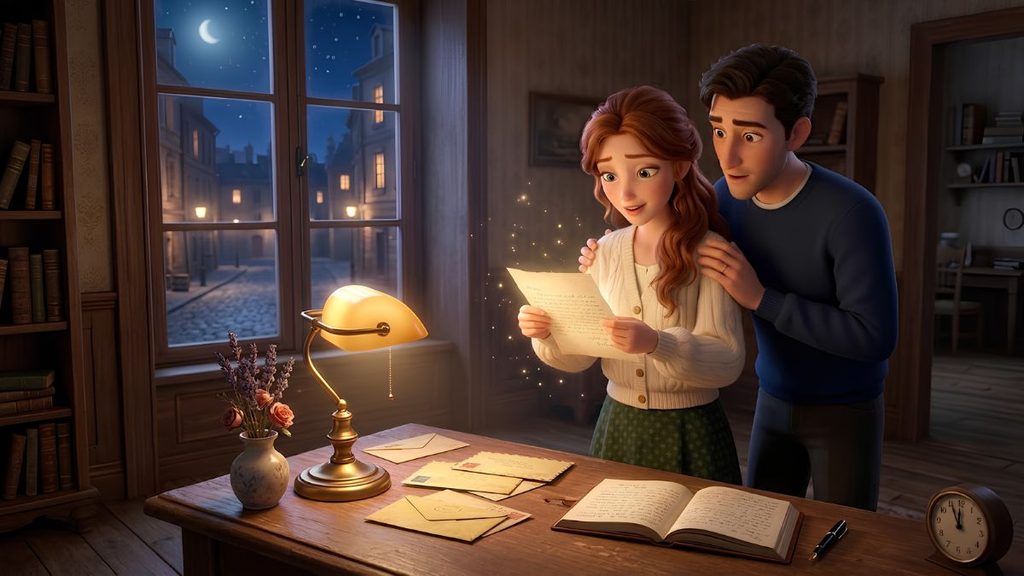
Characters: Clara and Ethan
Theme: Love, choices, and the uncertainty of the future
Clara had never believed in messages from the future.
She believed in calendars.
She believed in clocks.
She believed in plans.
She believed that tomorrow arrived because the earth continued moving and the clock eventually reached midnight.
Tomorrow was simply another day.
Nothing more.
That was what she believed until the morning she received a letter written in her own handwriting.
It arrived on an ordinary Tuesday.
There was nothing unusual about the envelope.
It was cream-colored, slightly worn around the edges, and addressed simply:
Clara Bennett
Apartment 14
Rosewood Street
She picked it up from the mailbox while returning from work.
There was no stamp.
No return address.
No postmark.
She turned it over.
Nothing.
“Strange.”
She carried it upstairs.
Her apartment was small but comfortable.
A bookshelf covered one wall.
There were plants beside the windows.
Photographs decorated the refrigerator.
A small wooden desk stood near the living room window.
Clara placed the envelope on the desk.
She made tea.
Changed clothes.
Answered two emails.
Then she remembered the letter.
She opened it.
The first sentence made her stop breathing.
Dear Clara,
If you’re reading this, I’m writing to you ten years from now.
She stared at the page.
Then laughed.
“Very funny.”
She assumed it was some elaborate joke.
Perhaps a friend had prepared it.
She continued reading.
You probably don’t believe me. I wouldn’t either.
Clara frowned.
The handwriting looked exactly like hers.
Not similar.
Exactly.
The same letters.
The same strange way she crossed her “t.”
The same little curve beneath her signature.
She read the next paragraph.
There are things I wish I could tell you before you make a decision that changes everything.
Clara’s smile disappeared.
She kept reading.
Tomorrow evening, at 7:15, you will meet a man named Ethan.
She looked at the clock.
Tuesday.
6:42 p.m.
Tomorrow was Wednesday.
The letter continued.
He will be standing outside the old bookstore on Bell Street. He will be holding a blue umbrella even though it will not be raining.
Clara stared at the page.
Then came the sentence that frightened her.
Do not walk away from him.
She put the letter down.
“This is ridiculous.”
She walked away.
Then returned.
She picked it up again.
At the bottom was a date.
Ten years in the future.
Clara sat down.
She spent the next hour trying to explain it.
Maybe someone had copied her handwriting.
Maybe the date was fake.
Maybe the whole thing was an elaborate prank.
She eventually put the letter in a drawer.
She decided to forget about it.
But the next day, curiosity won.
At 6:45 p.m., Clara found herself walking toward Bell Street.
She told herself she was only going because she wanted to prove the letter wrong.
The bookstore appeared ahead.
She checked her watch.
7:08.
She stopped across the street.
At 7:14, nothing happened.
At 7:15 exactly, a young man appeared.
He was holding a blue umbrella.
Clara’s heart stopped.
It wasn’t raining.
The man looked around.
Then he saw her.
He smiled.
“Clara?”
She stared at him.
“How do you know my name?”
He looked surprised.
“I don’t.”
She pointed at herself.
“I’m Clara.”
He laughed.
“Then I guessed correctly.”
She looked at the umbrella.
“Why are you carrying that?”
He looked down.
“I don’t know.”
She almost laughed.
“My name is Ethan.”
She remembered the letter.
Ethan.
She felt suddenly dizzy.
“You okay?”
Clara nodded.
“Yes.”
“You look like you’ve seen a ghost.”
“Maybe I have.”
Ethan smiled.
“That’s encouraging.”
They started talking.
It was surprisingly easy.
They discussed books.
Travel.
Music.
Food.
The weather.
Nothing extraordinary happened.
Except for one thing.
At 7:52, it began raining.
Ethan looked at the umbrella.
“I suppose this explains why I brought it.”
Clara laughed.
“Apparently.”
He opened it.
They stood beneath it together.
The rain fell around them.
Clara thought about the letter.
Do not walk away from him.
She didn’t.
That night, she returned home and pulled the letter from the drawer.
There was more writing.
She hadn’t noticed it before.
A new paragraph had appeared.
Good. You met him.
Clara’s heart raced.
She read on.
Now listen carefully.
You will fall in love with Ethan.
She stopped.
“No.”
She continued.
You will love him more than you thought possible.
She put the letter down.
Then picked it up again.
But three years from now, you will have to choose between staying with him and following the life you always dreamed about.
Clara frowned.
She didn’t know what that meant.
She continued reading.
Don’t be afraid of the choice.
The next sentence was underlined.
The future isn’t fixed.
Then:
That’s why I’m writing to you.
Clara sat quietly.
For the first time, she wondered whether the letter wasn’t trying to tell her what would happen.
Maybe it was trying to help her understand what could happen.
Over the following months, Clara and Ethan became close.
They went on dates.
They explored the city.
They visited museums.
They cooked together.
They stayed up too late talking.
Clara discovered that Ethan hated elevators.
Ethan discovered that Clara sang when she cooked.
Clara discovered that Ethan secretly loved old romantic movies.
Ethan discovered that Clara cried at animated films.
They laughed about everything.
One evening, Ethan asked:
“Why did you talk to me that first night?”
Clara smiled.
“Because you had a blue umbrella.”
He laughed.
“That’s it?”
“Maybe.”
She never told him about the letter.
Not yet.
Their relationship deepened.
One year passed.
Then two.
Clara eventually received an opportunity to work in another country.
It was the kind of job she had dreamed about for years.
She had worked toward it since university.
The position would last at least two years.
Ethan was offered a job in the same city.
But the timing was complicated.
They had different plans.
Different expectations.
For the first time, they had a serious argument.
“So what do we do?” Ethan asked.
Clara didn’t know.
The letter came back to her mind.
Three years from now, you will have to choose.
She went home that night and searched for it.
She opened the drawer.
The letter was still there.
But new words had appeared.
You’re closer than you think.
Clara’s hands trembled.
The next line said:
Don’t choose from fear.
She stared at it.
Then she understood.
The letter wasn’t telling her to stay with Ethan.
It wasn’t telling her to leave.
It was telling her to make her decision honestly.
She met Ethan the next day.
“I need to tell you something.”
He looked worried.
“What?”
“Before I met you, I received a letter.”
“A letter?”
“From the future.”
Ethan stared.
“Okay.”
“I know how that sounds.”
“Very strange.”
“I thought it was a joke.”
She told him everything.
The blue umbrella.
The date.
The predictions.
The new writing appearing on the page.
Ethan listened silently.
When she finished, he asked:
“Do you still have it?”
“Yes.”
She showed him.
He read it.
Then looked at her.
“Do you believe it?”
Clara thought.
“I don’t know.”
“Then what do you want?”
She looked at him.
“I want you.”
His expression softened.
“But I also want this opportunity.”
“I know.”
“What do we do?”
He took her hand.
“We figure it out.”
Clara smiled.
“That’s not a very romantic answer.”
“It’s the honest one.”
They decided to try long-distance.
It wasn’t easy.
There were missed calls.
Different time zones.
Lonely evenings.
Arguments.
But there were also surprises.
Letters.
Photographs.
Unexpected visits.
They learned how to communicate.
They learned how to trust.
Two years later, Clara returned home.
She found Ethan waiting at the airport.
He held no flowers.
No dramatic sign.
Just a small paper cup of coffee.
Her favorite kind.
She smiled.
“You remembered.”
“I always remember.”
She hugged him.
And suddenly, the future didn’t seem frightening.
Years passed.
They built a life together.
They moved into a small house.
They adopted a dog.
They traveled.
They argued about furniture.
They laughed about cooking disasters.
They celebrated birthdays.
They had difficult days.
They had beautiful days.
And through it all, the letter remained in a wooden box.
Clara never opened it again.
Until ten years after the date written on the first page.
It was a rainy evening.
Clara sat at her desk.
Ethan was in the kitchen making tea.
She opened the box.
The letter was still there.
She unfolded it.
The handwriting looked exactly as it had that first day.
She turned to the final page.
There was one sentence.
You made it.
Clara smiled.
Then another sentence appeared.
Now write the rest yourself.
She stared at the blank space beneath it.
Slowly, she picked up a pen.
She began writing.
Dear future Clara…
Ethan walked into the room.
“What are you doing?”
She smiled.
“Writing a letter.”
“To whom?”
“Me.”
He laughed.
“That’s complicated.”
She looked at him.
“Maybe.”
He sat beside her.
“What are you writing?”
She looked at the blank page.
Then at Ethan.
“About us.”
He smiled.
“What will you say?”
Clara thought for a moment.
Then wrote:
I don’t know what tomorrow will bring.
She continued.
I don’t know where we’ll live.
I don’t know what challenges we’ll face.
I don’t know how much we’ll change.
She paused.
Then wrote:
But I know that every important decision became easier when I stopped asking what the future wanted from me and started asking what kind of life I wanted to create.
Ethan read over her shoulder.
“That’s good.”
Clara smiled.
“Thank you.”
She continued.
And if you’re reading this years from now, I hope you remember something.
The future never belonged to the letter.
It belonged to us.
She put down the pen.
Ethan kissed her forehead.
“Beautiful.”
Clara looked at him.
“Do you ever wish we knew what was going to happen?”
He thought.
“Sometimes.”
“Why?”
“It would make some things easier.”
She smiled.
“But?”
“But then we wouldn’t get the surprise.”
Clara looked toward the window.
Rain was falling softly.
The city lights blurred against the glass.
She thought about the first night.
The bookstore.
The blue umbrella.
The impossible letter.
The fear.
The choices.
The distance.
The reunion.
Everything.
She realized that the letter had never actually predicted their future.
It had given her something much more valuable.
Courage.
It had taught her that knowing what might happen doesn’t mean you have to be controlled by it.
Life is still a collection of choices.
Some are easy.
Some are difficult.
Some change everything.
But every choice becomes part of the story.
Clara folded the letter.
She placed it back inside the wooden box.
Then she closed the lid.
Ethan looked at her.
“Done?”
“For now.”
He smiled.
“Good.”
They went to the kitchen.
They made tea.
The rain continued outside.
Later, they sat beside the window.
Clara rested her head on Ethan’s shoulder.
“Do you remember the blue umbrella?”
Ethan laughed.
“Of course.”
“You still have it?”
“Somewhere.”
“You should keep it.”
“Why?”
“It started everything.”
He looked at her.
“No.”
“What?”
“It didn’t start everything.”
“What did?”
He smiled.
“You did.”
Clara laughed.
“You were the one standing there.”
“You were the one who decided not to walk away.”
She became quiet.
He was right.
A future could offer possibilities.
A letter could offer warnings.
A prediction could offer clues.
But none of those things could make a decision for her.
She had chosen to stay.
She had chosen to love.
She had chosen to take risks.
And Ethan had done the same.
Outside, the rain became softer.
The room became quiet.
The clock approached midnight.
Clara closed her eyes.
“Are you sleepy?”
“A little.”
“Then sleep.”
She smiled.
“Tell me something first.”
“What?”
“Do you think tomorrow will be good?”
Ethan thought for a moment.
“I don’t know.”
She opened one eye.
“That’s not reassuring.”
He laughed.
“But I know one thing.”
“What?”
“Whatever tomorrow brings, we’ll be there.”
Clara smiled.
She closed her eyes again.
And for the first time, she realized she didn’t need a letter from tomorrow.
She didn’t need to know what would happen.
She didn’t need to see the final chapter.
The uncertainty was part of the adventure.
Tomorrow could bring happiness.
It could bring difficulty.
It could bring unexpected opportunities.
It could change everything.
But that was okay.
Because the most beautiful stories are not beautiful because we know how they end.
They are beautiful because we choose to keep turning the pages.
Together.
And somewhere inside a small wooden box, a letter from tomorrow waited quietly.
Not as a prediction.
Not as a warning.
But as a reminder.
The future is never completely written.
Sometimes, all we need is the courage to pick up the pen.
Moral: The future is not something we simply discover. We create it through the choices we make together.
4. The Little House Beside the Sea
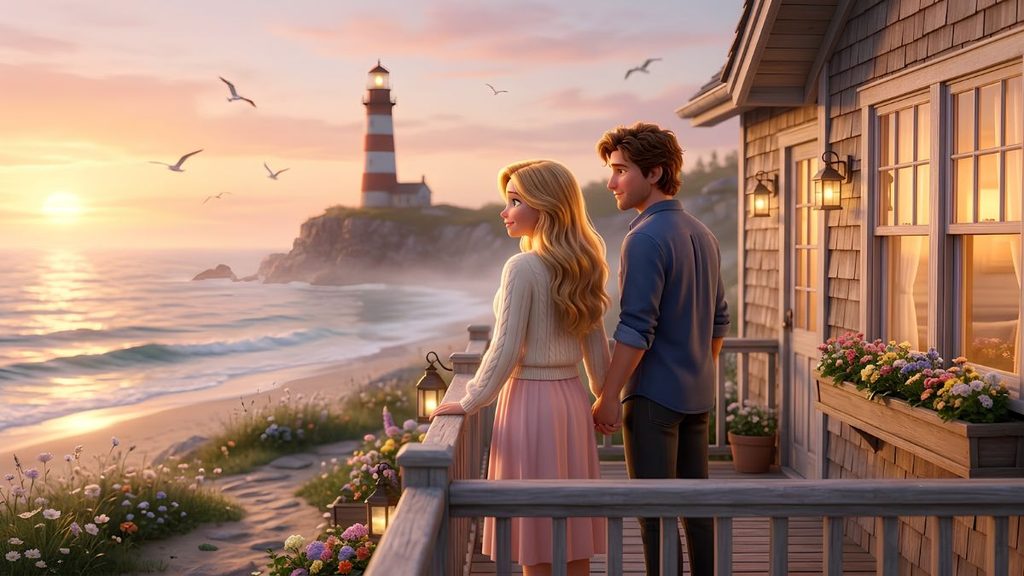
Characters: Lily and Noah
Theme: Healing, companionship, and peaceful love
Lily had spent most of her life believing that happiness was something she would find later.
Later, when she had a better job.
Later, when she had more money.
Later, when she finally took the vacation she had been postponing.
Later, when everything became less complicated.
She was thirty years old when she finally became tired of waiting for later.
Her job had consumed most of her life.
Every morning began with an alarm.
Every evening ended with another email.
Weekends were spent catching up on things she had ignored during the week.
She had friends, but she rarely saw them.
She had hobbies, but she rarely had time for them.
And although she had once loved painting, her brushes had been sitting untouched in a drawer for almost four years.
Then, one rainy Monday morning, Lily received a letter.
It was from a lawyer.
Her grandmother had passed away.
Lily had expected to feel sad.
Instead, she felt something more complicated.
Her grandmother had been the one person who always told her to slow down.
“Life isn’t a race,” she used to say.
Lily had never listened.
The letter contained an unexpected piece of information.
Her grandmother had left her a small cottage beside the sea.
Lily had visited it once as a child.
She barely remembered it.
The lawyer included an address.
Lily looked at it.
A little coastal village several hours away.
She immediately thought about selling it.
That was the sensible thing.
The cottage could be worth a significant amount.
She could sell it, put the money into savings, and return to her normal life.
But something stopped her.
Perhaps it was grief.
Perhaps it was curiosity.
Or perhaps it was the memory of her grandmother saying:
“One day, you’ll understand.”
Lily decided to visit the cottage before making a decision.
She packed one suitcase.
She drove toward the coast.
The journey took nearly five hours.
By the time she arrived, the sun was beginning to set.
The village was small.
There were only a few streets.
A bakery.
A grocery store.
A small café.
And an old lighthouse standing on a rocky cliff.
Lily followed the address.
Then she saw it.
The little house beside the sea.
It was smaller than she remembered.
White wooden walls.
Blue shutters.
A narrow porch.
Flowers growing along the path.
And beyond the house, the ocean.
Lily stopped the car.
For a moment, she simply stared.
The sea stretched endlessly toward the horizon.
She could hear the waves.
She could smell salt in the air.
She whispered:
“Grandma.”
The house was unlocked.
Inside, everything was surprisingly well maintained.
There were old photographs on the walls.
A small kitchen.
A cozy living room.
A bedroom facing the sea.
And a studio.
Lily opened the studio door.
Her grandmother had left an easel there.
Beside it were several old paintings.
Lily touched one.
It was a painting of the ocean at sunset.
She smiled.
She remembered watching her grandmother paint when she was little.
“You should try,” her grandmother had once told her.
“I can’t paint.”
“Not yet.”
Lily had laughed.
Now, standing in that room years later, she felt something stir inside her.
Maybe she would stay for a few days.
Just a few.
That evening, she walked to the beach.
The tide was coming in.
The sky was pink and gold.
Lily removed her shoes and walked along the wet sand.
She was so distracted by the ocean that she didn’t notice someone approaching.
“You’re going to get your feet wet.”
She turned.
A young man stood several meters away.
He had brown hair, rolled-up sleeves, and a friendly smile.
Lily looked down.
A wave had reached her ankles.
She laughed.
“Too late.”
The man smiled.
“I’m Noah.”
“Lily.”
“New here?”
“Apparently.”
He looked toward the cottage.
“You’re staying there?”
“Yes.”
He smiled.
“Then you’re Mrs. Bennett’s granddaughter.”
“My grandmother?”
“Everyone knew her.”
Lily smiled.
“Did you?”
“I did.”
“How?”
“I help maintain the lighthouse.”
He pointed toward the cliff.
“I’m there most mornings.”
Lily looked at the lighthouse.
“You work there?”
“Something like that.”
“What’s that supposed to mean?”
He laughed.
“I’m the caretaker.”
She smiled.
“Do you live here?”
“Just up the hill.”
They walked along the beach together.
Noah told her about the village.
He knew everyone.
He knew which bakery made the best bread.
Which café had the strongest coffee.
Which part of the beach had the most beautiful sunsets.
Which days the fishing boats returned.
Lily listened.
She realized that he spoke about the village the way her grandmother had spoken about it.
Like it was alive.
When they reached the cottage, Noah stopped.
“Goodnight, Lily.”
“Goodnight.”
She went inside.
That night, she slept with the window open.
The sound of the ocean filled the room.
For the first time in years, she didn’t set an alarm.
She woke naturally.
The sun was shining.
Birds were singing.
She made coffee.
Then she went into the studio.
She opened the drawer containing her old painting supplies.
The brushes were dusty.
She cleaned them.
Then she sat at the easel.
She looked at the ocean.
She began painting.
At first, nothing worked.
The colors looked wrong.
The lines were uneven.
She became frustrated.
Then she laughed.
It didn’t matter.
She wasn’t painting for anyone.
She was painting because she wanted to.
That afternoon, there was a knock at the door.
Noah stood outside holding a basket.
“I brought breakfast.”
Lily looked at him.
“It’s three in the afternoon.”
He looked at the basket.
“Late breakfast.”
She laughed.
“What is it?”
“Bread, fruit, and pastries.”
“You brought all that for me?”
“I had too much.”
“Convenient.”
He smiled.
“Very.”
They sat on the porch.
They ate.
They talked.
Then Noah noticed paint on Lily’s hand.
“You’ve been painting.”
She looked embarrassed.
“A little.”
“Can I see?”
“No.”
“Why?”
“Because it’s terrible.”
“That’s not a reason.”
“It is to me.”
Noah smiled.
“Your grandmother used to say the same thing.”
Lily looked at him.
“She did?”
“All the time.”
“What did she paint?”
“Mostly the sea.”
Lily looked toward the horizon.
“Why?”
Noah smiled.
“She said the sea never looked exactly the same twice.”
That sentence stayed with Lily.
The following morning, she painted again.
And the next.
And the next.
Days passed.
Then weeks.
Lily had planned to stay for five days.
She stayed for a month.
She stopped checking work emails.
She began walking every morning.
She painted.
She cooked.
She visited the bakery.
She drank coffee with Noah.
She watched sunsets.
Her life became smaller.
But somehow, it felt bigger.
One evening, Lily and Noah sat on the porch.
The sky was turning orange.
“You haven’t told me why you came here,” Noah said.
“My grandmother died.”
“I’m sorry.”
“She left me this house.”
He nodded.
“She loved it.”
“I know.”
“What was she like?”
Noah smiled.
“Stubborn.”
Lily laughed.
“Yes.”
“Kind.”
“Definitely.”
“Brave.”
Lily looked down.
“She was.”
Noah continued.
“She also worried about you.”
Lily looked at him.
“Me?”
“She told me once that you were working too hard.”
Lily laughed softly.
“She told everyone.”
“She wanted you to come here.”
“Did she?”
“She said you needed to remember how to be happy.”
Lily became quiet.
The waves moved gently beyond the house.
“Maybe she was right.”
Noah smiled.
“I think she was.”
Their friendship grew.
Then, slowly, something more appeared.
It wasn’t dramatic.
There was no sudden moment.
No grand declaration.
It was simply there one day.
Lily noticed it when Noah remembered how she liked her coffee.
Then again when he left a blanket outside because he knew she liked sitting on the porch at night.
Then when he listened to her talk about her fears without trying to solve them.
She began noticing the way he smiled when he thought she wasn’t looking.
One evening, they walked to the lighthouse.
The sun had already disappeared.
The sky was filled with stars.
Lily leaned against the railing.
“Beautiful.”
Noah looked at her.
“Yes.”
She caught him staring.
“What?”
“Nothing.”
“You weren’t looking at the sky.”
He smiled.
“Maybe not.”
Lily laughed.
They stood quietly.
Then Noah said:
“I’ve wanted to tell you something.”
“What?”
“I’m glad you came here.”
She smiled.
“Me too.”
“I mean it.”
“So do I.”
He took her hand.
She didn’t pull away.
The ocean moved below them.
The lighthouse light swept across the water.
Lily looked at their hands.
“I didn’t come here looking for anything.”
“I know.”
“I was supposed to stay five days.”
“I know.”
“Then why am I still here?”
Noah smiled.
“Maybe you found something.”
She looked at him.
“Maybe.”
Their first kiss happened beneath the lighthouse.
It was gentle.
Quiet.
Almost shy.
When they pulled apart, Lily smiled.
“That was nice.”
Noah laughed.
“Very romantic.”
She pushed his shoulder.
“You know what I mean.”
“I do.”
They walked home holding hands.
But happiness didn’t mean everything became simple.
Three months later, Lily received a phone call.
Her old company wanted her back.
They offered her a promotion.
A significant salary increase.
A beautiful apartment.
A position she had once dreamed about.
She looked at the offer.
It was everything she had wanted.
Everything she had worked toward.
Everything she had believed would make her happy.
But now she was sitting on the porch of a little house beside the sea.
She looked at Noah.
He could see the conflict in her face.
“What is it?”
She showed him the message.
He read it.
“This is a great opportunity.”
“Yes.”
“You should think about it.”
“What if I go?”
He was quiet.
“Then you go.”
Lily looked at him.
“That’s all?”
“What do you want me to say?”
“I don’t know.”
Noah took her hand.
“I don’t want you to stay because of me.”
Her eyes became wet.
“But what if I want to stay?”
“Then stay because you want this life.”
She looked at the ocean.
“I don’t know what I want.”
“That’s okay.”
“No, it isn’t.”
“It is.”
“I should know.”
“You don’t have to.”
She looked at him.
Noah smiled.
“You spent years thinking you had to know exactly where your life was going.”
Lily nodded.
“Maybe you don’t.”
“What if I make the wrong choice?”
He squeezed her hand.
“Then you make another choice later.”
She smiled through her tears.
“You’re very calm.”
“Someone has to be.”
She laughed.
For the next few days, Lily thought about everything.
She thought about her old life.
The office.
The city.
The salary.
The apartment.
The career.
Then she thought about the sea.
The cottage.
Painting.
Walking barefoot.
Drinking coffee on the porch.
Laughing with Noah.
She realized something.
Her old dream wasn’t wrong.
It simply wasn’t her dream anymore.
She declined the job.
That evening, she walked to the beach.
Noah joined her.
“Did you decide?”
She nodded.
“I’m staying.”
He smiled.
“Are you sure?”
“Yes.”
“Why?”
Lily looked at the sea.
“Because for the first time, I’m not choosing the life that looks best.”
She turned toward him.
“I’m choosing the life that feels like mine.”
Noah smiled.
He kissed her forehead.
“I’m glad.”
They returned to the cottage.
Lily went into the studio.
She finished her painting.
It showed the sea at sunset.
But this time, there were two small figures standing on the shore.
She showed it to Noah.
He smiled.
“Beautiful.”
“It’s not perfect.”
“Neither are we.”
She laughed.
“True.”
Years passed.
The cottage became their home.
Lily turned the studio into a small art room.
She began selling paintings to visitors.
Noah continued caring for the lighthouse.
They traveled sometimes.
But they always returned to the sea.
One evening, many years later, Lily found an old photograph in a drawer.
It showed her grandmother standing beside the cottage.
She turned it over.
There was a handwritten message.
For Lily.
Her hands trembled.
She read the note.
My dear Lily,
If you’re reading this, you’ve finally come here.
She smiled.
I know you will probably wonder why I left this house to you.
It isn’t because it is valuable.
It is because I want you to understand something I learned too late.
A peaceful life is not a small life.
Lily’s eyes filled with tears.
She continued.
Don’t spend your whole life waiting for happiness to arrive after the next achievement.
Happiness can be found in mornings when the sun comes through the window.
It can be found in warm bread, ocean air, quiet conversations, and someone who makes you laugh.
Look after this house.
But more importantly, look after yourself.
Lily pressed the letter against her heart.
Noah entered the room.
“What happened?”
She handed him the letter.
He read it.
Then he looked at Lily.
“She knew.”
“She did.”
They went outside.
The sun was setting.
They sat together on the porch.
The ocean stretched endlessly ahead.
Lily rested her head on Noah’s shoulder.
“Do you ever wonder what would have happened if I hadn’t come here?”
“Sometimes.”
“What do you think?”
He smiled.
“I think you’d still be working too much.”
She laughed.
“And you?”
“I’d still be fixing the lighthouse.”
“Alone?”
“Probably.”
She looked at him.
“I’m glad I came.”
He kissed her forehead.
“So am I.”
The evening became quiet.
The waves moved gently toward the shore.
The lighthouse began shining in the distance.
Lily closed her eyes.
She finally understood what her grandmother had wanted her to learn.
Life didn’t have to be enormous to be meaningful.
It didn’t need constant achievement.
It didn’t need endless travel.
It didn’t need everyone else’s approval.
Sometimes a meaningful life was simply this.
A little house.
A beautiful sea.
A painting drying beside the window.
A warm cup of coffee.
And someone sitting beside you when the sun goes down.
Lily opened her eyes.
“Do you think we’ll always live here?”
Noah smiled.
“I hope so.”
“What if we get bored?”
“We’ll watch the ocean.”
“What if we get old?”
“We’ll sit on the porch.”
“What if the house needs repairs?”
“We’ll fix it.”
“What if life gets difficult?”
“We’ll face it.”
She smiled.
“And if we forget what matters?”
Noah took her hand.
“We’ll come back here.”
“To the cottage?”
“To each other.”
Lily leaned against him.
The first stars appeared above the ocean.
The same stars her grandmother had once watched.
The same stars that had witnessed their first kiss.
The same stars that would remain long after they were gone.
The sea continued moving.
The lighthouse continued shining.
And the little house beside the sea remained warm and peaceful.
Lily closed her eyes.
She listened to the waves.
For the first time in her life, she wasn’t waiting for later.
She wasn’t waiting for the next promotion.
The next achievement.
The next vacation.
The next perfect moment.
She had finally discovered something her grandmother had known all along.
Sometimes happiness isn’t somewhere ahead.
Sometimes it is sitting quietly beside you.
Sometimes it sounds like ocean waves.
Sometimes it smells like coffee.
Sometimes it looks like an old wooden house.
And sometimes, if you’re very lucky, it looks like the person holding your hand as the sun disappears beyond the sea.
Lily smiled.
“Goodnight, Noah.”
He smiled.
“Goodnight, Lily.”
And beneath the stars, beside the endless sea, they stayed together until the night became completely quiet.
5. The Midnight Train to Everwood
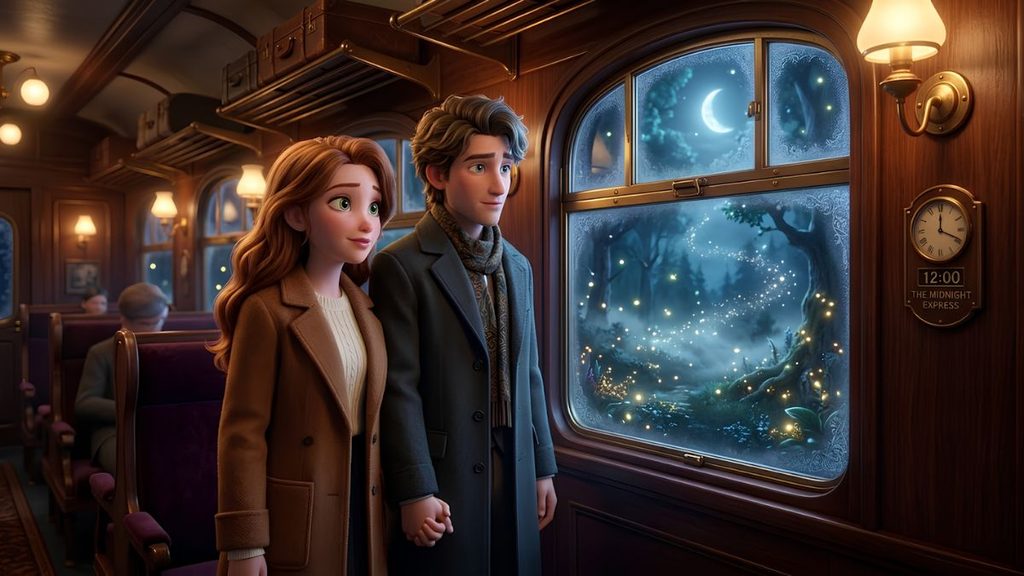
Characters: Emma and Lucas
Theme: Adventure, romance, and second chances
Emma had always been afraid of empty railway stations.
She couldn’t explain why.
There was something about them after midnight.
The long platforms.
The silent tracks.
The flickering lights.
The distant sound of wind moving through the signs.
During the day, railway stations were full of life.
People rushed toward trains.
Families said goodbye.
Travelers carried bags.
Announcements echoed through the halls.
But after midnight, everything changed.
The station seemed to belong to another world.
Emma discovered this one cold autumn night.
She had missed her last train.
Her phone battery was almost dead.
The taxi service had cancelled her ride.
And the small station outside the city was completely empty.
She sat on a wooden bench and checked the timetable.
There were no more trains.
She sighed.
“Perfect.”
She looked at the clock.
11:48 p.m.
She pulled her coat tighter.
The station lights flickered.
Then she heard something.
A train whistle.
Emma looked up.
“That’s impossible.”
The timetable said the station was closed.
But a train was approaching.
It moved silently toward the platform.
It was old.
Much older than the modern trains that usually passed through the station.
Its dark green exterior reflected the moonlight.
There were golden letters above the door.
EVERWOOD
Emma stood.
She had never heard of Everwood.
The train stopped.
The doors opened.
A conductor stepped onto the platform.
He wore an old-fashioned navy uniform.
“Miss?”
Emma stared at him.
“Where does this train go?”
“Everwood.”
“Where is that?”
He smiled.
“Wherever you need to go.”
Emma frowned.
“I need to get home.”
The conductor looked at her carefully.
“Perhaps.”
She should have walked away.
She knew that.
Every sensible instinct told her not to board a mysterious train at midnight.
But then she noticed someone sitting inside.
A young man.
Dark blond hair.
Charcoal coat.
A book resting on his lap.
He looked out the window.
Their eyes met.
He smiled.
Emma hesitated.
The conductor said:
“Your ticket.”
“I don’t have one.”
The conductor handed her a small golden ticket.
Her name was printed on it.
EMMA CARTER
She stared.
“How did you…”
The conductor smiled.
“All aboard.”
Emma stepped onto the train.
The doors closed.
The train began moving.
She sat across from the young man.
He looked at her ticket.
“Emma?”
“Yes.”
“I’m Lucas.”
“Do you know where we’re going?”
“Everwood.”
“What is Everwood?”
He smiled.
“I was hoping you knew.”
Emma laughed nervously.
“So neither of us knows?”
“Apparently.”
The train moved faster.
Outside the window, the city disappeared.
The landscape became a forest.
Moonlight filtered between the trees.
Then something strange happened.
Emma saw a house.
She blinked.
The house was gone.
Then she saw another.
A playground.
A school.
A beach.
Each appeared for only a moment.
“Did you see that?”
Lucas nodded.
“Yes.”
“What is happening?”
“I don’t know.”
They passed through a tunnel.
When they emerged, the world outside looked completely different.
There were stars everywhere.
Not just in the sky.
Tiny lights floated between the trees.
The train slowed.
A sign appeared.
FIRST MEMORY
Emma looked at Lucas.
“What does that mean?”
The train stopped.
The doors opened.
Neither of them moved.
Then Lucas stood.
“Maybe we should get off.”
“Why?”
“Because we’re here.”
They stepped onto the platform.
There was no station.
Only a small wooden bench beneath a tree.
Emma looked around.
“This place feels familiar.”
Lucas nodded.
“Mine too.”
They walked toward the bench.
Suddenly, Emma saw a little girl sitting there.
The girl looked about eight years old.
She was crying.
Emma recognized her.
It was herself.
She gasped.
Lucas looked at her.
“You know her?”
Emma nodded.
“That’s me.”
The memory played silently.
Young Emma was waiting for her father.
He had promised to pick her up from school.
He was late.
She waited.
And waited.
Eventually, he arrived.
He apologized.
He hugged her.
But Emma remembered how frightened she had been.
She had forgotten the memory.
Or perhaps she had simply buried it.
The scene disappeared.
The train whistle sounded.
Emma stood silently.
Lucas touched her shoulder.
“Are you okay?”
She nodded.
“I haven’t thought about that in years.”
The conductor appeared.
“Every passenger must remember something before reaching Everwood.”
“Why?” Emma asked.
“Because you cannot arrive somewhere new while carrying something you refuse to see.”
The doors opened.
They returned to the train.
The next station appeared after several minutes.
SECOND MEMORY
This time, Lucas became quiet.
They stepped outside.
A young boy stood in a garden.
Lucas stared.
“That’s me.”
The boy was holding a bicycle.
His mother stood nearby.
She was teaching him how to ride.
He fell.
She laughed.
Then helped him stand.
Lucas watched silently.
Emma looked at him.
“Your mother?”
He nodded.
“She died when I was seventeen.”
“I’m sorry.”
“I thought I had forgotten this.”
The memory faded.
Lucas wiped his eyes.
“I didn’t remember the sound of her laugh.”
Emma took his hand.
“You remember now.”
He squeezed her fingers.
“Thank you.”
They returned to the train.
Neither spoke for a while.
The train continued through the forest.
At midnight, they reached another station.
THIRD MEMORY
This one belonged to both of them.
Emma looked confused.
The doors opened.
They stepped outside.
There was a small café.
A woman was sitting alone.
A man walked toward her.
Emma stared.
The woman was her.
But older.
Much older.
She was sitting at a café table, looking sad.
The man was Lucas.
Older too.
They were arguing.
Emma couldn’t hear the words.
Then Lucas walked away.
The scene disappeared.
Emma turned toward him.
“What was that?”
Lucas looked frightened.
“I don’t know.”
“But it was us.”
“We haven’t met before tonight.”
“Exactly.”
They stared at each other.
The conductor appeared.
“Everwood shows possibilities as well as memories.”
Emma’s heart began beating faster.
“What does that mean?”
“You haven’t arrived yet.”
“Where are we going?”
The conductor smiled.
“To a choice.”
The train moved again.
This time, neither spoke.
Eventually, they reached a station unlike the others.
There was no sign.
No platform.
Just a door.
The conductor opened it.
“Everwood.”
Emma stepped outside.
The world was breathtaking.
A small town sat beneath a sky filled with stars.
Warm lights glowed from houses.
A river flowed through the center.
Flowers covered the streets.
Everything looked peaceful.
Beautiful.
Perfect.
Lucas stood beside her.
“This is Everwood.”
A woman approached them.
She looked about sixty.
She smiled.
“Welcome.”
“Who are you?” Emma asked.
“I am the keeper of Everwood.”
“What is this place?”
“A place between possibilities.”
Emma frowned.
“I don’t understand.”
The woman smiled.
“Everyone eventually reaches a moment when they must choose between the life they know and the life they could have.”
Lucas looked around.
“What are we supposed to choose?”
“You.”
He stared at Emma.
The woman continued.
“You met on this train because both of you are standing at crossroads.”
Emma looked at Lucas.
“What crossroads?”
The woman pointed toward two roads.
One led toward a bright city.
The other toward a quiet countryside.
“Your future can follow many paths.”
Emma looked at the city.
Her career.
Her ambitions.
Her old life.
Then she looked at the countryside.
Peace.
Quiet.
A slower life.
Lucas stood beside her.
“What happens if we choose different roads?”
“You continue your separate lives.”
“And if we choose the same?”
“You return to your world together.”
Emma felt tears forming.
“But how do we know which is right?”
The woman smiled.
“You don’t.”
Emma looked confused.
“Then what’s the point?”
“The point is not knowing.”
She looked at them.
“Love is not a guarantee.”
“Neither is happiness.”
“Neither is success.”
“You must choose anyway.”
The woman disappeared.
The town became silent.
Emma looked at Lucas.
“I don’t want to lose you.”
“You’ve known me for one night.”
“I know.”
He smiled.
“That’s the strange part.”
They walked toward the river.
Moonlight reflected on the water.
Lucas sat on the edge.
Emma sat beside him.
“What did you see at the station?” he asked.
“My father.”
He nodded.
“I saw my mother.”
“Did you feel better?”
“Yes.”
“Me too.”
They sat quietly.
Then Emma said:
“Maybe that’s why we’re here.”
“To remember?”
“Maybe.”
Lucas looked at her.
“And the other memory?”
“The one where we were older?”
“Yes.”
“I don’t want that.”
“Neither do I.”
They looked at each other.
“Then let’s not let it happen.”
Lucas smiled.
“We can’t control everything.”
“No.”
“But we can choose what we do now.”
Emma nodded.
“That’s enough.”
They stood.
The train whistle sounded again.
The conductor waited on the platform.
Emma looked at Everwood one last time.
“Will we remember this?”
“Only if you want to.”
She looked at Lucas.
“I want to.”
“So do I.”
They boarded the train.
The journey back was quieter.
They talked about their lives.
Their dreams.
Their fears.
Their mistakes.
Their hopes.
They discovered that they had more in common than either expected.
Emma wanted to leave the city someday.
Lucas wanted to open a small bookstore.
Emma wanted a home filled with plants.
Lucas loved cooking.
She hated cooking.
He laughed.
She promised to learn.
Eventually, the train slowed.
The forest disappeared.
The modern city returned.
The train stopped at the station where they had first boarded.
The conductor opened the door.
“Your journey is complete.”
Emma stepped onto the platform.
Lucas followed.
She turned around.
The train was already disappearing.
Within seconds, it was gone.
Only ordinary tracks remained.
Emma looked at Lucas.
“So…”
“So.”
“What happens now?”
He smiled.
“Coffee?”
She laughed.
“At midnight?”
“Why not?”
They walked toward the city together.
The next morning, Emma woke up in her apartment.
For a moment, she wondered whether everything had been a dream.
Then she found something beside her bed.
A golden ticket.
EMMA CARTER
She smiled.
She put it inside a drawer.
Months passed.
Emma and Lucas continued seeing each other.
Their relationship grew slowly.
They had disagreements.
They had difficult days.
They sometimes misunderstood each other.
But whenever they faced an important decision, they remembered Everwood.
They remembered the lesson.
They didn’t need to know the future.
They only needed to choose honestly.
One year later, Emma moved into a small apartment with Lucas.
It wasn’t perfect.
The kitchen was tiny.
The plumbing sometimes made strange noises.
Lucas’s books occupied almost every shelf.
Emma’s plants occupied almost every window.
But they loved it.
One rainy evening, Emma found Lucas sitting by the window.
“What are you thinking about?”
“Everwood.”
She smiled.
“Me too.”
“Do you think it was real?”
She sat beside him.
“I don’t know.”
“Do you think we’ll ever see the train again?”
“Maybe.”
“Would you go?”
Emma thought.
“No.”
Lucas looked at her.
“Why?”
“Because I don’t need it anymore.”
He smiled.
She rested her head against him.
“The train showed us all the possible futures.”
“Yes.”
“But we don’t need to know which one happens.”
“Why?”
“Because we’re building one.”
Lucas kissed her forehead.
Outside, rain fell against the window.
The room was warm.
Quiet.
Safe.
Years later, they sometimes told their children stories about a mysterious train that traveled through dreams.
They never told them that it had actually happened.
Or perhaps they did.
The details became blurred with time.
But the golden ticket remained.
It was framed and placed on a shelf.
Whenever someone asked about it, Emma smiled.
“It’s a reminder.”
“Of what?”
She would answer:
“That sometimes the most important journey begins when you don’t know where you’re going.”
Lucas would add:
“And that you should never be afraid of the unknown.”
Emma would laugh.
“You were afraid.”
“I was.”
“So was I.”
“But we got on the train.”
“And that made all the difference.”
Years passed.
They grew older together.
They traveled.
They built their little life.
They watched sunsets.
They celebrated birthdays.
They endured difficult seasons.
They forgave each other.
And whenever life became uncertain, they reminded each other of Everwood.
One night, many years later, Emma and Lucas sat beside the window.
The city was quiet.
Rain was falling.
Emma held his hand.
“Do you remember the first night?”
Lucas smiled.
“The train?”
“Yes.”
“I remember.”
“Do you regret getting on?”
He looked at her.
“Never.”
She smiled.
“Neither do I.”
The clock approached midnight.
Emma closed her eyes.
She imagined the old train moving through the forest.
She imagined the golden lights.
The mysterious stations.
The little town beneath the stars.
The woman who had told them they could not know the future.
And she realized something.
Perhaps Everwood had never been a place.
Perhaps it was simply the moment when two people stopped being afraid of tomorrow.
The future would always be uncertain.
People would change.
Circumstances would change.
Dreams would change.
But love could be chosen again and again.
Not once.
Not forever in a single promise.
But every morning.
Every evening.
Every ordinary day.
Lucas squeezed her hand.
“Ready for bed?”
Emma smiled.
“Yes.”
They stood together.
The lights went out.
The room became quiet.
Outside, the rain continued.
And somewhere far away, perhaps beyond the ordinary world, an old midnight train continued traveling through the darkness.
Its golden windows glowed softly.
Its wheels moved silently over impossible tracks.
And inside, another passenger sat beside another stranger.
Perhaps they were frightened.
Perhaps they were uncertain.
Perhaps they didn’t know where they were going.
But when the conductor arrived with two golden tickets, he would smile and say:
“All aboard.”
Because sometimes the greatest adventures begin when we step onto a train without knowing its destination.
Sometimes we have to leave the familiar behind.
Sometimes we have to face memories we tried to forget.
Sometimes we have to accept that tomorrow cannot be predicted.
And sometimes, somewhere between one station and the next, we meet someone who changes the entire journey.
Emma and Lucas never discovered whether Everwood truly existed.
They didn’t need to.
They had discovered their own version of it.
A home.
A love.
A future they couldn’t predict.
But one they could build together.
And for them, that was enough.
Moral: Sometimes the journey toward a new beginning requires us to make peace with the past.
6. The Garden That Bloomed at Night

Characters: Elena and James
Theme: Patience, romance, and discovering hidden beauty]
Elena had forgotten what it felt like to begin again.
For years, she had lived according to a simple routine.
Wake up.
Work.
Come home.
Eat something.
Watch television.
Sleep.
Repeat.
There was nothing particularly wrong with her life.
That was what made it difficult to explain.
She wasn’t unhappy.
She simply wasn’t excited.
She had once been different.
When she was younger, Elena had dreamed of traveling.
She wanted to paint.
She wanted to learn another language.
She wanted to wake up one morning and not know exactly what the day would bring.
But somewhere between university, work, responsibilities, and disappointment, those dreams had become quiet.
Then, one spring morning, her aunt called.
“Elena, I have something for you.”
“What?”
“A house.”
Elena laughed.
“A house?”
“Your great-aunt’s countryside cottage.”
“I didn’t know she had one.”
“Most people didn’t.”
“Where is it?”
Her aunt gave her the address.
It was several hours away.
Elena drove there the following weekend.
The cottage stood at the edge of a small village.
It was beautiful in an old-fashioned way.
Stone walls.
Wooden windows.
A chimney covered in ivy.
Wildflowers grew around the property.
And behind the house stood a tall iron gate.
Elena walked toward it.
The gate was locked.
Beyond it was a garden.
But it looked abandoned.
The grass was overgrown.
The trees had grown wild.
Vines covered everything.
She found an old key hanging beneath a stone.
She unlocked the gate.
The hinges creaked.
She stepped inside.
Nothing happened.
It looked like an ordinary neglected garden.
Elena walked around for several minutes.
Then she noticed a stone plaque.
There were words carved into it.
Some gardens bloom only for those ready to begin again.
Elena smiled.
“That’s dramatic.”
She returned to the house.
That evening, she unpacked.
She made dinner.
She sat by the window.
The countryside was completely quiet.
There were no traffic sounds.
No sirens.
No neighbors shouting.
Only wind.
And distant birds.
Elena slept deeply.
At exactly midnight, she woke up.
She didn’t know why.
She walked downstairs.
Then she noticed something through the window.
A faint glow.
She stepped outside.
The garden was shining.
Elena stopped.
Flowers were blooming everywhere.
The plants that had looked dead during the afternoon were now covered in luminous blossoms.
Blue.
Gold.
Violet.
White.
The entire garden seemed to glow beneath the moon.
She opened the gate.
Slowly, she walked inside.
Tiny lights floated through the air.
Fireflies.
But these were brighter than ordinary fireflies.
They moved like tiny stars.
Elena whispered:
“Beautiful.”
Then she heard a voice.
“You came.”
She turned.
A young man stood near the stone wall.
He had brown hair, blue eyes, and a gentle smile.
Elena stepped back.
“Who are you?”
“James.”
“What are you doing in my garden?”
He laughed.
“Your garden?”
“Yes.”
“Then I suppose I should apologize.”
“You should.”
He smiled.
“I’ve been taking care of it.”
“Why?”
“Because your great-aunt asked me to.”
Elena frowned.
“When?”
“Years ago.”
She looked around.
“Why didn’t she tell me?”
James shrugged.
“Maybe she wanted you to discover it yourself.”
Elena looked at the flowers.
“Does this happen every night?”
“No.”
“When?”
“Only when someone needs it.”
“Needs what?”
James looked at her.
“Another chance.”
She laughed softly.
“You’re serious.”
“Completely.”
She looked at the glowing flowers again.
“Why do they only bloom at night?”
James smiled.
“Some things are easier to see when the world becomes quiet.”
That sentence stayed with her.
The following morning, the garden was ordinary again.
The flowers had disappeared.
Elena searched for James.
He was nowhere to be found.
She assumed she had dreamed him.
Until evening.
At 11:55 p.m., she waited beside the garden.
At midnight, the flowers appeared.
James appeared too.
“You came back.”
“So did you.”
He smiled.
Elena walked toward him.
“Tell me about the garden.”
James sat on a stone bench.
“It’s old.”
“How old?”
“No one knows.”
“Who created it?”
“Your family.”
“My family?”
“Your great-aunt was one of the gardeners.”
Elena looked surprised.
“She never told me.”
“She wanted to.”
“Why didn’t she?”
“Maybe she was waiting.”
“For what?”
James looked at her.
“For you.”
The garden became quiet.
Elena didn’t know what to say.
James continued.
“The garden blooms for people who are carrying something they haven’t let go of.”
“What am I carrying?”
He smiled.
“That’s for you to discover.”
Every night, Elena returned.
She and James walked through the garden.
Each night, different flowers appeared.
Some were tiny.
Some were enormous.
Some glowed softly.
Others sparkled like stars.
James explained that every flower represented something.
Hope.
Courage.
Forgiveness.
Joy.
Memory.
Patience.
Love.
One night, Elena noticed a small silver flower.
“What does that one mean?”
“Regret.”
She touched it.
“Why is it here?”
“Because you still think about what you could have done differently.”
She became quiet.
James didn’t ask questions.
He simply sat beside her.
Eventually, Elena spoke.
“I wanted to become a painter.”
James looked at her.
“What happened?”
“I stopped.”
“Why?”
“I wasn’t good enough.”
“Who told you?”
“No one.”
She looked at the flower.
“I told myself.”
James nodded.
“That’s often the harshest voice.”
Elena smiled sadly.
“Maybe.”
The next morning, she found her old painting supplies in the attic.
She hadn’t touched them in years.
She cleaned them.
That night, she painted.
The first painting was terrible.
She laughed.
The second wasn’t much better.
But she continued.
James watched.
“You’ve improved.”
“You’re lying.”
“A little.”
She threw a brush at him.
He laughed.
Their friendship became stronger.
They spent mornings repairing the cottage.
Afternoons exploring the village.
Nights in the garden.
Elena began feeling alive again.
She started painting every day.
She painted the house.
The trees.
The sea she remembered from childhood.
The village.
The garden.
James.
She painted him without telling him.
One evening, he discovered the painting.
He stared at it.
“Is that me?”
Elena looked embarrassed.
“Maybe.”
“You made me look handsome.”
“You are handsome.”
She immediately realized what she had said.
James smiled.
“So you think I’m handsome?”
“Don’t make this difficult.”
He laughed.
“Too late.”
The garden seemed to glow brighter that night.
Elena looked around.
“What does that mean?”
James smiled.
“Maybe it approves.”
“Of what?”
He didn’t answer.
Instead, he took her hand.
They walked beneath the glowing trees.
Months passed.
Their friendship slowly became love.
There was no dramatic moment.
It happened in small ways.
James bringing her coffee.
Elena saving the last piece of cake for him.
Their long conversations.
Their shared jokes.
Their comfortable silences.
The way he always noticed when she was tired.
The way she always knew when he was worried.
Then one evening, Elena asked:
“Why do you stay here?”
James looked at the garden.
“I don’t know.”
“That’s not an answer.”
He smiled.
“My parents left when I was young.”
“Where did they go?”
“They moved to the city.”
“Why didn’t you go?”
“I wanted to stay.”
“Here?”
“Here.”
“Why?”
He looked toward the cottage.
“Because this place feels like home.”
Elena smiled.
“I understand.”
Then she became quiet.
“Are you afraid?”
“Of what?”
“That I’ll leave.”
James didn’t answer immediately.
“Yes.”
Elena squeezed his hand.
“I’m not planning to.”
He looked at her.
“Plans change.”
“Then we’ll make new ones.”
He smiled.
“That’s a good answer.”
One night, the garden changed.
The flowers were brighter than ever.
Hundreds of blossoms covered the trees.
Golden lights floated through the air.
The entire garden seemed to be celebrating.
Elena looked at James.
“What’s happening?”
He looked surprised.
“I’ve never seen it like this.”
They walked deeper into the garden.
At the center stood a single enormous flower.
It had never appeared before.
Its petals were white and silver.
Elena approached it.
There was a message beneath it.
The garden blooms completely when the heart is ready to love again.
Elena’s eyes filled with tears.
She looked at James.
“Is this about me?”
He nodded.
“I think so.”
She smiled.
“Then I guess I’m ready.”
James stepped closer.
“Ready for what?”
She looked at him.
“For you.”
He took her hand.
The garden seemed to brighten.
They kissed beneath the moonlight.
For the first time in years, Elena felt completely certain about something.
She wanted this.
She wanted him.
She wanted the little cottage.
She wanted the garden.
She wanted the quiet mornings.
She wanted the unpredictable evenings.
She wanted a life that didn’t feel perfect but felt real.
But life had one more test.
A gallery in the city discovered Elena’s paintings.
They offered her a major exhibition.
It was an opportunity she had once dreamed about.
She was thrilled.
Then she became afraid.
“What if I have to leave?”
James smiled.
“You don’t.”
“What if I have to travel?”
“Then travel.”
“What if everything changes?”
“It will.”
She looked at him.
“You’re not afraid?”
“I am.”
“Then why aren’t you stopping me?”
“Because loving someone doesn’t mean keeping them small.”
Elena hugged him.
“I love you.”
“I love you too.”
She accepted the exhibition.
For several weeks, she traveled between the village and the city.
It was exhausting.
But she didn’t give up the cottage.
She didn’t give up painting.
She didn’t give up James.
Instead, she learned that a new chapter didn’t have to erase the old one.
Her exhibition was a success.
People loved her paintings.
The final painting she displayed was of the midnight garden.
The title was:
The Place Where I Began Again
When she returned to the cottage, James was waiting.
“How was it?”
She smiled.
“Wonderful.”
He hugged her.
“I’m proud of you.”
She kissed him.
“Thank you.”
That night, they entered the garden.
The flowers were glowing.
But something was different.
The garden was no longer wild.
It was peaceful.
Beautiful.
Complete.
James looked around.
“Maybe it doesn’t need us anymore.”
Elena smiled.
“Why?”
“Because you’ve found what you were looking for.”
She looked at him.
“I think I did.”
Years passed.
The cottage became their permanent home.
Elena became a successful artist.
James continued caring for the garden.
They eventually opened the garden to a small number of visitors.
But there was one rule.
It could only be visited at midnight.
People came from distant towns.
Some were grieving.
Some were lost.
Some were beginning again.
And every night, the garden bloomed differently.
Some people saw flowers representing hope.
Others saw flowers representing forgiveness.
Some saw memories.
Some saw dreams.
And some saw love.
Elena never explained the garden’s magic.
She simply told visitors:
“Walk slowly.”
“Look carefully.”
“And don’t be afraid of what you find.”
One evening, an elderly woman visited.
She walked through the garden with tears in her eyes.
Elena approached her.
“Are you okay?”
The woman smiled.
“I think so.”
“What did you see?”
“A flower.”
“What did it mean?”
“Forgiveness.”
Elena nodded.
“Then perhaps you found what you needed.”
The woman smiled.
“Perhaps.”
After she left, Elena returned to James.
“Do you think the garden really knows what people need?”
James looked at the glowing flowers.
“I think people already know.”
“Then why do they need the garden?”
“Because sometimes we need somewhere quiet enough to hear ourselves.”
Elena smiled.
She looked around.
The flowers moved gently in the breeze.
Fireflies floated above them.
The moon illuminated the trees.
She thought about the person she had once been.
The woman who believed her dreams were over.
The woman who thought she wasn’t good enough.
The woman who had forgotten how to begin again.
She wished she could go back and tell that younger version of herself something.
She would say:
You are not behind.
You are not broken.
You are not too late.
Some dreams take longer.
Some wounds need time.
Some flowers only bloom at night.
And that doesn’t make them any less beautiful.
James walked toward her.
“What are you thinking?”
She smiled.
“How lucky I am.”
He took her hand.
“Me too.”
They walked deeper into the garden.
The flowers illuminated their path.
At the center stood the great silver flower.
It still bloomed.
But now, beside it, another flower had appeared.
A small golden one.
James looked at it.
“What’s that?”
Elena smiled.
“Maybe it’s ours.”
“What does it mean?”
She thought for a moment.
“Home.”
James squeezed her hand.
They stood beneath the stars.
The garden glowed around them.
The cottage windows shone warmly in the distance.
The world outside was quiet.
And Elena finally understood something.
Beginning again didn’t always mean leaving everything behind.
Sometimes beginning again meant returning to the person you had once been.
The person who dreamed.
The person who laughed easily.
The person who believed there was still something beautiful waiting around the corner.
Sometimes all you needed was a little courage.
A little patience.
And perhaps someone willing to walk beside you.
Elena looked at James.
“Are you ready for bed?”
He smiled.
“Not yet.”
“Why?”
“Because the garden is beautiful tonight.”
She leaned against him.
“Then we’ll stay a little longer.”
They sat together beneath the glowing flowers.
The moon moved slowly across the sky.
The fireflies drifted between the trees.
The flowers swayed gently.
And eventually, the world became completely still.
Elena closed her eyes.
She listened to James breathing beside her.
She listened to the distant wind.
She listened to the garden.
For the first time, she didn’t feel like she was waiting for something.
She had stopped searching.
She had stopped running.
She had stopped wondering whether she was enough.
She simply sat there.
Loved.
Safe.
At home.
And somewhere beneath the moonlight, the garden bloomed quietly around them.
Because some flowers bloom in daylight.
Some bloom in spring.
Some bloom after years of waiting.
And some bloom only at night.
But every flower has its own time.
Just like every heart.
Just like every love story.
And just like every new beginning.
Moral: Some things bloom slowly, but that does not make them any less beautiful.
7. The Promise Beneath the Stars
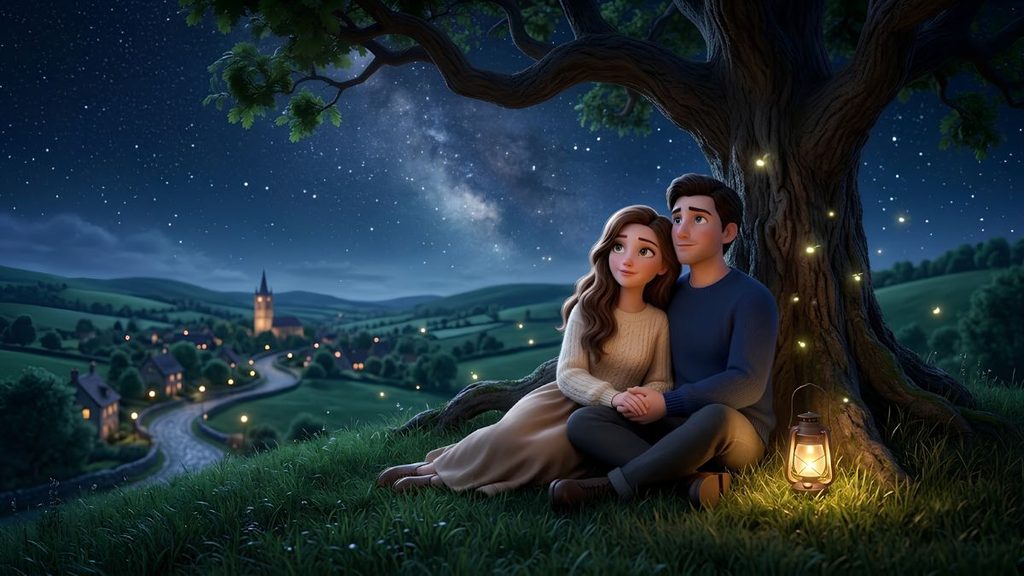
Characters: Ava and Ryan
Theme: Lifelong love, commitment, and growing together
Sophie had always been afraid of promises.
Not because she didn’t believe in them.
Because she did.
Too much.
When someone promised something, Sophie remembered it.
She remembered promises made years ago.
She remembered promises that had been kept.
And she remembered the ones that had been broken.
So when Daniel first told her, “I’ll always be here,” she smiled.
But she didn’t believe him.
Not completely.
Their story had begun on an ordinary afternoon.
Sophie was sitting in a small café, working on her laptop.
Outside, rain covered the windows.
The café was nearly empty.
She had been working for almost three hours when someone accidentally bumped into her table.
Her coffee spilled.
“Oh no.”
The stranger froze.
“I’m so sorry.”
Sophie looked up.
A young man stood beside her.
Dark brown hair.
Blue eyes.
A completely embarrassed expression.
“It’s okay.”
“No, it’s not.”
He grabbed napkins.
“I ruined your laptop.”
“It’s fine.”
“I’ll pay for repairs.”
“Really, it’s okay.”
He looked at her.
“You’ve said that three times.”
“Because it is.”
He laughed.
“I’m Daniel.”
“Sophie.”
“Nice to meet you, Sophie.”
“You too.”
He cleaned the table.
Then he walked away.
Sophie returned to her laptop.
Five minutes later, he came back.
He was holding another coffee.
“I owe you one.”
She smiled.
“Thank you.”
He placed it on the table.
“Same order?”
“You remembered?”
“You had sugar.”
She laughed.
“Observant.”
“Only when coffee is involved.”
They talked for twenty minutes.
Then an hour.
Neither noticed how much time had passed.
By the time the rain stopped, they had exchanged numbers.
Their first date happened three days later.
Then another.
Then another.
Slowly, Daniel became part of Sophie’s life.
He learned that she loved old bookstores.
She learned that he couldn’t cook pasta without burning it.
He learned that she hated crowded places.
She learned that he secretly loved dancing.
He made her laugh.
She made him feel understood.
Months passed.
One evening, they climbed a hill outside the city.
The sky was clear.
Stars covered the darkness.
They sat beneath an old oak tree.
Sophie looked upward.
“I’ve never seen so many stars.”
Daniel smiled.
“You’ve never looked from here.”
She leaned against him.
They stayed silent.
Then Daniel said:
“Can I tell you something?”
“What?”
“I think I’m falling in love with you.”
Sophie looked at him.
Her heart raced.
“I think I am too.”
He smiled.
They held hands.
Then Daniel said:
“I promise I’ll always be here.”
Sophie became quiet.
She looked at him.
“Don’t promise that.”
He looked surprised.
“Why?”
“Because you can’t know.”
“I know what I feel.”
“Today.”
“Tomorrow too.”
“You don’t know that.”
Daniel smiled.
“Maybe I don’t.”
She looked back at the stars.
“I just don’t want promises.”
He squeezed her hand.
“Then I won’t make one.”
That night became the beginning of something beautiful.
They built a relationship slowly.
They traveled together.
They met each other’s families.
They celebrated birthdays.
They spent lazy Sundays watching movies.
They argued about silly things.
They apologized.
They grew closer.
For the first time in years, Sophie stopped worrying about tomorrow.
Until one morning, Daniel received a phone call.
His father was ill.
He needed to return to his hometown.
It was several hours away.
He packed that afternoon.
Sophie helped him.
“How long will you be gone?”
“I don’t know.”
She nodded.
“Call me when you arrive.”
“I will.”
He hugged her.
Then he left.
The first week was difficult.
The second was worse.
Daniel called every night.
Sometimes for ten minutes.
Sometimes for two hours.
He told her about his father.
The doctors.
The hospital.
The old house.
The memories.
Sophie listened.
She tried to be strong.
But eventually, Daniel’s father needed long-term care.
Daniel couldn’t return.
Weeks became months.
Their relationship became long-distance.
Sophie tried to remain positive.
But loneliness crept in.
One evening, they argued.
“You don’t call like you used to.”
“I’m sorry.”
“You always say that.”
“I’ve been at the hospital.”
“I know.”
“Then why are you angry?”
“Because I miss you.”
Daniel became quiet.
“I miss you too.”
“Then come home.”
“I can’t.”
She started crying.
“I know.”
The call ended badly.
Sophie didn’t sleep.
The next morning, she regretted everything.
But Daniel didn’t call.
Neither did she.
Two days passed.
Then three.
On the fourth evening, someone knocked on her door.
She opened it.
Daniel stood there.
He looked exhausted.
His coat was wet from the rain.
Sophie stared.
“What are you doing here?”
“I needed to see you.”
She started crying.
He hugged her.
“I should have called.”
“I should have understood.”
They stood together in the doorway.
Neither wanted to let go.
Later, they talked for hours.
Daniel explained that his father’s condition had stabilized.
He would still need care.
But Daniel had arranged for additional help.
“I can’t promise I’ll always be able to stay,” he said.
Sophie nodded.
“I don’t need you to promise.”
“I want to.”
She looked at him.
“Why?”
“Because I know now that love isn’t about promising that nothing will change.”
She waited.
“It’s about promising that when things change, we will try.”
Sophie smiled.
“That I can believe.”
They returned to the hill a few days later.
The same oak tree.
The same stars.
Daniel took her hand.
“I have something for you.”
He gave her a small box.
Inside was a simple silver bracelet.
A tiny star hung from it.
Sophie smiled.
“Why a star?”
“Because even when you can’t see them, they’re still there.”
She looked at him.
“That’s beautiful.”
“I thought you’d like it.”
She put it on.
They sat beneath the tree.
The wind moved softly through the branches.
“I was wrong about promises,” Sophie said.
Daniel smiled.
“Really?”
“Maybe.”
“What changed your mind?”
She looked at the stars.
“I realized promises don’t have to be about the future.”
He listened.
“They can be about what we choose today.”
Daniel smiled.
“I like that.”
They held hands.
Then they made a promise.
Not that they would never fight.
Not that they would never be separated.
Not that life would always be easy.
Their promise was simpler.
Whenever life became difficult, they would tell the truth.
Whenever one of them was afraid, they would say so.
Whenever distance came between them, they would remember why they had chosen each other.
And whenever they didn’t know what tomorrow would bring, they would stop trying to control it.
They would simply face it together.
Years passed.
Daniel’s father eventually recovered enough to return home.
Daniel moved back to the city.
Sophie had built her career.
They rented a small apartment.
It wasn’t perfect.
The heating broke during winter.
The neighbors were loud.
The kitchen was tiny.
But they loved it.
One evening, Sophie came home exhausted.
She dropped her bag.
“I hate today.”
Daniel looked up from the kitchen.
“That bad?”
“Worse.”
He walked toward her.
“Come here.”
She hugged him.
“I need a vacation.”
“We’ll take one.”
“Where?”
“Anywhere.”
“Can we go back to the hill?”
He smiled.
“Of course.”
They went the following weekend.
They brought food.
A blanket.
A lantern.
And a bottle of sparkling juice.
They sat beneath the old oak tree.
The sky was clear.
Stars filled the darkness.
Sophie looked at Daniel.
“Do you remember the first time we came here?”
“Yes.”
“You said you would always be there.”
“I remember.”
“I told you not to promise.”
He laughed.
“You were very serious.”
“I was scared.”
“Of what?”
“Being disappointed.”
He took her hand.
“Are you still scared?”
She thought.
“Sometimes.”
“Me too.”
She smiled.
“Really?”
“Of course.”
“What are you afraid of?”
“Losing you.”
Sophie became quiet.
Then she leaned closer.
“You’re not going to lose me tonight.”
He smiled.
“Good.”
They sat together.
The lantern flickered.
The grass moved in the breeze.
The stars seemed brighter than ever.
Then Daniel said:
“I’ve been thinking.”
“That’s dangerous.”
He laughed.
“I want to ask you something.”
Sophie looked at him.
He reached into his pocket.
Her eyes widened.
“Daniel…”
He opened a small box.
Inside was a ring.
He didn’t kneel immediately.
Instead, he held her hand.
“I can’t promise that life will always be easy.”
Sophie smiled through tears.
“I know.”
“I can’t promise that we’ll never change.”
“I know.”
“I can’t promise that tomorrow will look like today.”
She nodded.
“But I can promise that I’ll keep choosing you.”
Sophie cried.
“That’s the only promise I want.”
Daniel smiled.
Then he asked:
“Will you marry me?”
She laughed through her tears.
“Yes.”
He slipped the ring onto her finger.
They hugged.
Above them, the stars continued shining.
Their wedding was small.
Family.
Friends.
A garden.
Music.
Laughter.
Nothing extravagant.
But it was perfect.
After the ceremony, they returned to the hill.
They sat beneath the old oak tree.
Sophie looked at her ring.
“Can you believe we’re married?”
Daniel smiled.
“No.”
“Me neither.”
They laughed.
Years passed.
They built a home.
They traveled.
They faced difficulties.
They celebrated successes.
They experienced losses.
They grew older.
Sometimes they disagreed.
Sometimes they misunderstood each other.
But they kept their promise.
Whenever something became difficult, they talked.
Whenever one became afraid, the other listened.
Whenever life became uncertain, they returned to the hill.
One winter evening, many years after their first meeting, Sophie and Daniel sat beneath the oak tree.
They were older now.
Their hair had begun turning gray.
Their hands were wrinkled.
But they still held each other the same way.
Sophie looked at the sky.
“Do you think there are more stars now?”
Daniel smiled.
“No.”
“Why does it look like there are?”
“Maybe because we’ve learned how to see them.”
She rested her head on his shoulder.
“Do you remember the promise?”
“Every word.”
“What was it?”
He smiled.
“To keep choosing you.”
Sophie closed her eyes.
“Did we?”
“Every day.”
She smiled.
The wind moved through the branches.
The lantern beside them glowed softly.
The stars filled the sky.
Sophie whispered:
“Thank you.”
“For what?”
“For keeping a promise you never made.”
Daniel laughed softly.
“Maybe that’s the best kind.”
They sat together until the night grew colder.
Then they walked home.
Slowly.
Hand in hand.
The hill remained behind them.
The stars remained above them.
And their promise remained between them.
Not written on paper.
Not carved into stone.
Not guaranteed by fate.
It lived in every ordinary decision.
Every apology.
Every hug.
Every morning coffee.
Every difficult conversation.
Every time one of them said:
“I’m here.”
Because love, they eventually discovered, isn’t about knowing that someone will always be beside you.
It is about choosing to stand beside each other for as long as you can.
Tomorrow may change.
Life may surprise you.
People may grow.
Dreams may evolve.
Nothing stays exactly the same.
But that doesn’t make love weaker.
It makes every moment more precious.
Sophie looked up one final time before entering their home.
The stars were shining.
She smiled.
And somewhere beneath those stars, the promise they had made years ago still existed.
Not as a guarantee.
But as a choice.
A choice they had made yesterday.
A choice they were making tonight.
And a choice they would make again tomorrow.
Moral: True love isn’t a promise that life will always be easy. It is a promise to face life’s changes together.**
Why Read a Long Bedtime Story to Your Girlfriend?
Modern relationships can become busy very quickly.
Work, studies, family responsibilities, social media, and everyday routines can leave couples with surprisingly little uninterrupted time together.
Reading a story creates an opportunity to slow down.
It Creates Quality Time
A bedtime story gives both people something to experience together.
Instead of scrolling through separate phones, you are sharing the same story.
You can laugh at funny moments, discuss characters, predict what will happen next, or simply listen together.
That shared experience can make an ordinary evening feel special.
It Helps Her Relax
A calm story can provide a gentle transition between a busy day and sleep.
Soft storytelling can help move attention away from work and everyday worries.
The goal isn’t necessarily to make the story exciting from beginning to end.
Sometimes the best bedtime stories become increasingly peaceful as they approach the ending.
It Can Strengthen Emotional Connection
Stories naturally create opportunities to talk about feelings.
A character making a difficult decision might lead to a conversation about dreams.
A romantic scene might remind you of your first date.
A character overcoming loneliness might encourage you both to talk about how much you appreciate one another.
The story becomes a doorway into meaningful conversation.
It Makes Goodnight Messages More Memorable
Instead of simply saying:
“Goodnight, sleep well.”
You can send a thoughtful story and finish with a personal message.
For example:
“I hope this story gives you something peaceful to dream about tonight. Goodnight, beautiful.”
A small gesture like this can feel much more personal.
What Makes a Good Long Bedtime Story for a Girlfriend?
Length alone does not make a bedtime story good.
A story can be thousands of words long and still feel boring if it lacks emotional movement.
A successful long bedtime story usually combines several elements.
A Strong Opening
The first few paragraphs should create curiosity.
You might introduce:
- A mysterious place
- An unusual character
- A romantic situation
- A magical object
- A strange coincidence
- An unexpected meeting
- A dreamlike setting
The opening should encourage the listener to continue.
For example, a story might begin with a girl discovering that a mysterious bookstore appears outside her apartment only after midnight.
Immediately, there is a question:
Why does the bookstore appear?
That curiosity encourages the listener to keep going.
Interesting Characters
Characters are the heart of any long story.
For romantic bedtime stories, the main characters should feel human rather than perfect.
They can have:
- Fears
- Habits
- Dreams
- Insecurities
- Funny personalities
- Small imperfections
- Personal goals
A girlfriend may connect more strongly with a character who feels believable than with a character who seems unrealistically perfect.
For example, a romantic male character could be caring but occasionally nervous.
A female character could be confident in her career but uncertain about relationships.
These imperfections create opportunities for emotional growth.
A Beautiful Setting
The setting can dramatically influence the mood of a bedtime story. Some popular settings include:
- Cozy Apartment: A couple spends a rainy evening together while cooking dinner, talking, and discovering something unexpected.
- Small European Town: Two characters wander through quiet streets, cafés, bookstores, and old buildings.
- Magical Kingdom: A princess, traveler, wizard, or ordinary person discovers a world filled with gentle magic.
- Beachside Cottage: A couple spends several peaceful days near the ocean and discovers something that changes their perspective on love.
- Mountain Cabin: Two people escape their busy lives and spend a few quiet days surrounded by snow, forests, and stars.
- Enchanted Forest: A character follows a mysterious light through the woods and discovers a magical secret.
- Old Bookstore: A mysterious book reveals memories, dreams, or possible futures.
The setting should support the mood rather than distract from the story.
How Long Should a Bedtime Story Be?
There is no single perfect length. It depends on how you plan to use the story.
- Short Reading Session: Around 1,000 to 1,500 words can work well for a quick bedtime story.
- Medium Story: Around 2,000 to 3,000 words provides enough space for a meaningful plot.
- Long Bedtime Story: Around 3,000 to 5,000 words can support multiple scenes, character development, and a stronger emotional journey.
- Extended Story: Stories above 5,000 words can become more immersive and may work well when divided into chapters.
The important thing is that the story should feel complete.
Adding unnecessary scenes simply to increase word count can make bedtime reading tiring rather than relaxing.
The Ideal Structure of a Long Bedtime Story
A well-structured story can keep the listener interested without making the narrative feel rushed.
Beginning: Introduce the World
Start by introducing the main character and setting.
Give the reader a reason to care.
Show what ordinary life looks like before something changes.
Middle: Introduce the Journey
Something should happen that moves the character away from normal life.
This could be:
- Meeting someone
- Discovering a secret
- Receiving an unusual letter
- Finding a magical object
- Going on a journey
- Facing an emotional problem
Development: Build the Relationship
The characters should interact and learn more about each other.
This is where romantic chemistry can grow.
Instead of simply saying that two characters love each other, show it through their actions.
For example, one character remembers the other’s favorite drink.
Another notices when their partner is nervous.
Someone waits patiently after a difficult day.
Small actions can communicate affection more effectively than exaggerated declarations.
Conflict: Give the Characters Something to Overcome
Even a relaxing story benefits from a little tension.
The conflict does not need to be frightening.
It could be:
- Distance
- Misunderstanding
- Fear of commitment
- A difficult decision
- A missed opportunity
- A personal insecurity
- An unexpected change
The purpose of conflict is to make the eventual resolution meaningful.
Ending: Bring the Story Down Gently
A bedtime story should ideally become calmer toward the end.
The final scenes can feature:
- A quiet conversation
- A beautiful sunset
- A peaceful bedroom
- Stars in the sky
- A reassuring promise
- A gentle reunion
- A comforting realization
The ending should leave the listener feeling satisfied and relaxed.
Keep the Romance Natural
One common mistake in romantic stories is making every interaction overly dramatic.
Real affection often appears through small things.
For example:
Instead of:
“He loved her more than anything in the entire universe.”
You could show his affection by having him remember that she always became cold at night and quietly bring her a blanket.
Actions create emotional credibility.
Small gestures can include:
- Making tea
- Saving the last piece of dessert
- Remembering an important date
- Listening without interrupting
- Holding hands
- Leaving a thoughtful note
- Waiting after a difficult day
- Making someone laugh
- Remembering an old story
These moments make a romance feel genuine.
Add Humor to Keep the Story Engaging
Long romantic stories do not have to be serious throughout.
Humor can make characters more relatable.
A couple might disagree over:
- Which movie to watch
- Who makes better coffee
- Who forgot the keys
- Which restaurant to choose
- Who gets the last cookie
- Who is worse at following directions
These little moments can make a relationship feel lived-in.
Humor also gives the listener emotional breathing room between more serious scenes.
Create Emotional Moments
The most memorable bedtime stories usually contain at least a few emotionally meaningful scenes.
These moments don’t need to be tragic.
They can be gentle.
For example, a character might discover that someone has been quietly supporting them all along.
A couple might realize how many ordinary memories they have created together.
Someone might finally understand that home is not necessarily a place but a person who makes them feel safe.
These moments can give the story a deeper meaning.
Use Foreign Names and Settings
If you want your stories to have an international or cinematic feel, foreign names can help establish that atmosphere.
Some suitable names include:
Female Names
- Amelia
- Sophie
- Clara
- Olivia
- Emma
- Ava
- Lily
- Mia
- Elena
- Isabella
Male Names
- Ethan
- Lucas
- James
- Ryan
- Oliver
- Noah
- Daniel
- Henry
- Alexander
- Liam
These names can be paired with settings such as London, Paris, Rome, Vienna, Prague, or fictional European towns.
A fictional location can be particularly useful because it allows complete creative freedom.
Bedtime Stories Can Have Different Moods
A collection of long bedtime stories becomes more interesting when every story has a different emotional style.
- Romantic: Focus on affection, connection, and emotional intimacy.
- Funny: Use misunderstandings, playful arguments, and humorous situations.
- Magical: Introduce fantasy elements and dreamlike settings.
- Emotional: Explore memories, relationships, personal growth, and meaningful choices.
- Adventure: Take the characters on a journey.
- Mystery: Introduce a gentle mystery that can be solved without becoming frightening.
- Inspirational: Give the characters challenges that ultimately teach them something meaningful.
A variety of moods prevents a collection from becoming repetitive.
How to Make a Story Perfect for Bedtime
A bedtime story should feel different from a daytime adventure story.
The writing style matters.
Use Comfortable Pacing
Avoid making every paragraph feel urgent.
Allow scenes to breathe.
Describe peaceful environments.
Let characters have quiet conversations.
Avoid Excessive Violence
If the purpose is relaxation, intense action can make it harder to wind down.
Gentle conflicts usually work better.
Avoid Constant Suspense
A small amount of mystery can be enjoyable, but constant cliffhangers can keep the reader mentally alert.
The story should gradually become calmer.
Use Sensory Details
Descriptions of:
- Rain against windows
- Warm blankets
- Fireplace sounds
- Soft evening light
- Ocean waves
- Cool mountain air
- Freshly brewed tea
can make a story feel immersive.
These details also reinforce the bedtime atmosphere.
Reading a Long Bedtime Story Aloud
If you are actually reading the story to your girlfriend, your delivery matters. You don’t need to sound like a professional narrator. Focus on being comfortable.
- Slow Down: Bedtime reading should generally be slower than normal conversation.
- Change Your Voice Slightly: Different characters can have subtle differences in tone. You don’t need exaggerated voices.
- Pause During Emotional Moments: A short pause can make an important sentence more meaningful.
- Keep Your Voice Calm: A softer voice can help create a relaxing atmosphere.
- Let Her Interrupt: If she wants to comment on something funny or romantic, let the conversation happen.
The goal isn’t to finish the story as quickly as possible.
The goal is to enjoy the experience together.
Long Bedtime Stories for Couples in Long-Distance Relationships
A bedtime story can be particularly meaningful when couples are separated by distance.
You can read the same story together during a video call.
One person can read while the other listens.
You can also alternate chapters.
Another option is to record yourself reading the story and send the audio recording as a goodnight message.
This creates a personal connection even when you cannot physically be together.
You can also personalize the story by adding small details that remind you both of your relationship.
For example, a fictional character might have:
- A favorite drink similar to your girlfriend’s
- A favorite place you visited together
- A shared joke
- A meaningful song
- A special nickname
- A memorable first-date location
These details can make a fictional story feel surprisingly personal.
Why Ordinary Moments Make the Best Romantic Stories
Grand romantic gestures are memorable, but ordinary moments often create stronger emotional connections.
Imagine a story where the couple spends an evening doing nothing particularly exciting.
They cook dinner.
They argue playfully about the amount of salt.
They clean the kitchen together.
They make tea.
They sit near a window while rain falls outside.
They talk about their childhood.
Nothing extraordinary happens.
Yet the story can still feel deeply romantic.
Why?
Because many relationships are built exactly this way.
Love isn’t only about unforgettable adventures.
It is also about finding comfort in ordinary evenings with someone you care about.
Ideas for Personalizing a Long Bedtime Story
If you are reading the story specifically to your girlfriend, personalization can make it more meaningful. You can subtly incorporate:
- Her Favorite Place: Turn it into the setting of the story.
- Her Favorite Food: Make it part of a memorable scene.
- A Shared Memory: Create a fictional version of something you experienced together.
- Her Personality: Give the main character some of her positive qualities.
- Your Relationship: Use the emotional dynamics of your relationship as inspiration.
- A Private Joke: Include a small reference that only the two of you understand.
The result can feel like a story written especially for her.
What Should the Ending Feel Like?
The ending is especially important for bedtime.
After a long journey, the reader should feel that the characters are safe.
A romantic bedtime story can end with:
- The couple watching the stars
- Two characters falling asleep together
- A peaceful morning approaching
- A promise to meet again
- A quiet walk home
- A warm embrace
- A character finally finding home
- A realization about love
The final paragraph should ideally slow down.
Shorter sentences can help create a softer rhythm.
For example:
The lights went out.
The rain continued quietly outside.
She rested her head against his shoulder.
Neither of them needed to say anything.
For tonight, they were exactly where they wanted to be.
Together.
That kind of ending naturally transitions into bedtime.
Long Bedtime Story vs Short Bedtime Story
Both have their place.
| Feature | Short Bedtime Story | Long Bedtime Story |
|---|---|---|
| Reading time | A few minutes | Longer session |
| Plot | Simple | More developed |
| Characters | Limited | More detailed |
| Romance | Quick emotional moment | Gradual development |
| Setting | Usually simple | More immersive |
| Conflict | Minimal | More developed |
| Best for | Quick goodnight | Relaxed evening |
| Emotional depth | Light to moderate | Moderate to deep |
If your girlfriend is already tired, a short story may be better.
If you both have time to relax and talk, a long story can become a wonderful shared experience.
Tips for Writing Your Own Long Bedtime Story
If you want to create your own story, start with a simple idea.
For example:
Two strangers meet every night at the same train station but never speak.
Then ask:
- Who are they?
- Why are they there?
- What keeps them apart?
- What brings them together?
- What do they learn?
- What changes?
- How does the story end?
You don’t need a complicated plot.
A strong emotional idea can carry an entire story.
Common Mistakes to Avoid
- Making the Story Too Complicated: A bedtime story doesn’t need ten characters and five separate plotlines. Keep the central idea clear.
- Making Every Scene Romantic: Too much romance can make the story feel repetitive. Mix romance with humor, adventure, conversation, and quiet moments.
- Creating Perfect Characters: Perfect characters are often less interesting. Give them flaws and personalities.
- Ending Too Abruptly: Allow the story to slow down before the final sentence.
- Adding Unnecessary Drama: A bedtime story doesn’t need constant tragedy to be emotional. Gentle emotional conflict can be more effective.
- Forgetting the Listener: Remember that this story is meant to be enjoyed at bedtime. The experience should feel warm, comforting, and inviting.
How to Turn Bedtime Stories Into a Romantic Routine
You don’t have to read a story every night.
You could create a weekly tradition.
For example:
Friday Night Story
Every Friday evening, choose one long story.
Turn off unnecessary notifications.
Make tea or hot chocolate.
Get comfortable.
Take turns reading.
Then spend a few minutes talking about the story.
This transforms storytelling into a shared ritual.
Over time, the stories themselves may become memories.
Years later, you might remember the story you read during a particular rainy evening or the one that made you both laugh until midnight.
Final Thoughts
A long bedtime story for girlfriend is not simply a long piece of fiction.
It can be a way to slow down, connect, and create a peaceful moment together at the end of a busy day.
The best stories don’t necessarily involve grand adventures or dramatic romance. Sometimes the most touching stories are about ordinary people discovering extraordinary meaning in simple moments.
A quiet conversation.
A shared cup of tea.
A walk beneath the stars.
A forgotten letter.
A mysterious bookstore.
A promise made during a difficult night.
These simple ideas can become memorable stories when they are built around genuine emotion.
Whether your girlfriend enjoys romance, fantasy, humor, adventure, or emotional stories, there is plenty of room to create a long bedtime story that feels personal and comforting.
And when the final chapter ends, the most important part may not be the story itself.
It may simply be the moment afterward, when you both put everything aside, smile at each other, and say:
“Goodnight. I’ll see you in our next story.”