Stories about sacrifice have a special place in storytelling because they explore one of the most meaningful parts of human nature: the willingness to give something up for someone or something we deeply value.
A sacrifice may involve time, comfort, money, opportunities, pride, or even personal dreams. While sacrifice is not always easy, stories about it often show how generosity, courage, love, and selflessness can transform lives.
Stories About Sacrifice With Moral Lessons are particularly valuable for readers who enjoy meaningful storytelling. They entertain while also encouraging reflection on important values such as compassion, responsibility, loyalty, courage, forgiveness, and kindness.
Whether you are looking for stories to read before bed, classroom material, family-friendly moral stories, or inspiring narratives for personal reflection, sacrifice-based stories can offer powerful lessons without feeling like direct lectures.
What Are Stories About Sacrifice?
Stories about sacrifice are narratives in which a character willingly gives up something valuable to help another person, protect a community, achieve an important goal, or remain faithful to a principle.
The sacrifice does not always have to be dramatic.
A character might give up a comfortable afternoon to help a struggling neighbor. A parent might sacrifice personal ambitions to support a child’s education. A friend might give up an opportunity so another person can succeed. A leader might put personal safety aside to protect others.
What makes these stories meaningful is the choice behind the sacrifice.
The character recognizes that something matters more than their immediate comfort or personal benefit.
That decision creates the central emotional conflict of the story.
Why Do Sacrifice Stories Have Powerful Moral Lessons?
Sacrifice stories work because readers can understand the conflict between personal desires and the needs of others.
A character may want one thing but realize that someone else needs their help more.
This creates an opportunity to explore questions such as:
- What are we willing to give up for someone we love?
- Is every sacrifice worthwhile?
- Can a small sacrifice make a major difference?
- Should we help others even when nobody notices?
- What does true courage look like?
- When should personal ambition take a back seat?
- Can generosity change someone’s future?
The strongest stories don’t simply tell readers that sacrifice is good.
Instead, they show the consequences of a character’s decision.
Readers experience the difficulty of the choice and understand the emotional reward that follows.
Stories About Sacrifice With Moral Lessons
1. The Clockmaker’s Last Evening
Sacrifice Type: Sacrificing Time
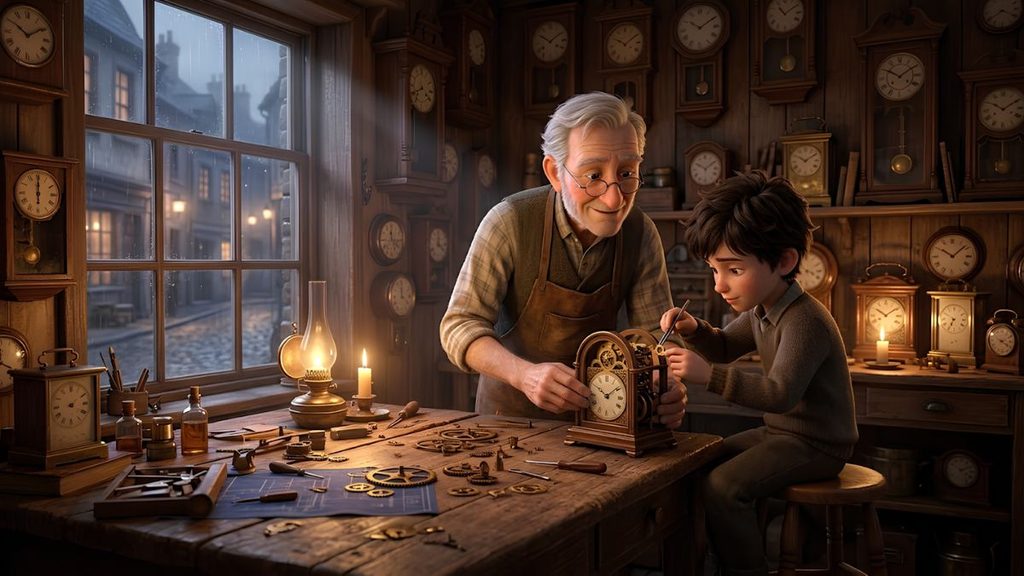
Elliot Hayes had spent nearly sixty years listening to clocks.
He knew the difference between a healthy clock and a troubled one simply by the sound of its ticking.
A clock that was working properly had a steady rhythm.
Tick.
Tock.
Tick.
Tock.
But a damaged clock had a different voice.
It hesitated.
It hurried.
Sometimes it seemed to sigh.
Elliot could hear those differences even when he was standing several rooms away.
People in the small English town of Bellmere often joked that Elliot could tell the time without looking at a clock.
They were not entirely wrong.
For most of his life, Elliot had owned a tiny clock shop on the corner of Rose Street and Market Lane.
The sign above the door read:
HAYES CLOCKS
The golden letters had faded over the years, and the wooden frame had become darker with age.
Inside, hundreds of clocks covered the walls.
Small brass carriage clocks.
Tall grandfather clocks.
Tiny watches.
Old pocket watches.
Cuckoo clocks.
Wooden clocks with painted faces.
Everywhere Elliot looked, something was ticking.
Some people found the sound unsettling.
Elliot found it comforting.
To him, every ticking clock was proof that time was still moving.
Elliot had always believed that time was more valuable than money.
He had learned that lesson from his father.
When Elliot was a boy, his father had owned a small repair shop.
One evening, a wealthy customer offered his father a large amount of money to repair an expensive clock immediately.
Elliot’s father refused.
Instead, he spent the evening helping an elderly neighbor repair a broken kitchen clock.
Young Elliot had been confused.
“Why didn’t you take the money?” he asked.
His father smiled.
“Money can be earned again.”
He pointed toward the clock.
“Time can’t.”
Elliot never forgot those words.
Decades later, he still lived by them.
One autumn afternoon, a boy named Oliver appeared outside Elliot’s shop.
He was about eleven years old.
He wore a green jacket that was slightly too large for him.
His shoes were muddy.
His brown hair was untidy.
He stood outside the shop window for several minutes, staring at the clocks.
Elliot eventually opened the door.
“You’ve been looking at that clock for quite some time.”
Oliver looked embarrassed.
“Sorry.”
“You don’t have to apologize.”
Elliot pointed toward a small wooden clock.
“That one is older than you.”
Oliver smiled.
“How old?”
“About eighty.”
“Does it still work?”
Elliot nodded.
“Most of the time.”
Oliver looked fascinated.
“How?”
“Because someone takes care of it.”
The boy nodded slowly.
Then he looked toward the large clock tower at the center of town.
“Does that one work?”
Elliot followed his gaze.
The Bellmere Town Clock had been silent for almost three years.
Its four enormous faces still overlooked the town, but its hands had remained frozen at 4:17.
Elliot sighed.
“No.”
“Why?”
“Nobody has repaired it.”
“Can you?”
Elliot smiled.
“I probably could.”
“Then why don’t you?”
Elliot looked at the clock tower.
“Because I’m old.”
Oliver frowned.
“You don’t look that old.”
Elliot laughed.
“That’s kind of you.”
The following week, Oliver returned.
Then he came again.
And again.
Soon, he became a regular visitor.
He would stand inside the shop and watch Elliot work.
Sometimes he asked questions.
Sometimes he simply listened.
“What does that spring do?”
“Why are there so many gears?”
“How does a clock know when to ring?”
Elliot answered every question.
One afternoon, Oliver asked:
“Do you have children?”
Elliot stopped repairing a pocket watch.
“I did.”
“Did?”
“My daughter lives in Canada.”
“Do you see her?”
“Not often.”
Oliver looked down.
“Do you miss her?”
Elliot smiled sadly.
“Every day.”
Oliver nodded.
He seemed to understand.
One rainy Friday, Oliver arrived later than usual.
He was carrying a photograph.
“Mr. Hayes?”
“Yes?”
“Can I ask you something?”
“Of course.”
Oliver placed the photograph on the counter.
It showed a man standing beside the Bellmere clock tower.
The man had his arm around a young Oliver.
Elliot recognized him.
“Your father?”
Oliver nodded.
“He died last year.”
Elliot’s expression softened.
“I’m sorry.”
Oliver looked at the photograph.
“He used to bring me here every Friday.”
“Here?”
“To the clock tower.”
Oliver pointed at the tower outside.
“He said we’d meet there every Friday afternoon.”
Elliot waited.
“But he doesn’t come anymore.”
The boy’s voice became quiet.
“I still go.”
Elliot looked at him.
“Every Friday?”
Oliver nodded.
“Even though the clock doesn’t work.”
Elliot understood.
The clock wasn’t simply a broken machine to Oliver.
It was connected to his father.
It was a memory.
A promise.
A place where he still felt close to someone he had lost.
That evening, Elliot walked to the town clock.
He climbed the narrow staircase.
The tower was dusty.
Birds had built nests near the roof.
The mechanism had not moved in years.
Elliot opened the metal casing.
He studied the gears.
Some were rusted.
Several springs were broken.
A connecting rod had cracked.
The repair would take weeks.
Perhaps months.
He climbed down.
Oliver was waiting outside.
“Can you fix it?”
Elliot looked at the boy.
“I think so.”
Oliver smiled.
“Really?”
“I’ll try.”
“How long?”
Elliot looked at the tower.
“Quite a while.”
Oliver nodded.
“I can wait.”
Elliot began repairing the clock the following Monday.
Every afternoon, he climbed the tower.
He cleaned gears.
Replaced springs.
Polished metal.
Rebuilt worn mechanisms.
Oliver began joining him.
At first, Elliot only let him watch.
Eventually, he gave him small tasks.
“Hold this.”
“Pass me that screwdriver.”
“Careful with the spring.”
Oliver learned quickly.
Soon, Elliot was teaching him how clocks worked.
One afternoon, Oliver asked:
“Why are you teaching me?”
Elliot smiled.
“Because someone taught me.”
“Who?”
“My father.”
Oliver looked at the clock.
“Did he fix this one?”
“No.”
“Then who did?”
Elliot laughed.
“I suppose we are doing it together.”
Weeks passed.
The weather became colder.
The days became shorter.
Elliot began feeling tired more often.
His hands shook occasionally.
His knees hurt when he climbed the stairs.
But he continued.
People in town noticed.
Some asked him why he was spending so much time repairing an old clock.
Elliot always gave the same answer.
“Because someone cares about it.”
They assumed he meant the clock.
He meant Oliver.
One evening, Elliot received a letter.
It was from his daughter.
She was visiting England for Christmas.
She wanted him to spend the holiday with her.
Elliot looked at the calendar.
Christmas was only two weeks away.
He had promised Oliver that the clock would be running before Christmas Eve.
For a moment, Elliot felt torn.
He hadn’t seen his daughter in almost two years.
He missed her.
He wanted to spend time with her.
But he also remembered Oliver standing beneath the tower every Friday.
Elliot called his daughter.
“I’d like you to come here.”
“Of course.”
“But I have something I need to finish first.”
She laughed.
“Another clock?”
“Yes.”
“Then I’ll wait.”
The repair became more difficult.
A crucial gear had been damaged beyond repair.
There was no replacement.
Elliot searched through his workshop.
He eventually found an old gear from a clock he had owned for forty years.
It was one of his favorite clocks.
His father had given it to him when he turned twenty.
Using the gear meant permanently dismantling the old clock.
Oliver watched silently.
“That’s your clock.”
Elliot nodded.
“Yes.”
“You don’t have to use it.”
“I know.”
“Then why are you?”
Elliot smiled.
“Because this clock needs it more.”
Oliver looked at him.
“You really like clocks.”
Elliot laughed.
“I do.”
Then he added:
“But sometimes you have to decide which things deserve your time.”
Christmas Eve arrived.
The clock was almost ready.
Only one problem remained.
The main spring wouldn’t hold its tension.
Elliot worked until midnight.
His hands were tired.
His eyes were heavy.
Oliver sat nearby.
“You should sleep.”
Elliot smiled.
“Probably.”
“Then why don’t you?”
“Because tomorrow is Christmas.”
Oliver looked at the clock.
“Does it matter if it takes another day?”
Elliot looked at him.
“It matters to you.”
Oliver smiled.
“Yes.”
Elliot returned to work.
At 11:52 p.m., Elliot finally fixed the spring.
He slowly pushed the mechanism into place.
The clock began moving.
Tick.
Tock.
Tick.
Tock.
Oliver’s eyes widened.
“It works.”
Elliot smiled.
“Not yet.”
He pointed toward the hands.
They were still frozen.
Elliot adjusted them carefully.
11:59.
Then midnight.
The enormous bell rang.
Dong.
The sound echoed across Bellmere.
People opened their windows.
Dogs began barking.
Lights appeared in houses.
The town clock had spoken for the first time in three years.
Oliver stood beneath it, crying.
Elliot placed a hand on his shoulder.
“Your father kept his promise.”
Oliver looked at him.
“What?”
“He said you’d meet here every Friday.”
Oliver smiled through his tears.
“He did.”
“And now the clock is here to remind you.”
The next morning, Oliver came to Elliot’s shop.
He was carrying something.
A small wrapped box.
“I made this.”
Elliot opened it.
Inside was a wooden clock.
It wasn’t perfect.
The numbers were uneven.
The hands were slightly crooked.
The paint was messy.
Elliot loved it immediately.
“It’s beautiful.”
Oliver smiled.
“I want you to have it.”
Elliot placed it on the counter.
“I’ll treasure it.”
Oliver hesitated.
“Mr. Hayes?”
“Yes?”
“Will you still be here next Christmas?”
Elliot looked at the boy.
Then at the hundreds of clocks around him.
He smiled.
“I hope so.”
Years passed.
Oliver grew older.
He continued visiting Elliot.
Eventually, Elliot taught him everything he knew.
How to clean a movement.
How to replace a spring.
How to polish brass.
How to listen to a damaged clock.
And most importantly, how to understand that every clock carried a story.
When Oliver was eighteen, he left Bellmere to study engineering.
Before leaving, he visited Elliot.
“I’ll come back.”
Elliot smiled.
“I know.”
“You’ll keep the shop?”
“For as long as I can.”
Oliver hugged him.
“Thank you.”
“For what?”
“For your time.”
Elliot smiled.
“That’s the one thing I never regretted giving away.”
Oliver returned years later.
By then, Elliot was gone.
The clock shop had been closed.
The sign had been removed.
But the Bellmere Town Clock still worked.
Every hour, its bells echoed through the town.
Oliver stood beneath it.
In his hands was a small wooden clock.
The one he had given Elliot years earlier.
Behind him, a young girl approached.
“Dad?”
Oliver turned.
“Yes?”
“Is this where you used to meet Grandpa?”
Oliver smiled.
“Yes.”
“Did he fix this clock?”
Oliver looked up.
“No.”
He smiled.
“We fixed it together.”
His daughter looked at the tower.
“Was he a good man?”
Oliver thought about the years Elliot had given him.
The afternoons.
The evenings.
The lessons.
The patience.
The Christmas Eve.
He nodded.
“He was.”
The clock began to ring.
One.
Two.
Three.
Oliver smiled.
His daughter took his hand.
And together they walked home.
Years later, Oliver became the owner of Hayes Clocks.
He repaired watches.
Restored antique clocks.
Taught children how mechanical clocks worked.
And every Friday afternoon, he left the shop door open.
Sometimes children came inside just to look.
Sometimes they asked questions.
Sometimes they needed someone to talk to.
Oliver always made time.
Because Elliot had taught him something more important than how to repair clocks.
He had taught him that time was not something we simply spent.
It was something we gave.
And once given to someone who needed it, it could become part of their life forever.
Moral Lesson
Giving your time to someone who needs you can be one of the most meaningful forms of kindness. Money and possessions can be replaced, but time can never be recovered. When we choose to spend our precious hours helping, teaching, listening, or simply being present for someone, we give them something truly valuable.
2. The Violin in the Attic
Sacrifice Type: Sacrificing Money or Material Possessions
Clara Bennett had always been told that the violin belonged to the family.
Not simply to her grandfather.
Not to her father.
Not even to her.
It belonged to everyone who had carried the Bennett name before her.
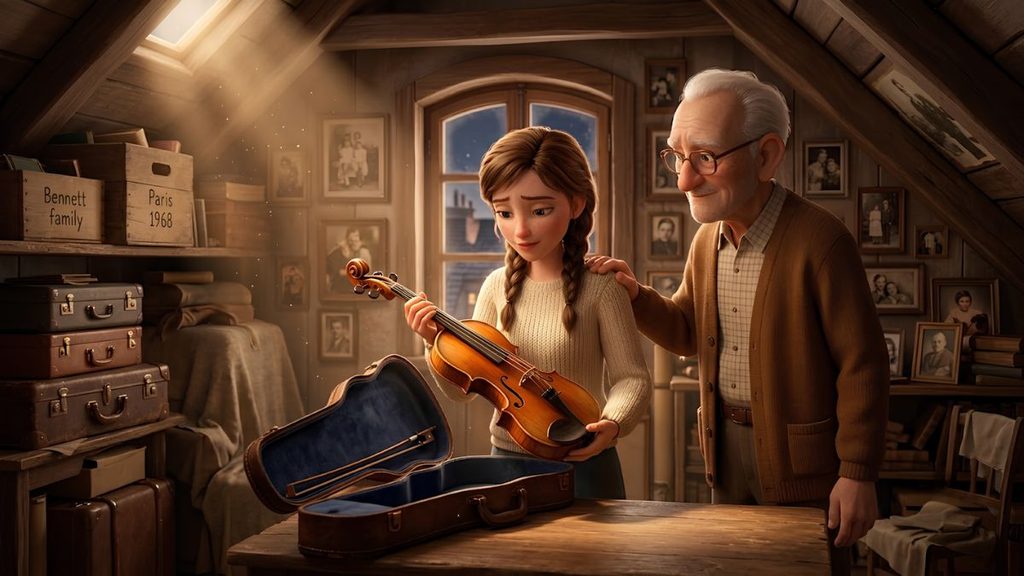
The violin was kept inside a dark wooden case in the attic of their old countryside home. It had been there for as long as Clara could remember.
Whenever she asked about it, her grandfather, Arthur, would tell her the same story.
“That violin traveled farther than any of us.”
Clara would smile.
“Where did it go?”
Arthur would carefully open the case.
“France. Germany. Italy. And eventually here.”
He would lift the violin as though it were made of glass.
“Your great-grandfather played it when he was young.”
“Was he famous?”
Arthur laughed.
“No.”
“Then why is it so important?”
Arthur would look at the instrument for a moment.
“Because something doesn’t have to be famous to be precious.”
Clara never quite understood what he meant.
She would eventually learn.
The Bennett family lived in a small village outside Edinburgh.
Their house had belonged to Arthur’s parents before him.
It was old, with stone walls, wooden floors, and a narrow staircase leading to a dusty attic.
Clara had grown up there with her younger brother, Ethan.
They were close despite being completely different.
Clara was quiet and thoughtful.
Ethan was energetic and curious.
He loved football, science experiments, and taking apart things he was not supposed to touch.
But both children loved music.
Clara played the piano.
Ethan loved listening.
Their mother, Margaret, had once hoped both children would learn an instrument.
But money was often tight.
Their father, Daniel, worked long hours as a mechanic.
Their mother worked part-time at the village library.
Nobody complained.
They simply learned to live carefully.
Ethan’s health began changing when he was thirteen.
At first, he became tired easily.
Then he stopped playing football.
Then he began missing school.
Doctors ran tests.
More tests followed.
Eventually, the family received difficult news.
Ethan needed a specialized treatment that was not fully covered by their insurance.
The cost was enormous.
Daniel tried everything.
He worked extra shifts.
Margaret took additional hours at the library.
Arthur offered his savings.
Clara began tutoring younger students for money.
But it wasn’t enough.
One evening, Clara overheard her parents talking in the kitchen.
“We’re still short,” Daniel said.
Margaret was silent.
“How much?”
“Too much.”
Clara stood outside the door.
She didn’t want to listen.
But she couldn’t walk away.
Then Daniel said something that changed everything.
“We may have to sell the house.”
Clara stepped into the kitchen.
“No.”
Both parents turned.
“We heard you.”
Daniel sighed.
“We’re trying to find another way.”
Clara looked at her mother.
“There has to be one.”
Margaret hugged her.
“We’re looking.”
That night, Clara couldn’t sleep.
She walked upstairs.
The house was silent.
She passed the old photographs hanging along the hallway.
Her grandparents.
Great-grandparents.
Relatives she had never met.
Then she looked toward the attic door.
The violin.
She climbed the stairs.
The attic smelled of dust and old wood.
Moonlight entered through a small circular window.
Clara found the violin case beneath a blanket.
She opened it.
The violin rested inside.
Its polished wooden surface reflected the moonlight.
Clara lifted it carefully.
She had seen her grandfather play it many times.
The sound had always been beautiful.
She turned the instrument over.
There was a small inscription inside.
For the one who understands that music is meant to be shared.
Clara touched the words.
Then she noticed something beneath the violin.
A letter.
It was addressed to Arthur.
She opened it.
The letter was from his father.
It explained that the violin had once belonged to a young musician who had been forced to sell almost everything he owned during difficult times.
The violin had been the last thing he had kept.
He eventually sold it to help his family survive.
Years later, Arthur’s father bought it and passed it down.
At the bottom of the letter was a sentence:
Never let an object become more important than the people it was meant to serve.
Clara read it twice.
Then she understood.
The next morning, Clara went downstairs.
Her grandfather was sitting near the window.
She placed the violin case on the table.
Arthur stared at it.
“What happened?”
Clara sat beside him.
“Ethan needs more money for his treatment.”
Arthur nodded.
“I know.”
“What if we sell this?”
Arthur became very still.
For a moment, Clara thought he would refuse.
Instead, he slowly opened the case.
He looked at the violin.
Then he smiled.
“Your great-grandfather once told me that this violin had saved his family.”
Clara nodded.
“Maybe it can do it again.”
Tears filled her eyes.
“Are you sure?”
Arthur looked at her.
“Clara, it’s only wood and strings.”
“But it means so much to you.”
Arthur gently touched the violin.
“It does.”
Then he added:
“But your brother means more.”
Selling the violin wasn’t simple.
It was a rare instrument.
A collector from London offered a substantial amount.
Another buyer wanted it for a private collection.
A professional musician also expressed interest.
Clara hated the idea of it leaving the family.
But she knew why they were selling it.
They weren’t selling a violin.
They were buying Ethan another chance.
Eventually, a famous concert violinist named Isabelle Laurent purchased it.
Before taking it, Isabelle visited the Bennett house.
She wanted to meet the family.
She sat with Arthur in the living room.
“Your grandfather told me the violin has a story.”
Arthur smiled.
“It has many.”
Isabelle looked at Clara.
“Would you like to hear it?”
Clara nodded.
Arthur told them about the violin’s journey.
How it had traveled across Europe.
How it had survived two generations.
How it had once been sold to save a family.
Isabelle listened quietly.
Then she asked:
“Do you play?”
Clara nodded.
“Piano.”
“Would you like to play the violin before I take it?”
Clara hesitated.
“Yes.”
Arthur handed her the violin.
Clara had held it before.
But this time it felt different.
It was no longer simply a family treasure.
It was leaving.
She raised the bow.
The first note was uncertain.
The second was stronger.
Soon, the attic seemed filled with music.
Arthur closed his eyes.
Isabelle smiled.
When Clara finished, nobody spoke for several seconds.
Then Arthur applauded.
“Beautiful.”
Clara wiped her eyes.
“I’m going to miss it.”
Arthur put his hand on hers.
“Missing something doesn’t mean you made the wrong choice.”
Ethan’s treatment began two weeks later.
The money from the violin covered a significant part of the cost.
The treatment was difficult.
There were good days.
There were bad days.
There were days when Ethan wanted to give up.
Clara stayed beside him.
She brought books.
Played piano recordings.
Told terrible jokes.
Sometimes she simply sat quietly.
Months passed.
Slowly, Ethan became stronger.
He returned to school.
Then he started walking farther.
Then he kicked a football again.
The first time he scored a goal after his recovery, Clara cried harder than he did.
But Clara still missed the violin.
One evening, she went to the attic.
The case was gone.
The space where it had rested was empty.
She sat on the floor.
Arthur found her there.
“Still thinking about it?”
“Yes.”
He sat beside her.
“I miss it too.”
“Do you regret selling it?”
Arthur thought carefully.
“No.”
“Not even a little?”
“I regret that we needed the money.”
He looked around the attic.
“But I don’t regret what we did.”
Clara nodded.
Three years passed.
Ethan was healthy.
Clara had started university.
She continued playing piano.
One afternoon, she received an email.
It was from Isabelle Laurent.
The subject line read:
A Special Invitation
Clara opened it.
Isabelle explained that she was performing in Edinburgh.
She wanted Clara and her family to attend.
There was something else.
The violin would be played during the final piece.
Clara’s heart began beating faster.
She showed the message to Arthur.
He smiled.
“I suppose we have a concert to attend.”
The concert hall was filled with people.
Isabelle walked onto the stage.
In her hands was the violin.
Clara immediately recognized it.
The tiny scratch near the bridge.
The dark mark beneath the neck.
The warm color of the wood.
She felt tears forming.
Isabelle began playing.
The music filled the hall.
Clara closed her eyes.
She remembered the attic.
Her grandfather.
Her brother.
The night they decided to sell it.
The fear.
The uncertainty.
Then she opened her eyes.
Isabelle was looking directly at her.
For a moment, Clara felt as though the violin had come home.
After the concert, Isabelle approached the family.
“How is Ethan?”
“Healthy,” Clara said.
Isabelle smiled.
“I’m glad.”
Arthur looked at the violin.
“It sounds beautiful.”
“Thank you.”
Clara asked:
“Do you still own it?”
Isabelle shook her head.
“No.”
Clara was surprised.
“What?”
Isabelle smiled.
“I donated it.”
“To whom?”
“To a music school.”
Clara looked confused.
“Why?”
Isabelle explained that she had learned the violin’s history.
She didn’t want it locked inside another private collection.
Instead, she had given it to a school that provided free music lessons to children who could not afford instruments.
“It should keep moving,” she said.
Arthur smiled.
“That is exactly what it was meant to do.”
Years later, Clara became a music teacher.
She often told her students that instruments were more than objects.
They were tools for creating memories.
One day, a little girl asked her:
“What’s the most valuable thing you own?”
Clara thought about the violin.
She thought about the attic.
She thought about Ethan.
Then she smiled.
“The people I love.”
The girl looked confused.
“That’s not an object.”
“I know.”
Clara picked up her piano sheet music.
“That’s why it’s valuable.”
Meanwhile, the violin continued traveling.
It moved from one classroom to another.
Children learned their first notes on it.
Some were nervous.
Some were impatient.
Some became extraordinary musicians.
Years later, one young student asked the music teacher about the strange inscription inside.
For the one who understands that music is meant to be shared.
The teacher told her the story of the Bennett family.
The student listened carefully.
Then she picked up the violin.
And began to play.
Clara eventually visited the music school.
She hadn’t seen the violin in years.
When she entered the practice room, she recognized it immediately.
It was resting on a stand.
An eleven-year-old girl was preparing to play.
Clara introduced herself.
The teacher told the girl:
“This is the family the violin once belonged to.”
The girl’s eyes widened.
“You owned it?”
Clara smiled.
“My family did.”
“Why did you sell it?”
Clara thought about the answer.
“Because my brother needed help.”
“Was it hard?”
“Very.”
“Do you wish you still had it?”
Clara looked at the violin.
Then at the girl.
“I wish we had never needed to sell it.”
She paused.
“But I’m glad we did.”
The girl smiled.
“Why?”
Clara touched the violin gently.
“Because it saved someone.”
That evening, Clara called Ethan.
She told him about seeing the violin again.
He laughed.
“Does it still sound the same?”
“Better.”
“Good.”
There was a pause.
Then Ethan said:
“Do you remember when we thought losing the violin meant losing part of our family?”
Clara smiled.
“Yes.”
“I think we were wrong.”
“How?”
“The violin became part of other families too.”
Clara looked toward the window.
The sun was setting over the city.
She thought about all the hands that had held that instrument.
All the children who had learned from it.
All the music it had created.
She finally understood what her grandfather had meant.
A valuable object was not necessarily one that remained in your possession.
Sometimes the most valuable thing you could do with something precious was let it help someone else.
Years later, the violin returned to Bellmere.
The music school organized a special concert.
Clara was invited.
Arthur had passed away by then, but Clara carried his memory with her.
The violin was placed beneath a warm spotlight.
Before the concert began, Clara walked onto the stage.
She looked at the audience.
Then at the violin.
She told them about her grandfather.
About Ethan.
About the attic.
About the sacrifice.
Then she said:
“Sometimes we think keeping something is the best way to honor it.”
She paused.
“But my grandfather taught me something different.”
She looked toward the violin.
“Sometimes you honor something by allowing it to help someone else.”
The audience became silent.
Then the music began.
A young musician lifted the violin.
And played.
Clara sat in the front row.
She closed her eyes.
She could almost hear Arthur’s voice.
Money can be earned again. Time can’t.
She remembered the violin.
She remembered what it had cost.
And what it had given.
A chance.
A future.
A life.
She opened her eyes.
The violin continued singing.
Not for the Bennett family alone.
But for everyone who needed its music.
And Clara finally understood that some treasures become more valuable when we are willing to let them go.
Moral Lesson
True generosity is measured not by the price of what we give but by what we are willing to sacrifice when someone we love genuinely needs our help. Material possessions can carry memories, but people and relationships are ultimately more valuable than things.
3. The Winter at Rosewood Station
Sacrifice Type: Sacrificing Personal Comfort
The winter of 1987 arrived early in the little town of Rosewood.
By the first week of December, frost covered the rooftops each morning. The narrow streets remained silver until nearly noon, and the trees surrounding the railway station had lost almost every leaf.
Rosewood Station stood at the edge of town.
It was small compared with the grand stations in London or Edinburgh, but it had served the community for generations.
There were two platforms, a waiting room, a ticket office, and a small stationmaster’s office heated by an old iron stove.
Henry Collins had worked there for almost twelve years.
He was thirty-two years old, quiet, dependable, and rarely complained.
His job was not glamorous.
He checked tickets.
Helped passengers.
Loaded luggage.
Cleaned the platforms.
Answered questions.
And during winter, he made sure nobody was left outside in the cold.
Henry had learned that last responsibility from his father.
His father had been a railway worker too.
Whenever Henry complained about working late, his father would say:
“A station isn’t just about trains. Sometimes it’s about people who need somewhere safe to wait.”
Henry never fully understood that lesson until the winter of 1987.
On December 18, Henry finished his evening shift at 9:30.
Snow had begun falling.
The weather forecast predicted a severe storm.
Henry pulled his coat tightly around himself as he walked toward the small staff room.
His plan was simple.
Make a cup of tea.
Check the final train schedule.
Lock the station.
Go home.
His wife, Emily, was waiting.
She had promised to make soup.
Their daughter, Sophie, had decorated the living room for Christmas.
Henry was already imagining the warmth of his house.
Then the telephone rang.
Henry answered.
“Rosewood Station.”
The voice on the other end belonged to the railway control center.
“Henry, the 8:45 train has been delayed.”
“How long?”
There was a pause.
“Possibly several hours.”
Henry looked toward the station clock.
It was 9:42.
“Why?”
“Heavy snow. The line north of Rosewood is blocked.”
Henry sighed.
“How many passengers?”
“Not sure. Around forty.”
Henry looked at the nearly empty platform.
Forty people.
That meant the waiting room would be crowded.
He glanced at the clock again.
His evening was disappearing.
But that was part of the job.
“Understood.”
At 10:15, the delayed train finally arrived.
It was not the train itself that worried Henry.
It was the people who stepped off.
Families.
Older travelers.
Students.
Workers.
And among them was an elderly couple.
The man was tall and thin.
His wife leaned heavily on his arm.
They looked exhausted.
Henry walked toward them.
“Are you traveling far?”
The man smiled politely.
“Glasgow.”
Henry shook his head.
“I’m afraid that won’t be possible tonight.”
The man looked confused.
“Why?”
“The line is blocked.”
His wife looked toward the falling snow.
“Is there somewhere we can stay?”
Henry looked toward the station.
The nearest hotel was five kilometers away.
The roads were already becoming dangerous.
“There is a small hotel in town,” he said.
“Can we get a taxi?”
Henry glanced outside.
“No taxis are operating tonight.”
The woman looked frightened.
“What should we do?”
Henry didn’t answer immediately.
He looked toward the station office.
Then at the snow.
Then at his watch.
He was supposed to be home hours ago.
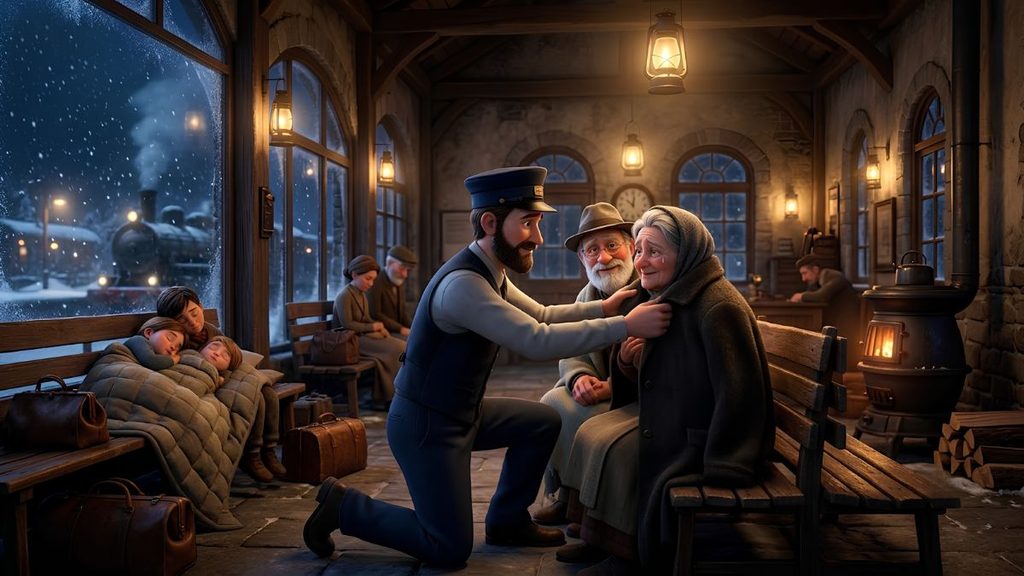
Henry opened the station waiting room.
He turned on every light.
“Everyone can stay here tonight.”
Some passengers thanked him.
Others looked relieved.
The elderly couple remained near the door.
Henry approached them.
“You should sit near the stove.”
The man shook his head.
“We don’t want to cause trouble.”
“You’re not.”
Henry helped them to a bench.
The woman’s hands were shaking.
Henry removed his thick wool coat and placed it around her shoulders.
She immediately protested.
“No, no. You’ll be cold.”
“I’m used to it.”
That was not entirely true.
Henry was already cold.
But he smiled.
“Please.”
She accepted the coat.
“Thank you.”
At 11:30, the station was still busy.
Henry made tea.
He found blankets in the storage room.
He gave his packed dinner to a young mother whose children were hungry.
He brought extra coal to the stove.
He helped people charge their emergency radios.
Then he walked outside to inspect the platform.
The wind hit him like ice.
Snow had covered the tracks.
Henry pulled his scarf over his face.
He checked the signals.
Everything was safe.
When he returned inside, his hands were numb.
The elderly man noticed.
“You should sit down.”
Henry smiled.
“I will.”
But he didn’t.
Someone needed more tea.
At midnight, Henry called home.
Emily answered.
“Henry?”
“Hi.”
“Where are you?”
“Still at the station.”
She sighed.
“I know.”
“I’m sorry.”
“How bad is it?”
“Pretty bad.”
“Can you come home?”
Henry looked around the waiting room.
Several people were asleep.
The elderly woman was wrapped in his coat.
A child was sleeping beside the stove.
An old man was drinking tea.
Henry lowered his voice.
“Not yet.”
Emily was quiet.
Then she said:
“Take care of them.”
Henry smiled.
“I will.”
At 1:30 in the morning, the storm became worse.
The electricity went out.
The station went dark.
For several seconds, everyone was silent.
Then children began crying.
Henry found a box of emergency lanterns.
He lit them one by one.
The waiting room filled with soft yellow light.
“Don’t worry,” he said.
“The lights will come back.”
But Henry didn’t know if they would.
He walked into the office.
The temperature was dropping.
He found the old iron stove and added coal.
The warmth slowly returned.
The elderly woman approached him.
“What’s your name?”
“Henry.”
“I’m Margaret.”
She pointed toward her husband.
“That’s George.”
Henry smiled.
“Nice to meet you.”
Margaret looked at his missing coat.
“You gave me your coat.”
“Yes.”
“Why?”
Henry shrugged.
“You looked colder than I was.”
Margaret smiled.
“You remind me of someone.”
“Who?”
“My son.”
“Where is he?”
She looked down.
“He’s gone.”
Henry didn’t ask more.
Sometimes silence was kinder than questions.
At 3:00 a.m., Henry began feeling exhausted.
His feet hurt.
His back hurt.
He wanted his bed.
He wanted Emily’s soup.
He wanted to see Sophie.
He wanted to be home.
Instead, he walked through the waiting room checking on everyone.
Margaret was sleeping.
George was awake.
“You should rest,” George told him.
Henry smiled.
“After the storm.”
George nodded.
“You’re a good man.”
Henry looked away.
“I’m just doing my job.”
George shook his head.
“No.”
He looked around the station.
“You’re doing more than your job.”
At 4:15, Henry received a radio message.
The railway control center had good news.
“The line may reopen by morning.”
Henry felt relieved.
But there was a problem.
The rescue crew needed to reach the blocked section.
The road was dangerous.
Henry volunteered to guide them.
He put on a spare jacket.
George stood up.
“You can’t go out in this.”
“I have to.”
“Why?”
“Because I know the line.”
George looked at him.
Then he smiled.
“Your father would have been proud.”
Henry froze.
“How did you know my father?”
George laughed.
“I didn’t.”
He looked toward the station.
“You just look like the kind of man he must have been.”
Henry stepped into the snow.
The storm was brutal.
He walked along the track with a lantern.
Every few minutes, he stopped to check the signal markers.
Eventually, he reached the maintenance crew.
He guided them toward the blocked section.
Together, they cleared the snow.
It took nearly two hours.
By sunrise, the railway line was open.
The first train slowly entered Rosewood Station.
The passengers cheered.
Henry stood on the platform, exhausted.
Margaret and George were among the first people to leave.
Margaret returned Henry’s coat.
“Thank you.”
Henry smiled.
“You’re welcome.”
George shook his hand.
Then he stopped.
“Wait.”
He reached into his pocket.
He pulled out an old photograph.
Henry looked at it.
The photograph showed a young railway worker standing beside a train.
Henry recognized him immediately.
His father.
Henry stared at George.
“Where did you get this?”
George smiled.
“Your father saved my life thirty years ago.”
Henry’s eyes widened.
“What?”
George explained.
Decades earlier, during another winter storm, his train had been trapped near Rosewood.
Henry’s father had stayed awake all night helping passengers.
He had given George his coat.
He had shared his food.
And he had walked through the snow to find help.
Henry stared at the photograph.
“He never told me.”
George laughed.
“Men like your father rarely do.”
The train left Rosewood at 7:10 a.m.
Henry watched it disappear into the snow.
Then he finally sat down.
He was exhausted.
His clothes were damp.
His hands were cold.
But he smiled.
The station slowly became quiet.
The storm began to weaken.
A few hours later, Emily arrived.
She found Henry asleep on a bench.
She gently touched his shoulder.
“Henry.”
He opened his eyes.
“Emily?”
“Come home.”
He smiled.
“Is Sophie awake?”
“She is.”
“Did she save me any soup?”
Emily laughed.
“She saved you everything.”
Henry stood.
Then he looked toward the station.
Margaret’s blanket was folded neatly on the bench.
A child’s drawing was taped to the wall.
It showed the station beneath a giant yellow sun.
Underneath it were the words:
THANK YOU, MR. HENRY.
Henry smiled.
Years passed.
Henry eventually became the stationmaster.
He never forgot that winter.
Neither did the people who had been there.
Every December, Rosewood Station received Christmas cards from passengers.
Some remembered the tea.
Others remembered the blankets.
One remembered the lanterns.
Margaret sent a letter every year.
She always wrote the same sentence:
Thank you for giving us your warmth when you needed it yourself.
Henry kept every letter.
One December evening, decades after the storm, Henry’s daughter Sophie visited the station.
She was now an adult.
She had become a teacher.
She found her father sitting beside the old stove.
“Do you still remember that night?”
Henry smiled.
“Of course.”
“Wasn’t it terrible?”
“Yes.”
“Weren’t you angry that you couldn’t go home?”
Henry thought about it.
“At the time, yes.”
Sophie smiled.
“But would you do it again?”
Henry looked toward the window.
Snow was falling again.
He nodded.
“Every time.”
Sophie sat beside him.
“Why?”
Henry smiled.
“Because sometimes someone else’s difficult night is more important than your comfortable evening.”
Sophie nodded.
“And your coat?”
Henry laughed.
“I never saw it again.”
“What happened?”
“I gave it to someone who needed it.”
Sophie smiled.
“Of course you did.”
That winter, Rosewood Station installed a new plaque beside the old waiting room.
It read:
To everyone who has ever offered warmth to someone standing in the cold.
Beneath it was a smaller line:
A little comfort given freely can become a memory that lasts a lifetime.
Henry never asked for the plaque.
He never expected recognition.
He had simply done what his father had taught him.
A station was not just a place where trains arrived and departed.
Sometimes it was a shelter.
Sometimes it was a place where strangers became friends.
And sometimes, on the coldest night of the year, it was simply the place where one person decided that another person’s comfort mattered more than his own.
Moral Lesson
Doing the right thing sometimes requires us to step outside our comfort zone. True kindness is not always convenient. Sometimes it means giving up warmth, sleep, time, or personal comfort so someone else can feel safe. The sacrifice may seem small in the moment, but its impact can remain with another person for years.
4. The Letter That Changed Eleanor’s Dream

Sacrifice Type: Sacrificing Personal Ambition
Eleanor Whitmore had spent most of her life drawing buildings.
She drew them on scraps of paper.
On the backs of grocery receipts.
In the margins of school notebooks.
On napkins at restaurants.
Even when she was supposed to be paying attention in class, she sometimes found herself sketching windows, staircases, rooftops, and enormous glass buildings.
Her dream was simple.
She wanted to become an architect.
Not just any architect.
She wanted to design buildings that made people feel hopeful when they walked inside them.
Her father, Richard, used to joke that Eleanor could turn anything into a building.
Once, when she was seven, she drew a castle on the wall of her bedroom.
Her mother, Margaret, was furious.
Richard had laughed.
“At least she has ambition.”
Eleanor never forgot that word.
Ambition.
To her, ambition meant believing that something better was waiting somewhere ahead.
Eleanor grew up in a quiet English town called Ashbourne.
Her family did not have much money.
Her father repaired heating systems.
Her mother worked at a small bakery.
They lived in a modest brick house with a blue front door.
Eleanor shared a bedroom with her younger sister, Sophie.
The two sisters were very close.
Eleanor was six years older.
When Sophie was frightened during thunderstorms, Eleanor would sit beside her bed until she fell asleep.
When Sophie struggled with mathematics, Eleanor helped her with homework.
When Sophie was bullied at school, Eleanor walked her home every afternoon for an entire month.
Their mother sometimes told Eleanor:
“You are more than a sister to her.”
Eleanor would smile.
“She’s my little shadow.”
And Sophie would protest.
“I’m not a shadow.”
“You are.”
“No.”
“Definitely.”
Then they would laugh.
As the years passed, Eleanor’s talent became obvious.
Her teachers encouraged her to apply to architecture schools.
She worked harder than anyone.
She studied late.
She entered competitions.
She won scholarships.
Eventually, she was accepted into a prestigious architecture program in London.
But there was one problem.
The tuition and living expenses were far beyond what her family could comfortably afford.
Eleanor was preparing to give up.
Then a letter arrived.
It was a scholarship.
A full scholarship.
It would cover almost everything.
Eleanor read it three times.
Then she ran downstairs.
“Mom!”
Margaret was preparing dinner.
“What happened?”
“I got it.”
“Got what?”
“The scholarship.”
Margaret dropped the spoon she was holding.
“Are you serious?”
Eleanor nodded.
Her mother hugged her.
Her father came into the kitchen.
“What is happening?”
Eleanor showed him the letter.
Richard read it.
Then he smiled.
“I told you.”
“What?”
“You could do it.”
Sophie was the last person Eleanor told.
She found her sister sitting in the garden.
“I got the scholarship.”
Sophie looked up.
“Really?”
Eleanor nodded.
Sophie jumped to her feet.
“You’re going to London!”
They hugged.
For several minutes, they simply celebrated.
Then Sophie became quiet.
“When do you leave?”
“In September.”
“That’s soon.”
“I know.”
Sophie looked toward the house.
“Mom will miss you.”
“So will you.”
Sophie smiled.
“Maybe.”
Eleanor laughed.
“You’re going to miss me terribly.”
Sophie rolled her eyes.
“Don’t flatter yourself.”
But Eleanor noticed that her sister’s smile had disappeared.
September arrived.
Eleanor moved to London.
Her first months were everything she had dreamed about.
She studied architectural history.
Learned computer modeling.
Visited famous buildings.
Worked with talented professors.
Met students from all over Europe.
For the first time, she felt as though her future had become real.
She called home every weekend.
Sophie always answered.
“How is London?”
“Busy.”
“Are you eating properly?”
“Yes.”
“You’re lying.”
“I’m not.”
“You sound tired.”
“I am.”
“Then sleep.”
Eleanor smiled.
“Goodnight, Sophie.”
“Goodnight.”
During Eleanor’s second year, Sophie’s life began changing.
She struggled at school.
Her grades dropped.
She stopped seeing friends.
She became withdrawn.
Margaret noticed first.
She called Eleanor.
“Your sister isn’t herself.”
“What happened?”
“We don’t know.”
Eleanor called Sophie.
“What’s wrong?”
“Nothing.”
“Sophie.”
“I’m fine.”
“You’re not.”
“I’m just tired.”
“Do you want me to come home?”
“No.”
“Are you sure?”
“Yes.”
Eleanor wanted to believe her.
She didn’t.
A few months later, Eleanor received another call.
This time it was her father.
“Your sister is having a difficult time.”
“What does that mean?”
“She’s struggling.”
“With school?”
“With everything.”
Eleanor felt helpless.
She wanted to go home.
But she had an important architecture competition in London.
Winning could lead to an internship at one of the country’s most respected firms.
It could change her career.
She had worked toward this opportunity for years.
She promised her father she would come home after the competition.
“Just give me two weeks.”
Richard hesitated.
“Okay.”
Eleanor threw herself into the competition.
She worked twelve-hour days.
She barely slept.
Her design was ambitious.
A community center built around natural light.
A place where people could study, meet, and create.
Her professors loved it.
One told her:
“If you win this, doors will open.”
Eleanor smiled.
She imagined the future.
A successful architecture career.
International projects.
Her own firm someday.
Everything she had wanted.
Then her phone rang.
It was her mother.
“Eleanor.”
Her voice was trembling.
“What happened?”
“It’s Sophie.”
Eleanor immediately stood.
“What happened?”
“She tried to hurt herself.”
Eleanor couldn’t breathe.
“Is she alive?”
“Yes.”
“Where is she?”
“At the hospital.”
Eleanor grabbed her coat.
“I’m coming home.”
She arrived at the hospital that night.
Sophie was asleep.
Her face looked smaller than Eleanor remembered.
Eleanor sat beside her bed.
For the first time in years, she felt completely powerless.
She had always believed that if she worked hard enough, she could solve problems.
But this was different.
She couldn’t design her way out of it.
She couldn’t calculate it.
She couldn’t draw a solution.
She could only sit beside her sister.
And stay.
The next morning, Sophie opened her eyes.
“Eleanor?”
“I’m here.”
“You came.”
“Of course.”
“You had your competition.”
Eleanor looked at her.
“I don’t care about the competition.”
Sophie looked away.
“You worked so hard.”
“So did you.”
“I failed.”
“No.”
“I did.”
“You didn’t fail.”
Sophie began crying.
“I don’t know how to fix myself.”
Eleanor held her hand.
“You don’t have to fix yourself.”
“What do I do?”
“We’ll figure it out together.”
Eleanor stayed home.
One week became two.
Two weeks became a month.
Her professor called.
“You’ve missed the final presentation.”
“I know.”
“You were one of the strongest candidates.”
“I’m sorry.”
“You could still submit.”
Eleanor looked at Sophie.
“I don’t think I can.”
There was silence.
“Are you sure?”
Eleanor closed her eyes.
“No.”
She wasn’t sure.
She wanted the career.
She wanted the opportunity.
She wanted the life she had imagined.
But she also knew that Sophie needed her.
The hardest moment came when Eleanor received an email.
She had won.
Even though she had not attended the final presentation, her professors had submitted her work.
She had won first place.
The prize included a position at an architectural firm in London.
It was everything she had dreamed about.
Eleanor stared at the screen.
Then she closed the laptop.
Sophie was sitting across the room.
“What happened?”
Eleanor smiled.
“Nothing.”
“You look sad.”
“I won the competition.”
Sophie smiled.
“That’s amazing.”
Eleanor nodded.
Then Sophie asked:
“When do you go back?”
Eleanor looked at her.
“I don’t know.”
Sophie understood.
“You should go.”
“I’m not leaving you.”
“I’ll be okay.”
“You don’t know that.”
“Neither do you.”
Eleanor walked over.
“Sophie.”
“Don’t sacrifice your life for me.”
Eleanor sat beside her.
“Maybe this isn’t a sacrifice.”
“What is it?”
“A choice.”
Eleanor decided to postpone the job.
Not abandon architecture.
Not abandon her dream.
Simply postpone it.
She contacted the firm.
They couldn’t hold the position.
That hurt.
But she accepted it.
For the next year, Eleanor remained at home.
She helped Sophie recover.
She attended appointments with her.
She encouraged her to return to school gradually.
She helped her discover interests outside academics.
Most importantly, she listened.
There were difficult days.
There were arguments.
There were nights when Sophie cried.
There were mornings when Eleanor wondered whether she had made the right decision.
But slowly, things improved.
Sophie began painting.
Then volunteering.
Then tutoring younger children.
Eventually, she returned to school.
One evening, Sophie entered Eleanor’s room.
Eleanor was drawing.
“What are you working on?”
“A library.”
“Why?”
“I thought about designing one.”
Sophie looked at the drawing.
“It has huge windows.”
“Of course.”
“Why?”
“Natural light.”
Sophie smiled.
“You’re still obsessed with buildings.”
“Always.”
Sophie sat beside her.
“You should go back.”
Eleanor looked at her.
“Where?”
“To architecture.”
Eleanor shook her head.
“I don’t know.”
“You sacrificed enough.”
Eleanor smiled.
“I didn’t sacrifice everything.”
“You lost your job.”
“I can find another.”
“You lost a year.”
“I gained a year with you.”
Sophie looked down.
“Still.”
Eleanor placed her hand on Sophie’s shoulder.
“Dreams don’t always disappear because we take a different road.”
Three years later, Eleanor moved back to London.
She enrolled in another program.
She found part-time work.
She continued studying.
She was older than many students.
She didn’t care.
Her experience had changed her.
She no longer designed buildings simply because they looked impressive.
She thought about the people who would use them.
She designed spaces where people could feel safe.
Libraries.
Community centers.
Schools.
Counseling spaces.
Places filled with natural light.
When someone asked why she cared so much about emotional well-being in architecture, she simply said:
“Buildings are for people.”
Sophie became a teacher.
She specialized in helping students who struggled academically or emotionally.
Her office had a large window.
On the wall was a framed sketch.
It was Eleanor’s first drawing of a library.
Beneath it, Sophie had written:
Sometimes the people who help us find our way become part of the path we were meant to take.
Years later, Eleanor received a major commission.
She was asked to design a community center in London.
She named it The Whitmore House.
It had a library.
Art rooms.
Counseling spaces.
A garden.
A large central hall filled with sunlight.
During the opening ceremony, Sophie stood beside her.
“You finally did it.”
Eleanor smiled.
“Yes.”
“You know what’s funny?”
“What?”
“You gave up your first big opportunity.”
“I know.”
“And somehow you ended up here anyway.”
Eleanor looked at the building.
“I suppose life took the long way.”
Sophie laughed.
“Would you do it differently?”
Eleanor thought about it.
Then she shook her head.
“No.”
“Even if you knew you would lose that job?”
“Yes.”
“Why?”
Eleanor looked at her sister.
“Because sometimes the right choice isn’t the one that takes you forward the fastest.”
She looked toward the sunlight streaming through the windows.
“Sometimes it’s the one that makes sure the people you love can walk beside you when you finally arrive.”
That evening, Eleanor and Sophie walked through the empty building.
The rooms were quiet.
The sunlight had faded.
Sophie stopped in the library.
“Do you remember the day you got your scholarship?”
Eleanor smiled.
“Of course.”
“You thought that was the beginning of your life.”
“I did.”
“And it wasn’t?”
Eleanor looked around.
“No.”
She smiled.
“It was only the beginning of one version of my life.”
Sophie nodded.
“And the other version?”
Eleanor looked at her.
“Was waiting for me at home.”
They hugged.
Outside, the city lights began appearing one by one.
Eleanor had once believed success meant reaching her destination as quickly as possible.
Now she understood something different.
A dream was important.
Ambition was valuable.
Success mattered.
But none of those things existed in isolation.
Sometimes life asked people to slow down.
Sometimes it asked them to change direction.
Sometimes it asked them to put a dream aside for a while.
And sometimes, surprisingly, the road they took while helping someone else eventually led them to a destination more meaningful than the one they originally imagined.
Moral Lesson
Success is meaningful, but sometimes helping someone we love matters more than achieving personal recognition. Sacrificing an opportunity does not always mean abandoning a dream. Sometimes it means choosing to care for someone during a moment when they need us most and trusting that another opportunity will come.
5. The Apology at Willow Bridge

Sacrifice Type: Sacrificing Pride
Marcus Bennett and Adrian Cole had been best friends for almost twenty years.
They had grown up on the same street in the small English town of Fairhaven.
Their houses stood only three doors apart.
As children, they rode bicycles together.
As teenagers, they played football on the same muddy field.
When they were seventeen, they promised that no matter where life took them, they would always remain friends.
They even had a place where they met whenever something important happened.
Willow Bridge.
It was an old stone bridge crossing a narrow river at the edge of town.
A huge willow tree grew beside it, its branches hanging over the water.
Marcus and Adrian had spent countless afternoons sitting beneath that tree.
They had shared secrets there.
Dreams.
Arguments.
Jokes.
Plans for the future.
They had promised each other that nothing would ever come between them.
Neither knew that one careless accusation would eventually test that promise.
Marcus was the more ambitious of the two.
He worked as a financial consultant in London and traveled frequently.
Adrian had stayed in Fairhaven.
He owned a small photography studio and preferred a quieter life.
Despite their differences, they remained close.
Marcus often called Adrian after difficult days.
Adrian would listen.
When Adrian’s business struggled, Marcus helped him create a new marketing plan.
They trusted each other.
At least, they thought they did.
One summer, Adrian received an opportunity to photograph a major charity event in London.
It was the biggest contract his studio had ever received.
If he succeeded, it could transform his business.
He called Marcus immediately.
“I got it.”
Marcus laughed.
“I knew you would.”
“It’s huge.”
“I’m proud of you.”
Adrian smiled.
“You’ll be there, right?”
Marcus hesitated.
“When is it?”
“Saturday.”
“I’ll try.”
Adrian’s smile faded.
“You said that last time.”
“I have a work commitment.”
“You can cancel.”
“I can’t.”
Adrian became quiet.
“It’s important to me.”
“I know.”
“Then be there.”
Marcus sighed.
“I’ll see what I can do.”
The event arrived.
Marcus didn’t come.
Adrian photographed hundreds of guests.
He smiled for clients.
He shook hands.
He delivered the photographs.
The event was a success.
But afterward, he felt disappointed.
Marcus called the following morning.
“How did it go?”
“Great.”
“That’s good.”
“Yeah.”
There was something cold in Adrian’s voice.
Marcus noticed.
“Are you angry?”
“No.”
“You sound angry.”
“I’m tired.”
Marcus sighed.
“I told you I couldn’t promise.”
“You didn’t even try.”
“I had work.”
“You always have work.”
“What’s that supposed to mean?”
“Nothing.”
“Adrian.”
“Forget it.”
He ended the call.
For several days, they didn’t speak.
Then Marcus heard something from a mutual friend.
Adrian had apparently told people that Marcus only cared about money.
Marcus was furious.
He called Adrian.
“Did you tell people I’m selfish?”
Adrian was silent.
“I asked you a question.”
“I said I was disappointed.”
“That’s not what I heard.”
“Then maybe you should ask the person who told you.”
Marcus’s voice became sharper.
“I’ve helped you for years.”
“And I’ve been there for you too.”
“Not like I have for you.”
Adrian froze.
The words hurt.
“So that’s how you see our friendship?”
Marcus immediately regretted saying it.
But pride prevented him from apologizing.
Adrian spoke quietly.
“Maybe I misunderstood you.”
Then he ended the call.
The friendship broke that evening.
Neither apologized.
Neither called.
Neither visited Willow Bridge.
Weeks became months.
Months became years.
Their mutual friends tried to bring them together.
Nothing worked.
Marcus moved further into his career.
Adrian expanded his photography business.
Both were successful.
Both were lonely in ways they refused to admit.
Sometimes Marcus drove past Willow Bridge.
He never stopped.
Sometimes Adrian walked near the river.
He avoided the bridge.
The promise they had made as teenagers became a memory neither wanted to touch.
Five years passed.
Marcus returned to Fairhaven after his mother became ill.
He stayed at the family home.
One afternoon, while cleaning an old cupboard, he found a photograph.
It showed two boys standing beneath the willow tree.
Marcus and Adrian.
They were thirteen.
Both were muddy.
Both were grinning.
Marcus stared at the photograph for a long time.
On the back, in Adrian’s handwriting, were the words:
Best friends forever.
Marcus smiled sadly.
He wondered where Adrian was.
Then he put the photograph away.
A few days later, Marcus received a message.
It was from a mutual friend.
Adrian is sick.
Marcus stared at the screen.
He immediately called.
“How sick?”
The friend hesitated.
“Very.”
“What happened?”
“He has a serious heart condition.”
Marcus sat down.
“Is he getting treatment?”
“Yes.”
“Will he recover?”
“I don’t know.”
Marcus felt something cold settle inside him.
Five years of anger suddenly seemed meaningless.
He remembered the last thing he had said.
Not like I have for you.
He wished he could take those words back.
That evening, Marcus went to the hospital.
He stood outside Adrian’s room.
For several minutes, he couldn’t move.
He considered leaving.
He imagined Adrian refusing to see him.
He imagined being rejected.
Then he remembered the photograph.
He knocked.
No answer.
He knocked again.
“Come in.”
Marcus opened the door.
Adrian was sitting near the window.
He looked thinner.
Older.
But his eyes were the same.
They stared at each other.
Neither spoke.
Finally, Marcus said:
“Hi.”
Adrian smiled faintly.
“Hi.”
Marcus sat down.
“How are you?”
“Better than I look.”
Marcus laughed softly.
“That’s good.”
Silence followed.
Marcus had imagined this moment countless times.
He had prepared speeches.
Explanations.
Arguments.
None of them mattered now.
Adrian looked at him.
“Why are you here?”
Marcus swallowed.
“Because I should have come five years ago.”
Adrian looked away.
Marcus stood.
“I was angry.”
Adrian said nothing.
“I thought you didn’t appreciate everything I’d done for you.”
Still nothing.
“And when I heard that you told people I cared more about money than friendship, I became furious.”
Adrian finally looked at him.
“I didn’t say that.”
Marcus nodded.
“I know.”
“You know?”
“I asked the person who told me.”
Adrian stared at him.
“They misunderstood what I said.”
Marcus smiled sadly.
“I should have asked you five years ago.”
Adrian looked down.
“I should have explained.”
They were quiet.
Then Marcus said the words that had taken him five years to speak.
“I’m sorry.”
Adrian closed his eyes.
Marcus continued.
“I was too proud to apologize.”
Adrian’s eyes became wet.
“So was I.”
They sat in silence.
There was no dramatic music.
No perfect speech.
No magical solution.
Just two old friends sitting in a hospital room, finally admitting that both had been wrong.
After a while, Adrian smiled.
“Do you remember Willow Bridge?”
Marcus laughed.
“Of course.”
“We should go.”
“When?”
Adrian looked toward the window.
“When I get out.”
Marcus smiled.
“I’ll be there.”
Adrian’s condition improved enough for him to leave the hospital temporarily.
The doctors warned him to rest.
Marcus offered to drive him home.
Instead, Adrian said:
“Take me to the bridge.”
Marcus hesitated.
“Are you sure?”
“Yes.”
They drove to Willow Bridge.
The willow tree was still there.
Older.
Larger.
Its branches nearly touched the river.
They walked slowly toward it.
Marcus looked around.
“Nothing has changed.”
Adrian laughed.
“Everything has changed.”
They sat beneath the tree.
For several minutes, neither spoke.
Then Adrian reached into his pocket.
He pulled out an old photograph.
Marcus recognized it immediately.
“The one from when we were thirteen.”
Adrian nodded.
“I kept it.”
Marcus smiled.
“So did I.”
They laughed.
Two grown men sitting beneath a tree, each carrying the same photograph.
“I was angry with you,” Adrian admitted.
“I know.”
“I wanted you to apologize first.”
Marcus smiled.
“Same.”
Adrian shook his head.
“Five years.”
“Five years.”
“That’s ridiculous.”
“Completely.”
They both laughed.
Then Adrian became serious.
“You know what I hated most?”
“What?”
“Not losing the argument.”
He looked at Marcus.
“Losing you.”
Marcus felt tears forming.
“Me too.”
The river flowed quietly beneath them.
Marcus looked at his old friend.
“I spent five years thinking you should be the one to apologize.”
Adrian nodded.
“I did too.”
Marcus smiled.
“Turns out we were both waiting for the other person to be brave.”
Adrian laughed.
“Brave?”
“Yes.”
“Apologizing isn’t brave.”
Marcus looked at him.
“I think it is.”
Adrian thought about that.
Then he nodded.
“Maybe you’re right.”
Adrian’s health remained uncertain.
There were good months and difficult ones.
Marcus became a regular visitor.
He helped with Adrian’s photography business when needed.
He drove him to appointments.
They watched football together.
They argued about everything.
They laughed about the years they had wasted.
Their friendship didn’t return exactly as it had been.
It became something different.
More honest.
More patient.
Neither assumed the other would always understand.
When something bothered them, they talked about it.
They had learned the cost of silence.
One spring morning, Marcus received a phone call.
Adrian’s condition had suddenly worsened.
He rushed to the hospital.
Adrian was awake.
He looked tired.
Marcus sat beside him.
“Hey.”
“Hey.”
“You look terrible.”
Adrian smiled.
“So do you.”
Marcus laughed.
They sat quietly.
Then Adrian said:
“If I hadn’t gotten sick, do you think we’d ever have talked again?”
Marcus didn’t answer immediately.
“I don’t know.”
“Me neither.”
Marcus looked down.
“I wish we’d never stopped.”
“Me too.”
“Five years is a long time.”
Adrian smiled.
“We can’t get it back.”
“No.”
“But we can use what’s left.”
Marcus nodded.
Adrian survived that difficult period.
His health remained fragile, but he recovered enough to return home.
The experience changed both men.
They stopped assuming there would always be another opportunity.
They traveled together.
Visited old friends.
Returned to Willow Bridge every year.
They even started photographing the willow tree as the seasons changed.
Spring.
Summer.
Autumn.
Winter.
Adrian called the collection:
The Years We Almost Lost.
Years later, the two friends stood beneath the willow tree again.
They were older now.
Their hair was gray.
Their movements were slower.
But they were laughing.
Marcus looked at the river.
“Do you remember what we promised here?”
Adrian smiled.
“That nothing would ever come between us.”
Marcus laughed.
“We were idiots.”
“Absolutely.”
“What should we have promised?”
Adrian thought for a moment.
“That if something ever came between us, we’d talk about it.”
Marcus nodded.
“That’s better.”
They sat quietly.
Then Marcus said:
“You know what I’ve learned?”
“What?”
“Being right isn’t always worth it.”
Adrian smiled.
“Especially when you’re wrong.”
Marcus laughed.
“Especially then.”
The sun began setting.
Golden light passed through the willow branches.
Marcus stood.
“Ready?”
Adrian nodded.
They began walking home.
Behind them, the bridge remained.
Stone.
Quiet.
Unchanged.
It had witnessed their friendship as children.
Their separation as adults.
And their reconciliation.
The bridge had taught them something neither had understood when they were young.
Friendship was not the absence of conflict.
It was the willingness to cross the distance created by conflict.
Sometimes that required forgiveness.
Sometimes it required honesty.
And sometimes it required one person to sacrifice something that felt incredibly difficult to surrender.
Pride.
Marcus and Adrian continued visiting Willow Bridge until they were old men.
Every year, they took the same photograph.
Two friends beneath the willow tree.
The first photograph showed two boys.
The final one showed two elderly men.
Between those photographs were decades of friendship, mistakes, silence, forgiveness, and love.
And whenever someone asked Marcus what had kept their friendship alive for so many years, he always gave the same answer:
“We eventually learned that an apology isn’t a defeat.”
He would smile.
“Sometimes it’s the thing that saves what matters most.”
Moral Lesson
Sometimes humility requires greater courage than winning an argument. Pride can keep people separated long after the original disagreement has stopped mattering. Being willing to admit a mistake, apologize first, and forgive can restore relationships that seemed permanently broken.
6. The Coat on the Chair

Sacrifice Type: Sacrificing for Friendship
Oliver Hayes and Nathan Brooks had been friends since university.
They met on their first day when Oliver accidentally walked into the wrong classroom and sat beside Nathan.
Nathan looked at him.
“You know this is a chemistry lecture, right?”
Oliver looked at the professor.
Then at his notebook.
Then back at Nathan.
“I’m studying literature.”
Nathan laughed.
“You’re definitely in the wrong room.”
Oliver packed his things.
“At least I’ve made one friend.”
Nathan smiled.
“Fair enough.”
That accidental meeting became the beginning of a friendship that lasted for years.
They were very different.
Oliver was organized, cautious, and always planning his future.
Nathan was spontaneous, optimistic, and often made decisions at the last minute.
Yet somehow they balanced each other.
When Oliver worried too much, Nathan told him to relax.
When Nathan acted without thinking, Oliver helped him fix the consequences.
They became inseparable.
After university, their lives took different paths.
Oliver moved to Manchester and found a job with an engineering company.
Nathan stayed in Bristol and worked as a graphic designer.
They didn’t see each other often.
But they called every weekend.
Sometimes they talked for hours.
Sometimes they only exchanged a few messages.
Their friendship never depended on constant contact.
They simply knew they were there for each other.
Then Nathan’s life changed.
Nathan’s mother became seriously ill.
She had been raising him alone since he was a child.
When her health deteriorated, Nathan returned to Bristol to care for her.
He reduced his working hours.
Then eventually stopped working altogether.
Medical bills began piling up.
Savings disappeared.
Nathan refused to complain.
Whenever Oliver asked how things were going, Nathan gave the same answer.
“We’re managing.”
Oliver knew what that meant.
They weren’t managing.
They were struggling.
One evening, Oliver called.
“How much do you need?”
Nathan became quiet.
“Nothing.”
“Nathan.”
“I’m serious.”
“You’re not.”
“We’re okay.”
“You’re not okay.”
Nathan sighed.
“I don’t want your money.”
Oliver understood.
Nathan wasn’t refusing help because he didn’t need it.
He was refusing because he didn’t want to feel dependent.
Oliver respected that.
But he still wanted to help.
Months passed.
Nathan’s mother improved slightly.
Then another problem appeared.
Nathan received an opportunity to create the visual campaign for a major European company.
It was the kind of contract that could rebuild his career.
But there was a problem.
The project required him to travel to Paris for six weeks.
He couldn’t leave his mother.
Nathan declined.
Oliver was furious.
“You’re giving up your career.”
“I have responsibilities.”
“You could hire someone.”
“I can’t afford it.”
“I’ll pay.”
Nathan shook his head.
“No.”
“Why?”
“Because I can’t keep letting you rescue me.”
Oliver stared at him.
“I’m not rescuing you.”
“What are you doing?”
“Being your friend.”
Nathan looked away.
“I don’t want friendship to become a debt.”
Oliver became quiet.
“Then don’t treat it like one.”
A few weeks later, Oliver traveled to Bristol.
He arrived unexpectedly.
Nathan opened the door.
“What are you doing here?”
“Helping.”
“I didn’t ask.”
“I know.”
Nathan shook his head.
“You can’t keep doing this.”
Oliver stepped inside.
“Then tell me what I can do.”
Nathan didn’t answer.
Oliver looked toward the kitchen.
There were dishes everywhere.
Bills covered the table.
His friend’s face looked exhausted.
Oliver finally understood.
Nathan didn’t need money.
He needed someone to stand beside him.
Oliver stayed for three weeks.
He worked remotely during the day.
In the evenings, he cooked.
He cleaned.
He drove Nathan’s mother to appointments.
He handled paperwork.
He made phone calls.
He did everything Nathan had been doing alone.
At first, Nathan resisted.
Then slowly, he stopped.
One evening, Nathan found Oliver asleep in a chair beside his mother’s hospital bed.
Oliver was still wearing his work clothes.
His laptop sat beside him.
Nathan smiled.
He covered his friend with a blanket.
The following month, Nathan’s mother became stable enough to move home.
Nathan finally returned to work.
His career began recovering.
He accepted smaller projects.
Then larger ones.
Eventually, the Paris company contacted him again.
They wanted him for another campaign.
This time, Nathan could accept.
Before leaving, he visited Oliver.
“I owe you.”
Oliver shook his head.
“No.”
“Let me finish.”
Oliver smiled.
“Go.”
Nathan hugged him.
Paris changed Nathan’s career.
His campaign was successful.
He received several new clients.
Within a year, his financial situation improved dramatically.
But he never forgot the weeks Oliver had spent beside him.
One winter evening, Nathan received a phone call.
Oliver was in trouble.
His company had collapsed.
He had lost his job.
His savings were almost gone.
Nathan immediately booked a train.
When Nathan arrived at Oliver’s apartment, he found his friend sitting alone.
“What happened?”
“The company shut down.”
“I’m sorry.”
Oliver shrugged.
“I’ll find something.”
Nathan looked around.
There were unopened letters on the table.
A suitcase stood near the door.
“Where are you going?”
“I haven’t decided.”
“Why is there a suitcase?”
Oliver hesitated.
“My landlord is selling the apartment.”
Nathan understood.
Oliver had nowhere to go.
“Come with me.”
“Where?”
“Bristol.”
“I can’t.”
“Why?”
“I don’t want to become your responsibility.”
Nathan smiled.
“Remember what you told me?”
Oliver looked at him.
“Friendship isn’t a debt.”
Nathan nodded.
“Exactly.”
Oliver moved into Nathan’s spare room.
At first, he stayed only temporarily.
Then one month became three.
Nathan helped him rebuild his career.
He introduced him to clients.
Reviewed his applications.
And when Oliver became discouraged, Nathan reminded him of something simple.
“You helped me when I couldn’t see a way forward.”
Oliver smiled.
“And now?”
“Now it’s my turn.”
One rainy evening, Nathan returned home and found Oliver sitting at the kitchen table.
There was an envelope in front of him.
“What is that?”
“I got a job.”
Nathan smiled.
“Where?”
“London.”
“That’s fantastic.”
Oliver nodded.
“It starts next month.”
Nathan hugged him.
Then Oliver noticed something.
There was a coat hanging over the back of a chair.
It was old.
Brown.
Worn around the sleeves.
“Is that your father’s coat?”
Nathan nodded.
“It was his.”
“You still have it?”
“Of course.”
Nathan’s father had died when Nathan was young.
The coat was one of the few things he had left.
Oliver touched the sleeve.
“You never wear it.”
“I don’t want to ruin it.”
Oliver smiled.
Winter arrived.
Nathan’s mother had another medical emergency.
This time, Nathan needed to travel to London for an important client presentation.
The presentation could determine whether his business survived the following year.
But he couldn’t leave his mother.
Oliver was preparing to return to London.
He knew how important the presentation was.
“You should go,” he told Nathan.
“I can’t.”
“I’ll stay with your mother.”
Nathan shook his head.
“She’s family.”
“So are you.”
Nathan looked at him.
“I can’t ask you to give up your trip.”
“You don’t have to ask.”
Oliver picked up the old brown coat.
“I’ll stay.”
Nathan stared.
“You can’t.”
“Why not?”
“Because you need to be in London.”
Oliver smiled.
“And you need to be here.”
He put on the coat.
It was too large.
Nathan laughed.
“You look ridiculous.”
“I know.”
Oliver stayed with Nathan’s mother for four days.
He cooked.
He drove her to the hospital.
He made sure she took her medication.
He kept Nathan updated.
Meanwhile, Nathan went to London.
The presentation was a success.
His contract was renewed.
His business survived.
When he returned, he found Oliver asleep in the chair beside his mother.
The old coat was still wrapped around him.
Nathan stood quietly in the doorway.
He suddenly remembered the first time Oliver had stayed by his mother’s hospital bed.
Years earlier.
The same chair.
The same exhaustion.
The same quiet friendship.
Nathan woke him.
“Hey.”
Oliver opened his eyes.
“How did it go?”
“We got the contract.”
Oliver smiled.
“Good.”
Nathan looked at the coat.
“You wore my father’s coat.”
“It was cold.”
“You could have taken another one.”
“I liked this one.”
Nathan smiled.
“You know why I keep it?”
“Because it belonged to your father.”
“Yes.”
Nathan touched the coat.
“He used to say that a coat is only useful when someone is wearing it.”
Oliver smiled.
“Sounds like him.”
Nathan nodded.
“He believed keeping something safe wasn’t as important as using it to help someone.”
The words stayed with Oliver.
Years later, they would still remember that night.
Nathan’s mother eventually recovered.
Oliver built a successful career.
Nathan’s design company grew.
They both married.
Had children.
Moved houses.
Changed jobs.
But their friendship remained.
They continued helping each other.
Sometimes with money.
Sometimes with work.
Sometimes with nothing more than a phone call.
One Christmas, Nathan gave Oliver a gift.
It was wrapped in plain paper.
Oliver opened it.
Inside was the old brown coat.
He stared at it.
“You can’t give me this.”
Nathan smiled.
“Why not?”
“It’s your father’s.”
“I know.”
“You said it was important.”
“It is.”
Oliver shook his head.
“I can’t take it.”
Nathan laughed.
“You already wore it.”
“That was different.”
“No.”
Nathan looked at him.
“That’s exactly the point.”
Oliver became emotional.
Nathan continued.
“My father believed that things should be used to help people.”
He placed the coat in Oliver’s hands.
“So I’m giving it to you.”
Oliver ran his hand over the worn fabric.
“I’ll take care of it.”
Nathan smiled.
“I don’t want you to take care of it.”
“What?”
“I want you to wear it.”
Oliver wore the coat for years.
It traveled with him.
To London.
To Bristol.
To Scotland.
On business trips.
Family vacations.
Winter walks.
Every time he wore it, he remembered the friendship that had carried him through difficult seasons.
Eventually, the coat became too old to wear.
Oliver placed it carefully in his wardrobe.
His daughter found it one day.
“Why do you keep this old coat?”
Oliver smiled.
“It belonged to a very good friend.”
“Was it expensive?”
“No.”
“Then why is it special?”
Oliver looked at the coat.
“Because someone gave it to me when I needed warmth.”
His daughter touched the sleeve.
“Was he your best friend?”
Oliver smiled.
“He still is.”
Many years later, Oliver and Nathan sat together beside a fireplace.
Their children were grown.
Their hair had turned gray.
They were telling old stories.
Nathan looked at Oliver.
“Do you remember when I wouldn’t accept your help?”
Oliver laughed.
“You were impossible.”
“So were you.”
“I know.”
Nathan smiled.
“Would you do it all again?”
Oliver thought about it.
“Every single time.”
Nathan nodded.
“Me too.”
The room became quiet.
Outside, snow began falling.
Oliver looked toward the old coat hanging near the door.
He realized something.
Friendship was not about keeping score.
It wasn’t about counting who gave more.
It wasn’t about making sure every favor was returned.
Real friendship was about being willing to carry one another when one person became too tired to walk alone.
Sometimes that meant giving money.
Sometimes time.
Sometimes comfort.
Sometimes an opportunity.
And sometimes it simply meant staying.
The following winter, Oliver’s daughter wore the coat for the first time.
It was still old.
Still worn.
Still imperfect.
But it was warm.
She stood in front of the mirror.
“How do I look?”
Oliver smiled.
“Like someone carrying a good story.”
She laughed.
“What’s the story?”
Oliver looked at the coat.
Then he looked at his daughter.
“It’s a story about two friends who learned that the greatest gifts aren’t always things you can buy.”
He paused.
“Sometimes they’re the hours you spend beside someone when they need you.”
And outside, beneath the falling snow, the old coat continued its journey.
Not as a valuable possession.
But as a quiet reminder that friendship becomes strongest when we are willing to sacrifice for one another.
Moral Lesson
True friendship is revealed when supporting someone requires effort or personal sacrifice. A genuine friend does not keep score of favors or expect every kindness to be repaid immediately. Sometimes the greatest gift we can offer is our time, comfort, presence, or willingness to stand beside someone during their hardest moments.
7. The Garden Behind the Blue Door
Sacrifice Type: Sacrificing for Family
There was a blue door at the end of Willow Lane.
Behind it stood a small house surrounded by an enormous garden.
The garden belonged to the Harper family.
For more than forty years, it had been cared for by Margaret Harper, a quiet woman who believed that almost anything could be saved with enough patience.
Broken chairs.
Old flowerpots.
Damaged books.
And sometimes, people.
Margaret lived there with her two grandchildren, Daniel and Lucy.
Their parents had died in a car accident when the children were young.
Margaret had never expected to become their parent.
But when the social worker asked if she could take them in, she had simply said:
“They’re family.”
She never asked how difficult it would be.
She simply opened the blue door.
Daniel was twelve when he came to live with Margaret.
Lucy was eight.
They arrived with two small suitcases.
Daniel carried a football.
Lucy carried a stuffed rabbit with one missing eye.
Margaret welcomed them into the kitchen.
“I’ve made tea.”
Lucy looked around.
“Is this our house?”
Margaret smiled.
“For as long as you need it.”
Daniel didn’t say anything.
He was angry.
He had lost his parents.
He had lost his home.
He didn’t want a grandmother telling him what to do.
But Margaret never forced him to talk.
She simply gave him space.
The garden became Lucy’s favorite place.
It had apple trees.
Rose bushes.
Lavender.
A small pond.
An old greenhouse.
There were winding paths covered with stones.
Margaret taught Lucy how to plant seeds.
“How long before they grow?”
“Depends.”
“On what?”
“On what you give them.”
Lucy thought about that.
“Water?”
“Water.”
“Sun?”
“Sun.”
“Love?”
Margaret smiled.
“Especially love.”
Daniel preferred the garage.
He liked fixing things.
Old bicycles.
Garden tools.
Broken radios.
Margaret encouraged him.
“You have your grandfather’s hands.”
“Is that good?”
“Very.”
Slowly, the children began healing.
They still missed their parents.
But the house became home.
The garden became their safe place.
And Margaret became the person they trusted most.
Years passed.
Daniel grew into a thoughtful young man.
Lucy became an excellent student.
Margaret grew older.
Her hair turned completely white.
Her knees hurt.
Her eyesight weakened.
But she continued working in the garden.
One morning, Daniel found her carrying a heavy bag of soil.
“Grandma.”
She stopped.
“What?”
“Let me do that.”
“I’m perfectly capable.”
“You almost fell.”
“I didn’t.”
“You did.”
Margaret smiled.
“You’re becoming bossy.”
“You raised me.”
“Perhaps I made a mistake.”
They laughed.
Daniel eventually received a scholarship to study engineering in London.
He was thrilled.
Margaret was proud.
Lucy cried.
“You’re leaving.”
“Only for university.”
“That’s far.”
“I’ll visit.”
“When?”
“Whenever I can.”
Margaret hugged him.
“You should go.”
Daniel looked at her.
“What about you?”
“I’ll be fine.”
“You can’t keep managing the garden alone.”
“I’ve managed it for forty years.”
“You’re not forty anymore.”
Margaret laughed.
“Neither are you.”
Daniel left.
Lucy remained at home.
She was preparing for university herself.
Margaret’s health began deteriorating.
At first, she hid it.
She didn’t want the children to worry.
But one afternoon, she collapsed in the garden.
Lucy found her.
The doctor later told them:
“She needs more help.”
Daniel returned from London.
He sat beside his grandmother.
“We’ll hire someone.”
Margaret shook her head.
“We can’t afford it.”
“We’ll find a way.”
She looked at him.
“You have university.”
“I’ll manage.”
“No.”
“Grandma.”
“I didn’t raise you so you could abandon your future.”
Daniel looked down.
“You sacrificed your future for us.”
Margaret smiled.
“I chose you.”
The house began requiring repairs.
The roof leaked.
The heating system was old.
The garden needed professional maintenance.
The bills became overwhelming.
Daniel started working part-time.
Lucy worked weekends.
Margaret sold some jewelry.
Still, it wasn’t enough.
Then a property developer made an offer.
The house and garden stood on valuable land.
He wanted to buy the property and build luxury apartments.
The amount offered was enormous.
Enough to pay Margaret’s medical expenses.
Enough to support Daniel through university.
Enough to give Lucy financial security.
Everyone told them to accept.
Daniel studied the papers.
“It’s a lot of money.”
Margaret nodded.
“We could sell.”
Lucy looked toward the garden.
“What happens to everything?”
“They’ll build over it.”
Lucy became silent.
The developer promised to preserve one tree.
One old apple tree.
Margaret laughed bitterly.
“One tree.”
Daniel looked at her.
“What do you want?”
Margaret didn’t answer immediately.
She looked through the window.
The garden was glowing in the afternoon sun.
“Your parents loved this place.”
Daniel remembered.
His father used to sit beneath the apple tree.
His mother planted lavender along the path.
Lucy had taken her first steps on the grass.
The garden wasn’t simply land.
It was memory.
That night, Daniel couldn’t sleep.
He walked into the garden.
The moon was bright.
He found Margaret sitting beneath the apple tree.
“You should be in bed.”
“So should you.”
He sat beside her.
“Maybe we should sell.”
Margaret looked at him.
“Do you want to?”
Daniel hesitated.
“I want you to be safe.”
“I am safe.”
“You’re sick.”
“I know.”
“You need treatment.”
“I know.”
“We could afford everything.”
Margaret smiled.
“Money can solve many problems.”
Daniel nodded.
“But not all.”
“No.”
Margaret reached into her pocket.
She pulled out a small envelope.
Inside was an old photograph.
Daniel looked at it.
It showed his parents standing beneath the apple tree.
They were young.
Happy.
Daniel’s eyes filled with tears.
“Your father planted that tree.”
“I know.”
“He planted it the year you were born.”
Daniel touched the photograph.
“I remember him telling me.”
Margaret smiled.
“He said that one day you’d be taller than it.”
Daniel laughed softly.
“I was.”
“Yes.”
Margaret looked at the tree.
“Some things are worth more than their price.”
The next morning, Daniel made a decision.
“We’re not selling.”
Margaret looked surprised.
“What?”
“We’ll find another way.”
Lucy smiled.
“I agree.”
Margaret shook her head.
“You don’t need to sacrifice your future for me.”
Daniel smiled.
“You taught us that family doesn’t abandon family.”
Margaret became quiet.
They found another solution.
Daniel started offering engineering services online.
Lucy began selling handmade garden products.
They turned part of the greenhouse into a small nursery.
People from the town began visiting.
They bought plants.
Flowers.
Herbal teas.
Homemade decorations.
The garden became a small community business.
Margaret taught visitors how to care for plants.
Lucy handled the shop.
Daniel managed the finances.
Slowly, the money improved.
Then something unexpected happened.
The local council announced a community garden grant.
The Harper garden qualified.
They applied.
They received enough funding to restore the greenhouse and make the garden accessible to visitors.
The developer’s offer remained on the table.
But now the family had another option.
They could keep the house.
Keep the garden.
And make it useful to the community.
Margaret cried when she heard the news.
“I thought I would have to lose it.”
Daniel hugged her.
“You don’t.”
The garden became famous in the region.
Families visited on weekends.
Children planted flowers.
Older people sat beneath the apple tree.
Schools brought students to learn about gardening.
Lucy eventually studied environmental science.
Daniel completed his engineering degree.
Margaret remained at the center of everything.
She taught people.
She told stories.
She handed out seeds.
And whenever someone asked why the garden mattered so much, she said:
“Because people need places where they can grow.”
One summer afternoon, Daniel returned home from London.
He had accepted a job with a major engineering firm.
Lucy was preparing for graduate school.
Margaret was sitting beneath the apple tree.
Daniel sat beside her.
“We made it.”
Margaret smiled.
“We did.”
He looked around.
The garden was full of people.
Children were laughing.
Flowers were blooming.
The greenhouse was filled with plants.
“Do you ever regret not selling?”
Margaret looked at him.
“Do you?”
“No.”
“Then neither do I.”
Years later, Margaret became too weak to work in the garden.
She spent most days sitting by the window.
Daniel and Lucy took care of everything.
One evening, Lucy brought her a small flowerpot.
“What is this?”
“A rose.”
Margaret smiled.
“Where did you find it?”
“I grew it.”
Margaret touched the leaves.
“Beautiful.”
“I planted it for you.”
Margaret smiled.
“You learned well.”
Margaret died peacefully that winter.
The entire town attended her funeral.
People brought flowers.
Letters.
Photographs.
Stories.
One elderly man said:
“Margaret gave me my first garden.”
A teacher said:
“She taught our students patience.”
A young girl said:
“She gave me a seed.”
Daniel listened.
He realized that his grandmother had never truly owned the garden.
She had simply cared for it long enough to pass it on.
Years later, the blue door remained.
The garden became a community foundation.
Daniel served on the board.
Lucy managed its environmental programs.
The old greenhouse became a learning center.
The apple tree still stood in the middle of the garden.
A small plaque was placed beneath it.
It read:
For Margaret Harper, who believed that anything given with love can grow beyond us.
One spring morning, Daniel brought his young daughter to the garden.
She ran across the grass.
“Dad!”
“What?”
“Look!”
She held up a tiny seedling.
“I planted this.”
Daniel smiled.
“Where?”
“Near Grandma’s tree.”
He crouched beside her.
“Do you know what Grandma used to say?”
“What?”
“Things grow when you give them what they need.”
His daughter thought about it.
“Water?”
“Yes.”
“Sun?”
“Yes.”
“Love?”
Daniel smiled.
“Especially love.”
She hugged him.
Daniel looked toward the blue door.
For a moment, he imagined Margaret standing there.
Watching.
Smiling.
He finally understood the greatest sacrifice she had made.
It wasn’t simply money.
It wasn’t the years she spent raising two children.
It wasn’t even the comfort she had given up.
Her greatest sacrifice was giving her life to something bigger than herself.
She had chosen family.
And in doing so, she had created a place where hundreds of other people eventually found family too.
The garden continued to grow.
Every spring, new flowers appeared.
Every summer, children ran beneath the apple tree.
Every autumn, families gathered to collect fruit.
Every winter, the greenhouse remained warm.
And behind the blue door, Margaret’s lesson lived on.
Love was rarely loud.
It often looked like cooking dinner.
Paying a bill.
Staying awake beside a sick child.
Giving up a comfortable evening.
Working when you were tired.
Choosing someone else’s future before your own.
These sacrifices might never appear in newspapers.
They might never receive awards.
But they could shape a person’s entire life.
Margaret had never called herself a hero.
She simply called herself a grandmother.
And sometimes, that was enough.
Moral Lesson
Love often expresses itself through quiet sacrifices that may go unnoticed. Family members sometimes give up comfort, money, opportunities, and personal plans to help the people they love build a better future. These sacrifices may seem ordinary, but their impact can continue for generations.
Different Types of Sacrifice in Moral Stories
Sacrifice can take many forms. This variety allows writers to create stories that feel different even when they share the same underlying theme.
Sacrificing Time
Time is one of the most valuable things a person can give.
A character may spend hours helping someone learn a skill, caring for an elderly relative, supporting a friend, or rebuilding something that has been damaged.
These stories teach that giving someone our attention can be more valuable than giving them material possessions.
Moral Lesson
Giving your time to someone who needs you can be one of the most meaningful forms of kindness.
Sacrificing Money or Material Possessions
Some stories involve characters giving away something they own to help another person.
It could be a treasured possession, savings, clothing, food, or another valuable item.
The important element is not how expensive the object is.
The importance comes from what it means to the person giving it away.
A character who gives up something personally meaningful demonstrates genuine generosity.
Moral Lesson
True generosity is measured by the willingness to share, not simply by the value of what is given.
Sacrificing Personal Comfort
A character might choose another person’s well-being over their own convenience.
For example, someone may give up a warm bed to care for a sick family member or spend a difficult night helping someone stranded during a storm.
These stories remind readers that kindness often requires effort.
Moral Lesson
Doing the right thing may sometimes require us to step outside our comfort zone.
Sacrificing Personal Ambition
This is one of the most emotionally powerful forms of sacrifice.
A character may have a dream of becoming successful, traveling, pursuing a particular career, or achieving recognition.
Then circumstances force them to choose between personal ambition and another person’s well-being.
The character’s decision can reveal what they truly value.
Moral Lesson
Success is meaningful, but sometimes helping someone we love matters more than achieving personal recognition.
Sacrificing Pride
Not every sacrifice involves something physical.
Sometimes the greatest sacrifice is letting go of pride.
A character may need to apologize first, admit a mistake, forgive someone, or ask for help.
This can be difficult because pride often prevents people from doing what they know is right.
Moral Lesson
Sometimes humility requires greater courage than winning an argument.
Sacrificing for Friendship
Friendship creates many opportunities for sacrifice-based storytelling.
A loyal friend may defend someone who is being treated unfairly, help them through difficult circumstances, or give up an opportunity to support them.
These stories emphasize that genuine friendship involves more than sharing good moments.
Moral Lesson
True friendship is revealed when supporting someone requires effort or personal sacrifice.
Sacrificing for Family
Family-centered sacrifice stories often focus on parents, siblings, grandparents, or children.
A parent might work long hours to provide educational opportunities.
An older sibling might postpone personal plans to care for younger brothers or sisters.
A grandparent might quietly make sacrifices so the next generation can have a better future.
Moral Lesson
Love often expresses itself through quiet sacrifices that may go unnoticed.
The Difference Between Sacrifice and Selflessness
Sacrifice and selflessness are closely connected, but they are not exactly the same.
Selflessness refers to putting another person’s needs ahead of your own.
Sacrifice usually involves giving up something valuable in order to do so.
For example, helping a stranger carry a heavy bag may be an act of kindness.
Giving up an important appointment to help that stranger could become a sacrifice.
Both can be meaningful.
The distinction gives writers opportunities to create different levels of emotional conflict.
Why Small Sacrifices Can Make Great Stories
A common misconception is that a sacrifice must be dramatic to be meaningful.
It doesn’t.
Some of the most touching moral stories involve ordinary people making small decisions.
A child might give their favorite toy to another child.
A student might share their lunch.
A neighbor might spend a weekend repairing an elderly person’s home.
A friend might stay awake late to comfort someone going through a difficult night.
These moments can have powerful emotional effects because readers recognize them from everyday life.
The message is simple:
Small acts can have large consequences.
Sacrifice and the Power of Quiet Kindness
Many people make sacrifices without receiving recognition.
They don’t receive awards.
Nobody writes about them in newspapers.
Sometimes the person they helped doesn’t even realize what was given up.
Stories built around this idea can be especially powerful.
They show that kindness does not become less valuable simply because nobody applauds it.
A mother preparing meals every morning, a teacher staying late to help a struggling student, or a friend quietly supporting someone during a difficult period may all be making meaningful sacrifices.
Moral Lesson
The value of kindness does not depend on whether others notice it.
Sacrifice Does Not Always Mean Losing
At first glance, sacrifice can appear to be about loss.
A character gives something up.
They miss an opportunity.
They surrender comfort.
They face difficulty.
However, good moral stories often reveal another side of sacrifice.
The character may lose something physically but gain something emotionally.
They may gain:
- Respect
- Trust
- Friendship
- Gratitude
- Wisdom
- Inner strength
- A deeper sense of purpose
- Peace of mind
This creates a more balanced message.
Sacrifice may involve loss, but it can also create something valuable.
The Role of Difficult Choices
A sacrifice story becomes much more engaging when the character faces a genuine dilemma.
If the decision is easy, there is little emotional tension.
Imagine a character who has two choices:
Choice A: Keep something valuable for themselves.
Choice B: Give it to someone who desperately needs it.
If the character immediately chooses B without hesitation, the story may feel predictable.
Instead, the character might struggle.
They may need the item themselves.
They may have worked hard to obtain it.
They may have promised themselves they would never give it away.
That internal conflict makes the eventual decision meaningful.
Sacrifice and Courage
Sacrifice often requires courage.
A person may fear losing something.
They may worry about being rejected.
They may be uncertain about the outcome.
They may even know that helping someone will make their own situation more difficult.
Yet they act anyway.
This makes sacrifice stories excellent tools for teaching courage.
Moral Lesson
Courage is not the absence of fear. It is choosing what is right despite fear.
Sacrifice and Compassion
Compassion is another important theme.
A character may notice someone else’s suffering and decide to help.
The sacrifice becomes a physical expression of empathy.
Instead of simply feeling sorry for someone, the character does something meaningful.
This can teach readers an important distinction:
Compassion becomes powerful when it leads to action.
Sacrifice and Gratitude
Some stories focus on what happens after the sacrifice.
The person receiving help may eventually discover what someone else gave up for them.
That realization can create a powerful emotional moment.
For example, a child might discover years later that a parent abandoned a personal opportunity to pay for their education.
A successful adult may discover that a teacher quietly supported them during their hardest years.
These stories demonstrate how sacrifices can remain meaningful long after they happen.
Moral Lesson
Recognizing the sacrifices others have made for us can deepen gratitude.
Sacrifice Should Not Always Be Romanticized
A thoughtful collection of moral stories should also recognize that sacrifice has limits.
Healthy sacrifice is different from constantly ignoring your own needs.
A character should not be taught that they must always suffer for others.
Sometimes asking for help is healthier than sacrificing everything.
Sometimes setting boundaries is necessary.
Sometimes protecting your own well-being allows you to continue helping others.
This creates a more mature moral perspective.
Moral Lesson
Helping others is valuable, but healthy relationships also require balance and self-respect.
How Sacrifice Changes Characters
A strong story should show character development.
At the beginning, a character may be selfish, impatient, fearful, or overly focused on personal success.
A difficult situation forces them to reconsider their priorities.
They make a sacrifice.
That decision changes them.
By the end, they may become:
- More compassionate
- More responsible
- More courageous
- More patient
- More grateful
- More humble
- More aware of other people’s struggles
This transformation gives the story emotional depth.
The Importance of Consequences
Every sacrifice should have consequences.
They don’t necessarily have to be negative.
The character may lose something.
Someone else may gain something.
A relationship may change.
A community may become stronger.
A misunderstanding may be resolved.
A new opportunity may appear.
Showing consequences helps readers understand why the character’s decision mattered.
Sacrifice in Everyday Life
The theme becomes more relatable when stories connect sacrifice to ordinary experiences.
Consider situations such as:
- A father working an extra shift for his child’s education
- A sister postponing a vacation to help her family
- A friend traveling across the country to support someone
- A teacher spending weekends helping struggling students
- A neighbor sharing food during a difficult month
- A stranger returning something valuable instead of keeping it
None of these situations requires extraordinary powers or dramatic settings.
They happen in ordinary life.
That is why they can feel especially meaningful.
What Makes a Good Moral Lesson?
A strong moral lesson should feel like the natural conclusion of the story.
Rather than interrupting the narrative to explain the lesson repeatedly, the story should allow readers to experience the character’s decision.
For example, instead of repeatedly saying:
“You should always help people.”
A story could show a character helping someone during a difficult moment and later receiving unexpected kindness from that same person.
The reader understands the lesson through the events.
This approach makes moral storytelling more engaging.
How to Read Stories About Sacrifice
These stories can be enjoyed purely as entertainment, but they can also encourage personal reflection.
After reading a story, consider asking:
- What did the main character sacrifice?
- Why did they make that choice?
- Was the sacrifice difficult?
- Who benefited from it?
- Did the character regret the decision?
- What changed because of the sacrifice?
- Would you have made the same decision?
- Was the sacrifice healthy and reasonable?
- What did the character learn?
- What lesson can you apply to everyday life?
These questions can turn a simple story into a meaningful conversation.
Why Stories About Sacrifice Stay With Us
The most memorable sacrifice stories often stay with readers because they reflect something universal.
Everyone has experienced a moment when they had to choose between what they wanted and what someone else needed.
Sometimes the sacrifice is small.
Sometimes it changes the direction of a person’s life.
Stories allow readers to experience these choices through fictional characters and consider what they might do in similar circumstances.
That is the real power of moral storytelling.
It doesn’t simply tell us what is right.
It encourages us to think about what we value.
Final Thoughts
Stories About Sacrifice With Moral Lessons can be emotional, inspiring, thought-provoking, and deeply relatable. They remind us that meaningful acts do not always require wealth, power, or extraordinary courage.
Sometimes sacrifice means giving time.
Sometimes it means sharing what we have.
Sometimes it means putting aside pride.
Sometimes it means supporting someone when leaving would be easier.
And sometimes it means choosing another person’s well-being over our own immediate comfort.
The most powerful sacrifice stories ultimately remind us that our choices affect other people. A seemingly small act of generosity can change someone’s day, while a major sacrifice can change an entire life.
When written thoughtfully, these stories don’t simply teach morality. They invite readers to reflect on kindness, courage, responsibility, love, gratitude, and the quiet ways people make a difference in one another’s lives.
The central lesson is simple: sometimes what we are willing to give up reveals what truly matters to us.