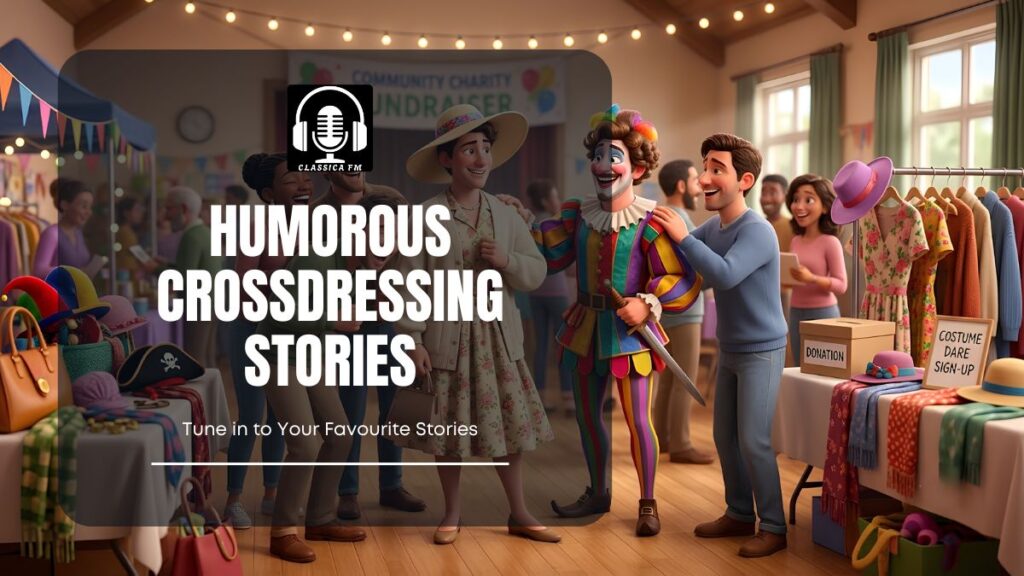
Humorous crossdressing stories bring together comedy, mistaken assumptions, unexpected situations, and everyday awkwardness. At their best, these stories are not simply about clothing. They explore confidence, friendship, identity, embarrassment, social expectations, and the funny situations that can happen when someone unexpectedly steps outside their usual appearance.
This article explores humorous crossdressing stories as a genre, what makes them entertaining, the themes commonly found in them, and why readers enjoy lighthearted stories built around wardrobe surprises and role reversals. The focus here is on the genre itself rather than individual stories.
What Are Humorous Crossdressing Stories?
Humorous crossdressing stories are fictional or anecdotal narratives in which a character wears clothing traditionally associated with another gender, often resulting in amusing circumstances.
The humor can come from many different sources. A character might accidentally end up wearing the wrong outfit, agree to help a friend with a costume, participate in a theatrical performance, accept a challenge, attend a themed event, or discover that an unexpected change in appearance creates a chain of funny misunderstandings.
The strongest stories generally make the situation the source of comedy rather than making the character themselves the joke.
This distinction matters because crossdressing can mean different things to different people. For one character, it may be a temporary costume or playful experiment. For another, it may be connected to self-expression or personal identity. Humorous storytelling can accommodate these different possibilities while keeping the narrative light and entertaining.
Humorous Crossdressing Stories
The Substitute for the Fashion Show
Daniel Mercer had always believed that there were three things he should never do.
He should never sing karaoke in public.
He should never agree to help friends move house.
And, under absolutely no circumstances, should he ever walk down a fashion runway wearing women’s clothing.
The third rule had never actually needed to be stated aloud. It was simply one of those private assumptions a person carried through life.
Daniel was twenty-nine, worked as an accountant, owned far too many identical blue shirts, and considered himself perfectly comfortable with his ordinary routine. His idea of fashion was buying two pairs of trousers when they were on sale.
So when his best friend Sophie called him on a Saturday afternoon and asked for help with a fashion show, Daniel assumed he would be carrying boxes.
He was wrong.
Very wrong.
The fashion show was being held at the old Riverside Hall, a renovated building in the center of town that normally hosted wedding receptions, charity dinners, and local theater performances.
Sophie had spent months preparing for the event.
She designed clothes for a small independent fashion label and had finally been given the opportunity to showcase her collection in front of several local buyers.
Daniel had promised to help.
“You’re just helping backstage,” Sophie had told him.
“Define helping.”
“Carrying things.”
“Excellent.”
“Moving racks.”
“Fine.”
“Maybe fixing something if it breaks.”
“Within reason.”
Sophie had laughed.
“Daniel, you’re an accountant. What could possibly go wrong?”
He would later remember that sentence with considerable regret.
By five o’clock, Riverside Hall was chaotic.
Models hurried between dressing rooms. Makeup artists carried brushes and palettes. Photographers tested their cameras. Music technicians argued about speakers.
Daniel stood backstage beside three clothing racks.
“Where do these go?” he asked.
“Second dressing room,” Sophie shouted.
Daniel grabbed a rack.
Then another.
Then a third.
For nearly two hours, everything went perfectly.
He began to relax.
At seven thirty, Sophie suddenly appeared looking terrified.
“Daniel!”
He knew immediately that something was wrong.
“What happened?”
“Clara isn’t here.”
“Who is Clara?”
“The final model.”
Daniel looked at the clock.
“Is she late?”
“She called. Her car broke down.”
“Can someone else do it?”
Sophie shook her head.
“The final outfit was designed specifically for her.”
Daniel glanced toward the garment rack.
“Can’t another model wear it?”
“It’s tailored for Clara.”
“Alter it.”
“Daniel.”
“What?”
“There’s twenty minutes until the finale.”
He slowly understood where the conversation was going.
“No.”
Sophie blinked.
“I haven’t asked you anything.”
“You were about to.”
“Was I?”
“Yes.”
She smiled.
“You know me too well.”
“No.”
“Daniel.”
“No.”
“You don’t even know what I’m asking.”
“I absolutely know.”
Sophie grabbed his arm.
“Please.”
“No.”
“It’s one walk.”
“No.”
“Thirty seconds.”
“No.”
“The audience won’t even know.”
Daniel stared at her.
“That’s precisely what I’m worried about.”
Five minutes later, Daniel was standing inside the dressing room staring at himself in the mirror.
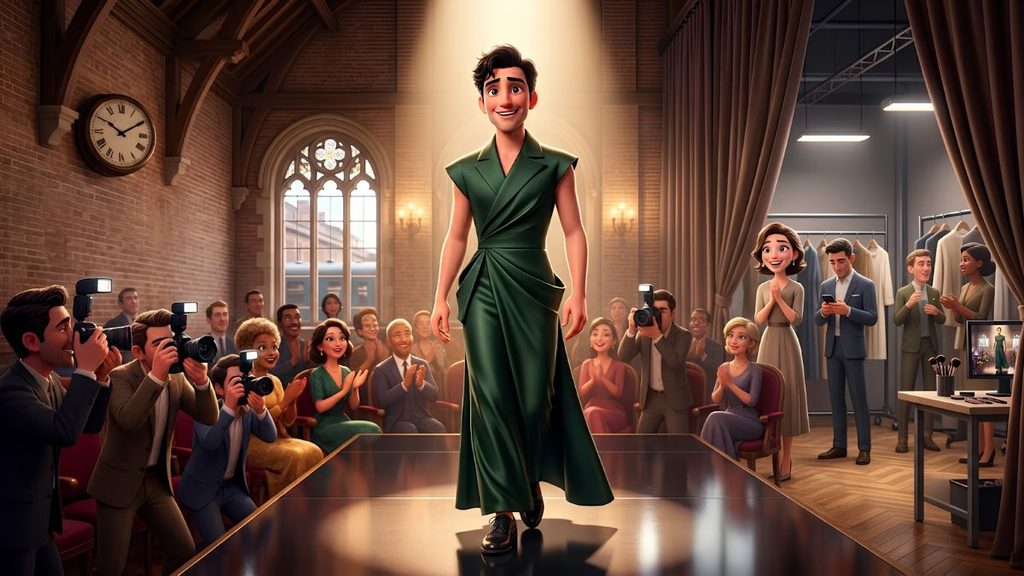
He was wearing the final outfit.
It consisted of a sophisticated dark-green dress with a fitted waist, a matching jacket, and a pair of elegant shoes that made him feel as though the floor had personally declared war on him.
His hair had been adjusted slightly.
Makeup had been applied lightly.
He stared at his reflection.
Sophie stood behind him.
“See?”
Daniel narrowed his eyes.
“See what?”
“You look great.”
“I look like someone who has made several terrible decisions.”
She laughed.
“You look completely different.”
“That’s not reassuring.”
“It’s supposed to be.”
Daniel looked down at the shoes.
“How do people walk in these?”
“Normally.”
“I have never seen anyone walk normally in these.”
Sophie handed him a small mirror.
“Just remember the routine.”
“There is a routine?”
“Walk to the end, pause, turn, walk back.”
“That’s the entire routine?”
“Yes.”
Daniel exhaled.
“I can do that.”
Sophie smiled.
“Exactly.”
Then she added:
“One more thing.”
“What?”
“There are photographers.”
Daniel closed his eyes.
“Of course there are.”
The show began.
From behind the curtain, Daniel watched the first models walk onto the runway.
The audience applauded.
The music was dramatic.
The lighting was beautiful.
Daniel’s heartbeat became increasingly loud.
“You’ll be fine,” Sophie whispered.
“I don’t think my heart agrees.”
The models continued.
One after another.
Then Sophie looked at him.
“You’re next.”
Daniel swallowed.
“Already?”
“Yes.”
“Maybe the audience will leave.”
“They won’t.”
“Maybe the building will lose electricity.”
“It won’t.”
“Maybe—”
“Daniel.”
He sighed.
“Fine.”
The curtain opened.
Daniel stepped onto the runway.
For the first two seconds, he forgot how to breathe.
Then something strange happened.
Nobody laughed.
Nobody pointed.
Nobody looked shocked.
People simply watched.
The music continued.
Daniel took another step.
Then another.
His nervousness slowly began to disappear.
He reached the end of the runway.
Paused.
Turned.
And walked back.
He almost smiled.
He had done it.
Thirty seconds.
Finished.
Then he heard someone shout from the audience.
“Beautiful!”
Daniel’s confidence disappeared again.
But he kept walking.
Backstage, Sophie hugged him.
“You did it!”
Daniel laughed nervously.
“I survived.”
“You were fantastic.”
“I nearly fell twice.”
“But you didn’t.”
A photographer appeared.
“Excuse me!”
Daniel turned.
“Yes?”
“I’m from the local magazine. Could I get a photograph?”
Daniel looked at Sophie.
Sophie was trying very hard not to laugh.
“Sure,” Daniel said cautiously.
The photographer positioned him near the backdrop.
“Perfect.”
Flash.
Another photograph.
Flash.
Daniel began to feel increasingly uncomfortable.
Then the photographer smiled.
“Would you mind doing a few more?”
Daniel glanced at Sophie.
She gave him a helpless shrug.
He posed again.
Flash.
The real disaster happened ten minutes later.
Daniel had changed back into his regular clothes and was carrying a box of accessories when a woman approached him.
“Excuse me.”
“Yes?”
“I’m looking for the model who wore the green outfit.”
Daniel froze.
“Why?”
“I represent a boutique in the city. We’d love to know who designed it.”
Daniel pointed toward Sophie.
“That’s my friend.”
The woman smiled.
“Wonderful. And the model?”
Daniel hesitated.
Sophie appeared behind him.
“This is Daniel.”
The woman smiled.
“Daniel?”
“Yes.”
“You were wonderful.”
Daniel looked at Sophie.
Sophie looked at the floor.
The woman continued.
“We would love to have you at our next promotional event.”
Daniel’s mouth opened.
Nothing came out.
Sophie finally rescued him.
“Daniel doesn’t normally model.”
The woman laughed.
“Neither did half the people who started.”
Daniel looked horrified.
Later that evening, the event ended.
The hall slowly emptied.
Daniel sat outside on the steps, wearing his ordinary clothes again.
Sophie sat beside him.
“You okay?”
“Yes.”
“Regret it?”
Daniel thought for a moment.
“Honestly?”
“Honestly.”
“No.”
Sophie smiled.
“Really?”
“I hated the first thirty seconds.”
“Understandable.”
“But after that…”
He shrugged.
“It wasn’t terrible.”
Sophie nudged him.
“You enjoyed it.”
“Don’t exaggerate.”
“You enjoyed it.”
Daniel laughed.
“Maybe a little.”
She grinned.
“Would you do it again?”
Daniel immediately shook his head.
“No.”
A pause.
“Probably.”
Sophie burst out laughing.
Daniel laughed too.
Then his phone buzzed.
He looked at the screen.
It was an email from the local boutique.
They wanted to discuss a possible appearance at their next event.
Daniel stared at it.
“Sophie.”
“What?”
“I think my evening just became a lot more complicated.”
She looked at the message.
Then she smiled.
“Welcome to fashion.”
Daniel put the phone away.
“One event.”
“Of course.”
“That’s it.”
“Absolutely.”
He looked at her suspiciously.
“You are already planning something, aren’t you?”
Sophie stood up.
“Me?”
“Yes.”
“I have no idea what you’re talking about.”
Daniel laughed.
As they walked toward the parking lot, he glanced once more at Riverside Hall.
Earlier that afternoon, he had entered the building believing that the only thing he would have to do was carry clothing racks.
Instead, he had walked a runway.
He had survived an unexpected transformation.
He had discovered that strangers could be surprisingly accepting.
Most importantly, he had learned something about himself.
Trying something completely outside his comfort zone had not destroyed his dignity.
It had simply given him a story.
And, judging by the email on his phone, perhaps several more stories were waiting.
Daniel smiled.
“Just don’t tell anyone at the office.”
Sophie laughed.
“No promises.”
“Especially not Marcus.”
“Why?”
“Because he’ll never let me forget it.”
Sophie considered this.
“You’re probably right.”
Daniel sighed.
“Then I suppose I’ll have to get used to being famous.”
“You’re not famous.”
“I walked a runway.”
“For thirty seconds.”
“Thirty very important seconds.”
Sophie laughed all the way to the car.
And Daniel, despite himself, laughed too.
The fashion show had begun as one of the most embarrassing favors he had ever agreed to.
It ended as one of the funniest adventures of his life.
And somewhere in a local photographer’s camera, Daniel Mercer was permanently preserved in a green dress, confidently walking beneath the runway lights.
He would never admit it publicly.
But he was secretly quite proud of that photograph.
The Mystery Dress in Apartment 4B
Noah Bennett had always considered himself a reasonably responsible person.
He paid his bills on time.
He remembered birthdays.
He returned borrowed books.
He even separated his recycling properly, which his landlord had once described as “surprisingly impressive.”
There was, however, one area of life where Noah was hopelessly disorganized.
Online shopping.
Packages arrived at his apartment almost every week, and Noah had developed a habit of bringing them inside without checking the label carefully.
Usually, this caused no problems.
Usually.
It was a Tuesday evening when everything changed.
Noah had just returned from work when he noticed two packages sitting outside his apartment door.
One was clearly his.
The other was not.
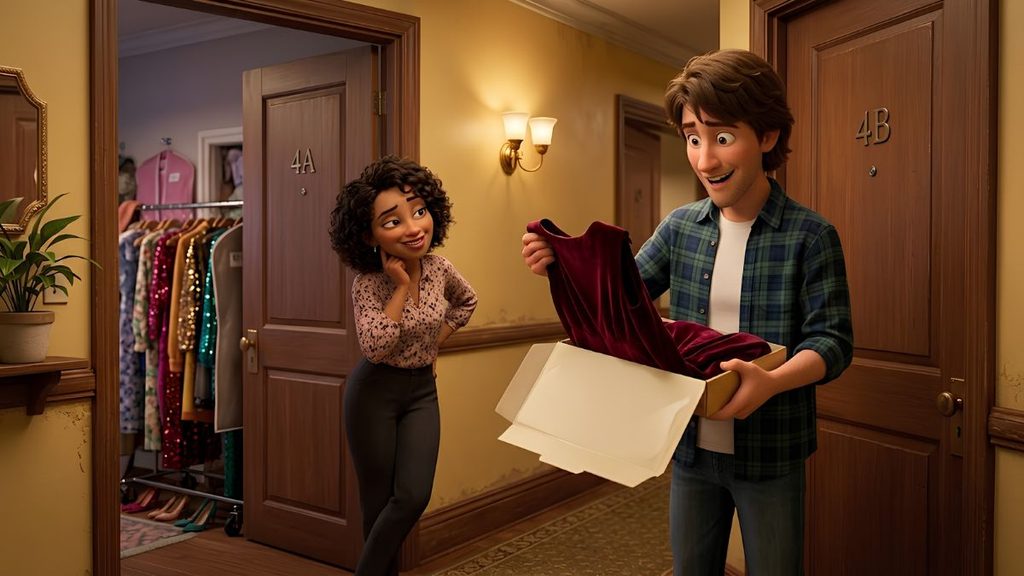
The unfamiliar package was larger, wrapped in pale cream paper, and had a handwritten label.
Apartment 4B.
Noah lived in Apartment 4A.
He looked toward the neighboring door.
4B was occupied by a woman named Amelia Hart, whom Noah had seen around the building several times.
They had exchanged polite greetings in the elevator but had never really spoken.
Noah picked up the package.
“I’ll give it to her.”
He knocked.
Nothing.
He knocked again.
Still nothing.
He checked his phone.
It was almost eight.
Perhaps Amelia was out.
Noah looked at the package again.
The label was slightly torn.
The name underneath was barely visible.
He hesitated.
Then he made his first mistake.
He brought the package into his apartment.
“I’ll give it back tomorrow.”
That was what Noah told himself.
He placed the package on his kitchen table.
Then he made dinner.
Then he watched television.
Then he forgot about it.
At around ten thirty, there was a knock at his door.
Noah opened it.
A man in a navy jacket stood outside.
“Excuse me,” the man said. “Are you from 4B?”
“No.”
The man looked confused.
“I’m looking for Amelia.”
“She lives next door.”
“I know. She asked me to collect something.”
Noah immediately remembered the package.
“Oh.”
He turned toward the table.
“I have something for her.”
The man looked relieved.
“Perfect.”
Noah picked up the package.
Then he noticed something.
The package had been opened.
He stared at it.
He didn’t remember opening it.
Then he remembered.
He had opened it earlier while looking for the delivery label.
He had seen the contents.
And immediately closed it again.
Inside was a dress.
A very elegant dress.
Dark red.
Long.
Beautifully tailored.
Noah had assumed Amelia was expecting it.
He held the package out.
“Here.”
The man took it.
Then frowned.
“This isn’t it.”
“What?”
He opened the package.
His expression changed.
“That’s definitely not what I’m collecting.”
Noah stared at him.
“Then what is it?”
The man looked equally confused.
“I don’t know.”
They both stared at the dress.
There was an uncomfortable silence.
Finally, the man said:
“Maybe it’s a mistake.”
“Probably.”
He handed the package back.
“I’ll wait for Amelia.”
“She isn’t home.”
“Right.”
Another silence.
Then the man left.
Noah closed the door.
He stared at the package.
Something about the whole situation felt strange.
The next morning, Noah found another note outside Apartment 4B.
PLEASE DO NOT MOVE ANYTHING FROM THE HALLWAY. EVENT PREPARATIONS START AT 6 PM.
Noah frowned.
Event preparations?
He had no idea Amelia was organizing an event.
At six that evening, the hallway became unexpectedly busy.
Two women carried boxes into Apartment 4B.
A man brought flowers.
Someone rolled in a clothing rack.
Noah watched through his slightly open door.
Then Amelia finally arrived.
She was carrying a large handbag and looked exhausted.
“Noah?”
He stepped outside.
“Hi.”
“Did you happen to receive one of my packages?”
“Yes.”
“Thank goodness.”
She walked toward him.
Then stopped.
“Where is it?”
Noah pointed inside.
“Come in.”
She entered his apartment.
Noah handed her the package.
She opened it.
Then her eyes widened.
“Where did this come from?”
“Your delivery.”
“I didn’t order this.”
Noah stared at her.
“You didn’t?”
“No.”
She lifted the dress carefully.
It was stunning.
Noah looked at it.
“So whose is it?”
Amelia checked the label.
The name was partially hidden.
“Marina.”
“Do you know a Marina?”
Amelia thought.
“My cousin.”
“Maybe she sent it to you.”
“She lives in another city.”
She turned the dress over.
A small card fell out.
Amelia picked it up.
Her eyes widened again.
“Oh.”
“What?”
She read the card.
Then laughed.
“This is for tonight.”
“What is tonight?”
“My friend’s charity fashion event.”
Noah blinked.
“You’re hosting a fashion event?”
“Helping organize one.”
“And this dress belongs to one of the models?”
“Apparently.”
She looked at him.
Then at the dress.
Then back at him.
“There’s a problem.”
“What?”
“The model is already here.”
Noah frowned.
“Then why did the dress come here?”
“I have no idea.”
An hour later, Apartment 4B looked like a backstage dressing room.
Clothes hung everywhere.
Shoes were scattered across the floor.
Someone had placed a large mirror against the wall.
Several people rushed around preparing for the event.
Noah stood near the doorway.
He had intended to return the dress and leave.
Instead, Amelia had asked him to stay for five minutes.
The five minutes had somehow become an hour.
“Can you hold this?”
“Sure.”
“Can you move that?”
“Okay.”
“Can you please stop standing in the doorway?”
“Sorry.”
Noah began helping.
He carried boxes.
He moved chairs.
He fixed a crooked picture.
Eventually, he started feeling useful.
Then Amelia appeared holding the mysterious red dress.
“Noah.”
He immediately became suspicious.
“No.”
“I haven’t said anything.”
“You don’t need to.”
“We have a problem.”
“What’s the problem?”
“The model who is supposed to wear this dress has disappeared.”
Noah stared at her.
“Disappeared?”
“Not literally.”
“Good.”
“She left her phone here.”
“Less good.”
“She was supposed to go on in twenty minutes.”
“And?”
“And the dress fits you.”
Noah laughed.
Then realized she wasn’t joking.
“No.”
Amelia smiled.
“Just try it.”
“No.”
“Please.”
“Absolutely not.”
“Nobody will know.”
“Everyone will know.”
“It’s a charity event. Everyone is too busy.”
“No.”
Amelia crossed her arms.
“Noah, you already helped me carry six boxes.”
“That doesn’t mean I’m wearing a dress.”
“Seven boxes.”
“No.”
“Eight.”
“That argument isn’t working.”
She sighed.
“Fine.”
Then she smiled.
“I’ll ask someone else.”
Noah relaxed.
Five seconds later, Amelia returned.
“No one else can wear it.”
He closed his eyes.
“You planned this.”
“I absolutely did not.”
Twenty minutes later, Noah stood behind a folding screen.
He had agreed.
He wasn’t entirely sure why.
Perhaps it was the pressure.
Perhaps it was curiosity.
Perhaps it was simply one of those strange moments when refusing became more exhausting than agreeing.
Amelia stood outside the screen.
“You okay?”
“Yes.”
“You sure?”
“No.”
She laughed.
Noah looked at himself in the mirror.
The dark-red dress fit surprisingly well.
He had expected it to look ridiculous.
Instead, it looked like an actual formal outfit.
That somehow made the situation more embarrassing.
Amelia handed him a pair of shoes.
“No.”
“Please.”
“No.”
“Fine.”
She placed them on the floor.
Noah stared at them.
Then sighed.
Five minutes later, he stepped out.
Amelia froze.
Then smiled.
“Wow.”
Noah looked nervous.
“Don’t say wow.”
“Why?”
“Because that makes it worse.”
“You actually look fantastic.”
“That’s even worse.”
She laughed.
The event was held downstairs in the building’s courtyard.
Guests began arriving.
Noah stayed backstage.
He planned to walk onto the small platform, stand there for thirty seconds, and leave.
Simple.
Easy.
No problem.
Then Amelia rushed over.
“Change of plan.”
“No.”
“I haven’t said it yet.”
“No.”
“The host has lost her voice.”
Noah stared at her.
“What does that have to do with me?”
“You have to introduce the next model.”
He laughed.
“Absolutely not.”
“Please.”
“No.”
“You’re already dressed.”
“That’s not a qualification.”
“You’re the only person who knows the running order.”
“Because you gave me the clipboard.”
“Exactly.”
Noah looked at the clipboard.
He looked at Amelia.
Then at the audience.
People were already sitting down.
He sighed.
“Fine.”
Noah stepped onto the platform.
The crowd applauded politely.
He held the microphone.
“Good evening.”
His voice sounded strange through the speakers.
He looked down at his notes.
“Thank you for coming.”
A woman in the front row smiled.
Noah continued.
He introduced the next model.
Then another.
Then another.
It was going surprisingly well.
Until someone shouted:
“Great outfit!”
The crowd laughed.
Noah smiled awkwardly.
“Thank you.”
Then he realized the person had been complimenting the dress.
He laughed too.
The tension disappeared.
Suddenly, the whole thing felt funny rather than terrifying.
Noah continued introducing the models.
At one point, he accidentally announced the wrong name.
The audience laughed.
He corrected himself.
More laughter.
By the end of the show, people were applauding.
Noah stepped backstage.
Amelia hugged him.
“You were amazing.”
“I made three mistakes.”
“Nobody cared.”
“I nearly announced the wrong designer.”
“But you didn’t.”
Noah looked down at the dress.
“I can’t believe I actually did that.”
Amelia smiled.
“Neither can I.”
Later that night, Noah changed back into his normal clothes.
The mysterious dress had finally found its owner.
Marina had arrived at the event after getting lost on the way.
She apologized repeatedly.
“I cannot believe my package went to the wrong apartment.”
Noah laughed.
“I can’t believe I ended up wearing it.”
Marina looked surprised.
“You wore it?”
“Briefly.”
Amelia interrupted.
“For almost the entire event.”
Noah looked at her.
“You promised not to mention that.”
“I promised nothing.”
Everyone laughed.
The following morning, Noah found another package outside Apartment 4A.
He looked at the label.
His name.
Correct address.
He sighed with relief.
Then he noticed a note taped to the top.
For the future fashion presenter.
Noah stared at it.
He knocked on Amelia’s door.
She opened it.
He held up the package.
“Really?”
She smiled.
“Open it.”
“No.”
“Why?”
“Because I know you.”
She laughed.
“You’ll never know what’s inside.”
Noah shook his head.
“That’s exactly what worries me.”
He returned to his apartment.
For several minutes, he simply stared at the package.
Then, despite himself, he smiled.
He opened it.
Inside was a coffee mug.
Printed across it were the words:
I Survived Apartment 4B Fashion Week.
Noah burst out laughing.
He kept the mug.
And from that day forward, whenever a package appeared outside his apartment, he checked the address three times.
Because Noah had learned an important lesson.
A misplaced package could lead to almost anything.
Even a fashion show.
And apparently, Apartment 4B had no shortage of surprises.
The Charity Challenge Nobody Expected
Ethan Cole had a simple philosophy about charity events.
Donate money.
Buy a raffle ticket.
Eat the cake.
Go home.
He believed charity was important, of course. He simply preferred supporting good causes without becoming personally involved in anything embarrassing.
Unfortunately, his friends knew this about him.
And they also knew exactly how to exploit it.
It happened on a sunny Saturday afternoon during the annual Riverside Community Fair.
The fair had everything a small town could possibly need for a Saturday.
There were food stalls, handmade crafts, children’s games, live music, a secondhand book table, and a large stage in the center of the park.
At the far end stood a colorful banner:
THE RIDICULOUS CHARITY CHALLENGE
Ethan had deliberately avoided looking at it.
His friend Marcus had not.
“Come on,” Marcus said.
“No.”
“You haven’t even heard the challenge.”
“I don’t need to.”
“You might enjoy it.”
“I know you.”
Marcus grinned.
“That’s hurtful.”
“It’s accurate.”
Their other friend Liam joined them.
“What’s happening?”
“Trying to convince Ethan to participate.”
Liam laughed.
“Good luck.”
Ethan pointed at both of them.
“I am warning you now. Whatever you’re planning, I’m not doing it.”
Marcus raised both hands.
“Fine.”
Ethan relaxed.
That was his second mistake.
The charity challenge was simple.
Participants picked a card from a large glass bowl.
Each card contained a ridiculous task.
The stranger the task, the more money sponsors donated.
One person had to sing a children’s song in the town square.
Another had to wear a giant inflatable dinosaur costume for an hour.
Someone else had to attempt a dramatic reading of a romance novel while wearing a fake mustache.
The crowd loved it.
Ethan did not.
“This is exactly why I don’t participate,” he said.
Marcus smiled.
“You’re afraid.”
“I’m sensible.”
“Same thing.”
Ethan ignored him.
Then Liam held up a card.
“How about this one?”
Ethan looked.
“What’s it say?”
“Spend two hours dressed in an outfit selected by your friends while collecting donations.”
Ethan stared at him.
“No.”
Marcus laughed.
“Why not?”
“Because I said so.”
“It’s for charity.”
“I’ll donate.”
“That’s not the challenge.”
“I’ll donate more.”
Marcus shook his head.
“You can’t buy your way out of this.”
“Watch me.”
Twenty minutes later, Ethan was standing beside the stage.
He had somehow agreed to participate.
He still wasn’t sure how.
The rules were straightforward.
His friends would select his outfit.
He would wear it for two hours.
He would walk through the fair collecting donations.
He could not reveal that he had chosen the outfit himself.
And every time someone donated, he had to take a photograph with the donor.
The goal was to raise as much money as possible.
Ethan looked at Marcus.
“You’re enjoying this.”
“Immensely.”
Liam appeared carrying a garment bag.
Ethan immediately became suspicious.
“What is that?”
“Your outfit.”
“Why is it in a garment bag?”
“Because we’re professionals.”
Marcus opened it.
Ethan stared.
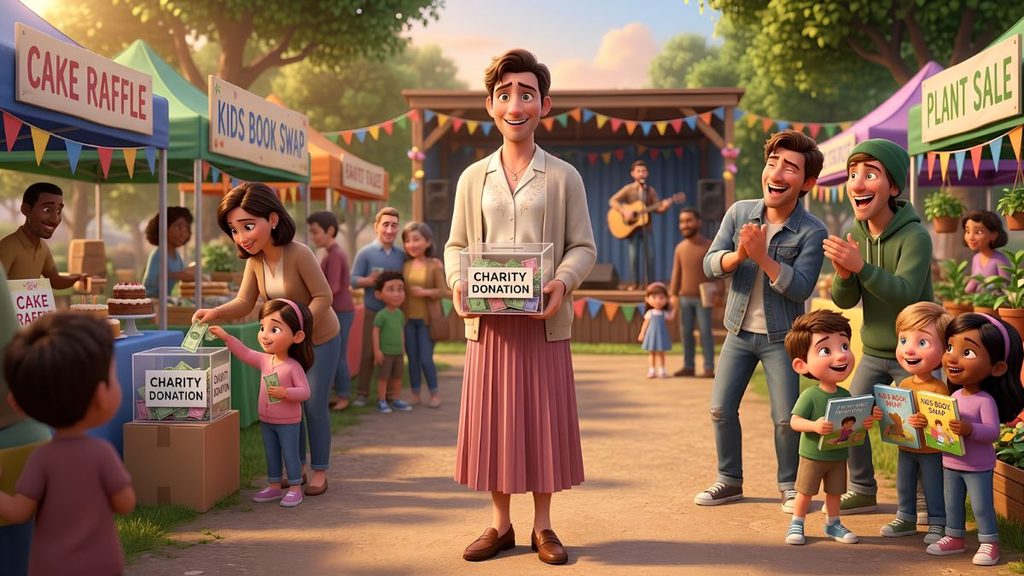
Inside was a carefully assembled outfit consisting of a fashionable blouse, a long pleated skirt, a lightweight cardigan, and several accessories.
Ethan’s mouth fell open.
“You have got to be kidding.”
“No.”
“You actually planned this?”
Marcus smiled.
“Last night.”
Ethan looked at Liam.
“You helped?”
“Absolutely.”
Ethan sighed.
“I hate both of you.”
“That’s fine.”
The organizers had arranged a private changing area behind the stage.
Ethan stood inside, staring at the clothes.
For a moment, he considered quitting.
Then he remembered the purpose of the challenge.
It was for charity.
Children’s education programs.
That mattered.
He took a deep breath.
“Okay.”
A few minutes later, he stepped outside.
Marcus and Liam were waiting.
They stared.
Then Marcus slowly smiled.
“You look fantastic.”
Ethan pointed at him.
“Don’t.”
“I’m serious.”
“Don’t make this worse.”
Liam laughed.
“Honestly, it works.”
Ethan looked down at himself.
He had expected the outfit to feel ridiculous.
Instead, it simply felt unfamiliar.
That was the strange part.
The clothes were comfortable.
The cardigan was soft.
The shoes were easier to walk in than he had expected.
He adjusted his hair nervously.
“Let’s get this over with.”
Marcus handed him a donation box.
“Two hours.”
Ethan sighed.
“Two hours.”
The first donor was an elderly woman named Mrs. Wilson.
She approached Ethan with a smile.
“I’ve been waiting for you.”
Ethan blinked.
“For me?”
“Of course.”
She placed some money in the box.
Then she laughed.
“You look wonderful.”
Ethan smiled awkwardly.
“Thank you.”
“Are you having fun?”
“Ask me in two hours.”
She laughed.
Marcus took a photograph.
Ethan continued walking.
The next donor was a teenager with his parents.
Then a group of office workers.
Then a family eating ice cream.
People reacted differently.
Some laughed.
Some complimented the outfit.
Some simply donated and moved on.
Ethan began to relax.
After thirty minutes, he realized something.
Nobody really cared.
They were there for the charity.
The outfit was just part of the entertainment.
That realization made the challenge much easier.
Then came the unexpected moment.
Ethan was walking past the food stalls when a little girl approached him.
She couldn’t have been more than eight.
“Are you a princess?”
Ethan froze.
Her mother looked embarrassed.
“I’m sorry.”
Ethan smiled.
“It’s okay.”
The little girl looked at the outfit.
“You look like one.”
Ethan crouched down.
“Thank you.”
She put a coin into the donation box.
“My grandmother gave me this.”
Ethan looked at the coin.
“That’s very kind.”
The little girl smiled.
“My school needs new books.”
Ethan’s expression softened.
“Then this will help.”
She nodded proudly.
Her mother took a photograph.
Ethan smiled.
For the first time that afternoon, he stopped thinking about himself.
The challenge suddenly felt meaningful.
An hour passed.
Then another thirty minutes.
Ethan was now surprisingly comfortable.
He had collected considerably more money than expected.
People recognized him as the “charity challenge guy.”
A group of college students even started cheering when they saw him.
“Ethan!”
He turned.
“How do you know my name?”
Marcus appeared behind him.
“I may have made a sign.”
Ethan looked.
A cardboard sign read:
ETHAN NEEDS YOUR DONATION. HE ALSO NEEDS BETTER FRIENDS.
Ethan laughed.
“Very funny.”
The students donated.
Marcus took another photograph.
Then something unexpected happened.
A local business owner approached Ethan.
“I’ve been watching this.”
Ethan smiled.
“Thank you.”
“I’d like to make a donation.”
The man handed him an envelope.
Ethan looked inside.
His eyes widened.
“That’s a lot.”
“It’s for the children’s reading program.”
Ethan looked toward the charity organizers.
They were stunned.
The donation was larger than anything collected that day.
People began applauding.
Ethan felt embarrassed.
But he was also proud.
At the end of the two hours, Ethan returned to the stage.
The organizer counted the donations.
Everyone waited.
Finally, she announced the amount.
The crowd cheered.
Ethan stared.
They had raised several times more than the original target.
Marcus hugged him.
Ethan laughed.
“Okay.”
“What?”
“You were right.”
Marcus looked shocked.
“About what?”
“This was actually worth doing.”
Marcus smiled.
“I knew it.”
“Don’t get carried away.”
Liam joined them.
“You have to admit, you looked good.”
Ethan shook his head.
“One compliment.”
“Just one.”
“Then we’re done.”
The organizers invited Ethan onto the stage.
“We’d like to thank Ethan for helping us raise such an incredible amount today.”
The crowd applauded.
Ethan stepped forward.
He wasn’t sure what to say.
Then he noticed the little girl from earlier standing near the front.
She was holding a small picture she had drawn.
It showed a person wearing a colorful outfit standing beside a large donation box.
She held it up.
Ethan smiled.
“Thank you.”
The crowd became quiet.
Ethan looked at the audience.
“I thought this was going to be embarrassing.”
People laughed.
“So I spent the first half hour worrying about what everyone thought.”
He paused.
“But then I realized something.”
He looked at the donation box.
“Nobody came here to judge me. They came here to help.”
The crowd applauded.
“And if wearing an unusual outfit for two hours can help buy books for children, then I suppose it’s not such a terrible thing.”
The applause grew louder.
Ethan smiled.
“Although I would like to formally request that my friends never organize another challenge.”
Marcus shouted from the crowd:
“Too late!”
Everyone laughed.
After the event, Ethan changed back into his regular clothes.
He returned the outfit carefully.
Then he walked toward his friends.
“So.”
Marcus smiled.
“So?”
“How much did we raise?”
Marcus told him.
Ethan nodded.
“That’s amazing.”
“Yes.”
Ethan looked at the empty donation boxes.
“I’m glad I did it.”
Liam smiled.
“You know what that means.”
“What?”
“You’ll have to participate next year.”
Ethan immediately shook his head.
“No.”
Marcus laughed.
“Why not?”
“Because I’ve learned my lesson.”
“What lesson?”
“Never trust your friends near a charity event.”
They laughed.
Then Ethan looked toward the park.
Families were still walking around.
Children were carrying books donated by local businesses.
Volunteers were packing away tables.
The little girl he had met earlier ran past him holding her drawing.
She stopped.
“Ethan!”
He turned.
She gave him a quick wave.
“Bye, princess!”
Ethan stared at her.
His friends burst into laughter.
He covered his face.
“She is never going to let me forget this.”
Marcus put an arm around his shoulder.
“Neither are we.”
Ethan laughed.
“Fine.”
He looked back at the little girl.
“Bye.”
She waved again.
Then disappeared into the crowd.
Ethan smiled.
The charity challenge had begun as something he wanted desperately to avoid.
He had expected embarrassment.
Instead, he had found laughter, unexpected confidence, and a reminder that sometimes stepping outside your comfort zone could make a real difference.
He still wasn’t planning to become a regular participant in ridiculous charity challenges.
But he did keep one photograph from that afternoon.
It showed him standing beneath the charity banner, wearing his unexpected outfit, holding the donation box, and smiling.
Whenever he looked at it, he remembered something important.
The funniest moments in life are sometimes the ones we never planned.
And occasionally, the most embarrassing challenge can become the most rewarding adventure.
As Ethan left the fairground, his phone buzzed.
A message from Marcus.
Next year’s challenge?
Ethan typed back immediately.
Absolutely not.
Three dots appeared.
Then:
We’ll discuss it later.
Ethan laughed.
He already knew he was in trouble.
The Wedding Planner’s Emergency Assistant
Oliver Hayes had attended enough weddings to know that something always went wrong.
A flower arrangement would arrive late.
Someone would forget the rings.
An uncle would give a speech that lasted forty minutes instead of five.
Or, in particularly memorable cases, the wedding cake would mysteriously disappear before the photographs.
But Oliver had never expected to become part of the problem.
He certainly had not expected to spend a Saturday afternoon wearing a formal dress while carrying a clipboard through a luxury wedding venue.
Yet that was exactly what happened.
It all started with a favor.
Oliver’s sister Emma was a professional wedding planner.
She was exceptionally good at her job.
She could organize two hundred guests, coordinate six vendors, solve transportation problems, and calm nervous bridesmaids while simultaneously answering three phone calls.
Oliver, on the other hand, was good at assembling furniture and remembering where he had parked his car.
Still, Emma occasionally asked him for help.
On this particular Saturday, she needed someone to assist at a large wedding.
“Just for the afternoon,” she promised.
“What do I have to do?”
“Carry boxes.”
Oliver nodded.
“I can carry boxes.”
“And move some decorations.”
“Fine.”
“And maybe help with the entertainment.”
Oliver paused.
“What does that mean?”
Emma smiled.
“Nothing complicated.”
He should have known better.
The wedding was being held at the Grand Willow Estate, a beautiful countryside venue surrounded by gardens.
The bride, Charlotte, was marrying her longtime partner James.
Everything had been planned perfectly.
There were white flowers everywhere.
Tables were covered with elegant linen.
A string quartet was preparing near the terrace.
The reception hall looked like something from a magazine.
Oliver arrived at noon wearing a simple suit.
Emma immediately handed him a clipboard.
“You’re officially my assistant.”
“I thought I was carrying boxes.”
“You are.”
He looked at the clipboard.
“What’s this?”
“Wedding schedule.”
“It’s twelve pages.”
“Yes.”
“Why?”
“Because weddings are complicated.”
Oliver sighed.
“Where are the boxes?”
Emma pointed across the hall.
“There.”
Oliver spent the next two hours moving decorations, checking deliveries, and trying to understand why one particular vase required three people to carry.
Then, at three fifteen, Emma received a phone call.
Her expression changed.
Oliver immediately knew something was wrong.
“What happened?”
She lowered the phone.
“We have a problem.”
“What kind?”
“The performance.”
“What performance?”
“The surprise performance during the reception.”
Oliver frowned.
“What about it?”
“The lead performer isn’t here.”
“Where are they?”
“Hospital.”
Oliver’s eyes widened.
“Are they okay?”
“Yes. Nothing serious. But they can’t perform.”
Emma looked around the room.
“We need someone to replace them.”
Oliver laughed.
“Good luck.”
Emma stared at him.
“No.”
“What?”
“No.”
“Emma.”
“No.”
“You haven’t even asked.”
“I know what you’re thinking.”
“You’re the only person I know who can remember the choreography.”
Oliver stared at her.
“I don’t know the choreography.”
“You watched rehearsals.”
“Once.”
“Twice.”
“That does not qualify me as a performer.”
Emma smiled.
“You don’t need to dance much.”
“What do I need to do?”
She hesitated.
“Mostly walk.”
Oliver narrowed his eyes.
“That sounds suspicious.”
Twenty minutes later, Oliver discovered why.
The missing performer was supposed to appear during a humorous musical number.
The performance involved a group of dancers dressed as characters from an old-fashioned romantic comedy.
One of the costumes was still hanging backstage.
It was elegant.
It was elaborate.
And it was clearly designed for a woman.
Oliver stared at it.
“No.”
Emma smiled nervously.
“Please.”
“No.”
“It’s for the wedding.”
“No.”
“The bride knows.”
Oliver looked toward Charlotte.
The bride was standing nearby.
She smiled.
“Please.”
Oliver sighed.
“Why does everyone keep asking me?”
“Because you said you would help,” Emma replied.
“I meant boxes.”
Charlotte laughed.
“We’ll never forget you for this.”
Oliver looked at the dress again.
“I already regret it.”
The costume was more complicated than Oliver expected.
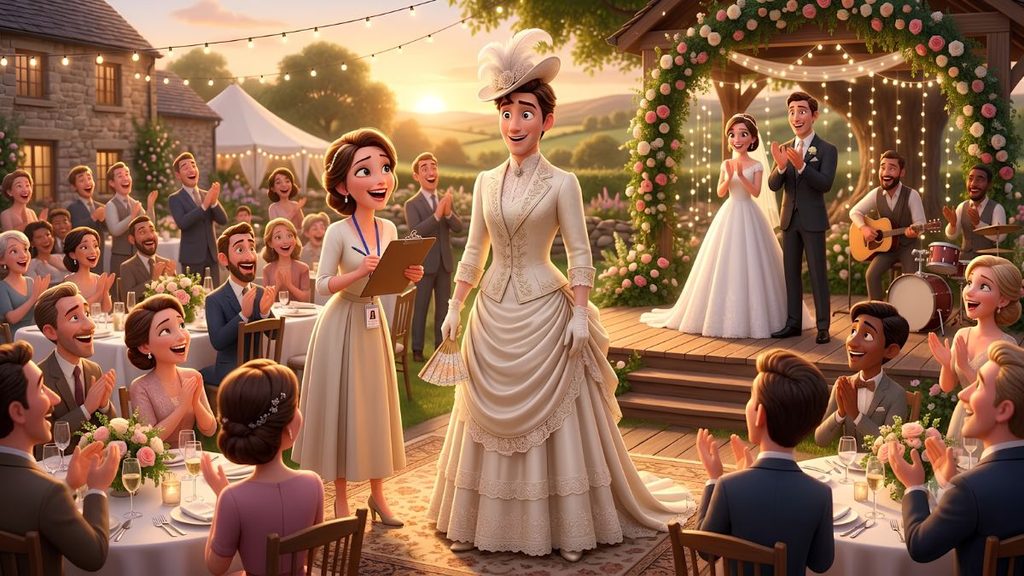
There was a long cream-colored dress, a fitted jacket, gloves, a decorative hat, and several accessories.
The wardrobe assistant helped him get everything arranged.
Oliver stood behind a screen.
“This is ridiculous.”
Emma laughed.
“You’re doing great.”
“I haven’t even come out yet.”
“Exactly.”
Oliver adjusted the jacket.
Then looked in the mirror.
For a moment, he didn’t recognize himself.
The costume transformed his appearance completely.
He looked like someone from another era.
He stepped out.
Emma stared.
Then she smiled.
“You actually look perfect.”
Oliver frowned.
“That’s not what I wanted to hear.”
Charlotte laughed.
“It’s wonderful.”
Oliver pointed toward the stage.
“I walk on, wave, and leave.”
“Correct.”
“How long?”
“Three minutes.”
“Fine.”
The wedding reception began.
Guests entered the hall.
Music played.
Dinner was served.
Oliver stayed backstage.
He was beginning to feel nervous.
Then Emma appeared.
“Ready?”
“No.”
“Excellent.”
“Why excellent?”
“Because nervous people follow instructions.”
Oliver laughed.
The music began.
The lights dimmed.
The dancers walked onto the stage.
Oliver waited.
Then his cue arrived.
He stepped forward.
The audience applauded.
He walked onto the stage.
Everything went perfectly.
Until he reached the center.
Someone in the audience shouted:
“That’s Oliver!”
The entire room laughed.
Oliver froze.
He looked toward Emma.
She was trying not to laugh.
The bride was laughing.
The groom was laughing.
Oliver finally laughed too.
Then he continued the performance.
The next thirty seconds were surprisingly enjoyable.
Oliver had expected embarrassment.
Instead, the audience’s reaction gave him confidence.
He exaggerated his movements.
He performed the little wave he had practiced.
He turned dramatically.
The audience applauded.
Then something unexpected happened.
The music changed.
Oliver forgot the next step.
He looked left.
Nothing.
He looked right.
Nothing.
Then he improvised.
He picked up a decorative fan from a nearby table and performed an exaggerated theatrical gesture.
The dancers immediately followed his lead.
The audience burst into laughter.
Oliver realized he had accidentally saved the performance.
He continued improvising.
The dancers copied him.
One dancer pretended to faint.
Oliver dramatically caught her.
The crowd applauded.
Then the music ended.
Everyone bowed.
Oliver bowed last.
He returned backstage.
Emma grabbed him.
“That was brilliant!”
“I forgot everything.”
“Exactly.”
“You mean I improvised.”
“You saved the entire performance.”
Oliver laughed.
“I can’t believe that worked.”
Unfortunately, the photographer had witnessed everything.
He approached Oliver.
“That was fantastic.”
“Thank you.”
“Could I get a few photographs?”
Oliver hesitated.
“Sure.”
The photographer positioned him near a floral arch.
Click.
Another photograph.
Click.
Oliver smiled awkwardly.
Then the photographer said:
“Could you hold the fan?”
Oliver laughed.
“Of course.”
Click.
The photographer looked at the camera.
“Perfect.”
The real surprise came during the reception.
The wedding planner announced a special award.
“Tonight, we’d like to recognize someone who stepped in at the last minute.”
Oliver looked around.
He didn’t think it was him.
Then Emma walked onto the stage.
“Oliver!”
The guests applauded.
Oliver shook his head.
“No.”
Emma laughed.
“Yes.”
He reluctantly walked onto the stage.
The bride handed him a small trophy.
It read:
BEST EMERGENCY ASSISTANT
The audience laughed.
Oliver held it up.
“Is this legally binding?”
Charlotte laughed.
“No.”
“Good.”
Everyone applauded.
Later that evening, Oliver sat outside on the terrace.
The garden lights glowed softly.
The wedding was winding down.
Emma joined him.
“You survived.”
“Technically.”
She smiled.
“You did really well.”
“I nearly walked into a table.”
“But you didn’t.”
“I forgot the choreography.”
“And created something better.”
Oliver looked at the trophy.
“Best Emergency Assistant.”
“Pretty impressive.”
“I still prefer carrying boxes.”
Emma laughed.
“Maybe.”
Oliver looked toward the reception hall.
People were dancing.
The newlyweds were surrounded by friends.
Everything had worked out.
“I have to admit something.”
“What?”
“I actually enjoyed it.”
Emma smiled.
“I knew you would.”
“Don’t tell anyone.”
“Too late.”
“What?”
She held up her phone.
The photographer had already sent her one of the photographs.
Oliver looked at it.
It showed him standing beneath the floral arch, holding the decorative fan, smiling confidently.
He laughed.
“I look ridiculous.”
“You look happy.”
Oliver studied the photograph again.
She was right.
He did look happy.
The next morning, Oliver received a message from Charlotte.
Thank you for saving our wedding performance. Everyone loved it.
Then came another message.
The photographer sent us the pictures.
Oliver opened the attached photograph.
It was the same one.
He smiled.
Then another message appeared.
Would you mind if we use your picture in our wedding album?
Oliver stared at the screen.
He laughed.
He typed:
Only if you promise not to put it on the first page.
Charlotte replied:
Too late.
Oliver shook his head.
He put the phone away.
Then he noticed the trophy sitting on his kitchen table.
He had brought it home.
He wasn’t sure why.
Maybe because the whole experience had reminded him that embarrassment wasn’t always something to avoid.
Sometimes it was simply the beginning of a funny memory.
He had agreed to help his sister carry boxes.
He had ended up wearing a formal costume, performing at a wedding, improvising choreography, posing for photographs, and receiving a trophy.
Not exactly what he had planned.
But perhaps that was the best thing about it.
Some of life’s funniest stories were created when plans went completely wrong.
And Oliver had a feeling his sister was going to find another emergency for him very soon.
His phone buzzed.
A message from Emma.
Free next Saturday?
Oliver stared at it.
Then typed:
Absolutely not.
Three dots appeared.
It’s only boxes.
Oliver smiled.
He knew better.
The Hotel Room Mix-Up
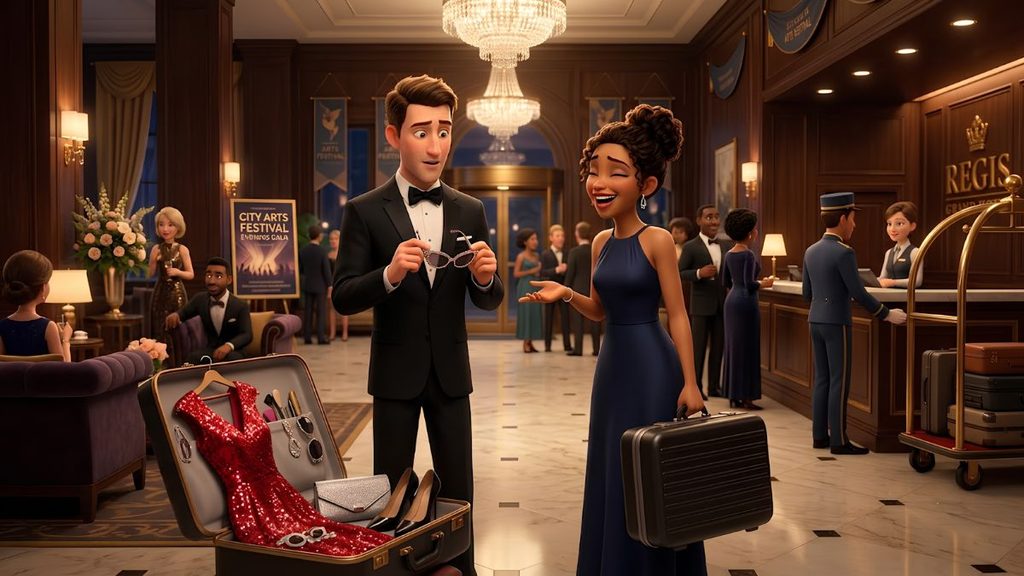
Oliver Grant had learned one important lesson from traveling for work:
Never trust a hotel room number when you are tired.
Unfortunately, he learned the lesson only after making one of the strangest mistakes of his life.
It was Friday evening, and Oliver had arrived in Bellmont, a quiet city known for its annual arts festival. He had traveled there for a business conference that would begin the following morning.
He was exhausted.
His train had been delayed.
His phone battery was nearly dead.
His suitcase wheel had broken somewhere between the station and the taxi.
And when he finally reached the hotel, he wanted only one thing.
A shower.
Then dinner.
Then sleep.
The receptionist handed him a key card.
“Room 417.”
Oliver nodded.
“Thank you.”
He took the elevator to the fourth floor.
He found Room 417.
He tapped the key card.
The door opened.
He walked inside.
He put his suitcase down.
Then he noticed something strange.
There were clothes hanging from the wardrobe.
Women’s clothes.
A large suitcase sat beside the bed.
There was a handbag on the desk.
Oliver froze.
“This isn’t my room.”
He checked the number.
He checked his key card.
He looked at the room again.
Definitely not his.
Then his phone buzzed.
A message from the hotel:
Dear Mr. Grant, due to a temporary room allocation issue, your accommodation has been moved to Room 418. We apologize for the inconvenience.
Oliver stared at the message.
“Of course.”
He grabbed his suitcase.
Then stopped.
His own suitcase was not beside the door.
The suitcase he had been carrying was different.
He looked at the luggage tag.
It belonged to someone named Claire Bennett.
Oliver closed his eyes.
Somewhere between the taxi and the hotel, his suitcase had been exchanged with another guest’s.
He immediately called reception.
“I’m in the wrong room.”
The receptionist sounded concerned.
“Sir, what room are you in?”
“417.”
“Your room is 418.”
“I know that now.”
“How did you get into 417?”
Oliver looked at the key card.
“I don’t know.”
The receptionist paused.
“Please don’t touch anything in the room.”
“I wasn’t planning to.”
“Security will come up.”
“Thank you.”
Oliver waited.
Five minutes later, a hotel employee arrived.
“Mr. Grant?”
“Yes.”
The employee looked into the room.
Then at Oliver.
Then at the suitcase.
“That’s not yours.”
“No.”
“We’ll sort it out.”
“Please do.”
The employee examined the luggage tag.
“Your suitcase is probably with Ms. Bennett.”
“Where is she?”
“She’s attending the Bellmont Arts Festival.”
Oliver sighed.
“Can I get my suitcase tonight?”
“We’ll try.”
Oliver looked at the clock.
It was nearly eight.
“I have a dinner meeting tomorrow.”
“We’ll do everything we can.”
An hour passed.
Oliver was now sitting in the hotel lobby wearing the same clothes he had traveled in.
His suitcase was somewhere else.
His toiletries were somewhere else.
His dress shirt for tomorrow’s conference was somewhere else.
Everything he needed was inside the wrong suitcase.
Then the hotel manager approached him.
“Mr. Grant, I’m terribly sorry.”
“Any news?”
“We’ve located Ms. Bennett.”
“Great.”
“She’s currently at a festival reception.”
“Can we contact her?”
“We have.”
“And?”
“She’s on her way.”
Oliver relaxed.
“Perfect.”
Then the manager hesitated.
“There’s one problem.”
“What?”
“She has your suitcase.”
“That’s fine.”
“She opened it.”
Oliver blinked.
“Why?”
“She needed to identify the owner.”
“Fair enough.”
The manager continued.
“She says your suitcase contains a tuxedo.”
Oliver nodded.
“Yes.”
“She needs formal clothing tonight.”
Oliver stared at him.
“What?”
“She has asked whether she can borrow it.”
Oliver looked confused.
“I don’t think that’s my problem.”
The manager smiled awkwardly.
“Normally, no.”
“But?”
“The festival’s main sponsor dinner is tonight.”
Oliver sighed.
“Of course it is.”
At nine fifteen, Claire Bennett arrived.
She was elegant, confident, and clearly amused by the situation.
She carried Oliver’s suitcase.
Oliver carried hers.
They stood facing each other in the hotel lobby.
“Hi,” Claire said.
“Hi.”
“I believe this belongs to you.”
She handed him his suitcase.
“Thank you.”
Oliver handed her hers.
“I’m sorry.”
“Don’t be. It was quite funny.”
“Funny?”
“Eventually.”
Oliver smiled.
“Fair enough.”
Claire opened her suitcase.
Then looked inside.
She laughed.
“I still can’t believe you walked into my room.”
“I was tired.”
“I know.”
“How do you know?”
“The security footage.”
Oliver’s face turned red.
Claire laughed.
“I’m sorry.”
“No, it’s fine.”
She looked at the hotel manager.
“Everything is sorted?”
“Almost.”
She looked at Oliver.
Then back at the suitcase.
“About the tuxedo.”
Oliver sighed.
“Yes?”
“I really do need it.”
He looked confused.
“You need my tuxedo?”
“Yes.”
“Tonight?”
“Yes.”
“Why?”
“I’m supposed to present an award.”
Oliver stared at her.
“You’re presenting an award?”
“Yes.”
“At the festival?”
“Yes.”
“And you don’t have formal clothes?”
“I do.”
She opened her suitcase.
Then stopped.
“My formal dress is missing.”
Oliver looked toward the hotel manager.
“Please tell me this isn’t another luggage problem.”
The manager smiled weakly.
“It is.”
Claire explained that her formal dress had been accidentally sent to another hotel.
She had been promised a replacement.
It had not arrived.
The award ceremony began in less than an hour.
Oliver looked at his tuxedo.
Then at Claire.
Then at the clock.
“I suppose you can borrow it.”
Claire smiled.
“Thank you.”
She paused.
“Would you mind helping me?”
“How?”
“The jacket is easy.”
She pointed toward the tuxedo.
“But the rest?”
Oliver suddenly understood.
The tuxedo wasn’t going to solve the problem.
She needed an alternative outfit.
The hotel manager offered a solution.
The hotel had a boutique shop on the ground floor.
It sold formal clothing for guests attending events.
They went downstairs.
The shop was nearly empty.
Claire found a beautiful black skirt and a white blouse.
Then she looked at Oliver.
“How does this look?”
“Very good.”
She smiled.
“Would you mind choosing a jacket?”
Oliver looked at the selection.
He picked a dark formal jacket.
Claire tried it.
“Perfect.”
Oliver nodded.
“There.”
She smiled.
“Thank you.”
Then she looked at him.
“Actually, there’s another problem.”
“What now?”
“My assistant is stuck in traffic.”
Oliver closed his eyes.
“Please don’t ask.”
Claire laughed.
“I was going to ask if you could carry my award.”
Oliver opened his eyes.
“That’s all?”
“That’s all.”
“Fine.”
An hour later, Oliver found himself backstage at the Bellmont Arts Festival.
He was wearing his tuxedo.
Claire was wearing the outfit they had assembled.
She looked elegant.
Oliver looked nervous.
“You’ve done this before, right?” he asked.
“Many times.”
“Good.”
“What are you worried about?”
“I’m not supposed to be here.”
Claire laughed.
“Neither am I, apparently.”
The ceremony began.
Oliver carried the award.
Claire walked onto the stage.
The audience applauded.
Everything went smoothly.
Until the host announced:
“Please welcome our special guest, Oliver Grant!”
Oliver froze.
Claire turned around.
“Why are they calling you?”
“I have no idea.”
The host smiled.
“Mr. Grant has traveled here for the business conference and, through an extraordinary luggage mix-up, became tonight’s unofficial assistant.”
The audience laughed.
Oliver walked onto the stage.
He waved awkwardly.
Claire handed him the award.
The audience applauded.
Oliver looked at her.
She whispered:
“Smile.”
He did.
The photographer took a photograph.
The next morning, Oliver woke up in Room 418.
His suitcase was safely beside the bed.
He checked everything.
Passport.
Wallet.
Clothes.
Toiletries.
All there.
He smiled.
Then he noticed something on the desk.
A note.
Thank you for saving my evening. Coffee at 9? — Claire
Oliver smiled.
He went downstairs.
Claire was already sitting in the hotel café.
She waved.
“Good morning.”
“Good morning.”
“Sleep well?”
“Very.”
“No accidental room changes?”
“Not yet.”
They laughed.
Claire pushed a coffee toward him.
“I owe you.”
“You don’t.”
“I borrowed your tuxedo.”
“And you returned it.”
“After using it to present an award.”
“True.”
She smiled.
“I also owe you dinner.”
Oliver sat down.
“That sounds fair.”
Over breakfast, Claire told him that the festival photographer had posted photographs from the ceremony.
One photograph showed Claire presenting the award.
Another showed Oliver standing beside her, holding the trophy.
A third showed them laughing backstage.
Oliver looked at the pictures.
“That’s actually a good photograph.”
Claire smiled.
“Yes.”
Then she turned the phone toward him.
A local festival account had posted:
THE HOTEL ROOM MIX-UP THAT SAVED THE AWARDS CEREMONY
Oliver stared.
“You’ve got to be kidding.”
Claire laughed.
“The story has already spread.”
“How?”
“The hotel manager told someone.”
Oliver shook his head.
“Fantastic.”
By Sunday morning, the story had become a favorite anecdote at the festival.
People recognized Oliver.
A café employee called him “Mr. 417.”
Someone asked whether he was attending another award ceremony.
Another person jokingly asked if he had packed the correct suitcase this time.
Oliver laughed.
He had never expected to become part of the festival’s unofficial entertainment.
But he didn’t mind.
The entire experience had taught him something.
Travel plans rarely survive contact with reality.
A train delay could become a missed meeting.
A broken suitcase wheel could become an adventure.
And a hotel room mistake could somehow lead to helping a stranger present an award.
When Oliver checked out, Claire walked him to the entrance.
“Next year?” she asked.
“What?”
“The festival.”
Oliver smiled.
“Only if we book separate floors.”
She laughed.
“Agreed.”
He picked up his suitcase.
Then checked the luggage tag.
His name was clearly printed on it.
He looked at Claire.
“Definitely mine.”
She smiled.
“Good.”
Oliver waved goodbye and headed toward the taxi.
Halfway there, he stopped.
He checked the room number on his phone.
He checked the suitcase.
Then he checked his passport.
Everything was correct.
He smiled.
For once, he had managed to leave a hotel without taking anything that belonged to someone else.
And somewhere behind him, Claire was laughing.
Oliver turned around.
“What?”
She shouted:
“You forgot your coffee!”
Oliver laughed.
He walked back.
Perhaps some mix-ups were worth having after all.
The Neighborhood Costume Competition
Lucas Bennett had never won a competition in his life.
He had come second in a school spelling contest when he was nine.
He had finished third in a local chess tournament at sixteen.
And once, at a company picnic, he had technically won a three-legged race, although his partner insisted they had simply fallen across the finish line before everyone else.
So when his sister Sarah announced that their neighborhood was holding a costume competition, Lucas had no intention of participating.
“Absolutely not,” he said.
Sarah looked up from her phone.
“You haven’t even heard the theme.”
“I don’t care what the theme is.”
“Creative characters.”
“No.”
“There’s a prize.”
“No.”
“A hundred dollars.”
Lucas paused.
Sarah smiled.
“You heard that.”
“I heard it.”
“Interested?”
“No.”
She raised an eyebrow.
“Two hundred.”
Lucas looked at her.
“You are an awful person.”
“Thank you.”
The competition was part of the annual Willow Creek Neighborhood Festival.
Every year, residents decorated their houses, organized food stalls, and held games for children.
This year, someone had suggested a costume competition.
The idea quickly became popular.
There would be awards for originality, presentation, and audience favorite.
Sarah immediately became enthusiastic.
She loved costumes.
Lucas did not.
He preferred simple clothes, quiet evenings, and never being the center of attention.
Unfortunately, Sarah had spent the previous week designing a costume specifically for him.
On Saturday morning, she appeared at his apartment carrying two large bags.
Lucas looked at them.
“What are those?”
“Your future.”
“No.”
She opened the first bag.
Inside was a carefully assembled costume.
Lucas stared.
“What character is that?”
“Lady Lavender.”
“Who?”
“She’s an elegant fictional character from an old-fashioned mystery series.”
Lucas looked horrified.
“Why does she need a costume?”
“Because you’re going to play her.”
He laughed.
Then realized Sarah wasn’t laughing.
“Wait.”
She smiled.
“You said you’d enter.”
“I said I’d think about entering.”
“I interpreted that as yes.”
“You interpreted incorrectly.”
“Too late.”
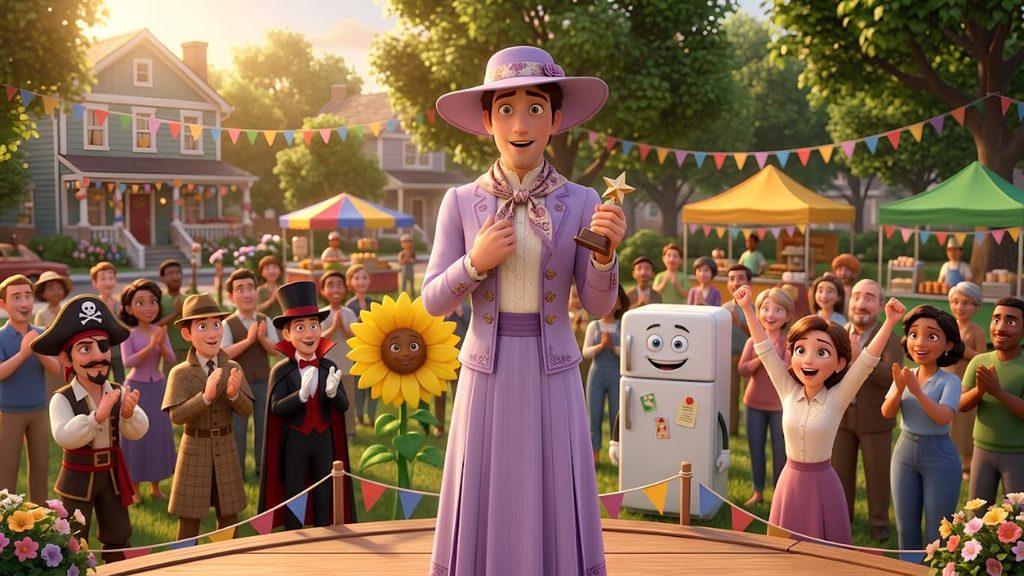
The costume consisted of a long lavender skirt, a cream blouse, a fitted jacket, a decorative scarf, and a wide-brimmed hat.
Sarah had even prepared accessories.
Lucas stared at everything.
“This is excessive.”
“It’s a competition.”
“I could wear a pirate costume.”
“You’d look terrible as a pirate.”
“I’d look like a normal person.”
Sarah laughed.
“You’ll look great.”
Lucas wasn’t convinced.
But after twenty minutes of arguing, he reluctantly agreed to try it.
He disappeared into his bedroom.
A few minutes later, he stepped out.
Sarah stared.
Then smiled.
“Wow.”
Lucas immediately became suspicious.
“Why did you say wow?”
“Because it works.”
He looked in the mirror.
The costume was surprisingly convincing.
The colors suited him.
The hat completed the look.
The transformation was so complete that Lucas almost laughed.
“I look ridiculous.”
“You look fantastic.”
“That’s worse.”
Sarah laughed.
“Come on.”
They walked to the neighborhood festival.
Lucas kept his head down.
“Relax,” Sarah said.
“I’m relaxed.”
“You’re walking like you’re escaping a bank.”
“I am trying not to be recognized.”
“We live in a neighborhood of four hundred people.”
“Exactly.”
They reached the competition area.
Several participants were already there.
There was a pirate captain.
A detective.
A medieval knight.
A giant sunflower.
A magician.
And one man dressed as a refrigerator.
Lucas stared.
“The refrigerator is going to win.”
Sarah laughed.
“Maybe.”
Lucas looked at himself.
Suddenly, his costume didn’t seem nearly as strange.
People were dressed in all kinds of ridiculous outfits.
Nobody cared.
In fact, several people complimented him.
“Wonderful costume!”
“Thank you,” Lucas replied nervously.
A woman approached.
“Who are you supposed to be?”
“Lady Lavender.”
The woman smiled.
“I love it.”
Lucas glanced at Sarah.
She looked delighted.
The competition began.
Each contestant had to walk across the small outdoor stage and introduce their character.
Lucas watched the first few.
The pirate shouted dramatically.
The detective performed an exaggerated investigation.
The magician produced a rabbit from a hat.
Then the refrigerator walked onto the stage.
The crowd applauded.
Lucas laughed.
“This is impossible to beat.”
Sarah nudged him.
“Just have fun.”
“That’s easy for you to say.”
Then the host announced:
“Next contestant: Lady Lavender!”
Lucas froze.
Sarah pushed him forward.
“Go.”
He walked onto the stage.
The crowd applauded.
He stood under the lights.
The host smiled.
“And who is Lady Lavender?”
Lucas had prepared an answer.
Unfortunately, his mind went completely blank.
He stared at the audience.
Nothing.
The host waited.
Lucas looked at Sarah.
She mouthed:
Mystery detective.
Lucas nodded.
He turned toward the audience.
“I am Lady Lavender.”
Silence.
Then he added:
“I solve mysteries.”
A few people laughed.
Lucas relaxed.
“And I never trust a person who eats dessert before dinner.”
The crowd laughed louder.
Lucas smiled.
He had no idea where that sentence came from.
But he continued.
“I also believe that every suspicious person has an unnecessarily complicated explanation.”
More laughter.
The audience began applauding.
Lucas suddenly understood.
He didn’t need a prepared speech.
He simply needed to have fun.
When he walked offstage, Sarah was laughing.
“What?”
“That was brilliant.”
“I made it up.”
“That’s why it was funny.”
Lucas smiled.
“Really?”
“Really.”
Then the host announced the next contestant.
Lucas relaxed.
The competition continued.
But something had changed.
Lucas was no longer embarrassed.
He was enjoying himself.
He even began talking to other contestants.
The man dressed as the refrigerator introduced himself as Peter.
“You were great,” Peter said.
“Thanks.”
“I liked the dessert line.”
“Me too.”
Peter laughed.
Then he asked:
“Want to take a picture?”
Lucas agreed.
They stood together.
The refrigerator and Lady Lavender.
It was probably the strangest photograph Lucas had ever been in.
Then came the audience vote.
People gathered around a large board.
Each contestant received applause.
The pirate received a lot.
The magician received even more.
Then came Lady Lavender.
Lucas expected polite applause.
Instead, the crowd erupted.
He looked shocked.
Sarah jumped up and down.
“What?”
“You won the audience vote!”
Lucas stared.
“I did?”
The host nodded.
“Lady Lavender!”
The crowd applauded.
Lucas walked onto the stage again.
The host handed him a small trophy.
It was shaped like a star.
Lucas looked at it.
“I actually won.”
Sarah shouted:
“I told you!”
Lucas laughed.
Then the host added:
“And our judges have awarded Lady Lavender the prize for Best Original Character.”
Lucas’s eyes widened.
“What?”
Sarah nearly screamed.
The crowd laughed.
Lucas accepted the second trophy.
He now had two.
After the competition, people approached Lucas.
Some wanted photographs.
Others complimented the costume.
A little boy asked:
“Are you really Lady Lavender?”
Lucas smiled.
“Only on Saturdays.”
The boy laughed.
Sarah shook her head.
“You’ve become famous.”
“Don’t exaggerate.”
A woman nearby said:
“Can I get a picture with Lady Lavender?”
Lucas sighed dramatically.
“Fine.”
He posed.
Then another person asked.
Then another.
Within ten minutes, Lucas had taken more photographs than he had taken during the previous five years combined.
Eventually, he looked at Sarah.
“You planned this.”
She laughed.
“I planned the costume.”
“You planned the fame.”
“No.”
“Are you sure?”
“Mostly.”
That evening, Lucas returned home carrying two trophies.
He placed them on the kitchen counter.
Sarah followed him.
“You know what?”
“What?”
“You were really confident.”
Lucas laughed.
“I was terrified.”
“You didn’t look terrified.”
“I was.”
She smiled.
“Sometimes confidence isn’t about feeling comfortable.”
Lucas looked at the trophies.
“Maybe.”
He thought about the competition.
He had spent the entire morning worrying that people would laugh at him.
They had laughed.
But not in the way he expected.
They laughed with him.
They enjoyed the character.
Nobody cared that the costume was unusual.
They cared that he was having fun.
That realization made him smile.
The next morning, Lucas received a message from Peter.
It was a photograph.
Lucas and the refrigerator stood together on the stage.
The caption read:
Willow Creek’s strangest detective duo.
Lucas laughed.
Then Sarah walked into the room.
“What are you laughing at?”
“Nothing.”
She looked at his phone.
“Oh, that’s a good picture.”
Lucas nodded.
“Yeah.”
Sarah picked up one of the trophies.
“You know, next year’s competition has a theme.”
Lucas immediately looked suspicious.
“No.”
“You haven’t heard it.”
“I don’t need to.”
“It’s famous movie characters.”
“No.”
“You could be—”
“No.”
“Or—”
“No.”
“Or maybe—”
“Sarah.”
She laughed.
“Fine.”
Lucas relaxed.
Then she smiled.
“Although I already have an idea.”
Lucas groaned.
“That’s exactly what I’m afraid of.”
Sarah walked away laughing.
Lucas looked at his trophies.
He smiled.
Maybe next year wasn’t such a terrible idea.
He would never admit that to Sarah.
Not yet.
A week later, Lucas returned to the neighborhood café.
The waitress looked at him.
“Lady Lavender!”
Lucas stopped.
“Oh, no.”
She laughed.
“Your coffee is ready.”
Everyone nearby laughed.
Lucas shook his head.
“Do you people ever forget?”
“No.”
He smiled.
“Fair enough.”
He took his coffee and sat down.
For years, Lucas had tried to avoid attention.
He had thought being noticed was embarrassing.
Now he understood something different.
Being noticed wasn’t necessarily uncomfortable.
Sometimes it meant people had enjoyed the person you allowed yourself to become.
And sometimes, the person you became for a costume competition turned out to be a little more confident than the person you had always been.
Lucas took a sip of coffee.
Then noticed something taped to the café window.
A poster.
NEXT YEAR’S COSTUME COMPETITION — REGISTRATION OPENS SOON.
He stared at it.
Then smiled.
“Maybe.”
He wasn’t sure whether he meant it.
But for the first time, he wasn’t automatically saying no.
And somewhere in a drawer at home, Lady Lavender’s hat was already waiting.
The Office Charity Calendar
Henry Parker had spent eleven years building a professional reputation around three things.
Reliability.
Efficiency.
And avoiding photographs whenever possible.
He had never understood why people enjoyed taking pictures at work.
A meeting photograph was fine.
A company event photograph was unavoidable.
But posed photographs?
Absolutely not.
So when his manager announced that the office would be creating a charity calendar, Henry immediately decided that he would contribute money instead of his face.
That seemed perfectly reasonable.
Unfortunately, his colleagues had other plans.
The announcement came during Monday’s staff meeting.
“Our community outreach team has chosen a charity project for this year,” announced Melissa, the office manager.
Henry continued typing on his laptop.
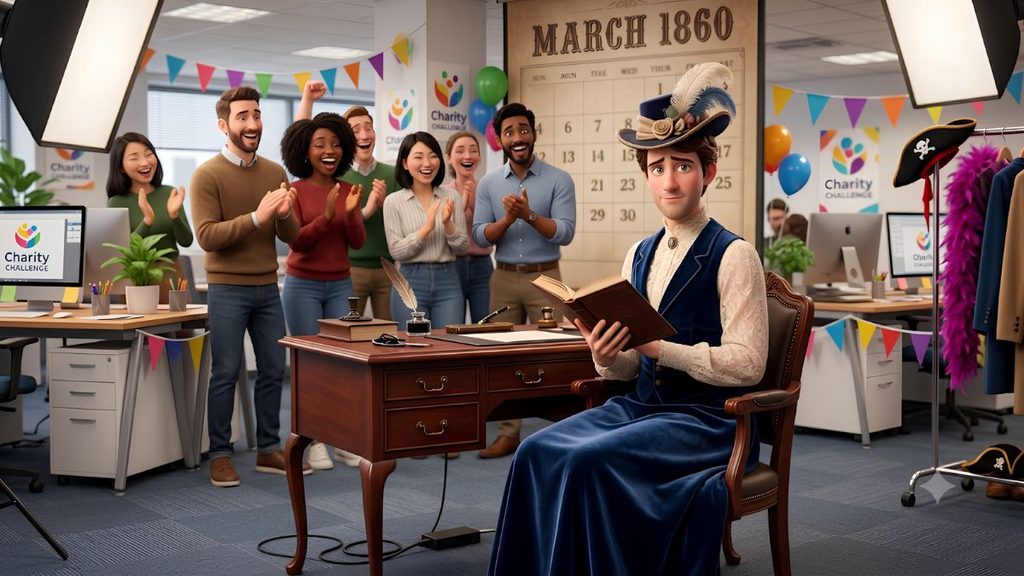
“We’re creating a twelve-month charity calendar.”
Several people applauded.
Henry stopped typing.
Melissa continued.
“Each month will feature employees dressed as fictional characters.”
Henry slowly looked up.
Someone behind him whispered:
“This is going to be amazing.”
Henry whispered back:
“Not for me.”
Melissa smiled.
“Participation is voluntary.”
Henry relaxed.
“However,” she continued, “we’re hoping every department will provide at least one volunteer.”
Henry looked around the conference room.
Nobody moved.
The marketing team exchanged glances.
The IT team suddenly became fascinated by their phones.
The finance department stared at the table.
Melissa sighed.
“We need someone from finance.”
Everyone looked at Henry.
Henry blinked.
“Why are you looking at me?”
His colleague David smiled.
“You’re our most photogenic accountant.”
Henry stared at him.
“You’ve known me for six years.”
“Exactly.”
At lunch, Henry was approached by three colleagues.
David.
Priya.
And Martin.
They sat across from him.
Henry looked suspicious.
“What do you want?”
Priya smiled.
“We have an idea.”
“No.”
“You don’t know the idea.”
“I know you.”
Martin laughed.
“We think you should be February.”
“Why?”
“Because February’s theme is romantic characters.”
“No.”
“There’s a costume.”
“No.”
“There’s a photo.”
“No.”
“There’s charity.”
Henry sighed.
“That’s emotional manipulation.”
“Yes,” Priya replied.
Henry tried to ignore the whole project.
For several days, he succeeded.
Then Thursday morning, Melissa stopped by his desk.
“Henry.”
“Yes?”
“Could we talk?”
“About the calendar?”
“Yes.”
“No.”
She smiled.
“I haven’t asked yet.”
“You don’t need to.”
She laughed.
“We’re short one volunteer.”
Henry looked around.
“Ask David.”
“David volunteered.”
“Martin?”
“Also volunteered.”
“Priya?”
“She’s photographing the project.”
Henry sighed.
“Fine.”
Melissa smiled.
“Wonderful.”
“I haven’t agreed to anything.”
“You just did.”
“That isn’t how agreements work.”
“Too late.”
The theme was revealed on Friday.
Each department had chosen a fictional character.
The marketing team selected a detective.
IT chose a superhero.
Human resources chose a fairy-tale queen.
Sales chose a pirate captain.
Finance had not selected anyone.
Henry asked:
“Can I be Sherlock Holmes?”
Melissa shook her head.
“Already taken.”
“A detective?”
“Taken.”
“A superhero?”
“Taken.”
“A pirate?”
“Taken.”
“An ordinary businessman?”
Melissa laughed.
“Too boring.”
Henry stared at her.
“Then what am I supposed to be?”
Priya walked into the room carrying a garment bag.
Henry immediately stepped backward.
“No.”
“You don’t know what’s inside.”
“I know enough.”
She opened it.
Inside was an elaborate costume.
A long blue skirt.
A cream blouse.
A fitted waistcoat.
A decorative hat.
Henry stared.
“Absolutely not.”
Priya smiled.
“You’d make a wonderful Victorian mystery heroine.”
“I’m not wearing that.”
“It’s for the calendar.”
“I’m an accountant.”
“Exactly.”
The office became increasingly excited.
Everyone was preparing for their photographs.
The photographer arrived on Wednesday.
There was music in the studio area.
People laughed.
Costumes filled the conference room.
Henry watched from his desk.
He had managed to avoid participating.
Then Melissa approached him.
“Henry.”
“No.”
“The photographer is ready.”
“I haven’t changed.”
“Exactly.”
Henry sighed.
He looked at the costume.
Then at the charity poster on the wall.
The calendar proceeds would support a local children’s literacy program.
He cared about that.
“How long?”
“Ten minutes.”
“Twenty.”
“Fine.”
“And nobody posts the photograph until I approve it.”
Melissa smiled.
“Agreed.”
Henry took the costume.
The changing room was empty.
Henry stared at himself in the mirror.
The outfit was surprisingly well made.
He adjusted the waistcoat.
Then the hat.
He looked completely different.
He laughed quietly.
“Well.”
He turned sideways.
“This is ridiculous.”
But it wasn’t unpleasant.
The clothes were comfortable.
The colors worked.
And, strangely, the character suited his serious expression.
Henry stepped outside.
The room went silent.
Then David said:
“Wow.”
Henry pointed at him.
“Don’t.”
Priya smiled.
“Honestly, Henry.”
“What?”
“You look fantastic.”
Henry sighed.
“This is exactly what I was afraid of.”
The photographer positioned Henry near a bookshelf.
“Look toward the camera.”
Henry did.
“Relax.”
“I’m relaxed.”
“You look like you’re about to audit me.”
Everyone laughed.
Henry smiled.
The photographer raised the camera.
Click.
“Excellent.”
Another photograph.
Click.
“Try a different expression.”
Henry raised an eyebrow.
Click.
The photographer looked at the screen.
Then smiled.
“That’s the one.”
Henry stepped forward.
“Can I see it?”
The photographer showed him.
Henry stared.
He didn’t look embarrassed.
He looked confident.
The outfit looked natural.
He laughed.
“Okay.”
Priya smiled.
“Good?”
“Very good.”
The calendar project became unexpectedly popular.
Employees began competing for the best photograph.
The January team posed as detectives.
March featured superheroes.
April featured fairy-tale characters.
May featured pirates.
And February featured Henry.
His photograph showed him sitting beside an old-fashioned desk, holding an open book, wearing the Victorian-inspired outfit and giving the camera a serious expression.
The caption read:
Every mystery begins with a story.
Henry secretly liked it.
He would never admit that.
Then the calendar went online.
Within days, the office charity page received hundreds of shares.
People began commenting.
One comment read:
Who is the February character? He looks like he belongs in a period drama.
Another said:
Finance department absolutely won February.
Henry read the comments during lunch.
David looked over his shoulder.
“You’re famous.”
“I’m not.”
“Someone called you elegant.”
“That’s concerning.”
“Someone else said you should model.”
Henry closed the page.
“That’s enough.”
Priya laughed.
“You have fans.”
“I have coworkers with too much free time.”
Then the company director called Henry into his office.
Henry immediately became nervous.
“Is there a problem?”
The director smiled.
“No.”
“Then why am I here?”
“I wanted to congratulate you.”
“For what?”
“The calendar.”
Henry looked confused.
“The calendar?”
“Your photograph has received the most positive responses.”
Henry stared.
“Really?”
“Yes.”
The director handed him a printed report.
The February page had generated more donations than any other month.
Henry looked at the numbers.
“That’s incredible.”
“It is.”
The director smiled.
“You helped make that happen.”
Henry smiled too.
For the first time, he didn’t feel embarrassed about the photograph.
He felt proud.
Not because he looked different.
Because the photograph had helped raise money.
A week later, the office held a small charity celebration.
The organizers announced the total amount raised.
Everyone applauded.
The amount was far higher than expected.
Melissa thanked everyone.
Then she turned toward Henry.
“And a special thank-you to Henry, whose February photograph became the most popular page in the calendar.”
The room erupted in applause.
Henry covered his face.
“Please stop.”
Everyone laughed.
David shouted:
“Speech!”
Henry shook his head.
“No.”
“Speech!”
“No.”
Priya handed him a microphone.
Henry stared at her.
“You planned this.”
She smiled.
“Maybe.”
He sighed.
Then stepped forward.
“I don’t know what to say.”
Someone shouted:
“Talk about fashion!”
The room laughed.
Henry smiled.
“I’ll simply say this.”
The room quieted.
“I didn’t expect to participate in this project.”
He looked at the calendar.
“I certainly didn’t expect to wear a costume.”
Everyone laughed.
“But I’m glad I did.”
He paused.
“Because sometimes doing something slightly ridiculous can help accomplish something genuinely important.”
The room applauded.
Henry smiled.
“Thank you.”
After the event, Henry returned to his desk.
A small package was waiting.
He opened it.
Inside was a framed copy of the February calendar page.
Underneath it was a handwritten note:
For the best accidental model in Finance.
Henry laughed.
He placed the frame on a shelf.
David walked past.
“You’re keeping it?”
Henry nodded.
“Yes.”
“I thought you hated photographs.”
“I still do.”
“Then why keep this?”
Henry looked at the picture.
“Because it reminds me that I did something I didn’t think I could do.”
David smiled.
“That’s surprisingly inspirational.”
“Don’t tell anyone.”
The following month, Henry arrived at work and noticed something unusual.
A large poster had appeared beside the elevator.
It was an advertisement for next year’s charity calendar.
At the bottom was a message:
Volunteer registrations open Monday.
Henry stared at it.
Then he heard footsteps.
Priya appeared beside him.
“Morning.”
Henry pointed at the poster.
“Don’t.”
She smiled.
“I haven’t said anything.”
“I know that expression.”
“What expression?”
“The one that means you’re planning something.”
Priya laughed.
“You’d be surprised.”
Henry shook his head.
“I am not participating next year.”
“Of course.”
He looked at her.
“You don’t believe me.”
“No.”
Henry laughed.
“Fair enough.”
They walked toward the office together.
As they reached his desk, Henry noticed another envelope.
He opened it.
Inside was a small invitation.
Would you consider returning as our February feature?
Henry stared at it.
Then smiled.
He put it in his drawer.
He wasn’t saying yes.
Not yet.
But he wasn’t throwing it away either.
And that, Henry realized, was progress.
His entire life had been built around staying inside his comfort zone.
The charity calendar had taught him that stepping outside it for a few minutes wasn’t necessarily frightening.
Sometimes it was funny.
Sometimes it was surprisingly enjoyable.
And sometimes, it could help someone else.
Henry looked at the framed photograph on his shelf.
The serious expression.
The unusual outfit.
The ridiculous hat.
He smiled.
Then he returned to his spreadsheet.
After all, he still had an important job.
He was an accountant.
Even accidental models had budgets to manage.
The Train Station Case of Mistaken Identity
Adrian Blake had never been particularly good at traveling light.
For a weekend trip, he packed enough clothes for two weeks.
For a business trip, he brought three pairs of shoes.
And for the Bellmont Arts Festival, he had somehow managed to bring an entire suitcase dedicated to costumes.
His friends considered this excessive.
Adrian considered it preparation.
“You don’t need four costumes for one evening,” his friend Marcus had told him.
“You don’t know what might happen.”
“It’s a costume festival, not an international emergency.”
“You never know.”
Marcus had laughed.
Adrian had ignored him.
Three days later, Adrian was standing in the middle of Bellmont Central Station, surrounded by thousands of travelers, carrying the very suitcase Marcus had mocked.
And he was about to discover exactly what could happen.
The Bellmont Arts Festival was one of the biggest cultural events in the region.
Every year, artists, musicians, performers, theater groups, and costume enthusiasts arrived from different cities.
Adrian had come specifically for the opening-night costume parade.
He wasn’t a professional performer.
He simply enjoyed theater and unusual costumes.
This year’s theme was Characters From Another Era.
Adrian had chosen an elegant vintage-inspired outfit for the event.
The costume consisted of a long emerald-green skirt, a cream blouse, a fitted jacket, a decorative hat, gloves, and a small handbag.
He had packed it carefully.
His plan was simple.
Arrive at the station.
Check into the hotel.
Change.
Attend the parade.
Take photographs.
Return to the hotel.
It was a good plan.
Unfortunately, Adrian’s plans had never been particularly lucky.
His train arrived at four forty-five.
The station was crowded.
People hurried toward exits.
Announcements echoed from the ceiling.
Suitcases rolled across the floor.
Adrian found a quiet corner near the restrooms and checked his phone.
His hotel room wouldn’t be ready for another hour.
He decided to change at the station.
It seemed harmless.
He took his suitcase into a private changing room.
Inside, he changed into the festival costume.
He adjusted the jacket.
Put on the hat.
Checked the gloves.
Then looked in the mirror.
He smiled.
“Not bad.”
He picked up his regular clothes and placed them into a small travel bag.
His large suitcase remained outside.
Adrian stepped out.
He was distracted by his phone.
A message from Marcus had arrived.
Send a picture or I won’t believe you actually wore it.
Adrian laughed.
He walked toward the luggage area.
And that’s when the first mistake happened.
His suitcase looked exactly like another suitcase.
Same size.
Same dark color.
Same style of wheels.
Same silver handle.
There were dozens of similar bags around the station.
Adrian grabbed one.
He didn’t notice the luggage tag.
He didn’t notice the small red ribbon tied around the handle.
He simply walked away.
Ten minutes later, he reached the festival entrance.
He stopped.
Then he realized something.
His suitcase felt lighter.
He opened it.
Inside was a completely different costume.
Adrian stared.
There was a bright purple jacket.
A feathered hat.
A pair of theatrical boots.
And a card that read:
BELL MONT THEATER COMPANY — PERFORMER 7
Adrian frowned.
“That’s not mine.”
He checked the suitcase again.
Nothing.
His own costume accessories were gone.
His phone buzzed.
Marcus.
Picture?
Adrian typed:
Small problem.
Marcus replied immediately.
What did you do?
Adrian looked at the suitcase.
I think I took someone else’s luggage.
He returned to the station.
But by then, the owner of the other suitcase was nowhere to be found.
Adrian approached the information desk.
“Excuse me.”
A staff member looked up.
“Yes?”
“I think I accidentally took another passenger’s suitcase.”
The staff member smiled.
“Do you have the luggage tag?”
Adrian checked.
It read:
Bellmont Theater Company.
The employee’s expression changed.
“That belongs to the festival performers.”
“Great.”
“They’re probably looking for it.”
“Even better.”
The employee picked up the phone.
After a short conversation, she looked at Adrian.
“They’re sending someone.”
“Excellent.”
Adrian relaxed.
Then the employee frowned.
“Actually…”
“What?”
“The theater company is performing at the main station entrance in fifteen minutes.”
Adrian looked down at himself.
Then at the suitcase.
Then back at the employee.
“Why is that a problem?”
“Because they say their lead performer is missing.”
Adrian blinked.
“I don’t understand.”
The employee pointed toward him.
“Your outfit.”
Adrian looked at himself.
Then she continued:
“They sent us a photograph of their performer.”
She showed him the image.
Adrian stared.
The photograph showed a woman wearing an almost identical style of vintage costume.
Adrian looked at his own reflection in the glass.
Then at the photograph.
“Okay.”
He laughed nervously.
“I can see the confusion.”
Before Adrian could explain further, a young woman came running toward him.
She stopped.
Her eyes widened.
“There you are!”
Adrian pointed at himself.
“Me?”
“Yes!”
“I’m sorry, I think you’ve mistaken me for someone else.”
The woman grabbed his arm.
“We’ve been looking everywhere.”
Adrian tried to explain.
“I’m not your performer.”
She stared at him.
Then at his costume.
Then at the suitcase.
Her eyes widened.
“You have the costume.”
“I have your costume.”
“Exactly.”
“So you know I’m not your performer.”
“Yes.”
She paused.
“But the performance starts in ten minutes.”
Adrian sighed.
“I can help you find her.”
“She’s missing.”
“Where did you last see her?”
“At the station.”
Adrian looked around.
“Then let’s search.”
They searched the station.
Nothing.
Five minutes passed.
Then another five.
The theater company’s director arrived.
He looked at Adrian.
Then at the suitcase.
Then at the missing performer photograph.
He sighed.
“This is a disaster.”
Adrian nodded.
“I agree.”
“Can you perform?”
Adrian laughed.
“No.”
The director looked desperate.
“Please.”
“No.”
“You have the costume.”
“That doesn’t make me an actor.”
“You look like the character.”
“That is not enough.”
The director stared at him.
Then said:
“You only need to walk across the platform.”
Adrian hesitated.
“That’s all?”
“Walk, wave, and stand beside the others.”
“No acting?”
“No.”
“No dancing?”
“No.”
“No speaking?”
“None.”
Adrian looked at the clock.
The performance would begin in six minutes.
He sighed.
“Fine.”
The theater company hurried Adrian backstage.
They adjusted his costume.
Someone fixed his hat.
Someone else handed him a small prop.
Adrian stared at it.
“What is this?”
“A handbag.”
“I already have one.”
“That’s the prop.”
Adrian looked at the handbag in his hand.
It was ridiculous.
He started laughing.
“What?”
“Nothing.”
The director looked nervous.
“Please don’t laugh during the performance.”
“I’ll try.”
The music began.
The performers stepped onto the station platform.
Adrian followed.
Hundreds of passengers watched.
He walked.
He waved.
He smiled.
Everything was fine.
Then someone in the crowd shouted:
“Lady Evelyn!”
Adrian froze.
He looked around.
Nobody else reacted.
The crowd applauded.
Adrian smiled awkwardly.
Then he realized they were calling the character.
He continued walking.
The performance moved toward its finale.
Adrian stood beside the other performers.
The director gave him a signal.
Adrian raised the handbag dramatically.
The audience laughed.
He had no idea why.
Then one of the performers whispered:
“Turn around.”
Adrian did.
The audience applauded.
He bowed.
The performance ended.
Backstage, everyone laughed.
“You were fantastic,” the director said.
“I did absolutely nothing.”
“Exactly.”
Adrian laughed.
Then a voice came from behind him.
“Excuse me.”
He turned.
A woman stood there holding his suitcase.
She was wearing ordinary travel clothes.
She looked exhausted.
“Is this yours?”
Adrian’s eyes widened.
“My suitcase!”
She smiled.
“I think we accidentally switched them.”
Adrian laughed.
“You’re the missing performer!”
“Yes.”
He looked at the theater director.
The director looked relieved.
“You found her.”
Adrian handed over the other suitcase.
She handed him his.
Everything was finally back where it belonged.
Then she looked at Adrian.
“You performed in my place?”
Adrian smiled.
“Apparently.”
She laughed.
“Thank you.”
The story should have ended there.
But it didn’t.
The festival photographer had captured the entire performance.
The next morning, Adrian’s phone exploded with notifications.
Marcus had sent him twelve messages.
What happened?
Why are you on stage?
Why are you wearing that?
Why are people calling you Lady Evelyn?
Adrian.
ADRIAN.
Then came a photograph.
It showed Adrian standing on the platform, holding the handbag dramatically while an entire crowd applauded.
Marcus had added one sentence:
You went to Bellmont for a costume parade and accidentally became a theater performer.
Adrian laughed.
He replied:
Technically, I was luggage support.
Marcus responded:
Sure.
By afternoon, the story had spread throughout the festival.
People recognized Adrian.
Some called him Lady Evelyn.
Others asked if he was performing again.
A child approached him and asked:
“Are you famous?”
Adrian laughed.
“No.”
The child pointed toward a festival poster.
Adrian followed the finger.
There he was.
His photograph had been used in the festival’s social media promotion.
The caption read:
Unexpected Performer Steals the Show at Bellmont Central.
Adrian stared.
“I can’t believe this.”
The missing performer laughed beside him.
“You were good.”
“I walked.”
“Very elegantly.”
He smiled.
“Thank you.”
That evening, Adrian attended the actual costume parade.
This time, he wore his original outfit.
He had finally recovered his suitcase.
He walked through the festival crowd.
People smiled.
One person recognized him.
“You’re Lady Evelyn!”
Adrian laughed.
“Not today.”
The person looked confused.
Adrian pointed toward his suitcase.
“Long story.”
Later, Adrian sat at an outdoor café with the theater company.
The director raised a glass.
“To accidental performers.”
Everyone laughed.
The original performer smiled.
“To accidental luggage swaps.”
Adrian raised his glass.
“To checking luggage tags.”
Everyone laughed again.
The director leaned toward him.
“You know, if you ever want to perform again…”
Adrian shook his head.
“No.”
“Why?”
“I think I’ve had enough excitement.”
The director smiled.
“Fair.”
Adrian looked around the table.
He had arrived in Bellmont expecting nothing more than a costume parade.
Instead, he had accidentally stolen a performer’s suitcase, been mistaken for an actress, appeared onstage before hundreds of people, and ended up in the festival publicity photographs.
It was absurd.
It was embarrassing.
And, strangely, it was one of the most enjoyable experiences he had ever had.
He looked at the original performer.
“I’m sorry about your suitcase.”
She laughed.
“And I’m sorry about your surprise performance.”
“Fair trade?”
“Fair trade.”
When Adrian returned home two days later, Marcus met him at the station.
“So.”
Adrian smiled.
“So?”
“How was the festival?”
“Wonderful.”
“Any problems?”
“None.”
Marcus looked suspicious.
“Really?”
Adrian nodded.
“Everything went perfectly.”
Marcus laughed.
“You’re terrible at lying.”
Adrian sighed.
“Fine.”
He pulled out his phone.
He showed Marcus the photograph.
Marcus stared.
Then burst out laughing.
“You actually performed!”
“Technically.”
“You have an audience!”
“Yes.”
“You have a handbag!”
“Yes.”
“And a fan club?”
Adrian frowned.
“What?”
Marcus showed him another photograph.
Someone had apparently created a social media post:
BRING BACK LADY EVELYN!
Adrian covered his face.
“No.”
Marcus laughed.
“You’ve become famous.”
“Please don’t say that.”
“Lady Evelyn!”
“Stop.”
They walked toward the parking lot.
Adrian was still laughing.
He had learned several things during his trip.
Always check your luggage tag.
Never assume a costume makes you invisible.
And if a stranger suddenly mistakes you for a performer, make sure you ask questions before stepping onto a stage.
Most importantly, he learned that some of life’s best stories begin with a simple mistake.
A wrong suitcase.
A confused stranger.
A missing performer.
And one very surprised traveler.
Adrian had gone to Bellmont hoping to enjoy a costume festival.
He left with something much better.
A story nobody would believe unless he showed them the photograph.
And the photograph was already making its way around town.
Lady Evelyn had officially arrived.
Even if Adrian still insisted it was an accident.
Why Do Readers Enjoy Humorous Crossdressing Stories?
There are several reasons this genre can be appealing.
Unexpected Situations
Comedy thrives on surprise.
A character who normally dresses one way suddenly appearing in an entirely different style can create an amusing contrast. The people around them may react with surprise, confusion, curiosity, or complete misunderstanding.
Readers enjoy watching these situations unfold because they often know more than the characters do.
Awkward but Harmless Moments
Many humorous stories are built around awkward situations.
A character may worry about being recognized, wonder whether their outfit looks convincing, struggle with unfamiliar clothing, or unexpectedly encounter someone they know.
These moments can create tension without becoming genuinely threatening.
Mistaken Identity
Mistaken identity is one of the oldest comedy devices in storytelling.
Crossdressing naturally creates opportunities for mistaken identity because a character may temporarily look very different from their usual appearance.
A friend might fail to recognize them. A colleague might make an incorrect assumption. Someone from the character’s past might suddenly appear.
The resulting confusion can drive an entire story.
Personality Versus Appearance
One particularly effective source of humor is the contrast between appearance and personality.
A serious accountant might unexpectedly find themselves dressed for a glamorous stage performance. A shy person might discover that their new appearance attracts attention. A confident character might suddenly become nervous because they are unfamiliar with their outfit.
The comedy comes from watching a familiar personality navigate an unfamiliar presentation.
Common Themes in Humorous Crossdressing Stories
Although every story can be different, several themes appear repeatedly.
The Unexpected Dare
A group of friends makes a playful challenge.
The protagonist initially refuses but eventually accepts. What begins as a simple joke becomes considerably more complicated when the character has to spend an entire afternoon, evening, or event maintaining the new appearance.
The humor comes from the increasingly elaborate consequences of accepting the dare.
The Costume Emergency
A theater group, workplace event, party, or community performance suddenly loses a performer.
Someone has to step in.
The replacement performer has very little preparation time, leading to a chaotic sequence of costume adjustments, rehearsals, and improvised solutions.
This setup works particularly well because the character has a legitimate reason for their unusual clothing.
The Wrong Bag
Two people accidentally pick up each other’s bags.
One contains an outfit that is completely unexpected for the person who receives it.
The character now has to solve the problem before the original owner notices.
This can lead to a series of increasingly ridiculous misunderstandings.
The Themed Party
A character attends a party without realizing that there is a particular dress code.
Everyone else arrives appropriately dressed while the protagonist is completely unprepared.
A friend offers an emergency outfit, and suddenly the character has to participate in the evening looking very different from normal.
The Theater Performance
Stage productions provide a natural setting for crossdressing comedy.
Actors frequently play characters who are very different from themselves. Costumes, wigs, makeup, rehearsals, and last-minute changes provide numerous opportunities for humorous scenes.
The character might initially be uncomfortable but eventually discover that they are surprisingly good at the role.
The Workplace Mix-Up
A workplace comedy can use crossdressing as part of a costume event, charity fundraiser, theatrical presentation, or company celebration.
The protagonist might spend an entire day trying to behave normally while colleagues struggle to recognize them.
The funniest version of this premise usually focuses on the character’s attempts to maintain composure.
The Role of Friendship
Friendship is often central to humorous crossdressing stories.
A close friend may encourage the protagonist to try something outside their comfort zone. Another friend might provide the clothing, while someone else becomes responsible for preventing the situation from becoming too embarrassing.
These relationships allow stories to remain warm rather than cruel.
A good friendship-based story might begin with teasing but eventually reveal genuine support.
The protagonist may discover that their friends are less judgmental than expected.
Comedy Through Confidence
Confidence can change dramatically when someone adopts a completely different appearance.
A character who initially feels awkward may gradually become more comfortable.
Perhaps they discover that they enjoy the attention. Perhaps they become surprisingly confident in their new role. Or perhaps they simply realize that they were worrying far more than necessary.
This creates an entertaining character arc.
The character does not necessarily need to change their identity. Sometimes the lesson is simply that experimenting with appearance does not have to be frightening.
The Importance of Setting
The setting can significantly influence the humor.
A Family Gathering
A character unexpectedly arrives at a family gathering in a completely different appearance.
Relatives begin asking questions, and the protagonist desperately tries to explain what happened.
A College or University Event
A themed event, theater production, or costume competition provides an easy reason for unusual clothing.
The competitive environment can create additional comedy.
A Small Town
Small communities are particularly useful for stories involving mistaken identity.
Everyone knows everyone, so the protagonist’s attempt to remain anonymous becomes much more difficult.
A Theater
Theater naturally supports costumes, makeup, role-playing, and dramatic misunderstandings.
It is one of the easiest settings for creating believable crossdressing comedy.
A Holiday Celebration
Halloween, costume parties, charity events, and other celebrations allow characters to experiment with appearance without requiring a complicated explanation.
Character Types That Work Well
Humorous crossdressing stories can feature many different personalities.
The Reluctant Participant
This character never intended to dress differently.
They are persuaded by friends or circumstances and spend the story trying to survive the experience.
Their reluctance creates plenty of opportunities for internal comedy.
The Enthusiastic Experimenter
This character is curious and willingly embraces the challenge.
They may become much more comfortable than everyone expected.
The Overconfident Character
This person assumes everything will be easy.
They quickly discover that clothing, accessories, makeup, or unfamiliar social situations are more complicated than expected.
Their confidence creates comedic irony.
The Perfectionist
This character wants everything to look perfect.
They spend hours worrying about tiny details while everyone else thinks the overall appearance is already convincing.
The Shy Character
A shy protagonist can provide a particularly charming story.
Their unexpected transformation might gradually help them become more confident.
Humor Without Cruelty
The best humorous crossdressing stories avoid relying entirely on ridicule.
Instead of making the character’s appearance the punchline, the story can focus on circumstances.
For example, the humor might come from:
- A character forgetting that they are dressed differently.
- A friend accidentally revealing the secret.
- A complicated costume malfunction.
- Someone recognizing the character by their voice.
- An awkward conversation.
- A character becoming unexpectedly confident.
- A series of harmless misunderstandings.
- The protagonist trying to act completely normal.
This approach creates comedy while allowing the character to remain sympathetic.
Transformation as a Story Device
Transformation is one of the most powerful elements in this genre.
The character begins in a familiar state and gradually enters an unfamiliar situation.
The transformation may involve clothing, hairstyle, accessories, makeup, posture, or simply adopting a different social role.
However, the most interesting part is usually what happens after the transformation.
How does the character behave?
What unexpected opportunities appear?
Who recognizes them?
Who does not?
What does the character discover about themselves?
These questions turn a simple costume change into a complete narrative.
Embarrassment and Comedy
Embarrassment is an effective comedic emotion because readers can easily relate to it.
Almost everyone has experienced an awkward moment involving clothing, public attention, or being unexpectedly noticed.
Crossdressing stories exaggerate these everyday experiences.
A character might worry that everyone is staring at them when, in reality, most people are simply going about their day.
That contrast between the character’s anxiety and reality can produce gentle humor.
The Importance of Dialogue
Dialogue can make these stories especially entertaining.
Friends teasing one another, characters trying to explain impossible situations, and people asking innocent questions can create memorable comedic exchanges.
Short dialogue often works better than lengthy explanations.
For example, a friend might calmly ask why the protagonist is wearing an unexpected outfit while the protagonist desperately searches for an explanation.
The humor comes from the contrast between the calm observer and the increasingly nervous protagonist.
Building a Good Humorous Crossdressing Story
A strong story generally follows a simple progression.
Establish the Normal Situation
Introduce the protagonist in their everyday life.
Readers should understand what the character normally wears and how they normally behave.
Introduce the Trigger
Something forces or encourages the character to dress differently.
This could be a dare, performance, mistake, party, challenge, or favor.
Create the Transformation
The character changes their appearance.
This is an opportunity for descriptive but tasteful humor.
Introduce Complications
Something goes wrong.
Someone recognizes the character.
Someone fails to recognize them.
The character encounters an unexpected acquaintance.
Or the original plan becomes much more complicated.
Increase the Comedy
One small problem leads to another.
The protagonist attempts to solve the first problem and accidentally creates a second.
This escalation keeps the story moving.
Reach the Turning Point
Eventually, the protagonist must decide whether to continue hiding, reveal the truth, or simply embrace the situation.
End With a Positive Payoff
A satisfying ending might involve laughter, friendship, confidence, or a surprising discovery.
The protagonist can look back on the experience and realize that it was not nearly as disastrous as they imagined.
Humorous Crossdressing Stories and Personal Expression
Although the genre is often comedic, it can also explore broader ideas about appearance and self-expression.
Clothing can influence how people perceive themselves and how others perceive them.
Trying a different style can sometimes make a character question assumptions they have held about themselves.
A humorous story does not need to become serious or philosophical to acknowledge this.
A character might simply discover that experimenting with clothing is less intimidating than expected.
Keeping the Stories Accessible
For a broad adult readership, accessible storytelling is usually more effective than complicated plots.
Readers should quickly understand:
- Who the protagonist is
- Why they are dressed differently
- What problem has occurred
- Who else knows about the situation
- What the protagonist is trying to accomplish
Clear motivations make the comedy easier to follow.
Final Thoughts
Humorous crossdressing stories can be playful, surprising, awkward, and heartwarming. The strongest examples use crossdressing as a storytelling device rather than relying on it as the entire joke.
Whether the premise involves a reluctant participant, a theatrical emergency, a costume challenge, a mistaken identity, or an unexpected fashion experiment, the possibilities for comedy are wide.
At their best, these stories combine humor, personality, friendship, awkward situations, and self-discovery to create entertaining narratives that readers can enjoy without taking themselves too seriously.
Future stories in this genre can explore everything from workplace misunderstandings and theatrical mishaps to friendship challenges, costume competitions, unexpected transformations, and hilarious attempts to keep a surprising change of appearance a secret.