
Cute bedtime stories are not only for children. Adults can also enjoy simple, heartwarming stories that bring a little warmth and comfort at the end of the day.
After a busy day filled with work, responsibilities, messages, and endless decisions, reading something light can provide a welcome change of pace. Instead of complicated plots or intense emotions, cute bedtime stories for adults can focus on small moments of happiness, gentle humor, affection, friendship, animals, cozy surroundings, and everyday kindness.
The goal is not necessarily to tell an unforgettable adventure. Sometimes the best bedtime story is one that makes the reader smile, feel comfortable, and gradually become ready for sleep.
This guide explores what makes a bedtime story feel cute, the different styles adults may enjoy, how these stories can create a relaxing nighttime atmosphere, and what to look for when choosing one.
What Are Cute Bedtime Stories for Adults?
Cute bedtime stories for adults are short or moderately paced stories built around sweet, comforting, amusing, or heartwarming situations.
They can involve adults, couples, friends, neighbors, animals, coworkers, or entirely fictional characters. The stories may take place in ordinary homes, cafés, gardens, bookstores, small towns, apartments, hotels, or imaginary worlds.
What makes them “cute” is usually the emotional tone rather than the age of the characters.
A character remembering to buy their partner’s favorite pastry can be cute.
A sleepy dog refusing to leave its favorite blanket can be cute.
Two neighbors exchanging homemade cookies can be cute.
A person finding a tiny handwritten note inside an old book can be cute.
These moments are small, but they can create a pleasant emotional experience.
Cute bedtime stories generally avoid unnecessary tension. They do not need villains, dangerous situations, major arguments, or complicated twists.
Instead, they allow the reader to slow down.
Cute Bedtime Stories for Adults
1. The Little Train That Arrived Early

Type: Cute Travel Story
The train usually arrived at 7:18.
Sophie knew this because she had taken it almost every weekday for the past three years.
She knew the sound of its arrival, the brief pause before the doors opened, the familiar announcement from the station speakers, and even the place where the morning sunlight usually fell across the platform.
Her journey was not particularly interesting.
She lived in a quiet neighborhood on the western side of the city and worked in an office several stations away. Every morning, she walked to the station, bought a cup of tea from the small kiosk, waited for the train, and found a seat near the window whenever one was available.
Then, after twenty-five minutes, she got off.
She had never thought of the journey as part of her day.
It was simply the part between leaving home and arriving at work.
Until one Tuesday morning, when the little train arrived early.
Sophie left her apartment at 6:58.
The morning was cool.
A pale layer of mist rested above the rooftops, and the streets were quieter than usual.
She walked along the same pavement she had walked along hundreds of times.
At the corner, she passed the bakery.
Its lights were already on.
Through the glass window, she could see rows of bread arranged neatly on wooden shelves.
The baker was standing behind the counter, carrying a tray.
Sophie often wondered what time the bakery opened.
She had never actually checked.
She continued walking.
A few minutes later, she reached the station.
The station was small.
There were two platforms, a ticket machine, a bench beneath a shelter, and a narrow kiosk that sold tea, coffee, newspapers, and small pastries.
Sophie looked at the station clock.
7:03.
She had fifteen minutes.
She smiled.
There was plenty of time.
She walked toward the kiosk.
“Good morning,” said the man behind the counter.
His name was Peter.
Sophie had seen him so often that they had eventually started greeting each other by name.
“Good morning, Peter.”
“The usual?”
“The usual.”
Peter prepared her tea.
He placed the cup on the counter.
Sophie paid and stepped aside.
She usually drank the tea while waiting.
That morning, however, she noticed something.
The platform was unusually empty.
Normally, by seven o’clock, there were already several commuters standing near the yellow line.
Today, there were only four people.
An elderly woman with a small shopping bag.
A young man wearing headphones.
A woman holding a folded newspaper.
And Sophie.
She sat on the bench.
The elderly woman sat at the other end.
The young man stood near the information board.
Nobody spoke.
The station was quiet enough for Sophie to hear the faint sound of birds in the trees beyond the tracks.
She looked at her tea.
Then at the clock.
7:07.
She had eleven minutes.
A train appeared in the distance.
Sophie looked up.
For a moment, she assumed it was another service passing on the opposite track.
Then she realized it was her train.
She looked at the clock again.
7:09.
She frowned.
The train was early.
Not by thirty seconds.
Not by a minute.
Almost ten minutes early.
It rolled slowly into the station.
The brakes made a soft metallic sound.
The doors opened.
The driver looked toward the platform.
Then he smiled.
“Good morning,” he called.
Sophie stepped inside.
The carriage was almost empty.
She chose her usual seat beside the window.
The elderly woman entered after her.
The young man sat several rows away.
The woman with the newspaper chose a seat near the door.
The train waited.
Sophie expected it to leave immediately.
Instead, the driver made an announcement.
“Good morning, everyone. We’re running a little ahead of schedule today. We’ll wait here for the scheduled departure time.”
Sophie smiled.
Of course.
The train had not actually changed the timetable.
It had simply arrived early.
She looked out of the window.
For the next few minutes, nothing happened.
And somehow, that felt pleasant.
Sophie usually spent those ten minutes waiting on the platform.
Now she was sitting comfortably inside the train.
The heater was warm.
The window was slightly fogged at the corners.
Someone had opened a newspaper nearby.
The young man with headphones was looking at his phone.
The elderly woman was examining something inside her shopping bag.
Sophie took a sip of tea.
She looked outside.
A sparrow hopped along the edge of the platform.
It stopped beside a small piece of bread.
The bird looked around.
Then picked it up.
Sophie watched until the sparrow flew away.
She had probably seen hundreds of birds around the station.
She had simply never stopped to watch one.
At 7:18, the train doors closed.
The train moved.
Sophie leaned back.
She knew every part of the route.
First came the narrow stretch between the station and the old warehouse district.
Then the river.
Then the fields.
Then the smaller villages.
Then the industrial area.
Usually, Sophie spent the journey reading emails or checking her phone.
That morning, she decided not to.
She put her phone into her bag.
Instead, she watched the window.
The train passed behind a row of houses.
She noticed a man opening the curtains of his kitchen.
A woman stood on a balcony watering plants.
A dog sat beside a garden gate.
A delivery van was parked outside a small shop.
The city was beginning its morning.
Sophie had passed these places hundreds of times.
But she had never really looked at them.
The train crossed the river.
The water was calm.
Morning sunlight touched its surface.
A pair of ducks moved slowly beneath the bridge.
Sophie smiled.
She wondered whether they lived there all year.
The train continued.
Beyond the river were open fields.
In summer, they were green.
In autumn, they became golden.
In winter, they often looked brown and quiet.
That morning, a thin layer of mist rested above the grass.
The distant hills were barely visible.
Sophie watched them disappear behind a row of trees.
The train moved at a steady pace.
Nothing changed quickly.
Nothing demanded her attention.
She simply watched.
At the next station, three passengers boarded.
One of them was a man carrying a small paper bag.
He sat opposite Sophie.
He opened the bag.
Inside was a pastry.
He took a bite.
Sophie noticed the familiar smell of cinnamon.
She looked away politely.
The man noticed her glance.
“From the bakery near the station,” he said.
Sophie smiled.
“I know the one.”
“It’s very good.”
“I’ll have to try it.”
He nodded.
Then returned to his breakfast.
That was the entire conversation.
Yet Sophie found herself smiling afterward.
It was a tiny interaction.
Nothing important.
But somehow, it made the journey feel less anonymous.
The train continued.
At another station, the elderly woman got off.
Before leaving, she nodded politely to Sophie.
Sophie nodded back.
The woman stepped onto the platform and walked toward the exit.
Sophie watched her disappear through the station doors.
She wondered where she was going.
Perhaps to the market.
Perhaps to visit someone.
Perhaps simply home.
The train doors closed.
It continued.
By 7:45, the sun was higher.
The mist had disappeared.
The countryside looked brighter.
Sophie noticed a farmer standing beside a wooden gate.
He was wearing a dark jacket and holding a bucket.
A few cows stood behind him.
One of them looked directly toward the passing train.
Sophie laughed quietly.
For a moment, she imagined that the cow had seen the train many times and was no longer impressed.
She wondered what the countryside looked like from the cow’s perspective.
Then the train moved beyond the field.
Sophie began noticing little things.
A red mailbox beside a cottage.
A bicycle leaning against a fence.
Laundry moving gently on a clothesline.
A greenhouse behind a farmhouse.
A row of newly planted trees.
A man sweeping the pavement outside a shop.
A woman carrying flowers.
A cat sitting on a windowsill.
None of these things were remarkable.
That was what made them pleasant.
The world was full of small activities happening at the same time.
People were making breakfast.
Opening shops.
Walking dogs.
Sweeping floors.
Driving to work.
Watering plants.
Preparing classrooms.
Starting machines.
Making tea.
The train simply passed through all of it.
At 8:00, Sophie reached her usual station.
She stood.
Collected her bag.
Waited for the doors to open.
Then stepped onto the platform.
The station was much busier now.
People moved in different directions.
Some hurried toward the exit.
Others waited for trains.
Phones rang.
Shoes tapped against the pavement.
A station announcement played overhead.
The quiet morning was gone.
Sophie walked toward the street.
But something had changed.
Not the station.
Not the train.
She had changed the way she noticed it.
That evening, after work, Sophie returned home.
She placed her keys on the small table beside the entrance.
Changed her clothes.
Made dinner.
Washed the dishes.
Then sat near the window with a cup of tea.
She thought about the morning.
The early train.
The sparrow.
The elderly woman.
The man with the cinnamon pastry.
The fields.
The river.
The cow.
She smiled.
Her day had been ordinary.
Nothing exciting had happened.
Yet she felt strangely content.
The next morning, Sophie returned to the station at the usual time.
7:03.
Peter was behind the kiosk.
“Good morning.”
“Good morning.”
“The usual?”
“The usual.”
Peter prepared her tea.
Sophie sat on the bench.
The station was busier than the previous morning.
Several commuters waited near the platform edge.
A train was expected at 7:18.
Sophie looked toward the tracks.
She wondered whether it would arrive early again.
It did not.
At 7:18 exactly, the train appeared.
It slowed.
Stopped.
Opened its doors.
Sophie stepped inside.
She chose her usual seat.
This time, she did not immediately reach for her phone.
She looked through the window instead.
The train began moving.
The days continued.
Sometimes the train arrived exactly on time.
Sometimes it was a minute late.
Once, it was three minutes early.
Sophie began to notice the differences.
She noticed the weather.
The changing fields.
The trees becoming bare.
The first frost on the station roof.
The bakery lights before sunrise.
The people who appeared regularly.
The young man with headphones.
The woman who always read the newspaper.
The elderly man who carried a blue umbrella.
The conductor who greeted passengers with the same cheerful voice every morning.
Sophie did not know any of them well.
But their repeated presence made the journey feel familiar.
Weeks passed.
One Friday morning, Sophie arrived at the station earlier than usual.
She bought her tea.
Then she stood beside the platform window.
Snow had fallen during the night.
A thin white layer covered the roofs.
The station garden looked soft and quiet.
Peter stepped outside the kiosk.
“Cold today.”
“Very.”
He looked toward the tracks.
“Train’s early.”
Sophie laughed.
“Again?”
“About five minutes.”
The train appeared.
It moved slowly through the snow.
Sophie stepped aboard.
This time, she sat by the window before the doors had even closed.
The carriage was warm.
The windows were slightly misted.
Outside, the world was white.
The train began moving.
Sophie watched the snow-covered fields.
The houses.
The trees.
The river.
The distant hills.
Everything seemed slower.
Quieter.
Softer.
She thought about how many times she had traveled this route without truly seeing it.
A journey did not have to take someone somewhere extraordinary.
Sometimes it was enough to notice the place they were already passing through.
Years later, Sophie would still remember the little train that arrived early.
Not because anything remarkable happened.
It did not.
There was no great adventure.
No unexpected discovery.
No dramatic meeting.
There was simply a train.
A quiet station.
A cup of tea.
A few passengers.
A river.
Some fields.
A sparrow.
A pastry.
And a morning that began a little earlier than expected.
Perhaps that was the charm of it.
The early train had given Sophie something she had not known she needed.
A few extra minutes.
A chance to look out the window.
A reminder that ordinary life was full of small things.
And sometimes, when everything around us seems to be moving too quickly, a slightly early train can offer a quiet invitation:
Look around.
Take your time.
Notice the journey.
And let the world pass gently by.
2. The Tiny Flower Shop on the Corner

Type: Cute Everyday Business Story
Every Saturday morning, Clara walked past the same flower shop.
She had been doing it for almost two years.
The shop stood on the corner of Willow Street and Market Lane, squeezed between a narrow stationery store and an old building with green shutters. It was small enough that, from the outside, it looked almost like a little garden room rather than a business.
There was a wooden sign above the door.
Mabel’s Flowers
The letters were slightly uneven, as though someone had painted them by hand.
Two large windows framed the entrance. In spring, they were filled with tulips. In summer, there were sunflowers and roses. During autumn, the window displayed dried grasses, small pumpkins, and bunches of golden leaves. In winter, evergreen branches and tiny white lights appeared around the doorway.
Clara liked the shop.
She liked looking at it.
But she rarely went inside.
She did not have a particular reason.
She simply enjoyed passing by.
Every Saturday, she would leave her apartment at around nine o’clock, walk to the market, buy vegetables and bread, and return home along Willow Street.
The flower shop was halfway between the market and her apartment.
And every Saturday, Clara slowed down when she reached it.
One cool Saturday morning in early spring, Clara stopped outside the window.
The display had changed.
The flowers were mostly pale yellow and soft white.
There were daffodils, small daisies, and delicate branches covered with tiny blossoms.
A ceramic jug stood in the center.
It was blue.
Clara had seen it before.
She liked that jug.
Behind the display, she noticed a handwritten card.
Fresh flowers this morning.
Clara smiled.
Then she noticed someone inside the shop.
An elderly woman was standing behind the counter.
Clara had seen her many times.
She assumed this was Mabel.
The woman was arranging flowers into a tall glass vase.
She wore a green cardigan and had silver hair tied loosely at the back.
As Clara stood outside, the woman looked up.
Their eyes met through the window.
Mabel smiled.
Clara smiled back.
Then, unexpectedly, Mabel opened the door.
“Would you like to come in and have a look?”
Clara hesitated.
“Just looking?”
“Just looking is perfectly acceptable.”
Clara laughed.
“Then yes.”
She stepped inside.
The shop smelled wonderful.
There was the fresh scent of flowers, damp leaves, clean water, and something faintly sweet that Clara could not identify.
The room was even smaller than she had imagined.
There were three wooden shelves along one wall.
A narrow counter stood near the back.
Buckets of flowers occupied almost every available space.
Some flowers were tall.
Some were tiny.
Some had not yet opened.
Others were already in full bloom.
Mabel moved carefully between the buckets.
“Saturday is usually busy,” she said.
“I thought it might be.”
“It isn’t yet.”
She glanced at the clock.
“People are still having breakfast.”
Clara smiled.
“I suppose they are.”
Mabel picked up a small bunch of flowers.
“These arrived early.”
They were yellow tulips.
Clara looked at them.
“They’re beautiful.”
“They’re cheerful.”
“That’s a good word for them.”
Mabel nodded.
“Flowers don’t need complicated descriptions.”
She placed the tulips back into their bucket.
“Sometimes yellow is simply yellow.”
Clara laughed.
She liked Mabel already.
Clara stayed for a few minutes.
She looked at roses.
Then tulips.
Then small white flowers whose name she did not know.
Mabel told her they were waxflowers.
Clara had never heard of them.
She asked how long they lasted.
Mabel explained.
Clara asked another question.
Mabel answered.
Eventually, Clara realized she had been inside for almost twenty minutes.
“I should probably get to the market,” she said.
“Of course.”
Mabel nodded toward the door.
“But come back anytime.”
Clara thanked her.
Then she stepped outside.
She walked toward the market.
Halfway down the street, she looked back.
The flower shop was still visible.
Mabel was arranging the yellow tulips in the window.
Clara smiled.
The following Saturday, Clara returned.
She told herself it was because she needed flowers.
That was only partly true.
She did need flowers.
At least, she decided she did.
She entered the shop.
Mabel was sitting behind the counter reading a newspaper.
“Good morning,” she said.
“Good morning.”
“Flowers today?”
“Yes.”
“Any particular kind?”
Clara looked around.
“I’m not sure.”
“That’s fine.”
Mabel stood.
“What are they for?”
Clara thought about it.
“My kitchen.”
“Then let’s find something that belongs in a kitchen.”
They walked around the shop.
Mabel showed her small flowers.
Clara chose white daisies.
“These,” she said.
“Good choice.”
Mabel wrapped them in brown paper.
Clara paid.
Then Mabel added one extra flower.
Clara noticed.
“What’s that?”
“A gift.”
“For what?”
“For buying flowers.”
Clara smiled.
“Thank you.”
“You’re welcome.”
She carried the bouquet home.
The daisies looked lovely in the kitchen.
Clara put them into a small glass jar.
They stood beside the window.
The morning sunlight touched their petals.
Clara made coffee.
Then she sat at the kitchen table.
She looked at the flowers.
It was a small thing.
Just flowers.
But the kitchen seemed slightly different.
A little brighter.
A little more welcoming.
She decided she would buy flowers more often.
The weeks passed.
Clara became a regular customer.
Sometimes she bought flowers.
Sometimes she only looked.
Sometimes she came into the shop and spoke with Mabel for ten minutes.
They talked about ordinary things.
The weather.
The market.
Books.
Bread.
Gardening.
The street outside.
Mabel knew everyone in the neighborhood.
She knew which customer preferred roses.
Which one liked lilies.
Which one always wanted flowers wrapped in newspaper.
Which one came every Friday to buy a single sunflower.
Clara found this fascinating.
Mabel seemed to remember tiny details about everyone.
One afternoon, Clara asked her how.
“Do you really remember what everyone likes?”
Mabel smiled.
“I’ve been here a long time.”
“How long?”
“Thirty-seven years.”
Clara looked around.
“Thirty-seven?”
Mabel nodded.
“Same shop?”
“Same shop.”
“That’s wonderful.”
Mabel looked toward the window.
“I suppose it is.”
One Saturday, rain began falling shortly after Clara arrived.
She stepped into the flower shop to escape the weather.
Mabel was standing near the window.
Rain covered the glass.
The street outside had become shiny.
Cars moved slowly over the wet road.
People hurried beneath umbrellas.
Inside the shop, everything felt warm.
Mabel turned on a small lamp beside the counter.
Its yellow light reflected against the glass vases.
“Tea?” she asked.
Clara looked surprised.
“You serve tea?”
“I have a kettle.”
“That counts.”
Mabel laughed.
She disappeared into the little room behind the counter.
A few minutes later, she returned with two cups.
They sat on small wooden stools near the back.
Rain tapped against the window.
Neither woman spoke for a while.
Clara drank her tea.
Mabel looked through the glass at the street.
“It is nice when people stop rushing,” she said.
“Because of the rain?”
“Yes.”
“People usually rush more in the rain.”
“Exactly.”
Clara laughed.
The afternoon remained quiet.
Only three customers came in.
One bought roses.
Another bought a small plant.
The third purchased a bouquet of mixed flowers.
Between customers, Mabel continued arranging flowers.
Clara watched.
She noticed how carefully Mabel worked.
She removed leaves from the lower stems.
Trimmed the ends.
Changed the water.
Moved one flower slightly.
Then another.
Sometimes she stepped back.
Looked at the arrangement.
And moved something again.
“You take your time,” Clara said.
“Flowers don’t complain about waiting.”
“That’s true.”
Mabel smiled.
“Neither should people.”
After the rain stopped, Clara left.
She carried no flowers that day.
She had only come inside to escape the weather.
But when she reached home, she realized she was smiling.
The little shop had become one of her favorite places.
Not because it was extraordinary.
It wasn’t.
There was no grand decoration.
No expensive furniture.
No large collection of rare flowers.
It was simply a small shop where someone took care with things.
That was enough.
One morning in May, Clara noticed something unusual.
The flower shop window was empty.
There were no flowers.
No ceramic jug.
No handwritten card.
The lights were off.
A small sign was attached to the door.
Closed for today.
Clara stopped.
She wondered why.
Perhaps Mabel was ill.
Perhaps there had been a delivery problem.
Perhaps she simply needed a day away.
Clara continued toward the market.
But she thought about the shop all morning.
On her way home, she passed it again.
The sign was still there.
The window remained empty.
The next Saturday, the shop was open.
Clara stepped inside immediately.
Mabel looked up.
“Good morning.”
“Good morning.”
“I wondered where you were.”
Mabel smiled.
“I went to the flower market.”
“All day?”
“All day.”
“Why?”
“I wanted to choose flowers for the summer.”
Clara looked around.
The shop was filled with new colors.
Peonies.
Lavender.
Roses.
Delicate blue flowers.
Mabel had clearly brought back far too many.
“You went a little overboard.”
“Perhaps.”
Clara laughed.
That summer, the flower shop became busier.
People bought flowers for birthdays.
Anniversaries.
Dinner parties.
Graduations.
Some bought flowers simply because they liked them.
Clara continued visiting.
Sometimes she helped Mabel carry buckets from the delivery van.
Sometimes she watered flowers.
Once, she spent half an hour removing small leaves from rose stems.
Mabel paid her with a cup of tea.
“That’s not much of a salary,” Clara said.
“It’s excellent tea.”
“I’ll consider it.”
One Saturday afternoon, Mabel placed two bouquets on the counter.
“They need a decision.”
Clara looked at them.
One was made from pale pink flowers.
The other contained yellow and white flowers.
“What decision?”
“Which one should go in the front window?”
Clara studied them.
“The yellow and white.”
“Why?”
“They look happier.”
Mabel nodded.
“That was my thought.”
“Then why did you ask me?”
“I wanted confirmation.”
Clara laughed.
They carried the bouquet to the window.
Mabel placed it on the blue ceramic jug.
They stepped back.
Clara tilted her head.
“Something is missing.”
Mabel looked.
“What?”
“A little green.”
Mabel considered this.
Then she added several leaves.
Clara smiled.
“Perfect.”
Mabel nodded.
“Now it looks like Saturday.”
The following weekend, the bouquet was still in the window.
Clara noticed that people stopped to look at it.
A man with a bicycle paused.
A woman carrying groceries stopped.
A young couple looked through the glass.
Even a child pointed at it.
Clara felt strangely pleased.
She knew she had only moved a few leaves.
But she liked being part of the little shop.
One evening, Clara arrived just before closing.
Mabel was sweeping the floor.
“You’re late.”
“I know.”
“Looking for something?”
Clara looked around.
“I don’t know.”
Mabel smiled.
“That’s usually how people find things.”
Clara walked around the shop.
She noticed a small bunch of lavender near the back.
“How much?”
“For you?”
“No.”
Mabel raised an eyebrow.
“Then the usual price.”
Clara laughed.
She bought the lavender.
Mabel wrapped it.
When Clara reached for her purse, Mabel shook her head.
“What?”
“Take it.”
“I can’t.”
“Why not?”
“Because I haven’t paid.”
“Consider it payment for all the leaves you moved.”
Clara smiled.
“That’s a very strange accounting system.”
“It’s a flower shop.”
“Fair enough.”
She took the lavender.
At home, Clara placed the lavender beside her bed.
The room smelled gently of flowers.
She opened the window.
Outside, the evening was quiet.
She thought about the shop.
The blue jug.
The wooden shelves.
The flowers.
The tea.
Mabel’s careful hands.
The little conversations.
None of it was extraordinary.
Yet all of it mattered.
There was something comforting about knowing that tomorrow morning, somewhere on the corner of Willow Street and Market Lane, someone would unlock a small door.
The lights would come on.
The buckets would be filled.
The flowers would be arranged.
The window would be cleaned.
And people would begin passing by.
Autumn arrived gradually.
The summer flowers disappeared.
The window changed again.
Mabel arranged dried grasses, orange leaves, small branches, and deep red flowers.
The blue ceramic jug remained.
Clara noticed it immediately.
“You keep that jug all year.”
“Of course.”
“Why?”
“It belongs here.”
That answer seemed sufficient.
Clara nodded.
One Saturday morning, Clara arrived earlier than usual.
The street was quiet.
The market had not opened yet.
The flower shop lights were on.
Mabel was standing behind the window.
She was arranging a bouquet.
Clara opened the door.
“You’re early.”
“So are you.”
“I work here.”
“Good point.”
Mabel laughed.
Clara put her bag beneath the counter.
“Do you need help?”
Mabel looked at the flowers.
“Actually, yes.”
They spent the next hour preparing the shop.
They changed the water.
Trimmed stems.
Cleaned the windows.
Arranged flowers.
Replaced the handwritten cards.
By the time they finished, the morning sun had reached the front window.
The shop looked beautiful.
Mabel stood beside Clara.
They looked at it together.
“Not bad,” Mabel said.
“Not bad at all.”
Clara eventually stopped thinking of the flower shop as somewhere she visited.
It became part of her routine.
Saturday mornings belonged partly to the little shop.
She would arrive with her market bag.
Mabel would greet her.
They would talk.
Sometimes there would be flowers to arrange.
Sometimes there would be tea.
Sometimes there would simply be silence.
And Clara learned that silence could be comfortable when shared with someone.
Winter came.
The shop window filled with evergreen branches.
Tiny warm lights appeared around the door.
The blue ceramic jug held white flowers.
One cold evening, Clara stood outside looking through the glass.
Mabel was closing.
She turned off the back lights.
Then the counter light.
Finally, she switched off the lamp near the window.
Before closing the door, she looked outside.
She saw Clara.
Mabel smiled.
Clara smiled back.
Neither waved.
Neither spoke.
Mabel locked the door.
Then walked away down the street.
Clara remained for a moment.
The flower shop was dark.
But the little lights around the doorway remained glowing.
Clara looked at them.
Then she turned toward home.
The next Saturday, she returned.
The shop was open.
Mabel was arranging flowers.
“Good morning.”
“Good morning.”
“Tea?”
“Definitely.”
Clara put her bag down.
She walked toward the back.
The kettle began to warm.
Outside, people passed along the street.
Inside, flowers stood quietly in their buckets.
The blue jug waited near the window.
And the little shop continued doing what it had done for thirty-seven years.
Opening.
Arranging.
Wrapping.
Giving.
Closing.
Then opening again.
Nothing extraordinary.
Nothing dramatic.
Just flowers.
Just mornings.
Just two people sharing tea in a tiny shop on the corner.
And sometimes, Clara thought, that was more than enough.
3. The Baker’s Window at Dawn
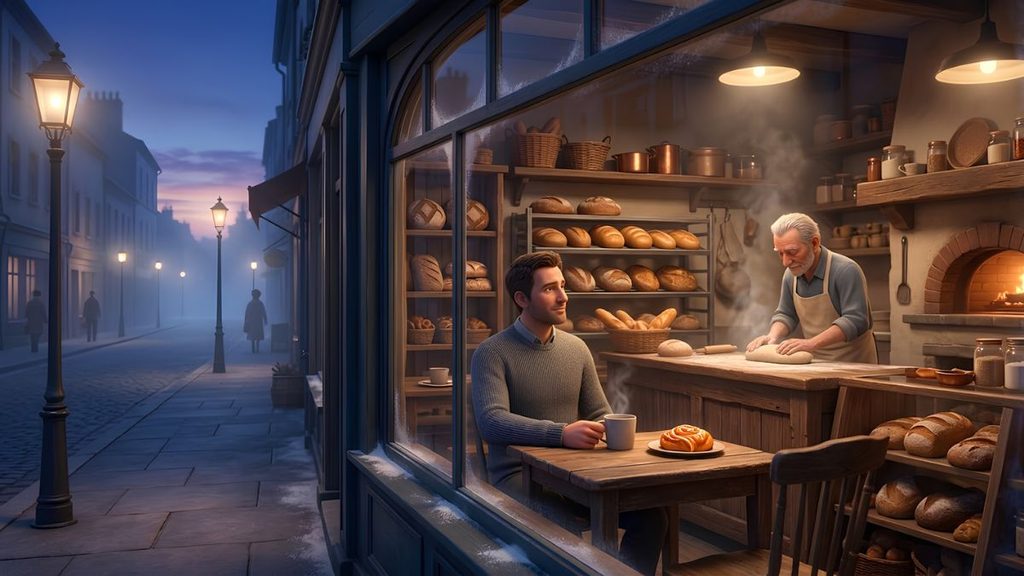
Type: Cute Food and Morning Story
Long before the shops opened, before buses became busy and before most people had drawn their curtains, the bakery on Linden Street was already awake.
Its front window glowed softly in the darkness.
Behind the glass, rows of bread rested on wooden shelves. Small pastries sat beneath clean cloths, waiting for the morning. A brass clock hung above the counter, ticking steadily through the quiet hours.
Daniel knew the bakery well.
He passed it every morning on his way to work.
He had been walking past it for nearly four years, but he had never entered.
There was no particular reason.
He simply preferred to make his coffee at home.
The bakery was just part of his morning scenery.
Until one winter morning, when he stopped outside its window.
It was 5:41 a.m.
The street was almost empty.
Daniel had left home earlier than usual because he had been unable to sleep.
Rather than lying awake in bed, he had decided to walk.
The air was cold.
His hands were tucked into the pockets of his coat.
A faint mist appeared whenever he breathed.
The city looked different at that hour.
During the day, Linden Street was crowded.
Cars moved through the intersection.
People carried shopping bags.
Children walked toward school.
Delivery vans stopped outside stores.
But before six o’clock, the street belonged to a much smaller group of people.
A street cleaner pushed a wide brush along the pavement.
A taxi moved slowly through the intersection.
Somewhere nearby, a metal shutter rolled upward.
Then Daniel saw the bakery.
Its lights were on.
He slowed down.
The bakery was called The Morning Loaf.
The sign above the door was simple.
Cream-colored letters on dark green wood.
Daniel had never noticed how nice it looked in the early morning.
He stopped beside the window.
Inside, a man was working.
Daniel recognized him.
He had seen the baker before.
He was probably in his late fifties, with gray hair and a white apron.
The man carried a tray from one side of the kitchen to the other.
Then he disappeared behind a swinging door.
A few moments later, he returned carrying a large bowl.
Daniel watched him place it on the counter.
The baker opened the bowl.
Steam rose gently.
Daniel could not see what was inside.
Then the baker began working.
He measured something.
Added something else.
Stirred.
Stopped.
Looked at the mixture.
Added a little more.
Daniel smiled.
There was something calming about watching someone perform a task they knew well.
No hurry.
No confusion.
Just one familiar movement following another.
The baker eventually noticed Daniel standing outside.
He looked toward the window.
Daniel raised one hand.
The baker smiled.
Then he pointed toward the door.
Daniel hesitated.
He looked at his watch.
5:52.
He still had plenty of time before work.
So he opened the door.
A small bell rang above him.
“Good morning,” the baker said.
“Good morning.”
“You’re out early.”
“So are you.”
The baker laughed.
“I suppose I am.”
Daniel looked around.
The bakery was warmer than the street.
The smell was even better inside.
Fresh bread.
Butter.
Coffee.
Something sweet.
Something warm.
“Do you want coffee?” the baker asked.
Daniel nodded.
“Please.”
The baker introduced himself as Thomas.
He poured coffee into a white ceramic cup.
Daniel sat at one of the small tables near the window.
There were only four tables in the bakery.
During the day, they were usually occupied.
At this hour, Daniel was the only customer.
Thomas returned to the kitchen.
Daniel watched him through the open doorway.
He prepared bread.
He checked the oven.
He arranged trays.
He wiped the counter.
He looked at the clock.
Then he went back to the dough.
Everything seemed to happen in the same order.
Daniel took a sip of coffee.
It was strong.
Exactly what he needed.
“What time do you start?” Daniel asked.
“Four thirty.”
“Every day?”
“Most days.”
“That’s early.”
Thomas smiled.
“You get used to it.”
Daniel looked toward the kitchen.
“Do you always make the same things?”
“Mostly.”
“Don’t you get bored?”
Thomas considered the question.
“Sometimes.”
Daniel laughed.
Thomas continued.
“But I like knowing what comes next.”
That sentence stayed with Daniel.
He looked through the window.
The sky was beginning to change.
It was still dark, but the blackness had softened slightly.
The buildings were becoming visible.
A single upstairs window across the street was illuminated.
Then another.
Someone else was awake.
Thomas brought out a small plate.
On it was a pastry.
Daniel looked at it.
“What is that?”
“Try it.”
Daniel took a bite.
It was warm.
Flaky.
Lightly sweet.
“That’s very good.”
Thomas nodded.
“It’s new.”
“New?”
“I usually make them with cinnamon. This morning I tried orange.”
Daniel took another bite.
“Keep the orange.”
Thomas smiled.
“I might.”
At 6:15, the first customer arrived.
It was a woman wearing a long brown coat.
She came in carrying a canvas shopping bag.
“Morning, Thomas.”
“Morning, Mrs. Bell.”
“The usual?”
“The usual.”
Thomas prepared a loaf of bread.
He wrapped it in brown paper.
Mrs. Bell paid.
They exchanged a few words about the weather.
Then she left.
The bell above the door rang softly.
Daniel watched her cross the street.
“She comes every morning?” he asked.
“Almost.”
“Same bread?”
“Every time.”
Daniel smiled.
There was something reassuring about that.
Another customer arrived.
Then another.
The bakery slowly became busier.
Daniel moved from his table to a seat closer to the wall.
He finished his coffee.
He looked at the time.
6:40.
He should leave soon.
But he did not feel like going.
The morning had become strangely peaceful.
The bakery had its own rhythm.
Door.
Bell.
Greeting.
Bread.
Paper bag.
Thank you.
Goodbye.
Then silence again.
The rhythm repeated.
At 6:50, a young man entered.
He looked tired.
Thomas handed him a small paper bag before he even spoke.
“Morning.”
“Morning.”
“The usual?”
“Yes.”
The young man paid.
As he turned toward the door, Thomas called after him.
“Have a good day.”
“You too.”
Daniel noticed that Thomas said this to everyone.
Not mechanically.
He seemed to mean it.
At 7:00, sunlight began touching the tops of the buildings.
It entered the bakery through the front window.
The golden light fell across the wooden tables.
Dust particles moved slowly in the air.
Daniel stood near the window.
He looked outside.
The city was waking.
A bus appeared at the end of the street.
A cyclist passed.
A shopkeeper lifted a shutter.
Someone walked a dog.
The bakery remained warm behind him.
Thomas was arranging bread on the shelves.
“You work nearby?” Thomas asked.
“Yes.”
“What do you do?”
“I work in an accounting office.”
Thomas nodded.
“Busy?”
“Usually.”
“Do you like it?”
Daniel thought about that.
“It’s fine.”
Thomas smiled.
“Fine is not a bad word.”
Daniel laughed.
“No, I suppose not.”
Thomas placed another loaf on the shelf.
“You’ll have to find something better to describe it someday.”
“Maybe.”
Daniel left at 7:10.
Before opening the door, he looked back.
Thomas was already preparing another tray.
The bakery was busier now.
People were entering.
Bread was disappearing from the shelves.
Coffee cups were being carried to tables.
The day had begun.
Daniel stepped outside.
The cold air returned.
He walked toward his office.
But he kept thinking about the bakery.
The next morning, Daniel passed it again.
This time, he stopped.
He looked through the window.
Thomas was there.
The same lights.
The same shelves.
The same brass clock.
Daniel opened the door.
The bell rang.
Thomas looked up.
“Good morning.”
“Good morning.”
“Coffee?”
“Please.”
Thomas smiled.
“Orange pastry?”
Daniel smiled.
“Definitely.”
The routine continued.
Daniel began arriving at 5:50.
He would order coffee.
Sometimes he would sit at the window.
Sometimes he would stand near the counter.
Sometimes he would simply watch Thomas work.
He learned the bakery’s rhythm.
At 5:30, the first bread came out of the oven.
At 5:45, the pastries were arranged.
At 6:00, the front lights became brighter.
At 6:15, Mrs. Bell arrived.
At 6:30, the delivery driver brought milk.
At 6:45, the street began filling.
At 7:00, sunlight reached the front counter.
And at 7:10, Daniel usually left.
One morning, Thomas handed him a small paper bag.
Daniel looked inside.
Two orange pastries.
“What are these?”
“I made too many.”
Daniel looked at him.
“Are you sure?”
“Absolutely.”
Daniel smiled.
“Thank you.”
“You’re welcome.”
Daniel carried the bag to work.
At ten o’clock, he ate one.
He saved the other for later.
He thought about bringing one home.
Eventually, Daniel’s colleagues noticed.
“You always smell like a bakery,” one of them said.
Daniel laughed.
“I stop there in the morning.”
“Every morning?”
“Almost.”
“Is it good?”
“Very.”
One colleague asked for the name.
Daniel told her.
The next week, she visited.
Then another colleague.
Soon, Daniel began seeing familiar faces from his office in the bakery.
Thomas seemed pleased.
The bakery became slightly busier.
But its atmosphere remained the same.
Warm.
Quiet.
Unhurried.
Spring arrived.
The mornings became brighter.
Daniel no longer needed his heavy coat.
The bakery window began displaying lighter pastries.
Thomas placed small pots of herbs near the door.
The smell of rosemary sometimes drifted into the street.
Daniel noticed everything.
The changing seasons.
The changing light.
The changing flowers in the small planter outside.
He had walked this street for years.
Now he knew it.
Not completely.
But enough to notice its little details.
One morning, Daniel arrived at 5:40.
The bakery was dark.
He stopped.
The sign was still hanging above the door.
But the lights were off.
There was a handwritten note on the door.
Closed this morning. Back tomorrow.
Daniel stood there for a moment.
He wondered if Thomas was ill.
He hoped everything was okay.
The next day, the bakery was open again.
Thomas was behind the counter.
Daniel entered.
“Everything all right?”
Thomas nodded.
“My oven stopped working.”
“Seriously?”
“Very seriously.”
Daniel laughed.
“What happened?”
“Nothing dramatic. It simply stopped.”
“Is it fixed?”
“Yes.”
Thomas pointed toward the kitchen.
“I had a repairman come yesterday.”
Daniel smiled.
“Good.”
Thomas nodded.
“Good.”
That was all.
The bakery was open.
The oven was working.
The morning could continue.
Summer came.
The mornings were warm.
Sometimes Daniel sat outside at the small table beside the bakery.
He drank coffee while watching the street.
Thomas occasionally joined him.
They spoke about ordinary things.
A new shop opening nearby.
The weather.
The price of flour.
A football match.
The city council repairing the pavement.
Nothing important.
Nothing that needed remembering.
And yet Daniel enjoyed those conversations.
One Saturday morning, Daniel arrived with a small gift.
He handed Thomas a package.
“What is this?”
“Open it.”
Thomas removed the paper.
Inside was a small wooden clock.
Thomas looked at it.
“It’s for the bakery.”
“You already have a clock.”
“I know.”
“Then why another?”
Daniel pointed toward the old brass clock above the counter.
“It’s slow.”
Thomas looked up.
He checked the time.
Then looked at the new clock.
He laughed.
“By three minutes.”
“Exactly.”
Thomas placed the new clock beside the register.
“Thank you.”
“You’re welcome.”
Thomas looked at it again.
“I suppose now I have no excuse for being late.”
Daniel smiled.
“I don’t think you’re ever late.”
The years passed.
Daniel continued working at the accounting office.
Thomas continued running the bakery.
The street changed slowly.
A bookstore closed.
A new café opened.
The old bus stop was moved.
The buildings were repainted.
New people moved into the neighborhood.
But The Morning Loaf remained.
The green sign.
The wooden shelves.
The brass clock.
The blue cups.
The smell of bread.
The warm window before sunrise.
One winter morning, Daniel arrived later than usual.
It had snowed overnight.
The sidewalks were covered in white.
The bakery window glowed against the darkness.
Daniel opened the door.
The bell rang.
Thomas looked up.
“You’re late.”
“I know.”
“Everything all right?”
“Yes.”
Daniel removed his gloves.
“The snow slowed me down.”
Thomas poured coffee.
“Snow does that.”
Daniel sat near the window.
Outside, the city was quiet.
Snow softened the sounds of traffic.
The streetlights reflected on the pavement.
Thomas worked behind the counter.
Daniel watched him.
The same movements.
The same careful rhythm.
Mix.
Shape.
Bake.
Arrange.
Wait.
Repeat.
It was almost the same as the first morning.
And Daniel realized that he liked that.
There was comfort in knowing that some things continued.
The bakery opened before sunrise.
The first bread came out of the oven.
The first customer arrived.
The coffee was poured.
The streets slowly woke.
The sky changed from black to gray.
Then from gray to blue.
And eventually, sunlight entered the window.
Nothing spectacular happened.
The world simply began another day.
Daniel finished his coffee.
He stood.
“See you tomorrow.”
Thomas nodded.
“Tomorrow.”
Daniel stepped outside.
The snow had begun falling again.
He walked down Linden Street.
Behind him, the bakery window remained warm and bright.
Inside, Thomas was already preparing the next tray of bread.
Daniel looked back once.
Then continued walking.
The morning was still young.
The city was waking.
And somewhere behind him, in a tiny bakery on a quiet street, bread was rising.
4. The Umbrella Stand by the Door
Type: Cute Household Story
Nora keeps an old umbrella stand beside the entrance of her apartment.
It holds several umbrellas, although she rarely remembers which one belongs to her.
On rainy days, she chooses one at random.
Over time, she begins noticing that the umbrellas seem to have personalities.
One is too small.
One always turns inside out in strong wind.
One has a wooden handle she particularly likes.
Another was left behind by a former tenant.
Nora eventually cleans the stand, repairs two umbrellas, and labels them.
By the end of the afternoon, the collection looks surprisingly neat.
That evening, rain begins tapping against the windows.
Nora chooses her favorite umbrella and places it beside the door for tomorrow.
Nothing more happens.
The umbrella stand simply becomes one of those ordinary things that makes a home feel lived in.
5. The Man Who Collected Beautiful Envelopes

Type: Cute Collecting Hobby Story
Arthur had a small collection of envelopes.
There were perhaps two hundred of them.
Some were cream-colored.
Some were pale blue.
Some were brown, gray, green, or almost white.
A few were decorated with flowers.
Others carried interesting stamps.
Some had unusual handwriting.
One or two were made from thick paper that felt almost like fabric between the fingers.
Arthur kept them all in a wooden cabinet beside his desk.
He did not collect expensive envelopes.
He did not search for rare ones.
He did not attend collectors’ meetings or spend weekends traveling to auctions.
He simply liked beautiful envelopes.
That was all.
Whenever someone asked him why, Arthur usually smiled and said, “I suppose I like small things that were made to carry something important.”
Then he would return to whatever he had been doing.
Arthur lived in a quiet apartment on the third floor of an old building.
His apartment was not large.
There was a small kitchen, a comfortable sitting room, one bedroom, and a narrow study beside the hallway.
The study was his favorite room.
A wooden desk stood beside the window.
A green desk lamp rested on one corner.
There was a bookshelf above the desk.
A comfortable chair stood nearby.
And beside the desk was the cabinet containing his envelopes.
Arthur had arranged them carefully.
The top drawer contained plain envelopes.
The second contained colorful ones.
The third was for unusual shapes.
The fourth contained envelopes with interesting stamps.
The bottom drawer was reserved for envelopes that Arthur considered especially beautiful.
He had no official system.
It was simply the system that made sense to him.
Every Sunday evening, Arthur spent some time with his collection.
It was not a serious activity.
He did not have to do it.
He simply enjoyed it.
After dinner, he would wash the dishes, make a cup of tea, and walk into his study.
He would switch on the green lamp.
Then he would open the cabinet.
The envelopes would be waiting.
Arthur would take out one drawer.
Place it on the desk.
And begin.
Sometimes he looked through only ten envelopes.
Sometimes twenty.
Occasionally he spent the entire evening sorting them.
He would arrange them by size.
Then perhaps by color.
Then he might change his mind and arrange them by the type of paper.
There was no deadline.
No correct answer.
The collection could be reorganized whenever he wished.
That was part of the pleasure.
Arthur’s interest had begun many years earlier.
He remembered the first envelope clearly.
It had arrived with a letter from an old friend.
The envelope itself was nothing remarkable.
It was pale green.
The paper was slightly rough.
There was a small blue stamp in the corner.
But Arthur liked the handwriting.
The address had been written carefully in dark ink.
The letters were slightly uneven.
The sender had crossed one word out and written it again.
Arthur had kept the envelope.
He did not know why.
He simply put it inside a drawer.
Several months later, he found another interesting envelope.
Then another.
Eventually, he had enough to create a collection.
On Sunday evenings, Arthur sometimes wondered whether other people noticed such things.
Most people opened an envelope and threw it away.
That made sense.
An envelope was designed to protect a letter during its journey.
Once the letter had been removed, the envelope had completed its job.
Arthur understood that.
But he liked the idea that something ordinary could still be worth looking at after its practical purpose was finished.
A simple piece of paper could have a color.
A texture.
A shape.
A stamp.
A handwritten name.
Tiny details could make it memorable.
One Sunday in October, Arthur sat at his desk earlier than usual.
Rain was falling outside.
It was not heavy rain.
Just a steady drizzle that made the windows look slightly blurred.
Arthur made tea.
He carried it into the study.
Then he opened the cabinet.
He selected the drawer containing his colorful envelopes.
There were blue ones.
Yellow ones.
Soft pink ones.
One bright orange envelope.
Arthur placed them on the desk.
He picked up the orange one.
He remembered where it had come from.
A stationery shop near the railway station.
He had bought it because he liked the color.
He had never used it.
He had simply kept it.
Arthur smiled.
Then he put it back.
He picked up a pale blue envelope.
This one had a small illustration of a bird in the corner.
He remembered receiving it from his cousin.
The letter inside had been about a garden.
Arthur no longer had the letter.
But he had kept the envelope.
Sometimes he wondered whether that was backwards.
Perhaps the letter was the important part.
Yet years later, the little bird remained.
It was still bright.
Still cheerful.
Still sitting in the same corner.
Arthur turned the envelope over.
Then placed it beside the orange one.
The rain continued.
Arthur drank his tea.
He could hear water running through the gutter outside.
Occasionally, a car passed along the street.
The sound of tires on wet pavement came and went.
Inside the apartment, everything was quiet.
Arthur liked evenings like this.
There was no reason to go anywhere.
Nothing needed fixing.
Nothing needed deciding.
He could simply sit at his desk.
Look at paper.
Drink tea.
Listen to rain.
He continued sorting.
A white envelope with a gold border.
A brown envelope made from recycled paper.
A small square envelope.
A long narrow one.
An envelope with a faded postage stamp.
An envelope with handwriting so neat that it looked printed.
One had a small tear along the edge.
Another had been folded once.
Arthur examined each one carefully.
He never rushed.
At the bottom of the drawer, he discovered one he had forgotten.
It was cream-colored.
The paper was thicker than most.
There was no stamp.
No writing.
No address.
It was completely unused.
Arthur held it between his fingers.
He remembered buying it years ago.
He had purchased a set of six.
Five had eventually been used.
This was the last.
He turned it over.
The paper was still smooth.
Arthur smiled.
“You’ve been waiting a long time,” he said.
Of course, the envelope did not answer.
Arthur placed it carefully on the desk.
He thought about using it.
Perhaps he could write a letter.
He had not written a proper letter in years.
Most of his communication happened through messages and email.
It was convenient.
Fast.
Simple.
Yet there was something appealing about sitting down with a sheet of paper.
Writing slowly.
Folding the letter.
Putting it inside the envelope.
Sealing it.
Writing an address.
Adding a stamp.
Then placing it into a mailbox.
Arthur looked at the empty envelope again.
Perhaps tomorrow.
He liked that thought.
There was no need to do it tonight.
Tomorrow was perfectly acceptable.
The following morning, Arthur wrote a letter.
It was to an old friend named Edward.
They had not spoken for several months.
There was nothing urgent to say.
Arthur simply wanted to ask how Edward was doing.
He sat at his desk after breakfast.
He took out a sheet of cream-colored paper.
Then he began writing.
The first line was easy.
The second was slightly harder.
After that, the words came naturally.
He wrote about the weather.
The apartment.
A new tree that had been planted near his building.
A book he had recently read.
Then, almost as an afterthought, he mentioned his envelope collection.
He wondered whether Edward remembered the old pale green envelope from years ago.
Arthur finished the letter.
Read it once.
Then folded the paper.
He placed the letter inside the cream-colored envelope.
The fit was perfect.
Arthur smiled.
He sealed it.
Then wrote Edward’s address.
His handwriting was not as neat as it had been when he was younger.
But it was readable.
He placed a stamp in the corner.
Then he held the envelope for a moment.
The collection had changed.
The last unused envelope was no longer empty.
It had become part of something.
Arthur put it beside his keys.
He would take it to the postbox later.
That evening, Arthur returned to the cabinet.
He opened the drawers.
The collection looked slightly different.
One envelope was missing.
Arthur knew exactly where it was.
It was traveling toward Edward.
He found himself wondering what would happen to it.
Perhaps Edward would keep it.
Perhaps he would throw it away.
Arthur did not mind.
The envelope had already served its purpose.
It had carried a letter.
That was enough.
The next Sunday, Arthur continued his usual routine.
Tea.
Green lamp.
Wooden cabinet.
Envelope drawer.
But this time, he added something new.
A small notebook.
He decided to write down where some of the envelopes had come from.
Not all of them.
Just the ones he remembered.
Pale blue bird: Edward, 2017.
Orange envelope: stationery shop near station.
Brown recycled paper: Saturday market.
White envelope with gold border: birthday invitation.
Small square envelope: Christmas card.
He wrote slowly.
The notebook was becoming a record of small things.
Arthur liked that.
As the months passed, the notebook grew.
He added short descriptions.
Sometimes only one sentence.
Sometimes two.
He did not try to write complete histories.
He simply wanted to remember.
One envelope had come from a bakery owner.
Another had carried a wedding invitation.
One had contained a postcard.
Another had been used for a handwritten thank-you note.
A particularly beautiful blue envelope had contained nothing more than a short message from a neighbor.
The contents had been ordinary.
The envelopes had become memories.
In spring, Arthur visited a stationery shop.
It was a small shop near the train station.
He had passed it many times.
That afternoon, he went inside.
There were notebooks on one wall.
Pens on another.
Boxes of cards.
Wrapping paper.
And, near the back, several shelves of envelopes.
Arthur looked at them carefully.
He picked up a pack of pale gray envelopes.
Then a set of dark green ones.
Then some simple white envelopes.
The shopkeeper watched him.
“Writing letters?”
Arthur smiled.
“Sometimes.”
“Invitation?”
“No.”
“Thank-you notes?”
“Perhaps.”
The shopkeeper nodded.
“People don’t write enough letters anymore.”
Arthur looked at the envelopes.
“Maybe they need better envelopes.”
The shopkeeper laughed.
“Maybe.”
Arthur bought the gray envelopes.
When he returned home, he placed them in the second drawer.
He did not immediately use them.
He liked knowing they were there.
That was enough.
Summer arrived.
Arthur’s Sundays became warmer.
He sometimes opened the window while sorting his collection.
Birds could be heard in the trees below.
The evening air moved the curtains gently.
The green desk lamp was no longer necessary until later.
Arthur still turned it on.
He liked the warm circle of light it created on the desk.
His routine remained the same.
The world outside changed.
His collection slowly changed too.
One evening, Arthur received a letter.
It was from Edward.
He recognized the handwriting immediately.
The envelope was ordinary.
White paper.
Blue stamp.
Nothing unusual.
Arthur opened it carefully.
Edward had written about his garden.
He had planted tomatoes.
They were growing well.
He had also remembered the pale green envelope from years earlier.
At the bottom of the letter, Edward had written:
I still remember that envelope. You were always noticing things nobody else noticed.
Arthur smiled.
He placed the letter on the desk.
Then he looked at the envelope.
It was ordinary.
But now it had a place in his collection.
Arthur added it to the notebook.
Letter from Edward, summer. White envelope. Blue stamp.
Then he placed the envelope into the fourth drawer.
He did not flatten it completely.
He liked the small curve it had from carrying the letter.
Autumn returned.
Rain began falling again.
Arthur sat at his desk one Sunday evening.
The same green lamp.
The same wooden cabinet.
The same quiet room.
He opened the drawer.
One by one, he looked at his envelopes.
He had nearly three hundred now.
He had never planned to collect so many.
He still did not consider himself a serious collector.
It was simply something he enjoyed.
He took out the pale green envelope that had started everything.
The paper was slightly faded.
The stamp was no longer bright.
The handwriting remained.
Arthur ran his finger gently across the surface.
Then he smiled.
So many years had passed.
The envelope had outlived the letter.
But it had preserved a little piece of that moment.
Arthur looked around his study.
The room was quiet.
The rain had stopped.
Streetlights had appeared outside.
A few windows across the road were glowing.
Someone was cooking dinner.
Someone else was reading.
A television flickered behind another curtain.
The city was settling into evening.
Arthur closed the drawer.
He put the notebook away.
Then he made another cup of tea.
Before going to bed, Arthur checked the mail.
There was one new envelope.
It was cream-colored.
Simple.
He looked at it for a moment.
Then laughed quietly.
He knew what he would do with it.
Not every envelope had to become part of the collection.
Some could simply be opened.
Some could carry letters.
Some could be discarded.
And some could be kept because they were beautiful.
There was room for all of them.
Arthur placed the new envelope on the desk.
Then switched off the green lamp.
The study became dark.
He closed the door.
And went to bed.
The next Sunday evening, the routine began again.
Tea.
Lamp.
Cabinet.
Drawer.
Arthur sat quietly at his desk.
He sorted the envelopes one by one.
Blue.
Cream.
Brown.
White.
Green.
Large.
Small.
Plain.
Decorated.
Old.
New.
There was nothing urgent about any of it.
The collection did not need to be completed.
There was no final envelope.
No perfect arrangement.
No destination.
Arthur simply enjoyed the quiet process.
One small piece of paper at a time.
Outside, evening settled over the neighborhood.
The last sunlight disappeared from the windows.
Streetlights came on.
A bus passed at the end of the street.
Then everything became quiet again.
Arthur finished sorting.
He returned the envelopes to their drawers.
Closed the cabinet.
Put his cup in the kitchen.
Turned off the lights.
And before leaving the study, he glanced once more at the wooden cabinet.
Three hundred little envelopes rested inside.
Each one had once carried something.
A letter.
An invitation.
A greeting.
A thank-you.
A birthday message.
A simple note.
Or perhaps nothing at all.
Arthur smiled.
Small things, he thought, could have long lives.
Sometimes all they needed was someone willing to notice them.
Then he closed the door.
The apartment became quiet.
And somewhere in the wooden cabinet, surrounded by hundreds of ordinary pieces of paper, the little pale green envelope waited patiently for another Sunday.
6. The Moonlight Laundromat

Type: Cute Nighttime Routine Story
It was nearly midnight when Clara discovered the laundromat.
She had not been looking for one.
In fact, she had not been looking for anything at all.
She had simply gone out for a walk.
The evening had been unusually warm, and her apartment felt stuffy. After opening the windows and turning on the fan, Clara had still been unable to settle down.
So she put on a light sweater, slipped her keys into her pocket, and walked outside.
The neighborhood was quiet.
Most of the shops were closed.
The bakery had darkened its windows.
The small bookstore had pulled down its shutters.
A few restaurants remained open farther down the street, but their lights were beginning to disappear one by one.
Clara walked without a destination.
She passed the pharmacy.
Then the bus stop.
Then a narrow side street she rarely used.
That was where she saw the laundromat.
Its sign read:
MOONLIGHT LAUNDRY
The letters were faded, but the windows were brightly illuminated.
Clara stopped.
She had lived in the neighborhood for almost three years.
She had never noticed it before.
The laundromat occupied the ground floor of an old brick building.
There were six large windows facing the street.
Behind them, washing machines and dryers stood in neat rows.
The machines were silver.
The floor was pale tile.
A few plastic chairs were arranged against one wall.
A vending machine stood beside the entrance.
Everything looked clean and surprisingly peaceful.
Most importantly, nobody seemed to be in a hurry.
Clara looked through the glass.
One washing machine was turning slowly.
Round and round.
The clothes inside moved through the water.
A dryer hummed quietly.
Clara watched for a few seconds.
Then she opened the door.
A small bell sounded above her.
“Good evening.”
The voice came from behind the counter.
Clara looked up.
An older woman was sitting there with a book.
She had silver hair tied loosely behind her head and wore a blue cardigan.
“Good evening,” Clara replied.
The woman smiled.
“Doing laundry?”
Clara laughed softly.
“Not exactly.”
“That’s all right.”
The woman returned to her book.
Clara stood near the entrance.
For some reason, she felt slightly embarrassed.
She had entered a laundromat without any laundry.
The woman seemed to understand.
“You can sit,” she said.
Clara looked at the chairs.
“Are you sure?”
“Of course.”
Clara sat down.
The woman introduced herself as Margaret.
She had managed the laundromat for twelve years.
Clara looked around.
“Twelve years?”
“Yes.”
“Do people really do laundry this late?”
“Some do.”
Margaret glanced toward the machines.
“Some people work late. Some people prefer quiet hours. Some simply like coming when there aren’t many people around.”
Clara nodded.
“I can understand that.”
Margaret smiled.
“So can I.”
Clara listened to the machines.
There was something soothing about the sound.
The washers hummed.
The dryers turned.
Occasionally, one machine clicked.
Then the rhythm returned.
Hummm.
Turn.
Hummm.
Turn.
Outside, a car passed slowly.
Its headlights moved across the window.
Then disappeared.
The laundromat became quiet again.
Clara leaned back.
She realized that she was beginning to feel sleepy.
“Do you come here often?” Margaret asked.
“No.”
“First time?”
“Yes.”
Margaret nodded.
“Most people say that.”
Clara smiled.
“What do they say after that?”
“They come back.”
Clara laughed.
“I might.”
Margaret closed her book.
“You should bring laundry next time.”
“I suppose that would help.”
A man entered carrying a large blue laundry bag.
He nodded to Margaret.
“Evening.”
“Evening, Peter.”
He placed the bag on a folding table.
Clara watched him sort his clothes.
White shirts.
Dark trousers.
Towels.
Socks.
He separated them carefully.
Then placed each group into a different machine.
There was nothing remarkable about it.
And yet Clara found herself watching.
Peter measured detergent.
Closed the machine.
Pressed a button.
The washer began filling with water.
He sat down.
Margaret returned to her book.
Clara looked through the window.
The moon was visible above the rooftops.
The laundromat had earned its name honestly.
Moonlight entered through the front windows.
It mixed with the warm fluorescent lighting inside.
The result was strange but pleasant.
Silver machines.
Pale floors.
Soft reflections.
A dark blue sky beyond the glass.
Clara thought it was one of the nicest places she had seen that night.
“Do you like working here?” she asked Margaret.
Margaret considered the question.
“Yes.”
“Even at midnight?”
“Especially at midnight.”
“Why?”
Margaret looked toward the windows.
“It’s quiet.”
Clara nodded.
“I like that.”
Margaret explained that she opened the laundromat at six in the morning.
During the day, it became much busier.
Parents came with children.
Students arrived with backpacks.
Workers brought uniforms.
People carried baskets and bags.
Sometimes all the machines were running.
But after eleven, everything slowed.
The last customers came in.
The dryers turned.
The street became quiet.
And Margaret had time to read.
“What do you read?” Clara asked.
“Anything.”
Margaret lifted her book.
“A mystery tonight.”
“Is it good?”
“Very.”
“Are you going to tell me who did it?”
Margaret laughed.
“Absolutely not.”
At 12:20, Peter moved his clothes from the washers into the dryers.
He folded the empty laundry bags.
Then he sat again.
Clara noticed that he had brought a small paperback.
He opened it.
Soon, all three of them were sitting quietly.
Margaret reading.
Peter reading.
Clara watching the machines.
The laundromat seemed almost like a waiting room.
Except nobody was waiting for anything important.
They were simply waiting for clothes to become dry.
Clara began noticing little details.
One dryer had a small scratch shaped like a crescent.
A vending machine displayed bottles of water and cans of tea.
Someone had left a small basket of spare hangers beside the folding table.
There was a wall clock above the counter.
Its second hand moved smoothly.
Tick.
Tick.
Tick.
The washing machines continued turning.
Clara looked at the clock.
12:37.
Then she looked again.
12:43.
Six minutes had passed.
It felt like half an hour.
Margaret noticed her expression.
“Time moves strangely here.”
“Yes.”
“That’s another reason I like it.”
Clara smiled.
“Does it ever get boring?”
Margaret looked around.
“Sometimes.”
Then she shrugged.
“Boring isn’t always bad.”
Clara thought about that.
She had spent most of her life trying not to be bored.
She filled empty moments with her phone.
Music.
Emails.
Television.
News.
Messages.
There was always something to read or watch.
But sitting in the laundromat, she realized that she had not checked her phone once.
She simply watched clothes go round and round.
At 1:00, Peter’s dryers stopped.
He stood and opened one.
Warm air escaped.
He reached inside.
The clothes were dry.
He folded the towels first.
Then the shirts.
Then the trousers.
He placed everything carefully into the blue laundry bag.
Before leaving, he said goodnight to Margaret.
“Goodnight, Peter.”
He nodded to Clara.
“Goodnight.”
“Goodnight.”
The bell sounded when he opened the door.
Then he disappeared into the quiet street.
Clara looked at the empty machines.
“Does he always come at this time?”
“Every Thursday.”
“Why Thursday?”
Margaret shrugged.
“That’s his laundry day.”
There was something comforting about that answer.
Not every habit needed an explanation.
Sometimes Thursday was simply laundry day.
At 1:15, another customer arrived.
This time it was a young woman carrying a small basket.
She greeted Margaret.
Then began loading a washer.
She did not speak much.
Margaret did not ask questions.
The young woman sat down.
Clara moved slightly to make room.
The three women sat quietly.
The machine turned.
The clock moved.
The moon remained above the rooftops.
Eventually, Clara realized that she had been inside for nearly two hours.
She stood.
“I should probably go home.”
Margaret closed her book.
“You don’t have to.”
“I know.”
Clara looked at the machines.
“I think I just wanted somewhere quiet.”
Margaret nodded.
“You found it.”
Clara smiled.
“Apparently.”
She stepped outside.
The night air felt cooler.
The street was almost empty.
Clara looked back at the laundromat.
The windows glowed.
Inside, the machines continued turning.
She could see Margaret behind the counter.
She was already reading again.
Clara walked home.
It took less than ten minutes.
When she reached her apartment, she opened the door.
Everything was exactly as she had left it.
Fan.
Window.
Sofa.
Lamp.
But the room felt different.
Quieter.
Clara changed into pajamas.
She washed her face.
Then went to bed.
For the first time in several nights, she fell asleep quickly.
The following Thursday, Clara returned.
This time, she brought laundry.
She had waited until evening to put it into a basket.
Then, at 11:30, she walked to the laundromat.
Margaret looked up.
“I knew you’d come back.”
Clara smiled.
“I brought laundry.”
“Good.”
Margaret pointed toward the machines.
“Third one from the left.”
Clara loaded her clothes.
She measured detergent.
Closed the door.
Pressed the button.
The machine began filling.
Clara sat down.
The routine became a weekly habit.
Every Thursday night, Clara came to Moonlight Laundry.
She usually arrived around 11:30.
She washed her clothes.
Moved them into a dryer.
Folded them.
Then walked home.
Sometimes Margaret was there.
Sometimes Peter arrived.
Sometimes the young woman came with her basket.
Sometimes Clara was the only customer.
The conversations remained simple.
How was your week?
Fine.
Cold tonight.
Yes.
Did you finish that book?
Almost.
Nothing more was necessary.
One Thursday, rain began falling.
Clara arrived with an umbrella.
The laundromat windows were covered with tiny drops.
Inside, everything was warm.
She placed her basket beside the washing machine.
Margaret handed her a towel.
“Your umbrella is leaking.”
“Thank you.”
Clara dried the handle.
Then sat down.
The rain tapped against the glass.
The machines hummed.
The lights reflected on the wet pavement.
It was one of the most peaceful evenings Clara could remember.
“What made you call it Moonlight Laundry?” Clara asked.
Margaret smiled.
“My husband.”
“Really?”
“Yes.”
“Did he own it?”
“He did.”
Margaret looked toward the window.
“He chose the name.”
“Why?”
“He used to say the laundromat looked nicest at night.”
Clara looked around.
“I agree.”
Margaret smiled.
“He would be pleased.”
There was no sadness in her voice.
Just warmth.
Clara watched the moonlight on the floor.
She imagined Margaret’s husband standing there years earlier.
Perhaps arranging the chairs.
Checking the machines.
Turning on the lights.
Perhaps looking through the windows at the moon.
Perhaps deciding that the place needed a name.
Moonlight Laundry.
It was a simple name.
But it suited the place.
As winter approached, the nights became colder.
Clara began wearing a heavier coat.
She started bringing a book.
Margaret kept a small electric heater near the chairs.
Peter continued arriving on Thursdays.
The young woman came every other week.
The laundromat remained the same.
The machines turned.
The dryers hummed.
The clock moved.
The moon appeared.
Sometimes clouds covered it.
Sometimes stars were visible.
Nothing unusual happened.
And Clara began to appreciate that.
One evening, she arrived earlier than usual.
The laundromat was empty.
Margaret was cleaning the folding tables.
Clara helped her.
She wiped one table.
Margaret wiped another.
They cleaned the machines.
Swept the floor.
Refilled the vending machine.
Then they sat down.
“You don’t have to help,” Margaret said.
“I know.”
“But you did.”
Clara smiled.
“It wasn’t difficult.”
“No.”
Margaret looked around.
“Most good things aren’t.”
At midnight, the first machine finished.
Clara opened it.
Warm clothes.
Soft towels.
Clean sheets.
She moved everything into a dryer.
Then sat down again.
She listened.
The dryer began turning.
Round.
Round.
Round.
Clara rested her head against the chair.
Her eyes became heavy.
Margaret noticed.
“You can sleep.”
Clara opened one eye.
“Here?”
“Why not?”
Clara smiled.
“I’m supposed to take my laundry home.”
“Your laundry will still be here when you wake up.”
Clara laughed.
“I don’t think I should sleep in a laundromat.”
“Probably not.”
They both laughed.
At 12:30, Clara finished folding her clothes.
She placed them neatly into her basket.
Before leaving, she looked around.
The silver machines.
The blue chairs.
The wall clock.
The vending machine.
The moonlit windows.
Margaret behind the counter.
Everything seemed familiar now.
Almost like part of her home.
“Goodnight,” Clara said.
“Goodnight.”
“See you next Thursday.”
Margaret nodded.
“Same time?”
“Same time.”
Outside, the moon was bright.
Clara walked home slowly.
She did not use her phone.
She did not listen to music.
She simply walked.
The streets were quiet.
A few windows remained illuminated.
Somewhere in the distance, a train moved through the city.
Clara reached her building.
She climbed the stairs.
Entered her apartment.
Placed the clean laundry away.
Turned off the lights.
And went to bed.
Years later, Clara would still remember those Thursday nights.
Not because anything extraordinary happened.
Nothing did.
There were no adventures.
No mysteries.
No unexpected discoveries.
There were only washing machines.
Warm dryers.
Quiet conversations.
Books.
Rain.
Moonlight.
And the gentle repetition of ordinary life.
Perhaps that was what she liked most.
The laundromat never demanded anything from her.
She did not have to achieve anything there.
She did not have to make decisions.
She only had to wait.
The clothes would wash.
The dryers would turn.
The minutes would pass.
And eventually, everything would be clean, folded, and ready to go home.
One night, much later, Clara sat by the window while her washing machine turned.
She looked at the clothes moving behind the glass.
Round and round.
She remembered the first night she had entered Moonlight Laundry without any laundry at all.
She smiled.
Then she looked outside.
The moon was rising above the rooftops.
The neighborhood was quiet.
The same quiet she had once gone searching for.
Clara closed her eyes.
The washing machine continued its gentle rhythm.
Round.
And round.
And round.
There was nowhere she needed to be.
Nothing she needed to solve.
Nothing waiting for her attention.
Just the soft sound of the machine.
The cool night beyond the window.
And the peaceful feeling of knowing that, for tonight, everything was being taken care of.
Clara breathed slowly.
The machine turned.
The moon climbed higher.
And the night became still.
7. The Postcard Rack at the Railway Station
Type: Cute Observation Story
Every morning, just after seven, Daniel passed through the old railway station on his way to work.
He did not need to use the station.
His office was only a short walk away.
But the station provided a convenient shortcut through the center of town, and Daniel had been taking that route for almost five years.
He knew its sounds.
The distant whistle of arriving trains.
The soft announcement over the speakers.
The footsteps of commuters crossing the tiled floor.
The rolling wheels of suitcases.
The occasional metallic clatter of a luggage trolley.
He knew the smell too.
Coffee from the small kiosk near Platform Two.
Warm bread from the bakery outside the main entrance.
Rain on the stone pavement during winter.
Dust and sunlight during summer.
Yet there was one thing inside the station that Daniel had never paid much attention to.
A small postcard rack.
It stood near the information desk.
It was made of dark wood and had several slowly rotating sections.
Most people walked past it without looking.
Daniel did too.
Until one Monday morning.
It was raining lightly.
Daniel arrived at the station earlier than usual.
His train was not his concern, but the rain had made the streets unpleasant, and he wanted to stay indoors for a few minutes before walking to work.
He stood near the information desk.
Then, without any particular reason, he looked at the postcard rack.
There were dozens of postcards.
Pictures of the town.
The railway station itself.
The old clock tower.
A nearby lake.
The market square.
A hill covered with trees.
A bridge crossing the river.
There were also postcards showing places farther away.
Small coastal villages.
Mountain towns.
Old European streets.
Quiet countryside roads.
Daniel walked closer.
He picked up one.
It showed the railway station during winter.
Snow covered the roof.
The clock tower was visible in the background.
A few warm windows glowed against the blue-gray morning.
Daniel turned the postcard over.
The back was blank.
He put it back.
Then he went to work.
The following morning, he noticed the rack again.
This time, he looked at it for longer.
The postcards were arranged without much order.
Some were new.
Some looked as though they had been there for years.
The corners of a few were slightly bent.
Daniel wondered how many people actually bought them.
He picked up a postcard showing the lake.
The lake was only fifteen minutes from town.
Daniel had visited it many times.
But the photograph showed it differently.
The water looked almost silver.
Mist hovered above the surface.
Trees stood quietly along the shore.
There was no one in the picture.
Daniel liked that.
He bought the postcard.
The shopkeeper at the station kiosk was a woman named Sophie.
She placed the postcard inside a small paper sleeve.
“Sending it somewhere?” she asked.
“No.”
“Keeping it?”
“I think so.”
Sophie smiled.
“That’s allowed.”
Daniel laughed.
He placed the postcard in his briefcase.
Then walked to work.
That evening, he took the postcard out.
He placed it on his desk.
The picture showed a quiet lake.
Daniel looked at it while drinking tea.
There was something peaceful about having a small image of somewhere familiar.
He had seen the lake himself.
But the photograph captured a particular moment that he had never witnessed.
Morning mist.
Still water.
Empty paths.
Daniel placed the postcard beside his lamp.
He decided he would keep it there for a while.
The next morning, he stopped at the rack again.
There was no particular reason.
He simply wanted to look.
He discovered a postcard showing an old village street.
Stone houses.
Window boxes.
A bicycle leaning against a wall.
A small bakery sign.
A cat sitting on a doorstep.
Daniel smiled.
He bought that one too.
Then he continued to work.
Soon, Daniel had a small collection.
He did not intend to collect postcards.
At least, that was what he told himself.
He simply found himself buying one every few days.
Sometimes he chose a picture of somewhere he knew.
Sometimes he chose somewhere he had never visited.
One showed a lighthouse.
Another showed a forest path.
One showed a mountain railway.
Another showed a quiet harbor.
He kept them in a wooden box at home.
He never sent them.
He never wrote on them.
He simply liked having them.
After several weeks, Daniel began noticing the rack’s regular customers.
There was an elderly man who always bought postcards of trains.
A woman with a red scarf frequently chose postcards showing gardens.
A student often stood in front of the rack for several minutes before selecting one.
A young couple bought postcards whenever they traveled.
They sometimes argued quietly about which one looked best.
Daniel found this amusing.
The postcard rack had its own little community.
Nobody belonged to it officially.
They simply appeared from time to time.
One morning, Daniel spoke to the elderly man.
“You like trains?”
The man looked at the postcard in his hand.
“Yes.”
“Do you collect them?”
“Not exactly.”
Daniel smiled.
“Neither do I.”
The man laughed.
“That’s what everyone says.”
His name was Arthur.
He had worked for the railway for forty years.
Now he was retired.
He came to the station twice a week.
“Why do you buy train postcards?” Daniel asked.
Arthur shrugged.
“I like seeing trains when they aren’t moving.”
Daniel understood immediately.
There was something different about a train in a still photograph.
No announcements.
No passengers.
No rushing.
Just the train.
Waiting.
Arthur showed Daniel one of his favorites.
It showed an old steam locomotive standing beside a small countryside platform.
The photograph was black and white.
A station clock showed 8:15.
There were no people.
“Beautiful,” Daniel said.
Arthur nodded.
“Very ordinary.”
Daniel looked at the image again.
“That’s probably why I like it.”
From then on, Daniel and Arthur occasionally spoke near the postcard rack.
Their conversations were never long.
They talked about photographs.
Weather.
Trains.
The station.
Sometimes Arthur recommended a postcard.
Sometimes Daniel did.
It became another part of Daniel’s morning routine.
Winter arrived.
The station became colder.
People wore thick coats and carried umbrellas.
The postcard rack remained near the information desk.
Its wooden frame had become slightly worn.
Daniel liked that.
It made the rack feel older than the station itself.
One morning, he found a new postcard.
It showed the station at night.
The platform lights were reflected on wet pavement.
A train stood quietly beside the platform.
Snow was beginning to fall.
Daniel bought it immediately.
That evening, he placed it beside the lake postcard.
Two quiet scenes.
One familiar place.
One familiar station.
He wondered how many photographs could exist of ordinary places.
Probably thousands.
Perhaps millions.
And yet each one showed something different.
One Saturday, Daniel took a walk around the lake shown on his first postcard.
The weather was cold.
The water was calm.
Mist hovered above the surface.
He stood on the same path he had seen in the photograph.
For a moment, he felt as though he had stepped inside the postcard.
But the real lake was different.
Birds moved across the water.
A dog ran along the path.
Someone was sitting on a bench.
The wind moved through the trees.
Daniel smiled.
The postcard had preserved one quiet moment.
The real place continued changing.
Both were beautiful.
When he returned home, Daniel placed the photograph beside the window.
He began thinking about the difference between photographs and memories.
A photograph stayed still.
A memory changed.
Yet perhaps that was why he liked postcards.
They did not demand anything.
They simply offered a small image.
A place.
A moment.
A possibility.
As the months passed, Daniel’s wooden box became fuller.
He arranged the postcards by subject.
Nature.
Railways.
Buildings.
Villages.
Water.
Night scenes.
He occasionally rearranged them.
Sometimes he sorted them by color.
He enjoyed the process.
There was no reason for it.
No purpose.
No achievement.
It was simply satisfying.
One evening, Daniel found an old postcard at the bottom of the box.
He did not remember buying it.
It showed a small seaside town.
White houses.
Blue shutters.
A narrow road leading toward the sea.
The postcard was slightly faded.
Daniel turned it over.
There was handwriting on the back.
He had written it himself.
Years earlier.
The message was only a few lines.
He had apparently bought the postcard while traveling and written it to himself.
He did not remember doing that.
The message said that he had enjoyed a quiet morning by the sea.
There was no grand story.
No important event.
Just a quiet morning.
Daniel smiled.
Perhaps that was the point.
The postcard rack remained at the station.
People continued walking past.
Some stopped.
Some did not.
Some bought postcards.
Most never looked.
Daniel still visited it almost every morning.
Sometimes he bought one.
Sometimes he did not.
Sometimes he simply rotated the rack slowly and looked at the pictures.
He liked seeing which ones were new.
He liked noticing which ones had disappeared.
He wondered where they went.
Perhaps someone sent them to a friend.
Perhaps someone kept them.
Perhaps someone placed one beside a bed.
Perhaps one was sitting on a refrigerator somewhere.
A small picture from the railway station.
One morning, Sophie told Daniel that the postcard rack would be moved.
“Where?”
“Near the main entrance.”
“Why?”
“They’re renovating this area.”
Daniel looked at the rack.
It had always stood there.
He had become used to seeing it.
He found the idea of moving it strangely unsettling.
Sophie laughed.
“It’s only a few meters away.”
“I know.”
“But you’ll still find it.”
Daniel smiled.
“Of course.”
The renovation took two weeks.
During that time, the rack disappeared.
Daniel noticed its absence every morning.
The information desk looked different.
The empty space seemed larger.
He missed the little wooden rack.
Not because it was important.
Because it had become familiar.
Eventually, the renovation finished.
The postcard rack was placed near the main entrance.
It looked almost exactly the same.
Daniel walked over.
He touched the wooden edge.
Then rotated it slowly.
There were new postcards.
One showed the river.
Another showed the town in spring.
Another showed the railway station from above.
Daniel picked one.
He turned it over.
Blank.
He smiled.
Arthur appeared a few minutes later.
“Moved,” he said.
“Yes.”
“Better location.”
“Perhaps.”
Arthur examined the rack.
“I don’t like it.”
Daniel laughed.
“Why?”
“Too bright here.”
Daniel looked around.
He had to agree.
The old location had been quieter.
Arthur picked up a train postcard.
“Still good pictures, though.”
“True.”
They stood there for a while.
Neither had anywhere urgent to be.
The station continued moving around them.
Passengers came and went.
Announcements echoed overhead.
Suitcases rolled across the floor.
Trains arrived.
Trains departed.
And beside the entrance, the postcard rack turned slowly.
Years later, Daniel still remembered that rack.
Not because of any particular postcard.
He remembered the routine.
The morning walk.
The station.
The smell of coffee.
The sound of trains.
The wooden rack.
The slow turning motion.
The small pictures.
The brief conversations.
The quiet moments before work.
His collection had grown considerably.
But he still bought postcards for the same reason.
Sometimes a beautiful picture was enough.
It did not need a story.
It did not need a destination.
It did not need to be sent anywhere.
It could simply exist.
One evening, Daniel sat at home and looked through his collection.
The room was quiet.
A lamp glowed beside him.
Outside, rain moved gently against the window.
He picked up the first postcard he had ever bought.
The lake.
The mist.
The empty path.
He turned it over.
Blank.
Then he picked up the photograph of the old railway station.
Then the village street.
Then the lighthouse.
Then the mountain railway.
Each picture held a quiet moment.
None required anything from him.
He placed them back in the wooden box.
Closed the lid.
And sat quietly for a while.
The next morning, Daniel walked through the railway station again.
The same announcements.
The same footsteps.
The same coffee kiosk.
The same trains.
Near the main entrance, the postcard rack stood beneath the morning light.
Daniel stopped.
He rotated it slowly.
A postcard showed a small house beside a river.
Another showed a garden after rain.
Another showed a quiet railway platform.
He chose the platform.
Sophie placed it in a paper sleeve.
“Another one?”
Daniel smiled.
“Another one.”
He put it into his coat pocket.
Then he walked toward the station exit.
Outside, the morning was beginning.
The streets were filling.
The sky was pale.
Somewhere behind him, a train gave a soft whistle.
Daniel continued walking.
In his pocket was a small postcard showing an ordinary railway platform.
He knew he would probably never send it.
He would probably take it home.
Place it in the wooden box.
And years later, perhaps, he would find it again.
He might not remember buying it.
He might not remember the morning.
But he would still have the picture.
A quiet platform.
A few empty benches.
Soft morning light.
And the feeling of having stood there once, on an ordinary day, with nowhere particularly urgent to go.
And for Daniel, that was more than enough.
8. The Little Clock Repair Shop
Type: Cute Craft and Shop Story
At the end of a narrow street, between a tailor’s shop and a small stationery store, there was a little clock repair shop.
Its sign simply read:
MILLER CLOCKS
The letters had once been gold.
Years of rain and sunlight had softened them until they looked almost brown.
The shop itself was not large.
There was one front window, one narrow door, and a brass bell above the entrance.
Inside were clocks.
Hundreds of them.
Some stood on shelves.
Some hung on walls.
Some rested beneath glass covers.
There were round clocks, square clocks, wooden clocks, silver clocks, brass clocks, small clocks, large clocks, and clocks so tiny that they could fit comfortably inside a person’s palm.
At almost any hour of the day, the shop contained a gentle mixture of ticking sounds.
Tick.
Tick.
Tick.
Tock.
Tick.
Tock.
It was never completely silent.
But it was never loud either.
For Daniel, who had recently moved into the neighborhood, the clock shop became one of those places he noticed without really knowing why.
He passed it every morning.
And every evening.
For several months, he never went inside.
Then, one rainy afternoon, he finally did.
Daniel had been clearing out a cupboard in his apartment.
Behind several old notebooks, he found a small wristwatch.
It belonged to his grandfather.
Daniel had not seen it for years.
The watch had a brown leather strap.
Its face was simple.
There were thin black numbers around the edge and two narrow hands.
When Daniel wound it, nothing happened.
He tried again.
Still nothing.
He looked at the watch for a while.
Then he remembered the little shop at the end of the street.
An hour later, he was standing outside it.
Rain moved gently down the window.
Daniel opened the door.
The brass bell rang.
And the sound of hundreds of clocks seemed to become slightly louder.
“Good afternoon.”
A man was sitting behind a wooden workbench.
He was perhaps seventy years old.
His hair was white.
He wore round glasses and a dark blue sweater.
Several tiny tools were arranged neatly in front of him.
“Good afternoon,” Daniel replied.
“I have a watch that needs repairing.”
The man smiled.
“Most people do.”
Daniel laughed.
He placed the watch on the counter.
The man picked it up carefully.
“Old?”
“Quite old.”
“Family?”
“My grandfather’s.”
The man nodded.
He examined the watch without rushing.
Then he opened the back.
He looked inside.
“Hmm.”
Daniel waited.
“Can you fix it?”
“I think so.”
The man looked up.
“Leave it with me.”
His name was Arthur Miller.
He had owned the shop for thirty-eight years.
Daniel found this out during their conversation.
Arthur wrote Daniel’s name in a small notebook.
Then he wrote down the description of the watch.
Brown leather strap.
Silver face.
Family watch.
He placed it in a shallow wooden tray.
“Come back Friday.”
“Will it be ready?”
“Probably.”
Daniel nodded.
“Thank you.”
Arthur smiled.
“You are welcome.”
The bell rang again when Daniel left.
Outside, the rain continued.
Daniel walked home.
For some reason, he felt pleased.
On Friday afternoon, Daniel returned.
Arthur was sitting at his workbench.
The watch was beside him.
“Ready?”
“Almost.”
Daniel smiled.
“I thought you said Friday.”
“It is Friday.”
Arthur looked at the watch.
“It needs a little more time.”
Daniel laughed.
“That’s appropriate.”
Arthur smiled.
“Very.”
He continued working.
Daniel stood nearby.
For the first time, he noticed how many clocks were in the shop.
He counted them.
Then lost count.
There were at least fifty visible from the front.
Perhaps more in the back.
“Do they all work?” Daniel asked.
“Most.”
“Doesn’t the ticking drive you crazy?”
Arthur shook his head.
“After a while, you stop hearing individual clocks.”
“What do you hear?”
Arthur listened.
“The room.”
Daniel liked that answer.
He stood quietly.
The clocks continued.
Tick.
Tock.
Tick.
Tock.
A large wooden clock on the wall chimed the hour.
Its sound was deep and gentle.
Another clock responded with a lighter chime.
Then another.
For several seconds, the shop seemed filled with different voices.
Then everything became quiet again.
Arthur returned to the watch.
“Why do people still repair clocks?” Daniel asked.
Arthur adjusted his glasses.
“Because people still like keeping time.”
“Couldn’t they just buy a new one?”
“They could.”
“But?”
Arthur smiled.
“Sometimes the old one means something.”
Daniel looked at his grandfather’s watch.
He understood.
Arthur placed the watch in front of him.
“The movement is fine.”
“That’s good.”
“It simply needed cleaning.”
Arthur opened a small drawer.
Inside were tiny bottles.
Tiny brushes.
Tiny screws.
Tiny tools.
Everything had a place.
He worked slowly.
He cleaned the watch.
Adjusted something.
Checked the hands.
Then wound it.
A faint ticking began.
Daniel smiled.
“It works.”
Arthur nodded.
“Yes.”
Daniel paid him.
Arthur wrapped the watch in a small piece of soft cloth.
“Take care of it.”
“I will.”
Daniel put the watch in his pocket.
He thanked Arthur.
Then left.
The brass bell rang.
He walked home.
On the way, he stopped beneath a streetlamp.
He took the watch out.
Tick.
Tick.
Tick.
It was working.
From that day forward, Daniel began visiting the shop occasionally.
He did not always have anything to repair.
Sometimes he simply wanted to look at the clocks.
Arthur never seemed surprised to see him.
“Afternoon.”
“Afternoon.”
“How’s the watch?”
“Still working.”
“Good.”
Then Daniel would sit in one of the two wooden chairs near the window.
Arthur would continue working.
Neither felt the need to talk.
Daniel learned the shop’s daily rhythm.
Arthur opened at nine.
He cleaned the front window.
Unlocked the door.
Turned on the small desk lamp.
Wound several clocks.
Checked his repair notebook.
Then began working.
Customers came and went.
Some brought watches.
Some brought clocks.
Some simply needed batteries.
A few came to buy old clocks that Arthur had repaired and placed on the shelves.
The shop was never crowded.
But it was rarely empty.
One morning, an elderly woman brought a small kitchen clock.
“It stopped last night.”
Arthur examined it.
“How old?”
“Twenty-five years.”
“That’s not very old.”
She laughed.
“Feels old to me.”
Arthur opened the back.
Daniel was sitting nearby.
He watched quietly.
The woman waited.
After several minutes, Arthur said:
“It needs a new spring.”
“Can you get one?”
“I have one.”
He reached into a drawer.
The woman smiled.
“You have everything.”
Arthur shook his head.
“Not everything.”
He found the spring.
Daniel began to understand why people trusted Arthur.
He never hurried.
He never made a repair sound more complicated than it was.
If something could be fixed, he fixed it.
If it could not, he explained why.
There was no drama.
No sales pitch.
Just quiet work.
One rainy evening, Daniel visited after work.
The shop was almost empty.
Arthur was repairing a small travel clock.
Rain tapped against the front window.
Daniel sat in the wooden chair.
The clocks ticked.
A kettle was boiling in the back room.
Arthur eventually brought two cups of tea.
“Milk?”
“Yes, please.”
Arthur handed him the cup.
Daniel looked around.
“Do you ever get tired of this place?”
Arthur thought about it.
“Sometimes.”
“Then why stay?”
Arthur looked at the clocks.
“I like knowing what needs doing.”
Daniel smiled.
“That’s very simple.”
“Simple is useful.”
They drank tea.
The clocks continued ticking.
Outside, the rain became heavier.
A bus passed.
Its headlights moved across the window.
Then disappeared.
The shop returned to its quiet rhythm.
Daniel looked at the clock on the wall.
It showed 6:20.
Another clock showed 6:18.
A third showed 6:23.
“Your clocks don’t agree.”
Arthur laughed.
“They’re clocks, not politicians.”
Daniel laughed too.
Over time, Daniel began learning the personalities of the clocks.
There was a tall wooden grandfather clock that chimed loudly.
A small brass carriage clock that ticked almost silently.
A square blue clock that was always three minutes slow.
A white kitchen clock with red hands.
A round railway clock.
A small alarm clock with two bells.
A decorative clock shaped like a house.
A tiny clock that had belonged to Arthur’s father.
Daniel liked the small brass carriage clock best.
Its ticking was barely audible.
Arthur noticed.
“You like that one?”
“Yes.”
“Why?”
“I don’t know.”
Arthur nodded.
“That’s usually enough.”
One afternoon, Daniel brought a clock of his own.
It was not old.
It was inexpensive.
A small wooden clock he had bought years earlier.
It had stopped.
Arthur opened it.
“Battery.”
Daniel laughed.
“That’s it?”
“That’s it.”
Arthur replaced the battery.
The second hand moved.
Tick.
Tick.
Tick.
Daniel smiled.
“How much?”
Arthur waved his hand.
“Nothing.”
“No.”
“Come on.”
Daniel insisted.
Arthur finally accepted a small payment.
“Fine.”
The seasons changed.
Spring became summer.
Summer became autumn.
The shop remained almost exactly the same.
The clocks continued ticking.
Arthur continued repairing them.
Daniel continued visiting.
Sometimes he stayed for ten minutes.
Sometimes half an hour.
Once, he spent nearly two hours there.
He had been reading a book.
Arthur had been repairing a complicated wall clock.
Neither spoke much.
The afternoon simply passed.
One evening, Daniel noticed something unusual.
A clock near the back wall had stopped.
It was an old wooden clock.
The hands pointed to 4:15.
“That one isn’t working,” Daniel said.
Arthur looked at it.
“No.”
“Are you repairing it?”
“Not anymore.”
“Why?”
Arthur was quiet for a moment.
Then he said:
“It belonged to my wife.”
Daniel did not ask anything else.
Arthur continued working.
The clock remained at 4:15.
Months passed.
Daniel became familiar with the shop.
He knew where Arthur kept the tools.
He knew which chair had the most comfortable cushion.
He knew that Arthur drank tea without sugar.
He knew the shop became brightest around four in the afternoon when sunlight entered through the front window.
He knew Arthur closed at six.
At 5:55, Arthur began putting away his tools.
At 5:58, he checked the repair notebook.
At 6:00, he locked the front door.
Then he walked through the shop, checking the clocks.
Daniel sometimes helped.
One by one, they were wound.
A small adjustment here.
A small adjustment there.
Then the lights went off.
One winter evening, snow began falling.
Daniel arrived just before closing.
Arthur was standing near the door.
“You’re late.”
“Sorry.”
“I was about to close.”
Daniel looked disappointed.
Arthur smiled.
“Come in.”
Daniel entered.
The shop was warm.
Snow was visible through the window.
The clocks ticked softly.
Arthur handed Daniel a cup of tea.
“Thank you.”
They stood near the counter.
Neither spoke for a while.
Outside, the street became quieter as snow accumulated.
Inside, the clocks continued their patient work.
“Do you ever wonder where all these clocks have been?” Daniel asked.
Arthur looked around.
“Sometimes.”
“People must have stories.”
“They do.”
“But you don’t know them.”
“Not all of them.”
Arthur pointed toward a small clock.
“That one came from a farm.”
Another.
“That one was in a hotel.”
Another.
“That one belonged to a school.”
Daniel listened.
The clocks suddenly seemed less like objects.
They were reminders of places.
Kitchens.
Bedrooms.
Offices.
Workshops.
Hallways.
Homes.
Arthur looked at the time.
6:10.
“You’re keeping me late.”
Daniel smiled.
“Sorry.”
Arthur shook his head.
“Don’t be.”
He closed the notebook.
Then he turned off the desk lamp.
The shop became dim.
The clocks remained visible in the fading light.
Daniel put on his coat.
Arthur unlocked the door.
“Goodnight.”
“Goodnight.”
Daniel stepped outside.
Snow was still falling.
He walked home slowly.
A few weeks later, Daniel noticed a sign on the shop window.
CLOSED FOR RENOVATION
He stopped.
The shop was dark.
The clocks were still visible behind the glass.
Daniel wondered what had happened.
He returned the next day.
The sign remained.
Then the next.
And the next.
Finally, after almost two weeks, the sign disappeared.
The shop opened again.
Daniel entered.
The bell rang.
Arthur looked up.
“Morning.”
“Morning.”
“Where were you?”
“Renovation.”
Daniel looked around.
Nothing appeared different.
“What did you renovate?”
Arthur pointed toward the back room.
“The floor.”
Daniel smiled.
“That’s it?”
“That’s it.”
The shop continued.
Quietly.
Predictably.
Just as before.
Arthur grew older.
Daniel noticed that he moved more slowly.
His hands were still steady.
His eyesight was not quite as good.
He sometimes used a magnifying glass.
But the work continued.
One spring morning, Daniel arrived to find Arthur sitting in the front chair.
He was not working.
The shop was unusually quiet.
“Everything okay?”
Arthur nodded.
“Just resting.”
Daniel sat beside him.
They watched the clocks.
Tick.
Tick.
Tock.
Tick.
The sunlight entered through the window.
Dust floated in the air.
A small brass clock reflected the light.
After a while, Arthur said:
“You know, I used to think repairing clocks was about making them run.”
Daniel listened.
“What is it about now?”
Arthur smiled.
“Keeping something going a little longer.”
Daniel looked at the clocks.
He understood.
That afternoon, Arthur gave Daniel a small clock.
It was the brass carriage clock Daniel had always liked.
Daniel looked surprised.
“I can’t take this.”
“You can.”
“Why?”
Arthur shrugged.
“You’ve been looking at it for years.”
Daniel held the clock carefully.
“How much?”
Arthur laughed.
“Nothing.”
Daniel smiled.
“Thank you.”
Arthur nodded.
“Take care of it.”
“I will.”
Daniel placed the little brass clock on his desk at home.
Its ticking was almost silent.
He could only hear it when the room was completely quiet.
At night, he sometimes sat beside it with a book.
The clock continued.
Tick.
Tick.
Tick.
It did not hurry.
It did not stop.
It simply moved through the seconds.
Years later, Daniel still visited Miller Clocks.
The shop eventually became quieter.
There were fewer customers.
Arthur worked fewer hours.
But the clocks remained.
The same wooden shelves.
The same brass bell.
The same old sign.
The same gentle ticking.
One evening, Daniel sat in the familiar chair.
Arthur worked behind the counter.
The sun was setting.
Golden light filled the shop.
The clocks continued their patient rhythm.
Daniel looked at his grandfather’s old watch.
It was still working.
He looked at the brass carriage clock Arthur had given him.
It was working too.
Two small objects.
Two quiet reminders.
Arthur looked up.
“Still keeping time?”
Daniel smiled.
“Yes.”
“Good.”
Arthur returned to his work.
Daniel sat quietly.
There was nothing else to say.
Outside, evening settled over the street.
The shops began closing.
People walked home.
Cars passed.
Windows lit up.
Inside the little clock repair shop, the clocks continued ticking.
One after another.
Slowly.
Steadily.
Patiently.
There was no hurry.
There was nowhere to go.
The minutes simply passed.
And for a little while, Daniel sat there listening to them.
Tick.
Tock.
Tick.
Tock.
The sound was soft enough to disappear into the room.
And peaceful enough to make the whole evening feel slower.
Eventually, Arthur closed his notebook.
Daniel stood.
“Goodnight.”
“Goodnight.”
The brass bell rang as Daniel stepped outside.
Behind him, the shop remained warm and quiet.
The clocks continued ticking in the darkness.
And somewhere on a small wooden desk, a brass carriage clock kept perfect time.
Not loudly.
Not urgently.
Just quietly.
One second after another.
One evening after another.
Until the night became completely still.
Why Adults Enjoy Cute Stories Before Bed
Adults often spend their days dealing with practical responsibilities.
Work requires attention.
Household tasks require planning.
Messages require responses.
Appointments need to be remembered.
Financial decisions and personal responsibilities can occupy the mind long after the working day has ended.
A cute story offers a different experience.
It asks the reader to focus on something simple.
A character making tea.
A couple walking home.
A cat sleeping in an unusual place.
Friends sharing dessert.
Someone decorating a small room.
A baker preparing tomorrow’s bread.
The simplicity can be comforting.
A gentle emotional change
A cute story can shift the mood from busy to peaceful.
Instead of thinking about everything that needs to happen tomorrow, the reader can spend a few minutes following a character through a small, pleasant experience.
Simple plots are easy to follow
Bedtime reading does not always need a complicated storyline.
A simple beginning, a few enjoyable moments, and a gentle conclusion can be enough.
This is particularly useful when the reader is already tired.
Cute stories can create positive emotions
Warm interactions, harmless humor, animals, friendship, and small acts of kindness can leave the reader with a pleasant feeling before turning off the light.
Different Types of Cute Bedtime Stories for Adults
There are many ways to create a cute bedtime story without making it childish.
The following categories can provide variety while maintaining a peaceful nighttime tone.
Cute Animal Stories
Animals are one of the easiest ways to introduce warmth into a bedtime story.
An adult character might live with an elderly dog who insists on sleeping in the same chair every evening.
Another story could follow a cat that believes a particular window belongs exclusively to it.
A gardener might have a friendly robin that visits every morning.
Someone living in an apartment might gradually become familiar with a neighborhood cat.
The animal does not need to cause chaos.
Its personality can simply become part of the character’s routine.
For bedtime reading, gentle animal behavior is often more suitable than stories involving danger or constant mischief.
Sweet Couple Stories
Cute romantic stories can focus on established relationships rather than dramatic romance.
A couple might have a tradition of sharing dessert before bed.
One partner could leave a small note beside the coffee machine.
Two people might cook breakfast together on a quiet Sunday.
A couple returning from work could stop at their favorite bakery.
One person might remember a tiny detail that the other had mentioned weeks earlier.
These moments can show affection without requiring intense romantic conflict.
The charm comes from ordinary closeness.
A quiet relationship can be just as interesting as a dramatic one when the story pays attention to meaningful details.
Cute Friendship Stories
Friendship can provide another warm foundation.
Two friends might meet at the same café every Friday evening.
They might exchange books.
They could take turns bringing homemade snacks.
Perhaps they have an amusing tradition that neither of them takes particularly seriously.
The story can explore how friendships develop through repetition and small gestures.
There does not need to be a major problem to solve.
Simply showing two people enjoying each other’s company can be enough.
Cozy Apartment Stories
An apartment can become an ideal setting for a cute bedtime story.
The character might return home after work.
They remove their shoes.
Put their keys into a bowl.
Change into comfortable clothes.
Water a plant.
Turn on a small lamp.
Prepare tea.
Then notice something unexpectedly pleasant.
Perhaps a neighbor has left a small package outside the door.
Perhaps a plant has produced a new flower.
Perhaps the character discovers an old photograph tucked inside a book.
The event can remain small.
The apartment itself becomes part of the story.
Warm lighting, comfortable furniture, books, blankets, plants, and familiar household objects can create a welcoming atmosphere.
Cute Café Stories
A small café can provide a charming nighttime setting.
The story might follow a café owner preparing for the evening.
Perhaps the same customers visit every week.
One customer always orders the same tea.
Another always chooses the table near the window.
A baker brings fresh pastries in the afternoon.
A regular customer knows the names of the staff.
The plot can revolve around these familiar routines.
There is something naturally comforting about returning to a place where people recognize one another.
A café story can also incorporate sensory details such as warm drinks, freshly baked bread, soft music, rain against the windows, and warm interior lighting.
Cute Neighborhood Stories
A quiet neighborhood can provide endless possibilities.
The story might follow several residents who know each other casually.
One person grows flowers.
Another walks a dog every evening.
Someone regularly sweeps the front steps.
A couple runs a small bookstore.
A retired teacher feeds birds.
A child leaves drawings near a neighbor’s mailbox.
The characters do not need to become involved in a major adventure.
Instead, the story can show how small interactions gradually create a sense of community.
This can be particularly effective for bedtime because the setting feels familiar and safe.
Cute Workplace Stories
Workplace stories can also be cute when the workplace is peaceful.
A bookstore employee might discover that a coworker keeps recommending the same book to everyone.
A bakery assistant might accidentally make one pastry slightly larger than the others and decide it should become the “special one.”
A librarian might notice that the same visitor always chooses the same chair.
A florist might spend the final hour of the day arranging leftover flowers.
The key is to keep workplace situations low-stakes.
The reader should not feel as though they are entering another stressful workday.
Cute Small-Town Stories
Small towns are useful settings for gentle storytelling.
A story could take place around a village bakery, neighborhood café, flower shop, library, or local market.
Characters recognize one another.
The same shops appear every day.
People exchange brief greetings.
Someone knows which bakery sells the best bread.
Another person knows when the local bookstore receives new deliveries.
These details can make the story feel warm and familiar.
The town itself can almost become a character.
What Makes a Cute Bedtime Story Relaxing?
A cute story can still become unsuitable for bedtime if it contains too much excitement.
The difference usually comes down to pacing and emotional intensity.
Gentle pacing
The story should allow events to unfold naturally.
There is no need to rush from one scene to another.
Low-stakes situations
The central situation can be small.
Finding a missing recipe is enough.
Choosing flowers is enough.
Preparing dinner is enough.
Waiting for a friend is enough.
Warm relationships
Friendly conversations and affectionate interactions can create emotional comfort.
Familiar environments
Homes, cafés, gardens, bookstores, kitchens, and quiet streets can make the story feel safe and recognizable.
A satisfying conclusion
A cute bedtime story does not need a dramatic ending.
The character might finish dinner, close a book, say goodnight to a pet, turn off a lamp, or simply return home.
The story can end quietly.
The Importance of Gentle Humor
Humor can make cute bedtime stories even more enjoyable.
However, bedtime humor works best when it is soft.
For example, a character might spend several minutes searching for their glasses before discovering that they are already wearing them.
A cat might repeatedly sit on the same chair whenever its owner tries to use it.
A person might carefully prepare a beautiful breakfast only to realize they forgot to make coffee.
A neighbor might become unusually serious about choosing the perfect flowerpot.
These situations can make readers smile without creating stress.
The goal is comforting amusement, not overwhelming comedy.
Cute Stories Do Not Have to Be Childish
This distinction is important.
A story can be cute while still being written specifically for adults.
Adult readers may appreciate:
- Subtle romance
- Dry humor
- Workplace routines
- Quiet friendships
- Cooking
- Travel
- Pets
- Interior spaces
- Personal traditions
- Everyday kindness
- Small-town life
- Reflective conversations
The writing can remain mature while the emotional tone stays sweet.
For example, two adults preparing dinner together can create a cute story without turning the characters into exaggerated or childish personalities.
Likewise, an adult living alone with a mischievous cat can provide humor while still exploring the comfort of companionship.
The Role of Animals in Cute Adult Bedtime Stories
Animals can provide emotional warmth with very little narrative complexity.
A sleepy dog waiting beside the door.
A cat sitting beside someone while they read.
A bird returning to the same garden.
An old horse standing quietly in a stable.
A rabbit appearing near a garden fence.
These moments do not require complicated plots.
The animal’s presence can simply make the story feel warmer.
For adult readers, the relationship between the character and the animal can also provide a subtle emotional center.
The animal becomes part of everyday life.
Everyday Objects Can Make Stories Feel Cute
Cute storytelling is not always about characters.
Objects can also create charm.
Consider:
- A favorite mug
- A worn cookbook
- A small lamp
- A knitted blanket
- An old armchair
- A wooden music box
- A tiny plant
- A handwritten shopping list
- A collection of postcards
- A favorite pair of slippers
A character might have a favorite mug that they use every evening.
Someone might keep a small wooden box filled with handwritten notes.
Another person might carefully repair an old chair instead of replacing it.
These details give the story personality.
Cute Bedtime Stories and Sensory Details
Sensory writing can make a simple story feel immersive.
Instead of saying:
She made tea.
A more atmospheric approach might describe the kettle beginning to hum, the steam rising from the cup, and the warm smell filling the kitchen.
Sensory details might include:
Sounds:
Rain against windows, a kettle, soft footsteps, pages turning, distant traffic, birdsong.
Smells:
Tea, coffee, bread, cinnamon, fresh flowers, clean laundry.
Textures:
Warm blankets, wooden furniture, soft sweaters, smooth ceramic cups.
Visual details:
Lamp light, moonlight, curtains, bookshelves, gardens, evening skies.
The important thing is moderation.
Too many details can make a story feel busy.
A few carefully chosen details are usually enough.
How Long Should a Cute Bedtime Story Be?
There is no fixed length.
Different readers have different preferences.
Very short stories
These can take only a few minutes to read.
They are useful when someone wants a quick calming story before bed.
Short stories
These might take around ten to fifteen minutes.
They provide enough room for a small plot and a satisfying ending.
Longer bedtime stories
Longer stories can explore relationships, environments, routines, and multiple small moments.
However, length should not be confused with complexity.
A long bedtime story can still follow a very simple plot.
The important thing is maintaining a calm rhythm.
How to Write a Cute Bedtime Story for Adults
A simple structure can make the writing process easier.
Start with a comfortable setting
Begin with a place that immediately establishes a peaceful atmosphere.
For example:
A quiet apartment on a rainy evening.
A small café before closing.
A bookstore on a winter afternoon.
A garden at sunset.
A hotel preparing for the night.
Introduce an ordinary character
The character does not need extraordinary abilities.
They might be a teacher, designer, baker, librarian, gardener, writer, photographer, or office worker.
Give them a small situation
The situation could be:
- Preparing dinner
- Waiting for a friend
- Caring for a pet
- Organizing a room
- Visiting a café
- Choosing flowers
- Repairing something
- Preparing for tomorrow
Add a few charming details
Small observations make the story feel personal.
A favorite mug.
A sleepy dog.
A crooked picture frame.
A funny neighbor.
A familiar song.
End gently
The conclusion should feel complete without becoming dramatic.
The character returns home.
The room becomes quiet.
The pet falls asleep.
The lights go out.
The story ends.
What to Avoid in Cute Bedtime Stories
Not every cute idea works equally well at bedtime. Avoid introducing unnecessary tension.
- Excessive conflict: Arguments and relationship problems can make readers more alert.
- Sudden danger: Car accidents, emergencies, frightening discoveries, or threatening characters can disrupt the relaxing mood.
- Complicated mysteries: Mysteries encourage readers to keep thinking about the answer.
- Constant plot twists: Too many surprises create mental stimulation.
- Overly emotional endings: A story can be touching without becoming deeply sad.
- Loud comedy: Humor is welcome, but constant chaos can work against the purpose of bedtime reading.
The best cute bedtime stories generally leave the reader feeling lighter rather than more stimulated.
Cute Bedtime Stories Can Focus on Small Moments
One of the most useful ideas in this genre is that the story does not need to be about something important.
A person buying flowers can be enough.
A couple making soup can be enough.
A dog waiting for its owner can be enough.
A bookstore closing for the night can be enough.
A person watering plants can be enough.
A friend bringing homemade cookies can be enough.
These moments may appear ordinary, but storytelling can make them meaningful.
The charm comes from slowing down and noticing them.
Creating a Cozy Nighttime Reading Experience
The story is only one part of the bedtime experience.
The environment also matters.
A reader might:
- Dim the lights
- Put the phone aside
- Make a warm caffeine-free drink
- Get comfortable under a blanket
- Read at a slower pace
- Reduce background noise
- Choose a familiar story
- Stop reading when they feel sleepy
A peaceful setting can make a gentle story feel even more relaxing.
The purpose is not to force sleep.
It is simply to create a transition between an active day and a quieter evening.
Final Thoughts
Cute bedtime stories for adults can be simple, warm, funny, romantic, cozy, or quietly emotional.
They do not need complicated adventures or dramatic conflicts.
A sleepy pet, a warm kitchen, a familiar café, a quiet conversation, a small act of kindness, or an ordinary evening can provide enough material for a satisfying bedtime story.
The strongest stories in this category understand that small moments can be meaningful.
A character turning on a lamp.
A partner leaving a note.
A cat settling into its favorite chair.
A friend bringing a pastry.
A baker preparing tomorrow’s bread.
A person closing the curtains at the end of the day.
These moments create a gentle sense of comfort.
And when the day’s noise finally becomes quiet, sometimes a small, sweet story is all an adult needs to slow down, smile, and settle into the night.