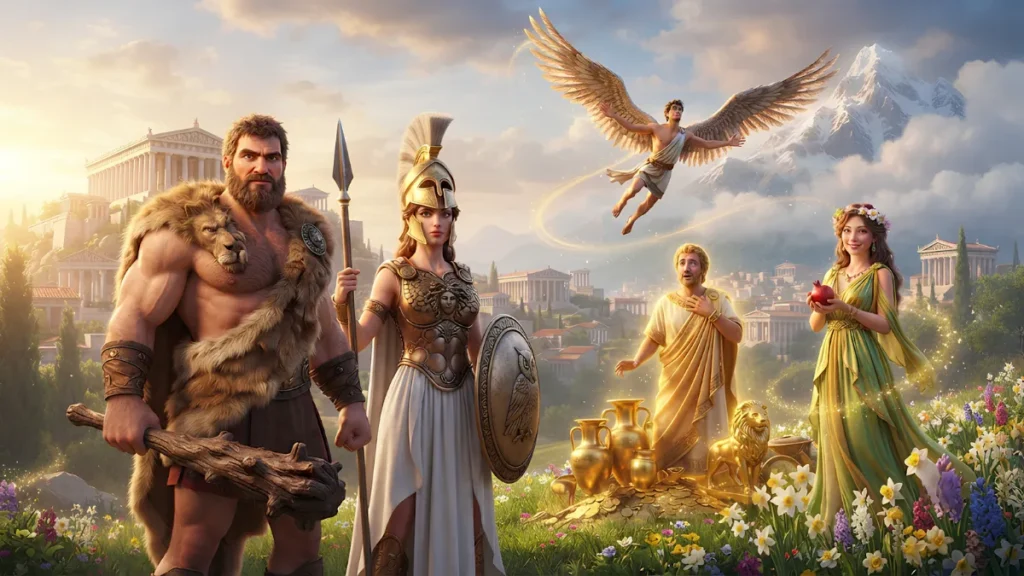
Greek mythology is filled with fascinating stories about powerful gods, brave heroes, mysterious creatures, and extraordinary adventures. But these ancient tales are much more than entertaining legends. They also teach valuable lessons about honesty, pride, kindness, courage, patience, love, greed, and the consequences of our choices.
Greek mythology stories with moral lessons help readers understand important values through unforgettable characters and dramatic events. From King Midas, who learned that too much greed can destroy happiness, to Icarus, who discovered the dangers of ignoring advice, these stories offer wisdom that remains relevant even today.
Whether you are looking for meaningful stories for children, interesting tales for students, or ancient legends with powerful life lessons, Greek mythology offers something for everyone.
In this article, you will discover some of the most popular Greek mythology stories, their meanings, and the moral lessons we can learn from them.
What Are Greek Mythology Stories With Moral Lessons?
Greek mythology stories with moral lessons are traditional tales from ancient Greece that use gods, goddesses, heroes, monsters, and ordinary people to explain human behavior and teach important values.
These stories often explore what happens when someone becomes too proud, selfish, dishonest, greedy, or careless. They also celebrate qualities such as bravery, determination, wisdom, compassion, and loyalty.
For example:
- The story of King Midas teaches us that greed cannot bring true happiness.
- The story of Icarus warns us against arrogance and ignoring good advice.
- The story of Arachne reminds us that talent should be accompanied by humility.
- The story of Hercules teaches us about courage, perseverance, and responsibility.
- The story of Pandora reminds us that curiosity and careless decisions can have unexpected consequences.
These ancient legends are still meaningful because the emotions, mistakes, and challenges experienced by their characters are part of everyday human life.
Famous Greek Mythology Stories With Moral Lessons
Here are 12 fascinating Greek mythology stories that combine adventure, imagination, and valuable life lessons.
1. King Midas and the Golden Touch
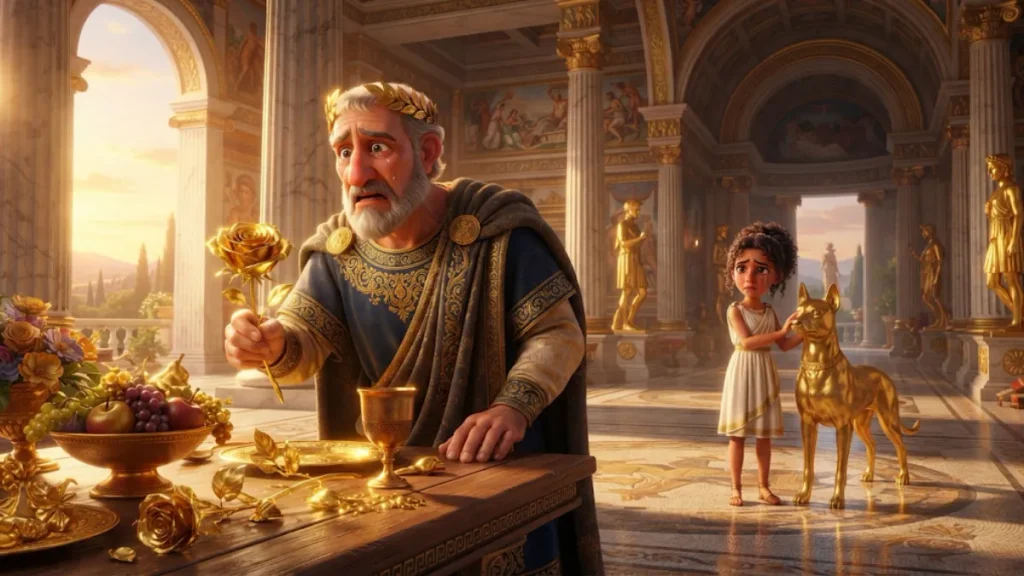
Long ago, in the ancient kingdom of Phrygia, there lived a king named Midas. He was known throughout the land for his enormous wealth, magnificent palace, and countless treasures. His kingdom was filled with beautiful gardens, golden decorations, and impressive buildings. Servants worked in his palace, musicians entertained his guests, and merchants traveled from distant lands to trade with him.
King Midas had almost everything a person could desire. He owned beautiful clothes, expensive jewels, enormous fields, and rooms filled with gold coins. Yet, despite having more wealth than most people could imagine, he was never satisfied.
Every morning, he visited his treasure room and admired his gold. He enjoyed watching sunlight reflect from golden cups, necklaces, and ornaments. Sometimes, he spent hours counting his coins and imagining how much richer he could become.
His greatest weakness was his endless desire for more.
Midas believed that gold was the most valuable thing in the world. He thought that if he could turn everything around him into gold, nobody would ever be wealthier or more powerful than him.
However, he failed to understand that happiness could not be measured by the amount of treasure stored inside a palace.
The Unexpected Guest
One beautiful afternoon, something unusual happened in the kingdom.
A group of travelers was passing through the royal gardens when one of them became separated from the others. He was an old companion of Dionysus, the Greek god of wine, celebration, and pleasure.
The traveler was tired and confused. He wandered through the gardens until he found a comfortable place to rest beneath a large tree.
When King Midas learned that a stranger was sleeping in his garden, he did not become angry. Instead, he welcomed the visitor into his palace.
He offered him delicious food, comfortable clothing, and a warm place to sleep. The king also instructed his servants to treat the guest with kindness.
The traveler was grateful for the hospitality.
When Dionysus discovered that his companion had been treated so generously, he decided to reward King Midas.
The following day, Dionysus appeared before the king.
Midas was astonished to see the powerful god standing inside his palace. He immediately bowed and welcomed him respectfully.
Dionysus smiled.
“I have heard that you treated my companion with great kindness,” he said. “Your generosity deserves a reward. Ask for anything you desire, and I shall grant your wish.”
King Midas could hardly believe his ears.
He had never imagined that he would receive such an extraordinary opportunity. He could ask for a larger kingdom, greater strength, a longer life, or perhaps even more treasure.
But his mind immediately returned to the one thing he loved most.
Gold.
Without considering the consequences, Midas answered, “My greatest wish is that everything I touch should turn into gold.”
Dionysus looked at him carefully.
“Are you certain this is what you want?” he asked.
“Absolutely!” replied Midas. “Imagine how wonderful my life would be if every object I touched became gold. I would become the richest king in the entire world.”
Dionysus understood that the king had not thought carefully about his request.
Nevertheless, he granted the wish.
“Very well, King Midas. From this moment onward, everything you touch will turn into gold.”
With those words, Dionysus disappeared.
Midas stood silently for a moment.
Then he looked at his hands and smiled.
His dream had finally come true.
The King Discovers His Magical Power
King Midas immediately wanted to test his new ability.
He reached toward a nearby wooden table and gently touched its surface.
Within seconds, the ordinary wood transformed into shining gold.
Midas stared at the table in amazement.
He touched a wooden chair, and it became gold too. Then he picked up a small stone from the floor. The moment his fingers touched it, the stone transformed into a beautiful golden object.
The king began laughing with excitement.
He walked through his palace, touching everything he could find.
Golden curtains replaced ordinary fabric. Wooden decorations became precious ornaments. Even the flowers in his garden transformed into golden sculptures.
The servants watched in disbelief.
Some believed their king had received a blessing from the gods. Others were frightened by the strange power.
But Midas was happier than he had ever been.
He imagined that his palace would soon become the most magnificent place in the world.
He would no longer need merchants to bring him gold. He would not have to worry about treasure or trade.
Everything he touched would become valuable.
For the first time in his life, King Midas believed that he had enough wealth to satisfy his desires forever.
Unfortunately, he had no idea that his happiness would soon disappear.
The First Sign of Trouble
After spending hours enjoying his magical power, Midas became hungry.
He returned to the dining hall, where his servants had prepared a wonderful meal.
There were fresh fruits, warm bread, roasted vegetables, delicious meat, and a large jug of cool water.
The king sat at the table with a cheerful expression.
“Today is the happiest day of my life!” he announced.
He reached for a piece of bread.
But the moment his fingers touched it, the bread became solid gold.
Midas looked at it in confusion.
He tried picking up an apple, hoping that the bread had somehow been an exception.
However, the apple also turned into gold.
He touched a grape, a piece of cheese, and a small cake.
Everything became golden and completely inedible.
His smile slowly disappeared.
“Bring me another meal!” he ordered.
The servants hurried to bring fresh food, but the same problem occurred.
Nothing could pass through his hands without turning into gold.
Midas then reached for his drinking cup.
As soon as his fingers touched it, the water inside transformed into solid gold.
He tried another cup, but the result was exactly the same.
The king began to panic.
He had wanted everything to become gold, but he had never imagined that he would be unable to eat or drink.
For the first time, he realized that his magical power had a terrible disadvantage.
Gold could buy food, but it could not satisfy hunger.
Gold could purchase water, but it could not quench thirst.
The king pushed away from the table and walked into the garden.
He needed time to think.
A Father’s Greatest Fear
As Midas sat beneath a tree, he heard a familiar voice.
“Father!”
His beloved daughter was running toward him.
She was delighted to see her father and wanted to share something wonderful that had happened in the garden.
She had heard about the magical transformation and was excited to discover what her father could do.
Midas looked at her and immediately felt a little better.
Unlike gold, his daughter was someone he genuinely loved. Her happiness mattered more to him than all the treasures in his palace.
She approached him with a bright smile.
“Father, is it true that you can turn things into gold?”
Midas nodded slowly.
“Yes, my dear. It is true.”
“Can you show me?”
The king hesitated.
He remembered what had happened to his food and water. He understood that his magical ability was dangerous, but he had not yet realized its full consequences.
Before he could explain, his daughter stepped closer and reached out to hug him.
Midas instinctively opened his arms.
The moment he touched her, something terrible happened.
Her body became covered in shining gold.
Her smile disappeared, her movement stopped, and she transformed into a golden statue.
Midas froze.
For several moments, he could not understand what had happened.
Then he looked at the golden figure standing before him.
It was his daughter.
The child he loved more than anything in the world had been transformed into an inanimate object.
“Please!” he cried. “Wake up! Say something!”
But the golden statue remained silent.
Midas fell to his knees.
He touched her golden hands, hoping that somehow she would move again.
Nothing happened.
The king began crying.
He had spent his entire life collecting gold, but now he had lost the person who made his life meaningful.
His palace was full of precious objects, yet he had never felt so poor.
He finally understood the terrible mistake he had made.
The King Understands the True Meaning of Wealth
Midas remained beside his daughter for a long time.
He remembered the days when she would run through the gardens, laugh with the servants, and sit beside him during meals.
She had never asked him for expensive gifts or golden decorations.
She simply wanted her father’s love and attention.
The king remembered how often he had ignored her because he was busy counting his treasures.
He had believed that becoming richer would make him happier.
Instead, his desire for more gold had taken away the happiness he already possessed.
His daughter’s golden figure stood as a painful reminder of his greed.
Midas finally understood that gold was not the same as happiness.
He would gladly exchange every treasure in his kingdom to hear his daughter laugh again.
But he could not undo what had happened.
Desperate and heartbroken, he decided to seek help from Dionysus.
He left his palace and traveled to find the god.
Along the way, he passed beautiful fields, rivers, and villages.
Normally, Midas would have admired the land and imagined how much wealth it could produce.
This time, he barely noticed the scenery.
His only thought was to reverse the terrible gift.
When he finally reached Dionysus, the king fell to his knees.
Midas Begs Dionysus for Forgiveness
“Please, mighty Dionysus,” Midas cried. “I made a terrible mistake. I thought your gift would make me happy, but it has brought nothing but suffering.”
Dionysus looked at the king.
“What happened, Midas?”
The king explained everything.
He described how his food and water had turned into gold. He told the god how his beloved daughter had become a golden statue.
“I no longer want this power,” Midas said. “Take it away. I would rather live as an ordinary man with nothing than remain a king who cannot enjoy the simplest things in life.”
Dionysus listened carefully.
He could see that the king had finally understood the consequences of his greed.
“Your wish was granted because you believed gold would bring you happiness,” the god replied. “But you forgot that life contains many things more valuable than wealth.”
Midas lowered his head.
“I understand now. I was foolish. Please give me a chance to correct my mistake.”
Dionysus decided to help him.
He instructed Midas to travel to the River Pactolus and wash his hands in its flowing water.
The river, he explained, would remove the magical power.
Midas thanked the god and immediately began his journey.
The River That Removed the Golden Touch
Midas reached the River Pactolus after a long journey.
Its water flowed gently between green banks and beautiful trees. Sunlight reflected on its surface, making it look peaceful and inviting.
The king stepped into the river.
He placed his hands beneath the flowing water and washed them carefully.
At first, nothing seemed to happen.
Then he noticed that the water around his fingers had changed.
A golden color spread through the current, and small pieces of gold appeared in the riverbed.
The magical power was finally leaving his body.
Midas washed his hands again and again until he was certain that the curse had disappeared.
He picked up an ordinary stone from the riverbank.
It remained a stone.
He touched a leaf.
It remained green.
For the first time since receiving the gift, Midas felt genuine relief.
He could touch ordinary things without destroying them.
He could eat, drink, and embrace the people he loved.
The king hurried back to his palace.
When he arrived, he immediately approached his daughter.
He gently touched her golden hand.
The statue began to change.
The golden surface slowly disappeared, and his daughter returned to her natural form.
She blinked, looked around, and smiled.
“Father?”
Midas could hardly believe his eyes.
He embraced her carefully, realizing that he could finally hold his child without fear.
The king began crying with happiness.
This time, his tears were not caused by sadness but by overwhelming relief.
He had lost his magical power, but he had regained something far more precious.
His family.
A Different Kind of King
After that experience, King Midas changed the way he lived.
He no longer spent entire mornings counting his coins or admiring his golden decorations.
He began paying attention to the people around him.
He spent more time with his daughter, listened to the concerns of his servants, and helped families who were struggling.
He also became more generous toward the people of his kingdom.
Whenever someone needed food, he offered help. When farmers experienced difficult seasons, he supported them. When poor families needed shelter, he made sure they received assistance.
The king still owned wealth, but he no longer allowed it to control his life.
He learned to enjoy ordinary meals, peaceful walks, family conversations, and the beauty of nature.
Sometimes, he visited the River Pactolus and remembered the day when his golden touch had disappeared.
He understood that his experience had taught him something no amount of wealth could ever teach.
True riches were not found in gold coins, expensive furniture, or magnificent palaces.
They were found in love, friendship, kindness, good health, and the ability to appreciate life.
King Midas had once believed that everything should turn into gold.
Now he understood that some things were too precious to be touched by gold at all.
Moral of the Story: Greed Can Destroy True Happiness
The story of King Midas teaches us that greed can make people forget what truly matters.
There is nothing wrong with wanting financial success, a comfortable home, or a better life. However, problems begin when the desire for more becomes so powerful that we stop appreciating what we already have.
Midas was already wealthy, but he was never satisfied. His desire for unlimited gold eventually threatened his ability to eat, drink, and enjoy the company of his beloved daughter.
His experience reminds us of several important lessons:
- Money cannot buy everything: Wealth can provide comfort, but it cannot replace love, health, happiness, or meaningful relationships.
- Think before making decisions: Midas accepted his magical gift without considering its consequences. Important decisions require careful thought.
- Appreciate what you have: Constantly wanting more can prevent us from enjoying the blessings already present in our lives.
- Family is more valuable than possessions: The king discovered that his daughter was worth more than all the gold in his palace.
- True happiness comes from balance: Ambition and financial success are valuable, but they should never become more important than our well-being and relationships.
The greatest treasure in life is not what we own, but the people we love and the moments we share with them.
2. Icarus and Daedalus: The Danger of Overconfidence

Long ago, in ancient Greece, there lived a brilliant inventor named Daedalus. He was famous throughout the kingdom for his extraordinary intelligence, creativity, and ability to solve problems that seemed impossible to everyone else.
Kings admired his inventions, craftsmen respected his skills, and ordinary people traveled great distances just to see the remarkable things he created.
Daedalus could design complicated machines, construct magnificent buildings, and build clever devices that seemed almost magical. He believed that human intelligence could overcome even the greatest challenges.
However, despite his remarkable talents, Daedalus was not always careful about the people he trusted or the situations he entered.
He had a young son named Icarus, who loved his father deeply. Icarus was adventurous, energetic, and curious about the world. He enjoyed listening to his father’s stories and watching him create extraordinary inventions.
Unlike his father, who preferred careful planning, Icarus often allowed excitement to guide his decisions.
He dreamed of exploring distant places, discovering hidden wonders, and experiencing adventures beyond his imagination.
One day, a terrible situation changed their lives forever.
Father and son found themselves trapped on an island, far away from the freedom they once enjoyed. Their only hope of escaping would come from Daedalus’s greatest invention yet.
But their journey would teach Icarus a lesson about ambition, pride, and the dangers of ignoring good advice.
The Arrival of Daedalus in Crete
Daedalus had once lived in Athens, where people recognized him as one of the greatest inventors of his time.
His intelligence eventually attracted the attention of King Minos, the powerful ruler of Crete.
The king invited Daedalus to his kingdom because he wanted someone capable of creating extraordinary structures and solving difficult problems.
Daedalus accepted the invitation.
He traveled to Crete with his young son, Icarus, hoping to begin a new chapter in their lives.
King Minos welcomed the inventor and offered him a comfortable place to live. He also promised rewards for every successful project.
Daedalus quickly became an important member of the royal court.
One of his most famous creations was the Labyrinth, an enormous structure filled with countless twisting passages, confusing corridors, and hidden chambers.
The Labyrinth was designed to imprison the terrifying Minotaur, a creature with the body of a man and the head of a bull.
It was so complicated that anyone entering it could easily become lost.
Even someone with a good sense of direction would struggle to find the way out.
King Minos was delighted with the invention.
However, Daedalus soon discovered that working for the king came with unexpected dangers.
The king wanted to control everything the inventor knew. He feared that Daedalus might reveal the secrets of the Labyrinth or use his intelligence to help someone escape.
As time passed, Daedalus began feeling uncomfortable.
He wanted to leave Crete, but King Minos refused to allow him to go.
The inventor realized that he and his son were prisoners.
The Father and Son Become Trapped
Years passed, but Daedalus never stopped thinking about escape.
He carefully studied the island, searching for a possible route away from the king’s control.
He considered traveling by land, but soldiers guarded the roads.
He thought about escaping by sea, but King Minos controlled the ships and watched the harbors closely.
Every possible plan seemed to end in failure.
One evening, Daedalus sat beside his son and looked toward the distant horizon.
Icarus noticed that his father seemed troubled.
“Father, why do you always look toward the sea?” he asked.
Daedalus sighed.
“Because beyond those waters lies the freedom we once enjoyed. I want us to return home, but the king has made it almost impossible.”
Icarus looked disappointed.
“Will we ever leave this place?”
Daedalus placed a comforting hand on his son’s shoulder.
“Yes, my son. I do not know how yet, but I will find a way.”
Icarus trusted his father completely.
He knew that Daedalus was clever enough to solve problems that defeated everyone else.
However, neither of them realized that the solution would require an invention unlike anything the world had ever seen.
One morning, while walking along the beach, Daedalus noticed several birds flying above the waves.
He watched them carefully.
Their wings moved freely through the air, allowing them to travel wherever they wanted without needing roads or ships.
Suddenly, an extraordinary idea entered his mind.
If birds could fly over the sea, perhaps humans could do the same.
Daedalus returned to his workshop immediately.
He had discovered a possible way to escape.
The Invention of the Wings
Daedalus began collecting feathers.
He searched the island, gathering feathers of different sizes and shapes. Some were large and strong, while others were small and delicate.
He also collected pieces of thread and soft wax.
Inside his workshop, he arranged the feathers carefully, placing the larger ones at the bottom and smaller ones above them.
He tied them together with thread and used wax to hold everything in place.
Slowly, the feathers began forming the shape of a magnificent wing.
Daedalus worked for many days.
His fingers became tired, but he refused to stop. He understood that the success of the invention would determine whether he and his son could ever be free again.
Eventually, he completed the first pair of wings.
They were large, lightweight, and beautifully constructed.
He tested their strength by gently moving them and checking every connection.
Then he began building a second pair for Icarus.
When the young boy entered the workshop and saw the enormous feathered structures, his eyes widened.
“What are those, Father?”
Daedalus smiled.
“They are our way out of Crete.”
Icarus looked confused.
“How can feathers help us escape?”
Daedalus lifted one of the wings.
“We will use them to fly.”
Icarus could hardly believe what he was hearing.
“Fly? Like the birds?”
“Exactly,” replied Daedalus. “We will cross the sea through the sky. King Minos may control the roads and the ships, but he cannot easily stop us from flying above them.”
Icarus jumped with excitement.
He imagined soaring over mountains, sailing above the clouds, and seeing the world from a completely different perspective.
For the first time in years, he felt hopeful.
However, Daedalus knew that their escape would be dangerous.
Creating wings was one challenge. Learning to use them safely was another.
Three Important Warnings
After completing both pairs of wings, Daedalus decided to teach his son how to fly.
He carefully attached the wings to Icarus’s shoulders and adjusted the straps.
The young boy moved his arms excitedly.
The feathers shifted with every movement.
Daedalus explained that the wings would require balance, patience, and careful control.
Then he gave his son three important instructions.
“First, do not fly too low above the sea,” he said. “The moisture from the waves may make the feathers heavy and difficult to control.”
Icarus nodded.
“Second, do not fly too high toward the sun. The heat may soften the wax that holds your wings together.”
Icarus looked toward the bright sky.
“Third, stay close to me. Follow my movements, and do not allow excitement to distract you.”
The young boy promised to obey.
“Do not worry, Father. I will listen carefully.”
Daedalus looked directly into his son’s eyes.
“I know you are excited, but remember that flying is not a game. One careless decision could cost us our lives.”
Icarus understood the seriousness of his father’s words.
He promised once again that he would follow every instruction.
Daedalus hoped that his son would remember these warnings when the moment came.
He had created the wings, but he could not control every decision Icarus would make.
The Great Escape Begins
The following morning, the sky was clear, and the sea was calm.
Daedalus and Icarus climbed to a high rocky place overlooking the island.
They could see the blue waters stretching toward the distant horizon.
Daedalus checked the wings one final time.
He adjusted the straps around his shoulders and made sure that every feather was secure.
Then he helped Icarus put on his wings.
“Are you ready?” he asked.
Icarus smiled.
“I have been waiting for this moment for years!”
Daedalus took a deep breath.
“Remember my instructions. Stay close to me, and never forget what I told you.”
Both men stepped toward the edge of the cliff.
Daedalus spread his wings.
For a moment, he remained still, feeling the wind against his body.
Then he jumped.
His wings caught the air, and he began flying.
Icarus followed.
At first, the young boy struggled to maintain his balance. His wings moved unevenly, and he nearly lost control.
But Daedalus called out instructions.
“Move your arms slowly! Keep your body balanced!”
Icarus adjusted his movements.
Gradually, he began flying more confidently.
Soon, both father and son were soaring above the sea.
Below them, the waves sparkled in the sunlight. Small fishing boats looked like toys, and the island of Crete slowly became smaller behind them.
Icarus laughed with excitement.
“Father! We are flying! We are really flying!”
Daedalus smiled.
“Yes, my son. We are free!”
For the first time in many years, they felt the joy of escaping their prison.
The difficult journey had finally begun.
Icarus Discovers the Joy of Flying
As they continued traveling, Icarus became increasingly comfortable with his wings.
He moved his arms more naturally and discovered how to use the wind to maintain his balance.
He looked down at the sea and watched dolphins jumping through the waves.
He saw birds flying beside him and felt as though he had become one of them.
Everything appeared beautiful from above.
The world seemed larger, brighter, and more exciting than he had ever imagined.
Icarus had always dreamed of adventure, but nothing could compare to the feeling of flying.
He began moving a little faster.
Then he climbed slightly higher.
Daedalus noticed the change.
“Stay near me, Icarus!” he called.
“I am right here, Father!” the boy replied.
However, the excitement was beginning to affect his judgment.
He wanted to experience more.
He wanted to see how high he could fly.
He wanted to discover whether he could reach the clouds.
Most importantly, he wanted to prove that he was capable of doing something extraordinary.
His father’s warnings slowly faded from his mind.
The young boy began believing that he had mastered the art of flying.
He no longer thought of the journey as a dangerous escape.
Instead, he saw it as an opportunity to demonstrate his abilities.
The Dangerous Temptation of Flying Higher
The sun was shining brightly above them.
Its golden light covered the sea and illuminated the feathers attached to Icarus’s wings.
The young boy looked upward.
He wondered what it would feel like to fly closer to the sun.
Perhaps the sky would become warmer and brighter.
Perhaps he could rise above the clouds and see places that no ordinary person had ever seen.
The thought filled him with excitement.
He glanced toward his father.
Daedalus was flying ahead, carefully maintaining a safe distance from the water and the sun.
Icarus slowly began moving upward.
At first, he climbed only a little.
He looked down and felt proud of himself.
Then he climbed higher.
The wind became stronger, and the sunlight grew warmer.
Icarus smiled.
He believed that nothing could stop him.
He spread his wings and continued rising.
For a moment, he felt like the most powerful person in the world.
But he had forgotten the most important warning his father had given him.
The wax holding his wings together could not withstand excessive heat.
Daedalus Notices His Son’s Mistake
Daedalus was concentrating on maintaining their direction when he noticed something unusual.
Icarus was no longer flying beside him.
He looked upward and saw his son climbing dangerously close to the sun.
Fear immediately filled his heart.
“Icarus! Come down!” he shouted.
But the young boy was too excited to understand the danger.
“Father! Look how high I can fly!”
Daedalus tried to move closer.
“Stop climbing! The sun is too hot! Come back immediately!”
Icarus heard his father’s voice, but he did not take the warning seriously.
He believed that his wings were strong enough.
He thought his father was simply being overly cautious.
Unfortunately, the sun was already beginning to damage the wings.
The wax softened under the intense heat.
Small pieces began loosening, and some feathers started moving out of place.
Icarus did not immediately notice what was happening.
He continued flying upward, enjoying the incredible view.
Then he felt something strange.
One of his wings became lighter.
He looked over his shoulder and noticed that several feathers were falling away.
His smile disappeared.
He moved his arms more quickly, trying to maintain his balance.
But the wings were beginning to fail.
The Fall of Icarus
Within moments, more feathers detached from the wings.
The wax had become too soft to hold them together.
Icarus panicked.
“Father! Help me!”
Daedalus turned toward his son.
He saw the damaged wings and understood what was happening.
“Spread your arms carefully! Try to stay balanced!”
But it was already too late.
The remaining feathers began falling away.
Icarus flapped his arms desperately, but without the wings, he could no longer remain in the air.
He looked toward his father with fear in his eyes.
“Father!”
Daedalus tried to reach him, but the distance between them was too great.
The young boy began falling toward the sea.
The beautiful sky that had once represented freedom had suddenly become a place of tragedy.
Icarus disappeared beneath the waves.
Daedalus continued flying, calling his son’s name.
But there was no answer.
He searched the water desperately, hoping that Icarus might somehow have survived.
The feathers floated across the surface, moving gently with the waves.
Daedalus finally understood that his beloved son was gone.
His greatest invention had helped them escape from Crete, but his son’s overconfidence had turned their journey into a tragedy.
A Father’s Grief
Daedalus landed near the water and searched for Icarus.
His heart was filled with unbearable sadness.
He had spent years protecting his son and teaching him everything he knew.
He had created the wings to give them both freedom.
He had warned Icarus about the dangers of flying too high.
Yet, despite all his efforts, he could not prevent the terrible accident.
The inventor looked at the scattered feathers and pieces of wax.
They reminded him of the excitement on his son’s face when he first discovered that they could fly.
He remembered Icarus laughing above the sea and shouting that they were finally free.
Those joyful moments now seemed like distant memories.
Daedalus realized that his son had not fallen because he lacked intelligence or ability.
He had fallen because he allowed excitement and pride to overpower wisdom.
The inventor continued his journey, but the happiness of escaping Crete had disappeared.
He had achieved his goal, yet the victory felt empty.
The story of Icarus became a lasting reminder of the dangers of ignoring advice and believing that excitement alone could protect us from consequences.
The Legacy of Icarus and Daedalus
The story of Icarus and Daedalus has been remembered for generations because it explores a common human weakness.
People often become so excited about their abilities, achievements, or opportunities that they forget to recognize their limitations.
Icarus was not foolish because he wanted to fly higher.
Ambition itself was not the problem.
The real mistake was believing that he could ignore the conditions that made flying possible.
He had received excellent advice from someone with experience, but he allowed his excitement to control his decisions.
Daedalus, on the other hand, represented careful thinking, preparation, and practical wisdom.
He understood that success required more than enthusiasm. It required discipline, patience, and awareness of danger.
Their story reminds us that having great opportunities does not guarantee success.
We must also understand how to use those opportunities responsibly.
Moral of the Story: The Danger of Overconfidence
The central moral of Icarus and Daedalus is that overconfidence can turn an opportunity into a disaster.
Icarus had an extraordinary opportunity to escape from imprisonment and experience the freedom of flying. However, he became so excited by his abilities that he ignored the warnings that could have saved his life.
His story teaches several important lessons.
1. Listen to experienced people
Daedalus understood the dangers of flying because he had designed the wings. His advice was based on knowledge and experience. Ignoring valuable guidance can lead to unnecessary mistakes.
2. Ambition needs wisdom
It is good to dream big and challenge yourself. However, ambition should always be balanced with careful thinking and realistic expectations.
3. Never underestimate risks
Icarus believed that the wings would continue working regardless of how high he flew. He failed to understand that every opportunity comes with certain limitations.
4. Confidence should not become arrogance
Confidence helps us attempt difficult things, but arrogance makes us believe that rules and warnings do not apply to us.
5. Success requires discipline
Reaching a goal is important, but maintaining good judgment along the way is equally necessary.
6. Freedom comes with responsibility
Icarus and Daedalus had finally escaped from King Minos. However, freedom also required them to make responsible decisions.
The story reminds us that wisdom is not about avoiding every risk. It is about understanding risks before taking them.
The greatest lesson is simple: Fly high, follow your dreams, but never allow pride to make you forget the wisdom that keeps you safe.
3. Arachne and Athena: The Importance of Humility
Long ago, in a beautiful region of ancient Greece called Lydia, there lived a young woman named Arachne. She was famous for her extraordinary weaving skills. People traveled from distant villages just to admire the beautiful cloth, colorful patterns, and detailed tapestries she created.
Arachne had a special talent. Her fingers moved so quickly and gracefully that it seemed as though they were dancing across the loom. She could turn ordinary threads into magnificent works of art. Her designs were so detailed that flowers appeared to bloom, birds seemed ready to fly, and people looked almost alive.
Everyone admired her talent.
Travelers praised her work, merchants offered generous payments for her creations, and other weavers considered her one of the most gifted artists in the kingdom.
However, as her reputation grew, something began changing inside Arachne.
She became increasingly proud of her abilities. Instead of feeling grateful for her talent, she began believing that she was better than everyone else.
She no longer appreciated the encouragement of ordinary people. She wanted everyone to recognize her as the greatest weaver who had ever lived.
Soon, her confidence turned into arrogance.
Arachne began making a claim that would eventually change her life forever. She believed her weaving was even better than the work of Athena, the Greek goddess of wisdom, crafts, and weaving.
She had no idea that her words would reach the ears of the goddess herself.
The Girl With Extraordinary Talent
Arachne lived in a modest home surrounded by beautiful countryside.
Her father was a dyer who worked with wool and other materials to create colorful threads. From childhood, Arachne had watched him prepare different colors and transform ordinary fabrics into attractive materials.
She became fascinated by the art of weaving.
While other children played outside, Arachne often sat beside her father and watched him work.
She asked questions about different threads, colors, patterns, and techniques.
Her father noticed her interest and encouraged her to practice.
At first, Arachne struggled.
Her early creations were uneven, and some of her patterns looked messy. Sometimes, she became frustrated when a thread broke or a design failed.
But she refused to give up.
She practiced every day, learning how to control the loom and combine colors in beautiful ways.
Gradually, her skills improved.
She discovered how to create detailed pictures using nothing but colored threads. She could weave landscapes, animals, flowers, and entire scenes from nature.
Her work became so impressive that people began visiting her home regularly.
One woman once admired a tapestry depicting a garden filled with roses.
“How did you make these flowers look so real?” she asked.
Arachne smiled proudly.
“With practice. Every thread has its place, and every color has a purpose.”
Another visitor admired a tapestry showing birds flying over a blue river.
“I have never seen anything like this,” he said.
“Then you have not seen enough of my work,” Arachne replied confidently.
At first, people found her confidence amusing.
But over time, her attitude became difficult to ignore.
She began believing that nobody could teach her anything because she already knew everything about weaving.
The Goddess Athena Receives a Challenge
In ancient Greece, Athena was considered the goddess of wisdom, courage, strategic warfare, and crafts.
She was especially respected for her knowledge of weaving and other artistic skills.
Many people believed that the goddess had blessed talented weavers with their abilities.
Whenever someone created an extraordinary piece of cloth, they often thanked Athena for her inspiration.
However, Arachne disliked hearing that her success was connected to a goddess.
She believed her talent belonged entirely to her.
One afternoon, a group of villagers gathered near her workshop to admire a new tapestry.
It was one of the most beautiful pieces she had ever created.
Arachne had woven a magnificent scene showing a forest filled with trees, colorful flowers, birds, and flowing water.
The details were remarkable.
The villagers praised her work enthusiastically.
“Your talent is truly a gift from Athena,” one elderly woman said.
Arachne immediately frowned.
“Why does everyone keep saying that?”
The woman looked surprised.
“Because Athena is the goddess of weaving. Surely you know that.”
Arachne shook her head.
“I know my own abilities. Athena has nothing to do with my success.”
The villagers became uncomfortable.
One man tried to calm her.
“Nobody is questioning your talent. We are simply saying that the goddess deserves respect.”
But Arachne had already become irritated.
“Respect? Why should I respect someone who has never even competed with me? I can weave better than Athena herself!”
The villagers looked at one another in disbelief.
Such words were considered extremely disrespectful.
One woman quietly warned her.
“Be careful, Arachne. The gods may hear what you say.”
Arachne laughed.
“Let them hear it! I am not afraid of a weaving competition. If Athena believes she is better than me, she should come and prove it.”
Unfortunately for Arachne, her challenge did not go unnoticed.
High above the mortal world, Athena heard every word.
Athena Decides to Visit Arachne
Athena was not pleased with Arachne’s arrogance.
She understood that the young woman was talented, but she also believed that talent should be accompanied by humility.
The goddess decided to visit Arachne and give her an opportunity to reconsider her behavior.
However, she did not appear in her divine form.
Instead, Athena disguised herself as an elderly woman.
She wore simple clothing, carried a walking stick, and covered her head with a modest shawl.
She traveled to Arachne’s village and approached the young weaver’s workshop.
Arachne was busy arranging threads when she noticed the visitor.
“Good afternoon,” the elderly woman said politely.
“Good afternoon,” Arachne replied.
“I have heard that you are a wonderful weaver. People speak highly of your work.”
Arachne smiled.
“That is true. My work is admired throughout the region.”
The old woman nodded.
“I would love to see your creations.”
Arachne proudly showed her several tapestries.
The elderly visitor examined them carefully.
She admired the colors, the patterns, and the precision of the weaving.
“You are certainly talented,” Athena said. “But remember that every gift should be treated with gratitude. You should not allow praise to make you disrespectful.”
Arachne raised an eyebrow.
“What do you mean?”
The elderly woman continued gently.
“People say that you compare yourself with Athena. Perhaps you should remember that the goddess has inspired countless talented artists. It would be wiser to respect her than challenge her.”
Arachne laughed.
“Why should I listen to such advice? I have worked hard to develop my skills. Nobody gave me my talent.”
“Hard work is admirable,” the old woman replied. “But humility is equally important.”
Arachne became irritated.
“Are you saying that I should pretend to be less talented than I am?”
“Not at all,” Athena answered. “You should simply understand that being talented does not make you superior to everyone else.”
Arachne crossed her arms.
“If Athena is truly so wonderful, let her come here. I will challenge her to a weaving competition.”
The elderly woman slowly removed her disguise.
Suddenly, the air seemed to change.
A brilliant light surrounded her, and her ordinary clothing transformed into magnificent divine garments.
A golden helmet appeared upon her head, and a powerful presence filled the room.
Arachne stepped backward in shock.
The elderly woman was no ordinary visitor.
She was Athena herself.
The Great Weaving Competition
The goddess looked directly at Arachne.
“You have challenged me, and I accept.”
Arachne was frightened for a moment, but her pride quickly returned.
She believed that her weaving skills would prove her superiority.
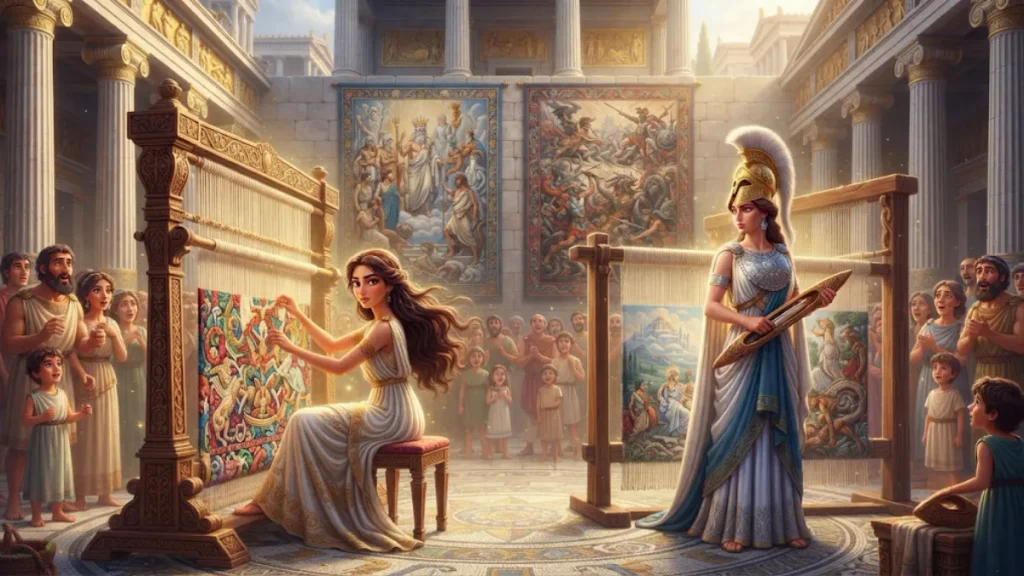
The competition was arranged in a large open courtyard.
Villagers gathered to witness the extraordinary event. Some were excited, while others feared what might happen.
Two enormous looms were placed side by side.
Athena stood before one loom, and Arachne stood before the other.
A collection of colorful threads was provided to both competitors.
The rules were simple.
Each contestant had to create a beautiful tapestry. The quality, creativity, detail, and craftsmanship of their work would determine the winner.
Athena selected threads of gold, silver, blue, and white.
Arachne chose a wide variety of colors, including deep red, green, purple, and bright yellow.
The competition began.
Both weavers moved their hands rapidly.
Threads crossed and combined, creating patterns that gradually became more detailed.
Athena worked with calm precision.
Her tapestry showed the gods of Olympus in their magnificent glory. Zeus sat upon his throne, Poseidon held his mighty trident, and other gods appeared in scenes representing their power.
The borders of her tapestry displayed images of mortals who had challenged the gods and suffered because of their arrogance.
It was both beautiful and meaningful.
Arachne, however, had chosen a very different subject.
Her tapestry depicted several stories about the gods, focusing on moments when they had deceived, punished, or mistreated humans.
She showed scenes of powerful gods disguising themselves, making mistakes, and using their abilities in ways that caused suffering.
Her work was incredibly detailed.
The colors were bright, the patterns were perfect, and the expressions on the woven figures looked remarkably realistic.
Even the villagers who had supported Athena could not deny Arachne’s extraordinary talent.
As the competition continued, the crowd became increasingly amazed.
Nobody had ever witnessed such remarkable weaving.
Arachne’s Tapestry Amazes Everyone
Hours passed.
Both competitors remained focused on their work.
Athena carefully completed the final details of her tapestry.
Arachne also finished her creation.
When the two works were displayed, the villagers stood silently.
Athena’s tapestry was magnificent.
It showed divine power, order, and wisdom. Every thread appeared carefully placed, and the entire design reflected the greatness of the gods.
Arachne’s tapestry was equally impressive.
It contained detailed scenes that seemed almost alive. The figures were beautifully woven, the colors blended perfectly, and every small detail demonstrated her exceptional craftsmanship.
Several villagers whispered among themselves.
“How can anyone create something so beautiful?”
“Look at those expressions. They seem real!”
Even Athena could not deny that Arachne’s weaving was extraordinary.
The young woman had demonstrated genuine skill.
However, the goddess also noticed something troubling about the work.
Arachne had used her extraordinary talent to mock the gods.
Her tapestry did not simply demonstrate artistic ability. It also represented her refusal to show respect or humility.
Athena became deeply offended.
She approached the tapestry and examined it carefully.
The quality of the weaving was impressive, but its message was deliberately disrespectful.
Arachne stood proudly beside her creation.
“Well, Athena, what do you think?” she asked.
“Have I not proved that I am the better weaver?”
The goddess did not immediately respond.
The crowd waited nervously.
Athena knew that Arachne had remarkable talent, but the young woman had turned the competition into an act of defiance.
The Consequences of Arachne’s Arrogance
Athena became furious.
In the traditional myth, she destroyed Arachne’s tapestry and struck her with her weaving shuttle.
Arachne was overwhelmed by shame and despair.
She realized that her actions had gone too far, but the damage had already been done.
The young woman could no longer bear the humiliation.
In some versions of the myth, Arachne attempted to take her own life.
Athena stopped her.
Instead of allowing her to die, the goddess transformed her into a spider.
Her arms and legs became thin spider legs, and her body changed into a small creature capable of spinning delicate webs.
Athena declared that Arachne would continue weaving for the rest of her existence.
From that moment onward, she would create beautiful webs instead of human tapestries.
Arachne’s extraordinary weaving talent had not disappeared.
It had simply taken a different form.
She could still create intricate patterns, but her new life would forever remind her of the consequences of pride and disrespect.
The villagers watched in silence as the small spider began moving away.
Some felt sadness for Arachne because they knew how talented she had been.
Others understood that her downfall had come from allowing arrogance to overpower her judgment.
The Beautiful Webs of Arachne
After the transformation, Arachne began creating webs.
She used her delicate threads to build intricate patterns between branches, walls, and corners.
Her webs were remarkably beautiful.
Some were circular, while others contained complicated geometric designs.
They sparkled when morning sunlight touched them and appeared almost magical when covered with tiny drops of water.
People who noticed these webs often remembered the story of the talented weaver who had challenged Athena.
The myth became an explanation for the origin of spiders and their remarkable ability to produce delicate webs.
It also became a lasting reminder that talent alone does not make someone wise.
A person may possess extraordinary intelligence, artistic ability, or physical strength, but without humility, those qualities can become a source of personal destruction.
Arachne had everything she needed to become a respected artist.
She had skill, creativity, determination, and recognition.
What she lacked was the ability to appreciate her achievements without insulting others.
Her story reminds us that success should make us grateful, not arrogant.
The Deeper Meaning Behind Arachne and Athena
The story of Arachne and Athena is more than a simple tale about a weaving competition.
It explores the relationship between talent, pride, hard work, and respect.
Arachne believed that her abilities made her superior to everyone else.
She worked hard to develop her craft, and she deserved recognition for her accomplishments. However, she made the mistake of believing that her success gave her permission to disrespect others.
Athena represented wisdom and the importance of understanding our place in the world.
The goddess did not initially punish Arachne for being talented. She first visited her in disguise and offered advice.
Arachne had an opportunity to respond with humility, but she rejected that opportunity.
Her story encourages readers to think about how they respond to success.
When people praise us, do we become kinder and more grateful?
Or do we begin believing that we are better than everyone around us?
The answer can determine whether our achievements become a source of inspiration or arrogance.
Moral of the Story: Talent Is Meaningless Without Humility
The central moral of Arachne and Athena is that being talented does not give us the right to become arrogant or disrespectful.
Arachne was an extraordinary weaver, but her pride eventually destroyed the happiness and recognition she could have enjoyed.
Her story teaches several important life lessons.
1. Stay humble even when you are successful
Success should never make us believe that we are better than everyone else. There is always something new to learn, and there will always be people with different strengths and abilities.
2. Respect others
Arachne could have celebrated her talent without insulting Athena. Respecting others does not reduce our own achievements.
3. Hard work deserves recognition, but arrogance creates problems
Arachne worked hard to become a skilled weaver. Her dedication was admirable, but her attitude damaged her reputation.
4. Listen to good advice
Athena initially approached Arachne peacefully and encouraged her to reconsider her behavior. Arachne ignored the warning because she believed she already knew everything.
5. Do not let praise change your personality
Compliments can encourage us, but too much pride can make us careless about the feelings of others.
6. True greatness includes good character
Talent may help someone achieve success, but kindness, humility, patience, and respect make that success meaningful.
The story of Arachne reminds us that our abilities can open doors, but our character determines how we treat the people we meet along the way.
A truly talented person does not need to prove superiority by making others feel small. True greatness shines through skill, kindness, and humility.
4. Pandora’s Box: The Consequences of Curiosity
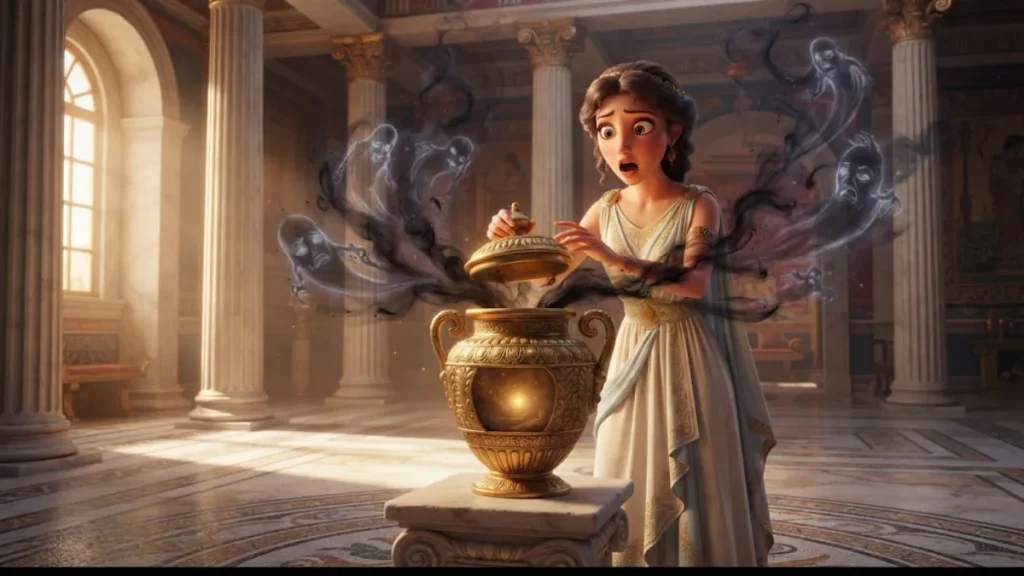
Greek Mythology Story About Curiosity, Temptation, and Hope
Long ago, when gods ruled Mount Olympus and humans lived under the watchful eyes of powerful immortals, there was a mysterious gift that carried both beauty and danger. It belonged to a young woman named Pandora, whose curiosity would change the world forever.
The story of Pandora’s Box is one of the most famous Greek mythology stories. It explains how suffering, illness, sadness, and hardship entered human life. But it also carries an important message: even when life becomes difficult, hope can help people find the strength to continue.
A Gift from the Gods
Long before Pandora was created, humans lived under the influence of powerful gods and goddesses. Among them was Zeus, the ruler of Mount Olympus. He expected humans to respect the gods and follow their commands.
One day, Zeus became furious with Prometheus, a Titan who had helped humanity. Prometheus had stolen fire from the gods and given it to humans. Fire allowed people to cook food, stay warm, make tools, and develop new skills.
Zeus considered this an unforgivable act. He believed humans had received something that belonged only to the gods. Determined to punish Prometheus and make human life more difficult, Zeus planned a punishment that would affect everyone.
He ordered Hephaestus, the god of craftsmanship and metalworking, to create a woman unlike any other.
Hephaestus carefully shaped her from earth and water. He gave her a beautiful appearance and brought her to life. Other gods also contributed to her creation.
Athena taught her useful skills. Aphrodite gave her charm and beauty. Hermes gave her a clever mind and the ability to communicate persuasively.
The gods named her Pandora, a name commonly understood as meaning “all-gifted” because she had received gifts from many gods.
But Zeus had another purpose for her creation.
Zeus Gives Pandora a Mysterious Jar
After Pandora was created, Zeus presented her with a beautiful, sealed jar. In many modern retellings, it is called Pandora’s Box, although the original Greek myth describes a large storage jar known as a pithos.
Zeus told Pandora that the jar was not to be opened.
He did not explain what it contained. He simply made it clear that she must never remove its lid.
Pandora accepted the gift without asking too many questions. She had been told that the jar was important, and she wanted to obey the command of the king of the gods.
However, the mysterious container soon became the center of her thoughts.
What could be inside it?
Perhaps it contained gold, precious stones, or wonderful gifts. Maybe it held something magical that could make life more beautiful. Or perhaps it contained something so valuable that Zeus wanted to keep it hidden.
Pandora tried to ignore these thoughts, but her curiosity continued to grow.
Pandora Begins Her New Life
After receiving the mysterious jar, Pandora was sent to live among humans. In many versions of the story, she became the wife of Epimetheus, the brother of Prometheus.
Prometheus had warned his brother not to accept gifts from Zeus because he suspected that the ruler of Olympus was planning something dangerous.
But Epimetheus ignored the warning.
He was captivated by Pandora’s beauty and kindness. He welcomed her into his home, and the two began their life together.
Their home was peaceful. They enjoyed simple meals, conversations, and the beauty of the natural world. Pandora learned about human life and the challenges people faced every day.
She also noticed that the jar remained untouched in a corner of their home.
At first, she did not think much about it. But as the days passed, the mystery became harder to ignore.
Whenever Pandora entered the room, her eyes moved toward the jar. Its sealed lid seemed to invite questions.
She wondered why Zeus had given her something so beautiful but forbidden her from opening it.
If it contained something good, why keep it hidden?
If it contained something dangerous, why give it to her at all?
Pandora had no answers.
The Growing Power of Curiosity
Days turned into weeks, and Pandora’s curiosity became stronger.
She tried to distract herself with household work, conversations with Epimetheus, and walks through the surrounding fields. Yet the unanswered questions followed her everywhere.
Sometimes she stood near the jar and imagined what might be inside. Other times, she walked away, reminding herself that Zeus had given a clear instruction.
One afternoon, while Epimetheus was away, Pandora found herself alone in the house.
The room was quiet.
Sunlight entered through the window and fell across the mysterious jar. Pandora approached it slowly.
She placed one hand on its surface.
The jar was cool and smooth. Its lid appeared tightly sealed.
Pandora hesitated.
She remembered Zeus’s warning. She also remembered how strange it was that the gods had given her something without explaining its purpose.
Her mind filled with questions.
What if there was nothing dangerous inside? What if the jar contained something wonderful? What if opening it was the only way to discover the truth?
She told herself that she would only lift the lid slightly. She would take a quick look and close it immediately.
After all, how much harm could one small action cause?
The Moment Pandora Opened the Jar
Pandora finally gave in to her curiosity.
She placed both hands on the lid and carefully began to lift it.
At first, nothing happened.
She looked inside, expecting to see gold, jewels, or some other mysterious treasure.
Instead, she heard a strange sound.
It began as a faint whisper and quickly became a terrible rushing noise.
Suddenly, dark shapes burst out of the jar.
They moved through the room like a storm.
Pandora stepped backward in fear as strange creatures and invisible forces escaped into the air. They flew through the open doorway and disappeared into the world beyond.
These were not ordinary creatures. They represented the troubles that would bring suffering to humanity.
Disease, pain, jealousy, greed, anger, sadness, poverty, and countless other hardships had been trapped inside the jar.
For the first time, Pandora understood why Zeus had forbidden her from opening it.
But the danger had already escaped.
Suffering Spreads Across the World
The troubles released from the jar spread throughout the world.
People who had once enjoyed peaceful lives began experiencing sickness and pain. Families faced loss. Neighbors argued. Greed and jealousy created conflicts between people who had once trusted each other.
Farmers struggled with poor harvests. Travelers faced danger on their journeys. Children became ill, and families experienced sadness.
Life became more difficult than it had ever been.
Pandora watched these changes with a heavy heart.
She had never intended to hurt anyone. She had only wanted to discover what the mysterious jar contained.
But her decision had consequences far beyond her own home.
She remembered Zeus’s warning and wished she had listened.
She also thought about Epimetheus and Prometheus. Prometheus had understood that Zeus’s gifts might hide a dangerous purpose. If only she had been more careful.
Pandora felt responsible for the suffering that had entered the world.
Pandora Tries to Stop What Has Happened
Frightened by the strange forces escaping from the jar, Pandora quickly rushed toward it.
She grabbed the lid and pushed it down with all her strength.
But the troubles had already escaped.
She tried to seal the jar tightly, hoping she could undo her mistake. Yet nothing could bring back what had flown away.
The room became silent again.
Pandora stood beside the jar, unable to move.
She had opened it because she wanted answers, but now she was left with regret and uncertainty.
She wondered whether the world could ever return to the way it had been.
As she looked inside the jar one final time, she noticed something remaining at the bottom.
It was small and quiet, unlike the dark forces that had escaped.
It was Hope.
Hope Remains Inside the Jar
Pandora gently reached into the jar and discovered that Hope had not escaped with the other troubles.
There are different interpretations of this part of the myth. In the commonly told version, Hope remains inside the jar, while some interpretations explore whether it was intentionally kept there or was meant to be released.
In this retelling, Pandora carefully protected the small gift.
She understood that although she could not undo her mistake, she could still make a choice about what happened next.
She decided to release Hope into the world.
The moment Hope escaped, it spread quietly among humanity.
It did not remove sickness, stop every conflict, or make every difficult situation disappear. Instead, it gave people the courage to face their struggles.
A sick person could still believe in recovery. A farmer who lost a harvest could plant seeds again. A family experiencing sadness could find comfort in one another.
People who faced failure could attempt something new.
Hope did not promise that life would always be easy. It reminded people that difficult moments did not have to be the end of their stories.
Pandora Learns the Meaning of Responsibility
Pandora could not change what she had done, but she could learn from it.
She understood that curiosity was not always wrong. It encouraged people to explore, ask questions, and discover new things. Without curiosity, humans might never have learned how to build homes, develop tools, understand nature, or improve their lives.
However, curiosity without patience and judgment could lead to harmful decisions.
Pandora had ignored a clear warning because she wanted an immediate answer. She had not considered the possible consequences of her actions.
Now she understood that every choice carried responsibility.
She also realized that regret alone would not help anyone. She could spend the rest of her life blaming herself, or she could use the experience to become wiser.
Pandora chose to move forward.
She treated others with kindness and tried to help people facing hardship. Whenever someone felt discouraged, she reminded them that hope was still possible.
The world could no longer be free from suffering, but people did not have to face suffering without courage.
The Legacy of Pandora’s Box
Over time, the story of Pandora became a lesson passed from one generation to another.
Parents told their children about the mysterious jar and the woman who opened it. Teachers used the story to explain why people should think before acting. Philosophers discussed the relationship between curiosity, temptation, responsibility, and hope.
The expression “Pandora’s box” eventually became a common phrase.
Today, people use it to describe an action that creates unexpected problems, especially when those problems become difficult to control.
For example, a person might say that sharing a private secret opened a Pandora’s box of arguments. A business decision might create several complications that nobody expected. A small mistake might lead to a much larger problem.
The phrase reminds people that some decisions have consequences far beyond their original purpose.
But the story is not only about danger.
Its most meaningful message is that hope can survive even when life becomes difficult.
Pandora’s mistake changed the world, but the presence of Hope offered humanity a reason to keep moving forward.
Moral of Pandora’s Box
The main moral of Pandora’s Box is that curiosity should be balanced with wisdom and responsibility. Wanting to discover something new is natural, but acting without considering the consequences can create problems that are difficult to reverse.
The story also teaches that hope remains important during difficult times. Even when people make mistakes or face unexpected hardships, they can learn, recover, and find the courage to continue.
Important Life Lessons from the Story
1. Think before you act: A decision made without considering its consequences can create serious problems.
2. Listen to wise advice: Warnings from experienced people should not be ignored simply because curiosity or excitement takes over.
3. Curiosity needs responsibility: Asking questions and exploring the unknown can be valuable, but not every action is worth taking.
4. Accept responsibility for mistakes: Blaming others does not undo what has happened. Learning and making better choices can help prevent similar mistakes.
5. Never lose hope: Difficult situations may change life, but hope gives people the strength to face challenges and begin again.
6. Not every mystery needs an immediate answer: Patience is sometimes wiser than acting simply because something is unknown.
What Does Pandora’s Box Symbolize?
Pandora’s Box symbolizes the unexpected consequences of human actions. In the original Greek myth, Pandora opens a jar containing troubles that escape into the world.
The story is often interpreted as a warning about temptation, disobedience, and the importance of thinking before making decisions. The Hope that remains inside the jar represents the strength and optimism that help humanity endure suffering.
Why Is Pandora’s Box an Important Greek Mythology Story?
Pandora’s Box remains important because its message is relevant to everyday life. People still make decisions out of curiosity, excitement, anger, or impatience without fully understanding what might happen next.
The story encourages readers to think carefully, respect useful warnings, and take responsibility for their choices. It also reminds us that mistakes do not have to destroy our future.
Even when something goes wrong, hope can help us find a way forward.
Conclusion
The story of Pandora’s Box teaches an unforgettable lesson about curiosity, responsibility, and hope. Pandora opened the mysterious jar because she wanted to discover its secrets, but her decision released suffering into the world.
Although she could not undo her mistake, one precious thing remained inside the jar: Hope.
That small gift became a symbol of humanity’s ability to face difficult situations and continue moving forward.
The greatest lesson is simple: curiosity can lead to discovery, but wisdom must guide our actions. And when our choices bring unexpected challenges, hope gives us the strength to begin again.
5. Hercules and the Twelve Labors: The Power of Perseverance
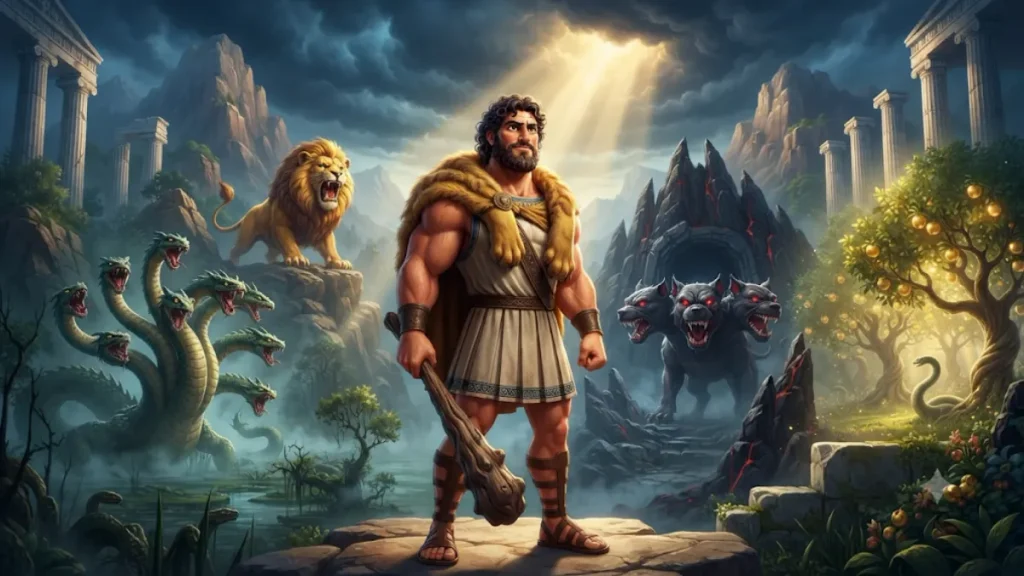
Greek Mythology Story About Courage, Determination, and Never Giving Up
Among the greatest heroes of Greek mythology, few were as famous as Hercules. Known for his extraordinary strength, courage, and determination, Hercules faced challenges that ordinary people could never imagine. Yet his greatest achievement was not simply defeating monsters or completing dangerous tasks. It was his ability to keep going when every challenge seemed impossible.
The story of Hercules and the Twelve Labors teaches an important lesson about perseverance. It reminds us that difficult situations can test our patience, strength, and character, but determination and courage can help us overcome even the greatest obstacles.
The Birth of a Powerful Hero
Long ago, in ancient Greece, there lived a powerful god named Zeus. He ruled Mount Olympus and was known as the king of all gods. Zeus had many children, including a son named Hercules, who was born with extraordinary strength.
Hercules was the son of Zeus and a mortal woman named Alcmene. From the moment he was born, his life was connected to the world of gods, heroes, and dangerous adventures.
However, Zeus’s wife, Hera, was furious about her husband’s relationship with Alcmene. She became jealous of Hercules and decided to make his life difficult.
Even as a baby, Hercules displayed unusual strength. According to one famous version of the myth, Hera sent two enormous snakes into his cradle to kill him. While other babies would have cried in fear, Hercules grabbed the snakes and crushed them with his tiny hands.
Everyone who witnessed the event realized that the child was no ordinary human.
As Hercules grew older, his strength became legendary. He learned wrestling, archery, sword fighting, and other skills needed by a great warrior. He became respected for his bravery and admired for his powerful body.
But his extraordinary strength did not protect him from every hardship.
The Tragedy That Changed His Life
Despite his courage and abilities, Hercules could not escape Hera’s anger.
One day, Hera caused Hercules to suffer a terrible madness. During this episode, he lost control and committed a tragic act against his own family. In many traditional versions of the myth, he killed his wife and children.
When the madness passed, Hercules realized what had happened.
He was devastated.
The strongest hero in the land could defeat monsters, fight armies, and overcome dangerous enemies, but he could not undo the tragedy.
Overcome with grief and guilt, Hercules searched for a way to make amends. He wanted to find forgiveness and restore meaning to his life.
He travelled to the Oracle of Delphi, where he sought guidance from Apollo.
The oracle told him that he must serve King Eurystheus of Mycenae. To atone for his actions, Hercules would have to complete a series of difficult tasks.
These challenges became known as the Twelve Labors of Hercules.
The tasks were designed to test his strength, intelligence, patience, and courage. Some involved terrifying creatures, while others required him to travel to distant and dangerous places.
Hercules accepted the challenge.
He knew the journey would be difficult, but he was determined to complete every task.
The First Labor: Defeating the Nemean Lion
The first task was to defeat the Nemean Lion, a terrifying beast that lived near the town of Nemea.
The lion was not an ordinary animal. Its skin was so tough that ordinary weapons could not pierce it. Spears and arrows were useless against its powerful body.
Many warriors had tried to defeat the creature, but none had succeeded.
Hercules travelled to the lion’s territory carrying his weapons. He fired arrows at the beast, but they bounced harmlessly off its skin.
He tried using his sword, but it could not cut through the lion’s thick hide.
Instead of giving up, Hercules changed his approach.
He realized that weapons would not help him win. He would have to rely on his physical strength.
When the lion entered its cave, Hercules followed it. After a fierce struggle, he managed to overpower the animal with his bare hands and defeat it.
He then used the lion’s own sharp claws to remove its skin.
From that day onward, Hercules wore the lion’s hide as protection.
Lesson: When one approach fails, look for another. Determination means adapting rather than giving up.
The Second Labor: Defeating the Lernaean Hydra
For his second task, Hercules was sent to defeat the Lernaean Hydra, a terrifying serpent-like monster that lived in a swamp near Lerna.
The Hydra had several heads, and its greatest danger was its ability to grow new heads whenever one was cut off. In some versions, one of its heads was immortal.
Hercules arrived at the swamp with his nephew Iolaus, who accompanied him as a helper.
The monster emerged from the water, hissing and attacking with its many heads.
Hercules began cutting them off with his sword. But each time he removed one head, two more appeared.
Soon, the battle became even more difficult.
Hercules realized that simply cutting off the heads would never defeat the monster.
He asked Iolaus for help. Whenever Hercules removed a head, Iolaus used a burning torch to cauterize the wound, preventing new heads from growing.
Together, they managed to defeat the Hydra. Hercules also dealt with its immortal head and buried it beneath a heavy rock.
The dangerous monster was finally defeated.
However, King Eurystheus refused to count this labor because Hercules had received help from Iolaus.
Hercules would have to continue proving himself.
Lesson: Some challenges cannot be overcome alone. Accepting help and working together can make an impossible task manageable.
The Third Labor: Capturing the Golden Hind
The third task seemed less dangerous than fighting a monster, but it tested Hercules in a different way.
He was ordered to capture the Ceryneian Hind, a beautiful deer with golden antlers and extraordinary speed.
The animal was sacred to Artemis, the goddess of the hunt and wilderness. Hercules had to capture it without harming it.
The deer was extremely fast and could run across forests and mountains without becoming tired.
Hercules followed it for a long time.
Days turned into weeks, and weeks turned into months. The deer continued escaping whenever he came close.
Hercules refused to abandon the task.
He followed the animal through valleys, forests, and distant lands. Finally, after a long pursuit, he managed to capture it carefully.
On his journey back, he encountered Artemis. The goddess was angry because the deer belonged to her.
Hercules explained that he had been ordered to capture the animal and had no intention of harming it. He promised to return it after showing it to Eurystheus.
Artemis eventually allowed him to continue.
Hercules successfully completed the task without killing the sacred animal.
Lesson: Not every victory requires force. Patience, restraint, and respect can be more powerful than physical strength.
The Fourth Labor: Capturing the Erymanthian Boar
The fourth labor required Hercules to capture a gigantic wild boar that terrorized the region around Mount Erymanthus.
The animal was enormous, aggressive, and dangerous. It destroyed crops, attacked animals, and frightened the people living nearby.
Hercules travelled toward the mountain, knowing that he needed to capture the beast alive.
He followed the boar through rough terrain until it escaped into a snowy region.
The deep snow made movement difficult. Hercules carefully pursued the animal until it became exhausted.
When the boar could no longer run, Hercules trapped it and carried it back to King Eurystheus.
The king was terrified when he saw the enormous animal. According to a popular retelling, he hid inside a large storage jar until Hercules had removed the boar.
Hercules had completed another task.
Lesson: Difficult goals often require persistence. Sometimes success comes not from rushing but from allowing the right opportunity to arrive.
The Fifth Labor: Cleaning the Augean Stables
The fifth task was very different from the previous challenges.
King Eurystheus ordered Hercules to clean the enormous stables of King Augeas in a single day.
The stables contained thousands of animals and had not been cleaned for many years. The accumulated waste had become so enormous that the task seemed impossible.
At first, Hercules thought about cleaning the stables by hand.
But he quickly realized that even his extraordinary strength would not be enough to complete the work in one day.
Instead of accepting defeat, he studied the surroundings.
He noticed that two rivers flowed near the stables. He developed a clever plan to redirect their water through the filthy area.
Hercules changed the course of the rivers and allowed the powerful water to wash away the accumulated dirt.
By the end of the day, the stables were clean.
King Augeas had promised to reward Hercules for completing the work, but later refused to honour the agreement.
King Eurystheus also refused to count the labor because Hercules had received payment for it.
Hercules accepted the disappointment and prepared for the next challenge.
Lesson: Intelligence is just as important as strength. When a problem seems too large, look for a smarter solution instead of relying only on hard work.
The Sixth Labor: Driving Away the Stymphalian Birds
The sixth task took Hercules to Lake Stymphalia, where a dangerous flock of birds had made life miserable for the people living nearby.
These birds had sharp beaks, dangerous claws, and metallic feathers that could be launched like weapons.
They attacked people and destroyed crops, making the surrounding area unsafe.
Hercules arrived with his weapons but soon realized that he could not easily reach the birds.
They lived among thick vegetation near the lake and flew away whenever he approached.
Then Athena, the goddess of wisdom, came to his aid.
She gave Hercules a special noise-making instrument created by Hephaestus. When Hercules used it, the loud sound frightened the birds and forced them into the air.
As the birds flew away from their hiding places, Hercules used his bow and arrows to drive them away.
The dangerous flock disappeared, and the region became safe again.
Lesson: Sometimes the right tool can make a difficult task easier. Wisdom includes knowing what resources to use and when to use them.
The Seventh Labor: Capturing the Cretan Bull
For his seventh labor, Hercules was sent to Crete to capture a powerful bull.
The animal was enormous and extremely aggressive. It charged through fields, destroyed buildings, and frightened everyone who encountered it.
Hercules travelled to the island and searched for the bull.
When he finally found it, the animal charged toward him with tremendous force.
Hercules avoided its attacks and used his strength to overpower it. After a difficult struggle, he managed to capture the bull alive.
He brought the animal back to Eurystheus, who was impressed by the achievement.
The bull was eventually released and later became part of another famous Greek myth involving the hero Theseus and the Minotaur.
Lesson: Courage is not the absence of fear. It is the ability to face danger with determination and control.
The Eighth Labor: Capturing the Mares of Diomedes
The eighth labor took Hercules to the land of Thrace, where a cruel king named Diomedes kept a group of terrifying horses.
These were not ordinary horses. They were wild, violent, and known for eating human flesh.
Diomedes fed them with the unfortunate people who crossed his path.
Hercules travelled to Thrace with a group of companions and managed to capture the dangerous animals.
However, the horses were difficult to control. They fought against their restraints and tried to escape.
In the struggle, Diomedes attacked Hercules. After defeating the king, Hercules used him to feed the horses, according to the traditional myth.
The animals became calmer, allowing Hercules to control them.
He brought the horses back to King Eurystheus and completed another labor.
Lesson: A dangerous problem sometimes has to be confronted directly. Courage and preparation help us face situations that others are afraid to approach.
The Ninth Labor: Obtaining the Belt of Hippolyta
The ninth task required Hercules to obtain the magical belt of Hippolyta, the queen of the Amazons.
The Amazons were a powerful community of warrior women known for their strength, independence, and skill in battle.
Hippolyta possessed a special belt given to her by Ares, the god of war.
King Eurystheus wanted Hercules to bring it back.
Hercules travelled to the land of the Amazons with several companions. When he met Hippolyta, she welcomed him and listened to his request.
In one version of the myth, Hippolyta was impressed by Hercules and willingly agreed to give him the belt.
However, Hera secretly created trouble by spreading a rumour that Hercules intended to kidnap the queen.
The Amazons became suspicious and prepared to attack.
A misunderstanding turned the peaceful meeting into a battle. Hercules eventually obtained the belt and returned to Eurystheus.
The task was complete, but the journey had shown him how quickly mistrust could destroy a peaceful agreement.
Lesson: Clear communication matters. Misunderstandings can turn cooperation into conflict, even when people initially have good intentions.
The Tenth Labor: Stealing the Cattle of Geryon
The tenth labor was one of Hercules’s longest journeys.
He was ordered to travel to the distant western lands and bring back the cattle of Geryon, a powerful giant with three bodies.
The cattle were guarded by a terrifying two-headed dog named Orthrus and a herdsman named Eurytion.
Hercules travelled across unfamiliar lands, facing heat, difficult terrain, and dangerous obstacles.
According to the myth, he eventually reached the western edge of the known world. There, he encountered Geryon’s guards.
Hercules defeated Orthrus and Eurytion before facing Geryon himself.
The battle was fierce, but Hercules emerged victorious and took control of the cattle.
His journey home was just as challenging. He had to guide the animals across long distances and deal with various obstacles along the way.
Eventually, he returned with the cattle and completed the tenth labor.
Lesson: Great achievements often require endurance. Reaching a goal is not always the hardest part. Sometimes the journey itself tests our determination.
The Eleventh Labor: Bringing Back the Golden Apples of the Hesperides
The eleventh labor was one of the most mysterious and difficult.
Hercules was ordered to bring back golden apples from the Garden of the Hesperides.
The garden was located in a distant place and protected by powerful forces. A dragon named Ladon guarded the golden apples, while the Hesperides, daughters of Atlas, watched over the garden.
Hercules did not know the exact location, so he began a long journey in search of it.
Along the way, he encountered Atlas, the Titan who was forced to hold the heavens on his shoulders.
Hercules asked Atlas for help in obtaining the golden apples.
Atlas offered to retrieve them himself, but he needed Hercules to hold the sky while he was away.
Hercules agreed.
For a time, the mighty hero carried the enormous burden of the heavens. Atlas returned with the apples but then suggested that he would leave Hercules holding the sky permanently.
Hercules understood the trick.
He pretended to agree but asked Atlas to hold the sky for a moment while he adjusted his position.
Atlas accepted the request.
As soon as Atlas took the burden back, Hercules collected the golden apples and left.
He had used intelligence rather than force to escape a difficult situation.
Lesson: Strength is valuable, but clever thinking can help us overcome challenges that cannot be solved through physical power alone.
The Twelfth Labor: Capturing Cerberus
The final labor was perhaps the most terrifying of all.
King Eurystheus ordered Hercules to travel into the Underworld and bring back Cerberus, the three-headed dog that guarded the entrance to the realm of the dead.
Cerberus was a monstrous creature with three fierce heads and a powerful body. Its job was to prevent the dead from escaping and the living from entering without permission.
Hercules knew that this task would test him more than any previous challenge.
He travelled to the Underworld and sought permission from Hades, its ruler.
Hades agreed to allow Hercules to take Cerberus, but only if he could capture the creature without using weapons.
Hercules approached the enormous dog.
Cerberus growled and prepared to attack.
Instead of using his sword or arrows, Hercules relied on his extraordinary strength. He wrestled with the beast and eventually managed to overpower it.
He brought Cerberus to the surface and presented it to Eurystheus.
The king was terrified by the sight of the three-headed monster. After seeing the creature, he ordered Hercules to return it to the Underworld.
Hercules did so, completing the final labor.
After years of dangerous journeys, difficult decisions, and seemingly impossible tasks, his punishment was finally over.
Hercules Becomes a Symbol of Perseverance
When Hercules completed the Twelve Labors, he had proven that strength was not simply about physical power.
Each task had tested a different part of his character.
The Nemean Lion tested his ability to adapt. The Hydra taught him the importance of cooperation. The golden hind tested his patience, while the Augean stables required intelligence.
The remaining tasks demanded courage, endurance, self-control, and determination.
Hercules had not succeeded because every challenge was easy. He succeeded because he continued even when the odds were against him.
His story became an inspiration for generations.
He showed that even a powerful hero could experience pain, regret, failure, and frustration. What mattered was the willingness to face difficulties and keep moving forward.
Eventually, Hercules became one of the most celebrated heroes in Greek mythology. His name came to represent extraordinary courage and the determination to overcome impossible obstacles.
Moral of Hercules and the Twelve Labors
The main moral of Hercules and the Twelve Labors is that perseverance helps people overcome difficult challenges. Success does not always come quickly, and even talented or powerful individuals can experience failure, disappointment, and hardship.
Hercules completed his tasks by combining strength with intelligence, patience, courage, and the willingness to keep trying.
His story teaches that true strength is not only about what a person can achieve physically. It is also about how they respond when life becomes difficult.
Important Life Lessons from the Story
1. Never give up easily: Difficult challenges may take time, but consistent effort can bring progress.
2. Use intelligence along with strength: Working harder is not always the answer. Sometimes changing your approach is more effective.
3. Learn from failure: When one method does not work, study the problem and try a different solution.
4. Accept help when necessary: Some challenges become easier when we cooperate with others.
5. Be patient: Not every goal can be achieved immediately. Some victories require long periods of effort.
6. Face your fears: Courage means taking action even when a situation feels frightening.
7. Take responsibility for your actions: Personal growth begins when we acknowledge our mistakes and work toward becoming better.
What Do the Twelve Labors of Hercules Symbolize?
The Twelve Labors symbolize the difficult challenges people must face throughout life. Each labor represents a different test of character, including patience, courage, wisdom, self-control, and perseverance.
The Nemean Lion represents the need to adapt, while the Hydra represents problems that become more complicated when approached incorrectly. The Augean stables symbolize overwhelming responsibilities that require creative solutions.
Together, the twelve tasks show that personal growth often comes through struggle, discipline, and determination.
Why Is Hercules an Important Figure in Greek Mythology?
Hercules is important because his story combines extraordinary strength with human struggles. Although he was the son of Zeus and possessed godlike abilities, he still experienced grief, guilt, difficult choices, and personal challenges.
His Twelve Labors made him one of the most famous heroes in Greek mythology. The stories have inspired countless books, paintings, films, and retellings.
More importantly, Hercules represents the idea that determination and courage can help people face challenges that initially appear impossible.
Conclusion
The story of Hercules and the Twelve Labors is a powerful reminder that success requires more than talent or physical strength. It demands patience, courage, intelligence, and the determination to continue despite difficulties.
Hercules faced dangerous monsters, exhausting journeys, and tasks that seemed impossible. Yet he never abandoned his mission.
His greatest achievement was not simply defeating twelve powerful enemies. It was proving that perseverance could help him overcome every challenge placed before him.
The lesson is simple: when life gives you difficult tasks, do not lose hope. Break the challenge into smaller steps, learn from your mistakes, seek help when needed, and keep moving forward.
Sometimes the greatest victory is simply refusing to give up.
6. The Tortoise and the Hare: A Lesson From Greek Fable Tradition
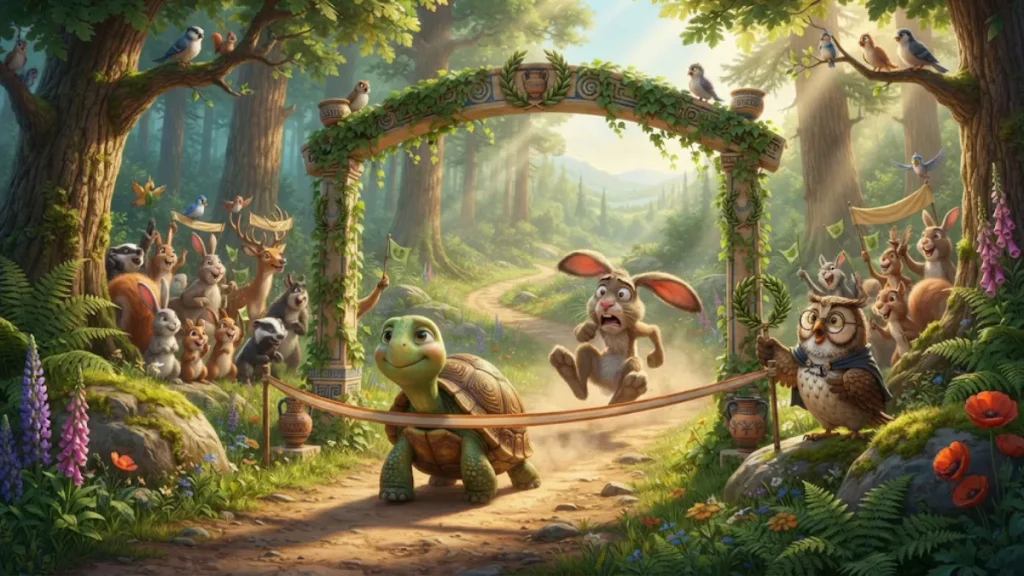
A Timeless Fable About Patience, Consistency, and Overconfidence
The Tortoise and the Hare is one of the most famous animal fables in the world. It tells the story of a confident hare who believes he can easily defeat a slow-moving tortoise in a race. Certain of his victory, the hare becomes careless and takes a nap along the way. Meanwhile, the tortoise continues moving forward at a steady pace and eventually reaches the finish line first.
Although the story is simple, its message is powerful. It teaches that consistent effort can be more valuable than natural talent when talent is combined with laziness or overconfidence.
The fable is traditionally associated with Aesop, the ancient Greek storyteller. It has been retold for generations because its lesson applies to education, work, relationships, personal goals, and everyday life.
The Hare Who Thought He Was the Fastest
Once upon a time, in a beautiful green forest surrounded by tall trees, flowering plants, and winding paths, there lived a hare who was famous for his incredible speed.
He could run faster than almost every animal in the forest. He could cross an open field in a few moments and disappear between the trees before anyone had time to follow him.
The hare was proud of his natural ability.
Whenever the animals gathered near the river or rested beneath the trees, he found an opportunity to talk about his speed.
“Nobody in this forest can run as fast as I can,” he often announced.
The squirrels admired his speed. The deer respected his athletic ability, and the smaller animals watched him with amazement.
However, the hare’s confidence gradually turned into arrogance.
He stopped appreciating the abilities of other animals and began believing that being fast made him better than everyone else.
One sunny morning, the hare was running along a forest path when he noticed a tortoise slowly making his way through the grass.
The tortoise was moving carefully, placing one foot in front of the other. His movements were steady, but compared with the hare, he seemed unbelievably slow.
The hare stopped and laughed.
“Good morning, Tortoise!” he called out. “Are you going somewhere, or will you reach your destination next week?”
The tortoise looked up calmly.
“Good morning,” he replied. “I am enjoying the beautiful morning and making my way through the forest.”
The hare laughed even louder.
“At your speed, you probably need an entire day just to cross this field!”
The tortoise did not become angry.
He simply smiled and continued walking.
The Tortoise Challenges the Hare
The hare’s teasing continued for several days.
Whenever he saw the tortoise, he made jokes about his slow movements.
One afternoon, while several animals were gathered near a large oak tree, the hare began boasting about how easily he could outrun anyone in the forest.
“I could race every animal here and still win without trying,” he declared.
The tortoise, who was sitting quietly nearby, finally spoke.
“You seem very confident about your speed,” he said. “Would you like to prove it?”
The hare turned toward him and burst into laughter.
“Are you challenging me to a race?”
“Yes,” replied the tortoise.
The other animals became curious. Some exchanged surprised looks, while others began laughing.
A race between the fastest animal in the forest and one of the slowest seemed almost impossible to take seriously.
The hare looked at the tortoise with amusement.
“Are you certain you want to do this? I could run to the finish line and return before you have covered half the distance.”
The tortoise remained calm.
“I may not be fast, but I know how to keep moving. Let us see what happens.”
The hare accepted the challenge immediately.
He believed the race would be the easiest victory of his life.
The Forest Animals Organize the Race
The animals decided to organize a proper race.
They selected a starting point near the old oak tree and a finish line beside a small hill on the other side of the forest.
The route passed through a grassy field, a narrow woodland path, and a sunny clearing before reaching the finish line.
The distance was long enough to make the race interesting, but everyone believed the hare would win easily.
A wise old owl volunteered to supervise the competition.
He explained the rules to both contestants.
“You must start when I give the signal,” he announced. “You must follow the marked path and reach the finish line. The first animal to cross it will be declared the winner.”
The hare nodded confidently.
The tortoise listened carefully.
The other animals gathered around the starting line. Some climbed trees to watch, while others stood along the path.
The hare stretched his legs and moved from side to side, eager to begin.
The tortoise adjusted his position and looked toward the distant finish line.
The owl raised his wings.
“Ready?”
The forest became quiet.
“Set?”
Both contestants prepared themselves.
“Go!”
The race began.
The Hare Takes an Early Lead
As soon as the owl gave the signal, the hare sprinted forward.
He moved so quickly that a cloud of dust rose behind him.
Within seconds, he had created a huge distance between himself and the tortoise.
The animals watching the race cheered.
“Look at the hare!” shouted a squirrel.
“He is already far ahead!” called a rabbit.
The hare glanced over his shoulder and laughed when he saw the tortoise moving slowly near the starting area.
He felt no pressure.
In his mind, the race was already over.
The hare continued running through the grassy field, jumping over small bushes and passing beneath the branches of tall trees.
Meanwhile, the tortoise kept walking.
He did not run faster than his body allowed. He did not waste energy trying to imitate the hare.
He simply continued moving forward.
One step at a time.
The Hare Becomes Overconfident
After running for some time, the hare reached a beautiful clearing.
The sun was shining brightly, and a gentle breeze moved through the trees. Soft grass covered the ground, and colourful flowers grew near a large tree.
The hare looked around and thought about his opponent.
“I am so far ahead that the tortoise probably hasn’t even reached the first turn,” he said to himself.
He laughed at the thought.
There was no reason to hurry.
He decided to rest beneath the tree for a little while.
“I have plenty of time,” he thought. “Even if I sleep for an hour, I will still reach the finish line before that slow tortoise.”
The hare stretched out on the soft grass and closed his eyes.
At first, he planned to rest only for a few minutes.
But the comfortable surroundings made him sleepy.
Soon, he was fast asleep.
The Tortoise Continues Without Stopping
While the hare was enjoying his nap, the tortoise continued along the forest path.
He had no idea that his opponent was sleeping.
He only knew that he had entered the race and wanted to finish it.
The sun moved higher in the sky as the tortoise travelled through the grassy field.
He passed a group of rabbits resting near a bush.
“Where is the hare?” one of them asked.
“Probably already at the finish line,” another replied.
The tortoise did not stop to argue.
He continued walking.
Soon, he reached the narrow woodland path. The ground was uneven, and tree roots crossed the trail.
He moved carefully to avoid stumbling.
A squirrel watching from a branch called out, “You are still going, Tortoise?”
“Of course,” he replied.
“But the hare is much faster than you!”
The tortoise smiled.
“I know. But I can only control my own steps.”
The squirrel looked surprised by the answer.
The tortoise continued forward.
He did not compare his progress with the hare’s speed. He did not become discouraged by the distance remaining.
He focused on the next step, then the one after that.
The Tortoise Passes the Sleeping Hare
After travelling through the woodland path, the tortoise entered the sunny clearing.
There, beneath the large tree, he noticed the hare sleeping peacefully.
The hare’s ears rested against the grass, and his legs were stretched comfortably in front of him.
The tortoise stopped for a moment.
He looked at the sleeping hare and understood that his opponent had become careless.
The tortoise could have shouted to wake him.
He could have laughed at him or stopped to celebrate his unexpected opportunity.
But he did none of those things.
He quietly continued along the path.
His movements remained slow and steady.
Step by step, he passed the sleeping hare and moved closer to the finish line.
A few forest animals noticed what was happening.
They watched in disbelief as the tortoise moved ahead.
Some wanted to wake the hare, but the wise owl reminded them that the race was still in progress.
“The hare must take responsibility for his own choices,” the owl said.
The tortoise continued walking.
The Hare Wakes Up
After a long nap, the hare finally opened his eyes.
He stretched his legs, yawned, and looked toward the path.
The clearing was quiet.
He suddenly remembered the race.
“Oh! I almost forgot!”
He jumped to his feet and looked back toward the direction from which he had come.
There was no sign of the tortoise.
The hare laughed.
“That poor tortoise must still be far behind.”
Feeling relaxed, he started running again.
But as he approached the next turn, he noticed something unusual.
A group of animals near the path was looking toward the finish line.
The hare became suspicious.
He ran faster.
Then he saw the tortoise.
The slow-moving animal was much closer to the finish line than he had expected.
For the first time during the race, the hare felt afraid.
“How did he get there?” he shouted.
He increased his speed and raced toward the finish line.
His powerful legs moved as quickly as they could.
He jumped over stones, passed through the grass, and pushed himself harder than before.
But he had wasted too much time.
The Tortoise Wins the Race
The tortoise could hear the hare approaching from behind.
He understood that his opponent was running as fast as possible.
But he did not stop.
He kept moving toward the finish line.
The animals gathered near the hill began cheering.
“Come on, Tortoise!”
“Keep going!”
“You can do it!”
The tortoise continued with all the strength he had.
The hare was getting closer.
He could almost see the finish line.
He ran harder, hoping to overtake the tortoise at the last moment.
But just before the hare could reach him, the tortoise crossed the finish line.
The owl raised his wings.
“The winner is the tortoise!”
For a moment, the forest became completely silent.
Then the animals erupted into cheers.
The squirrels jumped excitedly between branches. The rabbits clapped their paws, and the birds filled the air with cheerful songs.
The tortoise had won.
The hare arrived only moments later, breathing heavily and looking completely shocked.
He stared at the tortoise.
“I cannot believe this,” he said. “How could you possibly beat me? I am much faster than you!”
The tortoise smiled kindly.
“You are certainly faster than me,” he replied. “But you stopped moving while I continued.”
The Hare Learns an Important Lesson
The hare lowered his head.
For the first time, he understood that his natural speed had not guaranteed success.
He had been so confident that he believed the result was already decided. Instead of respecting the race, he had treated it as a joke.
He had wasted valuable time because he thought he could win whenever he wanted.
The tortoise, on the other hand, had not depended on extraordinary speed.
He had relied on patience, consistency, and determination.
The hare walked toward the tortoise.
“Congratulations,” he said. “You deserved to win. I made a mistake by underestimating you.”
The tortoise accepted his words.
“Thank you,” he replied. “You have great speed, and I have patience. We both have different abilities. But success depends on how we use them.”
The hare nodded.
He realized that there was more to winning than being naturally talented.
From that day onward, he became less boastful. He continued practising his running, but he also learned to respect other animals and appreciate their strengths.
The tortoise, meanwhile, returned to his peaceful life.
He never bragged about defeating the hare.
He simply remembered the race as a reminder that steady effort could achieve remarkable things.
The Lesson That Lasted for Generations
The story of the tortoise and the hare continued to be shared throughout the forest.
Parents told it to their children whenever they became impatient. Teachers used it to explain the importance of regular effort. Animals remembered it whenever someone became too proud of their abilities.
The tortoise had proved that being slow did not mean being incapable.
The hare had discovered that natural talent could become useless when combined with carelessness.
The race became a symbol of a much larger truth: success is not always about who starts fastest. Sometimes it belongs to the person who keeps going when others lose focus.
And that is why the little tortoise’s victory became one of the most memorable lessons in the history of fables.
Moral of The Tortoise and the Hare
The main moral of The Tortoise and the Hare is that slow and steady progress can lead to success, while overconfidence and carelessness can cause even talented individuals to fail.
The hare had natural speed, but he underestimated his opponent and wasted time. The tortoise had limited speed, but he remained focused and continued moving toward his goal.
The story reminds us that consistent effort, patience, and discipline are often more important than natural ability alone.
Important Life Lessons from the Story
1. Consistency matters more than occasional effort: Small actions performed regularly can produce meaningful results over time.
2. Never underestimate others: Every person has different abilities, and someone who appears less capable may achieve something remarkable through determination.
3. Avoid overconfidence: Believing that success is guaranteed can make people careless and unprepared.
4. Stay focused on your goal: Comparing your progress with others can distract you from the work that needs to be done.
5. Patience brings results: Important achievements often require time, practice, and persistence.
6. Talent needs discipline: Natural ability is valuable, but it must be supported by effort and responsible decisions.
7. Respect different strengths: People do not need to be equally fast, intelligent, or talented to achieve success.
What Does The Tortoise and the Hare Symbolize?
The tortoise symbolizes patience, consistency, discipline, and perseverance. It represents people who make steady progress without becoming discouraged by how slowly they are moving.
The hare symbolizes natural talent, speed, and overconfidence. His decision to stop and sleep represents the danger of assuming that success is guaranteed simply because someone has an advantage.
Together, the two characters demonstrate that ability alone does not determine the outcome. How people use their abilities matters just as much.
Is The Tortoise and the Hare a Greek Mythology Story?
The Tortoise and the Hare is traditionally classified as an Aesop’s fable rather than a Greek myth. Aesop was an ancient Greek storyteller associated with short moral tales featuring animals that behave like humans.
Unlike traditional Greek myths about gods, heroes, and supernatural events, Aesop’s fables generally focus on everyday human behaviour through simple animal characters.
The Tortoise and the Hare remains one of the best-known examples of this storytelling tradition.
How Does This Fable Apply to Modern Life?
The lesson of the tortoise and the hare is relevant to many areas of modern life.
- Education: A student who studies for a little time every day may perform better than someone who studies only before examinations.
- Career: Employees who consistently improve their skills can achieve long-term success, even if they are not the fastest learners.
- Fitness: Regular exercise and healthy habits often produce better results than occasional intense workouts.
- Business: Building a successful business requires patience, careful planning, and consistent effort.
- Personal development: Learning a new skill becomes easier when people practise regularly instead of expecting immediate results.
The story reminds us that progress does not have to be fast to be meaningful.
Conclusion
The Tortoise and the Hare is a timeless Greek fable tradition story that teaches the power of patience, consistency, and determination.
The hare had speed and confidence, but his overconfidence caused him to lose focus. The tortoise had no extraordinary physical ability, yet he continued moving forward until he reached his goal.
Their race reminds us that success is not always about being the fastest or the most talented person in the room. It is about staying committed, making consistent progress, and refusing to give up when the journey becomes difficult.
Sometimes, the person who moves slowly but never stops is the one who reaches the finish line first.
7. Orpheus and Eurydice: The Importance of Trust

A Greek Mythology Story About Love, Trust, Patience, and the Pain of Doubt
Among the most heartbreaking stories in Greek mythology is the tale of Orpheus and Eurydice. It tells the story of a gifted musician whose love for his wife was so powerful that he dared to enter the Underworld to bring her back.
Orpheus possessed a magical musical talent. His songs could calm wild animals, move trees, and even soften the hearts of gods. But when tragedy took away the woman he loved, his music became his only way to fight against fate.
The story teaches an important lesson about trust and patience. Sometimes, even when we are very close to achieving something precious, fear and doubt can lead us to make decisions that change everything.
The Musician Whose Songs Could Move the World
Long ago, in ancient Greece, there lived a young man named Orpheus. He was known throughout the land for his extraordinary musical talent.
Orpheus was the son of the Muse Calliope, who represented epic poetry and eloquence. Some versions of the myth also connect his father with the god Apollo, who was associated with music and the arts.
From an early age, Orpheus showed an unusual gift for music. He played a beautiful instrument called the lyre, producing melodies that seemed almost magical.
His music could do things that ordinary songs could never accomplish.
When Orpheus played near a forest, birds stopped flying to listen. Deer approached without fear, and wild animals gathered peacefully around him.
Trees seemed to lean toward his music, while rivers appeared to slow their movement as if they wanted to hear every note.
Even people who were angry or troubled became calm when they listened to him.
Orpheus never used his talent to show off. He believed music was a gift that allowed him to express emotions that ordinary words could not describe.
He sang about love, nature, happiness, sadness, and the mysteries of life.
But although his music brought joy to others, Orpheus had not yet discovered the greatest love of his own life.
Orpheus Meets Eurydice
One beautiful day, Orpheus met a young woman named Eurydice.
She was kind, graceful, and deeply connected to nature. She enjoyed walking through green meadows, listening to birds, and watching sunlight move across the trees.
When Orpheus first saw her, he felt something special.
He approached her and began playing his lyre. His music filled the air with a gentle melody.
Eurydice stopped walking and listened.
She had heard beautiful music before, but there was something different about Orpheus. His songs seemed to express feelings that she had never been able to put into words.
After the music ended, they began talking.
Their conversations became longer, and soon they started spending time together. Orpheus played songs for Eurydice, while she shared stories about the natural world and the simple things that made her happy.
They enjoyed peaceful walks, quiet evenings, and long conversations beneath the stars.
Orpheus discovered that he did not need music to impress Eurydice. She appreciated him for who he was, not simply for his extraordinary talent.
Eurydice also found comfort in his gentle nature and sincere affection.
Before long, they fell deeply in love.
A Wedding Filled With Happiness
Eventually, Orpheus and Eurydice decided to marry.
Their wedding became a joyful celebration attended by friends, family, and many creatures from the surrounding countryside.
The flowers were fresh, the trees were green, and the air was filled with music.
Orpheus played his lyre while Eurydice smiled beside him.
The gods and goddesses were said to have blessed their marriage, wishing them a long and happy life together.
For Orpheus, the moment felt like a dream.
He had always believed that music was the greatest gift in the world, but now he understood that sharing life with someone he loved was even more precious.
He composed beautiful songs for Eurydice and promised that he would always cherish her.
Eurydice promised to stand beside him through every season of life.
They imagined growing old together, travelling through beautiful landscapes, and filling their home with music and laughter.
Neither could have imagined how quickly their happiness would be tested.
The Tragic Accident
Not long after their wedding, a terrible tragedy occurred.
One day, Eurydice was walking through a meadow when she encountered a shepherd named Aristaeus.
In some versions of the myth, Aristaeus pursued her, and while trying to escape, Eurydice accidentally stepped on a poisonous snake hidden in the grass.
The snake bit her.
The poison spread quickly through her body, and she collapsed.
Despite the efforts of those nearby, Eurydice could not be saved.
She died, leaving the world of the living behind.
When Orpheus heard the news, his heart broke.
He rushed to the meadow, hoping that the terrible report was mistaken.
But when he arrived, he found Eurydice lifeless.
He knelt beside her and held her hand.
For a long time, he could not speak.
The woman who had brought so much happiness into his life was gone.
His music, once filled with joy, became filled with sorrow.
He played his lyre and sang songs of grief. The melodies were so heartbreaking that even the trees seemed to mourn with him.
The birds became silent, and the wild animals gathered around him.
Orpheus could not accept that his beloved wife was gone forever.
Orpheus Makes an Impossible Decision
As the days passed, Orpheus became increasingly desperate.
He remembered the stories of the Underworld, the mysterious realm where the souls of the dead travelled.
It was ruled by Hades and his queen, Persephone.
No ordinary living person could enter and return safely.
The Underworld was guarded by dangerous forces, including Cerberus, the three-headed dog. Its rivers separated the world of the living from the world of the dead.
Orpheus knew that travelling there would be extremely dangerous.
But he was unwilling to accept a future without Eurydice.
He decided to do something that no musician had ever attempted.
He would travel to the Underworld and ask Hades to return his wife.
People warned him that the journey was impossible.
Some told him that the dead could never return to the living. Others feared that he would never find his way back.
Orpheus listened, but his decision was already made.
He took his lyre and began the long journey.
The Journey to the Underworld
Orpheus travelled across mountains, forests, and valleys until he reached the entrance to the Underworld.
The atmosphere changed as he approached.
The sunlight disappeared, the air became cold, and the surroundings grew silent.
Before him stood the dark entrance to the realm of the dead.
Orpheus took a deep breath and entered.
Inside, he encountered shadows of departed souls wandering through the darkness.
He also reached the river Styx, which separated the living world from the Underworld.
There he found Charon, the mysterious ferryman who carried the souls of the dead across the river.
Charon was not accustomed to transporting living people.
When he saw Orpheus, he refused to help him.
But Orpheus did not argue.
Instead, he began playing his lyre.
The music floated across the dark river.
It was gentle, beautiful, and filled with sadness. Charon listened, and his expression slowly changed.
The ferryman was moved by the musician’s love and grief.
He finally agreed to carry Orpheus across the river.
Orpheus thanked him and continued his journey.
The Music That Stopped Cerberus
As Orpheus travelled deeper into the Underworld, he encountered Cerberus, the terrifying three-headed dog.
The creature guarded the entrance to the realm and prevented unauthorized visitors from passing.
Its three heads growled fiercely, and its enormous body blocked the path.
Most people would have run away in fear.
But Orpheus remained calm.
He lifted his lyre and began to play.
The music was so beautiful that Cerberus slowly stopped growling.
Its three heads lowered, and the enormous creature became peaceful.
For a moment, the terrifying guardian seemed like an ordinary dog listening to a familiar song.
Orpheus continued playing until Cerberus moved aside.
He walked past the creature and continued toward the palace of Hades.
His music had helped him overcome an obstacle that physical strength could never have defeated.
Orpheus Meets Hades and Persephone
At last, Orpheus reached the palace of Hades.
The ruler of the Underworld sat upon his throne beside Persephone, his queen.
The palace was surrounded by darkness, and the atmosphere was heavy with silence.
Hades looked at the living visitor with surprise.
“What brings a mortal into my kingdom?” he asked.
Orpheus bowed respectfully.
“My lord,” he said, “I have come because my wife, Eurydice, has been taken from me. I cannot accept a world without her. I ask you to allow her to return to the land of the living.”
Hades listened without responding.
Orpheus continued.
“I know that every soul must eventually come here. I do not ask you to change the laws of the universe for everyone. I only ask for one chance to bring my beloved home.”
Then he began playing his lyre.
His song described the happiness he had shared with Eurydice. He sang about their wedding, their peaceful walks, and the dreams they had made together.
But as the music continued, his voice became filled with sorrow.
He sang about the empty home, the silent evenings, and the unbearable pain of losing the person who had made his life complete.
The music moved everyone in the palace.
The spirits stopped wandering. The guards became silent, and even the cold atmosphere seemed to soften.
Persephone was deeply touched.
She remembered her own experiences of separation and understood the pain of being taken away from someone who loved her.
Hades, who was usually firm and unmoved by the requests of mortals, also felt sympathy.
Finally, he agreed to grant Orpheus a chance.
The Condition That Changed Everything
Hades agreed to allow Eurydice to return to the world of the living.
But he placed one strict condition on Orpheus.
“You may lead your wife out of the Underworld,” Hades said. “She will follow you along the path. But you must not turn around to look at her until both of you have reached the world of the living.”
Orpheus listened carefully.
“If you look back before reaching the exit, she will return to the Underworld, and you will lose her forever.”
Orpheus felt overwhelmed with happiness.
He bowed before Hades and promised to obey.
He had finally received the chance he had travelled so far to find.
He could almost imagine holding Eurydice’s hand again and returning home with her.
But the most difficult part of the journey was still ahead.
The Long Walk Back
Orpheus began walking toward the exit.
Behind him, Eurydice followed.
He could hear faint footsteps, but the darkness made it impossible to see her.
At first, he felt confident.
He remembered the condition given by Hades and promised himself that he would not look back.
He continued walking.
The path was long and uneven. Shadows moved along the walls, and strange sounds echoed through the passage.
Orpheus wanted to reach out and hold Eurydice’s hand.
But he knew he must not turn around.
He listened carefully.
Every few moments, he heard the faint sound of her footsteps behind him.
He was relieved.
She was still there.
They were finally going to be together again.
But as the journey continued, doubt slowly entered his mind.
What if Eurydice was not following him?
What if Hades had changed his mind?
What if the footsteps he heard belonged to another spirit?
Orpheus tried to control his thoughts.
He reminded himself that Hades had promised to let Eurydice return.
He needed to trust the agreement.
Still, the darkness made him increasingly anxious.
The Final Moments of Doubt
As Orpheus approached the exit, he noticed a faint light in the distance.
The world of the living was finally within reach.
He could see the outline of the path ahead.
His heart filled with excitement.
Soon, he would see Eurydice again.
He imagined turning around and looking into her eyes. He imagined embracing her and hearing her voice.
But then he noticed something that frightened him.
He could no longer hear her footsteps clearly.
Perhaps she was walking more slowly.
Perhaps she had fallen behind.
Or perhaps she was no longer there.
His mind became filled with fear.
He wanted reassurance.
He wanted to know that Eurydice was still following him.
He wanted to see her with his own eyes.
He took another step.
Then another.
The exit was almost within reach.
Orpheus could see the light of the outside world.
But his doubt became stronger than his patience.
He could no longer resist the temptation to look.
Orpheus Turns Around
Just before reaching the exit, Orpheus turned around.
For one brief moment, he saw Eurydice.
She was standing behind him, reaching toward him with a gentle expression.
Their eyes met.
Orpheus smiled with relief.
But then something terrible happened.
Eurydice began to fade.
A mysterious force pulled her backward into the darkness.
Orpheus stretched out his arms.
“Eurydice!” he cried.
He tried to move toward her, but she was already disappearing.
She looked at him with sadness as the distance between them grew.
Orpheus desperately reached for her hand.
But he could not touch her.
Within moments, Eurydice vanished into the shadows.
She had been so close to returning to the world of the living, but the condition had been broken.
Orpheus had lost her again.
This time, there would be no second chance.
The Second Loss
Orpheus stood at the entrance of the Underworld, unable to believe what had happened.
He had travelled through dangerous lands, faced the terrifying guardians of the dead, and persuaded Hades himself to release Eurydice.
He had accomplished what no ordinary mortal could have imagined.
Yet he had failed at the final moment.
His desire to see Eurydice had overcome his promise to trust the journey.
He tried to return to the Underworld, hoping that Hades would allow him another opportunity.
But the entrance was closed to him.
No matter how much he pleaded, the gods would not change their decision.
Orpheus had to return to the world of the living alone.
Life Without Eurydice
After returning, Orpheus no longer played music as he once had.
His songs became deeply sorrowful.
The people who heard him could feel the pain in every note.
He travelled through forests and valleys, remembering the life he had shared with Eurydice.
Whenever he saw a beautiful flower or heard a bird singing, he remembered her.
He understood that love was precious, but he also learned how painful fear and doubt could become.
The music that had once brought happiness now carried the memory of a love he could never recover.
In the later parts of the myth, Orpheus meets a tragic end, though different ancient accounts describe what happened to him in different ways.
His story remains one of the most emotional tales in Greek mythology.
The Meaning Behind the Tragic Ending
The tragedy of Orpheus and Eurydice is not simply about a man who looked back.
It is about the difficulty of trusting something we cannot see.
Orpheus had received a promise from Hades. He had every reason to believe that Eurydice was following him.
Yet the darkness created uncertainty.
He could hear her footsteps, but he could not see her. His imagination filled the silence with frightening possibilities.
He wanted certainty before the journey was complete.
That moment of doubt cost him the very thing he had fought so hard to regain.
The story reminds us that trust is sometimes hardest when we cannot immediately see the result of our efforts.
It also teaches that fear can make people abandon the very patience that would have helped them succeed.
Moral of Orpheus and Eurydice
The main moral of Orpheus and Eurydice is that trust and patience are essential when facing uncertainty. Orpheus came remarkably close to bringing Eurydice back, but his fear and doubt caused him to break the one condition that could have secured their reunion.
The story teaches that love requires more than strong emotions. It also requires patience, faith, and the ability to respect promises even when circumstances become difficult.
Important Life Lessons from the Story
1. Trust is essential: Healthy relationships depend on believing in one another, especially during uncertain situations.
2. Patience matters: Some goals require waiting until the right moment. Acting too soon can destroy an opportunity.
3. Fear can influence decisions: When people allow fear to control their actions, they may make choices they later regret.
4. Keep your promises: A promise should be respected even when following it becomes difficult.
5. Do not let doubt control you: Uncertainty is a normal part of life, but constantly imagining the worst can prevent us from moving forward.
6. Love requires understanding: Strong feelings are important, but lasting relationships also need trust, communication, and emotional maturity.
7. Some opportunities are fragile: When something precious is within reach, careful decisions matter more than ever.
What Does Orpheus and Eurydice Symbolize?
Orpheus and Eurydice symbolize the connection between love, loss, trust, and the human struggle against uncertainty.
Orpheus represents passionate love and the desire to overcome impossible obstacles. Eurydice represents the preciousness of life and the fragility of happiness.
The Underworld symbolizes the unknown, while the condition not to look back represents the need for patience and faith.
Orpheus’s final glance has often been interpreted as a symbol of doubt, fear, and the difficulty of trusting what cannot be seen.
Why Is Orpheus and Eurydice an Important Greek Mythology Story?
Orpheus and Eurydice is important because it explores emotions that remain relevant across generations.
People still experience love, separation, grief, fear, and uncertainty. The story shows how even extraordinary courage cannot always protect someone from loss.
It also explores the power of art and music. Orpheus’s songs could move animals, spirits, and even the rulers of the Underworld. His music represented the ability of beauty and emotion to reach places that ordinary strength cannot.
The myth has inspired countless poems, paintings, operas, plays, and modern adaptations.
Conclusion
The story of Orpheus and Eurydice is a heartbreaking reminder of how love, trust, and patience are connected.
Orpheus showed extraordinary courage by entering the Underworld to rescue his wife. His music softened the hearts of Hades and Persephone, giving him a chance that seemed impossible.
Yet when he was almost free, fear and doubt overcame his patience. One glance backward changed everything.
The story teaches us that trust is not always easy. Sometimes we must continue moving forward without immediate reassurance, believing that the promises we have received will be honoured.
True trust means having the patience to keep going, even when uncertainty makes us want to turn around.
8. The Goose That Laid the Golden Eggs: The Danger of Greed
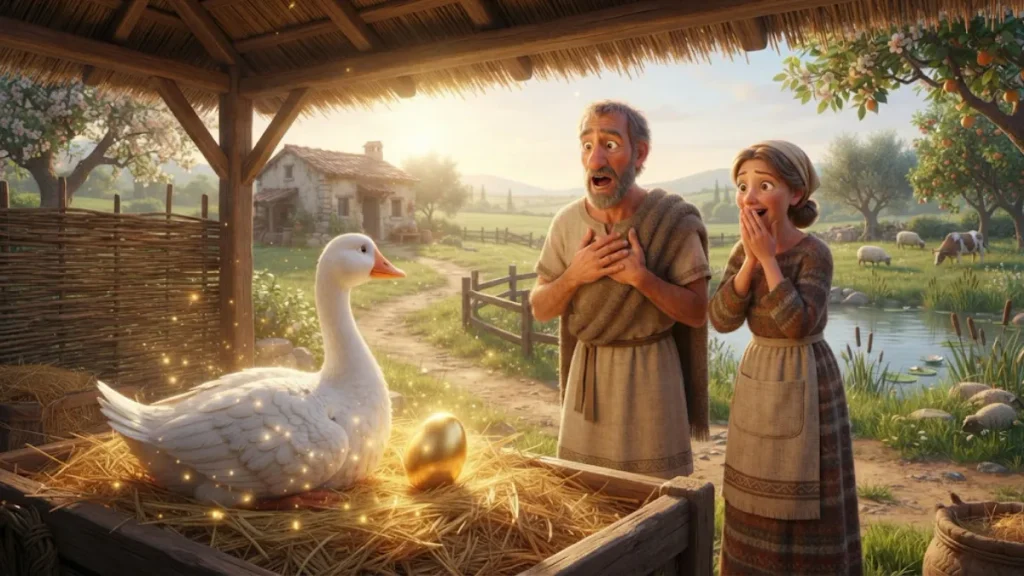
A Timeless Fable About Greed, Patience, and Being Content With What You Have
The Goose That Laid the Golden Eggs is a famous fable traditionally attributed to Aesop, the ancient Greek storyteller. It tells the story of a poor farmer and his wife who own a remarkable goose. Every morning, the goose lays one golden egg, gradually bringing the couple wealth and comfort. However, instead of appreciating their good fortune, they become impatient and greedy. They decide to take all the gold at once, making a decision that destroys the very source of their wealth.
This simple story carries an important lesson: greed can make people lose what they already have while chasing something more. It reminds us that patience, gratitude, and sensible decisions are often more valuable than the desire to become rich quickly.
A Poor Farmer and His Simple Life
Once upon a time, in a peaceful village surrounded by green fields and rolling hills, there lived a farmer with his wife.
They were not wealthy people. Their small house stood near a narrow dirt road, and their farmland was modest. They owned a few chickens, some goats, and several other farm animals.
Every morning, the farmer woke up before sunrise. He worked in his fields, fed his animals, collected firewood, and repaired anything that needed attention.
His wife managed the household, prepared meals, and helped care for the animals.
Although they worked hard, life was not always easy.
Some seasons brought good harvests, while others brought little income. Sometimes they had enough money to buy new clothes or improve their home, but often they had to save carefully.
The farmer frequently worried about their future.
“I wish we had enough money to live comfortably,” he told his wife one evening. “We work from morning until night, but we never seem to get ahead.”
His wife understood his concerns.
“Perhaps things will improve one day,” she replied. “We should continue working and be grateful for what we have.”
The farmer nodded, although he still dreamed of becoming wealthy.
Neither of them knew that something extraordinary was about to happen.
The Strange Goose Arrives
One morning, while walking near the edge of his property, the farmer noticed a beautiful white goose sitting beside a small pond.
It looked different from the other birds he had seen. Its feathers were unusually bright, and it seemed calm and comfortable around people.
The farmer approached slowly.
“Where did you come from, little one?” he asked.
The goose did not fly away.
Thinking that it might belong to someone nearby, the farmer looked around for its owner. When nobody appeared, he decided to take the goose home and care for it.
His wife was surprised when she saw the unusual bird.
“What a beautiful goose!” she exclaimed.
“We can keep it with our other animals,” the farmer said. “Perhaps it will become a good addition to our little farm.”
They prepared a comfortable place for it near the pond. The goose received fresh water, food, and a safe shelter.
The farmer and his wife treated the bird kindly.
They had no idea that the goose was unlike any ordinary farm animal.
The First Golden Egg
The following morning, the farmer went outside to feed the animals.
As he approached the goose’s shelter, something unusual caught his attention.
There was a bright golden object lying in the straw.
At first, he thought it was a small piece of metal.
He picked it up and examined it carefully.
It was an egg.
But it was not an ordinary egg.
It was made entirely of gold.
The farmer stared at it in disbelief.
He rubbed it with his fingers, turned it around, and looked at its shining surface.
“How can this be possible?” he whispered.
He rushed into the house.
“Wife! Come quickly! You must see something!”
His wife hurried outside, wondering what had happened.
The farmer showed her the golden egg.
She opened her eyes wide.
“Is this real gold?”
“I believe it is,” he replied. “Look at how it shines!”
They examined the egg carefully and realized that it was genuine gold.
Their lives were about to change.
A Goose That Lays Gold Every Morning
The farmer and his wife took the golden egg to a local goldsmith.
After examining it, the goldsmith confirmed that it was made of pure gold.
He offered them a generous amount of money for it.
The couple could hardly believe their luck.
With the money, they purchased food, repaired their roof, and bought a few things they had needed for years.
They were delighted.
The next morning, the farmer went to check the goose again.
To his amazement, another golden egg was waiting in the shelter.
He immediately called his wife.
“It has happened again!” he shouted.
They rushed outside and found another beautiful golden egg.
The goose had laid another one.
Day after day, the same extraordinary event continued.
Every morning, the goose laid one golden egg.
The farmer and his wife carefully collected each egg and sold it.
Their financial situation gradually improved.
They bought better clothes, repaired their house, and expanded their farmland. They no longer worried about every small expense.
For the first time in their lives, they felt financially secure.
The farmer often looked at the goose with gratitude.
“This wonderful bird has changed everything,” he told his wife.
She smiled.
“We should always take good care of it. We have been given something truly special.”
At that time, both of them were happy with their fortune.
Their Life Becomes Comfortable
As the weeks passed, the golden eggs continued arriving.
The farmer and his wife became wealthier with every passing day.
They hired workers to help with the farm. They purchased better furniture and replaced their old household equipment.
Their small house became more comfortable.
They could afford nutritious food, warm clothing, and other things they had once considered luxuries.
The farmer no longer needed to work from sunrise until sunset.
He spent more time enjoying his property and watching the animals.
His wife was pleased with their improved life.
One evening, while sitting outside their house, she looked toward the goose’s shelter.
“We have been very fortunate,” she said. “Every morning, that goose gives us another golden egg. We should never forget how much it has helped us.”
The farmer agreed.
But something had begun to change inside him.
Instead of thinking about how fortunate they were, he started thinking about how much richer they could become.
Greed Slowly Enters Their Minds
At first, the farmer was satisfied with one golden egg every day.
But after receiving many eggs, he began wondering whether the goose could produce more.
“Why does it lay only one egg each morning?” he asked his wife one day.
She looked at him with surprise.
“One golden egg every day is already more than we could have imagined.”
“Yes, but think about it,” he replied. “If it laid two eggs every day, we would become twice as wealthy.”
His wife smiled.
“Perhaps we should simply be thankful for what we have.”
The farmer did not respond.
He began spending more time thinking about the goose.
One egg every morning seemed too little compared with the wealth he believed he could possess.
He started imagining a large house, expensive furniture, beautiful horses, and endless money.
He wanted to become the richest man in the region.
Soon, the golden eggs no longer felt like a blessing.
They began to feel like a slow way of becoming wealthy.
The Farmer Develops an Impatient Plan
One afternoon, the farmer sat outside watching the goose near the pond.
He thought about all the golden eggs it had produced.
“If every egg is made of gold,” he wondered, “then perhaps the goose itself must be filled with gold.”
The thought excited him.
What if the goose contained a large quantity of gold inside its body?
What if he could collect all that gold at once instead of waiting for one egg every morning?
He imagined becoming wealthy overnight.
He would never have to wait for another egg.
He could buy everything he wanted immediately.
The farmer went inside and shared his idea with his wife.
“I have discovered a way to become richer than ever,” he announced.
His wife looked curious.
“What do you mean?”
“The goose must contain a great amount of gold inside it. If we open it, we could collect everything at once.”
His wife was horrified.
“Are you suggesting that we kill the goose?”
“Think about how much gold we might find!” he replied.
“But what if there is no gold inside? What if we lose the goose that gives us a golden egg every day?”
The farmer became impatient.
“Why should we wait for one egg at a time when we could have everything immediately?”
His wife tried to explain the danger of the plan.
But the farmer’s mind was already filled with dreams of instant wealth.
Greed had begun controlling his decisions.
The Couple Makes a Terrible Decision
For several days, the farmer thought about his plan.
His wife continued reminding him that they already had a comfortable life.
But the farmer could not stop imagining the wealth he might obtain.
He became convinced that the goose contained a treasure far greater than the golden eggs it produced.
Finally, one morning, he decided to act.
He entered the goose’s shelter and approached the bird.
The goose looked at him calmly.
It had no idea what was about to happen.
The farmer hesitated for a moment.
He remembered the many golden eggs that had changed his life.
He also remembered his dreams of becoming even richer.
Then he made his decision.
He killed the goose and opened its body, expecting to discover a large supply of gold.
But what he found shocked him.
There was no gold inside.
There were no hidden treasures, precious stones, or piles of valuable metal.
The goose was just an ordinary living bird.
The farmer stood silently, staring at what he had done.
His wife rushed toward him.
“What have you done?” she cried.
The farmer had no answer.
The source of their wealth was gone.
The Terrible Realization
The farmer and his wife searched the goose carefully, hoping that they had somehow missed the treasure.
But there was nothing.
The golden eggs had not been stored inside the bird.
They had been produced naturally by the magical goose.
By killing it, the farmer had destroyed the only source of those golden eggs.
His wife began crying.
“We had everything we needed,” she said. “We were comfortable, we had enough money, and we could have continued receiving golden eggs every morning.”
The farmer lowered his head.
He finally understood the terrible mistake he had made.
He had been so focused on getting more that he had destroyed what was already bringing him wealth.
The golden eggs could have supported them for years.
Instead, they had lost everything in a single moment.
Life Without the Golden Goose
The following morning, the farmer walked toward the empty shelter.
For the first time in many weeks, there was no golden egg waiting in the straw.
The pond was quiet.
The farm animals continued their usual routines, but the extraordinary goose was gone.
The farmer sat beside the shelter and remembered how excited he had been when he discovered the first golden egg.
He remembered the happiness of selling it and the comfort it had brought to his family.
He wished he could return to that moment.
But the past could not be changed.
His wife joined him.
“We cannot bring the goose back,” she said sadly. “But perhaps we can learn from what happened.”
The farmer nodded.
He knew that no amount of regret could undo his decision.
They still had their farm, their home, and some of the money they had saved. But their daily source of golden eggs had disappeared forever.
They had to return to a more ordinary way of life.
The farmer began working in the fields again. His wife continued managing the household.
This time, however, he understood the importance of appreciating what he had.
The Farmer Learns the True Meaning of Wealth
Months passed, and the farmer slowly rebuilt his routine.
He no longer spent every evening dreaming about becoming the richest person in the region.
Instead, he focused on maintaining his farm, caring for his animals, and managing his money carefully.
Whenever he saw a goose near the pond, he remembered the extraordinary bird he had once owned.
He understood that wealth was not simply about collecting as much money as possible.
True wealth also included security, peace of mind, health, family, and the ability to enjoy everyday life.
His wife often reminded him that they had been fortunate to receive such a wonderful gift.
The farmer agreed.
“If I had been patient, we could have enjoyed those golden eggs for many years,” he said. “I lost everything because I wanted everything at once.”
He never forgot that lesson.
The Story Becomes a Lesson for Everyone
Over time, the farmer’s story became known throughout the village.
People talked about the magical goose and the foolish decision that had destroyed its gift.
Parents told their children the story whenever they became impatient or demanded more than they needed.
Teachers used it to explain the dangers of greed.
The fable became a reminder that the desire for more can sometimes make people forget the value of what they already possess.
The golden eggs represented a steady source of wealth, while the farmer’s decision represented impatience and uncontrolled greed.
The story also showed that some opportunities cannot be recovered once they are destroyed.
The farmer had not lost the goose because he was poor or unlucky.
He had lost it because he could not appreciate the value of receiving something good regularly.
And that is why the story has remained meaningful for generations.
Moral of The Goose That Laid the Golden Eggs
The main moral of The Goose That Laid the Golden Eggs is that greed and impatience can destroy the very things that bring us happiness and success.
The farmer and his wife already had a valuable source of wealth. Instead of appreciating the golden eggs they received every day, they wanted everything immediately. Their impatience led them to destroy the goose and lose their future income.
The story teaches that patience, gratitude, and sensible decisions are more valuable than the desire for instant riches.
Important Life Lessons from the Story
1. Greed can lead to loss: Wanting more than we need can cause us to lose what we already have.
2. Be patient with success: Good things often grow gradually. Trying to achieve everything immediately can lead to poor decisions.
3. Appreciate what you have: Happiness does not always come from having more money or possessions. Sometimes it comes from recognizing the value of what is already available.
4. Think before making important decisions: Emotional decisions driven by excitement or greed can have permanent consequences.
5. Do not destroy long-term opportunities for short-term rewards: A steady source of income or progress may be more valuable than an uncertain promise of instant wealth.
6. Learn from mistakes: Even when a decision cannot be reversed, its lesson can help prevent similar mistakes in the future.
7. True wealth includes peace of mind: Money is useful, but it should not become more important than security, relationships, and happiness.
What Does the Golden Goose Symbolize?
The golden goose symbolizes a valuable and dependable source of prosperity. Its golden eggs represent the rewards that come from patience, consistency, and wise management.
The farmer represents people who become so focused on immediate rewards that they overlook the value of long-term opportunities.
The story also highlights an important distinction: the goose represents the source of wealth, while the eggs represent the rewards produced by that source.
Destroying the source to obtain an immediate reward is a decision that can eliminate future opportunities.
Is The Goose That Laid the Golden Eggs a Greek Mythology Story?
The Goose That Laid the Golden Eggs is traditionally classified as an Aesop’s fable rather than a Greek myth.
Aesop’s fables are short moral stories associated with ancient Greek storytelling. They often use animals and simple situations to explain human behaviour.
Unlike Greek myths involving gods, heroes, and supernatural adventures, this story focuses on ordinary human weaknesses such as greed, impatience, and poor judgment.
It is commonly included in collections of Greek fables because of its traditional connection with Aesop.
How Does This Fable Apply to Modern Life?
The lesson of the golden goose is relevant to many situations in modern life.
- Business: A business owner who sacrifices customer trust for quick profits may destroy a successful long-term business.
- Investments: Chasing unrealistic returns can put carefully built savings at risk.
- Career: Leaving a stable opportunity without considering the consequences can create unnecessary difficulties.
- Relationships: Taking loved ones for granted while constantly demanding more can damage valuable relationships.
- Personal growth: Expecting immediate results can lead people to abandon habits and goals that need time to develop.
The fable reminds us to protect the things that create lasting value instead of sacrificing them for temporary rewards.
Conclusion
The Goose That Laid the Golden Eggs is a timeless fable about greed, patience, and the importance of appreciating what we already have.
The farmer and his wife received an extraordinary gift that gradually improved their lives. But their desire for instant wealth made them forget the value of patience.
By killing the goose, they destroyed their only source of golden eggs and lost the opportunity to enjoy its benefits in the future.
The story teaches that success is not always about getting more. Sometimes it is about protecting what is already working, making thoughtful decisions, and being grateful for what we have.
Never destroy a valuable source of happiness or success just because you want a bigger reward today.
9. Persephone and Hades: The Changing Seasons
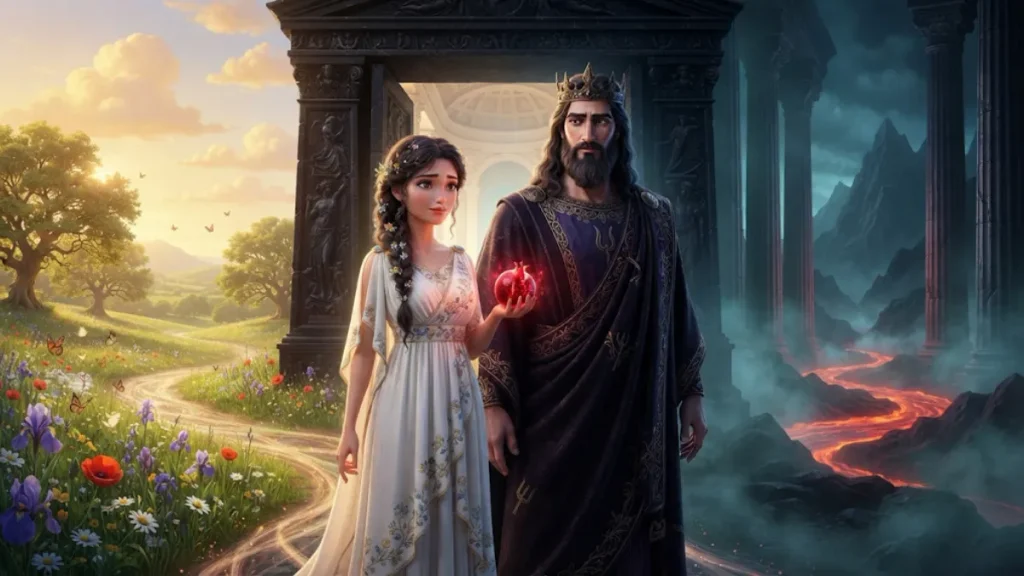
A Greek Mythology Story About Love, Loss, Motherhood, and the Cycle of Nature
The story of Persephone and Hades is one of the most fascinating myths in ancient Greek mythology. It explains how the changing seasons came to be and explores the powerful relationship between a mother and her daughter.
Persephone was the beautiful daughter of Demeter, the goddess of agriculture and harvest. She loved flowers, sunshine, and the peaceful beauty of nature. But one day, her life changed when Hades, the ruler of the Underworld, took her to his dark kingdom.
Her mother searched desperately for her, and the earth began to suffer as Demeter’s grief affected the natural world. Eventually, the gods arranged a compromise that allowed Persephone to spend part of the year with her mother and the remaining part in the Underworld.
According to the myth, this arrangement explains why the earth experiences different seasons.
Persephone, the Goddess of Spring
Long ago, in ancient Greece, there lived a beautiful young goddess named Persephone.
She was the daughter of Zeus, the king of the gods, and Demeter, the goddess of agriculture, fertility, and harvest.
Persephone was closely connected with nature. Wherever she walked, flowers seemed to bloom, trees appeared greener, and the fields became filled with colour.
She loved spending her days in meadows, collecting flowers, watching butterflies, and enjoying the warmth of the sun.
Her mother, Demeter, loved her more than anything in the world.
Demeter was responsible for helping crops grow and ensuring that the earth provided food for humans. Farmers depended on her blessings for healthy harvests, and people honoured her through festivals and offerings.
But despite her important responsibilities, Demeter always made time for Persephone.
The two enjoyed spending time together in the countryside. They walked through fields, admired beautiful flowers, and talked beneath the shade of ancient trees.
Persephone was happy with her peaceful life.
She had no idea that her future would soon take her far away from everything she loved.
Hades, the Ruler of the Underworld
Far beneath the surface of the earth existed a mysterious kingdom known as the Underworld.
It was the realm where the souls of the dead travelled after leaving the world of the living.
The kingdom was ruled by Hades, the god of the Underworld and brother of Zeus and Poseidon.
Hades was powerful, serious, and distant. Unlike the gods who lived on Mount Olympus, he spent most of his time in his underground kingdom.
His palace was surrounded by dark rivers, shadowy forests, and mysterious pathways.
Although Hades was often portrayed as frightening, he was not simply a monster or an evil god. He was the ruler responsible for maintaining order in the realm of the dead.
However, he lived a lonely existence.
One day, Hades saw Persephone walking through a beautiful meadow.
She was surrounded by flowers and sunlight, and her presence seemed to bring life to everything around her.
Hades became fascinated by her.
He began thinking about bringing Persephone to his kingdom as his queen.
But there was one serious problem.
Persephone belonged to the world above, and her mother would never willingly allow her daughter to leave.
The Day Persephone Disappeared
One beautiful morning, Persephone went into a meadow with several companions to collect flowers.
The countryside was peaceful.
Colourful blossoms covered the grass, butterflies moved between plants, and birds sang from nearby trees.
Persephone noticed a particularly beautiful flower growing at a distance.
It was more magnificent than anything she had seen before.
Its petals were unusually bright, and its fragrance seemed to fill the entire meadow.
Curious, Persephone walked toward it.
As she reached down to pick the flower, the ground suddenly began to shake.
The earth opened, revealing a dark passage beneath the meadow.
A magnificent chariot emerged from the opening, driven by Hades.
He approached Persephone and took her with him into the Underworld.
The earth closed behind them, leaving the meadow silent.
In some ancient versions of the myth, Zeus had secretly agreed to the arrangement, while Demeter had not been informed.
Persephone’s companions were left frightened and confused.
They searched the meadow, calling her name, but she had disappeared.
The peaceful morning had turned into a terrible mystery.
Demeter Begins Searching for Her Daughter
When Demeter discovered that Persephone was missing, she became overwhelmed with fear.
She searched the meadow, the nearby forests, and every place where her daughter might have gone.
She called Persephone’s name repeatedly.
But there was no answer.
Demeter asked the other gods whether they knew what had happened.
She questioned the nymphs, the spirits of nature, and the people who had been nearby.
Nobody could tell her where Persephone had gone.
Unable to find her daughter, Demeter decided to search across the entire world.
She carried burning torches and travelled through mountains, villages, and forests.
Night after night, she continued her journey.
She refused to rest because she feared that every passing moment might make it harder to find Persephone.
Her grief became so great that she temporarily neglected her responsibilities as the goddess of agriculture.
The fields began changing.
Crops stopped growing properly, flowers disappeared, and the land became dry.
Farmers became worried as their harvests began to fail.
People who depended on the earth for food could not understand why nature had suddenly become so unproductive.
They did not know that Demeter’s sorrow was affecting the entire world.
The Truth Is Revealed
After searching for many days, Demeter finally received information that changed everything.
The sun god Helios, who could see much of what happened across the world, revealed that Hades had taken Persephone into the Underworld.
He also explained that Zeus had known about the arrangement.
Demeter was furious.
She could not believe that Zeus had allowed her daughter to be taken without discussing it with her.
She felt betrayed by the gods she had trusted.
Her anger and sadness grew stronger.
She decided that she would not return to her duties until Persephone was brought back.
Without Demeter’s care, the earth became increasingly barren.
Fields that had once produced wheat and barley became empty. Fruit trees stopped providing their usual harvests, and people began suffering from hunger.
The gods realized that the situation could not continue.
If the earth stopped producing food, humanity itself would be in danger.
Zeus understood that he had to find a solution.
Persephone Arrives in the Underworld
Meanwhile, Persephone had arrived in the kingdom of Hades.
Everything around her was different from the world she had known.
There were no bright meadows or warm fields. Instead, she saw dark rivers, enormous stone buildings, and endless shadowy pathways.
At first, Persephone felt frightened and lonely.
She missed her mother.
She missed the sunshine, the flowers, and the sound of birds singing in the trees.
Hades welcomed her into his palace and offered her a place beside him.
He wanted her to become the queen of the Underworld.
Persephone was uncertain about her future.
She did not know whether she would ever see her mother again.
Although Hades provided her with beautiful surroundings and everything a queen might need, she could not forget the life she had left behind.
She spent much of her time thinking about Demeter.
Hades noticed her sadness.
He understood that Persephone’s connection with her mother and the world above was much stronger than he had expected.
The Pomegranate Seeds
One day, Persephone encountered a beautiful pomegranate in the Underworld.
Its red skin looked bright against the dark surroundings.
She had not eaten properly for some time and felt hungry.
She opened the fruit and ate a few seeds.
In Greek mythology, food from the Underworld carried special significance. Eating it could create a connection between a person and the realm of the dead.
Persephone did not fully understand the consequences of her decision.
In some versions of the myth, Hades deliberately offered her the pomegranate. In others, she ate the seeds herself.
The number of seeds also differs between ancient accounts and later retellings.
The important detail was that Persephone had eaten food from the Underworld.
This would affect the terms of her return.
She might be allowed to leave, but she could not remain permanently in the world above.
Her future would be divided between two worlds.
Zeus Arranges a Compromise
As Demeter’s search continued, the suffering on earth became impossible to ignore.
The gods watched as crops failed and people struggled to find food.
Zeus finally decided to intervene.
He sent Hermes, the messenger god, to the Underworld with an important message for Hades.
Hermes was instructed to negotiate Persephone’s return.
Hades understood that the situation had become serious.
He knew that Demeter would not restore the earth until her daughter returned.
However, because Persephone had eaten pomegranate seeds, a complete separation from the Underworld was no longer possible under the terms of the myth.
A compromise was arranged.
Persephone would spend part of the year with her mother in the world above and the remaining part with Hades in the Underworld.
This arrangement would allow Demeter and Persephone to reunite while also preserving Persephone’s connection to the kingdom of Hades.
Hermes prepared to escort Persephone back.
For the first time since her disappearance, she would see her mother again.
The Emotional Reunion of Mother and Daughter
When Persephone finally returned, Demeter rushed toward her.
The two embraced tightly.
Demeter held her daughter as if she never wanted to let her go again.
Persephone was equally happy.
She had missed her mother, her home, and the beautiful world above.
For a long time, they remained together, sharing their happiness and talking about everything that had happened.
Demeter’s sadness slowly disappeared.
The moment she was reunited with Persephone, she remembered her responsibilities as the goddess of agriculture.
The earth began to change.
Flowers appeared in the fields, trees produced fresh leaves, and the crops started growing again.
The air became warmer, and the countryside returned to its former beauty.
People celebrated the return of fertile land.
They planted seeds, prepared their fields, and looked forward to another successful harvest.
The reunion of mother and daughter had restored life to the earth.
Why the Seasons Change
Although Demeter was happy to have her daughter back, she knew that Persephone could not remain with her throughout the entire year.
When the time came for Persephone to return to the Underworld, Demeter became sad again.
She knew that she would have to spend months without her daughter.
As Persephone descended into the Underworld, Demeter’s grief returned.
The earth gradually became colder and less productive.
Flowers disappeared, trees lost their leaves, and the fields became quiet.
This was the explanation the ancient Greeks gave for the changing seasons.
When Persephone returned to the world above, Demeter became joyful, and the earth welcomed spring.
As the warm months continued, plants grew, flowers blossomed, and crops developed.
Later, the harvest arrived, bringing abundance to the fields.
But when Persephone returned to the Underworld, Demeter’s sadness brought the colder and less fertile part of the year.
Thus, the cycle continued.
Persephone spent part of the year with her mother and part with Hades, while the earth moved through its changing seasons.
Persephone Becomes Queen of the Underworld
Over time, Persephone became an important figure in the Underworld.
She was no longer simply the young goddess who had loved collecting flowers in the meadows.
She grew into a powerful queen who shared responsibility for the realm of the dead.
Alongside Hades, she became associated with the mysteries of life, death, and renewal.
She was sometimes portrayed as compassionate toward the souls who entered the Underworld.
Her experiences had changed her.
She understood both the beauty of life and the sadness of separation.
She also learned that happiness and sorrow could exist together.
When she returned to the world above, she enjoyed the warmth of nature and the love of her mother.
When she returned to the Underworld, she fulfilled her role as queen.
Her story became a symbol of transformation and the endless cycles of nature.
The Meaning Behind the Story
The myth of Persephone and Hades is more than a story about a goddess who travels between two kingdoms.
It reflects the ancient Greeks’ understanding of agriculture and the changing seasons.
They depended on crops for survival and observed how the natural world changed throughout the year.
Spring brought new growth, summer brought warmth, autumn brought harvests, and winter brought a period when much of the land became quiet.
The myth connected these natural changes with the emotions of Demeter and the journeys of Persephone.
It also explored the relationship between mothers and daughters, the pain of separation, and the possibility of finding balance after difficult experiences.
Persephone’s journey represented transformation.
She began as a young goddess associated with flowers and springtime, but eventually became a queen with an important role in the Underworld.
Her story showed that even after a painful change, life could take on a new meaning.
Moral of Persephone and Hades
The story of Persephone and Hades teaches that life moves through different periods of happiness, sadness, separation, and renewal. Just as the seasons change, difficult moments do not last forever.
It also highlights the strength of family bonds and the importance of finding balance when life takes an unexpected direction.
Important Life Lessons from the Story
1. Family bonds are powerful: The love between Demeter and Persephone shows how deeply family relationships can influence our lives.
2. Change is a natural part of life: Nothing remains the same forever. Learning to accept change helps us grow.
3. Difficult times eventually pass: The return of spring symbolizes the possibility of new beginnings after periods of sadness.
4. Every experience can bring transformation: Persephone’s journey changed her from a young goddess into a powerful queen.
5. Love can survive separation: Even when people are physically apart, meaningful relationships can remain strong.
6. Balance is important: Life contains both joyful and difficult experiences. Understanding this helps us appreciate each moment.
7. Accepting reality helps us move forward: Demeter eventually had to accept that Persephone would divide her time between two worlds.
What Do Persephone and Hades Symbolize?
Persephone symbolizes spring, renewal, transformation, and the connection between life and death. Her return to the world above represents the renewal of nature, while her descent into the Underworld represents the quieter period of the natural cycle.
Demeter symbolizes agriculture, motherhood, fertility, and the earth’s ability to provide food.
Hades symbolizes the Underworld and the mysterious realm of the dead.
Together, these characters represent the ancient Greek explanation of the natural cycle of growth, harvest, decline, and renewal.
How Does the Story of Persephone Explain the Seasons?
According to Greek mythology, the seasons change because Persephone spends part of the year with Demeter and the remaining part in the Underworld.
- Spring: Persephone returns, and Demeter’s happiness brings flowers and new growth.
- Summer: Nature flourishes, and crops grow under the warmth of the sun.
- Autumn: The harvest arrives as the earth prepares for a quieter period.
- Winter: Persephone returns to the Underworld, and Demeter’s sadness causes the earth to become cold and less productive.
This is a mythological explanation rather than a scientific one. Scientifically, Earth’s seasons are caused by the tilt of its axis as it travels around the Sun.
Why Is Persephone and Hades an Important Greek Mythology Story?
This myth is important because it connects several major themes in Greek mythology.
It explains the changing seasons, explores the relationship between gods and mortals, and introduces the ancient Greek understanding of the Underworld.
It also provides insight into the importance of agriculture in ancient Greek society. Since farming was essential for survival, people naturally developed stories explaining why the earth changed throughout the year.
The myth influenced ancient religious traditions, including the Eleusinian Mysteries, which were associated with Demeter and Persephone and explored themes of life, death, and renewal.
Its themes continue to inspire literature, paintings, theatre, films, and modern retellings.
Conclusion
The story of Persephone and Hades is a beautiful and emotional Greek myth about love, separation, transformation, and the changing seasons.
When Persephone disappeared into the Underworld, Demeter’s grief affected the entire earth. But her eventual return brought happiness and restored the natural world.
The arrangement between Persephone and Hades explained why the earth moves through different seasons, from the blooming beauty of spring to the quiet cold of winter.
The story reminds us that life is full of changes. There are moments of happiness and periods of sadness, but both are part of a larger journey.
Just as winter eventually gives way to spring, difficult chapters in life can lead to new beginnings.
What Are the Most Important Moral Lessons in Greek Mythology?
Greek mythology explores many aspects of human nature. Although the stories involve magical creatures and powerful gods, their messages are surprisingly practical.
Here are some important lessons found throughout these ancient legends.
| Moral lesson | Greek mythology example | What it teaches |
|---|---|---|
| Avoid greed | King Midas | Wealth cannot replace happiness |
| Stay humble | Arachne | Talent needs humility |
| Listen to advice | Icarus | Ignoring warnings can lead to trouble |
| Be patient | Orpheus | Doubt and impatience can cause loss |
| Never give up | Hercules | Determination helps overcome challenges |
| Help others | Prometheus | Compassion requires courage |
| Avoid selfishness | Narcissus | Relationships need empathy |
| Think before acting | Pandora | Decisions can have lasting consequences |
| Appreciate what you have | The Golden Goose | Greed can destroy valuable opportunities |
| Respect your limits | Bellerophon | Pride can lead to failure |
Why Are Greek Mythology Stories Still Relevant Today?
Greek mythology may be thousands of years old, but its lessons remain relevant because human nature has not changed completely.
People still struggle with jealousy, greed, pride, impatience, and selfishness. They also continue to demonstrate courage, kindness, determination, and love.
Consider these everyday examples:
- A student who refuses to listen to advice may learn an Icarus-like lesson about overconfidence.
- Someone who constantly wants more money may experience the same problem as King Midas.
- A talented employee who treats colleagues disrespectfully can learn from Arachne.
- A person who gives up after facing difficulties can find inspiration in Hercules.
- Someone who makes decisions without considering the consequences can remember Pandora’s story.
These connections make Greek mythology more than a collection of ancient legends. They turn it into a way of understanding human behavior and making better decisions.
How Can Children Learn From Greek Mythology Stories?
Greek mythology can be an interesting way to introduce children to important values and encourage thoughtful conversations.
Parents and teachers can use these stories to explain difficult ideas through simple examples.
Here are some effective ways to make these stories educational:
Discuss the moral after reading
After reading a story, ask children what they think the main character did wrong or right. This encourages them to think independently.
Connect the story to everyday life
Explain how King Midas’s greed is similar to someone who refuses to share toys or belongings.
Encourage storytelling activities
Ask children to retell their favorite Greek mythology stories in their own words. This helps improve their creativity, memory, and communication skills.
Discuss alternative endings
Ask children what might have happened if Icarus had listened to his father or if Pandora had kept the jar closed.
Introduce Greek gods and heroes
Characters such as Zeus, Athena, Hercules, and Persephone can make mythology more engaging and help children explore ancient Greek culture.
These activities make learning enjoyable while teaching values that children can apply in their daily lives.
Frequently Asked Questions About Greek Mythology Stories With Moral Lessons
What are the best Greek mythology stories with moral lessons?
Some of the best Greek mythology stories with moral lessons include King Midas and the Golden Touch, Icarus and Daedalus, Arachne and Athena, Pandora’s Box, Hercules and the Twelve Labors, and Orpheus and Eurydice. These stories teach lessons about greed, humility, courage, patience, and responsibility.
What is the moral lesson of King Midas?
The moral lesson of King Midas is that greed can destroy happiness. His desire to turn everything into gold caused him to lose the ability to enjoy food and nearly cost him his daughter’s life. The story teaches us to value relationships and meaningful experiences over material possessions.
What does the story of Icarus teach us?
The story of Icarus teaches us about the dangers of overconfidence and ignoring advice. Although ambition is important, we must understand our limitations and listen to people who have more experience.
Which Greek mythology story teaches humility?
The story of Arachne and Athena is a famous example of a Greek myth that teaches humility. Arachne was an exceptionally talented weaver, but her arrogance and disrespect toward Athena led to her downfall.
What is the moral lesson of Pandora’s Box?
Pandora’s story teaches us to think carefully before making decisions. Her curiosity led her to open a forbidden jar, releasing suffering into the world. However, hope remained inside, reminding humanity that difficult times can still be overcome.
Which Greek myth teaches courage and perseverance?
The story of Hercules and his Twelve Labors is one of the best examples. Hercules faced dangerous and seemingly impossible challenges but continued working until he completed every task.
Are Greek mythology stories suitable for children?
Many Greek mythology stories are suitable for children when presented in age-appropriate language. However, some original myths contain violence, death, and frightening situations. Parents and teachers can choose simplified versions that focus on positive lessons and avoid unnecessary disturbing details.
Why should students read Greek mythology stories?
Students can learn about ancient Greek culture, improve their reading comprehension, develop critical thinking skills, and understand universal human values. These stories also introduce important themes such as justice, courage, responsibility, and wisdom.
What is the most famous moral story in Greek mythology?
King Midas and the Golden Touch is among the most famous Greek mythology stories with a clear moral lesson. It demonstrates how uncontrolled greed can destroy the things that make life meaningful.
What is the difference between Greek mythology and Aesop’s fables?
Greek mythology includes traditional stories about gods, goddesses, heroes, monsters, and the origins of the world. Aesop’s fables are short moral tales, often featuring talking animals, that teach lessons about human behavior. Both traditions are associated with ancient Greek storytelling.
Conclusion: Ancient Stories With Lessons for Modern Life
Greek mythology stories with moral lessons continue to inspire readers because they explore the choices people make and the consequences that follow.
King Midas reminds us that greed cannot buy happiness. Icarus teaches us to balance ambition with wisdom. Arachne shows why humility matters, while Hercules demonstrates the importance of perseverance. Pandora’s story reminds us to think before acting, and Prometheus inspires us to help others even when doing so requires courage.
These legends are entertaining, but their greatest value lies in the wisdom they share.
Whether you are a student learning about ancient Greek culture, a parent looking for meaningful bedtime reading, or an adult interested in timeless life lessons, Greek mythology offers stories worth remembering.
The most important lesson is simple: our choices, values, and actions shape the kind of lives we create.