
Horror stories become especially memorable when they do more than create fear. A genuinely effective horror story can make readers uncomfortable, curious, and eager to discover what happens next. But when the ending completely changes the meaning of everything that came before, the experience becomes even more powerful.
Horror Short Stories to Read Online for Adults With a Twist are perfect for readers who enjoy suspense, mystery, psychological tension, unexpected revelations, and endings that stay in the mind long after the story is finished. Instead of relying only on monsters, blood, or traditional supernatural scares, these stories can build fear through atmosphere, uncertainty, secrets, and carefully hidden clues.
This type of horror is particularly appealing to adult readers because it can explore more complex themes such as guilt, loneliness, grief, obsession, betrayal, memory, identity, and the fear of losing control.
What Makes a Horror Story With a Twist Different?
A traditional horror story often builds toward a frightening confrontation. A twist-driven horror story takes a different approach. It encourages the reader to form an assumption and then challenges that assumption near the end.
The reader might believe that a character is being followed, only to discover that the character has been following someone else. A seemingly haunted house may turn out to be connected to a forgotten event from the protagonist’s past. A mysterious stranger may appear dangerous throughout the story, while the real threat is someone the reader trusted.
The best twists do not feel completely random. They should make the reader think:
“The clues were there all along. I just didn’t see them.”
That feeling is one of the biggest attractions of twist-ending horror.
Why Adults Enjoy Short Horror Stories With Unexpected Endings
Adults often have limited time for reading, which makes short horror especially appealing. A well-written story can establish its setting, introduce a mystery, create tension, and deliver a shocking conclusion without requiring several hours of reading.
Short stories can also experiment with unusual ideas without requiring a large commitment from the reader.
A story might take place in:
- An isolated house
- A nearly empty hotel
- A deserted road
- An old apartment building
- A hospital at night
- A quiet office
- A train station
- A remote village
- A forgotten basement
- A seemingly ordinary suburban home
The familiar setting can make the horror feel more believable because the reader can easily imagine being there.
The Importance of the Twist
The twist is the defining feature of this type of horror, but simply surprising the reader is not enough.
A strong twist should change how the reader understands the earlier parts of the story. Details that initially seemed insignificant may suddenly become important. A strange conversation may acquire a different meaning. A character’s unusual behavior may finally make sense.
For example, a story could begin with a person hearing footsteps outside their bedroom every night. The obvious assumption is that someone is breaking into the house. As the story progresses, the protagonist becomes increasingly frightened.
At the end, however, the reader discovers that the footsteps are coming from inside the bedroom.
That simple reversal changes the entire story.
Horror Short Stories to Read Online for Adults With A Twist
1. The Apartment Above Mine
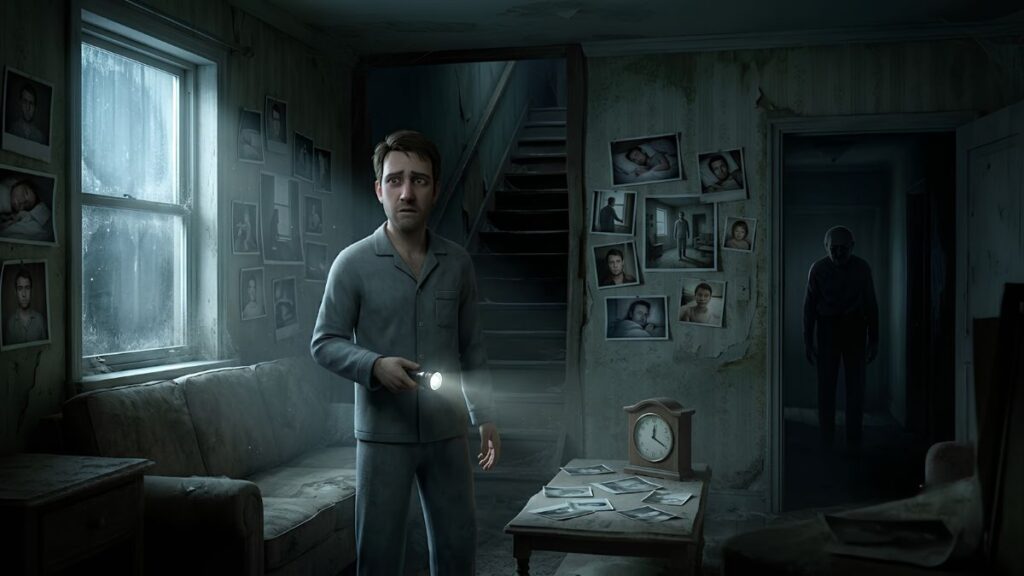
Daniel had lived on the seventh floor of Bellwood Apartments for almost three years, and during that time he had learned to recognize every sound the building made.
He knew the elevator groaned whenever it stopped between the sixth and seventh floors.
He knew the heating pipes clicked inside the walls during cold nights.
He knew the old wooden staircase complained beneath heavy footsteps.
He even knew the sound of Mrs. Harper in apartment 604 dragging her dining chair across the floor every morning at precisely seven.
But there was one sound Daniel could not explain.
Footsteps.
They came from directly above his bedroom.
Every night.
At exactly 2:13 a.m.
The first time Daniel noticed them, he assumed someone was walking in the apartment above his.
He was half asleep when he heard a slow step.
Then another.
Then another.
Someone was walking across the ceiling.
Daniel opened his eyes and stared into the darkness.
Step.
Step.
Step.
The footsteps moved from the far end of the room toward his bed.
He waited.
They stopped directly above him.
Daniel held his breath.
Nothing happened.
After perhaps thirty seconds, the footsteps continued toward the opposite wall.
Then they disappeared.
Daniel turned on his bedside lamp.
The clock read 2:14.
He laughed quietly.
“Probably the pipes,” he muttered.
The next night, it happened again.
2:13.
Step.
Step.
Step.
This time, the footsteps were heavier.
They crossed the ceiling, stopped above Daniel’s bed, and then moved away.
The third night, there was something else.
Furniture scraping.
A long, slow dragging sound passed above him.
Daniel sat upright.
The noise continued for nearly a minute.
It sounded as though someone were moving a heavy table across the floor.
He checked the building directory the next morning.
There were seven floors.
He was on the seventh.
There was no eighth floor.
Daniel went to the building manager.
“Is there some kind of maintenance space above apartment 708?”
The manager looked confused.
“Maintenance space?”
“An attic. Storage. Anything.”
“No.”
Daniel hesitated.
“I keep hearing someone walking above my apartment.”
The manager gave him an uncomfortable smile.
“You’re on the top floor.”
“I know.”
“Then you’re probably hearing the pipes.”
Daniel nodded, though he did not believe him.
That night, he waited.
He kept the lights off and watched the clock.
2:12.
Nothing.
2:13.
A footstep.
Daniel’s eyes opened wide.
Another.
Then another.
This time, the footsteps were not moving across the ceiling.
They were moving toward his bedroom door.
Daniel slowly looked upward.
The ceiling remained perfectly still.
Then he heard a faint sound.
A chair being dragged.
Right above him.
He grabbed his phone and started recording.
The footsteps continued.
One.
Two.
Three.
Then silence.
Daniel checked the recording.
The microphone had captured nothing.
Not even static.
He listened again.
Nothing.
He barely slept.
The following day, Daniel searched the internet for the history of Bellwood Apartments.
The building was almost sixty years old.
It had originally been constructed as a luxury residential complex, although several renovations had been completed over the years.
Daniel found an old photograph of the building.
There were eight visible levels.
He stared at the screen.
Eight.
The current building had seven.
Daniel zoomed in.
The uppermost level appeared to have windows.
He contacted the property management office and asked about the missing floor.
The manager refused to discuss it.
That made Daniel even more curious.
That evening, he walked through the building looking for anything unusual.
He found a locked door at the end of the seventh-floor hallway.
There was no apartment number.
Only a small brass plate.
SERVICE ACCESS
Daniel tried the handle.
Locked.
He returned to his apartment and searched his toolbox.
He found an old screwdriver.
He told himself he was only going to look.
Nothing more.
At midnight, he returned to the door.
The lock was old.
It took him several minutes.
Finally, it clicked.
Daniel opened the door.
A narrow staircase disappeared into darkness.
He switched on his phone flashlight.
The stairs went upward.
One floor.
Then another half-floor.
Then they ended at a wooden hatch.
Daniel pushed it open.
Dust fell onto his face.
He climbed through.
His flashlight swept across a dark room.
He froze.
There was an apartment above his.
Not an attic.
An apartment.
A complete apartment.
There was a living room.
A kitchen.
A bedroom.
A bathroom.
Even furniture.
Daniel slowly walked forward.
Everything looked strangely familiar.
The sofa was the same model as his.
The dining table was identical.
The television stood in exactly the same position.
He walked into the bedroom.
His stomach tightened.
The bed was identical to his.
Even the small bedside table was the same.
He turned toward the wall.
There were photographs.
Daniel stepped closer.
The first photograph showed him standing outside Bellwood Apartments.
The second showed him entering the building.
The third showed him sitting in his living room.
The fourth showed him sleeping.
Daniel stumbled backward.
“No.”
He looked around.
There were dozens of photographs.
All of him.
Taken from angles that should have been impossible.
He picked one up.
The photograph showed Daniel sleeping in his bedroom.
The timestamp on the back read:
Tomorrow. 2:13 a.m.
His hands began to shake.
He looked at the bed.
Then at the photograph.
Then at the ceiling beneath his feet.
A strange realization entered his mind.
The apartment above his was not simply copying his apartment.
It was showing his apartment.
But not the way it looked now.
The room changed.
Daniel watched in horror as the lights flickered.
The furniture shifted.
The walls seemed to breathe.
Then he heard footsteps.
Directly beneath him.
Daniel looked down.
Someone was walking inside his apartment.
His apartment.
The footsteps moved from the hallway toward the bedroom.
Daniel ran downstairs.
He reached his apartment and threw open the door.
Everything was exactly as he had left it.
Except for one thing.
A chair had been moved.
He stared at it.
He was certain he had left it beside the table.
Now it stood in the middle of the living room.
Daniel called the police.
They searched the apartment.
Nothing.
They searched the seventh-floor hallway.
Nothing.
Daniel told them about the hidden apartment.
When the officers checked the service door, it was locked.
There was no staircase.
No hatch.
No apartment.
One officer suggested Daniel get some sleep.
Daniel knew he was beginning to sound insane.
So he stopped talking about it.
But the footsteps continued.
Every night.
2:13.
Step.
Step.
Step.
And every night, something in his apartment moved.
A cup changed position.
A book disappeared.
A door was left open.
A photograph turned face down.
Daniel began sleeping with the lights on.
He stopped trusting his own memory.
Then, one night, he found another photograph beneath his pillow.
It showed him asleep.
The timestamp read:
Tonight. 2:13 a.m.
Daniel stared at the photograph.
There was something else in it.
A shadow stood beside his bed.
He looked toward the bedroom.
Nothing.
He checked the photograph again.
The shadow was closer.
Daniel stepped backward.
The clock changed.
2:12.
He grabbed his coat and ran toward the apartment door.
He was going to leave the building.
But before he could open it, footsteps sounded above him.
2:13.
Step.
Step.
Step.
Daniel stopped.
The footsteps moved across the ceiling.
Then stopped directly above him.
A voice whispered from somewhere upstairs.
“Daniel.”
He looked up.
It was his own voice.
“Daniel.”
The lights went out.
Daniel ran.
He found the service door.
This time it was open.
The staircase was there.
He climbed.
The hidden apartment waited above him.
But something had changed.
The furniture was no longer identical.
It was older.
Dust covered everything.
The photographs were different.
Daniel walked toward the wall.
There were hundreds now.
Photographs of him.
At different ages.
Ten years old.
Fifteen.
Twenty.
Twenty-five.
Thirty.
He reached the final photograph.
It showed Daniel standing in the hidden apartment.
Behind him stood another Daniel.
Daniel turned around.
No one was there.
Then he heard footsteps.
They came from below.
From his apartment.
He looked at the photograph again.
The timestamp read:
Tomorrow. 2:13 a.m.
The figure behind him had moved closer.
Daniel dropped the photograph.
He ran toward the stairs.
But before he reached them, the door slammed shut.
He pulled the handle.
Locked.
Then footsteps began moving across the hidden apartment.
Slowly.
Approaching him.
Daniel backed away.
“Who’s there?”
No answer.
The footsteps stopped.
A voice whispered behind him.
“You finally came upstairs.”
Daniel turned.
A man stood at the end of the hallway.
Daniel stared.
The man’s face was his own.
Older.
Much older.
His hair was gray.
His face was covered with small scars.
He looked exhausted.
Daniel couldn’t speak.
The older man raised a finger to his lips.
“Don’t make the same mistake.”
“What are you?”
The older Daniel looked toward the floor.
“You.”
Daniel shook his head.
“No.”
“Yes.”
“What is this place?”
The older Daniel looked almost sad.
“This is where you come when you realize the footsteps aren’t coming from above.”
Daniel’s heart pounded.
“Then where are they coming from?”
The older man looked at him.
“Below.”
A loud footstep echoed from the apartment beneath them.
Both men froze.
Then another.
The older Daniel grabbed his arm.
“We don’t have much time.”
“What happens?”
The older Daniel looked toward the photographs.
“You keep hearing the footsteps.”
“Yes.”
“You keep trying to find the person making them.”
“Yes.”
“And eventually you come here.”
Daniel stared at him.
“And then?”
The older man’s expression changed.
“You become the person making them.”
Daniel stepped backward.
“No.”
The older Daniel pointed toward the staircase.
“Go downstairs.”
Daniel hesitated.
“Why?”
“Because tonight is the first night you have a chance to change it.”
Daniel ran down.
The staircase seemed longer than before.
He reached his apartment.
The clock read 2:14.
The footsteps stopped.
Daniel stood in the darkness.
Silence.
For the first time in months, there was no sound above him.
He slowly looked toward the ceiling.
Then he heard something beneath the floor.
A footstep.
Daniel froze.
Another.
Another.
The footsteps were coming from his bedroom floor.
He backed away.
The floorboards creaked.
Then a voice whispered from underneath.
His own voice.
“Daniel.”
He screamed.
The next morning, the building manager found Daniel’s apartment empty.
There was no sign of him.
The service door remained locked.
The building had only seven floors.
Months later, a new tenant moved into apartment 708.
His name was Daniel.
The manager thought the coincidence was strange but said nothing.
On his first night, Daniel went to bed.
At exactly 2:13 a.m., he opened his eyes.
Step.
Step.
Step.
Someone was walking above him.
He sat up.
The footsteps stopped.
Then he heard furniture scraping.
He stared at the ceiling.
A photograph slowly slid from beneath his bedroom door.
Daniel picked it up.
It showed him sleeping.
And behind him stood a man.
The man was Daniel.
But much older.
On the back of the photograph were four words:
You finally came upstairs.
Twist: The footsteps are not coming from another person. They are coming from Daniel himself, one day in the future, desperately trying to warn his past self.
2. The Last Passenger
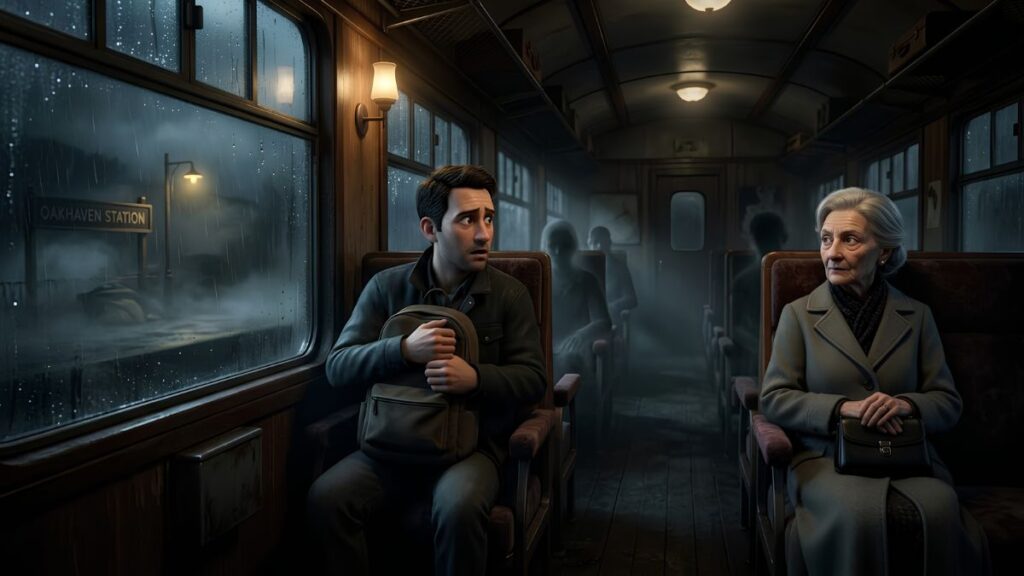
Michael had taken the 11:40 p.m. train home hundreds of times.
It was not a pleasant journey, but it was familiar.
Every evening, he left his office at around 10:50, walked six blocks to the station, bought a bottle of water from the same vending machine, and boarded the same late-night train.
The journey took thirty-seven minutes.
Normally, the train was almost empty by the time it reached his neighborhood.
Michael liked it that way.
After a long day at work, he preferred silence.
He could sit beside the window, put on his headphones, and watch the city disappear behind him.
That Tuesday night was no different.
Rain had been falling since late afternoon.
By the time Michael reached the station, his coat was damp and his shoes were soaked.
The platform was nearly empty.
A digital sign flickered above him.
11:40 PM — NORTHBOUND
Michael checked his phone.
11:37.
Three minutes.
He looked down the platform.
A woman stood beneath the farthest shelter.
She was elderly, perhaps in her seventies, wearing a long gray coat and holding a small black handbag.
She was completely dry.
Michael found that strange because the wind was blowing rain almost horizontally across the platform.
The woman noticed him looking.
She smiled.
Michael nodded politely.
The train arrived.
The doors opened.
Michael entered the nearest carriage.
The woman entered too.
He took his usual seat beside the window.
She sat opposite him.
For several minutes, neither spoke.
The train moved through the darkness.
Michael looked at his phone.
11:44.
The woman was staring at him.
He removed one earbud.
“Sorry?”
She smiled again.
“You take this train every night?”
Michael hesitated.
“Yes.”
“Always this one?”
“Yes.”
The woman looked toward the window.
“That is unfortunate.”
Michael frowned.
“What do you mean?”
She did not answer.
Instead, she asked:
“Are you getting off at the next station?”
“No. Three more stops.”
She looked relieved.
“Good.”
Michael stared at her.
“Why?”
The woman’s expression changed.
“You shouldn’t get off at the next station.”
Michael laughed nervously.
“Why not?”
She leaned closer.
“Because there is no next station.”
Michael thought he had misheard her.
“What?”
“There hasn’t been a station there for a long time.”
The train passed through a tunnel.
The lights inside the carriage flickered.
Michael looked around.
There were perhaps fifteen passengers when they had boarded.
Now there were only six.
He looked at the woman.
She seemed completely calm.
“What do you mean there hasn’t been a station?”
“You’ll understand.”
The train emerged from the tunnel.
Outside, everything was dark.
No buildings.
No streetlights.
No advertisements.
Nothing.
Michael checked his phone.
There was no signal.
He opened the train map.
The map showed the next station.
Harrington.
He had used it hundreds of times.
The woman watched him.
“Don’t worry,” she said.
“About what?”
“You’ll remember.”
The train began slowing.
Michael looked outside.
A platform appeared.
It was old and almost completely abandoned.
One yellow light flickered near the station sign.
HARRINGTON
The train stopped.
The doors opened.
Michael stood.
The woman grabbed his wrist.
“Don’t.”
Her grip was surprisingly strong.
Michael pulled his arm away.
“I need to get off.”
“No.”
“This is my station.”
She stared at him.
“You have never gotten off here.”
Michael laughed.
“Of course I have.”
“No.”
“I’ve lived here for years.”
The woman shook her head.
“You haven’t.”
The doors began closing.
Michael stepped back.
The train moved again.
He sat down.
His heart was beating faster.
The woman released his wrist.
“Who are you?”
“My name is Eleanor.”
“How do you know me?”
“I don’t.”
“Then why are you acting like you do?”
She looked toward the window.
“I know the train.”
Michael frowned.
“What does that mean?”
Eleanor did not answer.
The remaining passengers gradually disappeared.
One by one, they got off at stations Michael did not recognize.
Eventually, only Michael and Eleanor remained.
He checked the time.
12:08.
That was impossible.
The journey should have ended by now.
He looked at the train map again.
The station names had disappeared.
There was only one line.
And at the end of it was a red circle.
No name.
Michael stood and walked toward the driver’s cabin.
The door was locked.
He knocked.
No response.
He knocked harder.
Nothing.
He returned to his seat.
Eleanor was watching him.
“You should sit down.”
“What is happening?”
“You’re almost there.”
“Where?”
She looked at him sadly.
“Home.”
Michael felt a chill.
“This is not my home.”
Eleanor smiled faintly.
“That’s what you said last time.”
Michael stared at her.
“What?”
“You don’t remember.”
“Remember what?”
Eleanor opened her handbag.
Inside was a newspaper.
She carefully unfolded it.
The paper looked old.
Very old.
Michael looked at the headline.
TRAIN ACCIDENT CLAIMS 42 LIVES
The photograph beneath it showed a train lying on its side beside a collapsed section of track.
Michael stared.
He recognized the train.
It was the train he was sitting on.
His stomach tightened.
“That can’t be.”
Eleanor turned the newspaper around.
The date was twenty years earlier.
Michael shook his head.
“No.”
He looked at the photograph again.
Passengers were being carried away from the wreckage.
One of the victims was visible in the corner.
A young man.
Michael.
He stepped backward.
“That isn’t me.”
Eleanor said nothing.
Michael grabbed his phone.
He searched his name.
His hands trembled.
The internet loaded.
The first result was an old newspaper article.
He opened it.
The article described the accident.
Forty-two people died.
Among them was a twenty-eight-year-old office worker named Michael Turner.
Michael stared at the screen.
His own photograph appeared beneath the headline.
The same face.
The same scar above his eyebrow.
The same dark eyes.
His phone slipped from his hand.
“No.”
Eleanor gently picked it up.
“You’ve been riding this train for twenty years.”
Michael could barely speak.
“I would know.”
“You did.”
“Then why don’t I remember?”
“Because you weren’t ready.”
“Ready for what?”
“To get off.”
The train entered another tunnel.
All the lights went out.
Michael heard something behind him.
A whisper.
Then another.
Then dozens.
Passengers.
People who had disappeared from the train.
Their voices filled the darkness.
Some were crying.
Some were praying.
Some were calling names.
Michael covered his ears.
“What are they saying?”
Eleanor answered quietly.
“They’re saying goodbye.”
The lights came back.
The carriage was empty.
Eleanor was gone.
Michael stood.
“Eleanor?”
No answer.
He walked toward the door between the carriages.
It opened automatically.
Beyond it was another carriage.
Then another.
He walked through several cars.
Each one was filled with people.
But they were not sitting normally.
They were frozen in place.
A man stared at his hands.
A woman held a child.
A teenager looked toward the ceiling.
None of them moved.
Michael recognized some of their faces from the newspaper.
They were passengers from the accident.
He turned around.
Eleanor stood at the end of the carriage.
“Come back.”
Michael ran toward her.
“What is this?”
“The last journey.”
“What happens when it ends?”
“You leave.”
“Where?”
She looked toward the window.
“You’ll know.”
The train slowed.
A station appeared.
This one looked different.
There were dozens of people waiting on the platform.
Michael recognized them.
His mother.
His father.
His younger brother.
Friends from school.
People he had not seen in years.
People who were dead.
Michael stopped breathing.
His mother smiled.
She looked exactly as she had twenty years ago.
“Mom?”
Eleanor stood beside him.
“You’ve been trying to get home.”
Michael began crying.
“I thought I was going home every night.”
“You were.”
“But I never arrived.”
“You didn’t know how.”
The train stopped.
The doors opened.
Michael stepped toward the platform.
Then he stopped.
A terrible thought entered his mind.
“What about you?”
Eleanor smiled.
“I’ve already gotten off.”
Michael looked at her.
“You’re still here.”
“No.”
She pointed toward the platform.
A young woman stood there.
She looked exactly like Eleanor.
Only she was perhaps twenty-five years old.
The older Eleanor smiled.
“She has been waiting for me.”
Michael looked back at her.
“What happens to the train?”
“It keeps going.”
“For how long?”
“Until everyone remembers.”
Michael looked toward the dark carriage.
“Everyone?”
Eleanor nodded.
“Some people take longer.”
The conductor’s whistle sounded.
Michael stepped onto the platform.
His mother reached for him.
He took her hand.
For the first time in twenty years, he remembered.
The train had been traveling home that night.
It had been raining.
He had been thinking about his mother.
He had promised himself he would visit her that weekend.
Then there had been a violent impact.
Metal twisting.
Glass breaking.
Darkness.
And silence.
Michael remembered everything.
He looked back at the train.
Eleanor was still standing inside.
The doors began closing.
Michael called out.
“Thank you.”
She smiled.
Then the train disappeared into the darkness.
Michael turned toward his family.
His mother hugged him.
“You took so long.”
Michael cried into her shoulder.
“I know.”
Behind them, the station lights became brighter.
The rain stopped.
The sky slowly turned pale.
And somewhere far away, a train whistle sounded one final time.
Twenty years later, a railway worker found an old newspaper photograph inside a sealed station office.
The photograph showed the passengers from the accident.
Forty-two people.
The worker studied the picture.
Then he noticed something strange.
There were now only forty-one people in the photograph.
Michael was gone.
But a new person had appeared.
An elderly woman in a gray coat.
The worker stared at her face.
He knew her.
Everyone who had ever worked the late-night shift knew her.
She had been seen waiting at Harrington Station for years.
Always carrying a black handbag.
Always boarding the last train.
Always asking passengers the same question.
“Are you getting off at the next station?”
The worker turned the photograph over.
There was writing on the back.
A single sentence.
Some passengers need help remembering that the journey is over.
And somewhere, far beyond the station, a train began moving through the darkness.
Twist: Michael has not been riding the train every night. He died in the accident years ago and has been repeating the same journey without realizing it. The woman is another passenger trying to help him finally understand.
3. The Voice in the Baby Monitor
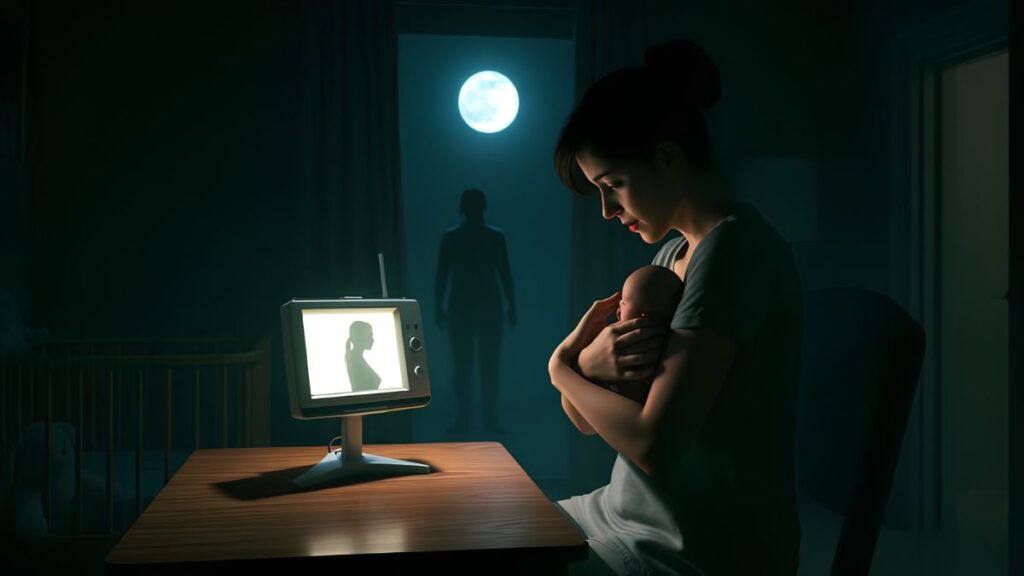
Sarah had always believed that a house became a home when someone you loved was sleeping inside it.
After the birth of her daughter, Lily, that feeling became stronger.
The small white house at the end of Willow Lane had never seemed particularly special before. It had old wooden floors, narrow hallways, and windows that rattled whenever the wind became strong.
But after Lily was born, Sarah began seeing the house differently.
The nursery was her favorite room.
She and her husband, Daniel, had painted the walls a soft cream color and placed a small wooden crib beside the window. A collection of stuffed animals sat on a shelf above it.
At night, Sarah would sit in the rocking chair beside the crib and watch Lily sleep.
Everything felt peaceful.
Until the baby monitor started talking.
It happened on a Tuesday night.
Sarah was lying in bed beside Daniel when a faint sound came from the monitor.
She opened her eyes.
At first, she thought it was static.
Then she heard a woman’s voice.
“Don’t open the bedroom door.”
Sarah sat upright.
Daniel was asleep beside her.
She reached for the monitor.
The screen showed Lily sleeping peacefully.
Sarah turned up the volume.
Nothing.
She stared at the screen for several seconds.
Then the voice returned.
“Don’t open the bedroom door.”
Sarah’s heart began beating faster.
She woke Daniel.
“Daniel.”
He groaned.
“What?”
“Did you hear that?”
“Hear what?”
“The monitor.”
He looked at the screen.
“Lily’s asleep.”
“I heard someone talking.”
Daniel smiled sleepily.
“Probably interference.”
Sarah wanted to believe him.
She turned the monitor off.
A few seconds later, she heard the voice again.
“Sarah.”
She froze.
The monitor was off.
Daniel sat up.
“What?”
Sarah stared at the device.
The screen was black.
“Someone said my name.”
Daniel reached for it.
He switched it on.
Lily was still asleep.
Nothing appeared unusual.
“See?”
Sarah nodded.
But she didn’t sleep much that night.
The following evening, she checked the monitor before going to bed.
She made sure the volume was low.
She checked the camera connection.
Everything seemed normal.
At 2:17 a.m., she woke to the sound of static.
Then the voice returned.
“Don’t let him see you.”
Sarah sat up.
She stared at the monitor.
“Who are you?”
Silence.
Then:
“Don’t let him see you.”
Sarah woke Daniel.
This time, he heard the voice too.
His face changed.
“What the hell?”
The voice disappeared.
Daniel checked the monitor.
“Could someone be accessing the camera?”
“I don’t know.”
He checked the Wi-Fi.
The connection was secure.
They changed the password.
They unplugged the monitor.
They checked every window and door.
Nothing.
The house was locked.
Sarah tried to convince herself that the device was malfunctioning.
But the next night, the voice returned.
“Sarah.”
She was sitting in the nursery when it happened.
Lily was asleep in her crib.
Sarah looked around.
“Who are you?”
The voice came through the monitor.
“Someone who knows what happens here.”
Sarah’s blood went cold.
“What happens?”
“You open the door.”
“What door?”
“The bedroom door.”
Sarah stared at the nursery entrance.
“What is behind it?”
Silence.
Then:
“Not Daniel.”
Sarah frowned.
“What does that mean?”
The monitor went silent.
She picked up Lily and ran downstairs.
Daniel found her sitting on the sofa with the baby in her arms.
“What happened?”
Sarah told him everything.
He listened without interrupting.
Then he said something that made her uncomfortable.
“Maybe we should leave for a few days.”
They stayed at a hotel that night.
Nothing happened.
The next morning, Daniel called the manufacturer of the baby monitor.
They told him there had been no known security issues.
The device had never been registered to another account.
There was no remote access.
No recorded audio.
Nothing.
They returned home that afternoon.
Sarah felt foolish.
Perhaps exhaustion had caused her to imagine the first voice.
Perhaps the second was interference.
Perhaps she had misunderstood the sounds.
But that night, at exactly 2:17 a.m., the monitor turned on by itself.
The voice whispered:
“He is coming.”
Sarah woke Daniel.
“What?”
“He’s coming.”
Daniel sat upright.
“What are you talking about?”
A sound came from downstairs.
A floorboard creaked.
Both of them froze.
Then another.
Someone was walking through the house.
Daniel reached for his phone.
The footsteps moved toward the stairs.
Sarah grabbed Lily from the crib.
The monitor whispered:
“Hide.”
Daniel looked at Sarah.
They rushed into the walk-in closet.
Daniel turned off the bedroom light.
The footsteps climbed the stairs.
Slowly.
One step.
Then another.
Sarah held Lily against her chest.
Daniel stood beside the closet door.
The footsteps stopped outside the bedroom.
The door handle moved.
Daniel raised his phone.
The bedroom door opened.
Sarah covered her mouth.
Someone entered.
The figure stood in the darkness.
Daniel whispered:
“Who are you?”
No answer.
The figure took one step toward the closet.
Then the baby monitor spoke.
“Sarah.”
The figure stopped.
“Don’t let him see you.”
The bedroom lights suddenly turned on.
There was nobody there.
Daniel ran to the hallway.
Nothing.
The front door was still locked.
Every window was closed.
They called the police.
Two officers searched the house.
They found nothing.
One officer suggested installing better locks.
The other asked about the baby monitor.
Daniel showed it to him.
The officer looked at the device.
“Where did you buy this?”
“Online.”
“Recently?”
“About six months ago.”
The officer turned pale.
“What?”
He stared at the model number.
“This model hasn’t been sold in years.”
Daniel frowned.
“That can’t be right.”
The officer looked at Sarah.
“My sister had one.”
Sarah felt a chill.
“Had?”
“She died.”
The room became silent.
“When?”
“About six years ago.”
Sarah looked at the monitor.
“What happened?”
The officer hesitated.
“She had a baby.”
“What was the baby’s name?”
The officer stared at the floor.
“Emily.”
Sarah looked at Daniel.
The officer continued.
“The baby disappeared.”
Sarah’s stomach tightened.
“What do you mean disappeared?”
“No one knows.”
The mother was found dead in the house.
The baby was gone.
The police searched for weeks.
Nothing was found.
The officer looked at the monitor again.
“Where did you say you bought this?”
Daniel showed him the order confirmation.
The officer stared at the screen.
“That address.”
“What about it?”
“That was my sister’s house.”
Sarah felt the room tilt.
“This is our house.”
The officer shook his head.
“No.”
He looked toward the hallway.
“This house was demolished six years ago.”
Daniel laughed nervously.
“That doesn’t make sense.”
The officer walked to the window.
He looked outside.
His expression changed.
“What’s the address here?”
Daniel told him.
The officer stepped backward.
“That street doesn’t exist anymore.”
Sarah looked outside.
The neighborhood was exactly as she remembered it.
Houses.
Trees.
Streetlights.
Cars.
Everything.
The officer left the house and called for another unit.
Sarah and Daniel stood in silence.
Then the monitor came alive.
The woman’s voice whispered:
“Don’t trust him.”
Sarah looked toward the police officer outside.
“Who?”
The monitor crackled.
“Daniel.”
Sarah slowly turned.
Daniel was standing behind her.
His face was expressionless.
“Sarah,” he said.
She stepped backward.
“What?”
He smiled.
“Give me the baby.”
Sarah held Lily tighter.
“Why?”
“Because she’s mine.”
Sarah’s heart stopped.
Daniel had never spoken about Lily that way.
“What did you say?”
His smile disappeared.
“Give her to me.”
Sarah ran.
She locked herself in the nursery.
Daniel stood outside.
He knocked gently.
“Sarah.”
She backed away from the door.
“Open it.”
The monitor came alive.
The woman’s voice whispered:
“Don’t open the door.”
Sarah began crying.
Daniel continued knocking.
“Sarah, please.”
The monitor spoke again.
“He isn’t Daniel.”
Sarah stared at the door.
“What happened to my husband?”
Silence.
Then:
“He opened the door.”
Sarah remembered the night they had first moved into the house.
Daniel had told her the previous owners had left suddenly.
He had found the house online.
He had insisted they move quickly.
Sarah had never questioned it.
The monitor crackled.
“He was never your husband.”
Sarah looked at Lily.
The baby opened her eyes.
For the first time, Sarah noticed something strange.
Lily wasn’t crying.
She was smiling.
The door handle began turning.
Sarah backed into the corner.
The monitor whispered:
“Sarah, listen carefully.”
“Yes?”
“Your daughter is not a baby.”
Sarah looked down.
Lily’s eyes were fixed on her.
The baby’s smile widened.
Then she spoke.
Not babbling.
Not making random sounds.
A clear voice.
“Mommy.”
Sarah dropped the monitor.
The nursery door opened.
Daniel stood outside.
Except it wasn’t Daniel.
His face looked almost right.
His eyes were too dark.
His smile was too wide.
Behind him stood the woman from the monitor.
She was pale and translucent.
Sarah screamed.
The woman looked at Lily.
“That’s what happened to my daughter.”
Sarah looked down.
Lily was no longer smiling.
She was staring at the woman.
The woman stepped closer.
“She took her place.”
Sarah shook her head.
“No.”
The woman pointed at Lily.
“She has been doing it for years.”
Sarah looked at the baby.
Suddenly, memories began returning.
Not memories from the past few months.
Older memories.
Sarah remembered living in another house.
She remembered another baby.
A daughter named Emma.
She remembered a terrible illness.
She remembered the baby dying.
She remembered being unable to accept it.
Then she remembered moving into the house.
She remembered Daniel telling her everything would be fine.
But Daniel had died two years before.
Sarah screamed.
The figure wearing Daniel’s face smiled.
“You wanted your family back.”
Sarah looked at the monitor.
The woman whispered:
“And something answered.”
The room went silent.
Sarah stared at Lily.
The baby’s face began changing.
For a moment, she looked like an ordinary child.
Then her features shifted.
Her eyes became dark.
Her smile widened.
And her voice became the voice of an adult woman.
“You invited me in.”
Sarah dropped to the floor.
The woman from the monitor stepped forward.
“You weren’t supposed to open the bedroom door.”
Sarah looked at her.
“Why?”
The woman pointed toward the hallway.
“Because that’s where it lives.”
Sarah slowly turned.
The bedroom door stood open.
Beyond it was darkness.
Not the darkness of an unlit room.
Something deeper.
Something endless.
A hand appeared around the doorframe.
Then another.
Sarah screamed.
The woman grabbed her hand.
“Run.”
They ran through the nursery window.
Sarah landed on wet grass outside.
She looked back at the house.
The windows were dark.
No police cars.
No streetlights.
No neighbors.
Nothing.
The entire neighborhood had disappeared.
Only the house remained.
The woman stood beside Sarah.
“What is this place?”
The woman looked at the house.
“A waiting room.”
“For what?”
“For people who refuse to accept goodbye.”
Sarah looked down.
Her hands were empty.
Lily was gone.
The woman said nothing.
Sarah closed her eyes.
When she opened them again, she was standing in a hospital room.
A nurse was holding her hand.
Her mother was crying beside the bed.
A doctor stood near the window.
“Sarah,” her mother whispered.
Sarah looked around.
“What happened?”
“You were in an accident.”
Sarah touched her stomach.
“Where’s my baby?”
Her mother began crying harder.
“You weren’t pregnant.”
Sarah stared at her.
Then she heard a familiar sound.
A baby monitor.
Static.
A woman’s voice whispered:
“Don’t open the bedroom door.”
Sarah turned toward the hospital room door.
It slowly began opening.
And behind it stood Daniel.
He smiled.
The baby monitor crackled one final time.
“You still haven’t learned.”
Twist: The voice was not warning Sarah about her husband. It was warning her about the baby, who is not what Sarah believed her daughter to be.
4. The Photograph on the Wall
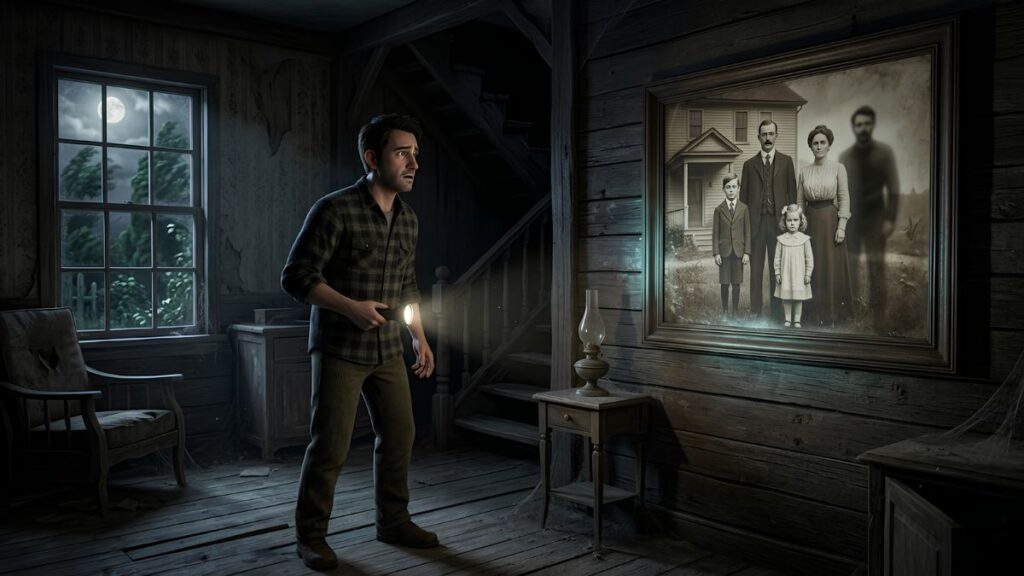
Thomas had never believed that houses could remember people.
He had heard stories, of course.
Old houses that creaked at night.
Rooms where lights turned on by themselves.
Photographs that seemed to change.
But those were stories people told because they liked being frightened.
Thomas preferred explanations.
A broken pipe was a broken pipe.
A strange noise was probably an animal.
And a shadow in the corner was usually caused by bad lighting.
That was why the old photograph should never have frightened him.
At least, not at first.
Thomas found the house on a cold Saturday morning in October.
It stood at the end of a narrow country road, surrounded by tall trees and an overgrown garden.
The property had been empty for nearly two years.
The previous owner had died, and no relatives wanted the house.
The price was surprisingly low.
Thomas bought it within a week.
He was thirty-eight, recently divorced, and tired of living in a crowded apartment.
The house was exactly what he wanted.
Quiet.
Private.
Far from the city.
On his first afternoon there, he walked through every room.
The kitchen needed work.
The upstairs bathroom needed replacing.
Several floorboards creaked.
But the living room was beautiful.
It had a large fireplace, tall windows, and old wooden walls.
As Thomas walked toward the staircase, something caught his attention.
A photograph hung beside the stairs.
It showed a family standing in front of the house.
A father.
A mother.
A young boy.
And a little girl.
Thomas assumed they were the previous owners.
He looked closer.
The photograph was old, perhaps fifty years old.
The family looked serious.
Nobody smiled.
Thomas noticed something strange.
The house behind them looked exactly as it did now.
Same windows.
Same front door.
Same stone steps.
He wondered who they were.
There was no name on the frame.
He left it alone.
That night, Thomas slept well.
The next morning, he noticed something unusual.
The little girl in the photograph had moved.
Thomas stared at the picture.
Yesterday, she had been standing beside her mother.
Now she stood slightly farther away.
He blinked.
Then laughed.
“I’m losing my mind.”
He took the photograph off the wall.
He placed it on the kitchen table.
He looked at it for several minutes.
Everything appeared normal.
The girl was standing beside her mother.
Thomas put it back.
That evening, he forgot about it.
Until the next morning.
The little girl had moved again.
This time, she was standing near the father.
Thomas took the photograph down.
He inspected the glass.
Perhaps it had been reflecting something.
Perhaps the frame contained two photographs.
He opened the back.
There was only one picture.
He placed it on the table.
Then he took a photograph of it with his phone.
The phone image showed exactly the same family.
Nothing unusual.
Thomas felt relieved.
He decided the problem was simply his imagination.
For the next few days, nothing happened.
Then, on Thursday morning, he noticed the father was looking directly at the camera.
Thomas remembered that the man had previously been looking toward the little girl.
He checked his phone.
The photograph he had taken days earlier showed the man looking away.
Thomas’s stomach tightened.
He opened the camera.
The photograph on the wall was different.
He took another picture.
The phone displayed the new version.
Thomas stepped backward.
“No.”
He took the photograph down.
He placed it face down on the table.
He went to work.
When he returned that evening, the photograph was back on the wall.
Thomas stopped at the doorway.
He had locked the house before leaving.
He was certain.
He walked toward the picture.
The family had changed again.
There was now a fifth figure standing behind them.
A man.
Thomas.
He was standing several feet behind the family.
His expression was blank.
Thomas stared at his own face.
The photograph showed him wearing the same clothes he was wearing that evening.
He looked at the photograph.
Then at himself.
Then back at the photograph.
His reflection in the glass moved normally.
The man in the photograph did not.
Thomas reached for the frame.
His hand trembled.
He pulled it from the wall.
The back was still sealed.
He opened it.
Inside was a newspaper clipping.
Thomas unfolded it.
The headline read:
FAMILY DISAPPEARS FROM COUNTRY HOME
The article was dated 1974.
The family in the photograph had disappeared.
All four members.
No bodies were ever found.
Thomas read the article twice.
At the bottom was a photograph.
It was the same family.
But there was no fifth figure.
Thomas looked at the picture in his hand.
There he was.
He put it down.
That night, he didn’t sleep.
At 2:30 a.m., he heard footsteps downstairs.
Thomas sat upright.
The footsteps moved across the living room.
Then stopped beneath the photograph.
Thomas picked up a flashlight.
He walked downstairs.
The living room was empty.
The photograph hung on the wall.
Thomas shone the flashlight toward it.
The family was still there.
But the fifth figure had moved closer.
Thomas was now standing beside the little girl.
He dropped the flashlight.
He stepped toward the picture.
The little girl was looking directly at him.
For the first time, she was smiling.
Thomas backed away.
The lights went out.
He ran upstairs.
The next morning, he called a friend.
His friend arrived at noon.
Thomas showed him the photograph.
His friend laughed.
“It’s just an old family picture.”
“Look carefully.”
His friend stared.
“What’s wrong with it?”
“There’s a man behind them.”
“Yes.”
“That’s me.”
His friend looked at Thomas.
Then at the photograph.
“You mean the resemblance?”
“No. That’s me.”
His friend shook his head.
“Thomas, you’ve been working too hard.”
Thomas showed him the old newspaper.
His friend read it.
Then he noticed something.
The article contained a floor plan of the house.
The layout was slightly different from the current house.
There was a room behind the living room.
A room that no longer existed.
Thomas looked at the wall.
“Where was that room?”
His friend pointed.
“Right there.”
They measured the wall.
The numbers didn’t make sense.
There was empty space behind it.
Thomas found an old hammer.
He broke through the wooden panel.
Behind it was a narrow doorway.
They opened it.
A cold smell came from inside.
The room was untouched.
Dust covered everything.
There was an old bed.
A wooden desk.
A child’s chair.
And another photograph.
Thomas picked it up.
It showed the family standing outside the house.
But this time, there were five people.
Thomas was standing in the center.
The little girl was holding his hand.
His friend whispered:
“Thomas.”
Thomas looked at the back.
There was writing.
We found him.
His friend stepped backward.
“Who is that?”
Thomas stared at the photograph.
He suddenly remembered something.
Not clearly.
A flash.
A garden.
A little girl.
A wooden swing.
A voice calling his name.
Then darkness.
Thomas dropped the photograph.
“I’ve been here before.”
His friend shook his head.
“No.”
“I remember the garden.”
“You couldn’t.”
Thomas looked at the wall.
The old photograph had changed again.
The family was no longer standing outside.
They were standing inside the hidden room.
Thomas was there too.
The little girl was pointing toward the doorway.
Behind them stood another man.
Thomas turned.
Nobody was there.
Then his friend screamed.
Thomas looked at the photograph.
His friend was now inside it.
Standing beside the family.
Thomas dropped the frame.
He turned around.
His friend was still in the room.
But something was wrong.
His friend stared at him without blinking.
“Thomas,” he said.
“What?”
“Do you remember me?”
Thomas felt cold.
“Of course.”
His friend smiled.
“No, you don’t.”
The lights flickered.
Thomas blinked.
For a moment, the room looked different.
The old furniture disappeared.
The walls became new.
The family stood around him.
The father.
The mother.
The boy.
The girl.
His friend was gone.
The little girl stepped forward.
“You came back.”
Thomas couldn’t speak.
“Who are you?”
The girl smiled.
“You promised.”
“Promised what?”
“That you would never leave us.”
Thomas shook his head.
“I don’t know you.”
The girl looked sad.
“You always say that.”
The room changed again.
Thomas saw himself as a child.
He was standing in the garden.
The little girl was beside him.
They were playing.
Then came a storm.
Then a fire.
Then screaming.
Thomas remembered.
The family had been his neighbors.
The little girl had been his best friend.
The house had caught fire.
Everyone had died.
Except Thomas.
He had survived.
But he had forgotten.
The memories had been buried for decades.
The photograph was not haunted.
It was remembering him.
The little girl reached for his hand.
“You came back.”
Thomas began crying.
“I didn’t know.”
“We waited.”
The photograph on the wall changed.
The family stood together.
Thomas was among them.
Then the little girl disappeared.
Thomas looked around.
“Where did she go?”
The father answered:
“She found someone else.”
Thomas turned.
His friend stood in the doorway.
But he was no longer his friend.
His face was pale.
His eyes were empty.
Thomas stepped backward.
“What happened to him?”
The father looked at him.
“He opened the door.”
Thomas remembered the hidden room.
The photograph.
The fifth figure.
The family.
He finally understood.
The house did not trap people.
It remembered them.
And once the house remembered you, it never forgot.
Thomas ran.
He burst through the front door.
The garden was empty.
He reached the road.
A car passed.
Thomas waved.
The driver stopped.
“Are you okay?”
Thomas looked back at the house.
Every window was dark.
He turned toward the driver.
“I need help.”
The driver unlocked the passenger door.
Thomas climbed inside.
As they drove away, he looked through the rear window.
The house became smaller.
Then smaller.
Then disappeared behind the trees.
Thomas closed his eyes.
He finally felt safe.
Until the driver spoke.
“Thomas?”
He opened his eyes.
“Yes?”
The driver smiled.
“You left something behind.”
Thomas looked down.
The old photograph was sitting on his lap.
He hadn’t brought it with him.
He slowly turned it over.
The family was standing outside the house.
Thomas was among them.
His friend stood beside him.
And in the background was the driver.
Thomas stared at the photograph.
The driver continued smiling.
Then Thomas noticed something else.
The photograph no longer showed the old house.
It showed the car.
It showed the road.
It showed the exact moment happening now.
Thomas looked at the driver.
The driver’s eyes were fixed on the road.
“Where are we going?”
The driver smiled.
“Home.”
Thomas looked through the windshield.
The road ahead was no longer leading toward the city.
It was leading back toward the house.
And standing beside the road was the little girl.
She was waiting for him.
Twist: Thomas was never the new owner of the house. He was the missing fourth member of the family, trapped in a repeating cycle where every new photograph slowly replaces his memory of who he really is.
5. Room 309
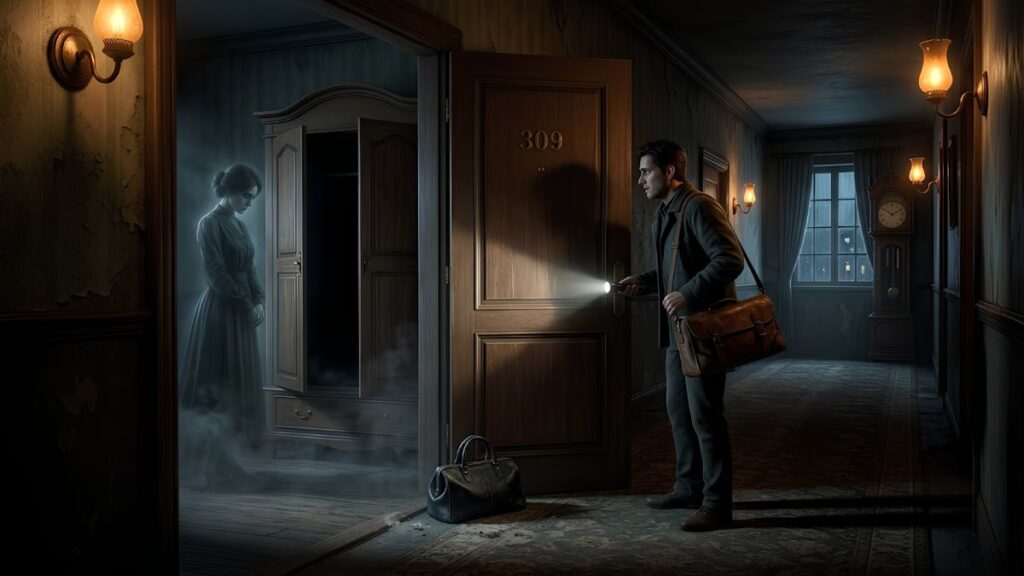
The first thing Daniel noticed about the Blackwood Hotel was the silence.
It was strange because the hotel stood in the center of a busy city.
Cars moved constantly along the street outside. People hurried past the entrance. Taxis stopped at the curb.
Yet the moment Daniel stepped through the revolving glass doors, everything became quiet.
Not peaceful.
Quiet.
As though the building were holding its breath.
Daniel checked his phone.
11:48 p.m.
He had been traveling for almost twelve hours.
His flight had been delayed, his luggage had been misplaced for two hours, and the taxi driver had taken the wrong road twice.
All he wanted was a shower and a few hours of sleep before his morning meeting.
The receptionist looked up when Daniel approached the desk.
She was a woman in her fifties with pale skin and tired eyes.
“Good evening,” Daniel said. “I have a reservation.”
She typed something into the computer.
“Name?”
“Daniel Carter.”
Her fingers stopped.
For a moment, she simply stared at the screen.
Then she looked at Daniel.
“Room 309.”
Daniel smiled.
“Yes.”
The receptionist looked uncomfortable.
“Are you sure?”
Daniel laughed.
“I think so. I booked online.”
She checked the reservation again.
“Yes.”
She picked up a key card.
Then she hesitated.
“Mr. Carter, if you need anything tonight, please call reception.”
“Of course.”
She handed him the key.
“Especially if you hear knocking.”
Daniel smiled awkwardly.
“Knocking?”
The receptionist’s expression remained serious.
“Old building.”
She looked away.
Daniel took the elevator.
The doors opened on the third floor.
The hallway was long and narrow.
There were only a few lights, and several of them flickered.
Room 309 was at the very end.
Daniel unlocked the door.
The room was surprisingly large.
A king-size bed stood against one wall.
There was a desk near the window.
An old wardrobe stood beside the bathroom.
The room smelled faintly of dust and lavender.
Daniel dropped his suitcase.
He took a shower.
Then he changed into comfortable clothes and climbed into bed.
For the first time that day, he felt relaxed.
Until he heard the knocking.
Three soft knocks.
Knock.
Knock.
Knock.
Daniel opened his eyes.
He looked toward the door.
Nothing.
He checked the time.
3:09 a.m.
He waited.
Three more knocks.
This time, they came from the wardrobe.
Daniel sat up.
His heart began beating faster.
He stared at the wardrobe.
The knocking came again.
Knock.
Knock.
Knock.
Daniel slowly got out of bed.
He walked toward it.
The wardrobe doors were closed.
He stood in front of them.
“Hello?”
Silence.
He opened the left door.
Empty.
The right door.
Empty.
Daniel laughed nervously.
“Very funny.”
He returned to bed.
The knocking came again.
This time, a voice accompanied it.
“Please.”
Daniel froze.
A woman’s voice.
Soft.
Barely audible.
“Please don’t leave me here.”
Daniel looked at the wardrobe.
His mouth went dry.
He opened it again.
Nothing.
The voice came from inside.
“Please.”
Daniel stepped backward.
He grabbed his phone.
No signal.
He walked toward the room’s telephone.
Before he could pick it up, the voice whispered:
“Don’t call them.”
Daniel stopped.
“Who are you?”
Silence.
Then:
“They don’t remember me.”
Daniel stared at the wardrobe.
“What do you mean?”
The voice answered:
“I’ve been here for twenty years.”
Daniel ran to the door.
He tried the handle.
Locked.
He swiped the key card.
Red light.
He tried again.
Red.
His heart raced.
He looked toward the telephone.
He picked it up.
No dial tone.
The woman’s voice whispered again.
“Please.”
Daniel backed away.
Then suddenly the wardrobe doors opened.
Nothing was inside.
But the back wall of the wardrobe had changed.
There was a narrow doorway.
Daniel stared.
He knew that doorway hadn’t been there before.
He stepped closer.
Cold air came through the opening.
Beyond it was darkness.
Daniel turned toward the room door.
Then back toward the wardrobe.
He should have left.
Instead, curiosity won.
He stepped through.
The passage was narrow.
Old wallpaper covered the walls.
The hotel seemed to disappear behind him.
He walked several meters.
Then he reached another door.
A brass number was attached to it.
309.
Daniel stared.
He opened the door.
He stepped into another hotel room.
It was identical to the room he had just left.
Same bed.
Same desk.
Same wardrobe.
But everything looked older.
Dust covered the floor.
The wallpaper was yellow.
An old television sat on the desk.
Daniel noticed a newspaper lying on the bed.
He picked it up.
The headline made his stomach drop.
WOMAN DISAPPEARS FROM BLACKWOOD HOTEL
The article was dated twenty years earlier.
Daniel read quickly.
A young woman named Anna Miller had checked into Room 309.
She had been traveling alone.
At 3:09 a.m., another guest reported hearing a woman screaming.
When hotel staff entered the room, Anna was gone.
The police found no evidence of an intruder.
No broken windows.
No forced door.
No trace of her.
She had simply disappeared.
Daniel looked toward the wardrobe.
The woman’s voice whispered:
“I’m still here.”
He dropped the newspaper.
“Anna?”
“Yes.”
“What happened?”
“I opened the door.”
“What door?”
“The wrong one.”
Daniel stepped backward.
“What does that mean?”
“I thought someone was outside.”
“Who?”
“I don’t remember.”
Daniel looked around the room.
“Where are you?”
A soft laugh came from behind him.
Daniel turned.
Anna was standing near the window.
She looked about twenty-five.
Her hair was wet.
Her clothes were old-fashioned.
Her face was pale.
But she looked human.
Daniel stared.
“You’re dead?”
Anna shook her head.
“No.”
“Then where have you been?”
“Here.”
“For twenty years?”
“Yes.”
“How?”
She looked toward the wall.
“I don’t know.”
Daniel stepped closer.
“Can I help you?”
Anna smiled sadly.
“You already did.”
“What?”
“You came.”
Daniel didn’t understand.
Then the lights flickered.
Anna disappeared.
Daniel heard footsteps in the hallway.
Someone was approaching.
He ran toward the doorway.
But the passage was gone.
There was only a wall.
Daniel began pounding on it.
“Anna!”
No answer.
The room door opened.
A man in an old hotel uniform entered.
He looked at Daniel.
“You shouldn’t be here.”
Daniel stepped backward.
“Who are you?”
The man didn’t answer.
Instead, he looked at the clock.
3:09.
Then he smiled.
“You’re early.”
Daniel ran.
He pushed past the man.
The hallway appeared again.
He ran toward the original room.
He opened the door.
His suitcase was still beside the bed.
His phone was on the nightstand.
He grabbed it.
The time was 3:09 a.m.
Exactly.
Daniel looked toward the wardrobe.
It was closed.
He ran to the room door.
This time, it opened.
He rushed downstairs.
The receptionist was sitting behind the desk.
Daniel placed the key card on the counter.
“I need to leave.”
She looked at him.
“Did you hear the knocking?”
Daniel stared at her.
“Yes.”
The receptionist closed her eyes.
“Then you opened the wardrobe.”
“Yes.”
Her face became pale.
“You shouldn’t have.”
“Why?”
She looked toward the hotel entrance.
“Because now it knows you’re here.”
Daniel felt a cold sensation move through his body.
“What knows?”
The receptionist didn’t answer.
Daniel pointed toward the hallway.
“Who was the man?”
“What man?”
“The hotel employee.”
She shook her head.
“There is no night employee.”
Daniel stared at her.
“He was wearing a uniform.”
The receptionist stood.
“Mr. Carter, you need to leave.”
“I agree.”
She walked toward the entrance.
Daniel followed.
They stepped outside.
The city was still moving.
Cars.
People.
Lights.
Everything looked normal.
Daniel exhaled.
He was safe.
Then the receptionist grabbed his arm.
“Don’t look back.”
Daniel froze.
“Why?”
“Because if you look back, you’ll see the hotel the way it really is.”
Daniel stared ahead.
“What does that mean?”
The receptionist whispered:
“Please don’t.”
Daniel couldn’t resist.
He turned.
The Blackwood Hotel was gone.
In its place stood a burned, abandoned building.
Broken windows.
Blackened walls.
Collapsed sections of roof.
Daniel stared.
The receptionist was no longer beside him.
He turned around.
She had disappeared.
Daniel stumbled backward.
A newspaper blew across the street.
He picked it up.
The headline read:
BLACKWOOD HOTEL DESTROYED BY FIRE — 20 YEARS AGO
Daniel looked toward the building.
A single window on the third floor was illuminated.
Room 309.
A woman’s silhouette stood behind the glass.
Anna.
Daniel’s phone rang.
Unknown number.
He answered.
A woman’s voice whispered:
“You shouldn’t have left.”
The call ended.
Daniel ran.
He did not stop until he reached a busy street.
He entered a restaurant filled with people.
He sat at the nearest table.
He ordered coffee.
His hands were shaking.
He tried to explain what had happened to himself.
Exhaustion.
Stress.
A nightmare.
Anything.
Then he noticed something on his hand.
A hotel key.
Room 309.
He threw it onto the table.
The key disappeared.
The waiter approached.
“Sir?”
Daniel looked up.
“Can I help you?”
The waiter stared at him strangely.
“Are you okay?”
Daniel nodded.
“Yes.”
The waiter placed a glass of water on the table.
“You were talking to someone.”
Daniel looked toward the chair opposite him.
It was empty.
“Who?”
The waiter pointed.
“The woman.”
Daniel’s blood went cold.
“What woman?”
The waiter looked confused.
“She was sitting there.”
Daniel looked at the empty chair.
On the table was a black handbag.
Old.
Wet.
Daniel slowly reached for it.
Inside was a photograph.
A young woman stood outside the Blackwood Hotel.
Anna.
Beside her stood a man.
Daniel recognized him.
It was the hotel employee.
But there was something written on the back.
Daniel turned it over.
He was my husband.
Daniel stared at the photograph.
The waiter asked:
“Sir?”
Daniel looked up.
“What?”
“You need to leave.”
“Why?”
The waiter pointed toward the restaurant window.
Daniel looked outside.
Across the street stood the Blackwood Hotel.
Perfectly restored.
Lights glowing.
People entering through the doors.
Daniel felt sick.
The hotel was not abandoned.
It was alive.
And the entrance doors were opening.
A woman stood inside.
Anna.
She raised her hand.
She was waving.
Daniel ran outside.
He didn’t know why.
Perhaps he wanted answers.
Perhaps he wanted to help her.
Perhaps the hotel had already begun pulling him back.
He crossed the street.
The doors opened.
The receptionist was waiting.
“Welcome back, Mr. Carter.”
Daniel stopped.
“I’ve never been here before.”
She smiled.
“Yes, you have.”
She handed him a key.
Room 309.
Daniel looked at it.
“What happens if I go upstairs?”
The receptionist whispered:
“You’ll remember.”
Daniel took the key.
He entered the elevator.
The doors closed.
The elevator began rising.
First floor.
Second.
Third.
Then it stopped.
The doors opened.
Room 309 stood at the end of the hallway.
Daniel walked toward it.
The door was already open.
Inside, Anna was waiting.
She smiled.
“You came back.”
Daniel stared at her.
“Why did you bring me here?”
“I didn’t.”
“Then who did?”
Anna looked behind him.
Daniel turned.
The hotel employee stood in the hallway.
He smiled.
“You did.”
Daniel felt dizzy.
“What?”
The man stepped closer.
“You’ve been coming here for twenty years.”
Daniel shook his head.
“No.”
The man pointed toward the room.
“Look.”
Daniel entered.
The walls were covered with photographs.
Dozens.
Hundreds.
All of Daniel.
Walking into the hotel.
Sleeping in Room 309.
Speaking to Anna.
Leaving.
Returning.
Over and over.
Daniel couldn’t breathe.
Anna whispered:
“You never stayed here for one night.”
Daniel stared at the photographs.
“You stayed for twenty years.”
The truth came back.
The first night.
The train.
The hotel.
The room.
The door.
He had died.
Not in a hotel.
On the road outside.
His taxi had crashed while taking him to the hotel.
His body had never arrived.
But his mind had.
And every night, he returned to Room 309.
Searching for someone.
Searching for Anna.
Searching for the reason he could never leave.
Anna stepped beside him.
“You were the last passenger.”
Daniel looked at her.
“What does that mean?”
She smiled.
“You were the last person I was waiting for.”
The room became silent.
The clock changed to 3:10.
For the first time in twenty years, it moved forward.
Daniel looked at the clock.
Anna smiled.
“You can go now.”
The hotel employee disappeared.
The walls began fading.
The room became bright.
Daniel heard a distant sound.
Rain.
Then a car horn.
Then silence.
He opened his eyes.
He was standing outside the hotel.
Morning sunlight filled the street.
The Blackwood Hotel was gone.
Only an empty lot remained.
Daniel looked down.
The key to Room 309 was in his hand.
Then it dissolved into dust.
He smiled.
For the first time, he felt free.
But years later, a new hotel was built on that same land.
The building was modern.
Bright.
Full of guests.
There was no Room 309.
The rooms were numbered differently.
But on the third floor, there was a locked maintenance room.
Hotel staff occasionally reported hearing knocking from inside.
Three knocks.
Always at 3:09 a.m.
And sometimes, when a new guest stayed alone, they heard a woman’s voice whisper from somewhere inside the walls:
“Please don’t leave me here.”
If they opened the door, they found an old black handbag.
Inside was always the same photograph.
Anna standing outside the hotel.
And beside her stood a man nobody recognized.
A man named Daniel.
Twist: He is not a guest visiting the hotel for the first time. He is the missing woman’s son, returning repeatedly without remembering that he has been searching for her for decades.
6. The Man in the Window
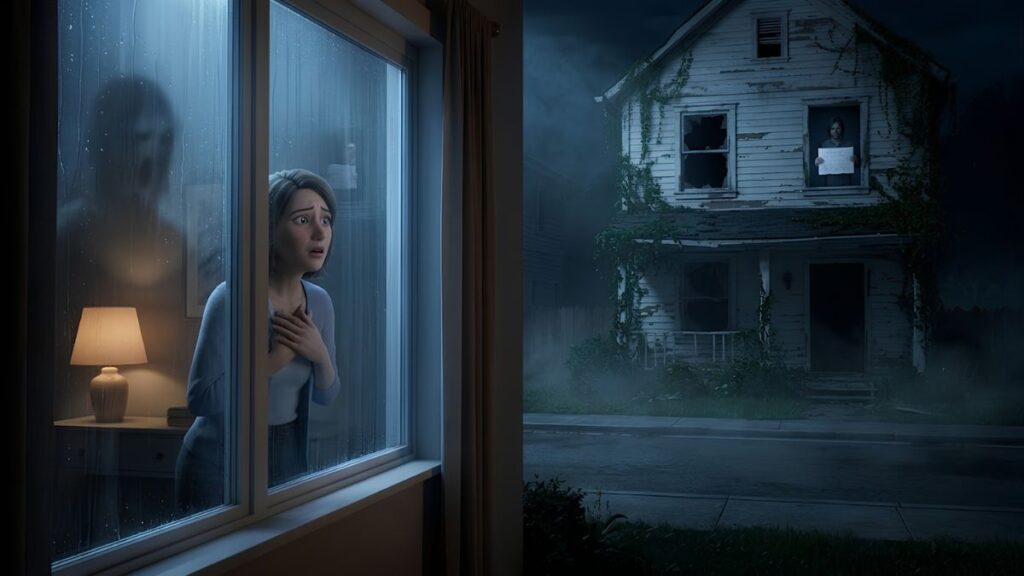
Emily first saw the man on a Monday evening.
She was standing in her kitchen, washing a coffee cup, when she noticed movement across the street.
The house opposite hers had been empty for as long as she could remember.
It was an old two-story building with faded white paint, boarded windows, and a garden that had slowly disappeared beneath weeds.
No one had lived there for years.
Yet someone was standing in an upstairs window.
A man.
Emily stopped washing the cup.
He stood completely still.
His face was difficult to see through the dirty glass, but she could tell he was looking directly at her.
She wiped her hands and moved closer to the window.
The man raised one hand.
He waved.
Emily stepped backward.
She looked at the house number.
She knew that house.
Everyone in the neighborhood did.
It had been abandoned after the previous owner disappeared.
Emily had never heard the full story.
Her neighbor once told her that police had searched the house for several weeks.
Another neighbor claimed the owner had gone mad.
Someone else said the house had been empty since a woman died there.
Emily had never cared enough to find out.
Until now.
She looked back at the upstairs window.
The man was gone.
Emily exhaled.
She returned to washing the cup.
She told herself she had probably seen a reflection.
That night, she closed all the curtains.
She slept badly.
At 2:00 a.m., she woke suddenly.
She had the strange feeling that someone was watching her.
Emily sat up.
The bedroom was dark.
She looked toward the window.
The curtains were closed.
She switched on the lamp.
Nothing.
She went back to sleep.
The following evening, she saw the man again.
Same window.
Same position.
This time, he was holding something.
A sheet of paper.
Emily stared at him.
He raised it against the glass.
There were large handwritten words.
Emily could not read them from across the street.
She went to the window.
The man pointed at the paper.
Emily opened her curtains farther.
He held it higher.
She still couldn’t see.
She took a pair of binoculars from a drawer.
She had bought them years earlier for watching birds.
She lifted them.
The paper came into focus.
Three words were written on it.
LOOK BEHIND YOU.
Emily’s stomach dropped.
She turned.
Nothing.
The kitchen was empty.
She looked back across the street.
The man was gone.
Emily checked every room.
Closets.
Bathroom.
Basement.
Nothing.
She locked the doors.
Then she called the police.
An officer arrived twenty minutes later.
Emily pointed toward the abandoned house.
“There was a man in that window.”
The officer looked through the binoculars.
“Are you sure?”
“Yes.”
“Did you know the house was empty?”
“Yes.”
The officer crossed the street.
Emily watched from her window.
He entered through the front door.
Several minutes passed.
Then he returned.
He looked confused.
“There was nobody inside.”
Emily frowned.
“He was upstairs.”
“I checked.”
“Maybe he left through another entrance.”
The officer shook his head.
“There isn’t one.”
He looked toward the house.
“Are you sure you saw a person?”
Emily didn’t answer.
The officer gave her a concerned look.
“Try to get some rest.”
He left.
Emily closed the curtains.
She did not look across the street again that night.
The next morning, she found a photograph beneath her front door.
It showed her standing in the kitchen.
The photograph had been taken from across the street.
Emily’s blood ran cold.
She looked toward the abandoned house.
The upstairs window was empty.
She called the police again.
This time, two officers searched the house.
They found nothing.
No camera.
No photographs.
No evidence anyone had been living there.
One officer suggested that someone might have taken the photograph from a nearby building.
Emily knew that was impossible.
The angle was wrong.
The photograph had clearly been taken from the upstairs window.
That evening, Emily kept every light in her house turned on.
At 11:30 p.m., she finally decided to sleep.
Then came a knock.
Not at the front door.
At the kitchen window.
Emily froze.
Another knock.
She slowly turned.
The man was standing outside the glass.
Emily screamed.
He stood on the other side of the window, but there was no way he could be there.
The kitchen was on the second floor.
He raised a piece of paper.
Emily stepped closer despite herself.
The paper said:
HE IS IN YOUR HOUSE.
Emily turned.
Nothing.
She looked back.
The man pointed toward the hallway.
Emily grabbed a kitchen knife.
She walked slowly through the house.
“Who’s there?”
No answer.
She checked the living room.
Empty.
The bathroom.
Empty.
Bedroom.
Empty.
Then she heard a sound from downstairs.
A floorboard creaking.
Emily stopped.
Another creak.
Someone was climbing the stairs.
She backed into the bedroom.
The footsteps continued.
One step.
Two.
Three.
Emily held the knife tightly.
A shadow appeared beneath the bedroom door.
She raised the knife.
The handle turned.
The door opened.
Emily screamed.
It was the police officer from the previous night.
“Emily!”
She nearly collapsed.
“What are you doing here?”
He lowered his hands.
“We received a call.”
“I didn’t call you.”
He looked confused.
“Your neighbor did.”
Emily stared at him.
“My neighbor?”
He nodded.
“The man across the street.”
Emily looked toward the window.
The abandoned house stood in darkness.
The officer followed her gaze.
“What man?”
Emily pointed.
“He’s there.”
The officer looked.
His face changed.
“There is someone in the window.”
Emily nodded.
“Yes.”
The officer immediately drew his weapon.
“Stay here.”
He left the bedroom.
Emily heard him running downstairs.
Then silence.
A minute later, the front door slammed.
Emily looked through the bedroom window.
The officer was crossing the street.
He entered the abandoned house.
Emily watched.
Several minutes passed.
Then the lights in the abandoned house came on.
One by one.
Ground floor.
Second floor.
Third room.
Then the upstairs window.
The man appeared.
Emily lifted the binoculars.
He was holding another piece of paper.
She read it.
HE FOUND ME.
Then the man pointed downward.
Emily looked toward the street.
The police officer was standing outside the house.
He was staring directly at her.
Emily lowered the binoculars.
Something was wrong.
The officer slowly raised one hand.
He waved.
Exactly as the man had done.
Emily stepped away from the window.
Her phone rang.
Unknown number.
She answered.
The officer’s voice whispered:
“Don’t let me see you.”
Emily’s blood ran cold.
“But you’re outside.”
“No.”
She heard breathing.
“I’m upstairs.”
Emily looked toward the bedroom door.
Someone was standing in the hallway.
She couldn’t see the face.
“Who are you?”
The voice on the phone whispered:
“I’m trying to stop him.”
“Stop who?”
A pause.
Then:
“You.”
Emily dropped the phone.
The figure in the hallway stepped closer.
Emily ran.
She locked herself in the bathroom.
The figure stopped outside.
“Emily.”
It was her own voice.
She covered her mouth.
The voice continued.
“You need to remember.”
Emily looked into the mirror.
Her reflection was smiling.
Emily wasn’t.
The reflection raised its hand.
Emily stepped backward.
The reflection wrote something on the mirror with its finger.
LOOK OUTSIDE.
Emily turned toward the window.
Across the street, the man was standing in the abandoned house.
He was no longer holding a paper.
He was pointing toward her.
Emily looked closer.
The man was crying.
Then she understood.
He wasn’t trying to frighten her.
He was trying to warn her.
Emily wiped the condensation from the glass.
The man held up another message.
I AM YOU.
Emily stared.
The man slowly removed his jacket.
He had the same scar on his left wrist.
The same scar Emily had.
He turned sideways.
Same face.
Older.
Much older.
Emily backed away from the window.
“No.”
Her phone rang again.
She answered.
Her own voice came through.
“Emily, listen.”
She was shaking.
“Who are you?”
“I am what happens if you open the front door.”
Emily couldn’t breathe.
“What?”
“Don’t leave the house.”
“What is happening?”
“I don’t have much time.”
“Tell me!”
The voice became desperate.
“Tomorrow morning, you’ll remember the house.”
Emily looked toward the abandoned building.
“What house?”
“The house you lived in before.”
“I’ve never lived there.”
“You have.”
Emily shook her head.
“No.”
“You were eight years old.”
A memory flashed.
A garden.
A swing.
A little boy.
A woman screaming.
A window.
Fire.
Emily grabbed the sink.
She remembered.
Her family had lived in that house.
There had been an accident.
Her parents died.
Emily survived.
But she had been sent away.
The memories had been suppressed.
The man across the street was her brother.
She had believed he died that night.
But he had survived too.
She looked at him.
He was holding a photograph.
Emily recognized it.
Two children standing in front of the house.
Emily and her brother.
She had forgotten his face.
He hadn’t.
He had spent years trying to contact her.
But why had he never simply approached her?
The answer came through the phone.
“He isn’t your brother.”
Emily froze.
“What?”
Her older voice whispered:
“That’s what he wants you to believe.”
The man across the street pressed his hand against the glass.
His face changed.
For a moment, he looked like Emily’s brother.
Then his features shifted.
The skin became gray.
The eyes turned black.
The smile became impossibly wide.
Emily screamed.
The voice on the phone said:
“Now you understand.”
The creature raised another photograph.
It showed Emily sleeping.
Then another.
Emily in the shower.
Another.
Emily eating breakfast.
Another.
Emily standing at the window.
The creature had been watching her for years.
The voice whispered:
“It lives in the house.”
Emily looked toward the abandoned building.
“Then what are you?”
Silence.
The voice answered:
“The reason it hasn’t reached you yet.”
Emily stared at the man.
He was no longer smiling.
He was pointing toward the front door of her house.
Someone was standing there.
Emily heard the doorbell.
Once.
Twice.
Then three times.
She didn’t move.
The voice on the phone whispered:
“Don’t answer.”
Emily looked through the peephole.
The police officer stood outside.
“Emily!”
She stepped away.
The officer knocked.
“Open the door.”
Emily didn’t move.
He knocked harder.
“I know you’re inside.”
The voice on the phone said:
“That’s not the officer.”
The thing outside began laughing.
Its voice changed.
It became Emily’s mother’s voice.
“Sweetheart, open the door.”
Emily began crying.
Her mother had been dead for twenty-five years.
The thing outside continued.
“It’s me.”
Emily covered her ears.
The voice changed again.
Her father’s voice.
Then her brother’s.
Then Daniel’s voice.
Then her own.
“Emily.”
The lights went out.
The phone went dead.
Silence.
Emily stood in darkness.
Then she heard the window open.
She turned.
The man from the abandoned house was standing inside her bedroom.
Emily screamed.
He raised both hands.
“I’m not here to hurt you.”
“Who are you?”
He looked exhausted.
“My name is David.”
“My brother?”
“Yes.”
Emily stared.
“How?”
“I’ve been trying to reach you.”
“Why?”
“Because it found us that night.”
“What is it?”
David looked toward the hallway.
“It lives between houses.”
Emily didn’t understand.
“It copies people.”
He pointed toward the abandoned house.
“That house isn’t abandoned.”
“What is it?”
“A trap.”
“For who?”
“For people who remember.”
Emily looked at him.
“What happens if I remember everything?”
David’s expression changed.
“You stop being yourself.”
A noise came from the hallway.
David grabbed Emily’s hand.
“We have to go.”
They ran toward the back door.
The house began changing around them.
Walls stretched.
Doors appeared where there had been none.
Photographs covered the walls.
Every photograph showed Emily.
At different ages.
Different moments.
Different lives.
David pulled her through the kitchen.
They reached the back door.
It opened.
Outside was the abandoned house.
Emily stopped.
There was no street.
No neighboring houses.
Only the old house.
David whispered:
“We’re inside it.”
The front door of the abandoned house opened.
A figure stood inside.
Emily’s mother.
She smiled.
“Come home.”
Emily began crying.
David pulled her backward.
“Don’t listen.”
Her mother stepped forward.
“You’ve been away long enough.”
Emily stared.
She wanted to believe her.
Then she noticed something.
Her mother’s reflection in the window was not moving.
Emily understood.
She closed her eyes.
“I don’t remember you.”
The figure screamed.
The house shook.
Windows shattered.
David grabbed her.
“Run!”
They ran.
The darkness broke apart.
Emily opened her eyes.
She was standing in her kitchen.
Morning sunlight filled the room.
David stood beside her.
The abandoned house across the street was gone.
In its place was an empty field.
Police cars surrounded the area.
An officer approached.
“Are you Emily?”
She nodded.
He looked confused.
“Do you know who this man is?”
Emily turned.
David was gone.
The officer showed her a photograph.
It showed a family.
Two children.
Emily.
And her brother.
The officer pointed to the boy.
“Your brother died twenty-five years ago.”
Emily stared at the photograph.
“No.”
The officer nodded.
“He was killed in the fire.”
Emily looked across the street.
The empty field was silent.
Then she noticed something.
A window.
Standing alone in the middle of the field.
No wall.
No house.
Just a window.
Behind it stood the man.
David.
He raised one hand.
He waved.
Emily raised hers.
Then the window disappeared.
Years passed.
Emily moved away.
She never saw the house again.
She never heard the voice.
She never told anyone the full story.
But she kept one photograph.
The old photograph of two children.
Sometimes, late at night, she would look at it.
And every time she did, she noticed something different.
At first, there were two children.
Then three.
Then four.
Then five.
One night, Emily noticed a man standing behind them.
He looked exactly like her.
Older.
Tired.
Afraid.
On the back of the photograph were four words:
Don’t look behind you.
Emily smiled sadly.
Then she heard a knock.
Not at the door.
At the window.
Three soft knocks.
She slowly turned.
A man stood outside.
He looked exactly like her.
And he was holding a piece of paper.
Emily already knew what it said.
LOOK BEHIND YOU.
She closed her eyes.
And this time, she didn’t turn around.
Twist: The man in the window was never watching Emily. He was trying to warn her about herself. The photographs reveal that Emily has been entering the abandoned house every night while sleepwalking, and something inside the house has been gradually replacing her memories.
7. The Call From Tomorrow
David received the first call at exactly midnight.
He was sitting alone in his apartment, watching an old movie while rain tapped against the windows.
His phone vibrated on the coffee table.
Incoming Call: David
He frowned.
His own number was calling him.
For a few seconds, he simply stared at the screen.
Then he answered.
“Hello?”
There was silence.
David checked the screen.
The call was still connected.
“Who is this?”
A man’s voice finally spoke.
David stopped breathing.
It was his own voice.
“David, listen carefully.”
David stood.
“Who are you?”
“I’m you.”
David laughed nervously.
“Very funny.”
“I’m calling from tomorrow.”
The smile disappeared from David’s face.
“What?”
“Tomorrow night. Don’t answer the door.”
The line went silent.
David looked at the clock.
12:01 a.m.
“Why?”
No answer.
“Why shouldn’t I answer the door?”
The call ended.
David stared at his phone.
He checked the number.
It was his own number.
He tried calling it.
The call went directly to voicemail.
He didn’t sleep much that night.
The next morning, he convinced himself it had been some kind of prank.
Perhaps someone had spoofed his number.
Perhaps an app had malfunctioned.
Perhaps he had dreamed part of it.
By lunchtime, the incident already seemed ridiculous.
He went to work.
He met his friends.
He answered emails.
He lived an ordinary day.
At 11:58 p.m., he remembered the call.
He laughed.
“Don’t answer the door.”
He said the words aloud.
Nothing happened.
12:00 a.m.
His phone rang.
David.
He froze.
He answered.
“Hello?”
His own voice spoke.
“Did you listen?”
David swallowed.
“Yes.”
“Good.”
“Who are you?”
“You know who I am.”
“What happens tomorrow?”
A pause.
“Someone comes to your door.”
“Who?”
“Don’t ask.”
David stood.
“Why?”
“Because if you know who it is, you’ll open the door.”
The call ended.
David looked toward his apartment door.
For the first time, he noticed how thin it was.
Anyone could knock.
Anyone could stand outside.
He checked the locks.
Then he checked them again.
The next day, David told his best friend, Mark, about the calls.
Mark laughed.
“You’re being scammed.”
“They’re calling from my number.”
“That’s easy to fake.”
“It sounds exactly like me.”
“Maybe you recorded yourself.”
David didn’t smile.
“I heard everything.”
Mark shook his head.
“Then don’t answer the door tomorrow.”
David looked at him.
“That’s what the call said.”
Mark laughed.
“See? Problem solved.”
The next night arrived.
David ordered food.
He canceled plans.
He stayed inside.
At 11:50 p.m., he turned off the television.
The apartment was silent.
He watched the clock.
11:59.
12:00.
Nothing.
He smiled.
Maybe it was over.
Then came the knock.
Three times.
Knock.
Knock.
Knock.
David stopped breathing.
He moved toward the door.
Then remembered the warning.
He looked through the peephole.
Mark stood outside.
David frowned.
Mark raised his hand.
“David, open the door.”
David didn’t move.
“Mark?”
“Yeah.”
“What are you doing here?”
“I need to talk to you.”
“About what?”
Mark looked nervous.
“Just open the door.”
David stepped backward.
His phone rang.
David.
He answered.
His own voice whispered:
“Don’t open it.”
David stared at the door.
“It’s Mark.”
“No.”
“It is.”
“No, David. It’s not.”
The person outside knocked again.
“David!”
The voice sounded exactly like Mark.
The phone voice continued.
“Listen to me.”
“What is happening?”
“Whatever you do, don’t let him see you.”
David whispered:
“Why?”
“Because he remembers your face.”
The call ended.
David stood frozen.
The knocking stopped.
Then Mark spoke.
“David?”
No response.
“I know you’re there.”
David moved away from the door.
Mark’s voice changed.
It became deeper.
“You should have answered.”
David’s phone rang again.
He answered.
“Tell me what’s happening.”
His own voice sounded frightened.
“I don’t have much time.”
“Who is outside?”
“Something that looks like Mark.”
“What does it want?”
“You.”
“Why?”
“Because you called me.”
David stared at the phone.
“What?”
“You called me first.”
David shook his head.
“No, you called me.”
Silence.
Then:
“No.”
The voice sounded confused.
“You called me tomorrow.”
David’s blood went cold.
“What?”
The line went dead.
The person outside stopped knocking.
David waited.
Minutes passed.
Nothing.
Eventually, he fell asleep on the sofa.
When he woke, sunlight was entering through the curtains.
The door was still locked.
No one was outside.
His phone showed no missed calls.
David felt relieved.
Then he saw the message.
FROM: DAVID
We need to talk.
He opened it.
There was a photograph attached.
David clicked it.
His bedroom appeared in the photograph.
Someone had taken the picture from inside his apartment.
The timestamp was today’s date.
But the photograph showed David sleeping on the sofa.
He dropped the phone.
Someone had been inside.
David searched the apartment.
Every room.
Nothing.
He called Mark.
No answer.
He tried again.
Still nothing.
He drove to Mark’s apartment.
The building manager told him Mark hadn’t come home.
David became worried.
He called the police.
An officer took his statement.
“Have you had problems with anyone recently?”
“No.”
“Any threats?”
“No.”
“Could your friend be involved?”
“I don’t know.”
The officer looked at the photograph.
“Where was this taken?”
“My apartment.”
“Who took it?”
“I don’t know.”
The officer studied the image.
Then looked at David.
“Have you checked the metadata?”
“No.”
The officer examined the file.
His expression changed.
“What?”
“The photograph was taken tomorrow.”
David stared at him.
“That isn’t possible.”
The officer turned the phone toward him.
The timestamp was one day ahead.
David felt sick.
The officer asked:
“Do you have a calendar?”
David checked.
The date on his wall calendar was today.
The photograph said tomorrow.
The officer slowly stood.
“Mr. Carter, I think you should stay somewhere else tonight.”
David nodded.
He went to a hotel.
He checked into a room on the fifth floor.
He turned off his phone.
He didn’t want to hear his own voice again.
At midnight, the room telephone rang.
David stared at it.
The ringing continued.
He didn’t answer.
His mobile phone began ringing.
David.
He turned it face down.
The ringing stopped.
Then a voice came from the bathroom.
“David.”
He froze.
The bathroom door was closed.
“David.”
It was his voice.
He backed toward the hotel room door.
The bathroom handle moved.
David ran.
He opened the hotel door.
The hallway was empty.
He sprinted toward the elevator.
The doors opened.
He entered.
As they closed, he saw someone standing at the far end of the hallway.
It was him.
David pressed the button repeatedly.
The elevator descended.
When the doors opened on the ground floor, he ran outside.
Rain was falling.
He called Mark again.
This time, someone answered.
“Hello?”
David stopped.
“Mark?”
“Yes.”
“Where are you?”
A pause.
“At home.”
David looked toward the hotel.
“What happened?”
“I don’t know what you’re talking about.”
“You came to my apartment.”
“No.”
“You knocked on my door.”
“I haven’t seen you in three days.”
David felt dizzy.
“Three days?”
“Yes.”
David checked his phone.
The date had changed.
Three days had passed.
He had no memory of them.
He returned to his apartment.
Everything looked normal.
His television was on.
A cup of coffee sat on the table.
His jacket hung by the door.
And there was a note on the floor.
He picked it up.
It was written in his handwriting.
Don’t trust Mark.
David called him.
Mark arrived twenty minutes later.
He looked worried.
“You look terrible.”
David showed him the note.
Mark read it.
“That’s your handwriting.”
“I know.”
“What happened?”
David told him everything.
Mark listened.
Then he said:
“Maybe you should sleep.”
David shook his head.
“No.”
“Why?”
“Because I think the calls are real.”
Mark looked toward the hallway.
“Maybe.”
David stared at him.
“What?”
Mark’s expression changed.
“I’ve heard them too.”
David’s heart stopped.
“What?”
“Your voice.”
“When?”
“Three days ago.”
“What did it say?”
Mark looked frightened.
“It told me not to trust you.”
Silence.
David stepped backward.
“What did you do?”
“I ignored it.”
“Why?”
“Because I thought it was a prank.”
David looked at the clock.
11:58 p.m.
His phone began vibrating.
David.
Mark stared at the screen.
“Answer it.”
David shook his head.
“No.”
“Why?”
“Because the call always comes at midnight.”
The clock changed.
12:00.
The phone stopped vibrating.
Then the apartment door knocked.
Three times.
Knock.
Knock.
Knock.
Mark looked at David.
“Don’t open it.”
David nodded.
The knocking came again.
Then a voice.
David’s voice.
“David.”
Mark whispered:
“What is that?”
David didn’t answer.
The voice outside continued.
“Open the door.”
David stepped backward.
His phone rang.
He answered.
His own voice said:
“Now you understand.”
David whispered:
“Who are you?”
“I told you.”
“You’re me.”
“Yes.”
“From tomorrow?”
“Yes.”
David looked at Mark.
“Why are you calling me?”
“Because tomorrow, you open the door.”
“I won’t.”
“You will.”
“Why?”
“Because you think Mark is outside.”
David looked at Mark.
Mark’s face went pale.
“What?”
The phone voice continued.
“You think you’re protecting yourself.”
David whispered:
“What happens if I don’t open it?”
A long silence.
Then:
“Then we never meet.”
David frowned.
“What does that mean?”
“You don’t understand.”
The voice became desperate.
“You need to open the door.”
David stared at the door.
“No.”
“David.”
“No.”
“You have to.”
“Why?”
“Because I’m outside.”
David froze.
The phone voice continued.
“I’m standing outside your door.”
David slowly turned toward the entrance.
Mark whispered:
“Don’t.”
The knocking started.
Three times.
David looked through the peephole.
A man stood outside.
It was David.
Older.
His face was covered in cuts.
His clothes were soaked.
He looked exhausted.
He raised his hand.
“Open the door.”
David stepped backward.
The phone voice whispered:
“That’s me.”
David looked at Mark.
“It’s you from tomorrow.”
Mark shook his head.
“No.”
The older David outside smiled.
Then he said:
“Mark isn’t who you think he is.”
David looked at Mark.
Mark stepped backward.
“Don’t listen to him.”
The older David shouted:
“He killed me!”
David’s heart pounded.
Mark stared at the door.
The older David continued:
“He’s been doing this for years.”
Mark whispered:
“David, don’t open the door.”
The phone rang.
David answered.
His own voice whispered:
“Don’t trust him.”
David looked between the door and Mark.
“What happened tomorrow?”
The voice said:
“Mark opens the door.”
David frowned.
“Which door?”
Silence.
“The apartment door?”
“No.”
“The hotel door?”
“No.”
“Then what?”
The voice became almost inaudible.
“Your front door.”
David looked at Mark.
“Why?”
“Because I wasn’t calling you.”
David’s stomach tightened.
“What?”
“You were.”
The call ended.
David stared at the phone.
Then he understood.
The calls had never been coming from tomorrow.
They had been coming from inside the house.
He looked toward the hallway.
The bathroom door was slightly open.
Mark noticed.
“What’s wrong?”
David whispered:
“The first call.”
“What about it?”
“I was sitting in the living room.”
“Yes.”
“Who was in the bathroom?”
Mark didn’t answer.
The bathroom door slowly opened.
A man stepped out.
It was David.
But not the David outside.
This one looked exactly like him.
Same age.
Same clothes.
Same face.
Mark screamed.
David backed away.
The figure smiled.
“You finally figured it out.”
David couldn’t speak.
The figure looked at Mark.
“You too.”
Mark ran toward the door.
The figure grabbed him.
David tried to stop it.
The room went dark.
When the lights returned, Mark was gone.
The front door was open.
Rain blew into the apartment.
David stood alone.
His phone rang.
David.
He answered.
His own voice whispered:
“Don’t answer the door tomorrow.”
David closed his eyes.
The cycle had begun again.
He finally understood.
The calls weren’t warnings.
They were instructions.
Every time he followed one, the events happened again.
Every time he tried to change them, he created another version of himself.
One who called from tomorrow.
One who waited outside.
One who stood inside the apartment.
One who remembered.
One who forgot.
And every version believed it was trying to escape.
David looked at the clock.
11:59 p.m.
His phone rang.
He didn’t answer.
The ringing continued.
12:00.
The apartment door knocked.
Three times.
David walked toward it.
He knew he shouldn’t.
But something inside him wanted to know what was outside.
He looked through the peephole.
Nobody.
He opened the door.
The hallway was empty.
Then his phone rang.
He answered.
His own voice whispered:
“Thank you.”
David frowned.
“For what?”
“For letting me in.”
David slowly turned.
Someone was standing behind him.
He recognized the face.
It was his own.
But this time, the man was smiling.
The lights went out.
The next morning, Mark found David’s apartment empty.
The police discovered no evidence of a struggle.
No broken locks.
No fingerprints.
Nothing.
Only a phone sitting on the kitchen table.
The call log contained one outgoing call.
The recipient was David’s own number.
The duration was one minute and thirteen seconds.
The timestamp was tomorrow.
Years later, a new tenant moved into the apartment.
On his first night, his phone rang at midnight.
The caller ID showed his own number.
He answered.
A frightened version of his own voice whispered:
“Listen carefully.”
The tenant laughed.
“Who is this?”
The voice replied:
“I’m calling from tomorrow.”
“Why?”
A long silence.
Then:
“Don’t answer the door.”
Three knocks sounded from the hallway.
Knock.
Knock.
Knock.
The tenant stared at the door.
Then his phone whispered:
“Whatever happens, don’t let him see you.”
The tenant looked through the peephole.
A man was standing outside.
It was him.
Older.
Terrified.
And behind the older version of himself stood someone else.
Someone who was smiling.
Someone who had no face.
Twist: The phone calls were never warnings from David’s future. Something else has been using his voice to manipulate him, and the final call reveals that it has already entered the house.
Different Types of Twists in Horror
There are many ways to create an unexpected ending. Writers can use psychological, supernatural, emotional, or mystery-based twists.
1. The Unreliable Narrator
The narrator may not be telling the complete truth.
Readers naturally trust the person telling the story, so discovering that the narrator has misunderstood, forgotten, hidden, or deliberately changed important details can create a powerful ending.
This approach works particularly well in psychological horror.
2. The Identity Twist
A character may not be who readers believe they are.
A mysterious neighbor could secretly be connected to the protagonist. A stranger could turn out to be a missing family member. Someone who appears to be helping the main character could actually be responsible for the terrifying events.
Identity-based twists can create both mystery and emotional impact.
3. The Supernatural Reversal
The story may initially appear completely supernatural, but the ending reveals something unexpected about the haunting.
Alternatively, readers may believe there is a rational explanation for everything, only to discover that something genuinely supernatural has been happening.
Keeping both possibilities open can create excellent suspense.
4. The Perspective Twist
Sometimes the biggest surprise comes from discovering whose story the reader has actually been following.
A character may appear to be investigating a disappearance, for example, only for the final paragraphs to reveal that the character is connected to the disappearance in a completely different way.
5. The Time Twist
A story can play with the reader’s understanding of when events are happening.
The protagonist may think they are experiencing events in the present, while the ending reveals that they are actually remembering the past, reliving a moment, or experiencing events from another point in time.
6. The Reality Twist
Reality itself can become uncertain.
The protagonist may believe they are trapped in an ordinary environment, only to discover that their surroundings are not what they appear to be.
This type of horror works especially well when the story gradually introduces small details that seem slightly wrong.
Psychological Horror and the Power of Uncertainty
Psychological horror does not always require a visible monster.
Sometimes the greatest fear comes from uncertainty.
A character who begins questioning their own memory can create more tension than a traditional creature. Readers may begin asking the same questions as the protagonist:
- Did that really happen?
- Who can be trusted?
- Why does nobody remember the event?
- Why is the character behaving differently?
- Is the protagonist imagining everything?
- What happened before the story began?
This uncertainty keeps readers engaged because they are trying to solve the mystery while experiencing the horror.
Why Atmosphere Matters
A good horror story creates an atmosphere before delivering its biggest scare.
An empty hallway at midnight can feel frightening when the details are carefully described. A flickering light, an unexplained sound, an unlocked door, or a clock that stops at the same time every night can create tension without immediately revealing the source of the danger.
Atmosphere gives the reader time to become emotionally invested.
Instead of immediately showing the monster, effective horror often allows the reader to imagine what might be there.
And sometimes what the reader imagines is more frightening than anything the writer could describe directly.
Ordinary Places Can Become Terrifying
One advantage of short horror stories is that they can transform familiar locations into frightening environments.
A bedroom can become frightening when someone hears breathing from underneath the bed.
An elevator can become terrifying when it repeatedly stops at a floor that does not exist.
A family photograph can become disturbing when a new person appears in it every morning.
An ordinary phone can become frightening when it receives messages from someone who died years ago.
The contrast between an ordinary setting and an extraordinary event makes the horror more relatable.
Building Suspense Before the Reveal
The twist should not arrive without preparation.
Strong horror stories usually plant clues throughout the narrative. Some may be obvious in hindsight, while others may seem completely ordinary during the first reading.
Writers can build suspense through:
- Unanswered questions
- Repeated sounds
- Strange objects
- Missing memories
- Contradictory conversations
- Unusual character behavior
- Hidden photographs
- Old documents
- Unexplained messages
- Recurring dreams
- Strange coincidences
- Details that do not quite fit
These clues give readers something to notice and interpret while maintaining the mystery.
Red Herrings in Twist-Ending Horror
A red herring is a misleading clue that encourages readers to form the wrong conclusion.
Red herrings can make horror stories more engaging because readers begin developing their own theories.
For example, a suspicious neighbor might appear to be responsible for strange events. The reader may spend the entire story watching the neighbor’s behavior.
But the final revelation could show that the neighbor was actually trying to protect the protagonist.
Used carefully, red herrings can make a twist much more satisfying.
However, they should not make the ending feel unfair. Readers should still have enough information to understand the truth once the twist is revealed.
Emotional Twists Can Be More Powerful Than Scares
Not every twist needs to make readers scream.
Some of the most memorable horror endings are emotionally disturbing rather than physically frightening.
A character may spend the entire story trying to contact someone they love, only to discover why that person never answered.
A person may believe they are protecting their family from danger, only to realize that they were the source of the danger.
A character may desperately try to escape a terrifying place, only to discover that they have already escaped it many times before.
These endings can create a combination of fear, sadness, and surprise.
The Difference Between a Scare and a Twist
A jump scare is designed to create an immediate reaction.
A twist is designed to change the reader’s understanding of the story.
A story can contain both, but they serve different purposes.
A loud noise behind a character might make the reader jump. Discovering that the character knew the noise was coming all along creates a twist.
For adults who enjoy mystery and psychological storytelling, twist-driven horror can be particularly satisfying because it gives them something to think about after the story ends.
How to Read Horror Stories Online Without Spoilers
One of the pleasures of Horror Short Stories to Read Online for Adults With a Twist is discovering the ending without knowing what is coming.
If you want the full experience, avoid reading summaries that reveal the final revelation.
Even seemingly harmless descriptions can accidentally reveal important information. It is often better to begin a story knowing only its basic premise.
After finishing the story, you can return to the opening paragraphs and look for clues that you missed the first time.
This can make a second reading surprisingly rewarding.
What Makes a Twist Feel Satisfying?
A satisfying twist usually has three qualities.
It Is Unexpected
The reader should not immediately predict the ending.
It Makes Sense
Once the truth is revealed, the earlier events should become clearer rather than more confusing.
It Changes the Story
The revelation should affect how the reader understands the characters, events, or setting.
A twist that simply introduces a random surprise may shock readers for a moment, but a carefully constructed twist can stay with them for much longer.
Themes That Work Well in Adult Horror
Adult horror can explore themes beyond simple fear.
Some powerful themes include:
- Isolation
- Regret
- Guilt
- Grief
- Betrayal
- Obsession
- Memory
- Identity
- Loneliness
- Fear of aging
- Loss of control
- Secrets
- Broken relationships
- Consequences of past decisions
These themes give horror stories emotional depth and allow readers to connect with the characters.
Why Short Horror Is Perfect for Online Reading
Online readers often prefer content that is easy to consume in one sitting. Short horror stories fit this format particularly well.
A reader can enjoy one story during a break, before bed, while traveling, or whenever they want a quick dose of suspense.
Short stories also make it easy to explore different horror styles. One story might focus on supernatural horror, while the next could explore psychological suspense or an unexplained mystery.
This variety keeps the reading experience fresh.
What Readers Can Expect From This Collection
A collection of Horror Short Stories to Read Online for Adults With a Twist can include stories with different settings, characters, and styles while maintaining one common element: an unexpected revelation.
Readers can expect stories that gradually build tension rather than revealing everything immediately. Some endings may be shocking, some unsettling, and others emotionally disturbing.
The goal is not simply to frighten the reader.
The goal is to make the reader question what they thought they understood.
Final Thoughts
The best short horror stories stay with readers because the fear does not necessarily end when the story does. A clever final revelation can make readers reconsider an earlier sentence, remember a strange detail, or imagine what might have happened after the final line.
That is what makes Horror Short Stories to Read Online for Adults With a Twist such an engaging category. These stories combine the quick reading experience of short fiction with the suspense of mystery and the psychological impact of horror.
Whether you enjoy haunted locations, mysterious strangers, unreliable narrators, supernatural events, disturbing discoveries, or endings that completely change the story, twist-driven horror offers plenty of ways to surprise you.
And sometimes, the most frightening part is not what the story reveals.
It is what the reader realizes was hiding in plain sight all along.