
Teachers do far more than teach lessons from textbooks. They encourage students to believe in themselves, help them overcome difficulties, recognize abilities that others may overlook, and often become an important source of guidance during challenging moments.
Inspirational short stories for teachers can capture these meaningful experiences in a simple and emotional way. A short story can show how a teacher’s patience, kindness, encouragement, or faith in a student can create a lasting difference.
These stories are especially useful for teachers who want something meaningful to read during a quiet moment, share with students, discuss during a classroom activity, or use as inspiration for a school assembly, teacher appreciation event, or educational program.
In this article, we will explore what makes inspirational stories for teachers meaningful, the themes they can explore, how they can influence educators and students, and what readers can learn from them.
What Are Inspirational Short Stories for Teachers?
Inspirational short stories for teachers are brief narratives centered around education, teaching, students, personal growth, perseverance, kindness, and the relationships formed inside and outside the classroom.
The teacher may be the main character, but the story does not always have to focus entirely on the teacher.
Sometimes, the most powerful story is about a student who struggles academically but eventually discovers confidence because a teacher refuses to give up on them.
In another story, a teacher may face a difficult class but learns that patience and understanding can accomplish more than strict discipline.
Some stories may focus on a small moment, such as a teacher remembering a student’s name, staying after school to provide extra help, or writing an encouraging note on an assignment.
These moments may appear ordinary.
But they can have extraordinary consequences.
Inspirational Short Stories for Teachers
1. The Student Who Never Raised His Hand

Every teacher has at least one student they remember long after the classroom has emptied.
Sometimes it is the student who made everyone laugh.
Sometimes it is the brilliant student who seemed destined for greatness.
And sometimes, it is the quiet student.
The student who sat at the back.
The student who rarely asked questions.
The student whose name was almost never heard during classroom discussions.
For Mrs. Eleanor Bennett, that student was a twelve-year-old boy named Oliver Hayes.
Oliver had been in her seventh-grade class for nearly three months, yet Eleanor knew surprisingly little about him.
She knew that he always arrived on time.
She knew that he preferred sitting near the window.
She knew that his handwriting was neat.
She knew that he completed most of his homework.
But she also knew something else.
Oliver never raised his hand.
Not once.
The Quietest Student in the Classroom
Mrs. Bennett’s classroom was usually full of energy.
Students talked excitedly before the bell rang. Chairs moved across the floor. Books opened and closed. Questions flew across the room.
Eleanor loved it.
She believed a classroom should not feel like a silent library. She wanted her students to think, question, discuss, disagree respectfully, and share their ideas.
So, every morning, she asked questions.
“What do you think the author wanted us to understand?”
“Why do you think the character made that decision?”
“Can someone explain this problem in another way?”
Hands usually went up immediately.
Oliver’s never did.
At first, Eleanor assumed he was simply shy.
Many children were.
She tried not to pressure him.
During discussions, she occasionally called on him gently.
“Oliver, what do you think?”
Oliver would look down at his notebook.
“I don’t know, Mrs. Bennett.”
Sometimes his answer was barely audible.
“That’s okay,” she would say. “Take your time.”
But Oliver almost never took his time.
He simply became quieter.
One afternoon, Eleanor asked the class to solve a mathematics problem.
The students worked in pairs.
As she walked around the room, she noticed Oliver had already completed the problem.
His answer was correct.
More importantly, his method was different from the one she had taught.
Eleanor stopped beside his desk.
“Oliver, can you show me how you solved this?”
Oliver looked nervous.
“I just did it this way.”
“Would you mind explaining it?”
He hesitated.
Then he slowly turned his notebook toward her.
Eleanor studied the page.
His reasoning was excellent.
In fact, his method was simpler than the method in the textbook.
“Oliver,” she said, smiling, “this is really clever.”
He shrugged.
Eleanor looked at him carefully.
“Have you ever thought about showing this to the class?”
Oliver immediately shook his head.
“No.”
“Why?”
He stared at his pencil.
“I don’t like talking.”
Eleanor smiled.
“That’s okay.”
She walked away, but she kept thinking about him.
There was clearly more to Oliver than his silence.
The Parent Meeting
A few weeks later, the school held parent-teacher meetings.
Oliver’s mother, Sarah Hayes, arrived near the end of the afternoon.
Eleanor greeted her warmly.
“Mrs. Hayes, I’m glad you came.”
Sarah smiled politely.
“Thank you for having me.”
They sat across from each other.
Eleanor began with Oliver’s strengths.
“He’s responsible. His written work is very good, and he understands concepts quickly.”
Sarah looked relieved.
“But?”
Eleanor paused.
“But he doesn’t participate much.”
Sarah lowered her eyes.
“I know.”
“Is he shy?”
Sarah sighed.
“He’s always been quiet.”
Eleanor waited.
Sarah continued.
“After his father died, he became even quieter.”
Eleanor’s expression softened.
Oliver’s father had died the previous year after a long illness.
Sarah explained that Oliver had struggled with the loss.
“At home, he talks more,” she said. “But outside, he doesn’t say much.”
Eleanor nodded.
“I understand.”
Sarah looked at her.
“Sometimes I worry people think he doesn’t care.”
“That’s not what I think,” Eleanor said.
“What do you think?”
Eleanor smiled.
“I think he has a lot to say. He just doesn’t believe people want to hear it.”
Sarah became quiet.
Those words stayed with her.
A Different Approach
The next morning, Eleanor decided to change her approach.
She stopped asking Oliver to speak in front of everyone.
Instead, she began giving him opportunities to express himself privately.
After a writing assignment, she wrote at the bottom of his paper:
“I really enjoyed reading your ideas. Tell me more about this.”
The following day, Oliver wrote an extra paragraph.
Eleanor responded again.
“Excellent thinking. I hadn’t considered it that way.”
Slowly, their written conversations grew.
Oliver began leaving small notes beside his assignments.
Mrs. Bennett discovered that he was curious about almost everything.
He liked astronomy.
He read books about inventions.
He enjoyed solving puzzles.
He drew detailed diagrams in the margins of his notebooks.
But he still wouldn’t raise his hand.
Eleanor didn’t force him.
Instead, she gave him small responsibilities.
One morning she asked:
“Oliver, could you help me organize these science materials?”
He nodded.
The next week:
“Would you help me check whether each group has the equipment they need?”
Again, he nodded.
Then she asked him to help a younger student understand a mathematics problem.
Something unexpected happened.
Oliver began talking.
Quietly at first.
Then more confidently.
Eleanor watched from across the room.
The student who barely spoke during class was patiently explaining fractions to another child.
His voice was calm.
His explanation was clear.
His confidence was visible.
Eleanor smiled.
She had finally found a door into Oliver’s world.
The Classroom Project
A month later, Eleanor introduced a major classroom project.
Each student had to choose a real-world problem and propose a solution.
Students could work alone or in small groups.
Oliver chose to work alone.
His project was about reducing food waste at school.
He researched how much food students threw away each day.
He interviewed cafeteria workers.
He created charts.
He calculated the amount of food wasted each week.
Then he designed a simple system that would allow students to separate untouched food from leftovers.
Eleanor was impressed.
“Oliver, this is excellent.”
He smiled.
“Thank you.”
“You should present it.”
His smile disappeared.
“I can’t.”
“Why not?”
“I don’t want everyone looking at me.”
Eleanor understood.
“How about this?” she said. “You don’t have to stand in front of the whole class.”
Oliver looked at her.
“You can explain it to me first.”
“Just you?”
“Just me.”
The next afternoon, Oliver stood beside Eleanor’s desk and explained his entire project.
He spoke for nearly ten minutes.
Eleanor didn’t interrupt.
When he finished, she said:
“You know what I noticed?”
Oliver looked worried.
“You really understand this.”
He smiled slightly.
“I like the topic.”
“I know.”
She paused.
“Would you consider letting two classmates see your project?”
Oliver thought about it.
“Maybe.”
Two classmates became four.
Four became eight.
Eventually, Oliver agreed to show his project to the entire class.
But Eleanor made one important promise.
“You don’t have to be perfect.”
Presentation Day
The classroom was unusually quiet.
Oliver stood beside the whiteboard.
His hands were trembling.
Eleanor stood near the back.
She didn’t rescue him.
She didn’t speak for him.
She simply smiled.
Oliver looked at the class.
“My project is about food waste.”
His voice was soft.
Nobody laughed.
He continued.
He explained his research.
He showed his charts.
He explained his idea.
Then something unexpected happened.
A student raised her hand.
“How did you calculate the amount of food wasted?”
Oliver answered.
Another student asked a question.
He answered that too.
Soon, the classroom was filled with questions.
Oliver responded to each one.
His voice became stronger.
His shoulders relaxed.
When he finished, the class applauded.
Not because the teacher told them to.
Because they were genuinely impressed.
Oliver looked at Eleanor.
She gave him a thumbs-up.
He smiled.
The Change
Oliver did not suddenly become the loudest student in the class.
He didn’t become someone he wasn’t.
He remained quiet.
He still preferred listening to speaking.
But something had changed.
He began raising his hand.
Not every day.
Not for every question.
But occasionally.
The first time it happened, Eleanor almost missed it.
She was discussing a novel when she noticed Oliver’s hand slowly rising.
She stopped.
“Oliver?”
He looked nervous.
“I think the character wasn’t actually afraid of failing.”
Eleanor smiled.
“Go on.”
Oliver explained his idea.
The class listened.
When he finished, another student said:
“That’s actually a really good point.”
Oliver smiled.
For the first time, he didn’t immediately look down.
Years Later
Twelve years passed.
Mrs. Bennett eventually moved to another school.
She taught hundreds of students.
Some became doctors.
Some became engineers.
Some became artists.
Some simply became good parents and good neighbors.
But she never forgot Oliver.
One afternoon, she received an envelope.
Inside was a letter.
Dear Mrs. Bennett,
I don’t know if you remember me. I was the student who never raised his hand.
Eleanor smiled.
She continued reading.
I wanted to tell you that I am studying engineering now. I still don’t like speaking in large groups. I probably never will. But I am not afraid of sharing my ideas anymore.
You once told me that I didn’t have to become louder. I just needed to believe that my ideas mattered.
I still remember that.
Thank you for giving me time instead of pressure.
Oliver
At the bottom of the letter was a photograph.
Oliver was standing beside a group of young engineers.
Eleanor stared at the picture for a long time.
Then she smiled.
She realized something important.
She had never taught Oliver how to become confident.
She had simply helped him discover that he already had something worth being confident about.
The Lesson for Teachers
Teaching is often associated with speaking.
Teachers explain.
Students answer.
Teachers ask questions.
Students raise their hands.
But not every child learns, communicates, or grows in the same way.
Some students need time.
Some need encouragement.
Some need private conversations before they are ready for public participation.
And some need a teacher who notices what exists beneath the silence.
A quiet student is not necessarily an uninterested student.
A student who never raises a hand may still have brilliant ideas.
A student who avoids attention may simply be afraid of being judged.
The greatest teachers don’t force every child into the same shape.
They discover the shape that allows each child to grow.
Mrs. Bennett could have labeled Oliver as shy and moved on.
Instead, she became curious.
She looked beyond his silence.
And because she did, Oliver learned something that went far beyond any textbook.
He learned that his voice mattered.
Moral of the Story
A good teacher does not measure a student’s potential by how loudly they speak. Sometimes the quietest student carries the most powerful ideas.
For Teachers:
Be patient with quiet students. Give them different ways to participate, recognize their strengths, and create an environment where they feel safe enough to share their ideas. Confidence grows when students know they are valued, not when they are pressured to perform.
2. The Red Pen

Every teacher has a favorite tool.
For some, it is a whiteboard marker.
For others, it is a laptop, a stack of books, or a well-organized lesson plan.
For Mrs. Charlotte Wilson, it was a red pen.
She carried one everywhere.
She used it to mark homework, correct spelling mistakes, underline important sentences, circle missing punctuation, and write comments in the margins of her students’ notebooks.
To Charlotte, the red pen represented responsibility.
She believed that if a student made a mistake, the teacher’s job was to point it out.
If a sentence was unclear, she corrected it.
If an answer was incomplete, she marked it.
If an assignment was poorly written, she returned it with detailed notes.
She wanted her students to become better.
She believed she was helping them.
And for many years, nobody questioned her method.
Until one student quietly stopped writing.
A Teacher Who Wanted the Best
Charlotte had been teaching English for almost fifteen years.
She was organized, punctual, and demanding.
Her classroom was always neat.
Books were arranged in rows.
Homework was collected on time.
Every assignment was carefully checked.
Her students knew that Mrs. Wilson expected their best.
“Don’t be afraid of mistakes,” she often told them.
“Mistakes are how we learn.”
She believed those words.
But she didn’t realize that her students were beginning to associate mistakes with something else.
Fear.
Among her students was a twelve-year-old boy named Ethan Miller.
Ethan was intelligent.
He was curious.
He loved reading adventure stories.
He could spend hours imagining characters and places.
But writing was difficult for him.
His ideas came faster than his ability to put them on paper.
He frequently forgot commas.
Sometimes he mixed up words.
His paragraphs jumped from one idea to another.
Still, his stories were imaginative.
One Monday morning, Charlotte gave the class a writing assignment.
“Write a story about a person who discovers something unexpected.”
The students immediately began writing.
Ethan stared at his blank page.
Then he started.
Within an hour, he had written nearly three pages.
He had created a story about a boy who discovered an abandoned lighthouse and found an old radio inside it.
He was excited.
He had never written so much.
When Charlotte collected the notebooks, Ethan felt proud.
For the first time, he thought:
Maybe I’m actually good at writing.
The Red Page
The next morning, Charlotte returned the assignments.
Ethan opened his notebook.
His excitement disappeared.
The pages were filled with red marks.
Red circles.
Red underlines.
Red corrections.
Red question marks.
There were comments in the margins.
“Incorrect punctuation.”
“Awkward sentence.”
“Poor word choice.”
“Rewrite this.”
“Unclear.”
At the bottom of the final page, Charlotte had written:
“You need to proofread your work more carefully.”
Ethan stared at the page.
He knew his teacher was right.
There were mistakes.
Lots of them.
But somehow, all he could see was the red.
He closed the notebook.
His friend Lucas leaned over.
“How did you do?”
Ethan shrugged.
“Bad.”
Lucas looked at his own paper.
“Mine has red marks too.”
Ethan looked around the classroom.
Everyone seemed to have red marks.
He tried to ignore the feeling.
But something had changed.
The Next Assignment
A week later, Charlotte gave the class another writing assignment.
This time, the topic was:
“A Place You Would Love to Visit.”
Students immediately began writing.
Ethan opened his notebook.
He thought about a mountain village he had seen in a documentary.
He imagined snow-covered houses, wooden bridges, pine forests, and small cabins.
He had dozens of ideas.
But then he remembered his previous assignment.
The red pen.
He wrote one sentence.
Then stopped.
He erased it.
He wrote another.
Then erased that too.
He checked the spelling.
He checked the punctuation.
He crossed out another sentence.
After twenty minutes, he had written only four lines.
Charlotte walked past his desk.
“Ethan, you need to keep writing.”
He nodded.
“I am.”
She looked at his page.
“That’s all you’ve written?”
Ethan lowered his eyes.
“Yes.”
“Why?”
“I don’t know.”
Charlotte moved on.
She didn’t think much about it.
But Ethan knew exactly why.
He was afraid of the red pen.
The Assignment That Never Came
Over the next few weeks, Ethan’s writing became shorter.
Three pages became two.
Two pages became one.
Eventually, he started handing in assignments with only a few paragraphs.
Charlotte was confused.
She knew Ethan could write.
His earlier stories had shown creativity.
Now he seemed uninterested.
One afternoon, she returned a writing assignment.
Ethan looked at it without opening it.
Charlotte noticed.
“Don’t you want to see your corrections?”
He shook his head.
“Why?”
He hesitated.
Then he said something that surprised her.
“Because I already know it’s wrong.”
Charlotte sat down beside him.
“What makes you think that?”
Ethan looked at the notebook.
“Because there will be red everywhere.”
Charlotte was silent.
For the first time, she looked at the situation from his perspective.
She opened his notebook.
The page was covered in corrections.
There were mistakes.
But there were also wonderful sentences.
Charlotte realized she hadn’t mentioned a single one.
A Different Question
That evening, Charlotte stayed late in her classroom.
She spread several student assignments across her desk.
She began reading them differently.
Instead of looking first for mistakes, she looked for strengths.
She discovered things she had overlooked.
One student had a brilliant sense of humor.
Another had an extraordinary imagination.
A girl named Sophie had written a beautiful description of her grandmother.
Lucas had created a surprisingly mature character.
And Ethan…
Ethan had written a sentence that made Charlotte stop.
He had described the abandoned lighthouse as:
“A lonely giant standing where the ocean forgot to end.”
Charlotte read it twice.
Then a third time.
It was beautiful.
She realized that while she had been correcting Ethan’s punctuation, she had almost missed his voice.
The Next Morning
The next day, Charlotte entered the classroom carrying something unusual.
Not one red pen.
Several colored pens.
She placed them on her desk.
The students looked curious.
“Today,” she said, “we’re going to do something different.”
She returned their assignments.
But this time, each paper contained two kinds of comments.
Some corrections were still marked in red.
But positive observations were written in green.
“Wonderful description.”
“Interesting idea.”
“Strong opening.”
“Excellent character.”
“I want to know what happens next.”
Ethan stared at his paper.
Near the top, Charlotte had written:
“Your imagination is one of your greatest strengths.”
He read the sentence several times.
Then he smiled.
The New Rule
Charlotte introduced a new classroom rule.
Every student had to identify three things they liked about their own work before looking at corrections.
“Why?” a student asked.
“Because mistakes are only one part of your work,” Charlotte explained.
She wrote on the board:
WHAT WORKED?
Then:
WHAT CAN IMPROVE?
“This,” she said, “is how writers grow.”
She explained that correcting mistakes was important.
But improvement required more than correction.
Students needed to know what they were already doing well.
Ethan began writing again.
Slowly at first.
Then more confidently.
The Story About the Lighthouse
A few weeks later, Charlotte assigned another creative writing project.
Ethan immediately began writing.
This time, he didn’t stop every few sentences to check his punctuation.
He wrote.
He crossed out some ideas.
He added others.
He wrote for nearly an hour.
When Charlotte collected the assignment, she recognized the story immediately.
It was about the lighthouse.
Ethan had rewritten it.
But this time, the story was longer.
Better.
More confident.
Charlotte read it after school.
The story was full of mistakes.
But it was also full of imagination.
She took out her red pen.
Then stopped.
She picked up a blue pen instead.
She corrected the most important errors.
But beside Ethan’s strongest passages, she wrote comments such as:
“This is excellent.”
“Beautiful description.”
“Your character feels real.”
“Keep developing this idea.”
At the end, she wrote:
“You have something important to say. Keep writing.”
Ethan’s Question
The next morning, Ethan approached her desk.
“Mrs. Wilson?”
“Yes?”
“Can I ask you something?”
“Of course.”
“Was my story really good?”
Charlotte smiled.
“Yes.”
“But it had lots of mistakes.”
“It did.”
Ethan looked confused.
“Then how can it be good?”
Charlotte leaned forward.
“Because mistakes don’t decide whether an idea is valuable.”
Ethan remained quiet.
She continued.
“Imagine someone gives you a beautiful painting, but there are a few scratches on the frame. Do you throw away the painting?”
“No.”
“Exactly. We fix the frame. We don’t destroy the painting.”
Ethan smiled.
“I understand.”
The Transformation
The change in Ethan was gradual.
He began volunteering to read parts of his stories.
He started participating in discussions.
He even joined the school’s writing club.
One afternoon, Charlotte walked past the library and saw him reading his story to a small group of students.
They were laughing.
Ethan was smiling.
He looked confident.
Charlotte stood quietly in the doorway.
She realized something.
Her red pen had never been the problem.
Her belief that correction was enough had been the problem.
Students needed guidance.
But they also needed encouragement.
They needed to know that mistakes did not make them failures.
The School Writing Competition
At the end of the school year, the school announced a writing competition.
Students could submit an original short story.
Ethan hesitated.
“Should I enter?” he asked Charlotte.
“Do you want to?”
“Yes.”
“Then enter.”
“But what if I don’t win?”
Charlotte smiled.
“Then you’ll still have written a story.”
Ethan submitted his lighthouse story.
Several weeks later, the winners were announced.
Ethan won second place.
He was surprised.
Charlotte was not.
After the ceremony, Ethan approached her.
“Mrs. Wilson?”
“Yes?”
“Thank you.”
“For what?”
“For changing the way you marked my work.”
Charlotte smiled.
“Did it help?”
Ethan nodded.
“Before, I thought good writers didn’t make mistakes.”
“And now?”
“Now I think good writers make mistakes and keep writing.”
Charlotte smiled.
“That’s exactly right.”
Years Later
Eight years passed.
Charlotte continued teaching.
One afternoon, an envelope arrived at school.
Inside was a letter from Ethan.
Dear Mrs. Wilson,
I’m studying journalism now. I still make spelling mistakes. I still rewrite sentences. I still have people correct my work.
But I don’t hate corrections anymore.
Do you know why?
Because you taught me that correction isn’t rejection.
You showed me that a mistake doesn’t erase everything good about my work.
I still have the blue pen you used on my lighthouse story.
You probably don’t remember it, but I do.
Charlotte smiled as she read the final sentence.
“Thank you for teaching me to keep writing.”
She placed the letter beside her desk.
Then she reached for her red pen.
She smiled.
She still used it.
But now, beside every correction, she looked for something worth praising.
The Lesson for Teachers
Teachers naturally notice mistakes.
It is part of the job.
A wrong answer needs correction.
A poorly constructed sentence needs improvement.
A student who struggles needs guidance.
But students are not collections of mistakes.
Every child has strengths that deserve to be noticed.
A student may struggle with grammar but have extraordinary imagination.
Another may struggle with mathematics but possess exceptional creativity.
Someone else may make frequent spelling mistakes but have the courage to keep trying.
When students receive only criticism, they may eventually stop taking risks.
And learning requires risk.
Children need to know that mistakes are safe.
They need to understand that making an error does not mean they are incapable.
Most importantly, they need to hear what they are doing right.
A teacher’s words can become the voice a student carries into adulthood.
“You’re not good at this” can become a lifelong limitation.
But:
“You can improve, and I can see your potential.”
can become a lifelong source of confidence.
Charlotte didn’t stop correcting her students.
She simply learned to balance correction with encouragement.
The red pen remained on her desk.
But it no longer represented failure.
It became one tool among many.
Because sometimes, the most powerful thing a teacher can write on a student’s paper is not a correction.
It is:
“Keep going.”
Moral of the Story
Correction helps students improve, but encouragement gives them the confidence to keep trying. A teacher should not only point out what is wrong but also recognize what is already right.
3. The Empty Chair
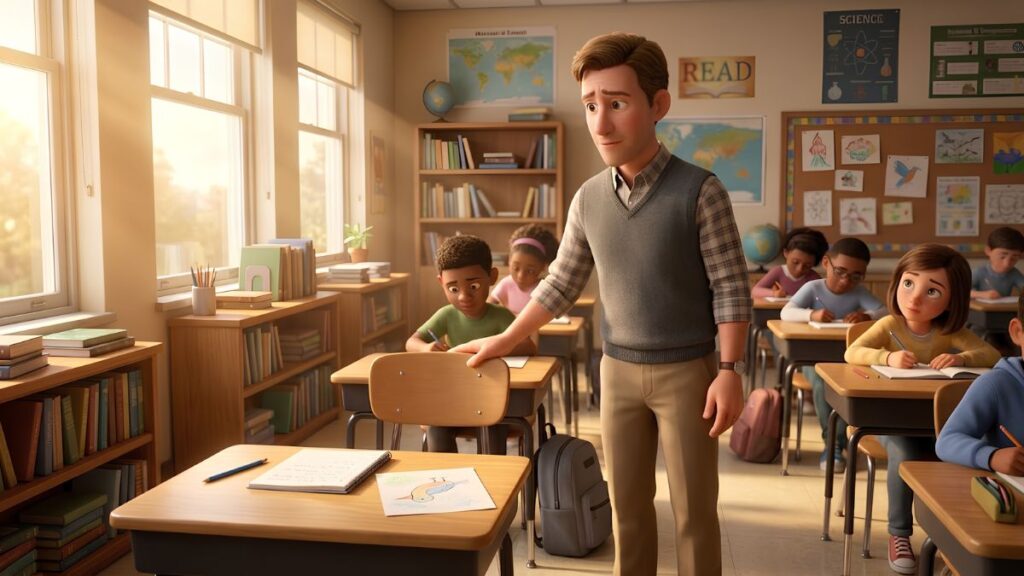
Every morning, Mr. James Anderson walked into his classroom at exactly 7:45.
He would place his books on the desk, open the windows, write the day’s lesson on the board, and arrange the chairs that his students had pushed out of place the previous afternoon.
Then he would look around the room.
There were twenty-eight students in his eighth-grade class.
Twenty-seven chairs were usually occupied.
One chair was always empty.
It belonged to Daniel Carter.
At first, James didn’t think much about it.
Students missed school.
They got sick.
They traveled with their families.
Sometimes they simply stayed home.
But Daniel had been absent for three days.
Then a week.
Then two weeks.
The empty chair slowly became part of the classroom.
Yet something about it bothered James.
He couldn’t explain why.
The Student in the Back Row
Daniel had never been the loudest student.
He sat near the back of the room, close to the wall.
He wasn’t particularly interested in sports, rarely joined noisy conversations, and preferred drawing small pictures in the margins of his notebooks.
But James remembered him as a hardworking student.
Daniel wasn’t always successful academically, but he tried.
Whenever he didn’t understand something, he stayed behind after class.
“Could you explain this one more time, Mr. Anderson?”
James always did.
Daniel would nod.
“I think I understand now.”
Sometimes he didn’t.
But he kept trying.
That was what James liked about him.
One afternoon, Daniel had stayed behind after everyone else had left.
“Mr. Anderson?”
“Yes?”
“Do you think someone can become good at something even if they’re bad at it now?”
James smiled.
“Absolutely.”
“How long does it take?”
“Sometimes months. Sometimes years.”
Daniel thought about that.
“So I shouldn’t give up?”
“Never because you’re not good at something yet.”
Daniel smiled.
“Okay.”
That was the last meaningful conversation James remembered having with him.
The First Week
During the first week of Daniel’s absence, James simply marked him absent.
On Monday:
Daniel Carter – Absent
Tuesday:
Absent
Wednesday:
Absent
By Friday, James asked the school secretary if everything was okay.
“Have you heard from Daniel’s family?”
The secretary checked the attendance records.
“His mother called. She said there are some family difficulties.”
“Is he coming back?”
“I don’t know.”
James nodded.
“Thank you.”
He returned to his classroom.
His eyes immediately went to the empty chair.
He wondered what “family difficulties” meant.
But he had twenty-seven other students to teach.
So he continued.
The Second Week
Daniel was still absent.
James began noticing small things.
Daniel’s desk had a tiny scratch shaped like a lightning bolt.
There was a blue pencil inside it.
A half-finished drawing was still tucked between two pages of his notebook.
Nobody had moved his belongings.
One afternoon, James found Daniel’s mathematics worksheet.
At the top, Daniel had written:
“I don’t understand this.”
Below it were several attempts.
All wrong.
James smiled sadly.
Daniel had tried five times.
He remembered their conversation.
I shouldn’t give up?
Never.
James wondered whether Daniel had been able to hear those words outside the classroom.
The Visit
After another week, James decided he couldn’t simply keep waiting.
He spoke to the school counselor.
“Would it be appropriate for me to visit Daniel’s family?”
The counselor nodded.
“If his parents are comfortable with it.”
The school contacted Daniel’s mother, Emily Carter.
She agreed.
That Saturday afternoon, James drove to the address the school had on file.
It was a small apartment building on the edge of town.
James knocked.
Emily opened the door.
She looked exhausted.
“Mr. Anderson?”
“Yes.”
“Please come in.”
James stepped inside.
The apartment was small but clean.
There were three pairs of shoes near the entrance.
A small table stood beside the window.
Then James noticed something.
There was very little food in the kitchen.
Emily saw him looking.
She lowered her eyes.
“I’m sorry.”
“You don’t need to apologize.”
She sat down.
“Daniel hasn’t been able to come to school because things have been difficult.”
James waited.
Emily finally explained.
Her husband had lost his job months earlier.
Then he had become seriously ill.
Medical bills had accumulated.
Emily had started working extra hours.
Daniel had begun taking care of his younger sister after school.
Then things became worse.
There were days when the family didn’t have enough money for transportation.
“There were mornings when Daniel said he didn’t want to go because he knew his sister would be alone.”
James listened quietly.
“Why didn’t you tell the school?”
Emily shook her head.
“I didn’t want people to feel sorry for us.”
James looked at her.
“I don’t think Daniel needs people to feel sorry for him.”
Emily looked up.
“He needs people to believe in him.”
A Different Kind of Lesson
James returned home that evening thinking about Daniel.
He had spent years teaching students about history, literature, mathematics, and science.
But suddenly he realized something.
Education wasn’t only about what happened inside the classroom.
Sometimes circumstances outside the classroom determined whether a child could even enter it.
The next morning, James spoke with the principal.
“I want to help Daniel return.”
The principal listened.
“What do you suggest?”
“Let’s find out what he needs.”
Together, they contacted the school counselor and several staff members.
The school arranged transportation.
A local community organization helped the family with groceries.
Another teacher offered Daniel’s mother information about employment assistance.
The school also arranged extra academic support so Daniel wouldn’t feel overwhelmed by missed lessons.
Nobody announced it to the students.
Nobody turned Daniel’s situation into gossip.
They simply helped.
The Empty Chair Remains
Even after the arrangements were made, Daniel didn’t immediately return.
James continued teaching.
But each morning, he still looked at the empty chair.
Then one Monday, something changed.
The classroom door opened.
Daniel stood there.
He looked thinner.
His hair was slightly longer.
He held his backpack tightly.
James smiled.
“Good morning, Daniel.”
Daniel nodded.
“Good morning.”
For a moment, neither said anything.
Then James pointed toward the empty chair.
“I think someone has been saving that seat for you.”
Daniel looked at the chair.
A small smile appeared.
“Can I sit there?”
James smiled.
“That’s what it’s for.”
Daniel walked across the classroom.
He placed his backpack down.
Then he sat.
The First Day Back
James didn’t make Daniel explain his absence.
He didn’t ask him to stand in front of the class.
He didn’t let other students question him.
Instead, he continued with the lesson.
At lunch, one of Daniel’s friends approached him.
“Where were you?”
Daniel looked uncomfortable.
James was nearby.
The friend quickly added:
“You don’t have to tell me.”
Daniel smiled.
“Thanks.”
That small moment made James proud.
His students had understood something important.
Not every story needed to be shared publicly.
Catching Up
Daniel had missed almost six weeks of school.
Catching up was difficult.
He struggled with mathematics.
He had missed several chapters in science.
His writing assignments were incomplete.
One afternoon, he sat with James after class.
“I think I’m too far behind.”
James shook his head.
“No.”
Daniel looked at him.
“Six weeks is a lot.”
“It is.”
“How will I catch up?”
“One day at a time.”
Daniel sighed.
“What if I can’t?”
James smiled.
“Then we’ll find another way.”
Daniel looked at him.
“You really think I can?”
“I wouldn’t tell you that if I didn’t.”
Daniel nodded.
“Okay.”
And he started.
Small Victories
Daniel didn’t suddenly become the best student in the class.
His progress was slow.
But it was real.
The first week, he completed one mathematics assignment.
The next week, he completed two.
Then he passed a science quiz.
It wasn’t a perfect score.
But Daniel smiled when he saw the result.
“Mr. Anderson!”
James looked up.
“I got 72!”
“That’s excellent.”
“I thought I would fail.”
“But you didn’t.”
Daniel grinned.
“I studied for three hours.”
James smiled.
“That effort matters.”
The Day Daniel Helped Someone Else
Several months later, another student struggled with a mathematics problem.
The student was frustrated.
“I can’t do this.”
Daniel looked over.
“I had trouble with that too.”
The student looked at him.
“Really?”
Daniel nodded.
“Yeah. But Mr. Anderson showed me a different way.”
He pulled his notebook closer.
“Look.”
Daniel explained the problem.
James watched from his desk.
The student finally understood.
“Oh!”
Daniel smiled.
“It’s easier when you break it into smaller steps.”
James felt something inside him.
He remembered the day Daniel had asked:
Do you think someone can become good at something even if they’re bad at it now?
Now Daniel was teaching another student the same lesson.
The School Awards
At the end of the year, the school held an awards ceremony.
Daniel wasn’t receiving an academic excellence award.
His grades were average.
But James nominated him for something else.
The Perseverance Award.
When Daniel’s name was announced, he looked surprised.
He walked to the stage.
James watched him accept the certificate.
The principal said:
“Daniel has demonstrated extraordinary determination throughout the year.”
Daniel looked toward James.
Their eyes met.
James smiled.
Daniel smiled back.
The Empty Chair Again
The following September, James returned to his classroom.
He arranged the desks.
He opened the windows.
He wrote the first lesson on the board.
Then he noticed something.
One chair was empty.
For a moment, he felt concerned.
Then he smiled.
It wasn’t Daniel’s chair.
Daniel had moved on to high school.
The empty chair belonged to a new student who hadn’t arrived yet.
James looked at it differently now.
An empty chair was no longer just an absence.
It was a question.
Why is this seat empty?
What story is behind it?
What does this student need?
James knew he couldn’t solve every problem.
But he could notice.
He could ask.
He could listen.
And sometimes, that was where help began.
Years Later
Nearly ten years after Daniel left the school, James received an unexpected visit.
A young man walked into his classroom.
He was taller now.
Confident.
He carried a folder under his arm.
“Mr. Anderson?”
James looked at him.
For a moment, he didn’t recognize him.
Then he smiled.
“Daniel?”
Daniel laughed.
“Yes.”
They shook hands.
“What are you doing here?”
“I wanted to show you something.”
Daniel opened the folder.
Inside was a university acceptance letter.
He had been accepted into a teaching program.
James looked at him.
“You’re going to become a teacher?”
Daniel nodded.
“I think so.”
“Why?”
Daniel smiled.
“Because once, a teacher noticed my empty chair.”
James became quiet.
Daniel continued.
“You didn’t just ask why I wasn’t in school. You came to find out what was happening.”
He paused.
“That changed everything.”
James smiled.
“You did the hard work.”
“Maybe.”
Daniel looked around the classroom.
“But you gave me a reason to come back.”
The Teacher’s Reflection
After Daniel left, James sat alone in his classroom.
He looked at the chairs.
Twenty-eight of them.
All occupied.
He thought about how easy it would have been to simply mark Daniel absent every day.
The attendance system would have recorded it.
The lessons would have continued.
The school year would have ended.
But Daniel might have disappeared quietly from the education system.
Nobody would have known how much he was struggling.
That was the danger.
Sometimes students don’t fail because they lack ability.
Sometimes life becomes too heavy for them to carry alone.
And unless someone notices, their absence can become permanent.
The Lesson for Teachers
Teachers cannot solve every problem a child faces.
They cannot remove every financial difficulty.
They cannot heal every family struggle.
They cannot control everything that happens outside school.
But teachers can notice.
They can ask questions.
They can listen without judgment.
They can contact families.
They can connect students with people who can help.
Most importantly, they can make students feel that their absence matters.
Daniel didn’t need a teacher who simply said:
“You’re behind.”
He needed someone who said:
“We noticed you were gone. We want you back. And we’ll help you catch up.”
That difference changed his life.
The empty chair had never been the problem.
The real problem would have been allowing that chair to remain empty without asking why.
Moral of the Story
A caring teacher does more than record attendance. A caring teacher notices when a student disappears, looks beyond the classroom, and reminds that student that they are valued and not forgotten.
Sometimes, the most important lesson a teacher can give is simply:
“We missed you. Come back. We’ll figure this out together.”
4. The Broken Pencil
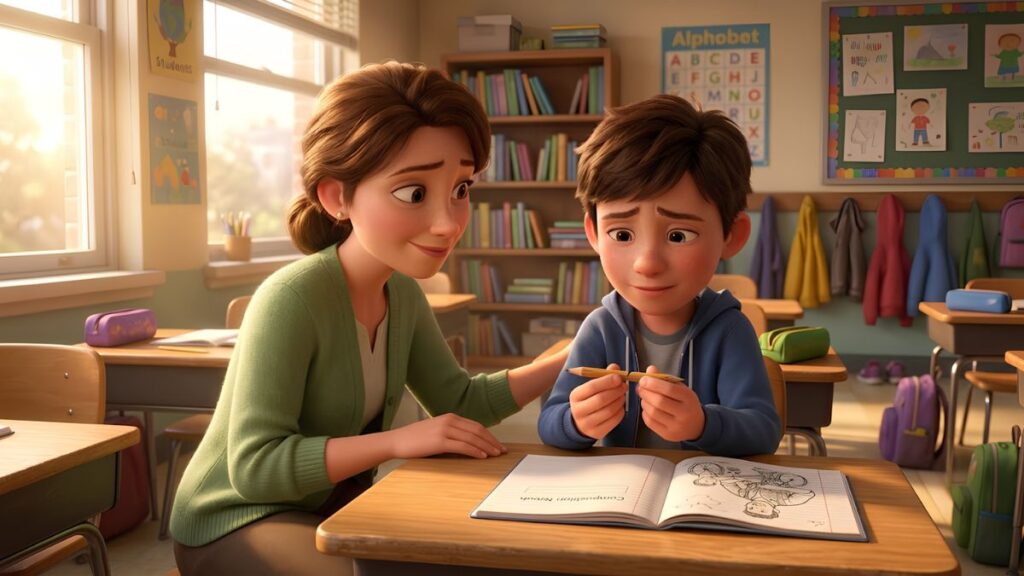
Every morning, Mrs. Amelia Brooks stood at the classroom door and greeted her students as they arrived.
“Good morning, Sophie.”
“Good morning, Liam.”
“Morning, Noah.”
She knew most of her students well.
She knew who loved mathematics, who preferred reading, who talked too much, who was always hungry before lunch, and who needed a few extra minutes to settle down before lessons began.
But there was one student she was still trying to understand.
His name was Ethan Parker.
Ethan was eleven years old and sat near the back of the classroom.
He was quiet.
He rarely volunteered answers.
He often seemed distracted.
And there was one strange thing Mrs. Brooks noticed almost immediately.
Ethan always used the same pencil.
It was short.
Very short.
The wooden surface was scratched and worn.
The eraser had disappeared.
The metal band around the end was bent.
The pencil was barely long enough to hold comfortably.
Yet Ethan used it every day.
The Pencil
At first, Mrs. Brooks thought Ethan had simply forgotten to bring school supplies.
So one morning, she quietly placed a new pencil on his desk.
Ethan looked at it.
Then he looked at her.
“That’s for you,” she said.
He picked it up.
“Thank you.”
But the next morning, the new pencil was gone.
The old broken pencil was back.
Mrs. Brooks was puzzled.
She didn’t ask.
Perhaps he preferred the old pencil.
Children sometimes became attached to ordinary objects.
She decided not to make an issue of it.
But she continued noticing.
During writing exercises, Ethan held the tiny pencil between his fingers.
When it became difficult to sharpen, he carefully sharpened it anyway.
When the pencil became too short, he used a small plastic pencil holder to extend its grip.
It was obvious that the pencil mattered to him.
The Writing Assignment
One Tuesday morning, Mrs. Brooks asked her students to write a short essay titled:
“Someone Who Inspires Me.”
The classroom became quiet.
Students began writing.
Some wrote about athletes.
Others wrote about parents.
One student wrote about a famous scientist.
Ethan stared at his notebook.
Mrs. Brooks walked around the classroom.
When she reached Ethan’s desk, she noticed he had written only one sentence.
“My father inspires me.”
She smiled.
“That’s a good beginning.”
Ethan nodded.
“Would you like to tell me more?”
He shook his head.
“Maybe later.”
“That’s fine.”
She walked away.
An hour later, Ethan handed in his paper.
It contained only four sentences.
Mrs. Brooks read them after class.
The writing was simple.
The grammar wasn’t perfect.
But the words were deeply emotional.
Ethan wrote about his father repairing old bicycles.
He wrote about how his father never complained when things were difficult.
He wrote about how his father always told him:
“If something breaks, don’t throw it away immediately. First, see if you can fix it.”
Mrs. Brooks read the sentence twice.
Then she looked at Ethan’s broken pencil.
Suddenly, she wondered whether the pencil was connected to his father.
A Conversation After Class
The next afternoon, Mrs. Brooks asked Ethan to stay for a few minutes.
When the other students left, Ethan stood beside his desk.
“Did I do something wrong?”
“No.”
He looked relieved.
“I wanted to ask you about something.”
Ethan waited.
“Your pencil.”
He looked down.
“What about it?”
“Why do you always use that one?”
Ethan hesitated.
Then he quietly said:
“It belonged to my dad.”
Mrs. Brooks became silent.
“Your father gave it to you?”
Ethan shook his head.
“He used it.”
Mrs. Brooks understood that there was more to the story.
“Would you like to tell me about it?”
Ethan sat down.
“My dad used to work in a repair shop.”
He looked at the pencil.
“He always carried this one.”
Ethan’s Father
Ethan explained that his father had been a bicycle mechanic.
He repaired bicycles, scooters, and sometimes small machines.
He didn’t make much money.
But he loved his work.
“He could fix almost anything,” Ethan said.
“Even things other people said were useless.”
His father had taught him how to repair a bicycle chain.
He had shown him how to tighten a loose screw.
He had even taught him how to sharpen a pencil properly.
Then, one winter, Ethan’s father became seriously ill.
He was unable to work.
The family struggled.
Ethan’s mother took extra shifts.
Ethan tried to help at home.
Eventually, his father died.
Ethan was quiet for a moment.
“The pencil was on his workbench,” he said.
“I took it.”
Mrs. Brooks looked at him.
“Why?”
“Because it was his.”
She nodded.
“Do you use it because you don’t have another pencil?”
Ethan shook his head.
“I have other pencils.”
“Then why this one?”
Ethan smiled sadly.
“It makes me feel like he’s still teaching me.”
Mrs. Brooks felt a lump in her throat.
She understood now.
The broken pencil wasn’t simply a pencil.
It was a memory.
A Different Kind of Student
After that conversation, Mrs. Brooks began seeing Ethan differently.
She realized that his silence wasn’t laziness.
His distraction wasn’t carelessness.
He was carrying grief.
And he was doing it quietly.
She began giving him more opportunities to work with his hands.
During science lessons, she asked him to help with experiments.
During mathematics, she allowed him to demonstrate practical examples.
She discovered that Ethan was excellent at understanding how things worked.
One afternoon, the class was building simple bridges from wooden sticks.
Most students struggled to make their bridges strong.
Ethan studied the materials.
He moved two pieces.
Then three.
He changed the angle.
Finally, he stepped back.
His bridge held.
Mrs. Brooks smiled.
“How did you figure that out?”
Ethan shrugged.
“I remembered something my dad showed me.”
“What?”
“Triangles make things stronger.”
Mrs. Brooks looked at the bridge.
She smiled.
“Your father taught you well.”
Ethan smiled too.
The Classroom Challenge
A few weeks later, Mrs. Brooks introduced a special project.
Each student had to find an everyday object that was broken or no longer useful and think of a way to give it a new purpose.
The students were excited.
One brought an old bottle.
Another brought a damaged toy.
Someone brought a broken clock.
Ethan brought the smallest object of all.
His broken pencil.
Some students laughed.
“What are you going to do with that?”
Ethan didn’t answer.
He placed the pencil on his desk.
Mrs. Brooks watched.
She knew it was important to him.
The Idea
Ethan decided not to repair the pencil.
Instead, he created a small wooden stand for it.
He used cardboard, glue, and pieces of recycled wood.
He designed a little holder that allowed the pencil to stand upright.
At the front, he attached a small piece of paper.
On it, he wrote:
“Things can still have value even when they are broken.”
Mrs. Brooks read the sentence.
“That’s beautiful.”
Ethan smiled.
“It’s what my dad used to say.”
Presentation Day
Each student presented their project.
One student showed how an old bottle could become a plant pot.
Another demonstrated how broken toys could become decorations.
Then it was Ethan’s turn.
He walked to the front of the classroom carrying the small wooden stand.
Inside it was the broken pencil.
He was nervous.
Mrs. Brooks could see his hands trembling.
He took a breath.
“This pencil belonged to my father.”
The classroom became completely silent.
“My father used it at work.”
Ethan explained what his father had taught him.
“He believed that if something was broken, you shouldn’t immediately decide it was useless.”
He looked at the pencil.
“Sometimes it just needs to be looked at differently.”
Nobody laughed.
Nobody whispered.
The students listened.
Ethan continued.
“I think people can be like that too.”
Mrs. Brooks felt her eyes become wet.
Ethan finished his presentation.
The classroom remained silent for a moment.
Then one student began clapping.
Another joined.
Soon everyone was applauding.
Ethan smiled.
The Question
After class, one student named Liam approached Ethan.
“Can I ask you something?”
“Sure.”
“Do you miss your dad?”
Ethan nodded.
“Every day.”
Liam looked at the pencil.
“Does that make you sad?”
“Sometimes.”
“Then why do you keep the pencil?”
Ethan thought about it.
“Because it makes me remember the good things.”
Liam smiled.
“My grandfather gave me an old watch.”
“Does it work?”
“No.”
Ethan smiled.
“Maybe you don’t need it to.”
A Teacher’s Realization
That evening, Mrs. Brooks sat at her desk.
She thought about Ethan.
She thought about how easily teachers could misunderstand children.
A student who didn’t participate might be grieving.
A student who didn’t complete homework might be struggling at home.
A student who appeared distracted might be carrying something invisible.
Teachers couldn’t know every story.
But they could choose not to judge too quickly.
They could ask questions.
They could listen.
They could notice the little things.
For Mrs. Brooks, that little thing had been a pencil.
The Unexpected Gift
A few months later, the school held a family appreciation event.
Students were asked to create something for a person they admired.
Ethan made a small wooden box.
He brought it to Mrs. Brooks.
“This is for you.”
She opened it.
Inside was a new pencil.
It was simple.
Blue.
Unused.
Mrs. Brooks smiled.
“Thank you.”
Ethan pointed at it.
“It’s not for writing.”
She laughed.
“Then what is it for?”
“It’s for remembering.”
“Remembering what?”
Ethan smiled.
“That teachers can help fix things too.”
Mrs. Brooks became quiet.
She understood.
She had thought she was helping Ethan.
But Ethan had taught her something too.
The Teacher’s Lesson
Teachers often believe they are the ones giving lessons.
But sometimes, the student teaches the teacher.
Ethan had entered Mrs. Brooks’s classroom carrying grief, memories, and a broken pencil.
She had initially seen a quiet child with an old school supply.
Later, she realized she was looking at a young boy trying to hold on to his father’s memory.
The pencil had taught her something important.
Not everything broken needs to be thrown away.
Not every imperfect thing is worthless.
And not every struggling child needs to be fixed.
Sometimes they simply need someone who sees their value.
Years Later
Many years passed.
Ethan eventually became an engineer.
He worked with machines.
He designed mechanical systems.
He enjoyed repairing things.
On his office desk sat a small wooden stand.
Inside it was an old broken pencil.
One day, a young intern noticed it.
“Is that your lucky pencil?”
Ethan smiled.
“No.”
“Then what is it?”
Ethan looked at it.
“My first teacher.”
The intern laughed.
“A pencil is your first teacher?”
Ethan shook his head.
“No. The pencil reminds me of two teachers.”
“Two?”
“My father taught me that broken things can be repaired.”
He paused.
“And Mrs. Brooks taught me that broken people don’t need to be thrown away either.”
The Last Lesson
Years later, Ethan returned to his old school.
Mrs. Brooks was still teaching.
He found her in the classroom.
She recognized him immediately.
“Ethan!”
They hugged.
He showed her the old pencil.
She smiled.
“You still have it?”
“Of course.”
“Does it still work?”
Ethan laughed.
“No.”
Mrs. Brooks looked at him.
“Then why keep it?”
Ethan smiled.
“Because some things aren’t valuable because they’re useful.”
He held the pencil carefully.
“Some things are valuable because of what they remind us of.”
Mrs. Brooks nodded.
She understood.
Sometimes a teacher’s greatest achievement isn’t a student’s highest grade.
Sometimes it is helping a child understand that their imperfections do not define their worth.
Moral of the Story
Never judge a student by what appears on the surface. A broken pencil may look worthless, but it can carry a lifetime of memories. In the same way, a struggling child may carry extraordinary potential that only patience, empathy, and encouragement can reveal.
A good teacher doesn’t simply teach students how to succeed.
A great teacher helps them believe they are worth believing in.
5. The Test That Wasn’t Graded
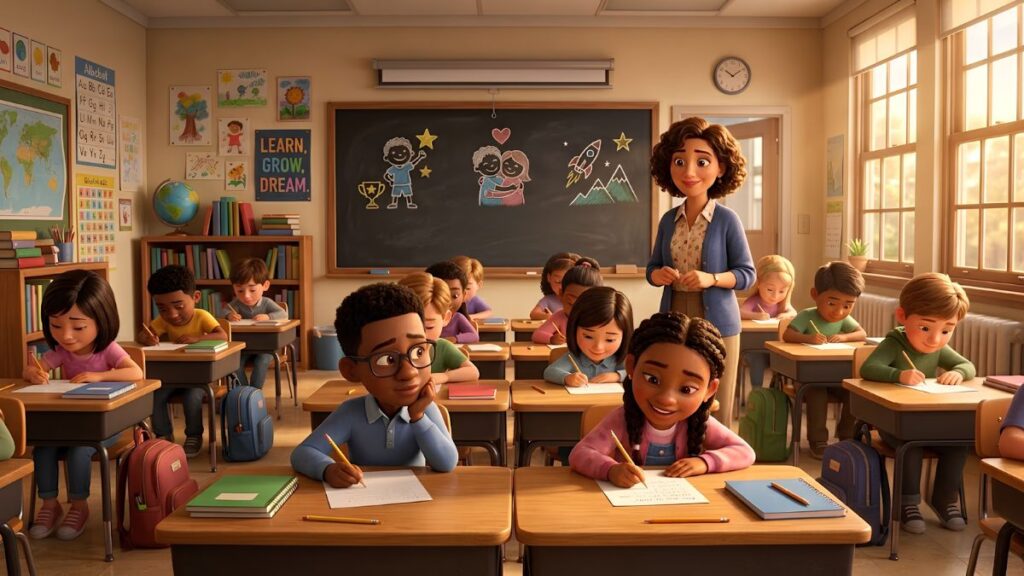
On Monday morning, Mrs. Olivia Carter walked into her classroom carrying a stack of white papers.
Her students immediately knew what that meant.
A test.
The room became unusually quiet.
Some students sat straighter.
Others looked nervously at one another.
A boy named Henry whispered to his friend, “I didn’t study enough.”
His friend whispered back, “Neither did I.”
Olivia placed the papers face down on her desk.
Then she smiled.
“Don’t worry. This isn’t the kind of test you’re expecting.”
The students looked confused.
“What does that mean?” asked Emma.
“You’ll find out.”
Olivia had been teaching for eighteen years.
She had given thousands of tests.
Mathematics tests.
Grammar tests.
Science tests.
History tests.
She had watched students celebrate high scores and cry over low ones.
She had seen children become obsessed with marks.
Some students believed a ninety meant they were smart.
An eighty meant they were average.
A sixty meant they had failed.
Olivia knew that grades were useful.
But she also knew something was missing.
There were important things in life that could never be measured with a number.
That morning, she decided to teach her students exactly that.
The Unexpected Test
Olivia walked to the board.
She wrote:
TODAY’S TEST
Then she turned around.
The students stared at her.
“Write your name at the top of the page.”
They did.
“Now write three things.”
The students waited.
Olivia continued.
“First: Write one thing you are proud of.”
Pens began moving.
“Second: Write the name of one person you appreciate.”
More pens moved.
“Third: Write one dream you hope to achieve someday.”
The classroom became completely quiet.
A student raised his hand.
“Mrs. Carter?”
“Yes?”
“What’s the subject?”
Olivia smiled.
“Life.”
The students laughed.
But they continued writing.
What Are You Proud Of?
The first question seemed easy.
At least, Olivia thought it would.
But as she walked around the room, she noticed many students struggling.
Some wrote immediately.
Others stared at their papers.
One student wrote:
“I’m proud that I got 95 on my science test.”
Another wrote:
“I’m proud that I won the football match.”
A girl named Emma wrote:
“I’m proud that I helped my little brother learn to read.”
Olivia noticed the difference.
Some students were thinking about achievements.
Others were thinking about character.
Both mattered.
Then she reached Henry.
His page was blank.
“Having trouble?” Olivia asked.
He nodded.
“I don’t know what I’m proud of.”
Olivia pulled up a chair.
“Nothing?”
Henry shook his head.
“I don’t get the best marks.”
Olivia looked at him.
“That’s not what I asked.”
Henry thought.
“I don’t know.”
Olivia smiled.
“Take your time.”
She moved on.
The Second Question
The next question was easier.
Who is one person you appreciate?
Students wrote names.
Parents.
Grandparents.
Friends.
Teachers.
Siblings.
One student wrote the name of his football coach.
Another wrote the name of a neighbor.
A girl named Sophie wrote:
“My older sister. She always waits for me after school.”
Olivia smiled.
She noticed something.
Students often had gratitude in their hearts.
They simply didn’t always say it.
The Third Question
The final question was:
What is one dream you hope to achieve?
This created excitement.
Hands went up.
“Can we write anything?”
“Anything.”
“Even if it’s impossible?”
Olivia smiled.
“Especially if it seems impossible.”
The students began writing.
Some wanted to become doctors.
Others wanted to become musicians, athletes, pilots, artists, scientists, teachers, and writers.
One student wanted to open a bakery.
Another wanted to travel around the world.
Henry remained quiet.
Olivia walked past him.
His page was still mostly empty.
She didn’t pressure him.
Collecting the Papers
After twenty minutes, Olivia said:
“Time.”
The students placed their papers on her desk.
Olivia gathered them.
Then she did something unexpected.
She put the papers in a drawer.
The students stared.
“You’re not grading them?”
“No.”
“Then why did we do it?”
Olivia smiled.
“You’ll understand tomorrow.”
The Next Day
The following morning, Olivia returned to class carrying the same papers.
The students were curious.
She stood at the front.
“Yesterday, I gave you a test.”
Everyone nodded.
“But there were no right or wrong answers.”
The students smiled.
“Today, I want to talk about why.”
She wrote three words on the board:
Pride. Gratitude. Dreams.
“These things are important,” she said.
“But they don’t appear on report cards.”
She looked around the room.
“Schools are very good at measuring certain things. We can measure how quickly you solve a problem. We can measure how many words you spell correctly. We can measure how much information you remember.”
She paused.
“But can we measure kindness?”
The students shook their heads.
“Can we measure courage?”
“No.”
“Can we measure how much someone loves their family?”
“No.”
“Can we measure how hard someone tries when nobody is watching?”
The room became quiet.
“No,” Emma answered.
Olivia nodded.
“Exactly.”
Henry’s Paper
Olivia picked up one paper.
“Some of you found the first question difficult.”
Henry looked down.
“I want to tell you something.”
She looked at him.
“You don’t need the highest score in the class to have something to be proud of.”
Henry looked up.
“Maybe you helped someone yesterday.”
He thought.
“Maybe you kept trying when something was difficult.”
Henry looked at his desk.
“Maybe you apologized when you were wrong.”
He looked up again.
“Maybe you were kind to someone who needed it.”
Olivia smiled.
“Those things matter.”
Henry slowly smiled back.
A Student’s Confession
After class, Emma stayed behind.
“Mrs. Carter?”
“Yes?”
“Can I tell you something?”
“Of course.”
Emma hesitated.
“I don’t think I’m good at school.”
Olivia looked surprised.
“Why?”
“Because my best friend always gets higher marks.”
“And?”
“I feel stupid next to her.”
Olivia sat down.
“Emma, do you know what your answer to yesterday’s second question was?”
“My sister?”
“Yes.”
“You wrote that she waits for you after school.”
Emma nodded.
“Do you know what that tells me?”
“What?”
“That you notice kindness.”
Emma looked confused.
“That’s important.”
“More important than grades?”
Olivia smiled.
“Grades are important. But they are not the only measure of who you are.”
The Student Who Wanted to Be a Doctor
Another student, Lucas, had written that he wanted to become a doctor.
During lunch, he approached Olivia.
“What if I don’t become one?”
Olivia looked at him.
“Then you’ll find another path.”
“But what if I fail?”
“Then you’ll learn.”
“What if people laugh?”
“They might.”
Lucas looked surprised.
“Really?”
“Sometimes people laugh at dreams they don’t understand.”
She smiled.
“Don’t let someone else’s doubt become your future.”
Lucas nodded.
The Test Becomes a Tradition
Olivia continued teaching the class.
But she never forgot the lesson of that day.
The next year, she gave the same test to a new group of students.
Then again.
And again.
Eventually, it became a tradition.
Every year, students answered three questions:
What are you proud of?
Who do you appreciate?
What is your dream?
Olivia kept the papers in a large box.
She never graded them.
She never compared students.
She never showed them to anyone without permission.
They were simply reminders.
Reminders that every child was more than a number.
The Box
After several years, the box became full.
Olivia sometimes opened it after school.
She read old answers.
One student had written:
“I’m proud that I learned to swim.”
Another:
“I appreciate my grandmother because she makes breakfast for me every morning.”
Another:
“I want to become a scientist.”
Another:
“I’m proud that I stopped being afraid of speaking in class.”
Some dreams were simple.
Some were enormous.
Some students had changed their dreams completely.
But every page told a story.
Years Later
One afternoon, Olivia received an email from a former student.
The student’s name was Sophie Williams.
Sophie had graduated nearly ten years earlier.
Her email said:
Dear Mrs. Carter,
Do you remember the test you gave us that wasn’t graded?
Olivia smiled.
She kept reading.
I found my old school notebook today. Inside it, I wrote that I wanted to become a writer.
I completely forgot about that dream.
I became an accountant instead. I like my job, but seeing that sentence reminded me that I once wanted to write stories.
So I started writing again.
I don’t know where it will lead. Maybe nowhere. Maybe somewhere.
But I’m glad you asked me what I wanted.
Olivia smiled.
She replied:
“Keep writing.”
Another Former Student
A few months later, another former student visited the school.
His name was Henry.
Olivia almost didn’t recognize him.
He was taller.
Confident.
He had become a firefighter.
“Mrs. Carter!”
She smiled.
“Henry!”
He hugged her.
“I wanted to thank you.”
“For what?”
“That test.”
Olivia laughed.
“The one I never graded?”
“Yes.”
Henry smiled.
“You asked me what I was proud of.”
“I remember.”
“I couldn’t think of anything.”
Olivia nodded.
“I remember that too.”
Henry continued.
“You told me to think about something small.”
He paused.
“I went home that night and thought about it.”
“And?”
“I realized I was proud that I never quit basketball even though I wasn’t very good.”
Olivia smiled.
“And that helped?”
“More than you know.”
Henry explained that he eventually stopped comparing himself with other players.
He focused on effort.
He became a better athlete.
Later, that mindset helped him through firefighter training.
“When things got difficult,” he said, “I remembered that I had already learned how to keep going.”
Olivia smiled.
The Final Class
Years later, Olivia prepared to retire.
On her final day, she stood before her students.
She looked around the classroom.
She saw nervous faces.
Excited faces.
Curious faces.
She thought about all the students she had taught.
Thousands of tests.
Thousands of grades.
Thousands of answers.
But the moments she remembered most were different.
The child who finally believed in himself.
The student who learned to forgive.
The girl who discovered her talent.
The boy who found courage.
The student who decided not to give up.
She walked to the board.
Then she wrote three questions.
What are you proud of?
Who do you appreciate?
What is your dream?
The students smiled.
They knew the tradition.
Olivia handed out the papers.
“Take your time.”
They began writing.
The Last Paper
At the end of class, Olivia collected the papers.
She looked at the stack.
She could have taken them home.
But she didn’t.
She handed them back to the students.
“Keep them.”
The students looked surprised.
“Why?”
“Because these answers belong to you.”
She smiled.
“Years from now, you may forget your test scores.”
She paused.
“You may forget which questions you got wrong.”
“But I hope you remember what you were proud of, who you appreciated, and what you dreamed about.”
The room was quiet.
Olivia continued.
“Education is not only about preparing you to pass exams.”
She looked at each student.
“It is about preparing you to live a meaningful life.”
The Real Test
After the students left, Olivia remained alone in the classroom.
The board still contained the three questions.
She looked at them one final time.
She realized that perhaps the most important tests in life were never handed out by teachers.
They came quietly.
A moment when someone needed kindness.
A moment when courage was required.
A moment when giving up seemed easier than continuing.
There were no answer sheets for those moments.
No grades.
No certificates.
But they mattered.
Perhaps more than any examination ever could.
The Lesson for Teachers
Teachers naturally focus on academic achievement.
And they should.
Education requires knowledge, discipline, practice, and assessment.
But students are human beings before they are test scores.
They need to know what they are good at.
They need to recognize the people who support them.
They need dreams that give their efforts meaning.
A teacher may never know which lesson will stay with a student for decades.
A formula may be forgotten.
A historical date may disappear from memory.
A grammar rule may be used only occasionally.
But a teacher who once said:
“I believe you can do this.”
may remain in a student’s memory forever.
The test that Olivia never graded became one of the most meaningful lessons her students ever received.
Because there were no marks.
No rankings.
No winners.
Just three simple questions that encouraged children to look inward.
And sometimes, that is exactly what education should do.
Moral of the Story
Not everything important in life can be measured with grades. A great teacher helps students recognize their strengths, appreciate the people around them, and believe in their dreams.
The most valuable lessons may never appear on a report card.
6. The Last Student to Leave

The final bell rang at exactly 3:15 every afternoon.
Within minutes, the school corridors became quiet.
Students rushed toward the buses, parents waiting outside, or the streets leading home.
Teachers gathered their books and prepared to leave.
But in Room 14, the lights often remained on.
Inside sat Mr. William Harris, a mathematics teacher, and one student named Sophia Turner.
Sophia was almost always the last student to leave.
It wasn’t because she wanted to stay.
It was because mathematics refused to make sense to her.
The Student Who Tried
Sophia was thirteen years old.
She was cheerful, polite, and hardworking.
But whenever mathematics appeared on the board, her confidence disappeared.
Numbers seemed to become tangled in her mind.
Fractions confused her.
Equations frightened her.
Word problems felt impossible.
She studied.
She practiced.
She asked questions.
Yet her test scores remained low.
Her classmates sometimes finished assignments while she was still trying to understand the first question.
Sophia began believing something terrible.
Maybe I’m just not smart enough.
Mr. Harris heard her say it one afternoon.
She was sitting at her desk after receiving a mathematics test.
She had scored 48 percent.
She stared at the paper.
“I tried.”
“I know.”
“I really tried.”
“I know.”
Sophia looked up.
“Then why can’t I do it?”
Mr. Harris pulled a chair beside her.
“Because understanding something takes time.”
“But everyone else gets it.”
“Not everyone.”
Sophia looked around the empty classroom.
“It feels like everyone.”
Mr. Harris smiled.
“You’re comparing your first attempt to someone else’s tenth.”
She didn’t fully understand what he meant.
But she remembered it.
The First Late Afternoon
The next day, Sophia stayed after school.
Mr. Harris was organizing his papers when he noticed her standing beside her desk.
“Do you need help?”
She nodded.
“I don’t understand equations.”
“Which part?”
“All of it.”
He laughed gently.
“That’s a good place to start.”
They began with something simple.
He wrote:
x + 5 = 12
“What is x?”
“Seven.”
“Why?”
“Because seven plus five is twelve.”
“Good.”
He wrote another.
x + 8 = 15
“Seven.”
“Exactly.”
Sophia smiled.
Then Mr. Harris changed the problem.
2x = 14
Sophia stared at it.
“I don’t know.”
“That’s okay.”
He explained.
They worked through five problems.
Then ten.
Then fifteen.
When Sophia finally solved one by herself, she looked surprised.
“I got it.”
Mr. Harris smiled.
“Yes, you did.”
Sophia packed her bag.
It was 4:10.
She had stayed nearly an hour.
The New Routine
After that day, something changed.
Sophia began staying after school twice a week.
Sometimes Mr. Harris helped her.
Sometimes she practiced independently.
He never gave her the answers.
Instead, he asked questions.
“What do you know?”
“What are you trying to find?”
“What have you tried?”
“Where did you get stuck?”
Slowly, Sophia learned how to think through problems.
Her grades didn’t immediately improve.
But something else did.
Her fear began to disappear.
The First Improvement
Three weeks later, Sophia received another test.
She looked at the score.
62 percent.
She stared at it.
Then she smiled.
Mr. Harris saw her expression.
“How did you do?”
“Sixty-two.”
“Congratulations.”
“But it’s still not very high.”
He shook his head.
“Don’t compare it with someone else’s score.”
Sophia smiled.
“Compare it with my last score?”
“Exactly.”
She looked at the 48 written on her previous test.
Then at the 62.
“That’s fourteen points.”
“That’s fourteen points you earned.”
Sophia smiled.
“Can I try for seventy next?”
“Absolutely.”
The Hard Day
Not every day was successful.
One afternoon, Sophia couldn’t solve a problem no matter how many times she tried.
She erased her work.
Started again.
Erased it.
Started again.
Finally, she pushed her pencil away.
“I hate this.”
Mr. Harris remained calm.
“Take a break.”
“I can’t do it.”
“You can.”
“No, I can’t.”
“Not yet.”
Sophia looked at him.
“What?”
He pointed to the problem.
“You can’t do it yet.”
She sighed.
“What’s the difference?”
“The word ‘yet’ means the story isn’t finished.”
Sophia stared at the page.
Mr. Harris continued.
“You’re not failing because you don’t know the answer right now. You’re learning.”
She picked up her pencil again.
The Student Who Stayed
Sophia became known as the last student to leave.
Her classmates sometimes joked about it.
“You practically live here.”
Sophia laughed.
“Maybe.”
But she didn’t mind anymore.
The classroom had become a safe place.
Nobody laughed when she made mistakes.
Nobody rushed her.
Nobody told her she was slow.
Mr. Harris simply waited.
A Different Problem
One afternoon, Mr. Harris gave Sophia a problem that wasn’t from the textbook.
He wrote:
A family has 24 apples and wants to divide them equally among six people. How many apples does each person receive?
Sophia immediately answered.
“Four.”
“How did you know?”
“Twenty-four divided by six.”
“Good.”
He wrote another.
If two people leave, how many apples does each remaining person receive?
Sophia paused.
“Six.”
“Excellent.”
He smiled.
“You solved that quickly.”
Sophia shrugged.
“That’s easy.”
“Exactly.”
He pointed toward the textbook.
“Sometimes a problem becomes easier when you understand what it represents.”
Sophia began to realize that mathematics wasn’t just about numbers.
It was about understanding relationships.
The Teacher’s Secret
Sophia eventually asked Mr. Harris:
“Were you always good at math?”
He laughed.
“No.”
“Really?”
“Really.”
“You?”
“Yes.”
“What happened?”
He leaned back.
“When I was your age, I hated mathematics.”
Sophia looked surprised.
“You did?”
“I was terrible at it.”
“Then how did you become a math teacher?”
“Because someone stayed with me.”
Sophia smiled.
“Who?”
“My teacher.”
Mr. Harris looked at the clock.
“She never let me believe that struggling meant I couldn’t learn.”
Sophia became quiet.
“That’s what you’re doing for me.”
Mr. Harris smiled.
“Exactly.”
The Big Examination
At the end of the school year, students had to take an important mathematics examination.
Sophia was nervous.
She had improved significantly.
But she still feared failing.
The night before the exam, she called her mother.
“I’m scared.”
Her mother said:
“You’ve worked hard.”
“But what if I fail?”
“Then you’ll try again.”
Sophia smiled.
She had heard those words before.
Exam Day
Sophia entered the examination room.
The paper was placed face down.
She took a deep breath.
When the teacher said, “Begin,” she turned it over.
The first question was familiar.
She solved it.
The second was harder.
She worked through it.
The third required several steps.
She didn’t panic.
She wrote down what she knew.
She broke the problem into smaller pieces.
She continued.
For the first time, she realized something.
She wasn’t thinking:
I’m bad at mathematics.
She was thinking:
How can I solve this?
That was the real victory.
The Results
A week later, the results were announced.
Sophia scored 81 percent.
She stared at the paper.
She couldn’t believe it.
Her friend hugged her.
“You got 81!”
Sophia laughed.
“I know!”
Mr. Harris saw her outside the classroom.
She ran toward him.
“I did it!”
He smiled.
“Yes, you did.”
“I got 81!”
“I’m proud of you.”
Sophia looked at her paper.
“But you helped.”
Mr. Harris shook his head.
“I showed you where to look.”
“You stayed.”
“Yes.”
“You didn’t give up.”
“Neither did you.”
Sophia smiled.
The Last Afternoon
On the final day of the school year, students were preparing to leave.
Sophia packed her bag.
She looked around Room 14.
The desks.
The whiteboard.
The mathematics posters.
The chair where she had spent so many afternoons.
Mr. Harris was cleaning his desk.
“Are you leaving?” he asked.
Sophia nodded.
Then she hesitated.
“Can I stay for a minute?”
He smiled.
“Of course.”
She sat down.
“Do you remember the first day I stayed after school?”
“Yes.”
“I thought I was stupid.”
Mr. Harris looked at her.
“And now?”
Sophia smiled.
“Now I think I just needed more time.”
“That’s a very important difference.”
A Small Gift
Sophia reached into her backpack.
She pulled out a small notebook.
“I made this for you.”
Mr. Harris opened it.
On the first page, Sophia had written:
“For the teacher who taught me that being slow is not the same as being unable.”
Mr. Harris read the sentence twice.
He looked up.
“Thank you.”
Sophia smiled.
“You deserve it.”
Years Later
Sophia left school and eventually went to university.
She didn’t become a mathematician.
She studied architecture.
Mathematics remained part of her life.
Geometry.
Measurements.
Structures.
Calculations.
But she no longer feared numbers.
She understood that difficult things became manageable when broken into smaller steps.
She had learned that lesson in Room 14.
Years later, Sophia returned to her old school.
Mr. Harris was still teaching.
She found him in the same classroom.
“Mr. Harris?”
He turned around.
He recognized her immediately.
“Sophia!”
They laughed.
“You’ve grown.”
“So have you.”
She handed him a photograph.
It was a picture of a building she had designed.
“I’m an architect now.”
Mr. Harris looked at it.
“This is beautiful.”
“Thank you.”
“Does it involve mathematics?”
Sophia laughed.
“Quite a lot.”
He smiled.
“I knew you’d find a way to use it.”
The New Student
While they were talking, a young student entered the classroom.
She looked nervous.
“Mr. Harris?”
“Yes?”
“I don’t understand this problem.”
Mr. Harris smiled.
“Come sit down.”
Sophia watched.
The student placed her notebook on the desk.
Mr. Harris sat beside her.
“What do you know so far?”
The girl shook her head.
“Nothing.”
Mr. Harris smiled.
“That’s okay.”
Sophia smiled too.
She had heard those words before.
The Circle Continues
Sophia left the classroom.
As she walked down the hallway, she heard Mr. Harris explaining the problem.
His voice was calm.
Patient.
Encouraging.
She realized that the most important thing he had taught her was never really about mathematics.
It was about persistence.
It was about patience.
It was about refusing to define yourself by one difficult chapter.
Some students need a faster explanation.
Some need a different explanation.
Some need more practice.
Some need someone willing to stay after the final bell.
And sometimes, the difference between giving up and succeeding is simply having a teacher who says:
“Let’s try one more time.”
The Teacher’s Perspective
Teachers often measure their success through grades.
But grades tell only part of the story.
A student who improves from 48 to 81 has achieved something important.
But the deeper achievement may be invisible.
That student has learned not to fear failure.
She has learned how to ask for help.
She has learned how to break a difficult problem into smaller pieces.
She has learned that struggling does not mean being incapable.
Those lessons can follow a person far beyond school.
Mr. Harris didn’t make Sophia brilliant overnight.
He didn’t give her shortcuts.
He didn’t remove every difficult problem.
He simply stayed.
He listened.
He explained.
He waited.
And when she wanted to give up, he reminded her that the story wasn’t finished.
The Last Student to Leave
Years later, Sophia still remembered those afternoons.
She remembered the ticking clock.
The empty hallway.
The sunlight fading through the classroom window.
The sound of pencils moving across paper.
And Mr. Harris saying:
“Take your time.”
She eventually understood why those words mattered so much.
The world often tells people to hurry.
Hurry to understand.
Hurry to succeed.
Hurry to catch up.
But learning doesn’t always happen quickly.
Some lessons require repetition.
Some skills require patience.
Some students need more time than others.
And that’s okay.
A great teacher knows that progress is not always visible immediately.
Sometimes the student who seems to be moving the slowest is actually building the strongest foundation.
Moral of the Story
Patience can transform a student’s relationship with failure. A great teacher doesn’t simply provide answers. They give students the confidence to keep searching for them.
Sometimes, all a struggling student needs is someone willing to stay a little longer and say:
“You don’t have to understand it today. We’ll keep working until you do.”
7. The Teacher Who Learned From Her Student

Mrs. Grace Thompson believed that a good teacher should always know what to do.
She believed teachers should be prepared.
They should have answers.
They should know how to explain difficult subjects.
They should know how to manage a noisy classroom.
Most importantly, they should understand how their students learned.
For twenty years, Grace had built her teaching career around that belief.
She was respected by her colleagues.
Parents trusted her.
Students knew she was fair.
Her classroom was organized down to the smallest detail.
Lesson plans were prepared days in advance.
Books were labeled.
Materials were arranged.
Every activity had a purpose.
Grace was proud of her classroom.
Then, one September morning, a new student walked through her door.
His name was Samuel Reed.
And Samuel was about to teach her something she had forgotten.
The New Student
Samuel was eleven years old.
He was quiet when he first entered the classroom.
He stood beside the door holding his backpack with both hands.
Grace smiled.
“Good morning. You must be Samuel.”
He nodded.
“Welcome.”
“Thank you.”
“Why don’t you take the seat near the window?”
Samuel walked to his desk.
Grace began the morning lesson.
She noticed something unusual almost immediately.
Samuel wasn’t taking notes.
He was drawing.
At first, Grace assumed he wasn’t paying attention.
She continued teaching.
“Today we’re going to learn about ecosystems.”
She wrote the word on the board.
Samuel looked at it.
Then he began drawing.
Grace walked toward him.
“Samuel.”
He looked up.
“Yes?”
“Are you following the lesson?”
He nodded.
“Then what are you drawing?”
Samuel turned his notebook around.
Grace expected to see random sketches.
Instead, she saw a detailed drawing of a forest ecosystem.
Trees.
Birds.
Rabbits.
Insects.
Streams.
Sunlight.
Arrows showed how energy moved through the environment.
Grace stared at the page.
“Did you draw this?”
Samuel nodded.
“Yes.”
“Why?”
“It helps me understand.”
Grace looked at him.
“Understand what?”
He pointed to the drawing.
“How everything connects.”
The Traditional Method
Grace had always taught ecosystems using diagrams from the textbook.
She explained.
Students listened.
Then they completed worksheets.
It had worked for years.
But Samuel’s drawing was different.
It wasn’t copied from the textbook.
He had created it himself.
Grace decided to continue with the planned lesson.
At the end of class, she gave the students a short quiz.
Samuel scored 98 percent.
Grace was surprised.
She gave him another worksheet.
He finished quickly.
Everything was correct.
Yet during the next lesson, he drew again.
Grace began to wonder.
Perhaps the drawings weren’t distractions.
Perhaps they were how Samuel learned.
The Conversation
After class, Grace asked him to stay.
“Samuel, may I ask you something?”
“Yes.”
“Why do you draw during lessons?”
He looked nervous.
“Because I remember things better when I draw them.”
“Do you understand what I’m saying when I explain?”
“Sometimes.”
“And when you draw?”
“Almost always.”
Grace nodded.
“Do you like writing?”
Samuel shrugged.
“It’s okay.”
“Do you prefer drawing?”
“Yes.”
“Why?”
Samuel thought for a moment.
“Because pictures stay in my head.”
Grace smiled.
“That’s interesting.”
Samuel looked down.
“Am I in trouble?”
“No.”
Grace smiled.
“Not at all.”
A Different Kind of Learner
That evening, Grace thought about Samuel.
She had spent years teaching students in a way that worked for most of them.
But she had never seriously considered whether every student needed the same approach.
The next morning, she changed one part of her lesson.
Instead of asking students to write a paragraph explaining the water cycle, she gave them a choice.
“Today, you can explain the water cycle in writing, through a diagram, or through a visual story.”
The students were excited.
Some wrote.
Some drew diagrams.
Some created comic strips.
Samuel created an extraordinary visual sequence.
Grace walked around the room.
She saw students who usually struggled with writing suddenly become more engaged.
A boy named Oliver created a comic.
A girl named Mia made a colorful diagram.
Another student used symbols.
Grace watched.
She realized something.
The students understood the concept.
They simply expressed understanding differently.
The Teacher Changes Her Lesson
From that day forward, Grace began experimenting.
She still taught traditional lessons.
But she added choices.
Students could sometimes:
- Write an explanation.
- Draw a diagram.
- Build a model.
- Give a short presentation.
- Create a timeline.
- Explain an idea through a story.
The classroom changed.
Students became more involved.
Some who had rarely participated began contributing.
Grace was surprised.
She had always thought she was teaching students how to learn.
Now she realized her students were teaching her how they learned.
Samuel’s Special Talent
Samuel wasn’t only good at drawing.
He was excellent at explaining complex ideas visually.
One day, Grace asked the class to learn about the human circulatory system.
She expected the usual confusion.
There were arteries.
Veins.
The heart.
Lungs.
Blood circulation.
It could be difficult for students to remember.
Samuel created a visual map.
He drew the heart in the center.
Then he drew the blood vessels as roads.
He labeled the lungs as a “refueling station.”
The body became a city.
Blood cells became delivery vehicles.
Oxygen became the package.
Grace looked at the finished drawing.
“This is brilliant.”
Samuel smiled.
“I was thinking about how cities work.”
Grace nodded.
“Can you explain it to the class?”
Samuel hesitated.
“I don’t like speaking.”
“You don’t have to.”
She paused.
“Would you like me to explain it while you show your drawing?”
Samuel thought.
“Okay.”
The Classroom Presentation
The next day, Grace stood beside Samuel.
Samuel held his drawing.
Grace explained his model.
As she spoke, Samuel pointed to different parts of the diagram.
The students immediately understood.
One student raised her hand.
“So the blood is like a delivery system?”
Samuel nodded.
“Exactly.”
Another student asked:
“Then the heart is like the main station?”
Samuel smiled.
“Yes.”
The entire class became involved.
Grace watched their faces.
They were understanding.
Not memorizing.
Understanding.
The Student Who Had Struggled
After class, a student named Daniel approached Grace.
“I finally understand it.”
Grace smiled.
“Really?”
Daniel nodded.
“I never understood the textbook picture.”
Grace looked at Samuel’s diagram.
“Sometimes the right explanation makes all the difference.”
Daniel smiled.
“I like this way.”
Grace nodded.
“So do I.”
The Teacher’s Challenge
A few months later, Grace attended a teacher training workshop.
The instructor asked:
“How do you know your students are learning?”
Teachers gave familiar answers.
“Test results.”
“Homework.”
“Class participation.”
“Assignments.”
The instructor nodded.
“Those are useful.”
Then she asked:
“But what if a student understands something but cannot demonstrate it through your preferred method?”
Grace immediately thought of Samuel.
She raised her hand.
“Then we may be measuring the method instead of the learning.”
The room became quiet.
The instructor smiled.
“Exactly.”
Grace wrote the sentence in her notebook.
She would remember it for years.
Samuel’s Difficult Day
Despite his talent, Samuel still struggled.
One afternoon, Grace found him sitting alone.
He had received a poor score on a writing assignment.
He looked frustrated.
“I hate writing.”
Grace sat beside him.
“You don’t hate writing.”
Samuel looked at her.
“You hate being forced to express every idea in one particular way.”
He thought about it.
“Maybe.”
Grace smiled.
“But writing is still important.”
Samuel nodded.
“I know.”
“Then we’ll work on it.”
“How?”
Grace took out a blank sheet.
“Start with a drawing.”
Samuel looked surprised.
“A drawing?”
“Yes.”
“Then we’ll turn your drawing into sentences.”
Samuel smiled.
“Okay.”
They began.
Samuel drew a scene.
Then he described it.
Grace helped him organize his ideas.
By the end, he had written a full page.
It wasn’t perfect.
But it was his.
The Teacher Learns Again
Grace realized something important.
Adapting her teaching didn’t mean lowering standards.
It meant creating different paths toward the same goal.
She still expected students to learn.
She still corrected mistakes.
She still gave assessments.
But she stopped assuming there was only one correct way to demonstrate understanding.
Samuel had opened her eyes.
The School Science Fair
At the end of the year, the school held a science fair.
Students were asked to choose a topic.
Samuel chose ecosystems.
He created a large three-dimensional model.
It showed how trees, insects, animals, water, soil, and sunlight interacted.
He used recycled materials.
The model was detailed.
Students gathered around it.
Teachers stopped to look.
Parents asked questions.
Samuel explained everything confidently.
Grace watched from a distance.
She remembered his first day.
The quiet boy drawing in the corner.
Now he was standing in front of dozens of people explaining science.
The Award
Samuel won first prize.
The principal called him to the stage.
Everyone applauded.
Samuel accepted the certificate.
Then he looked toward Grace.
After the ceremony, he ran toward her.
“Mrs. Thompson!”
“Congratulations.”
“You helped me.”
Grace shook her head.
“You did the work.”
Samuel smiled.
“But you let me draw.”
Grace laughed.
“Yes.”
“Other teachers told me to stop drawing.”
Grace became quiet.
Then she said:
“I’m glad you didn’t stop.”
Years Later
Many years passed.
Grace eventually became a mentor for new teachers.
During one training session, she told them about Samuel.
She explained how easily she had mistaken his drawing for distraction.
She told them how he had changed the way she thought about teaching.
Then she wrote on the board:
“Don’t ask only, ‘How do I teach this?’
Also ask, ‘How does this student learn best?'”
The new teachers listened carefully.
Grace continued.
“A classroom isn’t filled with identical minds.”
“Some students learn through words.”
“Some through numbers.”
“Some through pictures.”
“Some through movement.”
“Some through conversation.”
“Some need silence.”
“Some need collaboration.”
“The teacher’s job isn’t to force every student through the same door.”
She smiled.
“It’s to help them find a door that opens.”
Samuel Returns
Years later, Samuel returned to the school.
Grace was still there.
He walked into her classroom carrying a large portfolio.
“Mrs. Thompson?”
She turned.
“Samuel?”
He smiled.
They hugged.
“What are you doing now?”
Samuel opened his portfolio.
Inside were beautiful scientific illustrations.
He had become a scientific illustrator.
His work was used in educational books and museum exhibits.
Grace looked at the drawings.
“They’re incredible.”
Samuel smiled.
“I still draw when I need to understand something.”
Grace laughed.
“Some things never change.”
The Final Conversation
Before leaving, Samuel looked around the classroom.
“Do you still let students choose how to show what they know?”
Grace smiled.
“Whenever I can.”
“Good.”
He looked at her.
“You know, you taught me something.”
Grace raised an eyebrow.
“What?”
“That being different doesn’t mean being wrong.”
Grace smiled.
Then she replied:
“And you taught me that being a teacher doesn’t mean always having the answers.”
Samuel smiled.
“Then I guess we both learned something.”
The Greatest Lesson
Grace spent twenty years believing that teachers were supposed to provide knowledge.
She eventually understood that teaching was more complicated.
A teacher provides knowledge.
But a teacher also observes.
Listens.
Adapts.
Questions assumptions.
And learns.
Samuel had entered her classroom as a student.
But he left behind a lesson that changed the way she taught hundreds of children.
He taught her that every student carries a unique way of seeing the world.
Some students hide their strengths because those strengths don’t fit traditional expectations.
A child who draws during class may be distracted.
Or perhaps they are building a mental model.
A child who talks constantly may be disruptive.
Or perhaps they process ideas through conversation.
A child who struggles with writing may still possess extraordinary understanding.
The challenge for a teacher is to discover the difference.
The Teacher Who Became a Student
On the final page of her teaching journal, Grace wrote:
“Today I learned that teaching is not a one-way journey.”
She continued:
“Every student who enters my classroom brings something I do not know.”
“My responsibility is not only to teach them.”
“It is also to remain curious enough to learn from them.”
She closed the journal.
Outside the window, the schoolyard was full of children.
Different personalities.
Different abilities.
Different dreams.
Different ways of seeing the world.
Grace smiled.
She had spent years teaching children.
But one of her most important lessons had come from a boy who simply picked up a pencil and started drawing.
Moral of the Story
The best teachers are lifelong learners. Every student is different, and sometimes a student’s unique way of thinking can teach a teacher something just as valuable as any textbook.
A great teacher doesn’t simply ask:
“How can I teach this student?”
They also ask:
“What can this student teach me?”
Why Inspirational Stories Matter to Teachers
Teaching can be rewarding, but it can also be demanding.
Teachers manage lesson planning, assessments, classroom behavior, administrative responsibilities, changing educational expectations, and the individual needs of students.
During difficult periods, it can be easy to focus on what is going wrong.
Inspirational stories provide a reminder of why teaching matters.
A simple story about a teacher changing one student’s life can help educators reconnect with the deeper purpose behind their work.
They remind teachers that their work matters
A teacher may not immediately see the impact of their efforts.
A student may not say thank you.
A lesson may seem forgotten.
Years may pass before a former student explains how a teacher influenced their life.
Stories can remind educators that their influence often extends beyond what they can see.
They encourage patience
Students learn at different speeds.
Some understand concepts immediately.
Others require additional explanations, encouragement, and practice.
Inspirational stories can show why patience is an essential quality for educators.
They provide emotional encouragement
Teachers also need motivation.
Reading a meaningful story can offer a moment of reflection after a difficult day.
They celebrate small victories
Not every success involves a top examination score.
Sometimes success means a student finally raises their hand.
A child who was afraid to read aloud finally reads a paragraph.
A struggling student completes an assignment.
A withdrawn student begins talking to classmates.
These small achievements can be significant.
The Power of a Teacher’s Encouragement
One of the strongest themes in inspirational stories for teachers is encouragement.
A few words from a teacher can remain with a student for years.
Consider a student who repeatedly receives poor grades.
They may eventually begin believing that they are simply not intelligent.
If a teacher tells them, “You haven’t mastered it yet, but you can learn,” the message is very different.
Instead of seeing failure as an identity, the student can begin seeing it as part of the learning process.
Inspirational stories often demonstrate how encouragement can change this mindset.
A teacher doesn’t necessarily need to solve every problem.
Sometimes believing in a student is the first step toward helping them believe in themselves.
Teachers Who See Potential Others Miss
Students are not always able to recognize their own strengths.
A quiet student may have excellent writing skills.
A student who struggles with mathematics may be highly creative.
A child who finds traditional classroom activities difficult may have exceptional practical intelligence.
Teachers spend enough time with students to notice abilities that may not appear in examination results.
Inspirational stories can explore teachers who recognize these hidden talents.
Such stories remind educators to look beyond grades.
A student’s report card provides information.
It does not tell the entire story.
The Teacher as a Role Model
Students learn from what teachers do as much as from what they say.
A teacher who remains calm during a difficult situation demonstrates emotional control.
A teacher who admits making a mistake demonstrates honesty.
A teacher who treats every student with respect demonstrates fairness.
A teacher who continues learning demonstrates curiosity.
These everyday actions can become powerful lessons.
Inspirational stories can show teachers serving as role models without deliberately trying to teach a lesson.
Sometimes students remember a teacher’s behavior long after they have forgotten a particular classroom topic.
Stories About Teachers Who Never Give Up
Persistence is another important theme.
Some students require more time than others.
They may struggle because of academic difficulties, lack of confidence, family circumstances, language barriers, or other challenges.
A teacher who continues encouraging such a student can make an enormous difference.
Inspirational stories can show the relationship developing gradually.
At first, the student may resist.
Then they may make a small improvement.
Eventually, they may begin taking responsibility for their own learning.
The teacher’s persistence becomes part of the student’s journey.
These stories demonstrate that progress is not always immediate.
The Importance of Understanding Students
Teaching is not simply about delivering information.
It also involves understanding the people receiving that information.
Two students sitting in the same classroom may have completely different experiences.
One may be confident.
Another may be struggling with self-doubt.
One may have strong support at home.
Another may be facing difficulties outside school.
An effective teacher recognizes that behavior often has a story behind it.
Inspirational stories can explore moments when teachers look beyond a student’s behavior and discover what is actually happening.
This can transform frustration into empathy.
Inspirational Stories About Compassion
Compassion is one of the most powerful qualities a teacher can demonstrate.
A teacher may notice that a student is unusually quiet.
Instead of immediately criticizing the student for not participating, the teacher may ask whether everything is okay.
That small act of concern can make the student feel seen.
Compassion does not mean lowering expectations.
A compassionate teacher can maintain standards while still recognizing that students are human beings with emotions, fears, and challenges.
Stories built around compassion can remind teachers that kindness and discipline do not have to be opposites.
Lessons Beyond the Textbook
Some of the most memorable teaching moments happen outside the formal curriculum.
A teacher may teach students:
- How to handle failure
- Why honesty matters
- How to apologize
- Why kindness is important
- How to work with others
- Why persistence matters
- How to treat people with respect
- How to believe in themselves
These lessons may not appear on an examination.
But they can influence students throughout their lives.
Inspirational short stories for teachers can highlight these lessons through realistic situations rather than simply presenting advice.
The Emotional Connection Between Teachers and Students
Education is fundamentally human.
Teachers and students interact every day.
Over time, they develop relationships built on trust, respect, encouragement, and shared experiences.
A teacher may remember a student’s first successful presentation.
A student may remember the teacher who encouraged them after a disappointing result.
These memories can become meaningful long after the school year ends.
Inspirational stories can capture this emotional connection without becoming overly complicated.
A simple conversation or small gesture can sometimes carry more emotional weight than a dramatic event.
The Importance of Patience in Education
Learning rarely happens at exactly the same speed for everyone.
A teacher may explain a concept several times before a student understands it.
It can be frustrating.
But patience can make a significant difference.
Inspirational stories about patient teachers can show the gradual progress of students.
Instead of expecting immediate transformation, the teacher continues providing support.
Eventually, the student succeeds.
The message is simple:
Progress may be slow, but slow progress is still progress.
Teacher Appreciation Through Storytelling
Teachers are often appreciated through cards, speeches, certificates, and gifts.
Stories offer another way to recognize their contribution.
A short narrative can show the difference a teacher made in a student’s life.
For example, a former student might return years later and tell a teacher:
“You were the first person who told me I could do it.”
A sentence like that can communicate more than a formal award.
Inspirational stories can therefore be particularly appropriate for:
- Teacher Appreciation events
- Teachers’ Day programs
- School assemblies
- Educational newsletters
- Classroom discussions
- Teacher training sessions
- School websites
- Educational blogs
- Motivational presentations
How Inspirational Stories Can Help Students
Although these stories are written for teachers, students can benefit from them too.
When students read about a teacher who believes in a struggling child, they may begin understanding the importance of perseverance.
When they read about a student who eventually succeeds, they may feel encouraged about their own difficulties.
When they see teachers portrayed as human beings who also make mistakes, they may develop a more realistic understanding of education.
Stories can therefore create empathy in both directions.
Teachers understand students better.
Students understand teachers better.
What Makes a Teacher Story Truly Inspirational?
Not every story about a teacher is automatically inspirational.
The strongest stories usually contain an emotional journey.
A teacher faces a challenge.
A student struggles.
Something changes.
The characters learn something.
And the ending leaves the reader with a meaningful thought.
The story doesn’t need an unrealistic miracle.
In fact, realistic stories can often be more powerful.
A student improving slightly can be inspirational.
A teacher choosing patience can be inspirational.
A former student returning years later can be inspirational.
A teacher simply refusing to give up can be inspirational.
Keep the Stories Simple and Relatable
Inspirational stories work best when readers can recognize themselves in the characters.
The teacher should feel like a real teacher.
The students should have realistic concerns.
The classroom should feel familiar.
The conflict should be understandable.
This makes the emotional conclusion more powerful.
For example, a story about a teacher noticing that a student has stopped participating may be more relatable than a dramatic story involving extraordinary circumstances.
Small moments can carry enormous meaning.
Using Inspirational Stories in the Classroom
Teachers can also use short inspirational stories as teaching tools.
After reading a story, students can discuss questions such as:
- What did the teacher do differently?
- How did the student change?
- What was the most important decision in the story?
- What could the characters have done differently?
- What lesson can we apply to our own lives?
- Have you ever experienced something similar?
This transforms storytelling into an interactive learning experience.
Inspirational Stories for Teachers’ Personal Reflection
Teachers can also read these stories privately.
After a difficult day, a teacher may need encouragement just as much as a student does.
A story can provide an opportunity to pause and reflect.
Perhaps a difficult student is not simply being difficult.
Perhaps a teaching strategy needs to change.
Perhaps a small success was overlooked.
Perhaps the teacher needs to remember why they entered the profession.
Reflection can help educators reconnect with their purpose.
The Long-Term Impact of a Teacher
One of the most beautiful ideas explored in inspirational teacher stories is that educators may never fully know how far their influence reaches.
A teacher might encourage a student to read.
That student may eventually become a writer.
A teacher might encourage another student to study science.
That student may become an engineer or researcher.
A teacher may simply teach someone to believe in themselves.
Years later, that confidence may influence countless decisions.
The teacher may never witness all of these outcomes.
But the impact can continue.
Why Short Stories Can Be More Powerful Than Long Speeches
A speech can tell people that teachers matter.
A story can show them.
Instead of saying:
“Teachers should be patient.”
A story can show a teacher explaining the same concept for the fifth time while refusing to make a struggling student feel embarrassed.
Instead of saying:
“Teachers inspire students.”
A story can show a student returning years later to explain how a teacher changed their life.
Stories create emotional experiences.
That is why they can be remembered long after advice has been forgotten.
Choosing the Right Inspirational Story
The best story depends on the purpose.
For Teachers’ Day, choose stories about appreciation and lasting impact.
For classroom motivation, choose stories about perseverance and overcoming failure.
For teacher training, choose stories about patience, empathy, and classroom relationships.
For school assemblies, choose stories with a clear and memorable moral.
For personal reading, choose stories that focus on emotional renewal and the meaning of teaching.
For educational websites, choose stories that are simple, relatable, and suitable for a broad audience.
What Teachers Can Learn From Inspirational Stories
Every teacher’s experience is different, but certain lessons appear repeatedly.
Teachers can learn to:
- Be patient with students
- Look beyond academic results
- Recognize hidden abilities
- Encourage effort
- Treat mistakes as learning opportunities
- Listen before judging
- Maintain high expectations while showing compassion
- Celebrate small achievements
- Continue learning themselves
- Remember the long-term purpose of education
These lessons can strengthen both teaching practice and personal motivation.
Final Thoughts
Inspirational Short Stories for Teachers are more than simple motivational tales.
They are reminders of the human side of education.
A teacher’s influence may begin with a lesson in a classroom, but it can continue through a student’s choices, confidence, career, relationships, and understanding of the world.
The most meaningful stories often focus on ordinary moments:
A teacher who stayed a few extra minutes.
A student who finally succeeded.
An encouraging sentence written on an assignment.
A difficult child who eventually opened up.
A former student who returned to say thank you.
These moments remind us that teaching is not only about completing a syllabus.
It is about helping people grow.
And sometimes, a teacher may never realize just how important their presence was in a student’s life.
That is what makes stories about teachers so powerful: they remind us that one person’s patience, encouragement, and belief can become part of another person’s lifelong story.