After a long day, you may finally get into bed expecting to feel tired and relaxed, only to discover that your mind is still wide awake.
You may think about work, money, relationships, family responsibilities, unfinished tasks, conversations from earlier in the day, or everything you need to accomplish tomorrow. Your body wants to rest, but your thoughts keep moving.
This is where calming bedtime fables for him can become part of your nighttime routine.
A gentle fable gives you a quiet story to follow when you do not want anything too exciting, complicated, or emotionally intense. Instead of pulling you into suspense or keeping you wondering what will happen next, a calming bedtime fable allows you to slow down naturally.
You can follow a peaceful character, visit a quiet village, walk beside a river, sit beneath an old tree, or listen to a simple conversation between two people who have learned something important about life.
These stories can give you more than entertainment. They can offer a few peaceful minutes at the end of your day, a chance to reflect on your experiences, and a gentle reminder that you do not need to solve everything before you go to sleep.
What Are Calming Bedtime Fables for Him?
When you look for calming bedtime fables for him, you are usually not looking for a story filled with constant action.
You may simply want something peaceful enough to read when you are tired.
A calming fable usually follows a simple character through an ordinary or meaningful experience. The character may be struggling with impatience, disappointment, loneliness, ambition, regret, or uncertainty.
Rather than creating a dramatic conflict, the story slowly allows the character to see things differently.
You might recognize yourself in a character who works too hard, worries too much, wants everything to happen immediately, or struggles to let go of the past.
The story does not need to tell you what to think. Instead, you can discover the lesson naturally as you read.
That is what makes a fable especially suitable for bedtime.
Calming Bedtime Fables for Him
The Man Who Carried Tomorrow
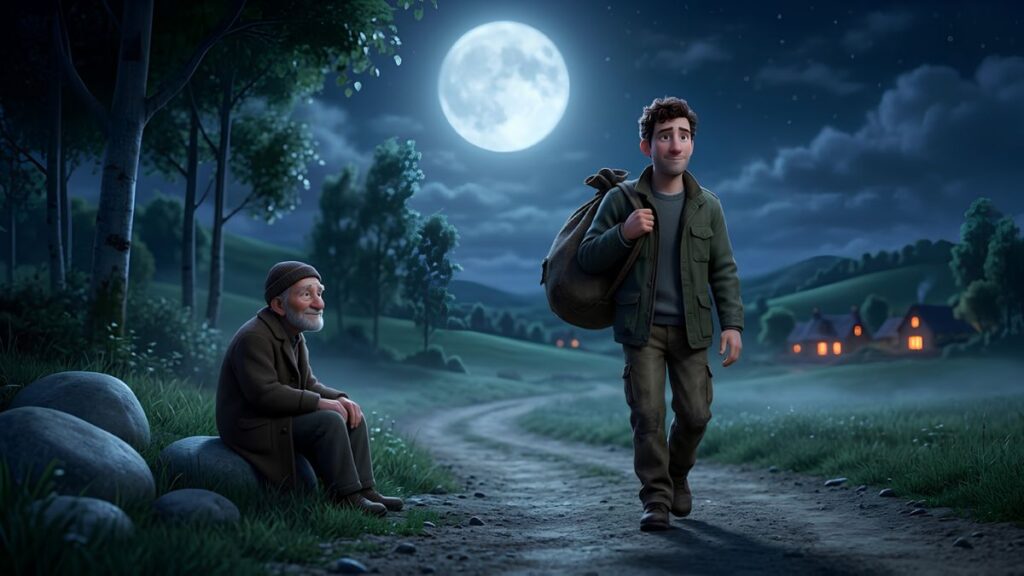
There was once a man named Elias who lived in a small town surrounded by quiet hills.
From the outside, Elias had a good life.
He had a comfortable home, steady work, enough money to meet his needs, and people who cared about him. He was responsible, dependable, and known by everyone as someone who could be trusted.
If a neighbor needed help fixing a fence, Elias would come.
If a friend needed advice, Elias would listen.
If his family needed something, he would do his best to provide it.
He rarely complained.
But there was one thing Elias had never learned to do.
He did not know how to leave tomorrow alone.
Every evening, when the sun disappeared behind the hills and the town became quiet, Elias would sit at his kitchen table and think about the following day.
He would think about the work waiting for him.
He would think about bills.
He would think about decisions he needed to make.
He would wonder whether he had said the right thing to someone.
He would imagine problems that had not happened yet.
And then he would create solutions for those imaginary problems.
By the time he finally went to bed, his body was exhausted, but his mind was still working.
One evening, Elias returned home later than usual.
The streets were quiet.
A few windows in the village still had lights glowing behind their curtains, but most of the houses had already settled into the night.
Elias entered his home, placed his keys on the table, and sat down.
He looked at the clock.
Tomorrow was going to be difficult.
He had an important meeting.
There was a repair he needed to arrange.
He needed to call his brother.
He needed to remember an upcoming payment.
He also had an unfinished task at work.
As he thought about each responsibility, another appeared.
Then another.
Soon, the entire next day seemed to be sitting on his shoulders.
Elias sighed.
“I wish I could finish tomorrow before tomorrow arrives,” he whispered.
He stood up and walked toward the bedroom.
But he stopped near the window.
Outside, the moon was bright above the hills.
The road beyond his house was almost empty.
For reasons he could not explain, Elias decided to take a walk.
He put on his coat and stepped outside.
The night air was cool.
The town was quiet enough that he could hear the leaves moving gently in the trees.
Elias walked slowly along the road leading toward the hills.
He had walked this road many times during the day, but it looked different at night.
There was no traffic.
No noise from shops.
No people rushing from one place to another.
Only the soft sound of his footsteps.
After walking for some time, Elias noticed a small figure sitting beside the road.
It was an old traveler.
The man wore a simple brown coat and had a small wooden walking stick resting beside him.
A large cloth bag sat on the ground near his feet.
Elias stopped.
“Are you all right?” he asked.
The old man smiled.
“I am fine.”
“Are you waiting for someone?”
“No.”
“Then why are you sitting here?”
The traveler looked toward the hills.
“I was resting.”
Elias nodded.
He was about to continue walking when the old man looked at him carefully.
“You seem tired.”
“I am.”
“You have been walking far?”
Elias shook his head.
“Not tonight.”
The old man smiled.
“Then perhaps you are tired from carrying something else.”
Elias looked at the traveler.
“What do you mean?”
The old man tapped the cloth bag beside him.
“I have traveled many roads. I have learned that people often carry things that cannot be seen.”
Elias smiled politely.
“I suppose I am carrying too many responsibilities.”
“Perhaps.”
The old man opened his bag.
Inside were several stones.
Large stones.
Small stones.
Smooth stones.
Rough stones.
Elias stared at them.
“What are those?”
“Worries.”
Elias laughed softly.
“Those are stones.”
“Today, yes.”
The old man picked up a small stone.
“This one is something that happened yesterday.”
He placed it in his palm.
“This one is something I am afraid might happen tomorrow.”
He picked up another.
“And this one is something I cannot control.”
Elias looked at the bag.
“Why do you carry them?”
The old man smiled.
“I don’t anymore.”
He turned the bag upside down.
The stones fell onto the ground.
Elias watched them roll across the dirt.
“Then why keep the bag?”
“To remember what I used to do.”
For a moment, neither man spoke.
The moonlight rested softly on the road.
Elias finally said, “I think I understand.”
The old traveler shook his head.
“Understanding is easy. Putting it into practice is harder.”
Elias smiled.
“That sounds true.”
The old man picked up one of the stones.
“Tell me, what are you worried about tonight?”
Elias began listing his concerns.
The meeting tomorrow.
The unfinished work.
The payment.
His brother.
A decision he needed to make.
Several things he had said that week.
The old man listened without interrupting.
When Elias finished, the traveler asked, “Which of these problems can you solve tonight?”
Elias thought about it.
“None of them.”
“Which can you solve tomorrow?”
“Some of them.”
“And which cannot be controlled by you at all?”
Elias became quiet.
He realized that several of his worries belonged in that final group.
The old man handed him the stone.
“Then why carry them tonight?”
Elias looked down at it.
He had no answer.
The traveler pointed toward the hills.
“Tomorrow has its own road. Let tomorrow walk it when it arrives.”
Elias smiled.
“You make it sound simple.”
“It is simple.”
“Is it easy?”
The old man laughed.
“No.”
They both smiled.
Elias sat beside him for a while.
They watched the moon move slowly across the sky.
For the first time in many nights, Elias was not thinking about what came next.
He was simply sitting.
Listening to the wind.
Feeling the cool air.
Watching the trees move.
After a while, he stood.
“Thank you.”
The traveler nodded.
“Before you go, leave one stone here.”
Elias looked around.
“There are no stones in my hands.”
The old man pointed toward Elias’s chest.
“Not there.”
Elias understood.
He closed his eyes.
He thought about tomorrow’s meeting.
He pictured himself sitting at the table.
He imagined doing his best.
Then he let the thought go.
He thought about the unfinished work.
He reminded himself that he could continue it tomorrow.
Then he let that thought go too.
He thought about the things he could not control.
He took a slow breath.
And let those go as well.
When he opened his eyes, nothing in the world had changed.
The meeting still existed.
The work was still unfinished.
The bills still needed to be paid.
Tomorrow was still coming.
But something inside Elias felt different.
The weight had become smaller.
He thanked the traveler again and began walking home.
This time, he walked slowly.
He noticed the moon.
He noticed the sound of his shoes against the road.
He noticed the smell of grass after the evening dew.
He realized that he had spent so many nights preparing for tomorrow that he had forgotten to experience today.
When Elias reached his house, he turned toward the hills.
The traveler was gone.
Only a few small stones remained beside the road.
Elias smiled.
He entered his home.
Instead of returning to the kitchen table to make another list, he simply washed his face, changed into comfortable clothes, and went to bed.
For a moment, the familiar thoughts returned.
The meeting.
The work.
The payment.
Tomorrow.
But this time Elias whispered to himself:
“Tomorrow has not arrived yet.”
He took a slow breath.
“It can wait.”
Another breath.
“I have done what I can for today.”
He closed his eyes.
The house was quiet.
Outside, the wind moved gently through the trees.
For the first time in a long while, Elias did not try to solve tomorrow.
He allowed tomorrow to remain where it belonged.
In the future.
And he allowed himself to remain where he belonged.
In the present.
Morning eventually came.
The sun rose over the hills.
Elias woke up.
The problems were still there.
But they no longer felt as large as they had the night before.
He got dressed, ate breakfast, and began his day.
The important meeting went reasonably well.
The unfinished work took time, but he completed it.
The payment was handled.
His brother called him in the afternoon.
Nothing had been perfect.
But nothing had needed to be perfect.
That evening, Elias returned home.
He sat at his kitchen table.
For a moment, he almost began thinking about tomorrow again.
Then he remembered the traveler.
He smiled.
He looked through the window at the darkening sky.
Tomorrow would come.
It always did.
But tonight belonged to him.
So he closed his notebook.
He put away his work.
And when the evening became quiet, Elias went for another walk.
He did not find the old traveler.
But he no longer needed to.
The lesson had stayed with him.
He had finally understood something that had been true all along:
You can prepare for tomorrow without living there.
You can care about the future without carrying it on your back.
You can make plans without spending tonight worrying about whether they will work.
And sometimes, the most responsible thing you can do at the end of a difficult day is simply rest.
Because tomorrow needs your attention when it arrives.
Tonight needs your peace.
Moral of the Story
You cannot carry tomorrow before it arrives. Do what you can today, release what you cannot control, and allow yourself to rest.
Reflection Before Sleep
As you finish this story, think about what you may be carrying tonight.
Perhaps there is something you need to do tomorrow.
Perhaps there is a decision you have not made.
Perhaps there is a problem you cannot solve yet.
You do not need to forget these things.
You only need to remember that they do not have to be solved at this exact moment.
Tomorrow will arrive when it is ready.
For tonight, you have permission to put the weight down.
Take a slow breath.
Let your shoulders relax.
Let the unfinished things remain unfinished.
You can return to them when morning comes.
For now, there is nothing you need to chase.
Nothing you need to prove.
Nothing you need to solve.
Just rest.
The Fisherman Who Stopped Chasing the Big Catch

On the edge of a quiet village, where the green hills gently descended toward a wide blue lake, there lived a fisherman named Samuel.
Samuel had spent most of his adult life beside the water.
He knew the lake better than almost anyone.
He knew where the reeds grew thickest.
He knew which parts of the shoreline became shallow after the summer rains.
He knew where the fish gathered in the early morning and where they disappeared when the sun climbed high.
He could tell when rain was approaching simply by looking at the clouds.
He could recognize different birds by their calls.
He knew how the wind changed before a storm.
And yet, despite knowing the lake so well, Samuel had gradually forgotten how to enjoy it.
When he was younger, fishing had been simple.
He would wake before sunrise, take his old wooden boat onto the water, and spend the morning enjoying the quiet.
Sometimes he caught several fish.
Sometimes he caught only one.
Sometimes he caught nothing.
It never mattered much.
He enjoyed watching the sunrise spread across the lake.
He enjoyed hearing the gentle movement of water against the boat.
He enjoyed the smell of wet earth along the shore.
He enjoyed returning home with his boat and knowing that another peaceful morning had passed.
But as the years went by, something changed.
Samuel became convinced that he needed to catch the biggest fish in the lake.
It began with a story.
An old fisherman had once told him about a huge silver fish that lived in the deepest part of the lake.
The fish was said to be larger than any ordinary catch.
Some villagers claimed they had seen its back breaking the surface.
Others said it was merely a legend.
Samuel became fascinated.
At first, he wanted to catch it for the challenge.
Then he began believing that catching the fish would change his life.
People would respect him.
Other fishermen would speak about him.
His name would become part of the village’s stories.
Perhaps he could sell the fish for a great deal of money.
Perhaps he would finally be known as the greatest fisherman in the region.
The idea grew in his mind.
Soon, ordinary fish no longer seemed important.
If Samuel returned home with ten fish, he barely noticed them.
If another fisherman caught more than he did, Samuel felt irritated.
If he spent an entire morning without catching anything, he considered the day wasted.
The lake that had once brought him peace had become a place where he measured himself.
Every morning, he went out earlier.
Every evening, he stayed later.
He bought stronger fishing lines.
He repaired his boat.
He studied old maps of the lake.
He listened carefully whenever someone mentioned the legendary fish.
His wife, Clara, noticed the change.
One evening, Samuel returned home exhausted.
He placed his fishing equipment near the door and sat heavily at the table.
Clara brought him a cup of tea.
“How was the lake today?” she asked.
“Nothing.”
“Nothing?”
“Not the fish I want.”
Clara smiled gently.
“Did you catch anything?”
“Three fish.”
“Then it wasn’t nothing.”
Samuel shook his head.
“They were small.”
Clara sat across from him.
“You used to be happy when you caught three fish.”
Samuel looked away.
“That was before.”
“Before what?”
“Before I knew there was something bigger out there.”
Clara remained quiet.
She knew that there was no point arguing.
Samuel was not listening to the lake anymore.
He was listening only to the idea inside his own head.
The next morning, Samuel left before sunrise.
The sky was dark when he pushed his boat into the water.
He rowed toward the deepest part of the lake.
The air was cool.
Mist floated above the surface.
For a few minutes, Samuel simply sat in silence.
The world looked beautiful.
Then he remembered why he was there.
He cast his line.
He waited.
Nothing happened.
He moved to another place.
Nothing.
He tried again.
Nothing.
The sun rose.
The mist disappeared.
Birds flew over the water.
A gentle breeze moved across the lake.
Samuel barely noticed.
Hours passed.
He caught two ordinary fish.
He threw them back.
He was not interested.
By afternoon, he was tired.
By evening, he was angry.
He returned home without the fish.
Clara was waiting.
“You were gone all day.”
“I know.”
“Did you catch anything?”
“Nothing worth keeping.”
She looked at him for a moment.
“You used to tell me that the lake always gave you something.”
Samuel frowned.
“What does that mean?”
“It means that sometimes you returned with fish. Sometimes you returned with a beautiful sunrise. Sometimes you returned with a story.”
Samuel said nothing.
Clara placed a bowl of soup on the table.
“Eat.”
That night, Samuel could not sleep.
He thought about the legendary fish.
He imagined its enormous body beneath the dark water.
He imagined catching it.
He imagined the villagers gathering around him.
He imagined people talking about him.
The more he imagined it, the more important it seemed.
The next morning, he returned to the lake.
Then the next.
And the next.
Weeks passed.
The search consumed him.
One morning, Samuel rowed farther than he had ever gone.
He reached a quiet section of the lake surrounded by tall reeds.
There was no one nearby.
He dropped his anchor.
The water was perfectly still.
Samuel cast his line.
Then he waited.
Ten minutes.
Twenty minutes.
An hour.
Nothing.
He leaned back.
The sun was warm.
A dragonfly passed over the water.
Samuel watched it.
For some reason, he smiled.
He had not noticed a dragonfly on the lake in years.
Another one appeared.
Then a second.
The two insects moved across the water as if they had nowhere else to be.
Samuel watched them for several minutes.
Then he heard something.
A soft splash.
He looked toward the reeds.
A family of ducks moved slowly across the lake.
Behind them were several small ducklings.
Samuel watched them disappear into the reeds.
He suddenly realized something.
He had spent years on this lake.
Yet he could not remember the last time he had simply watched it.
He had always been looking for something.
A bigger fish.
A better catch.
A better day.
A better result.
He had been present on the lake, but he had not really been there.
Samuel lowered his fishing rod.
He did not cast again.
Instead, he sat quietly.
The sun moved across the sky.
Clouds appeared.
A gentle breeze began to blow.
The surface of the lake became covered with small ripples.
Samuel listened.
The sound was almost like whispering.
For the first time in years, he felt no need to hurry.
He stayed until sunset.
When he returned to the village, he carried no fish.
Clara saw him walking toward the house.
She looked at his empty basket.
“You caught nothing?”
Samuel smiled.
“Not today.”
She waited.
Then she noticed something different in his face.
“You look happy.”
“I am.”
“What happened?”
Samuel sat down.
“I stopped fishing.”
Clara laughed.
“You stopped fishing?”
“For a while.”
“Why?”
Samuel thought about how to explain it.
“I realized I had been looking so hard for one fish that I stopped seeing the lake.”
Clara smiled.
She understood.
The next morning, Samuel woke before sunrise.
He prepared his boat.
But this time, he did something different.
He packed breakfast.
He brought a small book.
He took his fishing rod, but he did not make catching fish the purpose of the journey.
He rowed slowly onto the lake.
When the sun appeared, he watched it.
When birds flew overhead, he followed them with his eyes.
When the wind changed, he felt it on his face.
And when he caught a fish, he smiled.
When he caught another, he smiled again.
When he caught nothing, he still smiled.
Days became weeks.
Samuel continued fishing.
But his relationship with the lake had changed.
He still had goals.
He still worked.
He still cared about providing for his family.
He had not suddenly abandoned ambition.
He had simply stopped allowing one goal to consume everything else.
One afternoon, Samuel was sitting near the shore repairing his fishing net when a young fisherman approached.
The young man was frustrated.
“I have been fishing all morning,” he said.
Samuel looked up.
“How many fish?”
“Four.”
“And you’re unhappy?”
“I wanted ten.”
Samuel smiled.
“Why?”
“Because ten would make today successful.”
Samuel placed the net down.
“Who told you that?”
The young fisherman shrugged.
“I suppose I did.”
Samuel looked toward the lake.
“Then perhaps you should be careful about the rules you create for yourself.”
The young man sat beside him.
“What do you mean?”
Samuel pointed toward the water.
“Once, I believed that one great catch would make me successful. I spent years chasing it.”
“Did you find it?”
Samuel laughed.
“No.”
“Do you still want it?”
Samuel thought for a moment.
“Sometimes.”
The young fisherman looked surprised.
Samuel continued.
“But now I know that if I catch it, I will still have to go home at the end of the day.”
They both laughed.
The lake remained quiet.
Samuel looked at the horizon.
“There is nothing wrong with wanting something.”
He paused.
“But don’t let what you want become so important that you stop seeing what you already have.”
The young fisherman nodded.
That evening, Samuel returned home with a modest catch.
Clara prepared dinner.
They ate together near the open window.
Outside, the village was quiet.
After dinner, Samuel stepped outside.
The sky was filled with stars.
He looked toward the lake.
For a moment, he thought about the legendary fish.
Perhaps it existed.
Perhaps it did not.
Perhaps someday he would catch it.
Perhaps he never would.
For the first time, he realized that he was comfortable with either possibility.
The lake had given him something better than the fish he had spent years chasing.
It had given him back his attention.
It had taught him to notice the sunrise.
To hear the birds.
To appreciate a simple meal.
To enjoy a quiet evening.
To come home without measuring the day only by what he had achieved.
Years later, Samuel was sitting on the same shore when a group of young fishermen gathered around him.
One of them asked:
“Did you ever catch the great fish?”
Samuel smiled.
“No.”
They looked disappointed.
“Then why did you stop searching?”
Samuel looked toward the water.
“Because I finally understood that I had already found what I was looking for.”
“What?”
He smiled.
“The lake.”
The young fishermen were silent.
Samuel watched the sunset.
The sky slowly turned gold, then orange, then deep blue.
The water reflected the changing colors.
He sat quietly and listened.
There was no great discovery.
No enormous fish.
No crowd cheering his name.
Only a peaceful evening.
And somehow, that was enough.
Moral of the Story
Do not become so focused on chasing something bigger that you fail to appreciate the life already around you. Ambition can guide you forward, but gratitude allows you to enjoy the journey.
Reflection Before Sleep
As you finish this story, think about what you may be chasing right now.
Perhaps it is a career goal.
More money.
Recognition.
A relationship.
A better home.
A particular achievement.
There is nothing wrong with wanting these things.
But ask yourself whether the pursuit has made you overlook what is already present in your life.
Maybe there is someone you should appreciate.
Maybe there is a simple moment you have stopped noticing.
Maybe you have been measuring every day by what you achieved instead of how you experienced it.
You do not have to abandon your goals.
You only need to remember to look around while pursuing them.
The next sunrise does not need to be earned.
The evening sky does not need to be achieved.
A quiet conversation does not need to appear on a list of accomplishments.
Some of life’s best moments arrive without asking anything from you.
So tonight, let yourself stop chasing for a while.
Let the goals wait.
Let tomorrow’s ambitions remain tomorrow’s work.
For now, simply be where you are.
The journey is already happening.
The Lantern at the End of the Road
At the far end of a quiet village, where the last houses slowly gave way to fields and wooded hills, there stood an old stone road.
The road was not particularly wide.
It had no bright signs.
There were no shops along it and very few houses.
During the day, hardly anyone paid attention to it.
But at night, the road became important.
It was the road travelers used when they were returning home from neighboring villages.
And at the very end of that road stood an old lantern.
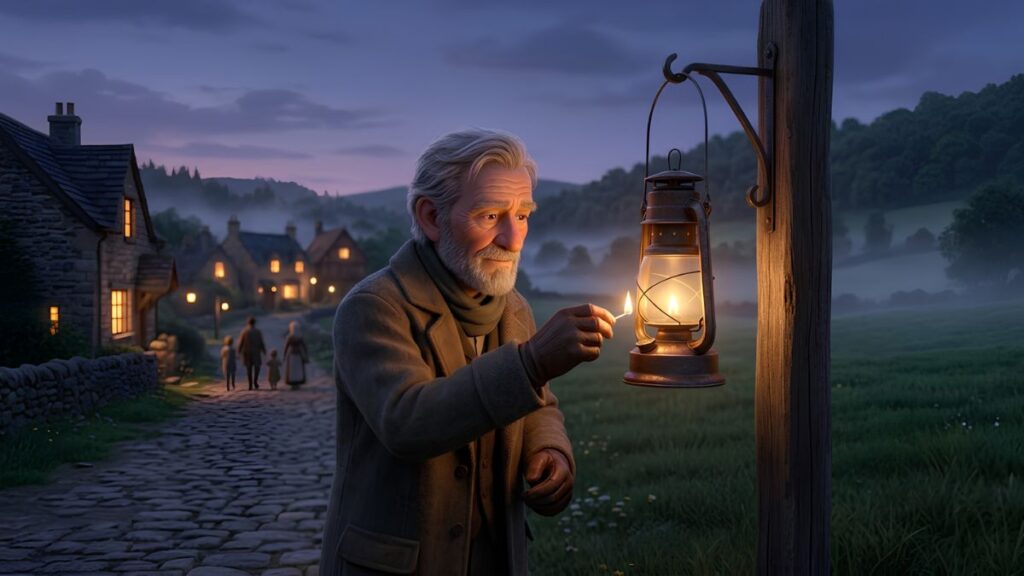
Every evening, just before the sun disappeared, a man named Thomas walked to the lantern and lit it.
Thomas had been doing this for more than twenty years.
He was not the mayor.
He was not wealthy.
He did not own a large house.
He was simply the village lantern keeper.
His work was quiet.
Almost nobody noticed him doing it.
Every evening, he carried a small oil container up the road, unlocked the metal door of the lantern, trimmed the wick, filled the oil, and carefully lit the flame.
Then he would stand there for a moment to make sure the light was burning properly.
Once the flame was steady, he would walk home.
The next evening, he would do it again.
And the evening after that.
And the evening after that.
Thomas had never expected applause.
When he first started the job, he had actually enjoyed it.
He liked the quiet walk at sunset.
He liked watching the fields change color as the evening arrived.
He liked knowing that someone traveling late at night would see the light and know that the village was near.
But as the years passed, Thomas began to wonder whether his work really mattered.
People rarely mentioned the lantern.
No one came to thank him.
No one noticed when he replaced the wick.
No one asked whether the oil had been filled.
Most villagers simply assumed that the lantern would be there.
One evening, Thomas returned home after lighting it.
His daughter, Anna, was sitting by the window.
She noticed that he looked tired.
“Is something wrong?” she asked.
Thomas removed his coat.
“I was thinking about the lantern.”
Anna smiled.
“You think about that lantern every evening.”
“Yes.”
“What were you thinking?”
Thomas sat down.
“I don’t know if it matters anymore.”
Anna looked surprised.
“Of course it matters.”
“Does anyone even notice it?”
She thought for a moment.
“Perhaps not.”
Thomas sighed.
“Then what am I doing?”
Anna did not immediately answer.
She knew her father.
When he asked a question like that, he was not looking for a simple reply.
He was tired.
Not from the work itself.
From feeling invisible.
“You know,” Anna said, “some things are important precisely because people don’t have to think about them.”
Thomas looked at her.
“What does that mean?”
She smiled.
“It means that when everything works, nobody notices. But when something stops working, everyone notices.”
Thomas laughed quietly.
“That doesn’t make me feel better.”
“Maybe it will someday.”
The next evening, Thomas walked to the lantern again.
He carried the oil.
He climbed the small stone steps.
He opened the metal door.
He cleaned the glass.
He trimmed the wick.
Then he lit the flame.
He watched it flicker.
For a moment, he wondered how many people had seen that light over the years.
Hundreds?
Thousands?
He would never know.
He closed the door and started walking home.
Halfway down the road, he heard footsteps behind him.
Thomas turned.
A young man was approaching.
The man was carrying a travel bag.
“Excuse me,” the traveler called.
Thomas stopped.
“Yes?”
“Is this the road to the village?”
Thomas pointed toward the lights in the distance.
“Yes. You are almost there.”
The traveler looked relieved.
“I saw your lantern from the hill.”
Thomas looked back at it.
“You did?”
“Yes.”
The traveler smiled.
“I wasn’t sure which road to take. Then I saw the light.”
Thomas nodded.
“Good.”
The traveler thanked him and continued toward the village.
Thomas stood still for a moment.
It was the first time in years that someone had told him directly that the lantern had helped.
He smiled.
Then he continued home.
The following weeks passed quietly.
Thomas continued his routine.
But now, every once in a while, he noticed travelers looking toward the lantern.
He began paying attention.
One evening, an elderly couple arrived just before sunset.
Another evening, a young family returned from a neighboring town.
A farmer arrived late after taking his animals to market.
A young woman traveling alone saw the lantern and knew she was close to home.
None of them knew Thomas was responsible for the light.
None of them knew how many evenings he had walked through the cold to keep it burning.
And Thomas began to understand something.
They did not need to know.
The lantern was not meant to make him famous.
It was meant to help people find their way.
For several years, this realization brought him peace.
Then, one autumn evening, a strong storm arrived.
The wind began before sunset.
Clouds covered the sky.
Rain fell heavily.
Thomas looked out his window.
The storm was becoming stronger.
Anna came into the room.
“You shouldn’t go tonight.”
Thomas looked toward the road.
“The lantern needs to be lit.”
“The wind is dangerous.”
“I will be careful.”
“Father.”
Thomas smiled.
“I won’t stay long.”
He put on his coat.
The rain was cold when he stepped outside.
He walked slowly.
The road was slippery.
Branches moved violently in the wind.
Thomas held his lantern equipment tightly.
When he reached the old light, he opened the metal door.
The wind immediately blew out the small flame he was trying to light.
Thomas tried again.
Again, the wind extinguished it.
He protected the wick with his hands.
He bent closer.
After several attempts, the flame finally caught.
Thomas closed the glass door.
The lantern began to glow.
Its warm light stood against the darkness.
Thomas looked at it.
For a moment, he felt proud.
Then he began walking home.
He had gone only a short distance when he heard a strange sound.
A horse.
Thomas turned.
A small carriage was struggling along the road.
The driver was trying to see through the heavy rain.
The horse became frightened.
The carriage stopped.
Thomas immediately ran toward them.
“Are you all right?”
The driver shouted that they were lost.
Thomas pointed toward the lantern.
“Follow the light!”
The driver looked up.
The lantern was barely visible through the rain.
But it was there.
Thomas guided them down the road.
Eventually, they reached the village.
The travelers were safe.
The driver thanked Thomas repeatedly.
“You saved us from spending the night in the storm.”
Thomas shook his head.
“I only lit a lantern.”
The driver smiled.
“Sometimes that’s enough.”
Thomas returned home soaked and exhausted.
Anna was waiting at the door.
She had been worried.
When she saw him, she hugged him.
“You’re never doing that again,” she said.
Thomas laughed.
“Probably not.”
That night, he slept deeply.
The next morning, something unexpected happened.
Several villagers came to his house.
Thomas opened the door.
There stood the traveler he had helped weeks earlier.
Behind him were several other people.
The elderly couple.
The farmer.
The young woman.
The family.
Thomas stared at them.
“What is happening?”
The traveler smiled.
“We wanted to thank you.”
“For what?”
“The lantern.”
Thomas looked confused.
The elderly woman stepped forward.
“My husband and I once became lost on the road. We saw the light.”
The farmer nodded.
“It helped me find my way home after a late trip.”
The young woman smiled.
“I was traveling alone one evening. Seeing the lantern made me feel safe.”
The young father lifted his little daughter into his arms.
“She always looks for the lantern when we come home.”
Thomas looked at the group.
He suddenly realized how many lives had quietly crossed the path of that light.
The lantern had been doing its work all along.
He simply had not seen the results.
Thomas felt his eyes becoming wet.
He looked down.
“I thought nobody noticed.”
The traveler smiled.
“Most of us did not know who lit it.”
Thomas laughed softly.
“Then how did you find me?”
The farmer raised his hand.
“I asked.”
Everyone laughed.
That evening, Thomas walked toward the lantern differently.
The road looked the same.
The fields looked the same.
The hills were the same.
But Thomas felt different.
He stopped halfway and looked at the village behind him.
Warm lights glowed from windows.
Families were having dinner.
Children were getting ready for bed.
People were returning home.
He looked toward the lantern.
Its light reached into the darkness.
Thomas understood something he would remember for the rest of his life.
Not every meaningful thing receives attention.
Some of the most valuable things in life happen quietly.
A father working long hours so his family can feel secure.
A mother preparing a meal when nobody thinks about who made it.
A friend listening when someone needs to speak.
A person keeping a promise even when nobody is watching.
A worker doing his job carefully even when no one praises him.
These things may seem small.
But they create safety, comfort, and trust.
Thomas had spent years believing that his work mattered only if someone noticed it.
Now he understood that usefulness does not depend on recognition.
The lantern did not become brighter when people praised it.
It simply continued to shine.
Years passed.
Thomas eventually became too old to climb the steps of the lantern safely.
One evening, he stood beside the road with Anna.
She had grown older too.
She looked at the lantern.
“Do you miss lighting it?”
Thomas smiled.
“Sometimes.”
“Do you miss being the lantern keeper?”
He thought about it.
“I miss the walks.”
Anna smiled.
“Then perhaps we can walk together.”
They stood quietly beneath the evening sky.
The lantern burned above them.
A young man was now responsible for maintaining it.
Thomas had taught him everything.
The young man checked the oil.
He cleaned the glass.
He trimmed the wick.
He lit it every evening.
Thomas watched him from a distance.
The young man never complained.
Perhaps, one day, he would.
Perhaps one day he would wonder whether anyone noticed.
And perhaps someone would eventually remind him that the light did not need applause.
Thomas turned toward home.
The road was quiet.
The sky was dark.
But the lantern continued to glow behind him.
He smiled.
For the first time, he did not wonder whether his years of work had mattered.
He knew.
Not because someone had written his name in a book.
Not because a crowd had gathered to celebrate him.
Not because he had become famous.
He knew because people had found their way home.
And sometimes, that is enough.
Moral of the Story
Your efforts do not become meaningful only when someone notices them. Some of the most important things you do may quietly make another person’s life safer, easier, or happier.
Reflection Before Sleep
Think about the quiet things you do.
Perhaps there is work you complete every day that nobody mentions.
Perhaps you support someone without expecting recognition.
Perhaps you have been there for a friend, cared for your family, kept a promise, or simply done the right thing when no one was watching.
You may sometimes wonder whether your efforts matter.
Tonight, remember Thomas and his lantern.
The light did not ask who was watching.
It simply continued to shine.
You may never know every person your kindness has helped.
You may never hear every thank-you you deserve.
You may never see all the ways your actions have made a difference.
That does not mean the difference was not real.
So if today felt unnoticed, do not let that convince you that it was meaningless.
Your quiet efforts may be lighting a road for someone else.
And somewhere, someone may be finding their way because of a light you chose to keep burning.
The Old Tree That Never Hurries
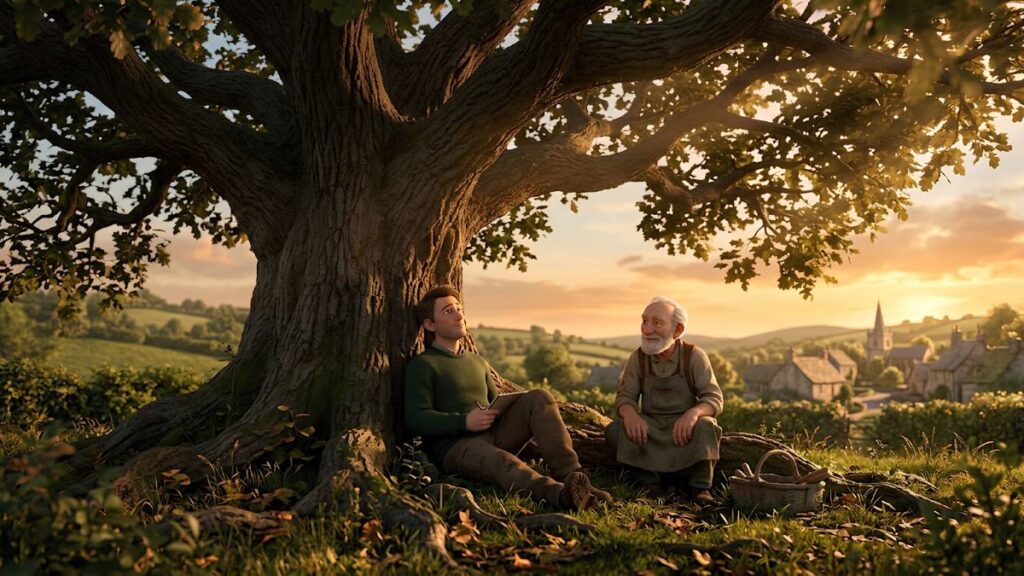
At the edge of a small village, where the houses slowly gave way to open fields, there stood an enormous old tree.
Nobody knew exactly how old it was.
The oldest people in the village remembered seeing it when they were children.
Their parents had remembered it too.
Some believed it had stood there for more than a hundred years.
Its trunk was wide enough that three grown men could hold hands around it and still not completely encircle it.
Its branches stretched over the grass like enormous arms.
During summer, its leaves created a cool patch of shade where villagers often rested.
During autumn, golden leaves covered the ground around its roots.
In winter, its branches stood quietly against the gray sky.
And in spring, small green leaves appeared again.
The tree never seemed to hurry.
It simply grew.
Near that tree lived a young man named Daniel.
Daniel was twenty-nine years old, ambitious, hardworking, and constantly dissatisfied with how slowly his life seemed to be moving.
He had spent years trying to build a successful career.
He worked long hours.
He learned new skills.
He took additional responsibilities.
He saved money whenever he could.
He made plans for the future.
But no matter how much progress he made, Daniel always felt that he was behind.
Someone else was earning more.
Someone else had purchased a better home.
Someone else had started a successful business.
Someone else seemed to know exactly what they were doing.
Whenever Daniel looked at other people’s lives, his own seemed smaller.
He wanted everything to happen quickly.
He wanted success now.
He wanted financial security now.
He wanted recognition now.
He wanted to know exactly where his life would be in five years.
One afternoon, after a particularly difficult day at work, Daniel walked toward the old tree.
He often went there when he needed to think.
He sat beneath its branches and leaned against the trunk.
“I don’t understand,” he said quietly.
The tree, of course, said nothing.
Daniel continued.
“I work hard.”
A breeze moved through the leaves.
“I keep trying.”
The branches swayed gently.
“I do everything people tell me to do.”
A few leaves fell beside him.
“And still, I feel like I am not getting anywhere.”
Daniel looked up at the enormous branches.
He suddenly felt irritated.
“You’ve been standing here forever,” he said.
The tree remained silent.
“You don’t have to worry about anything.”
The wind moved through its leaves.
“You don’t have goals.”
The tree continued to stand.
“You don’t have to compete with anyone.”
Nothing changed.
Daniel sighed.
“I wish life were that simple.”
He remained beneath the tree until sunset.
Then he returned home.
The next morning, he woke early and returned to work.
He continued pushing himself.
Months passed.
Daniel’s career improved slightly.
He received a better position.
His income increased.
People complimented his work.
Yet he still felt behind.
Now he compared himself with people who were more successful than before.
He had reached one goal, only to discover another waiting ahead.
One evening, Daniel returned to the tree.
An elderly gardener named Samuel was sitting nearby.
Samuel had lived in the village for many years.
He knew almost everyone.
Daniel sat beside him.
“You come here often,” Samuel said.
Daniel nodded.
“It helps me think.”
Samuel smiled.
“Or perhaps it helps you stop thinking.”
Daniel laughed.
“Maybe both.”
Samuel looked at the tree.
“Do you know why this tree is still standing?”
“Because it has strong roots?”
“That’s part of it.”
“Because it gets enough rain?”
“That too.”
Daniel waited.
Samuel pointed toward the branches.
“It does not try to become a tree overnight.”
Daniel smiled.
“I don’t think it has a choice.”
Samuel laughed.
“Neither do you.”
Daniel looked at him.
“What do you mean?”
“You are trying to force your life to grow faster than it can.”
Daniel became quiet.
“I don’t have time to wait.”
Samuel looked at him calmly.
“Everyone says that.”
“Because it is true.”
“Is it?”
Daniel frowned.
Samuel picked up a small branch that had fallen to the ground.
“Look at this.”
Daniel looked at it.
“Do you know how long it took this tree to grow that branch?”
“No.”
“Neither do I.”
Samuel smiled.
“But it happened one season at a time.”
Daniel looked at the tree.
Samuel continued.
“You see the tree today. You see its size. Its strength. Its shade.”
He tapped the ground.
“But you do not see the years when it was small.”
Daniel thought about that.
“When it was young, perhaps someone thought it was too small.”
“Maybe.”
“Perhaps someone looked at it and wondered whether it would ever become large.”
“Probably.”
Samuel smiled.
“Yet it kept growing.”
Daniel looked down.
“I wish my life felt like that.”
“It is.”
“It doesn’t.”
“Because you keep measuring the distance instead of noticing the growth.”
Those words stayed with Daniel.
That night, he thought about everything he had accomplished.
He realized that he rarely celebrated anything.
When he had learned something new, he immediately moved to the next goal.
When he earned more money, he wanted more.
When he received praise, he wondered when he would receive a promotion.
When he solved a problem, he immediately searched for another.
He had been moving forward.
But he had never allowed himself to feel that he was moving forward.
The following morning, Daniel changed something small.
Instead of beginning his day by checking what other people had achieved, he wrote down three things he had improved during the previous year.
He had become more confident.
He had learned new skills.
He had become better at managing his money.
The list was longer than he expected.
Daniel stared at it.
For the first time, he could see his own growth.
It was not dramatic.
There had been no single moment when everything changed.
His progress had happened quietly.
A little knowledge here.
A little experience there.
A difficult lesson.
A new habit.
A mistake.
Another attempt.
Just like the tree.
Weeks passed.
Daniel continued working toward his goals.
But he stopped expecting instant results.
He still wanted success.
He still worked hard.
But he learned to appreciate gradual progress.
One evening, he returned to the old tree.
Samuel was there again.
Daniel sat beside him.
“I think I understand now.”
Samuel smiled.
“That’s dangerous.”
Daniel laughed.
“Why?”
“Because whenever we think we understand everything, life usually teaches us something else.”
Daniel smiled.
“Fair enough.”
He looked at the tree.
“I used to think that being successful meant getting where I wanted to go quickly.”
“And now?”
“Now I think it means becoming someone who can handle the journey.”
Samuel nodded.
“Better.”
Daniel leaned against the tree.
The evening was quiet.
A few birds moved through the branches.
The village behind them became golden in the setting sun.
Daniel noticed something.
The tree had not changed.
It had not suddenly become larger.
It had not produced a new branch in front of him.
Yet it looked different.
Or perhaps Daniel looked different.
He began visiting the tree regularly.
Sometimes he brought a book.
Sometimes he brought tea.
Sometimes he simply sat there.
He learned to enjoy doing nothing for a while.
This was difficult at first.
Daniel had always believed that every minute needed to be productive.
But gradually, he discovered that rest was not the opposite of progress.
Sometimes rest allowed him to return to his work with a clearer mind.
Years passed.
Daniel’s career continued to develop.
He eventually started a small business.
It took longer than he expected.
There were setbacks.
There were months when he wondered whether he had made the wrong decision.
There were days when he wanted to give up.
But he remembered the tree.
He reminded himself that roots grow before branches become visible.
He continued.
Slowly.
Patiently.
One season at a time.
Eventually, his business became successful.
People congratulated him.
Some asked how he had managed to achieve so much.
Daniel often smiled.
The answer was not exciting.
There had been no secret.
No miracle.
No shortcut.
He had simply continued.
One spring morning, Daniel returned to the old tree.
He was no longer the restless young man who had once complained beneath its branches.
He was older now.
More patient.
More comfortable with uncertainty.
He stood beneath the tree and looked upward.
The branches were enormous.
New leaves were beginning to appear.
Daniel smiled.
He placed his hand against the trunk.
“Thank you,” he whispered.
A gentle breeze moved through the branches.
For a moment, he imagined that the tree was answering.
Not with words.
With silence.
With patience.
With its very existence.
The tree had never hurried.
It had never compared itself with another tree.
It had never looked at a younger tree and worried about being behind.
It had simply grown according to its nature.
Daniel understood that his life could be the same.
He did not need to become someone else.
He did not need to reach every goal immediately.
He did not need to measure his worth against another person’s timeline.
He only needed to keep growing.
Slowly.
Steadily.
Honestly.
One day at a time.
Years later, Daniel became an old man himself.
The village had changed.
New houses appeared.
Old houses disappeared.
The road was wider.
The fields were smaller.
But the tree remained.
Daniel sometimes sat beneath it with his grandchildren.
One afternoon, his grandson looked up at the enormous branches.
“Grandfather, how old is this tree?”
Daniel smiled.
“Very old.”
“How did it grow so big?”
Daniel looked at the tree.
“One year at a time.”
The boy thought about that.
“Couldn’t it grow faster?”
Daniel laughed.
“No.”
“Why?”
“Because that is not how trees grow.”
The boy looked disappointed.
Daniel smiled.
“And perhaps that is why trees have something to teach us.”
“What?”
Daniel pointed toward the branches.
“Some things become strong because they are given enough time.”
The boy leaned against him.
They sat quietly.
The afternoon breeze moved through the leaves.
Daniel closed his eyes.
He remembered the younger version of himself sitting beneath the same tree, frustrated because his life was not moving quickly enough.
He wished he could go back and speak to that young man.
He would tell him:
You are not behind.
You are growing.
You simply cannot see all of it yet.
Keep going.
Keep learning.
Keep trying.
And when you need to rest, rest.
The tree had been right all along.
Growth did not need to be hurried.
That evening, Daniel walked home slowly.
He did not think about what he needed to accomplish tomorrow.
He did not compare his life with anyone else’s.
He simply enjoyed the evening.
The sun was setting.
Birds were returning to their nests.
The village was becoming quiet.
Daniel smiled.
He had spent much of his life trying to become successful quickly.
Eventually, he learned something much more valuable.
A meaningful life does not need to be rushed.
It needs to be lived.
One day.
One lesson.
One step.
One season at a time.
Moral of the Story
You do not have to grow as quickly as someone else. Meaningful progress often happens quietly, one small step at a time. Give yourself time to develop, learn, and become the person you are meant to be.
Reflection Before Sleep
Think about where you are in your own journey.
Perhaps you feel behind.
Maybe you compare yourself with people who seem to have achieved more.
Maybe you expected your life to look different by now.
It is easy to see someone else’s finished branch while forgetting that you are still growing your roots.
You may not be able to see all of your progress yet.
The skills you have learned.
The difficult experiences that have strengthened you.
The mistakes that taught you something.
The moments when you chose to continue.
These things are part of your growth.
You do not need to become everything tonight.
You do not even need to know exactly where your life will be years from now.
You can simply take the next step when morning comes.
For tonight, let yourself rest.
The tree does not grow while worrying about how tall it should be tomorrow.
It simply stands beneath the sky and continues becoming what it already has the potential to become.
You can do the same.
The King Who Wanted One Peaceful Night

Long ago, in a prosperous kingdom surrounded by green hills and quiet forests, there lived a king named Adrian.
King Adrian had everything most people could imagine wanting.
His palace stood on a hill overlooking the kingdom.
Its walls were made of pale stone, its halls were decorated with beautiful paintings, and its gardens stretched farther than anyone could walk in a single afternoon.
There were servants to prepare his meals.
Guards protected the gates.
Advisers helped him make decisions.
Messengers brought him news from every corner of the kingdom.
If he wanted something, someone usually found a way to provide it.
And yet, there was one thing King Adrian could not command.
Sleep.
Every night, when the palace became quiet, Adrian would enter his enormous bedroom and lie down beneath soft blankets.
The room was comfortable.
The temperature was perfect.
The curtains were thick enough to block the moonlight.
The bed was wide and soft.
And still, he could not sleep.
His mind remained awake.
He thought about the kingdom.
Was the harvest going to be good?
Would the neighboring kingdom remain peaceful?
Had the royal treasurer counted the money correctly?
Would the merchants be satisfied?
Was the army prepared?
Had the servants completed their work?
Was there anything he had forgotten?
Every question created another.
Every answer created two more questions.
The king would turn to one side.
Then the other.
He would close his eyes.
Then open them.
Sometimes he would finally fall asleep just before dawn.
By morning, he would feel exhausted.
One morning, after another sleepless night, Adrian summoned his advisers.
“I need help,” he told them.
The advisers looked concerned.
“What is troubling Your Majesty?”
“I cannot sleep.”
One adviser immediately suggested a new mattress.
Another suggested softer pillows.
Another recommended special herbal tea.
A fourth suggested changing the curtains.
The king tried everything.
Nothing worked.
He purchased an expensive bed from another kingdom.
He hired musicians to play soft music.
He ordered servants to keep the palace completely silent after sunset.
He even had his bedroom moved to another part of the palace.
Still, he could not sleep.
One evening, Adrian became frustrated.
“Why is this so difficult?” he asked.
His chief adviser lowered his head.
“We do not know, Your Majesty.”
“Then find someone who does.”
The adviser bowed.
“I will.”
The next morning, a physician came.
The physician examined the king.
He asked questions.
He suggested remedies.
He prescribed a special drink to be taken before bed.
Adrian followed the instructions.
That night, he drank the mixture.
He climbed into bed.
He closed his eyes.
For several minutes, he felt hopeful.
Then his thoughts returned.
What if the harvest failed?
What if someone in the kingdom became angry?
What if tomorrow’s meeting went badly?
What if something happened while he slept?
The king opened his eyes.
He stared at the ceiling.
He whispered:
“Perhaps I need to control everything.”
And that became the beginning of an even bigger problem.
Adrian started giving more orders.
He instructed his guards to patrol throughout the night.
He ordered servants to check every door.
He demanded reports about the kingdom before bedtime.
He asked his advisers to predict possible problems for the next day.
His palace became more organized.
But Adrian became less peaceful.
The more he tried to control everything, the more things he found to worry about.
One evening, after another exhausting day, Adrian walked through his palace garden.
He saw the gardeners working.
One old gardener was quietly trimming the branches of an apple tree.
The gardener’s name was Elias.
He had worked in the palace garden for more than forty years.
Adrian stopped beside him.
“You are still working?”
Elias looked up.
“Only a little, Your Majesty.”
“How can you work so calmly?”
The gardener smiled.
“I have been doing this for a long time.”
Adrian looked at the tree.
“Doesn’t it worry you?”
“About what?”
“Whether the tree will grow properly.”
Elias laughed softly.
“Trees do not listen to worry.”
The king almost smiled.
“You seem unusually peaceful.”
“I suppose I am.”
“Do you sleep well?”
“Very well.”
Adrian became interested.
“How?”
Elias put down his tools.
“I finish my work, go home, eat dinner, and sleep.”
“That is all?”
“That is all.”
The king looked toward the palace.
“I have tried everything.”
Elias nodded.
“Perhaps you have tried too much.”
Adrian frowned.
“What do you mean?”
The old gardener pointed toward the garden.
“Come with me.”
They walked toward a small pond.
The surface of the water was perfectly still.
“Look at the pond,” Elias said.
Adrian looked.
“What do you see?”
“My reflection.”
“Yes.”
Elias picked up a small stone.
He dropped it into the water.
Ripples spread across the surface.
“Now what do you see?”
“Nothing clearly.”
“Why?”
“The water is moving.”
Elias nodded.
“The reflection was always there. You simply could not see it while the water was disturbed.”
Adrian understood the comparison.
“You are saying my mind is like the pond.”
“Perhaps.”
“And I am disturbing it.”
“Perhaps.”
The king looked at him.
“How do I stop?”
Elias smiled.
“You don’t.”
Adrian was confused.
“What?”
“You cannot force the water to become still.”
“Then what can I do?”
“Stop throwing stones into it.”
The king stared at the pond.
For several minutes, neither man spoke.
Eventually Adrian said:
“I think I have been throwing stones all day.”
Elias smiled.
“Most people do.”
That night, Adrian returned to his bedroom.
He did not call his advisers.
He did not request another report.
He did not ask the servants to change anything.
He simply prepared for bed.
When he lay down, his mind immediately began working.
The kingdom.
The harvest.
The treasury.
Tomorrow’s meeting.
He noticed the thoughts.
But instead of following each one, he reminded himself:
“Not tonight.”
Another thought appeared.
He let it pass.
Another appeared.
He let that one pass too.
It was not easy.
His mind had spent years learning to remain busy.
But slowly, the thoughts became less intense.
Eventually, Adrian fell asleep.
He woke before sunrise.
He was surprised.
He had slept for several hours without waking.
He felt different.
Not completely free from worry.
But lighter.
The next night, he tried again.
And the next.
Slowly, Adrian began changing his evenings.
He stopped discussing kingdom problems late at night.
He stopped demanding reports before bed.
He began walking through the garden after dinner.
Sometimes he sat beside the pond.
Sometimes he watched the sunset.
Sometimes he simply listened to the wind.
He discovered that he had spent years treating every problem as though it needed his immediate attention.
But many problems could wait until morning.
Some could not be solved at all.
And some were never truly problems.
They were simply possibilities his mind had imagined.
One evening, Adrian was walking through the garden when an adviser approached him.
“Your Majesty, there is a matter requiring your attention.”
Adrian listened.
It was an important issue.
But it did not need to be solved immediately.
He looked at the setting sun.
“We will discuss it tomorrow.”
The adviser looked surprised.
“Tomorrow?”
“Yes.”
“But shouldn’t we decide tonight?”
“No.”
The adviser hesitated.
Then bowed.
“As you wish.”
Adrian continued walking.
He felt no guilt.
He had finally learned that postponing something until morning was not the same as ignoring it.
Sometimes it was simply choosing the right time to deal with it.
Months passed.
The kingdom remained peaceful.
The harvest was good.
The treasury remained stable.
The guards continued their work.
The advisers continued advising.
Nothing fell apart because the king stopped thinking about the kingdom at bedtime.
In fact, Adrian became a better ruler.
Because he was rested.
He listened more carefully.
He made fewer impulsive decisions.
He became more patient.
He noticed things he had previously overlooked.
People began commenting on the change.
“His Majesty seems calmer.”
“He listens more than before.”
“He no longer becomes angry over small matters.”
“He seems happier.”
Adrian knew why.
He had finally understood something simple.
Peace was not something he could order his kingdom to provide.
Peace was something he needed to make room for.
One evening, years after his first sleepless night, Adrian stood beside the pond with Elias.
The old gardener was now very old.
The king looked at the water.
“Do you remember when you taught me about the pond?”
Elias smiled.
“I remember.”
“I thought you were telling me to stop worrying.”
“I was.”
Adrian laughed.
“It took me a long time to understand.”
“Most useful lessons do.”
The king watched the reflection of the moon in the pond.
“Do you know what I used to think?”
“What?”
“I thought that if I controlled enough things, I would finally feel safe.”
“And now?”
“Now I understand that controlling everything only gave me more things to worry about.”
Elias nodded.
Adrian continued.
“I still worry.”
“Of course.”
“I still have difficult decisions.”
“Of course.”
“I still make mistakes.”
Elias smiled.
“Of course.”
The king laughed.
“But now I know I don’t have to solve everything tonight.”
They stood quietly beside the pond.
The moon reflected perfectly on the still water.
Adrian looked at it.
He remembered the old stone Elias had thrown into the pond years before.
The reflection had not disappeared.
The water had simply been disturbed.
He realized that perhaps peace had always been there too.
He had simply been too busy disturbing his own mind to notice it.
That night, Adrian returned to his room.
He changed into comfortable clothes.
He opened the window slightly.
A cool breeze entered.
The palace was quiet.
He lay down.
For a moment, his mind returned to the kingdom.
There would always be problems.
There would always be decisions.
There would always be something that could be improved.
But none of it required his attention at that exact moment.
He closed his eyes.
“Tomorrow,” he whispered.
And for the first time, the word did not sound like a threat.
It sounded like a promise.
Tomorrow would come.
And when it did, he would meet it rested.
For tonight, he allowed himself to be only a man.
Not a king.
Not a ruler.
Not a decision-maker.
Not someone responsible for everything.
Just a tired man lying beneath the quiet night sky.
And finally, he slept.
Moral of the Story
Peace does not always come from controlling everything around you. Sometimes, peace begins when you accept that some things can wait until tomorrow.
Reflection Before Sleep
Think about how much you are trying to control tonight.
Perhaps you are thinking about work.
Money.
Family.
Your future.
A difficult decision.
Something someone said.
Something you wish you had done differently.
Ask yourself one simple question:
Does this truly need to be solved tonight?
If the answer is no, let it wait.
You are not giving up.
You are not being careless.
You are simply recognizing that your mind also needs rest.
Tomorrow will give you another opportunity to think clearly.
Tonight, you can put the problems down.
Imagine your thoughts as ripples on a quiet pond.
You do not have to force the water to become still.
Simply stop throwing more stones into it.
Let the surface settle.
Let the evening become quiet.
Let tomorrow remain tomorrow.
For now, you can rest.
The Traveler Who Missed the Destination

There was once a traveler named Daniel who had spent most of his life moving toward somewhere else.
He was not unhappy.
At least, that was what he told himself.
He simply believed that happiness was waiting for him at the end of his journey.
When he was young, he dreamed of leaving his small village.
He wanted to see distant cities.
He wanted to build a successful career.
He wanted to earn enough money to live comfortably.
He wanted to own a beautiful home.
He wanted to become someone people respected.
Most of all, he wanted to reach a place where he could finally say:
“I have made it.”
So Daniel made plans.
He saved money.
He studied.
He worked.
He traveled.
Whenever someone asked where he was going, he always had an answer.
“Somewhere better.”
His first journey began when he was twenty-two.
He left his village with a small bag, a little money, and a great deal of ambition.
His mother stood at the edge of the road to say goodbye.
“Do not forget to enjoy the journey,” she told him.
Daniel smiled.
“I will.”
But he did not understand what she meant.
To Daniel, a journey was simply the distance between where he was and where he wanted to be.
The road itself was not important.
The destination was.
He traveled for several days.
On the first morning, he walked through a beautiful forest.
Sunlight passed between the trees.
Birds sang above him.
A small stream ran beside the path.
Daniel noticed these things briefly.
Then he checked his map.
He was still far from the city.
“Keep moving,” he told himself.
He walked faster.
Later that day, he passed a small village.
People were sitting outside their homes.
Children were playing.
An old woman was selling bread near the road.
Daniel stopped long enough to buy a loaf.
The bread was warm.
It smelled wonderful.
The woman smiled.
“Where are you going?”
“To the capital.”
“Why?”
“To build a better life.”
The woman nodded.
“Good luck.”
Daniel thanked her and continued.
He did not notice that she had given him an extra piece of bread.
He was already thinking about the city.
Months passed.
Daniel reached the capital.
It was larger than he had imagined.
There were tall buildings, busy markets, crowded streets, and people from many different places.
He found work.
Then he found better work.
Then better still.
He earned more money.
He moved into a nicer home.
He bought better clothes.
He made new friends.
But he was still not satisfied.
He told himself:
“Once I earn this much, I will be happy.”
He reached the amount.
Then he wanted more.
“Once I own a home, I will feel successful.”
He bought a home.
Then he wanted a larger one.
“Once I become respected in my profession, I will finally relax.”
He achieved recognition.
Then he found someone more successful.
So he worked harder.
Daniel’s life became a series of destinations.
Each time he arrived, he immediately chose another place to go.
Years passed.
One evening, an old friend asked him:
“When will you stop?”
Daniel laughed.
“Stop what?”
“Chasing.”
“I am not chasing anything.”
His friend smiled.
“You are always going somewhere.”
Daniel looked offended.
“That’s because I have goals.”
“Goals are good.”
“Then what’s the problem?”
“The problem is that you never seem to arrive.”
Daniel had no answer.
That night, he sat alone in his apartment.
He looked around.
He had everything he had once dreamed of.
Money.
A comfortable home.
A respected career.
A good car.
Friends.
Yet he felt strangely tired.
He remembered his mother’s words.
“Do not forget to enjoy the journey.”
For the first time, he wondered whether he had.
A few weeks later, Daniel decided to take a long trip.
He wanted to visit a distant coastal town he had heard about when he was young.
He planned everything carefully.
He booked his accommodation.
He prepared his luggage.
He checked the route.
Then he left.
This time, however, something was different.
Daniel decided he would not rush.
He would travel slowly.
He would stop whenever he wanted.
He would take roads that looked interesting.
He would speak with strangers.
He would watch the scenery.
At first, this felt uncomfortable.
He was used to schedules.
He was used to measuring progress.
He was used to asking:
“How much farther?”
Now there was no hurry.
On the first afternoon, Daniel stopped beside a river.
An old wooden bridge crossed the water.
He sat on the bridge and watched the current.
A fisherman nearby was repairing his net.
“You traveling somewhere?” the fisherman asked.
“Yes.”
“Far?”
“Very.”
The fisherman smiled.
“Then you have plenty of time.”
Daniel laughed.
“That’s what I’m hoping.”
They spoke for a while.
The fisherman told him about the river.
He explained how the water changed after the rains.
He told Daniel about the best time to fish.
He spoke about his family.
Daniel listened.
When the conversation ended, Daniel thanked him.
As he walked away, he realized something.
He had spent years traveling without really speaking to the people he met.
He had been too focused on reaching the next place.
The next morning, Daniel stopped at a small village.
He ate breakfast at a family-owned café.
The owner was an elderly man who prepared fresh bread every morning.
Daniel sat outside.
He watched people begin their day.
A farmer walked past.
Children carried school bags.
A woman watered flowers outside her house.
A dog slept beneath a bench.
Nothing remarkable happened.
And yet Daniel felt peaceful.
He finished his breakfast slowly.
For once, he did not check the time.
He did not calculate how far he still had to travel.
He simply sat.
That afternoon, he took a wrong turn.
Normally, Daniel would have been irritated.
This time, he laughed.
The road led through a valley.
Wildflowers grew along the hillsides.
A small waterfall fell between two rocks.
Daniel stopped his car.
He stepped outside.
He stood there for several minutes.
The valley was beautiful.
He realized that if he had followed the correct route, he would never have seen it.
He took a photograph.
But more importantly, he remembered the moment.
Later that evening, Daniel stayed in a small guesthouse.
The owner gave him a simple room overlooking the hills.
As he prepared for bed, Daniel looked out the window.
The sky was filled with stars.
He thought about his old life.
He had always believed that the best part of life would begin once he reached the next destination.
But what if there was no single destination?
What if the destination kept moving?
What if he spent his entire life arriving somewhere and immediately searching for somewhere else?
The thought made him uncomfortable.
But it also made him feel free.
The next morning, he continued his journey.
Eventually, Daniel reached the coast.
The sea stretched endlessly before him.
The town was peaceful.
White houses stood along narrow streets.
Boats rested near the harbor.
The air smelled of salt.
Daniel walked toward the water.
He had finally arrived.
He stood on the shore and smiled.
This was the place he had been traveling toward.
For a moment, he felt exactly what he had imagined.
Then something surprising happened.
He realized he was not happier because he had arrived.
He was happier because he had learned how to travel.
The destination had not given him the peace he wanted.
The journey had taught him where to find it.
Daniel stayed in the coastal town for several days.
He woke early.
He walked along the beach.
He watched fishermen return with their boats.
He ate simple meals.
He talked with people.
He read books.
He watched the sunset.
He did not make plans for the next achievement.
He simply lived.
After a week, Daniel decided to return home.
He chose a different route.
This time, he did not care how long it took.
He stopped whenever something caught his attention.
He visited a small mountain village.
He drank tea with an elderly couple.
He walked through a forest.
He watched rain fall over a field.
He helped a farmer carry a heavy box.
He sat beside a stream.
Everywhere he went, he noticed something.
Life was happening between destinations.
He had been so focused on arriving that he had missed it.
Years later, Daniel became an older man.
He still traveled.
But his journeys were different.
He no longer asked:
“How quickly can I get there?”
Instead, he asked:
“What can I notice along the way?”
He stopped rushing.
He began enjoying long meals.
He spent more time with friends.
He called his family more often.
He walked without needing a reason.
He watched sunsets.
He listened to stories.
He became comfortable with slow days.
One evening, Daniel returned to his childhood village.
His mother had long since passed away.
The old road remained.
The forest was still there.
The little stream still moved through the trees.
Daniel walked along the path.
He remembered being twenty-two.
He remembered carrying his small bag.
He remembered his mother’s final words.
“Do not forget to enjoy the journey.”
Daniel smiled.
“I finally understand,” he whispered.
He sat beside the stream.
The water moved gently over the stones.
The evening sun filtered through the trees.
Daniel realized that he had spent many years trying to reach a future version of himself.
But there was never a final version.
There was only the person he was becoming.
Day after day.
Year after year.
Step after step.
The destination was never the whole story.
The road mattered.
The people mattered.
The quiet moments mattered.
The mistakes mattered.
The unexpected turns mattered.
Even the delays mattered.
They were all part of his life.
That night, Daniel slept in his childhood home.
Before closing his eyes, he thought about all the places he had visited.
Some had been beautiful.
Some had been difficult.
Some had changed him.
But the most important journey had not been from one city to another.
It had been the journey of learning how to be present.
He smiled in the darkness.
Tomorrow, he would go somewhere else.
But he no longer needed to hurry.
There was no need to race toward life.
Life was already happening.
And for the first time, Daniel was fully there to experience it.
Moral of the Story
Do not spend your entire life rushing toward the next destination. The journey itself contains moments, people, lessons, and memories that may become the most valuable parts of your life.
Reflection Before Sleep
Think about the destination you are currently chasing.
Maybe you are working toward a career goal.
Maybe you are saving for something.
Maybe you are waiting for a relationship, a new home, financial security, or another chapter of your life.
There is nothing wrong with having goals.
But ask yourself whether you are so focused on reaching the future that you are missing the present.
Look at what is already around you.
The people who care about you.
The ordinary moments that make your days meaningful.
The small successes you rarely celebrate.
The quiet evenings.
The conversations.
The places you pass every day without noticing.
Your life is not waiting for you somewhere far away.
It is happening now.
The destination will come when it comes.
Tonight, you do not need to hurry toward it.
Let yourself stay here for a while.
Breathe.
Rest.
Listen to the quiet.
Tomorrow will give you another road to travel.
And perhaps, this time, you will remember to look around.
The Small House by the River

There was once a man named Arjun who had spent most of his adult life trying to build a life that would make him proud.
He had succeeded.
At least, that was what everyone told him.
By the age of forty, Arjun had a successful business, a beautiful apartment in a large city, a comfortable car, and enough money to live without worrying about everyday expenses.
His name was known in professional circles.
People respected his opinions.
Young professionals sometimes asked him for advice.
Relatives spoke proudly about him.
Whenever Arjun returned to his hometown, someone would say:
“You have done very well.”
And Arjun would smile.
“Thank you.”
He always said the same thing.
But there was something he never said.
He was tired.
Not physically tired.
He had people for many of the things that consumed his time.
Someone cleaned his apartment.
Someone maintained his car.
Someone handled much of the routine work surrounding his business.
His tiredness came from somewhere deeper.
He had spent so many years trying to build a successful life that he had forgotten to ask himself whether the life he was building actually made him happy.
His days were full.
His calendar was full.
His bank account was healthy.
His home was comfortable.
Yet his evenings were strangely quiet.
He would return to his apartment after work, remove his shoes, sit in a comfortable chair, and look around.
Everything he owned seemed to say that he had succeeded.
But none of it seemed to say that he was content.
One evening, after a particularly long day, Arjun received a phone call from his younger sister.
“Are you coming home this year?” she asked.
Arjun looked at the calendar.
“I don’t know.”
“You always say that.”
“I’ve been busy.”
“You’ve been busy for years.”
Arjun smiled.
“I’ll try.”
His sister became quiet.
Then she said:
“Do you remember the house by the river?”
Arjun looked toward the window.
For some reason, the question affected him more than he expected.
“Of course I remember.”
“Father used to sit outside every evening.”
“I remember.”
“And Mother would call us inside when dinner was ready.”
Arjun smiled.
“She used to call us three times.”
His sister laughed.
“At least three.”
They spoke for a few more minutes.
After the call ended, Arjun remained seated.
The house by the river.
He had not thought about it properly in years.
He remembered the wooden door.
The small front porch.
The uneven stone path.
The old mango tree beside the house.
The river flowing behind it.
He remembered running outside with his sister.
He remembered sitting beside his father.
He remembered his mother’s cooking.
He remembered summer evenings when the electricity would sometimes go out and the entire family would sit outside beneath the stars.
The memories were simple.
Almost ordinary.
But strangely, they were some of the happiest memories he had.
The following morning, Arjun made a decision.
He would return to the village.
Not for business.
Not for a family event.
Not for a celebration.
He simply wanted to see the old house.
He took a few days away from work.
His colleagues were surprised.
“You are taking a vacation?”
“Yes.”
“Where are you going?”
“Home.”
They assumed he meant his city apartment.
But Arjun smiled.
“No. My first home.”
The journey took several hours.
As the city disappeared behind him, the roads became quieter.
Buildings became fewer.
Fields appeared.
Then small villages.
Then trees.
By late afternoon, Arjun saw the familiar river.
It looked smaller than he remembered.
Or perhaps he had simply become larger.
He drove slowly along the old road.
At the end of it stood the house.
The small house by the river.
Arjun stopped the car.
For a moment, he did not get out.
He simply looked.
The house was older now.
The walls needed painting.
The wooden door had faded.
The porch was smaller than he remembered.
The garden had become overgrown.
But the house was still there.
Arjun stepped out of the car.
He walked toward the door.
He placed his hand on it.
Then he smiled.
The key still worked.
When he opened the door, a familiar smell greeted him.
Old wood.
Dust.
Dry earth.
Something else he could not name.
Perhaps memory itself had a smell.
Arjun entered.
The rooms were almost empty.
His family had moved away years ago.
His parents were gone.
His sister lived in another city.
The house had been kept mostly closed.
Arjun walked slowly from room to room.
Here was the room where he and his sister had slept.
There was the corner where his mother had kept the old wooden cupboard.
There was the kitchen.
He could almost hear his mother’s voice.
“Arjun, dinner is ready.”
He smiled.
Then he became quiet.
He had spent years buying beautiful things.
Yet the memory that made him happiest was his mother’s voice calling him to dinner.
He walked outside.
The river flowed behind the house.
The sound was almost exactly as he remembered.
Water moved over stones.
Birds called from the trees.
Leaves rustled gently in the evening breeze.
Arjun sat on the old wooden steps.
The sun was beginning to set.
Golden light spread across the river.
He watched it quietly.
No phone rang.
No meeting was waiting.
No one needed a decision from him.
For the first time in years, there was nowhere he needed to be.
He stayed until the sky became dark.
That night, Arjun slept in his childhood room.
The bed was old.
The mattress was not particularly comfortable.
The room was warmer than his apartment.
There was no air-conditioning.
There was no city noise.
And yet he slept better than he had in months.
He woke early the next morning.
Birds were singing outside.
For a few seconds, he did not remember where he was.
Then he saw the old wooden ceiling.
He smiled.
He got up and walked outside.
The river was covered in morning mist.
He sat beside it with a cup of tea.
He had bought the tea from a small shop in the village.
It cost almost nothing.
But it tasted wonderful.
Perhaps it was the tea.
Perhaps it was the morning.
Perhaps it was simply that he was finally paying attention.
As he sat there, an old neighbor approached.
It was Mr. Raman, who had lived across the road when Arjun was a child.
The man was much older now.
He looked carefully at Arjun.
“Is that you?”
Arjun smiled.
“Yes.”
Mr. Raman laughed.
“You have become a big man.”
Arjun laughed.
“I suppose I have.”
“I saw your car.”
“Yes.”
“Very expensive?”
“Probably.”
Mr. Raman nodded thoughtfully.
Then he looked toward the river.
“But you still sit by the water.”
Arjun smiled.
“I suppose some things don’t change.”
They sat together.
After a while, Mr. Raman asked:
“Are you happy?”
The question was so direct that Arjun did not know how to answer.
He looked at the river.
“I think I am supposed to be.”
Mr. Raman chuckled.
“That wasn’t my question.”
Arjun smiled.
“No.”
Mr. Raman waited.
Arjun finally said:
“I don’t know.”
The old man nodded as if he had expected that answer.
“You have many things.”
“Yes.”
“Then why don’t you know?”
Arjun looked down.
“I thought having more would make me feel better.”
“And did it?”
“Sometimes.”
Mr. Raman smiled.
“Sometimes is not the same as always.”
Arjun laughed softly.
“No.”
The old man stood.
“Come with me.”
“Where?”
“I want to show you something.”
They walked behind the house.
There stood the old mango tree.
It was larger than Arjun remembered.
Its branches stretched over the yard.
Mr. Raman pointed toward it.
“Do you remember this?”
Arjun smiled immediately.
“Of course.”
“You used to climb it.”
“My mother hated that.”
“She used to shout from the kitchen.”
Arjun laughed.
“She did.”
They stood beneath the tree.
Arjun remembered something.
When he was ten years old, his father had built him a small wooden platform between two branches.
It was not a real treehouse.
It was simply a few boards tied together.
Arjun and his sister had spent entire afternoons sitting there.
They had imagined they were explorers.
They had pretended the river was an ocean.
They had made plans for imaginary journeys.
None of those afternoons had cost anything.
Yet Arjun could remember them more clearly than many expensive holidays he had taken as an adult.
He touched the tree.
“I had forgotten about the platform.”
Mr. Raman smiled.
“You forgot many things.”
Arjun looked at him.
“Maybe.”
“But you remember them now.”
Arjun nodded.
That afternoon, he walked through the village.
He visited the small market.
He sat at a tea stall.
He spoke with people he had not seen in years.
Some recognized him immediately.
Others needed a little help remembering.
Everyone asked about his life.
He told them he was doing well.
But this time, the words felt different.
He did not feel the need to impress anyone.
He simply talked.
That evening, Arjun returned to the house.
He cooked a simple meal.
The kitchen was small.
He burned the first batch of vegetables.
He laughed at himself.
He remembered his mother doing the same thing once when she had been distracted by something his father was saying.
Arjun sat outside with his meal.
The river moved quietly.
The sunset was beautiful.
He ate slowly.
He did not take a photograph.
He did not post anything.
He simply watched.
For several days, Arjun lived like this.
He woke early.
He drank tea beside the river.
He walked through the village.
He read old notebooks he found in a cupboard.
He sat beneath the mango tree.
He watched the sunset.
He slept.
Nothing remarkable happened.
And that was exactly what he needed.
One afternoon, his sister arrived.
She stood outside the house and smiled.
“You came.”
Arjun nodded.
“I needed to.”
She looked around.
“Does it feel smaller?”
“Much smaller.”
She laughed.
“Everything seemed enormous when we were children.”
They walked inside.
They opened old cupboards.
They found school notebooks.
Old photographs.
A broken toy.
A faded festival decoration.
A small wooden box.
Each object carried a memory.
They spent the afternoon talking.
Sometimes they laughed.
Sometimes they became quiet.
At sunset, they sat beside the river.
His sister looked at him.
“You seem different.”
Arjun smiled.
“How?”
“Relaxed.”
He thought about it.
“I think I forgot how to be here.”
She looked toward the river.
“Here?”
“Not this place.”
He paused.
“Just here.”
She understood.
They remained silent.
The sun slowly disappeared.
The river reflected the last light of the day.
Arjun thought about his life.
He had spent years believing that happiness would come from gaining more.
More money.
More success.
More recognition.
More comfort.
More achievements.
But sitting there beside his sister, he realized that some of his happiest memories were connected to having less.
A small house.
A simple meal.
A shared room.
A wooden platform in a tree.
An evening beside the river.
His father’s stories.
His mother’s voice.
His sister’s laughter.
None of those things had been expensive.
None had made him successful.
But they had made him feel loved.
And perhaps that was worth more than he had understood.
The next morning, Arjun called his business partner.
“I need to make some changes.”
“Changes?”
“Yes.”
“Are you closing the company?”
Arjun laughed.
“No.”
“Then what?”
“I am changing how I live.”
There was silence on the other end.
Arjun continued.
“I don’t want every year to disappear into work.”
His partner asked:
“Something happened?”
Arjun looked toward the river.
“Nothing happened.”
He smiled.
“That’s the point.”
When Arjun returned to the city a few days later, everything looked the same.
The traffic.
The buildings.
The noise.
The meetings.
The office.
His apartment.
But Arjun had changed.
He did not suddenly give away all his possessions.
He did not abandon his career.
He did not decide that ambition was meaningless.
Instead, he changed his relationship with what he had.
He began leaving work earlier when possible.
He called his sister more often.
He visited his old village regularly.
He invited friends to dinner instead of always meeting them for formal events.
He began taking walks without his phone.
He learned to sit quietly.
He learned to appreciate ordinary evenings.
Most importantly, he stopped measuring his life only by what he gained.
One evening, several months later, Arjun returned to the small house by the river.
The sunset was beginning.
He sat on the old wooden steps.
The river moved gently.
The mango tree rustled behind him.
He thought about the man he had once been.
The young man who had left this place determined to become successful.
He had succeeded.
But now he understood that success was only part of a life.
A person could gain wealth and still feel poor in the things that mattered.
A person could live in a beautiful house and still long for home.
A person could have everything and fail to notice what was already enough.
Arjun smiled.
The small house had taught him something his success never could.
Appreciation changes the way you experience what you already have.
The house was still small.
The river was still the same.
The sunset still lasted only a few minutes.
But now Arjun was present enough to appreciate them.
He closed his eyes.
He listened to the water.
He heard birds returning to their nests.
He felt the evening breeze.
He thought about his parents.
He thought about his sister.
He thought about childhood.
And he felt grateful.
Not because he had finally gained everything he wanted.
But because he had finally learned to notice what he already had.
The sun disappeared completely.
The sky turned deep blue.
A few stars appeared.
Arjun remained seated.
There was nothing he needed to accomplish.
Nothing he needed to prove.
Nothing he needed to buy.
Nothing he needed to chase.
For this moment, he was simply home.
And that was enough.
Moral of the Story
A meaningful life is not measured only by what you gain, but also by what you appreciate. Success can provide comfort, but gratitude gives meaning to the life you already have.
Reflection Before Sleep
Before you close your eyes tonight, think about the simple things that have brought you happiness.
Perhaps it was a meal someone prepared for you.
A conversation with someone you love.
An afternoon from childhood.
A familiar place.
A quiet walk.
A laugh you still remember.
A person who believed in you when you were uncertain about yourself.
Many of the moments that matter most are not expensive.
They are often ordinary moments that we were fully present enough to appreciate.
You do not have to stop wanting more from life.
You can still have ambitions.
You can still work toward your goals.
You can still build a better future.
But do not let the pursuit of more make you blind to what is already meaningful.
Look around.
There may already be more goodness in your life than you realize.
Tonight, let yourself appreciate it.
Think about the people who have helped you.
The places that shaped you.
The memories that still make you smile.
The simple comforts that make your days better.
You do not need to achieve anything else tonight.
You only need to notice.
The river is flowing.
The evening is quiet.
The day is finished.
For now, let what you have be enough.
Rest with gratitude.
Tomorrow can take care of itself.
Why You May Enjoy Reading a Calming Fable Before Bed
Your reasons for reading at night may be different from someone else’s.
Perhaps you want to relax after work. Perhaps you want to spend less time scrolling through your phone. Maybe you enjoy stories with meaningful lessons, or perhaps you simply want something peaceful to read before closing your eyes.
Whatever brings you to these stories, a calming fable can give you a gentle transition between your busy day and your quiet night.
You Can Step Away From Your Day
When you have been busy all day, your mind can remain connected to everything that happened.
You may replay a conversation.
You may think about a mistake you made.
You may worry about tomorrow’s meeting.
You may calculate expenses.
You may wonder whether you made the right decision.
For a few minutes, a story gives you somewhere else to place your attention.
You can leave your own worries behind temporarily and enter the world of the story.
You do not have to think about what happened at work.
You do not have to plan tomorrow.
You can simply follow the journey of the character.
You Can Slow Down Without Forcing Yourself
Sometimes you may tell yourself that you need to relax, but simply saying “relax” does not make your mind quieter.
A gentle story can make the transition easier.
You read a paragraph.
Then another.
You imagine the setting.
You follow the character.
The pace of the story gradually becomes slower, and you may find that your own thoughts begin to settle.
The experience does not have to feel like an exercise. You are simply reading something enjoyable.
You Can Reflect on Your Own Life
A good fable often makes you think about yourself without directly asking you to do so.
A character who constantly rushes may remind you of how often you hurry through your own day.
A character who refuses to forgive may make you think about something you have been carrying for years.
A character who finally appreciates his ordinary life may remind you of the things you sometimes overlook.
You can take whatever meaning feels relevant to you.
The Kind of Stories You May Want at Bedtime
When you are preparing for sleep, you may not want the same kind of story you would choose during the day.
You may prefer something slower, warmer, and easier to follow.
A calming bedtime fable can include:
- A peaceful setting
- A simple storyline
- A relatable main character
- A gentle emotional challenge
- Meaningful but natural dialogue
- A thoughtful life lesson
- A hopeful conclusion
The story can still be interesting.
It simply does not need to keep you alert through constant surprises.
Why Peaceful Settings Matter
The setting of a bedtime fable can influence how you experience the story.
You may find yourself more relaxed when the story takes place beside a quiet lake than in a crowded city.
You may enjoy imagining:
- A moonlit village
- A small house surrounded by trees
- A quiet mountain path
- A peaceful garden
- A cabin beside a lake
- A village near the sea
- A countryside road
- A warm room during gentle rain
- An old library at night
- A peaceful farm beneath the stars
These settings give your imagination something calm to explore.
Instead of staring at a bright screen or thinking about tomorrow’s responsibilities, you can picture a slower world.
Nature as a Source of Calm
Nature can become an important part of your bedtime reading experience.
A river may remind you that life continues to move forward.
An old tree may represent patience.
A garden may represent growth.
A sunset may represent the completion of another day.
Rain may create a feeling of quiet.
The moon may represent stillness.
These images can make a simple story feel deeper without making it complicated.
You do not need to analyze the symbolism.
You can simply enjoy the atmosphere.
Fables With Gentle Humor
You may also prefer bedtime stories that make you smile.
Not every calming fable needs to be serious or philosophical.
A little gentle humor can make a story feel warm and human.
You might encounter a character who takes himself too seriously, makes a harmless mistake, or misunderstands something in an amusing way.
The humor should remain comfortable rather than loud or aggressive.
The goal is to leave you smiling rather than excited.
Sometimes a small laugh is a pleasant way to end a long day.
What You May Not Want Before Sleep
Your bedtime reading experience can change dramatically depending on the type of story you choose.
If your goal is relaxation, you may want to avoid stories filled with:
- Graphic violence
- Frightening scenes
- Intense suspense
- Constant plot twists
- Disturbing imagery
- Heavy emotional conflict
- Complicated mysteries
- Overly stressful situations
- Extremely tragic endings
These elements may be enjoyable at another time, but they can make it harder for you to transition into a peaceful nighttime mood.
A calming fable should give you somewhere quiet to land.
You Do Not Need a Complicated Moral
One of the best things about a fable is that its lesson can be simple.
You may finish a story and think: “Perhaps I need to slow down.”
Or: “Maybe I should appreciate what I already have.”
Or: “I cannot control everything.”
Or: “I should forgive myself for an old mistake.”
That small realization may be enough.
The story does not need to transform your life overnight.
Sometimes a simple thought is more powerful than a long explanation.
Choosing a Fable Based on Your Mood
You can choose your bedtime story according to what you are feeling that evening.
- If You Had a Stressful Day: Choose a story about peace, patience, or letting go.
- If You Are Worried About the Future: Choose a story about courage, trust, or accepting uncertainty.
- If You Are Thinking About the Past: Choose a story about forgiveness or moving forward.
- If You Feel Lonely: Choose a story about friendship, connection, or companionship.
- If You Feel Unfulfilled: Choose a story about gratitude or contentment.
- If You Feel Motivated: Choose a gentle story about purpose, discipline, or meaningful ambition.
- If You Simply Want to Relax: Choose a quiet story with nature, simple characters, and a peaceful ending.
This makes bedtime reading feel more personal.
How Long Should You Read?
You do not need to spend a long time reading.
Even a short fable can give you a meaningful break from your day.
You might read for five or ten minutes when you are already tired.
On another night, you may want a longer story that allows you to become fully immersed in its world.
The important thing is not the exact number of minutes.
It is how the reading experience makes you feel.
If you finish a story feeling peaceful and ready to put the day behind you, it has served its purpose.
Making Bedtime Fables Part of Your Night
You can turn calming fables into a simple nighttime ritual.
You might finish your work, put your phone aside, get comfortable, and read one story.
You do not need a complicated routine.
The idea is simply to create a small period in which you are no longer working, planning, worrying, or trying to achieve something.
You are simply reading.
Over time, you may begin to associate these quiet moments with the end of your day.
Reading Without Trying to Solve Everything
One of the most important ideas behind calming bedtime fables is that you do not have to solve every problem before sleeping.
You may have unanswered questions.
You may have unfinished work.
You may have decisions to make.
You may have things you wish had gone differently.
That is okay.
Tomorrow will give you another opportunity to deal with them.
Tonight, you can allow yourself to pause.
A peaceful story can provide a small reminder that rest is not wasted time.
The Emotional Experience You Can Take From These Fables
The best calming fables may leave you with a feeling rather than a specific instruction.
You may feel:
- More peaceful
- More hopeful
- More grateful
- Less alone
- More accepting
- More reflective
- Less focused on today’s problems
- More prepared to let the day end
The story becomes a quiet companion rather than a source of stimulation.
What Makes These Stories Feel Personal
The most meaningful fables do not make you feel as though someone is preaching a lesson to you.
Instead, you recognize something familiar.
You see yourself in the character.
You understand his mistake.
You recognize his worries.
You understand why he made a particular decision.
And when he finally discovers something important, you may discover something about yourself too.
That is what gives a simple fable emotional power.
A Quiet Ending to a Busy Day
At the end of the day, you may not need another productivity technique.
You may not need another list of things to accomplish.
You may simply need a few quiet minutes.
A calming bedtime fable can give you that space.
You can follow a character through a peaceful evening, listen to a simple conversation, imagine a distant village, walk along a quiet path, or sit beside a river beneath the moon.
For a little while, there is nowhere else you need to be.
Nothing else needs to be achieved.
You can simply read.
And when the story ends, you can allow its final thought to remain with you while the rest of the day slowly fades away.
Conclusion
Calming Bedtime Fables for Him can give you a gentle way to end your day.
Whether you are tired from work, thinking about your future, carrying an old regret, missing someone, feeling uncertain, or simply looking for something peaceful to read, the right fable can offer a quiet moment of escape.
You can find stories about patience when you feel rushed, courage when you feel uncertain, gratitude when you feel dissatisfied, forgiveness when you are holding onto the past, and contentment when you are constantly chasing the next goal.
You do not have to take every lesson literally.
You do not have to solve your life while reading.
You can simply allow yourself to slow down.
After a busy day, sometimes the most valuable thing you can give yourself is permission to stop.
Let the story carry your attention for a few minutes.
Let the quiet setting settle your imagination.
Let the lesson arrive naturally.
And when you reach the final page, allow yourself to remember one simple thought:
The day is over. You have done enough for now. Tomorrow can wait.