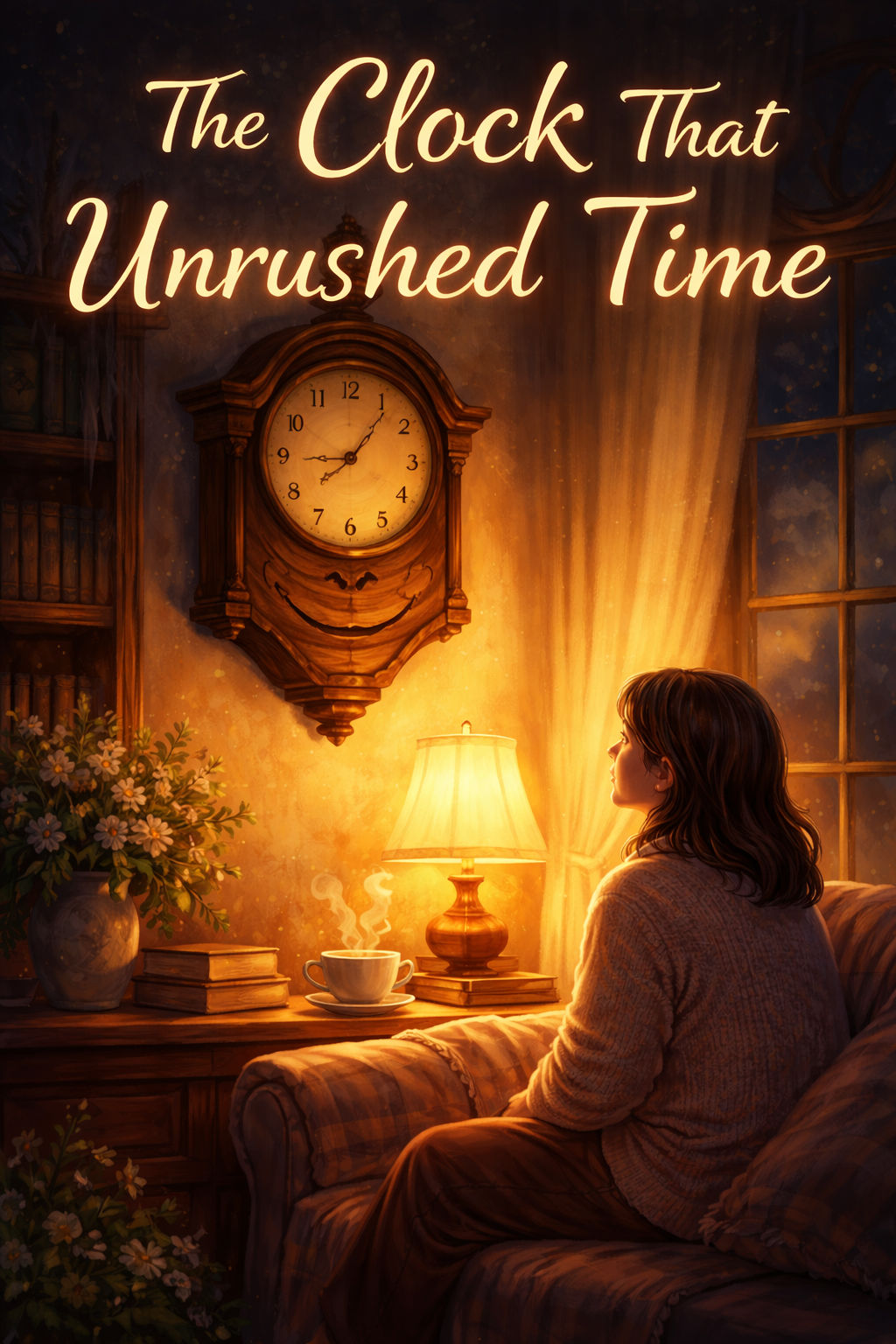
Chapter 1 — The Clock with a Crooked Smile
The house on Marigold Lane kept its own breathing.
It wasn’t a house anyone named on a tour. It had a leaning porch, paint like tired cream, and a garden that always seemed one season behind.
Inside, above the hallway table, hung a clock with a crooked smile carved into its wooden face.
No one could remember when the smile appeared. It had been there as long as anyone could say the house’s history. Folks called it old-fashioned, quaint, sentimental. Annie called it peculiar and, secretly, kind.
Annie worked late. Most nights she folded into the apartment like a tired origami figure — a little smaller at the edges, a little more careful with the space she took.
Her days were full of lists. Meetings stacked like folded shirts. Emails arrived like small, insistent birds. She learned to move fast because the world expected it. She learned to keep breathing while moving fast.
The first night the clock noticed her, she had brought the hurry home.
She came in with a bag under her eyes and an unfinished phone call in her chest. Papers rustled in her bag like restless leaves. She paced the small living room three times, four, and then stopped when she realized the room had stopped with her.
The clock’s hands had paused between two numbers, pointing nowhere and everywhere.
Annie checked her phone to measure the pause and found the screen trembling with notifications. She closed it and set it facedown. The pause stretched, not empty but soft, as if someone had tucked a warm blanket under the edge of the second hand and smoothed out the roughness of the minute.
Her shoulders loosened without meaning to.
She told herself it was a trick of tiredness. Maybe she had drifted for a second at her desk. Maybe the building’s wiring had hiccupped. Still, she noticed the clock’s carved smile now, as if it had waited for this precise hour.
That night she made tea because heat felt like a small anchor. The kettle sang, thin and honest, and she watched steam climb in slow, polite columns. The clock kept its gentle pause.
She sat at the small table and folded paper into a small square, not with any intention, but to make something with her fingers that didn’t have a deadline.
As she folded, a memory came—a childhood lullaby hummed by a parent with tired hands, the way time then had enough room to be kind. Annie let the memory flatten out the edges of her breath. The heartbeat in her throat slowed. The world, which had moments ago felt like a sprint with no finish, softened.
The kettle quieted. The clock hand, still between numbers, made her think of a place where seconds could be patient.
She didn’t sleep right away. She washed her face and found the laugh line near her eye had settled like a small promise. She put herself into bed, tucked under a quilt that smelled faintly of lemon soap, and let the quiet the clock offered move into her.
The pause didn’t feel like time stopped. It felt like someone had opened a door in the middle of a crowded train and let her sit down.
In the small hours she dreamed of a clock that unstitched hurry from the hems of days and laid it out on a table like an old coat, to be mended gently. In the dream the clock’s crooked smile looked very much like an invitation.
In the morning the hands were where hands usually are. The numbers marched on as if nothing odd had happened.
Annie carried the hush of the night with her through breakfast. It sat in her like a secret good coat, making the world less sharp at the edges. On the bus her phone buzzed. She waited until a busier moment, then answered with a voice that surprised her by being softer.
She kept half-expecting the world to require sprinting again, but it let her walk for once.
Later that afternoon a courier left a parcel at her door. Inside was an old envelope with no return address and a single line: For the nights you forget you can be kind to yourself.
No handwriting she recognized. No signature. She ran her thumb over the ink and felt the echo of the clock’s pause beneath her skin.
It was small, this first gift of unhurriedness. It did not remake her life. It simply made a room for rest where she had deleted one. It taught her, in the gentlest way, that sometimes time could be patient enough to let her breathe.
That evening she walked past the hallway and felt the clock watching, not like a judge, but like a neighbor who had brought a casserole and lingered on the stoop.
She wondered who wound the clock, who had carved that crooked smile, and whether someone else felt the pause as she did.
She did not know then how the clock would learn her name. She did not know how it would wait politely at the door of every frantic minute until she found the key to turn it.
She only knew she could breathe.
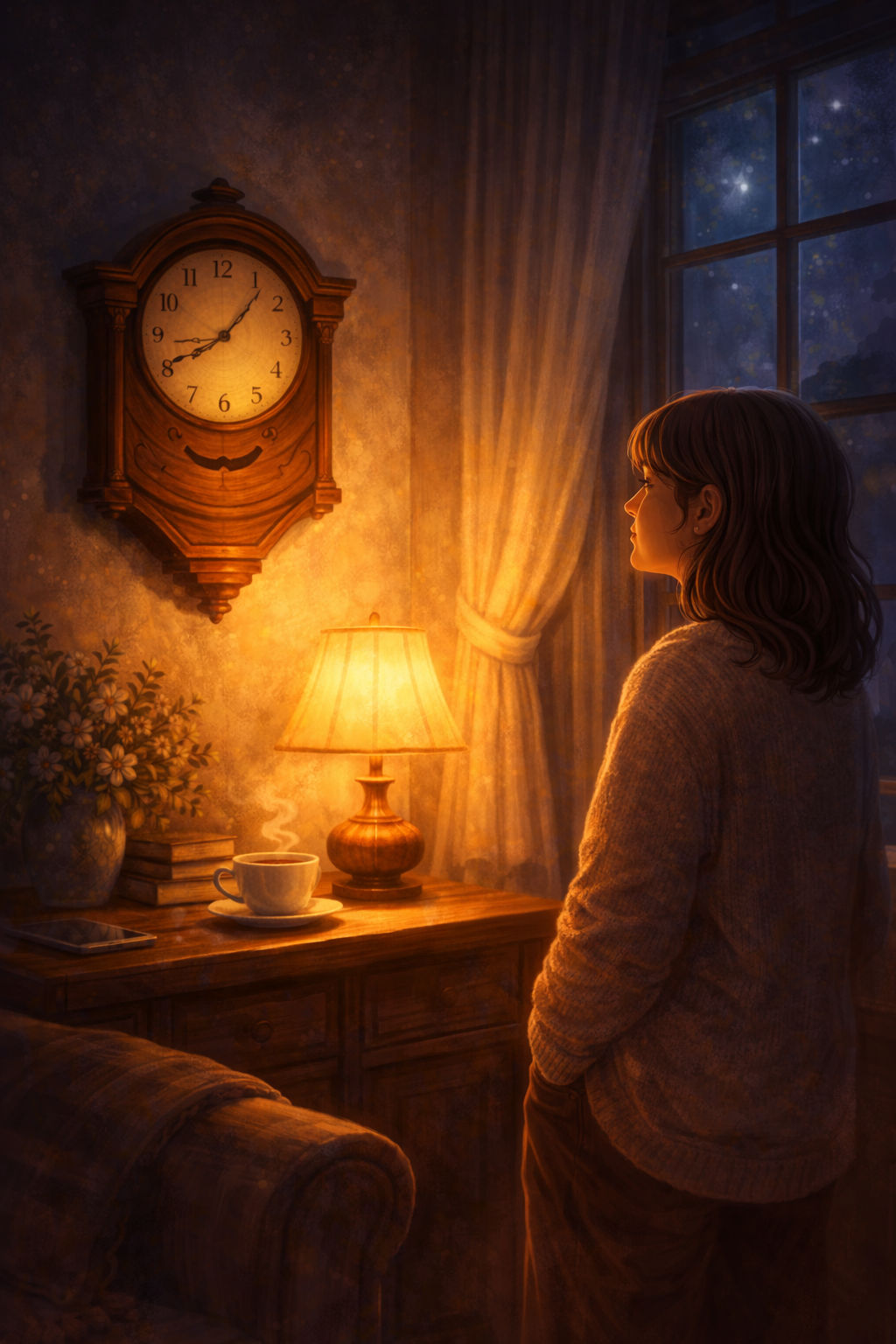
Chapter 2 — The House That Learned to Wait
The house noticed things before Annie did.
It noticed when her steps grew lighter on the stairs.
It noticed when she stopped checking the time while brushing her teeth.
It noticed when the quiet no longer felt empty.
On the second night, the clock waited longer before it paused.
Annie came home carrying the day like a box packed too tight. Her shoulders were stiff. Her jaw held a small ache she hadn’t named. She dropped her bag by the door and leaned her forehead against the wood for a moment longer than necessary.
The clock listened.
Its tick slowed—not suddenly, not dramatically—but the way breathing changes when someone sits down after a long walk.
Annie straightened and glanced up.
The hands were still moving. But the space between seconds felt wider. As if time had learned how to stretch without snapping.
She took off her shoes carefully, as though noise might break the softness gathering in the room.
The house smelled like dust and old paper and the faint citrus of the cleaner she used on Sundays. A floorboard sighed when she stepped on it. The sound felt companionable, not loud.
She moved into the kitchen and poured herself a glass of water. She drank it slowly, noticing the coolness against her teeth. She had forgotten, lately, how to do anything without rushing toward the next thing.
The clock paused while she stood there.
This time, she felt it.
Not as a trick. Not as coincidence.
The pause settled behind her ribs, gentle as a hand reminding her she could sit if she wanted.
She sat.
The chair creaked under her weight, and she laughed—just once, surprised by herself. The laugh sounded like something she hadn’t used in a while.
She stayed there, elbows on the table, palms open. No phone. No list. Just the small, patient quiet.
A thought surfaced, shy and careful.
What if this is allowed?
The clock’s smile caught the light from the single bulb overhead. The carved curve looked deeper tonight, like a secret it was willing to keep.
Annie reached into her bag and pulled out a notebook she hadn’t opened in weeks. Its pages were mostly blank, except for the first few where she’d once written plans with sharp urgency.
She turned to a clean page.
She didn’t write a to-do list.
She wrote one sentence.
Things that can wait.
Below it, she added nothing. The page didn’t ask for more.
The clock stayed paused, as if approving the restraint.
Later, when she lay in bed, she noticed how the night sounded different. The city outside still hummed, but it no longer pressed against her skull. The sounds moved around her instead of through her.
She thought of the envelope from earlier that day.
For the nights you forget you can be kind to yourself.
She pressed the paper flat on her bedside table, smoothing it like a promise she wasn’t ready to break.
Sleep came without negotiation.
In her dream, the house breathed more deeply. Walls widened. Doors learned patience. The clock loosened its grip on minutes and let them drift like leaves in water.
Someone—she couldn’t see who—was winding the clock, not to tighten it, but to remind it of balance.
When she woke, the morning felt ordinary.
But she did not.
She moved through the day with a new awareness, as though she carried a pocket of calm she could reach into if needed. When things pressed, she remembered the chair at the table. The blank page. The space between seconds.
That evening, when she returned, the clock did not pause right away.
It waited to see if she would.
She did.
She stood in the hallway, closed her eyes, and breathed once—slow, deliberate.
The clock answered.
The pause came like a shared understanding.
Annie smiled up at it, small and private.
“You’re teaching me,” she said quietly, unsure why she spoke aloud.
The clock did not move.
But its crooked smile seemed just a little wider.
Good Night.