
Sometimes, a good story is all we need to take a short break from our busy lives. Whether you are relaxing after work, enjoying a quiet cup of coffee, or looking for something meaningful to read before bed, 5 minute short stories for adults offer an enjoyable way to escape into another world without making a big time commitment.
These stories are short enough to finish during a quick break but meaningful enough to leave you thinking long after you have finished reading. They explore everyday experiences, relationships, love, friendship, personal growth, unexpected kindness, difficult decisions, and the lessons people learn throughout life.
Unlike longer novels, five-minute stories focus on a single situation, an important decision, or a memorable moment. Every story has a beginning, a meaningful development, and a satisfying conclusion.
In this collection, you will find engaging 5-minute short stories for adults that are easy to read, emotionally engaging, and filled with meaningful life lessons.
What Are 5 Minute Short Stories for Adults?
Five-minute short stories for adults are brief fictional narratives that can generally be read in approximately five minutes. Most contain around 500 to 750 words, depending on reading speed and writing style.
These stories are designed to entertain, inspire, or encourage readers to reflect on everyday situations. They often feature relatable adult characters dealing with work pressure, family responsibilities, relationships, financial challenges, personal ambitions, and unexpected changes in life.
A good five-minute story does not need a complicated plot. Instead, it uses simple storytelling, realistic characters, and a meaningful ending to create an enjoyable reading experience.
Why Do Adults Enjoy Reading Five-Minute Short Stories?
Adults often have busy schedules, making it difficult to find time for long books or lengthy articles. Short stories provide an easy way to enjoy reading without requiring hours of concentration.
Here are some reasons why these stories are popular among adult readers.
1. They save time: You can finish an entire story during a coffee break, lunch break, or before going to sleep.
2. They offer meaningful lessons: Many short stories explore important life lessons about patience, honesty, kindness, forgiveness, and personal growth.
3. They provide emotional relaxation: Reading an interesting story can offer a refreshing break from daily responsibilities and stressful situations.
4. They improve reading habits: People who struggle to finish long books can develop a consistent reading habit by starting with shorter stories.
5. They encourage reflection: A powerful ending or unexpected twist can make readers think about their own experiences and decisions.
10 Best 5 Minute Short Stories for Adults
The following original short stories explore different aspects of adult life. Each one offers an engaging reading experience with relatable characters, realistic situations, and meaningful conclusions.
1. The Empty Chair

Genre: Emotional Fiction | Theme: Love, Loss, Family, and Moving Forward
Daniel had never liked eating alone.
For more than thirty years, dinner had been the most important part of his day. No matter how exhausting work had been or how difficult life had become, he always looked forward to returning home, sitting across from his wife, Margaret, and sharing a meal.
Their conversations were rarely extraordinary. Sometimes they discussed the weather, their neighbors, or the rising cost of groceries. Other evenings, they argued about which television program to watch or laughed about something their grandchildren had said.
But those ordinary moments had made their life beautiful.
Now, at sixty-eight, Daniel sat alone at the same dining table.
Margaret had passed away eight months earlier after a long illness. Her death had left a silence in the house that Daniel could not describe.
Her favorite chair remained opposite him. He had not moved it, cleaned it differently, or allowed anyone else to sit in it.
Every evening, he placed two plates on the table out of habit. Then he remembered that there was nobody to share the meal with and returned one plate to the kitchen.
His daughter, Emily, had repeatedly encouraged him to move forward.
“Father, you cannot keep living like this,” she had told him during her last visit.
Daniel always gave the same answer.
“I’m managing, sweetheart.”
But he wasn’t managing. He was simply getting through each day.
A House Full of Memories
Daniel and Margaret had purchased their small house thirty-five years earlier. It was not luxurious, but it had everything they needed.
The living room contained an old wooden bookshelf, a faded family photograph, and a comfortable sofa where Margaret used to knit during winter evenings.
The kitchen still smelled faintly of the cinnamon biscuits she loved baking.
Even the garden reminded him of her. Margaret had planted roses along the boundary wall, and Daniel had promised to take care of them.
He watered them every morning, although he no longer knew whether she would have liked the way he trimmed them.
Sometimes, while walking through the garden, he imagined hearing her voice.
“Daniel, don’t cut those branches so short!”
He would smile for a moment before remembering that she was gone.
His friends occasionally invited him for coffee, but he usually refused. He had become uncomfortable around people who asked how he was doing.
They meant well, but every conversation eventually returned to Margaret.
And Daniel was tired of explaining that he missed her.
An Unexpected Discovery
One Thursday afternoon, Emily arrived unexpectedly.
She brought groceries, cleaned the kitchen, and prepared lunch.
After eating, she noticed her father sitting near the window, staring at Margaret’s chair.
“Dad, have you considered joining the community garden group?” she asked.
Daniel shook his head.
“I don’t need a group. I have the garden here.”
“Then perhaps you could invite some friends over.”
“I don’t feel like entertaining anyone.”
Emily sighed.
She wanted to help him, but she understood that grief could not be solved through suggestions.
Before leaving, she noticed an old envelope lying beneath the edge of Margaret’s chair.
“What’s this?” she asked.
Daniel looked at it.
“I haven’t seen that before.”
The envelope was slightly yellowed. His name was written across the front in Margaret’s familiar handwriting.
His fingers trembled as he opened it.
Inside was a folded letter.
My dearest Daniel,
If you are reading this, perhaps I am no longer sitting across from you at our little dining table.
I know you. You will probably spend too much time remembering me and too little time enjoying the life we built together.
Please don’t do that.
Remember our first holiday, when we got lost and ended up sleeping in a tiny hotel? Remember the terrible cake you baked on my birthday? Remember how we laughed when the kitchen ceiling started leaking?
Those were ordinary days, but they were our days.
I want you to keep living. Invite Emily over. Spend time with the grandchildren. Grow those roses. Cook something terrible and laugh about it.
And if someone needs a friend, make room for them.
I loved every year we spent together. Don’t let my absence make you forget how wonderful life can still be.
Forever yours,
Margaret.
Daniel read the letter once.
Then he read it again.
By the third reading, tears were running down his cheeks.
Emily quietly placed her hand on his shoulder.
“She knew you very well, Dad,” she whispered.
Daniel nodded.
“She always did.”
A Small Beginning
That evening, Daniel prepared dinner for the first time in several months.
He decided to make vegetable soup using Margaret’s old recipe.
He chopped the carrots, added potatoes, and followed the instructions written inside her recipe notebook.
Unfortunately, he added far too much salt.
When he tasted it, he laughed.
“Margaret would have thrown this away,” he said to himself.
For a moment, the house felt less lonely.
The following Sunday, he called Emily.
“Would you and the children like to come for dinner?”
“Of course, Dad!”
“And bring your husband too. I am making soup.”
Emily paused.
“Are you sure you want to cook?”
Daniel smiled.
“Well, I cannot promise it will be good.”
That Sunday, the house was filled with voices, laughter, and the sound of children running through the hallway.
Daniel served his soup proudly.
His grandson took one spoonful and immediately reached for a glass of water.
“Grandpa, why is it so salty?”
Everyone burst into laughter.
Daniel laughed harder than anyone.
For the first time in months, he enjoyed dinner without constantly looking at the empty chair.
The Chair Remains
A few weeks later, Daniel invited an old friend from the neighborhood for coffee.
Then he began attending the community garden meetings.
He still missed Margaret every day. Sometimes, he cried while looking through old photographs. Other times, he found himself speaking to her while watering the roses.
But something had changed.
He no longer believed that moving forward meant leaving her behind.
One evening, he sat at the dining table with Emily and her children. Margaret’s chair remained opposite him.
His granddaughter pointed toward it.
“Grandpa, why don’t you move that chair?”
Daniel looked at it and smiled.
“Because your grandmother loved sitting there.”
“Don’t you feel sad looking at it?”
“Sometimes,” he replied. “But sometimes it makes me happy too.”
His granddaughter climbed onto his lap.
Daniel looked around the room.
The house was no longer completely silent. There were family photographs, warm conversations, and new memories waiting to be made.
He finally understood what Margaret had been trying to tell him.
Love does not disappear when someone leaves. It becomes part of the memories, habits, and kindness we carry forward.
The empty chair was no longer a place of sadness.
It was a reminder that he had once shared a beautiful life with someone who had taught him how to live.
And he still had a life worth living.
Moral of the Story: Losing someone you love is never easy, but remembering them should not prevent you from enjoying the life ahead. Moving forward does not mean forgetting. It means carrying their love with you.
2. The Last Customer

Genre: Emotional and Inspirational Fiction | Theme: Kindness, Dreams, and the Meaning of Success
For nearly forty years, Mr. Harrison had opened his little bookstore at exactly nine o’clock every morning.
The shop stood on a quiet street in an old part of the city. Its wooden entrance had faded over the years, and the small bell above the door made a tired ringing sound whenever someone walked inside.
The bookstore was called The Turning Page.
It wasn’t particularly beautiful or modern. The shelves were made of dark wood, some books had yellowed pages, and the floor creaked whenever someone walked toward the back of the shop.
But Mr. Harrison loved every corner of it.
He knew where every book belonged, remembered the names of his regular customers, and could recommend a novel based on a person’s mood.
For him, the bookstore was never just a business.
It was a place where people could escape their worries, discover new ideas, and sometimes find the courage to begin again.
Unfortunately, the world around him had changed.
Large online retailers offered cheaper books and next-day deliveries. Young people preferred reading on their phones, and fewer customers visited traditional bookstores.
During the past year, business had become particularly difficult.
Mr. Harrison had already used most of his savings to pay the rent and electricity bills.
His daughter, who lived in another city, had suggested that he close the shop and move in with her.
But he wasn’t ready.
“Just one more month,” he always told her.
And then another month would begin.
A Quiet Afternoon
It was a rainy Thursday evening.
The streets were almost empty, and water ran along the pavement outside the bookstore.
Mr. Harrison stood behind the counter, looking at the clock.
It was 6:45 p.m.
He had sold only two books that day.
One was a children’s storybook purchased by a young father. The other was a detective novel bought by a woman who had been visiting the shop for more than twenty years.
Mr. Harrison sighed and began switching off the lights.
As he reached for the entrance door, he noticed someone standing outside.
It was a young woman in a grey coat.
She looked through the glass for a few seconds before slowly entering.
The little bell rang.
“Good evening,” Mr. Harrison said with his usual smile. “Can I help you find something?”
The woman looked around nervously.
“I’m not sure,” she replied. “I’m looking for a book, but I don’t know its title.”
“Do you remember the author?”
She shook her head.
“Not really. I just want something that might help me start over.”
Mr. Harrison paused.
He had heard many unusual requests during his career, but this one felt different.
“Starting over can mean many things,” he said gently. “Are you looking for something practical or something hopeful?”
The woman looked down.
“Something hopeful, I suppose.”
A Story Behind the Request
Her name was Claire.
She was thirty-two years old and had recently lost her job at a small advertising agency.
For months, she had struggled with financial pressure and an increasingly difficult personal relationship.
Eventually, everything had fallen apart at once.
She had left her apartment, moved into a small rented room, and was trying to rebuild her life.
“I used to read a lot when I was younger,” Claire explained. “But somewhere along the way, I stopped. Recently, I haven’t felt interested in anything.”
Mr. Harrison listened without interrupting.
He walked toward a shelf near the window and selected a collection of short inspirational stories.
“This might be a good place to begin,” he said.
Claire examined the book.
The cover was simple, with an illustration of a small boat sailing toward a distant lighthouse.
She turned it over and read the description.
“I like this,” she said.
Then she checked her purse.
Her expression changed.
“I’m sorry,” she whispered. “I don’t think I have enough money.”
Mr. Harrison looked at the price tag.
It was not an expensive book, but he noticed that she was counting every coin carefully.
“How much do you have?”
Claire hesitated.
“Not enough.”
Mr. Harrison picked up the book and placed it inside a paper bag.
“Take it.”
She looked surprised.
“What?”
“Take the book. Pay me whenever you can.”
“But I don’t even know you.”
Mr. Harrison smiled.
“That is perfectly all right. Books have helped me through difficult times too. Perhaps this one can help you.”
Claire tried to refuse, but he insisted.
Before leaving, she thanked him several times.
Mr. Harrison watched her disappear into the rainy street.
Then he returned to his counter and locked the door.
He never expected to hear from her again.
The Difficult Weeks
Three weeks passed.
The bookstore continued struggling.
Mr. Harrison received another rent reminder, and his electricity bill was higher than expected.
He began wondering whether his daughter had been right.
Perhaps it was time to close the shop.
One afternoon, he started packing books into cardboard boxes.
He had never imagined that his final days as a bookseller would arrive so quietly.
While sorting through the shelves, he found an old photograph.
It showed him standing outside the bookstore on its opening day, holding a pair of scissors after cutting the ribbon.
His wife, Eleanor, stood beside him.
She had passed away twelve years earlier.
Mr. Harrison smiled at the photograph.
Eleanor had always believed in the bookstore, even when the business struggled in its early years.
“You don’t sell books, Harrison,” she used to say. “You give people somewhere to go when they need to disappear for a little while.”
He placed the photograph carefully on the counter.
Then he returned to packing.
An Unexpected Package
On Monday morning, a delivery driver arrived carrying a medium-sized cardboard box.
“Package for Mr. Harrison.”
He signed for it and placed it on the counter.
There was no return address, only his name.
Inside was a handwritten letter, a photograph, and a neatly wrapped book.
He opened the letter.
Dear Mr. Harrison,
You probably don’t remember me, but I visited your bookstore on a rainy Thursday evening three weeks ago.
I was the woman who wanted a book but didn’t have enough money to buy it.
I wanted to thank you for what you did.
At that time, I was going through one of the most difficult periods of my life. I had lost my job, my confidence, and almost all hope that things could improve.
I didn’t expect a stranger to help me. But you gave me that book without asking for anything in return.
I started reading it that night. Some of the stories reminded me that difficult situations do not have to define the rest of our lives.
I began applying for jobs again. Last week, I received an offer from a small publishing company. I will start working there next Monday.
I have also written something myself. It is not very long, but I thought you might enjoy reading it.
Thank you for reminding me that kindness still exists.
Warm regards,
Claire.
Mr. Harrison sat down slowly.
He opened the photograph.
It showed Claire standing outside a modern office building, smiling and holding a small bouquet of flowers.
The wrapped book was her first collection of short stories.
On the first page, she had written:
To the man who reminded me that a small act of kindness can change someone’s day, and sometimes their entire life.
Mr. Harrison read the dedication several times.
His eyes became wet.
He placed the letter beside Eleanor’s photograph.
For a moment, he felt that his wife was standing beside him, smiling.
The Final Day
Two weeks later, Mr. Harrison finally decided to retire.
He put a handwritten notice on the bookstore window.
The Turning Page will close permanently on Sunday.
He expected the announcement to pass unnoticed.
But on Saturday morning, a former customer entered the shop.
Then another.
By afternoon, several people had arrived.
An elderly teacher remembered buying books for her students there. A middle-aged man explained that Mr. Harrison had helped him discover reading after a difficult childhood.
A young couple said they had met in the bookstore years earlier.
One customer remembered receiving a free storybook when he was a child because his parents could not afford it.
Story after story filled the little shop.
Mr. Harrison listened quietly, realizing that he had forgotten many of these moments.
Then the entrance bell rang.
Claire walked inside.
She was carrying a small bouquet and a copy of her newly published book.
“Good afternoon, Mr. Harrison.”
He smiled broadly.
“Claire! It’s wonderful to see you.”
She looked around at the customers and the half-empty shelves.
“I heard you were closing.”
“Yes. I suppose every story eventually reaches its final page.”
Claire shook her head.
“Not every story. Some simply begin a new chapter.”
She handed him the book.
“I wanted you to have the first copy.”
Mr. Harrison examined the cover.
It was a collection of short stories about ordinary people facing difficult situations.
He turned to the dedication.
For Mr. Harrison, who gave me a book when I had almost nothing left to believe in.
He looked at Claire.
“Thank you,” he said quietly.
“No,” she replied. “Thank you.”
The Real Value of a Bookstore
That evening, after the final customers had left, Mr. Harrison sat behind his counter.
The shelves were almost empty.
He looked at the little bell above the door, the old wooden floor, and the photograph of Eleanor.
He had spent forty years worrying about sales, rent, expenses, and profits.
But now he understood something he had never fully considered.
His bookstore had given people more than books.
It had given them memories, encouragement, friendships, and moments of comfort.
He had not become a wealthy businessman.
But he had helped people discover stories that changed how they saw the world.
And perhaps that was a different kind of success.
Before switching off the final light, he placed Claire’s book on the counter.
Then he smiled at the empty shop.
For the first time, he did not feel that he was losing something.
He felt grateful for everything he had been given.
The next morning, the bookstore would no longer open.
But somewhere in the city, a young woman would begin her first day at a publishing company, carrying a story that had started in a little bookstore on a rainy Thursday evening.
And Mr. Harrison would always remember that she had been his last customer.
Moral of the Story: Never underestimate the power of a small act of kindness. Something that seems insignificant to you may become a turning point in someone else’s life. True success is not measured only by money or recognition, but also by the positive difference we make in the lives of others.
3. The Promotion He Never Wanted

Genre: Inspirational Fiction | Theme: Work-Life Balance, Career Pressure, and Personal Happiness
For twelve years, Michael had worked at one of the most respected marketing companies in the city.
He was known as a hardworking employee, a reliable team leader, and someone who never complained about difficult assignments. Whenever a project was behind schedule, Michael was the person his manager called. Whenever a client demanded an unreasonable deadline, Michael found a way to deliver.
His colleagues admired his dedication.
Some even considered him the perfect example of professional success.
At thirty-nine, Michael had a comfortable salary, a senior position, and a reputation that many people would have envied.
But there was something nobody knew.
Michael was tired.
Not just physically tired, but emotionally exhausted from spending most of his life trying to achieve the next professional milestone.
He had missed family celebrations, cancelled holidays, forgotten important occasions, and spent countless weekends answering emails.
For years, he had convinced himself that all these sacrifices would eventually be worth it.
He just needed one more promotion.
And that promotion was finally within reach.
The Opportunity of a Lifetime
It was Monday morning when Michael’s manager, Rebecca, called him into her office.
“Michael, please close the door. I have some good news.”
He entered with a notebook in his hand.
Rebecca smiled.
“The company is preparing for a major leadership change. Our current director will be retiring next month, and the management team has decided to consider you for the position.”
Michael looked surprised.
“Me?”
“Absolutely. You have worked incredibly hard, and everyone recognizes your contribution.”
She explained that the new position would include a significant salary increase, a company car, additional benefits, and greater authority over important business decisions.
It was everything Michael had worked toward.
His colleagues would respect him even more. His professional profile would become stronger, and he would finally reach the position he had dreamed about when he first joined the company.
“Think about it over the next few days,” Rebecca said. “But I want you to know that you are our first choice.”
Michael thanked her and returned to his desk.
His colleagues quickly noticed his expression.
“What’s happening?” asked Daniel, his closest friend at work.
Michael smiled.
“I might be getting promoted.”
Daniel immediately stood up.
“That’s fantastic! We should celebrate tonight.”
Everyone congratulated him.
But Michael felt strangely uncomfortable.
He had expected excitement.
Instead, he felt a quiet sense of anxiety.
The Cost of Success
That evening, Michael drove home through heavy traffic.
He usually reached home around nine, but on that particular day, he arrived before seven.
His wife, Laura, was surprised to see him.
“You’re home early,” she said.
“Yes. I thought we could have dinner together.”
Laura smiled.
Their twelve-year-old daughter, Sophie, was sitting at the dining table completing her homework.
When she saw her father, she immediately ran toward him.
“Dad! You’re home!”
Michael hugged her.
“How was school?”
“Good. We had a science exhibition today.”
“Really? What did you make?”
Sophie showed him a small model of the solar system.
Michael examined it carefully.
“That’s wonderful. You did this yourself?”
“Yes. I wanted you to come and see it, but Mom said you had an important meeting.”
Michael looked at Laura.
She did not say anything.
He suddenly remembered receiving Sophie’s invitation two weeks earlier. He had promised to attend the exhibition but cancelled at the last minute because an important client had requested an emergency presentation.
“I’m sorry, sweetheart,” he said.
“It’s okay, Dad. I know you’re busy.”
Those words stayed with him.
Later that evening, after Sophie went to bed, Michael and Laura sat together in the living room.
“Rebecca offered me the director’s position,” he said.
Laura smiled.
“That’s wonderful news. You’ve worked so hard for it.”
“There’s something else.”
“What?”
“I’m not sure I want it.”
Laura looked at him.
For several seconds, she said nothing.
“Why?”
Michael leaned back.
“Because I think it will take even more time. More meetings, more travel, more responsibilities. I might have to work weekends regularly.”
Laura understood immediately.
She had spent years watching her husband sacrifice his personal life for his career.
“I don’t want you to regret turning down an opportunity,” she said. “But I also don’t want you to spend the next ten years wishing you had been more present with us.”
Michael stared at the ceiling.
He knew she was right.
A Conversation With an Old Friend
The following Saturday, Michael met his former university friend, Andrew, at a small coffee shop.
Andrew had taken a very different career path.
While Michael had spent years climbing the corporate ladder, Andrew had started a small photography business.
His income was less predictable, and he did not own an expensive car or live in a large house.
But he always seemed relaxed.
After ordering coffee, Michael told him about the promotion.
Andrew listened carefully.
“That’s a big opportunity,” he said.
“That’s what everyone keeps telling me.”
“Then what’s the problem?”
Michael explained his concerns about work pressure, family time, and the responsibilities attached to the position.
Andrew smiled.
“Do you remember what you wanted when we were twenty-five?”
Michael laughed.
“Money, a good job, and a successful career.”
“Exactly. And what do you want now?”
Michael paused.
“I don’t know.”
Andrew stirred his coffee.
“When I started my photography business, I wanted to become famous. I thought I needed expensive equipment, big clients, and international projects. Eventually, I realized that I enjoyed taking photographs more than chasing recognition.”
He continued.
“I still work hard, but I have learned to decide how much of my life I want to give to my work.”
Michael looked thoughtful.
“Are you saying I should reject the promotion?”
“No. I’m saying you should decide what success means to you before someone else decides it for you.”
That sentence stayed with Michael throughout the drive home.
The Decision
On Monday morning, Michael arrived at the office earlier than usual.
He prepared his notes and requested another meeting with Rebecca.
“I’ve thought carefully about the offer,” he began.
Rebecca smiled.
“Wonderful. So, are you accepting?”
Michael took a breath.
“I appreciate the opportunity, and I’m genuinely grateful that the management team considers me suitable for the position.”
Rebecca nodded.
“But I don’t want to accept it under the current expectations.”
Her expression changed slightly.
“What do you mean?”
Michael explained that he wanted to continue contributing to the company, but he also wanted a healthier work-life balance.
He was willing to take on additional responsibilities if the role could be structured with a reasonable schedule and a capable team.
“I don’t want to become someone who is always unavailable outside the office,” he said. “I’ve spent too many years doing that already.”
Rebecca listened quietly.
When he finished, she leaned back.
“Michael, I wish you had told us this earlier.”
He looked surprised.
“Why?”
“Because we’ve been discussing leadership responsibilities for months. We need someone who can build a strong team, not someone who personally handles every problem.”
She explained that the company had been planning to restructure the department.
Michael’s approach had made her realize that the organization needed a more sustainable leadership model.
“We cannot promise everything immediately,” she said. “But perhaps we can redesign the role.”
Michael felt relieved.
For the first time, he had expressed what he wanted without worrying about disappointing someone.
A Different Kind of Success
Over the following weeks, the company introduced a new management structure.
Michael was offered a senior leadership position with greater strategic responsibility, but the daily operational workload was distributed among other team members.
He accepted.
His salary increased, although not as much as it would have with the original director’s position.
More importantly, he established clear boundaries.
He stopped answering non-urgent emails late at night, delegated tasks more effectively, and encouraged his team to maintain reasonable working hours.
At first, some colleagues were surprised.
They had always considered Michael the person who would solve every problem himself.
But gradually, his team became more independent.
Outside work, Michael began making changes too.
He started having breakfast with his family every morning.
He attended Sophie’s school events and took Laura out for dinner twice a month.
He even returned to an old hobby he had abandoned years earlier: playing the guitar.
One Saturday, he and Sophie spent the afternoon learning a simple song together.
She laughed whenever he missed a chord.
“Dad, you’re terrible at this!”
Michael laughed.
“I know. But I’m improving.”
The Promotion He Never Wanted
Six months later, Michael attended a company leadership meeting.
Rebecca asked him to present the results of the department’s latest project.
His team had performed exceptionally well.
The project had been completed ahead of schedule, customer satisfaction had improved, and employee turnover had decreased.
After the meeting, Rebecca approached him.
“You know something, Michael? I think you’ve become a better leader since you stopped trying to do everything yourself.”
Michael smiled.
“Perhaps I finally learned that being responsible doesn’t mean being available every minute.”
That evening, he returned home before sunset.
Sophie was waiting near the entrance.
“Dad, are we going to the park?”
Michael looked at his watch.
“Absolutely. Give me five minutes.”
As they walked together, Sophie held his hand.
“Dad?”
“Yes?”
“You’re home more often now. I like it.”
Michael smiled.
He had once believed that success meant reaching the highest possible position in his company.
Now he understood that success could also mean being present for the people who mattered.
He had not rejected ambition.
He had simply stopped allowing ambition to control every part of his life.
And perhaps that was the promotion he had needed all along.
Moral of the Story: Professional success is important, but it should not come at the expense of personal happiness and meaningful relationships. True success means creating a life in which your career and personal priorities can exist together.
4. The Woman on Platform Seven

Genre: Emotional Fiction | Theme: Loneliness, Unexpected Friendship, Kindness, and Human Connection
Every morning at exactly 8:15, Sarah caught the same train to work.
She had been following this routine for almost six years. She woke up at 6:30, prepared a cup of coffee, checked her emails, and left her apartment by 7:45.
Her journey began at a busy railway station in the middle of the city. She usually stood near Platform Seven, where the 8:15 train arrived every weekday.
Sarah was thirty-four years old and worked as a financial analyst for a large consulting company. Her life was comfortable, predictable, and organized around deadlines.
She lived alone in a small apartment, had a decent salary, and occasionally met friends on weekends.
But lately, something had been missing.
Her days felt repetitive. She woke up, went to work, returned home, prepared dinner, watched television, and went to bed.
She had become so accustomed to her routine that she rarely noticed the people around her.
Until one Monday morning, when she noticed an elderly woman sitting alone on a bench.
The woman appeared to be in her late seventies. She wore a light blue cardigan, carried a small blue handbag, and held a folded newspaper in her hands.
There was nothing unusual about her appearance.
What caught Sarah’s attention was that the woman seemed to be watching the trains without ever boarding one.
The Woman Who Never Took the Train
For the next several mornings, Sarah noticed the same woman.
She always sat on the same bench, near the end of Platform Seven.
Sometimes she read her newspaper. Sometimes she watched people rushing toward the trains. Occasionally, she looked toward the station entrance as if waiting for someone.
Sarah wondered whether the woman was waiting for a family member.
One rainy Tuesday, Sarah arrived earlier than usual.
She purchased two coffees from the station café and sat on a nearby bench.
The elderly woman was there again.
After a few minutes, Sarah noticed that she was rubbing her hands together to keep warm.
Sarah hesitated before approaching her.
“Excuse me, would you like some coffee?”
The woman looked up.
“That’s very kind of you, dear. Thank you.”
Sarah handed her the cup and sat beside her.
For a few minutes, neither spoke.
Then Sarah asked, “Do you travel somewhere every morning?”
The woman smiled.
“Not anymore.”
Sarah looked confused.
“Then do you live nearby?”
“Yes. Just a few streets away.”
Sarah glanced toward the railway tracks.
“Do you come here to meet someone?”
The woman looked toward the opposite platform.
“Sometimes I come here to remember someone.”
Sarah realized that she had asked a personal question.
“I’m sorry. You don’t have to explain.”
The woman smiled gently.
“It’s all right. My husband and I used to travel together. Every morning, we caught the same train.”
A Story From the Past
Her name was Margaret.
She had been married to a man named Robert for forty-six years.
They had met when they were both young and worked in nearby offices. Their first conversation had taken place at the same railway station.
Robert had accidentally picked up Margaret’s newspaper, thinking it belonged to him.
When she pointed out his mistake, he apologized so enthusiastically that she couldn’t stop laughing.
A few days later, they met again.
Then they started travelling together.
Eventually, the daily train journey became part of their relationship.
They discussed work, shared sandwiches, argued about politics, and made plans for their future.
Years later, even after retiring, they continued visiting the station.
Sometimes they took short trips to nearby towns. Other times, they simply sat on the platform and watched the trains arrive.
Robert had passed away the previous year after a sudden illness.
Since then, Margaret had continued visiting Platform Seven.
“This was where everything began,” she explained. “When I sit here, I can almost hear him asking whether I’ve brought enough money for lunch.”
Sarah smiled sadly.
“Did you ever consider stopping your visits?”
Margaret looked down at her coffee.
“I tried. But home became too quiet. Here, there are people, conversations, and familiar sounds. Somehow, it makes me feel less alone.”
Sarah understood that feeling more than she expected.
An Unexpected Friendship
The following morning, Sarah returned to Platform Seven with two coffees.
Margaret was sitting on the same bench.
“Good morning,” Sarah said.
Margaret looked up and smiled.
“I was wondering whether you would come again.”
Sarah laughed.
“Well, I thought you might enjoy another coffee.”
That became the beginning of an unexpected friendship.
Over the next few weeks, Sarah began arriving fifteen minutes earlier.
She and Margaret talked about almost everything.
Margaret told her stories about raising two children, managing household expenses, travelling with Robert, and adjusting to retirement.
Sarah talked about her job, her apartment, her ambitions, and the difficulties of maintaining friendships as an adult.
One morning, Margaret asked her a question.
“Are you happy with your life, Sarah?”
Sarah was surprised.
“That’s a difficult question.”
“Why?”
“I have a good job, a comfortable apartment, and everything I need. But sometimes I feel as though I’m just following a schedule.”
Margaret nodded.
“That happens when we become too busy completing our days instead of actually living them.”
Sarah thought about those words.
She had spent years working toward professional goals, believing that happiness would come after the next promotion or salary increase.
But she rarely made time for the little things that once brought her joy.
“What did you do when you felt that way?” Sarah asked.
Margaret smiled.
“I went for a walk with Robert. We didn’t need a destination. We just needed time together.”
Sarah laughed.
“That sounds simple.”
“It was. Most good things are.”
A Missing Morning
One Monday morning, Sarah arrived at Platform Seven carrying two coffees.
But Margaret was not there.
Sarah looked toward the familiar bench.
It was empty.
She assumed the woman might have arrived late.
She waited for ten minutes, then boarded her train.
The following morning, Margaret was still absent.
Sarah began worrying.
She asked a station attendant whether he had seen an elderly woman carrying a blue handbag.
The attendant recognized her description.
“Ah, Mrs. Margaret. She hasn’t been coming recently.”
“Do you know why?”
“I heard she moved closer to her daughter. She used to visit almost every day.”
Sarah felt disappointed.
She had not expected their friendship to become so important, but she realized how much she looked forward to those morning conversations.
She wondered whether she would ever see Margaret again.
The Letter
A week later, Sarah arrived at the station and noticed the attendant standing near the entrance.
He approached her.
“Are you the young lady who used to have coffee with Mrs. Margaret?”
Sarah nodded.
“Yes. Is she all right?”
The attendant smiled and handed her a small envelope.
“She left this for you before moving away. She asked me to give it to you if I saw you again.”
Sarah opened the envelope.
Inside was a handwritten note.
Dear Sarah,
I hope you are doing well.
I wanted to say goodbye properly, but everything happened rather quickly. My daughter has been asking me to move closer to her for a long time, and I finally agreed.
I will miss our morning conversations and the coffee you always brought me.
When Robert passed away, I thought my happiest days were behind me. I believed that nobody could understand the loneliness I was experiencing.
Then one morning, a young woman offered me a cup of coffee.
You probably thought it was a small gesture, but it meant more than you can imagine.
You reminded me that friendship does not have an age limit and that life can still surprise us with beautiful moments.
I hope you remember something I once told you: don’t spend so much time preparing for a better future that you forget to enjoy the present.
Thank you for sharing your mornings with me.
With affection,
Margaret.
Sarah folded the letter carefully.
For a moment, she stood silently near the bench.
The station was crowded, the trains were arriving, and announcements echoed through the building.
But she could only think about the woman who had changed her mornings.
A New Perspective
Over the following months, Sarah made several changes to her routine.
She started arriving at work a little later whenever possible.
She joined a weekend walking group, began calling her parents more frequently, and started making plans with friends instead of constantly postponing them.
She also began volunteering at a nearby community center, where she met older people who enjoyed sharing stories about their lives.
Sometimes she remembered Margaret’s conversations while walking through the city.
One afternoon, she received a message from an unfamiliar number.
It was Margaret.
Her daughter had helped her set up a messaging application, and she wanted to say hello.
Sarah immediately replied.
They exchanged photographs, discussed books, and occasionally spoke on the phone.
A few months later, Sarah visited Margaret at her daughter’s home.
The elderly woman looked healthier and happier.
They spent the afternoon drinking coffee and remembering their conversations at Platform Seven.
Before Sarah left, Margaret held her hand.
“Promise me something,” she said.
“What?”
“Don’t wait until someone is gone to appreciate the ordinary moments you share with them.”
Sarah nodded.
“I promise.”
The Woman Who Changed Her Mornings
Several months later, Sarah was standing on Platform Seven when she noticed an elderly man sitting alone.
He was holding a small paper cup and looking toward the railway tracks.
Sarah remembered Margaret.
She approached him.
“Good morning. Would you like some coffee?”
The man looked surprised.
Then he smiled.
“That would be lovely. Thank you.”
Sarah sat beside him.
She didn’t know his name, his story, or what had brought him to the station.
But she knew that sometimes people simply needed someone willing to sit beside them.
As the train approached, Sarah looked at the empty bench where Margaret used to sit.
She smiled.
The woman who had once visited the station to remember her husband had taught Sarah something she would carry throughout her life.
Every ordinary day holds the possibility of an extraordinary connection.
And sometimes, all it takes is a cup of coffee and a little kindness to begin a friendship that changes everything.
Moral of the Story: Never underestimate the importance of small acts of kindness. You may not realize how much someone needs a conversation, a friendly smile, or a few minutes of your time. Meaningful friendships can begin at any age and in the most unexpected places.
5. The Price of an Old Watch
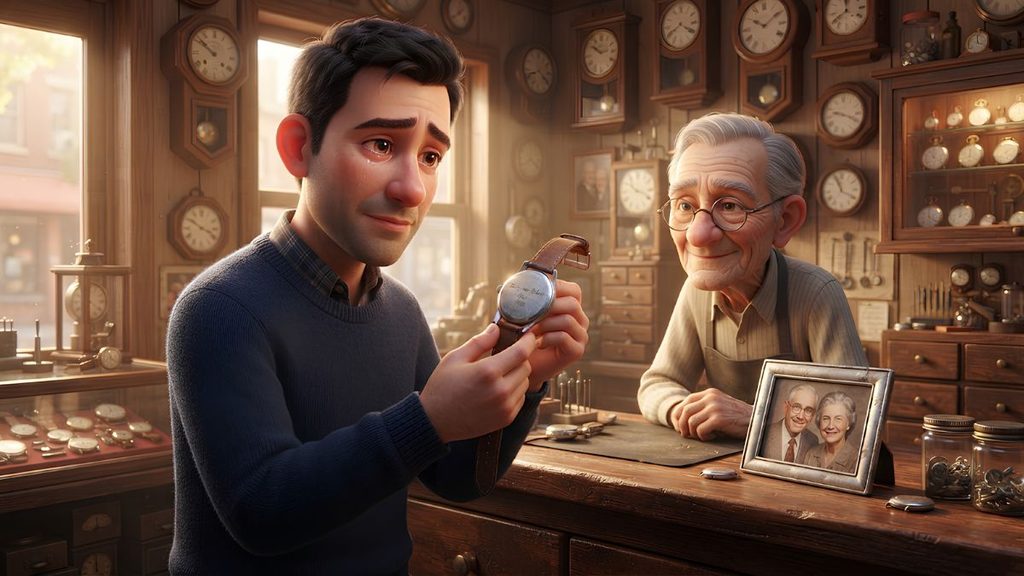
Genre: Emotional and Inspirational Fiction | Theme: Family, Memories, Love, and the True Value of Things
Robert had never understood why his father kept an old wristwatch inside his bedroom drawer.
It was a simple silver watch with a scratched glass face, a worn leather strap, and a small crack near one of the numbers. It had stopped working many years ago, yet his father had never thrown it away.
Whenever Robert asked about it, his father gave the same answer.
“Some things are worth keeping, even when they stop working.”
At the time, Robert thought it was just another one of his father’s strange observations.
His father, William, had been a quiet man who rarely spoke about his feelings. He had spent most of his life working as an accountant, raising his family, and taking care of his wife.
He was not wealthy, but he had always provided everything his family needed.
After his retirement, William spent most of his days reading newspapers, gardening, and occasionally repairing old household items.
The watch was one of the few possessions he refused to replace.
Robert had left home years earlier to build his own career in another city. He visited his parents whenever possible, but work and family responsibilities often kept him busy.
Then, one winter morning, William passed away peacefully in his sleep.
His death left a painful emptiness in the family.
After the funeral, Robert returned to his childhood home to help his mother organize his father’s belongings.
While sorting through the bedroom drawer, he found the old wristwatch.
He picked it up, turned it over, and examined the scratches.
For a moment, he considered throwing it away.
Then he remembered his father’s words.
Some things were worth keeping.
An Unwanted Inheritance
A few days later, Robert decided to visit an antique dealer.
The dealer operated a small shop in the old part of town. He purchased vintage furniture, paintings, watches, and other collectibles.
Robert placed the watch on the counter.
“I found this among my father’s belongings. Can you tell me whether it is worth anything?”
The dealer picked it up and examined it through a magnifying glass.
He checked the back, inspected the strap, and tried turning the crown.
After a few minutes, he placed it on the counter.
“It’s an old mechanical watch. Not particularly rare. The glass is damaged, and the movement isn’t working.”
“How much would you offer?”
The dealer considered it.
“Perhaps fifty dollars. Maybe a little more if I can find someone interested.”
Robert nodded.
He had expected something similar.
The watch had no sentimental value to him. It was simply an old object that his father had kept for too long.
“Let me think about it,” he said.
He placed the watch inside his pocket and left the shop.
A Visit to the Watchmaker
On his way home, Robert noticed a small repair shop he had never visited before.
Its sign read:
Harrison’s Watch Repairs.
The shop had been there for decades, and its window displayed several old clocks and mechanical watches.
Robert entered.
An elderly man was sitting behind the counter, carefully repairing a pocket watch.
“Good afternoon,” Robert said.
The man looked up.
“Good afternoon. How can I help you?”
Robert placed his father’s watch on the counter.
“I was wondering whether this could be repaired.”
The watchmaker picked it up.
His expression changed almost immediately.
“Where did you get this watch?”
“It belonged to my father. His name was William.”
The watchmaker looked at Robert carefully.
“William Harrison?”
Robert was surprised.
“Yes. Did you know him?”
The elderly man smiled.
“Know him? Your father used to visit this shop regularly.”
Robert pulled a chair closer.
“I didn’t know that.”
The watchmaker turned the watch over and examined its back.
“I remember this particular watch. Your father brought it here nearly thirty years ago.”
“What happened?”
The watchmaker chuckled.
“He wanted me to repair it before his wedding anniversary. The watch had stopped working, but he refused to replace it.”
Robert leaned forward.
“Why?”
The watchmaker placed the watch gently on a soft cloth.
“Because your mother gave it to him.”
A Memory From Thirty Years Ago
The watchmaker explained that William had purchased the watch shortly after getting his first permanent job.
At that time, he and his wife, Margaret, were newly married and struggling financially.
They lived in a small rented apartment and carefully managed every expense.
William wanted to buy a proper wristwatch because he often arrived late for work.
However, he could never justify spending money on something he considered unnecessary.
One day, on their first wedding anniversary, Margaret surprised him with the silver watch.
She had saved money for several months to purchase it.
William was deeply touched.
According to the watchmaker, William had visited the repair shop years later with a broken watch and a big smile.
“He told me his wife had given it to him when they were young. He said he had worn it through every important moment of his life.”
Robert looked down at the watch.
He remembered seeing it on his father’s wrist during childhood.
It had been there when his parents took him to school for the first time, when he graduated from college, and when he left home for his first job.
He had never paid attention to it.
The watchmaker continued.
“Your father asked me to repair it, but the movement was badly damaged. I told him that replacing it would be easier.”
Robert smiled faintly.
“What did he say?”
The watchmaker laughed.
“He said, ‘I don’t need another watch. I need this one to work again.'”
The Story Behind the Gift
Robert was beginning to understand that the watch meant far more to his father than he had ever imagined.
“Can you repair it now?” he asked.
The watchmaker nodded.
“I can try. But before that, I want to tell you something else.”
He opened a small drawer and removed an old notebook.
It contained repair records from several decades.
He searched through the pages until he found William’s name.
Beside the entry was a handwritten note.
Customer requested repair of anniversary gift. Does not wish to replace the original watch.
Robert read the words slowly.
The watchmaker smiled.
“Your father came here several times over the years. Whenever the watch stopped, he brought it back. Sometimes he could not afford the repair immediately, so he would return after a few weeks.”
Robert felt something tighten in his chest.
He remembered how his father had always been careful with money.
He also remembered how William rarely purchased anything for himself.
Yet he had continued spending money repairing a watch that was worth very little in the market.
“How much will it cost to repair?” Robert asked.
The watchmaker gave him an estimate.
Robert immediately agreed.
“Please do whatever is necessary.”
A Letter From the Past
While preparing the watch for repair, the watchmaker noticed something unusual.
There was a small engraving on the inside of the back cover.
He carefully opened it.
The inscription read:
To William, with all my love. Margaret.
Robert had never seen it before.
The watchmaker turned the cover slightly.
“Your mother must have had this engraved when she bought it.”
Robert stared at the inscription.
He suddenly remembered an old family photograph.
It showed his parents standing outside their first apartment. His father wore a simple shirt and trousers, while his mother held his arm.
William was wearing the same watch.
Robert asked the watchmaker whether he could leave it for a few days.
“Of course,” the man replied.
Before leaving, Robert asked one final question.
“Did my father ever tell you why he loved this watch so much?”
The watchmaker smiled.
“He once told me that when he looked at it, he remembered the woman who believed in him before he had anything to offer.”
Robert left the shop without saying another word.
On the journey home, he thought about his parents’ early years.
He realized that he knew very little about their life before he was born.
He had always thought of his father as an older man who spent his days working, paying bills, and taking care of the family.
He had forgotten that William had once been young, ambitious, romantic, and uncertain about the future.
He had also been someone’s husband before becoming his father.
The Watch Starts Ticking Again
Three days later, Robert returned to the repair shop.
The watchmaker was waiting for him.
“I have good news,” he said.
He placed the watch on the counter.
The glass had been replaced, the movement repaired, and the leather strap restored.
Then the watchmaker gently turned the crown.
The second hand began moving.
Tick.
Tick.
Tick.
Robert stared at it.
It was such a small sound, but it filled him with emotion.
For the first time, he understood why his father had never wanted to replace it.
The watch had accompanied William through decades of ordinary days and extraordinary moments.
It had witnessed the beginning of a marriage, the arrival of a child, career struggles, family celebrations, and countless quiet evenings.
It had been present when life was difficult and when everything seemed perfect.
It was more than an object.
It was a record of a lifetime.
“How much do I owe you?” Robert asked.
The watchmaker gave him the repair bill.
Robert paid it without hesitation.
Then he asked whether he could have a small wooden box to keep the watch safe.
The watchmaker found one and carefully placed the watch inside.
The Real Price
That evening, Robert sat with his mother in the living room.
He placed the wooden box on the table and opened it.
His mother looked at the watch.
For a few seconds, she did not speak.
Then she gently picked it up.
“Your father loved this watch,” she whispered.
Robert nodded.
“I know. I finally understand why.”
His mother smiled sadly.
“He used to look at it whenever he was worried. I think it reminded him of the early days when we had almost nothing but each other.”
She turned the watch over and noticed the engraving.
“Do you remember when I gave this to him?” she asked.
Robert shook his head.
“I was only twenty-five. Your father had just received his first permanent job. We couldn’t afford much, but I wanted to give him something he could keep forever.”
She smiled.
“He wore it on our wedding anniversary every year. Even after it stopped working, he kept it beside his bed.”
Robert looked at his mother.
“Why didn’t he tell me all this?”
She thought for a moment.
“Your father wasn’t someone who explained his feelings with words. He showed them through the things he did.”
Robert carefully placed the watch back inside the box.
He realized that he had spent years trying to understand his father’s financial decisions, professional choices, and practical advice.
But he had rarely asked about the memories behind them.
A Gift for the Next Generation
A few months later, Robert decided to keep the watch.
He had considered selling it when he first found it, but now the thought seemed impossible.
On his son’s eighteenth birthday, Robert placed the wooden box on the dining table.
His son, Ethan, opened it.
“What’s this, Dad?”
“An old watch. It belonged to your grandfather.”
Ethan examined it.
“Does it still work?”
Robert smiled.
“Yes. But that’s not the most important thing about it.”
He explained how his grandmother had gifted it to his grandfather, how the watch had accompanied him throughout his life, and why he had refused to replace it.
Ethan listened quietly.
“Can I keep it someday?” he asked.
Robert nodded.
“Of course. But I want you to understand something first.”
He pointed toward the engraving.
“This watch was never valuable because of its silver or its age. It was valuable because of the love and memories attached to it.”
Ethan held it carefully.
“I’ll take care of it.”
Robert smiled.
For a moment, he imagined his father standing beside them, watching the next generation discover the story behind his favorite possession.
The old watch continued ticking.
Its hands moved steadily, measuring seconds that would never return.
And Robert finally understood the real price of an old watch.
It could be fifty dollars to an antique dealer.
It could be a few hundred dollars to a collector.
But to a family, it could hold the memories of an entire lifetime.
Moral of the Story: The true value of something is not always measured by its market price. Objects become priceless when they carry memories, sacrifices, and love. Before throwing away something old, remember that it may hold a story worth preserving.
6. The Day She Said No

Genre: Inspirational Short Story for Adults
Theme: Self-respect, courage, personal boundaries, and finding your voice
Reading Time: Approximately 5 minutes
For most of her life, Meera had been the kind of person everyone liked.
She never refused a favor, never complained about extra work, and never argued when someone made a decision on her behalf. If a colleague needed help, she stayed late. If a family member needed money, she found a way to arrange it. If a friend wanted to meet, she changed her own plans.
People often called her kind, helpful, and understanding.
Meera smiled whenever she heard those words. But somewhere inside, she had begun to wonder whether people liked her because of who she was or because of everything she did for them.
At thirty-four, she had become an expert at saying yes.
Even when she was exhausted.
Even when she was uncomfortable.
Even when every part of her wanted to say no.
A Life Built Around Other People’s Expectations
Meera worked as a senior accountant at a small company. She was reliable, organized, and rarely missed a deadline. Her manager, Mr. Khanna, knew he could always depend on her.
Whenever someone failed to complete a task, the work somehow found its way to Meera’s desk.
“Meera, could you finish this report tonight?”
“Meera, I need you to handle the client’s documents.”
“Meera, can you come in on Saturday? We are a little short-staffed.”
Her answer was almost always the same.
“Of course. No problem.”
Her colleagues appreciated her, but they had also grown accustomed to her availability. Nobody wondered whether she had plans or whether she was tired.
At home, things were not very different.
Her younger brother frequently borrowed money without returning it on time. Her relatives expected her to attend every family gathering, even when she had important work. Her friends called whenever they needed someone to listen, but rarely asked how she was doing.
Meera did not blame anyone entirely. She knew she had helped create this pattern.
She had taught people that her time was always available.
And now she did not know how to take it back.
The Request That Changed Everything
One Friday evening, Meera was preparing to leave the office.
She had already worked an extra hour and was looking forward to spending the weekend with her mother, who had been visiting her for a few days.
Just as she picked up her handbag, Mr. Khanna approached her desk.
“Meera, I need a favor.”
She looked up.
“Yes, sir?”
“The quarterly financial report needs to be revised. The client meeting is Monday morning, and I want everything ready by Sunday night. Could you take care of it?”
Meera glanced at the thick folder in his hand.
“Sir, I have already completed my assigned work for this week.”
“I know, but you are the only person I trust with this.”
She felt the familiar pressure building inside her.
Her first instinct was to agree. She could already imagine his disappointment if she refused. Perhaps he would think she was becoming careless. Perhaps he would stop trusting her.
Then she remembered the plans she had made with her mother.
They had planned to visit a small temple outside the city on Saturday. Her mother had been looking forward to the trip for weeks.
Meera took a breath.
“I’m sorry, sir, but I won’t be able to work on it this weekend.”
Mr. Khanna looked surprised.
“What do you mean?”
“I mean I have personal commitments, and I won’t be available on Saturday or Sunday.”
For a moment, neither of them spoke.
Then he frowned.
“I thought you were someone we could depend on.”
The words hurt more than Meera expected.
She wanted to explain herself. She wanted to say that she had worked late countless times and had never refused a request before.
But she stopped herself.
“I am dependable, sir. But I also need time outside work. I can help plan how the report should be divided on Monday morning.”
Mr. Khanna picked up the folder.
“Fine. We’ll see what we can do.”
He walked away without another word.
Meera sat quietly for a few seconds.
Her hands were trembling.
She had said no.
And the world had not ended.
The Guilt of Choosing Herself
On the way home, Meera kept replaying the conversation.
Maybe she should have agreed. Maybe she had made a mistake. What if Mr. Khanna became angry? What if her colleagues had to suffer because she refused?
Her mind filled with questions.
When she reached home, her mother noticed her unusual silence.
“Is something wrong?” she asked.
Meera told her what had happened.
Her mother listened carefully before speaking.
“Did you have important work to finish?”
“Yes, but I could have done it over the weekend.”
“Did you promise someone else your time?”
Meera nodded. “I promised you.”
Her mother smiled gently.
“Then why are you feeling guilty for keeping your promise?”
Meera looked down.
“I don’t want people to think I’m selfish.”
Her mother held her hand.
“Being kind doesn’t mean giving everyone everything they ask for. You can love people and still have limits. You can help others without forgetting yourself.”
Meera said nothing.
Her mother’s words stayed with her throughout the evening.
For the first time, she considered that perhaps saying no was not a failure of kindness.
Perhaps it was an act of self-respect.
A Small Change With a Big Impact
The next Monday, Meera arrived at the office with a nervous feeling.
She expected Mr. Khanna to be cold or disappointed. Instead, he called a short meeting and assigned the financial report to three employees.
Meera was asked to review the final version rather than complete the entire project herself.
During lunch, her colleague Ritu approached her.
“I heard you refused the weekend work,” Ritu said.
Meera felt uncomfortable.
“Yes. I had some family plans.”
Ritu smiled.
“I wish I had done that last month. I worked three Sundays in a row because I was afraid to refuse.”
Meera looked at her in surprise.
“You could have said no.”
“I know. But everyone here treats you like the standard. If you always agree, people start thinking everyone should do the same.”
That conversation made Meera realize something important.
Her choices did not affect only her. By constantly accepting unreasonable demands, she had unintentionally helped create expectations that made it harder for others to protect their own time.
She decided to make a few small changes.
She stopped answering work messages late at night unless something was genuinely urgent. She began asking for deadlines before accepting additional responsibilities. When someone requested help, she considered her own workload before agreeing.
She also became more honest with her family and friends.
Sometimes she said, “I can’t today.”
Sometimes she said, “I need some time for myself.”
And sometimes she simply said, “No.”
Not everyone liked the change.
Her brother complained when she refused to lend him money without a repayment plan. A friend became upset when she could not attend a last-minute gathering.
But slowly, something unexpected happened.
People began to respect her time.
Some even started treating her more thoughtfully.
The Conversation She Had Been Avoiding
A few weeks later, Mr. Khanna called Meera into his office.
She entered, expecting another assignment.
Instead, he said, “I wanted to talk about the way we distribute work.”
Meera waited.
“I realized we’ve been depending too much on you. You have been handling responsibilities that should have been shared across the team.”
She was surprised.
Mr. Khanna continued.
“I should have noticed it earlier. Going forward, we’ll distribute additional assignments more fairly.”
Meera thanked him.
As she returned to her desk, she felt something she had not experienced in a long time.
Relief.
She had not lost her job. Her colleagues had not abandoned her. Her manager had not stopped trusting her.
She had simply expressed a reasonable boundary.
That evening, she went home and found her mother preparing tea.
“How was your day?” her mother asked.
Meera smiled.
“Good. I think things are finally changing.”
Her mother handed her a cup.
“Because you changed something first?”
Meera laughed softly.
“Maybe.”
Learning to Say Yes to Herself
Over the following months, Meera became more confident.
She still helped people. She still cared about her colleagues and family. She had not become rude or distant.
The difference was that she no longer believed every request deserved an automatic yes.
She learned that a person could be generous without being available all the time. She learned that disappointment was not always a sign that she had done something wrong.
Most importantly, she discovered that her own needs mattered too.
One Sunday morning, she sat beside her mother in the garden, enjoying the sunlight and a quiet cup of tea.
Her phone buzzed.
It was a message from a friend asking her to help organize an event that evening.
Meera looked at the message, thought about her plans, and typed:
“Sorry, I won’t be able to make it today. I hope everything goes well.”
She put her phone aside and returned to her tea.
There was no long explanation. No unnecessary apology. No anxious attempt to change her answer.
Just a simple no.
And for the first time, it felt completely natural.
Meera smiled as she watched a butterfly settle on a flower.
She had spent years trying to make everyone happy.
Now she understood that a meaningful life did not require her to disappoint herself every day just to avoid disappointing others.
The day she said no was not the day she became selfish.
It was the day she finally started respecting herself.
Moral of the Story
Saying no does not make you selfish, unkind, or unreliable. It means you understand that your time, energy, and happiness matter too. Healthy relationships respect boundaries, and genuine kindness should never require you to sacrifice yourself constantly.
Sometimes, the most important yes in life begins with a simple no.
7. The Man Who Started Again at Fifty

Genre: Inspirational Short Story for Adults
Theme: Second chances, courage, self-belief, and lifelong learning
Reading Time: Approximately 5 minutes
When Rajesh turned fifty, he received a birthday gift he had never expected.
It was not a watch, a new phone, or a family holiday. It was a termination letter.
After working for the same manufacturing company for twenty-seven years, Rajesh was informed that his position had been eliminated due to restructuring. The company was reducing its workforce, and several experienced employees were being asked to leave.
He read the letter twice, hoping he had misunderstood something.
But the words remained unchanged.
His career was over.
At least, that was what he believed.
For the first few days, Rajesh barely spoke. He had spent most of his adult life working, earning, and providing for his family. His salary had paid for his children’s education, the family’s home, and his parents’ medical expenses.
Now, at fifty, he was unemployed.
His wife, Sunita, tried to reassure him.
“Don’t worry. We will manage,” she said.
Rajesh nodded, but his mind was filled with questions.
Who would hire a fifty-year-old man? How would he compete with younger candidates? Was he too old to learn something new?
For the first time in decades, he felt completely lost.
When Experience Suddenly Seemed Worthless
Rajesh spent the next two months searching for another job.
He updated his resume, contacted former colleagues, and applied to several companies. Some never responded. Others rejected him after interviews.
One recruiter was particularly blunt.
“We are looking for someone younger who can adapt quickly to new systems.”
Rajesh thanked him politely and left.
On the way home, he stopped at a roadside tea stall. He sat quietly, watching young people passing by with laptops and backpacks.
He remembered when he had started his own career. He had been twenty-three, full of energy, and eager to prove himself.
Back then, fifty had seemed like an age when people had already achieved everything.
Now he understood how wrong that assumption had been.
At home, his son Amit noticed his father’s disappointment.
“Papa, why don’t you try something different?” Amit asked.
“Different? At this age?”
“Why not? You know how machines work, how factories operate, and how to manage people. That’s valuable experience.”
Rajesh smiled weakly.
“Companies want certificates and computer skills, not stories about how things worked twenty years ago.”
Amit thought for a moment.
“Then learn the skills they want.”
Rajesh looked at him.
“At fifty?”
“Especially at fifty. You have more experience than you realize. You just need to update it.”
The suggestion sounded simple, but Rajesh was not convinced.
The First Step Back to Learning
A few days later, Amit showed his father a free online course about basic computer applications and digital tools.
Rajesh looked at the screen with hesitation.
“I haven’t studied anything seriously in years.”
“That’s okay. You don’t have to finish everything in one day.”
Amit helped him create an account and showed him how to follow the lessons.
The first week was difficult.
Rajesh struggled with unfamiliar software, forgot passwords, and sometimes watched the same lesson three times. Whenever he made a mistake, he felt embarrassed.
One evening, he closed his laptop in frustration.
“I don’t think this is for me,” he said.
Sunita brought him a cup of tea.
“Do you remember when Amit was learning to ride a bicycle? He fell so many times that he wanted to give up.”
Rajesh smiled.
“And what did you tell him?”
“You told him that falling was part of learning.”
Sunita looked at him warmly.
“Perhaps you should listen to your own advice.”
Rajesh opened his laptop again.
The next morning, he studied for another hour.
Then another.
Slowly, the unfamiliar screen became less intimidating. He learned spreadsheets, basic inventory software, email communication, and digital documentation.
He also enrolled in a short course on modern production management.
For the first time in years, he was a student again.
Discovering the Value of Experience
Three months passed.
Rajesh had completed several courses and created a small portfolio of practical exercises. He still did not feel like an expert, but he was more confident than before.
One afternoon, a former colleague named Suresh called.
“I heard you’re learning new software,” Suresh said.
“Trying to,” Rajesh replied.
Suresh explained that he had recently joined a small packaging business. The company was struggling with inventory management, production delays, and poor coordination between workers.
“We need someone who understands factory operations. Would you be interested in meeting the owner?”
Rajesh hesitated.
“I don’t know if I am suitable.”
“Rajesh, you spent twenty-seven years solving exactly these problems. Come and talk to him.”
The following Monday, Rajesh visited the business.
The owner, Mr. Mehta, was a young entrepreneur in his early thirties. He listened as Rajesh explained his previous responsibilities and experience.
Then he asked, “How comfortable are you with modern inventory software?”
Rajesh answered honestly.
“I have recently completed training in digital inventory management. I am still learning, but I understand the operational side very well.”
Mr. Mehta nodded.
“Most candidates know the software but don’t understand what happens on the factory floor. We need someone who understands both.”
Rajesh was offered a three-month consulting assignment.
It was not a permanent job, and the salary was lower than what he had earned before.
Still, he accepted.
He knew this was an opportunity to begin again.
The Unexpected Challenge
Rajesh started work the following week.
The factory had around forty employees and was facing several problems. Materials were often ordered too late, production schedules were poorly maintained, and finished products sometimes remained in storage for weeks.
The younger employees were comfortable with computers, but many did not understand the practical difficulties of production.
Rajesh spent his first few days observing the entire process.
He spoke with machine operators, checked inventory records, and studied delivery schedules.
Rather than immediately changing everything, he listened.
One morning, he noticed that the factory was repeatedly running out of a particular packaging material.
The software showed that enough stock was available, but the physical inventory told a different story.
Rajesh investigated and discovered that employees were recording material usage at the end of each shift instead of immediately after production.
This created inaccurate stock information.
He introduced a simple system that combined digital records with regular physical checks. He also trained employees to update material usage in real time.
Within a few weeks, the number of unexpected shortages decreased.
He then reorganized the production schedule to reduce unnecessary machine downtime.
The owner noticed the improvement.
“How did you identify these problems so quickly?” Mr. Mehta asked.
Rajesh smiled.
“Twenty-seven years of making mistakes and learning from them.”
Mr. Mehta laughed.
“That is exactly the kind of experience we need.”
A New Beginning
At the end of three months, Mr. Mehta offered Rajesh a permanent position as operations manager.
The salary was not as high as his previous corporate package, but the work gave him something he had almost forgotten.
A sense of purpose.
Rajesh accepted the offer.
When he reached home that evening, Sunita was waiting for him.
“How was work?” she asked.
Rajesh placed his bag on the table and smiled.
“I think I have found my place again.”
Sunita’s eyes filled with happiness.
Their son Amit congratulated him over a video call.
“See, Papa? Fifty isn’t the end.”
Rajesh laughed.
“No, it isn’t. But I must admit, starting again was harder than I expected.”
“Was it worth it?”
Rajesh looked around the room.
“Absolutely.”
The Lesson He Shared With Others
A year later, Rajesh was invited to speak at a small career development event organized by a local training institute.
The audience included young graduates, unemployed workers, and several people over forty who were worried about changing careers.
One man in the audience asked him:
“Sir, do you think it is possible to start a completely new career after fifty?”
Rajesh paused before answering.
“I cannot promise that it will be easy. You may face rejection. You may need to accept a smaller salary. You may have to learn things that younger people already know. And sometimes, you may feel embarrassed when you make mistakes.”
He looked around the room.
“But being older does not mean you have stopped growing. Your experience is not useless. Your past is not wasted. You simply have to find a way to connect what you already know with what the world needs today.”
The audience listened quietly.
Rajesh continued.
“At fifty, I lost the job I thought I would keep until retirement. For a while, I believed my working life was over. But losing one opportunity forced me to discover another.”
After the event, several people approached him to ask for advice.
He answered every question patiently.
That night, Rajesh returned home and opened his old laptop. He had recently started learning another digital tool that could help him improve factory reporting.
Sunita noticed him studying.
“Another course?” she asked.
Rajesh smiled.
“Why not? I have a few more years of learning ahead of me.”
He looked at the calendar on the wall.
It was his fifty-first birthday the following week.
For the first time, the number did not frighten him.
He no longer saw fifty as the age when life began to close its doors.
He saw it as the age when he had finally learned how to open a new one.
Moral of the Story
Age should not be a reason to stop learning, growing, or pursuing new opportunities. Life does not always follow the plans we make, and sometimes unexpected setbacks lead us toward better possibilities.
Your experience is an asset, not a limitation. You may need to learn new skills, accept challenges, and begin at a different level, but it is never too late to build a meaningful new chapter.
You are never too old to start again. Sometimes, your best chapter begins after fifty.
8. The Forgotten Birthday
Genre: Emotional Short Story for Adults
Theme: Family, loneliness, love, and the importance of remembering the people who matter
Reading Time: Approximately 5 minutes
Every year, Anil remembered everyone’s birthday.
He remembered his wife’s birthday, his children’s birthdays, his parents’ anniversaries, and even the birthdays of a few close friends. He kept reminders on his phone and never missed an opportunity to send a thoughtful message or buy a small gift.
But there was one birthday nobody remembered.
His own.
Anil was turning fifty-eight that year. He worked as an accounts manager in a private company and had spent most of his adult life making sure his family never lacked anything.
He had paid for his children’s education, bought a comfortable apartment, and supported his wife through difficult times. He rarely complained about work or the responsibilities that came with family life.
He believed that love was best expressed through actions.
And he never expected anything in return.
Still, as his birthday approached, he found himself looking forward to something small.
Perhaps his daughter would call. Perhaps his son would send a message. Maybe his wife would prepare his favorite dinner.
He did not want an expensive gift or a grand celebration.
He simply wanted someone to remember.
A Morning Without Wishes
Anil woke up early on his birthday.
His wife, Kavita, was already in the kitchen preparing breakfast. Their son, Rohan, had left for work, while their daughter, Neha, was living in another city.
Anil checked his phone.
There were several messages from colleagues and old acquaintances, but nothing from his family.
He waited until breakfast.
Kavita placed a cup of tea beside him and began discussing the household expenses.
“Did you pay the electricity bill?” she asked.
“Yes, yesterday.”
“And Rohan needs some money for his car insurance. I told him you would help.”
Anil nodded.
He looked at her for a moment, hoping she might suddenly smile and wish him.
But she picked up her phone and returned to the kitchen.
Perhaps she was busy.
Anil told himself not to expect too much.
After breakfast, he went to work.
His colleagues wished him a good morning, but nobody knew it was his birthday. He sat at his desk, completed his reports, and attended two meetings.
At lunchtime, he checked his phone again.
Still nothing.
He opened his daughter’s contact and almost called her. Then he stopped.
He did not want to remind anyone.
He wanted the wish to come naturally.
The Evening That Felt Longer Than Usual
Anil returned home earlier than usual.
He had bought a small chocolate cake from a bakery near his office. It was the kind of cake he liked, with simple chocolate frosting and no elaborate decorations.
He placed it in the refrigerator.
Kavita was watching television when he entered.
“You’re home early,” she said.
“Yes. I thought we could have dinner together.”
“Tonight? I have already promised to visit the neighbors. They are having a small get-together.”
Anil looked at her.
“Oh. That’s fine.”
He changed his clothes and sat in the living room.
Around seven, Rohan called.
“Papa, I need to ask you something.”
“Yes, tell me.”
“Could you transfer some money? I have an unexpected expense this month.”
Anil agreed.
Before ending the call, he waited for a moment.
Rohan did not say anything else.
“All right, Papa. I’ll talk to you later.”
The call ended.
Anil put his phone down.
He walked to the kitchen, opened the refrigerator, and looked at the cake.
For a few seconds, he considered taking it out and lighting a candle.
Then he closed the refrigerator.
He was not angry with anyone.
He was simply tired of feeling invisible.
An Unexpected Visitor
At around eight-thirty, the doorbell rang.
Anil opened the door and found a young delivery worker holding a small package.
“Delivery for Mr. Anil Sharma?”
“Yes.”
He signed for it and brought the package inside.
There was no name on the outside, only his address.
He opened it carefully.
Inside was a small wooden photo frame and a handwritten note.
The photograph showed Anil standing with his daughter Neha when she was about eight years old. She was sitting on his shoulders, laughing, while he held her little hands.
He remembered that day clearly.
They had visited a local fair, and Neha had insisted that he carry her everywhere. By the time they returned home, his shoulders were aching, but he had never been happier.
He unfolded the note.
It read:
Happy Birthday, Papa.
I know I am far away, but I haven’t forgotten. I was going through my old photographs and found this one. It reminded me of how safe I always felt when you were around.
You have spent your life taking care of everyone. I hope you remember that someone still wants to take care of you, too.
I love you. I will call you tonight.
Your little girl, Neha.
Anil read the message twice.
His eyes filled with tears.
For the first time that day, he smiled.
The Call He Had Been Waiting For
A few minutes later, his phone rang.
It was Neha.
“Happy birthday, Papa!” she said excitedly.
Anil laughed softly.
“Thank you, beta.”
“I’m sorry I couldn’t come home. I wanted to surprise you with the photograph. Did you receive it?”
“Yes. It’s beautiful.”
“I found it in my old album. Do you remember that fair?”
“Of course. You refused to walk even a single step.”
Neha laughed.
“I was a little girl!”
“You were a very demanding little girl.”
They both laughed.
Then Neha became quiet.
“Papa, are you happy?”
Anil looked at the photograph in his hands.
“Yes, beta. I am.”
“Really?”
He paused.
“Well, I missed hearing from everyone today. But your message made my day.”
There was silence on the other end.
“Oh, Papa. I’m sorry. I thought you would be busy at work. I should have called earlier.”
“It’s okay.”
“No, it’s not. You always remember everyone’s special days. We should do the same for you.”
Anil did not know what to say.
Neha continued.
“Listen, I’ll come home next weekend. We will celebrate properly. And please don’t say you don’t need anything. This time, we are celebrating you.”
Anil smiled.
“I’ll be waiting.”
A Birthday Remembered
When Kavita returned home later that evening, she found Anil sitting in the living room.
The photograph was on the table.
She looked at it and suddenly remembered.
“Oh, Anil! I completely forgot. Today is your birthday!”
Anil smiled gently.
“Yes. It is.”
Kavita sat beside him.
“I’m sorry. I have been so busy with everything.”
“I know.”
She noticed the cake in the refrigerator and brought it out.
“Why didn’t you tell me?”
Anil looked at her.
“I didn’t want to remind anyone. I just thought someone might remember.”
Kavita lowered her eyes.
For years, Anil had quietly taken care of everyone. She had become so accustomed to his reliability that she had stopped noticing how much he did.
She placed the cake on the table and lit a candle.
“Happy birthday,” she said softly.
Anil closed his eyes and made a wish.
“What did you wish for?” Kavita asked.
He smiled.
“If I tell you, it won’t come true.”
They shared the cake together.
It was a small celebration, without decorations or guests. But for Anil, it meant more than an expensive party ever could.
The Birthday That Changed Everything
The following weekend, Neha arrived home with a cake and a small gift. Rohan also came, carrying a bouquet of flowers.
“Happy birthday, Papa!” they said together.
Anil laughed.
“Thank you. But my birthday was last week.”
“We know,” Neha replied. “This is the celebration you deserved.”
They spent the afternoon looking through old photographs, sharing stories, and remembering family moments.
At one point, Rohan sat beside his father.
“Papa, I’m sorry I only called you about money on your birthday.”
Anil placed a hand on his shoulder.
“Don’t worry. Just remember that I am not only here when you need something.”
Rohan nodded.
“I will.”
That evening, the family sat together around the dining table.
For the first time in a long while, nobody was looking at a phone or rushing to finish something.
They were simply enjoying one another’s company.
Anil looked around the table and felt grateful.
He understood that his family loved him. They had not forgotten him intentionally. They had simply become so caught up in their own lives that they had stopped noticing the little things.
But he also realized something else.
People should not have to hide their feelings just to avoid appearing demanding. Sometimes, telling loved ones that you miss their attention is not selfish. It gives them a chance to understand what matters.
As the evening ended, Neha hugged him.
“Next year, we won’t forget,” she whispered.
Anil smiled.
“Next year, I hope you remember without needing a reminder.”
Everyone laughed.
And this time, when Anil went to bed, he did not feel forgotten.
He felt loved.
Moral of the Story
Love is not always about expensive gifts, grand celebrations, or dramatic expressions. Sometimes, it is about remembering a birthday, making a phone call, asking how someone feels, or spending a little time together.
We often become so busy with our own responsibilities that we forget the people who have quietly supported us throughout our lives.
Never let the people who remember everyone else feel forgotten themselves.
9. The Small Coffee Shop
Genre: Feel-Good and Inspirational
Life Lesson: Consistency and kindness can build something meaningful.
When James opened his coffee shop, everyone told him the location was a mistake.
It was on a quiet street, far from shopping centers and busy offices.
For the first three months, he barely made enough money to cover the rent.
Still, every morning he opened at seven.
He learned his regular customers’ names, remembered their preferred drinks, and kept a small bowl of biscuits near the counter.
One rainy morning, a delivery driver entered the shop.
“Can I sit here for a few minutes? My motorcycle has broken down.”
“Of course,” James replied.
He offered the driver a cup of coffee.
When the driver asked how much it cost, James shook his head.
“Don’t worry about it. You look like you need a warm drink.”
The driver thanked him and left.
A few days later, he returned with two colleagues.
Then more people began visiting.
The driver had mentioned the coffee shop to his delivery group, describing it as a place where people were treated like friends.
Within a year, James had a steady customer base.
One afternoon, a customer asked him what his secret was.
James looked around the shop.
“I don’t think there is a secret. I simply try to make people feel welcome.”
The customer smiled.
“That’s probably why we keep coming back.”
James understood that building a successful business was not always about having the biggest sign or the best location.
Sometimes, it began with remembering someone’s name and offering a little kindness.
10. The Letter to My Younger Self

Genre: Inspirational Short Story for Adults
Theme: Self-acceptance, regret, personal growth, and learning to appreciate life’s journey
Reading Time: Approximately 5 minutes
On his fortieth birthday, Arjun found an old notebook while cleaning the storage room.
It was hidden inside a cardboard box filled with school certificates, photographs, and forgotten memories. The notebook had a faded blue cover, and its pages were slightly yellow.
He opened it casually.
On the first page, written in his own handwriting, were the words:
Things I want to achieve before I turn thirty.
Arjun smiled.
He remembered writing that list when he was twenty-two. Back then, he believed life would follow a perfect plan. He would become successful by twenty-five, buy a house by twenty-eight, start a business by thirty, and travel around the world before turning thirty-five.
He turned the pages.
Some goals had been completed. Others had been abandoned. A few seemed almost ridiculous now.
But one sentence caught his attention.
I hope I never become someone who is afraid to dream.
Arjun stopped smiling.
At forty, he had a stable job, a comfortable home, and a family that loved him. From the outside, his life looked successful.
Yet, somewhere along the way, he had become afraid of taking risks.
He had stopped painting, abandoned his business idea, and postponed several personal dreams because he was always waiting for the right time.
Looking at the notebook, he wondered what his younger self would think of him.
That night, he decided to write a letter.
Not to anyone else.
To the twenty-two-year-old boy he used to be.
A Conversation Across Time
Arjun sat at his desk, opened a fresh sheet of paper, and began writing.
Dear Younger Arjun,
I know you have big dreams. You want to become successful quickly, prove yourself to everyone, and build a life that makes people proud.
I wish I could sit beside you for a few minutes and tell you a few things.
He paused.
For a moment, he imagined his younger self sitting across from him, wearing an old college shirt, with messy hair and endless excitement in his eyes.
Then he continued.
You Don’t Have to Have Everything Figured Out
First, stop worrying so much about the future.
I know you are afraid of making the wrong decisions. You spend hours thinking about which career to choose, which opportunity to accept, and whether you are falling behind your friends.
You look at people who seem more successful and wonder why your life isn’t moving as quickly.
But listen carefully: you are not in a race.
Some people will earn their first million before thirty. Others will discover their purpose at forty. Some will build successful careers early, while others will spend years searching for the right direction.
Your journey does not have to look like theirs.
Arjun smiled as he remembered how often he had compared himself with his classmates.
He had once believed that everyone else was moving forward while he was standing still.
Now he understood that life was not a competition with a fixed finish line.
Don’t Let Fear Make Your Decisions
He continued writing.
You will make mistakes. Some will cost you money. Others will cost you time. A few will hurt your confidence.
You will reject opportunities because you are afraid of failing. You will remain in uncomfortable situations because starting again seems frightening.
And sometimes, you will say no to things you genuinely want because you are worried about what people might think.
Please don’t let fear become the person making your decisions.
You don’t need to be fearless. You only need to learn how to move forward even when you are afraid.
He put down his pen for a moment.
At thirty-one, he had once been offered an opportunity to join a small creative business. He had loved the idea but rejected it because the salary was uncertain.
For years, he had wondered what might have happened if he had accepted.
He could not change that decision now.
But he could stop allowing old fears to control new opportunities.
Take Care of the People Who Love You
Arjun returned to the letter.
You will spend a lot of time trying to impress people.
You will work late, chase promotions, and worry about building a reputation. You will sometimes miss family dinners because you believe there will always be another opportunity to spend time together.
But there won’t always be another opportunity.
Your parents will grow older. Your friends will become busy with their own lives. The people who once made ordinary days special may not always be around.
So call your parents more often. Listen when your mother tells the same story for the fifth time. Spend time with your father, even when you have nothing important to discuss.
And don’t wait for a special occasion to tell someone you love them.
Arjun looked at a photograph on his desk.
It showed him standing between his parents on his college graduation day.
His father had passed away several years earlier.
Arjun remembered how his father had always asked about his work, even when he did not understand exactly what his son did.
He wished he had spent more evenings simply sitting beside him.
His eyes became moist.
Some opportunities could be recovered.
Time with loved ones could not.
Your Worth Is Not Your Salary
He took a deep breath and continued.
You will sometimes believe that your value depends on how much money you earn.
You will feel embarrassed when someone earns more than you. You will worry about your job title, your possessions, and the way people see you.
But your salary is not your identity.
Your mistakes do not make you worthless. Your failures do not erase your good qualities. And your bank balance cannot measure the kindness you show, the relationships you build, or the person you become.
Work hard. Earn well. Build a comfortable life.
But don’t sacrifice your peace just to prove that you are successful.
Arjun remembered the years when he had worked without taking proper holidays. He had believed that rest was something he could enjoy after achieving all his goals.
But every time he reached one milestone, another appeared.
He had spent too much time preparing to enjoy life instead of enjoying the life he already had.
Keep Doing the Things That Make You Feel Alive
Arjun looked at the old notebook again.
Between the pages, he found a small pencil drawing of a mountain landscape.
He had drawn it during college.
He used to love painting, but gradually stopped because he thought it was a distraction from building a career.
He picked up his pen.
One more thing.
Don’t abandon everything that makes you happy just because it doesn’t earn money.
Keep painting. Keep reading. Travel when you can. Learn something new simply because it interests you.
You don’t have to turn every passion into a business.
Some things deserve to exist only because they make you feel alive.
He looked at the drawing for a long time.
Then he made a decision.
The following weekend, he would buy a new set of paints.
It was a small step, but it felt important.
You Are Going to Be Okay
By now, the letter had filled almost three pages.
Arjun felt lighter, as though he had finally said things he had carried silently for years.
He wrote the final paragraph.
Dear younger Arjun,
I cannot promise that everything will happen the way you want. Some dreams will change. Some people will leave. Some decisions will turn out differently than you expected.
You will have difficult days when you question everything.
But you will also experience moments of unexpected happiness. You will meet people who believe in you. You will build a family, create memories, and discover strengths you don’t know you have yet.
You will not become perfect.
You will become human, and that is enough.
So please, enjoy the journey. Stop being so hard on yourself. Forgive your mistakes, learn from them, and keep moving.
You are going to be okay.
With love,
Your forty-year-old self.
The Beginning of Something New
Arjun folded the letter and placed it inside the old notebook.
The next morning, he woke up earlier than usual.
He made himself a cup of coffee, opened the curtains, and looked at the sunlight entering his room.
Then he took out his phone and called his mother.
They spoke for nearly forty minutes.
After breakfast, he searched for a nearby art shop and ordered a few painting supplies.
That evening, he sat at his desk and began sketching the mountain landscape from his old notebook.
His first attempt was not very good.
The lines were uneven, and the proportions were wrong.
He laughed.
For the first time in years, he was doing something without worrying about being successful at it.
A week later, he placed the finished painting on the wall beside his desk.
It was not perfect, but he loved it.
Sometimes, he looked at it and remembered the letter.
He realized that writing to his younger self had not changed the past. It had not erased his mistakes or brought back the time he had lost.
But it had changed the way he looked at his present.
He no longer wanted to spend the next twenty years regretting the previous twenty.
He wanted to live the years ahead with more courage, gratitude, and curiosity.
And perhaps, if he ever reached sixty, he would write another letter.
This time, to the man he was today.
Because there was still so much life left to live.
Moral of the Story
Life rarely follows the plans we make when we are young. We make mistakes, lose opportunities, experience disappointment, and sometimes spend too much time worrying about what others think.
But every stage of life offers a chance to learn, grow, and begin again.
Don’t spend your present regretting your past or worrying endlessly about your future. Appreciate the people who love you, follow the things that make you happy, and give yourself permission to make mistakes.
The best gift you can give your younger self is to live the rest of your life with courage, kindness, and fewer regrets.
What Makes a Good Five-Minute Short Story?
A good five-minute short story should capture the reader’s attention quickly and deliver a satisfying experience within a limited word count.
Here are some important elements of effective short storytelling:
- A relatable opening: Start with a situation or character that readers can understand.
- A simple plot: Focus on one central event, conflict, or experience.
- Realistic characters: Give characters emotions, motivations, and challenges that feel believable.
- An engaging development: Build curiosity through a decision, discovery, disagreement, or unexpected event.
- A meaningful ending: Finish with an emotional moment, surprising revelation, or thought-provoking lesson.
- Natural language: Use clear sentences and conversational storytelling to make reading enjoyable.
The best short stories do not need complicated language or unnecessary details. Their strength comes from the emotions and ideas they communicate.
Different Types of 5 Minute Short Stories for Adults
Adult readers have different interests, and short stories can explore almost any subject. Some popular categories include:
Inspirational short stories: These stories explore determination, courage, personal growth, and the importance of never giving up.
Emotional short stories: These focus on family relationships, friendship, love, loss, and the experiences that shape our lives.
Romantic short stories: These explore relationships, unexpected connections, second chances, and the different ways people express love.
Mystery short stories: These introduce interesting situations, hidden secrets, unusual discoveries, and unexpected endings.
Moral short stories: These communicate lessons about honesty, responsibility, kindness, patience, and human values.
Real-life inspired stories: These explore realistic situations involving careers, family responsibilities, financial decisions, and personal challenges.
Feel-good short stories: These offer positive endings, warm characters, and comforting situations that leave readers smiling.
Are Five-Minute Short Stories Good for Adults Learning English?
Yes. Five-minute short stories can be useful for adults who want to improve their English reading skills.
Short narratives provide opportunities to learn vocabulary, understand sentence structure, recognize common expressions, and follow conversations in context.
They are particularly helpful for learners who find lengthy novels difficult to complete.
For better results, try the following reading routine:
- Read one short story without stopping to check every unfamiliar word.
- Identify the main characters and understand the central situation.
- Look up five to ten unfamiliar words.
- Read the story again to understand the vocabulary in context.
- Summarize the story in your own words.
Reading a short story every day can help build consistency and improve reading confidence over time.
When Is the Best Time to Read Five-Minute Short Stories?
You can enjoy five-minute short stories at almost any time of the day.
- During morning coffee: Start your day with an interesting or inspirational story.
- During lunch breaks: Take a short mental break from work responsibilities.
- While travelling: Read a story during a commute or while waiting for an appointment.
- Before bedtime: Choose a peaceful or emotional story to enjoy before sleeping.
- During free time: Replace a few minutes of aimless scrolling with something entertaining and meaningful.
You do not need a special reading schedule. Even five minutes of daily reading can help you develop a lasting habit.
Frequently Asked Questions About 5 Minute Short Stories for Adults
How long should a five-minute short story be?
A typical five-minute short story contains approximately 500 to 750 words. However, the actual reading time depends on the reader’s reading speed and the complexity of the language.
Are five-minute short stories suitable for adults?
Yes. They are suitable for adults who enjoy quick entertainment, meaningful life lessons, emotional storytelling, romance, mystery, and inspirational narratives.
Can I read a five-minute short story before sleeping?
Absolutely. Short stories are convenient bedtime reading material because they allow you to enjoy a complete narrative without committing to a lengthy book. Peaceful, feel-good, and reflective stories are particularly suitable.
What are the best topics for short stories for adults?
Popular topics include love, friendship, family relationships, career challenges, personal growth, financial struggles, second chances, unexpected kindness, and life-changing decisions.
Do short stories have moral lessons?
Many short stories contain moral lessons, although not all are written specifically to teach something. Some focus primarily on entertainment, emotional experiences, mystery, or unexpected endings.
Can reading short stories improve English?
Yes. Reading regularly can help adults improve vocabulary, reading comprehension, sentence structure, and familiarity with natural English expressions.
Are five-minute stories better than long novels?
Neither format is universally better. Short stories are convenient for quick reading, while novels provide more room for detailed characters, complex plots, and deeper storytelling. Both offer different reading experiences.
Where can I find interesting short stories for adults?
You can find short stories for adults on storytelling websites, online literary publications, digital reading platforms, and collections of short fiction. Look for stories that match your preferred genre and reading time.
Conclusion
Five-minute short stories for adults prove that meaningful storytelling does not always require hundreds of pages. A simple conversation, an unexpected meeting, a difficult decision, or a small act of kindness can create a memorable reading experience.
Whether you enjoy emotional family stories, workplace experiences, romantic narratives, inspirational lessons, or unexpected endings, short stories offer something for every reader.
The ten stories in this collection explore different aspects of life and remind us that some of the most important lessons come from ordinary moments.
So, take five minutes, choose a story, and enjoy a little break from your everyday routine. You might discover that a few minutes of reading can leave you with an idea or feeling worth remembering.