
Clean funny church stories offer a lighthearted way to enjoy everyday moments involving church communities, families, children, pastors, volunteers, and congregation members. These stories focus on innocent misunderstandings, unexpected comments, funny conversations, and relatable situations while maintaining a respectful attitude toward faith and religious communities.
Unlike comedy that depends on offensive language, controversial subjects, or disrespectful humor, clean church stories create laughter from ordinary situations. A child may misunderstand something said during a sermon. A nervous volunteer may make an innocent mistake.
A family may experience an amusing moment while preparing for a church event. A pastor may find himself in an unexpectedly funny conversation with a young member of the congregation.
The humor comes from the situation rather than from mocking faith itself.
This makes clean funny church stories suitable for readers who enjoy wholesome humor, family-friendly entertainment, and stories that combine laughter with everyday life.
What Are Clean Funny Church Stories?
Clean funny church stories are short, humorous narratives set around churches, religious communities, or situations connected with Christian family and community life.
They usually contain simple situations that become funny because of an unexpected misunderstanding or reaction.
For example, a child might interpret a familiar church expression literally. A new volunteer might misunderstand instructions before a community event. A family might arrive early for a church gathering and accidentally enter the wrong room.
These situations do not require offensive jokes or inappropriate language.
Instead, the humor develops naturally from the characters and circumstances.
A good clean church story should leave readers smiling rather than making them uncomfortable.
Why People Enjoy Clean Funny Church Stories
Humor has always been part of everyday community life.
People laugh at situations they recognize from their own experiences.
Church communities are no different.
People attend services, organize events, volunteer, teach children, prepare meals, participate in activities, and spend time with friends and family.
These ordinary activities create countless opportunities for harmless humor.
Clean funny church stories allow readers to recognize familiar situations while enjoying them from a slightly different perspective.
They can also create a sense of community because readers may think:
“Something like that has happened at our church.”
That feeling of recognition makes simple stories surprisingly entertaining.
The Importance of Keeping the Humor Clean
The word “clean” is important in this type of storytelling.
Clean humor avoids unnecessary offensive material.
It generally avoids:
- Profanity
- Sexual jokes
- Graphic situations
- Cruel humor
- Hate-based jokes
- Personal attacks
- Humiliation
- Excessively controversial subjects
- Mocking religious beliefs
Instead, the humor should come from harmless situations.
A funny church story can involve embarrassment without becoming cruel.
It can involve misunderstanding without making someone look foolish.
It can include a surprising comment without insulting anyone.
The goal is simple:
Make people laugh without making someone the target of unnecessary disrespect.
7 Clean Funny Church Stories
The Little Boy and the Long Prayer
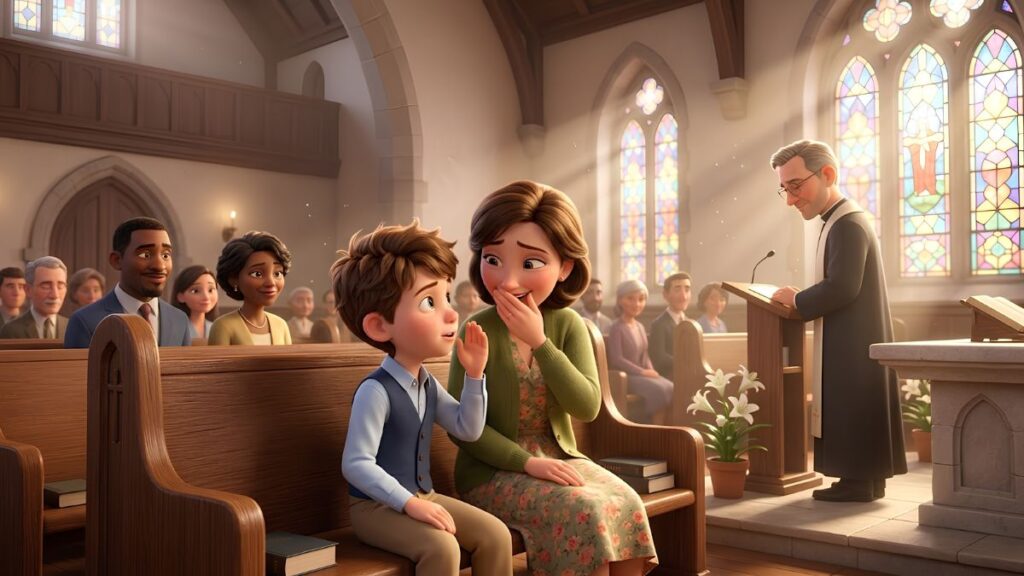
The Sunday morning service at Grace Community Church had started just as it did every week.
The sanctuary was filled with familiar sounds. Hymnbooks opened and closed. Children whispered to one another before being gently reminded to pay attention. Older members greeted their neighbors with warm smiles. Somewhere near the back, a baby made a tiny noise and was quickly carried outside by his father.
Eight-year-old Daniel sat beside his mother, Margaret, and tried very hard to behave.
He really did.
Daniel loved church. He enjoyed the music, the stories from the Bible, and especially the cookies that appeared after the service. He even liked listening to Pastor James preach, although he sometimes found the longer parts of the sermon difficult to follow.
But on this particular Sunday, Daniel had already been awake since six in the morning.
His father had promised him that after church they would go to the park.
That promise had been on Daniel’s mind all morning.
He had imagined himself running across the grass, climbing the playground, and kicking a football with his father. Every time he looked at the clock, he calculated how much longer he had to wait.
Then came the final prayer.
Pastor James walked to the front of the sanctuary and bowed his head.
“Let us pray.”
Everyone lowered their heads.
Daniel did too.
At first, he was perfectly comfortable.
Pastor James prayed for the church.
Then he prayed for families.
Then he prayed for people who were sick.
Then he prayed for people who were traveling.
Then he prayed for the community.
Then he prayed for the church’s upcoming charity event.
Daniel opened one eye.
His mother was still praying.
He closed his eye again.
Pastor James continued.
He prayed for teachers.
He prayed for students.
He prayed for people who were lonely.
He prayed for people looking for work.
He prayed for wisdom.
He prayed for peace.
He prayed for strength.
Daniel shifted in his seat.
His legs had begun to feel restless.
He glanced at his mother again.
She was still perfectly still.
Daniel wondered how adults managed to stay so comfortable for so long.
He looked toward his father.
His father had his head bowed and his hands folded.
Daniel sighed quietly.
Pastor James continued praying.
“And, Lord, we ask that You guide us throughout this coming week…”
Daniel waited.
Surely that meant the prayer was almost finished.
But Pastor James continued.
“…help us to be patient with one another…”
Daniel’s eyes opened.
Patient?
That seemed like an important prayer.
He looked at his mother.
Then he looked at Pastor James.
Then he looked at the clock.
Only a few minutes had passed.
Daniel’s stomach gave a small growl.
He hoped nobody heard it.
The prayer continued.
“Help us to remember those who need our kindness…”
Daniel thought about the cookies waiting in the fellowship hall.
He wondered whether the church volunteers had put chocolate chips in them this week.
He tried to focus on the prayer.
He really did.
But then Pastor James began praying about the church’s building repairs.
Daniel’s attention disappeared completely.
He leaned toward his mother.
“Mom.”
Margaret gently opened one eye.
“What?”
Daniel whispered so quietly that she almost couldn’t hear him.
“Has Pastor forgotten what he was praying about?”
Margaret’s eyes widened.
She immediately pressed her lips together.
“Daniel,” she whispered, “shhh.”
“But he’s been praying for a really long time.”
Margaret tried not to smile.
“Just be patient.”
Daniel nodded.
He sat back.
A few seconds passed.
Then he leaned toward her again.
“Maybe he needs a list.”
Margaret covered her mouth.
Her shoulders began to shake.
Daniel looked confused.
“What?”
“Nothing,” she whispered.
But unfortunately, the people sitting directly behind them had heard.
One of them coughed.
Another person suddenly became very interested in the floor.
Margaret knew exactly what was happening.
People were trying not to laugh.
Daniel, unaware of the growing amusement around him, continued listening.
Pastor James was still praying.
“And finally, Lord…”
Daniel’s eyes brightened.
Finally.
That sounded promising.
“…we ask that You bless every person gathered here today.”
Daniel smiled.
Surely that was the end.
But Pastor James continued.
“Bless our children…”
Daniel looked at his mother.
“…our parents…”
Daniel looked at his father.
“…our teachers…”
Daniel looked toward the children’s section.
“…our volunteers…”
Daniel sighed.
Apparently, “finally” did not mean “finished.”
Then Pastor James said something that Daniel had never heard during a prayer before.
“And Lord, help us to remember that sometimes the smallest voices can remind us of the biggest truths.”
Daniel looked up.
Pastor James had opened his eyes.
For just a moment, their eyes met.
Daniel immediately looked down.
He suddenly wondered whether Pastor James had heard him.
The prayer ended.
“Amen.”
The entire congregation said, “Amen.”
People began standing and talking quietly.
Daniel stayed seated.
He looked at his mother.
She was smiling.
“Did he hear me?” Daniel asked.
Margaret laughed softly.
“I think he might have.”
Daniel’s face turned red.
“I didn’t mean to be rude.”
“I know.”
“I was just asking.”
“I know that too.”
They walked toward the fellowship hall after the service.
Daniel stayed close to his mother.
He expected someone to tease him.
Instead, several adults smiled when they passed.
An elderly woman gave him a gentle pat on the shoulder.
“I think you asked a very good question,” she said.
Daniel looked surprised.
“Really?”
She nodded.
“Sometimes adults need children to remind us to pay attention.”
Daniel smiled.
At the refreshment table, Daniel found exactly what he had hoped for.
Chocolate-chip cookies.
He took one.
Then another.
His mother raised an eyebrow.
“Two?”
“I was hungry during the prayer.”
Margaret laughed.
Before Daniel could take a third cookie, Pastor James entered the fellowship hall.
Daniel froze.
Pastor James walked toward him.
Daniel looked at the floor.
“Hello, Daniel.”
“Hello, Pastor.”
“How are you?”
“Good.”
Pastor James smiled.
“I heard you had a question during the prayer.”
Daniel’s face became red again.
“I’m sorry.”
Pastor James shook his head.
“Why are you sorry?”
“Because I said the prayer was too long.”
A few adults nearby smiled.
Pastor James laughed.
“Daniel, prayers aren’t measured only by how many minutes they take.”
Daniel looked up.
“I know.”
“But I understand what you meant.”
Daniel waited.
Pastor James pulled up a chair.
“Do you know what I sometimes worry about?”
Daniel shook his head.
“I worry that people can pray for a long time without really thinking about what they’re saying.”
Daniel’s expression changed.
“You mean like saying lots of words?”
“Exactly.”
Pastor James smiled.
“A prayer can be two minutes long and be sincere. It can also be twenty minutes long and mean very little if the person praying is simply saying words.”
Daniel thought about that.
“So was your prayer too long?”
Several adults nearby suddenly became very interested in their conversations.
Pastor James laughed.
“Perhaps a little.”
Daniel smiled.
“But I had a lot of people to pray for.”
“I know.”
“And things to remember.”
“I know.”
Pastor James nodded.
“But your question reminded me of something important.”
“What?”
“Prayer is supposed to come from the heart. It isn’t a contest to see who can use the most words.”
Daniel took another bite of his cookie.
Pastor James continued.
“And sometimes, when adults become comfortable doing something, we can forget why we’re doing it.”
Daniel thought for a moment.
“Like when I clean my room but forget why I started?”
Pastor James laughed.
“Exactly like that.”
Daniel grinned.
Margaret joined them.
“I’m sorry about him,” she said.
Pastor James shook his head.
“Don’t be. I think Daniel gave me something to think about.”
The conversation might have ended there, but one of the church members had overheard everything.
Soon another person joined.
Then another.
Before long, several members were standing around Pastor James and Daniel.
One elderly man chuckled.
“Daniel, you may have saved us from a few long prayers.”
Everyone laughed.
Daniel looked worried.
“I don’t want people to stop praying.”
Pastor James put a hand gently on his shoulder.
“They won’t.”
“Good.”
“But perhaps I should remember that people have different needs. Sometimes a long prayer is appropriate. Other times, a short prayer can say everything that needs to be said.”
Daniel nodded.
Then he asked another question.
“Can I pray now?”
Everyone became quiet.
Pastor James smiled.
“Of course.”
Daniel closed his eyes.
He folded his hands.
His mother watched him carefully.
Daniel took a breath.
“Dear God, thank You for today.”
He paused.
“Thank You for my family.”
Another pause.
“Thank You for church.”
He thought about the cookies.
“And thank You for cookies.”
The room erupted in laughter.
Daniel opened one eye.
Pastor James was laughing too.
Daniel smiled.
“Please help people who are sick. Please help people who are sad. Please help people who need food. And please help Pastor James remember when his prayer is finished.”
The laughter became even louder.
Pastor James shook his head.
“That is certainly one way to pray.”
Daniel continued.
“And please help me be patient.”
He looked at his mother.
“And help Mom not laugh when I ask questions.”
Margaret laughed.
“That might be the hardest prayer of all.”
Daniel smiled.
“Amen.”
Everyone answered, “Amen.”
The prayer had lasted less than a minute.
Yet nobody felt that anything important had been left unsaid.
Later that afternoon, Daniel and his father finally went to the park.
They kicked the football around.
They raced each other across the grass.
They sat beneath a tree and ate sandwiches.
At one point, Daniel looked at his father.
“Dad?”
“Yes?”
“Do you think Pastor James was mad at me?”
His father smiled.
“No. I think he was grateful.”
“Why?”
“Because sometimes children notice things adults don’t.”
Daniel thought about that.
“But sometimes children say things that make everyone laugh.”
His father laughed.
“That too.”
The following Sunday, Pastor James stood at the front of the church before the opening hymn.
He smiled at the congregation.
“Before we begin,” he said, “I want to make one small announcement.”
People listened.
“Last Sunday, a young member of our church reminded me that prayers should be sincere, meaningful, and thoughtful.”
Daniel looked at his mother.
She smiled.
Pastor James continued.
“And I would like to thank that young member for reminding all of us that we should never become so accustomed to our routines that we forget their purpose.”
Daniel smiled proudly.
Then Pastor James added:
“Also, for the record, I have been informed that prayers should not interfere with someone’s Sunday afternoon football game.”
The congregation laughed.
Daniel covered his face.
“Mom!”
Margaret laughed.
“You’re famous now.”
Daniel shook his head.
“I’m never asking another question.”
His mother looked at him.
“You’ll ask another question in about thirty seconds.”
Daniel thought about it.
“Actually, I have one now.”
“What?”
“Are there cookies today?”
Margaret smiled.
“I knew it.”
After the service, Daniel discovered that there were cookies.
And there was something else waiting for him.
A small handwritten note from Pastor James.
It said:
“Never stop asking honest questions. Just remember to ask them at the right time.”
Daniel read the note twice.
Then he carefully placed it in his pocket.
He understood something that day.
Being honest did not mean saying every thought the moment it appeared.
Patience mattered.
Respect mattered.
Listening mattered.
But honesty mattered too.
Sometimes a child’s innocent question could make grown-ups stop and think.
Sometimes laughter could turn an embarrassing moment into a treasured memory.
And sometimes the simplest prayer could remind everyone why they had gathered together in the first place.
Daniel never forgot that lesson.
Neither did Pastor James.
And for many years afterward, whenever the pastor’s prayers became especially long, someone in the congregation would quietly smile and glance toward Daniel.
Daniel would simply smile back.
He knew exactly what they were thinking.
And if the prayer became very, very long?
Well, Daniel had learned patience.
Most of the time.
At least until the cookies arrived.
Moral of the Story
Sometimes honest questions can teach us something adults overlook. Children may not always understand every tradition or routine, but their innocent observations can remind adults to focus on what truly matters.
A meaningful prayer is not about how long it lasts. It is about sincerity, purpose, and connection with God. And when innocent mistakes create laughter, responding with kindness can turn an embarrassing moment into a valuable lesson.
2. The Choir Practice Mix-Up
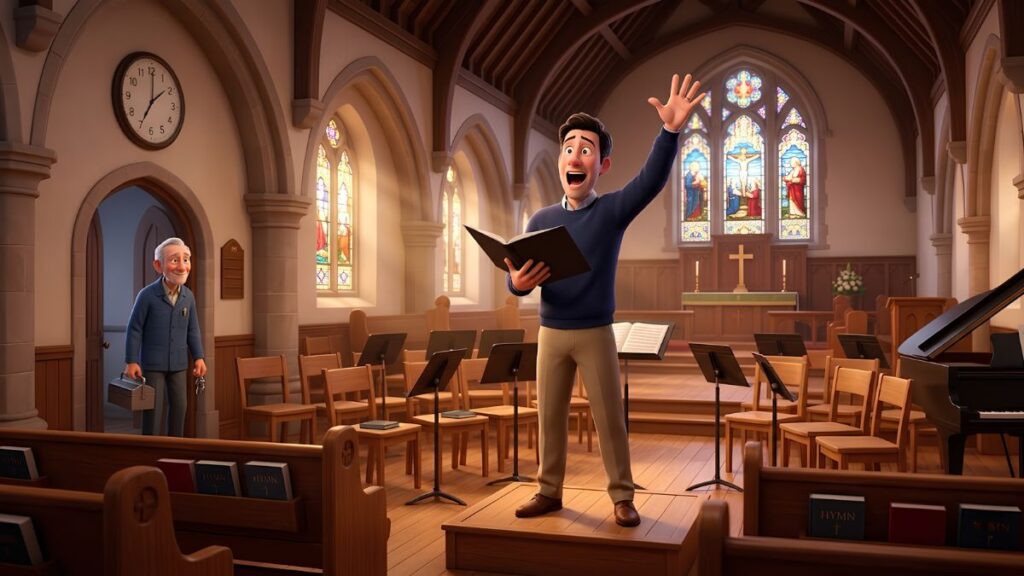
David had always believed that he was a responsible person.
He arrived at work on time.
He paid his bills before the due date.
He remembered birthdays.
He even kept a small notebook in his pocket where he wrote down important things he did not want to forget.
Unfortunately, there was one thing David had never learned to manage very well.
His confidence.
Especially when he was convinced he was right.
David had been attending Grace Community Church for several years. He was not a member of the choir, but he loved music and occasionally helped with church events.
One Sunday, the choir director, Mrs. Wilson, announced that the church would be holding a special music service the following weekend.
“We need everyone to help,” she told the congregation. “The choir will have several extra songs, and we will need volunteers for preparation.”
David immediately raised his hand.
“I can help.”
Mrs. Wilson smiled.
“Thank you, David. We need someone to help arrange the chairs and organize the music stands before rehearsal.”
“Absolutely.”
David was pleased.
He liked being useful.
After the service, Mrs. Wilson gave him some instructions.
“Choir rehearsal is Thursday evening at seven.”
David nodded.
“Thursday at seven.”
“Yes.”
“I’ll be here.”
Mrs. Wilson smiled.
“I’ll see you then.”
David walked home feeling proud.
He repeated the information to himself several times.
Thursday.
Seven o’clock.
Church.
Simple.
There was no way he could forget.
On Thursday afternoon, David checked his notebook.
Choir rehearsal: Thursday, 7:00 p.m.
He smiled.
“See? I remembered.”
At 6:25 p.m., he left his house.
He arrived at the church shortly after 6:40.
The building was quiet.
Very quiet.
David unlocked the side door with the key he had been given for volunteer work.
He stepped inside.
“Hello?”
No answer.
He walked toward the fellowship hall.
Empty.
He checked the main sanctuary.
Empty.
He looked at his watch.
6:45.
“They must be in the choir room,” he said.
David walked toward the choir room.
Empty.
He frowned.
Maybe everyone was running late.
He checked his phone.
No messages.
He waited five minutes.
Still nothing.
David began to wonder whether the rehearsal had been canceled.
But then he remembered something.
Choir members were often busy.
Perhaps they had been delayed.
David decided he would start preparing.
He moved chairs into position.
He arranged the music stands.
He placed folders on the chairs.
Then he noticed a piano.
David smiled.
He had always wanted to play the piano.
Unfortunately, he could only play three songs.
One was “Happy Birthday.”
Another was a children’s song.
The third was something he had learned from an online video but had never managed to play correctly.
Still, the empty church gave him confidence.
He sat down.
He placed his fingers on the keys.
He played a few notes.
The sound echoed through the empty sanctuary.
David smiled.
“This is actually pretty good.”
He played louder.
Then louder.
Then he began singing.
At first, he sang quietly.
Then he became more confident.
Soon David was singing at full volume.
He imagined the choir standing behind him.
He imagined the congregation listening.
He imagined Mrs. Wilson nodding proudly.
He even imagined Pastor James congratulating him after the service.
David reached the most dramatic part of the song.
He raised one hand.
He closed his eyes.
He sang the final note with everything he had.
Silence.
David opened his eyes.
The church was still empty.
He looked at the clock.
6:58.
“They should be here any minute.”
He continued practicing.
Seven o’clock passed.
Then 7:05.
Then 7:10.
Then 7:15.
David began getting impatient.
“Where is everybody?”
At 7:20, he called Mrs. Wilson.
The phone rang.
No answer.
David sighed.
He decided to practice one more song.
Then another.
Then another.
By 7:35, he had been singing for nearly half an hour.
He did not realize that he had become the only person in the building making noise.
Finally, he stopped.
He looked around.
Something felt strange.
He walked back toward the fellowship hall.
Still empty.
He checked the notice board.
There was a large announcement.
CHOIR REHEARSAL – THURSDAY – 7:00 P.M.
David smiled.
“See? I’m right.”
Then he noticed something underneath it.
A smaller note.
NEXT THURSDAY.
David stared at the words.
His smile disappeared.
He checked his phone.
The date was Thursday.
But it was the wrong Thursday.
The rehearsal was scheduled for the following week.
David stood completely still.
He slowly sat down on a chair.
“I have been singing alone for thirty-five minutes.”
The realization was painful.
Then something even worse occurred to him.
He had been singing loudly.
Very loudly.
Anyone walking past the church might have heard him.
He imagined people outside wondering what was happening.
David covered his face.
“This never happened.”
He gathered his things.
He was about to leave when he heard the sound of footsteps.
David froze.
The side door opened.
Mr. Harris, the church caretaker, walked inside carrying a toolbox.
He looked surprised to see David.
“David?”
David smiled nervously.
“Hello.”
“What are you doing here?”
“Choir practice.”
Mr. Harris looked at the empty room.
“Tonight?”
David nodded.
“Yes.”
Mr. Harris looked at the notice board.
Then he looked at David.
Then back at the notice board.
“Oh.”
David waited.
Mr. Harris’s face slowly changed.
He was trying not to laugh.
David pointed at him.
“Don’t.”
Mr. Harris pressed his lips together.
“I’m not laughing.”
“You are.”
“I’m trying not to.”
David sighed.
“I came on the wrong Thursday.”
Mr. Harris finally laughed.
“Apparently.”
David grabbed his jacket.
“I’m going home.”
As he walked toward the door, Mr. Harris called after him.
“David.”
“What?”
“You weren’t bad.”
David stopped.
“Really?”
Mr. Harris smiled.
“Well…”
David waited.
Mr. Harris continued.
“You were enthusiastic.”
David laughed.
“That’s a polite way of saying I was terrible.”
“I didn’t say that.”
“You didn’t have to.”
Both men laughed.
David left the church.
He thought the embarrassing moment was over.
It wasn’t.
The following Thursday, David arrived at church at 6:40 p.m.
This time, he checked the date three times.
He entered the sanctuary.
The choir was already gathering.
Mrs. Wilson looked up.
“David! You’re early.”
David smiled.
“I wanted to make sure I was here on the correct Thursday.”
Mrs. Wilson looked confused.
“What do you mean?”
Before David could answer, Mr. Harris walked past.
He looked at David.
Then he started laughing.
Mrs. Wilson looked at him.
“What happened?”
Mr. Harris shook his head.
“Ask David.”
David immediately knew what was coming.
“No.”
Mrs. Wilson smiled.
“Now I definitely want to know.”
Mr. Harris explained.
Within seconds, everyone in the choir knew.
David had arrived an entire week early.
He had arranged the chairs.
Set up the music stands.
Played the piano.
And sung by himself for almost forty minutes.
The choir members began laughing.
David stood there with his hands in his pockets.
“I knew this was going to happen.”
Mrs. Wilson tried to stop laughing.
“I’m sorry.”
“It’s okay.”
“You really thought rehearsal was tonight?”
“Yes.”
“And you practiced alone?”
“Yes.”
“For almost forty minutes?”
David nodded.
“Yes.”
Mrs. Wilson looked at him.
Then she smiled.
“Well, I have to admit something.”
“What?”
“I wish I had been here.”
Everyone laughed.
David laughed too.
At first, he had been embarrassed.
But now something strange happened.
The embarrassment began to disappear.
He realized everyone had made mistakes.
One choir member once arrived at church wearing two different shoes.
Another had accidentally brought her child’s school lunch instead of her own.
One man had once walked into the wrong classroom and sat through an entire Bible study before realizing he was supposed to be somewhere else.
Compared with those stories, David’s mistake was not so terrible.
It was simply funny.
The rehearsal began.
Mrs. Wilson handed everyone their music.
“All right,” she said. “Let’s start with the opening song.”
The choir began singing.
David stood toward the back.
He sang carefully.
After a few minutes, Mrs. Wilson stopped.
“David.”
He looked nervous.
“Yes?”
“Would you come forward?”
David walked toward her.
“I want you to lead the opening song.”
David stared at her.
“Me?”
“Yes.”
“But I thought I was just helping.”
“You are.”
“Then why am I leading?”
Mrs. Wilson smiled.
“Because you already practiced.”
The choir laughed.
David shook his head.
“You are never going to let me forget this, are you?”
“Probably not.”
David laughed.
He stood at the front.
The piano began.
David took a breath.
Then he started singing.
This time, he wasn’t alone.
The choir joined him.
Their voices filled the sanctuary.
David smiled.
He had never realized how different singing felt when other people were singing with you.
His earlier solo performance had seemed impressive only because the room was empty.
Now he understood something.
Music was not about showing how good one person could be.
It was about people coming together.
Different voices.
Different abilities.
Different personalities.
But one song.
After rehearsal, the choir members gathered in the fellowship hall.
Someone brought coffee.
Someone else brought cookies.
David took one.
Mrs. Wilson sat beside him.
“You know,” she said, “I think your mistake taught us something.”
David smiled.
“What?”
“Sometimes we are embarrassed because we think everyone is judging us.”
David nodded.
“But usually,” she continued, “people are too busy remembering their own mistakes.”
David laughed.
“That’s true.”
Mrs. Wilson smiled.
“And when we learn to laugh at ourselves, other people feel comfortable laughing with us instead of laughing at us.”
David looked around the room.
Everyone was talking and laughing.
Nobody was making fun of him.
They were simply enjoying the story.
David realized that something embarrassing had unexpectedly brought the group closer.
The next Sunday, the choir performed during the special service.
David stood among them.
When the music began, he looked toward Mrs. Wilson.
She smiled.
He smiled back.
The choir started singing.
Everything went perfectly.
No one missed a verse.
No one dropped a music folder.
No one sang at the wrong time.
And David did not arrive on the wrong Thursday.
After the service, Pastor James approached him.
“Excellent job.”
“Thank you.”
“I heard you had an interesting rehearsal experience.”
David sighed.
“That story is going to follow me forever, isn’t it?”
Pastor James laughed.
“I hope so.”
David smiled.
“Why?”
“Because every church needs a good story.”
David laughed.
“I suppose that’s true.”
Pastor James placed a hand on his shoulder.
“And remember, David, humility doesn’t mean never making mistakes. It means being willing to admit them.”
David nodded.
“And sometimes laughing at yourself.”
“Exactly.”
David looked toward the choir.
They were already talking about their next rehearsal.
This time, David opened his notebook.
He carefully wrote:
CHOIR REHEARSAL – NEXT THURSDAY – 7:00 P.M.
Then he underlined it.
Twice.
A choir member looked over his shoulder.
“Are you sure?”
David laughed.
“Absolutely.”
She smiled.
“Maybe check the date again.”
David looked at her.
“Very funny.”
Everyone laughed.
David laughed too.
And from that day forward, he became known at Grace Community Church as the man who never missed choir practice.
Well…
At least not by much.
His mistake became a story the church remembered for years.
Not because David had done something terrible.
Not because anyone wanted to embarrass him.
But because it reminded everyone of something simple:
Nobody gets everything right.
Sometimes we misunderstand.
Sometimes we arrive too early.
Sometimes we practice for an audience that isn’t there.
Sometimes we make mistakes that feel enormous in the moment.
But when we have good friends around us, those mistakes can become memories filled with laughter rather than shame.
David learned that being responsible did not mean being perfect.
It meant being willing to laugh, learn, and try again.
And perhaps most importantly, he learned one very practical lesson.
Always check the date.
Especially when the church choir is involved.
Moral of the Story
Being able to laugh at your own mistakes makes embarrassing moments easier. Everyone misunderstands something from time to time. Instead of allowing embarrassment to destroy your confidence, admit the mistake, learn from it, and allow others to share the laughter. Humility can turn an awkward moment into an opportunity for friendship and community.
3. The Missing Church Cookies
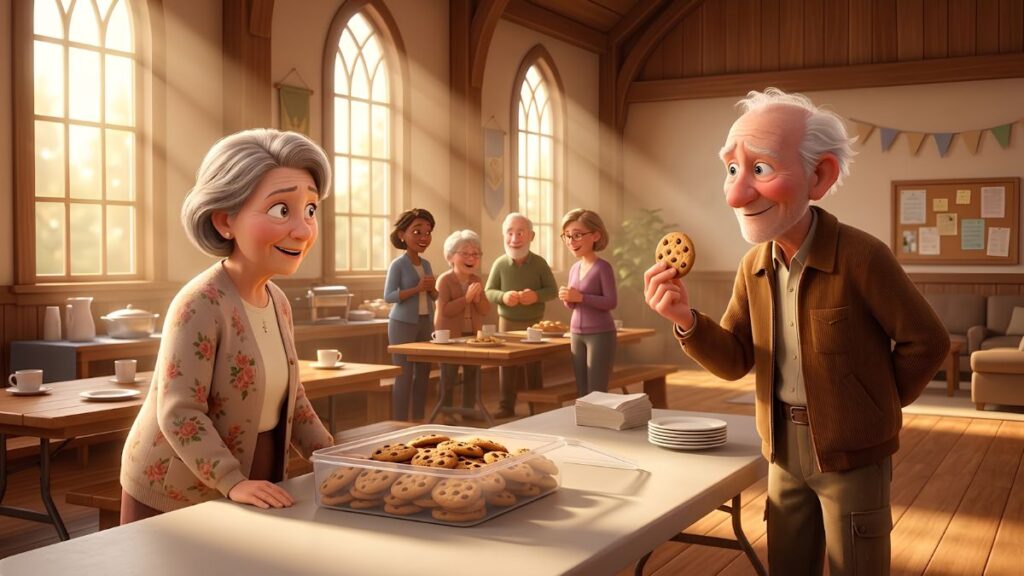
Mrs. Anderson believed that every church gathering needed three things.
Good people.
Good conversation.
And good cookies.
She had been baking cookies for church events for more than twenty years, and she took the responsibility very seriously.
Whenever there was a Sunday fellowship, community dinner, Bible study, children’s program, or holiday gathering, people knew that Mrs. Anderson would probably arrive carrying a large container of homemade cookies.
She had a reputation to maintain.
Her cookies were soft in the middle, slightly crisp around the edges, and usually filled with chocolate chips.
Sometimes she made oatmeal cookies.
Sometimes she made peanut butter cookies.
But her chocolate-chip cookies were legendary.
People often joked that they came to church events just to see what kind she had made.
Mrs. Anderson always pretended to be offended by that.
“People come for the fellowship,” she would say.
Then she would quietly add, “The cookies are just an extra blessing.”
One Saturday morning, the church was preparing for a large community gathering.
Volunteers were setting up tables and chairs.
Someone was decorating the fellowship hall.
The kitchen was filled with the smell of coffee.
And Mrs. Anderson had been awake since seven o’clock preparing cookies.
She mixed the dough carefully.
She measured the flour.
She added butter, sugar, eggs, and chocolate chips.
She arranged the cookies on baking trays.
Then she placed them in the oven.
Twenty minutes later, the kitchen smelled wonderful.
Mrs. Anderson removed the first batch.
She waited for them to cool.
Then she placed them in a large plastic container.
The second batch followed.
Then the third.
By late morning, she had nearly one hundred cookies.
She smiled proudly.
“That should be enough for everyone.”
She carried the container into the fellowship hall.
The event would begin in about an hour.
Mrs. Anderson placed the cookies on a large table near the coffee and tea.
Then she covered them with a clean cloth.
She turned around to help arrange some plates.
When she returned a few minutes later, she noticed something.
The container looked different.
Mrs. Anderson lifted the cloth.
She counted the cookies.
One.
Two.
Three.
Four.
Five.
Six.
She stopped.
There had been more.
She knew there had been more.
She counted again.
Six cookies were missing.
Mrs. Anderson frowned.
“That’s strange.”
She looked around.
The fellowship hall was nearly empty.
A few volunteers were working at the other end of the room.
She walked toward them.
“Did anyone take cookies?”
They shook their heads.
“Not me.”
“No.”
“I haven’t touched them.”
Mrs. Anderson returned to the table.
She counted again.
Six cookies were definitely gone.
She looked toward the kitchen.
Maybe someone had moved them.
She checked the kitchen.
Nothing.
She checked another table.
Nothing.
She returned to the fellowship hall.
A young volunteer named Emily was arranging napkins.
Mrs. Anderson approached her.
“Emily?”
“Yes?”
“Did you see anyone near the cookies?”
Emily thought for a moment.
“I saw some children running through here earlier.”
“Children?”
“Yes. A few of them.”
Mrs. Anderson sighed.
That explained everything.
Children and cookies were rarely a safe combination.
She walked toward the children’s room.
Several children were sitting there, preparing decorations.
Mrs. Anderson looked at them.
“Did any of you take cookies from the fellowship hall?”
The children looked at each other.
One boy shook his head.
Another girl said, “No.”
A third child looked confused.
Mrs. Anderson felt slightly embarrassed.
“All right. I just wanted to ask.”
She walked back.
But something still bothered her.
Six cookies had disappeared.
Not one.
Not two.
Six.
She returned to the table.
She counted again.
Still six missing.
Then she noticed something else.
There were no crumbs.
No wrappers.
No chocolate chips on the floor.
Whoever had taken them had been very careful.
Mrs. Anderson crossed her arms.
“This is a mystery.”
One of the volunteers laughed.
“Maybe the cookies walked away.”
Mrs. Anderson smiled.
“These cookies are good, but they’re not that good.”
She decided to let the matter go.
The event began.
People arrived.
Families greeted one another.
Children played.
Adults talked.
Coffee was served.
Eventually, the cookies were placed on plates.
Nobody mentioned the missing ones.
But Mrs. Anderson kept thinking about them.
She wondered whether she had simply miscounted.
Perhaps she had made fewer cookies than she remembered.
Maybe she had eaten one herself.
Maybe her husband had taken some before she left home.
She tried to convince herself that it was nothing.
Then she noticed Mr. Harris.
Mr. Harris was the church caretaker.
He had been working at the church for many years.
He was in his seventies, quiet, dependable, and always willing to help.
That morning, he had been moving chairs, checking lights, and making sure everything was ready.
Mrs. Anderson noticed him standing near the cookie table.
He looked at the cookies.
Then he looked around.
Then he quietly picked one up.
Mrs. Anderson stared.
Mr. Harris took a bite.
Then he walked away.
Mrs. Anderson’s eyes widened.
She immediately followed him.
“Mr. Harris?”
He turned around.
“Yes?”
“Did you take a cookie?”
Mr. Harris looked at the cookie in his hand.
“Yes.”
Mrs. Anderson tried to remain calm.
“Did you take cookies earlier?”
Mr. Harris looked confused.
“Earlier?”
“Before the event.”
He thought for a moment.
“Oh.”
Mrs. Anderson waited.
“Yes.”
“How many?”
Mr. Harris looked embarrassed.
“I don’t remember.”
Mrs. Anderson raised an eyebrow.
“More than one?”
Mr. Harris smiled.
“Perhaps.”
Mrs. Anderson took a breath.
“How many?”
He counted on his fingers.
“I think six.”
Mrs. Anderson stared at him.
“Six?”
Mr. Harris nodded.
“Maybe.”
Mrs. Anderson looked toward the ceiling.
“So you ate the missing cookies.”
Mr. Harris’s expression changed.
“Missing?”
“Yes.”
He looked genuinely surprised.
“I thought they were samples.”
“Samples?”
Mr. Harris nodded.
“I saw the container in the kitchen earlier. There was a note beside it.”
Mrs. Anderson frowned.
“What note?”
Mr. Harris pointed toward the kitchen.
“It said, ‘Samples for volunteers.'”
Mrs. Anderson immediately remembered.
She had written the note.
But she had intended it to mean that volunteers could sample one cookie after helping with setup.
She had not meant for anyone to eat six.
Mr. Harris continued.
“I thought the cookies were there for volunteers to taste throughout the morning.”
Mrs. Anderson looked at him.
“So every time you walked past the kitchen…”
“I took one.”
“And you thought that was allowed?”
“Yes.”
“All six times?”
Mr. Harris smiled.
“I was doing volunteer work.”
Mrs. Anderson tried to look serious.
But she couldn’t.
She started laughing.
Mr. Harris laughed too.
“I am sorry.”
“I thought one of the children had eaten them.”
Mr. Harris shook his head.
“I would never blame the children.”
Mrs. Anderson laughed.
“Apparently, I blamed the wrong generation.”
By now, a few volunteers had noticed the conversation.
“What happened?”
Mrs. Anderson explained.
Everyone started laughing.
Mr. Harris raised both hands.
“I honestly thought they were samples.”
Mrs. Anderson smiled.
“Well, I suppose they were.”
“Are you angry?”
“No.”
“Good.”
“Although…”
Mr. Harris looked nervous.
“What?”
“You owe me six cookies.”
Mr. Harris laughed.
“I’ll help clean the kitchen.”
“Deal.”
The mystery was solved.
But Mrs. Anderson realized that she had learned something important.
She had assumed the children were responsible.
She had never actually seen a child take a cookie.
She had simply connected two things in her mind:
Children.
Cookies.
Therefore, children must have taken the cookies.
It seemed logical.
But it wasn’t fair.
She had nearly accused innocent children because of an assumption.
That evening, after the event ended, Mrs. Anderson sat with Mr. Harris in the kitchen.
He was washing dishes.
She was packing away the remaining cookies.
“Mr. Harris?”
“Yes?”
“I owe you an apology.”
He looked surprised.
“For what?”
“I assumed you had done something wrong.”
Mr. Harris smiled.
“You didn’t accuse me.”
“Not directly.”
“You asked a question.”
“But I already had an answer in my head.”
Mr. Harris thought about that.
“That’s something we all do sometimes.”
Mrs. Anderson nodded.
“We see something and immediately decide what happened.”
“Yes.”
“Without asking.”
“Yes.”
She handed him a towel.
“Thank you for reminding me.”
Mr. Harris smiled.
“And thank you for the cookies.”
Mrs. Anderson laughed.
“You’re welcome.”
He paused.
“Can I take one more?”
She looked at him.
“One.”
“Thank you.”
He picked one up.
Mrs. Anderson watched him take a bite.
Then she smiled.
“You know, if you had asked me, I would have given you six.”
Mr. Harris laughed.
“That would have saved us a lot of trouble.”
“Exactly.”
The next Sunday, Mrs. Anderson arrived at church with another container.
She placed it on the fellowship table.
This time, she attached a large sign.
PLEASE ASK BEFORE TAKING COOKIES.
Underneath it, she wrote:
Especially you, Mr. Harris.
People laughed when they saw it.
Mr. Harris walked over.
“I feel personally attacked.”
Mrs. Anderson smiled.
“It’s a reminder.”
He picked up a cookie.
“May I?”
“Yes.”
He took one.
“May I have another?”
Mrs. Anderson nodded.
“Yes.”
“How about six?”
She laughed.
“Absolutely not.”
Everyone nearby laughed.
Later that day, one of the children approached Mrs. Anderson.
“Can I ask something?”
“Of course.”
“Did you really think we stole the cookies?”
Mrs. Anderson crouched down.
“I thought someone might have taken them.”
“Did you think it was us?”
She smiled.
“At first, yes.”
The boy looked serious.
“Why?”
Mrs. Anderson answered honestly.
“Because I made an assumption without knowing the whole story.”
The boy thought about that.
“Are you sorry?”
“Yes.”
“Did you say sorry to Mr. Harris?”
“Yes.”
The boy nodded.
“Good.”
Then he looked toward the cookie table.
“Can I have one?”
Mrs. Anderson laughed.
“Yes.”
The boy took a cookie.
He looked at it carefully.
Then he asked:
“Can I have two?”
Mrs. Anderson laughed again.
“One.”
“Okay.”
He walked away happily.
Mrs. Anderson watched him go.
She realized how easily a small misunderstanding could become something bigger.
If she had confronted the children angrily, they might have felt unfairly accused.
If she had repeated the accusation to others, an innocent person could have been blamed.
All because she had not stopped to ask a simple question.
The experience reminded her of something she had heard many times before but had not fully appreciated.
Good communication requires patience.
It is easy to assume.
It is harder to ask.
It is easy to judge.
It is harder to listen.
And sometimes, the truth is much simpler and funnier than the story we create in our own minds.
In this case, the mystery of the missing cookies had not been solved by an investigation.
There had been no dramatic discovery.
No guilty child had been caught.
No secret hiding place had been found.
The answer had simply been an elderly church caretaker who thought he was doing exactly what the note had invited him to do.
He had been eating cookies.
One at a time.
Very responsibly.
At least, that was his story.
And Mrs. Anderson never again looked at a missing cookie the same way.
Whenever something disappeared at church, someone would jokingly ask:
“Was it Mr. Harris?”
And Mr. Harris would always answer:
“Only if it was delicious.”
Everyone would laugh.
Mrs. Anderson would shake her head.
And then she would remind everyone of the real lesson.
“Ask first.”
Because sometimes the person you suspect is completely innocent.
Sometimes the explanation is completely different from what you imagined.
And sometimes the person you thought was stealing the cookies was simply a volunteer who misunderstood a sign.
The cookies became a funny church story.
But the lesson stayed with everyone.
Before making assumptions about someone, stop.
Ask.
Listen.
And give people the opportunity to explain.
Because you may discover that the truth is not what you expected.
And if cookies are involved, make sure the instructions are very clear.
Moral of the Story
It is better to ask questions before making assumptions about someone. A quick judgment can easily lead to misunderstanding or unfair blame. Clear communication, patience, and kindness can prevent small situations from becoming bigger problems. Sometimes the truth is much simpler than the story we create in our minds.
4. The Pastor’s Forgotten Umbrella

Sunday morning arrived with a steady rain.
Not the kind of rain that made people cancel their plans, but the kind that encouraged everyone to carry an umbrella, walk carefully, and spend a few extra minutes looking for their shoes before leaving the house.
At Grace Community Church, the parking lot was already filling up.
Cars arrived one after another.
People hurried from their vehicles toward the entrance, holding umbrellas over their heads.
Some umbrellas were large.
Some were tiny.
One particularly small umbrella barely covered its owner.
Another was so large that the person carrying it could hardly see where they were going.
Inside the church, volunteers were preparing for the morning service.
The sanctuary was warm and welcoming.
The lights were on.
The hymnbooks were arranged.
The microphones had been tested.
Everything appeared ready.
Pastor James arrived shortly before the service.
He stepped out of his car holding a large black umbrella.
He carefully closed it near the entrance and shook a few drops of water from his coat.
“Good morning,” he said to Mr. Harris, the church caretaker.
“Good morning, Pastor.”
“Quite a morning.”
Mr. Harris looked outside.
“It certainly is.”
Pastor James smiled.
“I almost brought the small umbrella.”
“Good thing you didn’t.”
Pastor James laughed.
“The small one has given up on me.”
He walked inside.
The service began a few minutes later.
Everything went smoothly.
The choir sang.
The congregation joined in the hymns.
Pastor James delivered his sermon.
Afterward, people gathered in the fellowship hall for coffee and conversation.
Outside, the rain continued.
Pastor James stood near the entrance talking with several church members.
Eventually, he looked at his watch.
“I should get home.”
He walked toward the coat rack.
He put on his jacket.
Then he stopped.
“Where’s my umbrella?”
Mr. Harris looked around.
“The black one?”
“Yes.”
“You came in carrying it.”
“I know.”
Mr. Harris smiled.
“Then it must be here somewhere.”
Pastor James looked at the coat rack.
Nothing.
He checked near the entrance.
Nothing.
He looked behind a chair.
Nothing.
He opened the closet.
Nothing.
He walked back into the fellowship hall.
“Has anyone seen my umbrella?”
Several people turned around.
“What does it look like?”
“Black.”
“Big?”
“Yes.”
“Anything special about it?”
Pastor James thought.
“No.”
That made things difficult.
There were at least ten black umbrellas in the building.
Mr. Harris began searching.
“Maybe you left it in the sanctuary.”
They walked into the sanctuary.
They checked the pews.
Nothing.
They checked beneath the chairs.
Nothing.
They looked near the piano.
Nothing.
Pastor James scratched his head.
“I know I had it.”
Mr. Harris smiled.
“Perhaps someone moved it.”
“Maybe.”
They searched the hallway.
Then the classrooms.
Then the office.
Nothing.
Soon several church members joined the search.
One person checked the children’s room.
Another checked the kitchen.
Someone looked in the storage closet.
Another checked the entrance again.
The search became surprisingly serious.
“Maybe someone accidentally took it,” one woman suggested.
“But it was raining,” someone else said.
“Perhaps they picked up the wrong umbrella.”
Pastor James sighed.
“I hope not.”
Mr. Harris continued searching.
“Let’s think logically.”
Pastor James nodded.
“Good idea.”
“You arrived through the main entrance.”
“Correct.”
“You carried the umbrella.”
“Correct.”
“You closed it.”
“Correct.”
“Then you walked inside.”
“Yes.”
“Where did you go?”
Pastor James thought.
“I went to my office.”
Mr. Harris looked at him.
“Did you take the umbrella into your office?”
“I don’t remember.”
They went to the office.
Pastor James opened the door.
They looked around.
No umbrella.
They checked behind the desk.
Nothing.
Inside the closet.
Nothing.
Under a chair.
Nothing.
Pastor James looked frustrated.
“This is ridiculous.”
Mr. Harris smiled.
“It’s an umbrella.”
“I know.”
“You’ll find it.”
“I hope so.”
The search continued.
Twenty minutes passed.
Then thirty.
The rain became heavier.
Pastor James looked out the window.
“I really need that umbrella.”
One of the church members laughed.
“Pastor, at this point, I think the umbrella needs you more than you need it.”
Everyone laughed.
Pastor James smiled.
“Very funny.”
They continued searching.
Another twenty minutes passed.
Now almost an hour had gone by.
The church was becoming quiet.
Most people had already left.
Only a few volunteers remained.
Pastor James stood near the entrance.
He looked tired.
“I don’t understand.”
Mr. Harris walked over.
“Let’s retrace your steps one more time.”
“All right.”
They stood outside the main entrance.
Pastor James pointed.
“I parked over there.”
“You opened the umbrella.”
“Yes.”
“You walked inside.”
“Yes.”
“You closed it.”
“Yes.”
“Then what?”
Pastor James paused.
“I remember placing the umbrella somewhere.”
“Where?”
“I don’t know.”
Mr. Harris laughed.
“That’s the problem.”
Pastor James laughed too.
They walked back inside.
Mr. Harris looked around.
“Where would you normally put it?”
“Usually near the door.”
“We checked there.”
“Yes.”
“Your office?”
“Yes.”
“Sanctuary?”
“Yes.”
“Fellowship hall?”
“Yes.”
“Classrooms?”
“Yes.”
“Kitchen?”
“Yes.”
“Storage?”
“Yes.”
Mr. Harris looked at him.
“Is there anywhere else?”
Pastor James thought.
“No.”
They stood silently.
Then Mr. Harris noticed something.
He looked at Pastor James.
“Pastor.”
“Yes?”
“What are you holding?”
Pastor James looked down.
In his right hand was a large black umbrella.
He stared at it.
Mr. Harris stared at it.
The two men remained silent.
Then Pastor James slowly raised the umbrella.
“Is this…”
Mr. Harris burst out laughing.
Pastor James looked at his own hand.
He had been holding the umbrella the entire time.
For nearly an hour.
He had carried it from room to room while searching for it.
He had walked through the sanctuary with it.
He had checked the office with it.
He had looked inside the kitchen while holding it.
He had stood at the entrance complaining about the missing umbrella while holding the missing umbrella.
Pastor James closed his eyes.
“Oh, no.”
Mr. Harris could barely speak because he was laughing.
“Pastor…”
“I know.”
“You were holding it.”
“I know.”
“The entire time.”
“I know.”
Mr. Harris leaned against the wall.
“I don’t know whether to laugh or congratulate you.”
Pastor James began laughing too.
“Just laugh.”
Mr. Harris did.
Within seconds, the remaining volunteers noticed what had happened.
“What happened?”
Mr. Harris pointed toward Pastor James.
“He found it.”
Everyone smiled.
“Where was it?”
Pastor James raised the umbrella.
“In my hand.”
Silence.
Then everyone laughed.
One woman shook her head.
“Pastor, how long were you holding that?”
“About an hour.”
The laughter became louder.
Pastor James smiled.
“I think I need a vacation.”
Mr. Harris replied:
“Perhaps somewhere without umbrellas.”
Everyone laughed again.
Pastor James walked toward the door.
He opened the umbrella.
Then he stopped.
He looked at it.
“Wait.”
Everyone became quiet.
Pastor James looked around.
“Are we sure this is mine?”
The room exploded with laughter.
Mr. Harris walked over.
“Pastor, you have been holding it for an hour. I think we can safely say it belongs to you.”
Pastor James laughed.
“Fair enough.”
He stepped outside.
Then he came back inside.
“One more question.”
“What?”
“Where are my car keys?”
Everyone looked at him.
Pastor James checked his pockets.
Nothing.
The room became silent.
Mr. Harris slowly started laughing again.
“Pastor…”
“What?”
“Check your other hand.”
Pastor James looked down.
His car keys were in his left hand.
Everyone laughed so hard that Pastor James had to sit down.
“All right,” he said. “I’m going home before I lose myself.”
Mr. Harris smiled.
“Good idea.”
Pastor James walked toward his car.
He still had the umbrella in one hand and his keys in the other.
Before getting into the car, he looked back at the church.
Everyone was still laughing.
He smiled.
He couldn’t blame them.
He had given them a story they would remember for years.
The next Sunday, Pastor James walked into the church carrying an umbrella.
The weather was sunny.
There wasn’t a cloud in the sky.
Mr. Harris looked at him.
“Expecting rain?”
Pastor James smiled.
“No.”
“Then why the umbrella?”
Pastor James raised it.
“It’s a reminder.”
“Of what?”
“To remember what I’m already holding.”
Mr. Harris laughed.
The story spread quickly through the church.
By the following week, several people had already heard it.
One church member told another.
Another told her family.
Soon, people were joking about Pastor James’s umbrella.
But the teasing was never cruel.
Everyone had forgotten something at some point.
Someone had searched for glasses that were sitting on their head.
Someone had looked everywhere for a phone that was in their pocket.
Someone had searched for car keys while holding them.
The umbrella story simply happened to be Pastor James’s turn.
One afternoon, a young boy approached him.
“Pastor?”
“Yes?”
“Did you really look everywhere for your umbrella while holding it?”
Pastor James smiled.
“Yes.”
“Why didn’t you notice?”
“I don’t know.”
The boy thought about it.
“Maybe you were thinking about too many things.”
Pastor James nodded.
“That’s probably true.”
“Does that happen to adults?”
“More often than you think.”
The boy smiled.
“My dad does that.”
Pastor James laughed.
“Most parents do.”
The boy asked:
“Did you get embarrassed?”
“A little.”
“What did you do?”
“I laughed.”
“Why?”
“Because there wasn’t much else I could do.”
The boy smiled.
“That’s what my mom says.”
Pastor James nodded.
“Your mother is wise.”
The conversation reminded him of something important.
People often expected leaders to have everything under control.
Pastors.
Teachers.
Parents.
Managers.
Community leaders.
But being responsible did not mean being perfect.
People forgot things.
People misunderstood things.
People made mistakes.
Even people who stood in front of a congregation every Sunday could spend an hour searching for an object they were already holding.
And that was okay.
The important thing was how people responded.
Pastor James could have become angry.
He could have blamed someone.
He could have insisted that someone must have moved the umbrella.
Instead, once he discovered the truth, he laughed.
That laughter made everyone else comfortable.
It reminded them that mistakes were normal.
Several months later, the church held another rainy Sunday service.
Pastor James arrived with his umbrella.
He walked through the entrance.
Mr. Harris looked at him.
“Pastor.”
“Yes?”
“Where’s your umbrella?”
Pastor James immediately looked at his hand.
Everyone nearby started laughing.
“I have it.”
Mr. Harris smiled.
“Good.”
Pastor James held it up.
“I’m learning.”
“Slowly.”
Pastor James laughed.
The church members continued talking.
The rain tapped gently against the windows.
Inside, everyone was warm.
The atmosphere was peaceful.
And somewhere near the entrance stood a black umbrella.
Safe.
Found.
And, this time, definitely not lost.
Pastor James looked at it one last time.
Then he smiled.
Sometimes the funniest moments in life are not planned.
Sometimes they happen because someone forgets something obvious.
Sometimes we search everywhere for an answer that is already right in front of us.
And sometimes, the best response to our own forgetfulness is simply to laugh.
Because everyone forgets.
Everyone makes mistakes.
Everyone has moments when their minds are somewhere else.
What matters is not whether we ever make mistakes.
What matters is whether we can respond with humility, patience, and a sense of humor.
Pastor James never forgot the lesson.
Although, to be completely honest, he occasionally forgot where he had put his umbrella.
But from then on, before searching the church from top to bottom, he always checked his hands first.
And whenever someone asked him why, he would smile and say:
“Experience.”
Moral of the Story
Everyone has forgetful moments, and sometimes the best response is simply to laugh. Making a small mistake does not make someone foolish or incapable. Being able to admit it, laugh about it, and move forward with humility can turn an embarrassing moment into a warm memory shared with friends.
5. The Sunday School Drawing
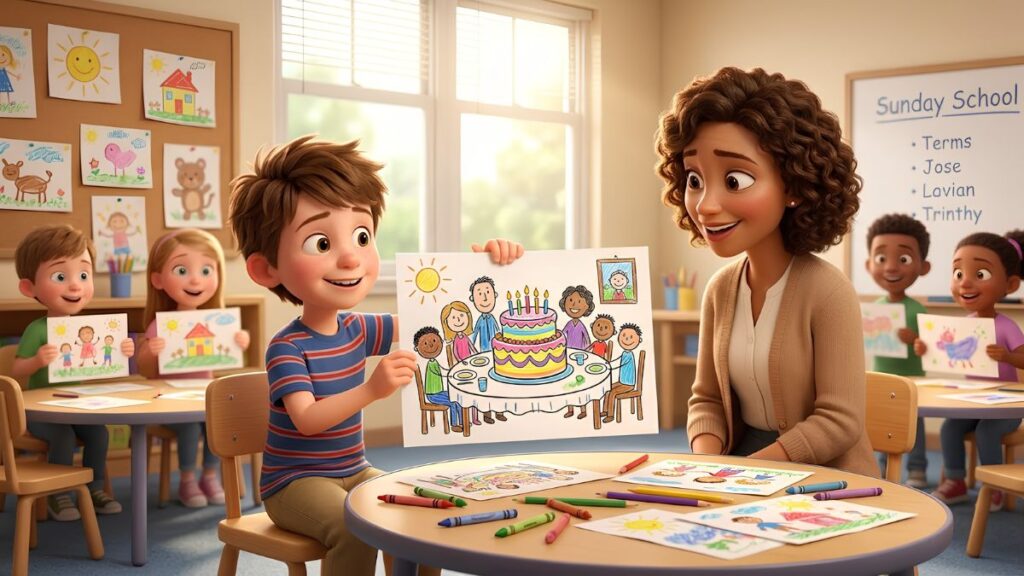
Sunday morning was always a busy time at Grace Community Church.
Adults hurried toward the sanctuary carrying Bibles, coffee cups, and umbrellas when the weather was bad.
Children moved in every direction.
Some ran toward the Sunday school rooms.
Some stopped to talk to friends.
Others followed their parents reluctantly, hoping that someone would announce that the lesson was going to be shorter than usual.
Among the children was nine-year-old Tommy.
Tommy was cheerful, curious, and almost always hungry.
His mother often joked that he could finish breakfast and ask what was for lunch five minutes later.
Tommy loved Sunday school.
He liked the stories.
He liked the songs.
He liked the games.
But there was one thing he loved more than almost anything else.
Food.
Especially cake.
And especially his grandmother’s cake.
Tommy’s grandmother, Grandma Rose, was famous in their family for making cakes.
Chocolate cake.
Vanilla cake.
Carrot cake.
Apple cake.
She could make almost anything.
But there was one thing that made Grandma Rose’s cakes particularly special.
She never made a small cake.
Whenever she brought cake to a family gathering, it was large enough to feed twice as many people as were actually present.
She believed there was no such thing as too much cake.
Tommy completely agreed.
One Sunday morning, Tommy entered his Sunday school classroom and sat down with the other children.
Their teacher, Mrs. Wilson, smiled at them.
“Good morning, everyone.”
“Good morning!”
“How is everyone today?”
“I’m hungry!” Tommy shouted.
The room burst into laughter.
Mrs. Wilson smiled.
“It’s nine-thirty in the morning, Tommy.”
“I know.”
“And you’re already hungry?”
Tommy nodded.
“Yes.”
Mrs. Wilson shook her head.
“Well, perhaps today’s lesson will help.”
“Is it about food?”
“No.”
Tommy looked disappointed.
Mrs. Wilson laughed.
“Today’s lesson is about gratitude.”
She walked toward the board.
“Gratitude means being thankful for the things we have.”
The children listened.
“Sometimes we are thankful for big things,” she continued. “Our families. Our homes. Our friends. Our health. The people who care for us.”
She paused.
“But we can also be thankful for simple things.”
Tommy raised his hand.
Mrs. Wilson smiled.
“Yes, Tommy?”
“Cookies?”
Everyone laughed.
Mrs. Wilson nodded.
“Yes. Cookies can be something you’re thankful for.”
Tommy smiled.
“I knew it.”
Mrs. Wilson handed each child a piece of paper and some colored pencils.
“I want each of you to draw a picture showing something you are thankful for.”
The children immediately began drawing.
One girl drew her family.
Another drew a house.
A boy drew a football.
One child drew a dog.
Another drew a garden.
Tommy stared at his blank sheet of paper.
He thought carefully.
What was he thankful for?
His parents?
Yes.
His little sister?
Sometimes.
His friends?
Definitely.
His church?
Yes.
His grandmother?
Absolutely.
Tommy picked up a brown colored pencil.
He started drawing.
First, he drew a very large rectangle.
Then another.
Then another.
He added a table.
Then chairs.
Then people.
Lots of people.
He added plates.
He added forks.
He added glasses.
Then he added something in the center of the table.
A huge cake.
Tommy looked at his drawing.
He was pleased.
He colored the cake carefully.
He added several layers.
He added frosting.
He even added what appeared to be strawberries on top.
Then he drew himself sitting at the table.
He made himself slightly larger than everyone else.
Mrs. Wilson walked around the classroom looking at the drawings.
She stopped beside Tommy.
“That’s a very big table.”
Tommy nodded.
“Yes.”
“Who are all these people?”
“My family.”
“That’s wonderful.”
“And that’s Grandma Rose.”
Tommy pointed to a woman at the end of the table.
“She makes the cake.”
Mrs. Wilson smiled.
“I see.”
Tommy proudly held up the picture.
“She always brings enough food for everybody.”
Mrs. Wilson smiled.
“That’s something wonderful to be thankful for.”
Tommy nodded.
“Yes.”
Soon the children finished.
Mrs. Wilson asked everyone to sit in a circle.
“Let’s share our drawings.”
One by one, the children showed their pictures.
Sarah showed her family.
“I am thankful for my parents because they take care of me.”
Everyone smiled.
Michael showed a picture of his dog.
“I’m thankful for my dog because he always plays with me.”
Another child drew a school.
“I’m thankful for my teacher.”
Mrs. Wilson smiled.
Then she turned toward Tommy.
“Tommy, would you like to show us yours?”
Tommy stood proudly.
He carried his picture to the front.
Everyone looked.
Mrs. Wilson smiled.
“That’s a wonderful drawing.”
Tommy nodded.
“I’m thankful for my family.”
Mrs. Wilson pointed toward the large table.
“Tell us about this.”
“That’s everyone eating.”
“And what’s in the middle?”
Tommy smiled.
“Grandma Rose’s cake.”
Everyone laughed.
Mrs. Wilson smiled.
“Why are you thankful for the cake?”
Tommy looked at the drawing.
“Because Grandma Rose always makes enough for everyone.”
Mrs. Wilson nodded.
“That’s a very good reason.”
Tommy smiled.
Then Mrs. Wilson asked:
“Is there anything else you are thankful for?”
Tommy thought for a moment.
“My family.”
“Good.”
“My friends.”
“Good.”
“My church.”
“Wonderful.”
“And the cake.”
The children laughed again.
Mrs. Wilson laughed too.
“Yes, Tommy. The cake.”
Tommy returned to his seat.
But then Mrs. Wilson noticed something about the drawing.
She leaned closer.
“Tommy?”
“Yes?”
“Why did you draw yourself with such a big piece of cake?”
Tommy looked at the picture.
He had indeed drawn himself with a piece of cake nearly as large as his head.
He smiled.
“That’s my favorite part.”
Everyone laughed.
Mrs. Wilson shook her head.
“I can see that.”
Tommy sat down.
The lesson continued.
But something happened afterward that nobody expected.
When the children left the classroom, Mrs. Wilson noticed Tommy’s drawing still sitting on the table.
She looked at it again.
The picture was simple.
A family.
A table.
Food.
A large cake.
But she realized there was something beautiful about it.
Tommy had not drawn an expensive toy.
He had not drawn a new bicycle.
He had not drawn a television or a video game.
He had drawn people sitting together.
He had drawn his family sharing a meal.
The cake was important to him, but what really made him happy was the gathering around it.
Mrs. Wilson smiled.
She carefully placed the drawing in a folder.
Later that morning, she mentioned it to Pastor James.
“Tommy made the sweetest drawing today.”
Pastor James smiled.
“What did he draw?”
“A family around a dinner table.”
“That sounds wonderful.”
“He said he was thankful because his grandmother always makes enough food for everyone.”
Pastor James laughed.
“That’s Tommy.”
Mrs. Wilson smiled.
“But there was something else.”
“What?”
“He wasn’t really thankful for the cake.”
Pastor James looked surprised.
“He wasn’t?”
Mrs. Wilson shook her head.
“I think he was thankful for what the cake represented.”
Pastor James smiled.
“A family together.”
“Exactly.”
That afternoon, Tommy went to his grandmother’s house.
Grandma Rose was in the kitchen.
She was preparing something.
Tommy walked in.
“What are you making?”
She smiled.
“Guess.”
Tommy looked at the counter.
There were eggs.
Flour.
Sugar.
Butter.
Chocolate.
Tommy’s eyes widened.
“Cake!”
Grandma Rose laughed.
“You guessed very quickly.”
“Because I know you.”
She smiled.
“How was Sunday school?”
“Good.”
“What did you learn?”
Tommy took off his shoes.
“We learned about being thankful.”
“That’s good.”
“I drew a picture.”
“Can I see it?”
Tommy opened his backpack.
He pulled out the drawing.
Grandma Rose looked at it.
Her face softened.
“You drew all of us.”
“Yes.”
“And there’s the cake.”
Tommy nodded proudly.
“I made it big.”
“I noticed.”
He smiled.
“I’m thankful for your cake.”
Grandma Rose laughed.
“Only the cake?”
Tommy shook his head.
“No.”
He pointed at the people around the table.
“I’m thankful for everybody.”
Grandma Rose hugged him.
“That’s what makes me happy.”
Tommy smiled.
Then he asked:
“When is the cake ready?”
Grandma Rose laughed.
“You really know how to ruin a sentimental moment.”
Tommy laughed.
“Sorry.”
“No, you’re not.”
“No.”
She smiled.
“Go wash your hands.”
Tommy ran toward the bathroom.
Later that evening, the family gathered around the table.
There were parents.
Children.
Grandparents.
Uncles.
Aunts.
Everyone was talking.
Everyone was laughing.
And in the center of the table was Grandma Rose’s cake.
Tommy looked around.
For once, he wasn’t thinking only about the cake.
He looked at the people around him.
His father telling a story.
His grandmother laughing.
His mother serving food.
His little sister trying to sneak frosting before dinner.
Tommy smiled.
He understood something.
The cake tasted wonderful.
But it wouldn’t be nearly as special if he were eating it alone.
The next Sunday, Mrs. Wilson returned Tommy’s drawing.
She had placed it inside a clear plastic folder to protect it.
Tommy looked at it proudly.
“Can I take it home?”
“Of course.”
He held it carefully.
“Thank you.”
Mrs. Wilson smiled.
“Do you remember what we learned?”
“To be thankful.”
“Yes.”
Tommy nodded.
“And?”
Mrs. Wilson waited.
Tommy thought.
“Be thankful for people, not just things.”
Mrs. Wilson smiled.
“Exactly.”
Tommy looked at his drawing.
“I think I understand.”
He pointed at the cake.
“The cake is good.”
Mrs. Wilson laughed.
“But the people are better.”
“Yes.”
Tommy paused.
“Although the cake is still really good.”
Mrs. Wilson laughed.
“I never doubted that.”
The story of Tommy’s drawing eventually became a favorite among the Sunday school teachers.
Not because it was the most artistic drawing.
It wasn’t.
The lines were uneven.
The people had oversized heads.
The table was strangely shaped.
The cake took up nearly half the page.
But the picture captured something important.
Gratitude does not always have to sound complicated.
Children often understand it in simple ways.
A child may be thankful for a favorite toy.
Another may be thankful for a pet.
Someone else may be thankful for their favorite meal.
These simple things can reveal deeper blessings.
Tommy’s cake represented his grandmother’s love.
The large table represented family.
The many chairs represented belonging.
The food represented generosity.
And the laughter represented the joy of being together.
Years later, Tommy would probably forget exactly what he learned in many Sunday school lessons.
He might forget some of the verses.
He might forget some of the songs.
He might forget the games.
But he would remember Grandma Rose’s cake.
And he would remember that being thankful was not about having the biggest or most expensive things.
It was about noticing the good things already around you.
A family meal.
A friend who listens.
A grandparent who cares.
A teacher who encourages.
A church community that welcomes you.
A simple piece of cake shared with people you love.
Those things can become some of life’s greatest treasures.
And whenever Grandma Rose baked a cake after that, Tommy would always say the same thing.
“Thank you, Grandma.”
She would smile.
Then she would ask:
“Is that all you’re thankful for?”
Tommy would look around the table.
“No.”
He would smile.
“I’m thankful we’re all here.”
Then he would pause.
“And I’m thankful for the cake too.”
Grandma Rose would laugh.
And the family would gather around the table.
Because sometimes gratitude is beautifully simple.
Sometimes it looks like a child’s drawing.
Sometimes it sounds like a quiet “thank you.”
And sometimes, it comes with frosting.
Moral of the Story
Children often express gratitude in the simplest and most honest ways. What may seem like a child’s appreciation for something small can actually reflect a deeper understanding of love, family, generosity, and togetherness. We should remember to be thankful not only for the things we enjoy, but especially for the people who make those moments meaningful.
6. The Church Picnic Competition

Every summer, Grace Community Church held a picnic.
It was one of the most popular events on the church calendar.
Families brought blankets.
Children played games.
Adults prepared food.
Someone always brought too much lemonade.
Someone else always forgot the serving spoons.
And every year, Pastor James reminded everyone that the picnic was supposed to be about fellowship, not competition.
Nobody listened very carefully to that last part.
Especially not David and Michael.
David and Michael had been friends for more than twenty years.
They had attended the same church, helped with the same community projects, and even worked together on several charity events.
They knew each other’s personalities very well.
David was organized.
Michael was energetic.
David liked to plan everything.
Michael liked to improvise.
David believed instructions existed for a reason.
Michael believed instructions were suggestions.
Despite their differences, they were good friends.
But there was one thing they both shared.
Neither liked losing.
The annual church picnic was scheduled for Saturday morning at a large park near the church.
The weather was perfect.
The sun was shining.
A gentle breeze moved through the trees.
Families spread blankets across the grass.
Children ran toward the playground.
Volunteers arranged tables under a large pavilion.
The smell of grilled food filled the air.
David arrived early.
He carried a large box.
Michael arrived shortly afterward.
“What did you bring?” Michael asked.
“Everything.”
Michael laughed.
“That’s not an answer.”
David opened the box.
Napkins.
Plates.
Cups.
Sandwich bags.
Plastic utensils.
Fruit.
Cookies.
Even small packets of salt and pepper.
Michael stared at him.
“You packed for a small army.”
David smiled.
“You never know what people will need.”
Michael opened his own bag.
“I brought bread.”
David looked at him.
“Just bread?”
“And peanut butter.”
“Anything else?”
“Jelly.”
David shook his head.
“You are impossible.”
Michael smiled.
“I’m efficient.”
The picnic officially began.
After lunch, Pastor James gathered everyone.
“Before we continue,” he announced, “we have a few friendly games.”
The children cheered.
The adults cheered too.
Pastor James smiled.
“Remember, these are just for fun.”
David looked at Michael.
Michael looked at David.
Both men smiled.
The first game was a sack race.
David participated.
Michael participated.
Neither wanted to lose.
They jumped across the grass.
David fell halfway through.
Michael laughed so hard that he nearly fell too.
The children cheered.
Eventually, Michael won.
David congratulated him.
“Well done.”
“Thank you.”
“Enjoy it.”
Michael smiled.
“What does that mean?”
“Nothing.”
The next game was a ring toss.
David won.
Then Michael won the beanbag challenge.
David won the trivia game.
Michael won the three-legged race.
By lunchtime, they were tied.
Then someone suggested a new competition.
“Why don’t we have a sack lunch challenge?”
Pastor James raised an eyebrow.
“A sack lunch challenge?”
One of the volunteers explained.
“Each team gets the same ingredients. They have five minutes to prepare a complete picnic lunch.”
The crowd loved the idea.
David immediately volunteered.
Michael did too.
Pastor James laughed.
“I knew this would happen.”
The organizers divided everyone into small teams.
David and Michael ended up on different teams.
Each team received:
Bread.
Cheese.
Lettuce.
Tomatoes.
Fruit.
Cookies.
Juice.
Napkins.
Plastic bags.
The goal was simple.
Prepare a neat sack lunch as quickly as possible.
The winning team would receive a small trophy.
David looked at the trophy.
It was only about ten inches tall.
But to him, it suddenly looked extremely important.
Michael looked at it too.
He smiled.
“This is mine.”
David laughed.
“We’ll see.”
The whistle blew.
Everyone started working.
David’s team immediately organized itself.
Bread here.
Cheese there.
Fruit in separate bags.
Napkins folded neatly.
David moved quickly.
“Sandwiches first!”
His teammates followed.
Across the table, Michael’s team was working just as quickly.
But Michael had a different approach.
He grabbed everything at once.
Bread.
Cheese.
Tomatoes.
Fruit.
Napkins.
He began assembling lunches rapidly.
“Faster!”
Someone laughed.
“We’re trying!”
David glanced across.
Michael was already on his third sandwich.
David became more determined.
“Don’t worry about decoration. Just finish.”
His team worked faster.
The clock continued.
Three minutes.
Two minutes.
One minute.
David shouted:
“Almost done!”
Michael shouted:
“One more!”
The whistle blew.
Everyone stopped.
The judges walked around inspecting the lunches.
David looked at his team’s table.
Everything was perfect.
The sandwiches were neatly wrapped.
Fruit was placed in small bags.
Cookies were separated.
Napkins were folded.
Even the juice boxes were positioned neatly.
David smiled confidently.
Then he looked across the table.
Michael’s team had finished too.
Their lunches were not nearly as neat.
Some sandwiches were slightly crooked.
One bag contained too much fruit.
Another had a cookie sitting on top of the sandwich.
But they were finished.
The judges talked quietly.
Finally, Pastor James stepped forward.
“The winning team is…”
Everyone waited.
“…David’s team!”
David raised both hands.
His teammates cheered.
Michael laughed and applauded.
“Congratulations.”
David smiled.
“Thank you.”
Pastor James handed him the small trophy.
David looked pleased.
Michael shook his hand.
“Good job.”
“Thanks.”
David held up the trophy.
“Looks like organization wins.”
Michael laughed.
“Today.”
David smiled.
“Today is enough.”
Everyone returned to the picnic.
The competition was forgotten.
At least for a while.
Then lunch began.
Families sat on blankets.
People talked.
Children ran around.
David and Michael sat beneath a tree.
David opened his lunch bag.
Michael opened his.
They each looked inside.
Then they looked at each other.
David frowned.
“Wait.”
Michael looked confused.
“What?”
“This isn’t my lunch.”
Michael checked his bag.
“Neither is this.”
They looked at the bags again.
Somehow, during the competition, they had accidentally mixed them up.
David had Michael’s lunch.
Michael had David’s.
Michael started laughing.
David shook his head.
“How did this happen?”
“I don’t know.”
David opened the bag again.
The sandwich was slightly crooked.
A cookie was sitting on top of it.
He looked at Michael.
“That’s yours.”
Michael opened his bag.
Inside was a perfectly wrapped sandwich.
Fruit neatly separated.
Napkin folded.
He smiled.
“And this is yours.”
David laughed.
“So we prepared each other’s lunches.”
“Apparently.”
David looked at his lunch.
“You know what’s funny?”
“What?”
“I spent five minutes making this.”
“And I spent five minutes making yours.”
They both laughed.
Then Michael held up his sandwich.
“Want to trade?”
David looked at him.
“Why?”
“Because I think yours looks better.”
David smiled.
“You mean you want the organized lunch.”
Michael nodded.
“Yes.”
David laughed.
“Fine.”
They exchanged lunches.
Michael opened the neat bag.
“Wow.”
David opened the messy one.
He looked at the crooked sandwich.
Then at the cookie.
Then at the fruit.
He smiled.
“You know what?”
“What?”
“This actually looks good.”
Michael laughed.
“Of course it does.”
They began eating.
After a few bites, Michael said:
“You know, I think we were taking this competition too seriously.”
David nodded.
“I think so too.”
“We were racing around like there was a championship on the line.”
David looked at the tiny trophy sitting beside him.
“It’s a ten-inch trophy.”
Michael laughed.
“Exactly.”
They both looked at it.
Then they started laughing.
A few minutes later, Pastor James walked past.
“How’s lunch?”
David smiled.
“We accidentally swapped meals.”
Pastor James laughed.
“How did that happen?”
“We were too busy trying to win.”
Pastor James nodded.
“That sounds about right.”
Michael pointed toward the trophy.
“We won.”
David corrected him.
“David’s team won.”
Michael smiled.
“Technically.”
Pastor James looked at the two men.
“And what did you win?”
David looked at Michael.
Michael looked at David.
Neither answered.
Pastor James smiled.
“Exactly.”
He walked away.
David picked up the trophy.
“You know what?”
“What?”
“Let’s give it to the kids.”
Michael smiled.
“Good idea.”
They walked toward the children’s games.
David handed the trophy to a group of children.
“Here.”
One little girl looked surprised.
“Who won it?”
David pointed at Michael.
“He did.”
Michael pointed at David.
“He did.”
The children laughed.
One boy asked:
“So who really won?”
David smiled.
“We both did.”
The boy looked confused.
“How?”
Michael answered.
“Because we remembered we’re friends.”
The boy nodded as though that made perfect sense.
Then he ran away with the trophy.
The picnic continued.
There were more games.
More food.
More laughter.
David and Michael participated in another race.
This time, neither cared who won.
They ran together.
Halfway across the grass, Michael stumbled.
David stopped to help him.
Michael laughed.
“You could have won.”
David shook his head.
“Not today.”
They finished the race together.
The crowd applauded.
Pastor James smiled.
“Now that’s what I call competition.”
Later in the afternoon, the families gathered for a group photograph.
Everyone stood together beneath a large tree.
David and Michael stood next to each other.
Michael whispered:
“Did you bring the trophy?”
David looked around.
“No.”
“Good.”
They laughed.
The photographer counted.
“Three…”
“Two…”
“One…”
Everyone smiled.
The picture captured the entire group.
Children.
Parents.
Grandparents.
Friends.
Volunteers.
Everyone together.
The trophy was nowhere to be seen.
And that was perfectly fine.
Years later, people would remember the church picnic.
Some would remember the games.
Some would remember the food.
Some would remember the rainy picnic the following year.
But many would remember David and Michael’s famous sack lunch competition.
The story became part of church history.
Whenever someone organized a friendly competition, someone would say:
“Remember what happened to David and Michael?”
And everyone would laugh.
David would always say:
“I won.”
Michael would answer:
“You won a trophy.”
David would smile.
“And you won a sandwich.”
Michael would laugh.
“Fair enough.”
The funny thing was that neither man really remembered who won most of the games that day.
They remembered the laughter.
They remembered eating each other’s lunches.
They remembered giving the trophy to the children.
And they remembered finishing the final race together.
The experience taught them something simple.
Competition can be fun.
Winning can be exciting.
Trying your best is important.
But none of those things matter very much if winning causes you to forget the people beside you.
Friendship is worth more than a trophy.
Community is worth more than being first.
And sometimes the best ending to a competition is realizing that you were never really competing against your friend in the first place.
You were simply enjoying the day together.
As the sun began to set, David and Michael helped clean up the picnic area.
They folded tables.
Collected trash.
Packed leftover food.
And carried chairs back to the church van.
Michael picked up a plastic bag.
“What’s this?”
David looked.
“It’s your lunch.”
Michael laughed.
“No wonder I couldn’t find my cookie.”
David smiled.
“You’ve been looking for it all afternoon?”
“Yes.”
David handed it to him.
Michael took the cookie.
Then he broke it in half.
He gave one half to David.
David smiled.
“Friends?”
“Friends.”
They ate the cookie together.
And that small moment was worth far more than any trophy.
Moral of the Story
Winning is not always important when friendship is more valuable. Healthy competition can bring excitement and laughter, but it should never become more important than relationships. The best victories are often the ones that leave everyone smiling, connected, and grateful for the people around them.
7. The Announcement Nobody Expected
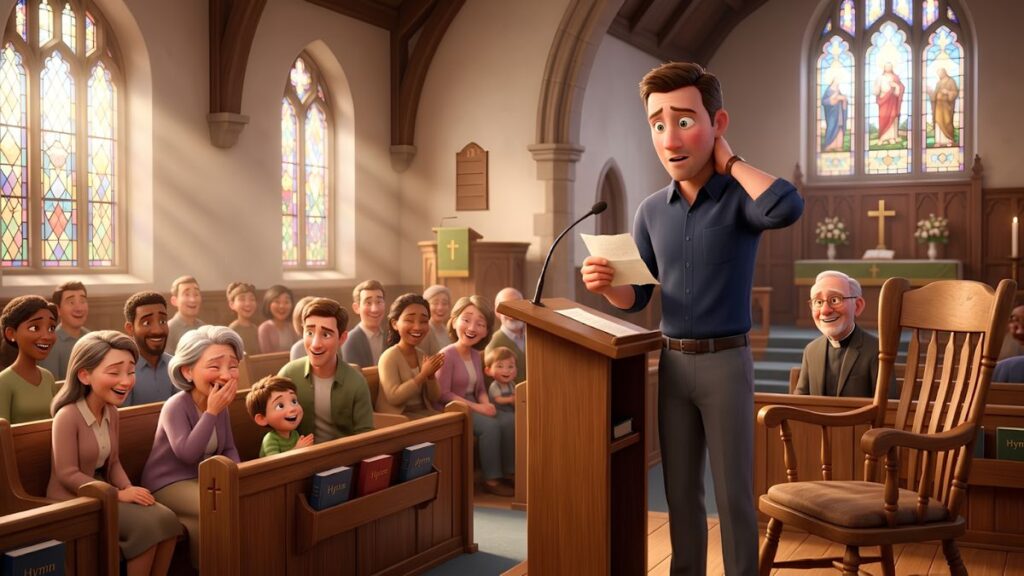
Robert had volunteered at Grace Community Church for years.
He helped arrange chairs.
He carried boxes.
He handed out programs.
He occasionally helped in the kitchen.
If something needed to be done, Robert was usually willing to help.
There was only one thing he tried very hard to avoid.
Speaking in front of a crowd.
Robert was comfortable talking to one person.
He was comfortable talking to two people.
He could even have a conversation with a small group.
But standing in front of the entire congregation?
That was different.
His voice became shaky.
His hands became sweaty.
His mind suddenly forgot every word he had ever learned.
Unfortunately, one Sunday morning, Robert was asked to do exactly that.
The church was preparing for its annual community dinner.
The event was important.
Families from the church would attend, but the dinner was also open to people from the surrounding neighborhood.
There would be food, music, games, and a short community program.
The organizers needed someone to make an announcement during the Sunday service.
After the service began, Pastor James noticed Robert sitting near the front.
He walked over.
“Robert?”
“Yes?”
“Could you help me with something?”
Robert smiled.
“Of course.”
“We need someone to make the announcement about the community dinner.”
Robert’s smile disappeared.
“Someone?”
“Yes.”
“Who?”
Pastor James smiled.
“You.”
Robert stared at him.
“Me?”
“Yes.”
Robert immediately looked around the sanctuary.
“Are you sure?”
Pastor James laughed.
“Very sure.”
Robert swallowed.
“I don’t think I’m good at announcements.”
“You’ll be fine.”
“What if I forget?”
“You have notes.”
“What if I say the wrong thing?”
“Then we’ll correct it.”
“What if…”
Pastor James smiled.
“Robert.”
“Yes?”
“It’s just an announcement.”
Robert nodded.
“Right.”
He took a deep breath.
“Just an announcement.”
Pastor James handed him a small piece of paper.
The information was simple.
Community Dinner
Saturday at 6:00 p.m.
Church fellowship hall.
Everyone welcome.
Bring a favorite dish to share.
Robert read it carefully.
He memorized it.
Then he read it again.
He even practiced in front of his bathroom mirror.
“Good morning, everyone. I’d like to remind you about our community dinner this Saturday…”
He stopped.
He started again.
“Good morning. Don’t forget the community dinner…”
He stopped.
Again.
“Everyone is invited to the community dinner…”
Better.
He practiced several more times.
By Sunday morning, Robert felt ready.
Well…
As ready as he could be.
During the service, he sat quietly.
He kept his note in his pocket.
He touched it several times to make sure it was still there.
Finally, Pastor James announced:
“Before we continue, Robert has an important announcement about our community dinner.”
Robert’s heart began beating faster.
He stood.
He walked toward the front.
Hundreds of eyes seemed to follow him.
He reached the microphone.
He looked at the congregation.
His mind went blank.
For a moment, Robert couldn’t remember a single word.
Then he saw the note in his hand.
He took it out.
He smiled nervously.
“Good morning.”
The congregation smiled.
Robert took a breath.
“I am here to remind everyone about the community dinner this Saturday.”
Good.
He was doing fine.
“Everyone is invited.”
Good.
“Please come and bring your favorite…”
He paused.
His mind suddenly raced.
Dish.
He knew the word.
He had practiced the word.
But at that moment, another word appeared in his mind.
Chair.
Robert continued.
“…favorite chair.”
Silence.
A few people blinked.
Robert didn’t notice.
He continued.
“We hope everyone can come and bring their favorite chair.”
Someone near the front looked confused.
Robert glanced at his note.
His face changed.
He read the actual word.
Dish.
He had said chair.
Robert froze.
A few people began smiling.
Someone quietly laughed.
Robert tried to correct himself.
“I mean…”
He took a breath.
“Bring your favorite dish.”
The congregation laughed gently.
Robert laughed too.
“Not your chair.”
More laughter.
Robert relaxed slightly.
Then, for reasons he would never understand, he became even more nervous.
He looked at his note.
“The dinner starts at six.”
Good.
“Please arrive early.”
Good.
“And don’t forget…”
He paused.
The congregation waited.
“…your favorite dish.”
Everyone laughed again.
Robert nodded.
“Yes. Your dish.”
He was about to leave the microphone.
Then he remembered one more detail.
“Oh!”
He turned back.
“We also need volunteers to help with setup.”
That was correct.
“And we need people to bring desserts.”
Correct.
“And…”
He looked at his note.
He read the line.
Then he accidentally repeated the dinner announcement.
“Also, don’t forget the community dinner this Saturday.”
The congregation laughed.
Robert realized what he had done.
“I already said that.”
More laughter.
He shook his head.
“I’m nervous.”
Someone shouted:
“We noticed!”
The congregation laughed even louder.
Robert smiled.
“Thank you for your honesty.”
He looked toward Pastor James.
Pastor James was laughing too.
Robert continued.
“Anyway, please come.”
He paused.
“Bring food.”
He looked at the congregation.
“And preferably…”
He held up one finger.
“…not furniture.”
The entire church burst into laughter.
Robert laughed.
Then he stepped away from the microphone.
As he returned to his seat, people smiled at him.
Some shook their heads affectionately.
Others gave him thumbs-up.
Robert sat down.
His face was red.
He whispered to himself:
“I am never doing that again.”
Pastor James leaned toward him.
“You did fine.”
“I invited everyone to bring chairs.”
“For about five seconds.”
“I repeated the announcement.”
“Twice.”
“I forgot what I was saying.”
“Only briefly.”
Robert sighed.
“Everyone laughed.”
Pastor James smiled.
“With you.”
Robert looked at him.
“Not at me?”
“With you.”
Robert smiled.
That distinction mattered.
After the service, several people approached him.
“You made my morning.”
“I’ve never heard an announcement like that.”
“Should I bring a chair?”
Robert laughed.
“Please don’t.”
One elderly woman smiled.
“I was actually trying to figure out how we were going to fit everyone’s chairs into the fellowship hall.”
Robert laughed.
“I almost created a logistical disaster.”
Another man joked:
“I was going to bring my favorite recliner.”
Robert shook his head.
“Please don’t.”
The laughter continued.
But nobody was cruel.
Nobody criticized him.
In fact, Robert discovered something unexpected.
People appreciated his honesty.
They had seen him become nervous.
They had seen him make mistakes.
And instead of pretending nothing had happened, he had laughed at himself.
That made people feel comfortable.
Later that afternoon, Robert went home.
He told his wife what had happened.
She laughed.
“You told everyone to bring their favorite chair?”
“Yes.”
“Why?”
“I don’t know.”
She laughed again.
“And then?”
“I repeated the announcement.”
“Twice?”
“Yes.”
She smiled.
“Anything else?”
“I almost told them to bring their favorite table.”
His wife laughed so hard she had to sit down.
Robert smiled.
“At least you’re enjoying this.”
“I am.”
The following week, the church office received an unusual phone call.
A woman asked:
“Is the community dinner still happening?”
The secretary said yes.
“Good,” the woman replied.
“I just wanted to make sure we don’t need to bring chairs.”
The secretary laughed.
“I think Robert’s announcement has become famous.”
The story spread through the community.
People who had not even been at the service heard about it.
Some people joked about it.
Others simply smiled.
And surprisingly, the community dinner received more visitors than expected.
People brought food.
People brought desserts.
People brought salads.
People brought bread.
Someone brought a large chocolate cake.
But nobody brought chairs.
Well…
Almost nobody.
Near the beginning of the dinner, an elderly man walked through the door carrying a folding chair.
Robert saw him.
He stopped.
The man smiled.
“I heard the announcement.”
Robert laughed.
“You actually brought a chair?”
The man nodded.
“It’s my favorite.”
Robert shook his head.
“All right. You win.”
Everyone nearby laughed.
The man unfolded the chair and sat down.
“Very comfortable.”
Robert smiled.
“At least someone took me seriously.”
The dinner was a huge success.
Families sat together.
Children played.
Neighbors met one another.
People shared food.
The church hall was filled with conversation and laughter.
At one point, Pastor James stood up.
“Before we finish, I’d like to thank everyone who helped make this evening possible.”
He thanked the volunteers.
He thanked the cooks.
He thanked the people who arranged the tables.
Then he looked toward Robert.
“And I’d especially like to thank Robert for his memorable announcement last Sunday.”
The room erupted in laughter.
Robert covered his face.
Pastor James continued.
“Thanks to Robert, we learned that community dinners require good food, good fellowship, and apparently a favorite chair.”
Everyone laughed.
Robert stood.
He raised his hands.
“Okay, okay.”
The room quieted.
Robert smiled.
“I have learned something.”
“What?”
“Never give me a microphone.”
Everyone laughed again.
Robert continued.
“But seriously…”
He looked around the room.
“I was nervous last Sunday.”
The room became quieter.
“I was afraid of making a mistake.”
He smiled.
“Then I made several.”
People laughed gently.
“But you know what?”
Robert looked around.
“Nobody got angry.”
He continued.
“Nobody made me feel foolish.”
He paused.
“Everyone laughed, and then everyone moved on.”
Pastor James smiled.
Robert continued.
“I think sometimes we’re so afraid of making mistakes that we forget something important.”
“What?”
“People are usually more understanding than we expect.”
The room was quiet.
“And sometimes the mistakes we are most embarrassed about become the stories we remember with the most affection.”
The congregation applauded.
Robert smiled.
Then he looked toward the elderly man sitting in the folding chair.
“And sometimes…”
He pointed.
“…they bring their favorite chair.”
Everyone laughed again.
The evening ended with music and conversation.
Robert stayed late to help clean up.
As he stacked chairs, he smiled.
There were a lot of chairs.
He looked at them.
Then he laughed.
“At least I got one thing right.”
The next Sunday, Pastor James handed Robert another note.
Robert looked suspicious.
“What is this?”
“An announcement.”
Robert immediately shook his head.
“No.”
Pastor James laughed.
“Just read it.”
Robert unfolded the paper.
He read it.
Then looked up.
“You’re serious?”
“Yes.”
Robert sighed.
“All right.”
He walked toward the microphone.
The congregation immediately started smiling.
Robert stood in front.
He looked at everyone.
“Good morning.”
The congregation responded.
“I have an announcement.”
People leaned forward.
Robert smiled.
“Don’t worry.”
He paused.
“No chairs are required.”
The congregation burst into laughter.
Robert laughed too.
Then he gave the actual announcement.
This time, he got every word right.
When he finished, everyone applauded.
Robert walked back to his seat.
Pastor James smiled.
“See?”
Robert nodded.
“I think I’m getting better.”
“You are.”
“And I didn’t invite anyone to bring furniture.”
“That’s progress.”
Robert laughed.
From then on, Robert was no longer afraid of speaking in front of the congregation.
He still became nervous sometimes.
His hands still shook occasionally.
He still checked his notes twice.
But he no longer believed that making a mistake would be a disaster.
He had learned something valuable.
Perfection was not necessary for connection.
People did not need a flawless speaker.
They needed someone sincere.
Someone willing to stand up.
Someone willing to help.
And someone willing to laugh when things went wrong.
Robert’s famous announcement became one of those little church stories people remembered for years.
Whenever a new volunteer became nervous about speaking publicly, someone would tell them:
“Don’t worry. Robert once invited the entire church to bring their favorite chair.”
Then Robert would hear about it.
He would shake his head.
And he would smile.
Because what had once felt like a terrible embarrassment had become a cherished memory.
A simple mistake had brought laughter to a congregation.
It had helped people feel comfortable.
It had reminded everyone that nobody was perfect.
And perhaps that was the most important announcement Robert ever made.
Moral of the Story
Small mistakes do not have to ruin a moment. Sometimes an embarrassing mistake becomes a memory that brings people together. Confidence does not mean never making mistakes. It means having the courage to continue, laugh at yourself, and keep going when things do not go exactly as planned.
Common Sources of Humor in Church Stories
There are many ways to create humor while keeping church stories wholesome.
Children’s Innocent Comments
Children are one of the most natural sources of clean humor.
They often understand language literally and ask questions that adults don’t expect.
A child may hear an expression during a church service and interpret it completely differently from the adults.
The humor comes from the child’s innocent perspective.
The child is not trying to be funny.
That is what makes the situation funny.
Funny Misunderstandings
Misunderstandings are another excellent source of humor.
A person may misunderstand an announcement.
A volunteer may hear the wrong instruction.
Someone may arrive at the wrong location for an event.
A simple misunderstanding can create an entire story without requiring anything offensive.
Church Event Problems
Church events can also create funny situations.
Examples include:
- Preparing for a community dinner
- Organizing a holiday event
- Setting up chairs
- Decorating a hall
- Organizing a children’s activity
- Preparing a choir performance
- Running a fundraising event
- Hosting a community gathering
When several people work together, unexpected situations naturally occur.
These moments can become entertaining stories.
Nervous Volunteers
Volunteers often have good intentions but may become nervous when given an unfamiliar responsibility.
Someone might accidentally read the wrong announcement.
Another person might forget where something was placed.
Someone organizing an event might become so focused on one task that they completely overlook another.
These situations can create gentle humor while keeping the character sympathetic.
Family Situations
Families attending church together provide another rich source of material.
Parents may try to keep young children quiet.
Siblings may whisper to each other.
Grandparents may have funny observations.
A teenager may misunderstand something an adult says.
These situations are relatable because they happen in many families.
Characters in Clean Funny Church Stories
Strong characters make simple situations much more entertaining.
A story doesn’t need dozens of characters.
Usually, two or three memorable characters are enough.
The Pastor
The pastor can be calm, thoughtful, friendly, or occasionally surprised by something unexpected.
A pastor character should generally be treated respectfully.
The humor can come from the situation rather than portraying the pastor as incompetent.
The Child
Children are excellent characters for wholesome church humor.
They ask direct questions.
They interpret words literally.
They notice details adults overlook.
Their honesty can create funny situations without any intention to cause trouble.
Parents
Parents provide another relatable perspective.
They may try to control a situation while secretly finding it funny themselves.
A parent might be embarrassed by something their child says but later laugh about it.
Grandparents
Grandparents can add warmth and personality.
They may have strong opinions, old-fashioned habits, or amusing observations.
Their experience can also create funny contrasts between generations.
Volunteers
Volunteers are particularly useful characters because they may be responsible for unexpected tasks.
A volunteer organizing an event can easily become involved in a harmless series of mistakes and misunderstandings.
The Role of Innocence
One of the strongest characteristics of clean funny church stories is innocence.
The best humor often happens because someone doesn’t realize how funny their words or actions sound.
For example, a child might ask a completely sincere question during a serious moment.
The child isn’t trying to disrupt anything.
The humor comes from the unexpected timing.
This type of humor is especially effective because readers can laugh without feeling that anyone has been intentionally harmed or insulted.
How to Create a Good Clean Church Story?
A successful story usually begins with an ordinary situation.
For example:
A family arrives at church.
A volunteer prepares for an event.
A child attends a Sunday school class.
A pastor prepares for a service.
Nothing unusual happens initially.
Then something unexpected occurs.
The character reacts.
The situation becomes more complicated.
Finally, the story reaches a humorous conclusion.
This simple structure works because readers can easily follow the sequence of events.
Start With a Relatable Situation
The opening should feel familiar.
For example:
A mother is trying to get her children ready for church.
A volunteer is preparing chairs before an event.
A pastor is organizing announcements.
A child is attending Sunday school for the first time.
A family is preparing food for a church gathering.
The more relatable the opening, the easier it is for readers to connect with the story.
Introduce an Unexpected Problem
The story becomes interesting when something goes differently than expected.
Perhaps a child misunderstands an instruction.
Perhaps someone forgets an important item.
Perhaps two people misunderstand each other.
Perhaps a simple task becomes surprisingly complicated.
The problem does not need to be serious.
In fact, keeping the problem small often makes the humor cleaner and more enjoyable.
Build the Humor Gradually
Good humor usually works better when it develops naturally.
Instead of immediately revealing the punchline, allow readers to understand what the characters are experiencing.
Give the characters reactions.
Let the misunderstanding grow.
Then deliver the humorous moment.
This creates anticipation.
The reader understands what is happening just before the character does.
That difference in knowledge can make a simple scene funny.
End With a Strong Punchline or Warm Ending
A clean funny story should usually end with something memorable.
The ending could be:
- An unexpected comment
- A funny realization
- A surprising misunderstanding
- A family laughing together
- A pastor responding with gentle humor
- A character learning something amusing
- A final sentence that changes how readers view the situation
The ending should feel natural rather than forced.
Clean Humor vs. Mean Humor
There is an important difference between laughing with someone and laughing at someone.
Clean church humor should generally make the audience feel included.
For example, a story about a child misunderstanding a phrase can be funny because everyone recognizes the innocence of the situation.
A story that humiliates a person for something they cannot control is less appropriate.
Good humor creates warmth.
Bad humor creates discomfort.
This distinction is particularly important when writing stories connected with religious communities.
Keeping Religious Elements Respectful
Church stories naturally involve religious settings and practices.
Writers should treat those elements thoughtfully.
Humor can come from:
- Everyday conversations
- Family interactions
- Children’s observations
- Event preparation
- Friendly misunderstandings
- Community activities
- Volunteer experiences
It does not need to come from mocking religious beliefs.
This approach allows the stories to remain entertaining while respecting readers who take their faith seriously.
The Emotional Side of Church Humor
Although these stories are primarily designed to make readers laugh, they can also create positive emotions.
A funny story about a church community may remind readers of people they know.
A story about a child may remind someone of their own childhood.
A story about an elderly church member may bring back memories of a grandparent.
A story about volunteers may remind readers of community experiences.
This combination of humor and familiarity can make short stories more memorable.
Why Short Stories Work Well for This Category
Short stories are particularly effective because readers can finish them quickly.
They work well for:
- Blog articles
- Reading websites
- Church newsletters
- Family websites
- Social media
- Email newsletters
- Sunday school activities
- Community publications
A short story can deliver a complete humorous situation without requiring a large time commitment.
Readers can enjoy one story during a short break and return for another later.
Creating Different Types of Church Humor
A website should avoid publishing the same type of joke repeatedly.
Instead, stories can explore different situations.
- Family Humor: Focus on parents, children, grandparents, and siblings.
- Children’s Humor: Use innocent questions and unexpected observations.
- Church Event Humor: Focus on dinners, celebrations, performances, decorations, and community activities.
- Volunteer Humor: Explore harmless mistakes and misunderstandings.
- Pastor and Congregation Humor: Focus on friendly conversations and unexpected situations while remaining respectful.
- Sunday School Humor: Use children’s curiosity and innocent interpretations.
- Community Humor: Show how church members interact outside regular services.
This variety keeps the category interesting.
How to Make the Stories Feel Original
Originality is important when developing a large collection of clean funny church stories.
Avoid repeating the same joke with different character names.
Instead, change:
- The setting
- The characters
- The source of the misunderstanding
- The type of event
- The emotional situation
- The ending
- The perspective
For example, one story could involve a child.
Another could involve an elderly volunteer.
Another could involve a church dinner.
Another could involve a family preparing for a holiday event.
Another could involve a pastor dealing with an unexpected question.
The category becomes much stronger when every story has its own premise.
Avoiding Predictable Humor
Readers quickly lose interest if every story follows the same pattern.
If every story begins with a child saying something funny, the category will become repetitive.
Instead, alternate between different forms of humor.
Some stories can use misunderstandings.
Others can use irony.
Some can involve unexpected consequences.
Others can rely on character personalities.
This creates a more diverse reading experience.
The Importance of Character Reactions
Sometimes the funniest part of a situation is not what happens but how people react.
A mother may try not to laugh.
A pastor may pause before responding.
A grandparent may immediately understand the situation.
A child may remain completely serious while everyone else laughs.
These reactions make the scene feel realistic.
They also help readers imagine themselves in the situation.
Writing Dialogue Naturally
Dialogue is particularly important in funny stories.
A short conversation can often create more humor than a long description.
Keep dialogue simple and natural.
Characters should sound like real people.
Children should speak differently from adults.
Older characters may have different expressions.
Pastors and volunteers should have distinct personalities.
Natural dialogue makes the humor feel spontaneous.
The Balance Between Humor and Story
A clean funny story should still be a story.
It should have:
- Characters
- A setting
- A situation
- A small conflict or misunderstanding
- A development
- A humorous conclusion
Simply listing jokes does not create a strong story.
Readers should feel that they are following an event that happened to the characters.
That makes the humor more memorable.
Why Wholesome Humor Has Lasting Appeal
Trends in entertainment change constantly.
But simple humor remains popular because people enjoy laughing about familiar experiences.
Clean church stories can appeal to readers who prefer entertainment without profanity or offensive content.
They can also create a positive atmosphere.
A reader should be able to finish a story and feel lighter than when they started.
That is one of the greatest strengths of wholesome humor.
Making the Category Appealing to Adults
Although church stories can be family-friendly, the writing should not always feel childish.
Adult readers appreciate humor based on real experiences.
Stories can explore:
- Busy parents
- Community responsibilities
- Volunteering
- Generational differences
- Marriage
- Friendships
- Workplace situations connected with church communities
- Unexpected conversations
- Everyday embarrassment
The tone can remain clean while still being sophisticated.
What Makes a Great Clean Funny Church Story?
A strong story usually combines several elements:
- Relatable situation: Readers recognize the circumstances.
- Likeable characters: Readers care about the people involved.
- Unexpected development: Something happens differently than expected.
- Natural humor: The joke grows from the situation.
- Respectful tone: No unnecessary insults or offensive material.
- Memorable ending: The final moment leaves readers smiling.
- Emotional warmth: The story creates a sense of community.
When these elements work together, even a very simple event can become an entertaining story.
Final Thoughts
Clean funny church stories show that humor does not need offensive language or controversial subjects to be entertaining.
Some of the funniest moments come from ordinary life.
A child’s innocent question.
A volunteer’s harmless mistake.
A family’s misunderstanding.
A surprising conversation.
A community event that doesn’t go according to plan.
These moments are relatable because they happen to real people.
The best clean church stories respect faith while finding humor in everyday situations surrounding church life. They bring families and communities together through laughter while keeping the tone positive and wholesome.
For a storytelling website, this category can also provide a wide range of content. Stories can focus on children, families, pastors, volunteers, friendships, church events, community activities, and everyday misunderstandings.
Most importantly, the humor should leave readers smiling rather than embarrassed or offended.
That is what makes Clean Funny Church Stories a valuable category for readers who enjoy wholesome, family-friendly entertainment with a warm community spirit.