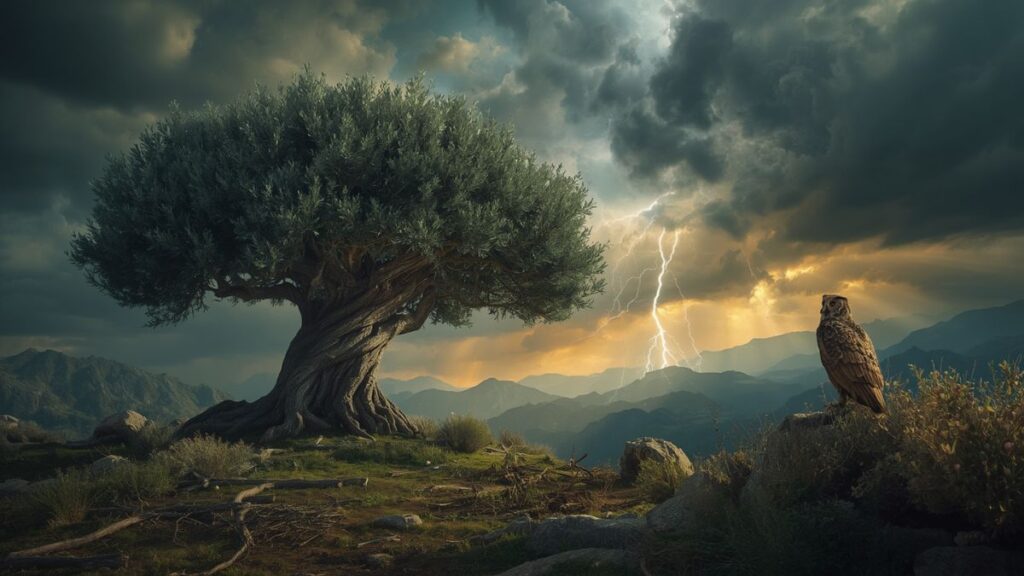
In the northern hills of ancient Greece, where emerald meadows stretched beneath towering mountains and clear streams sparkled under the sun, there was a quiet village called Thaloria. It was a humble place, known not for wealth or great temples, but for its hardworking shepherds who cared for their flocks with patience and devotion.
Among them lived a young shepherd named Lycos.
Lycos owned very little. His small stone cottage stood on the edge of the village, overlooking a broad hillside where wildflowers bloomed every spring. He had no fine clothes, no servants, and no fields of golden wheat.
His greatest treasures were his thirty sheep, his loyal sheepdog Argos, and the kindness that filled his heart.
Every morning before sunrise, Lycos led his flock into the hills.
He knew every trail, every stream, and every safe meadow. He greeted the birds as they sang from the olive trees and thanked the gods each evening for another peaceful day.
The villagers respected him, but many believed he was too generous.
Whenever travelers passed through Thaloria, Lycos offered them fresh water and bread.
If a child lost a lamb, he helped search until sunset.
If an elderly neighbor became ill, he cared for their animals without asking for payment.
His friends often shook their heads.
“You will never become rich by giving everything away,” one farmer told him.
Lycos simply smiled.
“I have enough.”
“But one day you may need more.”
“Then I hope someone will help me as I have helped others.”
His answer never changed.
The Bread on the Stone
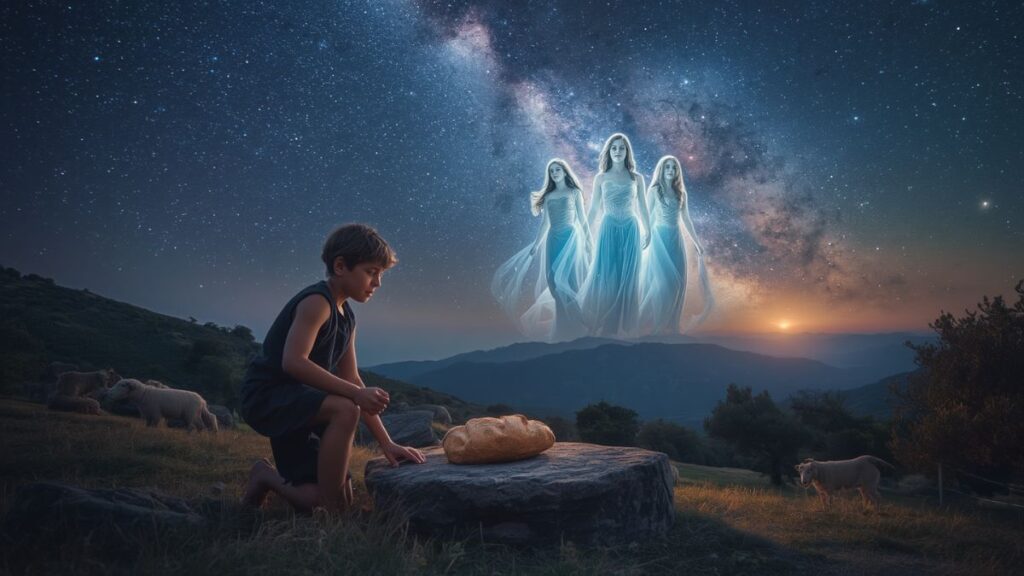
Every evening, after bringing his sheep safely home, Lycos climbed a nearby hill where a large flat stone overlooked the valley.
There, he placed a small loaf of fresh bread.
Then he quietly walked away.
No prayers.
No speeches.
No requests.
Just a loaf of bread.
The villagers eventually noticed.
One evening, three shepherds followed him.
When Lycos returned, they examined the stone.
“There is no one here.”
“Perhaps he feeds birds,” one guessed.
But no birds came.
The next morning, the bread was gone.
The shepherds were puzzled.
That evening they hid behind nearby bushes.
Again, Lycos placed a loaf upon the stone and left.
They waited for hours.
Nothing happened.
Eventually they grew tired and returned home.
When they checked again at sunrise, the bread had disappeared.
The rumors spread quickly.
Some claimed wild animals took it.
Others believed thieves wandered the hills at night.
A few laughed openly.
“Lycos feeds ghosts.”
Children giggled whenever they passed him.
“Did the spirits enjoy their supper?”
Lycos never became angry.
He only answered,
“If someone is hungry, I am glad the bread was useful.”
A Secret in the Night Sky
Unknown to anyone in Thaloria, the bread was never taken by animals.
Each night, after the moon climbed above the mountains, three radiant maidens descended from the heavens.
They were the daughters of Nyx, the goddess of night.
Their names were Astraea, Lyra, and Selenea.
Their sacred duty was unlike any other.
Every evening they arranged the stars across the sky before dawn.
They guided constellations into place.
They polished fading stars until they shone brightly again.
They carried tiny lights across the heavens like lantern keepers.
Their work ensured sailors could navigate the seas and travelers could find their way during the night.
Though immortal, they often became weary.
For centuries they had crossed the sky without rest.
One evening Astraea noticed the loaf upon the stone.
“It has been left for someone.”
Lyra looked around.
“There is no one here.”
Selenea smiled.
“Perhaps it is meant for whoever needs it most.”
Carefully they shared the bread.
It was simple.
Warm.
Freshly baked.
They had not tasted such kindness from mortals in many centuries.
The following evening another loaf appeared.
Then another.
Night after night.
Season after season.
Year after year.
The shepherd never missed a single evening.
The Curiosity of Olympus
On Mount Olympus, even the gods began noticing something unusual.
Hermes, the swift messenger, spoke first.
“I have watched a shepherd who gives away part of his supper every night.”
Apollo looked interested.
“Does he seek a blessing?”
“No.”
“Does he pray for riches?”
“No.”
Athena raised an eyebrow.
“Perhaps he seeks wisdom.”
Hermes smiled.
“He asks for nothing.”
The gods exchanged curious glances.
Zeus himself became interested.
“Few mortals give without expecting something in return.”
Athena nodded thoughtfully.
“Perhaps we should simply watch.”
And so they did.
For several years, the gods quietly observed Lycos.
They watched him help strangers.
Share food.
Rescue lost animals.
Comfort lonely children.
Never once did he boast about his generosity.
Never once did he demand recognition.
A Difficult Winter
Then came the harshest winter anyone could remember.
Snow covered the hills much earlier than usual.
The streams froze.
Grass disappeared beneath thick ice.
Many shepherds lost sheep to hunger.
Lycos shared his stored hay with neighbors whose barns were empty.
His own flock became thinner.
His savings disappeared.
Leon, another shepherd, confronted him.
“You are making a mistake.”
“How?”
“You keep helping everyone.”
“They need help.”
“And soon you will need it too.”
Lycos looked toward his sheep.
“Perhaps.”
“You should stop leaving bread on that stone.”
“It is only one loaf.”
“One loaf every day becomes many loaves.”
Lycos quietly answered,
“If I stop giving simply because times become difficult, then my kindness was never genuine.”
Leon walked away without another word.
The Longest Night
The winter grew worse.
Clouds hid the stars for many weeks.
Cold winds howled through the mountains.
Even the daughters of Nyx struggled to complete their work.
The heavens became darker.
Several stars faded.
Constellations lost their brightness.
The maidens grew weak.
One night Astraea sighed.
“We have no strength left.”
Selenea looked sadly at the bread.
“This shepherd continues feeding us while he himself grows hungry.”
Lyra watched Lycos walking back toward his cottage through deep snow.
“He has become thinner.”
“Yet he still shares.”
The three sisters decided they could no longer remain silent.
A Gift Returned
That night, after placing the stars across the heavens, they descended to the hillside before Lycos returned home.
Moonlight surrounded them like silver mist.
When Lycos reached the stone the next morning, he stopped in surprise.
Instead of an empty rock, three radiant women stood waiting.
Their robes shimmered with countless tiny stars.
Their eyes reflected the night sky.
Argos barked once, then quietly lay beside his master.
Lycos bowed respectfully.
“Who are you?”
Astraea smiled warmly.
“We are the Keepers of the Evening Sky.”
“You have accepted my bread?”
“For many years.”
Lycos looked embarrassed.
“It was only bread.”
Selenea shook her head.
“It was kindness.”
“I never knew who received it.”
“That is why your gift was precious.”
Lyra stepped forward.
“Most people give when they are seen.”
“You gave when no one watched.”
The Test of Character
Astraea asked gently,
“Why did you leave bread each evening?”
Lycos thought carefully.
“My mother once told me that somewhere, someone is always hungrier than we imagine.”
“So you hoped a hungry traveler would find it?”
“Yes.”
“And when no traveler appeared?”
“I trusted that whoever needed it would receive it.”
“You never asked the gods for anything?”
“No.”
“Not even during the difficult winter?”
Lycos smiled.
“The gods already gave me enough to share.”
The three sisters looked at one another.
His answer confirmed everything they had witnessed over the years.
The Hidden Spring
Astraea lifted her hands toward the mountains.
The stars above began shining even though the sun had already risen.
Silver light flowed across the rocky hillside.
The ground trembled gently.
Then, with a deep rumble, water burst from between two enormous stones.
Crystal-clear water poured into the valley.
The frozen earth softened.
Streams filled once more.
Grass slowly returned.
Within weeks flowers bloomed where snow had covered the land.
The sheep found fresh pasture.
The crops recovered.
Birds returned in great numbers.
The terrible drought that followed winter ended almost overnight.
The villagers could hardly believe their eyes.
They rushed toward the miraculous spring.
Some declared it a blessing from Zeus.
Others believed Poseidon had struck the rocks with his trident.
Only Lycos understood the truth.
The Village Changes
Soon travelers came from distant cities to see the spring.
Many asked Lycos how the miracle had happened.
He simply replied,
“It began with a loaf of bread.”
Some laughed, thinking he joked.
Others listened carefully.
The elders of Thaloria decided that every evening a basket of food would be placed beside the spring for travelers and strangers.
Children carried fresh fruit.
Farmers contributed vegetables.
Bakers left warm bread.
No one signed their names.
No one expected praise.
Helping quietly became part of village life.
Within a few years, Thaloria gained a new reputation.
It became known as the Village of Open Hands.
Merchants preferred stopping there because they knew they would always find kindness.
Travelers often returned simply to thank the people.
Prosperity gradually followed.
Not because the villagers sought wealth.
But because generosity created friendships wherever it went.
Zeus Visits the Village
Many years later, Zeus himself descended from Olympus disguised as an old traveler.
He walked through the village asking for water.
Every household welcomed him.
Children offered him bread.
An elderly woman insisted he rest by her fire.
A blacksmith repaired his sandals without payment.
Finally Zeus found Lycos, now an old man with silver hair.
“You have changed this village.”
Lycos smiled.
“I only left bread upon a stone.”
Zeus laughed.
“No.”
“You planted something far greater.”
“What was that?”
“A habit of kindness.”
The king of the gods revealed his true form.
Lightning flashed gently across the sky.
Golden light surrounded the hillside.
The villagers fell silent.
Zeus raised his mighty hand.
“As long as this spring flows, may kindness never disappear from this valley.”
The waters sparkled brighter than ever before.
The Legacy of the Stone
Years passed.
Lycos eventually grew too old to guide his flock.
Young shepherds visited him each evening.
They listened to stories about the stars.
About kindness.
About giving without expecting rewards.
When Lycos peacefully passed away, the villagers placed the flat stone beside the spring instead of leaving it alone upon the hill.
Every evening, someone still placed fresh bread upon it.
Not because magical maidens would come.
Not because miracles were expected.
But because somewhere, someone might be hungry.
Generations later, travelers still found bread waiting beside the spring.
Parents taught their children the story of the shepherd who believed unseen kindness mattered just as much as kindness performed before a crowd.
High above, the daughters of Nyx continued arranging the stars each night.
Whenever they looked toward Greece, one constellation always seemed to shine a little brighter above Thaloria.
The gods never explained why.
But the stars themselves seemed to remember the humble shepherd who had shared his supper without ever asking who would receive it.
For while kingdoms rise and fall, and monuments eventually crumble into dust, acts of genuine kindness continue traveling through the world, touching lives the giver may never know.
And perhaps that is the greatest gift the gods ever taught humanity.
Not that kindness is always rewarded.
But that true kindness does not need a reward to be worthwhile.
Moral of the Story
The greatest acts of kindness are those done without expecting recognition or reward. When you give with a sincere heart, your goodness can brighten lives in ways you may never see, just as the stars quietly brighten the night sky.