The annual science fair was the biggest event of the school year at Oakwood Elementary.
For weeks, the hallways buzzed with excitement. Students carried poster boards, built colorful models, and practiced explaining their experiments. Every classroom was filled with volcanoes, solar system displays, homemade robots, and carefully labeled plant projects.
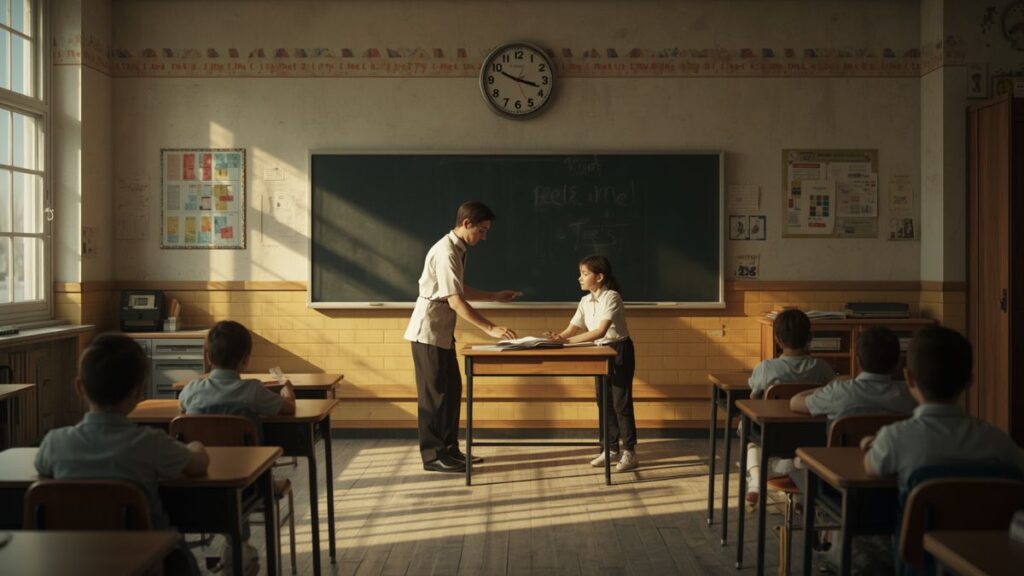
Mrs. Harper loved science fair season.
She believed it wasn’t about winning trophies. It was about asking questions, solving problems, and discovering that even the smallest idea could grow into something extraordinary.
One Monday morning, she handed each student a project planner.
“This year’s theme,” she announced, “is ‘A Small Idea Can Change the World.’“
The students immediately began brainstorming.
“I want to build a volcano!”
“I’m making a bridge out of popsicle sticks.”
“I’m testing which paper towel absorbs the most water.”
Everyone eagerly shared their ideas.
Everyone except Noah.
He quietly stared out the classroom window.
Mrs. Harper noticed.
“What are you thinking about, Noah?”
He hesitated before answering.
“I don’t want to build something everyone has already seen.”
The class became quiet.
“So,” Mrs. Harper asked, “what would you like to make?”
Noah took a deep breath.
“I want to build a bird feeder that only opens for hungry birds.”
The room erupted with laughter.
“How would the feeder know if a bird is hungry?”
“That’s impossible.”
“My dog would probably eat it first.”
Even Noah smiled nervously.
“I know it sounds silly.”
Mrs. Harper raised her hand, and the room became quiet again.
“There are no silly ideas,” she said. “There are only ideas that need time to grow.”
Those words stayed with Noah.
That afternoon, he began sketching.
His first design used a simple platform that opened when a lightweight bird landed but stayed closed for heavier animals like squirrels.
His second design included a small rain cover.
His third used recycled materials instead of expensive supplies.
Each version looked different.
Each one solved a problem the previous design couldn’t.
At home, Noah worked in the family garage with his grandfather, who had once been a carpenter.
“I’ve never built anything like this,” his grandfather admitted.
“Neither have I,” Noah replied.
“That’s what makes it exciting.”
For two weeks, they measured, cut, glued, and tested.
Sometimes the door wouldn’t open.
Sometimes it stayed open.
Sometimes the squirrels figured out how to reach the food anyway.
Every failure became another lesson.
Every mistake led to another idea.
When Noah proudly carried the finished feeder into class, several students gathered around.
“It doesn’t look like much.”
“It’ll never work.”
“My volcano is definitely going to win.”
Noah quietly placed the feeder beside his desk and continued making notes.
Mrs. Harper walked over.
“Would you like to test it outside?”
His eyes lit up.
Together, they hung the feeder from a tree near the playground.
The class watched from the classroom window.
For nearly twenty minutes, nothing happened.
One student whispered, “Maybe no birds live here.”
Then a small sparrow landed gently on the platform.
The door slowly opened.
The bird happily pecked at the seeds.
When it flew away, the door quietly closed again.
A squirrel scampered toward the feeder a few minutes later.
It climbed onto the platform.
Nothing happened.
The class gasped.
“It actually works!”
Noah couldn’t stop smiling.
Mrs. Harper clapped first.
Soon the entire class joined her.
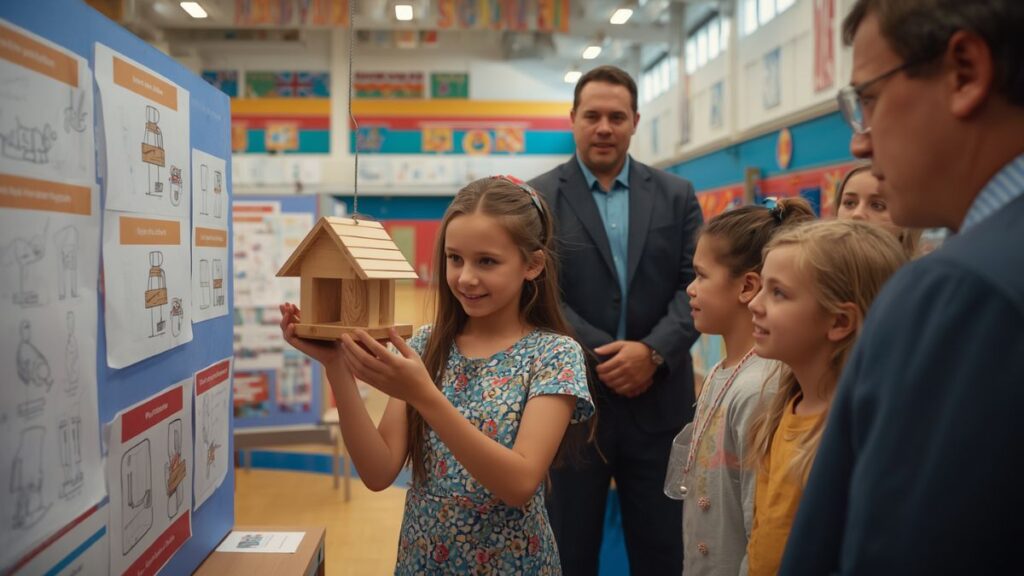
On science fair day, the gymnasium transformed into a colorful exhibition hall.
Parents, teachers, and judges walked from table to table, asking questions.
Many projects looked impressive.
There were glowing planets, erupting volcanoes, electric circuits, crystal gardens, and working bridges.
Noah’s display looked simple by comparison.
A handmade wooden feeder.
A few sketches.
Several pages describing the improvements he had made after each failed attempt.
Some visitors barely glanced at it.
Others smiled politely before moving on.
One judge, however, stayed much longer.
Instead of asking about the finished feeder, she pointed toward Noah’s notebook.
“Tell me about your mistakes.”
Noah looked surprised.
“You want to hear about those?”
“Especially those.”
For the next ten minutes, Noah explained every design that hadn’t worked.
He described the problems, the changes, and the reasons behind each new version.
The judge nodded thoughtfully.
“I think you’ve learned something many inventors spend years discovering.”
“What’s that?” Noah asked.
“A good invention isn’t built from success.”
“It’s built from improvement.”
Weeks later, the winners were announced during the school assembly.
Third place.
Second place.
The students waited quietly.
“And this year’s first-place science project goes to…”
The principal smiled.
“Noah Peterson.”
The auditorium exploded with applause.
Noah stood frozen.
His classmates looked genuinely shocked.
Even the students who had laughed at his idea clapped the loudest.
Mrs. Harper watched proudly from the back of the room.
After the ceremony, Noah approached her.
“I thought my project wasn’t exciting enough.”
Mrs. Harper smiled.
“The judges didn’t reward the feeder.”
“They rewarded the thinking behind it.”
That lesson spread through the classroom.
The following year, students became less afraid of unusual ideas.
Instead of copying projects from books or the internet, they began asking original questions.
Could rainwater be collected more efficiently?
Could classroom lights save energy?
Could birds help spread flower seeds?
The science fair became more creative than ever before.
Years passed.
Noah graduated from middle school, then high school.
He remained fascinated by solving everyday problems.
He studied engineering in college and spent countless hours designing simple devices that made life easier for both people and animals.
One afternoon, nearly fifteen years after winning the science fair, Mrs. Harper received an invitation.
A local environmental center was opening a new wildlife garden.
The keynote speaker was an award-winning environmental engineer.
His name made her smile.
Noah Peterson.
Curious, she attended the event.
As Noah stood before the audience, he spoke about protecting wildlife through practical, affordable inventions.
Behind him were several bird feeders now being used in parks across the state.
Each one was based on the same idea he had developed as a ten-year-old student.
After the presentation, Noah spotted Mrs. Harper standing quietly near the back.
He immediately walked over.
“I hoped you’d come.”
“I wouldn’t have missed it,” she replied.
He laughed.
“I still remember everyone laughing at my first idea.”
“So do I.”
“I’m glad you didn’t laugh.”
Mrs. Harper smiled.
“My job was never to tell you which dreams were possible.”
“My job was to help you believe they were worth exploring.”
Noah nodded.
“You know what I remember most?”
“What?”
“The day we tested the feeder outside.”
Mrs. Harper smiled.
“The sparrow?”
“No.”
“You.”
“You stood there smiling before it even worked.”
She looked puzzled.
“I guess I believed in you.”
“Exactly.”
“You believed before there was proof.”
Those words stayed with Mrs. Harper long after the ceremony ended.
The following week, she returned to her classroom carrying Noah’s old science fair notebook.
She had kept a copy all those years.
When her new students asked why every page contained crossed-out ideas and failed designs, she simply said,
“Because success usually begins with a page full of mistakes.”
The students looked at one another thoughtfully.
Then one little girl raised her hand.
“I have a weird science idea.”
Mrs. Harper smiled.
“Wonderful.”
“Let’s hear it.”
The classroom filled with laughter, questions, and imagination.
Once again, another small idea had found a place to grow.
Mrs. Harper realized that this was the true purpose of teaching.
Not to give students all the answers.
But to create a classroom where questions were welcomed, mistakes were celebrated, and unusual ideas were given the chance to become remarkable realities.
Years later, many students would forget the formulas they memorized or the dates they studied.
But they would always remember the teacher who believed in an impossible-looking science project before anyone else did.
And sometimes, that single moment of belief was enough to change the direction of an entire life.
Moral: Great teachers don’t judge ideas by how they look at first. They nurture curiosity, encourage persistence, and remind students that every great invention begins with someone willing to believe in an idea others cannot yet see.