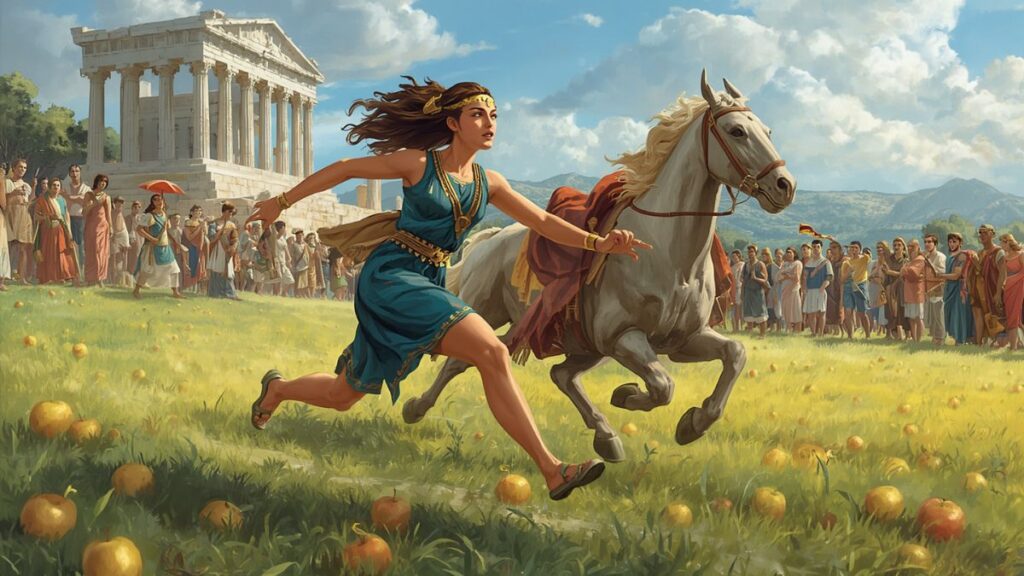
In the hills and forests of ancient Greece lived a young woman whose speed amazed everyone who saw her run. Her name was Atalanta, and from an early age she proved that determination, courage, and hard work could help someone accomplish extraordinary things.
Unlike many people who dreamed only of fame or riches, Atalanta loved the freedom of running through forests, climbing mountains, and exploring nature. She trained every day, becoming faster and stronger with each passing year.
Her remarkable ability soon spread across Greece, and people traveled from distant kingdoms just to watch her race. Some admired her talent. Others wished to challenge her. But Atalanta’s greatest journey was not about winning races. It was about making wise choices, staying true to herself, and discovering that both determination and humility are essential in life.
Her story remains one of the most memorable Greek mythology stories because it teaches children that success comes through dedication, honesty, and thoughtful decision-making.
A Childhood Filled with Adventure
Atalanta grew up surrounded by towering trees, sparkling rivers, and peaceful valleys. Rather than spending her days inside grand palaces, she preferred exploring the wilderness.
She loved watching deer leap gracefully through the forest.
She admired birds soaring above the mountains.
She studied how animals moved quickly and silently.
Each day became another opportunity to improve herself.
She practiced running over rocky hills without stumbling.
She climbed steep cliffs to strengthen her legs.
She learned patience while observing nature.
Although life in the forest could sometimes be difficult, Atalanta never complained.
She believed that every challenge made her stronger.
Her determination impressed everyone who met her.
Becoming the Fastest Runner
As the years passed, Atalanta’s speed became legendary.
No one in nearby villages could keep up with her.
Young athletes challenged her.
Experienced runners tested their skills against hers.
One after another, they finished far behind.
People began calling her the fastest runner in Greece.
Yet Atalanta never boasted about her victories.
Whenever someone congratulated her, she smiled politely.
“I still have much to learn,” she would say.
Her humility earned as much respect as her remarkable talent.
A Difficult Promise
As Atalanta grew older, many princes and noblemen hoped to marry the famous runner.
They arrived with expensive gifts.
Some brought beautiful jewelry.
Others offered treasures, horses, or grand promises.
But Atalanta was not interested in choosing a husband simply because he was wealthy or powerful.
She wanted someone who respected her abilities and possessed wisdom as well as courage.
To discourage those seeking fame rather than friendship, she announced an unusual challenge.
“If anyone wishes to marry me,” she declared, “he must first defeat me in a footrace.”
The rules were simple.
If the challenger won, Atalanta would gladly marry him.
If he lost, he would accept defeat with honor and return home.
Most people believed no one could possibly outrun her.
Challengers from Every Kingdom
News of Atalanta’s challenge spread across Greece.
Soon the roads filled with travelers eager to compete.
Strong athletes arrived from distant cities.
Young princes believed they possessed unmatched speed.
Famous runners hoped to become legends.
Before every race, Atalanta greeted each challenger respectfully.
She wished them good luck.
She reminded them that winning required more than confidence.
Then the race began.
Almost immediately, Atalanta pulled ahead.
Her feet moved swiftly across grassy fields.
She leaped over rocks with ease.
She crossed streams without slowing down.
One by one, every challenger fell farther behind.
Crowds cheered as Atalanta crossed the finish line first.
Although disappointed, most competitors admired her incredible skill.
A Young Man Named Hippomenes
Among those who heard about Atalanta was a thoughtful young man named Hippomenes.
Unlike many previous challengers, Hippomenes did not underestimate her.
He respected her talent and admired her determination.
Rather than relying only on his speed, he began thinking carefully about how he might compete fairly.
He understood something important.
Winning would require wisdom as well as athletic ability.
Before the race, Hippomenes quietly prayed for guidance.
According to the legend, the goddess Aphrodite heard his request.
She decided to help him.
The Three Golden Apples
Aphrodite gave Hippomenes three beautiful golden apples unlike anything found on Earth.
They shimmered brilliantly in the sunlight.
Each apple seemed almost magical.
“This race will not be won through speed alone,” Aphrodite explained.
“Use these wisely.”
Hippomenes thanked her.
He carefully placed the apples inside a small pouch.
He knew success would depend on making the right decisions at exactly the right moments.
The Great Race Begins
The day of the race finally arrived.
People gathered from villages across Greece.
Some climbed nearby hills for a better view.
Children sat on their parents’ shoulders.
Merchants sold fruit and fresh bread.
Excitement filled the air.
When the signal sounded, both runners sprinted forward.
At first, Hippomenes kept pace with Atalanta surprisingly well.
The crowd gasped.
No challenger had stayed this close before.
But gradually Atalanta’s incredible speed began carrying her ahead.
She seemed almost impossible to catch.
A Clever Strategy
Realizing the moment had arrived, Hippomenes gently tossed the first golden apple onto the path.
Its brilliant glow caught Atalanta’s attention.
Curious, she paused briefly to pick it up.
The delay allowed Hippomenes to move ahead.
Soon Atalanta caught him again.
She was simply too fast.
Then Hippomenes threw the second golden apple.
Once again, Atalanta stopped for only a moment.
The race remained incredibly close.
Spectators watched in amazement.
Neither runner seemed willing to give up.
Finally, just before reaching the finish line, Hippomenes rolled the third apple slightly off the path.
Atalanta hesitated.
Should she leave it behind?
Or retrieve it?
That brief decision gave Hippomenes enough time to cross the finish line first.
The crowd erupted into cheers.
Accepting Victory with Grace
Although Atalanta had lost the race, she showed remarkable sportsmanship.
She congratulated Hippomenes warmly.
“You earned your victory through careful planning,” she said.
“You respected both the challenge and your opponent.”
Hippomenes smiled.
“I admired your courage long before the race began,” he replied.
“The competition taught me that true success comes from preparation, patience, and respect.”
The crowd applauded both competitors.
They understood they had witnessed something special.
Lessons Beyond Winning
The race quickly became famous throughout Greece.
Some people focused only on who won.
Others recognized the deeper lessons hidden within the story.
Atalanta demonstrated that hard work and discipline could achieve extraordinary results.
Hippomenes showed that intelligence and strategy were often just as valuable as physical talent.
Both competitors treated each other with respect before, during, and after the race.
Their kindness impressed people as much as the competition itself.
Atalanta’s Lasting Legacy
Even after the famous race, Atalanta remained one of Greece’s greatest heroes.
Children admired her courage.
Young athletes copied her training methods.
Parents told her story to encourage perseverance and humility.
Artists painted scenes of the legendary race.
Poets celebrated her determination.
Her name became a symbol of excellence earned through dedication rather than luck.
Why This Story Still Inspires Children
Although thousands of years have passed, Atalanta’s story continues to inspire readers of all ages.
Children today also face challenges that require patience and perseverance.
They study for difficult tests.
They practice sports and musical instruments.
They learn new skills that take time and effort.
Like Atalanta, they discover that improvement comes through consistent practice.
Like Hippomenes, they learn that thoughtful planning can make difficult tasks easier.
The story reminds children that success isn’t measured only by winning.
Good character matters just as much.
Lessons from The Race of Atalanta
The story of Atalanta teaches several valuable life lessons.
Hard work creates success. Atalanta became the fastest runner because she practiced every day.
Respect your opponents. Both runners treated each other kindly before and after the race.
Wisdom can be as important as talent. Hippomenes relied on careful planning instead of speed alone.
Stay humble after success. Despite becoming famous, Atalanta never bragged about her abilities.
Accept both victory and defeat with grace. Winning and losing are both opportunities to grow and learn.
Never stop improving. Atalanta believed there was always something new to learn, no matter how successful she became.
Conclusion
The Race of Atalanta is far more than the story of a famous competition. It is an inspiring tale about perseverance, wisdom, humility, and respect.
Atalanta earned admiration through years of dedication and hard work, while Hippomenes showed that careful planning and thoughtful decisions can sometimes achieve what strength alone cannot.
Together, their story reminds children that true success is not only about crossing the finish line first. It is about showing kindness, respecting others, learning from every experience, and always striving to become the best version of ourselves.