Long ago, where green forests stretched across gentle hills and sparkling streams flowed through peaceful meadows, there lived a cheerful young rabbit named Niska. Every spring, the valley burst into life with colorful wildflowers, buzzing bees, singing birds, and fresh green plants. The forest was home to deer, squirrels, foxes, turtles, birds, and many other animals who lived together in harmony.
Every year, the forest animals worked hard to prepare for winter. They gathered berries, collected seeds, stored nuts, and harvested vegetables from sunny clearings. The elders always reminded the younger animals,
“Take only what you need today, and leave enough for tomorrow.”
Most animals followed this advice carefully.
Niska enjoyed helping everyone. He loved planting tiny seeds, watering young plants with buckets filled from the nearby stream, and watching the gardens grow throughout the summer.
One warm morning, an elderly tortoise named Mako called the young animals together.
“This season,” he said, “we must care for the First Harvest Garden.”
The children looked excited.
“What makes it special?” asked Niska.
Mako smiled.
“The first harvest reminds us that nature provides enough when we care for it wisely and share with others.”
Every morning, the young animals visited the garden.
They pulled weeds.
Watered the vegetables.
Protected tender plants from strong winds.
Scarecrows made from fallen branches kept hungry crows away without harming them.
The garden flourished.
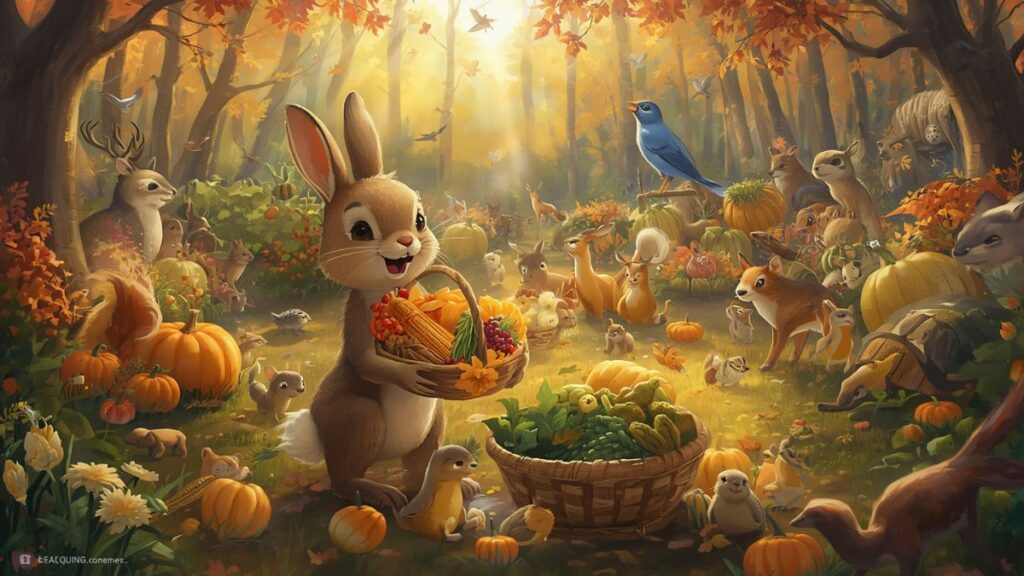
Rows of pumpkins, beans, corn, squash, berries, and herbs filled the sunny clearing with brilliant colors.
When harvest time finally arrived, everyone gathered to celebrate.
The vegetables were larger than anyone had expected.
“There is enough for everyone,” the animals cheered.
The elders divided the harvest fairly among every family.
Each household received enough food to begin preparing for winter.
As the celebration ended, Niska noticed something surprising.
Several baskets of fresh vegetables still remained.
“What should we do with the extras?” he asked.
One squirrel suggested,
“We should save them for ourselves.”
A young raccoon nodded.
“What if winter becomes colder than expected?”
Others agreed.
The extra harvest looked like a valuable treasure.
That evening, Niska carried one of the baskets home.
His grandmother welcomed him warmly.
“You seem thoughtful.”
Niska explained the discussion.
His grandmother smiled gently.
“When you have more than enough, what do you usually do?”
“I share.”
“And has sharing ever made you poorer?”
Niska thought for a moment.
“No.”
“It usually brings friends closer.”
The next morning, Niska walked through the forest carrying his basket.
Near the edge of the meadow, he met an elderly hedgehog gathering tiny mushrooms.
“Good morning,” Niska said.
The hedgehog smiled.
“My garden didn’t grow very well this year.”
Without hesitation, Niska shared several fresh vegetables.
The hedgehog thanked him with grateful tears.
Later that day, Niska found a family of field mice repairing their small home after a summer storm had damaged it.
They had spent so much time rebuilding that they hadn’t gathered enough food.
Again, Niska shared part of his harvest.
As he continued walking, he helped a family of birds by leaving berries beneath their favorite tree.
He carried herbs to an elderly badger recovering from illness.
He even placed fresh vegetables outside a shy rabbit family’s burrow without waiting for thanks.
By evening, his basket was much lighter.
Yet somehow, his heart felt fuller than ever.
When Niska returned to the garden the following morning, something unexpected had happened.
Other young animals had started sharing too.
The squirrel who wanted to keep everything had delivered acorns to older rabbits.
The raccoon had gathered fresh water for neighbors whose well had become muddy.
Several birds had collected berries for families with young children.
Kindness spread through the forest faster than anyone expected.
The village elder smiled.
“The harvest has grown again.”
Niska looked confused.
“But the baskets are smaller.”
“The food is smaller,” the elder replied.
“The generosity is much larger.”
A week later, strong winds swept through the valley.
Many fruit trees lost their remaining apples.
Several gardens were damaged before winter fully arrived.
Normally, the animals might have worried.
Instead, something remarkable happened.
Those who still had extra food immediately shared it.
Families opened their storage rooms.
Neighbors helped repair damaged fences.
Children gathered fallen apples before they spoiled.
No one was left without enough to eat.
The forest had become stronger because everyone cared for one another.
As winter settled across the valley, snow covered the hills.
The streams slowed beneath thin sheets of ice.
Most animals remained comfortably inside their warm homes.
One snowy afternoon, Niska looked outside and noticed a hungry young fox searching for food.
Some animals became nervous.
But the elder tortoise quietly stepped forward.
“He is hungry, not dangerous.”
Niska carried a basket of vegetables and berries outside.
The young fox accepted the food gratefully.
Before leaving, he quietly said,
“Thank you.”
That simple moment changed many hearts.
The children realized kindness often removed fear better than anger ever could.
When spring finally returned, something wonderful happened.
Families from neighboring forests arrived carrying gifts.
“We heard about your kindness during the winter,” one deer explained.
“We brought seeds to plant together.”
Others carried fruit trees.
Some brought berry bushes.
Several families offered tools and gardening knowledge.
The First Harvest Garden became larger than ever before.
This time, children from many forests worked side by side.
They laughed together while planting seeds.
They shared stories during rest breaks.
They celebrated every tiny green sprout that appeared.
By autumn, the garden produced an even greater harvest.
This time, no one argued about what to do with the extra food.
Everyone already knew.
Large baskets were prepared for elders.
Extra supplies were stored for difficult seasons.
Travelers received fresh meals before continuing their journeys.
Animals recovering from illness found baskets waiting outside their homes.
One young rabbit asked Niska,
“How do we know how much to share?”
Niska smiled.
“Start by making sure everyone has enough.”
Years passed.
Niska grew into one of the forest’s wisest leaders.
Each harvest season, he welcomed young children into the garden.
Instead of teaching them only how to grow vegetables, he taught them something even more important.
“A healthy garden feeds our bodies.”
“A generous heart feeds our community.”
Every First Harvest Festival began with the same tradition.
Each family placed one basket in the center of the garden before taking food home.
That basket became the Community Basket.
Anyone could give.
Anyone in need could receive.
No one kept track.
No one expected repayment.
The basket was always full because kindness never seemed to run out.
Generations later, visitors often asked why the forest community seemed so joyful.
The elders simply pointed toward the garden.
“It all began with one rabbit who chose to share his first harvest.”
The children smiled whenever they heard the story.
They understood that the greatest harvest wasn’t measured by the size of pumpkins, baskets, or fields.
It was measured by the kindness growing inside every heart.
And every autumn, as golden leaves drifted gently across the peaceful valley, the animals celebrated another successful harvest with thankful hearts, knowing that generosity had become the richest crop of all.
Moral of the Story
Sharing what we have, no matter how small, helps everyone grow stronger together. Generosity creates friendships, builds trust, and turns a good harvest into a lasting blessing for the whole community.