Emma considered herself a practical shopper.
She rarely bought unnecessary items.
She compared prices.
Read reviews.
Made sensible decisions.
At least that was the version of herself she preferred to believe existed.
Reality occasionally disagreed.
One Saturday morning, while drinking coffee and browsing online, Emma encountered a problem she didn’t know she had.
According to an advertisement, her home lacked proper organization.
The advertisement seemed very confident about this.
Photographs displayed perfectly arranged closets.
Neatly folded clothing.
Beautiful storage containers.
Shelves that appeared incapable of becoming messy.
The images looked impressive.
Emma glanced around her apartment.
A blanket rested on a chair.
Several books occupied the coffee table.
A stack of unopened mail sat near the kitchen counter.
Nothing seemed particularly alarming.
Yet suddenly she felt slightly less organized than before.
This was precisely how advertisements worked.
Five minutes later, she found herself examining a storage organizer.
The product description was enthusiastic.
Very enthusiastic.
Apparently, this organizer could transform cluttered spaces into masterpieces of efficiency.
It promised simplicity.
Convenience.
Peace of mind.
Possibly enlightenment.
The reviews were equally persuasive.
Customers described life-changing experiences.
One review suggested the organizer improved productivity.
Another implied it strengthened family relationships.
A third seemed dangerously close to claiming magical powers.
Emma laughed.
Then added it to her cart.
The organizer wasn’t expensive.
It looked useful.
And honestly, who couldn’t benefit from a little extra organization?
Three days later, a large box arrived at her apartment.
Emma carried it inside with excitement.
The packaging looked promising.
Professional.
Efficient.
Well-designed.
She imagined a quick assembly process followed by immediate satisfaction.
The box had different plans.
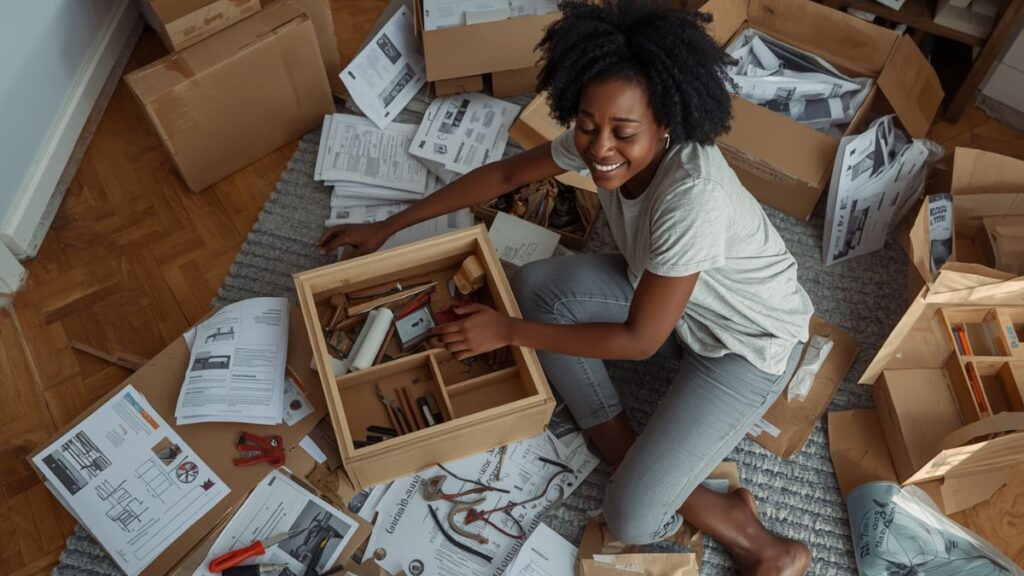
After opening it, Emma discovered approximately one hundred and forty-three separate pieces.
At least that was how it felt.
The actual number may have been lower.
Emotionally, however, it felt accurate.
Panels.
Screws.
Brackets.
Connectors.
Items identified only by mysterious letters.
A thick instruction booklet rested on top.
Emma picked it up.
The booklet contained diagrams.
Many diagrams.
Every page featured arrows pointing toward other arrows.
Tiny illustrations connected to additional illustrations.
Nothing included words.
Apparently the manufacturer believed furniture assembly should resemble solving an ancient puzzle.
Emma remained optimistic.
How difficult could it be?
The answer appeared immediately.
Very difficult.
The first step seemed simple enough.
Connect Part A to Part B using Connector C.
Unfortunately, Part A looked remarkably similar to Part D.
Connector C resembled Connector F.
And the diagrams offered approximately the same level of guidance as a treasure map.
An hour passed.
The organizer remained theoretical.
Emma sat surrounded by parts.
Studying instructions.
Questioning choices.
At one point she became convinced a panel was upside down.
Twenty minutes later she discovered it wasn’t.
The panel had been correct.
Everything else was confused.
By lunchtime, progress finally appeared.
Several sections stood upright.
The structure vaguely resembled furniture.
This felt encouraging.
Unfortunately, the next phase introduced additional complications.
One shelf refused cooperation entirely.
No matter how carefully Emma followed instructions, the shelf insisted on existing at impossible angles.
The disagreement lasted nearly thirty minutes.
Eventually Emma won.
Barely.
The organizer retaliated by hiding several screws.
Emma searched everywhere.
Under boxes.
Inside packaging.
Around the room.
The missing screws eventually appeared exactly where she had already checked three times.
This seemed suspicious.
The project continued.
Afternoon became evening.
The apartment transformed into a construction zone.
Cardboard occupied the floor.
Tools appeared in unusual locations.
Instruction pages covered nearby surfaces.
The organizer grew slowly.
Piece by piece.
Shelf by shelf.
At long last, after nearly three hours of effort, the final component clicked into place.
Emma stepped back.
The organizer stood proudly against the wall.
Completed.
Stable.
Functional.
Beautiful.
Victory.
She admired it for several moments.
The sense of accomplishment felt enormous.
Few experiences rival the satisfaction of successfully assembling furniture.
Especially furniture that initially appeared impossible.
Emma smiled proudly.
Then she encountered a small problem.
A very small problem.
A completely avoidable problem.
The organizer was larger than expected.
Much larger.
She looked around the apartment.
Then looked at the organizer.
Then looked around again.
The realization arrived slowly.
Where exactly would it go?
The original location suddenly seemed too small.
The hallway wasn’t suitable.
The bedroom lacked space.
The office corner already contained furniture.
For the first time, Emma considered a question she probably should have asked before ordering the organizer.
Did she actually need it?
The answer felt increasingly uncertain.
She measured walls.
Rearranged furniture.
Tested different locations.
Nothing worked particularly well.
The organizer wasn’t wrong.
The apartment simply disagreed with its dimensions.
Several hours later, Emma found a compromise.
The organizer fit inside a spare room.
Technically.
The placement wasn’t ideal.
But it worked.
More importantly, the project was over.
Or so she thought.
The next morning, Emma began organizing items.
Books.
Documents.
Storage containers.
Miscellaneous household supplies.
Everything found a place.
The organizer performed beautifully.
Until she noticed something amusing.
Several smaller organizers already existed inside the room.
Boxes.
Containers.
Storage baskets.
The new organizer ended up storing organizational products.
She stared at the arrangement.
Then laughed.
The organizer had become an organizer organizer.
An entire piece of furniture dedicated to organizing things designed for organization.
The irony felt magnificent.
Later that week, her friend Rachel visited.
Naturally, Emma gave a tour.
“Here’s the new organizer.”
Rachel nodded.
“It looks nice.”
“Thank you.”
“What do you keep in it?”
Emma hesitated.
“Other organizers.”
Rachel stared.
“Excuse me?”
Emma pointed.
Storage boxes.
Containers.
Filing systems.
All neatly organized.
Inside the organizer.
Rachel laughed so hard she nearly sat on the floor.
“You bought storage for your storage.”
“When you say it like that, it sounds ridiculous.”
“It is ridiculous.”
Emma couldn’t argue.
The evidence stood directly in front of them.
Months passed.
The organizer remained useful.
Eventually it filled with genuinely practical items.
Yet the story never disappeared.
Friends loved it.
Especially because the situation felt relatable.
Many people purchased products expecting dramatic improvement.
Sometimes the results were helpful.
Sometimes they were merely funny.
Years later, Emma still owned the organizer.
It remained sturdy.
Functional.
Reliable.
Every now and then she opened it and remembered the assembly adventure.
The missing screws.
The confusing diagrams.
The realization that she had nowhere to put it.
The organizer organizer.
The memory always made her smile.
Because the project represented something larger than furniture.
It represented optimism.
The belief that one purchase might somehow improve life.
Humans seemed remarkably good at believing that.
Perhaps because hope is enjoyable.
Even when it arrives in a large cardboard box requiring three hours of assembly.
In the end, Emma considered the purchase worthwhile.
Not because it transformed her apartment.
Not because it solved every organizational challenge.
Because it provided a good story.
And good stories, unlike storage organizers, never require assembly.
Reflection
Funny bedtime stories often find humor in everyday ambitions. The Online Shopping Victory reminds us that good intentions can produce unexpected results. Sometimes the funniest purchases aren’t the ones we regret, but the ones that leave us with stories worth telling for years afterward.