A Short Story With Moral About Patience, Care, and Seeing Value in Everything
At the end of a quiet street stood a tiny watch repair shop with a faded wooden sign that read “Kumar’s Watch Repair.” The shop had been there for so many years that most people walked past it without paying much attention. While new stores displayed shiny gadgets and modern clocks, the little repair shop seemed to belong to another time.
Inside worked an elderly man named Mr. Kumar.
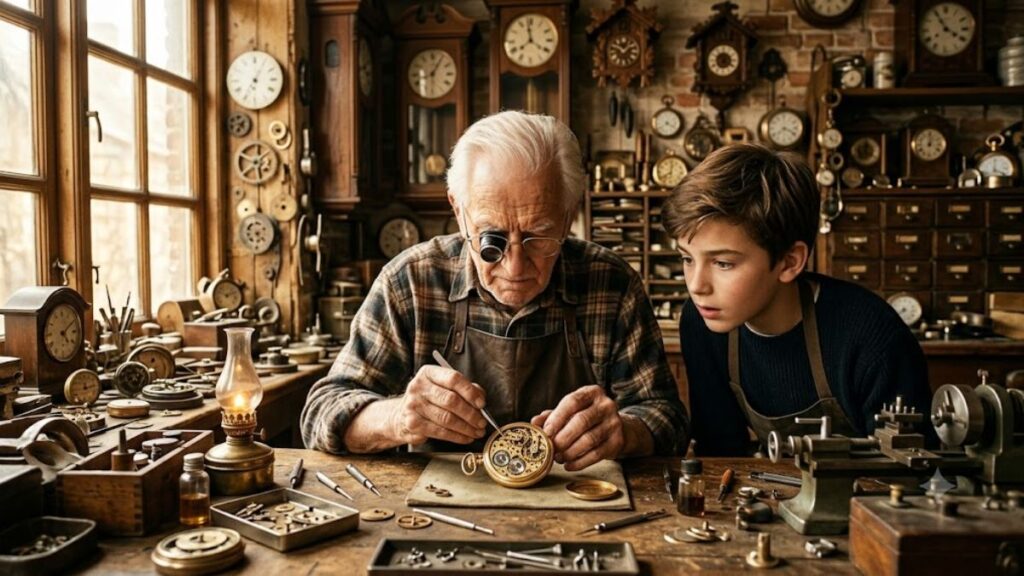
His silver hair, gentle smile, and steady hands made him well known among the people who visited him. Every morning, he carefully unlocked the shop, dusted the shelves, and placed dozens of watches on a wooden table. Some were old pocket watches, others were wristwatches that had belonged to parents or grandparents. Each one had a different story.
Mr. Kumar never rushed his work.
He believed that repairing a watch required patience, attention, and respect.
Many people wondered why he continued repairing old watches when buying a new one was much easier.
One sunny afternoon, a curious twelve-year-old boy named Aarav stopped outside the shop while walking home from school.
Through the window, he watched Mr. Kumar carefully taking apart a small pocket watch using tiny tools.
Aarav stepped inside.
“Good afternoon,” he said politely.
Mr. Kumar looked up and smiled.
“Good afternoon. What brings you here today?”
“I’ve passed your shop many times,” Aarav replied. “I wanted to see what you do.”
Mr. Kumar nodded.
“Then you’ve come to the right place.”
He handed Aarav a small magnifying glass.
“Take a look at this watch.”
Aarav examined it carefully.
“It looks broken,” he said.
“It stopped working many years ago,” Mr. Kumar replied.
“Then why don’t you throw it away?”
Mr. Kumar smiled.
“Because being broken doesn’t mean something has lost its value.”
Those words stayed in Aarav’s mind.
Every afternoon after school, he began visiting the little shop.
Sometimes he helped organize tools.
Sometimes he cleaned the shelves.
Most of the time, he simply watched.
He noticed that Mr. Kumar treated every watch with the same care, whether it was expensive or ordinary.
One day, a businessman entered the shop carrying a scratched wristwatch.
“It’s old,” the man said. “I was about to throw it away, but my daughter insisted I bring it here.”
Mr. Kumar carefully opened the watch.
After examining it for several minutes, he smiled.
“The problem is small. It only needs a new spring.”
The businessman looked surprised.
“I thought it was completely ruined.”
Mr. Kumar replied, “Many things appear beyond repair until someone takes the time to understand them.”
Aarav listened quietly.
Every day, he learned something new.
A week later, an elderly woman visited the shop with a tiny gold watch.
“My husband gave me this on our first anniversary,” she explained. “It stopped working years ago, but I could never bring myself to throw it away.”
Mr. Kumar handled the watch as gently as if it were made of glass.
He spent two days cleaning every small gear inside it.
When he finally wound the watch, it began ticking once again.
The woman smiled with tears in her eyes.
“You didn’t just repair my watch,” she said softly.
“You brought back a beautiful memory.”
After she left, Aarav asked, “You spent two whole days fixing one watch. Was it worth it?”
Mr. Kumar looked at him.
“Some things cannot be measured by money.”
A few months passed.
Aarav became more interested in learning how watches worked.
Mr. Kumar taught him how every tiny gear had an important purpose.
“If even one small piece stops working,” he explained, “the whole watch stops.”
Aarav thought about this.
“So every part matters?”
“Exactly,” Mr. Kumar replied.
“The smallest part often keeps everything moving.”
One rainy afternoon, a young boy rushed into the shop carrying an old alarm clock.
“It belonged to my grandfather,” he said.
“It stopped working yesterday.”
Mr. Kumar examined the clock carefully.
“It can be repaired.”
The boy smiled with relief.
As Aarav watched, he realized something important.
People were not bringing watches because they wanted to know the time.
They were bringing memories.
Every watch represented birthdays, weddings, family traditions, achievements, or loved ones.
Mr. Kumar wasn’t simply repairing machines.
He was preserving stories.
One evening, Aarav asked, “How did you become so patient?”
Mr. Kumar smiled.
“When I was young, I wanted everything to happen quickly. My own teacher once told me that patience is the tool that repairs more than broken watches.”
“What did he mean?”
“He meant that patience helps repair mistakes, friendships, relationships, dreams, and even confidence.”
Those words stayed with Aarav.
Years passed.
Aarav continued helping in the shop during weekends and school holidays.
Slowly, he learned how to clean gears, replace springs, and assemble watches piece by piece.
Whenever he became frustrated, Mr. Kumar reminded him,
“Never rush something that deserves care.”
Eventually, people in the neighborhood began recognizing Aarav as the old watchmaker’s apprentice.
One afternoon, a customer thanked Aarav after he successfully repaired a simple wristwatch.
“It works perfectly,” the customer said.
Aarav smiled proudly.
But Mr. Kumar quietly whispered,
“Always stay humble. Every repair teaches something new.”
As the years went by, Mr. Kumar grew older and found it difficult to work long hours.
One morning, he handed Aarav the tiny brass key to the shop.
“You’ve learned how to repair watches,” he said.
“But I hope you’ve learned something even more important.”
Aarav nodded.
“I have.”
“What is it?” asked Mr. Kumar.
Aarav smiled.
“I’ve learned that broken things should never be judged too quickly. Sometimes they only need patience, care, and someone willing to believe they can work again.”
Mr. Kumar’s eyes filled with pride.
Years later, after Mr. Kumar retired, Aarav continued running the little repair shop.
The sign above the door remained the same.
So did the values taught inside it.
People still brought old watches with stories attached to them.
And every customer left with more than a repaired watch.
They left with hope.
Whenever someone asked Aarav why he never threw away broken watches, he would simply smile and repeat the lesson his teacher had shared many years earlier.
“Being broken doesn’t mean something has lost its value.”
That simple sentence became the heart of the little shop and inspired everyone who walked through its doors.
Moral of the Story:
Everything has value when we give it care, patience, and a second chance.