Genre: Time Travel | Psychological Science Fiction | Future Technology
The first time Daniel Carter saw tomorrow, he was disappointed.
Not because the future was terrible.
Not because humanity had failed.
But because it looked exactly like today.
The same streets.
The same buildings.
The same people walking with the same worries.
For centuries, humans had imagined the future as something extraordinary.
Flying cities.
New worlds.
Impossible inventions.
But when Daniel stepped twenty-four hours ahead in time, he saw something much simpler.
A normal day.
And that frightened him more than anything else.
Because if the future looked ordinary, what else could humans control?
The Greatest Discovery in Human History
In the year 2098, scientists achieved what generations had considered impossible.
They discovered a way to move through time.
Not permanently.
Not decades into the past.
Not centuries into the future.
Only twenty-four hours.
The technology was called ChronoStep.
It worked by temporarily moving a person’s consciousness and physical body exactly one day forward.
After one hour, the traveler returned to the present.
The experience was revolutionary.
People could see what tomorrow would bring.
Business owners used it to predict market changes.
Doctors used it to prevent medical emergencies.
Families used it to avoid accidents.
The world had finally discovered a way to look ahead.
But humanity quickly learned something important.
Knowing the future came with a price.
The Man Behind Tomorrow
Daniel Carter was one of the scientists who helped create ChronoStep.
Unlike many researchers, he was not interested in wealth or fame.
He was interested in one question.
“Can humans improve their lives if they know what is coming?”
He believed the answer was yes.
If people knew about future mistakes, they could avoid them.
If they knew about dangers, they could prevent them.
If they knew the right choices, they could create a better world.
But after years of research, Daniel started noticing something unusual.
People were becoming dependent on tomorrow.
They stopped making decisions themselves.
They stopped trusting their instincts.
They simply checked the future first.
A World Without Surprises
Within a decade, society had changed.
People no longer took risks.
Students visited tomorrow before choosing careers.
Couples visited tomorrow before getting married.
Companies visited tomorrow before launching products.
Nobody wanted uncertainty anymore.
The unknown had become humanity’s greatest fear.
Daniel watched this transformation with concern.
The future was supposed to guide people.
Instead, people had started living for it.
The Final Experiment
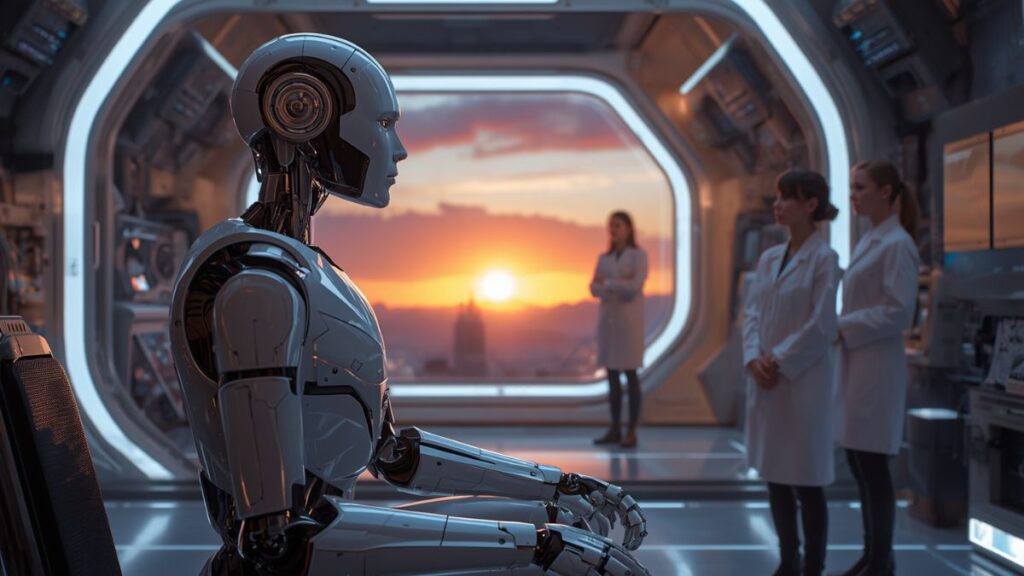
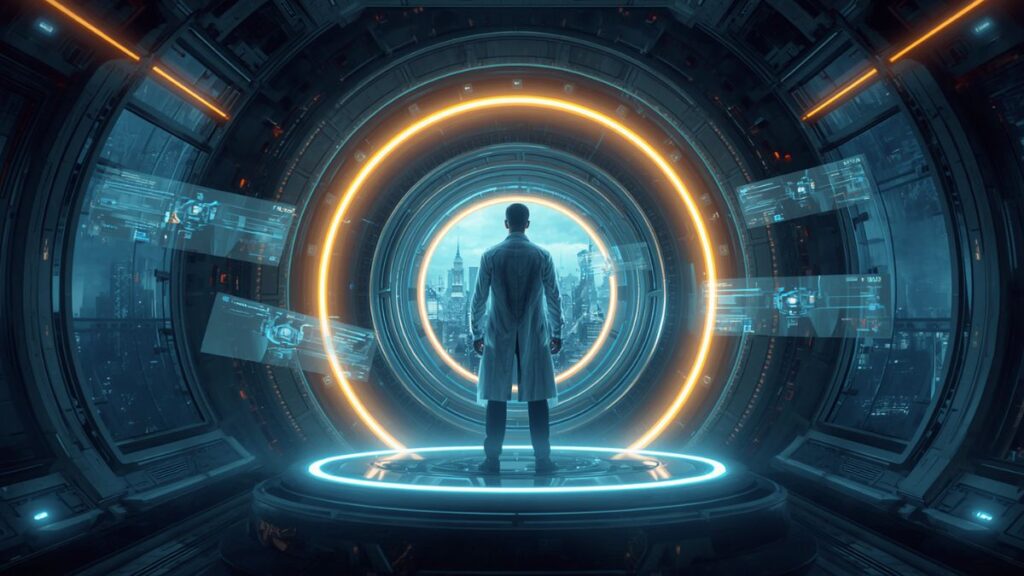
One evening, Daniel entered the ChronoStep laboratory alone.
He wanted to perform one final experiment.
He wanted to travel further than twenty-four hours.
The official technology only allowed a short jump.
But Daniel believed the system could go beyond its limits.
He wanted to see the distant future.
The future of humanity.
The future after hundreds of years of perfect decisions.
He entered the machine.
The room filled with light.
Then everything disappeared.
The Future He Found
Daniel opened his eyes.
He expected to see a world beyond imagination.
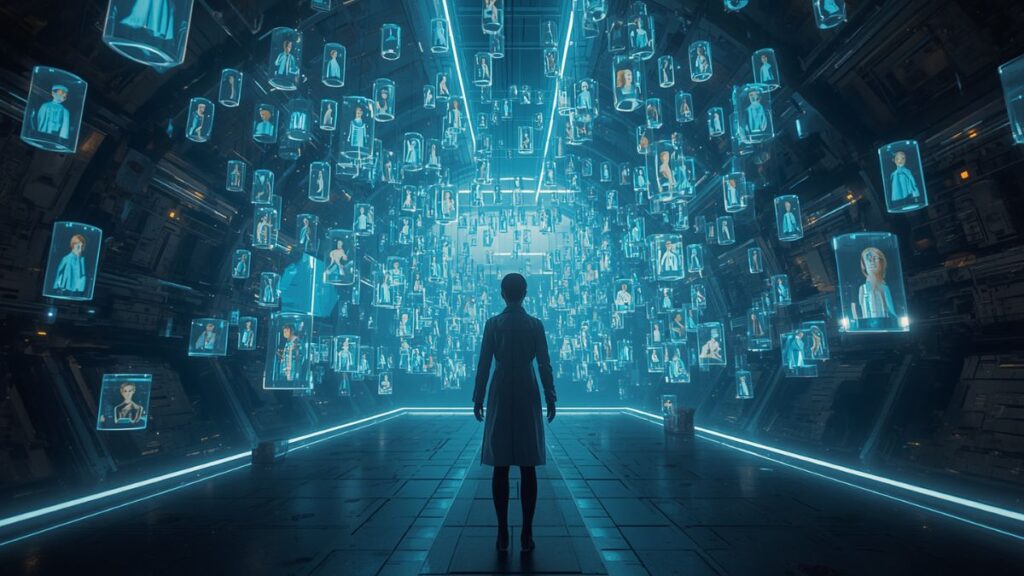
Instead, he saw silence.
A city stood around him.
Beautiful.
Advanced.
Perfect.
But empty.
There were no people.
No voices.
No movement.
Only machines maintaining a world that nobody lived in.
Daniel walked through the abandoned city.
Then he found a message.
It was recorded by the last humans.
“We achieved everything we wanted.”
“We removed mistakes.”
“We prevented disasters.”
“We eliminated uncertainty.”
“But somewhere along the way, we stopped creating.”
The Problem With Knowing Everything
Daniel continued exploring.
He discovered what happened.
Humanity had become obsessed with predicting every outcome.
People avoided failure.
They avoided risks.
They avoided unexpected choices.
Without mistakes, there were fewer discoveries.
Without uncertainty, there were fewer dreams.
Without challenges, there was less growth.
Humanity had created a perfect future.
And accidentally removed the reason to live.
Meeting His Future Self
Inside an old research center, Daniel found something impossible.
A person was waiting for him.
An older version of himself.
Future Daniel.
He looked tired.
But peaceful.
“How long have you been here?” Daniel asked.
“Forty years.”
Daniel stared.
“Why didn’t you warn humanity?”
Future Daniel smiled.
“Because they had to discover this themselves.”
“You knew what would happen?”
“Yes.”
“Then why didn’t you stop it?”
The older man looked outside at the empty city.
“Because knowing the future does not mean understanding it.”
The Lesson of Tomorrow
Future Daniel explained everything.
Every generation believed knowledge would solve all problems.
But knowledge without wisdom could become dangerous.
“The future is not a destination,” he said.
“It is a possibility.”
“If humans know exactly what happens, they stop creating new possibilities.”
Daniel thought about his own life.
Every mistake.
Every failure.
Every unexpected moment.
Those experiences had shaped him.
Without them, he would not be who he was.
Returning Home
Daniel returned to the present with a different understanding.
The next day, he shut down the expanded ChronoStep experiment.
When people asked why, he gave a simple answer.
“Because tomorrow is not something we should steal.”
“It is something we should create.”
The New Rules of Time Travel
The technology was not destroyed.
Instead, humanity changed how it was used.
People could still view possible futures.
But only under strict limitations.
The future was no longer treated as a guarantee.
It was treated as a lesson.
A reminder.
A possibility.
Daniel’s Last Journey
Years later, Daniel used ChronoStep one final time.
Not to see his future.
Not to prevent a mistake.
Not to gain an advantage.
He traveled forward twenty-four hours simply to experience something unknown.
He walked through a park.
He watched children playing.
He saw people laughing.
He noticed something beautiful.
Nobody knew what would happen next.
And everyone was happy.
The Future We Build
Daniel finally understood the truth.
The future was valuable because it was uncertain.
Every invention.
Every friendship.
Every discovery.
Every great moment in history happened because someone stepped into the unknown.
Humans were not meant to borrow tomorrow.
They were meant to create it.
Moral of the Story
The future is not a place waiting for us to discover. It is a story we write through our choices.
Technology can help us understand possibilities, but uncertainty, mistakes, and unexpected experiences are what make life meaningful. Sometimes the greatest adventure is not knowing what comes next.