In a bright fifth-grade classroom, excitement filled the air long before the afternoon lesson began.
Mrs. Simmons walked to the front of the room carrying a stack of colorful paper.
The students immediately grew curious.
“Are we doing art today?” one student asked.
Mrs. Simmons smiled.
“Not exactly.”
“We’re going to learn about design, effort, and success.”
She handed one sheet of paper to every student.
Today’s challenge was simple.
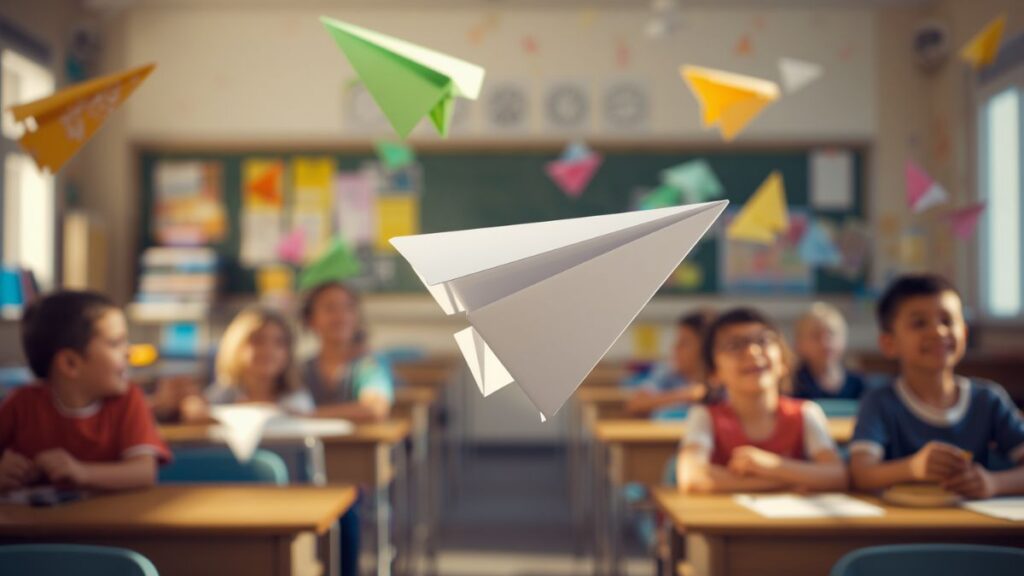
Each student would fold a paper airplane.
When everyone finished, they would fly their airplanes across the classroom.
Whoever flew the farthest would win.
The classroom erupted with excitement.
“I’ll definitely win.”
“My airplane is going to fly across the whole room.”
“My brother taught me the perfect design.”
As soon as the folding began, dozens of paper airplanes slowly came to life.
Each one had its own shape and personality.
Some had long wings.
Others had pointed noses.
A few looked sleek and confident.
Among them was one small airplane folded from a simple white sheet of paper.
It wasn’t the sharpest.
It wasn’t the fanciest.
Its wings were slightly uneven.
The other airplanes quickly noticed.
“You don’t look very aerodynamic.”
“You’ll never fly very far.”
“You’re too ordinary.”
The little airplane smiled politely.
“I’ll simply do my best.”
The larger airplanes laughed.
“That’s what airplanes say when they know they can’t win.”
The little airplane remained quiet.
Mrs. Simmons lined the students along one side of the classroom.
One by one, the airplanes launched into the air.
Some soared beautifully.
Others immediately crashed.
One looped in circles before falling into a bookshelf.
Another landed inside the classroom plant.
Laughter filled the room.
Finally, it was the little airplane’s turn.
It lifted gently into the air.
For a moment, it floated peacefully.
Then it slowly glided downward.
It landed only halfway across the classroom.
The students measured every flight.
The winner had traveled nearly twice as far.
The little airplane looked disappointed.
“I knew I wouldn’t win.”
Mrs. Simmons carefully collected all the airplanes.
Instead of throwing them away, she placed them on a classroom shelf.
“We’ll use them again tomorrow.”
That night, the airplanes quietly talked among themselves.
The winning airplane proudly rested at the front.
“I told everyone I’d be the champion.”
The others admired it.
“You flew the farthest.”
“You deserve it.”
The little airplane sat silently near the back of the shelf.
The next afternoon, Mrs. Simmons announced another activity.
This time, students would write one encouraging sentence on their airplanes before flying them again.
“Wherever your airplane lands,” she explained, “the student who finds it must read the message aloud.”
Soon colorful messages covered every wing.
Keep trying.
You can do it.
Believe in yourself.
Never stop learning.
The little airplane received a simple message.
Someone believes in you.
It smiled.
The airplanes were launched once more.
Again, the little airplane didn’t travel the farthest.
Instead, it gently floated beside a shy student named Oliver.
Oliver picked it up and quietly read the message.
He smiled.
No one noticed except Mrs. Simmons.
The following week, the class repeated the activity.
This time, students wrote one compliment for a classmate instead.
The little airplane landed beside Mia.
She unfolded the message.
“Thank you for always helping others.”
Mia smiled brightly.
“I didn’t know anyone noticed.”
The little airplane felt surprisingly happy.
It hadn’t flown the farthest.
Yet somehow, it had reached exactly the person who needed its message.
Over the next several weeks, the airplanes became part of many classroom activities.
Sometimes they carried vocabulary words.
Sometimes science questions.
Sometimes acts of kindness students promised to complete.
Every time the little airplane flew, it landed near someone different.
A lonely student.
A nervous student.
A child celebrating improvement.
Each landing brought a smile.
Meanwhile, the champion airplane continued winning distance contests.
It proudly flew from one end of the classroom to the other.
Students applauded every impressive flight.
Still, something slowly began bothering it.
Whenever class ended, children carefully picked up the little airplane to reread its messages.
No one talked much about the champion anymore.
One evening, the champion airplane asked,
“Why does everyone seem happier to find you than me?”
The little airplane thought for a moment.
“I don’t know.”
“Maybe people remember how something makes them feel.”
Weeks passed.
One rainy afternoon, strong winds blew through an open classroom window just as Mrs. Simmons prepared another activity.
The airplanes unexpectedly lifted into the air.
Some were carried wildly around the room.
Several struck walls.
One became trapped behind a bookshelf.
The champion airplane shot toward the ceiling before crashing into a cabinet.
The little airplane gently rode the breeze.
It floated slowly downward.
It landed softly on the desk of a substitute teacher visiting the classroom.
Curious, the substitute unfolded the paper.
Inside was one of the encouraging messages students had written earlier.
“You are capable of more than you think.”
The substitute smiled.
“I needed that today.”
Mrs. Simmons quietly smiled too.
Sometimes even teachers need encouragement.
As the school year continued, the paper airplanes became worn.
Their folds softened.
Tiny tears appeared along the wings.
Mrs. Simmons carefully repaired each one with transparent tape.
One afternoon, she gathered the class.
“I’d like everyone to choose the airplane that inspired them most this year.”
The students walked toward the display shelf.
To the surprise of every airplane, nearly every child reached for the little white airplane.
Not because it flew the farthest.
Because of the messages it carried.
Oliver spoke first.
“It reminded me to believe in myself.”
Mia smiled.
“It made me feel appreciated.”
Another student added,
“It always seemed to land exactly where someone needed it.”
Mrs. Simmons nodded.
“Interesting.”
“Why do you think that happened?”
One little girl raised her hand.
“Maybe it wasn’t trying to be the best.”
“Maybe it was trying to help.”
The classroom grew quiet.
The champion airplane looked thoughtfully at the little airplane.
“I always wanted to go farther.”
The little airplane smiled kindly.
“I just hoped to reach someone.”
Years passed.
Mrs. Simmons kept one paper airplane inside a glass display case in her classroom.
It wasn’t the airplane that had flown the greatest distance.
It was the little white airplane covered with handwritten messages from dozens of students.
Each year, new classes asked about it.
Mrs. Simmons always shared its story.
“The farthest flight isn’t always the most meaningful.”
“The greatest success is often measured by the lives we touch.”
Many years later, Oliver returned to visit the school.
He had become a counselor helping children overcome anxiety.
As he walked into the classroom, he immediately recognized the little airplane inside its glass case.
He smiled.
“I can’t believe you still have it.”
Mrs. Simmons laughed.
“I could never throw it away.”
Oliver looked at the faded words on its wings.
“I still remember the message I found.”
He paused.
“I almost transferred schools that year.”
“I felt invisible.”
“That little airplane landed beside me.”
“It made me think maybe someone noticed.”
Mrs. Simmons smiled gently.
“They did.”
Oliver nodded.
“I know now.”
He looked around the classroom filled with new students.
“I try to encourage children the same way.”
“Sometimes one kind sentence changes everything.”
Before leaving, Oliver carefully placed a new folded paper airplane beside the old display case.
Inside it he wrote:
Kindness always finds the right place to land.
Mrs. Simmons smiled.
The tradition continued.
Every year, students folded new paper airplanes.
Every year, encouraging words floated gently through the classroom.
Some airplanes traveled far.
Others barely crossed the room.
But each one carried the possibility of making someone’s day brighter.
The little white airplane had never won a single race.
Its wings had never carried it farther than the others.
Yet its journey reached hearts instead of distances.
And that, Mrs. Simmons reminded every class, was the kind of flight that truly mattered.
Because success is not always measured by how far we go.
Sometimes it is measured by the hope we leave behind wherever we land.
Moral: True success is not about being first or going the farthest. It is about encouraging others, spreading kindness, and making a positive difference wherever life takes you.