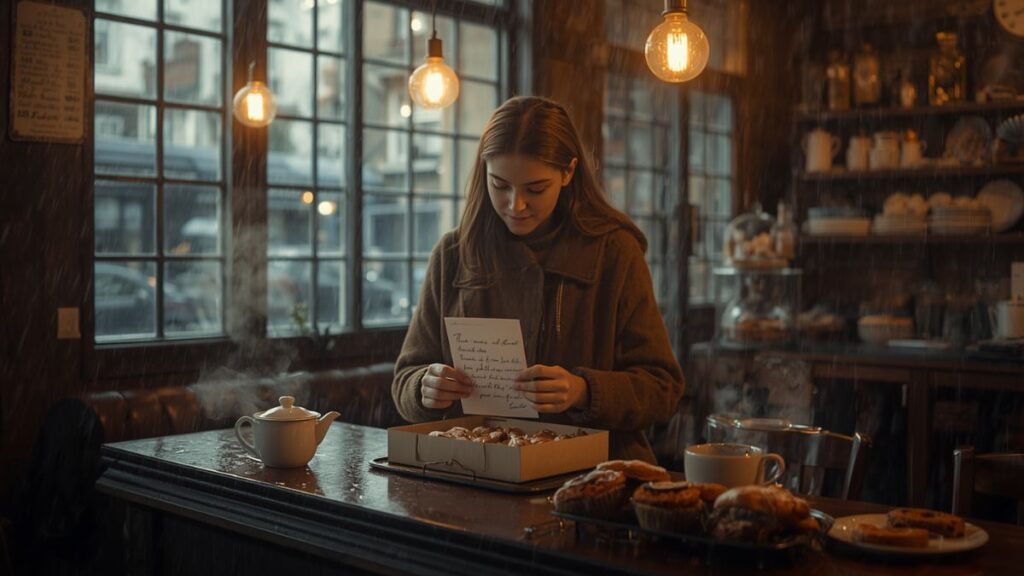
Every Saturday morning, Emma visited the same bakery.
The routine had started almost by accident.
A few years earlier, she had wandered into the small shop while exploring a side street she normally ignored. The smell of fresh bread and warm pastries drifted through the open door, and before she knew it, she was carrying a paper bag filled with cinnamon rolls back to her apartment.
The following Saturday, she returned.
Then the Saturday after that.
Eventually it became a tradition.
The bakery sat on a quiet corner between a flower shop and a bookstore. Its windows were decorated with handwritten signs and small potted plants. Fresh bread lined wooden shelves, and glass display cases showcased pastries that looked almost too beautiful to eat.
Emma loved everything about the place.
The smell of vanilla and butter.
The sound of coffee cups clinking against saucers.
The cheerful greetings exchanged between customers.
The feeling that nobody seemed to be in a hurry.
In a world that often moved too fast, the bakery felt refreshingly slow.
Every Saturday, Emma ordered the same thing.
A blueberry pastry.
A cup of tea.
And occasionally a small cookie for later.
The staff eventually learned her name.
She learned theirs.
The routine became familiar and comforting.
One rainy Saturday morning, something unusual happened.
Emma purchased her usual pastry and carried the paper box home.
Outside, rain tapped softly against umbrellas and shop windows.
Inside her apartment, everything felt warm and cozy.
She made tea, settled into her favorite chair, and opened the pastry box.
A folded piece of paper rested inside.
She frowned.
At first she assumed it was a receipt.
But when she unfolded it, she discovered a handwritten message.
The note read:
“I hope something good happens to you today.”
That was all.
No name.
No explanation.
Just a simple sentence.
Emma smiled.
The message was unexpected.
Yet it immediately improved her mood.
She placed the note beside her teacup and enjoyed her breakfast.
Throughout the day, she found herself glancing at the message.
Something good happens to you today.
Such a simple wish.
Yet surprisingly thoughtful.
By evening, she had almost forgotten about it.
Then something good actually happened.
An old friend called unexpectedly.
They spoke for nearly an hour.
Laughed.
Shared stories.
Promised to meet soon.
When the conversation ended, Emma noticed the note still sitting on the table.
She smiled.
Perhaps it was a coincidence.
Perhaps not.
Either way, she appreciated it.
The following Saturday, she returned to the bakery.
Part of her wondered whether the note had been a mistake.
Perhaps intended for another customer.
Perhaps accidentally placed inside her box.
She didn’t mention it.
Instead, she ordered her usual pastry and tea.
Everything seemed normal.
Until she reached home.
Inside the pastry box rested another folded note.
This one said:
“Don’t forget to notice something beautiful today.”
Emma laughed aloud.
Now she was certain.
Someone at the bakery was leaving notes intentionally.
The mystery intrigued her.
After breakfast, she went for a walk.
Along the way, she remembered the note.
Notice something beautiful.
At first, she wasn’t sure what qualified.
Then she saw a small girl helping her younger brother cross a puddle.
She noticed flowers blooming beside a fence.
She watched sunlight break through clouds after the rain.
Beautiful things seemed to appear everywhere once she started looking.
That evening, she carefully placed both notes inside a drawer.
She wasn’t sure why.
They simply felt worth keeping.
The following Saturday brought another message.
“Someone is grateful that you’re in their life.”
The Saturday after that:
“Take time to enjoy the little things.”
Then:
“A smile can brighten someone’s entire day.”
Week after week, the notes continued.
Each one short.
Simple.
Positive.
Emma never discovered who wrote them.
The bakery employed several people.
Any one of them could have been responsible.
Oddly enough, the mystery made the notes even more enjoyable.
She began looking forward to them.
Not because they contained life-changing wisdom.
But because they encouraged her to pause.
To reflect.
To appreciate ordinary moments.
One afternoon, while organizing paperwork, Emma realized something interesting.
She had become happier.
Not dramatically happier.
Just slightly.
Consistently.
The notes hadn’t solved her problems.
Life still included challenges.
Difficult days still occurred.
Yet the messages seemed to shift her attention toward positive things she might otherwise overlook.
That realization fascinated her.
How could such small messages have such a meaningful effect?
Perhaps because kindness rarely needs to be complicated.
A thoughtful sentence.
A friendly gesture.
A sincere compliment.
Simple things often matter most.
Months passed.
The collection of notes continued growing.
Emma stored them in a small wooden box.
Whenever she experienced a stressful day, she occasionally reread a few.
The messages always seemed to arrive at the right moment.
One Saturday, however, there was no note.
Emma opened the pastry box.
Nothing.
Just the pastry.
For a brief moment, she felt disappointed.
Then she laughed at herself.
The notes had spoiled her.
Surely whoever wrote them couldn’t continue forever.
Perhaps they had become busy.
Perhaps they moved away.
Perhaps they simply decided to stop.
Whatever the reason, Emma understood.
Still, she missed them.
The following week brought another surprise.
She visited the bakery as usual.
The atmosphere felt slightly different.
A sign near the counter announced that Mr. Harris, the bakery owner, would be retiring.
Emma smiled.
Mr. Harris had owned the bakery for decades.
He greeted customers by name.
Remembered birthdays.
Asked about families.
His kindness contributed greatly to the bakery’s charm.
That morning, customers shared stories about him.
Everyone seemed fond of the man.
Emma was no exception.
As she prepared to leave, Mr. Harris stopped her.
“I have something for you.”
He handed her a small envelope.
Curious, she opened it.
Inside rested a folded note.
The handwriting looked familiar.
Very familiar.
Her eyes widened.
It was identical to the notes she had been receiving.
Mr. Harris smiled.
“You figured it out.”
“You wrote them?”
He nodded.
Emma laughed.
“Why?”
The elderly baker shrugged.
“Because people need encouragement.”
The answer seemed perfectly suited to him.
“That’s it?”
“That’s it.”
Emma shook her head.
“You have no idea how much those notes meant.”
Mr. Harris smiled gently.
“I suspected they helped.”
He pointed toward the envelope.
“Read the rest.”
Inside was a longer message.
It read:
“Thank you for visiting the bakery all these years. You may have come for pastries, but your kindness brightened many mornings here too. Never underestimate the impact of simply showing up with a smile.”
Emma felt unexpectedly emotional.
For years she believed she was merely a customer.
Yet apparently she had become part of the bakery’s story as well.
The realization warmed her heart.
People affect one another more than they realize.
A familiar face.
A friendly conversation.
A consistent act of kindness.
These things create connections.
Sometimes quietly.
Sometimes without either person noticing.
When Mr. Harris retired several weeks later, the community organized a small celebration.
Customers shared stories.
Photographs decorated the walls.
Laughter filled the bakery.
Emma attended, carrying the wooden box containing every note.
When she showed it to Mr. Harris, he laughed.
“You kept them all?”
“Every single one.”
He seemed genuinely touched.
The bakery eventually passed to new owners.
Fortunately, very little changed.
The bread remained delicious.
The atmosphere remained welcoming.
The traditions continued.
And one Saturday morning, several months later, Emma discovered something unexpected inside her pastry box.
A folded note.
She opened it.
The message read:
“I hope something good happens to you today.”
Emma smiled immediately.
The tradition lived on.
Perhaps the new owners discovered Mr. Harris’s idea.
Perhaps someone else decided to continue it.
Either way, she was grateful.
Some traditions deserve to survive.
Especially the ones that make people smile.
As she enjoyed her pastry, Emma thought about how remarkable it was that a few handwritten sentences could create so much happiness.
Not because the words were extraordinary.
But because they were thoughtful.
Intentional.
Kind.
The world often celebrates big gestures.
Yet many meaningful moments begin with something much smaller.
A handwritten note.
A warm pastry.
A kind wish from a stranger.
And sometimes, that’s more than enough.
Reflection
Cute bedtime stories often highlight the power of small acts of kindness. A simple note may seem insignificant, but thoughtful gestures can brighten someone’s day, encourage reflection, and create connections that last much longer than expected.