Some of the most powerful stories in the Bible are not about kings, prophets, or miracles.
Instead, they are simple stories about ordinary people making extraordinary choices.
One of the best examples is the Parable of the Good Samaritan, found in Luke 10:25-37.
At first glance, it appears to be a straightforward story about helping someone in need. However, beneath the surface lies a profound lesson about sacrifice, compassion, prejudice, mercy, and what it truly means to love others.
For centuries, this parable has inspired people around the world because it challenges readers to look beyond comfort, convenience, and personal interests.
It asks a difficult question:
Who is our neighbor?
Even more importantly, it asks:
What are we willing to sacrifice to help someone in need?
The story remains one of the greatest examples of selfless sacrifice in Scripture.
A Question About Eternal Life
The story begins when a lawyer approached Jesus with a question.
He asked what he must do to inherit eternal life.
Jesus responded by asking what was written in God’s law.
The lawyer answered correctly.
He said people should love God with all their heart, soul, strength, and mind.
They should also love their neighbors as themselves.
Jesus affirmed the answer.
But the lawyer wanted further clarification.
Perhaps hoping to limit his responsibility, he asked:
“And who is my neighbor?”
Instead of giving a direct definition, Jesus told a story.
That story became known as the Parable of the Good Samaritan.
A Dangerous Road
Jesus described a man traveling from Jerusalem to Jericho.
This road was well known during biblical times.
It stretched through rugged terrain filled with steep hills, rocky paths, and isolated areas.
The route had a reputation for danger.
Robbers often hid among the rocks, waiting for travelers to pass.
Anyone walking alone faced considerable risk.
As the traveler made his journey, exactly what people feared happened.
A group of robbers attacked him.
They stole his belongings.
They beat him severely.
Then they left him lying beside the road.
Injured.
Helpless.
And close to death.
The man could do nothing for himself.
He desperately needed assistance.
The First Traveler
After some time, a priest approached along the same road.
This seemed promising.
Priests were respected religious leaders.
They served in the temple.
People expected them to model compassion and obedience to God.
Surely the injured man would receive help.
But when the priest saw him, something unexpected happened.
He crossed to the other side of the road.
Then he continued walking.
The priest offered no assistance.
No conversation.
No concern.
He simply moved on.
Jesus did not explain the priest’s reasoning.
Perhaps he feared an ambush.
Maybe he worried about ritual cleanliness.
Possibly he felt too busy.
Regardless of the reason, the result was the same.
A suffering man remained alone.
The Second Traveler
Later, a Levite came along the road.
Levites also served important religious roles.
Like the priest, he likely understood God’s commands about mercy and compassion.
When the Levite noticed the injured man, he at least came closer.
He looked at him.
He observed the situation.
Then he continued on his way.
Again, no help was offered.
The injured traveler remained abandoned.
The actions of both men must have surprised Jesus’ audience.
People would naturally expect religious leaders to respond with kindness.
Instead, they walked away.
Their knowledge did not translate into action.
The Unexpected Hero
Then Jesus introduced a third traveler.
A Samaritan.
This detail shocked His listeners.
Jews and Samaritans had a long history of hostility.
The two groups distrusted one another.
Prejudice and resentment existed on both sides.
Many Jewish listeners would have expected the Samaritan to become the villain of the story.
Instead, Jesus made him the hero.
When the Samaritan saw the wounded man, he was moved with compassion.
Unlike the others, he did not look away.
He did not cross the road.
He stopped.
That decision changed everything.
Compassion in Action
Compassion is more than feeling sympathy.
True compassion leads to action.
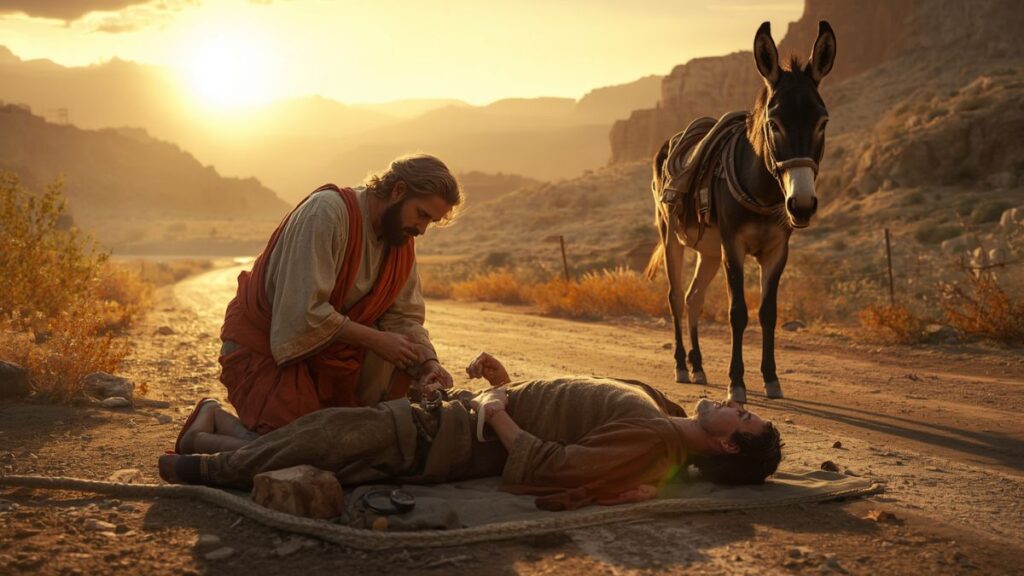
The Samaritan approached the injured traveler.
He examined his wounds.
He cleaned them.
He treated them with oil and wine, common medicines of the time.
Then he bandaged the injuries carefully.
This alone required effort.
The Samaritan interrupted his journey.
He invested time and energy.
He exposed himself to potential danger.
Yet he continued helping.
His compassion moved beyond words.
It became action.
A Personal Sacrifice
The Samaritan’s sacrifice did not end with first aid.
After treating the wounds, he placed the injured man on his own animal.
This meant the Samaritan likely walked while the wounded traveler rode.
The journey became slower and more difficult.
Yet the Samaritan willingly accepted the inconvenience.
He prioritized another person’s needs above his own comfort.
This is one of the most remarkable aspects of the story.
Sacrifice often involves inconvenience.
Helping others frequently requires giving up time, comfort, resources, or personal plans.
The Samaritan demonstrated exactly that.
Taking Him to Safety
The Samaritan eventually arrived at an inn.
There he ensured the injured man had shelter and care.
Many people would have considered their responsibility complete at this point.
Not the Samaritan.
He remained involved.
He stayed with the man and cared for him through the night.
This detail reveals genuine concern.
The Samaritan was not looking for recognition.
He was not performing a public act of generosity.
He simply wanted to help someone in need.
Paying the Cost
The next morning, the Samaritan prepared to continue his journey.
Before leaving, he gave money to the innkeeper.
He instructed him to care for the wounded traveler.
Then he made an even greater commitment.
If additional expenses arose, the Samaritan promised to pay them when he returned.
This was extraordinary generosity.
He accepted financial responsibility for a complete stranger.
He expected nothing in return.
No reward.
No repayment.
No recognition.
His actions were motivated entirely by compassion.
The Meaning of True Sacrifice
The Samaritan sacrificed several things:
His Time
He interrupted his schedule.
His journey became longer and more complicated.
His Safety
Stopping on a dangerous road carried risks.
The robbers could have still been nearby.
His Comfort
He gave up his place on the animal.
He walked so another person could ride.
His Resources
He used his own oil, wine, bandages, and money.
His Convenience
He assumed responsibility for someone else’s problem.
All of these sacrifices were voluntary.
The Samaritan helped because he chose to love his neighbor.
Why Jesus Chose a Samaritan
Jesus intentionally selected a Samaritan as the hero.
This choice challenged cultural prejudices.
His audience likely expected a religious leader to demonstrate compassion.
Instead, the outsider became the example of true righteousness.
The message was clear.
Loving others is more important than social status, religious titles, or cultural identity.
God cares about how people treat one another.
Compassion is measured by actions, not labels.
Stories of Sacrifice in the Bible
Among all stories of sacrifice in the Bible, the Good Samaritan stands out because the sacrifice was entirely voluntary.
No command forced him to stop.
No law required him to help.
No reward motivated his actions.
He sacrificed simply because another human being needed assistance.
This makes the story especially powerful.
The Samaritan chose mercy when it would have been easier to walk away.
Bible Stories for Adults
This remains one of the most relevant Bible stories for adults because it addresses everyday situations.
Most adults will never face a giant like David.
Most will never stand before a king like Esther.
But everyone encounters opportunities to help others.
A struggling coworker.
A lonely neighbor.
A family member facing difficulties.
A stranger in need.
The Good Samaritan teaches that faith is demonstrated through practical compassion.
It is not enough to recognize a need.
Love requires action.
The Difference Between Seeing and Helping
One of the most important lessons in the story involves the difference between noticing and responding.
The priest saw the wounded man.
The Levite saw him too.
The Samaritan also saw him.
The difference was not observation.
The difference was response.
Many people notice suffering.
Fewer choose to become involved.
The Samaritan allowed compassion to move him into action.
That is what made him different.
Loving Difficult People
Another remarkable aspect of the story is that the Samaritan helped someone who likely belonged to a group that disliked his own people.
He did not ask questions.
He did not demand gratitude.
He did not evaluate whether the traveler deserved assistance.
He simply helped.
This challenges readers today.
Loving people who are kind to us is relatively easy.
Loving people who are different, difficult, or unfamiliar requires greater sacrifice.
The Samaritan demonstrated that kind of love.
What Adults Can Learn
Compassion Requires Action
Feeling sorry for someone is not enough.
Real compassion produces practical help.
Sacrifice Often Involves Inconvenience
Helping others may require time, money, effort, or personal comfort.
Every Person Has Value
The Samaritan treated the injured traveler with dignity and respect.
Love Has No Boundaries
Compassion should not be limited by background, culture, status, or personal differences.
Small Acts Can Have Great Impact
One person’s willingness to help completely changed another person’s future.
Why This Story Still Inspires Readers
Thousands of years later, the Good Samaritan continues inspiring people because it reflects the best qualities of humanity.
Kindness.
Mercy.
Generosity.
Selflessness.
These qualities remain valuable in every generation.
The story reminds readers that true greatness is not measured by wealth, status, or influence.
It is measured by how people treat others.
Jesus’ Final Question
After telling the parable, Jesus asked the lawyer a simple question.
Which of the three travelers acted like a neighbor?
The answer was obvious.
The one who showed mercy.
Jesus then gave a direct instruction:
“Go and do likewise.”
Those words remain the challenge of the story today.
The goal is not merely to admire the Samaritan.
The goal is to imitate him.
Conclusion
The Parable of the Good Samaritan is one of the Bible’s greatest stories of sacrifice.
An injured traveler lay helpless beside a dangerous road.
Two respected men passed by without helping.
A Samaritan, someone least expected to show compassion, stopped and sacrificed his time, comfort, safety, and resources to save a stranger.
His actions transformed a tragic situation into a powerful example of mercy.
For adults today, the story remains deeply relevant.
Opportunities to help others appear every day.
The challenge is deciding how we will respond.
Will we walk past like the priest and Levite?
Or will we stop like the Samaritan?
The answer reveals what it truly means to love our neighbors.
And that timeless lesson is why the story of the Good Samaritan continues to be one of the most meaningful and inspiring accounts in all of Scripture.