Every morning, just before the doors of Maplewood Public Library opened, the librarian, Mrs. Eleanor Brooks, walked slowly through the quiet reading room.
She dusted the shelves.
Straightened the books.
Opened the curtains to let the morning sunlight stream across the wooden floor.
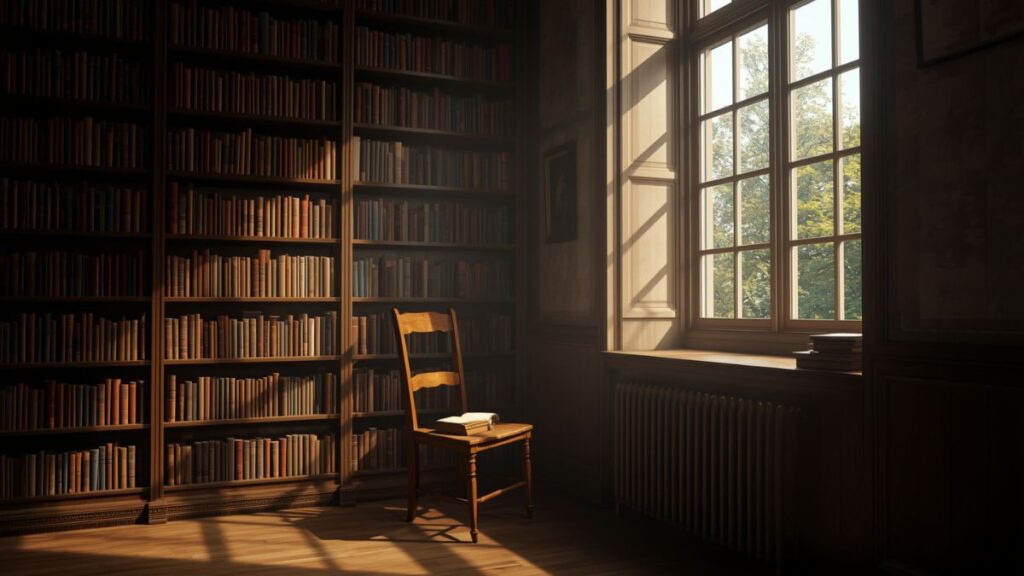
Before welcoming the first visitors, she always paused beside a single empty chair placed near the tallest bookshelf.
Unlike the other chairs, this one was old.
Its wooden arms had grown smooth from years of use.
The green cushion had faded.
One leg had been repaired more than once.
Visitors often ignored it because newer, softer chairs filled the rest of the library.
Yet Mrs. Brooks gently dusted that chair every single morning.
“It’s still my favorite,” she would whisper.
No one understood why.
Children always chose the colorful beanbags.
Teenagers preferred the computer desks.
Adults settled into the comfortable armchairs by the windows.
The old chair remained empty for hours.
If it could think, the chair often wondered,
“Have I become useless?”
Years earlier, it had rarely been empty.
Students had prepared for exams while sitting there.
Young writers had filled notebooks with stories.
Parents had read bedtime books to their children.
Scientists, teachers, artists, and business owners had all spent countless hours in that very chair.
But time had changed everything.
Now, newer furniture attracted everyone’s attention.
One rainy afternoon, a nervous twelve-year-old girl named Maya entered the library carrying a worn backpack.
She had recently transferred to a new school.
Reading had always been difficult for her.
While searching for a quiet place, she noticed every comfortable seat was occupied.
Only the old wooden chair remained.
Reluctantly, she sat down.
Mrs. Brooks smiled from across the room.
“I think you’ll like that spot.”
Maya wasn’t so sure.
She opened a book.
At first, she struggled through each sentence.
Whenever she stumbled over difficult words, frustration filled her eyes.
“I’ll never become a good reader,” she whispered.
Mrs. Brooks quietly approached.
“You know…”
“Every great reader once struggled with their first difficult book.”
She placed another book beside Maya.
“This one starts a little easier.”
Day after day, Maya returned.
Always choosing the same chair.
Each week she became more confident.
Soon she wasn’t simply reading books.
She was borrowing them.
Writing notes.
Asking questions.
Imagining new worlds.
Months later, her teacher announced a school storytelling competition.
Maya hesitated.
“I can’t do it.”
Mrs. Brooks smiled.
“Remember your first book?”
Maya nodded.
“You thought you couldn’t finish that either.”
Encouraged, Maya entered the competition.
She didn’t win first place.
She earned second.
But something much more important happened.
She believed in herself.
Years passed.
Maya grew into an award-winning children’s author.
During interviews, journalists often asked,
“Where did your love of stories begin?”
She always smiled.
“In an old chair at my local library.”
One autumn morning, a young man named Daniel walked into the library.
He had recently lost his job.
Weeks of unsuccessful interviews had left him discouraged.
He wandered through the bookshelves with little purpose.
Mrs. Brooks noticed his worried expression.
“Looking for something?”
Daniel sighed.
“I don’t even know anymore.”
She pointed toward the old chair.
“Start there.”
Daniel smiled politely and sat down.
He picked up a book about entrepreneurship.
Then another about leadership.
Another about communication.
One book led to the next.
Over the following months, Daniel spent nearly every afternoon reading in the same chair.
He learned new skills.
Studied successful businesses.
Created plans.
Eventually, he started a small woodworking company in his garage.
It grew steadily.
Within ten years, Daniel employed more than two hundred people.
During the opening of his new headquarters, he surprised everyone.
The entrance featured an identical wooden chair with a brass plaque beneath it.
It read:
Every opportunity begins with learning.
Back at Maplewood Library, the old chair continued waiting quietly.
It never knew who would sit there next.
One winter, an elderly man recovering from illness began visiting each afternoon.
Books helped him regain hope.
A teenager struggling with mathematics discovered a love for engineering.
A young mother learned a new language.
A retired soldier studied history.
Each left the chair carrying something invisible but valuable.
Confidence.
Knowledge.
Purpose.
One summer, the town council announced plans to renovate the library.
New furniture would replace the old chairs.
Workers measured every room.
Catalogs filled with modern designs covered the librarian’s desk.
One official pointed toward the old chair.
“This one should definitely go.”
Mrs. Brooks gently shook her head.
“No.”
“It’s staying.”
The official looked puzzled.
“It’s old.”
“It doesn’t match anything.”
Mrs. Brooks smiled.
“Neither do many of the people whose lives it changed.”
The council agreed to leave it.
During the renovation, a local newspaper published an article asking residents to share memories of the library.
Letters poured in.
Hundreds mentioned the same chair.
A judge wrote,
“I studied law there.”
A doctor remembered preparing for medical school.
A teacher recalled discovering her love of literature.
An artist drew sketches there every Saturday.
A grandfather wrote,
“I taught my granddaughter to read while sitting in that chair.”
The newspaper filled an entire special edition with these stories.
Soon visitors came simply to see the famous chair.
Not because it was beautiful.
But because it represented possibility.
Mrs. Brooks eventually retired after forty years of service.
At her farewell celebration, the mayor thanked her.
“You’ve helped thousands of readers.”
She smiled softly.
“I simply introduced them to books.”
Then she glanced toward the old chair.
“And sometimes…”
“…to the right place to sit.”
Her assistant, Emily, became the new librarian.
On her first morning, she noticed a small handwritten note hidden beneath the chair.
Mrs. Brooks had left it years earlier.
It read:
This chair is never empty.
It is always filled with someone’s future.
Emily carefully returned the note.
She understood.
Years later, a little boy wandered into the library holding his father’s hand.
Every colorful seat was occupied.
Only the old chair remained.
“I don’t want that one,” the boy complained.
His father smiled.
“I’ve sat there before.”
“You have?”
“When I was your age.”
“What happened?”
“I discovered the dream that became my career.”
Curious, the boy climbed into the chair.
He opened the first book he found.
It was about space exploration.
Hours passed unnoticed.
That little boy eventually became an aerospace engineer.
Like so many before him, he often said his journey began in the quiet corner of a small library.
The old chair remained where it had always been.
Its wood grew smoother.
Its cushion softer.
Its story richer.
Visitors still overlooked it at first.
But many left believing it was the most valuable seat in the building.
Not because of how it looked.
But because of what it represented.
A place where ordinary people discovered extraordinary futures.
A place where dreams quietly took root between the pages of a book.
And a reminder that education rarely changes lives all at once.
It changes them one reader…
One page…
One lesson…
And sometimes…
One simple chair at a time.
Moral: Education quietly transforms lives. Every book we read, every lesson we learn, and every moment spent seeking knowledge can open doors to a brighter future.