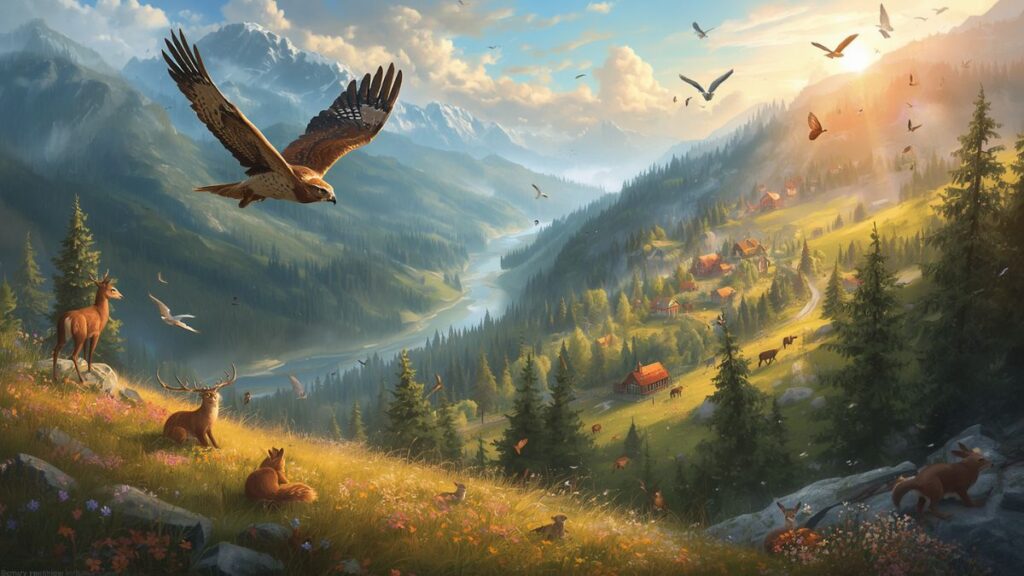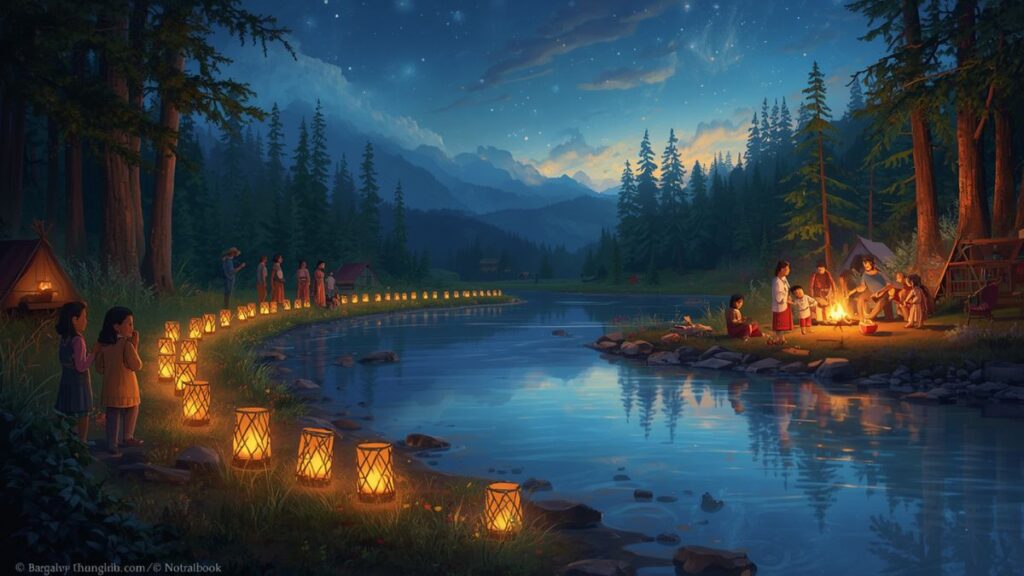
Long ago, between two gentle mountains, there was a beautiful valley where rivers flowed through green meadows and tall cedar trees swayed in the breeze. Every spring, families from nearby villages gathered for a special celebration that honored friendship, gratitude, storytelling, music, and respect for nature. It was the happiest day of the year, and children eagerly counted the days until the festival arrived.
Among the visitors was a cheerful boy named Toma. He loved carving small wooden toys, climbing hills with his friends, and listening to the stories shared by the village elders each evening.
Across the valley lived another child named Aiyana. She was known for making colorful decorations from leaves, feathers, and wildflowers. She looked forward to the celebration just as much as Toma did.
Although the children from the two villages met every year, they always competed in games, races, and contests.
Sometimes the competitions became so serious that hurt feelings lasted long after the festival ended.
As another celebration approached, the elders hoped this year would be different.
At the center of the valley lived an old drum maker named Nodin.
For many years, he had crafted beautiful hand drums from carefully selected wood and stretched hides. His drums were famous throughout the region because they produced warm, steady rhythms that echoed through the hills.
People often asked him what made his drums sound so special.
Nodin always smiled and answered,
“A drum speaks with many parts working together.”
Few people understood what he meant.
Several days before the celebration, Toma and Aiyana visited Nodin’s workshop.
Shelves filled with unfinished drums surrounded the small cabin.
Bundles of cedar wood rested beside smooth stones and carving tools.
The children watched as the old craftsman carefully tightened the drum’s laces.
“May we help?” Toma asked.
“Of course,” Nodin replied.
He handed each child a simple task.
Toma polished the wooden frame.
Aiyana tied the leather cords.
Another child gathered soft cloth for cleaning.
Before long, the drum was finished.
When Nodin gently struck its surface, a deep, beautiful sound filled the workshop.
“It sounds wonderful,” Aiyana whispered.
Nodin nodded.
“Could I have made it alone?”
The children looked at one another.
“You probably could,” Toma answered.
The old man smiled.
“Perhaps.”
“But working together made it better.”
Neither child thought much about his words.
The morning of the festival finally arrived.
Families filled the valley with laughter.
Children played games beneath the tall trees.
Storytellers welcomed visitors around large circles of smooth stones.
Artists displayed beautiful baskets, blankets, carvings, and paintings inspired by nature.
The aroma of freshly prepared food drifted through the air.
Everything seemed perfect.
The first event was a relay race.
Children from each village lined up proudly.
When the race began, everyone ran as fast as they could.
Toma’s team won by only a few steps.
The children cheered loudly.
Some celebrated so enthusiastically that the losing team became upset.
Later, an archery contest produced similar disagreements.
By afternoon, several children refused to play together.
The joyful celebration had slowly become a competition.
Nodin quietly watched from beneath an old cedar tree.
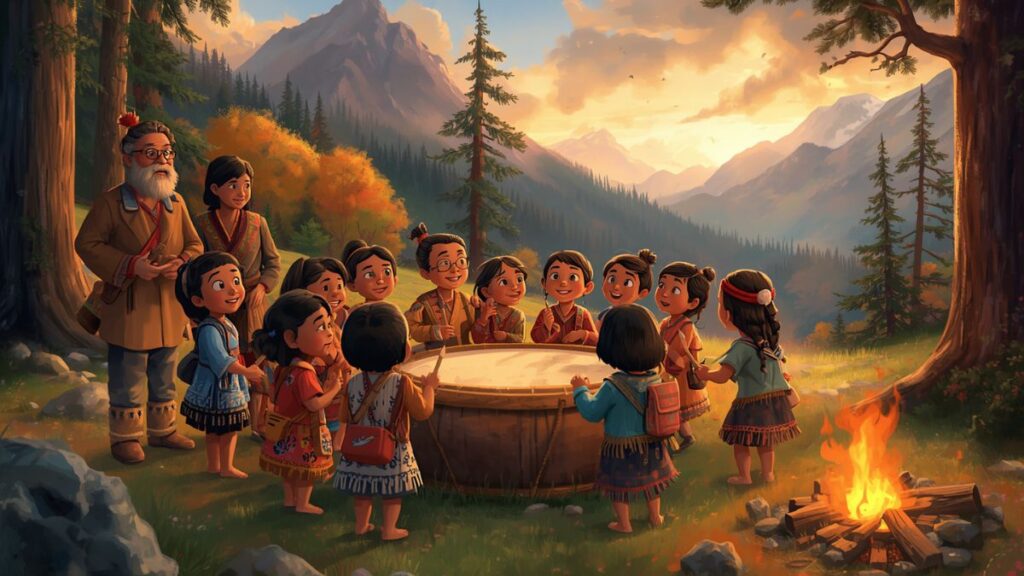
As evening approached, he invited every child to gather around the central fire.
“I have one final activity,” he announced.
The children eagerly gathered.
At the center of the circle sat his newest drum.
“I need volunteers.”
Nearly every hand rose.
Nodin smiled.
“But there is one rule.”
“No one may play alone.”
The children looked confused.
He divided them into small groups.
One child would keep a slow rhythm.
Another would clap.
A third would shake small rattles made from dried seeds.
Others would sing together.
At first, the music sounded uneven.
Some children rushed ahead.
Others tried to play louder than everyone else.
The rhythm quickly fell apart.
Nodin gently stopped them.
“What happened?”
“We weren’t together,” one girl admitted.
He nodded.
“Let’s try again.”
This time everyone listened more carefully.
The drum began with one steady beat.
Boom.
Boom.
Boom.
Soon the rattles joined softly.
Then the clapping.
Finally, every child added their voices.
The valley filled with joyful music unlike anything anyone had heard before.
Parents smiled.
Birds fluttered from nearby trees.
Even the river seemed to dance with the rhythm.
When the final note faded, complete silence filled the valley.
Then applause erupted from every direction.
The children looked at one another with surprise.
The performance had only succeeded because everyone had worked together.
Nodin smiled.
“The strongest rhythm doesn’t come from the loudest drum.”
“It comes from hearts working together.”
Those words stayed with the children throughout the evening.
The next morning, another surprise awaited them.
Heavy rain had fallen during the night.
Several walking paths leading through the valley had become blocked by fallen branches and muddy ground.
Visitors struggled to reach the main gathering area.
Without waiting for instructions, Toma remembered the drum.
He called to the other children.
“Let’s clear the paths together.”
Aiyana immediately agreed.
Soon children from every village worked side by side.
Some gathered branches.
Others carried stones to strengthen muddy trails.
Several older children helped younger ones cross small streams safely.
Within hours, every pathway was open again.
Families could once again travel freely across the valley.
The elders watched proudly.
One elder smiled.
“The children finally understand.”
That afternoon, the celebration continued.
This time the games felt different.
Instead of cheering only for their own teams, children applauded everyone’s effort.
When someone stumbled during a race, others stopped to help.
Artists shared supplies instead of keeping them hidden.
Musicians invited new friends to join their songs.
The atmosphere became warmer than ever before.
As sunset painted the sky with shades of orange and purple, the villagers gathered once again around the great fire.
Nodin carried the drum into the center of the circle.
“This drum belongs to all of you now,” he announced.
“It reminds us that every voice matters.”
Together, children from both villages played the same joyful rhythm they had learned the night before.
Parents joined with singing.
Grandparents clapped along.
The youngest children danced happily around the fire.
The sound echoed across the valley until the stars filled the sky.
Years passed.
The annual celebration continued to grow.
New families arrived.
New children joined the games.
Before every festival began, the oldest elder always shared the story of the drum that united the valley.
Young visitors listened carefully as they learned that the celebration was never about winning.
It was about strengthening friendships.
One year, a young boy asked,
“Why don’t we keep score anymore?”
The elder smiled.
“Because some victories cannot be measured.”
“What do you mean?”
He gently tapped the old drum.
“When people leave as better friends than when they arrived, everyone wins.”
The children nodded thoughtfully.
Generations later, the drum remained at the center of every gathering.
Its surface had grown worn from countless hands.
Its sound had become softer with age.
Yet every beat still carried the same lesson.
Communities grow stronger when people listen, cooperate, and celebrate one another instead of competing.
Whenever the first drumbeat echoed through the valley each year, children remembered that every person, just like every beat, plays an important role in creating something beautiful.
And so the tradition continued, reminding every new generation that kindness, respect, and teamwork create the happiest celebrations of all.
Moral of the Story
When people work together, listen to one another, and celebrate each other’s strengths, they create harmony, lasting friendships, and a stronger community.